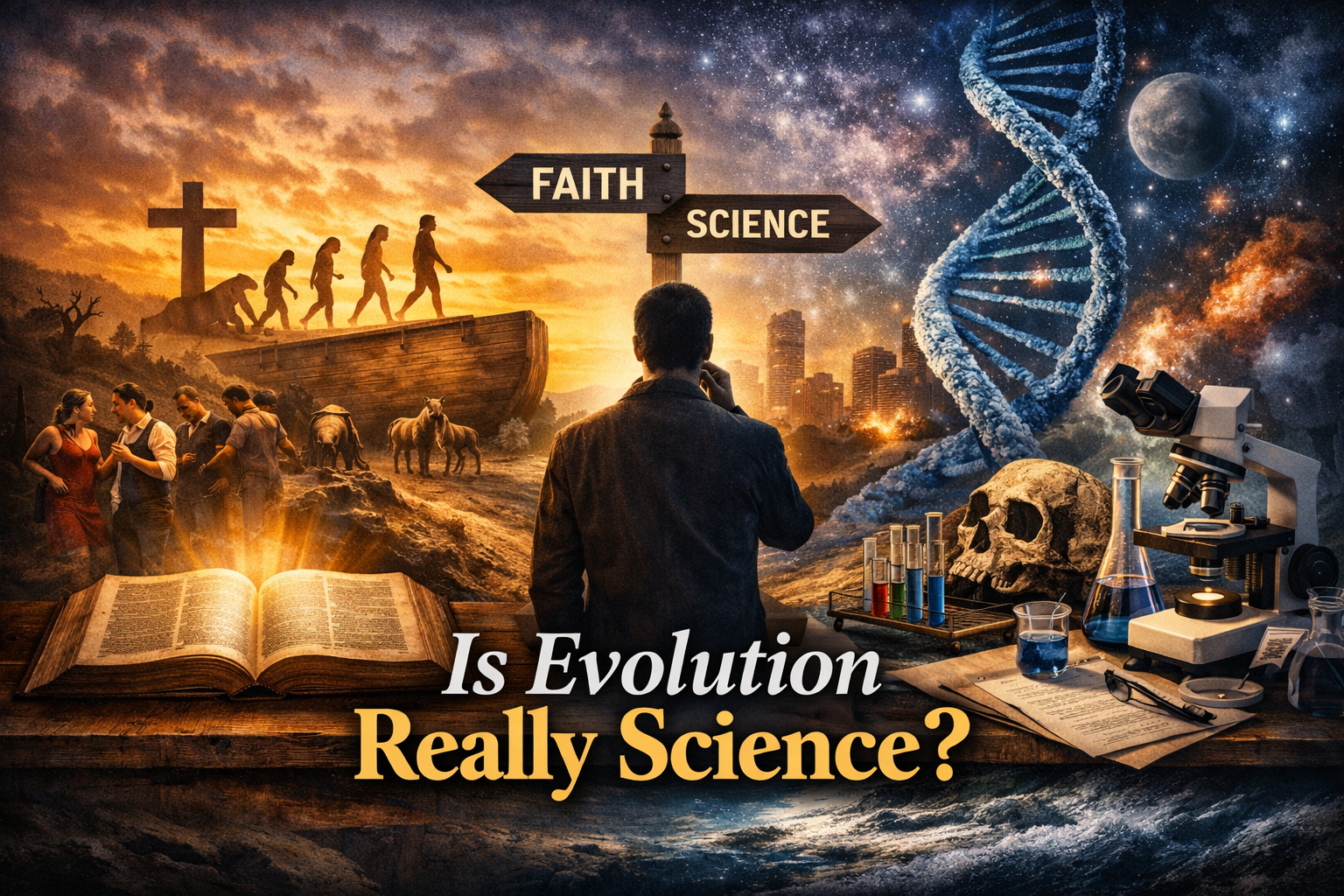
Many people have been taught that science is whatever is established by schools and universities, and that creationism is merely a religious belief without any basis in fact. Let us examine whether that claim is true and valid. When did evolution come about? Were there scientists before Darwin? Did they all teach falsehoods, or were they legitimate scientists? What are the facts about the theory of evolution? Can it rightly be called science? Is evolution really science, or is it something else entirely?
Is Evolution Really Science? Origins of Science
Nearly all the branches of modern science were founded by creationists. In fact, many of these individuals were very likely guided by God to help people understand creation. Science, properly defined, is what can be tested, proven, and demonstrated. Yet it seems that “science” has increasingly become whatever certain specialized experts teach, without anyone being permitted to question their conclusions.
Is that truly science? No — science should be the pursuit of truth. People often tell me that creationists are uneducated. But is this really an issue of education, or is it an issue of honesty? Is evolution really science, and which side can rightly claim that title?
Are all educated people honest? No. So this issue is not fundamentally about education. It’s also worth noting that most people in the Western world spend many years studying the theory of evolution in school. Below is a list of major branches of science — and notably, all of these were founded by creationists who believed in God and the Bible.
Here is a brief, partial overview of accomplished scientists of the 18th and 19th centuries — all of them creationists:
- Louis Agassiz (1807–1873): glacial geology, ichthyology
- Charles Babbage (1792–1871): actuarial tables, calculating machines, foundations of computer science
- Francis Bacon (1561–1626): the scientific method of research
- Robert Boyle (1627–1691): chemistry, gas dynamics
- Sir David Brewster (1781–1868): optical mineralogy, the kaleidoscope
- Georges Cuvier (1769–1832): comparative anatomy, vertebrate paleontology
- Sir Humphry Davy (1778–1829): thermokinetics
- Jean Henri Fabre (1823–1915): entomology of living insects
- Michael Faraday (1791–1867): the electric generator, electromagnetics, field theory
- Sir John A. Fleming (1849–1945): electronics, the thermionic valve
- Joseph Henry (1797–1878): the electric motor, the galvanometer
- Sir William Herschel (1738–1822): galactic astronomy, double stars
- James Joule (1818–1889): reversible thermodynamics
- Lord William Kelvin (1824–1907): the absolute temperature scale, energetics, thermodynamics, the transatlantic cable
- Johannes Kepler (1571–1630): celestial mechanics, ephemeris tables, physical astronomy
- Carolus Linnaeus (1707–1778): the classification system, systematic biology
- Joseph Lister (1827–1912): antiseptic surgery
- Matthew Maury (1806–1873): hydrography, oceanography
- James C. Maxwell (1831–1879): electrical dynamics, statistical thermodynamics
- Gregor Mendel (1822–1884): genetics
- Samuel F. B. Morse (1791–1872): the telegraph
- Isaac Newton (1642–1727): calculus, dynamics, the law of gravity, reflecting telescopes
- Blaise Pascal (1623–1662): hydrostatics, the barometer
- Louis Pasteur (1822–1895): bacteriology, the law of biogenesis, pasteurization, vaccination, and immunization
- Sir William Ramsay (1852–1916): inert gases, isotopic chemistry
- John Ray (1627–1705): natural history, the classification of plants and animals
- Lord Rayleigh (1842–1919): dimensional analysis, model analysis
- Bernhard Riemann (1826–1866): non-Euclidean geometry
- Sir James Simpson (1811–1870): chloroform, gynecology
- Sir George Stokes (1819–1903): fluid mechanics
- Rudolf Virchow (1821–1902): pathology
It is true that not everyone before Darwin believed in God, and Darwin was not the first person to propose a theory of evolution. In fact, Darwin’s theory closely paralleled the work of another man before him. Alfred Russel Wallace independently arrived at a theory of evolution, and Darwin was quick to take up similar ideas and develop them further.
We read in the Bible that Paul warned something would arise in the future calling itself science, yet would not truly be science — it would be a deception. Evolution, as commonly taught, blends genuine scientific fact with what functions essentially as a belief system. It is cleverly disguised, much like rat poison — which is typically about 99 percent ordinary food. The rat is deceived into eating it, believing it to be simply food. Is evolution really science? It is, in essence, a blending of provable scientific facts with the unprovable, faith-based claims of evolutionary theory.
Sadly, millions place blind trust in science educators, academic credentials, and institutional research, and fall unquestioningly into accepting evolutionary theory as fact — because they see genuine truth in the surrounding science, without recognizing that the evolutionary claims themselves go beyond what science can actually test or prove.
Many things taught in science textbooks are entirely true and scientific. But the evolutionary elements — the Big Bang, the transition from one species into another, the geologic column, ideas about early humans, the supercontinent Pangaea — these fall into a different category, since they cannot be directly tested or proven. They can only be accepted on a kind of faith: faith in credentials, faith in years of academic training passed down from one generation of scholars to the next.
Wikipedia describes Darwin’s predecessor this way:
Alfred Russel Wallace OM FRS (8 January 1823 – 7 November 1913) was an English naturalist, explorer, geographer, anthropologist, biologist, and illustrator. He is best known for independently conceiving the theory of evolution through natural selection, and his paper on the subject was jointly published alongside some of Charles Darwin’s writings in 1858, which later prompted Darwin to publish On the Origin of Species.
Like Darwin, Wallace conducted extensive fieldwork, first in the Amazon River basin, and later in the Malay Archipelago, where he identified what is now known as the Wallace Line — a boundary separating the Indonesian archipelago into a western portion with largely Asian-derived wildlife and an eastern portion reflecting Australasian fauna. He is sometimes referred to as the “father of biogeography.”
Is Evolution Really Science? The Origins of Darwin’s Theory
There was a secret society in England engaged in spiritualist practices, and one of its leading members was Thomas Huxley — the man largely responsible for promoting and popularizing Darwin’s theory around the world. It is worth noting how this theory became mainstream in part through the influence of a society associated with spiritualist practices.
Darwin traveled extensively, and upon arriving in the Galápagos Islands, he observed that finches — a type of bird — had larger beaks on one island and smaller beaks on another. This was a sound observation: the birds were adapting. But does this justify the conclusion that creatures can transform into entirely different species without cause? No — that is a flawed conclusion. It is comparable to claiming that a wrecked Honda could eventually become a Ferrari, given enough time. It simply does not follow logically. Is evolution really science? Both creation and evolution ultimately rest on belief systems — evolution simply presents itself as science while functioning, in key respects, much like a religious framework.
When we observe small cats and large cats, we should not assume they transformed from nothing, for no reason, with no underlying cause. That is not scientific reasoning, my friends — it assumes far more than the evidence supports. Yet once people are taught this framework, speculative scientific narratives come to be accepted as established fact. Is evolution really science? Evolutionary theory relies heavily on supposition.
Is Evolution Really Science? “Science” So-Called
“O Timothy, keep that which is committed to thy trust, avoiding profane and vain babblings, and oppositions of science falsely so called.” (1 Timothy 6:20)
Paul rightly foresaw that a belief system would one day arise, disguised as science, yet ultimately a deception. No one has ever observed an animal transform into an entirely different kind of creature. Fossils of cats, said to be millions of years old, show that cats have remained essentially unchanged across that supposed span of time. How can this be, if evolution claims that living things change dramatically over time?
We should also consider that carbon dating methods rest on assumptions that are not as fixed or certain as often presented, since underlying conditions used in such calculations have varied over time — meaning that the resulting dates can shift accordingly. For fossilization to occur, an organism generally needs to be buried quickly. Fossilization itself is relatively rare, suggesting that some major event, such as a large-scale flood, may explain the vast number of fossils we find today.
Is evolution really science? Evolutionary theory rests largely on supposition rather than direct evidence. It remains, in many respects, a theory built on unproven assumptions — such as the idea that life and matter could simply appear from nothing, for no discernible reason. The oldest known trees are roughly 4,000 years old. How could this be, if the earth itself is billions of years old?
Similarly, some of the oldest river deltas are estimated at only a few thousand years old, based on annual rates of sediment deposit — this is one method used to estimate delta age. If the earth were truly billions of years old, why aren’t the oldest deltas far more massive, stretching for thousands of miles? Beneath the ocean lie mountain ranges, and mountains naturally erode over time. If the earth were billions of years old, why isn’t the ocean floor far flatter, having long since eroded smooth?
We know roughly what Niagara Falls looked like 150 years ago — the well-known evolutionist Charles Lyell was photographed there. Niagara Falls erodes at a rate of roughly three centimeters per year. If the earth is billions of years old, why do the falls still exist at all? Logically, they should have eroded away entirely over such an immense span of time.
Is Evolution Really Science? The Central Argument
Let us return to the question of species changing over time. Yes, adaptation clearly occurs — but who says this adaptation cannot be attributed to God? Living things adapt; God anticipated that creatures would face both cold and hot climates, and designed natural selection as a built-in mechanism to help preserve species. If we move from Alaska to Mexico, our bodies will adapt to the new climate.
Does this mean we will turn into an entirely different creature? No. Adaptation simply helps us survive changing conditions — it is not creation. For anything to exist, it requires planning. If all things arose purely from natural selection and random mutation, can these mechanisms truly think, plan, or feel? No — so how could they create anything at all without a plan behind it? Is evolution really science on this point? It falls short of true scientific reasoning.
It is much like claiming a Ferrari could simply assemble itself without any planning. This does not align with what we observe in the world around us. A plane, a car, a computer, a phone — none of these things can exist without deliberate planning. Someone must determine the color, the shape, the function, and the purpose behind each creation, as well as decide on the materials to be used — leather for some shoes, plastic or wood for others. All of this reflects the work of intelligent design.
Is Evolution Really Science? Why It Falls Short
This is why we maintain that evolution, as a complete theory, is not strictly science — it blends a measure of genuine science with enough speculation to mislead and deceive. It carries about as much scientific weight as claiming that a piece of wood could become a castle, or that a piece of metal could become a Ferrari. It simply does not hold up. Why would it make sense to claim that animals and humans appeared from nothing, from nowhere, for no reason at all?
Is this really more scientific than magic? No — in many respects, evolutionary theory begins to resemble belief in magic. Things do not simply appear without cause, generated by a purposeless mechanism. Who created natural selection in the first place? How did natural selection itself come into being? Is natural selection still evolving today? When did it begin to exist?
These are questions atheists must answer for their theory to hold up under scrutiny. For creationists, natural selection is simply the mechanism God designed to help preserve species — and it operates within clear limits. Natural selection allows variation within a species — there are small dogs and large dogs — but a dog cannot become an elephant, because the necessary genetic information for that transformation simply does not exist within a dog’s genome.
Gregor Mendel spent years cross-breeding pea plants in his experiments, and ultimately concluded that there exists a genetic boundary that cannot be crossed. Peas can become larger, or change color, but they can never become tomatoes — no matter how much time passes. This points to another core assumption within evolutionary theory: time itself. Many evolutionists, unable to observe their theory unfolding in real time, simply assume that given enough time, transformative change will occur on its own. This, too, falls short of genuine scientific reasoning.
I hope you enjoyed this post. Did you know that Jesus loves you, and died for you?
Jesus thinks about you constantly. What would keep you from inviting Him into your heart right now? Repeat after me: Father God, forgive my sins. Give me Your righteousness. Help me walk with You. Bless and heal me, please, in the name of Jesus. Amen.
EARTHLASTDAY.COM
Read more amazing prophecy books.
Leave a Reply