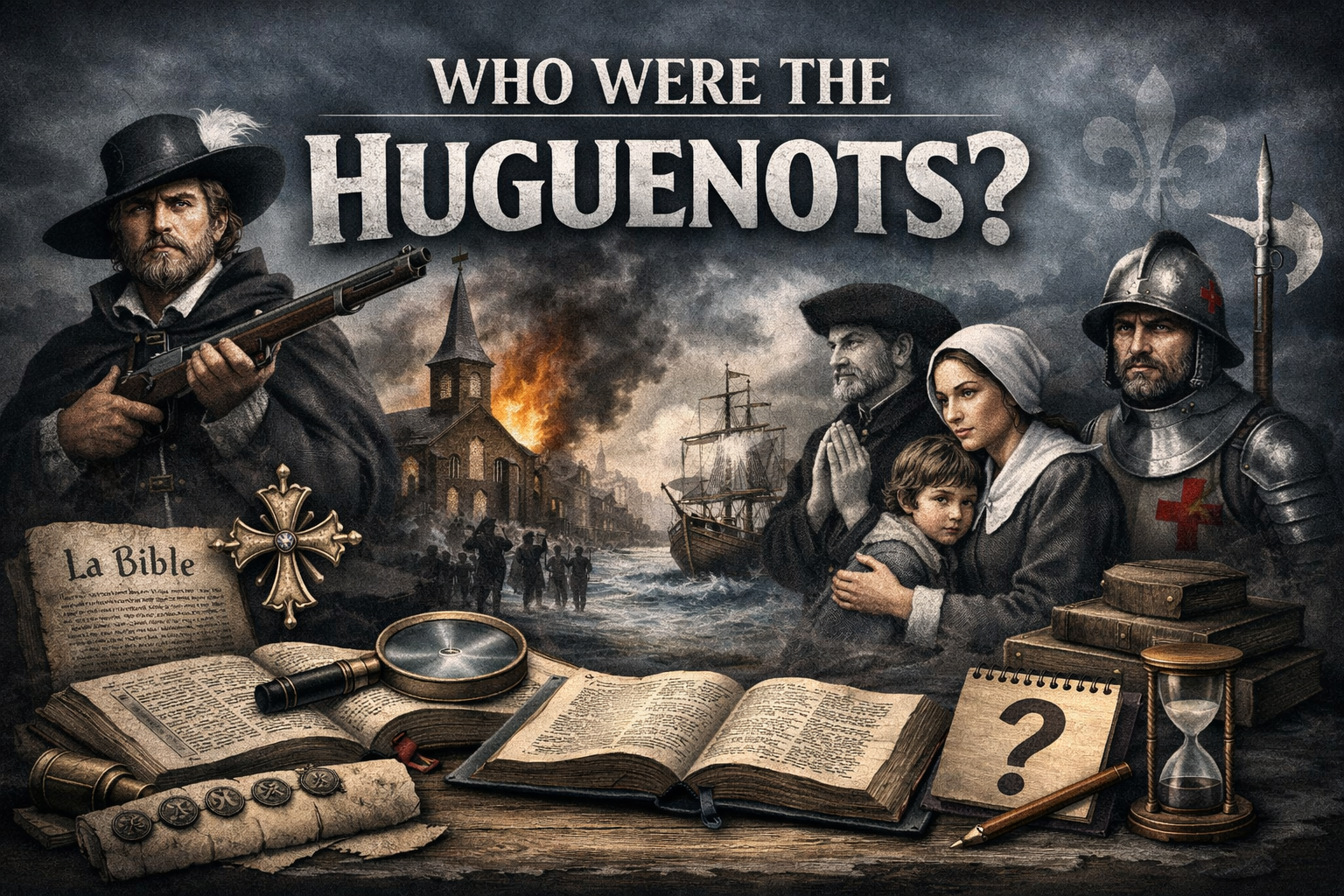
The French Huguenots — Who They Were and What the Bible Says About Them
This is a fascinating question, as many people have heard of the Huguenots but know very little about them. The Huguenots were French Protestants who emerged in the 16th century. After Martin Luther posted his theses in Germany, Jean Calvin was called by God to preach the message of righteousness by faith — and France was never the same again.
France and the Bible
France has historically been one of the most vocal opponents of the Bible. Yet the whole nation did not reject it. Millions of French men and women accepted the love of Jesus with an open heart. The south of France — from the Pyrenees, through the Cévennes, and into areas close to Switzerland such as Saintonge — became the heartland of French Protestantism. The north remained predominantly Catholic, while the south was dominated by Protestants.
Who Were the Huguenots?
The Huguenots were essentially gone by the time of the French Revolution, and largely scattered well before that. But where did this movement begin?
To understand the Huguenots fully, we must go back further than the 16th century Reformation. The true church of God has existed since the first century. As we see in the story of the Waldenses, the apostolic church of the first century gave way to a faithful remnant who fled the persecution of Nero and kept the light of truth burning throughout the Middle Ages.
By the 16th century, the Waldenses had grown somewhat lukewarm — and it is possibly for this reason that God raised up reformers to revive the light of Scripture in the world. The Huguenots arose around the same time as Luther, and in some ways even before him.
Before Luther had become known as a Reformer, the flame was already burning in France. A Catholic priest named Lefèvre d’Étaples began preaching from the Bible at the University of Paris — something almost no one was doing at the time. His ideas spread quietly across the country and did not stop until the French Reformation was nationwide.
The Huguenots and Revelation 12
Revelation 12 tells the story of the true church from beginning to end. It describes a woman — representing the church — who gives birth to Jesus, who is then taken up to heaven. Afterward, the woman flees into the wilderness for 1,260 years.
“And the woman fled into the wilderness, where she had a place prepared by God, that they should feed her there for a thousand two hundred and threescore days.” — Revelation 12:6
This period of 1,260 years encompasses the Waldenses, the Huguenots, and all faithful Protestants from the 16th century onward. It cannot refer to Mary, as Mary did not live for 1,260 years. The church began in the first centuries, and by the 16th century we see massive persecution — of the Lollards in England, of the Protestants and Jews in Spain, and of the Huguenots and Albigenses in France. The Huguenots are prophesied in the Bible. The whole of Revelation 12 is the story of the church from start to finish.
The Reformation in France
Many French people refused to return to the Catholic Church, and persecution followed. This became one of the most brutal chapters of the Inquisition. Many Huguenots were sent to Marseille, where they perished on ships from hunger and abuse. Some were hanged, some burned, some imprisoned, and some had their feet burned so that they could no longer walk. The cruelties invented against the servants of Jesus seemed to know no limit.
The man at the center of it all was Lefèvre d’Étaples. In 1512 — before either Luther or Zwingli had begun their work — Lefèvre wrote:
“It is God who gives us, by faith, that righteousness which by grace alone justifies to eternal life.” — Wylie, b. 13, ch. 1.
He also exclaimed:
“Oh, the unspeakable greatness of that exchange! The Sinless One is condemned, and he who is guilty goes free; the Blessing bears the curse, and the cursed are brought into blessing; the Life dies, and the dead live.” — D’Aubigné, b. 12, ch. 2.
Lefèvre had discovered the most important topic in the Bible — righteousness by faith. Even today this topic is little understood. It is this message alone that started the Reformation. Sadly, many Christians today believe either in cheap grace or in legalism. Few understand for themselves that this issue is critical to their eternal welfare.
William Farel
Among Lefèvre’s students was William Farel — a man who would carry the torch of the Reformation far beyond France. Before his conversion, Farel was a devoted Catholic who burned with zeal to destroy all who opposed the Church.
“I would gnash my teeth like a furious wolf when I heard anyone speaking against the pope.” — Wylie, b. 13, ch. 2.
He had been tireless in his devotion to the saints, making the rounds of the churches of Paris, worshipping at altars and adorning holy shrines with gifts. But none of it brought him peace. Conviction of sin weighed heavily upon him, which no act of penance could remove. Then, as if hearing a voice from heaven, he listened to Lefèvre’s words:
“Salvation is of grace. The Innocent One is condemned, and the criminal is acquitted. It is only the cross of Christ that opens the gates of heaven and closes the gates of hell.” — Ibid., b. 13, ch. 2.
Meaux — Where the French Reformation Began
Lefèvre d’Étaples worked in Meaux, a city not far from Paris — today about 45 minutes by train. It was here that the French Reformation began.
“The light kindled at Meaux shed its beams afar. Every day the number of converts was increasing.” — Great Controversy, p. 216.
The bishop of Meaux, under pressure, eventually recanted — but his flock remained steadfast. Many of them witnessed for the truth amid the flames. Through their courage at the stake, these humble Christians spoke to thousands who in days of peace had never heard their testimony.
Louis Berquin
Another early French Huguenot reformer was Louis Berquin — a nobleman of extraordinary zeal and eloquence. He was a favorite of the king and was regarded by many as the Reformer of France.
“Berquin would have been a second Luther, had he found in Francis I a second Elector.” — Beza.
“He is worse than Luther,” cried the Papists.
He was imprisoned three times by papal authorities, only to be released each time by the king, who admired his genius and nobility of character. But eventually the Romanists prevailed. Louis Berquin was condemned and executed in a horrific manner — four horses were attached to his limbs and he was torn to pieces.
The Huguenots Flee France
When a paper mocking the Catholic Mass was pinned to the door of the king’s own bedchamber in the Louvre, it ignited what became known as the St. Bartholomew’s Day Massacre — one of the darkest events in French history. After that, edicts were issued expelling all Huguenots from the country.
Sadly for France, a nation that excels in the arts, music, architecture, and politics lost many of its most gifted and virtuous citizens. After the Huguenots left, France fell into a deep recession, with little food or prosperity remaining. France was reaping the bitter fruit of persecuting God’s people.
The Edict of Nantes, issued by Henry IV — the only Protestant king of France — had previously granted the Huguenots a measure of protection. But when it was revoked, Huguenots fled in enormous numbers to other countries — as far as South Africa and North Carolina in the United States.
The Huguenots and the French Revolution
By the time of the French Revolution, very few Huguenots remained in France. Most had fled. During the Revolution, a different kind of persecution arose — this time it was the Catholic priests who suffered. The atheistic power described in Revelation 11 — the chapter that speaks prophetically of France — began to behead and kill many of the very priests who had once persecuted the Huguenots.
Conclusion
The story of the Huguenots is the story of righteousness by faith — the most important message in the Bible, and the message upon which the destiny of the church depends. As Lefèvre declared, and as the Huguenots lived and died believing:
“And while teaching that the glory of salvation belongs solely to God, he also declared that the duty of obedience belongs to man. If thou art a member of Christ’s church, thou art a member of His body; if thou art of His body, then thou art full of the divine nature.” — Great Controversy, p. 213.
To understand more deeply who the Huguenots were and what happened to them, I counsel you to read:
- Daniel and the Revelation — Uriah Smith
- The Great Controversy — Ellen G. White
You may also visit the Musée du Désert in the Cévennes — a museum that tells the full story of the Huguenots and their persecution during the Middle Ages.
Father God, thank You for the faithful witness of the Huguenots. Help me to receive the righteousness of Jesus by faith as they did, and to stand firm for truth whatever the cost, in the name of Jesus. Amen.
EARTHLASTDAY.COM
Leave a Reply