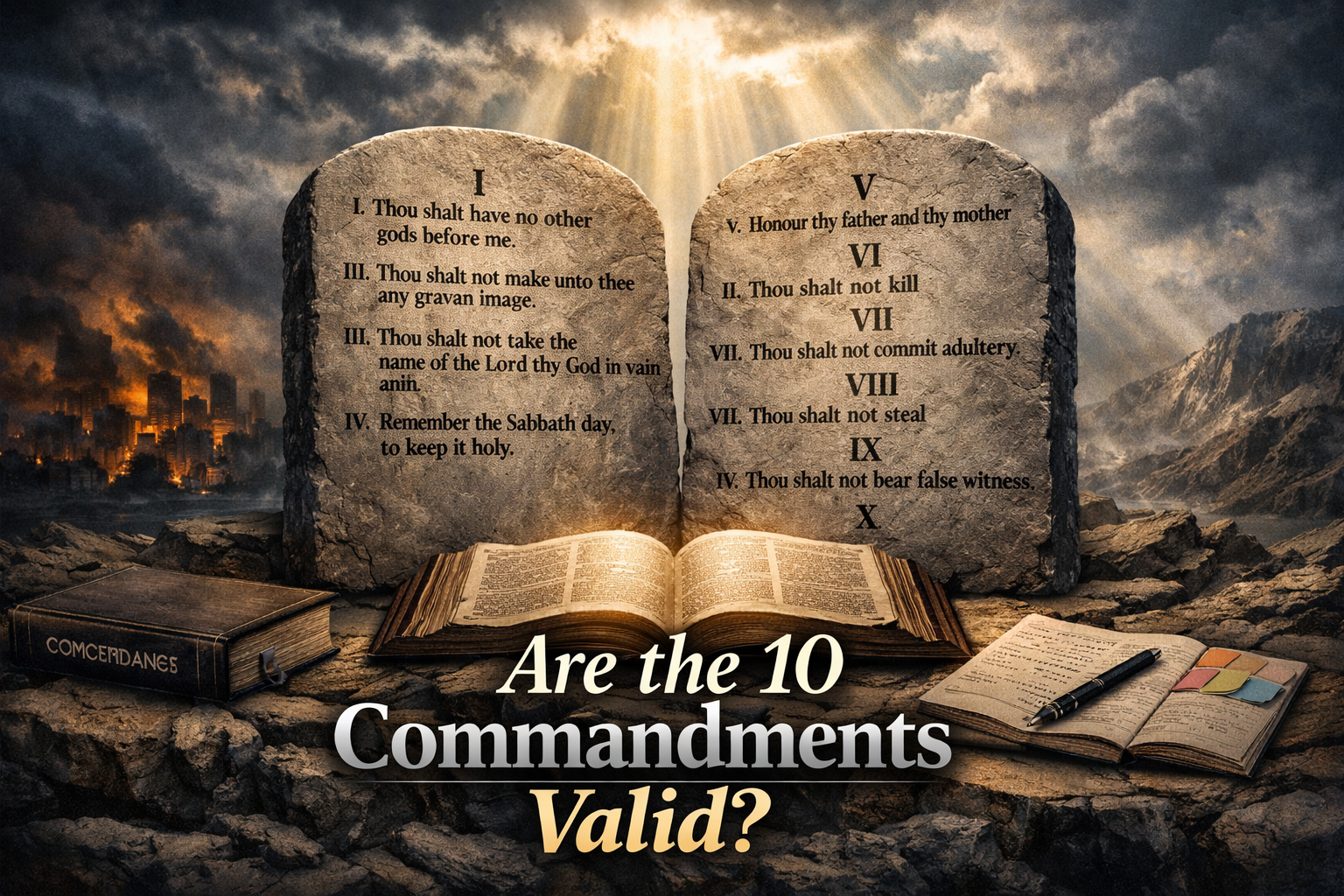
Many people say that we should no longer keep the Ten Commandments. What does the Bible actually say? We know that Jesus died for sin and for us as sinners. Many churches teach that the law is no longer in effect, and that we now live under grace.
Could it be that living under grace does not mean abandoning obedience to God’s commandments, but rather keeping them through God’s grace? Does God’s grace nullify our obligation to obey Him? Does God’s grace mean that anyone, regardless of their spiritual state, can enter heaven? Can people go to heaven while remaining in their sins?
Are the Ten Commandments Still Valid? Sin Remains the Same
One compelling argument is that sin itself never changes. Sin was the same in Old Testament times, and it remains the same today, in the era we now live in. Because the commandments reflect God’s unchanging nature, they remain the same as well.
“My covenant will I not break, nor alter the thing that is gone out of my lips.” (Psalm 89:34)
“Jesus Christ the same yesterday, and to day, and for ever.” (Hebrews 13:8)
God never changes, and God’s law cannot change either, since the law is simply the expression of what God loves — our love for Him and for one another — and what God hates, such as lying, stealing, and similar sins.
“Think not that I am come to destroy the law, or the prophets: I am not come to destroy, but to fulfil. For verily I say unto you, Till heaven and earth pass, one jot or one tittle shall in no wise pass from the law, till all be fulfilled. Whosoever therefore shall break one of these least commandments, and shall teach men so, he shall be called the least in the kingdom of heaven: but whosoever shall do and teach them, the same shall be called great in the kingdom of heaven.” (Matthew 5:17–19)
Here Jesus says that nothing from the Ten Commandments can pass away. When we consider that Jesus died for our sins, we understand that His teaching in the New Testament remains entirely consistent with the Old Testament. If sin is the transgression of the law, then people from Old Testament times to today are equally sinners, equally needing the blood of Jesus to cleanse them. The commandments Jesus upheld never changed, in either testament.
To claim, as many churches and Christians do today, that the law ended when Jesus came is essentially to claim that sin no longer exists. But the definition of sin is the transgression of the law.
“Whosoever committeth sin transgresseth also the law: for sin is the transgression of the law.” (1 John 3:4)
The Bible is clear on this point. If there were no law, there could be no sin. For example, certain roads in Germany have no speed limit — which means you cannot violate a speed limit law there, because none exists. If the Ten Commandments no longer applied, it would mean there could be no more sin and no more sinners. Yet the New Testament plainly teaches that people today are, if anything, worse than ever.
“But evil men and seducers shall wax worse and worse, deceiving, and being deceived.” (2 Timothy 3:13)
To say there are no more commandments is to say there is no more sin. God also cannot be unjust, judging one person differently from another for the same offense simply because of when they lived. God cannot logically say:
God: “You two — when are you from?”
First sinner: “Old Testament times.”
God: “Very well, you may enter heaven.” [Turning to the second] “And you — when are you from?”
Second sinner: “New Testament times.”
God: “You are condemned.”
God cannot assign different outcomes to two people who committed the same sin, simply because they lived in different eras. The teaching of Jesus regarding the commandments remains identical, old and new. In fact, when Jesus says, “I give you a new commandment,” this commandment was already present in the Old Testament.
Loving God and loving others — these two commandments summarize the Ten Commandments entirely. The first four commandments instruct us to love God; the remaining six instruct us to love one another. The commandments of Jesus are eternal, because God Himself is eternal. The Old and New Testaments together form one unified revelation of God, without division.
Are the Ten Commandments Still Valid? Apparent Contradictions
Some passages appear, at first glance, to contradict this. In Romans 6, Paul writes that we are no longer “under the law.” What does it mean to be “under the law”? In Old Testament times, the Jewish people were under the law in the sense that they had to bring an animal sacrifice to receive forgiveness — yet they were ultimately saved through faith in the coming Messiah.
“For sin shall not have dominion over you: for ye are not under the law, but under grace.” (Romans 6:14)
The teaching on God’s commandments remains unchanged between the Old and New Testaments. We are no longer under the law’s condemnation because we are no longer required to bring animal sacrifices. Does this mean we no longer need to keep the Ten Commandments? No — reading further in context, we find:
“What shall we say then? Is the law sin? God forbid. Nay, I had not known sin, but by the law: for I had not known lust, except the law had said, Thou shalt not covet. But sin, taking occasion by the commandment, wrought in me all manner of concupiscence. For without the law sin was dead. For I was alive without the law once: but when the commandment came, sin revived, and I died. And the commandment, which was ordained to life, I found to be unto death. For sin, taking occasion by the commandment, deceived me, and by it slew me. Wherefore the law is holy, and the commandment holy, and just, and good.” (Romans 7:7–12)
Paul explains here that we come to recognize sin only through the law — the law points us toward our sinfulness. Paul affirms that the law itself is holy, just, and good. This does not mean we are saved by keeping the law, as we will see further — but it also does not mean we are excused from obeying God through the righteousness and power He provides within us.
Another verse often raised is the statement that “Christ is the end of the law.” What does the word “end” mean here? Word meanings in 1611, when the King James Bible was translated, often differed significantly from their modern usage. Words like “let,” “suffer,” or “end” carried different meanings then. Let us examine this word as used elsewhere in Scripture.
“For Christ is the end of the law for righteousness to every one that believeth.” (Romans 10:4)
At first glance, this seems to say that Jesus ended the law. But looking further, we find the word “end” carries a different sense in this context. The teaching of Jesus never changed, and Jesus Himself remains the same forever.
“Behold, we count them happy which endure. Ye have heard of the patience of Job, and have seen the end of the Lord; that the Lord is very pitiful, and of tender mercy.” (James 5:11)
Here we see that the word “end,” in 1611 English, could also mean design, purpose, goal, or fulfillment. This verse, then, does not mean that Christ abolished the law, but rather that His death accomplished the purpose of the law — providing forgiveness and holiness before God through the forgiveness of sins, and through God’s power, known as righteousness by faith, which is the only true means by which people can keep the law.
“Wherefore the law was our schoolmaster to bring us unto Christ, that we might be justified by faith. But after that faith is come, we are no longer under a schoolmaster.” (Galatians 3:24–25)
Here again, Paul uses similar language to Romans 6, stating that we are no longer “under” a schoolmaster. Does this verse suggest we no longer need to keep the commandments? No.
It is worth noting how often people read Scripture quickly and end up embracing false doctrines as a result. We need to take our time when studying the Bible — to be slow to judge and slow to draw conclusions. We are no longer bound to the schoolmaster that once required us to bring animals, spend our resources, and sacrifice an innocent creature for our sins. We are freed from that particular bondage — but since sin itself has never changed, the law that defines it cannot be abolished.
Are the Ten Commandments Still Valid? Saved by Grace
We are saved by grace, not by works. This stands in contrast to another extreme view — that some Christians hold, believing they are saved by their own works. Both extremes are mistaken. Sadly, the majority of Christian churches today believe the Ten Commandments no longer apply, while the opposite error is believing that we earn our salvation through good works. Before exploring this further, let us consider a few more verses regarding the law. Solomon tells us that we will all be judged according to the law.
“Let us hear the conclusion of the whole matter: Fear God, and keep his commandments: for this is the whole duty of man.” (Ecclesiastes 12:13–14)
All people on earth will be judged according to the Ten Commandments. But how can anyone be judged fairly if there were no standard defining right and wrong? What about those who have never heard the Bible — how will God judge them? Through their conscience, and through what they have come to understand. God speaks directly to our conscience. Scripture describes a “still small voice” through which the Holy Spirit speaks to every person on earth, showing them the path they should walk. The teaching of God’s commandments remains the same for everyone, kept through God’s grace — since even our good works are ultimately prepared and enabled by God.
“And thine ears shall hear a word behind thee, saying, This is the way, walk ye in it, when ye turn to the right hand, and when ye turn to the left.” (Isaiah 30:21)
Romans 1 tells us that no one will have any excuse, since God speaks to us through conscience and heart, revealing what is true. If we reject this inner call, we will be left without excuse. Romans 1 also tells us that creation itself bears witness to God — through nature, we come to understand that God exists.
“Because that which may be known of God is manifest in them; for God hath shewed it unto them. For the invisible things of him from the creation of the world are clearly seen, being understood by the things that are made, even his eternal power and Godhead; so that they are without excuse: Because that, when they knew God, they glorified him not as God, neither were thankful; but became vain in their imaginations, and their foolish heart was darkened. Professing themselves to be wise, they became fools.” (Romans 1:19–22)
Are the Ten Commandments Still Valid? Unchanged from Old to New
Since sin cannot change, and God cannot judge people differently across Old and New Testament times, the law itself cannot change. Because sinners still exist today, it means God’s law is still being broken. Here are a few additional verses regarding the commandments:
“So speak ye, and so do, as they that shall be judged by the law of liberty.” (James 2:12)
“It is easier for heaven and earth to pass, than one tittle of the law to fail.” (Luke 16:17)
“My covenant will I not break, nor alter the thing that is gone out of my lips.” (Psalm 89:34)
“All his commandments are sure. They stand fast for ever and ever.” (Psalm 111:7–8)
The Ten Commandments can never be changed.
“Think not that I am come to destroy the law… I am not come to destroy, but to fulfil… Till heaven and earth pass, one jot or one tittle shall in no wise pass from the law, till all be fulfilled.” (Matthew 5:17–18)
“For whosoever shall keep the whole law, and yet stumble in one point, he is guilty of all.” (James 2:10)
“By the law is the knowledge of sin.” (Romans 3:20)
Our understanding of right and wrong comes through the law. This is precisely why many churches today, existing in a lukewarm, Laodicean state, claim we no longer need to keep the commandments — having been led, sadly, to embrace certain falsehoods. Many of these believers are sincere children of God who love Jesus deeply. Still, we need to clearly understand what the Bible actually teaches. This question of whether the commandments remain in force is genuinely important.
If someone believes they no longer need to keep the commandments, they will inevitably become confused about the nature of sin itself. Why would Jesus need to die, and how could sin even exist, if there is no law left to transgress?
“By this we know that we know him, if we keep his commandments.” (1 John 2:3)
What about this verse?
“Knowing this, that the law is not made for a righteous man, but for the lawless and disobedient, for the ungodly and for sinners, for unholy and profane, for murderers of fathers and murderers of mothers, for manslayers.” (1 Timothy 1:9)
Does this verse suggest we no longer need to keep the law? No — it states that the law exists for those who do evil. Does it imply the law applies only to especially wicked people? No — when we consider the whole of Scripture in context, we find that all people are sinners. This verse is describing the consequence of failing to love God and others: the judgment of the law, and ultimately eternal separation from God’s presence.
If there were no law, God would have no basis for excluding sin from heaven — yet God desires His children to be eternally safe there. So the correct understanding of this verse is that the law exists, in part, to ensure sin has no place in heaven.
Are the Ten Commandments Still Valid? Righteousness by Faith
So then, what is the purpose of Jesus’ death on the cross? It is to bring us forgiveness, and to enable us to keep the law through His righteousness working within us.
“I will put my laws into their mind, and write them in their hearts.” (Hebrews 8:10)
“For what the law could not do… God did, by sending his own Son… that the righteousness of the law might be fulfilled in us.” (Romans 8:3–4)
Once we recognize that we are sinners, we can ask God to grant us His power. This doctrine — righteousness by faith — is among the most wonderful truths found anywhere in Scripture. Even our good works are ultimately accomplished by God, working through us.
“For we are his workmanship, created in Christ Jesus unto good works, which God hath before ordained that we should walk in them.” (Ephesians 2:10)
Why, then, do we still keep the commandments, if God accomplishes this through us? Our part is simply to believe. We do not keep the commandments on our own once we receive Jesus’ righteousness — He keeps them through us. The opposite error to avoid is believing that we are saved by our own works. Scripture is clear: we are not saved by works. When the Bible speaks of being “judged by works” as well, it means that genuine love for God will naturally produce good works as evidence.
This does not mean we work in order to earn our salvation. The teaching of Jesus’ commandments remains the same now as it always has been. Yet if we could save ourselves through our own works, why would Jesus have needed to die on the cross at all? We cannot be saved by the cross of Jesus and our own works simultaneously. Nor can we claim that the law no longer exists — to do so would be to claim that sin no longer exists, which is simply untrue.
“And if by grace, then is it no more of works: otherwise grace is no more grace. But if it be of works, then it is no more grace: otherwise work is no more work.” (Romans 11:6)
Jesus really loves you. Visit our righteousness by faith television page and explore our related articles on this topic. Many Christians remain confused about the law — some leaning toward legalism, others denying the law’s continued validity altogether (which, ironically, can become its own form of legalism in reverse). This is truly a difficult situation to navigate.
Jesus died for you. Through faith, you can receive His power to do what is right — this experience is called righteousness by faith. Many do not embrace this message, because the human heart still wants to believe there is something good within itself to offer God toward its own salvation. Yet the Bible tells us that even our best works are like filthy rags before God — there is nothing inherently good in us on our own.
This first step is difficult for many to accept, especially those too proud to humble themselves and recognize that we are all, ultimately, undone apart from God. Righteousness by faith is not merely a doctrine — it is an experience.
I hope you have been blessed, my friend. Have you accepted Jesus into your heart? Repeat after me: Father God, forgive my sins. Give me Your righteousness. Help me to walk with You. Bless and heal me, please, in the name of Jesus. Amen.
EARTHLASTDAY.COM