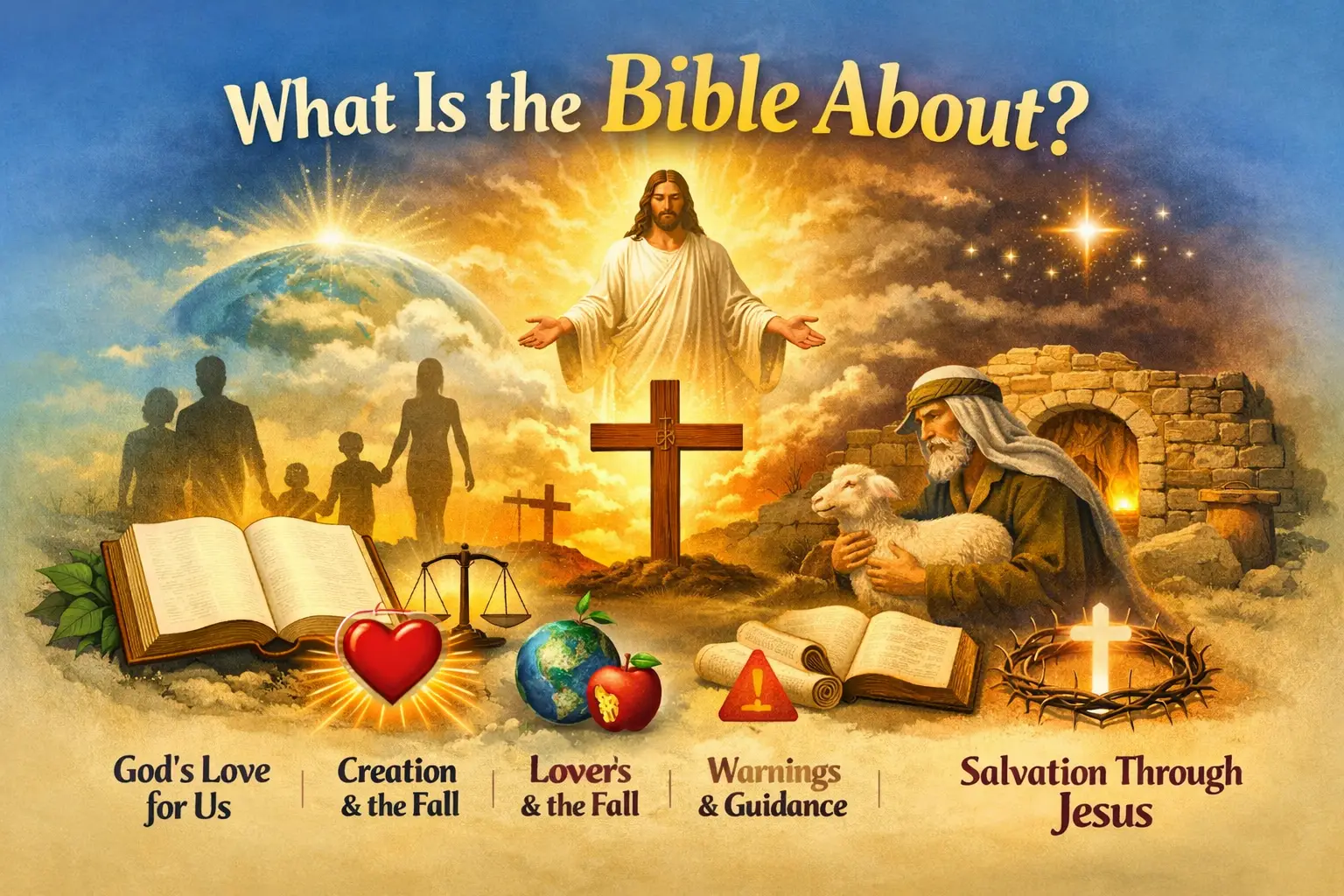
The Bible is about the love of God, and God telling humanity how much He cares for them. A large part of the Bible consists of warnings God sent to Israel, which also apply to the modern church and our modern society — warnings not to follow this world, but to follow the truth. What is the Bible about? It’s about God creating human beings because He wanted to share His love with us. God wanted to create beings who could be loved by Him, and who could love Him in return.
What Is the Bible About? God Created the Universe
God created the universe, yet this truth is overshadowed today. Since creation, around 6,000 years ago, most human beings have believed in some form of creation. Everything that exists requires planning — without planning, there is no creation. Can natural selection or random mutation plan anything? No. To make something, it must first be planned, and planning requires intelligence, a mind, and awareness — things that natural selection, or the so-called mechanisms behind evolution, simply do not possess.
We can conclude, then, that the only way to believe in evolution is to believe that things appear magically — that they arise from nowhere, for no reason, out of nothing. But this isn’t scientific. For a car to exist, someone must plan its size, shape, color, and function. A car cannot simply appear from a piece of metal, even given millions of years. Likewise, a castle cannot appear from a piece of wood lying in a forest, even given millions of years.
What is the Bible about? It’s about God’s love — so great that He chose to create a beautiful world so His creatures could live in it, at peace and happy forever. But sin entered the world.
What Is the Bible About? Sin Entered the World
Sin is a mystery. An angel who was perfect for a long time chose to depart from God’s system of love, kindness, humility, and honesty. Satan grew jealous of Jesus, wanting the first place for himself. When God the Father took counsel with Jesus, this is when Satan’s jealousy began. His heart became proud because of his own beauty and intelligence.
The love and admiration of billions of angels began to turn Satan’s heart, leading him to believe he was special and worthy of adoration, like God. Satan began planting in the hearts of the angels the idea that God’s government was unfair — that God was a tyrant, and that by following Satan instead, they would be free and far happier. After many attempts to bring Satan back, God the Father and Jesus finally had to cast him down to earth. For the past 6,000 years, we’ve seen the results of Satan’s leadership: war, chaos, death, and confusion.
What Is the Bible About? Israel’s Apostasy
God chose a man, Abraham, as the leader and father of a nation and a church meant to teach the world the way to be saved from this terrible situation. But the nation of Israel, faithful in the time of Moses, fell repeatedly into apostasy, turning to worship other gods.
The same thing happens today. Being proud and selfish is, in essence, worshipping oneself — it is idolatry. We can only truly worship God and give Him the glory. Idolatry is still everywhere in our society; we may not bow before carved images, but worshipping ourselves is idolatry all the same. Placing supreme confidence in human reasoning and human thought leads people away from the truths of the Bible.
In the final 500 years of Israel’s existence as God’s covenant nation, there was no prophetic revelation given. Before that, the apostasy had grown so great that God had to send the Assyrians to deport Samaria, and the Babylonians to deport Judah, where Jerusalem was located.
What Is the Bible About? The Coming Messiah
God then set aside Israel as a nation, and all who wished to receive salvation would need to believe that Jesus died on the cross — this faith in His loving sacrifice brings forgiveness of sins and cleanses us from all our past wrongdoing. The coming of Jesus was prophesied roughly 300 times in the Old Testament, some dating back as far as 1,100 years before His birth. Isaiah 53, written about 700 years before Jesus was born, speaks of His death and life — a remarkably impressive prophecy.
Isaiah 53:2 — “For he shall grow up before him as a tender plant, and as a root out of a dry ground: he hath no form nor comeliness; and when we shall see him, there is no beauty that we should desire him.”
Jesus did not come with riches, splendor, or anything to attract the eye. Jesus was meek, lowly, humble, and gentle. Those who truly love God will love Jesus.
Isaiah 53:3 — “He is despised and rejected of men; a man of sorrows, and acquainted with grief: and we hid as it were our faces from him; he was despised, and we esteemed him not.”
Many people rejected Jesus because His way is not this world’s system. Here, pride, selfishness, and dishonesty are what tend to be accepted. Christians who resemble Jesus will likewise be rejected. Jesus said that we would be hated by all for His sake. Jesus was despised; Jesus was not valued at His true worth.
Isaiah 53:4 — “Surely he hath borne our griefs, and carried our sorrows: yet we did esteem him stricken, smitten of God, and afflicted.”
Even though Jesus was rejected and hated, He chose to take our sins upon Himself. Had He not done so, our destiny would have been eternal separation from God. Jesus loves you and me so deeply that He preferred to take on the suffering and pain Himself, so that we would not have to suffer in that way.
What is the Bible about? It’s about the love of God. Jesus was seen as weak, as someone the Father seemed to be punishing. In Old Testament times, when someone suffered, people often assumed God was punishing them for their sins.
In the book of Job, his friends believed his suffering was the result of his own wrongdoing — a deeply legalistic mindset. But the suffering of Jesus came so that we could be forgiven of our sins and have a chance at eternal life. All who believe that Jesus died on the cross receive forgiveness of their sins and eternal life.
Isaiah 53:5 — “But he was wounded for our transgressions, he was bruised for our iniquities: the chastisement of our peace was upon him; and with his stripes we are healed.”
Written 700 years before Jesus was born, Isaiah 53 tells us that Jesus would die for our sins. He was wounded because of our sins, so that we could live forever with Him — where there will be no more tears, no more pain, no more suffering, no more separation, no more anger, no more injustice, and no more hate.
What Is the Bible About? The Life of Jesus
Jesus came to earth, taking on the likeness of humanity. He remained 100 percent God while also being 100 percent man. Living on earth, we could see who God truly was — sweet, humble, honest, kind, forgiving, merciful, and sincere. These are the remarkable qualities of God, and Jesus said, “If you have seen Me, you have seen the Father.”
Jesus drew close to those considered sinners and society’s so-called “bad” people, while often being rejected by religious people. In fact, this is one of the great teachings of the Gospels — it shows that God’s kingdom is not of this world. Jesus loved humility, honesty, and love itself. A person can belong to a church, yet simply being called a “Christian” does not mean that person truly belongs to God — it is the fruit of one’s life that reveals whether they are truly a child of God.
What is the Bible about? It’s about the love of God. What is highly esteemed in this world is often an abomination to God — this is a critically important concept to understand. A person can be rejected by society, yet held in the highest esteem by God. Someone can be highly esteemed by society, yet seen as vile in God’s eyes. What truly matters is what God sees.
As the Bible says, we cannot be a friend of God and a friend of the world at the same time — we must choose which side we will stand on. The story of Jesus speaks extensively about righteousness by faith versus legalism, and this connects closely with how those rejected by society — the outcasts — are so often received and embraced by God. We cannot save ourselves; righteousness belongs to God alone. Only when we understand this concept can true conversion take place. As long as we try to work our way to heaven, we remain lost.
Another biblical principle is this: when we seek to be seen and praised by others, the Bible says that God only approves of those whom He Himself lifts up. Human beings spend a great deal of time trying to showcase themselves to others — but God is not like that. God loves a meek and quiet spirit.
2 Corinthians 10:18 — “For not he that commendeth himself is approved, but whom the Lord commendeth.”
1 Peter 3:4 — “But let it be the hidden man of the heart, in that which is not corruptible, even the ornament of a meek and quiet spirit, which is in the sight of God of great price.”
Do you resemble Jesus? Are you meek and lowly? Do you give God the glory in all things? Jesus loves you — so have you accepted Jesus into your heart? Repeat after me: “Father God, forgive my sins, come into my heart. Heal and bless me. Give me Your righteousness. In the name of Jesus, amen.”