Tag: three angels message revelation 14

  • Babylon in the Book of Revelation

    Babylon in the Book of Revelation


    Why is it important to identify Babylon in the book of Revelation?
    In Revelation 14, a message is given to the whole world — “to all nations, kindreds, tongues, and people.” When the world and its churches reject this message, the very next verse declares: “Babylon is fallen.”
    Following that rejection, the seven last plagues fall on this Babylon system, and those who remain receive the mark of the beast and the wrath of God. In other words, the entire sequence — the daughters of Babylon, the mark of the beast — begins with a message that is given and then rejected:

    “The hour of his judgment is come” (Revelation 14)

    To understand what the mark of the beast is, we first have to understand who delivered this message, what it was about, and when it was given. And all of this prophecy traces back to one starting point: Daniel 2 and Daniel 7.
    Tracing Babylon back to Daniel
    The author of Revelation is the apostle John — also known as John the Revelator.
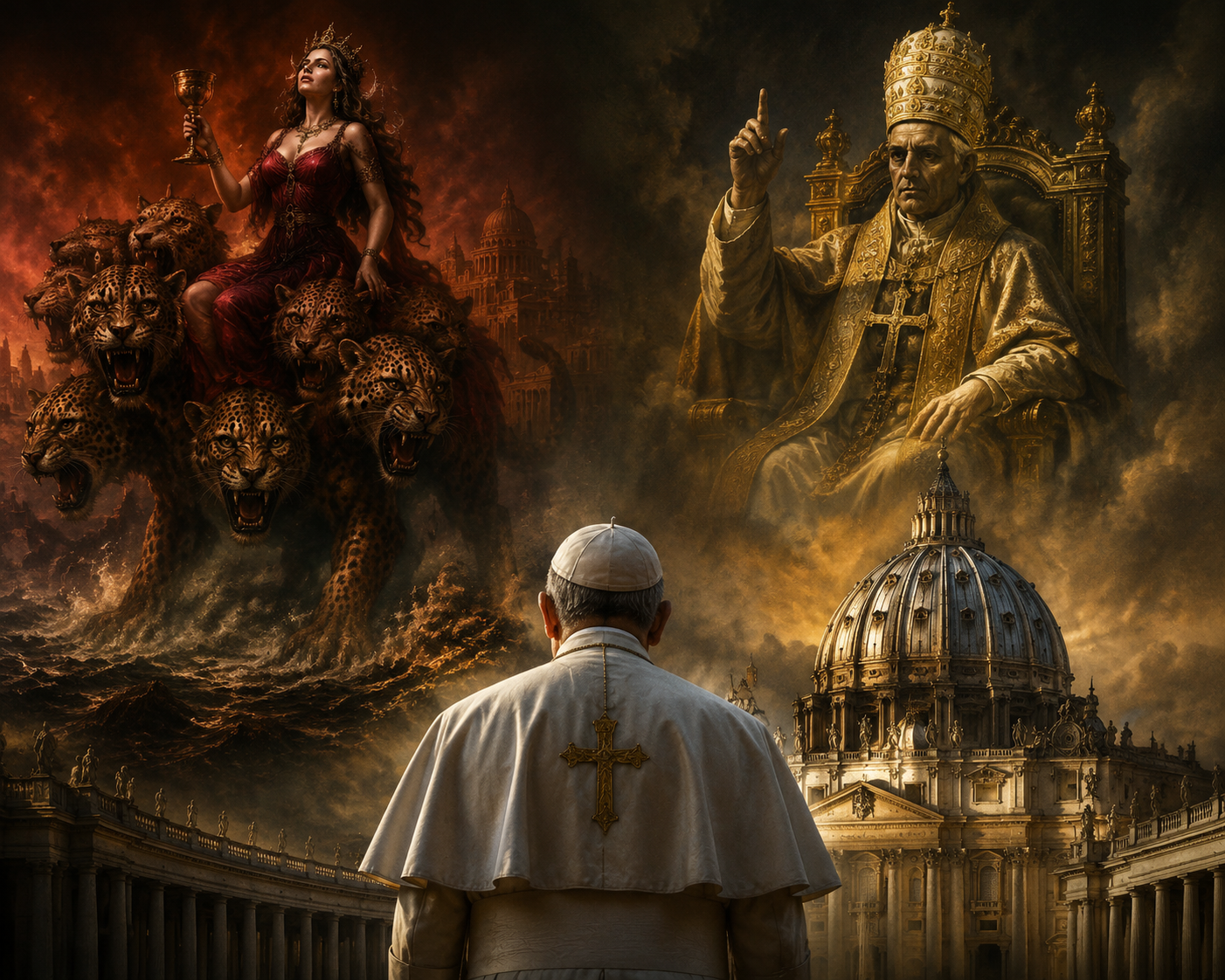
    Babylon in the book of Revelation is identified with the “little horn” in Daniel 7, which in turn is identified as the antichrist, the “man of sin,” and the “son of perdition.” In Daniel 2, Daniel describes an image made of four metals, and tells the king of Babylon:

    “Thou art this head of gold… And after thee shall arise another kingdom inferior to thee, and another third kingdom of brass, which shall bear rule over all the earth.” (Daniel 2:38–39)

    After Babylon came Medo-Persia, then Greece, then Rome.
    In Daniel 7, the same four kingdoms appear again, but this time as beasts. Scripture gives more detail about the fourth beast, Rome — saying a “little horn” (the antichrist) arises out of it. This makes the case, as this interpretation argues, that the antichrist arises from Rome — laid out plainly in both Daniel 2 and Daniel 7.
    The characteristics of this power
    According to Daniel 7, this little horn — antichrist, or Babylon — would:

    Persecute the saints (the Inquisition)
    Change times and law — specifically, change the commandment regarding the Sabbath from Saturday to Sunday
    Speak blasphemies — claiming the power to forgive sins, and claiming the title “God”
    Continue for “a time and times and the dividing of time” (interpreted as 1,260 years)

    “I considered the horns, and, behold, there came up among them another little horn, before whom there were three of the first horns plucked up by the roots: and, behold, in this horn were eyes like the eyes of man, and a mouth speaking great things… 25 And he shall speak great words against the most High, and shall wear out the saints of the most High, and think to change times and laws: and they shall be given into his hand until a time and times and the dividing of time.” (Daniel 7:8, 25)

    The book of Revelation adds further identifying marks. This power would:

    Be located on the city of seven hills (Rome)
    Have prelates wearing purple and scarlet (the cardinals of Rome)

    “And the woman was arrayed in purple and scarlet colour, and decked with gold and precious stones and pearls, having a golden cup in her hand full of abominations and filthiness of her fornication… 9 And here is the mind which hath wisdom. The seven heads are seven mountains, on which the woman sitteth.” (Revelation 17:4, 9)

    Jesus doesn’t give us names outright — his words are written in parables and characteristics. But, in this view, anyone who searches the Scriptures with these descriptions in hand will conclude that Babylon in the book of Revelation refers to the Catholic Church.


    Why “Babylon” can’t mean paganism
    For Babylon to “fall,” it must have once stood on the truth. Did the Catholic Church ever stand on the truth? That’s a worthwhile question for debate when it comes to the early church fathers — but one thing is clear: Babylon cannot refer to pagan religion, because paganism never fell away from the truth in the first place.
    Babylon in the book of Revelation is identified here as the papacy, and the “daughters of Babylon” as the Protestant churches that observe Sunday — many of which, in this view, no longer “protest” in any meaningful sense. Babylon is said to become “the house of demons” — which implies it was once the house of God.
    So consider the contrast:

    Were pagan religions ever the house of God? No.
    Did pagan religions ever fall away from the truth? No.
    Do pagan religions commit “fornication” by claiming to belong to Jesus while serving another master? No — pagan religions never claimed to belong to Jesus in the first place.

    But Revelation specifically says Babylon fornicates.
    What does “fornication” mean here?
    In this reading, it means claiming to belong to Jesus — to be saved by him alone — while at the same time advancing the kingdom of Satan by teaching his doctrines, whether knowingly or unknowingly. Scripture warns that Satan can deceive “even the very elect.” A deceived person doesn’t know they’re serving Satan; they believe they’re serving Jesus alone.


    By this reasoning, Babylon can only refer to Christian churches that have rejected truth and become Babylon. Believers within “Babylon” today believe they belong to Jesus, even though — in this view — many of their core teachings are the same ones that Babylonian priests once preached on Sundays in pagan temples to Satan, back in the days of Daniel.
    When does Babylon fall?
    A message is given to all nations. That message is rejected. And in the very next verse, Jesus declares: “Babylon is fallen.”

    “And I saw another angel fly in the midst of heaven, having the everlasting gospel to preach unto them that dwell on the earth, and to every nation, and kindred, and tongue, and people, 7 saying with a loud voice, Fear God, and give glory to him; for the hour of his judgment is come.” (Revelation 14:6–7)

    A similar pattern of “falling” appears in Romans 11, where Israel falls because of unbelief:

    “Well; because of unbelief they were broken off, and thou standest by faith. Be not highminded, but fear: 21 for if God spared not the natural branches, take heed lest he also spare not thee.” (Romans 11:20–21)

    “Falling,” in this sense, means rejecting new light from God or rejecting the messengers who bring it. When a church “falls,” it doesn’t mean it rejects the entire Bible or stops preaching Jesus altogether — Babylon in the book of Revelation continues to preach Jesus. But Satan doesn’t mind that, because he knows that rejecting new light sends people backward into darkness.
    When the first angel’s message is given in Revelation 14 —

    “saying with a loud voice, Fear God, and give glory to him; for the hour of his judgment is come: and worship him that made heaven, and earth, and the sea, and the fountains of waters” —

    Jesus says, in the very next verse:

    “And there followed another angel, saying, Babylon is fallen, is fallen, that great city, because she made all nations drink of the wine of the wrath of her fornication.” (Revelation 14:8)

    If the “mother church” had already fallen back in the early centuries, then who is Jesus referring to here?


    The historical moment of the message
    In this interpretation, this is a message about “the hour of his judgment” that was proclaimed throughout the world — first to Protestant churches in the United States, then to the world — by William Miller in 1844. Miller proclaimed that Jesus had entered the Most Holy Place in heaven to begin judging humanity in that year. When churches broadly rejected this message, they became “Babylon” — though many sincere individuals responded and joined what is described as Jesus’ final message to the world.


    The closing appeal
    Will you follow Jesus and the three angels’ message — or remain content in Babylon? Knowing that the seven last plagues, the mark of the beast, and the wrath of God are coming upon Babylon, why remain in a system that will receive God’s judgment? Jesus is asking: will you obey now?

    “And I heard another voice from heaven, saying, Come out of her, my people, that ye be not partakers of her sins, and that ye receive not of her plagues. 5 For her sins have reached unto heaven, and God hath remembered her iniquities.” (Revelation 18:4–5)
  • Who Is John That Wrote the Book of Revelation? The Three Angels’ Message Explained

    Who Is John That Wrote the Book of Revelation? The Three Angels’ Message Explained

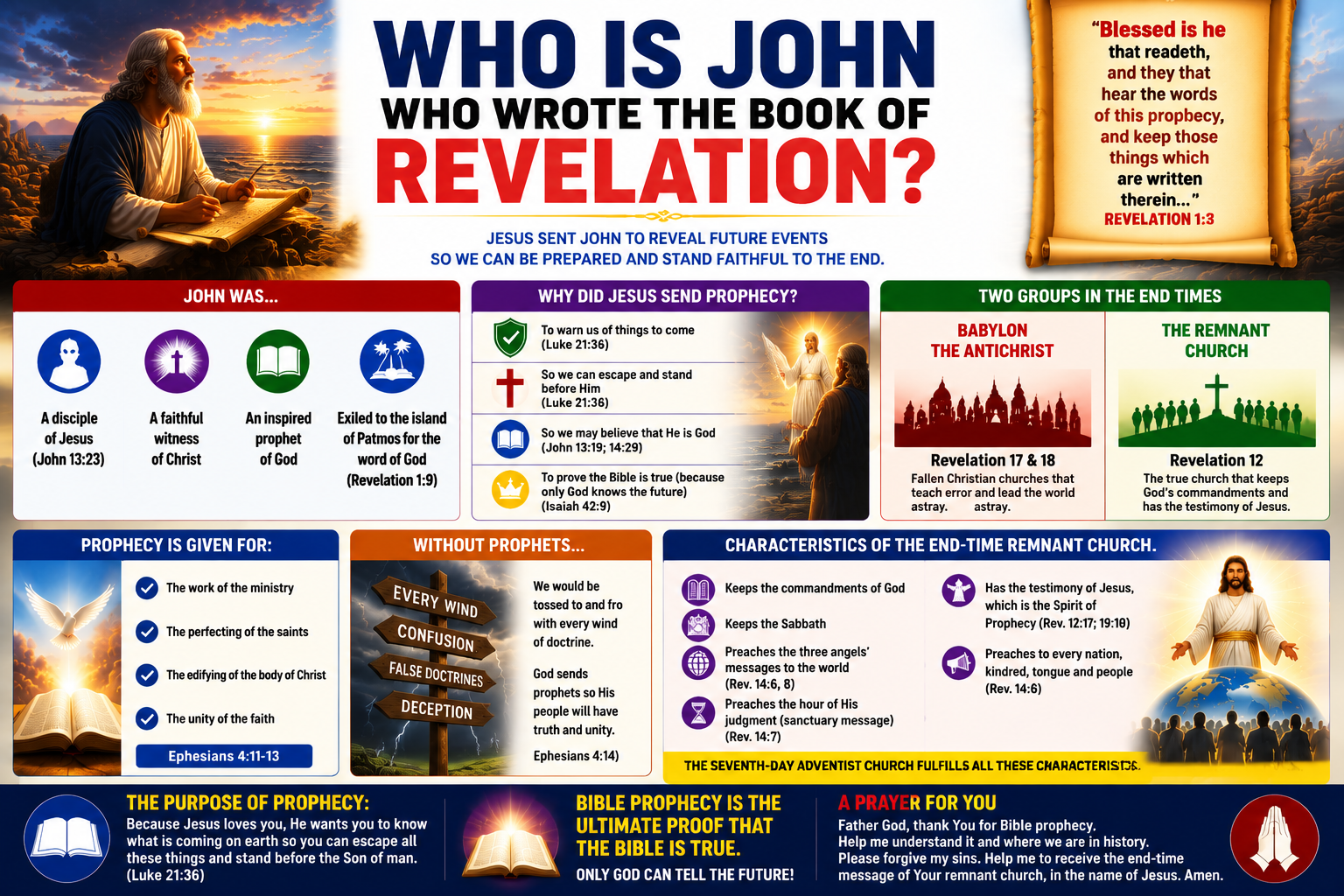
    John is the apostle who was with Jesus — a teenager at the time. He is known traditionally as the beloved John, who rested his head on Jesus’s breast. He was also called by God to write the first, second, and third epistles of John, and lastly the book of Revelation, on the island of Patmos. Babylon in the book of Revelation? Babylon is the mother; she has daughters, and daughters come from the mother.

    What Is Revelation About?

    The book of Revelation is a revealing of the future of the world: seven churches, seven seals, seven trumpets. Most of the end-time message of the book of Revelation centers on a message given to the world in Revelation 14.

    This message is called the three angels’ messages. The first angel, the Bible says, is given to all nations, tongues, and peoples — so it is not an obscure message given by a local prophet. It is a worldwide message. Is this message given only to non-Christians? No — it says to all people, all nations.

    What Is This Message to the World That Is Rejected?

    This message is: “Saying with a loud voice, Fear God, and give glory to him; for the hour of his judgment is come: and worship him that made heaven, and earth, and the sea, and the fountains of waters.” (Revelation 14:7)

    Who gave this message to the world? When was it given? What is it about? The only person in history who gave this exact message was William Miller, in 1844 — no one else in history has given this message.

    This is the first angel’s message: “the hour of his judgment is come.” Babylon, in the book of Revelation, refers to fallen Christian churches.

    The Hour of His Judgment: A Sanctuary Message

    Israel observed, every year, the Day of Atonement, when the high priest would enter the most holy place to decide the destiny of the people. Babylon in the book of Revelation cannot refer to pagan religions, because pagan religions were never “the mother” the way the Catholic Church has been. In the Old Testament pattern of salvation in Israel:

    1. The priest kills the lamb.
    2. Once a year, the high priest enters the most holy place to cleanse the record of sin.

    If salvation were accomplished entirely through Jesus dying on the cross, why did Jesus then go to the sanctuary in heaven to intercede for us? If salvation were finished at the cross, this additional ministry would make no sense. This message — the hour of His judgment — was to be given in the end times, to all nations.

    This message parallels Daniel 8:14 — “And he said unto me, Unto two thousand and three hundred days; then shall the sanctuary be cleansed.” The cleansing of the sanctuary refers to the high priest entering the most holy place. Here, Gabriel says that after 2,300 years, the cleansing of the heavenly sanctuary would take place — to cleanse sin not for Israel alone, but for the whole world.

    This hour of His judgment is so important because Jesus sends the seven last plagues, the mark of the beast, and His wrath upon those who reject this message. Understanding what this message is truly about is vital.

    Babylon in the Book of Revelation: Why the Churches Fall

    The next verse says that these churches become Babylon — meaning that they were once truly God’s churches.

    Revelation 14:8 — “And there followed another angel, saying, Babylon is fallen, is fallen, that great city, because she made all nations drink of the wine of the wrath of her fornication.” Fornication here refers to false doctrines. We commit fornication when we have a husband or wife, yet take another lover. Here, Jesus says these churches claim to belong to Him, their one true husband, yet they preach beliefs that come from Satan, thereby advancing Satan’s kingdom on earth.

    They “fornicate” by embracing false doctrines. When we believe something, we become part of that belief — it becomes who we are. When we preach doctrines not found in the Bible, our whole being becomes contaminated by those false beliefs.

    What Happens When This Message Is Rejected?

    Jesus says these churches have become corrupt; they receive the seven last plagues; they receive the wrath of God; they receive the mark of the beast.

    Revelation 14:9-11 — “And the third angel followed them, saying with a loud voice, If any man worship the beast and his image, and receive his mark in his forehead, or in his hand, The same shall drink of the wine of the wrath of God, which is poured out without mixture into the cup of his indignation; and he shall be tormented with fire and brimstone in the presence of the holy angels, and in the presence of the Lamb: And the smoke of their torment ascendeth up for ever and ever: and they have no rest day nor night, who worship the beast and his image, and whosoever receiveth the mark of his name.”

    Two Camps Since the Second Century

    Many pastors still teach about “the church” as though we were living in the first century, when there was only one church. Paul said that after his departure, divisions would form. Lucian, in the second century — used by God to help preserve the true biblical text, the Byzantine, or majority, text — recognized that camps were already forming. Since the second century, there have been two camps.

    Babylon in the book of Revelation refers to the mother church, the Catholic Church — many loving Catholics belong to her, but Jesus is referring here to the system of belief, not condemning individuals. The daughters of Babylon are the Sunday-keeping Protestant churches, which fell in 1844 when William Miller proclaimed the “hour of His judgment” message — a message of life or death.

    The Faith of Jesus: Keeping the Commandments

    Jesus says in Revelation 14 that this faithful group holds to the faith of Jesus and keeps His commandments by faith, while on the other side, many churches teach that the law has been abolished.

    Revelation 14:12 — “Here is the patience of the saints: here are they that keep the commandments of God, and the faith of Jesus.”

    Most churches do not realize that when they say “we no longer need to keep the law,” they are effectively saying “we are free to break the law.” But the Bible says: “Whosoever committeth sin transgresseth also the law: for sin is the transgression of the law.” (1 John 3:4) No one can keep the law in their own strength. The real question is twofold: (1) Is the law still binding? (2) Who keeps the law — and how?

    No One Can Keep the Law Alone

    Paul himself said he considered himself the worst of sinners. A converted person is someone who recognizes there is nothing inherently good within themselves.

    Romans 7:18-19 — “For I know that in me (that is, in my flesh,) dwelleth no good thing: for to will is present with me; but how to perform that which is good I find not. For the good that I would I do not: but the evil which I would not, that I do.”

    No one is righteous on their own. Jesus can only give His righteousness to: (1) those who recognize they are sinners — and this, sadly, is the minority, since most people believe they are already good; (2) those who know they cannot keep the law in their own strength; (3) those who ask Jesus for His righteousness.

    I encourage you to read the writings of Alonzo T. Jones and E.J. Waggoner on this subject. On one side, some preach that the law is finished — this is a false gospel. On the other, many teach that we keep the law through human effort alone — this is also false. Why not study this life-changing topic of righteousness by faith?

    Recommended resources: