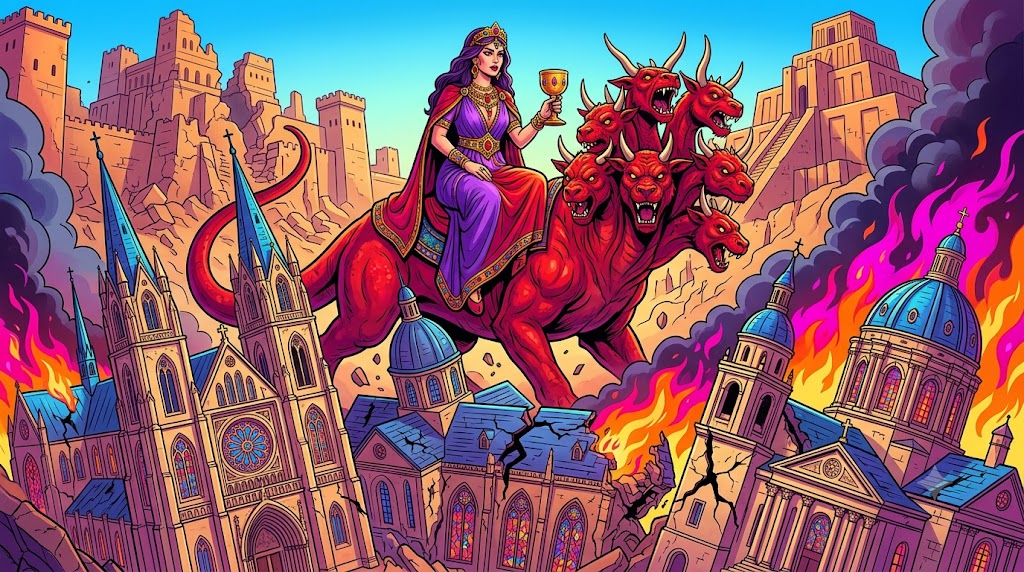
Who is Babylon in the book of Revelation? Is the fall described in the book of Revelation a literal or a spiritual fall?
This is part one in our series seeking to discover who Babylon, in the Bible, truly is. We know Babylon appears already in the Old Testament, and that the books of Revelation and Daniel are mostly prophetic — meaning that most of their symbols are not literal, but prophetic.
1 Corinthians 2:14 — “But the natural man receiveth not the things of the Spirit of God: for they are foolishness unto him: neither can he know them, because they are spiritually discerned.”
2 Peter 1:19-21 — “We have also a more sure word of prophecy; whereunto ye do well that ye take heed, as unto a light that shineth in a dark place, until the day dawn, and the day star arise in your hearts: Knowing this first, that no prophecy of the scripture is of any private interpretation. For the prophecy came not in old time by the will of man: but holy men of God spake as they were moved by the Holy Ghost.”
Is Babylon, in the book of Revelation, the pagan religion of old, or does it refer to Christian churches? In this first part, we will cover the fall of modern Babylon and identify who this modern Babylon truly is. Some of the characteristics of Babylon are: (1) she falls; (2) she becomes a house of demons; (3) she fornicates; (4) the name Babylon itself means confusion, or a mixture of truth and error; (5) Babylon falls specifically because of rejecting truth, as described in Revelation 14.
A. A message is given.
Revelation 14:6-7 — “And I saw another angel fly in the midst of heaven, having the everlasting gospel to preach unto them that dwell on the earth, and to every nation, and kindred, and tongue, and people, Saying with a loud voice, Fear God, and give glory to him; for the hour of his judgment is come.”
B. The message is rejected. The churches that reject this message become Babylon.
Revelation 14:8 — “And there followed another angel, saying, Babylon is fallen, is fallen, that great city, because she made all nations drink of the wine of the wrath of her fornication.”
Does Babylon Represent Pagan Religions or Christian Churches?
We know this message was never given to pagan religions, because they never fell from the truth — to fall means one was previously standing. Paul says we stand on the truth; when we fall, it means we are falling away from truth, or rejecting it. Babylon, in the book of Revelation, falls after the first angel’s message is given and rejected.
So what is this rejected message that (1) causes Babylon to fall, (2) causes her to receive the seven last plagues, and (3) causes her to receive the mark of the beast? The book of Revelation tells us this message is given — but to whom? To all nations and peoples on earth. Jesus makes clear that this is not a local, obscure message, but a worldwide one.
Revelation 14:6 — “And I saw another angel fly in the midst of heaven, having the everlasting gospel to preach unto them that dwell on the earth, and to every nation, and kindred, and tongue, and people.”
So we have now established: (1) a worldwide message from a loving Jesus is given; (2) churches reject this message; (3) these churches that reject this message become Babylon; (4) these churches then receive the seven last plagues and the mark of the beast.
Before we identify exactly what this message is, we must first establish who Babylon is.
Babylon, in the book of Revelation, cannot refer to pagan religions, because:
- They never fell from the truth.
- They were never standing on the truth to begin with.
- They never became “the house of demons” — to become the house of demons, one must have first been the house of God.
- They never rejected the first angel’s message.
- They are not a mixture of Bible truth and paganism — which is precisely what makes Babylon “Babylon.”
- They do not fornicate, in the biblical sense, since fornication implies claiming to belong to Jesus while simultaneously preaching doctrines of paganism or Satan, thereby advancing Satan’s kingdom while claiming the name of Christ.
- Pagan religions never claimed to belong to Jesus in the first place.
What Does Paul Mean When He Says Israel “Fell” Because of Unbelief?
Now that we have established that Babylon cannot refer to pagan religions, let us examine the message that was given and rejected. Note that the three angels’ messages are given not only to Christian churches, but to the entire world — yet this message was first given specifically to the Christian churches. Paul says Israel fell, and explains why: because of unbelief. We can conclude, then, that “falling,” in the Bible, means a person, a church, or a nation rejects God’s light.
Note: this does not mean the person or church rejects every truth about God — only that, in rejecting new light, they reject truth itself. Jesus is the way, the truth, and the life; rejecting any light from God means we are, in effect, rejecting Jesus Himself.
John 14:6 — “Jesus saith unto him, I am the way, the truth, and the life: no man cometh unto the Father, but by me.”
Romans 11:11-12, 20 — “Through their fall salvation is come unto the Gentiles, for to provoke them to jealousy. Now if the fall of them be the riches of the world, and the diminishing of them the riches of the Gentiles; how much more their fulness?… Well; because of unbelief they were broken off, and thou standest by faith. Be not highminded, but fear.” Babylon, in the book of Revelation, tells us that modern Sunday-keeping Christian churches are, in this sense, fallen.
What Is the Rejected Message? The Earthly Sanctuary
We find this message in Revelation 14. As we have seen, it is not a local message — it is given to the whole world. But it was first given specifically to the Protestant and Catholic churches in the United States.
Revelation 14:6-7 — “And I saw another angel fly in the midst of heaven, having the everlasting gospel to preach unto them that dwell on the earth, and to every nation, and kindred, and tongue, and people, Saying with a loud voice, Fear God, and give glory to him; for the hour of his judgment is come: and worship him that made heaven, and earth, and the sea, and the fountains of waters.”
This message is: “the hour of His judgment is come.” What does this mean? In ancient Israel, the high priest would enter the most holy place only one day each year. This was called the day of judgment, and at that time it concerned only the people of Israel.
Leviticus 16:33 — “And he shall make an atonement for the holy sanctuary, and he shall make an atonement for the tabernacle of the congregation, and for the altar, and he shall make an atonement for the priests, and for all the people of the congregation.”
On this one day each year, called the Day of Atonement, the high priest would enter the most holy place to cleanse the accumulated record of sin from the sanctuary. When an animal was sacrificed throughout the year, the sin was symbolically transferred to the sanctuary. Once a year, the high priest would cleanse the sanctuary of all the sin that had accumulated there, transferred from the sinner, to the animal, to the sanctuary itself.
What Is the Rejected Message? The Heavenly Sanctuary
Now we live in New Testament times. Babylon, in the book of Revelation, refers to spiritual Babylon, not literal Babylon. In the New Testament, Jesus entered the sanctuary in heaven — the book of Hebrews tells us Jesus entered the holy place.
But Daniel 8:14 tells us that at the end of a period of 2,300 days, or 2,300 literal years, Jesus would enter the most holy place of the heavenly sanctuary to begin deciding who will go to heaven and who will not. This is called “the hour of His judgment is come.”
Daniel 8:14 — “And he said unto me, Unto two thousand and three hundred days; then shall the sanctuary be cleansed.”
Revelation 14:7 — “Saying with a loud voice, Fear God, and give glory to him; for the hour of his judgment is come.”
The hour of His judgment and the cleansing of the sanctuary are one and the same event.
The Hour of His Judgment: The 2,300 Days
To make this simple: the 2,300 days represent years, since in Bible prophecy, one prophetic day equals one year. The angel Gabriel tells us, in Daniel 9, that this 2,300-year period begins when Jerusalem is rebuilt.
Daniel 9:25 — “Know therefore and understand, that from the going forth of the commandment to restore and to build Jerusalem unto the Messiah the Prince shall be seven weeks, and threescore and two weeks: the street shall be built again, and the wall, even in troublous times.”
Jerusalem was rebuilt in 457 BC. So even a child could calculate this prophecy: 457 BC minus 2,300 years brings us to 1844 AD. This message is the worldwide message of Revelation 14. Jesus says churches worldwide rejected this message and became Babylon — and then they receive the mark of the beast and the seven last plagues. So it becomes vital to know: (1) what this message is, (2) who gave this message, and (3) when this message was given.
Seal the Book Until the Time of the End
Gabriel tells Daniel, in Daniel 12, to seal up the book, so that no one would understand its prophetic portions until the time of the end. Gabriel goes on to explain that the time of the end follows the 1,260-year prophecy — the 1,260 years of papal persecution, which ended in 1798.
Daniel 12:9 — “And he said, Go thy way, Daniel: for the words are closed up and sealed till the time of the end.”
Who Gave This Message — When — and What Is It?
We have just seen that this message could only be given after 1798, since Gabriel says the book would remain sealed until the time of the end. So who, after 1798, gave a worldwide message about “the hour of His judgment is come”? The only person we find in history who gave a worldwide message about the sanctuary, about the 2,300 days, and about the hour of His judgment is William Miller.
Babylon in the Book of Revelation: The Conclusion
William Miller gave this message; the message was given in 1844; the message concerned Jesus entering the most holy place in 1844 to begin deciding who would go to heaven and who would ultimately be destroyed forever. It is a deeply solemn message — for even today, Jesus may be reviewing your life, your thoughts, your actions, your intentions, and deciding your eternal destiny.
So now we can finally answer the question: who is Babylon in the book of Revelation? William Miller preached primarily to Sunday-keeping Protestant churches. They largely rejected this message. Yet many came out of those churches, recognizing that they had become Babylon. Jesus calls this the first angel’s message. Jesus died on the cross for you — He preferred to die rather than be separated from you for eternity.
But Jesus must test us to discover who is truly honest, and who is truly humble. Jesus knows that many people call themselves Christians without truly being so. His way of testing the genuineness of our faith is by sending new light and new messages. Jesus knows that all honest people will follow the truth, while all dishonest people will reject it.
This message creates a separation between the true and the false. Will you follow Jesus and the truth? Or do you prefer to remain comfortable in what you already know, and reject the new light Jesus sends you? Jesus says that all who reject this message will receive the wrath of God, the seven last plagues, and the mark of the beast. It is a truly momentous message. What a sobering thought, that most who call themselves Christians will receive the plagues and ultimately be destroyed forever — why? Because they chose to reject the light and follow what was popular instead. Why not follow Jesus and His last message of the three angels now?
Father God, I believe in this first angel’s message. Help me to accept the three angels’ messages. Forgive my sins; give me Your righteousness, please, in the name of Jesus. Amen.