Most Christians today think and believe that Israel is central to Bible prophecy. They support Israel and believe the temple in Jerusalem will be rebuilt, and that the nation remains in the hands of God in a special, literal sense. But what does the Bible really say? Few people know the origins of this belief. Looking into end time prophecy and current events regarding Israel in the Bible, we find that John Darby was the first person to teach both:
- The secret rapture, and
- Israel as literal in Bible prophecy.
If we make a mistake on this point, it is very dangerous, as we could end up teaching something not found in the Bible, and lead people astray. Let us take time to study the Bible carefully, as your eternal life is at stake — for we would otherwise miss the true meaning of Bible prophecy and teach people something that will never happen, something Jesus never told us to teach. Is Israel in Bible prophecy or not? Where do we find Israel in Bible prophecy? What does the Bible teach about Israel? Let us find out.
Is Israel in Bible Prophecy?
The names in prophecy are spiritual. There is a principle in Bible prophecy: if Babylon does not refer to literal Babylon, and if Sodom does not refer to the literal city of Sodom today — because these cities no longer exist — then these names in prophecy cannot refer to a literal city in today’s world. These names are prophetic.
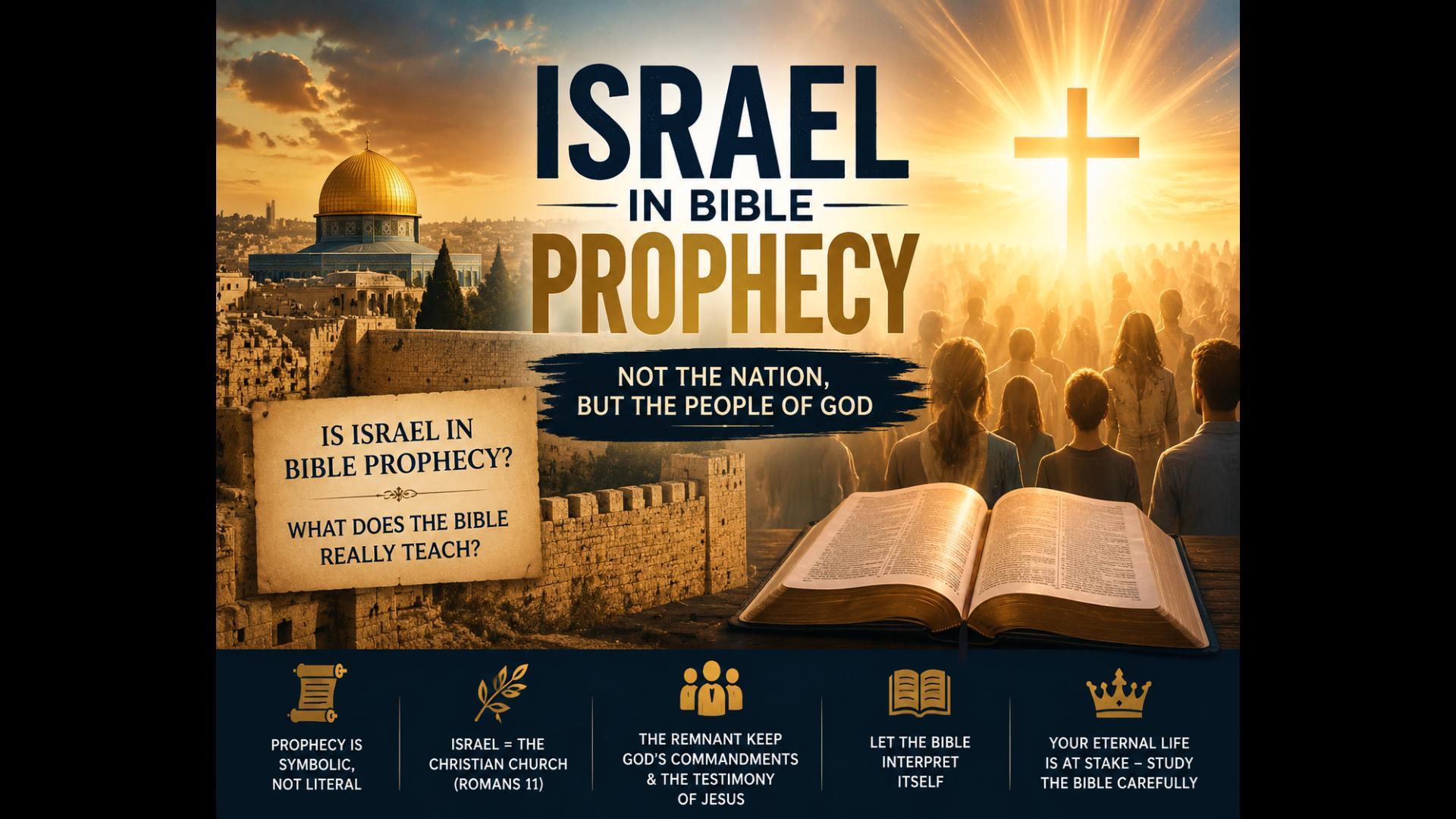
In Ezekiel, we read about Meshech and Tubal. Do these cities exist today? No. So the Bible cannot be referring to these cities literally, but prophetically. Prophecy is symbolic, not literal. Almost everything in the book of Revelation consists of symbols and prophetic images, not literal descriptions — the four beasts, the two witnesses, the image of Daniel 2, the pale horse of Revelation 9. The same principle applies to prophetic names: they are not literal, but prophetic. Israel, too, does not refer to the literal country of Israel, but to the end-time church.
1 Corinthians 2:14 — “But the natural man receiveth not the things of the Spirit of God: for they are foolishness unto him: neither can he know them, because they are spiritually discerned.”
2 Peter 1:19-21 — “We have also a more sure word of prophecy; whereunto ye do well that ye take heed, as unto a light that shineth in a dark place, until the day dawn, and the day star arise in your hearts: Knowing this first, that no prophecy of the scripture is of any private interpretation. For the prophecy came not in old time by the will of man: but holy men of God spake as they were moved by the Holy Ghost.”
Interpretation of Prophecy
In prophecy, when a symbol is given, we find its meaning by searching for it in other parts of the Bible.
Isaiah 28:13 — “But the word of the Lord was unto them precept upon precept, precept upon precept; line upon line, line upon line; here a little, and there a little; that they might go, and fall backward, and be broken, and snared, and taken.” For example: what is a “beast” in Bible prophecy? Can we say it is a literal beast? No. What does the Bible say?
Daniel 7:23 — “The fourth beast shall be the fourth kingdom upon earth, which shall be diverse from all kingdoms, and shall devour the whole earth, and shall tread it down, and break it in pieces.” Jesus spoke in parables; people who did not know the Bible well did not understand them — only those whom God chose to enable could understand Jesus’s parables. The meaning of prophetic symbols is found in other parts of the Bible. The spiritually minded understand things in a spiritual sense.
Prophetic Names in the Bible
In Bible prophecy, we encounter different prophetic names — like Babylon, Sodom, Egypt. But in Revelation 11, God tells us these names are not literal, since the literal earthly cities no longer exist. Their meaning is prophetic.
Revelation 11:8 — “And their dead bodies shall lie in the street of the great city, which spiritually is called Sodom and Egypt, where also our Lord was crucified.”
Revelation 17:5 — “And upon her forehead was a name written, Mystery, Babylon The Great, The Mother Of Harlots And Abominations Of The Earth.”
Ezekiel 27:13 — “Javan, Tubal, and Meshech, they were thy merchants: they traded the persons of men and vessels of brass in thy market.”
Can we say Jesus is speaking here of the literal city of Babylon and the literal city of Sodom? No — Sodom did not exist in John’s time, nor does it exist in ours. Can we say these verses speak of a literal Tubal and Meshech? No, these places no longer exist. Can we say Babylon in prophecy is the literal city of Babylon? No. Can we travel to visit the city of Babylon today? No. So, as in Revelation 11, Jesus tells us these cities carry a spiritual, prophetic meaning. We must understand spiritual things not literally, but spiritually.
If all names in prophecy are prophetic, can we break this prophetic principle and insist that Israel is literal? No. As a consistent rule, if all names in prophecy are symbolic, then “Israel” does not mean the literal country of Israel, but something else. Paul says Israel today refers to the church. The last Bible prophet in this movement teaches that all the prophets spoke more for our time than for their own:
“Never are we absent from the mind of God. God is our joy and our salvation. Each of the ancient prophets spoke less for their own time than for ours, so that their prophesying is in force for us.” (MR 522)
Romans 15:4 — “For whatsoever things were written aforetime were written for our learning, that we through patience and comfort of the scriptures might have hope.”
Matthew 24:15 — “When ye therefore shall see the abomination of desolation, spoken of by Daniel the prophet, stand in the holy place, (whoso readeth, let him understand).”
We conclude that prophecy contains many symbols. To understand these symbols, we go to other parts of the Bible to find their meaning. Prophetic names are not literal but symbolic. Just as Babylon refers to spiritual Babylon, not the literal city now in ruins, Israel does not refer to the country of Israel, but to the Christians of the end times.
Israel Is Not the Country, But the Christian Church
In Romans 11, Paul says he laments and deeply desires to save some of the Jews of Israel. If the Jews were automatically saved today simply by being born Jewish, then Paul would be making a serious mistake, and he would not be speaking under divine inspiration when he says he wants to save “some” of them — implying that all Jews remain lost until they accept Jesus. Israel today is the church, especially the remnant church of Revelation 12.
Romans 11:14 — “If by any means I may provoke to emulation them which are my flesh, and might save some of them.” Here Paul says that Israel — all Jews — are lost, just as all who do not believe are lost, until they give their hearts to Jesus and accept the ransom paid for their sins. Only then can their sins be forgiven.
Israel: Enemies of the Gospel
Romans 11:28 — “As concerning the gospel, they are enemies for your sakes: but as touching the election, they are beloved for the father’s sakes.” Here Paul says that Israel, as a nation, stands as an enemy of the gospel — not every individual Jew, of course, since some, like Peter and John, did accept Jesus. But as a nation, Israel has rejected Jesus to this day. Can enemies of the gospel enter heaven while remaining enemies? No — they would need to repent first. For now, Israel as a nation, rather than being automatically saved, remains entirely lost apart from personal acceptance of Christ.
What About “All Israel Shall Be Saved”?
Romans 11:26 — “And so all Israel shall be saved: as it is written, There shall come out of Sion the Deliverer, and shall turn away ungodliness from Jacob.” Paul cannot spend an entire chapter explaining that Israel is separated from God and lost, only to then say that all Israel — without exception — will automatically be saved. The meaning is that all Jews who desire salvation can be saved; or that all Jews appointed unto salvation will be saved; or that all Israelites who accept Jesus will be saved.
Israel Not Cast Away
Romans 11:2 — “God hath not cast away his people which he foreknew. Wot ye not what the scripture saith of Elias? how he maketh intercession to God against Israel saying.” Here Paul is saying that God does not forbid entrance into heaven to any Jew who accepts Jesus. God could have declared that every Jew would be forbidden from entering heaven because of the crucifixion, but Paul says no — not all Jews are bound for destruction. Those Jews who accept Jesus can be saved. God has not permanently closed heaven to all Israelites.
In the following verse, Paul reveals that only 7,000 Jews remained faithful in his example from the time of Elijah — 7,000 out of millions is not a large number. Peter himself warns that Paul’s writings are complex, and that many twist them to their own destruction.
Romans 11:4-5 — “But what saith the answer of God unto him? I have reserved to myself seven thousand men, who have not bowed the knee to the image of Baal. Even so then at this present time also there is a remnant according to the election of grace.”
2 Peter 3:16 — “As also in all his epistles, speaking in them of these things; in which are some things hard to be understood, which they that are unlearned and unstable wrest, as they do also the other scriptures, unto their own destruction.” This brings us back to the principles of sound Bible study. In every Bible topic, God allows certain verses to appear, at first glance, to contradict the truth — so that we might study the Bible more deeply.
An honest person knows the Bible never truly contradicts itself. A dishonest person will seize on a verse that suits them and close their eyes to verses that seem to say otherwise. But an honest person will study these so-called “apparent contradictions” and discover they are only apparent. Here, an honest reader can see that: (1) Paul spends the whole chapter explaining that Israel is lost, separated from God.
So why would Paul then say Israel is not cast away, and that all Israel will be saved? If taken at face value, this would be a contradiction, and Paul would be speaking nonsense. Instead: “all Israel will be saved” means all Jews who accept Jesus will be saved. And “God has not cast away his people” means that no Jew is forbidden from accepting Jesus and entering heaven — God has not closed heaven to Jewish people under all circumstances.
Israel Rejected by God, the Branch Broken Off
Continuing in Romans 11, we see that Paul says God, in His righteous judgment, broke off the branch called Israel, and grafted in the Christians in its place. Can God have two separate “chosen peoples” existing in the same sense, side by side? No.
Romans 11:17-18 — “And if some of the branches be broken off, and thou, being a wild olive tree, wert grafted in among them, and with them partakest of the root and fatness of the olive tree; Boast not against the branches. But if thou boast, thou bearest not the root, but the root thee.” Israel, the original branch, has been cut away, and God has grafted in the Christians in its place. How, then, can Israel be saved?
Romans 11:15 — “For if the casting away of them be the reconciling of the world, what shall the receiving of them be, but life from the dead?” Israel can be saved by accepting Jesus and turning away from unbelief and rebellion. How do we know Israel fell into unbelief? Why did they fall, and from what did they fall? From truth. How do people fall spiritually? By rejecting truth and light from God. Can someone remain in good standing with God while rejecting His truth? No — a person who rejects truth is no longer in good standing with God.
Romans 11:19-20 — “Thou wilt say then, The branches were broken off, that I might be grafted in. Well; because of unbelief they were broken off, and thou standest by faith. Be not highminded, but fear.” Israel can return to God as individuals, but not by birthright — only by personally accepting Jesus.
Romans 11:22-23 — “Behold therefore the goodness and severity of God: on them which fell, severity; but toward thee, goodness, if thou continue in his goodness: otherwise thou also shalt be cut off. And they also, if they abide not still in unbelief, shall be grafted in: for God is able to graft them in again.”
Who Is Israel Today?
“The city of Jerusalem is no longer a sacred place. The curse of God is upon it because of the rejection and crucifixion of Christ. A dark blot of guilt rests upon it, and never again will it be a sacred place until it has been cleansed by the purifying fires of heaven. At the time when this sin-cursed earth is purified from every stain of sin, Christ will again stand upon the Mount of Olives. As His feet rest upon it, it will part asunder, and become a great plain, prepared for the city of God.” (RH, July 30, 1901)
Galatians 3:29 — “And if ye be Christ’s, then are ye Abraham’s seed, and heirs according to the promise.” The people of Jesus today are the Christians — but which Christians?
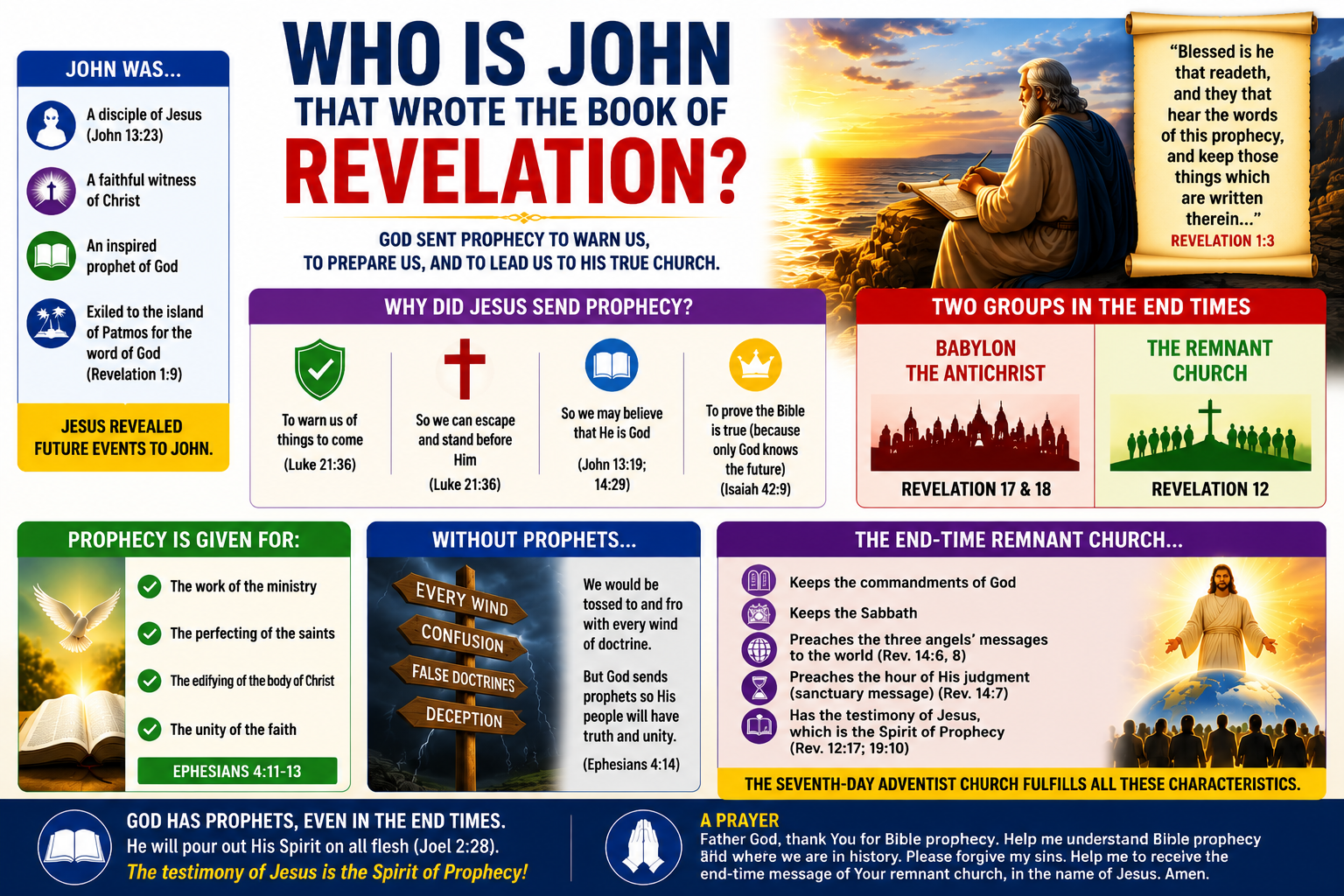
Revelation 12:17 — “And the dragon was wroth with the woman, and went to make war with the remnant of her seed, which keep the commandments of God, and have the testimony of Jesus Christ.” They are the last people who: (1) keep the commandments of God; (2) keep the Sabbath; (3) preach the three angels’ messages to the world; (4) preach the sanctuary message of the hour of His judgment; (5) have a true prophet, since the testimony of Jesus is the Spirit of Prophecy.
1 Corinthians 1:24 — “But unto them which are called, both Jews and Greeks, Christ the power of God, and the wisdom of God.” To be saved, all are called to accept the love of Jesus and the forgiveness of their sins through His death on the cross — Jews, Greeks, and all nations alike.
Galatians 3:28 — “There is neither Jew nor Greek, there is neither bond nor free, there is neither male nor female: for ye are all one in Christ Jesus.” Salvation is no longer inherited through birth, but received through conversion and faith in the love of Jesus.
Romans 9:6-8 — “Not as though the word of God hath taken none effect. For they are not all Israel, which are of Israel: Neither, because they are the seed of Abraham, are they all children: but, In Isaac shall thy seed be called. That is, They which are the children of the flesh, these are not the children of God: but the children of the promise are counted for the seed.” The children born into Israel by physical descent are no longer automatically the children of God — but the children of faith in Jesus are the true children of God.
Repeat after me: Father God, help me to accept the truth for these end times. Forgive my sins, and may Jesus come into my heart, in the name of Jesus. Amen.