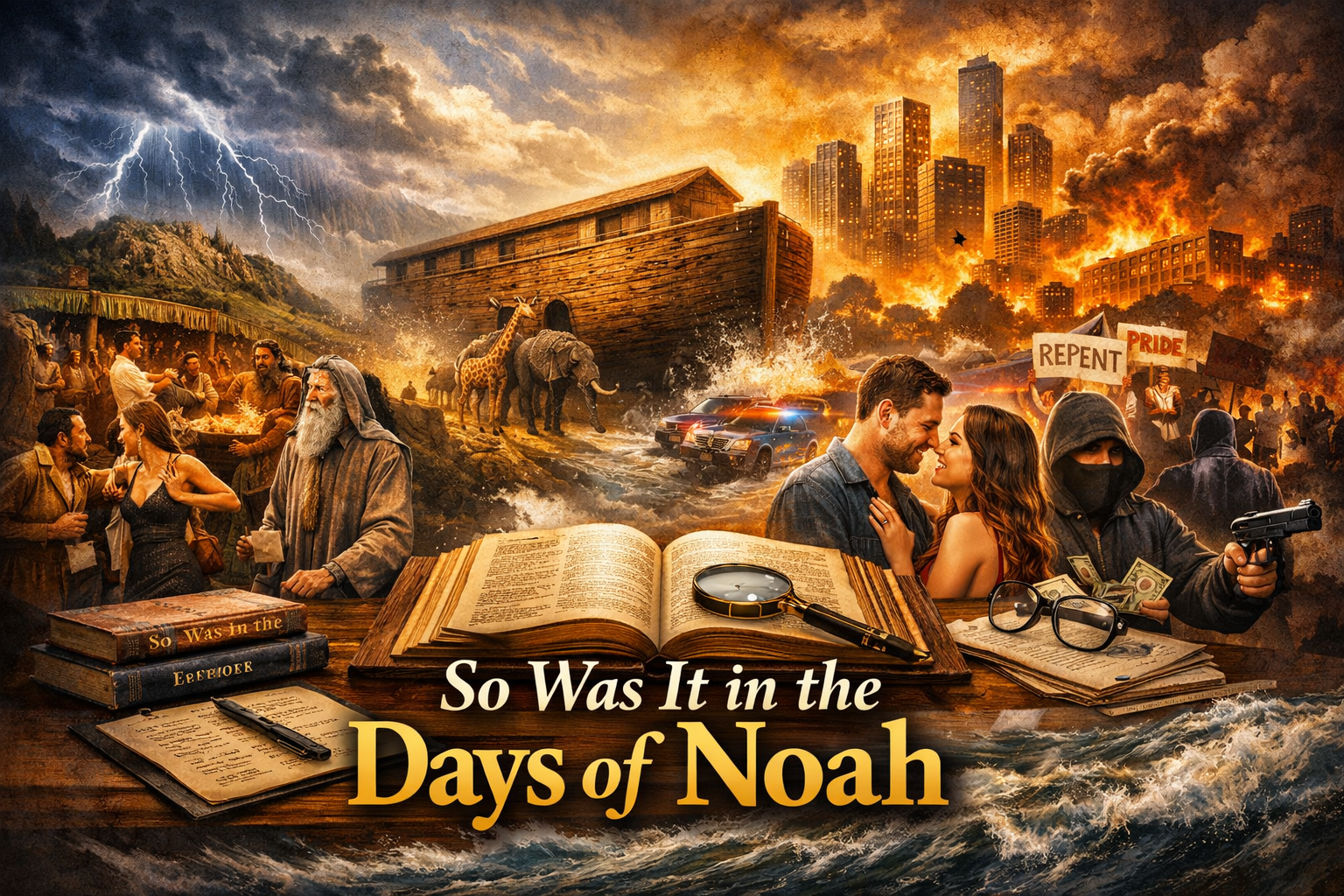
What was life like in the days of Noah, and why is it important for us to understand what happened then? This was about 2,400 years before Jesus, or roughly 4,400 years ago. The Bible tells us that the end times will resemble the days of Noah. Let us explore how we can compare our generation to the time of Noah.
“And the Lord said, My spirit shall not always strive with man, for that he also is flesh: yet his days shall be an hundred and twenty years.” (Genesis 6:3)
Here we see that God shortened the human lifespan, as He did not want men to live as they had before the flood — some living 900 years, developing and spreading evil wherever they went. A long-living, unrepentant sinner becomes a contaminating influence on society. Before the flood, people lived for many centuries — a blessing for those who wished to develop their talents, yet sadly, most people before the flood turned to evil. The Bible tells us the same pattern is unfolding today.
“There were giants in the earth in those days; and also after that, when the sons of God came in unto the daughters of men, and they bare children to them, the same became mighty men which were of old, men of renown.” (Genesis 6:4)
People thought only of love for self. The Bible is not condemning love itself here, but rather condemning the pursuit of one’s own will instead of God’s will. So was it in the days of Noah, when people thought only of themselves — though God created the earth so that we might love one another.
“And God saw that the wickedness of man was great in the earth, and that every imagination of the thoughts of his heart was only evil continually.” (Genesis 6:5)
We can scarcely imagine the depth of evil in that era. Yet today, it often seems evil goes unchecked, while minor matters that God never condemned become major points of contention in our generation. This effectively treats the Bible as untrustworthy and elevates human reasoning to the place of ultimate authority — just as happened in the days of Noah.
Human reasoning reigned supreme, while God’s words were set aside. Our society today does the same thing, making its own rules and deciding right and wrong apart from God. Sadly, many will awaken too late to realize that what truly matters for eternal life is God’s Word — and that truth is not determined by human beings, but established by God alone. So was it in the days of Noah, when people believed they alone could decide right from wrong, with no divine authority above their own thinking.
“And it repented the Lord that he had made man on the earth, and it grieved him at his heart.” (Genesis 6:6)
God must have grieved deeply to see this beautiful earth, which He created with such love and compassion, become a place filled with violent, selfish people — people who delighted in lying, cheating, and abusing one another. A place where pride and self-interest ruled the day, and God’s love and will were set aside. So was it in the days of Noah, and the same state of affairs is unfolding today.
This is why Jesus says:
“And as it was in the days of Noe, so shall it be also in the days of the Son of man.” (Luke 17:26)
“And the Lord said, I will destroy man whom I have created from the face of the earth; both man, and beast, and the creeping thing, and the fowls of the air; for it repenteth me that I have made them.” (Genesis 6:7)
Here we see that humanity’s wickedness had become so intense that God determined to bring an end to the earth’s inhabitants. We know that God is merciful, and the reason many today are not yet destroyed is that God is slow to anger. When, then, does God’s judgment fall? When a nation or individual has exceeded the limits of His forbearance.
“Because sentence against an evil work is not executed speedily, therefore the heart of the sons of men is fully set in them to do evil.” (Ecclesiastes 8:11)
Because people do not see God punishing them immediately, they continue in evil, until their hearts become filled with every kind of pride and selfishness. Often in Scripture, the word “pride” is used as nearly synonymous with evil — a fascinating study we could explore further another time. So was it in the days of Noah, when people worshiped self and believed that their accomplishments were achieved purely through human power.
“The fear of the Lord is to hate evil: pride, and arrogancy, and the evil way, and the froward mouth, do I hate.” (Proverbs 8:13)
Pride, arrogance, and the evil way are, in essence, the same thing.
“But Noah found grace in the eyes of the Lord.” (Genesis 6:8)
Noah, too, was saved by grace. It is a misconception to believe that people in the Old Testament were saved by works. They were saved by grace, but performed works to demonstrate their faith in the coming Messiah. Now that the Messiah has died on the cross, we look back and need only ask God for forgiveness.
So Was It in the Days of Noah: Unbelief
Unbelief was the defining characteristic of Noah’s time. People loved to follow the majority, never considering that the majority could be wrong. This, too, was a form of weakness, as many were afraid to stand apart and be different. They did not realize that by following the crowd, they put their own lives in danger — and ultimately perished in the flood. Can you imagine dying by drowning? What a terrible death, brought about entirely by unbelief.
It seems there must have been preachers in that day, since atheism was not yet common — people still lived close enough to creation that many continued to believe God was the Creator. But the religion of the day was one shaped by society itself. Any preacher who deviated from established religious norms appears to have been rejected. So was it in the days of Noah, who was treated as an independent preacher and rejected for it.
“And spared not the old world, but saved Noah the eighth person, a preacher of righteousness, bringing in the flood upon the world of the ungodly.” (2 Peter 2:5)
How can the Bible say that Noah “brought in” the flood? This is quite striking. We live in a time when people insist that human reasoning is paramount — most Christians today even believe that human reasoning alone is sufficient. But if that were true, why would we need God at all? If human reasoning is enough to explain the Bible, then why look to Him?
Let us, then, do away with God — which is essentially what our society is doing. Yet here we see that Noah preached both the coming flood and the end of the world, and it appears Noah was also preaching the message of righteousness by faith — further proof that people back then, too, were saved by faith. No one can be saved by works alone; if salvation came by works, there would have been no need for Jesus to die on the cross. So was it in the days of Noah, and so it is today — people believe they can save themselves, rendering the cross of Jesus of no effect.
If works alone were sufficient, the death of Jesus on the cross becomes meaningless. But humanity is not God, and apart from God, humanity is nothing. We see that God places messengers on earth, directing their words — and when those words are rejected, we reject God Himself, bringing judgment and condemnation upon ourselves. If only people would realize this: that there are people on earth led by God, and rejecting them means rejecting God and His message, bringing judgment upon ourselves.
So Was It in the Days of Noah: Men’s Words or God’s Words?
It is remarkable to see how, in churches today, when a messenger of God speaks, people assume his words come merely from his own reasoning, rather than from God. People no longer believe in absolute truth. Let us learn this lesson, as it is one of the very reasons God sent the flood upon the ancient world. So was it in the days of Noah — rejecting absolute truth opens the door to trusting human reasoning, opinions, feelings, and impressions instead.
Very often, people are led by evil spirits, and the impressions they receive frequently come from evil angels. But if God is real — which we know He is — then we can be confident that God chooses certain men and women on earth to preach the truth. If God does this, it means God speaks through His chosen agents. Would God send people to preach merely their own opinions and reasoning? Yet this is exactly what many Christians and non-Christians believe today — which amounts to mocking God and worshiping human beings and their reasoning instead.
We have the example of Moses. When the leaders of the people came and told him that his words and actions were merely his own feelings and impressions, his own will, God became deeply angry. What does this mean? It means we are each responsible for discerning who is truly sent by God, and who is acting purely on their own authority. So was it in the days of Noah — God’s words were not believed, and the people rejected God through His messenger.
So Was It in the Days of Noah: 250 Princes of Israel
“And they rose up before Moses, with certain of the children of Israel, two hundred and fifty princes of the assembly, famous in the congregation, men of renown.” (Numbers 16:2)
Here we see that the rebellion against Moses did not come from obscure individuals — it involved 250 princes of Israel, men of high position and power.
“And they gathered themselves together against Moses and against Aaron, and said unto them, Ye take too much upon you, seeing all the congregation are holy, every one of them, and the Lord is among them: wherefore then lift ye up yourselves above the congregation of the Lord?” (Numbers 16:3)
Here these princes approach Moses, insisting he has no right to rebuke the people. In doing so, they imply that they believe Moses speaks only from his own mind. They also accuse him of elevating himself above others. In essence, these princes are saying: “We do not believe God speaks through you. We do not believe God has sent you.”
This is quite remarkable, considering these men had witnessed all the plagues in Egypt. They saw the Red Sea part, saw God judge the Egyptians within it, saw the pillar of fire by night and the pillar of cloud by day — and still they did not believe. What incredible unbelief. Often, refusing to believe God’s messengers stems from unbelief itself. So was it in the days of Noah.
“And when Moses heard it, he fell upon his face: And he spake unto Korah and unto all his company, saying, Even to morrow the Lord will shew who are his, and who is holy; and will cause him to come near unto him: even him whom he hath chosen will he cause to come near unto him.” (Numbers 16:4–5)
God’s way of resolving this was to clearly reveal who was truly His servant. In this case, God acted immediately. In the case of Jesus, it took years before the Pharisees recognized Him as the Son of God. Some people are so spiritually blind that even when the earth shakes beneath an earthquake, they still refuse to believe. We could study Numbers chapter 16 in full another time — but for now, let us return to why so was it in the days of Noah.
So Was It in the Days of Noah: Selfishness
“God bestowed upon these antediluvians many and rich gifts; but they used His bounties to glorify themselves, and turned them into a curse by fixing their affections upon the gifts instead of the Giver. They employed the gold and silver, the precious stones and the choice wood, in the construction of habitations for themselves, and endeavored to excel one another in beautifying their dwellings with the most skillful workmanship.
They sought only to gratify the desires of their own proud hearts, and reveled in scenes of pleasure and wickedness. Not desiring to retain God in their knowledge, they soon came to deny His existence. They adored nature in place of the God of nature. They glorified human genius, worshiped the works of their own hands, and taught their children to bow down to graven images.” (Patriarchs and Prophets, p. 90)
Pride and selfishness were the great sins of Noah’s time. To become a true Christian, one must begin with the opposite qualities — humility and honesty, qualities that can only come from God. Pride and dishonesty stand in direct opposition to these. A Christian cannot accomplish much while harboring a lying spirit, since truth will not be welcomed where dishonesty reigns. When the people of Noah’s time heard his preaching, their hearts resisted the truth and preferred instead to believe a lie. They refused to humble themselves, repent, ask forgiveness, and escape the coming judgment. This is a fitting moment to consider the following verse:
“For Christ also hath once suffered for sins, the just for the unjust, that he might bring us to God, being put to death in the flesh, but quickened by the Spirit: By which also he went and preached unto the spirits in prison; Which sometime were disobedient, when once the longsuffering of God waited in the days of Noah, while the ark was a preparing, wherein few, that is, eight souls were saved by water.” (1 Peter 3:18–20)
Here it says Jesus went and preached — but through whom? Through the Holy Spirit. When did the Holy Spirit preach in this way? In the days of Noah, while the ark was being prepared. Some believe this verse describes Jesus going to hell, but it actually describes Jesus reaching those held captive by unbelief in Noah’s day — and notably, it was the Holy Spirit working through Noah who did the preaching, not Jesus directly. This shows us once again that certain people are specially led by God; the passage doesn’t even credit Noah with the preaching outright, but attributes the work to Jesus and the Holy Spirit acting through him.
So Was It in the Days of Noah: Pride
“This class were foremost in rejecting the preaching of Noah. As they endeavored to represent God by material objects, their minds were blinded to His majesty and power; they ceased to realize the holiness of His character, or the sacred, unchanging nature of His requirements. As sin became general, it appeared less and less sinful, and they finally declared that the divine law was no longer in force; that it was contrary to the character of God to punish transgression; and they denied that His judgments were to be visited upon the earth. Had the men of that generation obeyed the divine law, they would have recognized the voice of God in the warning of His servant; but their minds had become so blinded by rejection of light that they really believed Noah’s message to be a delusion.” (Patriarchs and Prophets, p. 95.3)
“It was not multitudes or majorities that were on the side of right. The world was arrayed against God’s justice and His laws, and Noah was regarded as a fanatic. Satan, when tempting Eve to disobey God, said to her, ‘Ye shall not surely die.’ (Genesis 3:4). Great men, worldly, honored, and wise men, repeated the same. ‘The threatenings of God,’ they said, ‘are for the purpose of intimidating, and will never be verified. You need not be alarmed. Such an event as the destruction of the world by the God who made it, and the punishment of the beings He has created, will never take place. Be at peace; fear not. Noah is a wild fanatic.’ The world made merry at the folly of the deluded old man. Instead of humbling the heart before God, they continued their disobedience and wickedness, the same as though God had not spoken to them through His servant.” (Patriarchs and Prophets, p. 96)
Here we see that the entire world stood arrayed against God. Even today, some people resist standing among the minority — many prefer to remain part of the majority, to fit in with the crowd. The great men of the day calmed the people’s fears, insisting nothing would happen, that there would be no flood. Are we learning from this lesson? This, after all, is the goal of this article — to understand why so was it in the days of Noah, so that we might avoid repeating the same error: unbelief, choosing to follow the crowd, being too proud to repent and follow truth for fear of ridicule, trusting corrupt leaders, neglecting a daily devotional life with God, and selfishness — serving only oneself.
So Was It in the Days of Noah: Defiance Against God
There was great defiance against God in that era, evident in the fact that Noah himself was mocked. Can you imagine being mocked for 120 years, yet continuing to preach because God had called you to deliver this solemn message?
“But Noah stood like a rock amid the tempest. Surrounded by popular contempt and ridicule, he distinguished himself by his holy integrity and unwavering faithfulness. A power attended his words, for it was the voice of God to man through His servant. Connection with God made him strong in the strength of infinite power, while for one hundred and twenty years his solemn voice fell upon the ears of that generation in regard to events, which, so far as human wisdom could judge, were impossible.” (Patriarchs and Prophets, p. 96.2)
“The world before the Flood reasoned that for centuries the laws of nature had been fixed. The recurring seasons had come in their order. Heretofore rain had never fallen; the earth had been watered by a mist or dew. The rivers had never yet passed their boundaries, but had borne their waters safely to the sea. Fixed decrees had kept the waters from overflowing their banks. But these reasoners did not recognize the hand of Him who had stayed the waters, saying, ‘Hitherto shalt thou come, but no further.’” (Patriarchs and Prophets, p. 96)
Just as Noah was rejected in his day, so it will be with God’s messengers who remain faithful to the Bible. It is a strange thing to see — the world does not welcome people who are humble, honest, and sincere. Do you want to save your life, and to go to heaven? The very things that happened in the days of Noah are happening again today. What would keep you from asking God to help you escape what is coming?
“Men’s hearts failing them for fear, and for looking after those things which are coming on the earth: for the powers of heaven shall be shaken. Watch ye therefore, and pray always, that ye may be accounted worthy to escape all these things that shall come to pass, and to stand before the Son of man.” (Luke 21:26, 36)
Jesus really loves you. Do you want to go to heaven? Repeat after me: Father God, forgive my sins. Help me to escape what shall come upon the earth. Give me Your righteousness. Bless and heal me, please, in the name of Jesus. Amen.
Read more amazing prophecy books — EARTHLASTDAY.COM