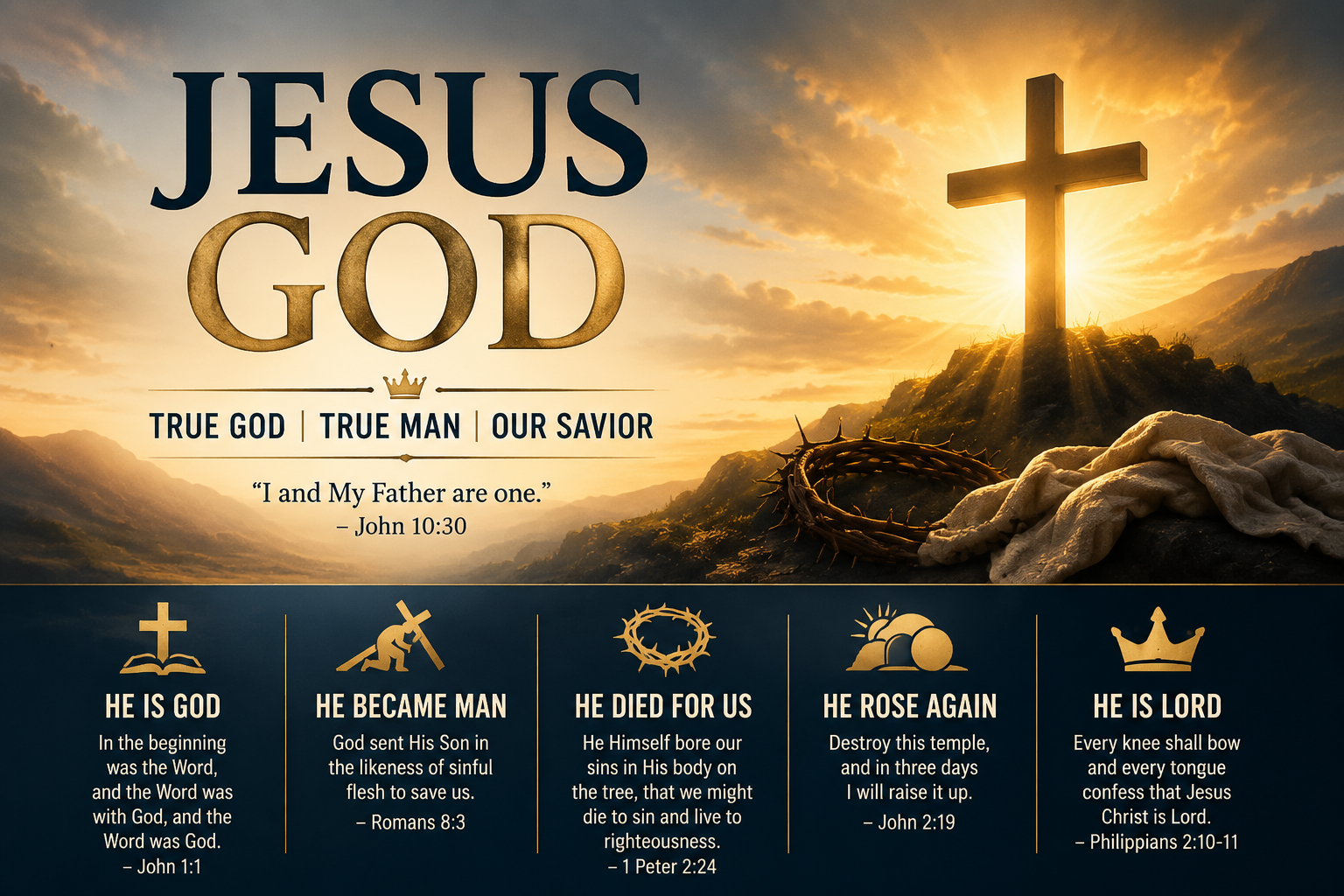
This is a very important topic, as one billion of our Muslim friends believe Jesus is not God. Millions of Hindus do not believe Jesus is God either. Jehovah’s Witnesses also do not believe that Jesus is God. Is Jesus God in Christianity? Why does this matter so much? Because what we believe on this point can affect our eternal life. Was Jesus truly born as a human? Who raised Jesus from the dead? How can Jesus be God and still die on the cross? We will try to answer these questions here, my friend.
Is Jesus God in Christianity? One God
A common misconception is the assumption that the word “one” always means a single person. If you’ve ever studied another language or traveled abroad, you may know that a single word can carry different shades of meaning depending on context. The Hebrew word for “one” doesn’t always mean strictly singular. Let us examine the meaning of “one” in Hebrew.
There are two Hebrew words for “one”: yachid and echad. Yachid refers to a strict singular — one shoe, one car, one computer. Notably, the word used for “One God” throughout Scripture is never yachid. The word consistently used is echad, which often conveys a sense of unity among multiple parts.
Echad describes things like one family, one government, or one business. “One” in this sense means unified, not necessarily singular. A family is not one individual person — it’s made up of different individuals forming a single family unit. A business is rarely a single person either — it’s typically composed of many people working together. A government, too, is made up of many people functioning as one body.
They are united in purpose, in action, and in goal, while remaining distinct individuals. When the Bible speaks of “one God,” it does not necessarily mean a single person. Consider when Pharaoh had two dreams, and Joseph said:
“And Joseph said unto Pharaoh, The dream of Pharaoh is one: God hath shewed Pharaoh what he is about to do.” (Genesis 41:25)
How could Joseph say the dream was “one,” when Pharaoh had clearly had two dreams? Pharaoh’s two dreams carried the same meaning — they were united in purpose and significance, even though they were two distinct dreams.
When God confounded the languages at the Tower of Babel, He referred to the people as “one.” Why would God describe potentially millions of people as “one”? Is Jesus God in Christianity? Yes — because God, too, is one in unity, while existing as distinct persons.
“And the Lord said, Behold, the people is one, and they have all one language; and this they begin to do: and now nothing will be restrained from them, which they have imagined to do.” (Genesis 11:6)
God knew there were many people there, yet described them as one — united by one goal, one mindset, one shared purpose. Once again, “one” does not necessarily mean a single person. “One God” can similarly mean unified in purpose, action, and goal.
This is reflected when God creates humanity in Genesis:
“And God said, Let us make man in our image, after our likeness: and let them have dominion over the fish of the sea, and over the fowl of the air, and over the cattle, and over all the earth, and over every creeping thing that creepeth upon the earth.” (Genesis 1:26)
Was God speaking to Himself here? That seems unlikely — which suggests that “God” does not refer to a single person in this context. Notably, the Hebrew word for God here is Elohim, a term denoting deity in a broader sense. If God says “let us,” then God the Father was clearly not alone in that moment. Is Jesus God in Christianity? Yes — Scripture indicates that God created the universe together with Jesus and the Holy Spirit.
Is Jesus God in Christianity? Can God Die on the Cross?
A common question from our Muslim friends is: How can Jesus be God and still die on the cross? It’s true that divinity itself cannot die — God, by nature, cannot cease to exist. But Scripture tells us that Jesus took on a human body. In doing so, Jesus never ceased to be God — He became fully human and fully divine at the same time.
“For what the law could not do, in that it was weak through the flesh, God sending his own Son in the likeness of sinful flesh, and for sin, condemned sin in the flesh.” (Romans 8:3)
Jesus took on human form because He needed to live a perfect human life in order to redeem humanity from sin.
Hebrews 9 tells us that life is found in the blood:
“And almost all things are by the law purged with blood; and without shedding of blood is no remission.” (Hebrews 9:22)
When Jesus died on the cross, His life paid the penalty for your sins and mine. Without His sacrifice, you and I would have had to bear the consequences of our own sin, since:
“For the wages of sin is death; but the gift of God is eternal life through Jesus Christ our Lord.” (Romans 6:23)
Had Jesus not come to die in our place, we would each have had to pay the price for our own sin — eternal separation from God. When Jesus died on the cross, it was the human aspect of Jesus that experienced death. As Jesus Himself said, “Destroy this body, and I will raise it up.” How could Jesus raise His own body if He were truly dead? Because the divine nature of Jesus raised up His human body.
“Jesus answered and said unto them, Destroy this temple, and in three days I will raise it up.” (John 2:19)
Jesus even told Nicodemus that He remained in heaven even while present on earth. While physically on earth, the divine nature of Jesus remained in heaven. Jesus said that no one had ascended to or descended from heaven except Himself, the One who remained there still. How could Jesus still be “in heaven” while speaking directly with Nicodemus? Is Jesus God in Christianity?
“And no man hath ascended up to heaven, but he that came down from heaven, even the Son of man which is in heaven.” (John 3:13)
The divine nature of Jesus raised up the human body of Jesus. His divine nature never died.
Is Jesus God in Christianity? When Did Jesus Say He Was God?
Jesus claimed to be God on multiple occasions. In fact, this very claim is the reason He was ultimately crucified. Jesus said that He and the Father are one.
“My Father, which gave them me, is greater than all; and no man is able to pluck them out of my Father’s hand. I and my Father are one.” (John 10:29–30)
This verse is interesting, as Jesus acknowledges that the Father is greater than He is. Was Jesus denying His own divinity here? No — this verse points to a hierarchy within the Godhead, much like a hierarchy exists within a business or government. The Father holds a position of greater authority than Jesus the Son.
But Jesus is not saying here that He isn’t God — simply that He holds a different rank within the Godhead, much as a father typically holds greater authority than his children within an earthly family. What about when Jesus said He did not know the exact hour of His own return, and that only the Father knew?
“Verily I say unto you, that this generation shall not pass, till all these things be done. Heaven and earth shall pass away: but my words shall not pass away. But of that day and that hour knoweth no man, no, not the angels which are in heaven, neither the Son, but the Father.” (Mark 13:30–32)
“But of that day and hour knoweth no man, no, not the angels of heaven, but my Father only.” (Matthew 24:36)
In these verses, Jesus again points to a rank or hierarchy within the divine nature. The Father and the Son each chose, in a sense, what to know and reveal, much as individuals maintain certain matters of privacy. It means Jesus willingly chose not to know certain things — similar to choosing not to listen when someone shares gossip or backbiting in your presence.
Is Jesus God in Christianity? Eating, Drinking, Sleeping
What about Jesus needing to eat, drink, and sleep? Because Jesus took on a human body to live on earth, He had to live as humans do — eating, sleeping, and experiencing physical needs like everyone else. Jesus could not simply rely on His divine nature to bypass these human limitations. Had He done so, it would have given Satan grounds to claim that Jesus had an unfair advantage.
Jesus had to live a fully human life. He used His divine power only to perform miracles that benefited others — never to spare Himself hardship. He ate and slept just as any human would. Is Jesus God in Christianity? Yes — and one compelling reason is that there are some 300 prophecies in the Old Testament concerning the coming of Jesus, written long before His birth.
Is Jesus God in Christianity? Prophecies About Jesus
Daniel chapter 9, written around 650 B.C., reveals the exact year Jesus would die on the cross. This is truly remarkable — how could Scripture predict, 650 years in advance, the precise timing of Jesus’ death, unless it was divinely inspired?
“Know therefore and understand, that from the going forth of the commandment to restore and to build Jerusalem unto the Messiah the Prince shall be seven weeks, and threescore and two weeks: the street shall be built again, and the wall, even in troublous times.” (Daniel 9:25)
This is known as the 2,300-year prophecy. You can read our article explaining Daniel 8:14 for further detail. This prophecy begins with the rebuilding of Jerusalem. The angel Gabriel tells us that adding 69 weeks, or 483 years, brings us to the baptism of Jesus.
This is remarkable, since Jesus was baptized in A.D. 27 — exactly 483 years after the decree to rebuild Jerusalem. Gabriel’s prophecy in Daniel 9 is striking in its precision. This same prophecy tells us that the Jewish nation would have a final period of covenant favor lasting one week, or seven years, and that Jesus would die in the middle of that seven-year period. Is Jesus God in Christianity? Yes — this prophecy offers powerful evidence pointing to Jesus’ divine identity.
In fact, written around 650 B.C., this prophecy predicted three specific events:
- Jesus would be baptized 483 years into the future.
- The Jewish nation, as a covenant people, would be set aside seven years later.
- Jesus would die on the cross in the middle of those seven years.
Did all of this happen exactly as predicted? Yes. Jesus was baptized in A.D. 27. Seven years later, in A.D. 34, the gospel formally turned toward the Gentile world. What falls in the middle of those seven years, between 27 and 34? A.D. 31 — the year Jesus was crucified, precisely as the prophecy of Daniel 9 anticipated.
In a future article, I will explore Revelation chapter 9, another remarkable piece of evidence for the Bible’s reliability. Revelation 9 speaks prophetically of the fall of the Ottoman Empire — yet it was written some 2,000 years earlier. How could Scripture know, two millennia in advance, the timing of such a specific historical event? Because the Bible is true, my friend. Is Jesus God in Christianity? Yes — Jesus is God, and the Bible can be trusted.
Did you know that Jesus loves you, my friend? Did you know that Jesus died so that you could live? Did you know that by asking forgiveness for your sins and placing your faith in Jesus’ sacrifice on the cross, you can receive eternal life? Why not repeat after me: Father God, please forgive my sins. Bless and prosper me. Give me Your righteousness. Help me to walk with You every day, reading the Bible and praying, in the name of Jesus. Amen.