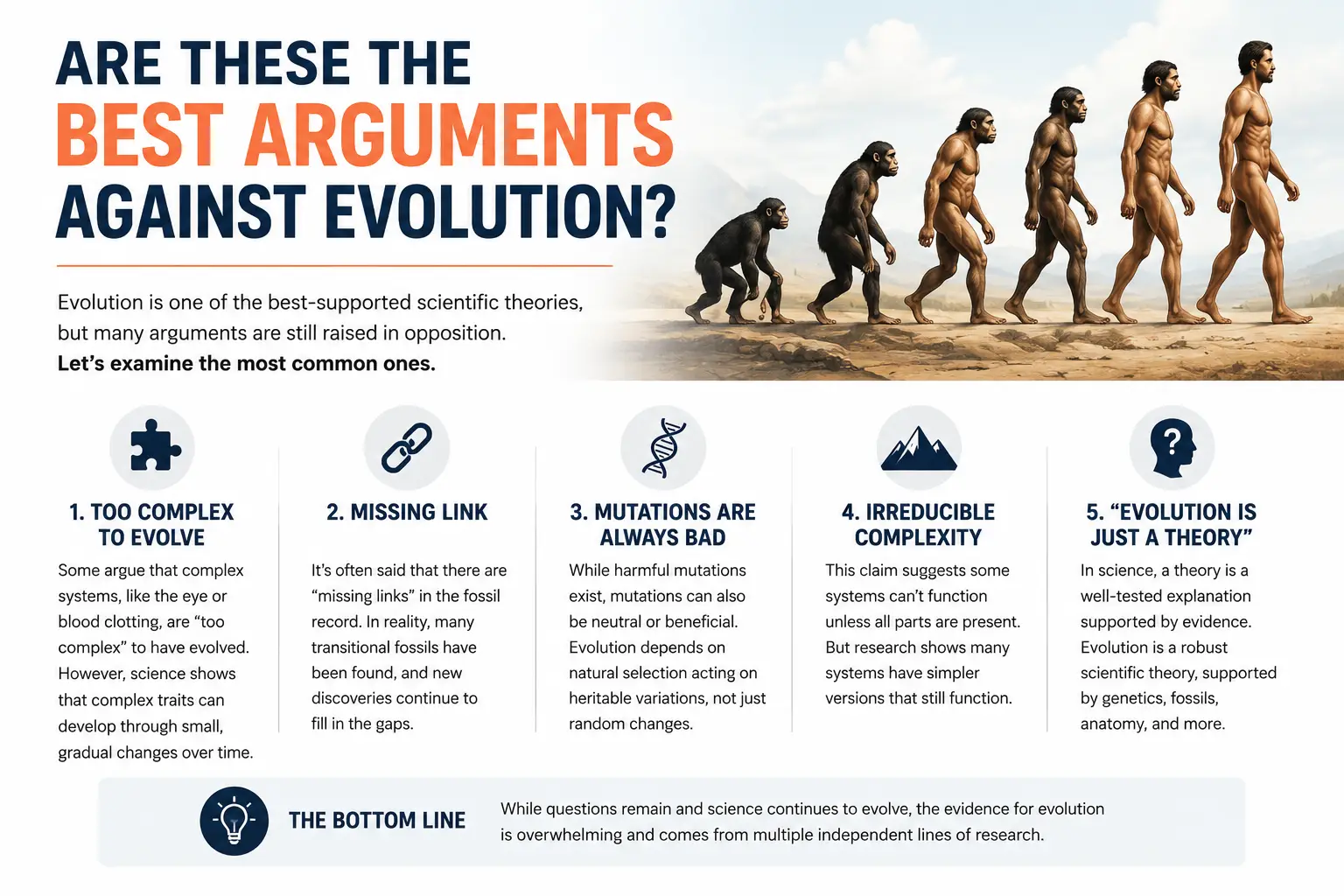
This is a very good question, as most Christians don’t know much about creation themselves. God’s word alone is enough for someone with genuine faith who reads the Bible daily. But for someone who doesn’t read the Bible regularly, their faith will remain weak, and they’ll struggle to fully believe it. Faith is like a muscle — unless it’s used, it weakens, and unless we engage with Scripture often, our faith will naturally grow weak as well. Let’s explore some of the best arguments against evolution.
Best Arguments Against Evolution? Who Will Be Saved?
Atheists are my friends — I believe many atheists can still go to heaven, and that many people who carry the Christian label, yet whose lives reveal something quite different through their actions, may not enter heaven at all. It’s not so much about the label someone claims, but about who they truly are. Someone who is kind, honest, humble, gentle, sincere, and non-judgmental has a much greater likelihood of entering heaven than many who simply identify as Christian. So, what are the best arguments against evolution?
One significant point worth noting first: the Bible itself teaches something many atheists might not expect. Many assume the Bible teaches that all Christians automatically go to heaven — but that isn’t accurate. In fact, Jesus said that many who call themselves Christians will not enter heaven. In one place, He suggests roughly half will not be allowed in; elsewhere, He indicates that many, or even the majority, will not enter. And in another passage, Jesus says that many from the east and west — meaning many who are not Christians by label — will sit and feast with Abraham.
Matthew 7:21–23 — “Not everyone who says to Me, ‘Lord, Lord,’ shall enter the kingdom of heaven, but he who does the will of My Father in heaven. Many will say to Me in that day, ‘Lord, Lord, have we not prophesied in Your name, cast out demons in Your name, and done many wonders in Your name?’ And then I will declare to them, ‘I never knew you; depart from Me, you who practice lawlessness!’”
Matthew 25:1–13 — “Then the kingdom of heaven shall be likened to ten virgins who took their lamps and went out to meet the bridegroom. Now five of them were wise, and five were foolish. Those who were foolish took their lamps and took no oil with them, but the wise took oil in their vessels with their lamps. But while the bridegroom was delayed, they all slumbered and slept. And at midnight a cry was heard: ‘Behold, the bridegroom is coming; go out to meet him!’ Then all those virgins arose and trimmed their lamps. And the foolish said to the wise, ‘Give us some of your oil, for our lamps are going out.’ But the wise answered, saying, ‘No, lest there should not be enough for us and you; but go rather to those who sell, and buy for yourselves.’ And while they went to buy, the bridegroom came, and those who were ready went in with him to the wedding; and the door was shut. Afterward the other virgins came also, saying, ‘Lord, Lord, open to us!’ But he answered and said, ‘Assuredly, I say to you, I do not know you.’ Watch therefore, for you know neither the day nor the hour in which the Son of Man is coming.”
Matthew 8:10–12 — “When Jesus heard it, He marveled, and said to those who followed, ‘Assuredly, I say to you, I have not found such great faith, not even in Israel! And I say to you that many will come from east and west, and sit down with Abraham, Isaac, and Jacob in the kingdom of heaven. But the sons of the kingdom will be cast out into outer darkness. There will be weeping and gnashing of teeth.’”
Best Arguments Against Evolution? Faith
The argument from faith is particularly interesting when exploring the best arguments against evolution. Many atheists assume that Christians base their beliefs on nothing concrete, yet there is, in fact, substantial supporting evidence — such as the roughly 300 prophecies found in the Old Testament concerning the coming of Jesus, written many years before His birth.
Prophecy stands as one of the most compelling, hard-to-dismiss arguments, since these prophecies are remarkably precise. Only someone who exists outside of time, with a divine vantage point, could accurately foretell events thousands of years in advance — as seen, for instance, in Revelation 9’s prophecy regarding the fall of the Ottoman Empire, written roughly 2,000 years in advance, pinpointing its fall to the very day: August 11, 1840.
John 14:29 — “And now I have told you before it comes, that when it does come to pass, you may believe.”
Isaiah 42:8–9 — “I am the Lord, that is My name; And My glory I will not give to another, Nor My praise to carved images. Behold, the former things have come to pass, And new things I declare; Before they spring forth I tell you of them.”
Do atheists have faith of their own? Yes — faith in academic credentials, faith in those labeled “scientists,” and significant trust placed in human reasoning and human conclusions. This is worth examining carefully. While religious individuals openly acknowledge their faith in God and Scripture, atheists, to be fully honest, must also recognize that they too operate on a kind of faith — faith in human reasoning itself.
Exploring the best arguments against evolution further, we find there’s no definitive proof that the earth and universe simply arose from nothing. Small, observable changes within species don’t constitute proof against divine involvement, since God could easily work through small, gradual changes as well — and no one has demonstrated that such minor changes have ever produced an entirely new kind of creature.
Both perspectives ultimately rest on a form of faith. Christians place faith in biblical prophecy and in the conviction that the world we observe couldn’t have arisen by pure chance, from nothing, for no reason. Atheists place faith in the assumption that human reasoning is essentially infallible, and that small, hoped-for changes over time have produced everything we see. Both positions, in this sense, involve belief systems rooted in faith.
Best Arguments Against Evolution? Natural Selection and Planning
Can anything come into existence without being planned first? This is one of the strongest arguments against evolution. We’re not aiming to attack anyone personally — we value unity, love, and respect for everyone — but we do believe in pursuing truth, and that truth deserves to be followed. And even where disagreement remains after a respectful discussion, there’s value in what we can learn from one another along the way.
This particular argument was reportedly presented to around 3,000 atheists, including several prominent scientists, and not one was able to satisfactorily answer it. Some deflected the core issue, but no one could fully resolve it. The argument states that nothing can come into existence without first being planned. A car, a shoe, a plane, a building, a computer — all require deliberate planning to exist. The same logic applies more broadly: for anything to exist, it requires planning.
Without that planning, existence would essentially require something akin to magic. A piece of wood cannot become a castle, even given billions of years. A piece of raw metal will never become a finished car, no matter how much time passes. How much more true is this for living organisms, which are far more complex than cars or computers? This suggests that, often without realizing it, atheists attribute almost divine creative power to natural selection. Let’s examine natural selection more closely.
Does natural selection possess a brain, intelligence, or awareness? No — and without these, it cannot plan anything. God designed natural selection as a mechanism to help preserve and adapt species to their environments. If a population moves from Siberia to Africa, for example, it adapts to the new climate and food sources over time. This is adaptation — it doesn’t create an entirely new species; it simply adjusts existing traits. We see small dogs and large dogs, but there is no genetic pathway within “dog” to eventually produce something like an elephant. The only way for entirely new forms to appear without planning would be through something akin to magic — and there’s no other mechanism evolution offers to explain it.
An atheist might respond, “I don’t believe it’s magic” — but the honest reality is that no one has fully explained how natural selection, lacking any brain, intelligence, or capacity for planning, could create entirely new, complex forms of life. If something cannot be fully explained through demonstrable, testable mechanisms, it falls outside strict science — it remains, in a sense, a belief held by faith. If a human being could theoretically emerge purely through chance and random assembly, then, by the same logic, a piece of wood could randomly assemble itself into a castle — yet we know this is mathematically impossible.
Building a castle requires intelligence, planning, purpose, and carefully assembled materials. The same logic applies to animals and human beings. Such remarkably complex biological systems cannot reasonably emerge gradually, for no reason, from nothing. Even gradual development would require an underlying purpose and direction — yet without any reasoning capacity, natural selection has no plan and no direction. And without direction, nothing complex can be coherently assembled or created.
Best Arguments Against Evolution? Complexity
This leads to another one of the best arguments against evolution: complexity. How could a purely random process produce something as precise, complex, and intricately assembled as living organisms, seemingly from nothing? It seems mathematically and logically implausible. A functioning machine requires many interdependent parts working together — a car engine missing even a single critical component simply won’t run. Could a car have come together one piece at a time, functioning at each incomplete stage? No — it would have been useless for however long it took to fully assemble.
In the same way, complexity poses a serious challenge to any belief that complex life emerged without intelligence, planning, or direction. Without direction, there can be no coherent end goal or purpose. As even Darwin himself acknowledged, nature would appear chaotic and disorganized if his theory played out without limits — we might expect strange hybrid creatures, like part-monkey, part-car oddities, or giraffes with lion-like traits.
An engine cannot function unless all its components arrive together, properly assembled, at the same time — remove a single part, and the whole system fails. Similarly, a human being could not have emerged one piece at a time — an arm appearing, then millions of years later a foot, then kidneys, then a neck. This sequence doesn’t hold up logically. All the necessary biological systems need to be present and functioning together simultaneously for a human being to be alive at all.
A human cannot survive without a functioning circulatory system, a brain, or a digestive system. And since natural selection cannot think, plan, feel, or direct outcomes toward any goal, it seems unable to have produced such intricately interconnected systems on its own. Natural selection functions more as a built-in mechanism for preserving and adapting existing species, rather than as a creative force capable of generating entirely new, complex life forms.
Best Arguments Against Evolution? The Apparent Young Age of Things
Several observations point to a relatively young age for certain natural features — the oldest known trees are roughly 4,000 years old, the oldest coral reefs appear to be around 4,000 years old as well, and the oldest known comets seem to be only a few thousand years old. If the earth were truly billions of years old, why don’t we find trees, coral reefs, or other natural features that are billions of years old themselves? Coral reef age, for instance, can be estimated based on known growth rates.
Additionally, the earth’s rotation is gradually slowing by a small amount each year. If the earth were truly billions of years old, this would imply that, at some point in the distant past, it would have been spinning so rapidly that sustaining life would have been impossible.
Fossils of animals believed to be millions of years old often appear essentially identical to animals we see today. If evolution had been continuously occurring over such vast timescales, we might expect to see much more dramatic change reflected in the fossil record. This represents a notable challenge for evolutionary theory. There are, of course, genuinely scientific, testable elements within modern science — but these are sometimes blended together with broader philosophical assumptions, and people don’t always realize that accepting demonstrable facts doesn’t necessarily mean accepting every accompanying assumption as equally proven.
True science, in its purest form, involves what can be directly tested, observed, and demonstrated. Alongside genuinely provable scientific facts — astronomical measurements, for instance — broader interpretive frameworks have also been introduced, such as deep-time assumptions, the Big Bang model, the standard geological column, and continental configurations like Pangea. These broader interpretive frameworks involve more philosophical reasoning than direct, repeatable demonstration.
We hope this has helped you better understand the creation perspective. We’re all neighbors and fellow human beings sharing this earth, and there’s real value in working together with mutual respect, even amid differing beliefs — no two people see everything exactly alike. We hope this discussion has offered a thought-provoking look at creation. Feel free to visit our creation-focused video page and our creation books page to learn more.