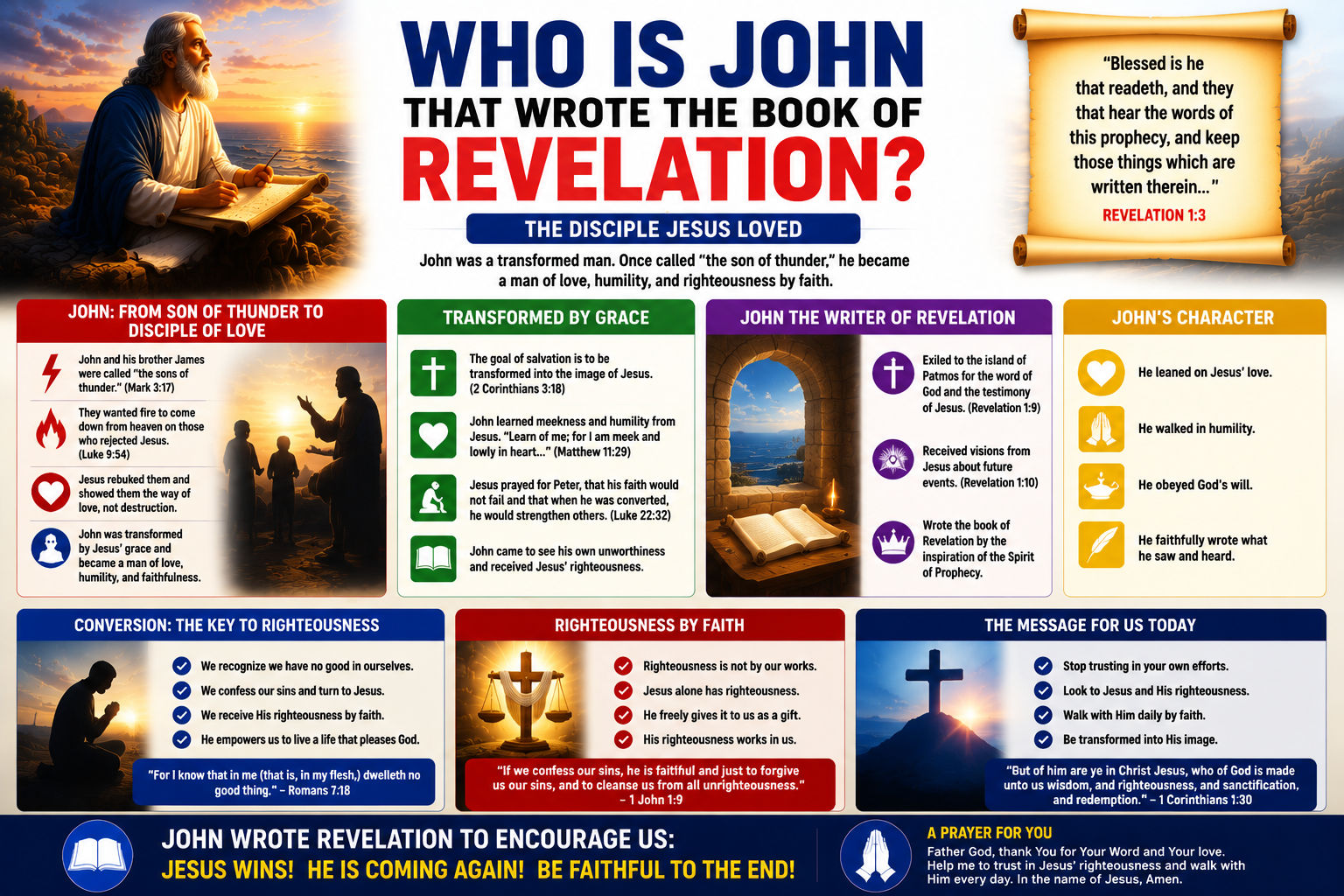
This is what the Bible says about who John, the writer of the book of Revelation, truly was. John was also called the disciple Jesus loved. Why does the Bible say this, when we know Jesus loved everybody? Does Jesus love some people more than others? In a sense, yes — John resembled Jesus the most, and this is why Jesus loved him so deeply.
The goal of salvation, and the reason Jesus died on the cross, is so that human beings can be transformed into the image of Jesus. We can become transformed into the image of Satan, or into the image of Jesus — there is no other choice. Self, which was cultivated by Satan, or unselfish love, like Jesus. The Bible says Jesus was meek and lowly; Jesus was honest and humble.
Matthew 11:29 — “Take my yoke upon you, and learn of me; for I am meek and lowly in heart: and ye shall find rest unto your souls.”
2 Corinthians 3:18 — “But we all, with open face beholding as in a glass the glory of the Lord, are changed into the same image from glory to glory, even as by the Spirit of the Lord.”
In seeking to understand who John, the writer of Revelation, truly was, we find that he displayed the most divine character traits of all the apostles. But John did not start out this way.
John the Son of Thunder
John and his brother James were called “the sons of thunder.” They did not begin as gentle, kind men. Peter, too, was self-important and at times cowardly. But Jesus told him: “When you are converted…” — meaning that at the time, they were not yet converted. To tell the truth, very few Christians are truly converted. Most Christians simply follow a few rules, but this does not mean their heart has been changed, or that they are truly Christians.
Luke 22:32 — “But I have prayed for thee, that thy faith fail not: and when thou art converted, strengthen thy brethren.”
Mark 3:17 — “And James the son of Zebedee, and John the brother of James; and he surnamed them Boanerges, which is, The sons of thunder.”
Having a distinct personality and being original is good — but serious defects of character will keep us out of heaven. Did you know that when Jesus returns, He will not remove our defects of character or our sins at that moment? Pride, selfishness, rudeness, unkindness, apathy, lying — the Bible teaches that when Jesus returns, He will give us a new body: an immortal body in place of a mortal one. Now, while we live, is the time to let Jesus’s grace remove our sins and defects of character.
1 Corinthians 15:53 — “For this corruptible must put on incorruption, and this mortal must put on immortality.”
John was an angry man — possibly judgmental, and quick to condemn others without sufficient reason. Like the Pharisees, legalists are often quick to condemn while believing themselves faultless.
Luke 9:52-56 — “And sent messengers before his face: and they went, and entered into a village of the Samaritans, to make ready for him. And they did not receive him, because his face was as though he would go to Jerusalem. And when his disciples James and John saw this, they said, Lord, wilt thou that we command fire to come down from heaven, and consume them, even as Elias did? But he turned, and rebuked them, and said, Ye know not what manner of spirit ye are of. For the Son of man is not come to destroy men’s lives, but to save them. And they went to another village.”
John, in this case, wanted an entire city destroyed simply because they refused to host Jesus. God knows that for people to be condemned, they must reject the truth repeatedly and persistently. It is very possible that, later on, many people in that very town accepted and loved Jesus — God is merciful. This swift impulse to condemn and criticize, judging from a worldly standpoint, was a spirit that needed to be removed from John.
Like all of us, John was once an unconverted man. Most of the apostles remained unconverted even after spending a long time with Jesus — it is possible that the apostles only became truly converted after Jesus’s death.
In the Gospel of Luke, Jesus tells Peter that he is still unconverted.
Luke 22:32 — “But I have prayed for thee, that thy faith fail not: and when thou art converted, strengthen thy brethren.” A converted person, as we will see later in this article, is someone who: (1) realizes there is nothing good within themselves, and (2) receives Jesus’s righteousness. A proud person, or someone who believes they are already good, cannot receive Jesus’s righteousness.
In Matthew’s Gospel, all the apostles seek to know who among them is the greatest. Jesus’s answer implies that none of them was yet truly converted — can an unconverted person be called a Christian? When Jesus told His disciples, “when you become converted,” He was telling them, in effect, that none of them yet were.
Matthew 18:1-4 — “At the same time came the disciples unto Jesus, saying, Who is the greatest in the kingdom of heaven? And Jesus called a little child unto him, and set him in the midst of them, And said, Verily I say unto you, Except ye be converted, and become as little children, ye shall not enter into the kingdom of heaven. Whosoever therefore shall humble himself as this little child, the same is greatest in the kingdom of heaven.”
The Unconverted Men of the Bible
When we read the Bible, we see that God uses people that worldly men would never consider good — men the world would call worthless or outcasts. Did you know that much of the Bible was written by two murderers? Moses killed a man and fled to Midian. Paul, in the New Testament, used all his power to persecute and kill Christians — this is why Paul said he was unworthy to be called an apostle.
1 Corinthians 15:9 — “For I am the least of the apostles, that am not meet to be called an apostle, because I persecuted the church of God.”
Exodus 2:11-12 — “And it came to pass in those days, when Moses was grown, that he went out unto his brethren, and looked on their burdens: and he spied an Egyptian smiting an Hebrew, one of his brethren. And he looked this way and that way, and when he saw that there was no man, he slew the Egyptian, and hid him in the sand.”
It is incredible to consider that two murderers — Paul and Moses — wrote much of the Bible.
We also have Isaiah, who, upon seeing God’s glory, recognized how wicked he truly was — yet he became a prophet.
Isaiah 6:5 — “Then said I, Woe is me! for I am undone; because I am a man of unclean lips, and I dwell in the midst of a people of unclean lips: for mine eyes have seen the King, the Lord of hosts.”
We have Peter, who, when certain Jews arrived, withdrew from eating with Gentiles for fear of what others would think of him — an act of cowardice.
Galatians 2:12-13 — “For before that certain came from James, he did eat with the Gentiles: but when they were come, he withdrew and separated himself, fearing them which were of the circumcision. And the other Jews dissembled likewise with him; insomuch that Barnabas also was carried away with their dissimulation.” This same Peter, who once told Jesus he would die for Him, later denied even knowing who Jesus was.
Luke 22:56-57 — “But a certain maid beheld him as he sat by the fire, and earnestly looked upon him, and said, This man was also with him. And he denied him, saying, Woman, I know him not.”
We have Abraham, who also lied out of fear.
Genesis 12:13 — “Say, I pray thee, thou art my sister: that it may be well with me for thy sake; and my soul shall live because of thee.”
We could continue listing men who were once wicked yet called by God — but they became converted. In seeking to know who John, the writer of Revelation, truly was, we discover this essential truth: one must first recognize that there is nothing good within oneself.
Jesus cannot give His righteousness to someone who believes they are already good, or to someone who believes their own works count toward eternal life. Conversion happens only when we realize there is nothing good in us.
Romans 7:18 — “For I know that in me (that is, in my flesh,) dwelleth no good thing: for to will is present with me; but how to perform that which is good I find not.”
Romans 3:23 — “For all have sinned, and come short of the glory of God.”
John Becomes Converted
This is the most beautiful topic in the Bible. Most Christians are not truly converted, and as we have seen, they cannot rightly even be called Christians in the deepest sense. Following a set of rules, or giving mental assent to certain knowledge, does not mean the heart has been changed.
A person can know a great deal about the Bible and still be a deeply wicked person. Many people also believe that good and evil are simply whatever society decides. Nothing could be further from the truth. Truth comes from God — man has no power, and no right, to decide what truth is. This is insolence and idolatry. When men place themselves above God, as we see happening today, we should fear, because we know God’s judgments will fall terribly.
Human reasoning is utterly confused. We do not know anything of ourselves on our own.
1 Corinthians 4:3-4 — “For I know nothing by myself; yet am I not hereby justified: but he that judgeth me is the Lord.”
Ephesians 4:18 — “Having the understanding darkened, being alienated from the life of God through the ignorance that is in them, because of the blindness of their heart.”
Romans 1:28 — “And even as they did not like to retain God in their knowledge, God gave them over to a reprobate mind, to do those things which are not convenient.”
To become converted is to recognize that no human being is inherently good. The best works of human beings cannot attain salvation or help anyone enter heaven. Jesus works in me, but my own works are worthless on their own. Every Bible character we’ve mentioned, despite serious defects of character, overcame through the righteousness of Jesus — they were transformed.
Jesus Alone Has Righteousness
Human beings are unrighteous, unable to do good on our own. Jesus alone has righteousness. What is righteousness? Simply put, right-doing. To most people, someone who doesn’t lie, who keeps the Sabbath, and so on, seems like a good person. But God knows that our best works are tainted by selfishness, pride, and every kind of subtle wickedness — which is why our best works are ultimately worthless before Him.
Isaiah 64:5-6 — “But we are all as an unclean thing, and all our righteousnesses are as filthy rags; and we all do fade as a leaf; and our iniquities, like the wind, have taken us away.”
John 17:25 — “O righteous Father, the world hath not known thee: but I have known thee, and these have known that thou hast sent me.”
John 7:18 — “He that speaketh of himself seeketh his own glory: but he that seeketh his glory that sent him, the same is true, and no unrighteousness is in him.”
Romans 9:14 — “What shall we say then? Is there unrighteousness with God? God forbid.”
Man Has No Righteousness of His Own
1 John 1:9 — “If we confess our sins, he is faithful and just to forgive us our sins, and to cleanse us from all unrighteousness.”
Romans 1:18 — “For the wrath of God is revealed from heaven against all ungodliness and unrighteousness of men, who hold the truth in unrighteousness… Being filled with all unrighteousness.”
Who is John that wrote the book of Revelation? He was someone who came to recognize the beauty of Jesus’s character — incredible humility instead of pride, honesty instead of lying, kindness instead of hatred, fervent love instead of an uncaring, apathetic spirit. This is what moved him.
Righteousness is not something we do — righteousness is being made righteous by a power above us. We are not made righteous by our actions. John wanted to become like Jesus. The transformation of character can only be accomplished by God — we cannot change anything within ourselves. Sadly, most religions on earth, both pagan and Christian (including Catholicism), teach that one attains perfection of character and heaven through one’s own works.
Matthew 11:29 — “Take my yoke upon you, and learn of me; for I am meek and lowly in heart: and ye shall find rest unto your souls.”
1 Corinthians 1:30 — “But of him are ye in Christ Jesus, who of God is made unto us wisdom, and righteousness, and sanctification, and redemption.”
Sadly, most people are so proud that they refuse to recognize that they are utterly without merit before God. Even mixing our own efforts with Jesus’s righteousness is a form of legalism, and leaves a person in a lost condition. Many Christians will say, “I believe in grace alone,” and then add, “and my own efforts and works” — this mixes truth with error, and such people remain in a lost condition. If we are saved by works as well as by grace, then we cannot truly be saved by grace.
Romans 11:6 — “And if by grace, then is it no more of works: otherwise grace is no more grace. But if it be of works, then it is no more grace: otherwise work is no more work.” If I could save myself by my own works, why would I need Jesus at all? Why did Jesus die on the cross, if any human being could attain heaven through their own efforts?
Are We Saved by Works Also?
James 2:24 — “Ye see then how that by works a man is justified, and not by faith only.” One day I was in a church, and an elder quoted this verse. I asked him: where in this verse does it say that the works come from man? Nowhere in this verse does it say that man performs the works. Jesus said that the works He did came from the Father.
John 14:10 — “Believest thou not that I am in the Father, and the Father in me? the words that I speak unto you I speak not of myself: but the Father that dwelleth in me, he doeth the works.” James was saying that we are saved by faith — but does this mean we can transgress the law? No. The Bible teaches that we cannot keep the law in our own strength. So what is the solution?
- Recognize that we are sinful and unable to obey on our own.
- Ask Jesus to give us His righteousness.
Since we have no righteousness of our own, the only way we can do right is through Him who possesses righteousness. As an amazing gift, filled with love and kindness, Jesus freely gives us His righteousness.
This has been the most beautiful message of Jesus in my life. I was a legalist for a long time, until Jesus showed me this truth. My Christian walk has become so much happier and more peaceful since then — no more constantly worrying whether I’m doing the right thing, no more anxiety over how much I need to do. Today, I make no effort whatsoever on my own. Instead, every morning I ask Jesus to give me His righteousness. Jesus obeys through me; Jesus overcomes sin through me. None of it is my own effort — this is why it is called righteousness by faith.
I recommend reading the works of Alonzo T. Jones and Ellet J. Waggoner, the two messengers of righteousness by faith.
Repeat after me: Father God, I pray You will forgive my sins. Please give me Your righteousness; help me to understand this topic and to no longer be a legalist. In the name of Jesus, amen.