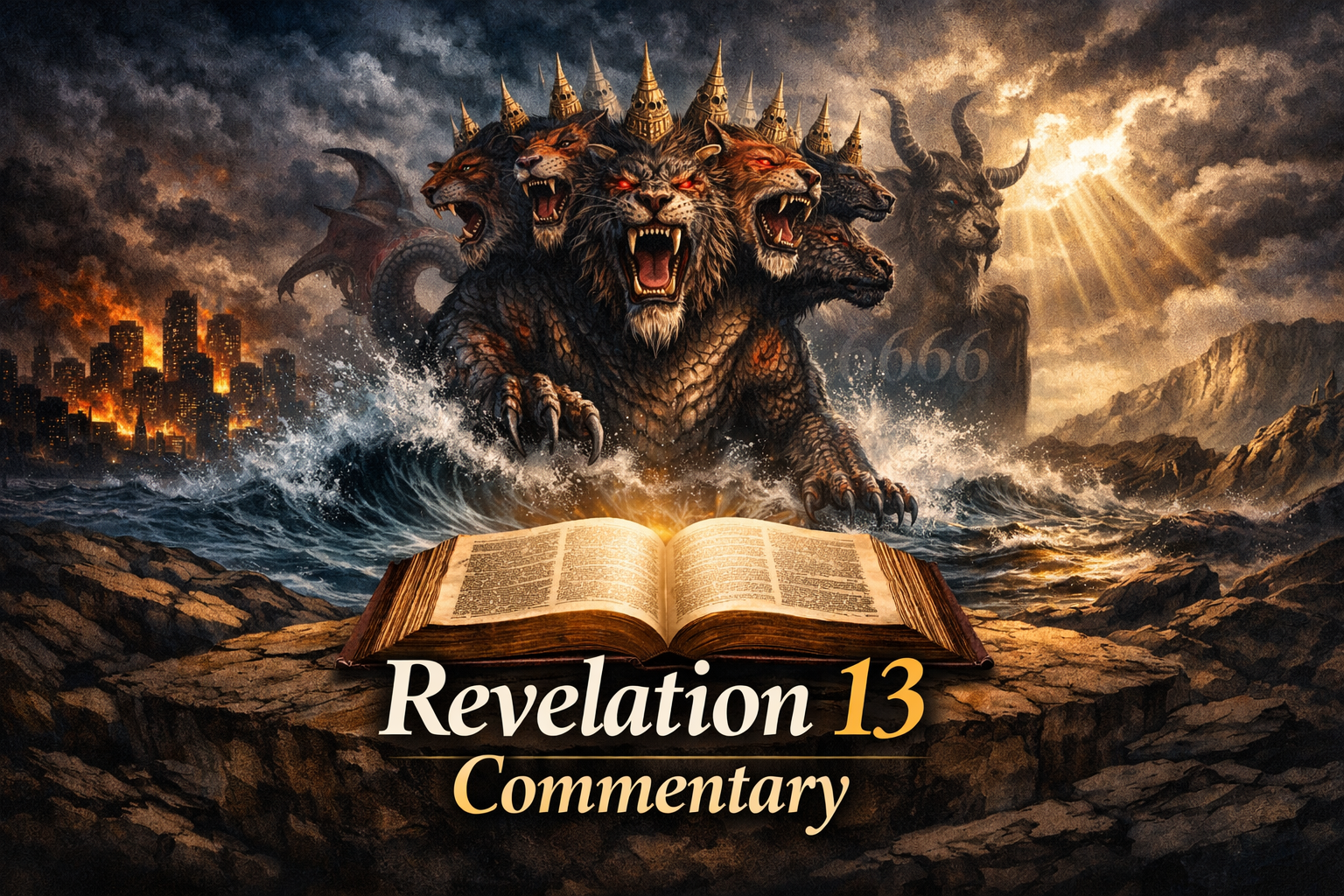
Here is an explanation of chapter 13 of the book of Revelation. This chapter is key to understanding who the beast and Babylon are. This Revelation 13 commentary helps us understand what will soon take place, as this chapter tells us that the first beast joins forces with a very powerful world power. This chapter tells us that this world power gives the beast its authority and performs false miracles. Who is the beast in this Revelation 13 commentary? Who is this second beast? What will they do to the inhabitants of the earth?
“And I stood upon the sand of the sea, and saw a beast rise up out of the sea, having seven heads and ten horns, and upon his horns ten crowns, and upon his heads the name of blasphemy.” (Revelation 13:1)
The sea represents peoples, multitudes. The Bible tells us that prophecy did not come by the will of man — the explanations of biblical symbols are found elsewhere in Scripture itself.
“And he saith unto me, The waters which thou sawest, where the whore sitteth, are peoples, and multitudes, and nations, and tongues.” (Revelation 17:15)
This verse tells us that John saw a beast rising out of the sea. Who is this beast? Reading further, we see that this beast corresponds to the four beasts of Daniel chapter 7. In Daniel 7, we learn that Babylon is the first kingdom, followed by Medo-Persia, then Greece, then Rome — and out of Rome arises a little-horn power, the antichrist, also called Babylon.
This beast speaks blasphemy. What is blasphemy? Let us find the answer in Scripture. This Revelation 13 commentary is filled with symbolic language. Many try to interpret the Bible according to their own preferences, but the Bible itself tells us we cannot do this — we must let God interpret His own Word.
“For the prophecy came not in old time by the will of man: but holy men of God spake as they were moved by the Holy Ghost.” (2 Peter 1:21)
Men spoke the revelations of God, but the interpretation comes from God Himself. The symbols in this Revelation 13 commentary are explained by Scripture, not by human interpretation.
“And the beast which I saw was like unto a leopard, and his feet were as the feet of a bear, and his mouth as the mouth of a lion: and the dragon gave him his power, and his seat, and great authority.” (Revelation 13:2)
These four beasts appear in Daniel chapter 7, and correspond to the same four kingdoms represented in the statue of Daniel chapter 2. These four beasts begin with Babylon, as Daniel tells Nebuchadnezzar in Daniel 2: “Thou art this head of gold.” Babylon is also the first of these four beasts. If Babylon is the first of these four kingdoms, can we identify which kingdom followed it in history? Yes.
“And wheresoever the children of men dwell, the beasts of the field and the fowls of the heaven hath he given into thine hand, and hath made thee ruler over them all. Thou art this head of gold.” (Daniel 2:38)
Babylon is the head of gold, and the lion is the first of the four beasts.
“These great beasts, which are four, are four kings, which shall arise out of the earth.” (Daniel 7:17)
Instead of four separate beasts or kingdoms, as in Daniel 7, here in this Revelation 13 commentary, the four beasts are combined into one. We also read that the dragon gives this beast its power, its seat, and its authority. Who is the dragon? We learn in Revelation 12 that the dragon is Satan.
“And the great dragon was cast out, that old serpent, called the Devil, and Satan, which deceiveth the whole world: he was cast out into the earth, and his angels were cast out with him.” (Revelation 12:9)
This means that these four kingdoms, combined into one end-time power, receive their authority from Satan to rule the world. It is remarkable to understand that the power ruling the earth in the end time is ultimately governed by Satan — and that most people on earth, because they do not study the Bible, will be deceived by it.
“And I saw one of his heads as it were wounded to death; and his deadly wound was healed: and all the world wondered after the beast.” (Revelation 13:3)
Here we read of a deadly wound. The Bible often refers to the 1,260 days, or years, of papal persecution — so we understand that this wound occurs at the end of that period, marking the end of the papacy’s dominant rule. What happened then? Napoleon’s general, Berthier, took the pope captive in 1798, dealing a deadly wound to the papacy.
The papacy began in 538, when Justinian granted it both spiritual and temporal authority. Adding 1,260 years brings us to the deadly wound of 1798. This Revelation 13 commentary tells us that this wound would be healed — that the papacy, having lost its former power over kings and rulers, would regain all the influence it once held. Could this mean a revival of the Inquisition? Let us continue reading.
“And they worshipped the dragon which gave power unto the beast: and they worshipped the beast, saying, Who is like unto the beast? who is able to make war with him?” (Revelation 13:4)
A time will come when all the earth’s inhabitants will worship the beast. We know from Daniel 7 that this beast can be none other than the papacy. This Revelation 13 commentary tells the story of the two beasts of Revelation uniting together. This power:
- Rules for 1,260 years
- Has a man who speaks blasphemies
- Uproots three pagan kingdoms
- Seeks to change the Sabbath to Sunday
- Persecutes millions of Christians
- Sits on a city of seven hills
- Has prelates who wear purple and scarlet
- Has a leader whose name corresponds to the number 666
No other power on earth fulfills all these characteristics. The papacy ruled for 1,260 years, experiencing a major setback in 1798. The papacy is now regaining its lost influence. It persecuted some 50 million Christians during the Middle Ages and the Inquisition. It has a leader who claims to represent God and to forgive sins. It sought to change the Sabbath from Saturday to Sunday. It resides in Rome, the city of seven hills, and its prelates wear scarlet and purple. How precise and remarkable the Bible’s description is — this can be fulfilled by only one power: the papacy.
“And there was given unto him a mouth speaking great things and blasphemies; and power was given unto him to continue forty and two months.” (Revelation 13:5)
What is blasphemy? Let us see what Scripture says. The Pharisees accused Jesus of blasphemy because He claimed: (1) to be God, and (2) to have the power to forgive sins. Jesus was not blaspheming, because He truly is God. Does the pope, or the Catholic priesthood, claim the authority to forgive sins? Yes. Does the pope claim to be God, or God’s representative on earth? Yes. This is blasphemy.
“The Jews answered him, saying, For a good work we stone thee not; but for blasphemy; and because that thou, being a man, makest thyself God.” (John 10:33)
“Why doth this man thus speak blasphemies? who can forgive sins but God only?” (Mark 2:7)
Here we see that, out of unbelief, the Pharisees refused to accept that Jesus was God. Do we have direct quotes from papal sources claiming the authority to forgive sins and represent God on earth? This Revelation 13 commentary offers remarkable insight into end-time events and how earth’s history will conclude.
The Pope Claims to Be God on Earth
“The Pope is not simply the representative of Jesus Christ. On the contrary, he is Jesus Christ Himself, under the veil of the flesh, and who by means of a being common to humanity continues His ministry amongst men… Does the Pope speak? It is Jesus Christ Who is speaking. Does he teach? It is Jesus Christ Who teaches. Does he confer grace or pronounce an anathema? It is Jesus Christ Himself Who is pronouncing the anathema and conferring the grace. Hence consequently, when one speaks of the Pope, it is not necessary to examine, but to obey… Therefore by Divine ordination, all, no matter how august the person may be — whether he wear a crown or be invested with the purple, or be clothed in the sacred vestments: all must be subject to Him Who has had all things put under Him.” — Evangelical Christendom, January 1, 1895, p. 15, published in London by J. S. Phillips
“It seems that Pope John Paul II now presides over the universal Church from his place upon Christ’s cross.” — “Auckland Bishop Says Pope Presides From the Cross,” Auckland, New Zealand, September 20, 2004, Zenit.org
“In founders and foundresses [of the consecrated orders of nuns and priests, etc.] we see a constant and lively sense of the Church, which they manifest by their full participation in all aspects of the Church’s life, and in their ready obedience to the bishops and especially to the Roman Pontiff… A distinctive aspect of ecclesial communion is allegiance of mind and heart to the magisterium of the bishops, an allegiance which must be lived honestly and clearly testified to before the People of God by all consecrated persons.” — Pope John Paul II, “Apostolic Exhortation on the Consecrated Life and Its Mission in the Church and in the World,” Rome, March 25, 1996
“It seems that Pope John Paul II now presides over the universal Church from his place upon Christ’s cross,” said Bishop Dunn, who traveled with seven other prelates to Rome. — “Auckland Bishop Says Pope Presides From the Cross,” Auckland, New Zealand, September 20, 2004, Zenit.org (Article #ZE04092001)
“The Pope is of so great dignity, and so exalted that he is not a mere man, but as it were God, and the vicar of God.” — Ferraris’ Ecclesiastical Dictionary; Pope Pius V
“All names which in the Scriptures are applied to Christ, by virtue of which it is established that He is over the church, all the same names are applied to the Pope.” — On the Authority of the Councils, Book 2, Chapter 17
“The Pope and God are the same, so he has all power in Heaven and earth.” — Pope Pius V, quoted in Barclay, Chapter XXVII, p. 218
“…the Pope is as it were God on earth, sole sovereign of the faithful of Christ, chief of kings, having plenitude of power.” — Lucius Ferraris, Prompta Bibliotheca Canonica, Juridica, Moralis, Theologica, Ascetica, Polemica, Rubristica, Historica, Volume V, article “Papa, Article II,” published in Paris by J. P. Migne, 1858 edition
“The Pope takes the place of Jesus Christ on earth… by divine right the Pope has supreme and full power in faith, in morals over each and every pastor and his flock. He is the true vicar, the head of the entire church, the father and teacher of all Christians. He is the infallible ruler, the founder of dogmas, the author of and the judge of councils; the universal ruler of truth, the arbiter of the world, the supreme judge of heaven and earth, the judge of all, being judged by no one, God himself on earth.” — Quoted in the New York Catechism
“To believe that our Lord God the Pope has not the power to decree as he is decreed, is to be deemed heretical.” — Gloss, Extravagantes of Pope John XXII, “Cum inter,” Title XIV, Chapter IV, Paris, 1685
Father A. Pereira notes: “It is quite certain that Popes have never approved or rejected this title ‘Lord God the Pope,’ for the passage in the gloss referred to appears in the edition of the Canon Law published in Rome in 1580 by Gregory XIII.”
Writers on Canon Law state: “The Pope and God are the same, so he has all power in heaven and earth.” — Barclay, Chapter XXVII, p. 218
Pope Nicholas I declared that “the appellation of God had been confirmed by Constantine on the Pope, who, being God, cannot be judged by man.” — Decretum Gratiani
“The pope is of so great dignity and so exalted that he is not a mere man (…) he is as it were God on earth, sole sovereign of the faithful of Christ, chief of kings, having plenitude of power.” — Lucius Ferraris, Prompta Bibliotheca, 1763, Volume VI, “Papa II,” pp. 25–29
“The supreme teacher in the Church is the Roman Pontiff. Union of minds, therefore, requires (…) complete submission and obedience of will to the Church and to the Roman Pontiff, as to God Himself.” — Pope Leo XIII, On the Chief Duties of Christians as Citizens, Encyclical, 1890
“God separates those whom the Roman Pontiff, who exercises the functions, not of mere man, but of the true God (…) dissolves, not by human but rather by divine authority.” — Decretals of Gregory IX, Book 1, Chapter 7.3
“Hence the Pope is crowned with a triple crown, as king of heaven and of earth and of the lower regions (infernorum).” — Lucius Ferraris, Prompta Bibliotheca, 1763, Volume VI, “Papa II,” p. 26
Innocent III wrote: “Indeed, it is not too much to say that in view of the sublimity of their offices the priests are so many gods.” — The Dignity of the Priesthood, Liguori, p. 36
“The Pope is not only the representative of Jesus Christ, he is Jesus Christ himself, hidden under the veil of flesh.” — Catholic National, July 1895
“We hold upon this earth the place of God Almighty.” — Pope Leo XIII, Encyclical Letter, June 20, 1894
“For thou art the shepherd, thou art the physician, thou art the director, thou art the husbandman, finally thou art another God on earth.” — Labbe and Cossart, History of the Councils, Vol. XIV, col. 109
The title “Lord God the Pope” appears within a gloss of the Extravagantes of Pope John XXII, Title 14, Chapter 4. In an Antwerp edition of the Extravagantes, the words “Dominum Deum Nostrum Papam” (“Our Lord God the Pope”) appear in column 153; in a Paris edition, in column 140.
Roman Catholic Canon Law, through Pope Innocent III, describes the Roman pontiff as “the vicegerent upon earth, not a mere man, but of a very God” — explained in a gloss as referring to his role as Christ’s vicegerent, Christ being “very God and very man.” — Decretales, Title 7, Chapter 3
“The pope is the supreme judge of the law of the land… He is the vicegerent (replacement) of Christ, who is not only a Priest forever, but also King of kings and Lord of lords.” — La Civiltà Cattolica, March 18, 1871, quoted in Leonard Woolsey Bacon, An Inside View of the Vatican Council, American Tract Society, p. 229
The closing line of the 1302 papal bull Unam Sanctam, issued by Pope Boniface VIII, states: “We declare, we proclaim, we define that it is absolutely necessary for salvation that every human creature be subject to the Roman Pontiff.” — Unam Sanctam, promulgated November 18, 1302
“Christ entrusted His office to the chief pontiff;… but all power in heaven and in earth has been given to Christ;… therefore the chief pontiff, who is His vicar, will have this power.” — Corpus Juris, Chapter 1, column 29
“All the faithful must believe that the Holy Apostolic See and the Roman Pontiff [the Pope] possesses the primacy over the whole world, and the Roman Pontiff is the successor of blessed Peter, Prince of the Apostles, and is true vicar of Christ, and head of the whole church, and father and teacher of all Christians; and that full power was given to him in blessed Peter to rule, feed, and govern the universal Church by Jesus Christ our Lord.” — First Dogmatic Constitution on the Church of Christ, “Eternal Pastor,” Vatican Council, 1870, Chapter 3, in Philip Schaff, Creeds of Christendom, Vol. 2, p. 262
“The Pope’s authority is unlimited, incalculable; it can strike, as Innocent III says, wherever sin is; it can punish every one; it allows no appeal and is itself Sovereign Caprice… No right can stand against him, no personal or corporate liberty; or as the [Roman Catholic] Canonists put it — ‘The tribunal of God and of the pope is one and the same.’” — Ignaz von Döllinger, “A Letter Addressed to the Archbishop of Munich,” 1871
“The Saviour Himself is the door of the sheepfold: ‘I am the door of the sheep.’ Into this fold of Jesus Christ, no man may enter unless he be led by the Sovereign Pontiff; and only if they be united to him can men be saved, for the Roman Pontiff is the Vicar of Christ and His personal representative on earth.” — Pope John XXIII, coronation homily, November 4, 1958
“This is our last lesson to you: receive it, engrave it in your minds, all of you: by God’s commandment salvation is to be found nowhere but in the Church; the strong and effective instrument of salvation is none other than the Roman Pontificate.” — Pope Leo XIII, Allocution, February 20, 1903
“Furthermore, in this one Church of Christ no man can be or remain who does not accept, recognize and obey the authority and supremacy of Peter and his legitimate successors.” — Pope Pius XI, Mortalium Animos, January 6, 1928
“We define that the Holy Apostolic See (the Vatican) and the Roman Pontiff hold the primacy over the whole world.” — Council of Trent decree
“Of what sublime dignity is the office of the Christian priest who is thus privileged to act as the ambassador and the vicegerent of Christ on earth! He continues the essential ministry of Christ; he teaches the faithful with the authority of Christ, he pardons the penitent sinner with the power of Christ, he offers up again the same sacrifice of adoration and atonement which Christ offered on Calvary.” — John O’Brien, Ph.D., Faith of Millions, pp. 268–269
The historical exchange between Wilfrid, Bishop Colman, and King Oswiu regarding papal authority, as recorded in St. Bede’s Ecclesiastical History of the English Nation, further illustrates the long-standing claim of papal primacy traced to Christ’s words to Peter in Matthew 16:18–19.
“And he opened his mouth in blasphemy against God, to blaspheme his name, and his tabernacle, and them that dwell in heaven.” (Revelation 13:6)
Here we see this beast blaspheming God and His tabernacle — connected to the sacrifice of Jesus, and the forgiveness of sins becomes, in effect, devalued. It becomes transactional, undermining the sufficiency of Jesus’ sacrifice, through which all sinners may seek forgiveness directly, without needing to go through a priest or make a payment. It should be noted that many Catholic individuals are loving, good-hearted people — we are simply explaining what the Bible teaches in this Revelation 13 commentary.
God calls us to understand the book of Revelation. If, in the end times, the papacy will once again rule the world and cause great loss of life, we have a responsibility to help others understand this — so that many, including faithful Catholics, may have their eyes opened to the truth. This is a remarkable Revelation 13 commentary.
“And it was given unto him to make war with the saints, and to overcome them: and power was given him over all kindreds, and tongues, and nations.” (Revelation 13:7)
This is tragic, as during the Middle Ages the papacy was responsible for the deaths of an estimated 50 million Huguenots, Waldenses, Albigenses, and Lollards. “The saints” refers to those who hold firmly to biblical truth. All this authority was granted to the papacy for that 1,260-year period — authority we’ve seen was granted by Satan himself.
“And all that dwell upon the earth shall worship him, whose names are not written in the book of life of the Lamb slain from the foundation of the world.” (Revelation 13:8)
All honest people will accept the truth; all dishonest people will reject it. Those who do not yet know the truth are not held accountable for it — but once we hear the truth, failing to follow it makes us transgressors in God’s sight.
“If any man have an ear, let him hear.” (Revelation 13:9)
A correct understanding of Bible prophecy can come only from God. The Holy Spirit alone reveals the truth found in Scripture.
“He that leadeth into captivity shall go into captivity: he that killeth with the sword must be killed with the sword. Here is the patience and the faith of the saints.” (Revelation 13:10)
God is just, and God defends His people. He will protect them and hold accountable those who do them harm. Scripture says it would be better for someone to be cast into the depths of the sea than to cause a humble believer to stumble. It also says that whoever touches one of God’s children touches the very apple of His eye.
“For thus saith the Lord of hosts; After the glory hath he sent me unto the nations which spoiled you: for he that toucheth you toucheth the apple of his eye.” (Zechariah 2:8)
“But whoso shall offend one of these little ones which believe in me, it were better for him that a millstone were hanged about his neck, and that he were drowned in the depth of the sea.” (Matthew 18:6)
“And I beheld another beast coming up out of the earth; and he had two horns like a lamb, and he spake as a dragon.” (Revelation 13:11)
Here we encounter a second beast with four distinguishing features: (1) it comes up from the earth; (2) it arises around the end of the 1,260 years of papal supremacy; (3) it has two horns; and (4) it begins like a lamb but ends up speaking like a dragon. Who is it? What does “earth” symbolize here? It represents the opposite of “waters.”
“And he saith unto me, The waters which thou sawest, where the whore sitteth, are peoples, and multitudes, and nations, and tongues.” (Revelation 17:15)
If “waters” represent multitudes, then “earth” represents a sparsely populated region. This power arises in such a region around 1798. It has two horns, representing religious freedom and civil power, kept independent of one another. It begins gently, like a lamb, like Jesus — suggesting a Christian nation — but ultimately speaks like the dragon, like Satan. This can be fulfilled only by the United States of America. It emerged around 1798, in a region still sparsely populated at the time (largely inhabited by Native peoples), and is unmistakably a Christian-founded nation. Sadly, this remarkable nation — one that has given so much to the world through Bible missionaries and biblical teaching, and one that God has richly blessed — will ultimately end up speaking like the dragon, Satan.
“And he exerciseth all the power of the first beast before him, and causeth the earth and them which dwell therein to worship the first beast, whose deadly wound was healed.” (Revelation 13:12)
This second beast will carry out exactly what the papacy once did — meaning that inquisition-style persecution will come to the United States. This second beast will call all the earth’s inhabitants to worship the papacy, which will regain all the influence it once lost, ruling the world once again in partnership with the United States.
“And he doeth great wonders, so that he maketh fire come down from heaven on the earth in the sight of men.” (Revelation 13:13)
Since Satan is the spiritual force behind the papacy, he will also empower the United States to perform miraculous signs — through which billions on earth will be deceived. Because most people do not study the Bible, they will fall under powerful delusion and come to believe a lie. Satan, too, is capable of performing miracles, so let us be cautious — miracles alone are not proof that something comes from God, even though God Himself certainly does perform genuine miracles.
“And deceiveth them that dwell on the earth by the means of those miracles which he had power to do in the sight of the beast; saying to them that dwell on the earth, that they should make an image to the beast, which had the wound by a sword, and did live.” (Revelation 13:14)
These miracles will deceive billions on earth — only a small group who study Scripture will remain undeceived. The Bible tells us that demonic forces are capable of performing miracles; in the days of Moses, Pharaoh’s magicians performed similar feats.
“For they are the spirits of devils, working miracles, which go forth unto the kings of the earth and of the whole world, to gather them to the battle of that great day of God Almighty.” (Revelation 16:14)
“And he had power to give life unto the image of the beast, that the image of the beast should both speak, and cause that as many as would not worship the image of the beast should be killed.” (Revelation 13:15)
Here, the United States will compel all people on earth to worship the papacy, effectively giving life to “the image” — a recreation of what occurred in the past. The Inquisition will return in a new form, and through legislation, the United States will compel worship aligned with the papacy’s defining mark: Sunday observance.
S. C. Mosna, Storia della Domenica (1969), pp. 366–367: It was not the Creator, as described in Genesis 2:1–3, but the Catholic Church that “can claim the honor of having granted man a pause to his work every seven days.”
“The Question Box,” The Catholic Universe Bulletin, August 14, 1942, p. 4: The Catholic Church changed the observance of the Sabbath to Sunday by virtue of the divine, infallible authority given to her by her Founder, Jesus Christ. The Protestant, claiming the Bible alone as the guide of faith, has no scriptural basis for observing Sunday. In this matter, the Seventh-day Adventist is the only consistent Protestant.
“And he causeth all, both small and great, rich and poor, free and bond, to receive a mark in their right hand, or in their foreheads.” (Revelation 13:16)
When the Bible says the United States “causes” this to happen, how can a nation cause someone to do something? Through legislation — by passing laws that compel certain behavior. The United States will pass laws requiring Sunday worship, and those who refuse will face severe consequences.
“And that no man might buy or sell, save he that had the mark, or the name of the beast, or the number of his name.” (Revelation 13:17)
No one will be able to buy or sell during this time without bearing the mark of Sunday worship. Those who choose to keep the biblical Sabbath instead will face persecution. This is how these end-time events will unfold, my friend. Isn’t the Bible remarkably clear on this point? Isn’t God merciful and gracious enough to reveal to us in advance how these events will transpire? This is laid out so plainly in prophecy that it cannot be mistaken. This Revelation 13 commentary describes the union of the papacy and the United States.
“Here is wisdom. Let him that hath understanding count the number of the beast: for it is the number of a man; and his number is Six hundred threescore and six.” (Revelation 13:18)
This number, 666, corresponds to the leader of the first beast. The papal title “Vicarius Filii Dei” — “Vicar of the Son of God” — when calculated using Latin numerals, yields a striking result. What do we find when we take these Latin numerals?
I hope you have been blessed by this remarkable Revelation 13 commentary. Do you know that Jesus loves you so much that He led you to this article, to help you understand the end-time events soon to unfold on earth? Now is the time to seek the truth and study this topic more deeply. I recommend:
The calculation works by taking the Roman numerals embedded within the Latin letters of “VICARIVS FILII DEI” (V=5, I=1, C=100, A=0, R=0, I=1, V=5, S=0, F=0, I=1, L=50, I=1, I=1, D=500, E=0, I=1) and summing them — which does total 666.
| Letter | Roman Numeral Value |
|---|---|
| V | 5 |
| I | 1 |
| C | 100 |
| A | — |
| R | — |
| I | 1 |
| V | 5 |
| S | — |
| F | — |
| I | 1 |
| L | 50 |
| I | 1 |
| I | 1 |
| D | 500 |
| E | — |
| I | 1 |
Adding these values together: 5 + 1 + 100 + 1 + 5 + 1 + 50 + 1 + 1 + 500 + 1 = 666
Repeat after me: Father God, forgive my sins. Give me Your righteousness. Bless and heal me. Help me to walk with You, in the name of Jesus. Amen.
EARTHLASTDAY.COM