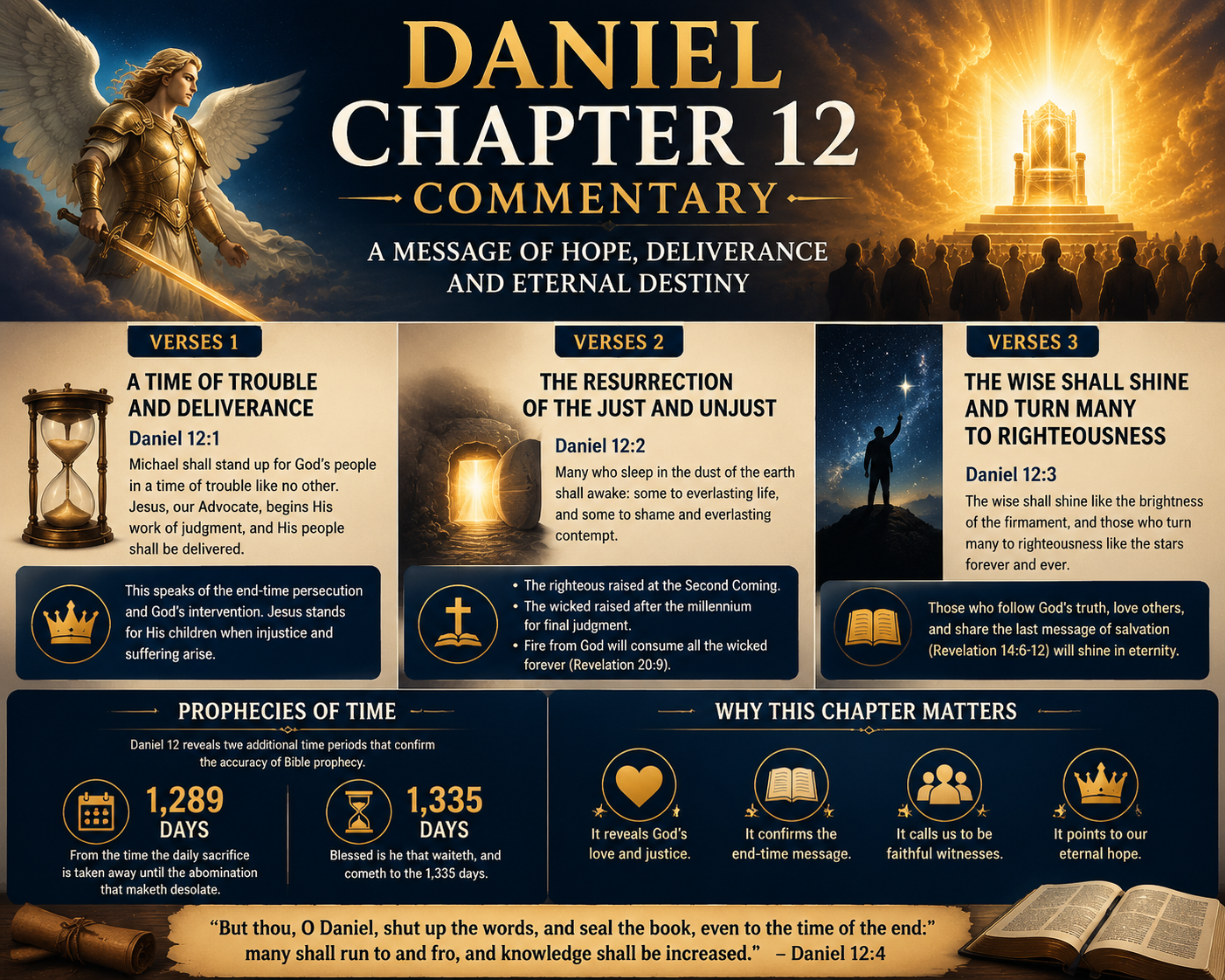
This is a very important chapter, as it speaks directly to the time of the end. This Daniel chapter 12 commentary offers tremendous insight into that period. This chapter connects to “the hour of his judgment” found in Revelation 14, reveals the work of Jesus in the heavenly sanctuary, and returns to the theme of the 1,260 years of papal persecution, also echoed in Revelation 11, 12, and 14.
This chapter also introduces two additional time prophecies — the 1,290 and 1,335 years — which further confirm the end-time movement and the validity of the 2,300-day prophecy. Daniel 12 also speaks of a group entrusted with proclaiming end-time truth to many, a group made pure and sanctified. What a remarkable chapter. Let us walk through this Daniel chapter 12 commentary together.
“And at that time shall Michael stand up, the great prince which standeth for the children of thy people: and there shall be a time of trouble, such as never was since there was a nation even to that same time: and at that time thy people shall be delivered, every one that shall be found written in the book.” (Daniel 12:1)
What does “at that time” refer to? This could connect to the closing verses of Daniel 11 — remember that the original Scriptures had no chapter divisions or punctuation marks. Alternatively, this time frame may refer to the broader 1,260 years of papal persecution. The closing verses of Daniel contain some of the most significant unfulfilled prophecy for our time, describing the papacy’s entry into the United States — “the glorious land” — its eventual enforcement of the mark of the beast, and nations becoming entangled in its influence.
Either way, this verse points to the time of the end. The papal persecution lasted from 538 to 1798; it is during this period that Jesus stands up on behalf of His people. When does Jesus “stand”? When judgment begins, and when His people face persecution, Jesus rises to defend them. Jesus does not remain silent in the face of injustice and suffering. There is a double application here, as this verse also describes a period of persecution unlike any the world had previously witnessed.
During the Middle Ages, the papacy was responsible for the deaths of an estimated 50 million Christians. This Daniel chapter 12 commentary tells us that Jesus intervened during this period, shortening its duration. The verse mentions Jesus “standing” twice — a repetition signaling its importance. This reveals the depth of Jesus’ love and compassion for you. Jesus knows exactly what you’re going through. Jesus knows your struggles. Jesus is here to help — nothing is impossible for Him.
This Daniel chapter 12 commentary tells us that those who gave their lives to Jesus, rather than to empty formalism, legalism, or paganism blended with Christianity, will be found among the redeemed in heaven. This is not to say that all Catholics will be excluded from heaven — many Catholic believers are good-hearted people who simply follow what they have been taught.
We are held accountable only once genuine light comes to us, and we knowingly reject that truth. This is what it truly means to reject Jesus Himself, who is the way, the truth, and the life. When we reject truth, we reject life itself, and we fall into spiritual darkness — and God cannot grant us further light until we first accept the light already given.
“And many of them that sleep in the dust of the earth shall awake, some to everlasting life, and some to shame and everlasting contempt.” (Daniel 12:2)
When will this take place? When Jesus returns, those who have died in faith will be raised to eternal life in heaven. Some have rested in the grave for thousands of years — it’s remarkable to consider how deeply Jesus loves each of them.
Consider King David and Abraham — one day, they too will rise again. Jesus eagerly anticipates the day He will finally be reunited with His faithful, loving followers. This verse actually refers to two distinct events: first, the resurrection of the righteous at Jesus’ second coming; and second, the resurrection of the wicked at the end of the millennium, after they have remained in the grave for a thousand years, only to be raised and ultimately destroyed forever.
“But the rest of the dead lived not again until the thousand years were finished. This is the first resurrection.” (Revelation 20:5)
“The rest” refers to those not included in the resurrection at Jesus’ return.
“For the Lord himself shall descend from heaven with a shout, with the voice of the archangel, and with the trump of God: and the dead in Christ shall rise first: Then we which are alive and remain shall be caught up together with them in the clouds, to meet the Lord in the air: and so shall we ever be with the Lord.” (1 Thessalonians 4:16–17)
After the wicked are finally raised, God carries out what Scripture calls His “strange work.” He will send fire upon all who have ever lived in rebellion against Him, destroying them permanently. This is undeniably a sorrowful outcome — it can be difficult to understand how a loving God could bring an end to the proud, the selfish, the unloving, the dishonest, the unbelieving, and the legalistic. Yet for the safety and security of His children in heaven, Jesus must carry out this solemn act.
“For the Lord shall rise up as in mount Perazim, he shall be wroth as in the valley of Gibeon, that he may do his work, his strange work; and bring to pass his act, his strange act.” (Isaiah 28:21)
God sends fire from heaven to destroy the wicked, much as He once destroyed Sodom and Gomorrah.
“And they went up on the breadth of the earth, and compassed the camp of the saints about, and the beloved city: and fire came down from God out of heaven, and devoured them.” (Revelation 20:9)
“And they that be wise shall shine as the brightness of the firmament; and they that turn many to righteousness as the stars for ever and ever.” (Daniel 12:3)
True wisdom is not something any of us possess on our own — as Solomon noted, anyone who considers themselves wise should instead recognize their own foolishness. But God offers light, and those who are truly wise are those who follow the gentle voice of the Holy Spirit speaking within their hearts. This Daniel chapter 12 commentary tells us these individuals do something remarkable: they love others, warn them of coming judgment, speak of the love of Jesus, and proclaim the final message of salvation — the three angels’ message.
“And this gospel of the kingdom shall be preached in all the world for a witness unto all nations; and then shall the end come.” (Matthew 24:14)
“Go ye therefore, and teach all nations, baptizing them in the name of the Father, and of the Son, and of the Holy Ghost: Teaching them to observe all things whatsoever I have commanded you: and, lo, I am with you always, even unto the end of the world. Amen.” (Matthew 28:19–20)
“But thou, O Daniel, shut up the words, and seal the book, even to the time of the end: many shall run to and fro, and knowledge shall be increased.” (Daniel 12:4)
Here we see further confirmation that the 1,260 days — or “a time, times, and half a time” — do not refer to literal days. Gabriel makes clear that this book, filled with end-time prophecies such as the 1,260, 1,335, 1,290, and 2,300-day periods, points toward the time of the end. That period begins at the conclusion of the 1,260 years of papal persecution. This also confirms that the remnant church could only emerge after this period concluded in 1798.
The papacy persecuted God’s people for 1,260 years. The legally recognized supremacy of the pope began in 538 A.D., when Emperor Justinian elevated the Bishop of Rome to head of all churches — an event known as the Edict of Justinian.
Adding 1,260 years to 538 A.D. brings us to 1798. In that year, the pope was deposed when the French general Berthier, acting under Napoleon’s command, took him into captivity. Napoleon’s forces appeared intent on crushing papal authority altogether, and roughly eighteen months later, the pope died in exile in Valence, France. This event marked the end of the papacy’s ability to enforce its decrees through political power.
“Then I Daniel looked, and, behold, there stood other two, the one on this side of the bank of the river, and the other on that side of the bank of the river.” (Daniel 12:5)
“And one said to the man clothed in linen, which was upon the waters of the river, How long shall it be to the end of these wonders?” (Daniel 12:6)
Here Daniel sees two angels posing a question about timing. What had been the central topic throughout the book of Daniel? The little horn, or antichrist power, described in Daniel 7, 8, 9, and 11. The angels ask how long this power would continue to rule and persecute God’s people.
“And I heard the man clothed in linen, which was upon the waters of the river, when he held up his right hand and his left hand unto heaven, and sware by him that liveth for ever that it shall be for a time, times, and an half; and when he shall have accomplished to scatter the power of the holy people, all these things shall be finished.” (Daniel 12:7)
Here the answer given is “a time, times, and half a time” — one year, plus two years, plus six months, totaling three and a half years. How many months is that? Forty-two months. And how many days is that, using the Jewish calendar’s 30-day months? 42 × 30 = 1,260. This Daniel chapter 12 commentary tells us this represents the period during which the saints — true, faithful Christians — would be tested to the very limits of their endurance: the Waldenses, the Huguenots, the Lollards, the Albigenses. Their history is a fascinating and important one to study, especially since the church may soon face similarly intense trials.
“And I heard, but I understood not: then said I, O my Lord, what shall be the end of these things?” (Daniel 12:8)
Here, once again, a question about timing is raised.
“And he said, Go thy way, Daniel: for the words are closed up and sealed till the time of the end.” (Daniel 12:9)
This offers further confirmation that these “days” represent years rather than literal days — since three and a half literal years from 600 B.C., when this book was written, would not bring us anywhere near the time of the end. While the book of Daniel does touch on historical events of its own time, its central focus remains the time of the end — the conclusion of the “time, times, and half a time,” or the 1,260 years, which ended in 1798.
Wikipedia describes this period as follows:
Pius VI condemned the French Revolution and the suppression of the Gallican Church that resulted from it. French troops commanded by Napoleon Bonaparte defeated the papal army and occupied the Papal States in 1796. In 1798, upon his refusal to renounce his temporal power, Pius was taken prisoner and transported to France. He died eighteen months later in Valence. His reign of over two decades is the fifth-longest in papal history.
“Many shall be purified, and made white, and tried; but the wicked shall do wickedly: and none of the wicked shall understand; but the wise shall understand.” (Daniel 12:10)
During the 1,260 years, many believers were sanctified through persecution. A similar trial may soon come upon the church once again. Many, God may mercifully allow to “fall asleep,” as the coming struggle between truth and deception may prove too severe for some to endure while still living.
“And from the time that the daily sacrifice shall be taken away, and the abomination that maketh desolate set up, there shall be a thousand two hundred and ninety days.” (Daniel 12:11)
“The daily” here refers to paganism (notably, the word “sacrifice” does not appear in the original language). Since papal supremacy began in 538, this verse points to a slightly earlier moment when paganism was effectively displaced to make way for papal rule across Europe. In 508, Clovis, king of the Franks, became the last major European ruler to convert to Catholicism, opening the way for the wider Christianization — under papal authority — of Europe. Adding 508 to 1,290 brings us, once again, to 1798.
“Blessed is he that waiteth, and cometh to the thousand three hundred and five and thirty days.” (Daniel 12:12)
“But go thou thy way till the end be: for thou shalt rest, and stand in thy lot at the end of the days.” (Daniel 12:13)
This Daniel chapter 12 commentary introduces yet another time prophecy: the 1,335 years. Starting again from 508, when paganism was displaced, where do we arrive? 1843 — remarkably close to 1844. This is striking: if anyone harbored doubt after studying the 2,300-day prophecy of Daniel 8:14, which also points to 1844 as the start of Jesus’ work of cleansing the heavenly sanctuary, this passage offers yet another independent confirmation of that same pivotal date.
This stands as compelling support for the three angels’ message of the end time, a theme woven throughout both Daniel and Revelation. It carries immense significance, as it represents the final message given to planet Earth through the remnant of Revelation 12. Jesus truly loves you. This Daniel chapter 12 commentary is powerful — in many ways, it functions as a kind of prophetic convergence point, where multiple time prophecies and messages all point toward the same climactic conflict between truth and error.
The mark of the beast stands opposed to those who bear the seal of God. Which side will you stand on, my friend? Jesus loves you. Have you accepted Jesus into your heart? Repeat after me: Father God, please forgive my sins. Come into my heart. Give me Your righteousness. Heal and bless me, in the name of Jesus. Amen.