I love Seventh-day Adventists. They are, by and large, honest and disciplined people. In fact, Ellen G. White says that God rebukes them precisely because they are the apple of His eye. Yet there are a few things Jesus holds against them — a message found in Revelation 3, addressed to the Laodicean church. The sad reality is that many Seventh-day Adventists reject any rebuke directed at the church, even when that rebuke comes directly from God.
The 1888 message of righteousness by faith was also rejected.
What is the straight testimony? This is a message found throughout both the Bible and the writings known as the Spirit of Prophecy, yet many Adventists — even pastors — remain unaware of it. Many Adventists have been taught that theirs is the true church, which is both true and biblical. But many teachers have failed to teach the other side of that truth: that the church, too, has fallen into a lukewarm state, and that God sent Ellen G. White largely to deliver this rebuke — the straight testimony — to His people.
Why is this message so rarely taught in Adventist churches around the world? Why is it that when an Adventist discovers this message, found throughout Ellen White’s own writings, they are often treated as troublemakers? This represents a significant failure among many members of the Seventh-day Adventist Church.
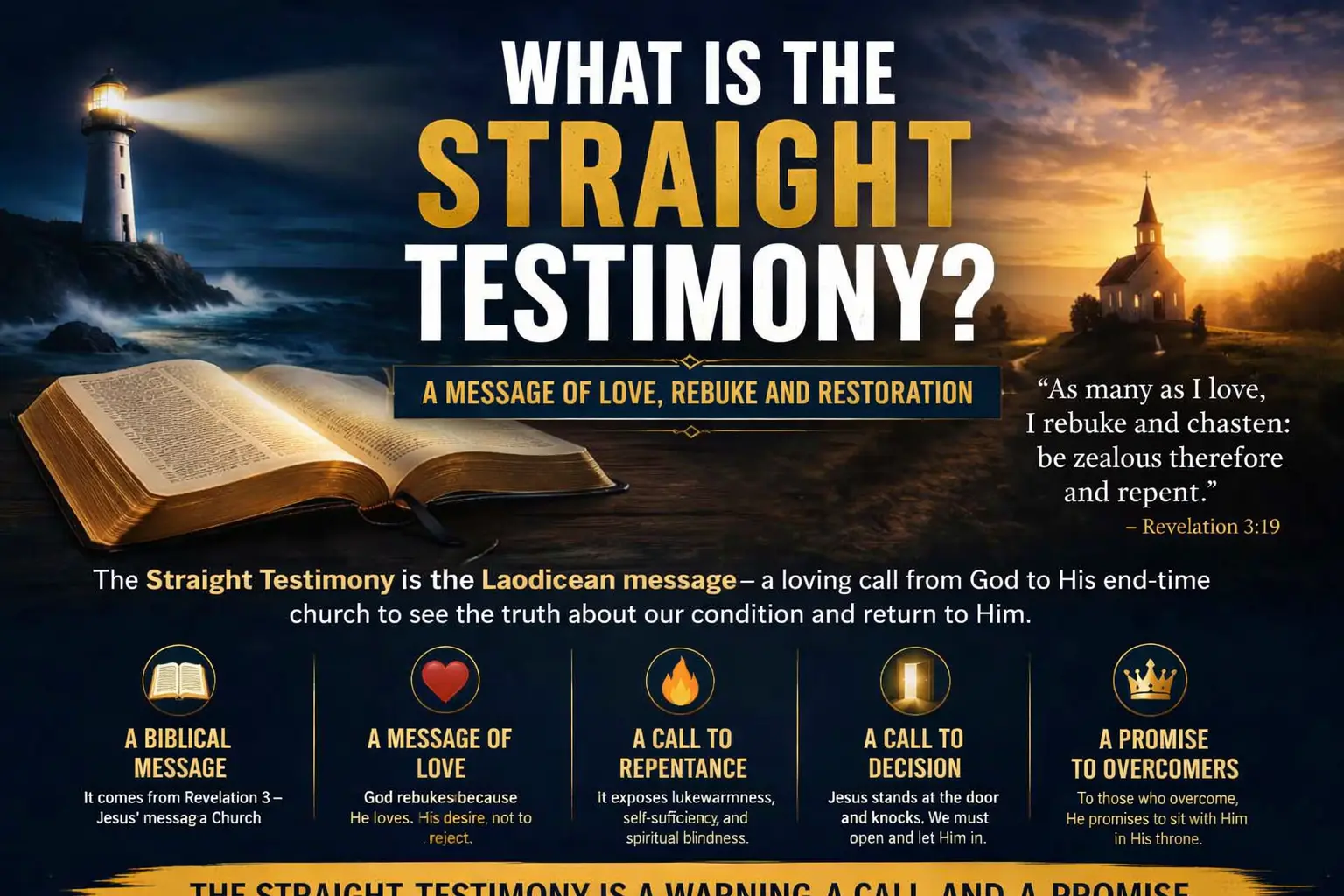
What Is the Straight Testimony? It Is the Laodicean Message
We see here a tendency among many members to relate to church leadership the way Catholics often relate to their priests — depending entirely on the messenger for spiritual instruction, and avoiding any topic the minister doesn’t personally address.
“The Laodicean message must be given with earnestness and power, as a message from heaven.” (SpTB02 20.1)
Yet astonishingly, almost no Adventist church regularly teaches this message. I was a Seventh-day Adventist for many years before I encountered the straight testimony myself. What is the straight testimony? It is the Laodicean message. And what is the Laodicean message? It is a message of loving rebuke from God to His end-time Israel, His end-time church. Let us examine this message as found in Scripture and the Spirit of Prophecy.
“The message to the Laodicean Church is appropriate to the church at this time: ‘And unto the angel of the church of the Laodiceans write; These things saith the Amen, the Faithful and True Witness, the beginning of the creation of God; I know thy works, that thou art neither cold nor hot: I would thou wert cold or hot. So then because thou art lukewarm, and neither cold nor hot, I will spew thee out of my mouth.
Because thou sayest, I am rich, and increased with goods, and have need of nothing; and knowest not that thou art wretched, and miserable, and poor, and blind, and naked: I counsel thee to buy of me gold tried in the fire, that thou mayest be rich; and white raiment, that thou mayest be clothed, and that the shame of thy nakedness do not appear; and anoint thine eyes with eye-salve, that thou mayest see.
As many as I love, I rebuke and chasten: be zealous therefore and repent.’ There are many who are priding themselves upon their spiritual riches, their knowledge of the truth, and are living in guilty self-deception. When the members of the church humble themselves before God by zealous, not half-hearted, lifeless action, the Lord will receive them. But he declares, ‘I will come unto thee quickly, and will remove thy candlestick out of his place, except thou repent.’ How long shall this warning be resisted? How long shall it be slighted?” (RH, December 23, 1890, par. 14)
What Is the Straight Testimony? The Message and the Members Are Different
So what is the underlying problem? It is this: the fact that the Seventh-day Adventist Church is the remnant church of Revelation 12 does not mean its members are exempt from becoming lukewarm. There’s a meaningful difference between the truth God has given — which cannot be altered, since God revealed it to Moses and Abraham — and whether individuals actually live according to that truth. God does not force anyone to follow it.
People often confuse the messenger with the message — these are two entirely different things. Many will look at a particular Christian’s unloving or unkind behavior and conclude they don’t want to follow Jesus at all. But God’s responsibility is to preserve the truth; He does not force any individual to be loving or good. Let us examine the message itself and see whether it comes from God.
The fact that the message — the three angels’ message of Revelation — is true does not mean that every member of the remnant church is automatically loving and Christlike. What is the straight testimony? It functions much like the message of Elijah — a call to decision, a call to honestly examine our true spiritual condition. This message works hand in hand with righteousness by faith, also called the loud cry message of Revelation 18.
“The True Witness says, ‘I know thy works, that thou art neither cold nor hot.’ And again, ‘As many as I love, I rebuke and chasten; be zealous, therefore, and repent.’ Then comes the promise, ‘Behold, I stand at the door, and knock; if any man hear my voice, and open the door, I will come in to him, and will sup with him, and he with me.’ ‘To him that overcometh, will I grant to sit with me in my throne, even as I also overcame, and am set down with my Father in his throne.’” (RH, September 16, 1873, par. 23)
Here we see that God’s end-time people are, in many cases, spiritually blind — unable to recognize their own condition, unable to see how offensive legalism and spiritual apathy are to God. The truth, given so freely through Ellen White, can paradoxically make people spiritually complacent. When we are legalistic, we rarely recognize it in ourselves. Churches repeat so often that we must do this or that to be saved that we eventually come to believe it, even though Ellen White never taught that we work our way into heaven.
What Is the Straight Testimony? The Shaking
How serious is this message? Extremely serious. As I often tell fellow Seventh-day Adventists: many know about the three angels’ message intended for the world. But did you know there is also a specific message for the church itself? Most Adventists tell me, “No, I had no idea.” This is remarkable — we have Ellen White’s writings, we have the Bible, where the remnant church is prophesied from Old Testament to New — and still, so many remain unaware.
This message — the straight testimony — is connected to what’s known as “the shaking.”
“I asked the meaning of the shaking I had seen and was shown that it would be caused by the straight testimony called forth by the counsel of the True Witness to the Laodiceans. This will have its effect upon the heart of the receiver, and will lead him to exalt the standard and pour forth the straight truth. Some will not bear this straight testimony. They will rise up against it, and this is what will cause a shaking among God’s people.” (EW 270.2)
This means that only a select few Seventh-day Adventists — whether independent or affiliated with the official conference structure, it doesn’t matter — will be entrusted with delivering this specific message to the church. What does this straight testimony typically include? It runs throughout both the Spirit of Prophecy writings and Scripture itself.
What are some of the rebukes contained in it? Legalism, pride, apathy, spiritual laziness, and an unkind, unloving spirit, among others. The rejection of the 1888 righteousness by faith message pushed the church further into a Laodicean condition — marked by abuse of authority, coldness, and a lack of genuine love. There are, in fact, many more character traits that many Seventh-day Adventists take pride in avoiding outwardly, while remaining blind to the same condition within their own hearts.
“This company who bound themselves together by cords of unsanctified sympathy would not receive reproof and counsel. The straight testimony was irksome to them.” (PH159 179.1)
“I have been instructed to give a message of warning to our churches in Oakland and Berkeley. Many who love self-indulgence and who murmur at the straight testimony of the Laodicean message, are ignorant of how sinful their actions really are.” (18MR 232.1)
Here Ellen White affirms that we are often blind to our own condition. A legalistic mindset tends to see itself as fundamentally good — first, because such individuals compare themselves to the world around them rather than to Jesus; and second, because they place undue weight on outward works rather than on how they genuinely treat others.
Both Ellen White and Scripture make clear that we will ultimately be judged far more by how we treated others than by our personal habits. Many Seventh-day Adventists focus heavily on dietary choices, dress standards, and other external practices — while the heart underneath remains unloving, unkind, and self-centered. Yet many mistakenly believe their outward conduct is sufficient, remaining blind to the true condition of their hearts. In effect, Jesus is left standing outside the door, while the simple lessons of the gospel are dismissed as too elementary to bother with.
Many Seventh-day Adventists gravitate toward advanced prophetic study, while overlooking the foundational lessons — humility, turning the other cheek, forgiveness, helping those in need, meekness. These basic lessons have never lost their importance. What truly defines a Christian is Christlikeness.
“…the solemn testimony upon which the destiny of the church hangs.” (CCh 338.5)
“The light given me has been very forcible that many would go out from us, giving heed to seducing spirits and doctrines of devils.” (2SM 392.2)
“But the days of purification of the church are hastening on apace. God will have a people pure and true. In the mighty sifting soon to take place, we shall be better able to measure the strength of Israel. The signs reveal that the time is near when the Lord will manifest that his fan is in his hand, and he will thoroughly purge his floor. There are few really consecrated men among us; few who have fought and conquered in the battle with self.” (PH117 62.2)
“In the last vision given me, I was shown the startling fact that but a small portion of those who now profess the truth will be sanctified by it and be saved.” (1T 608.3)
Only a small portion of Seventh-day Adventists, according to this statement, will ultimately be saved. This is a sobering quote — it suggests that only a fraction of the many who hold this faith will truly enter heaven. Yet many of us assume that simply accepting the final message for earth, the three angels’ message, guarantees our salvation. It does not.
What is the straight testimony? It is God’s rebuke directed at the Seventh-day Adventist Church — though it applies equally to all churches, since many members of other denominations will eventually embrace the three angels’ message themselves, while many Adventists who reject the straight testimony will leave the church altogether.
“We are coming to a crisis, and I am in terror for our souls. Why is it that we find men leaving the faith? Are we in a position where we shall know what we believe, and shall not be shaken out?” (YRP 129.4)
Here the Spirit of Prophecy states plainly that many will leave the faith. Does it say they will leave the church itself? Not necessarily — it says they will leave the faith.
Sadly, many members never look beyond what their pastor happens to preach, and many never study Scripture deeply on their own. One of the things that most contributes to spiritual lukewarmness in the church is a fear of exploring new topics — a preference for remaining comfortable with the light already received, rather than embracing further light, such as the straight testimony, even when it is laid out so plainly.
“The straight testimony must be revived, and it will separate those from Israel who have ever been at war with the means that God has ordained to keep corruptions out of the church. Wrongs must be called wrongs. Grievous sins must be called by their right name. All of God’s people should come nearer to Him and wash their robes of character in the blood of the Lamb. Then will they see sin in the true light and will realize how offensive it is in the sight of God.” (3T 324.1)
When was the last time you heard a sermon specifically addressing pride, selfishness, or an unloving spirit? Legalism? These topics are almost never directly addressed. Many Adventist sermons today simply repeat familiar themes we’ve heard hundreds of times. How many more times do we need to be reminded that the dead are asleep, not in heaven? How many more times do we need to hear that Saturday is the Sabbath? Sister White noted that God will, at times, send important messages outside the usual channels, through individuals He personally chooses.
“There must be a revival of the strait testimony. The path to Heaven is no smoother now than in the days of our Saviour. All our sins must be put away. Every darling indulgence that hinders our religious life must be cut off. The right eye or the right hand must be sacrificed, if it cause us to offend. Are we willing to renounce our own wisdom, and to receive the kingdom of Heaven as a little child?
Are we willing to part with self-righteousness? Are we willing to give up our chosen worldly associates? Are we willing to sacrifice the approbation of men? The prize of eternal life is of infinite value. Will we put forth efforts and make sacrifices proportionate to the worth of the object to be attained?” (PH001 6.3)
The approval of others is a powerful temptation. Many who claim to be Christian still long deeply to please the world around them. Self-righteousness is a serious offense to God — when someone, through their actions, essentially declares, “I am good enough; I don’t need Jesus,” even while verbally affirming that we’re saved by grace, their behavior tells a different story. This renders the cross of Jesus, in effect, an unnecessary offense, robbing it of its purpose.
What Is the Straight Testimony? The Last Church
“Those who permit themselves to rise in opposition to the plain testimony, become self-deceived, and have really thought that those upon whom God laid the burden of His work were exalted above the people of God, and that their counsels and reproofs were uncalled for. They have risen in opposition to the plain testimony which God would have them bear in rebuking the wrongs among God’s people.” (CD 428.2)
“I have no desire to hurt the soul of any one, but I must bear the straight testimony given me.” (LLM 43.7)
There’s a meaningful distinction between someone who criticizes the church without cause and without any divine calling, and someone genuinely called by God to deliver this specific heavenly message known as the straight testimony. Specific sins and shortcomings are addressed directly through this message. What is the straight testimony?
It is Jesus’ loving rebuke to the Laodicean, end-time remnant church — addressing pride, legalism, lack of love, spiritual indifference, apathy, and more. This message runs throughout many of Ellen White’s writings. Now that you understand what the straight testimony is, you may find your eyes opened to recognize this message wherever it appears.
What Is the Straight Testimony? A Message of Love
It is genuinely true that the Seventh-day Adventist Church is the prophesied Laodicean church of Revelation, and the remnant church spoken of in Scripture. But does having the truth from God mean its members are automatically holy and good? No. Did ancient Israel possess the truth? Yes — given directly through Moses, Abraham, and the prophets.
Did that mean Israel remained holy throughout its history? No — their condition deteriorated so severely that God was ultimately forced to set ancient Israel aside. Did you know that Ellen White warns that modern Israel, the Seventh-day Adventist Church, faces the danger of repeating that same fate? What a sobering thought.
“The message to the church of the Laodiceans is a startling denunciation, and is applicable to the people of God at the present time.” (3T 252.1)
“God reproves men because He loves them.” (1SM 48.1)
“He reproves, He rebukes, He chastens; but it is only that He may restore and approve at last.” (TM 22.2)
“The Lord is merciful. He does not chastise His people because He hates them, but because He hates the sins they are committing. He must chastise them, that they may return to their loyalty. If the warnings and reproofs given in the Word of God and in the testimonies of His Spirit are not plain enough, what words would be sufficiently plain to bring about a revival and a reformation?” (UL 240.7)
“I am now charged to write out the straight testimony which was given to me Monday night. I am to withhold none of it.” (LLM 164.5)
“But some of those who know of my experience, and who have had all the evidence that the Lord will ever give them, evade the truth when the straight testimony comes to rebuke some of their plans.” (13MR 122.1)
What Is the Straight Testimony? A Rejected Message
The fact that many reject this message does not mean you need to reject it as well. In fact, the straight testimony is, in essence, the same message ancient prophets delivered to Israel long ago — addressing legalism, empty ritual, pride, and unbelief.
Believing oneself to be righteous, good, and holy while remaining spiritually corrupt is a tragic state of self-deception. Someone who has genuinely experienced righteousness by faith will never claim to be holy and good on their own merit, nor will they judge others harshly simply to criticize. The very sins once rebuked among the Pharisees are the same ones addressed in this message to the Seventh-day Adventist Church today.
“While these evils remain untouched everything passes along smoothly, but when the straight testimony comes and reproof and rebuke are given, there is a rising up against the straight testimony. It does not agree with the carnal mind, their carnal security is disturbed, they resist the work of God, and some will fall off.” (15MR 330.1)
“Jesus must abide in the heart; and where He is, the carnal desires will be subdued and be kept in subjection by the operation of the Spirit of God.” (ST, June 6, 1892, par. 5)
What Is the Straight Testimony? A Call to Repentance
This message exists to bring us light, to open our eyes to our true spiritual condition. It asks: You hold all the truth? You keep the Sabbath? You follow the health message? You believe in the sanctuary doctrine? Your beliefs may be correct — but do you genuinely resemble Jesus in character? Do you believe that simply professing Christianity is sufficient?
Is church membership alone enough to secure your place in heaven? Sadly, many believe exactly this — that church membership and the label of “Christian” are sufficient for salvation, even while their actual fruit reveals an unloving, arrogant spirit, the very opposite of who Jesus truly is. Is the goal not to become like Jesus — loving, kind, honest, and humble? Unless we genuinely experience this transformation in Christ, my friend, we will never walk those streets of gold. We will never enter the heavenly mansions prepared for us. We will never live a life that reflects the very character of God.
“God’s plan is not to send messengers who will please and flatter sinners, He delivers no messages of peace to lull the unsanctified into carnal security. But He lays heavy burdens upon the conscience of the wrong-doer, and pierces his soul with sharp arrows of conviction.” (ST, February 12, 1880, par. 25)
“He is knocking, knocking at your heart. Open the door and let Him in. Empty the heart of all selfishness, by living right, eating right, thinking right. Enthrone the Saviour in the heart. With His long human arm He encircles the race, while with His divine arm He grasps the throne of the Infinite. I am hungry for the Spirit of God. Are you, brethren? My soul longs for it. May the Lord help us to take steps heavenward.” (Ms 29, 1901)
“The counsel of the true Witness is full of encouragement and comfort. The churches may yet obtain the gold of truth, faith, and love, and be rich in heavenly treasure. ‘Buy of me gold . . . that thou mayest be rich; and white raiment, that thou mayest be clothed, and that the shame of thy nakedness do not appear.’ The white raiment is the righteousness of Christ that may be wrought into the character. Purity of heart, purity of motive, will characterize every one who is washing his robe, and making it white in the blood of the Lamb.” (RH, July 24, 1888; 7BC 965.3)
Did you know that the straight testimony is essentially the same as “the counsel of the True Witness”? This message is, fundamentally, the Laodicean message itself. How can we acknowledge that we are the Laodicean church, while simultaneously rejecting the very message addressed specifically to Laodicea?
“If ever there was a people that needed to heed the counsel of the True Witness to the Laodicean church to be zealous and to repent before God, it is the people who have had opened up before them the stupendous truths for this time, and who have not lived up to their high privileges and responsibilities. We have lost much in not living up to the light of the solemn truths which we profess to believe.” (RH, June 4, 1889, par. 9)
Many Seventh-day Adventists never share the three angels’ message with others, even though billions of lives hang in the balance because of it. This itself is a serious offense before God. It is better to live an imperfect Christian life while sharing the three angels’ message with others, than to obsess over minor personal regulations purely out of self-righteousness and ego.
How long will it take for the church to be revived and spiritually awakened once again? Do you know that Jesus loves you? Repeat after me: Father God, forgive my sins. Come into my heart. Heal and bless me. Give me Your righteousness, please, in the name of Jesus. Amen.
If you enjoyed this post, feel free to comment below and on other articles. Join the forum to share your faith and thoughts — you’re welcome to post links connected to spiritual topics there as well.