Author: 4angelslight@gmail.com

  • 5 Ways to Identify the True Church According to the Bible

    5 Ways to Identify the True Church According to the Bible

    When Jesus died on the cross, He did so for all of humanity, not only for professing Christians. Saying “I believe in Jesus” or “I believe Jesus died on the cross” does not by itself mean you will go to heaven.

    The Bible tells us in many places that Christianity, as a whole, has fallen — that many Christians sound like devils: arrogant, proud, selfish, unloving. We need to become like Jesus to enter heaven.

    There are many churches around the world, and the first step is to come out of the false churches and enter the true church. Every organization — including atheism — contains some truth, but mixes that truth with lies, and this is what deceives people. Christian churches are no different. Yet one church is true — the Revelation 12 church — and all other churches are false, identified in Revelation chapters 17 and 18.

    1. The True Church Keeps the Commandments

    Jesus wrote the book of Revelation. He gave it to an angel, who gave it to John, who gave it to the seven churches. Those seven churches signify all churches since the time of Jesus.

    Jesus gives us signs to help us identify the true church. First, He tells us there are two kinds of Christianity:

    THE REMNANT — Revelation Chapter 12
    BABYLON — Revelation Chapters 17 and 18

    So someone may say, “I am a Christian,” but this is not really the question. The real question is: which church do you belong to? Do you belong to the remnant church, or do you belong to Babylon? “What difference does it make, as long as I believe in Jesus?” you might ask.

    It makes all the difference, because:

    1. Babylon will receive the seven last plagues.
    2. Jesus asks all people in Babylon to come out before the plagues fall.
    3. Jesus said that fifty percent of Christians are Babylon — the foolish virgins.
    4. Babylon will receive the wrath of God, poured out without mixture.
    5. The people of Babylon will receive the seven last plagues and be destroyed forever.

    The true church is the pure woman of Revelation 12. Jesus gives us signs to identify her. The true church:

    • Keeps the commandments
    • Keeps the Sabbath
    • Has a true prophet bearing the Testimony of Jesus
    • Preaches the three angels’ messages
    • Preaches the sanctuary judgment message

    How do we know this is the last church? Because in Revelation 14, once the three angels’ message has finished being preached to all people, Jesus returns.

    Revelation 14:14And I looked, and behold, a white cloud, and upon the cloud one sat like unto the Son of man, having on His head a golden crown, and in His hand a sharp sickle.

    Jesus returns once the three angels’ message has been preached to all people. Who gives this three angels’ message?

    Revelation 14:6Having the everlasting gospel to preach unto them that dwell on the earth, and to every nation, and kindred, and tongue, and people.

    One great sign of the true church is that it keeps the Ten Commandments. We are not saved by obedience — we obey because we love Jesus. No one will be saved by the works of the law, and no one will be saved while in disobedience. All true obedience flows from the righteousness of Jesus.

    Revelation 12:17And the dragon was wroth with the woman, and went to make war with the remnant of her seed, which keep the commandments of God, and have the testimony of Jesus Christ.

    They believe in the Ten Commandments. Almost every Christian church today says, “We do not need to keep the Ten Commandments; they have passed away.” Yet the Bible, through Jesus’ prophecy in Revelation, foretells that the Christian world will lie to God by claiming the cross of Jesus made the law worthless — that there is no more sin because there is supposedly no more law, when in fact sin is the transgression of the law. The true church keeps the commandments of God, including the seventh-day Sabbath, the fourth commandment.

    2. The True Church Keeps the Sabbath

    This is one of the key signs of the end-time events — it is the test of loyalty. Those who bear the name of Jesus but do not care about truth, and are not honest, reject the Sabbath. They are content to settle for the minimum. The true church of God in Christ keeps the Sabbath.

    Some say the Sabbath was done away with — but no, it is part of the Ten Commandments. We cannot remove one commandment while saying the others remain binding; that is a lie. The true church is the one that rebuilds the old waste places and teaches people to return to the Bible and leave the teachings of Babylon.

    Exodus 20:8–11Remember the sabbath day, to keep it holy. Six days shall you labour, and do all your work: but the seventh day is the sabbath of the LORD your God: in it you shall not do any work, you, nor your son, nor your daughter, your manservant, nor your maidservant, nor your cattle, nor your stranger that is within your gates: for in six days the LORD made heaven and earth, the sea, and all that in them is, and rested the seventh day: wherefore the LORD blessed the sabbath day, and hallowed it.

    It is true that Colossians 2 says:

    Colossians 2:16Let no man therefore judge you in respect of… the sabbath days.

    Here “sabbath days” is plural, so this is not referring to the seventh-day Sabbath. Those sabbath days were the Levitical, yearly ceremonial sabbaths, which fell on various days such as Monday, Wednesday, or Friday. These were done away with because they pointed forward to the cross of Jesus. The seventh-day Sabbath, on Saturday, cannot be done away with, since it is a memorial of creation. Heaven and earth will pass away before the Sabbath passes away.

    3. The True Church Has the Testimony of Jesus

    What is the Testimony of Jesus? It is the Spirit of Prophecy — it identifies a church that has true prophecy.

    Revelation 12:17Those who have the testimony of Jesus Christ.
    Revelation 19:10For the testimony of Jesus is the spirit of prophecy.

    This is one more very important sign of the true end-time church. In fact, the whole of Revelation 12 tells the story of the woman, the true church. It begins with the apostles, continues with the Waldenses, who fled into the mountains and the wilderness for 1,260 years, and the true church emerges after 1798, following the 1,260 years of papal persecution.

    The true church has a true prophet, and as a whole, holds true prophetic interpretation. The Bible says that in the end times, many will come with false prophecy, but Jesus tells us how to discern the truth.

    The true church of God in Christ correctly interprets the prophecies of the Bible, with God inspiring its teachers to explain them. It keeps the commandments, it keeps the Sabbath, and it has the Testimony of Jesus, which is the Spirit of Prophecy.

    4. The True Church Preaches the Three Angels’ Message

    The true church of God in Christ preaches the three angels’ message. How many churches around the world preach this message? Only one. How many churches preach the three angels’ message and also keep the Sabbath? Only one church.

    The three angels’ message sets the true church apart from other churches, which only talk about Jesus without much insight into prophecy or present truth. The three angels’ message is a solemn warning that all Christians who remain in their fallen churches will receive the mark of the beast. All Christians who refuse end-time truth and remain attached to traditions such as Sunday-keeping, eternal hellfire, or the secret rapture will not make it to heaven, because in refusing truth, they refuse Jesus and are being dishonest with themselves — since the only reason someone would refuse the truth is dishonesty. The true church keeps the commandments, keeps the Sabbath, and preaches the three angels’ message.

    5. The True Church Preaches the Sanctuary Judgment Message

    The true church preaches the sanctuary judgment message. Every year, the Jews observed the Day of Atonement, during which all Israel had to fast and search their hearts. Anyone who failed to do so was cut off from the camp.

    The same thing is happening today, and only one church is preaching this message — that Jesus is in the Most Holy Place of the heavenly sanctuary, and that He is currently deciding our eternal destiny. The true church knows, from Bible prophecy, that it has been sent by God to deliver this message: that the judgment is happening now, and all cases are being decided by Jesus.

    Once Jesus has examined all the cases of all humanity, He will return. It is a solemn message that all humans are under the scrutiny of the heavenly Judge and Creator, and that all of us will soon receive our sentence: eternal damnation or eternal life.

    The true church is one church, and only one, because Jesus gives us these signs so that we can know without doubt which church He is speaking of. He could not be referring to Mary, for instance, as “the woman,” since Mary did not go into the wilderness for 1,260 years, did not flee to another continent as described in Revelation 12, and did not face a flood sent against her.

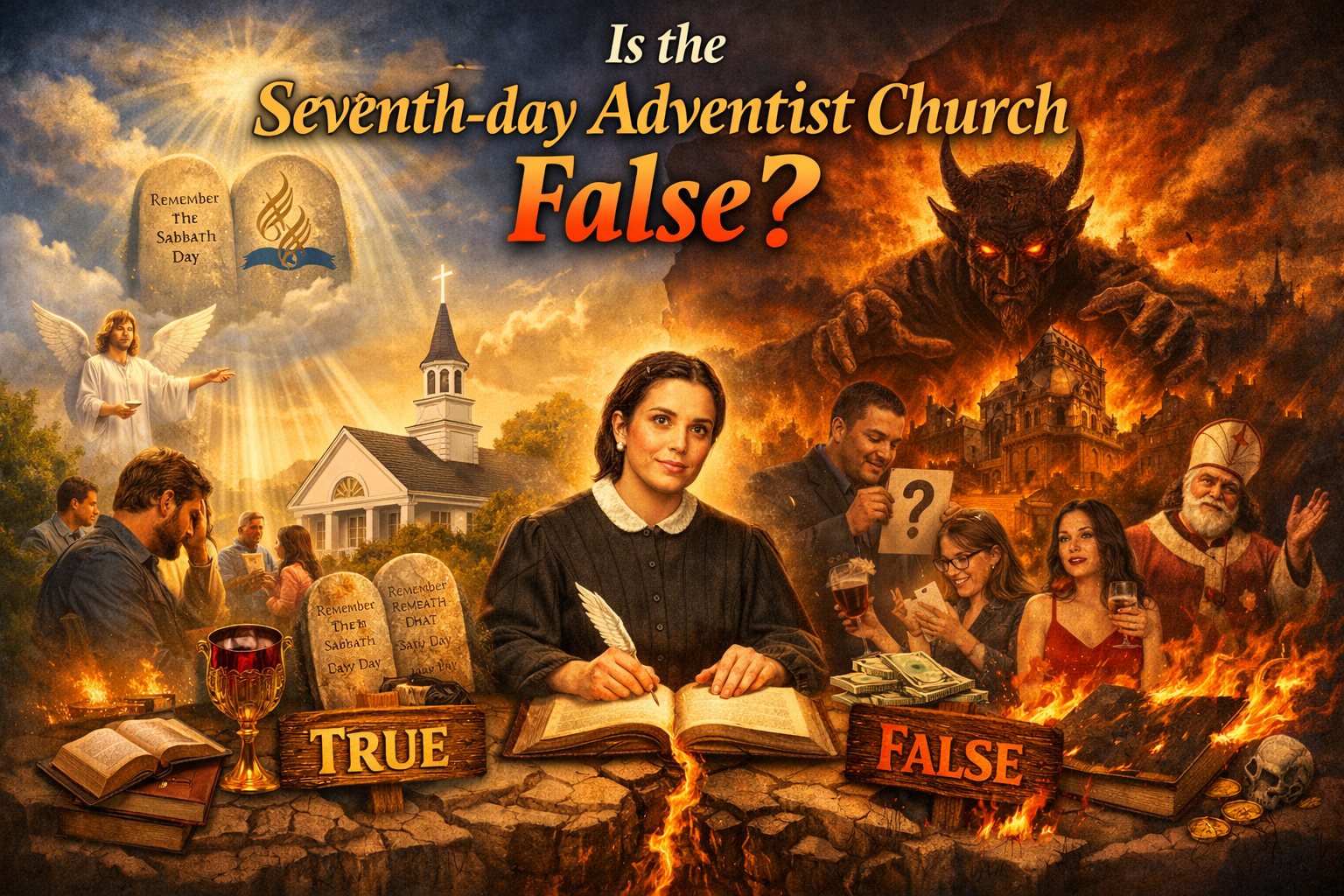
    Jesus says the true church keeps the commandments, keeps the Sabbath, preaches the three angels’ message, and preaches the sanctuary message. This church is the Seventh-day Adventist Church. All other churches, Jesus says, are Babylon.

    Repeat after me: Father God, help me to come out of Babylon. Help me to study this message clearly and in detail. Give me Your righteousness, forgive my sins, and provide for all my needs, in the name of Jesus, amen.

  • Christ Our Righteousness: A. G. Daniells Bible Study Quiz (Question & Answer)

    Christ Our Righteousness: A. G. Daniells Bible Study Quiz (Question & Answer)

    Christ Our Righteousness: A. G. Daniells Bible Study Quiz (Question & Answer)

    This book is one of the most important books written on the righteousness by faith message. Christ Our Righteousness was compiled by A. G. Daniells, General Conference president of the Seventh-day Adventist Church. This Advent Bible study contains some amazing quotes and truths that can save the churches around the world. This is surely the most important topic and message we can ever study. Christ Our Righteousness — A. G. Daniells Bible Study, Advent Bible Study, Question & Answer Quiz.

    Christ Our Righteousness — A. G. Daniells, concentrate

    Cor Ch. 1 — Christ Our Righteousness

    As we empty ourselves of self, what must we do? Accept the righteousness of Christ. How should we hold on to it? By faith.

    Which words are applicable to the SDA church? You have left your first love. The tragedies, sorrows of life? Are recounted that Christ may be sought as the great Comforter and Deliverer. Why are our sinful, corrupt natures presented? That Christ may be appealed to for the cleansing.

    And may? Be in very deed Christ our righteousness. What does every phase of truth in the Sacred Volume point to? In some way to Christ as our righteousness. What occupies a large importance in the Bible? Christ our righteousness.

    What is set forth in the Bible? Its source, its nature, the possibility to be obtained by sinners. To whom does righteousness belong? To God. Daniel 9:7? To You, God, belongs righteousness, and to us confusion of face. In what is God righteous? In all His ways (Psalm 145:17). What is God’s righteousness like? The great mountains (Psalm 36:6).

    How long is God righteous? An everlasting righteousness (Psalm 119:142). What does God love? Righteousness (Psalm 11:7). What does God have? No unrighteousness. What is the very opposite of sin? The nature of righteousness. To what is it associated? Holiness, godliness. Awake to? Righteousness, and sin not (1 Corinthians 15:34).

    If we love righteousness, what should we hate? Iniquity. Righteousness is the antithesis of? Sin. Who is the source of righteousness? God. Is righteousness inherent in human nature? No. We are? Carnal, sold under sin. This we are filled with? Unrighteousness. What is human nature filled with? Unrighteousness.

    How did Jesus call Abel? Righteous Abel. What does Paul say about Abel? He obtained witness that he was righteous. What did the Lord say about Noah? “Thee have I seen righteous before Me in this generation” (Genesis 7:1). Noah was a? Just man and perfect in his generation, and Noah walked with God (Genesis 6:9).

    Abraham believed? God, and it was counted unto him for righteousness (Romans 4:3). And delivered righteous Lot? Sore distressed by the lascivious life of the wicked, for that righteous man, dwelling among them, in seeing and hearing, vexed his righteous soul from day to day with their lawless deeds (2 Peter 2:7–8).

    Christ Our Righteousness — A. G. Daniells Bible Study, Advent Bible Study

    How were Zacharias and Elizabeth? They were both righteous before God, walking in all the commandments and ordinances of the Lord, blameless (Luke 1:6).

    Upon what conditions? The only way righteousness can be obtained by sinful men? By faith. How shall the just live? By faith. What does the gospel reveal? The perfect righteousness of God. How is righteousness manifested? Without the law.

    From what can the law not deliver us? Sin. The law points? To sin. But the law does not? Deliver from sin. What does the law declare? The whole world guilty before God. No effort of the sinner? Can cancel his guilt or bring righteousness. That righteousness, declares Paul? Is by faith.

    What is man filled with? All unrighteousness. If Abraham were justified by works? He had to glory, but not before God.

    Abraham — the only way: To him that works not? But believes on Him that justifies the ungodly, his faith is counted for righteousness. God is righteous in? All His ways. David also described? The blessedness of the man unto whom God imputes righteousness without works (Romans 4:6).

    Righteousness by faith expresses? The most wonderful transaction in this world. Righteousness by faith expresses? The greatest transaction that God, in His infinite plenitude, could bestow upon mankind. Faith was? Reckoned to Abraham for righteousness (Romans 4:9).

    The law of God demands? Righteousness from all who are under His jurisdiction. How have all made themselves? Incapable of rendering this righteousness, by transgression. What has this made men? Under the condemnation of the law. The righteousness of God without? The law is manifested, being witnessed by the law and the prophets. Christ Our Righteousness — A. G. Daniells Bible Study, Advent Bible Study.

    Even the righteousness of God? Which is by faith of Jesus Christ unto all, and upon all them that believe (Romans 3:21–22). Being justified? Freely by His grace, through the redemption that is in Christ Jesus, whom God has set forth to be a propitiation, through faith in His blood. To him that works not? But believes on Him that justifies the ungodly, his faith is counted for righteousness. What a marvelous solution? For the awful problem of sin.

    Many have missed the way. What is strange and sad? That this simple and beautiful way of righteousness seems so hard for the natural, carnal heart to accept. Why did Israel not attain to the law of righteousness? Because they sought it by works.

    What is the secret of Israel’s failure? Being ignorant of God’s righteousness, and going about to establish their own righteousness, they have not submitted themselves to the righteousness of God.

    Cor Ch. 2 — A Message of Supreme Importance

    What work does the righteousness by faith message do? A cleansing, regenerating work. Why did God send this message? In mercy. Other reason? Many had lost sight of Jesus; they needed to have their eyes directed to His divine person, His merits, and His changeless love for the human family.

    Cor Ch. 3 — Preparatory Messages

    Christ Our Righteousness — A. G. Daniells Bible Study, Advent Bible Study. What two messages has God always sent to His people? The serious results which would come unless they returned to Him. Message two? What was needed to help them. To what is the righteousness by faith message similar? Messages that came to the people of God in olden times.

    The Message of 1887

    What was the message of 1887? A warning of danger — a specific evil: formalism, forms, ceremonies. How long was this message given? The whole year of 1887, in the Review and Herald. It is possible to be? A formal, partial believer and lose eternal life.

    It is possible to obey Bible injunctions, be regarded as a Christian, and? Perish, because you are lacking essential qualifications that constitute Christian character. The observance of? External forms will never meet the great wants of the soul. A mere profession of Christ is not enough to prepare one to stand the test of the judgment.

    There is in the church? Too much formality. Those who profess to be guided by the Bible may? Be like the pretentious fig tree, destitute of fruit. A formal round of? Religious services is kept. But? Where is the love of Jesus? Spirituality is dying. Dwell more upon? Practical godliness. Far less on? Mechanical arrangements.

    The messages continued to come throughout the entire year, telling us? We were trusting too much in forms, ceremonies, theories, mechanical arrangements. What is formalism? Most deceptive and ruinous. It is? The hidden, unsuspected rock upon which the church, through centuries, well-nigh wrecked.

    What is one peril of the last days? Forms of godliness. God sends warnings to His church? To escape the perils of formalism. What was sent to save from formalism? The righteousness by faith message. This movement is? Of God; it is destined to triumph gloriously. Not alone came warnings against forms? With it came the righteousness by faith message.

    Greatest and Most Urgent Need

    Christ Our Righteousness — A. G. Daniells Bible Study, Advent Bible Study. What is our most urgent need? A revival of true godliness. To seek this? Should be our first work. There are persons in the church? Who are not converted. The hindrance to? Strength and success are far greater from the church itself than from the world.

    Alas, what is prevailing in the church? Pride, hypocrisy, deception, love of dress, frivolity, amusement, desire for supremacy. What are these? All these sins have clouded the mind so that eternal things are not discerned. Who brought the forgotten book of the law? Ezra.

    The Remedy to Be Applied

    There is a wide difference between? Pretended union and a real connection with Christ by faith. What cannot be overcome without union with Christ? The power of evil that is so identified with human nature. Christ first? Chose us, paying an infinite price for our redemption.

    What must be overcome? Pride, selfishness, vanity, worldliness, sin in all its forms.

    A Startling Message

    Christ Our Righteousness — A. G. Daniells Bible Study, Advent Bible Study. Are not the symptoms of? Decay and declension painfully visible in the midst of Christian churches today? What has come upon the SDA church? Spiritual death. The SDA church, which should be manifesting? Life and zeal. Some power? Has cut the cable that anchored them to the eternal Rock. They are drifting? Away to sea, without chart or compass.

    What situation? Could be more alarming than this? Turning all the heart to Him? Who alone can hold us fast.

    Back to Safe Anchorage

    It is not enough to? Be familiar with the arguments of the truth.

    The Climax of the Preparatory Message

    Let there be a dwelling? Upon the humiliation, self-denial, meekness, lowliness of Christ. That? Proud, selfish hearts may see the difference between themselves and the pattern.

    Show Jesus in? His condescension to save fallen men. What was Jesus not obliged to do? Bear the curse of God as surety for the fallen race. Why is righteousness by faith from God? It bears the divine credentials; its fruit is unto holiness. What did the righteousness by faith message bring? Peace, hope, joy. What was it? The supreme element needed to prepare a people to meet God.

    How does the legalist try to refrain from sin? In his own strength. What does this message arouse? It arouses His people to repent and to do their first work. For what purpose did some not receive righteousness by faith? To prevent an awakening among the people. They gave? The trumpet an uncertain sound.

    What did these men declare? The law should be preached, not the righteousness of Christ. How will righteousness by faith, the third angel’s message, be treated? It will not be comprehended; it will be called a false light by those who refuse to walk in its advancing glory. There is sadness in heaven? Over the spiritual blindness of many of our brethren. E. White calls upon every minister to leave? Pride, strife, supremacy, and to humble their hearts. Why does Satan not want righteousness by faith presented? His power would be broken.

    What keeps churches in feebleness? The coldness of heart, the unbelief of those who ought to have faith. Christ Our Righteousness — A. G. Daniells Bible Study, Advent Bible Study. What is unbelief called? An evil heart of unbelief. The time of test is just upon us? For the loud cry of the third angel has already begun in the revelation of the righteousness of Christ. This is the? Beginning of the light of the angel whose glory shall fill the whole earth.

    Then I saw another mighty angel? Commissioned to descend to the earth, to unite his voice with the third angel. The light which? Attended this angel penetrated everywhere. The work of this angel comes in? At the right time, to join in the last great work of the third angel’s message as it swells to a loud cry. While the work of salvation is closing? Trouble shall be coming on the earth, and the nations will be angry.

    Yet? Held in check, not to hinder the work of the third angel. At that time? The latter rain will come to give power to the loud voice of the third angel. And prepare saints? To stand in a period when the seven last plagues shall be poured out.

    The days in which we live are? Eventful and full of peril. The signs of? The coming of the end are thickening around us. Events are to come to pass? That will be of a more terrible character than any that the world has yet witnessed. The time of? Test is just upon us, for the loud cry of the third angel has already begun in the revelation of the righteousness of Christ.

    This is the? Beginning of the light of the angel whose glory shall fill the whole earth. If you would stand the time of trouble? You must know Christ and appropriate the gift of His righteousness, which He imputes to the repentant sinner.

    Cor Ch. 5

    What will the loud cry be similar to? Similar to that which was wrought by the disciples. What will be more abundant? Latter rain. What was the early rain? The work of the apostles in the first century.

    Cor Ch. 6

    Christ Our Righteousness — A. G. Daniells Bible Study, Advent Bible Study. What is the third angel in verity? Righteousness by faith. Justification by faith is God’s way? Of convicting sinners of their guilt, their condemnation, their utterly undone and lost condition. It is also? God’s way of changing weak, sinful, defeated men into strong, righteous, victorious Christians.

    What is the faith of Jesus? The secret of their rich, deep experience. What did the faith of Jesus do? That faith by which Jesus triumphed over the powers of darkness. By this faith? We are empowered to keep the commandments of God. To fail to enter this faith? To miss the real, redeeming virtue of the third angel’s message.

    Unless this is gained? The believer will have only theories, doctrines, forms. That will prove? A fatal and awful mistake. What cannot save from sin? The theory, the doctrines. Against what are we warned? Making this fatal mistake. What mistake? Formalism — having the form of knowledge and of the truth in the law. What is the rock that wrecked untold thousands? Not having righteousness by faith.

    Cor Ch. 7

    What is it to lose sight of righteousness by faith? It is to miss what is vital in the plan of redemption.

    Cor Ch. 8

    Christ Our Righteousness — A. G. Daniells Bible Study, Advent Bible Study. Scores of men have preached who were? Unconverted, unsanctified, unholy. We must have more? Than an intellectual belief of the truth. Our doctrines may be correct, but? This is not sufficient. A belief in theory? Is not enough. The problem with our work? We have been content to present a cold theory of the truth.

    A theoretical knowledge? Of the truth is essential. But? It will not save us. The greatest deception? That a theoretical knowledge of the truth is sufficient. Men may profess faith? If it does not make them sincere, kind, patient, forbearing, it is a curse.

    In the lives of many in the church books? There has been no genuine change, no genuine conversion. Their character reveals many blemishes. Our hope? Knowledge that Christ is our righteousness. A cold, legal religion? Can never lead souls to Christ. For? It is a Christless, loveless religion. The saving salt? Is the pure, first love. The love of Jesus? The gold tried in the fire.

    What is legalistic religion worth? As salt that has lost its savor. How does legalism supply lack? Busy activity, zeal that is Christless. Forms and ceremonies? Do not make the heart good and the character pure. How did Jesus present the Pharisees’ religion? Devoid of saving faith. To subscribe one’s name to a church creed? Is of no value if the heart is not changed.

    Men may be church members, work earnestly? And be unconverted. What does not make the heart good and character pure? High pretensions, forms, ceremonies. What is a form of religion? Nothing more than selfishness. It is painful to see? The selfishness that exists in the hearts of many of God’s professed believers.

    There are many who have a? Religion of outward forms and observances. All who assume? The ornaments of the sanctuary but are not clothed with Christ’s righteousness will appear in the shame of their own nakedness. The five foolish virgins had lamps? Which means knowledge of the Bible.

    They had not? The grace of Christ. Day by day? They went through a round of ceremonies and external duties, but their service was lifeless. Their religion was? A dry husk without the true kernel. They held fast to? Forms, but they were deceived in their Christian life, full of self-righteousness.

    Failing to learn lessons in the school of Christ? Which would have made them wise unto salvation. While we are increased in? Self-righteousness, and trust in ceremonies, and depend on rigid rules, we cannot do the work for this time. The observance of? External forms will never meet the great want of the human soul.

    A mere profession of Christ? Is not enough to prepare one to stand the test of the judgment. What is abominable to God? Fasting and prayer in a self-justifying spirit. What does external humiliation, imposed sacrifice, proclaim to the world? That the doer of these things considers himself righteous. These things call attention? To the observer, saying, “This man is entitled to heaven.” But it is all? A deception.

    Works will not? Buy us an entrance to heaven. There are many who seem? To imagine that outward observances are sufficient for salvation. But formalism will? Fail to bring the peace of God. Who has forms of religion and godliness? Those who do not have a daily experience in the things of God. The appearance of light in the church — a form of godliness may appear to be working well? But may be as destitute of grace as the hills of Gilboa.

    Cor Ch. 9

    Christ Our Righteousness — A. G. Daniells Bible Study, Advent Bible Study. What seems incredible but is plainly told as a fact? That righteousness by faith should be lost sight of by many entrusted with heaven’s final message. Those who profess to believe the third angel’s message? Have lost sight of righteousness by faith. There is not one in a hundred that? Understands for himself righteousness by faith.

    So necessary? For our present and eternal welfare. It becomes necessary? For us to seek Him sorrowing, as did Joseph and Mary. The reason our preachers accomplish so little? Is they do not talk with God; He is a day’s journey from us. What was written in 1889 in the Spirit of Prophecy? That a large number of Adventists had lost sight of justification by faith.

    What is it to lose sight of righteousness by faith? It is to miss the supreme purpose of the gospel. Which must? Prove disastrous for the individual. No matter? How well-meaning and earnest regarding doctrines. Unless divine power is brought into our experience? Christ and His righteousness will be dropped; their faith without power or life. Unless they zealously repent? There will be among those spewed out of the mouth of God.

    How have God’s people failed to bring divine power into their experience? To a lamentable degree. What has been crowded out? The simplicity. What took its place? Forms and ceremonies. What has God’s professed people made themselves? An offense in His sight.

    Boastful self-sufficiency and complacent self-righteousness? Have masked and concealed the beggarly elements and nakedness of the soul. But with God? All things are naked and manifest. What does the want of righteousness produce? Wretchedness and nakedness in those who feel rich and increased with goods. In their own righteousness? They are represented as clothed with filthy rags. Yet in this condition? They flatter themselves to be clothed upon with Christ’s righteousness. Could? Deception be greater?

    What did Martin Luther fear? That righteousness by faith would be lost sight of. Martin Luther said when he has lost Christ? He must fall into confidence in his own works. Sad fact that? Jesus has been made secondary while theories take first place. Do not imagine that? Ceremonies and forms will make you an heir of heaven. Our churches are dying? For want of the teaching of righteousness by faith. An argumentative subject is? Productive of little good. One subject will swallow up all others? Christ our righteousness.

    Cor Ch. 10

    Christ Our Righteousness — A. G. Daniells Bible Study, Advent Bible Study. What is provided through Christ? Restoration and reconciliation. What makes the cross of Christ possible? A full, complete ransom has been paid; the sinner is pardoned; the justice of the law is maintained. Why can we center our hopes on Christ alone? Because He is our substitute and surety. The best efforts that men, in his own strength, can make are? Valueless. He who is trying to reach heaven? By his own work, by keeping the law, is attempting an impossibility.

    Men cannot be saved? Without obedience. But his works? Should not be of himself. Righteousness for justification? Is imparted. No repentance is genuine? If it does not work. Righteousness for sanctification? If it does not work reformation. What element is righteousness by faith? A supernatural element in human nature. We are under the control of? One or the other of the two great powers that are contending for the supremacy of the world. How do people belong to Satan? It is not necessary for us deliberately to choose the service of the kingdom of darkness in order to come under its dominion. We only have to? Neglect to ally with Jesus.

    Unless we do so? Satan will take possession of the heart and make it his abiding place. He who has righteousness is not? Hard-hearted or unsympathetic. When we accept Christ? Fruits will appear. As we enter the close of time? The current of evil will be more decidedly toward perdition. Although the righteousness of Christ is freely offered? Some do not appropriate it; it is a robe unworn, a fountain untouched.

    Only those who are clothed with the garments of His righteousness? Will be able to endure the glory of His presence when He shall appear. On Christ’s coronation day? He will not acknowledge as His any who wear spot or wrinkle. Jesus, surrounded by? The army of the redeemed, each bearing the sign “The Lord Our Righteousness.”

    Cor Ch. 11

    Christ Our Righteousness — A. G. Daniells Bible Study, Advent Bible Study. Justification by faith is the work? Of God, of laying the glory of men in the dust. And doing for men? That which it is not in his power to do for himself. When are men prepared to be clothed with Christ’s righteousness? When they see their nothingness. How are men losing the right way? Thinking that they must do something to merit the favor of God. They seek? To make themselves better by their own unaided efforts.

    This they? Can never accomplish. If by any? Efforts of our own we could advance one step toward heaven, the words of Christ would not be true. There are many who feel? They have a great work to do before they can come to Christ. It seems difficult? For them to understand that Christ is a complete Savior. They lose sight of the fact? That Christ is the way, the truth, the life. First of all, entering this experience? Man must be brought to the realization of his hopeless condition.

    Without grace? Nothing can be done for the sinner; he is in a hopeless condition. Through grace? Supernatural power is imparted. Christ is the source? Of every right impulse. He is the only one? Who can arouse in the heart enmity against sin. No soul can? Repent without the grace of Christ. The law demands? Righteousness. This the sinner? Owes to the law, but he is incapable of rendering it. Those making profession of godliness? Bear evil fruits. Men cannot meet? The demands of the law in his own strength. His works? Will all be tainted by sin. The only way the sinner obtains righteousness? Is through faith.

    Not by works of? Righteousness which we have done. But according to? His mercy He saved us. There are many Christians? Who have not the garment of righteousness. They profess to be children of God? But are not cleansed from sin. They are? Selfish and self-sufficient; their experience is Christless. They neither? Love God nor their neighbor. They do not see? The defects in themselves. They are not able to detect? Workings of pride and iniquity. They are glad in garments? Of self-righteousness. And stricken? With spiritual blindness. Our churches are dying? For the want of teaching in righteousness by faith.

    If we are self-sufficient? And think that we may go on as we please and yet hope to come out on the right side finally, we shall find that we have made a terrible mistake. What is lost in the SDA church? Love for God and one another. What is cherished? Self, self, self — and striving for the supremacy. Unless there is a reconversion? There will soon be such a lack of godliness that the church will be presented as the barren fig tree.

    What has come in? Selfishness. And God says? “I will remove thy candlestick out of its place, except you repent.” Jesus looked upon the? Pretentious, fruitless fig tree. With mournful reluctance, He pronounced the words of doom. Under the curse? Of an offended God, the fig tree withered away. God help His people? Make an application of this lesson while there is still time.

    God’s people today are not? Fulfilling this commission to go into all the world. Why? Selfishness prevents them from receiving these words. In many hearts there seems? To be scarcely a breath of spiritual life. God brings against ministers and people? The heavy charge of spiritual feebleness. God calls for? Revival and reformation. Unless this takes place? God’s people will continue to grow more abhorrent to the Lord until He refuses to acknowledge them as His children.

    There is more hope of an? Open enemy than one that is neutral. The darkness shall cover the earth? And gross darkness the people. But the Lord shall arise upon thee, and His glory shall be seen upon thee. God rebukes His people? For their sins, that He might humble them. How many are? Backslidden, having lost their first love, neither cold nor hot? Satan will do his utmost? To keep them in a state of indifference and stupor. They were made to see themselves as? Sinful and polluted, and Christ was lifted up. As they looked upon? His spotless righteousness, they saw their own deformity and pollution.

    It is Christ in His fullness? That the sinner must see. For the? Unparalleled love of Christ will bring conviction. When we partake of the divine nature? We will look with abhorrence upon all our exaltation of self. Their offering has been valueless? As was Cain’s, for it was destitute of the righteousness of Christ. There are tares mingled? Among the wheat. You have a few names? Even in Sardis, which have not defiled their garments. God’s people have lost? Their first love.

  • The 1888 Message: Why Righteousness by Faith Is the Most Important Bible Truth

    The 1888 Message: Why Righteousness by Faith Is the Most Important Bible Truth

    I was studying the Bible this morning, along with the book Christ Our Righteousness by A. G. Daniells, which quotes Ellen G. White. It said that Martin Luther feared this very topic would one day be eliminated.

    PASTOR WAGGONER AND A. T. JONES

    Once a Christian forgets and abandons righteousness by faith, all that is left is reliance on their own works. What is righteousness by faith? It is receiving Jesus’ power to do good, since there is no good in humans on our own.

    This is sobering, because Paul tells us that once we rely on works, we are separated from Jesus. We make ourselves into gods and “good people,” and we render the cross of Jesus of no effect. The 1888 message of righteousness by faith is realizing that we are all sinners with nothing good inside us. Let us find out the five reasons why this is the most important Bible belief.

    1. Righteousness by Faith — Without It, We Are Left Relying on Our Own Works

    Without the righteousness of Jesus, the only thing left is trusting in our own works. But we know that humans cannot do anything good on their own. Even our best works are described this way:

    Isaiah 64:6But we are all as an unclean thing, and all our righteousnesses are as filthy rags; and we all do fade as a leaf; and our iniquities, like the wind, have taken us away.

    The problem with much of modern Christianity is that most people believe they are good, that there is something good inside them. Righteousness by faith is believing — and coming to the conclusion — that man has nothing good in himself. Jesus said:

    John 15:5I am the vine, you are the branches: he that abides in Me, and I in him, the same brings forth much fruit: for without Me you can do nothing.

    In fact, legalism is the belief that one can do things without Jesus — which is impossible.

    KORAH, DATHAN, ABIRAM REBELLION

    Psalm 14:3They are all gone aside, they are all together become filthy: there is none that does good, no, not one.

    The Bible clearly says there is not one good person on earth. The 1888 message of righteousness by faith begins with realizing that we cannot do good, and that even our good deeds, apart from Jesus, are tainted with sin. Unless we have the power of Jesus’ righteousness, all that remains is our own works — and these will never carry us through the gates of the holy city.

    2. Righteousness by Faith — Our Works Do Not Save Us

    Works do not save us; the law does not save us. The law can point us to our sin, but the law, or obedience to it, does not save us. Doing things does not save. Failing to obey makes us disobedient, yet the works that matter are done by Jesus, not by ourselves.

    The law, or obedience to it, does not make you a good person. No one becomes good by obeying — being good is a state of being, and either we are good or we are evil. Since all humans are evil, no human is good on their own.

    No matter how much someone obeys, they cannot become good through obedience. The only solution is for someone else who is good to give us a power called righteousness by faith, so that we can become good. This power is righteousness by faith. Our works do not save us. We cannot be saved without works, but our works are not our own — they come from God. There is incredible peace in knowing:

    1. All humans are evil.
    2. Humans cannot be saved through works.
    3. Works do not make someone righteous.
    4. Only God is good, and only He has the remedy.

    KORAH, DATHAN, ABIRAM REBELLION

    3. Righteousness by Faith — Without It, We Make Ourselves Gods

    The 1888 message of righteousness by faith needs to be spread throughout the world. This is the message that eclipses all other messages. Someone does not even need to be a Christian to fall into this trap — there are plenty of atheists and legalists who believe that by obeying rules, they become good people.

    When someone believes that obedience earns them righteousness, they are essentially saying:

    1. They do not need God.
    2. They possess divinity.
    3. The cross of Jesus was worthless.

    No one is God — there is only one God who is good. To the rich young man, Jesus said:

    Luke 18:18–19Why do you call Me good? There is none good but God.

    Jesus then told him to obey the commandments. Yet throughout the whole Bible, we discover that man cannot obey through his own strength. When Jesus says “obey the commandments,” the real work of man is to choose. We have the power of choice — to choose God or Satan, to choose evolution or creation, to choose to try to save ourselves or to let God give us His righteousness.

    Unless we have God working in us, and ask Him daily, “Father God, please put Your robe of righteousness on me,” we begin to think we are gods — that we are good, that we do not need God, that we are here to impress Him by showing how good we are. All of this is a lie. What is righteousness by faith? It is laying the glory of man into the dust, and showing us both how corrupt we are and how precious and holy God is.

    KORAH, DATHAN, ABIRAM REBELLION

    4. Righteousness by Faith — Without It, We Are Separated from Jesus

    We are separated from Jesus when we believe we can do things to earn heaven. The 1888 message of righteousness by faith was given through A. T. Jones and Waggoner — their writings need to be read often and studied fully and deeply. Then our Christian life will become entirely different, much happier, and far more peaceful, and we will be able to gain entrance into heaven.

    When we believe we can gain heaven by ourselves, we render Jesus of no effect, and the cross of Jesus becomes useless — because the cross would be worthless if heaven could be earned by works. Then no remission of sins would mean anything at all.

    Galatians 5:4Christ is become of no effect unto you, whosoever of you are justified by the law; you are fallen from grace.

    This is a serious warning in the Bible: those who believe they can save themselves by works are separated from Jesus. What is righteousness by faith? It is realizing that humans are worthless in doing good — even world leaders, the best pastors, the best missionaries. Only God has the solution. Unless we ask Jesus for this gift of righteousness by faith, we are left trying to earn heaven through works.

    PASTOR A. T. JONES

    5. Righteousness by Faith — Without It, We Will Not Enter Heaven

    When someone believes they are good, that their works will impress God and earn them entrance into heaven, they are making themselves into gods — and we know there is only one God. This is pride. It is deeply offensive to God. It is lying to God. It is a protest demanding human worship, and a protest against the cross of Jesus.

    No one who believes such things can enter heaven. They make God a liar. And we have seen throughout the Bible that the proud will be destroyed. Either we give glory to God, or we worship ourselves. Legalists worship themselves — they believe humans are good and holy. This reminds me of the story of Moses and the three rebels who said:

    Numbers 16:3You take too much upon you, seeing all the congregation are holy, every one of them.

    This is the legalist lie — that humans are inherently good. God had to destroy Korah, Dathan, and Abiram, because the real issue was whether God was speaking through Moses. They refused to accept that God was speaking through Moses, because they worshiped humanity and believed themselves to be good. Righteousness by faith is worshiping God, not man.

    It is very interesting that when Moses told Korah, Dathan, and Abiram to come the next day to see who was truly called by God, these three men were so deceived, and knew so little about right and wrong, truth and lies, that they actually came expecting God to favor them. The power of deception is incredible, and we must be careful never to worship humans, who are merely dust.

    The 1888 message of righteousness by faith, given through A. T. Jones and Waggoner, is the healing remedy for a legalistic church. Repeat after me:

    Father God, forgive me for thinking myself to be good and holy. I pray that You give me Your righteousness every day, and that You do good through me. I ask that I may have a daily experience with You. Provide for all my needs, heal me, give me the desires of my heart according to Your will, in the name of Jesus, amen.

  • 5 Bible Prophecies Already Fulfilled: Proof That End-Time Prophecy Is True

    5 Bible Prophecies Already Fulfilled: Proof That End-Time Prophecy Is True

    End-time prophecy and Bible prophecy as a whole are God’s proof that God is real and that the Bible is true. Can you say what will happen one thousand years from now, on June 10th? No. God can. If God can, it means that God lives in the future. If God lives in the future, what does that mean? It means God stands outside of time itself, at the beginning of eternity, beyond the end of time, beyond the beginning of every ending.

    It means that God is divine. End-time prophecy is amazing to study, and it is fascinating to see that events were prophesied down to the very day, thousands of years in advance. For example, Revelation 9 indicates that Islam, through the Ottoman Empire, would fall on August 11, 1840. Josiah Litch, writing in 1838, said that if his calculations were correct, the Ottoman Empire would fall on that exact date in 1840.

    In a comment on Revelation 9, Litch predicted that the Ottoman Empire would lose its power in August 1840. When, on August 11, 1840, the Ottoman Empire accepted guarantees from the Great Powers, it was interpreted as a fulfillment of Bible prophecy and of Litch’s interpretation of it. Let us study five of the best Bible prophecies, part one.

    1. End-Time Prophecy: 9/11

    This is an amazing prophecy from the end-time prophet Ellen G. White, who wrote that the towers of New York would fall — a comment written in 1902, about one hundred years before the event. She also said the towers would fall as though made of pitch, since towers usually fall to one side. She further said that the fire engines would not be working. This is exactly what happened on 9/11. End-time prophecy videos give a clear explanation that we are living at the very end of history. The end will come as a surprise.

    This connects to the study we made on the last five verses of the book of Daniel. We should also study this alongside the false prophet, the Sunday-keeping churches, the mark of the beast, and the seven last plagues — because God’s judgments will fall not only on atheists and the wicked world, but also upon the fallen Christian world, which refuses new light and is content holding beliefs that come from paganism, thereby mocking the Bible and insulting God Himself.

    “On one occasion, when in New York City, I was in the night season called upon to behold buildings rising story after story toward heaven. These buildings were warranted to be fireproof, and they were erected to glorify the owners and builders. Higher and still higher these buildings rose, and in them the most costly material was used.”

    “The scene that next passed before me was an alarm of fire. Men looked at the lofty and supposedly fire-proof buildings and said: ‘They are perfectly safe.’ But these buildings were consumed as if made of pitch. The fire engines could do nothing to stay the destruction. The firemen were unable to operate the engines.” — Testimonies for the Church, vol. 9, pp. 12, 13, Ellen G. White, 1901.

    “But I have no light in particular in regard to what is coming on New York, only that I know that one day the great buildings there will be thrown down by the turning and overturning of God’s power. From the light given me, I know that destruction is in the world. One word from the Lord, one touch of His mighty power, and these massive structures will fall. Scenes will take place the fearfulness of which we cannot imagine.” — Review and Herald, July 5, 1906, Ellen G. White, 1903.

    “The time is right upon us when there will be sorrow in the world that no human balm can heal. Even before the last great destruction comes upon the world, the flattering monuments of man’s greatness will be crumbled in the dust. God’s retributive judgments will fall on those who, in the face of great light, have continued in sin. Costly buildings, supposed to be fire-proof, are erected. But as Sodom perished in the flames of God’s vengeance, so will these proud structures become ashes.” — Signs of the Times, Oct. 9, 1901, Ellen G. White.

    2. End-Time Prophecy: San Francisco

    The same end-time prophet, called by Jesus “the Testimony of Jesus” in Revelation 12:17, identifies one of the signs of the end-time church as having the Testimony of Jesus. End-time prophecy is fulfilled without private interpretation in the Christian world when we take the Bible alone and let it interpret itself.

    Revelation 12:17And the dragon was wroth with the woman, and went to make war with the remnant of her seed, which keep the commandments of God, and have the testimony of Jesus Christ.

    We read in Revelation 19:10 what the Testimony of Jesus is:

    Revelation 19:10For the testimony of Jesus is the spirit of prophecy.

    This is one of the signs of the true end-time church — there is only one church that fulfills these points; all others, Jesus said, are fallen churches. End-time prophecy videos help us learn the truth about Bible prophecy, free from any private interpretation.

    This true church also:

    1. Preaches the three angels’ messages
    2. Preaches the sanctuary doctrine
    3. Preaches the judgment hour message
    4. Keeps the commandments
    5. Keeps the Sabbath
    6. Has a true prophet
    7. Comes after 1798, the time of the end

    “Not long hence these cities will suffer under the judgments of God. San Francisco and Oakland are becoming as Sodom and Gomorrah, and the Lord will visit them in wrath.” — Evangelism, 403, 404; Ellen G. White, September 1, 1902 — Judgments on Oakland and San Francisco.

    a) San Francisco earthquake, April 18, 1906 — 28,000 buildings destroyed by earthquake or fire in San Francisco alone, with destruction extending to surrounding cities as well.
    b) October 17, 1989 earthquake — total damage figures not yet known at the time of writing (Early Writings, p. 15, Ellen G. White).

    “While at Loma Linda, the second night after the dedication of the sanitarium, there passed before me a most wonderful representation. During a vision of the night, I stood on an eminence, from which I could see houses shaken like a reed in the wind. Buildings, great and small, were falling to the ground. Pleasure resorts, theaters, hotels, and the homes of the wealthy were shaken and shattered. Many lives were blotted out of existence, and the air was filled with the shrieks of the injured and the terrified.” — Review and Herald, May 24, 1906, par. 1, Ellen G. White.

    “The destroying angels of God were at work. One touch, and buildings so thoroughly constructed that men regarded them as secure against every danger, quickly became heaps of rubbish. There was no assurance of safety in any place. I did not feel in any special peril, but the awfulness of the scenes that passed before me I cannot find words to describe. It seemed that the forbearance of God was exhausted, and that the judgment day had come.” — Review and Herald, May 24, 1906, par. 2.

    “The angel that stood by my side then instructed me that but few have any conception of the wickedness existing in our world today, and especially the wickedness in the large cities. He declared that the Lord has appointed a time when He will visit transgressors in wrath for persistent disregard of His law.” — Review and Herald, May 24, 1906, par. 3, Ellen G. White.

    “At about one o’clock I awoke, and was impressed to write out some things regarding the supreme rulership of God, and the sacredness of His law. When I met my secretary early in the morning, I told her that wonderful representations had been passing before me in the night season.”

    “After breakfast, we received a message asking us to go to Los Angeles by the afternoon train; but I was unable to take any part in preparing for the journey. I was as one dazed by the awful scenes that had passed before me.” — Review and Herald, May 24, 1906, Ellen G. White.

    3. End-Time Prophecy: The Third Woe

    The first and second woes apply to Islam. We saw that the Ottoman Empire fell on August 11, 1840, according to end-time prophecy, Revelation chapter 9, and God’s sending of Josiah Litch to explain the matter. If the first woe is Islam, then the remaining woes are also tied to Islam.

    End-time prophecy is being fulfilled all around us. It says that the nations grew angry, meaning that Islam will again strike in terror on a grander scale, and the resulting devastation will become so great that the nations of the Western world will become angry. End-time prophecy points us to the terrible events still to come on earth.

    Revelation 11:14, 18The second woe is past; and, behold, the third woe comes quickly… And the nations were angry, and Your wrath is come, and the time of the dead, that they should be judged.

    This remains to be fulfilled — one of the worst events still to arrive on earth: the third woe. Along with that, the third world war will soon follow, as Ellen G. White said she saw one great final combat. End-time prophecy videos explain clearly the final events of our world.

    4. End-Time Prophecy: The Cup of Iniquity Is Filling

    The cup of iniquity is almost full, and people around the world will be caught by surprise to see such incredible woes and desolations fall upon the earth. For those who have studied end-time prophecy, it will be no surprise, as it is written in the Bible. How can you escape the coming judgments? By spending time in the Bible and in prayer, and by asking God to give you His righteousness.

    Every nation and every individual has a limit — only God knows that limit — and once it is passed, His ministry of wrath begins. No one else knows where that limit lies. When you fill a glass, you can see when it overflows. This world is overfilled, yet we do not know when it will pass the limit of transgression, pride, selfishness, offense, apathy, and an unloving, uncaring spirit.

    The judgments of God, covered in end-time prophecy videos, will become more and more severe as a means of waking people up to their danger. How many will wake up? How many will realize they are in danger of eternal destruction? How many will turn and respond to the calls of the Holy Spirit? How many will refuse and instead follow the blind messages of society, led and influenced by Satan? End-time prophecy updates show us that the end is near and is approaching rapidly.

    5. End-Time Prophecy: The Seven Last Plagues

    The seven last plagues will fall on those who receive the mark of the beast. Do not assume that such people will be non-Christians who never attend church. End-time prophecy tells us that the round of ceremonies in churches will continue, but the Spirit of God will have withdrawn from the earth.

    People will continue reading the Bible, but those who, like the Pharisees, reject the final message will have passed the limit of God’s forbearance. Just as in Noah’s time, many were believers, yet they rejected the present truth message and were left behind to perish in the flood.

    God always has a present truth message — unless we follow Jesus every step of the way, we fall behind into darkness and into the wicked world below. Do you want to escape the coming judgments? Do you want to escape the mark of the beast? Repeat after me: Father God, I ask You to forgive my sins. Help me to understand end-time prophecy. Give me Your righteousness, and help me have a daily experience with You, in the name of Jesus, amen.

  • 5 Reasons Why Apathy Will Bring God’s Judgment Upon the World

    5 Reasons Why Apathy Will Bring God’s Judgment Upon the World

    From the list of sins in the Bible, we find one behavior that God does not tolerate at all — a behavior that is highly toxic to humanity. It is like a cold, dry spell upon our planet that dries up the fruits of love and sympathy between people and breeds hatred and every kind of evil. It is apathy.

    God’s judgment will fall on those who spread this evil malady. God’s judgment upon the world will not be delayed for those who influence others into apathy and thus spread it like wildfire through cities and towns, corrupting the earth and God’s creation. Let us find out five reasons why apathy is so dangerous.

    1. God’s Judgment — No Fruits (Matthew 7:16)

    The Bible says that we know someone by their fruits. Yet the Bible also says we should not judge others. What does this mean? We are to judge others by the Bible — to know whether someone is of God or not by the way they behave and speak — but we cannot judge others by today’s society, since society’s judgment is corrupt. One thing we can know is the fruit of a person’s life, how they behave. One evil fruit that very easily reveals a person is not in Jesus is apathy.

    It belongs to the same list of sins as pride and an unloving, unkind spirit. Apathy is neither loving others nor outright hating them — but apathy belongs in the category of hate, because the apathetic person believes that simply not hating is good enough. Yet Jesus said:

    Matthew 12:30He that is not with Me is against Me, and he that gathers not with Me scatters abroad.

    This means a person who does not love, hates. A person who does not embrace truth stands on the side of lies. There is no middle ground. It is striking how many people believe there is a middle ground.

    Life is made by God, and God is always one way or the other — God is never in the middle. God is either deeply loving, kind, and merciful, or God is sending judgments such as the sword, famine, plagues, and lions to destroy people. This is the character of God, and we are called to be like Him. God’s judgment will fall on those who have taken on the spirit of the world — wanting to remain in the middle, never taking a position, never fully choosing one side or the other. God’s judgment upon the world will fall on those who think they can remain neutral.

    There is no such thing as neutral. There is no such thing as apathy without consequence. Apathy is hate — it is the refusal to love someone. Apathy is having an uncaring spirit and loving only yourself. Apathy is failing to do what Jesus told us to do:

    John 13:34–35A new commandment I give unto you, that you love one another, as I have loved you, that you also love one another.

    2. God’s Judgment — No Love

    If love is what God wants us to show toward others and toward Him, what is the worst thing we can do? Not love others, and not love God.

    John 13:35By this shall all men know that you are My disciples, if you have love one to another.

    Apathy is people becoming totally engrossed in society’s behaviors, forms, ceremonies, and fashions. If society does something contrary to the Bible, should you do it? No. Yet millions of Christians and atheists alike simply follow society as though it were God. Society is not God, and the Bible says:

    Exodus 23:2You shall not follow a multitude to do evil.

    God’s judgment will fall on those who seek to please men rather than God. Here too we see that we cannot please both God and men, yet many believe it is possible to be of society and of God at the same time.

    James 4:4Know you not that the friendship of the world is enmity with God? Whosoever therefore will be a friend of the world is the enemy of God.

    God destroyed the people in the days of Noah because they said, “We do not need to enter the ark; we are happy outside; we need nothing.” God destroyed them all except eight. In Revelation 3, it says:

    Revelation 3:17Because you say, I am rich, and increased with goods, and have need of nothing; and know not that you are wretched, and miserable, and poor, and blind, and naked.

    Jesus spews out those who say, “I do not need anything.” The apathetic people of society are seen as the cool ones, but God sees them as despicable and disgusting, to the point of spewing them out — because they are liars. We need many things every day in order to live, and saying “I need nothing” is a lie.

    Revelation 21:8All liars shall have their part in the lake which burns with fire and brimstone.

    To be apathetic is to refuse the main thing God asks of us: to love one another.

    1 Corinthians 13:5Love seeks not her own.

    1 Peter 1:22Seeing you have purified your souls in obeying the truth through the Spirit unto unfeigned love of the brethren, see that you love one another with a pure heart fervently.

    3. God’s Judgment — They Do Not Know God

    People who are apathetic not only lack love for others — they are proud and selfish, without mercy, and they judge others according to the standards of this world. Apathetic people have never truly come to know Jesus; they follow this world and the god of this world.

    Many claim to be Christians, yet they are so blind that they cry “Jesus, Jesus” while failing to see that their character resembles Satan far more than Jesus. They display no trait of character that resembles Jesus at all. It is extremely offensive to God to see people claiming His name while being filled with the spirit of Satan and evil.

    There are two main lists of sins in the Bible — Romans 1 and 2 Timothy 3 — where it says:

    2 Timothy 3:2–3Lovers of their own selves, boasters, proud, unthankful, without natural affection.

    To be apathetic is to be unthankful. A person who receives countless gifts from God and says, “I need nothing,” is telling a terrible lie. God’s judgment will surely fall on such a lie, since we need air, water, food, work, money, friends, love, shelter, a place to stay, a car, insurance, shoes, clothing, internet, electricity, phones, computers — and the list goes on.

    4. God’s Judgment — Refusing the Truth

    Apathy is the complete opposite of the character of God. Was Jesus ever apathetic? No.

    James 4:17To him that knows to do good, and does it not, to him it is sin.

    We do not get to choose our own version of right and wrong. I remember a sister telling me, “Oh, some people think they’re spiritual” — implying that some people can simply choose not to be spiritual. This is a lie, because we do not get to choose truth.

    People who are not spiritual are wicked and are refusing the calls of the Holy Spirit in their hearts. It is deeply offensive to God when an atheist lives worldly — how much more offensive when someone who claims to be a Christian is apathetic. One of the listed sins of the last days, which will bring some of the most terrible of God’s judgments, is being “without natural affection.”

    People without natural affection are lifeless, selfish, and proud. Their entire lives revolve around themselves. God’s judgment has been delayed because some might still break away from the delusion of our society — but God’s judgment upon the world will not be delayed much longer. Most people see the tornadoes, earthquakes, viruses, plagues, and wars as merely natural events, but they are allowed and sent by God to wake men and women to the terrible danger they are in of perishing forever and receiving the final judgment of God, which Revelation 14 says will be without mercy:

    Revelation 14:10The same shall drink of the wine of the wrath of God, which is poured out without mixture into the cup of His indignation.

    “Without mixture” means that while God’s judgments in the past fell with mercy mixed in, this time, the final plagues will be poured out without mercy. Because the whole world will have had access to the full light and knowledge of the Bible, everyone will have had to make a decision between truth and lies. Yet most people will worship humans, worship society, and follow what they can see rather than the loving God they cannot see. Their guilt will be without excuse, and God’s judgment will be righteous.

    Revelation 16:5For You are righteous, O Lord, because they have shed the blood of saints and prophets.

    5. God’s Judgment Is Not a Fairy Tale

    If God sent terrible punishments before, He will do so again — and we already see terrible things falling across the earth. God’s judgment upon the world comes out of love, to turn people from their sins and help them see the folly of following this world rather than the truth.

    Apathy is the complete opposite of a loving Jesus, who took children in His arms and loved them. Apathy is the complete opposite of a God who is merciful, full of kindness and tenderness. To refuse to love others and show them affection is to dry up your own practice of love and produce no fruit as a result. Trees — and Christians — that bear no fruit are cut down. The list of sins in the Bible tells us that the apathetic, and those without natural affection, shall never enter heaven.

    To be apathetic, and to love only a certain group of people, is to think and judge according to the world — believing that only the proud, the wicked, and the unloving deserve love, when in fact the opposite is true. The Bible says that, rather than deserving love, such people deserve death:

    Romans 1:32Who knowing the judgment of God, that they which commit such things are worthy of death, not only do the same, but have pleasure in them that do them.

    If you have seen yourself in this message — unloving, uncaring, apathetic — and recognize that you cannot enter heaven in such a condition, why not repeat after me:

    Father God, forgive my sins. Give me Your righteousness every day to do good and reject evil. Help me to love others, and not to hate them through apathy and coldness, in the name of Jesus, amen.

    BLOG. HOME

  • Why We Chose the Name “Earth’s Last Day” for Our Ministry

    Why We Chose the Name “Earth’s Last Day” for Our Ministry

    People will be greatly surprised to see all the terrible judgments of God that will soon fall upon the earth. The warnings God sends come through natural disasters and through Bible messengers. Those messengers are chosen by God. The thing is, those messengers do not carry a credential — they do not hold a paper saying “Sent by God.”

    Earth’s Last Day is a warning message showing that the love of Jesus is being rejected by many.
    The only way we can discern whether someone is a true messenger of God is through discernment, and through the Holy Spirit speaking to us. The kindness of God is being insulted, and the Holy Spirit is going unperceived by the masses of people on the earth. The only natural consequence is that disasters come to bring men and women to their senses, so they can see the danger they are in of losing eternal life. Let us find out the five reasons why we chose the name “Earth’s Last Day” for our ministry

    1. Earth’s Last Day — The Christian World Is Sleeping
      The state of the church is alarming. People in Christian churches are extremely wicked, selfish, proud, apathetic, and they do not realize how deeply their behavior offends God. They do not see how far their own lives are from Jesus. Earth’s Last Day exists to wake up the Christian world.

    2. I remember being in Eastern Europe, where I met someone from my own country. We talked for a few minutes, and he said, “We need to be like Jesus.” I was so taken aback that someone so extremely proud, selfish, apathetic, and unloving could say, “I am like Jesus,” that I could hardly believe he had said such a thing.

    3. Many times, people’s blindness to their own spiritual condition is so far removed from the truth that it resembles the Native Americans looking out at the Spanish ships arriving in America — the sight was so far outside their frame of reference that they did not even perceive the ships. We truly live in a lying generation, both inside and outside the church. Earth’s Last Day exists to wake us up.
    4. Earth’s Last Day — The World Is Deceived and Blind
      We live in a deceptive, lying, and dishonest generation. After speaking with thousands of people, I have come to realize that if I told most people the light was red, they would insist it was green. This is a lying generation that claims to be good and politically correct while being thoroughly corrupt — a generation that claims all is well when, in truth, all is wrong. Earth’s Last Day exists to help you see the truth and follow Jesus.
      Galatians 6:3 — For if a man thinks himself to be something when he is nothing, he deceives himself.

    5. People today believe they get to decide what truth is. We have arrived at a time when humans think they are gods, and there is nothing more offensive to God than humans believing they are gods who no longer need the real God. Earth’s Last Day exposes the lies and sins of our day, and points you to the solution: Jesus — because we are all sinners, and unless we recognize this, there is no solution.

    6. Unless we see our true condition, no help is possible. Unless a driver recognizes his car is on fire, he cannot fix it. Unless the sinner sees his utterly lost and undone condition, there is no help from God. Unless we recognize that the only remedy is the righteousness of Jesus, the sinner remains in his deplorable state. Earth’s Last Day points you to that solution.
      Humans are all corrupt and wicked. God’s only solution is righteousness by faith.
    7. Earth’s Last Day — The Voices for God Are Very Few
      Fewer and fewer people believe the Bible; instead, they trust in human power, human reasoning, human speeches, human inventions, and human deception. Can we believe truth and lies at the same time? No — we must all make a decision. At Earth’s Last Day, you will realize that most churches preach only part of the Bible, causing people to miss many incredible messages that few ever address.
      Follow the lies, or follow the truth.
      This, in fact, is the story of planet Earth. At Earth’s Last Day, we teach that humans have a fallen nature, and that through God, we can become like Jesus. These character traits are seen as weaknesses by the world, but they are in fact the power and character of God:
      Humility

    Honesty

    Sincerity

    Kindness

    Gentleness

    Mercy
    Every human being faces this choice. No one is immune to it. Every day, we make decisions — we choose right, or we choose wrong. We choose lies, or we choose truth. Our lives are made up of the sum of those daily choices, just as a bank account is made up of the sum of daily and monthly income. Are you choosing right or wrong? You stand on the side of God or Satan according to what you believe — or refuse to believe. Earth’s Last Day exposes truths that other churches rarely discuss.


    Hosea 9:9 — They have deeply corrupted themselves, as in the days of Gibeah: therefore He will remember their iniquity, He will visit their sins.
    Sadly, the voices speaking the truth are becoming fewer. Nevertheless, in the judgment, no one will have any excuse, for every day the Holy Spirit speaks to all humans, saying:
    Isaiah 30:21 — And your ears shall hear a word behind you, saying, This is the way, walk you in it, when you turn to the right hand, and when you turn to the left.
    Luke 18:8 — I tell you that He will avenge them speedily. Nevertheless, when the Son of man comes, shall He find faith on the earth?
    SODOM AND GOMORRAH

    1. Earth’s Last Day — The State of Society Is Becoming More Evil
      What is more alarming than society becoming very wicked is that most people on earth do not even realize it. They believe it is normal to be hateful, selfish, proud, and apathetic. What will bring God’s terrible judgments is not the large, obvious sins. Less than one percent of the population does something as extreme as killing someone or robbing a bank. Earth’s Last Day helps you find the truth and exposes things other preachers do not address.
      What was the sin that brought Sodom’s fall?
      Ezekiel 16:49 — Behold, this was the iniquity of your sister Sodom: pride, fullness of bread, and abundance of idleness was in her and in her daughters, neither did she strengthen the hand of the poor and needy.

    2. We see that the sins of Sodom are things almost never exposed in most churches. When was the last time you heard a sermon against pride or selfishness? The sin of Sodom was pride and selfishness — they thought only of themselves. They did not care about others. They did not love others. They were apathetic. They claimed they needed nothing. Today, people might say, “Well, this isn’t so bad.” It might not seem bad in the eyes of men. But this is among the most offensive things a person can do in the eyes of God — and what truly matters is what God considers right or wrong, not what men think.
      If the most important thing we can do is love, then what is the worst thing we can do? Not love.
      Pride is not loving others.

    Selfishness is not loving others.

    Apathy is not loving others.
    What was the sin of the days of Noah?
    Genesis 6:5–7 — And God saw that the wickedness of man was great in the earth, and that every imagination of the thoughts of his heart was only evil continually. And it repented the Lord that He had made man on the earth, and it grieved Him at His heart.


    The sin of the days of Noah was that men thought only evil — they had a heart of unbelief. And if we have unbelief, what do we have? A dishonest and lying spirit. We refuse the truth because we are liars. Like today, most people in Noah’s time believed they could decide what truth was for themselves. But humans are not God. Humans do not decide what truth is.


    We have come to a time like the days of Noah. At Earth’s Last Day, we expose, through the power of the Holy Spirit, the true sins of the last days. The true sins of the days of Noah were lying, deception, and dishonesty. When someone is dishonest, it is because they believe their own reasoning is above God’s — and they are also proud. Violence filled the earth, and violence comes from a failure to love others, which we can directly correlate with the sins of Sodom.
    What were the sins of the Pharisees?


    The Jewish nation was greatly favored by God. The sin of the Pharisees was also unbelief, pride, and the belief that outward forms and ceremonies were enough to change the heart.
    Matthew 23:27 — Woe unto you, scribes and Pharisees, hypocrites! For you are like unto whited sepulchres, which indeed appear beautiful outward, but are within full of dead men’s bones, and of all uncleanness.
    The sin of the Pharisees was hypocrisy — lying to themselves, believing they were good when they were entirely corrupt. They were deceived, and the same thing is happening today — not only in the religious world, but among atheists as well, who are likewise filled with self-deception. This is what Earth’s Last Day seeks to expose.

    1. Earth’s Last Day — The Warnings Must Be Given to Help Some
      Some will break away from the deception. The pride, selfishness, unloving spirit, and apathy filling the earth are the very things for which God destroyed entire nations in the past. As people fail to heed these messages, God’s judgments will become more pronounced, and some will escape the terrible chaos soon coming upon the earth. It is in mercy that God allows this, because every time a natural disaster occurs, some people come to their senses and say:

    2. “I have drifted far from the love of Jesus. I did not spend time with God in prayer and Bible reading. Now is the time to come back to God.”
      At Earth’s Last Day, we urge you to come back to God, as time is very short. What if you were to die tonight — would you be lost? Losing heaven means losing everything; gaining heaven means gaining everything. Why not follow God now — read the Bible and pray every day, starting today?

    3. Repeat after me: Father God, forgive my sins. Give me Your robe of righteousness, and help me spend time with You every day. Provide for all my needs, give me the desires of my heart, prosper me, and may all my plans succeed according to Your will, in the name of Jesus, amen. BLOG HOME
  • Why God Gave Us the Bible: 5 Reasons We Need Scripture to Know the Truth

    Why God Gave Us the Bible: 5 Reasons We Need Scripture to Know the Truth

    Many people wonder why God gave us the Holy Bible — the Old and New Testament — to read as Scripture. Most people believe whatever is accepted by society and feel they do not need the Bible at all.

    Whatever the leaders of the world tell us is truth, that is what most people follow. They change with every shift of the wind. When the winds of belief in society change, most people turn their sails and follow the new direction. Let us find out the five reasons why God gave us the Holy Bible, the Old and New Testament, as Scripture.

    1. The Bible Gives Absolute Truth, Not Opinions

    Can man know how to conduct himself? No. Why? Because man did not create himself. If man had created himself, then man would know how to direct his own steps, since the universe, the mind, and the very concepts of good and bad would have been created by man. But man is only a creature, a created being, and so man does not know how to direct his own steps. God gave us the Holy Bible, the Old and New Testament, as Scripture so that we could know what truth is.

    Jeremiah 10:23O Lord, I know that the way of man is not in himself: it is not in man that walks to direct his steps.

    Is there a reason why man cannot know truth from his own mind? Because of sin, man’s mind has become darkened and cannot discern truth from error. This is, in fact, why atheism is wrong — atheism places total trust in, and worships, the human brain as infallible. God gave us the Holy New Testament so that we could be guided into all truth, because most people do not realize that the human mind is influenced and led by evil spirits.

    Many of the thoughts, impressions, and feelings we have come from Satan. Yes, Satan has the ability to influence people. Satan can speak in the first person, and the person thinks it is their own thought. It is a fearful thing not to believe in Satan, as this terrible foe can deceive minds to their own destruction. The Holy Bible, the Old and New Testament, was very likely sent by God for exactly this reason.

    Opinion is not truth. There are two kinds of topics: absolute topics and matters of opinion. When we talk about food — do you prefer apples or bananas — this is personal taste; it is not absolute, and it varies from person to person. But when we talk about absolute topics, personal opinion has no place. When we ask, “Do most human beings have two legs?” this is absolute. Some people may believe humans do not have two legs, but the matter is absolute — it is either true or false.

    When we say “most cars have four wheels,” it is either true or false, making it an absolute topic. When we say “the end of the world is coming,” it is either true or false. Personal opinion has no say in such matters — only arguments for or against can be given.

    God gave us the Holy Bible, the Old and New Testament, as Scripture so that we could be guided into absolute truth.

    John 17:17Sanctify them through Your word; Your word is truth.

    Jeremiah 17:9The heart is deceitful above all things, and desperately wicked: who can know it?

    2. The Bible Reveals That Man’s Mind Is Corrupt

    Because of sin, man’s mind is constantly influenced by lies — the lies of our fallen society, and the lies Satan brings into our thoughts, opinions, and feelings. People who are not reading the Holy New Testament every day are deceived.

    We see this bias even in science, which should be something into which men’s opinions never enter. Almost every time I watch an evolution documentary, the presenters inject their own thoughts and ideas, turning it into a total fairy tale, far removed from true science. Even the greatest scientists fail to understand that opinions are things like taste in food or color, while science is meant to be an absolute topic in which personal feelings have no part.

    Yet science today is falsely so called — it is a mixture of true science, which can be tested, proven, and demonstrated, and a cultic religion called evolution. The Big Bang, transition from species to species, and the geological column are not scientific but religious claims. They cannot be proven, tested, or demonstrated, and so they are not science. How does the Holy Bible, the Old and New Testament, prove itself true? Through Bible prophecy — this is God’s proof.

    3. The Bible Shows That Society Belongs to Satan

    Can any human explain what will happen on June 10th in the year 4000? No. God can. If God can explain what will happen 2000 years from now, what does that tell us? It means that God is divine and that God lives in the future.

    Can you explain the 1260 years, the 2300 days, the loud cry, the pale horse, the four angels holding the winds, or the three angels’ messages? If not, then you do not yet know the Bible and cannot judge a book without first having studied it carefully, with an open and unbiased mind, and for long enough to find out whether it is true. God always sends messengers to warn others of imminent danger.

    Society belongs to Satan.

    Acts 2:40And with many other words did he testify and exhort, saying, Save yourselves from this untoward generation.

    What does “untoward” mean? Unruly, contrary, adverse, improper, defiant, noncompliant. We see that our world does not belong to God when it instead belongs to passing fashions and circulating ideas. The Holy Bible, the Old and New Testament, is the only true guide in this confused society.

    Ephesians 2:2Wherein in time past you walked according to the course of this world, according to the prince of the power of the air, the spirit that now works in the children of disobedience.

    No wonder most people will end up in hell. If the whole story of planet Earth is a battle between truth and error, and most people refuse the voice of truth in their hearts and instead follow this lying society, then they cannot enter heaven — because every human being will have made a choice for truth, or for error and lies.

    4. The Bible Reveals That God Knows the Future

    Since God knows the future, this means that only God knows the truth — and the Bible even says that God is truth.

    John 14:6I am the way, the truth, and the life: no one comes to the Father except through Me.

    Since God is truth, can humans decide what truth is? No — because God is the Creator of truth, and truth Himself. Humans are merely small agents whose role is to seek truth and either accept or reject it. All honest people will accept truth; all dishonest people will reject it. The Holy Bible, the Old and New Testament, tells us what the truth is. Man cannot decide what truth is, because man is not God and did not create the universe.

    Did truth exist before you were born? Yes. Will truth remain the same after you die? Yes. Then, by your living, you did not change the truth in any way. None of your opinions, feelings, or thoughts altered truth in the slightest. The Holy Bible, the Old and New Testament, contains thousands of prophecies — and these could only come from someone who knows the future. This person not only knows the future but also created the universe. He knows what truth is, because He is Truth Himself: God.

    5. The Bible Reveals That God Is Truth

    God is truth; therefore man is not truth. The only way man could decide what truth is would be if man were the creator and lawgiver of the universe. Did man create conscience? No. Did man create the world? No. Did man create good? No.

    Man is either a follower of truth and of God, or a follower of the inventor of evil, Satan. The Bible says that sin and evil originated in Satan’s heart. Thus, humans have no way of knowing the truth unless:

    1. They read the Holy Bible, the Old and New Testament.
    2. Someone — a messenger — tells them the truth.
    3. The Holy Spirit reveals the truth to them.

    God is truth, and all humans are under His divine jurisdiction. All humans are created beings, made by God’s love. Jesus Himself died for all humans — His blood was shed for you because He loves you so much. Sin entered because humans began to follow lies and forgot the truth God had spoken to them. When Satan spoke to Eve, it was a lie — a lie contrary to what the Holy Bible records that God spoke to them.

    God said (Genesis 2:17)You shall not eat of it.
    Satan said (Genesis 3:4)You shall not surely die.

    Which voice will you follow — Satan’s lies, or God’s truth? The Holy Bible, the Old and New Testament, tells you the truth. Why not start reading the Bible every day from now on, and feed your mind with truth?

    Repeat after me: Father God, forgive my sins. Help me to believe and follow truth. Give me Your robe of righteousness, in the name of Jesus, amen.

    BLOG HOME

  • Why Evangelism Is Not Spreading: 5 Bible Reasons Behind the Church’s Decline

    Why Evangelism Is Not Spreading: 5 Bible Reasons Behind the Church’s Decline


    It seems like the more preaching is done, the fewer people come into the church. It seems like there is a leak, a hole in the bottom of the church. More people are leaving the church now than at any time we can remember.
    We know that something is going on, and that few people in the church really do evangelism. The majority come to church, enjoy the blessings of God, and give nothing back. In doing so, they show that they do not love God and do not love other people. Here are five reasons why evangelism does not seem to advance.

    1. Evangelism and Ungratefulness
      I remember the story of when Jesus healed ten lepers. These healed men kept on walking, not even coming back to say thank You, Jesus. Only one came back and gave thanks.
      Think of the suffering and energy spent by heaven — God, Jesus, the Holy Spirit, billions of angels — to bring humans to the light and make them partakers of the heavenly gift of eternal life. What is evangelism? Evangelism is giving a very urgent warning message.
      This is the message God gives through earthquakes, winds, tornadoes, and fires — these are God’s means of waking people up to the danger they are in of perishing forever without hope.
      It is like someone learning every week that an earthquake is coming and never telling anyone about it. Then the earthquake comes, and millions die who were never warned. Shall the blood of these people fall on those who failed to give the warning? Surely it shall.
      I remember reading of a vision given to Ellen G. White, in which an angel asked her, “Shall these, with Bibles under their arms, go to heaven without giving the message?” The angel answered, “Never, never, never.” Ellen G. White also said that no one shall enter heaven without having gained at least one star for their crown. Evangelism is showing love for others. The absence of evangelism shows that something is very wrong in a person’s spiritual life.
    2. Evangelism and Selfishness
      This lack of evangelism can be traced to selfishness, unbelief, or an uncaring spirit. I remember watching a video of a Chinese man entering a store. People were standing around him. He fell to the ground, and nobody helped him up — nobody asked if he was okay, nobody moved to lend him a hand. This is the spirit behind the lack of evangelism: apathy.
      Yet our society and young people today think it is “cool” to be apathetic. They will soon find out that it is hot to be apathetic — especially in the fires of hell, where it shall be very hot indeed for those who did not care.
      Revelation 3:16 — So then because you are lukewarm, and neither cold nor hot, I will spew you out of My mouth.
      For someone to spit in another’s face means they are angry — but for God to spew someone out means God is very angry. God is very angry at apathy. When people say, “I do not need anything,” they mock God; they lie, and they act as if they were God, providing for their own needs.
      Nothing is more tragic than this — humans saying, “I do not need God; I provide for my own needs.” It is incredible to see that humanity has reached this point. This cannot be fixed until church members become truly converted.
      How can you expect evangelism to happen when most members are legalists and apathetic? What is evangelism? It is telling others that they are in great danger and that, unless they reform, accept the truth, leave the liar, and follow the Creator, they will perish forever.
    3. Evangelism and an Uncaring Spirit
      Oh, the uncaring Christian — what a terrible thing to be. It would have been better never to have known God than to say, “I am a Christian,” while loving no one — or to deceive yourself by saying, “Well, at least I am liked by people of this generation.” Choose to be like God or like Satan — there is no middle ground. Either you resemble Jesus, or you resemble Satan. There is no other alternative.
      This is the choice we must make, and how few people in our society resemble Jesus. Christians, above all, should set the example of being loving, kind, honest, and sincere people. But they are too afraid of being rejected and disliked by others.
      Evangelism cannot be carried out by Christians who only think of and serve themselves. They are uncaring, yet they say, “I am a Christian.” It is like a robber saying, “I love others,” or a liar saying, “I am honest.” It means the person is lying to such a degree that they no longer see their own condition.
      An evangelism explosion requires people who are like Jesus — humble, honest, sincere. Yet many people who now enter the church are proud, unloving, and uncaring. How can such people preach the message that Jesus loves others when they themselves care about no one? Their love is so weak that one single act of true love would expose just how weak their benevolence really is.
    4. Evangelism and Unbelief
      In the 1840s, most Christian churches received a message called the Midnight Cry.
      Matthew 25:6 — Behold, the bridegroom comes; go out to meet Him.
      Every Christian church closed its doors to the coming of Jesus. They refused to prepare for His return. In fact, their Christianity was only a social club for meeting people, and they did not have real faith in the second coming of Jesus.
      Evangelism cannot be carried out by churches that do not believe in the second coming of Jesus.
      Luke 18:8 — Nevertheless, when the Son of man comes, shall He find faith on the earth?
      Today it would be a disaster — if Jesus came right now, most people would be lost. Most church members would also be lost. Sometimes I wonder why some people even go to church — they do not care about the Bible, they do not care about others, and their character is the complete opposite of Jesus’ character.
      The unbelief of the Christian world — refusing to love others and warn them — is tragic, especially considering what a privilege it is to tell others about the love of God and help them escape the danger soon to fall upon the world.
      One important point: the goal is not to have everyone accept the truth. This is the mistake most Christians make. The goal is to have everyone listen and make a decision.
      The prophet Ellen G. White says that when everyone has made a decision for or against Christ, then the end will come. What is evangelism? It is the loving warning given to others that they are in great danger and need to escape the terrible plagues, calamities, tornadoes, earthquakes, floods, and all of God’s coming judgments.
      The goal is not to have everyone accept the truth — the goal is to have everyone make a decision for or against Jesus. Evangelism will end when all humans have said either:
      “I follow Jesus,”

    or

    “I refuse to accept Jesus as true.”

    1. Evangelism and Fear
      This, in fact, is how the judgment shall be. All honest people will accept the truth, and all dishonest people will reject the truth. So the only thing that needs to happen is for all people to hear the truth and make up their minds.
      We live in a day when people are so arrogant and offensive toward God that they think they can decide what truth is — they think they can invent truth and make the Bible say whatever they want it to say. But man does not create truth, man cannot invent truth, man does not decide what truth is. Why?
      Because before you were born, truth existed; after you die, truth will remain the same. Your living did not change the truth. Your opinions will die with you, and truth will continue to live on. Christians fear rejection in doing evangelism, but rejection is actually a good thing. Rejection teaches you success, because unless you are rejected, you will not succeed. Success only comes after many rejections.
      Do not fear rejection — as you are rejected, you become accustomed to it, and it becomes easier, especially if you are rejected every day. The work will end with God finishing it. But woe to those who heard the truth and, through apathy, selfishness, and laziness, refused to give the message its full and certain sound.
      Repeat after me: Father God, forgive me for not having told others of their danger. Help me to evangelize and preach the truth as it is in Jesus. Provide for all my needs and help me walk with You. Give me Your robe of righteousness, in the name of Jesus, amen. BLOG HOME
  • Why the Seventh-day Adventist General Conference Is No Longer the Voice of God

    Why the Seventh-day Adventist General Conference Is No Longer the Voice of God

    The Seventh-day Adventist Church is the true church. It is very plain and easy to see from the Bible. It is also easy to see from the Bible that all other churches have fallen and are Babylon. But as the Adventist message is from God, like other churches, there are wheat and tares among its members.

    It is true that God has set up the General Conference of Seventh-day Adventists to organize, to set up churches, and to appoint pastors and missionaries. But is the General Conference the voice of God? Five reasons say otherwise.

    1. The Same Message Repeated Over and Over

    The same message has been repeated over and over again, and no new light has been given from the General Conference.

    2. The Adventist Message Has Been Watered Down

    The Seventh-day Adventist message — which is the only true church on earth — has been watered down. Especially when we compare how the Adventist pioneers preached the message, it is clear it is no longer given its full force, far from it. It is a very weakened Adventist message, and I believe God is not pleased at all, and is in fact very displeased.

    3. The Health Message Has Been Reduced to the Basics

    Only the basics are taught: be vegetarian, exercise, sleep well, get some fresh air — this is almost all that is taught as the health message. This is very sad.

    When we compare this with Harvey Kellogg’s books, they were filled with incredible natural health practices, such as cold therapy, which boosts the immune system like nothing else can. In fact, some true doctors today call this “the remedy for incurables.” When nothing else works, giving the person very cold and then hot treatment can wake up the organs and bring someone who is nearly dead back to life. It boosts blood flow and the immune system.

    4. Allowing Gangsters and Thugs in the Church

    I love Adventist television; I watch it every day. But why are they now allowing people who talk like thugs onto Christian television? What is going on? Could it be that they are becoming blind to the truth? No Christian should speak with a proud, unloving, uncaring voice filled with selfishness and self-importance. If these people can speak on Christian television, why not invite Satan too? Adventist conferences and churches are becoming lukewarm.

    Isn’t what makes a Christian their resemblance to Jesus? Qualities such as humility, gentleness, kindness, honesty, and sincerity? But these people who are invited are proud, selfish, uncaring, and unloving. They have nothing of Jesus but the name. The Adventist General Conference is sleeping and failing to give the warning.

    5. Refusing to Work Together with Independent Ministries

    It is interesting to see that nominal Adventists have always rejected independent ministries as if they were a plague. I remember when I was newly baptized — a few weeks later, I went to church with the lovely couple who had brought me into the church. There was a Jamaican sister there with a loudspeaker in the parking lot.

    The church members made me see her as if she were crazy, yet inside the church, she gave me a tape. They told me to be careful with those messages. Looking back, I see they were referring to Branch Davidians, Jeff Pippenger, or other independent ministries. Some of their messages are not biblical, but at least they continue studying, and many of their messages are drawn from the Bible. The Seventh-day Adventist General Conference should not rest on its laurels, as these laurels can be taken away.

    In fact, it is very possible that God sees those who continue to study and seek new light from the Bible favorably, while seeing the regular Seventh-day Adventist General Conference as sleeping and merely repeating the same messages over and over.

    When I watch Adventist television, which I love and think is amazing, I ask myself: don’t they see that the same message is being repeated again and again? Don’t they have new light, new studies to bring forth?

    The Bible is full of prophecies we do not yet fully know or understand — in Zechariah, Joel, Amos, and Ezekiel. Why not give more light to the people? I remember that in The Great Controversy, Ellen G. White wrote that when the Christians left Europe for America, the pastor on the shore told them to continue studying the Bible, as new truth would unfold. And we see one reason Babylon fell is that it became satisfied with the light it had and grew spiritually bland and dead. Yet the truth continues to be found in Ellen G. White’s writings. The Seventh-day Adventist Conference is not seeking new light.

    Here we see that she says the General Conference of Seventh-day Adventists needs to be listened to in matters of organization, but spiritually, it is no longer the voice of God. It tries to please people, countries, leaders, and organizations instead of preaching the plain truth of the Word of God.

    ELLEN G. WHITE QUOTES

    “It has been a necessity to organize union conferences, that the General Conference shall not exercise dictation over all the separate conferences. The power vested in the Conference is not to be centered in one man, or two men, or six men; there is to be a council of men over the separate divisions. In the work of God no kingly authority is to be exercised by any human being, or by two or three. The representatives of the Conference, as it has been carried with authority for the last twenty years, shall be no longer justified in saying, ‘The temple of the Lord, the temple of the Lord are we.’ The men in positions of trust have not been carrying the work wisely” (Manuscript 26, 1903).

    “Yet we hear that the voice of the Conference is the voice of God. Every time I have heard this, I have thought that it was almost blasphemy. The voice of the Conference ought to be the voice of God, but it is not, because some in connection with it are not men of faith and prayer; they are not men of elevated principle.” (Sermons and Talks, vol. 2, p. 159).

    “That these men should stand in a sacred place, to be as the voice of God to the people, as we once believed the General Conference to be — that is past” (1888 Materials, p. 1745).

    “The enemy of souls has sought to bring in the supposition that a great reformation was to take place among Seventh-day Adventists, and that this reformation would consist in giving up the doctrines which stand as the pillars of our faith, and engaging in a process of reorganization. Were this reformation to take place, what would result? The principles of truth that God in His wisdom has given to the remnant church would be discarded. Our religion would be changed. The fundamental principles that have sustained the work for the last fifty years would be accounted as error. A new organization would be established. Books of a new order would be written. A system of intellectual philosophy would be introduced. The founders of this system would go into the cities, and do a wonderful work. The Sabbath, of course, would be lightly regarded, as also the God who created it. Nothing would be allowed to stand in the way of the new movement. The leaders would teach that virtue is better than vice, but God being removed, they would place their dependence on human power, which, without God, is worthless. Their foundation would be built on the sand, and storm and tempest would sweep away the structure” (Selected Messages, vol. 1, pp. 204–205).

    “It has been some years since I have considered the General Conference as the voice of God.” — Manuscript Releases 17, p. 216, 1898; Last Day Events, p. 50.3

    “That these men should stand in a sacred place, to be as the voice of God to the people, as we once believed the General Conference to be — THAT IS PAST.” — Ellen White, The General Conference Bulletin, April 3, 1901, p. 25; Last Day Events, p. 50.

    “I do not find rest in spirit. Scene after scene is presented in symbols before me, and I find no rest until I begin to write out the matter. I have not slept since two o’clock. I think we will institute at least once each day a season of prayer for the Lord to set things in order at the center of the work. Matters there are being shaped so that every other institution is following in the same course. And the General Conference is itself becoming corrupted with wrong sentiments and principles. In the working up of plans the same principles are manifest that have controlled matters at Battle Creek for quite a length of time.” — Ellen White, Letter 55, September 19, 1895, par. 2

    “I have been shown that the Jewish nation were not brought suddenly into their condition of thought and practice. From generation to generation they were working on false theories, carrying out principles that were opposed to the truth, and combining with their religion thoughts and plans that were the product of human minds; human inventions were made supreme.” — Ellen White, Letter 55, September 19, 1895, par. 3

    “At times, when a small group of men entrusted with the general management of the work have, in the name of the General Conference, sought to carry out unwise plans and to restrict God’s work, I have said that I could no longer regard the voice of the General Conference, represented by these few men, as the voice of God. But this is not saying that the decisions of a General Conference composed of an assembly of duly appointed, representative men from all parts of the field, should not be respected. God has ordained that the representatives of His church from all parts of the earth, when assembled in a General Conference, shall have authority. The error that some are in danger of committing, is in giving to the mind and judgment of one man, or of a small group of men, the full measure of authority and influence that God has vested in His church, in the judgment and voice of the General Conference assembled to plan for the prosperity and advancement of His work.” — Ellen White, Testimonies for the Church, vol. 9, 260.2, 1909; General Conference Bulletin, May 31, 1909, Art. A, par. 12; Ms38a, p. 13 (published three times in 1909, once in 1915, once in 1949, once in 1992 with a slant to it in Last Day Events).

    Manuscript 114, July 1894 — Diary entry about Willie White regarding O. A. Olsen, Granville, Australia

    “I have had conversation with W. C. White. He was presenting before me the necessity of our people heeding the voice of the General Conference. Then I said, ‘WCW, it is time you should understand that, notwithstanding the opinion that has prevailed, the General Conference so-called is no longer the voice of God. It has become a strange voice, and they are building strange fire. God does not speak through them. The work that is being done in the General Conference is a strange work. Elder Olsen is not in the light. Had he stood in the light, he would not have allowed us to be separated from him and come to this country.

    He has stood in a divided position in reference to the spirit brought from Minneapolis. He let the burdens fall upon me that never should have come upon me. Had he stood to his post of duty like a man after God’s own heart, the clouds would have broken and light would have come in clear and bright. But his half-and-half position was acting out the Aaron, and God was displeased. We were needed at the heart of the work all the years that we have been away from America.

    There is being done in America, by the General Conference, that which the churches in the conferences know nothing about. You were not wanted in their councils. They wanted to get you out of the way. Elder Olsen was not fully in all their projects at first, but they — Harmon Lindsay and A. R. Henry — deceived him. Elder Olsen has betrayed the cause of God. He is not in union with Elder Ellet Waggoner, neither is he in harmony with A. T. Jones. He is yoked up and united with the men who are working at cross-purposes with God, and the churches are becoming leavened with the spirit that prevails at Battle Creek.

    W. C. White appeared astonished when I told him that he was not wanted in Battle Creek councils and was crowded out, and meetings were held that he should have been notified to attend. But they took special pains that he should not know of these meetings. Elder Olsen could have wholly changed these things if he had stood free in God, bravely opposed to wrong, but he yoked up as a true yoke-fellow with A. R. Henry, who has carried things with a high hand. [They] would control everything upon the Pacific Coast if they could get their grasp upon it. I am instructed that the Lord will let these men have all they have worked for, and then will He punish them and mark their future.’” — Ellen White, Ms 114-1894, p. 1–3

    BLOG HOME

  • Why Noah Was Called Righteous: 5 Bible Lessons for Today’s Wicked Generation

    Why Noah Was Called Righteous: 5 Bible Lessons for Today’s Wicked Generation

    God told Noah, “You have I seen righteous before Me in this generation” (Genesis 7:1). It is interesting that the world saw Noah as a wild man, a crazy man. Noah surely was not highly regarded by most people in his society.

    Very likely, Noah was not accepted in people’s gatherings or social circles, as they saw him as someone who told tales and tried to deceive the society in which he lived. Yet God told Noah, “You have I seen righteous in this generation.” Let us find out five reasons that made God call Noah righteous.

    1. Noah Saw His Society as Wicked

    Noah saw that his society was wicked and corrupt, from the leaders of his day to the lowest of men. Most people in Noah’s time were unrighteous and trusted only what was accepted by the media of the day. Unrighteous people followed whatever the great men of their time told them was truth. Whatever came from the mouths of the leaders of the day was treated as truth.

    God is not unrighteous to forget (Hebrews 6:10), and God did not forget Noah in the ark, who was saved by faith. Noah saw that most people in his time sought only their own comfort and well-being and did not care about others. Noah saw that most people in his time were selfish, proud, unloving, and uncaring. In fact, the Bible says:

    Genesis 6:11The earth also was corrupt before God, and the earth was filled with violence.

    2. Noah Believed the Truth, Not Men’s Hearts

    Noah preferred to follow the truth rather than what people with diplomas were saying. Sometimes people with diplomas do tell the truth — but usually:

    Luke 16:15For that which is highly esteemed among men is abomination in the sight of God.

    The way people talk, what people respect and do not respect, how people speak, what they value in today’s society — all of this has become an abomination to God. Imagine that many women today value evil, proud men. Many women love men who are aggressive, liars, robbers, and selfish. Can you imagine what kind of society we have come to?

    This was the society in which Noah lived. As in Noah’s days, God is not unrighteous to forget your deeds and to see that you do not follow society. Noah did not care what was fashionable in his day — Noah followed what was true. How few people today follow what is true. Even when told the truth, most people would rather follow their own wishes and prefer to distort the truth into a lie.

    People today are unrighteous — they will even go so far as to say there is no such thing as truth, and they regularly lie and mock the truth. Worse than that, no one talks about this — no sermon, no preacher, no church stands up and exposes this incredible evil. Noah knew what was taught in his day, yet Noah preferred to follow what God’s word said.

    Unrighteous people built each other up to follow society rather than truth, and they perished in the flood. We see the same thing happening today. And it is only going to get worse, until God sends terrible judgments upon wicked humanity, who will have passed the boundary of God’s patience.

    3. Noah Did Not Follow Crowds

    Noah did not follow crowds. Noah followed what God told him to follow. In fact, the Bible says:

    Exodus 23:2You shall not follow a multitude to do evil.

    Galatians 1:4Who gave Himself for our sins, that He might deliver us from this present evil world, according to the will of God and our Father.

    Noah did not follow lies, because following society while knowing it is contrary to the will of God is embracing the lie and becoming a liar. All honest people will accept the truth; all dishonest people will reject the truth. Noah did not follow crowds, and the Bible says that we are hated for being different. The unrighteous hate the good — it is as simple as that. Most people are afraid to be good because they are afraid of being hated.

    Matthew 24:9And you shall be hated of all nations for My name’s sake.

    If you are a Christian and you are not hated, then you are very likely not a true Christian — and you are very likely proud, dishonest, and a mocker, since all humble, honest, and sincere people are hated.

    But because Noah loved the truth more than the applause of men, he was rejected by society. Unrighteous people, all who hated Noah, stopped laughing only when water came pouring down from the sky and up from the earth.

    Romans 1:25Who changed the truth of God into a lie, and worshipped and served the creature more than the Creator, who is blessed forever. Amen.

    4. Noah Loved God More Than Men’s Applause

    Most people do everything to be accepted by society. They want to fit in and to be loved by others. But:

    James 4:4Know you not that the friendship of the world is enmity with God?

    This world’s history is all about loving truth and hating the lie. Many Christians in the Middle Ages died terrible deaths because they loved the truth.

    When debating with people, we find that some have gone so far into lying that they believe what they are saying is the truth. Unrighteous people love to lie. They might think, unconsciously, that they are preserving themselves, but they are destroying themselves. No lie is worth it.

    Many robbers and liars working the subways of our capitals are still poor. It does not pay to lie. It does not pay to rob others. It does not pay to be dishonest.

    This is why many people in our world may be highly accepted by society, yet God can see their hearts. God can see that they are dishonest.

    Unrighteous people, all liars, will be destroyed. God can help you tell the truth and love the truth — by faith, His righteousness can transform you.

    Revelation 21:8All liars shall have their part in the lake of fire.

    5. Noah Had Faith Shown in His Life

    By following the truth, Noah showed his faith in God — that the flood was coming and that God could be taken at His word. No rain had ever fallen on the earth at that time, yet Noah believed that the world was wicked. Noah believed that his society had gone too far and had reached the limit of God’s forbearance. Noah knew that the judgments of God were about to fall.

    It is incredible to see that Noah’s society did not perceive any of this. They were so spiritually blind that they thought everything was fine. This is what I see today when talking to people. I explain to them what is happening in the world, and only sometimes do I see them open their eyes. Some people think I am imagining things.

    Noah seemed to be imagining things too — yet God’s judgments fell, and fell hard, and every living creature died. They died because of their pride, because of their selfishness, because of their unloving character, because of their unbelief. They all died. Will you die too in the soon-falling judgments of God?

    Or will you follow truth and accept the small voice of the Holy Spirit in your heart? Repeat after me: Father God, I pray that You forgive my sins. Help me see what truth is and how wicked the world is today. Help me walk close to You and be faithful to You until Jesus comes. In the name of Jesus, amen.

    BLOG HOME

  • Why Having Your Name on the Church Books Won’t Save You — 5 Sobering Bible Truths

    Why Having Your Name on the Church Books Won’t Save You — 5 Sobering Bible Truths

    One time, a friend asked me if my parents were saved. I understood what he meant — whether their names were on the church books, whether they were church members. Yet he himself was proud, arrogant, unloving, and uncaring.

    I am a church member, but I was proud. I told him this and explained that having your name on the church books does not help at all if you do not sound and look like Jesus. Eternal salvation does not depend on having your name on the books. Here are five reasons why having your name on the church books will not save you.

    1. I Am a Church Member, But I Am a Legalist

    I am a church member, but I am a legalist. To some people, it may seem that once their name is in the church books, they will be saved. No — this is not true. It is not like having your name reserved on the next flight, with your seat guaranteed. Your seat for heaven is not reserved. You should put your name on the list through baptism and by joining the true church, but this does not guarantee anything.

    My name is written in the church book — will I be in heaven? I do not understand why people think that having their name in the church is enough. It is a good step, as Jesus said we need to leave Babylon, the Revelation 17 church, and enter the bride, the remnant church, the Revelation 12 church.

    Eternal salvation starts by believing in Jesus. If we are baptized, then we are on our way, but it is still not a guarantee. People misunderstand the Bible verses that say:

    Acts 16:31Believe on the Lord Jesus Christ, and you shall be saved.
    Mark 16:16He that believes and is baptized shall be saved.

    This means that your first step toward heaven is to believe and be baptized. The Bible never says this is a sure guarantee of getting into heaven.

    I am a church member — will I go to heaven? The Bible says that unless you believe and are baptized, you shall not get to heaven. But it does not say that you will never fall after that, or that you will not become more evil, selfish, and proud, and thus be refused entrance into heaven. To go to heaven, you need to be like Jesus — humble, kind, loving, sincere, honest.

    Entering heaven depends on who you are, as it says in Revelation 3:5To him that overcomes.

    Overcomes what? Sin. Revelation 21:8But the fearful, and unbelieving, and the abominable, and murderers, and whoremongers, and sorcerers, and idolaters, and all liars, shall have their part in the lake which burns with fire and brimstone: which is the second death.

    How many people believe in Jesus and were baptized, yet are idolaters, liars, whoremongers, proud, arrogant, and selfish? Many. Will they enter heaven? Never. God cannot trust them there.

    Jesus is returning for a church which He might present to Himself — a glorious church, not having spot or wrinkle or any such thing, but holy and without blemish.

    This is the condition for eternal salvation — sanctification, not simply “I am a church member, my name is written in the book.” This has no power with God. Yet your first step is to be written in the books of the true church. Believing otherwise is a legalistic way of thinking, and legalists are not saved — they are still trusting in themselves rather than in God’s power.

    2. I Am a Church Member Who Sounds Like the World

    I am a church member, but I sound like the world — will I have eternal salvation? No. When the apostles spoke, people knew they were Christians by their sanctified speech — not only the words they said, but the way they spoke.

    They were gentle, kind, humble, sincere, honest. Here too, we see someone who says, “I am a church member, my name is written, and I shall be in heaven,” yet they are aggressive, proud, uncaring toward others, and constantly judging others — believing they will still be in heaven. That person is deceiving themselves.

    Galatians 6:3For if a man thinks himself to be something when he is nothing, he deceives himself.

    How many people deceive themselves? Why? Because they judge themselves according to this world and not according to God. Someone can consider themselves great in this world, while God sees them as the weakest person.

    I am a church member, but if you are harsh, proud, selfish, and unloving, know that no one will speak like this in heaven. Jesus was known for His love. If you bear the name of Jesus but are as aggressive as Satan, your dwelling place shall be eternal destruction. It is plain and clear from the Bible.

    3. I Am a Church Member Who Is Selfish

    How many Christians are selfish? Quite a few — yet they are never removed from their position, because most Christians measure evil according to what society calls evil. Most Christians do not follow God; they follow this world.

    You can be selfish, proud, and unloving in this world, but the Bible is clear: no selfish, proud, or unloving person will enter heaven. “I am a church member, recorded by the deacon, and I will enter heaven and have eternal salvation.” Well, maybe not — because you can fall. You need to:

    1. Be sanctified
    2. Accept all truth Jesus sends you
    3. Remove your legalism through righteousness by faith

    And understand: you cannot do anything without Jesus and without His righteousness by faith. When the disciples sought to find out who was greatest among them, Jesus said:

    Matthew 18:3Except you be converted and become like little children, you shall not enter the kingdom of heaven.

    Hebrews 12:14And holiness, without which no one shall see the Lord.

    4. I Am a Church Member Who Is Unloving

    I do not care about others. I go to church, I have good friends there, and I am sometimes even asked to preach. I am a church member — will I enter heaven? In your present condition, no, you will never enter heaven. Because the main point of the Bible teaches us to:

    Love God.
    Love others.

    Unless you receive power from God called righteousness by faith and are converted, you cannot be an uncaring, unloving person and think you will be in heaven. You are deceiving yourself. The main point of the Bible is: love one another.

    Eternal salvation is only for those who love — those who care, those who are not apathetic, those who lend a hand, those who exercise their love gifts, those who take time for others, those who consider not only their own needs but the needs of others.

    If you say, “I am a church member,” this will not mean anything to God in the judgment. You can even help the poor and help the sick all day long — if you do this without love, or because of selfish motives, to be seen, to build a good reputation, or for other selfish reasons, you will definitely burn in hell and become ashes.

    5. I Am a Church Member Who Is Proud

    I am a church member, recorded in the books, and my pastor baptized me — but I am proud. Will I enter heaven? I believe you will definitely not enter heaven, and your church membership does not count for much, because many pastors do not recognize the evils named in the Bible and only see what society counts as evil.

    Eternal salvation is only for the humble. Every time there is a proud person in the Bible, they are wicked. In fact, the words “proud” and “wicked” appear together many times in the Bible — they are almost synonymous. A proud person is always a wicked person. Satan fell because of pride. A proud person is a son of Satan. Many sons of Satan are church members.

    When Jesus returns and the millennium ends, and they are raised from their thousand years in the grave, they will find out that their church membership was only a piece of paper without any power to save them — because their character resembled Satan more than Jesus.

    They will tear up those church membership papers, and there will be millions of them burning when Jesus sends fire and consumes sinners along with their membership — for those who did not sanctify their hearts to become like Jesus. When Jesus returns, it will be too late.

    Revelation 20:9And fire came down from heaven, and devoured them.

    Eternal salvation must start by believing in Jesus, being baptized, joining the true church, and having your name in the church. The deception lies in thinking that piece of paper means anything as a guarantee. It does not.

    Many people will burn to ashes in hell trusting in pieces of paper — such as scientific diplomas or doctorate degrees. These may mean something in this world, but they do not mean much to God, as most scientists teach lies.

    Why not ask Jesus to give you His righteousness by faith?

    Repeat: Father God, forgive my sins. Give me Your righteousness by faith. Help me to follow You until Jesus comes. Provide for all my needs, in the name of Jesus. Amen. BLOG HOME

  • 5 Ways God’s Punishment Falls on the Wicked — Bible Study KJV

    5 Ways God’s Punishment Falls on the Wicked — Bible Study KJV

    People think that God is only kind, loving, and good — but they avoid the part of God’s character that is strict justice. We see this even in Christian countries, where most people who claim to believe in God still behave as devils. They are selfish, arrogant, proud, unloving, and unkind. We have seen that these are the very things that bring the wrath of God upon a person and upon a nation. Let us find out five ways God’s punishment falls on the wicked.


    1. How God’s Punishment Falls on the Wicked — Israel’s Deportation.

    Did you ever have your parents repeat something to you so many times, and after you refused to obey, you were surprised when you received a spanking? Did this ever happen to you as a parent? This is exactly what happened to Israel. God’s punishment fell — and it fell powerfully.

    Samaria, which is the northern kingdom of Israel, was deported — and not by just anyone, but by the cruelest of people, the Assyrians, who would skin men alive. The entire north of Israel was left empty. In fact, when the king of Assyria repopulated Samaria with foreigners, lions came and attacked the people. When this was reported to him, the Assyrian king sent a priest of Israel to teach the people how to worship God — and the lions withdrew.

    God’s judgments come when a person or a country has passed the limit of His forbearance. This means that many people and many countries are doing evil, yet they have not yet passed that limit. Are you close to crossing that line? Is your country close to receiving God’s judgments? Why does God not punish immediately? Because the person or country can still repent.


    2. How God’s Punishment Falls on the Wicked — The French Revolution.

    When the papacy killed fifty million Huguenots, Albigenses, and medieval Protestants, it seemed as though God was not punishing them. Yet years later, God’s punishment fell — at the French Revolution, it was the Catholic priests who were led to the terrible guillotine and killed. The Bible says in Galatians 6:7: “Be not deceived, God is not mocked, for whatsoever a man sows, that shall he also reap.”

    We see that God does not judge as men do. God’s punishment falls slowly — yet when it falls, it is terrible. Hebrews 10:31 says: “It is a fearful thing to fall into the hands of the living God.” Many people do not fear God because they have never fallen into His hands, or they do not recognize God’s judgment as coming from Him.

    The more God loves someone, the faster the judgments fall. The less God loves someone, the slower — but the stronger — the punishments fall. If you have not received any punishment from God, it does not mean you are doing well. In fact, most people do not know that they are doing evil. The main reason is that they do not read the Bible — the book of truth that will judge every man’s mind.

    It will not be God’s fault if they do not read the Bible, because:

    1. God, through the Holy Spirit, touches every man’s heart.
    2. Nature speaks of God.
    3. God speaks through our conscience and tells us what truth is.

    1 Timothy 4:2: “Speaking lies in hypocrisy, having their conscience seared with a hot iron.”

    Follow God and the calls of the Holy Spirit — because if you follow this corrupt and wicked society, you will be destroyed. The Bible repeatedly says that our society is ready to be thrown into the flames.

    Galatians 1:4: “Who gave Himself for our sins, that He might deliver us from this present evil world.”

    The prophet Ellen G. White writes in The Great Controversy, page 286:

    “When France publicly rejected God and set aside the Bible, wicked men and spirits of darkness exulted in their attainment of the object so long desired — a kingdom free from the restraints of the law of God. Because sentence against an evil work was not speedily executed, therefore the heart of the sons of men was fully set in them to do evil. Ecclesiastes 8:11. But the transgression of a just and righteous law must inevitably result in misery and ruin. Though not visited at once with judgments, the wickedness of men was nevertheless surely working out their doom. Centuries of apostasy and crime had been treasuring up wrath against the day of retribution; and when their iniquity was full, the despisers of God learned too late that it is a fearful thing to have worn out the divine patience.

    The restraining Spirit of God, which imposes a check upon the cruel power of Satan, was in a great measure removed, and he whose only delight is the wretchedness of men was permitted to work his will. Those who had chosen the service of rebellion were left to reap its fruits until the land was filled with crimes too horrible for pen to trace. From devastated provinces and ruined cities a terrible cry was heard — a cry of bitterest anguish.

    France was shaken as if by an earthquake. Religion, law, social order, the family, the state, and the church — all were smitten down by the impious hand that had been lifted against the law of God. Truly spoke the wise man: The wicked shall fall by his own wickedness. Though a sinner do evil a hundred times, and his days be prolonged, yet surely I know that it shall be well with them that fear God, which fear before Him: but it shall not be well with the wicked. Proverbs 11:5; Ecclesiastes 8:12-13. They hated knowledge, and did not choose the fear of the Lord; therefore shall they eat of the fruit of their own way, and be filled with their own devices. Proverbs 1:29, 31.”


    3. How God’s Punishment Falls on the Wicked — Jehu.

    When Jehu completed his cleansing of evil — something rarely seen in all of Bible history, and which could perhaps not happen today since the world is no longer a theocracy but governed by presidents — God said in 2 Kings 10:30: “Because you have done well in accomplishing what is right in My eyes and have done to the house of Ahab all I had in mind to do, your descendants will sit on the throne of Israel to the fourth generation.”

    The prophet Elisha anointed Jehu king of Israel at God’s command. What exactly did Jehu do that was precisely what God had in mind? Jehu shot Joram with a bow. Then the eunuchs threw Jezebel from a high window. Israel had been filled with idolatry and evil. When God anoints a righteous leader as king, it means God means business.

    The seventy sons of Ahab were then killed. Then Jehu went to the city and staged a false feast to Baal. All the prophets of Baal came to the feast, and through this deception Jehu had them all beheaded. Thus Israel was cleansed from idolatry. Only after all of this did God say, “You have done all that was in My heart.”

    Why does God not cleanse all evil today? Because the world is no longer a theocracy where the prophet and the king are messengers of God.

    The Bible says in Revelation 6:15-17: “Then the kings of the earth, the princes, the generals, the rich, the mighty, and everyone, both slave and free, hid in caves and among the rocks of the mountains. They called to the mountains and rocks, Fall on us and hide us from the face of Him who sits on the throne, and from the wrath of the Lamb. For the great day of His wrath has come, and who shall be able to stand?”

    God’s punishments will fall on earth. The prophet Ellen G. White said that when God’s judgments begin to fall, there will be no respite until the end. Upon whom will God’s judgments fall? Upon the wicked. Who is a wicked person? A wicked person is someone who:

    1. Is unrighteous.
    2. Does not love God.
    3. Does not love other people.

    How can we fail to love other people? Someone who is proud cannot love himself and others at the same time. Someone who is selfish cannot love God, others, or himself. Every time we see a proud person in the Bible, it is an evil person.

    God’s judgment will fall more and more. Are you protected by Jesus? Do you have the righteousness of Jesus? If you prefer your own righteousness, you are separated from Christ. If you refuse the truth given to you, you are refusing Jesus.

    Luke 21:36: “Watch therefore and pray always, that you may be accounted worthy to escape all these things that shall come to pass, and to stand before the Son of Man.”

    God’s judgments will be so powerful — God’s means of waking people from their spiritual sleepiness and apathy — that Luke 21:26 says: “Men’s hearts failing them for fear, and for looking after those things which are coming on the earth, for the powers of heaven shall be shaken.”

    2 Kings 9:17-37 and 2 Kings 10:1-36

    “When the lookout standing on the tower in Jezreel saw Jehu’s troops approaching, he called out, ‘I see some troops coming.’ ‘Get a horseman,’ Joram ordered. ‘Send him to meet them and ask, Do you come in peace?’ The horseman rode off to meet Jehu and said, ‘This is what the king says: Do you come in peace?’ ‘What do you have to do with peace?’ Jehu replied. ‘Fall in behind me.’ The lookout reported, ‘The messenger has reached them, but he isn’t coming back.’ So the king sent out a second horseman. When he came to them he said, ‘This is what the king says: Do you come in peace?’ Jehu replied, ‘What do you have to do with peace? Fall in behind me.’ The lookout reported, ‘He has reached them, but he isn’t coming back either. The driving is like that of Jehu son of Nimshi — he drives like a maniac.’

    ‘Hitch up my chariot,’ Joram ordered. And when it was hitched up, Joram king of Israel and Ahaziah king of Judah rode out, each in his own chariot, to meet Jehu. They met him at the plot of ground that had belonged to Naboth the Jezreelite. When Joram saw Jehu he asked, ‘Have you come in peace, Jehu?’ ‘How can there be peace,’ Jehu replied, ‘as long as all the idolatry and witchcraft of your mother Jezebel abound?’ Joram turned about and fled, calling out to Ahaziah, ‘Treachery, Ahaziah!’

    Then Jehu drew his bow and shot Joram between the shoulders. The arrow pierced his heart and he slumped down in his chariot. Jehu said to Bidkar, his chariot officer, ‘Pick him up and throw him on the field that belonged to Naboth the Jezreelite. Remember how you and I were riding together in chariots behind Ahab his father when the Lord spoke this prophecy against him: Yesterday I saw the blood of Naboth and the blood of his sons, declares the Lord, and I will surely make you pay for it on this plot of ground, declares the Lord. Now then, pick him up and throw him on that plot, in accordance with the word of the Lord.’

    When Ahaziah king of Judah saw what had happened, he fled up the road to Beth Haggan. Jehu chased him, shouting, ‘Kill him too!’ They wounded him in his chariot on the way up to Gur near Ibleam, but he escaped to Megiddo and died there. His servants took him by chariot to Jerusalem and buried him with his ancestors in his tomb in the City of David. Then Jehu went to Jezreel. When Jezebel heard about it, she put on eye makeup, arranged her hair, and looked out of a window. As Jehu entered the gate, she asked, ‘Have you come in peace, you Zimri, you murderer of your master?’ He looked up at the window and called out, ‘Who is on my side? Who?’ Two or three eunuchs looked down at him. ‘Throw her down!’ Jehu said. So they threw her down, and some of her blood spattered the wall and the horses as they trampled her underfoot.

    Jehu went in and ate and drank. ‘Take care of that cursed woman,’ he said, ‘and bury her, for she was a king’s daughter.’ But when they went out to bury her, they found nothing except her skull, her feet, and her hands. They went back and told Jehu, who said, ‘This is the word of the Lord that He spoke through His servant Elijah the Tishbite: On the plot of ground at Jezreel, dogs will devour Jezebel’s flesh. Jezebel’s body will be like dung on the ground in the plot at Jezreel, so that no one will be able to say, This is Jezebel.’”

    “Now there were in Samaria seventy sons of the house of Ahab. So Jehu wrote letters and sent them to Samaria: to the officials of Jezreel, to the elders and to the guardians of Ahab’s children. He said, ‘You have your master’s sons with you and you have chariots and horses, a fortified city and weapons. Now as soon as this letter reaches you, choose the best and most worthy of your master’s sons and set him on his father’s throne. Then fight for your master’s house.’ But they were terrified and said, ‘If two kings could not resist him, how can we?’ So the palace administrator, the city governor, the elders, and the guardians sent this message to Jehu: ‘We are your servants and we will do anything you say. We will not appoint anyone as king; you do whatever you think best.’

    Then Jehu wrote them a second letter, saying, ‘If you are on my side and will obey me, take the heads of your master’s sons and come to me in Jezreel by this time tomorrow.’ Now the royal princes, seventy of them, were with the leading men of the city, who were rearing them. When the letter arrived, these men took the princes and slaughtered all seventy of them. They put their heads in baskets and sent them to Jehu in Jezreel. When the messenger arrived, he told Jehu, ‘They have brought the heads of the princes.’ Then Jehu ordered, ‘Put them in two piles at the entrance of the city gate until morning.’ The next morning Jehu went out. He stood before all the people and said, ‘You are innocent. It was I who conspired against my master and killed him, but who killed all these? Know, then, that not a word the Lord has spoken against the house of Ahab will fail. The Lord has done what He announced through His servant Elijah.’ So Jehu killed everyone in Jezreel who remained of the house of Ahab, as well as all his chief men, his close friends, and his priests, leaving him no survivor.

    Jehu then set out and went toward Samaria. At Beth Eked of the Shepherds, he met some relatives of Ahaziah king of Judah and asked, ‘Who are you?’ They said, ‘We are relatives of Ahaziah, and we have come down to greet the families of the king and of the queen mother.’ ‘Take them alive!’ he ordered. So they took them alive and slaughtered them by the well of Beth Eked — forty-two of them. He left no survivor.

    After he left there, he came upon Jehonadab son of Rekab, who was on his way to meet him. Jehu greeted him and said, ‘Are you in accord with me, as I am with you?’ ‘I am,’ Jehonadab answered. ‘If so,’ said Jehu, ‘give me your hand.’ So he did, and Jehu helped him up into the chariot. Jehu said, ‘Come with me and see my zeal for the Lord.’ Then he had him ride along in his chariot. When Jehu came to Samaria, he killed all who were left there of Ahab’s family; he destroyed them, according to the word of the Lord spoken to Elijah.

    Then Jehu brought all the people together and said to them, ‘Ahab served Baal a little; Jehu will serve him much. Now summon all the prophets of Baal, all his servants and all his priests. See that no one is missing, because I am going to hold a great sacrifice for Baal. Anyone who fails to come will no longer live.’ But Jehu was acting deceptively in order to destroy the servants of Baal. Jehu said, ‘Call an assembly in honor of Baal.’ So they proclaimed it. Then he sent word throughout Israel, and all the servants of Baal came; not one stayed away. They crowded into the temple of Baal until it was full from one end to the other. And Jehu said to the keeper of the wardrobe, ‘Bring robes for all the servants of Baal.’ So he brought out robes for them.

    Then Jehu and Jehonadab son of Rekab went into the temple of Baal. Jehu said to the servants of Baal, ‘Look around and see that no one who serves the Lord is here with you — only servants of Baal.’ So they went in to make sacrifices and burnt offerings. Now Jehu had posted eighty men outside with this warning: ‘If one of you lets any of the men I am placing in your hands escape, it will be your life for his life.’ As soon as Jehu had finished making the burnt offering, he ordered the guards and officers: ‘Go in and kill them; let no one escape.’ So they cut them down with the sword. The guards and officers threw the bodies out and then entered the inner shrine of the temple of Baal. They brought the sacred stone out of the temple of Baal and burned it. They demolished the sacred stone of Baal and tore down the temple of Baal, and people have used it for a latrine to this day.

    So Jehu destroyed Baal worship in Israel. However, he did not turn away from the sins of Jeroboam son of Nebat, which he had caused Israel to commit — the worship of the golden calves at Bethel and Dan. The Lord said to Jehu, ‘Because you have done well in accomplishing what is right in My eyes and have done to the house of Ahab all I had in mind to do, your descendants will sit on the throne of Israel to the fourth generation.’ Yet Jehu was not careful to keep the law of the Lord, the God of Israel, with all his heart. He did not turn away from the sins of Jeroboam, which he had caused Israel to commit. In those days the Lord began to reduce the size of Israel. Hazael overpowered the Israelites throughout their territory east of the Jordan in all the land of Gilead, from Aroer by the Arnon Gorge through Gilead to Bashan. As for the other events of Jehu’s reign, all he did, and all his achievements, are they not written in the book of the annals of the kings of Israel? Jehu rested with his ancestors and was buried in Samaria. And Jehoahaz his son succeeded him as king. The time that Jehu reigned over Israel in Samaria was twenty-eight years.”


    4. How God’s Punishment Falls on the Wicked — The Flood.

    The flood is a great example of God being long-suffering and patient — and of that patience having a limit. The people who heard Noah thought he was crazy. Some followed society because they trusted the scientists of the day more than God. They listened to men more than to God. They preferred the applause of men over the approval of God. Yet God’s judgment was about to fall.

    John 12:43: “For they loved the praise of men more than the praise of God.” This is the state of the world today. Do you love people’s applause more than God’s approval? Then you belong to this world — you are on the side of evil.

    God’s punishment fell in the flood, yet for 120 years nothing happened. People truly thought Noah was out of his mind — which God would wait 120 years before bringing judgment? Yet God’s punishment fell so completely that everyone died except the eight persons in the ark. Will the same thing happen today? Yes. Matthew 24:37: “As it was in the days of Noah, so shall it be at the coming of the Son of Man.”

    The world today is in the exact same condition as it was in Noah’s day. People do not care about truth. They think truth is whatever they choose to believe. They have dishonest and lying spirits. They do not care to be honest and sincere. They simply want their own way. This is very evil, very wicked.

    They think that vice — such as apathy, not loving others, being cold and uncaring — is a virtue. Romans chapter one says they changed the truth of God into a lie. Today, if you meet most people — especially the young — they truly believe that being unloving, uncaring, and cold is a sign of strength and virtue.

    And not only that — they will persecute you, become very angry with you, and reject you if you do not follow their evil ways. And these people are not only in the world. They are in the church.

    1 Peter 4:4: “They think it strange that you do not run with them to the same excess of riot, speaking evil of you.”


    5. How God’s Punishment Falls on the Wicked — When Jesus Returns.

    When Jesus returns, it will be chaos. Most cities will be upside down. Many islands will have disappeared. The financial system will have collapsed. Ellen G. White says there will come a time when money will be worth nothing. God’s punishments are about to fall on the earth and upon individuals. God’s judgments, which have long lingered, will not be delayed much longer. Why not repent and ask Jesus every day to clothe you in His righteousness? Why not read the Bible and Ellen G. White’s books every day and pray that you may have a deep, loving connection with God before it is too late?

    Ellen G. White writes in The Great Controversy, pages 614-615:

    “When He leaves the sanctuary, darkness covers the inhabitants of the earth. In that fearful time the righteous must live in the sight of a holy God without an intercessor. The restraint which has been upon the wicked is removed, and Satan has entire control of the finally impenitent. God’s long-suffering has ended. The world has rejected His mercy, despised His love, and trampled upon His law. The wicked have passed the boundary of their probation; the Spirit of God, persistently resisted, has been at last withdrawn. Unsheltered by divine grace, they have no protection from the wicked one.

    Satan will then plunge the inhabitants of the earth into one great, final trouble. As the angels of God cease to hold in check the fierce winds of human passion, all the elements of strife will be let loose. The whole world will be involved in ruin more terrible than that which came upon Jerusalem of old.

    A single angel destroyed all the firstborn of the Egyptians and filled the land with mourning. When David offended against God by numbering the people, one angel caused that terrible destruction by which his sin was punished. The same destructive power exercised by holy angels when God commands will be exercised by evil angels when He permits. There are forces now ready, and only waiting the divine permission, to spread desolation everywhere.

    When God’s presence was finally withdrawn from the Jewish nation, priests and people knew it not. Though under the control of Satan, and swayed by the most horrible and malignant passions, they still regarded themselves as the chosen of God. The ministration in the temple continued; sacrifices were offered upon its polluted altars, and daily the divine blessing was invoked upon a people guilty of the blood of God’s dear Son and seeking to slay His ministers and apostles.

    So when the irrevocable decision of the sanctuary has been pronounced and the destiny of the world has been forever fixed, the inhabitants of the earth will know it not. The forms of religion will be continued by a people from whom the Spirit of God has been finally withdrawn; and the satanic zeal with which the prince of evil will inspire them for the accomplishment of his malignant designs will bear the semblance of zeal for God.

    As the Sabbath has become the special point of controversy throughout Christendom, and religious and secular authorities have combined to enforce the observance of Sunday, the persistent refusal of a small minority to yield to the popular demand will make them objects of universal execration. It will be urged that the few who stand in opposition to an institution of the church and a law of the state ought not to be tolerated; that it is better for them to suffer than for whole nations to be thrown into confusion and lawlessness. The same argument many centuries ago was brought against Christ by the rulers of the people. It is expedient for us, said the wily Caiaphas, that one man should die for the people, and that the whole nation perish not. John 11:50. This argument will appear conclusive; and a decree will finally be issued against those who hallow the Sabbath of the fourth commandment, denouncing them as deserving of the severest punishment and giving the people liberty, after a certain time, to put them to death. Romanism in the Old World and apostate Protestantism in the New will pursue a similar course toward those who honor all the divine precepts.”

    Ellen G. White continues in The Great Controversy, page 654:

    “When the voice of God turns the captivity of His people, there is a terrible awakening of those who have lost all in the great conflict of life. While probation continued they were blinded by Satan’s deceptions, and they justified their course of sin. The rich prided themselves upon their superiority to those who were less favored; but they had obtained their riches by violation of the law of God. They had neglected to feed the hungry, to clothe the naked, to deal justly, and to love mercy. They had sought to exalt themselves and to obtain the homage of their fellow creatures. Now they are stripped of all that made them great and are left destitute and defenseless. They look with terror upon the destruction of the idols which they preferred before their Maker. They have sold their souls for earthly riches and enjoyments, and have not sought to become rich toward God. The result is, their lives are a failure; their pleasures are now turned to gall, their treasures to corruption. The gain of a lifetime is swept away in a moment.

    The rich bemoan the destruction of their grand houses, the scattering of their gold and silver. But their lamentations are silenced by the fear that they themselves are to perish with their idols.

    The wicked are filled with regret, not because of their sinful neglect of God and their fellow men, but because God has conquered. They lament that the result is what it is; but they do not repent of their wickedness. They would leave no means untried to conquer if they could.

    The world sees the very class whom they have mocked and derided, and desired to exterminate, pass unharmed through pestilence, tempest, and earthquake. He who is to the transgressors of His law a devouring fire is to His people a safe pavilion.”


    Repeat after me:

    Father God, I see that I am a sinner. Forgive my sins. Help me to have a relationship with You and to not follow this world, in the name of Jesus. Amen.


    EARTHLASTDAY.COMRead amazing prophecy books.

  • 5 Reasons Why the Modern Health System Is Wrong — Natural Health News

    5 Reasons Why the Modern Health System Is Wrong — Natural Health News


    Do you love truth? It seems like in this world people do not like truth. Yet God commands us to love and to tell the truth. Even if this truth is not loved by our society, we need to tell it. I am not a doctor. God is not a doctor. God does not have a diploma from any earthly institution. Yet God is our healer and knows better than we do how to heal ourselves. Natural health is the answer. This is where true healing is found. I am only sharing my experience and what I have learned. Find out the five reasons why the modern health system is wrong.

    To learn how to heal from diseases and to discover true natural health news, go to the health page.


    1. Natural Health News — The Cause of Sickness.

    What is the cause of sickness? Modern medicine does not answer this question. All it knows is how to make symptoms go away. This is how modern medicine operates, and this is why millions of people stay sick for years and never get better.

    It is a dangerous game they play, because to learn only how to treat sickness is not the same as being able to heal sickness. It is like a mechanic who only learns how to make your engine look good being handed a car to repair. That mechanic cannot truly repair the car, because the only thing he knows is how to make it appear well. Yet this is exactly what modern medicine is doing.

    Let us understand clearly — treating symptoms will never heal disease. Never finding the cause of the disease means never healing any disease.

    The modern health system is very fortunate because the body heals itself constantly. It is a game of chance for them — they sell medicine, yet medicine never truly heals disease. When the body recovers, it is always the body doing the healing. Natural health is where true healing is found, because we can only help the body heal itself. Most of the time, medicine actually hinders the body from healing itself.

    Unless we know the cause of sickness, we can never truly heal. Ask your doctor: why do I have cancer? Why do I have heart disease? Why do I have arthritis? “I do not know.” If your doctor cannot answer that question, he cannot heal you.


    2. Natural Health News — Treating One Organ Is Not Treating the Body.

    Treating one organ is not treating the whole body. Heart disease, for example, is not found in the heart alone — it is found throughout all the veins of the body. If you are sick, your whole body needs to be treated, because the sick organ is simply the weakest point.

    Natural health is where healing is truly found. Amputations are sometimes necessary — but sadly, I was in Mexico and I saw a taxi driver who stopped me on the street. He said, “Can you help me? My client has no legs and I need someone to help me get him out of the car.” I helped this poor man into his wheelchair. It was deeply sad to see someone who had fallen victim to the approach of removing and amputating organs when there are often far simpler solutions — such as fasting for diabetes.

    Dr. Fung explains that fasting for a few weeks for diabetes cleanses the liver, and the diabetes resolves because diabetes is a condition of excess. Remove the excess through fasting and the body heals itself. Modern medicine, in this regard, acts as little more than certified disease managers. Why does this happen? Because doctors are not trained to find the cause of diabetes or any other sickness. They are trained only in allopathy — the management of symptoms.

    Why would anyone want to manage disease indefinitely? Because they do not know that there are ways to truly heal disease through natural health.


    3. Natural Health News — Modern Medicine Is a Business.

    Modern medicine is a business. A hospital is, when we think about it, a real estate investment. They need a certain number of beds filled to generate revenue. If you can make someone purchase your product for thirty years, you have an extraordinary client base.

    When we think about it, most businesses have only about ten percent of clients who return regularly — and if those clients come back for even one year, it is considered good. Can you imagine having clients who return regularly for thirty years? It is an incredible business model. Yet selling products that do not heal is not an ethical thing to do.

    Most pharmaceutical companies, however, do not know that their products do not heal. Why? Because they do not know any other way. Their training is in allopathy — the management of disease. Modern medicine and modern science actively resist any other form of research and suppress true healing methods. As a result, the real solutions to healing disease remain largely hidden from most people.

    Natural health stores and natural health resources can save you and your family enormous suffering — but knowledge is the key.


    4. Natural Health News — Treating the Symptom Never Cures the Disease.

    If modern medicine treats only the symptoms, it never treats the disease itself. In fact, a fundamental choice must be made: do you want to heal the disease or merely treat the symptoms? A symptom is the effect of the disease — the pain, the discomfort, the rashes — these are only the results of the underlying problem. Treating them will never make the sickness go away.

    Natural health is the answer. It is like having a hole in a boat and continuously bailing out the water. How long will you have to do this? Forever. Is the water coming into the boat the problem? No — the water is a symptom of the problem. You can keep removing the water, yet it will keep pouring back in.

    But if you fix the actual problem — the hole in the boat — then you have truly solved it. Placing a stent in the heart will never fix the problem if the person continues eating excessive amounts of fat. Enlarging the heart’s arteries does not eliminate the cause.

    Natural health news gives you the answers to your most pressing health problems.


    5. Natural Health News — Avoiding All Natural Treatments.

    In modern science, just as in the theory of evolution, alternative perspectives are refused and dismissed. The modern medicine system is not the true answer, because the body does not work with medicine — the body works with nutrients. Would it not follow, then, that the body heals with nutrients, or through cleansing the body of excess?

    Most of the time, healing a sickness involves two things:

    ELIMINATING — removing the things that cause the sickness, such as through colon cleansing.

    ABSORBING — feeding the sick body the right foods, such as raw food or fresh juices made from a juicer, not store-bought juices.

    If the solution is eliminated from consideration before it is even examined, it will never be found. It is like telling someone, “Go into the store and look at everything except the oranges.” When the person comes out and you ask, “Did you see any oranges?” they will say no. Modern medicine — did you find true healing? No. Why? Because true healing has already been excluded from its mindset and from the entire modern medical education system.

    No wonder people never get well. They never truly heal. They stay on medication for thirty years without any real improvement.

    Then why not think differently? Why not examine how the body truly works and give the body what it needs — cleansing, nutrients, and rest?

    Are we not going to be accountable to God in the judgment for all we have done, thought, and said? Will not God ask you to give account of your stewardship? Did people get better? No. Then why did you not seek another way to heal? Did people get worse? Then why did you not give them the teaching and treatment they needed?


    Repeat after me:

    Father God, I ask Your forgiveness for the ways in which I have failed to help people heal. Help me to learn and understand how to truly heal the body and make people well. Forgive my sins and help me walk with You, in the name of Jesus. Amen.

  • Book of Galatians Ephesians Philippians Colossians bible quiz

    Book of Galatians Ephesians Philippians Colossians bible quiz

    Questions and answers on the four books of the apostle Paul: Galatians, Ephesians, Philippians, and Colossians. This is an amazing way to learn the Bible. You can test your knowledge and see if you know the Bible. You can learn more of the books of Galatians, Ephesians, Philippians, and Colossians.

    The Paul epistles in chronological order. These are the four letters of Paul after the book of Romans. The St. Paul epistles. The summary of Paul’s letters from Galatians to Colossians. Galatians Bible study questions and answers, Bible study verse by verse.


    Galatians, Ephesians, Philippians, Colossians Concentrate

    Ga Ch 1
    Why did Jesus give Himself? For our sins
    That He might? Deliver us from this present evil world
    From whom was the gospel that Paul preached? Not after men
    By whom was it? By revelation of Jesus
    When did God separate Paul? From his mother’s womb
    Why? To reveal His Son in me that I might preach Him among the heathen
    Where did Paul go after that? Arabia and Damascus
    With whom did Paul stay in Jerusalem? Peter, 15 days
    How many other apostles did Paul meet? Only James, Jesus’ brother

    Ga Ch 2
    How did Paul go to Jerusalem? By revelation
    Which gospel was committed to Peter? Circumcision
    Which gospel was committed to Paul? Uncircumcised
    Who gave Paul and Barnabas the right hand of fellowship? James, Cephas, John
    If righteousness came by the law? Christ is dead in vain

    Ga Ch 3
    How have we received the Spirit? By hearing of faith
    What is legalism? The flesh
    Who are children of Abraham? They which be of faith
    How are they which are of faith? Blessed with faithful Abraham
    How many are justified by law? No one
    What is the law not? Not of faith

    If the inheritance is by the law? It is no more by promise
    How did God give the inheritance to Abraham? By promise
    What has the Scripture concluded? All under sin
    And if ye be Christ’s? Ye are Abraham’s seed and heirs according to the promise

    Ga Ch 4
    If we are baptized we? Have put on Christ
    If we are Christ’s we? Are Abraham’s seed and heirs
    When did God send His Son? When the fullness of time was come
    Made? Of a woman under the law
    Why? To redeem them that were under the law
    If we are sons we are? No more servants

    If we are sons we are? Heirs
    How was Abraham’s bondwoman’s son born? After the flesh
    Sinai covenant? Genders to bondage
    Which is? Agar
    Agar is? Mount Sinai in Arabia
    But Jerusalem is? Free, the mother of us all
    Rejoice you barren? For the desolate has many more children than she that has a husband
    We are not sons of the bondwoman? But of the free

    Ga Ch 5
    If ye be circumcised? Christ shall profit you nothing
    For those justified by law? Christ has become of no effect
    Ye are? Fallen from grace
    What avails in Jesus? Faith which works by love

    To be a legalist is to be? Hindered not to obey the truth
    What have we been called? Unto liberty
    By love? Serve one another
    If ye bite and devour one another? Take heed not to consume one another
    Walk in the Spirit? Ye shall not fulfill the lust of the flesh

    Fruit of the Spirit? Love, joy, peace, long-suffering, gentleness, goodness, faith, meekness, temperance
    If we live in the Spirit we should also? Walk in the Spirit
    Let us not be desirous? Of vain glory

    Ga Ch 6
    If a man is taken in a fault? Restore in spirit of meekness
    Why? Considering yourself lest you be tempted
    Bear one another’s burdens? So fulfill the law of Christ
    Who deceives himself? He that thinks he is something when he is nothing

    Let every man? Prove his own work
    For every man? Shall bear his own burden
    Be not deceived? God is not mocked
    When shall we reap? In due season
    If? We faint not

    Let us do good to whom? To all men
    Especially? Those of the faith
    What does not avail in Christ? Circumcision
    What does avail? A new creature
    Why had no man to trouble Paul? Because I bear in my body the marks of the Lord Jesus


    Eph Ch 1
    How was Paul an apostle? By the will of God
    How has God blessed us? With all spiritual blessings in heavenly places
    When has God chosen us in Him? Before the foundation of the world
    For what? That we should be holy and without blame before Him in love

    Having predestinated us? Unto the adoption of children by Jesus to Himself
    According? To the good pleasure of His will
    To the? Praise of the glory of His grace
    Wherein He has? Made us accepted in the beloved

    In whom we have? Redemption through His blood
    Forgiveness of sins? According to the riches of His grace
    Wherein He has abounded toward us? In all wisdom and prudence
    Having made known unto us? The mystery of His will
    According? To His good pleasure
    Which? He has purposed in Himself

    That in? The dispensation of the fullness of time
    He might? Gather in one all things in Christ
    Both which are? In heaven and in earth
    In whom? We have obtained an inheritance
    Being? Predestinated according to the purpose of Him

    Who? Works all things according to the counsel of His own will
    That we? Should be the praise of His glory
    After ye believed? Ye were sealed with that Holy Spirit of promise
    Which is? The earnest of our inheritance
    Until? The redemption of the purchased possession
    Unto? The praise of His glory
    That? God may give you the Spirit of wisdom and revelation in the knowledge of Him

    The eyes? Of your understanding being enlightened
    That ye? May know what is the hope of His calling
    And? What the riches of the glory of His inheritance in the saints
    And what is? The exceeding greatness of His power
    To? Us-ward who believe
    According? To the working of His mighty power

    Which He wrought in Christ? When He raised Him from the dead
    And set Him? At His own right hand in heavenly places
    Where? Far above all principality and power and might and dominion
    And? Everything that is named
    Has put all things? Under His feet
    And gave Him? To be the head over all things to the church
    Which is? His body
    The fullness? Of Him that fills all in all


    Eph Ch 2
    And you has He? Quickened
    Who were? Dead in sins and trespasses
    Wherein in times past? Ye walked according to the course of this world
    According to? The prince of the power of the air
    The Spirit that? Now works in the children of disobedience
    Among whom? In times past we had our conversation
    In? The lusts of our flesh

    Fulfilling the? Desires of the flesh and mind
    And were? By nature the children of wrath
    But God who? Is rich in mercy for His great love wherewith He loved us
    Even when? We were dead in sins
    Hath? Quickened us together with Christ
    And has? Raised us up and made us sit in heavenly places
    That in the ages to come? He might show the exceeding riches of His grace in His kindness towards us

    For we are? His workmanship
    Created? In Christ Jesus for good works
    Which God has? Before ordained
    That we? Should walk in them
    Without Christ? Being alienated from the commonwealth of Israel
    And? Strangers from the covenant of promise
    Having? No hope and without God in this world
    Ye who were afar off? Are made near by the blood of Christ

    He is? Our peace
    He has? Broken down the middle wall of partition between us
    Having abolished in His flesh? The enmity, the law of commandments in ordinances
    For to? Make of two one new man, so making peace
    And that He might? Reconcile both unto God in one body by the cross
    Having? Slain the enmity

    And came and? Preached peace to you which were afar off
    For through Him? We both have access by one Spirit unto the Father
    Ye are no more? Strangers and foreigners
    But? Fellow citizens with the saints
    And are? Built upon the foundation of the apostles and prophets
    Jesus being? The chief cornerstone
    In whom? All the building fitly framed together
    Grows? Unto a holy temple in the Lord
    In whom? Ye are also built together for a habitation of God through the Spirit


    Eph Ch 3
    If he have heard? Of the dispensation of the grace of God which is given me to you
    How that? By revelation He made known to me the mystery
    When ye read? Ye may understand my knowledge in the mystery of Christ
    Which in other ages? Was not made known unto the sons of men
    That the? Gentiles should be fellow heirs and of the same body

    And partakers? Of His promise
    I was made a minister? According to the grace of God given unto me
    By? The effectual working of His power
    Unto me? Who am less than the least of the saints is this grace given
    That I should? Preach among the Gentiles the unsearchable riches of Christ

    As to make? All men see
    What is? The fellowship of the mystery
    Which? From the beginning has been hid in God
    Who? Created all things by Jesus Christ
    To the intent? Unto the principalities and powers
    Might be known? By the church the manifold wisdom of God

    According? To the eternal purpose which He purposed in Christ
    In whom? We have boldness and access with confidence by the faith of Him
    That He would grant you? According to the riches of His glory
    To be? Strengthened with might by His Spirit in the inner man
    That? Christ may dwell in your hearts by faith
    That ye being? Rooted and grounded in love
    May be able to comprehend? Breadth, length, depth, height
    And to know? The love of Christ which passes knowledge
    That ye might be? Filled with all the fullness of God
    Unto Him that is able? To do exceedingly abundantly above all we can ask or think
    According? To the power that works in us


    Eph Ch 4
    We should walk? Worthy of the vocation we are called
    With all? Lowliness and meekness, with long-suffering, forbearing one another in love
    Endeavoring? To keep the unity of the Spirit in the bond of peace
    There is one? Body, Spirit, one hope of your calling

    One? Lord, faith, baptism
    One God and Father who is? Above and through and in you all
    Unto every one of us? Is given grace according to the measure of the gift of Christ
    When He ascended on high? He led captivity captive and gave gifts unto men

    He gave some? Apostles, prophets, evangelists, pastors, teachers
    For the? Perfecting of saints, work of ministry, edifying of the body of Christ
    Till we all come? In unity of faith, knowledge of the Son of God
    Unto? A perfect man, into the measure of the stature of the fullness of Christ

    That we be no more? Children tossed to and fro and carried about with every wind of doctrine
    By? The sleight of men and cunning craftiness
    Whereby? They lie in wait to deceive
    But speaking? The truth in love
    May? Grow up into Him in all things who is the head
    From whom? The whole body fitly joined together and compacted
    By? That which every joint supplies

    That ye walk not? As other Gentiles walk
    In? The vanity of their mind
    Having the? Understanding darkened
    Being? Alienated from the life of God
    Through? The ignorance that is in them
    Because? Of the blindness of their hearts

    Who being? Past feeling
    Have? Given themselves over unto lasciviousness
    To work? All uncleanness unto greediness
    Lasciviousness? Unbridled lust, excess, wantonness, insolence
    Ye put off? Concerning the former conversation the old man
    Which is corrupt? According to deceitful lusts
    Put on the new man which? After God is created in righteousness and true holiness

    Putting away? Lying — speak every man truth with his neighbor
    For? We are members one of another
    Let no? Corrupt communication proceed out of your mouth
    But? That which is good
    To the? Use of edifying
    And grieve not? The Holy Spirit
    By whom? Ye are sealed unto the day of redemption

    Let all? Bitterness, wrath, anger, clamor, and evil speaking be put away with malice
    Be ye? Kind one to another, tenderhearted, forgiving
    As? Christ forgave you


    Eph Ch 5
    Be ye followers? Of God as dear children
    And walk? In love as Christ also has loved us
    And has given Himself for us as? An offering and a sacrifice to God
    For? A sweet-smelling savor
    But? Fornication, uncleanness, covetousness

    Let it not? Be once named among you
    Neither? Filthiness, foolish talking, jesting
    Which are? Not convenient but rather giving of thanks
    For no? Whoremonger, unclean person, nor covetous man
    Who is? An idolater
    Has? Any inheritance in the kingdom of God

    Let no man? Deceive you with vain words
    For? Because of this comes the wrath of God upon the children of disobedience
    Vain words meaning? Which contain nothing, empty-handed, destitute of spiritual wealth
    Walk as? Children of light
    The fruit of the Spirit is in? All goodness and righteousness and truth

    Have no fellowship? With the unfruitful works of darkness
    But? Rather reprove them
    Awake you? That sleep and arise and Christ shall give you light
    See that ye walk? Circumspectly, not as fools but as wise
    Redeeming? The time because the days are evil

    Be ye not? Unwise but understanding what the will of the Lord is
    Giving thanks? For all things always
    The husband is? The head of the wife as Christ is the head of the church
    As the church is? Subject unto Christ, so let wives be subject in everything

    Christ gave Himself for it? That He might cleanse it with the washing of water by the Word
    That He might? Present it glorious, not having spot or wrinkle, that it should be holy and without blemish
    So ought men? Love their wives as their own bodies
    He that loves his wife? Loves himself
    The wife see? That she reverence her husband


    Eph Ch 6
    Honor your parents? That it may be well with thee and that you may live long
    Parents? Do not provoke your children
    But bring them up? In the nurture and admonition of the Lord
    Whatsoever good thing a man does? That shall he receive from the Lord
    Put on? The whole armor of God
    That ye? May be able to stand against the wiles of the Devil

    For we wrestle not against? Flesh and blood
    But against? Principalities and powers
    Against? The rulers of the darkness of this world
    Against? Spiritual wickedness in high places
    Loins? Truth
    Having on? The breastplate of righteousness
    Feet? Shod with the preparation of the gospel of peace

    Above all? Taking the shield of faith
    With which? You shall be able to quench all the fiery darts of the wicked
    Helmet? Of salvation
    Sword? Of the Spirit
    Which is? The Word of God
    Grace be to all them? That love the Lord Jesus in sincerity


    Ph Ch 1
    That ye may be? Sincere and without offense in the day of Jesus Christ
    Being filled? With the fruits of righteousness
    Which are by Jesus? Unto the glory and praise of God
    Some preach Christ? Of envy and strife, some of good will
    The one preach Christ? Of contention, not sincerely

    Knowing that I am set? For the defense of the gospel
    Whether in pretense or? Truth, Christ is preached
    For to me to live? Is Christ and to die is gain
    To abide in the flesh? Is more needful for you
    For unto you it is given? Not only to believe but to suffer for His sake


    Ph Ch 2
    If there be any? Consolation, comfort of love, fellowship of the Spirit, bowels and mercies
    Let nothing be done through? Strife and vainglory
    Vainglory meaning? Groundless self-esteem, empty pride, vain opinion
    But in? Lowliness of mind let each esteem others better
    Look not every man? On his own things

    But every man? On the things of others
    Jesus being in the form of God? Thought it not robbery to be equal with God
    What did Jesus make Himself? Of no reputation
    Took upon Him? The form of a servant
    And was made? In the likeness of men

    Being found in fashion as a man? He humbled Himself
    And became? Obedient unto death
    That? Every tongue should confess
    That Jesus is Lord
    Do all things? Without murmuring and disputings
    That ye? May be blameless and harmless, the sons of God

    Without? Rebuke
    In the midst? Of a crooked and perverse nation
    Among whom we? Shine as lights in the world
    What did God do that Paul may not have sorrow upon sorrow? Heal Epaphroditus

    And that every tongue? Should confess that Jesus Christ is Lord
    Work out? Your own salvation
    Work out? Result in, render one fit for a thing, outcome, result of, manufacture
    Do all things? Without murmuring and disputing
    That ye may be? Blameless and harmless

    That ye may be? Without rebuke in the midst of a crooked and perverse nation
    Among whom? Ye shine as lights in the world
    Holding forth? The word of life

    That I may? Rejoice in the day of Christ
    That I? Have not run in vain neither labored in vain


    Ph Ch 3
    Beware of? Dogs, of evil workers, of the concision
    Circumcised? The eighth day
    Of the? Stock of Israel
    Tribe of? Benjamin
    Touching the law? A Pharisee
    Concerning zeal? Persecuting the church
    Touching righteousness in the law? Blameless

    What things were gain to me? I counted loss for Christ
    I count all things but loss? For the excellency of the knowledge of Christ


    EARTHLASTDAY.COM — Read amazing prophecy books.

  • 5 Bible Examples That Prove Selfishness Is a Sin — Bible Study Verse by Verse

    5 Bible Examples That Prove Selfishness Is a Sin — Bible Study Verse by Verse

    We live in a very selfish society, and it has changed very fast in just a few years. The prophet Ellen G. White said the last events shall be rapid ones. Things are changing so fast that people who do not have a daily connection with Jesus will be overcome. It is a sad fact, but it is true.

    Many people think that living only for yourself and being selfish is the new trend — the new way to live. They will soon wake up to the reality that it will become a nightmare, because no selfish person can truly be happy or satisfied. We are only happy when we do good to others.


    1. Selfishness in the Bible — King Ahab and Naboth’s Vineyard.

    Naboth was living peacefully in his home. He had a beautiful vineyard from which he ate fruit and lived a tranquil life — until the king who lived next door decided he wanted that vineyard for himself. The king’s name was Ahab, and his wife’s name was the wicked Jezebel.

    Selfishness in the Bible teaches us why we must develop strength in the power of God, because:

    1. You make people happy.
    2. You become satisfied through giving.
    3. You help society.
    4. You erase your defects of character.

    Naboth’s Vineyard — 1 Kings 21:1-29

    “Some time later there was an incident involving a vineyard belonging to Naboth the Jezreelite. The vineyard was in Jezreel, close to the palace of Ahab king of Samaria. Ahab said to Naboth, ‘Let me have your vineyard to use for a vegetable garden, since it is close to my palace. In exchange I will give you a better vineyard or, if you prefer, I will pay you whatever it is worth.’ But Naboth replied, ‘The Lord forbid that I should give you the inheritance of my ancestors.’ So Ahab went home, sullen and angry because Naboth the Jezreelite had said, ‘I will not give you the inheritance of my ancestors.’ He lay on his bed sulking and refused to eat.

    His wife Jezebel came in and asked him, ‘Why are you so sullen? Why won’t you eat?’ He answered her, ‘Because I said to Naboth the Jezreelite, sell me your vineyard, or if you prefer, I will give you another vineyard in its place. But he said, I will not give you my vineyard.’ Jezebel his wife said, ‘Is this how you act as king over Israel? Get up and eat! Cheer up. I’ll get you the vineyard of Naboth the Jezreelite.’

    So she wrote letters in Ahab’s name, placed his seal on them, and sent them to the elders and nobles who lived in Naboth’s city with him. In those letters she wrote: ‘Proclaim a day of fasting and seat Naboth in a prominent place among the people. But seat two scoundrels opposite him and have them bring charges that he has cursed both God and the king. Then take him out and stone him to death.’ So the elders and nobles who lived in Naboth’s city did as Jezebel directed in the letters she had written to them.

    They proclaimed a fast and seated Naboth in a prominent place among the people. Then two scoundrels came and sat opposite him and brought charges against Naboth before the people, saying, ‘Naboth has cursed both God and the king.’ So they took him outside the city and stoned him to death. Then they sent word to Jezebel: ‘Naboth has been stoned to death.’ As soon as Jezebel heard that Naboth had been stoned to death, she said to Ahab, ‘Get up and take possession of the vineyard of Naboth the Jezreelite that he refused to sell you. He is no longer alive, but dead.’

    When Ahab heard that Naboth was dead, he got up and went down to take possession of Naboth’s vineyard. Then the word of the Lord came to Elijah the Tishbite: ‘Go down to meet Ahab king of Israel, who rules in Samaria. He is now in Naboth’s vineyard, where he has gone to take possession of it. Say to him, This is what the Lord says: Have you not murdered a man and seized his property? Then say to him, This is what the Lord says: In the place where dogs licked up Naboth’s blood, dogs will lick up your blood — yes, yours!’

    Ahab said to Elijah, ‘So you have found me, my enemy!’ ‘I have found you,’ he answered, ‘because you have sold yourself to do evil in the eyes of the Lord. He says, I am going to bring disaster on you. I will wipe out your descendants and cut off from Ahab every last male in Israel — slave or free. I will make your house like that of Jeroboam son of Nebat and that of Baasha son of Ahijah, because you have aroused My anger and have caused Israel to sin.’

    ‘And also concerning Jezebel the Lord says: Dogs will devour Jezebel by the wall of Jezreel. Dogs will eat those belonging to Ahab who die in the city, and the birds will feed on those who die in the country.’ There was never anyone like Ahab, who sold himself to do evil in the eyes of the Lord, urged on by Jezebel his wife. He behaved in the vilest manner by going after idols, like the Amorites the Lord drove out before Israel.

    When Ahab heard these words, he tore his clothes, put on sackcloth and fasted. He lay in sackcloth and went around meekly. Then the word of the Lord came to Elijah the Tishbite: ‘Have you noticed how Ahab has humbled himself before Me? Because he has humbled himself, I will not bring this disaster in his day, but I will bring it on his house in the days of his son.’”

    King Ahab was selfish — he coveted what belonged to another person. This is two sins in one: coveting and stealing. On top of that, his wife Jezebel brought false witnesses, which is lying — and they had Naboth killed, which is murder. Once a person becomes selfish and thinks of himself too much, the path to destruction descends very rapidly. The first step is this:

    Do not covet other people’s things.

    King Ahab could have acquired many lands, houses, and properties — but he wanted this one specific vineyard next door. Because Naboth refused to give it to him, they sank so low as to murder Naboth to take what belonged to him. Selfishness in the Bible is shown to be a terrible thing, because the opposite of selfishness is to love others.

    Do you see our society today? People are running faster and faster and are never satisfied. They are never happy. A selfish person is an unhappy person. When Naboth refused to give his vineyard, Jezebel arranged a feast where evil men falsely accused Naboth of cursing God and the king. Then they took Naboth outside the city and stoned him to death.

    What a tragic story of evil people so selfish and proud that they are ready to destroy others to get what they want. Is our world not filled with people like this today? Later, the prophet Elijah delivered a courageous message to Ahab, telling him that his wife would die and that God would bring disaster upon his household.


    2. Selfishness in the Bible — King Herod.

    King Herod gave a speech. It was possibly a beautiful, sunny, hot day. The crowd waited in expectation for this remarkable address. Herod’s oratory was so impressive that the crowd declared: “The voice of a god, and not of a man!”

    At this, Herod became proud and accepted the adoration of the crowd. He accepted the worship that belongs to God alone. Herod must have thought to himself: “Yes, I am an amazing speaker and person, and I did it all myself — without God.”

    Right away, God struck him dead. Examples of selfishness in the Bible are incredible to observe — how people can think so highly of themselves that they even forget that God is the one who gives them their power, wisdom, and wealth. This proves that selfishness is one of the worst sins, because Jesus taught that those who will make it to heaven must be the complete opposite — they must love others.

    Selfishness in the Bible is not something you can overcome from within yourself, because all good deeds come from God. Since most people believe there is goodness within themselves already, they never do things that are truly pleasing to God.

    Selfishness in the Bible teaches us that God made humans to love Him and to love others.

    • Mark 12:30-31: “You shall love your neighbor as yourself.”
    • John 15:12: “Love one another.”
    • Ephesians 4:32: “Be kind one toward another, tenderhearted.”
    • 1 Corinthians 13:4-5: “Love is patient, love is kind.”

    3. Selfishness in the Bible — King Nebuchadnezzar.

    Here again we have the example of King Nebuchadnezzar, who took the glory for everything he had as though there were no God — as though a human being could succeed or receive anything without it being sent by God. This is pride and selfishness combined.

    Selfishness in the Bible did not go well for Nebuchadnezzar, as God caused him to eat grass like an animal for seven years. Why did God do that? To teach him that all things — power, money, and glory — come from God alone.

    Selfishness in the Bible is also seen in the case of Ananias and Sapphira, who lied to God in order to keep money for themselves. Instead of lying, they should have simply said, “We do not want to give all the money,” and the matter would have been settled. In this we see that it is better for someone not to call themselves a Christian than to claim the name and be a Christian in name only.

    This selfishness in the Bible is closely connected to apathy — another grievous sin of the last days. Ananias and Sapphira were selfish. They wanted to keep the money, yet they said, “We will give it to God.” The Bible says: “Let every man give as he has purposed in his heart.” It is far better not to promise anything than to change your mind and then lie to God.

    We see it begins with selfishness and continues with a lie. What a terrible curse this incredible sin is — a sin for which most humans are guilty, not only outside the church but inside it as well. Like many young people who say, “I am a Christian,” while God is saying, “Where is the fruit?”

    Not only are you lying by calling yourself a Christian, but you are selfish, proud, and apathetic. The only thing that makes you a Christian is the name. Like Ananias and Sapphira, you are holding back the price of the house — and for this you will not enter heaven.

    Revelation 21:8: “All liars shall have their part in the lake which burns with fire and brimstone.”

    Only God can take away your corrupt nature and cleanse it with His righteousness.


    4. Selfishness in the Bible — King David.

    Can you imagine having hundreds of wives and still not being satisfied — and then wanting one more, who is already married to someone else? David saw Bathsheba bathing naked, and when someone told him she was a married woman, David proceeded anyway. Even for a person who has been alone for a long time, committing adultery is wrong. But for someone who already has hundreds of wives to take another man’s wife is the very definition of selfishness. It is like a child who already has many toys going to take another child’s toys.

    Selfishness in the Bible shows us that the heart can become so selfish that it is never satisfied and always wants more. This is why when we give, we become satisfied, and God is able to make all grace abound toward us — for this is the true joy.

    Acts 20:35: “It is more blessed to give than to receive.”

    Our society, filled with selfishness, is heading toward disaster. Selfishness in the Bible is shown to be the path to hell. It very often goes hand in hand with pride and a dishonest heart.


    5. Selfishness in the Bible — King Solomon.

    Consider this example: being a king at that time — like King Ahasuerus — meant that if you did not like your wife, you could replace her very quickly. In fact, King Ahasuerus had hundreds of women brought before him every night until he chose Esther.

    King Solomon could have done the same with Hebrew women. Why then did Solomon turn to pagan women? This is also selfishness. God had forbidden the taking of pagan women, and if you have the power to choose from among women of your own faith and people, there is no reason to pursue pagan women — unless the heart is selfish.

    Here again we see the selfish heart of Solomon, who began as a humble and good king but ended in tyranny. Love is not selfish — yet Solomon became selfish. He lost his daily connection with God and began to feel important in himself. Even one thousand beautiful women were not enough.

    The same principle applied to Adam and Eve. The reason Eve ate the fruit was selfishness — she was not satisfied and wanted more. It is not a sin to desire more. What is a sin is to take more at the expense of others.

    Are you selfish? Are you apathetic? Are you lying to God by calling yourself a Christian while bearing none of the fruit of the Spirit? Why not repent now and ask God for forgiveness?

    Repeat after me:

    Father God, I see that I am selfish. I ask You, please take this from me. Help me to love others, to think of others, and to do things for others. Give me Your righteousness and help me walk every day with You, in the name of Jesus. Amen.


    EARTHLASTDAY.COM

  • 5 Reasons Why God Cannot Wink at Sin — Bible Verse Sermon

    5 Reasons Why God Cannot Wink at Sin — Bible Verse Sermon

    Have you ever read in the Bible that God overlooked Solomon and the Jews when they had many wives and took concubines? The question is: can God wink at sin? Let us take a tour through the Bible and find out whether God ever closed His eyes when people stole, lied, robbed, and killed. No — God can never close His eyes to sin. As the wages of sin is death, let us find out five reasons why God cannot wink at sin.


    1. Why God Cannot Wink at Sin — For Biting a Fruit, the Earth Was Cursed.

    We see that God cannot wink at sin, because sin is deeply offensive to Him. Sin cost the life of His own Son, Jesus. Romans 5:12 says: “By one man sin entered into the world.” Just because of one sin — can you imagine all the trouble and suffering that has happened on earth, and the terrible curse and evil that has been going on for six thousand years? It is quite incredible to see the result of sin upon this earth.

    When people say that God winked at Solomon having many wives, we need to understand that it was indeed a sin — and that it is no longer lawful for us to have more than one wife. I am not entering into the topics of sex outside of marriage or whether nudity is a sin in this post. I have yet to write a post on whether it is lawful for a man to have more than one wife.

    True knowledge comes only through the Holy Spirit teaching us. Man cannot arrive at truth by himself. Yet we know that God cannot wink at sin, because sin has terrible consequences. We can prove this by observing that God did not directly rebuke Solomon for having seven hundred wives and three hundred concubines.

    A modern word for concubine would be a girlfriend, though a concubine is more specifically a sexual partner. We can honestly conclude, therefore, that Solomon’s sexual practices in that regard were not classified as sin. You may say that God rebuked Solomon — and yes, He did. But God did not rebuke Solomon for having many wives. God rebuked Solomon because he had taken unconverted, pagan women who led his heart away to evil.

    For God to wink at sin is impossible. So if God overlooks something, it is not a sin — though it may not be a good practice either.


    2. Why God Cannot Wink at Sin — For Refusing to Enter the Ark, God Cursed the Earth.

    We also see that God judged the entire earth for one reason — the people refused to enter the ark. It is important to note something extremely significant here: God did not ask the people to repent. God simply told them to enter the ark, and they refused.

    This shows that lack of faith and lack of repentance go hand in hand. God knew that those who would not repent would also refuse to enter the ark and would not believe. God cannot wink at sin, and we see that He destroyed what were very likely millions of people because of their incredible sinfulness.

    Genesis 6:11-13: “The earth also was corrupt before God, and the earth was filled with violence. And God looked upon the earth, and behold, it was corrupt, for all flesh had corrupted his way before God. And God said to Noah, the end of all flesh is come before Me, for the earth is filled with violence through them, and behold, I will destroy them with the earth.”

    Did God wink at sin here? No — God destroyed all living flesh. God cannot wink at sin because that would be excusing sin. And if God could wink at sin, it would mean that:

    • The death of Jesus is void.
    • The penalty for sin being death is void.
    • The plan to redeem humanity would be a waste of time.

    But the wages of sin is death — Romans 6:23. 1 Corinthians 15:22 says: “For as in Adam all die.” The call to accept Jesus would be meaningless if God could simply excuse sin whenever He chose. There would be no need for Jesus to pay the penalty of sin, which is death. God does not wink at sin, and the flood is a powerful example of that — because millions died because God cannot and will not excuse sin.

    As much as God loves us, God must punish sin and allow the consequences of our transgressions to follow. Even after someone repents of stealing, it is not entirely over — the Bible says they must make restitution, and in some cases return sevenfold what was stolen.


    3. Why God Cannot Wink at Sin — God Never Winked at Sin Throughout Scripture.

    All throughout the Bible we see that God cannot wink at sin. When Israel sinned, God sent the Assyrians and Israel was deported. When Judah sinned, God sent the Babylonians and Judah was deported. When Babylon sinned, God destroyed her. When the papacy sins, God will destroy her, and all nations will see the results of sin.

    2 Kings 17:18: “Therefore the Lord was very angry with Israel and removed them out of His sight. There was none left but the tribe of Judah only.”

    2 Kings 24:14: “Then He led away into exile all Jerusalem and all the captains and all the mighty men of valor — ten thousand captives — and all the craftsmen and all the smiths. None remained except the poorest people of the land.”

    When Jesus was crucified, for thirty years nothing visibly happened — no immediate judgment, no punishment, no outward sign of God’s anger. But in 70 AD, Titus came to Jerusalem and one million Jews were killed. God’s retributive judgments fell. It took time, but they did fall. Often God’s punishments do not fall immediately, but they will fall — especially when the person does not repent and change course.

    Luke 21:20: “And when you shall see Jerusalem compassed with armies, then know that the desolation thereof is near.”


    4. Why God Cannot Wink at Sin — God Did Not Wink at Sex Outside of Marriage as a Sin.

    Based on prior posts — on whether fornication or sex outside of marriage is a sin, and whether nudity is a sin in the Bible — we can conclude that since God cannot wink at sin, the so-called sins of Solomon were not actually sins. Solomon did sin in marrying pagan women. But Solomon did not sin by having many wives, as it was a common practice — even if pagan in origin — and it was not classified as a sin.

    We see that Moses had two wives — one from Cush in Ethiopia, and one from Midian in Arabia. Yet God inspired Moses to write: “You shall not commit adultery.” To have sexual relations with a married woman outside of your own wife is adultery. To take another wife — a single woman — is not classified as a sin in Scripture.

    Leviticus 15:18: “The woman also with whom a man shall lie with seed of copulation, they shall both bathe themselves in water and be unclean until evening.”

    Sex outside of marriage is not a sin in the biblical sense — it is an impurity. Paul said in 1 Corinthians 7:9: “It is better to marry.” If marriage is better than sex outside of marriage, then sex outside of marriage is still good — simply not the best option, according to modern Christian interpretation.

    Furthermore, the Greek word translated as “fornication” — porneia — never means sex outside of marriage in the Bible. The word fornication carries the meaning used by the 1611 King James Bible writers, not the twenty-first century meaning applied by modern Christianity.

    God cannot wink at sin — because to do so would be to excuse sin, and sin would carry no weight and could be erased without a penalty. We never see that in the Bible. People all over the world must repent — and even repentance itself is a gift from God — and we see terrible consequences for sin all around us.


    5. Why God Cannot Wink at Sin — Sex Outside of Marriage Is Not a Sin.

    Porneia means spiritual idolatry. The Corinthians used to go to prostitutes at the tops of mountains, worship Satan, and seek favors from him. This is the true meaning of fornication — spiritual idolatry involving Satan, with sexual acts involved. The sins classified as fornication are found in Leviticus chapters 15 through 18. They are homosexuality, lesbianism, bestiality, and adultery. They are never simply defined as sex outside of marriage.

    God cannot wink at sin. God overlooked Jews for thousands of years having multiple wives. Yet for the woman, 1 Corinthians 7:39 says: “A woman is bound by law for as long as her husband lives.”

    Can something be acceptable one moment and then suddenly become sin? Why would sexual practices that were considered normal right up until the cross suddenly become repulsive and deeply evil the moment after the cross? Or is this something our society fabricated — something not found in the Bible? Our society fabricated this standard. Sin never changes. Sin can never become acceptable one day and then become sin again. Lying, stealing, adultery, selfishness, pride, and apathy have always been sin and will always be sin.


    If you liked this post, why not ask Jesus into your heart right now? We have seen the discrepancies between today’s Christianity and the Bible.

    Repeat after me:

    Father God, help us to follow You and the truth. Provide for all our needs. I ask that those who are reading this be blessed. Provide for all their needs. Grant them the desires of their hearts according to Your will. May they be faithful until Jesus comes, in the name of Jesus. Amen.


    EARTHLASTDAY.COM — Read amazing prophecy books.

  • 5 Differences Between Good Men and Evil Men in the Bible

    5 Differences Between Good Men and Evil Men in the Bible

    We see that many people — and women especially — love, respect, and even applaud evil people. It is incredible to see that some human beings would respect and admire evil. Yet this is the case. Coming out of my Christian circle, I could not understand that this would exist. But upon entering a secular environment, I found it to be true. Some people — many people — love and respect evil. Now is the time for all good men to shine, but there are only a few. Let us find out five differences between good and evil men in the Bible. Where have all the good men gone?


    1. A Good Man Stands for Good.

    Most people dislike those who are totally evil or totally good. In this society, you are expected to be somewhere in between. But the Bible says that if you are in between, you are lukewarm — and God will vomit you out of His mouth. God hates those who are in between. God wants people to be clearly on one side or the other.

    Most people do good deeds sometimes, are kind for a little while, and then return to being bad — and they think this is normal. I am not talking about someone who struggles unintentionally, but about people who vacillate between deliberately choosing good or evil. The most astounding thing is that most people think this is simply how life works — that you feel like doing good some days and feel like doing bad on others. Understand this: you have to do good even when you do not feel like it.

    Humans should not act purely on their feelings. Love is a principle — we love whether we feel like it or not. I remember speaking with a woman who did not understand that she was required to love everybody. I was shocked to discover that some people choose whom they will love. It reveals the weak and cruel heart they carry.

    They only love those they feel drawn to — those they have things in common with. Such a person will not enter heaven, where we will love everybody. If you cannot love everybody now, you will never enter heaven, where love for all is required.

    All the evil men in history loved some people and hated others. So by that argument, does that make them good people too? No. Jesus said, “Love one another. Love all people. Love your enemies. Do good to those who persecute you. Forgive, and you shall be forgiven.”

    This shows that we have arrived at a time in society where truly good people — those who follow truth and not society — are very few.


    2. A Good Man Defends Justice.

    Now is the time for all good men to shine, yet we see that only a few remain. Who defends justice today? Who stands for what is right? Almost nobody. And yet people still praise evil men — when in fact they are very weak men who would never stand for truth, because they have only ever stood for themselves. If you have spent your entire life standing only for yourself, you are not accustomed to standing for truth and justice.

    An evil man is a weak man in the sight of God. Have you ever studied the phrase “in the eyes of God” or “in the sight of God” in the Bible? God repeats this often, because what is seen in man’s eyes and what is seen in God’s eyes are completely different — as different as north is from south.

    The evil men in history are those whom society has accepted and embraced. As the Bible says in Luke 16:15: “That which is highly esteemed among men is abomination in the sight of God.” Good men are stronger because they defend justice and what is right. Wicked men only defend themselves and their selfish ambitions.

    Evil men are weak because:

    A. They do not turn the other cheek.
    B. They seek the first place.
    C. They judge by appearance.
    D. They deceive and lie at the first opportunity to benefit themselves.
    E. They only love when there is something in it for them.
    F. They hate or are indifferent to others.
    G. They would never be courageous enough to tell the truth when it costs them something.
    H. They do not help those in need unless their conscience burns too strongly to ignore.
    I. They are weak inside but project a false front of strength.
    J. To them, strength means being without compassion or love.


    3. A Good Man Follows God.

    Good men follow God. Evil men follow themselves. The Bible does say that we need to love ourselves — but the Bible also says in Romans 1:32: “Who knowing the judgment of God, that they which do such things are worthy of death, not only do the same but have pleasure in them that do them.”

    The Bible says that whether you call yourself a Christian or an atheist, if you have no natural affection and no mercy, you deserve to die. Your name Christian means nothing. Now is the time for all the good men to show up — but the Bible says such a man is hard to find, and we live in a society where truly good people are fewer every year.

    The world teaches that to be unloving, unmerciful, and unkind is to be strong. The Bible says it is weakness. Anyone can be hateful and without love. In fact, it takes no effort to be apathetic — it is like being at rest. It takes effort to love others. To be evil is very easy. To pick up a weapon and harm someone requires no effort. But to be kind and to love requires far more effort and deliberate choice.

    Many people have weakened under social pressure. That pressure has been too strong for them, and they are so afraid of not being accepted that they follow the world. They become apathetic, unkind, unloving, proud, and arrogant — those natural thorns of the heart.

    In a garden, which is harder to grow — fruits and vegetables, or weeds? Fruits and vegetables, of course.

    It is the same in the heart. Society respects those who let the natural evil fruits of the heart spring up unchecked. When you think about it, it is truly remarkable. And society hates those who, through the righteousness of Jesus, restrain the natural evil of the heart. Many Christians think that “the flesh” in the Bible refers only to sexual sin — but in Galatians, Paul uses the word “flesh” to describe legalism itself.

    These two points are connected. A legalist will follow whatever is esteemed in his society. The evil men in history have let the natural weeds of the heart grow unchecked. God says, “Hate evil.” Which will you choose? The great problem of society is that most people are in between — sometimes evil, sometimes good — and they never make a clear choice about which side they will stand on.

    Which side do you choose? To stay in the middle means you are on the side of Satan. Jesus said in Matthew 12:30: “He that is not with Me is against Me.”


    4. A Good Man Can Be Hated.

    Most Christians are amazed when they see a fellow Christian hated and rejected by society. The reason they themselves are not rejected and hated is simple — they are not truly acting like Christians. If they were speaking and living like Christians, they would also be hated and rejected.

    Jesus said in Matthew 10:22: “You shall be hated by all men for My name’s sake.”
    2 Timothy 3:12 says: “All that will live godly in Christ Jesus shall suffer persecution.”

    If you are not humble, honest, kind, and sincere, then you are not a Christian. A Christian is someone who resembles Jesus. A Christian is not merely someone who claims the name.

    Are you like Jesus? Or are you proud, selfish, arrogant, unloving, unmerciful, and without natural affection? Then you belong to Satan. You belong to whoever you resemble.

    Now is the time for all the good men to tell the world that their doom is certain, and that unless they change, sudden destruction will come upon them. That day will come, burning like an oven, and all the proud and all those who do wickedly shall be burned up.

    Matthew 3:12: “Whose fan is in His hand, and He will thoroughly purge His floor — but He will burn the chaff with unquenchable fire.”

    Luke 13:7: “For three years I come seeking fruit on this fig tree and find none. Cut it down — why does it use up the ground?”

    Are you using God’s ground for nothing? Evil men in history are those who do not love, who are unmerciful, and who resemble Satan. Many have gone out into the world while retaining the name Christian.


    5. A Good Man Follows God and Not the World.

    If you are using God’s ground for nothing — if you attend church and spread an unmerciful, unloving message, if you cause others to become evil — you are not only wasting God’s ground, you are a servant of Satan operating inside God’s house. You are an impostor.

    If you listen to sermons year after year, if others in the church invest time and energy into helping you, if you spend time and resources going to church and you never do anything for God — you are wasting God’s means for nothing. Can you imagine? Angels guard you. God gives you His keeping power, wisdom, and blessings. He grants you knowledge of truth and amazing biblical understanding — and you never use these blessings to benefit others? It is almost like being a criminal and allowing others to perish while you do nothing.

    Evil men in history have been apathetic, and you become the same — benefiting only yourself and doing as others around you are doing. “But all people are like me — they do not care, they love themselves, and they do not do much for God.” They bear no fruit for God, and the tree will eventually be cut down, as God and His angels cannot go on investing time and effort for no return.

    Good men follow God and not the world. The Bible says that truth comes from God — and so we automatically see that wherever the world contradicts the Bible, the world is lying. Even when that contradiction comes from leaders. Why? Because truth never contradicts itself. Since human beings cannot invent or create truth, truth is found only in the Holy Bible.

    The Holy Bible is your guide. The Holy Bible is where we fallen human beings can find the road to truth and reject lies. The Holy Bible is where we can expose the lies of society. The Holy Bible is the place where we can discern between right and wrong, between good and evil. Why is our society in such a terrible condition? Because people follow their own wicked minds instead of the Bible.

    Proverbs 28:26: “He that trusts in his own heart is a fool.”
    Jeremiah 17:9: “The heart is deceitful above all things and desperately wicked — who can know it?”

    Now is the time for all the good men to show others the truth. Terrible judgments are soon coming upon this earth — the incredible wrath of God against evil. We have seen that evil means being unmerciful, proud, selfish, and unkind. Evil is not only the dramatic things that very few people do, like robbing banks. Since we know that most people will end up in hell, evil is simply not being like Jesus — not having the loving traits of character that make one resemble Christ — and instead bearing the traits that make one resemble Satan.

    Where have all the good men gone? Many people are leaving the truth because the opinions of men’s minds have become powerful enough for them to say, “These humans have the truth — I will leave God.” Yet in doing so they are entering a lie and a very dangerous path, trusting in humans and following humans. The evil men in history have held very strong opinions — only for the masses to discover, too late, that those were only opinions and not truth.

    Do you prefer evil or good? Choose your path now. You cannot be in between. Being in between means you belong to Satan. If you are evil and claim to be a Christian, you are mocking the name of God.

    Which side will you choose? What do you love — evil or good?

    If you choose good, repeat after me:

    Father God, I ask You to help me love good and hate evil. I pray that You give me Your righteousness, bless me in all things, and help me walk with You until the end, in the name of Jesus. Amen.


    EARTHLASTDAY.COM — Read amazing prophecy books.

  • 5 Ways How to Not Be a Legalist — Bible Verse Study Scripture KJV

    5 Ways How to Not Be a Legalist — Bible Verse Study Scripture KJV

    Did you know that if you are a legalist, you are separated from Christ? This is what Paul said to the Galatians. Some were trying to be saved by the law, and Paul told them they were preaching a false gospel and that they were separated from Jesus. Did you know that if you are a legalist, you are proud and you think there are good things in you? These are lies that need to be removed before you can become a true Christian. Find out the five ways how to not be a legalist.

    The parable of the Pharisee and the tax collector illustrates this point well. Was Paul a Pharisee? He was by name — but Paul became the ultimate example of a non-legalist. In the parable of the Pharisee and the tax collector, we see that the Pharisee thinks he is good, while the tax collector knows he is a bad person. On which side are you?


    The Parable of the Pharisee and the Tax Collector

    Luke 18:9-14 — “To some who were confident of their own righteousness and looked down on everyone else, Jesus told this parable: ‘Two men went up to the temple to pray, one a Pharisee and the other a tax collector. The Pharisee stood by himself and prayed: God, I thank you that I am not like other people — robbers, evildoers, adulterers — or even like this tax collector. I fast twice a week and give a tenth of all I get. But the tax collector stood at a distance. He would not even look up to heaven, but beat his breast and said, God, have mercy on me, a sinner. I tell you that this man, rather than the other, went home justified before God. For all those who exalt themselves will be humbled, and those who humble themselves will be exalted.’”


    1. How to Not Be a Legalist — Accept That You Are Not Good.

    The only way to cleanse yourself from legalism is to recognize that you are not good and that only God is good. Unless you do so, there is no hope for you. If you asked one hundred people on the street, “Are you a good person?” — how many would say yes? Almost everybody. This shows that legalism is nearly everywhere in society. Some countries are more legalistic than others.

    The parable of the Pharisee and the tax collector shows that you can call yourself a Christian and still be a bad person. The name Christian means nothing in itself. The Bible says there is none good, not even one — they have all gone astray; there is none that seeks God.

    The Bible also says that unless we are connected to the root, the branch has no spiritual life in it. The Bible says that all have sinned and fallen short of the glory of God. Let us accept the fact that there is not one good person on earth — not even one.

    All our good works are like filthy rags. You can do your very best, and without God it is still corrupt, because the intentions are wicked, selfish, and corrupt. When Jesus was taken, all the apostles fled. We are but men. We are dust. We are clay. Humans are not God. There has never been a truly good human being since the creation of the world.

    Some humans are less evil than others, but they are still evil, because inside every human being there is nothing inherently good. Paul said, “I know that in me, that is in my flesh, nothing good dwells. When I want to do good, evil is present in me.” If Paul — perhaps the greatest Christian who ever lived — could say that, how much more are you and I evil?

    Was Paul a Pharisee? Yes — but God changed Paul to see his own sinfulness and to receive the righteousness of Jesus. Paul had killed Christians, and in his legalism he thought he was doing a good deed.

    The parable of the Pharisee and the tax collector shows that some Christians do recognize they are evil and can receive the righteousness of Jesus by faith. Unless you ask Jesus for His righteousness every day, you will fail.


    2. How to Not Be a Legalist — Accept That You Are a Sinner.

    Have you ever sinned? Then you are not a good person. Some churches teach that your good works cancel out your bad works. No — Adam and Eve sinned one time and they died. The same applies to you and me. For one sin alone, you and I deserve to die.

    “The wages of sin is death.”

    Sin is the transgression of the law — not human law, but God’s law. We need to keep human laws as well, because God says so. We are sinners, and all humans have sinned. It is significant to know that Jesus never sinned while on earth. This is why Jesus could pay our price on the cross.

    The parable of the Pharisee and the tax collector shows the Pharisee beating his chest and saying, “God, I am a good person — I do this and that.” It is telling to see that legalists believe that by doing things they receive righteousness. This reveals their wicked heart — they try to buy God’s favor and receive righteousness through their own deeds.

    This proves that legalists and Pharisees are not truly good. If they were good, goodness would already be something they are — they would not need to point to their deeds to claim it. The very act of saying, “I do this, therefore I am a good person,” proves that legalists are evil.

    Was Paul a Pharisee? Yes — but in Galatians, Paul said: “That no one is justified by the law in the sight of God is evident.” Men may be seen as good in the sight of other men — but what matters more, to be accepted by God or accepted by men? James 4:4 says: “Don’t you know that friendship with the world is enmity with God?” Accept that you are a sinner.


    3. How to Not Be a Legalist — Accept That Only Jesus Is Good.

    When the rich young ruler came to Jesus and called Him “Good Teacher,” Jesus replied: “None is good but God.”

    Here we see another legalist whom Jesus is trying to help see that he was attempting to gain salvation by works. The Bible is clear — only God is good. When men do good deeds, it is only by the power of God. Man is merely a channel. God does the work. Man is only a channel for good or for evil.

    Revelation 19 says of Jesus: “True and righteous — and in righteousness He judges and makes war.” To the Pharisees, Jesus said, “Which of you can convict Me of sin?” Yet in the eyes of the world, Jesus was considered evil, because the Pharisees said He had a devil. This shows how corrupt and mistaken human judgment truly is.


    4. How to Not Be a Legalist — Accept That Only Jesus Has Righteousness.

    The good news is that Jesus has the solution. Jesus wants you to see that you are not good, you will never be good on your own, and that only in Jesus is there a power called righteousness by faith — a power that can clothe you in His righteousness.

    It does not mean you will never sin again, but that when you fall, you get up and walk again — not in your own power, but in God’s power and righteousness. Yet it is possible, through Christ, to overcome sin.

    The parable of the Pharisee and the tax collector shows how many people claim to be religious yet are evil, selfish, proud, and completely blind to their own spiritual condition. In different countries we see the same thing — religious people and atheists alike, all over the world, think they are good. They do not realize that only God has the solution: the righteousness by faith that gives power to do good and to be good.

    Was Paul a Pharisee before his encounter with Jesus on the road to Damascus? Yes. We see that God struck Paul with blindness — because legalists see themselves as good in their own eyes. God sees things in a completely different way than humans do.

    The parable of the Pharisee and the tax collector shows that human principles and self-righteousness are worthless to change the heart. Human dogmas are powerless to make someone truly good. Human laws and edicts are powerless to transform their citizens into good, honest, and kind human beings.


    5. How to Not Be a Legalist — Accept That Unless You Do So, You Cannot Go to Heaven.

    This is an extremely serious topic, because many religious people believe that by accepting Jesus they will automatically go to heaven. That is not true.

    Jesus said to the foolish virgins: “I do not know where you are from. Depart from Me, you who work iniquity.” Is it the same loving Jesus who took little children in His arms who is saying to fifty percent of Christianity, “Go away”? Yes. The five foolish virgins represent half of all Christianity.

    Many shall come in His name saying they:

    • Prophesied
    • Cast out devils
    • Did many wonderful works

    With today’s numbers, this fifty percent of Christianity could represent approximately one billion people. They helped the poor. They went to church every week. They fed the hungry. Yet Jesus will tell them, “You do not have the wedding garment. Those works you thought you did by yourself, and you did them to receive the glory of men.”

    Jesus said: “How can you believe, you who receive honor from one another and do not seek the glory that comes from God only?” Jesus also said: “Not he who commends himself is accepted, but he whom the Lord commends.”

    The man who came to the wedding feast wearing his own garment had his own righteousness and his own works. He was confident he could enter because he was a Christian and had not done much evil. But he had his own righteousness, robbed God of His glory, and in doing so thought himself to be God — just as all legalists do.

    Unless you ask for the righteousness of Jesus, you will be left with your own. You cannot have both at the same time — earthly, corrupt works alongside God’s perfect holiness and righteousness. Which will you choose?

    “Choose this day which you will have — your human, defective works, or Jesus’ perfect righteousness.”


    Repeat after me:

    Father God, I see myself as a sinner. I ask You, please forgive me. Place Your righteousness on me and help me to walk with You until Jesus comes, in the name of Jesus. Amen.


    EARTHLASTDAY.COM — Read amazing prophecy books.

  • 5 Reasons Why God Is Punishing People With Plagues and Pestilences

    5 Reasons Why God Is Punishing People With Plagues and Pestilences

    God’s judgments are positive toward those He judges, aimed at their ultimate good. In fact, the punishments we see are God’s way of warning humans of their coming doom. Do you see what is happening around you — plagues, viruses, tornadoes, earthquakes? Know that these are warnings. Unless you repent, you shall likewise perish. I believe the plagues and pestilences we are seeing today are just the appetizer of what is coming upon this earth.

    All of God’s judgments are aimed at whatever interferes with love. Our society is very evil, and the most stunning thing is that most people do not realize it — they think it is normal. Why? Because most people are like sheep. They follow whatever the next person is doing instead of following the Bible. Let us find out five of the reasons why God is punishing people with plagues and pestilences.


    1. Why God Is Punishing People With Plagues and Pestilences — Because of Pride.

    God is definitely sending plagues and pestilences because of pride. I almost never hear a sermon about pride, yet it is all over the Bible. Pride is the sin God hates most — the hardest of all sins to cleanse. All sin originated in Satan’s mind because of pride. All the sins humans commit are rooted in pride — selfishness, lying, stealing. People do these things because they love themselves too much and do not love others enough.

    Is this serious? Walk through any city in the world and you will see that most people are proud. If God did not care about it, would He not destroy and punish these people? The Bible says: “What is highly esteemed among men is abomination to God.”

    You can do many things on earth that the police will never stop you for — yet God will stop you at the judgment and send you into the flames. Pride, selfishness, treachery, unkindness, and rudeness — if your righteousness does not exceed the righteousness of this society, you have no hope of eternal life.

    The Bible also says in Psalms 12:3: “The tongue that speaks proud things, I will cut off.” For God to want to cut someone off and actually do it means the person is truly evil. God says He will destroy all the proud and cut them off.

    Why does God not do it immediately? Because God is merciful and He waits for the person to repent. All nations and all individuals have a limit. If they pass that limit, they will receive punishment. We see that pride is offensive even to humble people, because proud people think they are better than others — when in fact it is a complete illusion.

    “What do you have that you did not receive? And if you did receive it, why do you boast as if you did not receive it?”

    The Bible asks those two questions. Pride is an illusion. Pride is:

    1. Lying to God.
    2. Robbing God.

    When we are proud, we lie by claiming we have or are something that did not come from God. When we are proud, we steal from God by saying, “God did not give me this — I did it myself.”

    God’s judgments are positive toward those He judges for their good, because it is the only way to wake some people up to the reality of their coming doom and the soon destruction of the earth by fire.

    Malachi 4 says: “All the wicked and all the proud shall be ashes under the soles of your feet.” The first of the seven things God hates is a proud look. Pride is a lie — it is not true that anyone is anything or has anything that did not come from God.

    Christians need to be careful every day not to follow that example. Nobody is anything unless God gives it to us. Nobody has anything unless God has given it to us.

    All of God’s judgments are aimed at whatever interferes with love. When people pass the point of no return, terrible judgments will fall on this earth such as we have never seen. The prophet Ellen G. White says:

    “The most vivid representation cannot reach the magnitude of the ordeal.”

    Even if we gathered the greatest artists and writers to try to depict what is coming upon this earth, it would only be a faint shadow of the incredible judgments and God’s righteous anger against the wicked, proud, apathetic, and unloving people of this world.


    2. Why God Is Punishing People With Plagues and Pestilences — Because of Apathy.

    This is definitely one of the most offensive things people do today — especially young people — and they do not even realize it. They simply do not care. What does the Bible say we need to do? Love. What is the total opposite of love? Apathy. All of God’s judgments are aimed at whatever interferes with love.

    Recently I spoke with a young leader in a church and shared these things with him. He thought they were not important. It is incredible to see people acting the way society acts rather than the way the Bible instructs us. If we are a friend of the world, we become an enemy of God — and bearing the name Christian while living this way makes it even more dangerous, because the person is completely blind to their own spiritual condition.

    They bear the name of God and of love, yet they are unkind, rude, and apathetic, without any natural affection. How much more blind can a person be? I once told a leader of a Christian conference that if I had met him on the street, I would have thought he was an evil man. No love, no compassion, no tenderness, no pity, no gentleness, no sweetness of character. The person was claiming to be a Christian yet did not possess a single trait of character that resembled Jesus.

    God’s judgments are positive toward those He judges for their good. Just because society is apathetic and unloving does not mean you have to be that way too. Do you not know that those who follow this world will perish with the world?

    All that is in the world comes from Satan — the fashions, the ways of speaking, the behaviors. Not only that, but if you say to God, “I do not need anything, I do not love anybody,” is it possible that God can answer your prayer? All of God’s judgments are aimed at whatever interferes with love.

    Yes — the Pharisees said, “Let His blood be on us and on our children,” and it happened. God answered the Pharisees’ prayer. Your behavior is a prayer to God. Beware what you are asking God for. If you tell God, “I do not need anything,” God may answer that prayer.


    3. Why God Is Punishing People With Plagues and Pestilences — Because of Refusing Truth.

    Refusing truth is also a great offense to God. When people say, “What I believe becomes truth as long as I believe it,” they make the Bible a lie. Humans cannot make or create truth. Humans cannot decide or sit in judgment over God’s Word. Yet this is exactly what is happening today.

    We seem to be living through a repeat of the French Revolution. Could the same results occur again? Ellen G. White says that a reign of terror — as people refuse all of God’s truth and the Bible — was the inevitable result of the French Revolution and its horrors.

    Most people I speak with think that as long as they believe something, it becomes true. So I ask them — a terrorist believes something; does that make it true for him? No. God’s judgments are positive toward those He judges for their good.

    I cannot see anything more offensive than this. It is like every citizen walking past the police and the president every day and saying, “You make no laws. There are no rules.” When humans say, “I decide what truth is, I can make my own truth,” we have reached a very dangerous point. Sadly, many Christians have begun to believe the same thing. What is troubling is that young people in churches are being given pulpits and are teaching this belief, leading sincere Christians astray through this satanic example.

    • No human being can create truth.
    • No human being can invent truth.
    • No human being decides any truth.

    If that were the case, why would we need the Bible? If that were the case, why would God need to teach humans? If that were the case, why would God need a judgment — since humans would be the ones deciding truth?

    Humans only seek truth. Some are called to teach truth — but they are not deciding truth. They are taught by the Holy Spirit and deliver that truth to others from God. They are mouthpieces, not truth creators, for no human being is God.

    If men say, “I am god,” then let them learn from what will happen to Satan. He was cast from heaven and is awaiting destruction.


    4. Why God Is Punishing People With Plagues and Pestilences — Because of the Lying Spirit.

    The lying spirit goes hand in hand with saying, “I decide truth.” That itself is a lie, and the person saying it is a liar and a deceiver. When truth is presented to most people, they call it false. Most people I speak with refuse the truth. Yet preaching the truth does not require people to accept it — all people must make a decision.

    Noah’s flood would never have happened unless Noah had proclaimed the truth and that truth had been either refused or accepted. If everyone you preach to refuses the truth, you have done an incredible work — the angel records the refusal, and the person is marked accordingly. When all people shall have taken sides — either for the truth or against it — then the end will come, says Ellen G. White.

    People hate the truth. All the points we have examined are rooted in a dishonest and lying spirit. When Jesus was crucified, nothing immediately happened to His murderers. The sun still shone, they had food to eat, they could breathe. But thirty years later, Emperor Titus came, and one million Jews were crucified. So much blood ran through the temple that it flowed like a river. Be careful, modern church — you are in the same danger as the Jews of old, of offending God so greatly that the only resolution is the destruction of the wicked. The Jews had definitively passed the limit of their probation when they crucified Jesus on the cross.

    A proud person is a liar. An apathetic person is a liar — they say, “I do not need anything.” If God answered that prayer immediately, they would find themselves completely stripped of everything. People who say, “I decide truth,” are liars. They have become so inflated in their own minds that they think themselves to be God.

    God’s judgments are positive toward those He judges for their good. The closer we get to the end of the world, the stronger God’s warnings will become — in nature and in society. Only those who have seared their hearts with iron will fail to see it. Lying spirits cannot enter heaven. Revelation 21:8 says all liars shall have their part in the lake of fire. We cannot expect to live in lies and yet accept the truth. A liar cannot accept the truth because he prefers lies. And this is how God will judge:

    • All honest people will accept the truth.
    • All liars will refuse the truth.

    5. Why God Is Punishing People With Plagues and Pestilences — Because of Hatred Toward One Another.

    People in society rarely smile anymore. There is no kindness. When they look at you, it is as though they are looking at a cow in a field. Their thoughts and feelings are so consumed with themselves and their own benefit that, without the restraint of laws, many would be ready to harm others.

    The hatred and the unloving spirit spreading across the earth today is incredible. Why are people so unloving? Why are people so unkind? If life is so short — only 28,600 days on average — why waste it in false seriousness and unkindness? God’s judgments are aimed at whatever interferes with love, and those who are unloving and unkind carry a completely different spirit than the one Jesus had.

    • Can one be unloving and be a Christian? No.
    • Can someone be unkind and be a Christian? No.
    • Can someone be rude and be a Christian? No.

    This is the very heart of Christianity — almost everything else follows from it. “By their fruits you shall know them.” Unless the tree bears good fruit, it is cut down and thrown into the fire.

    One can be an atheist, but if they are kind, loving, and gentle, they will enter heaven before millions of Christians who are unkind. Do not mock Jesus by calling yourself a Christian while living in evil at the same time. God and Satan have no partnership. Do not serve two masters — and deep down, if you prefer the ways of Satan, you will be destroyed with him.


    We have seen that pride, apathy, rejecting truth, a lying spirit, and hatred toward others are among the key reasons why God is punishing people with plagues and pestilences. Will you repent of these things? Have you seen their evil character? Have you seen how offensive they are to God? Have you seen that you cannot truly be a Christian while doing these things?

    Why not repeat after me:

    Father God, I see that I have been an evil person, and I did not know that these things were evil. I ask You, please forgive me and give me the righteousness of Jesus. Help me to love others and to be honest, humble, kind, and loving, in the name of Jesus. Amen.


    EARTHLASTDAY.COM — Read amazing prophecy books.

  • The 5 Sins That Will Have You Burn in Hell That Very Few Preachers Talk About

    The 5 Sins That Will Have You Burn in Hell That Very Few Preachers Talk About

    1. Not Listening

    Almost everybody today is committing this sin, and this is why almost everybody on earth will end up in hell. It seems like something innocent — not listening to others in a conversation — but see how offensive it truly is to God.

    When you enter a conversation, there is a silent agreement: you speak, I listen; I speak, you listen. After a few minutes, when you do not listen, you are deceiving the other person. You lured them into what they thought would be a conversation, and you broke that agreement.

    Most Christians do not know what sin truly is. They think it is only outward behavior. As Ellen G. White says, the most important thing Jesus looks at is how we treat each other.

    A. Deception

    You enter a silent agreement that says, “We will communicate,” and then you break that agreement. This is deception. All people who do such things are, in their daily lives, dishonest, deceptive, and dangerous.

    B. Lying

    When you say you will do something and you do not, you are lying. It is better not to enter a conversation at all than to be half-hearted about it. Either you have a conversation or you do not. God does not like double-minded people.

    Your silent agreement to participate in the conversation is broken, and you have entered into the lie of deceiving the other person. Among the sins that will have you burn in hell, not listening is one people think makes them appear cool — but it is one of the most foolish things in the world. Who, in their right mind, genuinely wanting to help and bless others, would enter a conversation and waste another person’s time?

    C. Being Unloving

    Not listening is unloving. The Bible says we need to love others. When you deceive and lie to another person, you are also failing to love them. If you do not love someone, what are you doing? You are hating them. There is no middle ground. It is disrespectful and unkind.

    This is another sin that churches do not talk about — but being unloving and disrespecting people is, in truth, hating people. Disrespect has a socially acceptable name, and people use it as an excuse to hate others under a different label. But disrespect is simply society’s accepted way of hating others. God says we need to love everybody and accept everybody.

    So many Christians have an unloving spirit. By deceiving someone through not listening, you are also wasting their time — and in doing so, you are hating them. It would be better not to enter a conversation if you do not intend to listen. It reveals a double spirit, which will burn in hell. Love is the fulfilling of the law. All people who enter conversations and do not listen carry a hateful, unloving spirit that will burn in hell.

    D. Time and Talent

    By entering a conversation and not listening, you are wasting other people’s time. Did you know that time is a talent? God will ask you to give account for your time. You will have to answer to God for:

    A. How you used your own time.
    B. How you used other people’s time.

    By not listening, you are wasting other people’s time — and since other people’s time belongs to God, you are wasting God’s talent. You will be found wanting in the judgment and will not enter heaven. Nobody who wastes other people’s time can enter heaven. They are selfish, proud, deceivers, and liars. Can such people enter heaven? Never.


    2. Placing Opinions Above the Bible

    Sometimes when debating a Bible topic, I present Bible verses as arguments, and the other person avoids those arguments entirely and keeps saying, “I believe this and that.” Right away, I know one thing — this person is dishonest and a liar. How do I know they are liars? Because every honest person, when presented with an argument, will seek to determine whether that argument is true or false.

    If a person avoids the argument in order to push their own opinion, they are in serious spiritual darkness. They have gone in the way of Balaam. If I say this shoe is red and you say it is white, a liar will say, “I believe it is white.” An honest person will investigate before passing judgment. They will consult experts, examine the evidence carefully, and only after thorough examination come to a conclusion.

    When people pass swift conclusions, it reveals something serious. Among the sins that will have you burn in hell, this may be the one for which God will send the greatest judgment — human beings claiming to be God. To Eve, the serpent said, “You shall be as gods.” This is a satanic manifestation in human beings who think they are gods.

    1. Truth is not important to them — they value what they want over truth.
    2. They lack wisdom, because a wise person takes time before coming to conclusions.

    Truth comes from God. Can a human being create truth? No. Did truth exist before you were born? Yes. Will truth remain the same after you die? Yes. Therefore, your existence has not changed the truth, however strong your opinions may have been.

    Corrupt people mix truth with their opinions. There are topics that are matters of opinion — food, colors, music, personal taste. But when we talk about the Bible and judgment, we are talking about absolutes. An absolute is either true or false. If I say most men have two legs, it is either true or false. Does opinion have anything to do with it? No. It is absolute.

    When someone adds their opinions to absolute topics, they are acting as though they are God — because nobody can create truth or decide what truth is. Look at how corrupt human beings have become — many of them think they can decide truth. Is that not troubling? Society has gone so far into sin that people think they can play God and decide what is true.

    When someone gives their personal opinion on an absolute matter, they are saying, “I am god.” It is so offensive that I do not understand how God restrains Himself from judging those who commit such an offense. Giving your opinion will never change the truth.

    Paul said he knew nothing of himself. When humans claim to know things of themselves, apart from God, they are lying. They are elevating themselves to divinity. They are stealing God’s glory. They are arrogant and deceivers. Such persons cannot enter heaven — for no deceiver, no liar, and no proud person shall enter heaven.


    3. Judging


    4. Following Society’s Trends

    You can call yourself a Christian, but if it is only to please society, you are not pleasing God. If you believe certain things — such as that sex is wrong — simply because society says so, then you are not pleasing God. Only those who follow the Bible above society please God. Only those who do not follow a multitude to do evil please God.

    If you follow society, it means you are fearful of not being accepted and loved by the world. Can you be a friend of the world and a friend of God at the same time? No. He who is a friend of the world — even while bearing the name Christian — is an enemy of God. You have to choose your side.

    Among the sins that will have you burn in hell, this is one of the most critical — you cannot serve both society and God at the same time. Jesus said, “Render to Caesar what belongs to Caesar.”

    What is the worst sin of all? It is to reject the Holy Spirit — when that still, small voice calls you — and instead follow what other human beings are doing, like a sheep. The sin that separates us from God is rejecting God so many times that you no longer hear His voice, yet still claiming to be a Christian. The sin unto death is unbelief — refusing to follow the Bible.


    5. Being Rude or Unkind

    Prophet Ellen G. White said: “Nobody rude or unkind shall enter heaven.” It is incredible to see how widespread this behavior is in our society. One thing is certain — unless they reform, rude and unkind people will never enter heaven. Nobody unlike Jesus will enter heaven. If you are unlike Jesus, who do you resemble? You resemble Satan. Jesus is humble, kind, loving, honest, and sincere.

    You can claim to be a Christian all you want. But being a Christian in name only makes you, in practice, a servant of Satan. Nobody rude or unkind shall enter heaven. People think they can enter heaven while being rude and unkind — it will be a great surprise for them to discover that unless they overcome this sin now, they will never enter heaven.

    Love others, for it is the little things that make up a life of happiness or wretchedness.


    You have now seen five of the sins that will cause people to burn in hell. This is not a game. These are serious sins, yet people treat it as though it is acceptable to abuse others and waste their time. People think it is fine to lie and deceive others, not understanding that God records all words, actions, and thoughts — and they will have to give account in the judgment.

    Why not ask Jesus right now to give you His robe of righteousness? It is the only way you can become righteous — through Jesus and the righteousness that comes by faith. In yourself there is nothing good. It is impossible for you to do good unless you receive righteousness by faith. You will never overcome sin on your own.

    Do you see your condition? Just because the world and most people live this way, does that make it acceptable? No.

    Do not follow the world. What is highly esteemed in the eyes of the world is an abomination to God. Unless you repent, you are an abomination to God.

    Repeat after me:

    Father God, forgive my sins. Help me to have Your righteousness. Help me not to be evil. Give me Your righteousness and take me to heaven at the right time, in the name of Jesus. Amen.


    What is the worst sin? It is pride. Satan fell because of pride. It is very telling that in our society, many are attracted to proud people — yet God hates pride. Which will you choose — Jesus or Satan?

    Jesus is humble, honest, and sincere. Jesus is everything that society hates. The sin that separates us from God is the fear of following the Bible. The sin unto death is unbelief — a lying spirit, dishonesty, pride, and selfishness. Receive the righteousness of Jesus to flee these things.


    EARTHLASTDAY.COM — Read amazing prophecy books.

  • 5 Reasons Why the Bible Rapture Doctrine Is False

    5 Reasons Why the Bible Rapture Doctrine Is False

    Did you ever wonder why Christians for two thousand years knew that the Second Coming would be visible, literal, and audible to all people? Why would the truth suddenly change? Would God have allowed millions of people to believe a lie — that Jesus would return visibly — when in fact, according to the secret rapture theory, Jesus would return invisibly and snatch away millions of people? And all of this after the judgment is finished, leaving people to live on earth for no reason without any further judgment? Find out the five reasons why the Bible rapture doctrine is false.


    1. Why the Bible Rapture Doctrine Is False — The Judgment Is Over When Jesus Returns.

    Did you know that when Jesus returns, the judgment will already be over? The Bible says that Jesus will close the books and then return to earth. The secret rapture theory cannot be true, because there would be no point in leaving people to live on earth for a few more years when all judgment has been closed and the destiny of every person has been decided.

    The Bible rapture doctrine is false because we know that Jesus will exchange His judge’s robes for the robe of King of Kings. Nowhere does the Bible say that life will continue on earth after Jesus returns. In fact, Revelation 20 tells us that when Jesus returns, Satan is bound because:

    • All the righteous are in heaven.
    • All the wicked have been slain by the brightness of Christ’s coming.
    • The wicked only resurrect after the end of the millennium — Revelation 20.

    After Jesus returns, the earth is empty. Satan remains here for one thousand years with no one to tempt. Life will not go on after Jesus returns. The return of Jesus means the judgment and eternal destiny of every soul will have already been decided. The Bible rapture doctrine is not biblical.


    2. Why the Bible Rapture Doctrine Is False — Every Eye and Every Ear Shall See and Hear Jesus.

    • Every eye shall see Him.
    • Jesus returns with the trumpet of God.
    • All people will see Jesus return.

    Every ear will hear the sound of the trumpet signaling the end of the world and the doom of all the wicked — the proud, the arrogant, the selfish, the self-righteous, the apathetic, the unloving, the unkind, and the rude. They will all know that their doom is sealed forever.

    Does any Bible verse say that Jesus will come invisibly? No. The phrase “as a thief in the night” does not mean Jesus will come invisibly. It means Jesus will come in the manner of a thief — a thief does not warn people; he simply enters and takes. Jesus will return suddenly and unexpectedly. Most human beings will be terribly shocked at how suddenly Jesus appears.

    Why the Bible rapture doctrine is false is clear: every eye shall see Jesus, and every ear shall hear Him. “When they say peace and safety, then sudden destruction comes upon them, and they shall not escape.”


    3. Why the Bible Rapture Doctrine Is False — The Seven Years of Daniel End at the Crucifixion.

    The seven years in Daniel 9 have nothing to do with the Second Coming. In Daniel 9, the angel Gabriel explains that this prophecy refers to Jerusalem being rebuilt, leading up to Jesus being baptized and the crucifixion of the Messiah. It then says that the 2,300 years end when the sanctuary shall be cleansed.

    This is speaking of Jesus entering the Most Holy Place and beginning to decide the eternal destiny of every person. Why the Bible rapture doctrine is false could not be clearer. Those seven years run from the Messiah being anointed — or baptized — in 27 AD, to the rejection of the Jewish nation in 34 AD. This is totally non-biblical when used to support a secret rapture.

    When Jesus was baptized, He said, “The time is fulfilled.” Which time? The 2,300 days of Daniel 8:14, which are explained in Daniel 9. The seven years begin with the Messiah being anointed in 27 AD. Adding seven years brings us to 34 AD. In the midst of those seven years, the Messiah would be cut off — crucified. Jesus was crucified in 31 AD. This proves that the Bible is incredible and accurate, and that the secret rapture theory is completely false.


    4. Why the Bible Rapture Doctrine Is False — Probation Ends Before Jesus Returns.

    The probation of all humanity ends before Jesus returns. After probation closes, there will be a period of days — and then Jesus will be seen in the sky. When probation ends, nobody will realize it.

    When probation ends, the churches will continue their round of false worship, filled with demonic influence. Governments will continue to enact laws, even as their doom is certain. The secret rapture is exposed as false. Jesus will come visibly. When Jesus returns, the judgment will already be finished. The seven years of Daniel 9 point to the baptism and crucifixion of Jesus — not to a future tribulation period.


    5. Why the Bible Rapture Doctrine Is False — One Taken, One Left.

    “One shall be taken, one shall be left.”

    Who is taken, and who is left?

    Jesus says, “Where you see the eagles, there shall the dead bodies be.” Revelation 20 says that when Jesus returns, the wicked are slain by the brightness of His coming. Then all the birds feed on the bodies of the wicked.

    This means that those who are taken are taken to be killed and consumed by the birds. Those who are left — those who remain — are caught up to meet the Lord in the air.

    1. Jesus returns and slays the wicked.
    2. Revelation 20 — birds feed on the bodies of the wicked.
    3. Those who are left behind — those who remain — are caught up in the air.

    The secret rapture is not in the Bible. It is a doctrine of devils. Would God have allowed millions of Christians to believe for two thousand years that Jesus would return visibly, only to now say it will be invisible? Is God a liar? No.

    Why the Bible rapture doctrine is false is clear — it is not in the Bible, and it is dangerous. Millions of Christians believe they will have a second chance, when in fact probation ends before Jesus returns. You need to have your life ready now, because Jesus could return at any moment.


    If you have not given your life to Jesus, know that Jesus loves you. Why not repeat after me:

    Father God, forgive my sins. Help me to live close to You, and take me to heaven at the right time, in the name of Jesus. Amen.


    EARTHLASTDAY.COM — Read amazing prophecy books.

  • 5 Sins Nobody Talks About in the Bible — KJV Bible Study

    5 Sins Nobody Talks About in the Bible — KJV Bible Study

    5 Sins Nobody Talks About in the Bible — KJV Bible Study

    Why is nobody talking about the things we are seeing everywhere? Are people blind? Are preachers sleeping? Do people think it is normal to be selfish, proud, unloving, unkind, and apathetic? Is it not a great offense to God?

    Let us say you want to offend God greatly — what would you do? Be mean and hate others. To fulfill God’s law is to love others, to be kind, loving, humble, and giving. What is the total opposite of those traits of character, and what stands in complete opposition to the Bible and to God? Pride, apathy, being unloving, unkind, and selfish. These things are the total opposite of who God is.

    What does unrighteous mean? It means the absence of the power from God to do good, since man has no righteousness of his own. Those who think they have any righteousness of themselves will perish. The resurrection of the righteous and the unrighteous will occur when Jesus comes back — and many of those who have claimed Jesus will perish. God will remember those who have been honest, humble, and sincere. Remember those three traits of character — you will need them to enter heaven.


    1. What Does Unrighteous Mean? Pride.

    Has anyone ever been arrested for being proud? No. This shows us that God’s standard of righteousness is far higher than man’s standard. A man can be considered a good person by society’s standards yet be completely vile in God’s eyes.

    Pride is the most vile, corrupt, and detestable of all sins in the Bible. What does righteousness mean? Righteousness means God gives power to man, who is unable to do good from himself. In the resurrection of the righteous and the unrighteous, we shall see many surprises.

    Malachi 4 says all the proud and all the wicked will be ashes under the soles of your feet. God struck down Herod when he became proud. God made the king of Babylon eat grass like a beast because of his pride. God destroyed Moab because of its pride.

    Satan’s fall, and the mess we are in today, is because of pride. All sin comes from pride. Someone lies or steals because they are not humble enough to tell the truth, or they steal because they love themselves too much.


    2. What Does Unrighteous Mean? Apathy.

    In Revelation 3, Jesus says:

    “Because you say, I have need of nothing.”

    Then what does Jesus do?

    “I will vomit you out of my mouth.”

    For someone to spit on another means they are very angry. For someone to vomit on another’s face means Jesus is extremely angry. Pride and apathy go hand in hand.

    When the Pharisees said, “Let His blood be on us and on our children,” God answered that prayer. If you are apathetic, God will answer your prayer and remove the jobs, money, and blessings — until you repent and say, “I need things.” What does unrighteous mean? It is to follow the ways of this world while thinking you are a good person, when in truth no one is good.

    The resurrection of the righteous and the unrighteous will happen at the end of the thousand years, when those who refused the mark of the beast will enter heaven. Most Christians will receive the mark of the beast and be destroyed in hell.

    When the disciples sought after the first place, Jesus told them: “Unless you are converted and become like little children, you shall not enter heaven.” This means that today most people are proud. Most people seek the first place. Most people are apathetic — they say, “I do not need anything,” which is a lie, because they need shoes, cars, money, and jobs. They need so many things that if God took away even a few of them, they would be very sad.


    3. What Does Unrighteous Mean? Being Unloving.

    Most people today are unloving — so unloving that the very look on their face says, “I do not care about you.” Do you think such a person shall enter heaven? One person said, “This is just my appearance.” But people do not understand that the most powerful sermon we preach to others is our facial expression. We see thousands of people and speak to only a few. How did those we walked past perceive us? Did they think we were loving, or unkind?

    If unkind, they will reproduce that unkindness to others — and this is how society becomes corrupt. It is like a herd: one does something and all the others follow, until they are all doing the same thing. Yet the Bible says, “Do not follow a multitude to do evil.”

    What does unrighteous mean? It is the robe Jesus gives by faith, knowing that humans are totally unable to do anything good unless they have this righteousness that comes from God alone.

    The resurrection of the righteous and the unrighteous will happen when the three angels’ messages have been given to all nations and tribes, and when the last person has heard — then Jesus will return. God is not unrighteous to forget — KJV — for all evil deeds, words, and thoughts are written down. Your facial expression and the tone of your voice are written down as well.


    4. What Does Unrighteous Mean? Being Unkind.

    Prophet Ellen G. White said: “Nobody rude or unkind shall enter heaven.” How many people — and Christians — are rude? What do we know? They shall never enter heaven. Only those who are like Jesus — kind even in their facial expression — shall enter heaven. A pleasant personality. A peaceful presence.

    Selfishness is the opposite of love. Someone cannot be selfish and loving at the same time — this is a delusion. Either we love or we are selfish. Either we are humble or we are proud. We see people who try to exercise love sometimes, and selfishness at other times. They are double-minded, corrupt, and lukewarm — and this is total corruption. Either we follow God or we follow Satan. Which will you choose?

    What does unrighteous mean? It means being contrary to God, who is love, humility, sincerity, and honesty. It means being proud, selfish, and dishonest. The resurrection of the righteous and the unrighteous will come as a surprise — at a time you think not, the Son of Man comes.

    Little time remains before the end of the world. Are you ready? God is not unrighteous to forget — KJV — your works. Yet all who follow Babylon and remain proud, selfish, apathetic, unloving, and unkind shall burn in hell.

    You may have given much to the poor. You may have attended church faithfully. You may have read the Bible extensively and spent entire days in prayer. Yet God will say:

    “I DO NOT KNOW YOU. DEPART FROM ME, YOU WHO WORK INIQUITY.”


    5. What Does Unrighteous Mean? Selfishness.

    Selfishness is seen in the little things. Someone standing in line who pushes to be in front. Someone who fills their plate when food is running low and leaves none for others. Someone who runs over other people to claim the first spot. This society is filled with selfish people.

    We see this in divorce. Divorce is very much a selfish act — someone wants their own way so badly that they tear the other person down to get it, even when what they want is not truly important.

    Selfishness is the opposite of love. Someone cannot be selfish and loving at the same time — this is a delusion. Either we love or we are selfish. Either we are humble or we are proud. We see people who try to exercise love sometimes, and selfishness at other times. They are double-minded, corrupt, lukewarm, and totally corrupt. Either we follow God or we follow Satan. Which will you choose?

    What does unrighteous mean? It means placing society’s standards before God’s truth. The resurrection of the righteous and the unrighteous will happen soon, and sadly, most people who have lived on this earth will perish. God is not unrighteous to forget — KJV — your works. Yet your works are worthless unless they are done in God’s power and to His glory.


    Do you love Jesus? Why not accept Him into your heart right now?

    Father God, I believe in You. Forgive my sins, help me to live close to You, and take me to heaven, in the name of Jesus. Amen.


    EARTHLASTDAY.COM — Read amazing prophecy books.

  • 5 Reasons Why Nudity in the Bible Is Not a Sin — Bible Study

    5 Reasons Why Nudity in the Bible Is Not a Sin — Bible Study

    This is a very important topic close to my heart, just as is the question of whether fornication — sex outside of marriage — is a sin. I see so many Christians invest enormous energy on the topics of nudity and sex, while at the same time being arrogant, selfish, apathetic, and hateful.

    Should we follow the Bible, or what accepted churches tell us? We need to remember that even fifty percent of the wise virgins are not entering heaven, and many churches hold to doctrines of devils. Let us find out what the Bible says about nudity.


    1. Is Nudity a Sin? God Made the Body.

    Are all things that God made good? The Bible tells us so. By saying that the body is evil and nakedness is bad, anyone who holds that belief is claiming that God made things that are bad and evil. God never made anything bad. The same applies to sex — sex is never bad when it is not used in infidelity or outside of the man-and-woman covenant.

    Is nudity a sin? It cannot be, because all things created by God are good and perfect. The body itself is one of the greatest creations of God. In the Bible, there are quite a few examples we shall examine that prove nudity is not a sin. For nudity to be a sin, it would have to originate from Satan, as sin is a mystery and an invention of Satan.


    2. Is Nudity a Sin? Old Testament Examples.

    In Isaiah 20, verses 1 to 3, God tells Isaiah to be naked and walk three years completely naked. Incredible, is it not? Why has no preacher ever preached on this topic? Because it does not fit the modern agenda.

    Recently I was in church, and they were talking about repentance and the consequences of sin. I brought up the story of nudity in the Bible — specifically how David danced literally naked, wearing only a small piece of cloth. Is nudity in the Bible a sin? No, because Michal, David’s wife, went to rebuke David for it.

    We know David was exposing himself, and when she rebuked him, God — instead of rebuking David — told Michal that she would bear no children for the rest of her life. She was punished because she rebuked her husband for something that was not a sin, rather than searching the Bible to see what it actually says. We see men of God in the Bible getting naked.

    Bathsheba was bathing naked. Was this an isolated incident, or was it a common custom for women to bathe naked? It was very likely a custom, since no one ever told Bathsheba that she should not be bathing naked or that she should bathe in a closed environment. Is nudity in the Bible a sin? No, because today’s Christianity has been shaped largely by the Puritans, who were far too strict on this issue — especially when compared to Old Testament Jews, who were much more open on the subject.


    3. Is Nudity a Sin? New Testament Examples.

    In John 21, Peter is fishing naked. The Bible says that when he sees Jesus on the shore, he puts on his clothes, for he was naked. What was Peter doing naked on a boat at the beach? There were people present. Did Peter not know, after spending three years with Jesus, that it was wrong to be naked?

    Apparently not — because if nudity had been a sin, Peter would have known it after spending three years with Jesus, and Jesus would have told him: “What are you doing naked on a boat?”

    Is nudity a sin? It is considered sinful by this society, yet God does not see it the same way. Of course, we are expected to be clothed in most contexts, yet there are many examples in the Bible that prove otherwise. Common sense also tells us: is nudity a sin? No — because what would be inherently wrong with the body? Nothing.

    Christians who believe nudity is sinful point to Matthew 5, where it says you shall not look at a woman to lust after her. Yet in context, it is speaking about adultery and married people. So if looking with desire at a single person is not in itself a sin, then nudity cannot be a sin either.


    4. Is Nudity a Sin? God Commands Nudity.

    King Saul began to prophesy, and the Bible says that when Saul received the Holy Spirit, he became naked. It is incredible to see that in this example, a natural response to receiving the Holy Spirit was to become naked.

    God made Adam and Eve naked — did God sin? No, God cannot sin. Therefore, it was a good thing. Can we say that Adam’s body was fully exposed and Eve’s body was fully exposed? Yes.

    The Seventh-day Adventist Church teaches that they wore a robe of light. That may be true; yet even if one wears a robe, the form beneath it can be visible. Thus, when the Bible says Adam and Eve were naked, it means they were naked — and it cannot be a sin, because God cannot cause someone to sin. Is nudity a sin? No, because God cannot make someone sin.

    Is nudity a sin? The answer is found already in Genesis. Adam and Eve walked naked, and they did sin — by taking the fruit. Yet if nudity itself were a sin, they would have fallen before that moment. God would have said, “Adam and Eve, you are naked — you have sinned.” He did not.


    5. Is Nudity a Sin? Recapitulation.

    We have seen that David danced naked, and when his wife rebuked him, she received a punishment for rebuking something that was not a sin. Bathsheba was bathing naked — surely a common practice for women in Israel.

    Is nudity a sin? No, because we have seen that the Puritans preached a stricter gospel than what the Bible actually teaches on this topic. We see Isaiah walking naked for three years in Isaiah 20. We see King Saul becoming naked when receiving the Holy Spirit.

    Is nudity a sin? No, because we see Peter fishing naked in John 21. In Mark, we see that one of the disciples came to witness the arrest of Jesus wearing nothing but a linen cloth. We see that when the Bible says “naked,” it means naked — otherwise, God provides the specific detail of what the person is wearing. In this case, the young man flees the garden naked and leaves the linen sheet behind.

    Is nudity a sin? No — what is this disciple doing going out with nothing but a linen sheet? Did you know that one of the Gospels was written by someone who, according to this account, went out nearly naked? Is nudity a sin? No, because we see that sin is:

    1. Not loving God
    2. Not loving others

    Do you love Jesus? Do you want to be in heaven? Why not repeat after me:

    Father God, please forgive my sins. Help me to have the righteousness of Jesus and walk with You. Please take me to heaven, in the name of Jesus. Amen.


    EARTHLASTDAY.COM — Read amazing prophecy books.

  • 5 Last Verses of Daniel Chapter Eleven Explained — Bible Study Guide

    5 Last Verses of Daniel Chapter Eleven Explained — Bible Study Guide

    The last five verses of Daniel chapter eleven are very important. These are some of the prophecies in the Bible that still need to be fulfilled. The last verses of Daniel 11, explained in this Bible study guide, relate to the mark of the beast and the time of the end. The king of the north is that which is north of Israel — Babylon, or the papacy. The king of the south relates to a country south of Israel — Egypt, which represents atheism.


    5 Last Verses of Daniel Eleven Explained

    1. Prophet Daniel Timeline — Da. 11:40
    2. Prophet Daniel Timeline — Da. 11:41, 42
    3. Prophet Daniel Timeline — Da. 11:43
    4. Prophet Daniel Timeline — Da. 11:44
    5. Prophet Daniel Timeline — Da. 11:45

    1. Prophet Daniel Timeline — Da. 11:40

    “And at the time of the end shall the king of the south push at him: and the king of the north shall come against him like a whirlwind, with chariots, and with horsemen, and with many ships; and he shall enter into the countries, and shall overflow and pass over.” — Daniel 11:40

    The last verses of Daniel 11, explained in this Bible study guide, tell us that verse forty says the king of the north — Babylon, which is today the papacy — shall enter into Egypt, or a country that signifies Egypt, at the end times. France passed the torch of atheism to Russia. When did the papacy attack Russia?

    When John Paul II met Reagan, they planned a strategy to bring down the Russian federation. And when they did strike, many countries were entered — Ukraine, Belarus, Lithuania, Estonia, and Latvia, among others. These countries are now independent.

    This was the stroke of the papacy — the king of the north — against Egypt, the atheistic power of Russia. The papacy did pass over and overflow, according to the prophet Daniel’s timeline.


    2. Prophet Daniel Timeline — Da. 11:41, 42

    “He shall enter also into the glorious land, and many countries shall be overthrown: but these shall escape out of his hand, even Edom, and Moab, and the chief of the children of Ammon. He shall stretch forth his hand also upon the countries: and the land of Egypt shall not escape.” — Daniel 11:41, 42

    The last verses of Daniel 11, explained in this Bible study guide, show us that Egypt signifies atheism — as in Revelation 11, it says “Sodom and Egypt, where the Lord was crucified.” Ellen G. White says this signifies France, and France passed the torch to Russia.

    This king of the north — which we know to be the papacy spiritually — would enter the glorious land. Which is the glorious land? Ellen G. White says the United States is a favoured people of God. God gave more light to the United States than to any other nation. The United States is a favoured people — the glorious land. The papacy, in Daniel chapter eleven, enters also into the United States.

    Some escape out of the hand of the papacy — Edom, Moab, and Ammon. Who were these people? They were cousins of Israel — descendants of Abraham and the children of Lot.

    Spiritually, these represent Christians who are cousins of the true church — the Seventh-day Adventist Church. We can refer here to the Sunday Protestant churches, who are cousins of the Seventh-day Adventist Church. The prophet Daniel’s timeline says that these escape from the papacy’s hand.

    It later says that Egypt — which here refers to the whole world being in the condition of Egypt — represents the world. Sister White says, “Shall we retrace our steps back to Egypt?” Egypt is the world. The last verses of Daniel 11, explained in this Bible study guide, show us that the papacy’s influence extends over the whole world.


    3. Prophet Daniel Timeline — Da. 11:43

    “But he shall have power over the treasures of gold and of silver, and over all the precious things of Egypt: and the Libyans and the Ethiopians shall be at his steps.” — Daniel 11:43

    Daniel chapter eleven tells us that the papacy would receive the treasures of the earth — of the Libyans and the Ethiopians. Libya is a poor country, representing all poor countries. The papacy will receive the riches of Ethiopia, representing all rich countries. The last verses of Daniel 11, explained in this Bible study guide, show us that the last verses of Daniel teach about the papacy enforcing its rule — and then the fall of the papacy — the same as Revelation chapter thirteen.


    4. Prophet Daniel Timeline — Da. 11:44

    “But tidings out of the east and out of the north shall trouble him: therefore he shall go forth with great fury to destroy, and utterly to make away many.” — Daniel 11:44

    Who are the kings of the east? God, Jesus, and the Holy Spirit. The papacy will hear news from God that will trouble it in its quest to rule the world again, as in the Middle Ages. Then the papacy will put all its power into destroying the world and utilising civil power.

    The last verses of Daniel 11, explained in this Bible study guide, speak of the time when the mark of the beast is enforced and the working of the papacy — first against atheism, then against the nations of the world. The last verses of Daniel 11 give the very last events before the coming of Jesus, in Daniel chapter eleven, verses forty to forty-five.


    5. Prophet Daniel Timeline — Da. 11:45

    “And he shall plant the tabernacles of his palace between the seas in the glorious holy mountain; yet he shall come to his end, and none shall help him.” — Daniel 11:45

    Which glorious land sits between two seas? Glorious lands are either Israel or the United States. Israel does not stand between two seas. The United States does. Daniel chapter eleven says that the papacy shall plant its tabernacle — or house — in the United States.

    That is quite a shocking revelation from the last verses of Daniel 11, explained in this Bible study guide. The United States will become enamoured with the papacy and its teachings — a nation that once burned Catholic books at its inception. A mountain is a church. The true land where the truth shone is the United States. But the last verses of Daniel 11, explained in this Bible study guide, tell us that the papacy will come to its end and nobody will help it.

    Surely the nations, after that, will have realised that they have been fooled and deceived. The planting of the tabernacle is the Sunday law time — when all true believers shall face persecution. Then the final events shall be rapid ones. Then the papacy will fall and Jesus will return. What a glorious end to this amazing study of the last verses of Daniel 11.

    The return of Jesus — the prophet Daniel’s timeline — as Revelation 14 tells us, Jesus returns after all people have heard the three angels’ message and made a decision. Jesus did not die in vain for you. Jesus loves you, and His blood was shed for you. Yet there is still a test to pass — the three angels’ message and the teachings of Babylon. Which will you choose — Jesus or human teachings?

    If you prefer to receive Jesus’ teachings, repeat after me — “Father God, forgive my sins, help me to understand Your end-time truth, help me to walk with You in Your righteousness, and take me to heaven. In the name of Jesus, amen.”

    Read amazing prophecy books

  • Is Sex Outside Marriage a Sin in the Bible (KJV)? — A Study on Fornication

    Is Sex Outside Marriage a Sin in the Bible (KJV)? — A Study on Fornication

    I know this sounds crazy, but I have talked to pastors and many Christians about fornication in the Bible, and nobody has been able to give solid Bible verses to prove otherwise. Some claim that sex outside of marriage is a sin, but the word “fornication” in the Bible never means sex outside of marriage, according to this study.

    If nobody can covet before marriage, then all Christians are guilty, as they all coveted before getting married. Is sex outside of marriage a sin in the Bible (KJV)?


    Why Sex Outside Marriage Is Not a Sin (Study Outline)

    1. Fornication in the Bible — Covet
    2. Fornication in the Bible — Pornea
    3. Fornication in the Bible — Old and New Testament
    4. Fornication in the Bible — Bible Verses
    5. Fornication in the Bible — Before and After the Cross of Jesus

    1. Fornication in the Bible — Covet

    It says in Matthew chapter 5 that:

    “Whosoever looks on a woman to lust after her has already committed fornication in his heart.”

    If we take this verse in context, it appears that Jesus is talking about married people, as He says: “You have heard, you shall not commit adultery.” Thus, this does not refer to single people.

    Is sex outside of marriage a sin in the Bible (KJV)? Have you ever lusted over someone before getting married? Yes. Have you decided in your heart before marriage, “Yes, I want him” or “Yes, I want her”? Yes.

    Thus, if this interpretation is correct, it would mean:

    1. Jesus wilfully causes every Christian to sin
    2. All Christians who are married are guilty of coveting someone before marriage

    Fornication is described as a sin against the body. However, this study argues that fornication never means sex outside marriage.

    The word “covet” can be used in a good or bad sense. Coveting someone’s wife, goods, animals, or possessions is a sin.

    But the Bible also shows positive coveting:

    1. To desire the office of a bishop
    2. Angels desire to look into the things of the cross

    Can we covet something that does not belong to someone? No.

    If you take an apple from a tree in someone’s garden, you have coveted. If you take an apple from a wild tree that belongs to nobody, you have not covet.

    A person can only covet sexually when it involves something that belongs to another person. The argument is that the evil in adultery is not the sexual act itself, but coveting what belongs to someone else.


    2. Fornication in the Bible — Pornea

    “Pornea” is the Greek word translated as fornication in the Bible.

    This study claims that “pornea” never means sex outside of marriage. The Bible was translated into English in 1611, and the meaning used then should be considered.

    According to this view, pornea includes:

    1. Spiritual adultery
    2. Idolatry
    3. Sexual sins found in Leviticus chapters 15–18

    These chapters include homosexuality, bestiality, incest, and other sexual sins.

    For example, it says, “You shall not take a woman and her sister.” The question is raised: if all sex outside marriage were forbidden, why would this specific instruction be needed?

    Thus, this study argues that fornication is not simply sex outside marriage, but refers to specific sinful practices.

    It also argues that natural desires such as sex are God-given needs, and therefore not sinful in themselves.

    Natural needs include:

    • eating
    • drinking
    • reproduction

    This is contrasted with unnatural acts such as stealing, lying, and killing.


    3. Fornication in the Bible — Old and New Testament

    Paul says in the New Testament, “It is better to marry than to burn.” This is interpreted as referring to strong sexual desire.

    If fornication outside marriage were always a sin, it is argued that Paul would have strictly commanded marriage in all cases.

    “Burning” is understood as:

    • strong sexual desire
    • inability to restrain desire
    • desire for sexual activity

    This study argues that fornication in the Bible is always linked to sexual sins listed in Leviticus 15–18, not general sex outside marriage.

    It also raises the question: did moral standards change five minutes before and after the cross? It argues that God does not change His judgment.

    Examples are given such as Solomon having many wives and concubines, and other Old Testament figures.

    The argument concludes that God does not judge people differently between Old and New Testament eras.


    4. Fornication in the Bible — Bible Verses

    Paul says in 1 Corinthians 7 that it is good for a man not to touch a woman. This is linked to times of persecution in Corinth.

    Later, Paul speaks of rights to lead a sister in ministry journeys (1 Corinthians 9), which is used in this study to argue different interpretations of “carnal” matters.

    The word “carnal” is interpreted here as relating to physical or bodily matters.

    This section argues that fornication has been misunderstood and misinterpreted as sexual immorality outside marriage, while originally referring to other practices.

    It also mentions Corinthian society practices involving temple prostitution and idol worship, suggesting that fornication was linked to idolatry and pagan rituals.


    5. Fornication in the Bible — Before and After the Cross of Jesus

    Before the cross, many Old Testament figures had multiple wives, including Abraham, David, Solomon, Jacob, and others.

    These individuals are described in Hebrews 11 as heroes of faith.

    This raises the question: how can they be considered faithful if their practices were later judged differently?

    It is argued that God does not change His moral standards and does not show partiality.

    This study concludes that fornication is not simply sex outside marriage, but refers to specific sinful practices such as idolatry, temple rituals, and pagan sexual practices.

    Natural sexual desire is described as part of human nature and not itself a sin.


    Final Appeal

    If you have seen value in this post, and it has given you freedom, why not subscribe and follow for more studies?

    Jesus loves you.

    Repeat this prayer:

    Father God, forgive my sins. Help me to walk with You and guide me to truth. Take me to heaven in the name of Jesus, amen.

    Read prophecy studies

  • 5 Reasons Why the Seventh-day Adventist Church Is Lukewarm

    5 Reasons Why the Seventh-day Adventist Church Is Lukewarm

    The Seventh-day Adventist Church is the true church. It is clear from the Bible and from the teaching of Jesus. But the church Jesus says is lukewarm. The beliefs of the Seventh-day Adventist Church are all biblical — so what happened to this pure church? Read on for five reasons why the Seventh-day Adventist Church is lukewarm.


    5 Reasons Why the Seventh-day Adventist Church Is Lukewarm

    1. The 1888 Message Rejected
    2. Sleepy Preachers
    3. Living as the World
    4. No Spiritual Life
    5. No Evangelism

    1. The 1888 Message Rejected

    There was a message given in 1888 by two pastors that changed the Seventh-day Adventist Church — it was the revelation of the righteousness of Jesus, given by two pastors:

    • A. T. Jones
    • Waggoner

    Since then, when I enter a Seventh-day Adventist church, I can feel whether the church is legalistic or not. There are so many legalistic Adventists — and the reason is that the 1888 message, which God gave to lighten the earth with His glory, was rejected. And sadly, even today the Seventh-day Adventist Church is not preaching this message much.

    One of the greatest beliefs of the Seventh-day Adventist Church is the righteousness by faith message. Why are Seventh-day Adventists not studying or reading this most precious message? It is incredible — because this message is the solution to the legalistic condition we see everywhere in the world, and it is one of the main reasons why the Seventh-day Adventist Church is lukewarm.

    Seek a Seventh-day Adventist church near you — not all of them are legalistic. The Seventh-day Adventist message is the truth, yet some members are legalists — and thus the church is lukewarm.


    2. Sleepy Preachers

    How many times have I entered a Seventh-day Adventist church and heard a sermon I have heard so many times before? Over and over again we hear the woman at the well, the prodigal son, and the story of Nicodemus. Are there no more chapters in the Bible? How big the Bible is — and how little we preach of it — is an offense to God.

    The beliefs of the Seventh-day Adventist Church place it as the only true church. But most of us know about five percent of the Bible. The Seventh-day Adventist Church near you is the true church — yet Jesus gives it rebukes, saying it is in a Laodicean state and is lukewarm.

    What are the beliefs of the Seventh-day Adventist Church? The righteousness by faith message is the central message of the Seventh-day Adventist Church — yet most non-Adventists have never heard of it. And sadly, because Adventists themselves do not study this message, they are in a terrible lukewarm condition.


    3. Living as the World

    I heard a very good sermon recently — it was a wake-up message. Yet the brother, and most Christians, have little understanding of what sin truly is. He said sin is going to movies and listening to worldly music. It is not the best thing to do — but sin is much more than that. And if Christians do not know what sin is, how can they avoid it?

    For most Christians, doing as the world means they avoid killing, drugs, alcohol, and pornography — and that is about all. But the Pharisees and Satan never used drugs or alcohol, nor went to movies — yet they are very wicked. Sin is not being like Jesus.

    Pride, selfishness, apathy, deception, hate, judging others, seeking the first place, revenge — these are sins. There are two lists of sins in the Bible we should memorize — Romans 1 and 2 Timothy 3.

    2 Timothy 3:1-5 — “But mark this: There will be terrible times in the last days. People will be lovers of themselves, lovers of money, boastful, proud, abusive, disobedient to their parents, ungrateful, unholy, without love, unforgiving, slanderous, without self-control, brutal, not lovers of the good, treacherous, rash, conceited, lovers of pleasure rather than lovers of God — having a form of godliness but denying its power. Have nothing to do with such people.”

    Romans 1:29-32 — “Being filled with all unrighteousness, fornication, wickedness, covetousness, maliciousness; full of envy, murder, debate, deceit, malignity; whisperers, backbiters, haters of God, despiteful, proud, boasters, inventors of evil things, disobedient to parents, without understanding, covenantbreakers, without natural affection, implacable, unmerciful: who knowing the judgment of God, that they which commit such things are worthy of death, not only do the same, but have pleasure in them that do them.”

    The beliefs of the Seventh-day Adventist Church identify it as the bride of Revelation 12 — the true church. Jesus says all other churches are Babylon. Yet one of the reasons why the Seventh-day Adventist Church is lukewarm is that its members can act as the world does — because they do not fully know what sin is. And almost nobody on earth knows what sin truly is.

    Sin is:

    • Not loving God
    • Not loving others

    Can you love others and do the things mentioned above? No.

    What are the beliefs of the Seventh-day Adventist Church? The most important belief — instead of repeating the Sabbath so much and having churches filled with legalists — would be to study the righteousness by faith message.


    4. No Spiritual Life

    I see that many members of the Seventh-day Adventist Church do not have a spiritual life — whether in the sermons I hear or in the conversations I have with them. And I am not speaking only of the Seventh-day Adventist Church, for this is happening all over the world.

    But the difference is that the Seventh-day Adventist Church should be different — separate from the world and full of spiritual life. When we talk to someone who is supposed to be a Christian, we should hear a message. But when I talk to many Christians and Seventh-day Adventists, they have no message to give. This means:

    1. They do not study their Bibles.
    2. They do not pray.

    For when we spend time with Jesus, He gives us a message — He speaks to us through His Word and through prayer.

    The beliefs of the Seventh-day Adventist Church teach that the true church went into the wilderness for 1,260 years during the time of papal persecution — and then the true church came out. Jesus says it comes out after the 1,260 years of papal persecution that ended in 1798.


    5. No Evangelism

    I am in a city of one million inhabitants. There are about ten thousand Seventh-day Adventists. How long would it take to reach a city of one million with ten thousand members?

    If every member spoke to or reached three persons a day, it would take about one month for everyone in the city to know who the Seventh-day Adventists are. It is incredible, then, that so many people I have spoken to say, “Who? The Seventh-day what?”

    In the United States there are three hundred million people and about one million Seventh-day Adventists. If every member spoke to ten persons a day, that is ten million people reached in a day — and one hundred million people reached in ten days.

    Why are there still so many people in the United States who have never heard of the Seventh-day Adventist Church? What is the church doing? What are the members doing? Why are they not telling others about the truth? Did you know it can take only one minute to say — “Do you know Ellen G. White? She is the true prophet — there are free apps with all her books on Google.”

    The beliefs of the Seventh-day Adventist Church are all biblical. The Seventh-day Adventist Church believes the truth — but its members do not always resemble Jesus, and the church is in a lukewarm condition. It is the church of Revelation 12 — the true church.

    Why not come to Jesus and study the healing message for the Laodiceans — the righteousness by faith message? This message is a matter of life or death. The righteousness by faith message is the only solution for a Laodicean condition. Ellen G. White says it is the message upon which the destiny of the whole church depends.


    If you have not yet accepted Jesus — Jesus loves you. Would it be a crazy idea for you to accept Jesus into your heart right now?

    Repeat after me — “Father God, forgive my sins, help me to have the righteousness of Jesus, and take me to heaven. In the name of Jesus, amen.”

    Read amazing prophecy books — watch, like, and subscribe.

  • 5 Ways to Prevent and Heal Disease Naturally

    5 Ways to Prevent and Heal Disease Naturally

    I am not a doctor — and we have to say that in this world, because everyone is responsible for their own health and for preventing disease. As the Bible says, we are the temple of God. Thus we are responsible for taking our health into our own hands and seeking how the body can heal. Here are five ways I believe the body can prevent and heal disease naturally.


    5 Ways to Prevent and Heal Disease Naturally

    1. Fasting
    2. Vitamin C
    3. Castor Oil
    4. Neem Oil
    5. The Wim Hof Method

    1. Fasting

    Fasting is extremely powerful. When we eat, the body uses eighty percent of its energy to digest food. Can you imagine how much power the body has to heal diseases when it is resting and not digesting? If I were sick, the first thing I would do is fast.

    To prevent disease, fasting is the number one thing I would do. It is not easy, but it is very powerful. In fact, I do not know of many diseases that cannot be helped with fasting. I would fast because the body will do what is called autophagy.

    When the body has nothing to eat, it will start to consume the bad cells and the cancer cells. The body will start to cleanse the liver and flush the kidneys. Fasting is the power healer.


    2. Vitamin C

    The fastest way to heal disease naturally is to take one hundred grams of vitamin C per day. Many people say that vitamin C or garlic will not heal serious disease. Many people who try natural remedies fail — why? Because they take too small a dose.

    A little dose of vitamin C will never heal serious disease. Even if you take fifty grams of vitamin C a day — which is a lot — it will very likely still not be enough.

    So can you imagine how many people take five hundred milligrams of vitamin C a day and expect that to heal them? No — five hundred milligrams, five grams, or even twenty grams of vitamin C are not enough.

    I went to the dentist once with a very bad gum infection. They laughed when I said vitamin C would heal it. But when that happens, I put one hundred grams of vitamin C in one litre of juice or water and drink some every thirty minutes. Usually the infection is gone after three days. Vitamin C is very powerful when you take enough of it for long enough.


    3. Castor Oil

    Castor oil is one of the most powerful oils on earth and is remarkable for cleansing and healing the body. It is the only oil that, when applied to the skin, enters the bloodstream and begins to cleanse the body. Putting castor oil at night on the kidneys, colon, and chest is amazing for giving your body a thorough cleanse.

    Castor oil is one of the best natural ingredients to help prevent and heal disease. I remember my mother had water in the lungs — she was quite sick and the doctors had no idea what to do. I told her to put some castor oil on her chest and she would soon feel much better. Three days later her lungs were perfectly healed. Castor oil on the chest is one way to success.


    4. Neem Oil

    Neem oil is one of the most powerful blood cleansers we have on earth. Neem oil is a spermicide and works better than condoms. Neem oil is so remarkable that it can help prevent most sexually transmitted diseases.

    Neem oil helps heal malaria. Neem oil helps heal diabetes. What an incredible herb. Take neem oil and it will cleanse your blood and body from impurities. Take neem oil, but not too much, as neem oil is so powerful it can make you vomit. What I do is put just a few drops into a small bottle of water or juice — it is ingested much more easily that way.


    5. The Wim Hof Method

    Do you know the Wim Hof Method? It is incredibly powerful. Since I watched Wim Hof’s videos, I have used it every day. It consists of breathing exercises and cold showers.

    Did you know that the real doctors called hygienists used to use cold showers for what are called the incurables? For people who were at the point of death, the method was alternating cold and hot showers. It reinvigorates the body and wakes up the organs.

    Scientists injected Wim Hof with a deadly bacteria — E. coli — and he wanted to show how powerful his immune system was. The bacteria did not kill him. Some thought it was because Wim Hof was specially built. But Wim Hof then trained his brother in the breathing exercises and cold showers.

    The scientists also injected his brother with the E. coli bacteria — and he did not die either. Cold showers wake up all your organs and your body and give you an amazing immune system. Of course, it also depends on what you are eating and your lifestyle.

    The Wim Hof Method is free and gives instant results. The Wim Hof Method breathing makes your immune system much more powerful.


    If you liked this post, why not subscribe and like our Earth Last Day channel on YouTube?

    Did you know that Jesus loves you? Why not accept Him into your heart right now?

    Repeat after me — “Father God, forgive my sins and take me to heaven. In the name of Jesus, amen.”

    Read amazing prophecy books

  • 5 Ways to Win Debates Against Evolutionists

    5 Ways to Win Debates Against Evolutionists

    5 Ways to Win Debates Against Evolutionists

    I have done about one thousand debates with atheists from different countries, including famous research scientists in France and Aron Ra, who left the debate after three days — not being able to answer the questions. Here are the five main points you can use to let the truth triumph. Join our discussion forum.

    We do not win debates — our goal is to win a soul for Jesus. And the truth wins. Only if the person is honest will they accept it, for even an angel could talk to a dishonest person and they would still reject the truth. The reason for this post is that when we train the church, the truth advances.


    5 Ways to Win Debates Against Evolutionists

    1. Planning
    2. Opinions
    3. Honesty
    4. Transitions
    5. God Has No Proof

    1. Planning

    In debates, going into details is a waste of time. We have to go to the origin — the root of their belief.

    Do things appear for no reason? No.

    Do things appear from nothing? No.

    Do things appear out of nowhere? No.

    Evolution is the belief in magic. Things — plants, animals, humans — do not appear for no reason. All things need to be planned. This planning issue is the breaking point for evolution. All things need to be planned — a car, a shoe, a plane, a phone, a computer.

    A house has a shape and a color. Someone planned the size of the bedroom and the size of the kitchen. They planned their use and function. Then material was found and used to make the house.

    The house, unless it is planned in someone’s mind, will never exist. Nothing that exists can exist unless it is planned. After that, the more the atheist has been brainwashed by the random cult, the longer it will take for them to grasp this.

    I have had people who right away say, “Yes, I understand — evolution is foolish, and nothing can exist unless it is planned.” Some people will keep on giving examples, only to find out that they did believe in magic.

    Why is the earth blue and not red? Why is the earth round and not square? Why is the earth spinning? Why do humans have two eyes and not four? Can natural selection and mutation choose these things? No. Why?

    Natural selection has:

    • No brain
    • No thought
    • No intelligence
    • No planning

    But unless something is planned, it cannot exist — for to believe otherwise is to believe in magic. Believing otherwise is like saying a rock and a tree in the forest can become a castle — for no reason, out of nowhere, from nothing.

    Natural selection and mutation — the two gods that atheists worship — cannot make or create anything. They are only a program that God created to preserve species.

    Unless God had first created natural selection, cold weather or a change of food would kill us all. This God-given program preserves species, but it does not create anything. Why? Because it has no brain, no intelligence, and no planning.

    It is a blind mechanism that God designed to preserve animals and humans when cold comes after a long summer. As natural selection — the god of evolution — cannot plan, it cannot create anything. And when an evolutionist says, “I believe that it does,” then they truly believe in magic. What is more scientific — evolution theory or a magician’s trick? At least with a magician, we know the rabbit is real.


    2. Opinions

    One main reason why atheists are the way they are is because they think — “I believe something, therefore it is true.” Most people today think that because they believe something, it becomes true. It is like saying that a tribe in Africa believes they can eat your brain and receive power from it. Truth does not depend on our feelings.

    Did you create truth? No.

    Did truth exist before you were born? Yes.

    Will truth remain the same after you die? Yes.

    By your living, did you change truth? No.

    Who created truth? God.

    Who alone can decide what truth is? God.

    What is man’s job? To seek the truth.

    How will God judge humans? All honest people will accept the truth. All dishonest people will reject the truth.

    Evolutionists can be easily exposed by seeing that they believe in their own feelings and not in the truth. Most people’s minds are dishonest — thus their feelings are not the truth.

    But the word “science” was stolen by evolutionists 160 years ago. They mix scientific facts with a religion called evolution. And many people see some scientific facts and are deceived by the religion called evolution.


    3. Honesty

    It all comes down to honesty. So many atheists are trying to judge God — can you imagine such a thing? Humans judging God and God’s creation. God sends the truth to all people. The Holy Spirit speaks to hearts every day. God sends messengers to preach the truth. All who reject the truth are dishonest. All who accept the truth are honest.

    In the time of Noah, the only thing God did was send Noah to preach for one hundred and twenty years. All the honest in the crowd accepted the truth. The others — the majority — were either dishonest or blinded by the media, blinded by the crowds, or blinded by the scientists of their day.

    Evolution is destroyed easily — for nothing can appear for no reason, out of nothing, from nowhere. This is definitely the belief in magic, which they call science today.

    True science is what we can:

    • Test
    • Measure
    • Analyze

    Millions of years, transition from species to species, the geological column, the big bang — these are the doctrines and beliefs of a church called the random cult, which has a prophet called Darwin and two gods called natural selection and mutation. To these two gods, atheists give reasoning powers and divine attributes.


    4. Transitions

    Transitions are the only reason why atheists believe in the random religion called evolution. Why do atheists believe in evolution? Because they assume things.

    Never assume anything unless you know the facts — assuming can destroy your life. The Pharisees assumed Jesus was poor, with no house and no money. They assumed and concluded — “This man cannot be the Son of God.” They judged by appearance.

    Why do atheists believe in evolution? They see changes in the species and they assume — as we see changes, a small cat becomes a bigger cat — and they assume a cat becomes an elephant. This is where they have it wrong. They imagine things and assume things that are not real.

    Yes, there are changes within species. Humans change color and adapt to heat. Small cats become bigger cats. This is God’s given adaptation process to preserve us.

    Because we see transition within a species does not mean that the cat becomes a fish.

    Because we see a skateboard does not mean the skateboard becomes a motorcycle.

    Because we see a rock and a tree does not mean they become a house.

    Because we see a piece of metal does not mean it will become a car.

    Evolution is exposed as false — a religious cult that believes in magic. The Bible says it is a delusion of the mind. Evolution theory is taught as truth all over the world, but God calls it science falsely so called.


    5. God Has No Proof

    Many atheists say there is no proof for God.

    God says, “I tell you things before they come to pass, that you may know that I am God.”

    What is God’s proof for His existence and for the Bible being true? Bible prophecy and end-time events.

    Can a man say what will happen on June 10 in the year 3000? No.

    As God can — what does that mean? It means God lives in the future.

    If God lives in the future, what does that mean? It means God is divine.

    If God is divine and He lives in the future, what does that mean? It means the Bible is true, and God is the Lawgiver — and all humans must recognize Him who gives to all: food, air, water, money, jobs, friends, and talents.

    Evolution is the belief that things pop into existence from nowhere, out of nothing, for no reason. Evolution claims to be science — but evolution is a religion that was added to science when atheists took over the scientific world.

    Evolution is nonsense, as we know that the leaders of this world most of the time do not follow God — and we see that they teach contrary to what the Great Leader of the universe has been teaching.

    Have you seen how evolution is the belief in magic? Have you seen that there is no science in having things appear for no reason? Why not accept Jesus into your heart right now?

    Repeat after me — “Father God, forgive my sins, help me to walk with You until the end, and take me to heaven. In the name of Jesus, amen.”

  • Why the World Today Is as Wicked as in the Days of Noah

    Why the World Today Is as Wicked as in the Days of Noah

    Why the World Today Is as Wicked as in the Days of Noah — 5 Reasons and a Chronological Order of End-Time Events

    What is going on in our world? People are so rude, so selfish, so self-loving, so apathetic, so uncaring, so cold. Here are five reasons why the world is wicked, and a brief chronological order of end-time events. As we know, the final events will be rapid ones — for God will not allow this situation in the world much longer.

    5 Reasons Why the World Is Wicked — End-Time Events Timeline

    1. No love, no compassion
    2. Arrogance
    3. People think they are gods
    4. No honesty — most are liars
    5. Loving and respecting evil

    1. No Love, No Compassion

    Worst of all is that people do not seem to see anything bad in the world. They think it is normal for people to be so rude, so selfish, and so unbelieving. Chronological order of end-time events — the third woe is Islam, when it strikes again. Then Revelation says the nations grew angry. And the prophet Ellen G. White says there will be a great conflict — a third world war.

    End-time events timeline — we see that no love or compassion is greatly seen even inside the churches. Even most Christians are contaminated with this evil. But to go to heaven, one needs to be like Jesus. Why the world today is as wicked as in the days of Noah.

    This will never change — Jesus’ character will never change. Those who change with the world like a chameleon will perish with the world. Timeline of end-time events — the startling truth is that thousands of cities, now almost given over to idolatry, will be destroyed.


    2. Arrogance

    God is loving and kind — but when people or nations pass the limit, God’s love has to send plagues and punishments. Chronological order of end-time events — one more sign will be that the church will do as the world does. The church will talk, behave, and be like the wicked world that will perish. This is the end-time events timeline, and one more event to note.

    When was the last time you heard someone preach about pride and arrogance? Yet according to the Bible, this is the most evil sin one can commit. Because when someone does something really bad, they do it once. But when someone is proud, they are continually sinning. Why the world today is as wicked as in the days of Noah.

    They are continually offending God — continually saying, “I am god, and all I have is mine, and God did not give me anything.” The Bible asks this world two important questions:

    1. What do you have that was not given to you?
    2. And if it was given to you, why do you boast as if it was not given to you?

    All we have — the money, the work, the health, the friends, the social skills — were given by God as a gift. Have you heard of people who can play entire classical music pieces after hearing them only once? But this world says, “No — what I have and what I am came from me.” Jesus says, “Unless the branch is connected to the root, you have no life in you.”

    End-time events timeline — one more event is that the countries of the world will pass God’s boundary and will begin to receive God’s punishment. And I think we are already seeing this.

    Herod was killed instantly because he gave not God the praise. Nebuchadnezzar was made to eat grass like an animal for seven years — to teach him to give God the glory. Satan’s fall came because of pride. All sin is because of pride. Someone lies because they do not humble themselves enough to tell the truth. People steal because they love themselves above others.

    Timeline of end-time events — the rejection of God’s law that we see in the Christian world today will not end well at all. One thing to know: it is a fearful thing to fall into the hands of the living God. Why the world today is as wicked as in the days of Noah.


    3. People Think They Are Gods

    When humans start to think that they can decide what truth is, then we know we are very near the limit of God’s patience. I talk with thousands of people, and in almost every conversation the same thing is repeated.

    Most people think that there is no absolute truth — that everyone can choose their own truth. This could be the most offensive thing someone can do: to say to God, “You have no truth, because I — the human being — choose what truth is.” It is incredible that we would see such a time.

    Did you create truth? No.

    Did truth exist before you were born? Yes.

    Will truth remain the same after you die? Yes.

    By living your life, you did not change truth — for only the One who created truth can decide what truth is.

    Chronological order of end-time events — the shaking, the sealing, then the seven last plagues.


    4. No Honesty — Most Are Liars

    After talking to thousands of people, I have realized that we can tell about ninety-nine percent of people that two plus two is four — and they will reason it out and give their own explanation and arrive at a different answer. You can give truth to many people, and most will not accept it. Why the world today is as wicked as in the days of Noah.

    How will God judge the world?

    All people will listen to the truth. All dishonest people and liars will reject the truth. All honest people will accept the truth.

    Chronological order of end-time events — we need to study especially the book of Revelation and the book of Daniel. Christianity is separated into two parts: Babylon — the Revelation 18 church — and the bride — the Revelation 12 church. In which church are you? As the Babylon Christians will burn in hell — “Come out of her, my people.”

    The end-time events timeline will finish with the Revelation 18 message that lights the whole world — which is the revelation of the love of Jesus, the righteousness by faith message of pastors A. T. Jones and Waggoner.

    The timeline of end-time events will see a great separation, and many will say “Jesus” and claim to be on God’s side — but will end up burning in hell, with Jesus telling them, “I do not know where you are from — depart from Me, you who work iniquity.”


    5. Loving and Respecting Evil

    This is what I see when I talk to people — that many men and especially women love and adulate evil. As if it were difficult to be evil and to do evil. According to the Bible, evil is natural. Everybody does evil, and the natural fruits of the heart are selfishness, pride, hate, jealousy, apathy, an uncaring spirit, an unmerciful spirit, and all the rest of the evil traits of character.

    When someone has these traits, the world says, “He has character.” And when someone lacks these traits, the world says, “He lacks character.”

    No — it is not that that person lacks character. That person has an evil spirit and is weak. They let the natural fruits of the evil heart spring forth. Jesus said He is coming for a church that has no spot or wrinkles. There are very evil wrinkles — and all those who love these things will perish and burn with their love. Why the world today is as wicked as in the days of Noah.

    I tell women often — did you know that there will be no evil men in heaven? Get used to good men and to loving what is good, for no evil men will be in heaven. When someone loves evil men, they love evil — and will burn with their love.

    The chronological order of end-time events is that only a few will be saved. As it was in the days of Noah — only the righteous were saved. So shall it be when Jesus returns.

    The end-time events timeline tells us that we need to come out of Babylon and accept the three angels’ message.

    Know what the sanctuary message is and the 2,300 days message. We need to know who the end-time prophet is — as Jesus said, Revelation 12:17: “My church has the testimony of Jesus.” Revelation 19:10: “For the testimony of Jesus is the spirit of prophecy.”

    The timeline of end-time events tells us that only a few will be saved — those who have the traits of character given by God through faith, for no human is good and no human can do good without God:

    • Honesty
    • Humility
    • Sincerity

    If you liked this post, why not watch and subscribe to the Earth Last Day channel on YouTube?

  • 5 Ways We Can Know We Are Close to the End of the World — End-Time Bible Prophecy Being Fulfilled

    5 Ways We Can Know We Are Close to the End of the World — End-Time Bible Prophecy Being Fulfilled

    Jesus Brings You End-Time Bible Prophecy

    Here are five ways we can know that the end of the world is near — ways we can know we are close to the end of the world, fulfilling everywhere. We can see the book of Revelation and the book of Daniel being fulfilled close to the end of the world.

    1. End-time wickedness
    2. End-time Bible events
    3. End-time signs of the end of the world

    1. Society refuses God’s truth and establishes its own truth
    2. Society refuses God’s ways
    3. Society says they can decide what truth is
    4. Society worships men
    5. Society thinks it can make God follow its lead

    1. Society Refuses God’s Truth and Establishes Its Own Truth

    End-time Bible events explained — when a society refuses God’s truth, we know that we have gone far into the limit of God’s forbearance. When a society says that God’s truth is no longer relevant, and that society’s leaders can establish their own truth, that is one of the ways we can know we are close to the end of the world. This means that the minds of society’s leaders have gone so far away from God that, like Pharaoh, it can fall — having reached its limit point.

    When a society thinks that there is no God, we are in big trouble. End-time Bible events are being fulfilled.

    Knowing that God set up the United States as a light and a favoured people to teach the truth to the world — when millions of Americans refuse the Bible and:

    1. Do not read the Bible anymore
    2. Do not go to church anymore
    3. Do not care about others anymore

    We know one thing — Jesus’s judgments and punishments are soon to fall.

    Which father, seeing his son or daughter going the wrong way, would not discipline them in love so that they return to the right path? God would be truly uncaring if He did not warn people of the danger to come and the calamity soon to fall upon the world. These are ways we can know we are close to the end of the world.

    I counsel you to study clearly three books that will give you a clearer understanding of what will soon happen on earth. End-time signs of the end of the world are here:

    1. Last Day Events — Ellen G. White
    2. Maranatha — Ellen G. White
    3. Daniel and the Revelation — Uriah Smith

    You can find these books free online and greatly learn how society is rushing madly to fill up the cup of its wrath with God.

    1. End-time wickedness
    2. End-time Bible events
    3. End-time signs of the end of the world

    Most people today believe there is no absolute truth. They believe that they can make up and choose what truth is. In the Bible, that is called blasphemy. Yes — society has gone so far as to call themselves gods. These are ways we can know we are close to the end of the world, being fulfilled before our eyes.

    The worst part about this is that people do not realize what they are doing. At least when a wicked person recognizes their wrong, there is hope. When a society does not even see that they are doing wrong, they are in great danger of receiving much intense wrath from God. End-time signs of the end of the world.


    2. Society Refuses God’s Truth

    Can a human invent and create truth? No. Why? Because only He who made the universe and humans can create truth and is truth. Jesus said, “I am the way, the truth, and the life.”

    Many people I speak to refuse the plain truth given to them. These are ways we can know we are close to the end of the world.

    Why is that? It is because people are not honest. As the prophet Ellen G. White said — all honest souls will accept the truth. Thus we can conclude that all dishonest and lying souls will refuse the truth. These are ways we can know we are close to the end of the world, filled in at this point — and God’s judgments will follow accordingly.

    God sends the truth to humans:

    1. By preaching
    2. By the Holy Spirit speaking to the conscience
    3. By God speaking through nature or other means He uses

    One of the end-time signs of the end of the world is that people refuse the truth. As it was in the days of Noah, so shall it be when the Son of Man comes.

    In the days of Noah, people were dishonest and chose their own ways over truth. These ways we can know we are close to the end of the world are being fulfilled before our eyes.

    When the police stop a robber, I have seen in documentaries that the robber will lie until confronted. This is also caused by:

    1. Selfishness
    2. Pride

    All sin comes from pride. Satan fell because of pride.

    When society says you can decide what truth is, then they are saying to God:

    We have become gods — we are the creators of the universe. We do not see you, God, and as we only see humans, we are going to worship ourselves.

    This is a high point in the ways we can know we are close to the end of the world.

    If I ask you — what could a human do or say to God that would make God the most angry and offended? More than cursing God is this — after all the preaching, the Bible teaching, and the angels’ efforts to bring humans to the truth, for humans to say, fulfilling end-time Bible events:

    1. We as humans will from now on decide what truth is.
    2. We as humans do not need any God, as we see ourselves as superior to God.
    3. We as humans see ourselves far above God.

    End-time signs of the end of the world.

    We will follow on next with the last signs that show we are in the end of the end. We are living close to terrible judgments of God falling, as society is offending God as no other society has done before. The ways we can know we are close to the end of the world — the cup is reaching its brim.

    When will the last drop be poured in?


    Next Time:

    1. Society says they can decide what truth is
    2. Society worships men
    3. Society thinks it can make God follow its lead

    As you can see, society is in danger — but you can save your soul. You can escape the coming doom by clinging to Jesus and feeding your soul with the Bible every day. Maybe this is the last opportunity for you to hear the truth.

    Follow Jesus — and repeat after me:

    “Jesus, forgive my sins, help me to walk with You until the end, and take me to heaven. In the name of Jesus, amen.”

    JESUS LOVES YOU

    EARTHLASTDAY.COM

  • 1 Chronicles and 2 Chronicles study quiz  — Holy Bible, King James Version

    1 Chronicles and 2 Chronicles study quiz — Holy Bible, King James Version

    1 Chronicles and 2 Chronicles — Holy Bible, King James Version

    Do you know the books of 1 Chronicles and 2 Chronicles in the Holy Bible? We use a question-and-answer form. It is an easy way to learn 1 Chronicles and 2 Chronicles — Holy Bible, Old Testament.

    1 Chronicles Questions and Answers — Bible Study


    1 Ch. Ch. 1

    Who did Cush beget? Nimrod — who became mighty on earth.

    Who are the sons of Israel? Reuben, Simeon, Levi, Judah, Issachar, Zebulun, Dan, Joseph, Benjamin, Naphtali, Gad, and Asher.

    Who was the firstborn of Judah? Er — who was evil, and God slew him.


    1 Ch. Ch. 4

    What did Jabez ask God, that God granted? To bless him and enlarge his coasts and keep him from evil.

    What did the sons of Simeon do? They found good pasture and smote the Amalekites to dwell there.


    1 Ch. Ch. 5 — 1 Chronicles Questions and Answers Bible Study

    What did the children of Manasseh do? Evil — worshipping idols.

    What did God do? He sent Pul and Tiglath-Pileser from Assyria, who deported them to the river Gozan in Assyria.


    1 Ch. Ch. 6

    Who executed the priest’s office in Solomon’s temple? Azariah.


    1 Ch. Ch. 10

    Who slew Saul and Jonathan? The Philistines, in Mount Gilboa.

    Who died with Saul? His three sons and his whole house.

    Who dwelt in the cities of Israel, and why? The Philistines — because Israel fled.

    Where was Saul buried? Under the oak in Jabesh.


    1 Ch. Ch. 11

    What did David say to take Jebus? Whoever smites the Jebusites first shall be chief captain.

    Who took Jebus? Joab.

    What did Jashobeam do? He slew 300 men at one time.

    Who was Eleazar? One of the three mighty men.

    Who was the brother of Joab? Abishai.

    What did Jehoiada do? He slew two lion-like men and one lion in a pit on a snowy day — and an Egyptian five cubits high.

    Who was among the valiant men? Uriah the Hittite.


    1 Ch. Ch. 13

    Where was the ark of God? In Kirjath-jearim.

    What was the place where Uzza was killed called? Perez-uzza.

    Who sent David timber and people to build him a house? Hiram of Tyre.

    Whom did David ask before going to war? God.

    What did God tell David the second time? Go not straight to war — go to the mulberry trees, and when you hear the sound of going in the tops of the trees, then go.


    1 Ch. Ch. 16 — 1 Chronicles Questions and Answers Bible Study

    What did God not suffer to be done? Wrong to His people when they were abroad — and He allowed no harm to His prophets.


    1 Ch. Ch. 17

    What did God tell Nathan to tell David? That He would build David a house.

    Why? Because God had not dwelt in a house since He brought up Israel.

    What would God not do to David? Not take His mercy from him.

    What did David answer God? Who am I, and what is my house? Also: Thou hast regarded me according to the estate of a man of high degree.

    What does His blessing do forever? What God blesses is blessed forever.


    1 Ch. Ch. 18

    Who did David fight with? The Philistines of Gath, Moab, and Hadarezer king of Zobah.

    How many Syrians did David kill when they came to help Hadarezer? 22,000.

    Who asked about David’s welfare? Hadoram, the son of Tou king of Hamath.

    Who slew the Edomites in the valley of salt? Abishai — 18,000.


    1 Ch. Ch. 19 — 1 Chronicles Questions and Answers Bible Study

    To whom did David send messengers to comfort? Hanun, son of Nahash, king of Ammon.

    What did they do to David’s messengers? They shaved their heads and cut their garments to the buttocks, saying the messengers had come to spy out the land.

    What did David say? Tarry at Jericho until your beards are grown — for they were greatly ashamed.

    What did Hanun, king of Ammon, do? He hired chariots for battle.

    Who was chief of the army? Joab — who saw the battle was set against him both in front and behind.

    What did Joab do? He sent his brother Abishai against Ammon — whoever was stronger would help the weakest.

    What did the Syrians do? They fled — and Ammon also fled.

    What did the Syrians then do? They called for help from Syria.

    What did David do? He slew 47,000 Syrians.

    What did Hadarezer do? He made peace.

    What did the Syrians then do? They helped Ammon no more.


    1 Ch. Ch. 20

    What did Joab do? He fought against Rabbah.

    What did David do? He took the crown from the king of Ammon — one talent of gold.

    How many times did Israel fight the Philistines in Gath? Three times.

    Who was there? A man with 24 fingers.

    Who was from Gath? Goliath.

    Who slew the 24-fingered giant? Jonathan, David’s brother.


    1 Ch. Ch. 21 — 1 Chronicles Questions and Answers Bible Study

    Who provoked Israel? Satan — to number the people.

    From where to where did David want to number? From Beersheba to Dan.

    Who tried to restrain David? Joab — saying, “Are they not all my lord’s servants?”

    Whom did Joab not count, and why? Levi and Benjamin — because the word was abominable to Joab.

    Who did God call to bring a message? Gad the seer.

    What message was given? Three years of famine, three months of being destroyed before your foes, or three days of the sword of the Lord — even the pestilence in the land.

    What did David say? “Let me fall into the hands of the Lord, for great are His mercies.”

    How many fell when God sent the pestilence? 70,000.

    Who did God send to destroy Jerusalem? The angel of the Lord.

    What did David see? The angel of the Lord with his sword drawn, stretched out between heaven and earth.

    What did the angel of the Lord say to Gad, concerning David? To set up an altar in the threshing floor of Ornan the Jebusite.

    How much did David give Ornan? 500 shekels of gold.


    1 Ch. Ch. 23

    How many worked in the house of God? 26,000.

    How many were officers and judges? 6,000.

    How many were set as porters? 4,000.

    How many were set to praise God? 4,000.

    Whom did David set as musicians? Asaph, Heman, and Jeduthun.

    What were they to do? Prophesy with harps, psalteries, and cymbals.

    How many sons did Jeduthun have? Six — who prophesied with a harp, to give thanks and to praise the Lord.

    How many children of Heman praised God? 14.

    How many altogether praised God in the temple? 288.


    1 Ch. Ch. 27

    Why did Joab not finish the counting? Because the wrath of God fell.

    Who was David’s uncle? Jonathan — a wise man and a scribe.

    Who was David’s counsellor? Ahithophel.


    1 Ch. Ch. 28 — 1 Chronicles Questions and Answers Bible Study

    Why did David tell Israel to keep God’s commandments? To keep and leave this land as an inheritance.

    What did David tell Solomon? That God searches all hearts and the imagination of all thoughts.


    1 Ch. Ch. 29

    What did David pray? “All riches and honour come from Thee — what are we, to offer so willingly? All things come from Thee, and of Thine own have we given Thee.”


    2 Ch. Ch. 1

    What did God do for Solomon? He was with him and strengthened him exceedingly.

    Where did Solomon’s horses come from? Egypt.


    2 Ch. Ch. 2

    What did Hiram, king of Tyre, tell David? Because God loved His people, He has made you king.


    2 Ch. Ch. 3 — 1 Chronicles Questions and Answers Bible Study

    Where did Solomon start to build the house of God? Mount Moriah.

    What happened at Mount Moriah? God appeared to David at the threshing floor of Ornan.

    What is the threshing floor of Ornan? The place where the angel stayed his hand after David’s numbering — a barn-like place, similar to where Jesus was born — where the altar was set and Ornan kindly offered it freely.


    2 Ch. Ch. 4

    What was under the molten sea in the temple? Twelve oxen.

    How many lavers, tables, and candlesticks did Solomon make? Ten of each.


    2 Ch. Ch. 6

    How did Solomon begin the prayer of dedication for the temple? “There is no God like Thee, who keeps covenant and shows mercy for those who walk before Thee with all their heart.”


    2 Ch. Ch. 7

    What happened when Solomon finished praying for the temple dedication? Fire came down from heaven and consumed the sacrifice, and the glory of God filled the house.

    What did the people do when the fire came down? They bowed to the pavement and worshipped, saying, “For He is good, for His mercy endures forever.”

    What did God tell Solomon after the fire came down? “If my people, who are called by my name…”


    2 Ch. Ch. 9

    What did all the kings of the earth seek? The presence of Solomon, to hear his wisdom.

    Where are the rest of Solomon’s acts written? In the books of Nathan, Ahijah, and Iddo the prophets.

    How long did Solomon reign? 40 years.


    2 Ch. Ch. 10

    What sentence did Rehoboam answer Jeroboam and Israel? “My little finger is thicker than my father’s loins.”

    What caused Rehoboam to answer evil? God — as spoken by the prophet Ahijah to Jeroboam.

    Who did Rehoboam send to get tribute? Hadoram — who was stoned.


    2 Ch. Ch. 11 — 1 Chronicles Questions and Answers Bible Study

    How many wives and concubines did Rehoboam have? 18 wives and 60 concubines — and he loved Maachah, the daughter of Absalom, above all.


    2 Ch. Ch. 13

    Where did Abijah stand to fight Jeroboam? Mount Zemaraim.

    Was his message right? God gave the kingdom to David forever — not because of merit, but because it was from God.

    How many wives did Abijah have? 14 — and 38 children.

    Where is Abijah’s story written? In the book of the prophet Iddo.


    2 Ch. Ch. 15

    What does God do according to our actions? “The Lord is with you if you be with Him — and if you seek Him, He will be found of you.”

    What had Israel been for a long time? Without the true God, without a priest, and without the law.

    Who did God use to vex the people with all adversities? God Himself.

    What was it like in those times? No peace — but great vexation.

    What did Israel do at that time? They made a covenant to seek God with all their heart and soul.

    What would happen to those who would not seek God? They were put to death.

    What did God give them? Rest round about.

    What happened because King Asa did good? There were no more wars.


    2 Ch. Ch. 16

    Who gave Asa a message? Hanani the prophet.

    What did Hanani tell Asa? Because you have relied on Syria, Syria has escaped.

    What do the eyes of God do? They go to and fro throughout the earth, to show Himself strong on behalf of those whose heart is perfect toward Him.

    What did the prophet Hanani say? You have done foolishly — you will have wars.

    What did Asa do? He put Hanani in prison.

    What happened to Asa in the 39th year of his reign? He was diseased in his feet.

    What did Asa do? He sought physicians and not the Lord.


    2 Ch. Ch. 17

    How did God bless Jehoshaphat because he did good? With riches and honour in abundance.

    What else did God do? The fear of the Lord fell on the kingdoms around him, so that they made no war against Jehoshaphat.


    2 Ch. Ch. 18

    What had Jehoshaphat said that Ahab did not agree with? Ahab said Micaiah always prophesied evil against him — Jehoshaphat said, “Let not the king say so.”

    What did the king’s messengers tell Micaiah to say? To speak good.

    What did Micaiah answer? “What my God says, I will speak.”


    2 Ch. Ch. 20 — 1 Chronicles Questions and Answers Bible Study

    What did God do to destroy Moab and Ammon? He caused them to turn against each other.

    What did Jehoshaphat’s army do? They took so much spoil — riches and precious jewels — that it took three days to gather it, there was so much.

    Who prophesied against Jehoshaphat, and why? Eliezer — because he joined with Ahaziah, king of Israel, to make ships to go to Tarshish.


    2 Ch. Ch. 21

    Whom did Jehoshaphat’s son Jehoram marry? Ahab’s daughter.

    What message came from Elijah? Because Jehoram had not walked as his father Jehoshaphat had, and had slain his brethren who were better than he, and had led Israel into idolatry — a great plague would come upon the people, and Jehoram would suffer a disease of the bowels.

    Who was not buried in the sepulchre of the kings? Jehoram.


    2 Ch. Ch. 25

    What did Amaziah do? He gathered an army.

    What did the man of God say? God is not with you — God has power to help and to cast down.

    What did Amaziah say? I gave 100 talents.

    What did the man of God say? God is able to give you much more.


    2 Ch. Ch. 28

    What happened when Israel won war against Judah? The prophet Oded said not to take captives, for God’s wrath was great.

    What did Ahaz, king of Israel, do? He gave money to Assyria — which helped him not.


    2 Ch. Ch. 29

    What did God do because Israel worshipped idols? He delivered them to trouble, astonishment, and hissing.


    2 Ch. Ch. 30

    What happened when letters were sent to all Israel to repent? They laughed them to scorn.


    2 Ch. Ch. 32

    What did Hezekiah do against Sennacherib? He stopped up the wells of water.

    How did Hezekiah speak to the people? “Be not afraid of the multitude — there are more with us than with them. With them is an arm of flesh, but with us is the Lord our God, to fight our battles.”

    How did God help Israel? He sent an angel that slew all the mighty men.

    Why was there wrath against Hezekiah? Because he was ungrateful.

    What did Hezekiah do? He humbled himself for the pride of his heart.

    What did Hezekiah have? Exceeding much riches and honour.


    2 Ch. Ch. 33

    What did God do to Manasseh? He sent him to prison in Babylon.

    What did Manasseh do? He humbled himself greatly — and God sent him back to Jerusalem.


    2 Ch. Ch. 35

    Who spoke through Necho, king of Egypt? God.

    What did He say? God told me not to fight with you.

    What did Josiah do? He disguised himself and went to fight against the word of God spoken through Necho.

    What other times did God speak through pagans? Through Abraham’s wife, Jethro, the wise men, the king of Tyre, the queen of Sheba, philosophers, the constitution, Cyrus, Elijah’s anointing of Hazael, Assyria, Joseph’s Pharaoh.

    Where did Josiah go to fight? Megiddo.


    2 Ch. Ch. 36

    Who changed kings in Israel? The king of Egypt — he removed Jehoahaz and put Eliakim in his place, whom he renamed Jehoiakim.

    Jehoiakim’s son reigned how long? He was eight years old and reigned three months — and did evil.

    Whom did Nebuchadnezzar put in his place? His brother Zedekiah.

    What did Zedekiah do? He did not humble himself before Jeremiah.

    Who stirred up the spirit of Cyrus? God.

  • The Books of Corinthians — Bible Study

    The Books of Corinthians — Bible Study

    The Books of Corinthians — Bible Study

    The books of Corinthians in the Holy Bible are amazingly filled with precious truth we need to understand. We put these two epistles of the New Testament in question-and-answer form.

    1 Corinthians Questions and Answers — Bible Exam


    1 Co. Ch. 1 — 1 Corinthians Questions and Answers Bible Exam

    In what are we enriched by God? In all utterance and in all knowledge.

    What will God do for us? Confirm us unto the end, that we may be blessed.

    How should we be joined together? In the same mind and judgment.

    What does God do with the wisdom of the wise? 1 Co. 1:19 — “I will destroy the wisdom of the wise, and will bring to nothing the understanding of the prudent.”

    How did the world know not God? By the wisdom of the world.

    What do Jews and Greeks seek? Jews seek signs; Greeks seek wisdom.

    What is Christ crucified to them? To the Jews, a stumbling block; to the Greeks, foolishness.

    What are not many of those who are called? Wise, mighty, or noble.

    What has God chosen? The foolish, the weak, the base, and the despised.

    What is Jesus made unto us? Wisdom, sanctification, righteousness, and redemption.

    In what should we glory and have pride? In the Lord.


    1 Co. Ch. 2 — 1 Corinthians Questions and Answers Bible Exam

    What was Paul’s speech not? Enticing words of wisdom.

    Why? So that faith would not stand in the wisdom of man, but in the power of God.

    What do the princes of this world know not? The wisdom of God.

    What would they have done had they known God’s wisdom? Not crucified the Lord of glory.

    How can we know the things of God? By the Holy Spirit.

    What are the things of God to natural men? Foolishness.

    Why can he not know them? They are spiritually discerned.

    What does he that is spiritual do? He judges all things and is judged by none.


    1 Co. Ch. 3 — 1 Corinthians Questions and Answers Bible Exam

    Why were the Corinthians still carnal? Envying, strife, and divisions.

    We are God’s what? Husbandry and building.

    Husbandry? Care, cultivation, and the breeding of crops and animals.

    How will every man’s work be revealed? The day shall declare it, for it shall be revealed by fire.

    How shall we receive a reward? If any man’s work abides.

    If we think ourselves to be wise, what should we do? Become a fool.

    How does God see the thoughts of the wise? As vain.


    1 Co. Ch. 4

    What did Paul know of himself? Nothing.

    What will God bring? To light the hidden things of darkness, and make manifest the counsels of the heart.

    Why should we not be proud? What do we have that we have not received?

    Why, then, what? Why do we glory as if we have not received it?

    What are we made? The filth and offscouring of the world.

    Offscouring? Someone rejected by society — an outcast.


    1 Co. Ch. 5

    What do we need to purge out, and why? The old leaven — to be a new lump, as we are unleavened.

    How should we keep the feast? With the unleavened bread of sincerity and truth.

    With whom should we not keep company? The covetous, extortioners, idolaters, railers, and drunkards.


    1 Co. Ch. 6 — 1 Corinthians Questions and Answers Bible Exam

    Who will not inherit the kingdom? The unrighteous, fornicators, idolaters, adulterers, the effeminate, abusers of themselves with mankind, thieves, the covetous, drunkards, revilers, and extortioners.


    1 Co. Ch. 7

    What does the husband render to the wife? Due benevolence.

    What do the wife and husband have no power over? Their own bodies.

    How can they defraud one another? Only by consent.

    How is this spoken? By permission, not by commandment.

    When should people marry? If they cannot contain themselves.

    How are the children of non-Christian couples regarded? As unclean.

    What should we not be? Servants of men.

    Why should those who use this world not abuse it? For the fashion of this world passes away.

    When can one think he behaves uncomely toward his virgin? When she passes the flower of her age.

    After whose judgment is a woman happier remaining single? After Paul’s judgment.


    1 Co. Ch. 8

    What does knowledge do? Knowledge puffs up; charity edifies.

    What does he that thinks he knows anything find? He knows nothing yet as he ought to know.

    If someone loves God, what then? He is known of Him.

    What is an idol? Nothing in the world.

    Why is the conscience of the weak one emboldened to eat idol’s meat? By your knowledge that idols are nothing.

    Why would a weak brother perish? By your knowledge.


    1 Co. Ch. 9 — 1 Corinthians Questions and Answers Bible Exam

    Who was Paul’s seal of apostleship? The Corinthian church.

    Who could forbear working? Paul and Cephas.

    What things do people not do at their own charge? Go to war, plant a vineyard, or feed a flock.

    What should those who plow and thresh do? Do so in hope.

    What should those who sow spiritual things reap? Carnal things.


    1 Co. Ch. 10

    What did the Jewish fathers do? They went under the cloud and passed through the sea.

    How were they baptized? In the cloud and in the sea.

    How did God feel about many of them? He was displeased and overthrew them in the wilderness.

    What were these things? Examples.

    Why? So that we might not lust after evil things.

    What happened to those who tempted Christ? They were destroyed by serpents.

    What happened to those who murmured? They were destroyed by the Destroyer.

    Why did these things happen? As examples, for our admonition.

    We, being many, are? One bread and one body.

    All things are lawful to me — but? All things edify not; not all are expedient.

    What should we seek? Another man’s wealth — that is, his spiritual profit.

    To whom should we give no offense? To the Jews, the Gentiles, or the church of God.

    What did Paul not seek? His own profit, but the profit of many, that they may be saved.


    1 Co. Ch. 11 — 1 Corinthians Questions and Answers Bible Exam

    Who is the head of every woman? The man.

    Who is the head of Christ? God.

    Why should a man not cover his head? He is the image and glory of God.

    What is the woman? The glory of the man.

    What is the man not of? Of the woman.

    What was the man not created for? For the woman.

    What does he that eats of the communion unworthily do? He is guilty of the body and blood of the Lord.

    What does he that eats and drinks unworthily bring upon himself? Damnation to himself.

    By not doing what? By not discerning the Lord’s body.

    What is the result in the church? Many are weak, sick, and many sleep.


    1 Co. Ch. 12

    What does the same Holy Spirit give? Gifts.

    There is the same Lord, but? Differences of administration.

    Why is the manifestation of the Spirit given? To profit withal.

    What things are given to Christians? The word of wisdom, the word of knowledge, faith, gifts of healing, working of miracles, prophecy, discerning of spirits, divers kinds of tongues, and interpretation of tongues.

    How does the Holy Spirit divide these? As He wills.

    What have we been made by the Spirit? To drink of the Holy Spirit.

    Which members of the body are more necessary? Those who are feeble.

    Upon which members do we bestow more honour? Those who are less honourable.

    Which of our parts have more comeliness? Our uncomely parts.

    What has God given to the body? More abundant honour to the parts that lacked.

    How did God set some in the church? Apostles, prophets, teachers, miracles, healing, helps, governments, and diversity of tongues.

    What should we covet? The best gifts.


    1 Co. Ch. 13

    What am I if I have not love? Sounding brass and a tinkling cymbal.

    When am I nothing? Even if I have the gift of prophecy, understand all mysteries and all knowledge, and have all faith to remove mountains.

    What profits me nothing? If I bestow all my goods to feed the poor and give my body to be burned — without love.

    What is love? It suffers long, is kind, envies not, vaunts not itself, is not proud, is not dishonest, is not selfish, is not easily provoked, thinks no evil, rejoices not in iniquity but in the truth.

    Vaunteth meaning? To boast or brag.

    What does love do? It bears, believes, hopes, and endures all things.

    What else does love do? It never fails.

    What will fall away? Prophecies will fail, tongues will cease, and knowledge will vanish away.

    How do we know things? In part — we prophesy in part.

    What did Paul do when he was a child? He spoke, understood, and thought as a child.


    1 Co. Ch. 14

    What should we follow after? Charity — and desire spiritual gifts, but rather to prophesy.

    Who understands the one who speaks in an unknown tongue? No man — only God.

    What does he do in the spirit? He speaks mysteries.

    What does he that prophesies do? He speaks to men for edification, exhortation, and comfort.

    What does he that speaks in tongues do? He edifies himself.

    He that prophesies? Edifies the church.

    How did Paul profit the churches? By revelation, knowledge, prophesying, or by doctrine.

    How can people not prepare for battle? If an uncertain sound is given.

    In what should we be children? In malice.

    In what should we be men? In understanding.

    For whom are tongues? For those who believe not.

    For whom is prophesying? For those who believe.

    How should unknown tongues be spoken? By two or three.

    What are subject to the prophets? The spirits of the prophets.

    What are the things that Paul wrote? The commandments of the Lord.


    1 Co. Ch. 15

    How many disciples saw Jesus after He rose? Above 500.

    What if Christ is not risen? Our preaching and faith are vain.

    With whom did Paul fight in Ephesus? Beasts.

    What corrupts good manners? Evil communications.

    What should we awake to? Righteousness — and sin not.

    What is the sting of death? Sin.

    What is the strength of sin? The law.

    How should we be in God’s work? Steadfast, unmovable, always abounding.


    1 Co. Ch. 16

    Where was Paul going? Macedonia.

    How long did he want to stay? The winter.

    Where was Paul staying until Pentecost? Ephesus.

    Why? Because a great door and effectual is opened unto me, and there are many adversaries.

    What did Timothy do? He worked the work of the Lord.

    Who did not come? Apollos.

    How should all our things be done? With charity.

    What is the firstfruits of Achaia? The house of Stephanas.

    To what have they addicted themselves? To the ministry of the saints.

    Who supplied what was lacking in the Corinthian church? Stephanas, Fortunatus, and Achaicus.

    What have they done? Refreshed my spirit and yours.


    2 Co. Ch. 1 — 1 Corinthians Questions and Answers Bible Exam

    Blessed be who? God — the Father of our Lord Jesus, the Father of mercies, and the God of all comfort.

    When does God comfort us? In all our tribulations.

    Why? That we may be able to comfort those who are in any trouble.

    What abounds in us? The sufferings and consolations of Christ.

    Why is our hope steadfast? If we partake of the sufferings, we will partake of the consolation.

    What happened to Paul in Asia? He was pressed out of measure, above strength.

    What did Paul do? He despaired of life.

    What did Paul have? The sentence of death in himself.

    What has God done for us? He has sealed us and given us the earnest of the Spirit in our hearts.

    Why did Paul not yet go to Corinth? To spare you.

    What was Paul to the Corinthians? A helper of their joy.

    What happened in Troas? A door was opened.

    Why did Paul have no rest? Because he found not Titus.


    2 Co. Ch. 2

    In what state did Paul write to the Corinthians? In much affliction and anguish of heart, with many tears.

    What does God always do? He always causes us to triumph and makes manifest the savour of His knowledge in every place.

    What are we unto God? A sweet savour of Christ in those that are saved and those that perish.

    What are we to them? A savour of life unto one, or of death unto the other.


    2 Co. Ch. 3

    What were the Corinthians? Our epistles.

    What are we not sufficient in ourselves to do? To think anything.

    Where is our sufficiency? Of God.

    How was the ministration of death? Glorious.

    What shall be rather more glorious? The ministration of the Spirit.

    What is where the Spirit of the Lord is? Liberty.

    How do we behold? With open face, as in a glass.

    What happens to us? We are changed into the same image from glory to glory.

    By whom? By the Spirit of the Lord.


    2 Co. Ch. 4 — 1 Corinthians Questions and Answers Bible Exam

    As we have received this ministry? We faint not.

    What have we renounced? The hidden things of dishonesty — not walking in craftiness, not handling the Word of God deceitfully.

    If the gospel is hidden, to whom is it hidden? To those who are lost.

    What has Satan done? He has blinded the minds of those who believe not.

    Why? Lest the light of the glorious gospel shine unto them.

    What do we preach not? Ourselves.

    What has God commanded? That light shine out of darkness — and shine in our hearts.

    Why? To give the light of the knowledge of the glory of God.

    Where do we have this treasure? In earthen vessels.

    Why? That the excellency of the power may be of God.

    Troubled but? Not distressed.

    Perplexed but? Not in despair.

    Persecuted but? Not forsaken.

    Cast down but? Not destroyed.

    Always what? Bearing about in the body the dying of the Lord.

    Why? That the life of Jesus might be manifest in our body.

    What are we who live? Always delivered to death for Jesus’ sake.

    Why? That the life of Jesus might be manifest in our mortal bodies.

    Though our outward man perishes, our? The inward man is renewed day by day.

    The things that are seen are? Temporal.

    The things which are unseen are? Eternal.


    2 Co. Ch. 5

    What happens if the earthly house of this tabernacle is dissolved? We have a building of God — a house not made with hands, eternal in the heavens.

    Why do we groan earnestly? Desiring to be clothed upon with our house which is from heaven.

    What has God given us? The earnest of the Spirit.

    What must we all do? Appear before the judgment seat of Christ.

    For what? That everyone may receive the things done in his body.

    Which things? Whether good or bad.

    Knowing the terror of the Lord, we? Persuade men.

    And that He died for all — that? Those who live should not live unto themselves.

    But unto whom? Unto Him who died for them.

    What has God given us? The ministry of reconciliation.

    Who has God made sin? Jesus.

    For whom? For us.

    For what purpose? That we might be made the righteousness of God in Him.


    2 Co. Ch. 6 — 1 Corinthians Questions and Answers Bible Exam

    What did Paul beseech the Corinthians? Not to receive God’s grace in vain.

    How are we approved as ministers of God? By much patience, necessities, afflictions, distresses, stripes, imprisonments, tumults, labour, watchings, and fastings.

    How else? By pureness, by knowledge, by long-suffering, by kindness, by the Holy Spirit, by love unfeigned, by the word of truth, by the power of God, by the armour of righteousness, by honour and dishonour, by evil report and good report.

    As deceivers and? Yet true.

    As unknown and? Yet well known.

    As dying and? Behold, we live.

    As chastened and? Not killed.

    As sorrowful and? Always rejoicing.

    As poor and? Yet making many rich.

    As having nothing? And yet possessing all things.

    What part has he that believes with? An infidel.


    2 Co. Ch. 7 — 1 Corinthians Questions and Answers Bible Exam

    Having these promises, what should we do? Cleanse ourselves from all filthiness of the flesh.

    Doing what? Perfecting holiness in the fear of God.

    What happened in Macedonia? No rest — troubled on every side, without fightings, within fears.

    What did God do? He comforted those that are cast down, by the coming of Titus.

    What did that selfsame thing work in the Corinthians? Carefulness, clearing of themselves, indignation, fear, vehement desire, zeal, and revenge.

    What did they prove themselves to be? Clear in this matter.

    What does godly sorrow do? It works repentance unto salvation.

    What does the sorrow of the world work? Death.


    2 Co. Ch. 8

    In what did the Corinthians abound? Faith, utterance, knowledge, diligence, and love toward us.

    He that gathered much? Had nothing over.

    He that gathered little? Had no lack.


    2 Co. Ch. 9

    He that sows bountifully? Shall reap bountifully.

    How should every man give? As he has purposed in his heart.

    Not? Grudgingly or out of necessity.

    What is God able to do? Make all grace abound towards us.

    Why are we enriched in everything? To all bountifulness.

    What is the administration of this service? Giving to the poor.

    What does it do? It supplies the wants of the saints.

    Also? It is abundant by many thanksgivings to God.

    Thanks be to God for what? His unspeakable gift.


    2 Co. Ch. 10

    Now I Paul beseech you by? The meekness and gentleness of Christ.

    For though we walk in the flesh, we? Do not war after the flesh.

    For our weapons are not? Carnal.

    But? Mighty through God.

    For what purpose? To the pulling down of strongholds.

    Casting down? Imaginations and every high thing that exalts itself against the knowledge of God.

    Having in readiness? To revenge all disobedience.

    Why did God give Paul authority? For edification, not for destruction.

    How were Paul’s letters described by some? As weighty and powerful.

    But his bodily presence? Weak — and his speech contemptible.

    To whom did Paul not want to compare himself? To those who commend themselves.

    What is not wise? Comparing and measuring ourselves among ourselves.

    Who is approved? He whom God commends.

    Who is not approved? He that commends himself.

    Commends meaning? Presents, introduces, shows, proves, establishes, exhibits.


    2 Co. Ch. 11

    How was Paul toward the Corinthians? Jealous with a godly jealousy.

    What did Paul do? He espoused them to one husband.

    That Paul may present the Corinthians as? A chaste virgin unto Christ.

    What did Paul fear? That your minds would be corrupted from the simplicity that is in Christ.

    How were those who preached another gospel described? As false apostles, deceitful workers, transforming themselves into the apostles of Christ.

    Who are transformed into ministers of righteousness? Satan’s angels.

    How shall their end be? According to their works.

    What did Paul receive of the Jews? Forty stripes save one.

    Twice what? Beaten and stoned.

    Thrice what? Shipwrecked.

    How long in the deep? A night and a day.

    Who desired to apprehend Paul? The governor under Aretas the king, who kept the city of the Damascenes.

    How did Paul escape? Through a window — in a basket, let down by the wall.


    2 Co. Ch. 12

    When did Paul receive his vision? Fourteen years ago.

    Where was he taken? To the third heaven.

    Yet of myself? I will not glory.

    Lest I be? A fool.

    Why did Paul receive a thorn in the flesh? Lest he should be exalted above measure.

    How many times did Paul ask God to remove it? Three times.

    Why should we glory in our infirmities? That the power of Christ may rest upon me.

    In what did Paul take glory? Infirmities, reproaches, necessities, persecutions, and distresses.

    How were the signs of an apostle wrought in the Corinthians? By patience, signs, wonders, and mighty deeds.

    What was Paul’s will toward the Corinthians? To spend and be spent for them.

    The more he loved them? The less he was loved.

    Why did Paul do all things for the Corinthians? For their edifying.


    2 Co. Ch. 13 — 1 Corinthians Questions and Answers Bible Exam

    How shall every word be established? In the mouth of two or three witnesses.

    How was Jesus crucified? Through weakness.

    Yet? He lives by the power of God.

    Prove your own selves — why? Lest ye be reprobates.

    Reprobate? Not standing the test, not approved, unfit, unproved, spurious.

    What did Paul pray for the Corinthians? That they do no evil and be honest.

    What can we do against the truth? Nothing.

  • Last day events Ellen G White quiz

    Last day events Ellen G White quiz

    Ellen G. White’s Last Day Events — Study Guide (King James Version)

    This is a great way to learn from Ellen G. White’s stunning end-time Bible prophecy book called Last Day Events. For me, this end-time Bible prophecy book is quite incredible. This book by Ellen G. White gives us incredible insight into what is soon to pass on earth. Enjoy this Ellen G. White Last Day Events study guide — Bible study, King James Version.


    Last Day Events concentrates on: Shaking — Sealing — Close of Probation — 4 Angels — Angel of Mercy Leaves — 7 Last Plagues — Armageddon


    LDE Ch. 1 — Earth’s Last Crisis

    What is about to happen? Something great and decisive — the world is on the verge of a stupendous crisis.

    What is forecast? Approaching events of the greatest magnitude.

    What forecasts them? Calamities, the state of society, and alarms of war.

    What is soon to take place in our world? Great changes.

    What is near? The time of trouble that is to increase.

    What has almost reached its fulfillment? The 11th chapter of Daniel.

    What is nigh upon us? The time of trouble such as we have never seen.

    What are we to ask Jesus to do? To place His everlasting arms beneath us and carry us through the time of trial before us.

    What is the world becoming? More and more lawless.

    What will soon arise among the nations? Great trouble that shall not cease until Jesus comes.

    What are we on the verge of? The time of trouble.

    What is before us? Perplexities that are scarcely dreamed of.

    What will follow one another? God’s judgments in quick succession.

    Which ones? Fire, flood, earthquakes, war.

    What has God always given warning for? Coming judgments.

    Who before escaped judgments? Those who were obedient to His commandments.

    Who received the judgments? The disobedient and unbelieving.

    Which warning did Jesus give to Jerusalem? Its destruction.

    Who escaped destruction? Those who fled the city.

    What is today’s warning? The second coming and world destruction.

    Who will be saved? Those who heed the warning.

    Why were the apostles unprepared for Jesus’ death? His words were banished from their minds.

    What work has the third angel’s message said of the angel? Fearful is his work; terrible is his mission.

    Which work has the third angel’s message? To separate the wheat from the tares, and to seal the wheat for the heavenly garner.

    What should engross the whole mind? The shaking and the sealing.

    What should we study? The great waymarks pointing to the times in which we live.

    Who will catch the steady events ordained by God to take place? Those who place themselves under God’s control.

    What are we to see in history? The progress of events in the marshalling of nations for the final conflict.

    Ellen G. White Last Day Events study guide — Bible study, King James Version

    What day is at hand? The day when the destiny of souls shall be fixed forever.

    What is to be kept before the people? That the solemn day of God will come suddenly and unexpectedly.

    What do many look away from? Present blessings and comforts.


    LDE Ch. 2 — Signs of Christ’s Soon Return

    Whose voice do we hear in times of perplexity? God’s voice, saying, “It is I; be not afraid.”

    How big was Ellen White’s family? Ten, plus three visitors.

    What marks the evidence of the soon close of earth’s history? Gluttony and intemperance.

    What represents what modern history is fast hastening toward? The antediluvian world.

    How was the overwhelming majority in the time of Noah? Opposed to truth and enamored with a tissue of lies.

    Who is at every mob? Evil angels, rousing people to deeds of violence.

    What will make God reveal Himself in His majesty? The perversity and cruelty of man that will attain to such a height.

    What will soon have reached its limit? The wickedness of the world.

    What will then happen? God will pour out His judgments.

    By what will the earth’s crust be rent? By elements concealed within it.

    What are warnings that God’s Spirit will not always strive with men? Fires, floods, and earthquakes.

    What will be convulsed before the Son of man appears? Everything in nature.

    What is but a faint picture of what will happen in the future? Air, food, and pestilences.

    What will soon be refused? God’s keeping power.

    To whom? Those who disregard God’s commandments.

    What is already falling? God’s plagues.

    What are these judgments for? To bring professing Christians to their senses.

    Why does God permit judgments? That the world may take heed, and sinners be afraid and tremble before Him.

    What is God’s purpose in sending calamities? One of His means to bring men and women to their senses.

    What does God express in the unusual workings of nature? To doubting humans what He has clearly revealed in His Word.

    What are among the agencies of God? Things to rouse men to a sense of their danger.

    What is in the hands of God? The program of coming events.

    What does God have in His own charge? The destiny of nations and the concerns of His church.

    What is under divine control? The complicated play of human events — wheels within wheels — like complications under the hand of the cherubim.


    LDE Ch. 3 — When Shall These Things Be?

    Ellen G. White Last Day Events study guide — Bible study, King James Version

    What shut Israel out for 40 years from Canaan? Murmuring, unbelief, and rebellion.

    What has shut the SDA church from entering heaven? Murmuring, unbelief, and rebellion.

    What has kept us in this world so many years? Unbelief, worldliness, unconsecration, and strife.

    What would have happened if the church had done her work? Jesus would have returned.

    How do angels represent their message? As very short.

    What is conditional? God’s promises and threatenings.

    Why has Jesus not come yet? Insubordination.

    What should we not add? Charging God for not coming, which is the result of our own sin.

    When will Jesus return? When His character will be perfectly reproduced in His people.

    What is in our power? To bring this scene of misery to an end.

    What does God keep with nations? An account of unerring accuracy.

    When does God’s ministry of wrath start? When the figures reach a certain amount.

    When will the nations’ cup be full? When the first day of the week is enforced.

    When will God’s forbearance cease? When iniquity has reached its boundary.

    When will wrath come? When heaven’s record book marks the sum of transgression.

    Where can men not go? When the limit is reached, offers of mercy are withdrawn and the ministry of judgment commences.

    What time is coming? When fraud and insolence reach the point that God will not permit to pass.

    What will people then learn? That there is a limit to God’s forbearance.

    What cannot be delayed after that limit? God’s judgments.

    What will happen when earth’s inhabitants have filled the cup of iniquity? God’s wrath, long slumbered, will awake.

    Who will drink the cup of unmingled wrath? The land of great light.

    What is nearly filled? The cup of iniquity.

    What is about to descend upon the guilty? The retributive justice of God.

    What has the earth almost reached? The point where God will permit the destroyer to work his will.

    How long did Enoch walk with God? 300 years.

    What would Jesus have ever kept before us? The shortness of time.

    What shall we see in heaven? The shortness of the waiting period — the probation.


    LDE Ch. 4 — God’s Last Day Church

    Ellen G. White Last Day Events study guide — Bible study, King James Version

    What is the only church doing? Standing in the breach, making up the hedge, and building up the old waste places.

    In what is the SDA church superior to all? In the facilities to teach truth and to vindicate the law of God.

    Who will be safe? Those who believe that God has spoken through Sister White and have been given her message — safe from many delusions.

    What has God made the SDA church? Depositaries of God’s law.

    What else has God made the SDA church? His representatives and ambassadors.

    What has been committed to the SDA church? The greatest wealth of truth and the most fearful warnings.

    What have SDAs been set for? As watchmen and lightbearers.

    What has been entrusted to the SDA church? The last warning to a perishing world.

    What is of no greater importance? The preaching of the three angels’ message.

    Why was organization indispensable? For the support of the ministry, the work in new fields, the handling of unworthy members, church property, and the publication of truth.

    To which city does Ellen White compare the SDA church? Capernaum.

    In which state is the SDA church? Laodicean — God’s presence is not in her.

    What is the General Conference becoming? Corrupted by wrong sentiments and principles.

    What is the voice of Battle Creek? No longer the voice of God.

    What does the SDA church need? To be reproved, warned, and counseled.

    What is the SDA church’s only object on earth? The one upon which God bestows His supreme regard.

    What will not triumph? The bulwarks of Satan. The three angels’ message will triumph.

    Why would sentence be put upon the SDA church? Because blessings have not qualified her to do her work.

    By what will the SDA church be judged? By the blessings bestowed and the opportunities given.

    What sentence will be given to the SDA church? Found wanting.

    What were admonitions and warnings to the SDA church? The Battle Creek and Review and Herald fires.

    What will happen unless the SDA church repents and is converted? She will eat the fruit of her own doing and abhor herself.

    What will heal the SDA church? Resisting evil, choosing good, seeking God, humility, reaching her high calling, and standing on the platform of eternal truth.

    Why did ancient Israel suffer? Unsanctified hearts and unsubmitted wills.

    Why was Israel finally rejected? Unbelief, self-confidence, impenitence, blindness of mind, and hardness of heart.

    What is Israel for the SDA church? A danger signal lifted before us.

    Who will become the church triumphant? Members of the church militant who have proved to be faithful.

    What was the life of Jesus charged with? A divine message of the love of God.

    What did Jesus want? He longed intensely to impart this love to others in rich measure.

    What beamed from Jesus’ countenance? Compassion.

    What was Jesus’ conduct characterized by? Grace, humility, truth, and love.

    Who needs these same qualities? The church triumphant.


    LDE Ch. 5 — Devotional Life of the Remnant

    Ellen G. White Last Day Events study guide — Bible study, King James Version

    What kind of storm is coming? A storm that will try every man’s heart.

    Without what can the heart not be kept in a condition of sweetness? The daily application of the salt of the Word.

    For what should Christians be preparing? What is soon to break upon the world as an overwhelming surprise.

    Preparing by doing what? Studying the Bible and conforming to its precepts.

    Who only will be shielded from delusions? Those who have studied the Bible.

    What is to be stored in the memory? The precious words of Christ.

    How are they to be valued? More than gold or silver.

    What will God flash into the memory? Knowledge of the Bible, in the time it is most needed.

    What do few realize? The control of thoughts and imagination.

    How should we be living? In reference to the great day of God.

    What will soon startle the living and the dead? The trumpet of the archangel.


    LDE Ch. 6 — Lifestyle and Activities of the Remnant

    What has God long waited for? The spirit of service to take over the church.

    How should we watch, work, and pray? As if it were the last day granted to us.

    What does God desire through the Sabbath? To preserve among men the knowledge of Himself.

    Who will not be held guiltless on the Sabbath? Those who neglect to relieve suffering on the Sabbath.

    Who will not enter heaven? Those defiled by the foul blot of selfishness.

    What work only will soon be done? Medical missionary work.

    How is the health message related to the third angel’s message? As closely connected as the arm and hand are to the body.

    What will happen when the depression of the church is greatest? A little company standing in the light.

    What will they do? Cry out about the abominations in the land and pray for the church, though the world does otherwise.

    What are we not to do? Confederate with worldlings, lest we become imbued with their spirit.

    What is not objectionable? Musical instruments.

    Who puts words in our lips? Angels of God.

    What can be known? That Jesus Christ is speaking through you.


    LDE Ch. 7 — Country Living

    Ellen G. White Last Day Events study guide — Bible study, King James Version

    How did God show His great love for Adam and Eve? By planting a garden especially for them.

    How was Adam and Eve’s time spent? Dressing the garden and receiving visits from angels and their instructions.

    Who are kings and queens? Those who possess land and a home.

    What will in the future be a very serious problem? Buying and selling.


    LDE Ch. 8 — The Cities

    Above whom did Cain stand? At the head of a great class of men who worship the god of this world.

    How did Noah’s descendants separate? The evil, annoyed by the teaching and example of the God-fearing, went to Shinar.

    Who is swept away? Youth, by the popular current.

    What are the cities filled with? Confusion, violence, and crime.

    What will come upon the earth? Terrible shocks — lordly palaces will become heaps of ruin.

    What happens when God’s restraining hand is removed? The destroyer begins his work.

    Where will the greatest calamity come? In the cities.

    What is coming as the end approaches? All cities turned upside down.

    How will judgments be meted out? According to people’s wickedness and the light they had.

    What is coming before the great destruction? Flattering monuments will be crumbled.

    What will be destroyed, and why? Costly structures — because their owners have passed the boundary of forgiveness.

    What is the Word of the Lord? The prophecies of the Old Testament.

    What will bring the time of trouble? Labor unions.

    How will the cities be dealt with? Strictly.

    Why does God not destroy a city immediately? Because some souls can break away.

    Where are soul winners’ greatest opportunities? In the large cities.

    Where do SDA restaurants need to be? In the cities.

    What will SDA enemies do? Anticipate the decree and assail them with the sword.

    Who will protect them? Angels — swords fall as straw.

    How are others defended? By angels in the form of men of war.


    LDE Ch. 9 — Sunday Laws

    Ellen G. White Last Day Events study guide — Bible study, King James Version

    What did the papacy think? That it was not only equal to God but above God.

    What is the child of the papacy? The Sunday change.

    What does the Bible call the change to Sunday? Her fornication.

    What has Satan done with the Sabbath? Made it an object of special attack.

    What did Satan want the world to think? That the Sabbath was changed — to obliterate the memory of it, to place in its stead a day bearing no credential of God, and to make those who keep Sunday put as much sanctity upon it as the Sabbath.

    Who will be united against God’s people? All powers that have apostatized from their allegiance to the law of God.

    Why is the Sabbath the great point of issue? Because God is identified as Lawgiver and Creator through it.

    What do lawmakers little realize? The result of changing the Sabbath.

    What should we do about the Sabbath issue? Delay as long as possible the threatened calamity.

    When will Protestantism act and join hands with the papacy? When the USA abjures the principles of its government by setting a Sunday law.

    What will Protestants do? Throw their whole influence and strength to the side of the papacy.

    What will give life and vigor to the corrupt faith of Rome? A national act enforcing the false Sabbath.

    What will this revive? Her tyranny and oppression of conscience.

    Who will be embittered against the SDA church? Men of position and trust.

    What is destroying love of justice and regard for truth? Political corruption.

    What will USA legislators do? Secure public favour by yielding to the popular demand for a Sunday law.

    What is Sunday laws passed by Protestants? The enforcement of the worship of the papacy.

    What is the world filled with? The storm of war and variance.

    Under whom will the world unite to oppose the SDA church? The papacy.

    By whom is this cemented? The great apostate.

    What will Sunday laws bring? National apostasy from the principles of republicanism upon which the USA was founded.

    What will be accepted by USA rulers? The religion of the papacy.

    Why will legislators yield to Sunday? For popularity and patronage.

    In passing the Sunday law, what will the USA do? Disconnect herself fully from righteousness.

    What is the Sunday law a sign of? That the limit of God’s forbearance has been reached.

    What will God do when His law is made void and apostasy becomes a national sin? God will work on behalf of His people.

    What have Americans been? A favoured people.

    What will happen when they restrict religious liberty, surrender Protestantism, and give countenance to the papacy? The measure of guilt will be full, and the national apostasy will be registered in the books of heaven.

    What will USA legislative councils do? Enact laws that bind the conscience of men.

    What will then happen? The law of God made void, national apostasy, and national ruin.

    What will they do in the time of national apostasy? Acting by the policy of Satan, they will rank with the men of sin.

    How will God judge this? The measure of their guilt will be full.

    What will be taken under the protection and care of the state? Catholic principles.

    Where will the Sunday law go? To all parts of the world — foreign nations will follow the USA’s example.

    What is the last act in the drama? Sunday for Sabbath.

    What will God then do? Reveal Himself.

    What will it then be time for? For God to work.

    How will God reveal Himself? To shake the earth terribly.

    Who will be stirred to enmity against the SDA church? The whole world, for not following the papacy.

    What will the Christian world be? The theatre of great and decisive actions.

    Who will unite? Secular and religious powers.

    For what? To enforce the observance of Sunday.

    What is a good way to spend Sunday after the Sunday law? Medical missionary work and holding meetings.

    What does opposition and persecution of truth do? It makes the truth more beautiful and strong.


    LDE Ch. 10 — The Little Time of Trouble

    Ellen G. White Last Day Events study guide — Bible study, King James Version

    What did the SDA church do at the start of the time of trouble? They were filled with the Holy Spirit and preached the Sabbath more fully.

    What does this “little time of trouble” mean? A little time before the great time of trouble.

    What will happen then? Just before the plagues are poured out, the work of salvation is closing, trouble is on the earth, and nations are angry but held in check.

    What will come in the USA? The boasted land of freedom will come to an end.

    What will the SDA church fight? The battle for the Sabbath.

    How will nations rise up? In their pride and power they will make laws to restrict religious liberty.

    Where do Protestants and papists unite? In the strong arm of civil power.

    What will last-day people know? What it means to be persecuted for truth’s sake.

    What will be nothing to non-SDAs? God’s law — but our law is everything.

    What will prevail in courts? Injustice — the refusal to hear the truth.

    What will be pleaded in courts? Not our right, but God’s right to our service.

    Who will combine, and for what? Wealth, genius, and education — to cover the SDA church with contempt.

    How will the SDA church be treated? As traitors — enemies of law and order, breaking down the moral restraints of society, causing anarchy and corruption, and calling down God’s judgments.

    What will their conscientiousness be called? Obstinacy, stubbornness, and contempt of authority.

    For what will SDAs be accused? Disaffection toward the government.

    How will they try to overcome SDA faith? By voice, pen, boasts, threats, ridicule.

    What will be more than rivalled? When popery joins Protestantism.

    When will hoarded wealth become worthless? Under the Sunday law.

    What will those loyal to God see? Every earthly support cut off.

    What will Satan say? “For fear of wanting food and clothing, they will join the world.”

    How will SDAs be treated after the Sunday law? Some will be cast into prison, others exiled, others made slaves.

    What will happen when God’s restraining power is withdrawn? Men will be under the control of Satan — strange developments will appear.

    How cruel can the heart be? Very cruel, without God.

    How many SDAs will there be after the Sunday law? Some will be in prison, some will be martyrs, and some will flee from towns.

    As enmity against the SDA church rises, what are we to do? Move to places not so bitterly opposed to the truth.

    What does God not require of us? To remain where our influence has no effect and our lives are endangered.

    What is our positive duty? To go to places where people are willing to hear the truth.

    When will God interpose? When defiance of God’s law is universal and the SDA church is persecuted.

    What will God do? Answer fervent prayers.

    What does God love to have us do? Seek Him with all our heart and depend on Him as our deliverer.

    What will be permitted for a time? Oppressors to triumph.

    What will soon be everywhere in the world? Trouble.

    How is God’s love for His church? Infinite — His care unceasing.

    How will He purify His church? As He purified the temple.

    What are God’s workmen? Afflictions, crosses, temptations, and adversity.

    For what purpose? To fit us for the heavenly garner.


    LDE Ch. 11 — Satan’s Last Day Deception

    Ellen G. White Last Day Events study guide — Bible study, King James Version

    How is Satan working? With an intensity that is marvellous — working with lying wonders.

    What does Satan hide? His deformity under a Christian garb — he assumes the attributes of a Christian and claims to be a Christian.

    Who will profess faith in the Bible? Spirits.

    What will happen? Their work will be accepted as a manifestation of divine power.

    What is the strongest bulwark of vice? Not the abandoned sinner or degraded outcast, but the life that appears virtuous.

    What can they become? Decoys of Satan, to entice souls to the precipice of ruin.

    What do unbelievers have a right to expect? That the consistent life of a Christian will do more to promote God’s honour.

    What do saints need? A thorough understanding of present truth.

    Who does God have in nominal churches? Honest children of His.

    When will they be called out? Before the plagues fall.

    What happens before God’s judgments come on the earth? A revival of primitive godliness not seen since apostolic times.

    What will Satan do? Try to hinder it.

    How? By counterfeiting it in the fallen churches.

    What will Satan use? Every opportunity to seduce allegiance to God.

    How will Satan and his angels appear? As men.

    Who will also appear as men? God’s angels.

    What will evil angels do? Talk to those who know the truth.

    Who will bring in a strong spirit of unbelief? Evil angels in the form of men in SDA ranks.

    Who is bringing in the last scenes of the drama? Power from beneath.

    To whom will Satan appear? To those binding themselves in secret societies.

    Who will Satan deceive when appearing as Jesus? None — except those who, like Pharaoh, resist the truth.

    Will Satan’s miracles be real? Yes.


    LDE Ch. 12 — The Shaking

    Who will receive the plagues? SDAs who do not have more consecration than the nominal churches.

    What will come in the SDA church? Division — two parties will develop: wheat and tares.

    What must be separated? The chaff from the wheat.

    What will be repeated? The rebellion of Dathan and Abiram.

    Who is among the SDA church? Wicked men who love not God or the truth.

    Who will yield to the powers that be? Those who have step by step yielded to worldly demands and conformed to worldly customs.

    Why will they yield? Rather than suffer derision, insult, prison, or death.

    Who will give heed to seducing spirits and doctrines of devils? A larger class than we anticipated.

    What will the church have to do? Preach in a terrible crisis.

    What will Satan bring to the SDA church? Fanaticism and cold formalism.

    What will cause the shaking? The straight testimony called forth by the True Witness to the Laodiceans.

    How will the shaking come? Some will rise up against it.

    What will some SDAs want? For those who give the straight testimony to be silenced.

    What will some SDAs give up when they stand under Satan’s banner? Faith and the testimony of Jesus.

    What is Satan’s last deception? To make of no effect the testimonies of the Spirit of God.

    How will Satan work among SDAs? By unsettling confidence in the true Testimony.

    What else has Satan done? Made masterly efforts to unsettle faith in the Testimonies.

    Who will pattern after ancient Israel? Men whom God has highly honoured.

    What will they do? Pursue human projects.

    What will be frequent? Apostasies among men in responsible positions.

    What does the shaking that God causes do? It blows away the multitudes like dry leaves.

    Who will appear to be base metal? A great proportion of those who appear genuine.

    What happens when the church appears to fall? Sinners are sifted out.

    Who will abandon their positions? A large class who professed the three angels’ messages.

    Who does God have? Faithful servants hidden from view.

    How are they like? Stars hidden in the daytime.

    Who makes decisions when persecution happens? The witnesses.

    Who have been shaken out? The careless and indifferent.

    With whom is God’s Spirit striving? With many.

    What is the time of God’s destructive judgments? A time of mercy for those who have had no opportunity to know the truth.

    Who will be admitted in? Large numbers who hear the truth for the first time.

    Who joins the foe? Company after company — then tribes join Jesus.


    LDE Ch. 13 — The Latter Rain

    Ellen G. White Last Day Events study guide — Bible study, King James Version

    What happens under the latter rain? Under the influence of fertilizing showers, tender shoots spring up.

    When does the latter rain fall? At the close of the season — it ripens the grain and prepares it for the sickle.

    What is first given for the seed to germinate? The dew and the early rain.

    What does the dew and rain do afterward? It ripens to the harvest.

    What does this symbolize? How the Holy Spirit carries spiritual growth from one stage to another.

    What does the ripening rain represent? The completion of God’s work of grace in the soul.

    What does the power of the Holy Spirit do? The moral image of God is perfected in the character.

    What are we to be? Wholly transformed into Jesus’ likeness.

    What is the latter rain? The ripening of earth’s harvest.

    What does the latter rain represent? The spiritual grace that prepares the church for the second coming.

    Unless the latter rain falls, what happens? There is no life, no green blade, no seed brought to perfection.

    What did the disciples do while waiting for the Holy Spirit to fall? They humbled their hearts, confessed their unbelief, and put away all differences and the desire for supremacy.

    When was the Holy Spirit poured out? When they came into perfect unity — not striving for the highest place.

    Until when will the Holy Spirit’s presence abide with the true church? Until the end.

    What happened then? Thousands were converted in one day.

    What did the Holy Spirit do for them? It enabled them to speak in foreign languages — what they could not have accomplished in a lifetime.

    What were the apostles’ hearts surcharged with? Such benevolence that it compelled them to go to the ends of the earth.

    What was the result of the outpouring of the Holy Spirit at Pentecost? The glad tidings were carried to the uttermost parts of the earth.

    What is promised near the close of earth’s harvest? The bestowal of spiritual grace to prepare the church for the coming of Jesus.

    When will the revival of primitive godliness be? Before the final visitation of God’s judgments.

    Not seen since when? Apostolic times.

    What is another name for the latter rain? The refreshing from the presence of the Lord.

    What will the latter rain come to give? Power to the loud voice of the third angel and to prepare the saints to stand through the time of the seven last plagues.

    What change does the latter rain cause? Those with the armour of God speak with great power.

    What is the latter rain also? The refreshing from God’s presence and the loud cry of the third angel.

    What will the latter rain work in us? Meekness, humbleness, and a conscious dependence on God.

    What happens if we do not progress, seek the former rain, and seek the latter rain? We will lose our souls.

    Whose responsibility will that be? Ours.

    What are the opportunities to receive the early and latter rain? Camp meetings, home church, and labouring for souls.

    What can Satan not do? Hinder the showers of blessing from falling on God’s people.

    To what will the measure of the Holy Spirit be proportionate? To the desire and faith exercised for it.

    What does the Lord want us to do? Trouble Him with our petitions for the latter rain.

    What is the most urgent need? A revival of primitive godliness.

    What is our first work? To seek a revival of primitive godliness.

    What is revival? A renewal of spiritual life — a resurrection from spiritual death.

    What is reformation? A reorganisation of ideas, theories, habits, and practices.

    When will the showers of the Holy Spirit come? When we are abiding in Christ — when the soul is surrendered, selfishness is dead, there is no rivalry or strife for supremacy, oneness exists, and love is seen and felt.

    When can God not bless a church? When the work of others is discounted and supremacy is sought.

    What we need in order to stand at the second coming: the putting away of envy and strife for supremacy.

    What must we do? Utterly destroy the roots of these unholy things.

    What must Christians do? Put away dissension.

    What is Christianity? The revealing of the tenderest affection for one another.

    What is Christ to receive from us? Our supreme love.

    How will every soul be saved? Through love.

    What is true conversion? A change from selfishness to a sanctified affection for God and for others.

    What attributes does God cherish most? Love and purity.

    What is the strongest argument for the gospel? The loving, lovable Christian.

    Who can never enter heaven? Half-hearted, sinful Christians.

    Who only will receive the latter rain? Those who have overcome every besetment — pride, selfishness, love of the world — and have gained victory over every wrong word and action.

    What is for us to do? Remedy the defects in our characters.

    When will the latter rain fall? When indolence and slothfulness are wiped away.

    Who will unite with the third angel? The Revelation 18 angel.

    What is this? The latter rain.

    How will the SDA church be found wanting? By not removing wrongs and correcting errors.

    What time will never come? When the whole church is revived at once.

    Who will receive greater light? Those who live up to the light they have.

    What can we not afford? To fail to recognise the outpouring of the Holy Spirit.


    LDE Ch. 14 — The Loud Cry

    What does God have? Jewels and representatives in every church.

    How are they not rejected by God? By rejecting light or unfavourable circumstances.

    What is among Catholics? Many who are conscientious.

    Where is the greater part of God’s people? In Sunday Protestant churches.

    When do Babylon’s sins reach unto heaven? When God’s law is made void.

    When does the three angels’ work finish? At the end of earth’s history.

    What is the last message given to the world? Revelation 18 and the third angel’s message.

    What is the three angels’ message? Righteousness by faith.

    What is the most precious message? Righteousness by faith.

    What is the last message of mercy given? The revelation of His character of love.

    What revives and strengthens the SDA church to pass through the time of trouble? The latter rain.

    What happens as the end draws near? The testimonies of God’s servants become more decided and powerful.

    How will God work? Out of the usual order of things, contrary to human planning.

    What will be seen? God taking the reins into His own hands.

    What will workers do? They will be surprised by the simple means God uses to perfect His work.

    What will soon happen to the SDA church? An awakening that will surprise many.

    Who will God use? Common people.

    Who are the last workers trained by? The unction of His Spirit rather than training in scientific institutions.

    What will God show in sending simple people to do the work? That He is not dependent on learned, self-important people.

    By whom will the earth be lightened with glory? By those who accept every ray of light.

    What will even the unlearned be able to do? Withstand the doubts and questions that infidelity can produce, and put to shame the sophistries of scorners.

    Where will the loud cry reach? Every city and town.

    Why do we need to study the Bible? Not to be confused when called to testify in court.

    How will nominal SDAs see the loud cry? As something dangerous — it will arouse their fears and brace them against it.

    How will the third angel’s message be received? It will not be comprehended and will be called a false light.

    What will many do? Not believe in the three angels’ messages — they will be disregarded by the vast majority.

    What will popular ministers do? Filled with anger as their authority is questioned, they will say the message is from Satan and stir up multitudes to persecute those who give the message.

    What sounds come out from the ranks of the world? A zeal far in excess of that of the SDA church.

    What will multitudes do? Receive the truth and join the armies of the Lord.

    Who will come to the light of truth? Every honest soul.

    From where do most trace back their convictions? To publications.

    Who largely makes up the work of the fourth angel? The publishing houses.


    LDE Ch. 15 — The Seal of God and the Mark of the Beast

    Who will be seen as enemies of Christ? Those who do not take a side on the seal of God issue.

    Who will be more at variance? The children of light and the children of darkness.

    Who can enter heaven? Those who lived up to the light they had.

    How will we be judged? According to the light we had.

    What do judgment decisions depend on? Our benevolence.

    How does Jesus see every act of benevolence? As done to Jesus Himself.

    How will eternal destiny be determined? By what was done for the poor and the suffering.

    Who worship God ignorantly? Some among the heathen.

    Where did they hear God’s voice? In nature.

    What is the evidence that the Holy Spirit has touched their hearts? Their works.

    Who will be surprised? Jesus’ followers, at the approval of pagans in heaven.

    Some people with good works are refused — why? Their motives were defiled by selfishness and were not acceptable.

    What gives character acceptance to our acts? Motives.

    What will come when the SDA church is sealed? The shaking.

    What is the sealing? Settling into truth — intellectually and spiritually.

    What has already begun? The shaking.

    Upon whom will the seal be placed? Those who keep the Sabbath conscientiously and who resemble Jesus.

    What is the true sign of loyalty to God? The Sabbath.

    Who will be protected in the time of trouble? Those who fully resemble Jesus.

    Upon whom will the seal not be placed? The world-loving, the deceitful, and those with false tongues.

    Who receives the seal? Those who overcome the world, the flesh, and the devil.

    Until when can the Sabbath test not come? When the mediation of Jesus in the holy place is finished.


    LDE Ch. 16 — The Close of Probation

    Ellen G. White Last Day Events study guide — Bible study, King James Version

    What did Ellen White say of the time of the end of probation? “It is time to work, as night comes when no one can work.”

    When will the image of the beast be formed? Before probation closes.

    Who makes the image of the beast? The two-horned power — an image to and of the beast.

    To whom does the two-horned power make an image? To the papacy.

    What does the image of the beast represent? A form of apostate Protestantism when it seeks civil power.

    When will we receive the seal of God? Before the time of trouble.

    What happens then? The four angels cease to hold the winds.

    What happens then? Famine, pestilences, wars, the sword — the world in confusion.

    What happens when the four winds are released? The powers of the earth gather their forces for the last great battle.

    How will the close of probation come? Suddenly and unexpectedly — a short time before Jesus appears in the clouds.

    What will the people of earth not know? The irrevocable decision that has been pronounced in the sanctuary.

    What will continue? The forms of religion — with the Spirit of God withdrawn and satanic zeal.

    What has undermined faith in the Bible? Scepticism called science.

    What happens when men are at ease? Jesus returns.

    How will the world be when sudden destruction comes? Philosophy will have banished the fear of God. Ministers will be pointing to long ages of peace, and the world will be absorbed in rounds of pleasure and business.


    LDE Ch. 17 — The Seven Last Plagues and the Wicked

    By whom will the world soon be left? By the angel of mercy — then the seven plagues will fall.

    What is soon to fall? The bolts of God’s wrath.

    What happens when God starts to punish? There will be no respite until the end.

    Who will unite with satanic agencies? All those who do not have the Spirit of truth.

    What comes after the four angels loose the winds? The battle of Armageddon.

    Why are the four angels not yet loosing the winds? The people are being warned of coming doom.

    What is gathering? A storm — gathering, ready to burst.

    What happens when the angels loose the winds? A scene of strife that no pen can picture.

    What was the destruction of Jerusalem? A faint shadow of the destruction of a world that rejected His mercy and trampled His commandments.

    What happens after the angels let loose the winds? Satan plunges the world into one great final trouble.

    What will then happen? All elements of strife are let loose.

    What kind of ruin will happen? More terrible than the destruction of Jerusalem.

    What is God’s glory? To be merciful — full of forbearance, kindness, goodness, and truth.

    What is also the glory of God? His justice in punishing the sinner.

    How will God spoil the whole land? By fire, flood, plagues, and earthquakes.

    How does Jesus stand? As one hearing every prayer and confession — represented by the rainbow around His head.

    What does the rainbow signify? Grace and love.

    What will take the place of grace and mercy? Justice.

    What right will Jesus then assume? That of Supreme Judge.

    How does the Bible represent God? As a being of mercy and benevolence — and also as a God of strict and impartial justice.

    What are the two titles of God? Moral Governor and Father.

    What can God do that men cannot? Exercise infinite justice.

    What does God do to bring people back? He warns, corrects, reproves, and points to the only path of safety.

    Who can God use to punish those who follow their own way? His enemies, as instruments.

    How do people treat the Holy Spirit? It is insulted, refused, and abused.

    What is the Holy Spirit doing? It is being withdrawn from the earth.

    What happens in consequence? Satan’s cruel work spreads over land and sea.

    Why is the Holy Spirit at last withdrawn? Because the wicked have passed the boundary of probation and have no protection from Satan.

    How many Assyrians died under one angel? 185,000.

    What can evil angels do? The same destructive power as when God commands His holy angels to destroy.

    What is poured out when Jesus finishes His intercession? Unmingled wrath against the beast worshippers.

    What happened when the plagues were falling? Some begged to be taught how to escape.

    What did the saints have for them? Nothing — the last warning had been given.

    Ellen G. White Last Day Events study guide — Bible study, King James Version

    What did the plagues do? They enraged the wicked against the righteous — “Rid us of these plagues; stop them.”

    What are the seven last plagues? The most awful scourges known to mortals.

    When and what happens when God delivers His people? At midnight — signs and wonders follow in quick succession.

    Who first feels the stroke of God’s wrath? God’s professed church.

    What did the ancient men of the SDA church do? They betrayed their trust.

    What is the angel of mercy doing? Folding its wings and leaving the earth to Satan.

    How are the wrath of principalities and powers? In bitter revolt against God — filled with hatred against those who serve Him.

    How real are the battles between good and evil angels? As real as real armies.

    What is the outcome? Eternal destiny.

    How will Satan’s enmity manifest? More and more against all that is good.

    What will all inhabitants of the earth soon do? Have taken a side for or against the government of heaven.

    What will happen when the Revelation 18 angel is manifest? The good and evil will awake from slumber — the armies of the living God will take the field.


    LDE Ch. 18 — The Seven Last Plagues and the Righteous

    What will happen when Jesus ceases His mediatorial work? The case of all will have been decided.

    What happens when the third angel’s work closes? Mercy no longer pleads for all.

    How severe is the coming crisis? The most vivid imagination cannot reach the magnitude of the ordeal.

    What happens when Jesus leaves the most holy place? Rulers are left under the control of evil angels — laws are passed under the direction of Satan — unless the time were short, no one would be saved.

    What is Satan’s principal concern? To silence the Sabbath keepers.

    What will Satan do when the angel of mercy folds its wings? Deeds long wished to do.

    What happens in the time of trouble? Every case is decided.

    What is then upon God’s people? The seal of God.

    Where will God’s people be in the time of trouble? All over the earth — tried singly, not in groups.

    How will we need to stand the test? By oneself — as if there were none other.

    What will happen to those who stored food? It will be taken away by violent hands.

    How will God feed us? As He fed Elijah — and He will send manna.

    How many will be working in the time of trouble? None who are suffering mentally.

    What is promised to the remnant in the time of trouble? Bread and water.

    How will the saints be preserved in the time of trouble? Through the ministration of angels.

    How will the saints stand in the time of trouble? Unmoved — angels excelling in strength will protect them.

    Who will know who the 144,000 are? Those who are among them.

    What happens when the protection of human laws is withdrawn? A simultaneous movement for their destruction.


    LDE Ch. 19 — Christ Returns

    Ellen G. White Last Day Events study guide — Bible study, King James Version

    What happens when Jesus returns? Clouds clash against each other, the atmosphere is rolled back, an open space in Orion appears, and the voice of God is heard.

    What is heard before Jesus returns? The voice of God, heard repeatedly, immediately preceding.

    What do the wicked think God’s voice giving the day and hour is? Thunder and earthquake.

    What happens just after the day and hour are given? Jesus returns.

    What happens when Jesus returns? There is a terrible awakening for those who lost all in the conflict of life.

    They lament — but? Do not repent.

    What does Jesus note? Every difficulty and danger.

    What is the first impression of Christians when Jesus returns? They are terror-stricken at His majesty.

    What does one feel? That he cannot live in His holy presence.

    How will the wicked fall? In the mad strife of their own fierce passions and by the awful outpouring of God’s wrath.

    What is the glory of Jesus’ countenance? It is life to the righteous and consuming fire to the wicked.

    Who cannot endure the return of Jesus? Those who have willed hatred.

    What was granted to them? Years of probation to form characters for heaven.

    What will be glorious? To see Him and be welcomed as His redeemed ones.

    What will we be, to meet Jesus? The happiest of beings.

    What will it be to be home at last? Where the wicked cease their troublings and the weary find rest.

    How is the glory of Jesus? Exceeding lovely — His countenance brighter than the sun.

    How can heaven be described? Human language is inadequate to describe it.

    What would happen if we had one view of heaven? We would never wish to dwell on earth again.

    What happens to babies who have no mother who was saved? Angels conduct them to the tree of life.

    What is insignificant compared to heaven’s reward? All human praise, in comparison to the infinite rewards of heaven.

    Who will not be in heaven? Those who are rough and unkind.

    What do all seek in heaven? The interest and happiness of others.

    Who also will not be in heaven? Those who are selfish.

    What will people in heaven never do? Wrong to each other.

    In what do people in heaven rival one another? In doing good.

    Who is the greatest in heaven? The most humble.

    What will people in heaven never know? Sorrow, griefs, or tears.

    Why will angels, redeemed saints, and people of other worlds shout? Because they will be no more annoyed by Satan.

    What will there be between Jesus and the redeemed saints? Close communion.

    What is heaven’s greatest joy? To look upon the face of God — to see Him as Father.

    Who will be the first to greet the resurrection morning? The angel.

    Why was Satan’s existence cut short? To convince the universe of God’s justice.

    What will Jesus explain to us? The dark providences that were used to perfect the Christian character.

    Who ordered earth’s experiences? Infinite love.

    Why will we rejoice with unspeakable joy? Because we will realise the tender care of Jesus.

    What is to angels a subject of continual amazement? The humiliation of Jesus and the wonderful love of the Father in giving His Son.

    What will be studied through eternal ages? The humiliation of Jesus and the love of the Father in giving His Son.

    What will continually unfold? New truths.

    Why will our minds constantly expand and our joy continually increase? As we learn more of the wisdom, love, and power of God.

    What will the years of eternity bring? Richer and more glorious revelations of God.

    What is progressive? Knowledge, love, reverence, and happiness.

    What happens the more we learn of God? The greater our admiration for His character.

    What will happen when Jesus opens before all the riches of redemption and the amazing achievements in the great controversy? The hearts of the ransomed will thrill with more fervent devotion.

    There is an infinity beyond what? However far we may advance in the knowledge of God’s wisdom and power.

    What is a tiny drop compared to the boundless ocean of God’s love? All the paternal love that has come through human hearts.

    How is God’s love? Boundless and exhaustless.

    To what is there an infinity beyond? All our search to understand God’s love.

    What does eternity itself cannot reveal? The full measure of God’s love.

    What happens when the great controversy is ended? Sin and sinners are no more — the universe is clean — one pulse of harmony and gladness beats through all creation.

    What flows from God? Life, light, and gladness.

    Who declares that God is love? From the minutest atom to the greatest star, all things animate and inanimate declare it.

  • 5 Reasons why the theory of evolution cannot be true

    5 Reasons why the theory of evolution cannot be true

    We are living in an age when many people just follow the trends. Whether they are right or false does not matter to them. They just want to be in the crowd following the herd. Or people just want to follow their own ideas even if it conflicts with the truth.

    They try to find a way to evade the truth to follow their cherished ideas. Why the theory of evolution cannot possibly be true? Let us find out five reasons why the theory of evolution is not true.


    1. Young Earth Creationism — The Random Effect

    Why would someone believe that random things can create complexity? We can see that in movies, in Disney, but this is not reality. Are people watching too many movies? Do people and scientists mix up science and reality?

    Yes, as sometimes when we watch documentaries from famous scientists we can see they mix up their own ideas and wishes with reality. Young Earth creationism does not do that, as the proof for a young Earth is very ample.

    And they should not be paid to mix their own wants and wishes with reality. Deep down they are saying: “I do not want God to be true,” and they let people know that they mix their wishes with science. And they use science as a way to reject God.

    Why the theory of evolution cannot possibly be true: we see that nothing can exist randomly. Can a house exist from a rock and a tree? No, even if we give it billions of years, a rock and a tree will never make a house.

    Can a Ferrari appear at your front door from nowhere, out of nothing, for no reason? Even given one billion years? No. Randomness cannot create anything, because for randomness to create something, organise things, and make them orderly and beautiful, randomness would need to think, have a brain, and plan.

    Without a brain, no planning is possible. Without intelligence, no planning is possible. Without planning, nothing can exist. All things—a car, plane, house, castle, computer, phone—must be planned before they exist. If this is so for simple things, how much more for complex things such as humans and animals?

    Evolution believes in randomness. Evolution is the belief in magic, much like Houdini’s magic. Creationism teaches that the Earth was created around 6000 BC.


    2. Young Earth Creationism — The Magic Effect

    If nothing can be planned, then nothing can exist. Believing otherwise always leads to magic. The same magic that magicians use. It is false, because things do not arrive by chance.

    Why the theory of evolution cannot possibly be true:

    From nowhere
    From nothing
    For no reason

    But the theory of evolution does believe things appear for no reason. So we see it is a belief; it is not truth. Why then do people believe in evolution? It is because they trust humans, and because there are scientific facts mixed with evolution. Evolution is a mix of scientific facts and a religion called evolution.

    What is science?

    Science is what we can test, prove, and demonstrate. Things like the distance from Earth to the Sun—this is science. Why? Because we can test, prove, and demonstrate it.

    The speed of rotation of the Earth—is it science or evolution? It is science. Why? Because we can test, prove, and demonstrate it.

    What is evolution? The parts about:

    • billions of years
    • transformation from one species to another
    • geological column
    • big bang

    These things are religious beliefs; they are not science. Young Earth creationism has many proofs, but these things mentioned above are considered beliefs.

    I see the theory of evolution as a religion. Atheists have three “gods”: natural selection, mutations, and time. These are called by some the “prophets” of Darwin.

    God said: “Beware of false science, which is falsely so called.” God said people would one day use the word science in a false way. Things do not transform. Atheists believe in evolution because they see changes in species.

    There are small humans, big humans—does this mean they transform into something else? No.

    Why the theory of evolution cannot possibly be true.


    3. Young Earth Creationism — The Complexity Effect

    Why the theory of evolution cannot possibly be true tells us that God made everything at once. Adam was fully formed at once and ready to eat, with trees made in a few minutes.

    We see that evolution has a problem, as it says things formed slowly. How could the heart live without blood flow? How could the valves pump without a pump?

    How could a human being evolve and survive without a stomach to digest food? How could he survive without a brain to think and plan? How could the first human exist unless he had legs and feet to walk? How could he exist without lungs to breathe and eliminate toxins?

    We see that something cannot evolve little by little, as it would require all parts to exist at the same time.

    Take away parts of a car—the fuel pump, gas pedal, cylinders—and the car cannot function. The complexity problem is too much for evolution, and it proves evolution to be a belief in magic.

    Creationism teaches that the Earth was created around 6000 BC, perfect from God’s word.


    4. Young Earth Creationism — The Lack of Knowledge Effect

    Humans only know maybe one percent of all knowledge in the universe. Given only one percent knowledge, can someone come to correct conclusions about everything? No. Yet we see every day that most humans lack understanding and wisdom, as they judge things they do not fully know.

    Young Earth creationism is based on facts, as Bible prophecy is proof that God and the Bible are true. The theory of evolution is based on the belief that:

    • humans can decide truth
    • human minds are not fallible
    • humans have all knowledge

    Sometimes a plane pilot feels he is going up, but instruments show he is going down. Feelings are misleading. This is why God gave us the Bible—to give us a true and tested book that shows where we are and where we are going.

    Why the theory of evolution cannot possibly be true: many atheists debate things they do not know. Do they study prophecy? No. Have they read the Bible? Most have not. Then how can they debate a book they have not studied?

    Humans have very little knowledge and are often dishonest and corrupt. Following such ideas is like following blind guides.

    Creationism teaches that the Earth was created around 6000 BC.

    The sun loses mass, meaning it used to burn brighter. Going back 6000 years, the sun was slightly brighter. But going back millions of years, it would have been so bright that no life could exist.

    Why the theory of evolution cannot possibly be true.


    5. Young Earth Creationism — The Human Worship Effect

    Sadly, many atheists are so because we live in a world where humans worship humans. If most people on Earth read the Bible every day, we would have a better world and people would not follow human destruction.

    Do not be deceived; you are responsible for your beliefs. Do not think God wants you to bow to human dogmas, resumes, and diplomas. These mean nothing to God.

    The reason people in Noah’s time refused to enter the ark was because human scientists told them the flood could not happen according to their calculations. They were destroyed because they followed humans, not God.

    You have a choice. If you are an atheist, why not be honest and seek the Bible with an open mind?

    Why not start studying the Bible carefully and slowly to understand what it says, and only make up your mind after deep study of the entire Bible?

    Can you explain the:

    • 1260 days
    • 2300-year prophecy
    • two witnesses
    • loud cry
    • three angels’ message
    • angry horse
    • cleansing of the sanctuary

    No? Then as 100 percent of atheists I have spoken to in the past twenty years have not been able to explain these prophecies, it means they have not studied the Bible deeply.

    Why not download a Bible app right now and start reading the Bible?

    I counsel you to study these books:

    Repeat after me:

    Father God, help me to believe in You. Give me faith, forgive my sins, and remove atheistic beliefs from me. In the name of Jesus, amen.

  • Waggoner’s Romans Questions — Book of Romans Questions and Answers, Quiz Bible Study

    Waggoner’s Romans Questions — Book of Romans Questions and Answers, Quiz Bible Study

    What did Paul declare himself to be? “A servant of Jesus Christ.”

    To what was he called? “Called to be an apostle.”

    To what was he separated? “Separated unto the Gospel of God.”

    Was this Gospel first announced in Paul’s day? “Which He had promised afore by His prophets in the Holy Scriptures.”

    Whose Gospel is it? “The Gospel of God.”

    What is this Gospel, or good news, about? “Concerning his Son Jesus Christ our Lord.”

    Who is this Jesus? He “was made of the seed of David according to the flesh, and declared to be the Son of God with power.”

    What is his power as the Son of God? “According to the Spirit of holiness, by the resurrection from the dead.”

    For what purpose did Paul receive grace and apostleship from Christ? “For obedience to the faith among all nations, for his name.”

    In what blessed condition were the people in Rome? “Beloved of God.”

    What were they called? “Called saints.”

    What was the request of the Spirit for them? “Grace to you, and peace from God our Father and the Lord Jesus Christ.”

    For whom did the apostle give thanks to God? “I thank my God through Jesus Christ for you all.”

    What does he say is the chief characteristic of the Romans? “Your faith.”

    How prominent was their faith? “Your faith is spoken of throughout the whole world.”

    What did the apostle always do for them? “Make mention of you always in my prayers.”

    How often did he pray for them? “Without ceasing.”

    How emphatically does he make this statement? “God is my witness.”

    How did he say that he himself served God? “Whom I serve with my spirit in the Gospel of his Son.”

    For what did the apostle pray concerning the Romans? “Making request, if by any means now at length I might have a prosperous journey by the will of God to come unto you.”

    Why was he so anxious to see them? “I long to see you, that I may impart unto you some spiritual gift.”

    Why did he wish to impart a spiritual gift to them? “To the end ye may be established.”

    What had he often purposed? “Oftentimes I purposed to come unto you.”

    Why had he not gone? “But was let [hindered] hitherto.”

    Why had he purposed to go to them? “That I might have some fruit among you also, even as among other gentiles.”

    How did Paul hold himself as related to men? “I am debtor both to the Greeks, and to the barbarians, both to the wise, and to the unwise.”

    What was he therefore willing to do? “So, as much as in me is, I am ready to preach the Gospel to you that are at Rome also.”

    What had the apostle declared himself ready to do? “I am ready to preach the Gospel to you that are at Rome.” (Verse 15)

    Book of Romans questions and answers, quiz Bible study.

    Of what was he not ashamed? “I am not ashamed of the Gospel of Christ.”

    Why was he not ashamed of the Gospel of Christ? “Because it is the power of God.”

    In what respect is it the power of God applied? “It is the power of God unto salvation.”

    To whom is the Gospel the power of God unto salvation? “To every one that believeth.”

    In what order? “To the Jew first, and also to the Greek.”

    What is revealed in the Gospel? “For therein is the righteousness of God revealed.” From faith to faith.

    Of what is this an illustration? “As it is written, The just shall live by faith.”

    From what place is the wrath of God revealed? “The wrath of God is revealed from heaven.”

    Against what is the wrath of God revealed? “Against all ungodliness and unrighteousness of men.”

    What is done to the truth by ungodly men? “Who hold down the truth in unrighteousness.” (Revised Version.)

    What is the justice of the revelation of God’s wrath against all ungodliness of men? “Because that which may be known of God is manifest in them.”

    How is it that the knowledge of God is manifest in them? “For God hath showed it unto them.”

    Since what time have the invisible things of God been seen? “Since the creation of the world.” (Revised Version.)

    What are these invisible things? “His everlasting power and divinity.” (Revised Version.)

    By what are the everlasting power and divinity of God made known? “Being perceived through the things that are made.” (Revised Version.)

    What, then, is the condition of all who sin? “They are without excuse.”

    When they knew God, wherein did they fail? “When they knew God, they glorified him not as God.”

    In what respect did they fail to glorify him? “Neither were thankful.”

    What caused their ingratitude? They “became vain in their imaginations.”

    What was the result of their vain imaginings? “Their foolish heart was darkened.”

    In what sad condition were they? “Professing themselves to be wise, they became fools.”

    What did they then do? “Changed the glory of the uncorruptible God into an image made like to corruptible man, and to birds, and fourfooted beasts, and creeping things.”

    To what were they left as a consequence? “Wherefore God also gave them up to uncleanness, through the lusts of their own hearts.”

    How did they pervert the truth? They “changed the truth of God into a lie,” “exchanged the truth of God for a lie.” (Revised Version.)

    What false worship did they introduce? They “worshiped and served the creature more rather than the Creator.”

    What was the result of this self-exaltation and creature worship? “For this cause God gave them up to vile affections.”

    Book of Romans questions and answers, quiz Bible study.

    What was the result of their refusing to have God in their knowledge? “God gave them over to a reprobate mind,” or “a mind void of judgment.”

    With what were they therefore necessarily filled? “Being filled with all unrighteousness,” etc.

    What declaration does the apostle make to man? “Therefore thou art inexcusable, O man.”

    What man is it that is inexcusable? “Whosoever thou art that judgest.”

    Why is the man that judges inexcusable? “For wherein thou judgest another, thou condemnest thyself.”

    How is it that he condemns himself? “For thou that judgest doest the same things.”

    Of what may we be sure? “We are sure that the judgment of God is according to truth against them which commit such things.”

    Therefore what is the man who judges evil-doers not to think? “That thou shalt escape the judgment of God.” (WOR 30.2 – WOR 30.13)

    What leading question is asked of the self-righteous judge? “Despisest thou the riches of his goodness and forbearance and long-suffering?”

    Of what is such an one ignorant? “Not knowing that the goodness of God leadeth thee to repentance.”

    What do such treasure up for themselves? “Treasurest up unto thyself wrath.”

    In accordance with what is this wrath treasured up? “After thy hardness and impenitent heart.”

    Against what time is this wrath treasured up? “Against the day of wrath.”

    What will then be revealed? “Revelation of the righteous judgment of God.”

    What will God then render? “Who will render to every man according to his deeds.”

    To what class will he render eternal life? “To them who by patient continuance in well-doing seek for glory and honor and immortality.”

    What will he render to them that are contentious, and that do not obey the truth? “Indignation and wrath, tribulation and anguish.”

    Unto how many will this be rendered? “Upon every soul of man that doeth evil.”

    In what order? “Of the Jew first, and also of the gentile.”

    Book of Romans questions and answers, quiz Bible study.

    Is God as impartial in his rendering of rewards as of punishment? “But glory, honor, and peace, to every man that worketh good, to the Jew first, and also to the Gentile.”

    What is not found with God? “For there is no respect of persons with God.” He “without respect of persons judgeth according to every man’s work.” (1 Peter 1:17)

    What proves that there is no respect of persons with God? “For as many as have sinned without law shall also perish without law; and as many as have sinned in the law shall be judged by the law.”

    Book of Romans questions and answers, quiz Bible study.

    What is to become of the ones who have sinned without law? They “shall also perish.”

    How shall those perish who have sinned without law? “Without law.”

    What of those who have sinned in the law? They “shall be judged by the law.”

    When shall this be? “In the day when God shall judge the secrets [of men]” before God.

    What will simply hearing the law not do for men? “For not the hearers of the law be just before God.”

    Who alone shall be justified? “The doers of the law shall be justified.”

    But what of the men who have never heard the law? “These, having not the law, are a law unto themselves.”

    What do they show by their actions? “Which show the work of the law written in their hearts.”

    What shows that even without the law they have some knowledge of what the law requires? “Their conscience also bearing witness.”

    How do they regard the different actions done by themselves? “Their thoughts the meanwhile accusing or else excusing one another.”

    By whom will the secrets of men be judged? “God shall judge the secrets of men by Jesus Christ.”

    In accordance with what will the judgment be? “According to my Gospel.”

    To whom does the apostle now address himself? “Behold, thou art called a Jew.”

    In what does the one called a Jew rest? “And restest in the law.”

    Of what does he boast? “Makest thy boast of God.”

    What does he know? “And knowest his will.”

    How is it that he knows God’s will? “Being instructed out of the law.”

    Knowing the will of God through being instructed out of the law, what is he able to do? “Triest the things that differ” (marginal reading).

    Of what does his knowledge of the law give him confidence? “Are confident that thou thyself art a guide of the blind, a light of them which are in darkness, an instructor of the foolish, a teacher of babes.”

    Book of Romans questions and answers, quiz Bible study.

    What, and what only, does he have in the law? “Hast the form of knowledge and of the truth in the law.”

    What questions imply that he has not the fact or the truth of the law? “Dost thou steal?” “Dost thou commit adultery?” “Dost thou commit sacrilege?” “Through breaking the law dishonorest thou God?”

    What shows that these leading questions are really positive charges of breaking the law? “For the name of God is blasphemed among the gentiles through you, as it is written.”

    What does the apostle say of circumcision? “Circumcision verily profiteth.”

    When does circumcision profit? “If thou keep the law.”

    What does circumcision sometimes become? “Thy circumcision is made uncircumcision.”

    Under what circumstances does this take place? “If thou be a breaker of the law.”

    What if the circumcised one keeps the righteousness of the law? “Shall not his uncircumcision be counted for circumcision?”

    What is the relative standing of the uncircumcised law keeper and the circumcised law breaker? “Shall not uncircumcision which is by nature, if it fulfil the law, judge thee, who by the letter and circumcision dost transgress the law?”

    Who is not a real Jew? “He is not a Jew, which is one outwardly.”

    What is not circumcision? “Neither is that circumcision, which is outward in the flesh.”

    Who is the true Jew? “He is a Jew, which is one inwardly.”

    Where is real circumcision? “Circumcision is that of the heart.”

    Of what does it consist? “In the spirit, and not in the letter.”

    Where is the glory and praise of real circumcision? “Whose praise is not of men, but of God.”

    What do we know? “Now we know that what things soever the law saith, it saith to them who are under the law.”

    To whom does it speak? “To them who are under [within the sphere of] the law.”

    What is the object of its speaking? “That every mouth may be stopped.”

    Under what circumstances only may every mouth be stopped? “All the world may become guilty before God.”

    What then is the conclusion? “Therefore by the deeds of the law there shall no flesh be justified in his sight.”

    Book of Romans questions and answers, quiz Bible study.

    Why not? “For by the law is the knowledge of sin.”

    What is now manifested? “But now the righteousness of God without the law is manifested.”

    How is righteousness manifested? “Without the law.”

    Whose righteousness is it that is thus manifested? “The righteousness of God.”

    What credentials has this righteousness? “Being witnessed by the law and the prophets.”

    Where is it manifested? “Unto all and upon all them that believe.”

    How is it manifested? “By faith of Jesus Christ.”

    How is the righteousness of God manifested apart from the law? “By faith of Jesus Christ.”

    In whom is it manifested? “Unto all and upon all them that believe.”

    What distinction is made between people? “There is no difference.”

    Why not? “For all have sinned.”

    In sinning, of what have men come short? “All have sinned, and come short of the glory of God.”

    While in this state, what do those who believe receive? “Being justified.”

    How justified? “Freely.”

    By what? “By his grace.”

    Through what? “Through the redemption that is in Christ Jesus.”

    How did this come about? “Whom God hath set forth.”

    What for? “To be a propitiation.”

    By what means? “Through faith in his blood.”

    What does he declare? “To declare his righteousness.”

    Whose righteousness does he declare? God’s righteousness — the righteousness of him who set him forth. (See Psalm 40:6–10.)

    For what is God’s righteousness declared in Christ? “For the remission of sins that are past.”

    Of what is this a manifestation? “The forbearance of God.”

    Book of Romans questions and answers, quiz Bible study.

    Why is it that God’s own righteousness is declared for the remission of sins? “That he might be just, and the justifier of him which believeth in Jesus.”

    What have we previously learned as to the condition of all men? “Guilty before God.” “For all have sinned.”

    What is God to them that believe? “The justifier of him which believeth in Jesus.”

    How does he justify those who have sinned? “Freely by his grace through the redemption that is in Christ Jesus.”

    What righteousness does the man so justified have? “The righteousness of God which is by faith of Jesus Christ.”

    Where is boasting then? “It is excluded.”

    By what law — of works? “Nay; but by the law of faith.”

    What then is the conclusion? “Therefore we conclude that a man is justified by faith without the deeds of the law.”

    Is God the God of the Jews only? Is he not of the gentiles also? “Yes, of the Gentiles also.”

    What is the proof? “Seeing it is one God, which shall justify the circumcision by faith, and uncircumcision through faith.”

    Do we then make void the law through faith? “God forbid.” Not by any means; “yes, we establish the law.”

    What is the theme for consideration in this chapter? What “Abraham our father, as pertaining to the flesh, hath found.”

    What would Abraham have if he were justified by works? “If Abraham were justified by works, he hath whereof to glory.”

    But can he glory? “Not before God.”

    How is this proved? By “the Scripture.”

    What saith the Scripture? “Abraham believed God, and it was counted unto him for righteousness.”

    Book of Romans questions and answers, quiz Bible study.

    What was counted unto him for righteousness? His faith.

    How would the reward be reckoned if it were the reward of works? Not “of grace, but of debt.”

    How is it to him that worketh not? His faith is counted for righteousness.

    Whom does God justify? “The ungodly.”

    Who describes this blessedness? “David also describeth the blessedness of the man, unto whom God imputeth righteousness without works.”

    In what words? “Blessed are they whose iniquities are forgiven, and whose sins are covered. Blessed is the man to whom the Lord will not impute sin.”

    What important question arises here? “Cometh this blessedness then upon the circumcision only, or upon the uncircumcision also?”

    What gives rise to this question? “For we say that faith was reckoned to Abraham for righteousness.” How was it reckoned to him — when he was in circumcision, or in uncircumcision? “Not in circumcision, but in uncircumcision.”

    What did Abraham receive? “He received the sign of circumcision.”

    What was the value of this sign? “A seal of the righteousness of the faith which he had.”

    When did he have this righteousness of faith? “Yet being uncircumcised.”

    Why was his faith reckoned to him for righteousness when he was yet uncircumcised? “That he might be the father of all them that believe, though they be not circumcised.”

    Of whom else is he the father? “The father of circumcision.”

    To what circumcised ones is he the father? “To them who are not of the circumcision only.”

    What must the circumcised children of Abraham necessarily have in addition to their circumcision? “That faith of our father Abraham, which he had being yet [uncircumcised].”

    What promise was made to Abraham? “That he should be the heir of the world.”

    To whom was this promise made? “To Abraham” and “to his seed.” “Now to Abraham and his seed were the promises made.” (Galatians 3:16)

    Who is the seed? “He saith not, And to seeds, as of many; but as of one, and to thy seed, which is Christ.” (Galatians 3:16)

    Is Christ in his own person the only seed? “And if ye be Christ’s, then are ye Abraham’s seed, and heirs according to the promise.” (Galatians 3:29)

    Of what are Abraham and his seed heirs? “Of the world.” On what basis was this inheritance promised? “The promise, that he should be the heir of the world, was not to Abraham, or to his seed, through the law, but through the righteousness of faith.”

    If they which are of the law be heirs, what is the result? “Faith is made void, and the promise made of none effect.”

    Book of Romans questions and answers, quiz Bible study.

    Why so? Because the law worketh wrath.

    If there were no law, what would there not be? “Where no law is, there is no transgression.”

    Why is it, then, that the law worketh wrath? Because “by the law is the knowledge of sin.” (Romans 3:20)

    What have we already found the inheritance to be? “The world.”

    And how is it to be obtained? “Through the righteousness of faith.”

    If it were of works, what would be the result? “Faith is made void, and the promise made of none effect.”

    Why? “Because the law worketh wrath.”

    Why is the inheritance of faith? “That it might be by grace.”

    To what end? “To the end the promise might be sure to all the seed.”

    Of whom is Abraham the father? “The father of us all.”

    Before whom? “Before him whom he believed, even God.”

    According to what scripture? “As it is written, I have made thee a father of many nations.”

    How could God say to Abraham before he had any child, “I have made thee a father of many nations”? He “quickeneth the dead, and calleth those things that be not as though they were.”

    How did Abraham receive the promise of God? “He staggered not at the promise of God through unbelief.”

    In what was he strong? He “was strong in faith, giving glory to God.”

    Of what was he persuaded? “Fully persuaded, that what he had promised, he was able also to perform.”

    What was the result? “Therefore it was imputed to him for righteousness.”

    For whose sake was this written? “For us also.”

    Why for our sakes? “To whom it shall be imputed.”

    What shall be imputed? That which was imputed to Abraham, namely, righteousness.

    On what condition will it be imputed to us also? “If we believe on him that raised up Jesus our Lord from the dead.”

    Why was he delivered to death? He “was delivered for our offenses.”

    For what purpose was he raised again? He “was raised again for our justification.”

    What have the preceding chapters set before us? Justification by faith.

    Being justified by faith, what do we have? “We have peace.”

    What peace do we have? “We have peace with God.”

    Through whom do we have peace? “Through our Lord Jesus Christ.”

    What else do we have through him? “We have access by faith into this grace wherein we stand.”

    Book of Romans questions and answers, quiz Bible study.

    What do we therefore do? “Rejoice in hope of the glory of God.”

    What else? “And not only so, but we glory in tribulations also.”

    Why do we glory in tribulations? “Knowing that tribulation worketh patience.”

    What does patience work? “And patience, experience.”

    What comes with experience? “And experience, hope.”

    And what does hope not do? “Hope maketh not ashamed.”

    What therefore must hope do? It must give boldness.

    How does it give this boldness? “Because the love of God is shed abroad in our hearts.”

    How is the love of God shed abroad in our hearts? “By the Holy Ghost which is given unto us.”

    What evidence have we that God will give us all these blessings? “For when we were yet without strength, in due time Christ died for the ungodly.”

    For whom did Christ die? “Christ died for the ungodly.”

    In what condition were those for whom Christ died? “Without strength.”

    What is the greatest love known to man? “Greater love hath no man than this, that a man lay down his life for his friends.” (John 15:13) Compare with Romans 5:7.

    But what is the love of God for us? “But God commendeth his love toward us, in that, while we were yet sinners, Christ died for us.”

    When did Christ die for us? “While we were yet sinners.”

    Since we were sinners, in what relation did we stand to God? “Alienated and enemies in your mind by wicked works.” (Colossians 1:21) “The carnal mind is enmity against God.” (Romans 8:7)

    What did Christ do for us when we were enemies? “Died for us.”

    What does the death of Christ do for us? “When we were enemies, we were reconciled to God by the death of his Son.”

    If when we were enemies we were reconciled to God by the death of his Son, of what may we be much more sure? “Much more, being reconciled, we shall be saved by his life.”

    How did sin enter into the world? “By one man sin entered into the world.”

    What did sin bring with it? “And death by sin.”

    Upon how many did sentence of death pass? “And so death passed upon all men.”

    Why? “For that all have sinned.”

    What then was the fruit of that first offense? “By the offense of one judgment came upon all men to condemnation.”

    But what else comes just as extensively? “The free gift came upon all men unto justification of life.”

    By what means did it come? “By the righteousness of one.”

    How only does righteousness come? “By the obedience of one.”

    Why did the law enter? “The law entered, that the offense might abound.”

    What took place when sin abounded? “Where sin abounded, grace did much more abound.”

    Where did sin abound? Wherever the law was; because the law entered that sin might abound, and sin is not imputed where there is no law.

    Book of Romans questions and answers, quiz Bible study.

    Then when did sin abound? When “the law entered.”

    Then when must grace have superabounded? At the entering [of] the law.

    Why did God provide that where sin abounded, grace might much more abound? “That as sin hath reigned unto death, even so might grace reign through righteousness unto eternal life by Jesus Christ our Lord.”

    How has sin reigned? “Unto death.”

    How does grace reign? “Through righteousness.”

    Unto what? “Unto eternal life.”

    Through whom? Through “Jesus Christ our Lord.”

    For what purpose did the law enter? “The law entered, that the offence might abound.” (Romans 5:20)

    But what do we find when the offense abounds? “Where sin abounded, grace did much more abound.” (Verse 20)

    What shall we say then? Shall we continue in sin, that grace may abound? “God forbid.” (Not by any means.) And why not?

    How shall we, that are dead to sin, live any longer therein? “If we have been baptized into…”

    Jesus Christ, into what were we baptized? “So many of us as were baptized into Jesus Christ were baptized into his death.” What does baptism mean? “We are buried with him by baptism into death.”

    What further? “That like as Christ was raised up from the dead by the glory of the Father, even so we also should walk in newness of life.”

    If we have been “planted” together in the likeness of his death, what will surely follow? “We shall be also in the likeness of his resurrection.”

    What has taken place? “Our old man is crucified with him.”

    Why is the “old man” crucified with Christ? “That the body of sin might be destroyed.”

    And what will be the result of that? “That henceforth we should not serve sin.”

    From what is he that is dead free? “He that is dead is freed from sin.”

    Of what may we be confident if we are dead with Christ? “That we shall also live with him.”

    Why have we this confidence? “Knowing that Christ being raised from the dead dieth no more; death hath no more dominion over him.”

    Why not? “For in that he liveth, he liveth unto God.”

    Therefore since we are dead and raised with him, what must be the case with us? “Likewise reckon ye also yourselves to be dead indeed unto sin, and alive unto God through Jesus Christ our Lord.”

    Book of Romans questions and answers, quiz Bible study.

    How have we learned that we are to regard ourselves? “Reckon ye also yourselves to be dead indeed unto sin, but alive unto God through Jesus Christ our Lord.”

    If dead to sin but alive unto God, how are we to stand related to sin? “Let not sin therefore reign in your mortal body.”

    If sin reign in our body, what do we do? “Obey it in the lusts thereof.”

    What further exhortation is given? “Neither yield ye your members as instruments of unrighteousness unto sin.”

    To what are we to yield ourselves? “Yield yourselves unto God.”

    In what way? “As those that are alive from the dead.”

    And what are our members to be? “Instruments of righteousness unto God.”

    If we thus yield ourselves as instruments of righteousness unto God, what will be the result? “Sin shall not have dominion over you.”

    Why will sin not have dominion over us? “For ye are not under the law, but under grace.”

    What then? Shall we sin because we are not under the law, but under grace? “God forbid.” Not by any means — far from it.

    Whose servants are we? “To whom ye yield yourselves servants to obey, his servants ye are.”

    What were we formerly, when not under grace? “The servants of sin.”

    But what has now been done for us? “Made free from sin.”

    How was it that we were made free from sin? “Ye have obeyed from the heart that form of doctrine which was delivered you.”

    Being made free from sin, what have we become? “The servants of righteousness.”

    How are we now to yield our members servants to righteousness? “As ye have yielded your members servants to uncleanness and to iniquity.”

    When we were the servants of sin, from what were we free? “When ye were the servants of sin, ye were free from righteousness.”

    What is the fruit of those things of which we are or should be ashamed? “The end of those things is death.”

    But what now that we are made free from sin, and are the servants of God? “Ye have your fruit unto holiness.”

    And what is the end? “The end everlasting life.”

    What is the wages of sin? “The wages of sin is death.”

    And what the gift of God? “The gift of God is eternal life.”

    Through whom? “Through Jesus Christ our Lord.”

    To whom does the apostle speak in this chapter? “I speak to them that know the law.”

    What are such expected to know about the law? “That the law hath dominion over a man so long as he liveth.”

    What illustration of this is given? “The woman which hath an husband is bound by the law to her husband so long as he liveth.”

    What takes place when the husband dies? “If the husband be dead, she is loosed from the law of her husband.”

    If while her husband was alive she should be married to another man, what would the law call her? “An adulteress.”

    But what if her husband be dead? “She is no adulteress, though she be married to another man.”

    Why not? “She is free from that law.”

    What personal application is made of this illustration? “Wherefore, my brethren, ye also are become dead to the law.”

    By what means? “By the body of Christ.”

    For what purpose? “That ye should be married to another.”

    To what other? “Even to him who is raised from the dead.”

    To what end? “That we should bring forth fruit unto God.”

    What fruit was brought forth when we were in the flesh? “Fruit unto death.”

    What was it that produced this fruit unto death? “The motions of sins, which were by the law, did work in our members to bring forth fruit unto death.”

    What gave them that power? “The law.”

    But now what has taken place, since we are married to him that is raised from the dead? “But now we are delivered from the law.”

    How is it that we can be married to another, and still be free before the law? “That being dead wherein we were held.”

    What is the difference in the service now and then? “That we should serve in newness of spirit and not in the oldness of the letter.”

    What shall we say then? Is the law sin? “God forbid.” Far from it.

    What proves that? “I had not known sin, but by the law.”

    What special commandment revealed the greatness of sin? “I had not known lust, except the law had said, Thou shalt not covet.”

    What does the apostle say that sin wrought in him? “Sin… wrought in me all manner of concupiscence.”

    How did it do this? “Taking occasion by the commandment.”

    What was the condition of sin without the law? “Without the law sin was dead.”

    But what was the apostle’s condition without the law? “I was alive without the law.”

    What change occurred when the commandment came? “When the commandment came, sin revived, and I died.”

    What did he find the commandment to be? “The commandment… I found to be unto death.”

    Yet for what was the commandment designed? It was “ordained to life.”

    What did sin do? “Sin… deceived me, and… slew me.”

    How had it the power to do this? “Sin, taking occasion by the commandment, deceived me, and by it slew me.”

    What was it that deceived or slew him, the law, or sin? “Sin… deceived me, and… slew me.”

    Wherefore what is true of the law? “The law is holy, and the commandment holy, and just, and good.”

    Was then that which was good, namely, the law, made death unto him? No; “but sin… working death in me by that which is good.”

    Why was this? “That it might appear sin;” “that sin by the commandment might become exceeding sinful.”

    What do we know of the law? “We know that the law is spiritual.”

    But what about ourselves? “But I am carnal.”

    And therefore in what condition? “Sold under sin.”

    What do we call one who is bought and sold? A slave.

    What is the evidence that the one who is carnal is a slave? “That which I do, I allow not; for what I would, that do I not; but what I hate, that do I.”

    What is shown by the fact that he does the evil that he hates? “I consent unto the law that it is good.”

    Therefore who is it in reality that does the evil works? “It is no more I that do it, but sin that dwelleth in me.”

    To what law is such an one subject? “I find then a law, that, when I would do good, evil is present with me.”

    In what does he delight? “I delight in the law of God.”

    How does he delight in the law of God? “After the inward man.”

    Then why does he not obey it? “I see another law in my members, warring against the law of my mind, and bringing me into captivity to the law of sin which is in my members.”

    In what condition is such an one? “O wretched man that I am!”

    What is his distressed cry? “Who shall deliver me from the body of this death?”

    Is there any hope of deliverance? “I thank God through Jesus Christ our Lord.”

    What is the condition of them that are in Christ? “There is therefore now no condemnation to them which are in Christ Jesus.”

    How do such walk? “Not after the flesh, but after the Spirit.”

    From what have we been made free? “From the law of sin and death.”

    What has done this? “The law of the Spirit of life in Christ Jesus.”

    How did God send his Son? “In the likeness of sinful flesh.”

    What for? “For sin.”

    What did he thus do? “Condemned sin in the flesh.”

    For what purpose? “That the righteousness of the law might be fulfilled in us.”

    Why could not the law itself do this? Because “it was weak through the flesh.”

    How is it then that it can be done in us through Christ? Because we “walk not after the flesh, but after the Spirit.”

    What is said of those who are after, or according to, the flesh? “They that are after the flesh do mind the things of the flesh.”

    What of them that are after the Spirit? “They that are after the Spirit, the things of the Spirit.”

    What is the difference between the flesh and the Spirit? “These are contrary the one to the other.” (Galatians 5:17)

    What is it to be minding the flesh? “To be carnally minded is death.”

    And what to be minding the Spirit? “To be spiritually minded is life and peace.”

    Why is it that to be carnally minded is death? “Because the carnal mind is enmity against God.”

    In what does its enmity consist? “It is not subject to the law of God.”

    Can not the carnal mind be brought into subjection to the law of God? “Neither indeed can be.”

    Then what necessarily follows? “So then they that are in the flesh can not please God.”

    What is the condition of those in whom the Spirit of God dwells? “Ye are not in the flesh, but in the Spirit, if so be that the Spirit of God dwell in you.”

    What is said of the one who has not this Spirit? “If any man have not the Spirit of Christ, he is none of his.”

    What have we learned to be impossible for them that are in the flesh? “They that are in the flesh can not please God.”

    Then how can we serve the Lord? “But ye are not in the flesh, but in the Spirit.”

    How is it that we are “in the Spirit”? “If so be that the Spirit of God dwell in you.”

    What if one has not this Spirit? “If any man have not the Spirit of Christ, he is none of his.”

    But if Christ by his Spirit be in us, then what? “The body is dead.”

    Why is the body dead? “Because of sin.”

    And the Spirit? “The Spirit is life because of righteousness.”

    Of what may we be sure if the Spirit of God dwells in us? “He that raised up Christ from the dead shall also quicken your mortal bodies by his Spirit that dwelleth in you.”

    In the first chapter we learned that we are debtors; but to what do we owe nothing? “We are debtors, not to the flesh, to live after the flesh.”

    For what only can the flesh give us? “If ye live after the flesh, ye shall die.”

    How shall we live? “If ye… do mortify the deeds of the body, ye shall live.”

    How are we to mortify the deeds of the body? “Through the Spirit.”

    Who are the sons of God? “As many as are led by the Spirit of God.”

    What spirit have we not received from the Lord? “Ye have not received the spirit of bondage again to fear.”

    What Spirit have we received? “Ye have received the Spirit of adoption.”

    What does this Spirit enable us to do? “Whereby we cry, Abba, Father.”

    To what does the Spirit witness? “That we are the children of God.”

    What necessarily follows? “If children, then heirs.” Whose heirs? “Heirs of God.”

    With whom do we have common heirship? “Joint-heirs with Christ.”

    Since we are joint-heirs with Jesus Christ, what shall we enjoy with him? “We may be also glorified together.”

    Under what conditions? “If so be that we suffer with him.”

    To what does the Spirit bear witness? “That we are the children of God.” If we are children, then what are we? “If children, then heirs.”

    Heirs of whom? “Heirs of God.”

    With whom do we share this heirship? “Joint heirs with Christ.”

    What did Christ inherit on this earth? “He was oppressed, and He was afflicted.” (Isaiah 53:7)

    Then if we are joint heirs, what must we do? “Suffer with Him.”

    What else will also be sure? “We may be also glorified together.”

    What may we know of the sufferings of this present time? They “are not worthy to be compared with the glory which shall be revealed in us.”

    For what does the material creation wait? “For the manifestation of the sons of God.”

    To what was the creation made subject? “To vanity.”

    How? “Not willingly, but by reason of Him who hath subjected the same in hope.”

    What is the hope? “The creature itself shall be delivered from the bondage of corruption.”

    Into what will it be delivered? “Into the glorious liberty of the children of God.”

    What is the condition of the whole creation at the present time? “The whole creation groaneth and travaileth in pain together until now.”

    What besides the lower creation is in this condition? “Ourselves also.”

    For what do we groan? “For the adoption, to wit, the redemption of our body.”

    What have we received as a surety that the body will be redeemed? “The firstfruits of the Spirit.”

    By what are we saved? “By hope.”

    For what do we hope? “For that we see not.”

    What does hope lead us to do? “We with patience wait for it.”

    What does the Spirit do for us? “The Spirit also helpeth our infirmities.”

    Why is this necessary? “We know not what we should pray for as we ought.”

    How therefore does the Spirit help us? “The Spirit itself maketh intercession for us.”

    In what way? “With groanings which cannot be uttered.”

    What does he who searches the hearts know? “He that searcheth the hearts knoweth what is the mind of the Spirit.”

    Who searches the hearts? “I the Lord search the heart.” (Jeremiah 17:10)

    Why does the Lord know the mind of the Spirit? Because he maketh intercession for the saints according to the will of God.

    What then do we know? “We know that all things work together for good.”

    To whom? “To them that love God.”

    How are such ones called? “Called according to his purpose.” How may we be sure that all things work together for good to them that love God? “Who are the called according to his purpose.”

    For whom He did foreknow, He also did predestinate to be conformed to the image of his Son.

    Why did he predestinate them to be conformed to the image of His Son? “That he might be the firstborn among many brethren.”

    What is said of those whom he thus predestined? “Them He also called.”

    What of those whom he called? “Them he also justified.” And what of those whom he justified? “Them he also glorified.”

    What shall we then say to these things? “If God be for us, who can be against us?”

    What has God done, to show that He is for us? “Spared not his own Son, but delivered him up for us all.”

    What then must necessarily follow? That He must “with him also freely give us all things” that might and should be asked.

    What burden does the apostle say that he carried continually? “I have great heaviness and continual sorrow in my heart.”

    For whom did he have this sorrow? “For my brethren, my kinsmen according to the flesh.”

    How great was his love and sympathy for them? “I could wish that myself were accursed from Christ for my brethren.”

    Who were these brethren? “Israelites.”

    What privileges did they have? “The adoption, and the glory, and the covenants, and the giving of the law, and the service of God, and the promises,” and “the fathers.”

    What other great honor was theirs? “Of whom as concerning the flesh Christ came.”

    If their condition was so bad, notwithstanding all the promises, how could the integrity of God’s word be shown? “For they are not all Israel, which are of Israel.”

    Who only of Abraham’s descendants are the seed? “In Isaac shall thy seed be called.”

    What is said of the children of the flesh? “These are not the children of God.”

    Who are the seed? “The children of the promise are counted for the seed.”

    What shows that the children are “born, not of blood, nor of the will of the flesh, nor of the will of man, but of God”? “When Rebecca also had conceived, … the children being not yet born… it was said unto her, The elder shall serve the younger.”

    How did the verdict in after years agree with this? “Jacob have I loved, but Esau have I hated.”

    Is there then unrighteousness with God? “God forbid.” Not by any means. He “without respect of persons judgeth according to every man’s works.” (1 Peter 1:17)

    On what then does every man’s salvation depend? “It is not of him that willeth, nor of him that runneth, but of God that showeth mercy.”

    For what purpose did God say to Pharaoh that He had raised him up? “That I might show My power in thee, and that My name might be declared throughout all the earth.”

    What is the conclusion? “Therefore He hath mercy on whom He will have mercy, and whom He will He hardeneth.”

    What was Paul’s earnest desire for Israel? “That they might be saved.”

    What good thing did he testify that they had? “They have a zeal of God,” or for God.

    But in what essential thing was it lacking? It was “not according to knowledge.”

    Of what were they ignorant? “Ignorant of God’s righteousness.”

    What did this ignorance lead them to do? To seek “to establish their own righteousness.”

    What was the result? “They did not subject themselves to the righteousness of God.”

    Where only can the end of the law be found? “Christ is the end of the law for righteousness to every one that believeth.”

    What is the description of the righteousness which is of faith? “The word is very nigh thee, even in thy mouth and in thy heart.”

    On what terms will anyone be saved? “If thou shalt confess with thy mouth the Lord Jesus, and shalt believe in thine heart that God hath raised Him from the dead.”

    How then does righteousness come? “With the heart man believeth unto righteousness.”

    Who will be saved? “Whosoever shall call upon the name of the Lord.”

    What is necessary in order that men call on the Lord? That they should believe.

    And what is necessary in order that they may believe? That they should hear.

    And how only can they hear? When some are sent to preach. Has this condition been met? “It is written, How beautiful are the feet of them that preach the Gospel of peace, and bring glad tidings of good things.”

    Have men obeyed this Gospel message? Isaiah says, “Lord, who hath believed our report?” How do faith and hearing come? “Faith cometh by hearing, and hearing by the word of God.”

    Although they have not all believed, have they not all heard? “Yes verily.”

    What evidence is there of this? “Their sound went into all the earth, and their words unto the ends of the world.”

    What was the result of this preaching? “I was found of them that sought Me not; I was made manifest unto them that asked not after Me.”

    Did God therefore leave Israel to their own destruction? “To Israel He saith, All day long I have stretched forth My hands unto a disobedient and gainsaying people.” (Ch. 12 [continues])

  • Romans, Holy Bible King James Version — Questions and Answers

    Romans, Holy Bible King James Version — Questions and Answers

    Romans, Holy Bible King James Version — Questions and Answers

    Book of Romans Concentrate, Question and Answers. Epistle of Romans questions and answers, quiz Bible study guide.

    Romans Chapter 1

    What was Jesus made? Of the seed of David, according to the flesh.

    What have we received from Jesus? Grace and apostleship, for obedience to the faith among all nations.

    What was Rome’s faith? Spoken of throughout the whole world.

    Why did Paul want to impart spiritual gifts? That the Romans might be established.

    Against what is the wrath of God revealed? Against all ungodliness and unrighteousness of men, who hold the truth in unrighteousness.

    What is clearly seen? The invisible things of Him, since the creation of the world.

    How is God’s eternal power and Godhead understood? By the things that are made.

    What happened to those who knew God? They glorified Him not as God; they were unthankful, [given to] vain imaginations, [their] foolish heart darkened.

    Epistle of Romans questions and answers, quiz Bible study guide.

    What did God give them up to? Uncleanness, the lust of their hearts, [and] dishonouring their bodies between themselves.

    What else did God give them up to? Vile affections, against nature.

    As they retained not God in [their] knowledge? God gave them up to a reprobate mind.

    What does “reprobate” mean? Not standing the test, not approved, spurious.

    With what are they filled? Unrighteousness, fornication, wickedness, covetousness, maliciousness; full of envy, murder, debate, deceit, malignity; whisperers, backbiters, haters of God, despiteful, proud, boasters, inventors of evil things, disobedient to parents; without understanding, covenant-breakers, without natural affection, implacable, unmerciful.

    What are those who do such things worthy of? Death.

    Romans Chapter 2

    Epistle of Romans questions and answers, quiz Bible study guide.

    What do we do when we judge others? We condemn ourselves.

    What are we sure of, concerning God’s judgment? It is according to truth.

    What do people who judge think? That they shall escape God’s judgment.

    What do they despise? The riches of God’s goodness, forbearance, [and] long-suffering.

    What does God’s goodness lead us to? Repentance.

    What do their hardness and impenitence treasure up? Wrath against the day of wrath.

    What do those who, with patient continuance in doing good, seek? Glory, honour, immortality, eternal life.

    What is for those who are contentious and obey not the truth? Indignation and wrath.

    What is upon every soul that does evil? Tribulation, anguish.

    What is to every man that does good? Glory, honour, peace.

    What is true for the Gentiles? Doing by nature the things contained in the law, they are a law unto themselves.

    Where is the law for them [written]? In their hearts, their conscience bearing witness.

    What is [a man] here called to be? A guide of the blind, a light to those in darkness, an instructor of the foolish, a teacher of babes.

    What is circumcision, if we break the law? Uncircumcision.

    What if Gentiles keep the righteousness in the law? [It is counted as] circumcision.

    What do pagans do, if they fulfill the law? Judge the Jew.

    Why? By the letter and circumcision, [the Jew] transgresses the law.

    What is not a Jew? [One who is so only] outwardly.

    What is circumcision [truly]? Of the heart, in the spirit.

    Romans Chapter 3

    Epistle of Romans questions and answers, quiz Bible study guide.

    What was committed to the Jews? The oracles of God.

    Who are under sin? Jews and Gentiles.

    What are evil people [like]? Unprofitable; [their] mouth an open sepulchre; tongues full of deceit; poison of asps under their lips; [their] mouth full of cursing and bitterness; feet swift to shed blood; destruction and misery in their ways; the way of peace [they] have not known; no fear of God before their eyes.

    How is the whole world guilty before God? Under the law.

    How is the righteousness of God manifested? Through Jesus.

    How did God set forth redemption? As a propitiation, through faith in His blood.

    For what purpose? To declare His righteousness, for the remission of sins that are past, through the forbearance of God.

    Whom does God justify? He that believes in Jesus.

    By what is boasting excluded? By the law of faith.

    Whom shall God justify? Circumcision, by and through faith.

    Romans Chapter 4

    What would Abraham have had, if justified by works? Glory before men.

    What is the reward to him whose works are reckoned? By debt.

    How does David describe the blessedness of imputed righteousness, without works? Blessed [are they whose] iniquities [are] forgiven, [and whose] sins [are] covered; [blessed is the man to whom] the Lord [will] not impute sin.

    When was faith reckoned to Abraham? When he was in uncircumcision.

    What is circumcision? A seal of the righteousness of the faith which he had.

    What was the promise, that Abraham would be heir of the world? Through the righteousness of faith.

    If those of the law are heirs, [what happens to faith]? Then faith is made void.

    Why is Abraham the father of us all? “I have made thee a father of many nations.”

    God quickens the … and …? The dead, and calls those things that be not, as if they were.

    How was Abraham not weak in faith? He considered not his own body now dead.

    What did Abraham [believe] about God’s promise? [He was] fully persuaded [that] what God [had] promised, He was able to perform.

    Why was Jesus delivered? For our offenses, [and] raised again for our justification.

    Romans Chapter 5

    Epistle of Romans questions and answers, quiz Bible study guide.

    What do we have access to, by faith? God’s grace.

    Being justified by His blood, what shall we be? We shall be saved from wrath.

    What is Adam a figure of? He who was to come.

    What has abounded unto many? The grace of God, and the gift [by] grace.

    How does sin reign? Unto death.

    How does righteousness reign? Through righteousness, unto eternal life.

    Romans Chapter 6

    As Christ was raised from the dead, [what should we do]? We should walk in newness of life.

    Why is our old man crucified with Him? That the body of sin might be destroyed.

    What should we reckon ourselves [to be]? Dead to sin, [but] alive unto God.

    Romans Chapter 7

    What did the motions of sin do, working in us? Work in our members, [to] bring forth fruit unto death.

    What is present in us? To will.

    What is not present? To perform that which is good.

    What did Paul see? Another law in his members.

    Warring against what? The law of my mind.

    Bringing [me] into captivity to what? The law of sin.

    Romans Chapter 8

    Epistle of Romans questions and answers, quiz Bible study guide.

    What did the law of the Spirit of life do? Made me free from the law of sin and death.

    What is true of those who are after the flesh? They cannot please God.

    What does the earnest expectation of the creature do? Waits for the manifestation of the sons of God.

    To what was the creature made subject? Vanity.

    From what shall the creature be delivered? The bondage of corruption.

    Unto what? The glorious liberty of the children of God.

    What do we have? The firstfruits of the Spirit.

    What do we do? Groan within ourselves.

    Waiting for what? The adoption, [and] the redemption of our bodies.

    What does He that searches the hearts know? The mind of the [Spirit].

    Why? Because He makes intercession for the saints, according to God’s will.

    Whom He did foreknow, He [also did] what? Did predestinate [them] to be conformed to the image of His Son.

    Those whom God did predestinate, He [also did] what? Called, justified, glorified.

    What shall not separate us from God’s love? Tribulation, distress, persecution, famine, nakedness, peril, sword.

    What else cannot separate us from God’s love? Life, death, angels, principalities, powers, things present or to come, [nor] height, [nor] depth, nor any other creature.

    Romans Chapter 9

    What pertains to the Jews? The adoption, the glory, the covenants, the giving of the law, the service of God, the promises.

    Who are not the children of God? The children of the flesh.

    Who are the children of God? The children of the promise, [who] are counted as the seed.

    It is of God that shows mercy, and not of whom? Of him that wills, and of him that runs.

    What power has the potter over the clay? To make one vessel unto honour, [and] another unto dishonour.

    Upon what does God have mercy? Vessels of mercy.

    What did God endure long, [the] vessels of wrath fitted for destruction? To make known the riches of His glory on the vessels of mercy.

    What does God say, in order? “I will call them my people, which were not my people.”

    What have the Gentiles attained? Righteousness, which is of faith.

    Why didn’t Israel attain to the law of righteousness? They sought it by works.

    Romans Chapter 10

    Epistle of Romans questions and answers, quiz Bible study guide.

    What is Israel’s zeal? Not according to knowledge.

    How so? Ignorant of God’s righteousness, [seeking to] establish their own righteousness, not submitted to God’s righteousness.

    Where is the word of faith? In [thy] mouth and in [thy] heart.

    How are we saved? Believe [on] Jesus in [thy] heart, confess with [thy] mouth.

    With the heart? Man believes unto righteousness.

    With the mouth? Confession is made unto salvation.

    What did Moses say? “I will provoke you to jealousy by [those who are] no nation [a foolish nation].”

    What did Isaiah say? “I was found of them that sought me not.”

    What else did Isaiah say? “All day long I have stretched forth my hands unto a disobedient and gainsaying people.”

    Romans Chapter 11

    What was Paul? An Israelite, of the tribe of Benjamin.

    What did Elijah say? “I am left alone.”

    How many had God reserved? 7,000.

    Who are they? The remnant, according to the election of grace.

    What has God given Israel? The spirit of slumber; eyes that they should not see, ears that they should not hear.

    What does David say? “Their table [is] made a snare, [and a] trap, [and a] stumblingblock, [and a] recompense unto them: [their] eyes [are] darkened, [and their] back [is] bowed down always.”

    What did the Jews’ fall accomplish? Salvation [came] to the Gentiles, to provoke them [Israel] to jealousy.

    What is the fall of the Jews? Riches [to] the world, [and to the] Gentiles.

    What did Paul want to do with the Jews? Provoke them to emulation.

    What is “emulation”? [The desire to] surpass [another’s] achievement.

    What is the casting away of the Jews? The reconciling of the world.

    What is the receiving of the Jews? Life from the dead.

    What do the Gentiles partake of? The root and fatness of the olive tree.

    What should the Gentiles not do, and why? Boast; [for] the root bears [you, not you the root].

    How are the Gentiles grafted in? Contrary to nature, into the good olive tree.

    Until when is there blindness to Israel? Until the fullness of the Gentiles come in.

    What are the Jews, according to the gospel? Enemies.

    As touching the election? Beloved, for the Father’s sake.

    What are God’s gifts and calling? Without repentance.

    How have the Gentiles obtained mercy? Through Israel’s unbelief.

    “O the depth of…?” The riches, both of the wisdom and knowledge of God.

    How are God’s judgments? Unsearchable; His ways past finding out.

    How are all things? Of Him, [and] through Him, [and] to Him.

    Romans Chapter 12

    Epistle of Romans questions and answers, quiz Bible study guide.

    How should we think of ourselves? Not more highly than we ought, but soberly.

    How should love be? Without dissimulation.

    Abhor [what]? Abhor [that which is] evil; [cleave to] that which is good.

    Romans Chapter 13

    How many powers are not of God? None.

    Whosoever resists the powers [that be]? Resists the ordinance of God.

    What happens to those who resist? They receive damnation.

    What is the power [that be]? A minister [to thee] for good.

    What should we render? Tribute, custom, fear, honour.

    Who has fulfilled the law? He that loves another.

    Romans Chapter 14

    Happy is who? He that condemns not himself in that thing which he allows.

    Romans Chapter 15

    What does Isaiah say about the root of Jesse? Romans 15:12 — “There shall be a root of Jesse, and he that shall rise to reign over the Gentiles; in him shall the Gentiles trust.”

    Where did Paul preach? Illyricum.

    Where is Illyricum today? Eastern Greece, Croatia, Montenegro, Albania.

    Romans Chapter 16

    What would God have us be? Wise concerning [that which is] good, [and] simple concerning evil.

    Who was Paul’s host? Gaius.

    What is God able to do? Stablish us, according to the gospel.

    What has been kept secret since the beginning of the world? The revelation of the mystery.

    By whom is the mystery made manifest? The prophets.

    Unto what end? To all nations, unto [the] obedience of [the] faith.

  • Israel History Bible Sites — Free Article About Jerusalem

    Israel History Bible Sites — Free Article About Jerusalem

    Sea of Galilee — 70 percent of Jesus’ ministry; 700 feet below sea level; 70 miles north of Jerusalem.

    Where did Abraham enter the Promised Land? Sea of Galilee.

    Where did Jesus set His ministry? Capernaum, north of the Sea of Galilee.

    Where is Cana close to? Nazareth.

    Who was from Cana? Nathanael. Israel history Bible sites, free article about Jerusalem.

    Where did the transfiguration happen? Mount Tabor.

    How many of the disciples were from the Sea of Galilee? 6.

    Where were the other disciples from? The Galilee area as well.

    What did Jesus do at the Sea of Galilee? Fed 5,000, calmed the sea, walked on water, performed most of His miracles, gave the Sermon on the Mount, [healed] the man with pigs, taught parables, [rebuked] Chorazin, Bethsaida, Capernaum.

    Whose hometown was Bethsaida? Peter, Andrew, Philip.

    Where is Magdala? Sea of Galilee.

    Where did Jesus give the Great Commission? Mount Arbel.

    Where did Jesus ask, “Who do men say that the Son of man is?” Caesarea Philippi.

    What happened at Caesarea Philippi? Demon worship; it was considered a gate of the underworld.

    Where did Dan settle? Northern Israel. Israel history Bible sites, free article about Jerusalem.

    What is Israel, from north to south? “From Dan to Beersheba.”

    What happened in Dan? Jeroboam set up an altar [with a golden] calf.

    Who chose to dwell by the Jordan River? Lot.

    What happened at the Jordan River? Naaman was healed, the axe head floated, John the Baptist baptized [there].

    Who built Caesarea? Herod the Great.

    Who went to Caesarea? Paul, after his vision; Cornelius lived here; the Holy Spirit was given to the Gentiles [here]; Philip lived [here]; Paul was tried [here]; Agrippa died [here].

    What happened at Mount Carmel? Elijah [called down] fire.

    What happened at Megiddo? Solomon fortified it; many battles [were fought here]; Ahab [built a] water tunnel.

    How many lived in Nazareth at the time of Jesus? 300.

    Israel history Bible sites, free article about Jerusalem.

    What happened in Cana? Water [turned] to wine; Nathanael was from Cana.

    What happened at Mount Tabor? The transfiguration.

    What happened at Beth-shean? Saul died.

    Where did Abraham set an altar entering Israel? Shechem.

    Who settled at Shechem? Jacob, after meeting Esau, returning from Padan-aram.

    What happened at Shechem? Dinah’s defilement; Jacob buried [the] false gods; Joseph was sold into slavery.

    Between which mountains does Shechem lie? Mount Gerizim and Mount Ebal, at Shechem.

    What blessing happened at Shechem? Moses [commanded] blessings and cursings [be proclaimed there] upon entering the Promised Land.

    Who gave [his] last words at Shechem? Joshua, [who] gathered the tribes.

    Whose bones were buried at Shechem? Joseph’s.

    Whom did Jesus meet at Shechem? The woman at the well.

    How is Shechem called in John chapter 4? Sychar.

    Where is Gilgal close to? Jericho.

    What happened at Gilgal? Israel first camped there after crossing the Jordan.

    What did they do after crossing the Jordan? Entered the Promised Land.

    What happened at Gilgal? Joshua [set up] 12 stones after crossing the Jordan.

    What did the Jews celebrate at Gilgal? Passover.

    Who met the Jews at Gilgal? The Gibeonites.

    Who asked for [land at] Gilgal? Caleb.

    Who taught at Gilgal? Samuel.

    Who was made king at Gilgal? Saul.

    Whose reign came to an end at Gilgal? Saul’s.

    Israel history Bible sites, free article about Jerusalem.

    Who may have founded Joppa? Japheth, Noah’s son.

    What was Joppa? An entry-point seaport to Israel.

    What became the main port in the time of Jesus? Caesarea.

    Who left from Joppa? Jonah.

    Who lived in Joppa? Dorcas, Simon the tanner, [and] Peter [had his] vision [there].

    Which territory is Shiloh in? Ephraim.

    What was in Shiloh? The temple [tabernacle].

    Who gave [his] last words at Shiloh? Joshua.

    To which tribes was Shiloh’s territory given? To seven tribes.

    What happened in Shiloh? [Men of Benjamin hid in the vineyards to] seize women [during a feast].

    Who prayed in Shiloh? Hannah, for a son [Samuel].

    Who lived in Shiloh? Eli.

    Where did Abraham [first] call upon God? Ur.

    Who were Hophni and Phinehas? Eli’s sons.

    Who sinned at Ai? Achan.

    Israel history Bible sites, free article about Jerusalem.

    Who made a covenant at Mizpah? Jacob [and] Laban.

    What was Mizpah? A rallying point; [where the] Levite’s concubine was killed.

    Who killed the man’s concubine? The tribe of Benjamin.

    Who judged Israel from Mizpah? Samuel.

    Who was presented to Israel at Mizpah? Saul.

    Who exercised great faith at Michmash? Jonathan.

    What is Jericho called? The City of Palms.

    Who lived at Jericho? Rahab, the prostitute.

    What happened at Jericho? Israel crossed the Jordan nearby.

    Which city was captured first upon entering the Promised Land? Jericho.

    What miracle did God do at Jericho? Made the sun stand still [referring to Joshua’s broader campaign].

    Who came often to Jericho? Elijah, Elisha.

    What did Elisha do at Jericho? Healed the water source.

    Who was from Jericho? Zacchaeus, the tax collector [who climbed a] tree.

    Where is the Good Samaritan story set? On the road from Jericho to Jerusalem.

    Where did John the Baptist live? The Judean desert.

    Israel history Bible sites, free article about Jerusalem.

    Where was Jesus tempted? The Judean desert.

    Where is Gibeon located? Six miles north of Jerusalem.

    What does “Gibeon” mean? Hill city.

    What was at Gibeon in David’s time? The tabernacle.

    Where did Joshua pray for the sun to stand still? Gibeon.

    Who came to Gibeon? Solomon, to offer sacrifices; he had a dream [there].

    What was Jerusalem chosen for? Ps. 132:13 — “For the Lord hath chosen Zion; he hath desired it for his habitation.”

    Where did Abraham offer Isaac? Jerusalem, Mount Moriah.

    Where was Solomon’s temple built? [Mount Moriah].

    What was the temple mount? The threshing floor [bought] from Araunah the Jebusite.

    When did Solomon build the temple? 960 BC.

    When was Solomon’s temple destroyed? 586 BC, [by] Babylon.

    When was the second temple rebuilt? 538 BC.

    Where does it say Stephen was martyred? Acts chapter 7.

    When did Muslims conquer Jerusalem? 636 AD.

    When was the Dome of the Rock built? 691 AD.

    From where did Jesus prophesy the destruction of Jerusalem? Mount of Olives.

    From where did Jesus go to heaven? Mount of Olives.

    Which village is close to the Mount of Olives? Bethany.

    Where does it say Jesus ascended close to Bethany? Lk. 24:50–51.

    “And when He had led them out as far as to Bethany, He lifted up His hands, and blessed them. And it came to pass, while He blessed them, He was parted from them.”

    Israel history Bible sites, free article about Jerusalem.

    Where did Jesus enter Jerusalem in His triumphant entry? [From the] Mount of Olives.

    What is located at the base of the Mount of Olives? Gethsemane.

    What is between the Mount of Olives and the temple mount? The Valley of Jehoshaphat.

    What is the Valley of Jehoshaphat also called? The Kidron Valley.

    What will happen in the Valley of Jehoshaphat? The unbelieving nations will be [destroyed, their blood flowing] like [a river].

    Unto where will it stretch? 180 miles, to the Red Sea.

    What is the eastern gate called? The Golden, or Beautiful, Gate.

    What is it? One of the most-used gates to enter the temple mount area.

    What two pools are in Jerusalem? The Pool of Siloam and the Pool of Bethesda.

    Whom did Jesus heal at the Pool of Bethesda? A paralyzed man, [sick] 38 years.

    What did Jesus do at the Pool of Siloam? Healed a blind man with [clay made from] saliva.

    Where did Peter deny Jesus? The house of Caiaphas.

    Where was Jesus condemned? The house of Caiaphas.

    Who was from Bethlehem? Naomi.

    Who was buried in Bethlehem? Joseph’s wife [Rachel, traditionally near Bethlehem].

    Who else was from Bethlehem? Boaz.

    Who was from Timnah? [Samson’s wife, a] Philistine [woman; the] town [associated with] Delilah.

    What happened at Timnah? Samson began his deliverance from the Philistines.

    What happened in [the Valley of] Elah? David slew Goliath.

    What happened in Lachish? It was the last city destroyed by Assyria, 701 BC.

    Where is En-gedi? The west side of the Dead Sea.

    Where is En-gedi [mentioned] in the Bible? Song of Solomon.

    What happened in Hebron? 3 couples [were buried there]: Abraham [and] Sarah, Isaac [and] Rebekah, Jacob [and] Leah.

    Israel history Bible sites, free article about Jerusalem.

    Where is Hebron? 3,000 feet [elevation], the highest city in Israel.

    What is the second most sacred site for Jews, after the Western Wall? The Cave of the Patriarchs, Hebron.

    What did Abraham do at Hebron? Bought [a cave] for Sarah’s burial.

    What did God tell Abraham at Hebron? [His] descendants [would be] as the stars [and as the sand of the] sea.

    Where did Abraham offer hospitality to 3 strangers? The oaks of Mamre.

    Where did the [Israelite] spies [scout the] land? Hebron.

    Where did King David reign before moving to Jerusalem? Hebron, for 7 years.

    Where did Abraham settle, leaving Shinar? Beersheba.

    What does “Beersheba” mean? Well of the oath.

    Which oath took place at Beersheba? [Between] Abimelech and Abraham.

    Who was Abimelech? King of Gerar.

    Where was Gerar? A Philistine town.

    Where did Jacob steal the birthright? Beersheba.

    What did Abraham do [on his way from] Beersheba? Travel to Mount Moriah to sacrifice Isaac.

    Where is Mount Moriah? The temple mount.

    What happened at Masada? The final events of the Jewish-Roman war.

    Where is Sodom? South of the Dead Sea.

    What was at Tel Arad? Another temple, forbidden by God.

    Who led one of the greatest revivals? King Josiah.

  • Bible quiz Matthew Mark Luke John

    Bible quiz Matthew Mark Luke John

    Gospel of Matthew — Questions and Answers (King James Version)

    Matthew 1

    About whose time were the Jews carried to Babylon? Jechonias.

    How many generations? 14 — Abraham, David, Babylon, Jesus.

    Matthew 2

    What did the wise men offer Jesus? Gold, frankincense, myrrh.

    What age did Herod kill, and under? 2 years and under.

    Which prophecy did Herod’s killing fulfill? Jer. 31:15.

    Who reigned after Herod? Archelaus, his son.

    Matthew 3

    What 4 things did John the Baptist say Jesus would do? Fan in His hand, purge the floor, gather the wheat into the garner, burn the chaff.

    Where did Jesus come to be baptized? From Galilee to Jordan.

    Matthew 4

    Where did Satan take Jesus? The pinnacle of the temple, an exceeding high mountain.

    Where did Jesus go after the temptation? Left Nazareth for Capernaum, the coasts of Zabulon and Naphtalim.

    Where was this prophesied? Is. 9:1–2.

    How did Jesus begin to preach? “Repent.”

    Which 2 apostles did Jesus see first? Peter, Andrew.

    What were they doing? Fishing.

    Which apostles did Jesus see next? James, John.

    Where did Jesus’ fame go? All Syria.

    Whom did Jesus heal? Those with disease, torment, possession, lunacy, palsy.

    From where did people follow Jesus? Galilee, Decapolis, Jerusalem, Judaea, Jordan.

    Matthew 5

    What sermon is in Matthew 5? The Sermon on the Mount.

    How does the Sermon on the Mount begin? “Blessed [are the] poor in spirit.”

    Which are the blessings in the Sermon on the Mount? Poor in spirit, mourn, meek, hunger for righteousness, merciful, pure in heart, peacemakers, persecuted.

    Matthew 6

    When does God not reward us? When we do alms to be seen.

    How should alms be done? Not to be seen.

    When does God know our needs? Before we ask Him.

    Will God forgive us if we don’t forgive? No.

    What should we do when we fast? Anoint our head and wash our face; no sad countenance.

    How will God reward us when we fast secretly? Openly.

    Where should we lay up treasures? In heaven, where no moth and rust, and no robbers.

    Where is our treasure? Where our heart is.

    What is the light of the body? The eye.

    What happens when the eye is single? The body is full of light.

    What happens when we try to serve 2 masters? We hate one and love the other.

    How much should we think about our lives? No thought for what we eat, drink, or wear.

    What do the fowls of the air not do? Sow, reap, or gather into barns.

    Can we, by thinking, add a cubit to our height? No.

    What do the lilies not do? Toil and spin.

    Who was not arrayed like the lilies? Solomon.

    What will God do if He clothes the grass so? Clothe us.

    What should we not do? Take thought, or worry.

    Why? Because God knows we need these things.

    What should we seek first? The kingdom of God and His righteousness.

    Why should we not worry about tomorrow also? “Sufficient unto the day is the evil thereof.”

    Matthew 7

    Why should we not judge? As we judge, we shall be judged.

    What should we see before seeing the mote in our brother’s eye? Our own beam.

    What should we not give, and why? Pearls to dogs, lest they trample them underfoot and rend you.

    What do humans not give when asked? A stone for bread, a serpent for fish.

    How does Jesus compare His love to human love? If human beings, being evil, give good things, how much more will God, who is good, give good things?

    What should we do to others? All the things we want them to do for us.

    What is this called? The law and the prophets.

    Where should we enter, and why? The strait gate, for wide is the gate and broad is the way that leads to destruction.

    How many find the way to life? Few.

    How do false prophets come? In sheep’s clothing.

    What are they inside? Ravening wolves.

    What is “ravening”? To take as a spoil, to ravage (from Latin “rapina”).

    How do we know people? By their fruits.

    What do we not gather? Grapes of thorns, or figs of thistles.

    How do we know a good tree? By its fruits.

    Can an evil tree bring forth good fruit? No.

    What happens to trees that do not bring forth fruit? Hewn down and cast into the fire.

    Do only those who have the name of Jesus enter heaven? No — those who do the will of God.

    What will nominal Christians claim at the judgment? That they prophesied, cast out devils, and did many wonderful works.

    How much does Jesus know those who only carry His name? He never knew them.

    What does the wise man who builds his house on the rock do? He hears Jesus’ sayings and does them.

    What came and made his house fall? Rain, flood, winds blew.

    Why did his house not fall? Founded on a rock.

    Who is the man who hears Jesus’ sayings and does not do them? A foolish man.

    Where did he build his house? On sand.

    How great was his fall? Great.

    Matthew 8

    Where was Jesus coming from when the leper spoke to Him? The mountain.

    How did the leper greet Jesus? Worshipping Him.

    What did he say? “If thou wilt, thou canst make me clean.”

    Where did the centurion beseech Jesus? Capernaum.

    Who was sick, and of what? His servant, of the palsy.

    What is palsy? Paralysis with trembling.

    What did Jesus say? “I will come.”

    Who will sit down with Abraham in the kingdom? Many from the east and the west.

    What will happen to the children of the kingdom? Cast into outer darkness, where there is weeping and gnashing of teeth.

    How was it done for the centurion? As he believed.

    How was Peter’s wife’s mother? Lying sick of a fever.

    What did Jesus touch? Her hand; she rose and ministered to them.

    What happened when evening had come? Many were brought to Jesus who had devils.

    Which saying was thereby fulfilled? Isaiah 53:4 — “Himself took our infirmities, and bare our sicknesses.”

    What did Jesus say when He saw the great multitudes? “Depart [unto] the other side.”

    Who spoke to Jesus then? A scribe, saying, “I will follow you wherever you go.”

    What did Jesus answer? “Foxes have holes, birds of the air have nests; the Son of man has nowhere to lay His head.”

    What did another disciple tell Jesus? “Let me [first] bury my father.”

    What did Jesus answer? “Follow me; let the dead bury their dead.”

    How was the ship in the tempest? Covered with the waves.

    Where did Jesus meet the 2 devil-possessed men? The country of the Gergesenes.

    What did the city do when the herd of swine died? Besought Him to depart out of their coasts.

    Matthew 9

    Where did Jesus go when He entered the ship? His own city.

    Whom did they bring to Jesus? A man sick of the palsy.

    Why did Jesus tell him, “Your sins are forgiven”? To prove that only God can forgive, He healed him.

    Who sat with Jesus at the table? Many sinners and publicans.

    What did Jesus answer when asked why His disciples fast not? A piece of new cloth, new wine, old wineskins.

    Who came to speak to Jesus right after? A certain ruler, whose daughter was dead.

    Who hindered Jesus on the way? A woman with an issue of blood for 12 years.

    After Jesus raised the ruler’s daughter, who met Him? Two blind men.

    What did Jesus ask them? “Do you believe that I am able to do this?”

    What did Jesus answer? “According to your faith be it unto you.”

    Who came after that? A dumb man possessed with a devil.

    Why did Jesus have compassion on the multitudes? They fainted, as sheep having no shepherd.

    Matthew 10

    What power did Jesus give His disciples? To cast out spirits and heal all sickness.

    What are the names of the apostles? Peter, Andrew, James, John, Philip, Bartholomew, Thomas, Matthew, James, Lebbaeus, Simon, Judas.

    What is Lebbaeus’ surname? Thaddaeus.

    Where were they not to go? The way of the Gentiles, or into Samaritan cities.

    Where were they supposed to go? To the lost sheep of Israel.

    What were they to do and say? “The kingdom of God is at hand”; heal the sick, cleanse lepers, raise the dead, cast out devils.

    For what reason? “Freely you have received, freely give.”

    What were they not to take in their purse? Silver, gold, brass, [nor] a scrip, 2 coats, shoes, [nor] staves.

    What is a scrip? A bag.

    Why? “The workman is worthy of his meat.”

    When entering a town, what were they to enquire? Who is worthy, and stay there until they leave.

    When coming to a house, what should they do? Salute it.

    If the house is worthy, what should be done? Let your peace come upon it; if not, let it return to you.

    If not received? Shake off the dust of your feet.

    What else should we do? Beware of men, for they will deliver you to councils and scourge you in the synagogues.

    Why will Christians be brought before governors? For a testimony against them and the Gentiles.

    How should we prepare our speeches? Take no thought what to say.

    Who will speak through us? The Spirit of our Father.

    How will people treat us? Hated by all for Jesus’ sake.

    Who will remain? Those who endure to the end.

    When persecuted in one city, what to do? Flee to another.

    Why will they persecute us? “If they have called the master Beelzebub, how much more his household?”

    How should we treat them? Fear them not.

    Are there hidden things never to be known? Nothing covered that shall not be revealed, and hid that shall not be known.

    Where should we preach Jesus’ words? What you hear in darkness, preach in light; what you hear in the ear, preach upon the housetops.

    Whom should we never fear? Human beings, those that kill the body.

    How much are 2 sparrows sold for? 1 farthing.

    How many fall to the ground without God noticing? Not one.

    What is our value? More than many sparrows.

    Whom will Jesus confess or deny before His Father? Those who confess Jesus before men, He will confess; and those who deny Jesus, He will deny.

    What did Jesus come to bring? Not peace, but a sword.

    Who is not worthy of Jesus? He that loves father or mother more than Jesus; he that does not take up his cross and follow Jesus.

    Who finds life? He that loses it.

    What do those who lose their life find? Life.

    Those who receive us receive whom? Jesus and His Father.

    What reward do people have when they receive us? A prophet’s reward, a righteous man’s reward; whoever gives a little one a drink shall not lose his reward.

    Matthew 11

    What did Jesus do after commanding His disciples? Went to teach and preach in their cities.

    How many disciples did John send after he heard of all Jesus’ works? 2.

    What did Jesus answer John? “The blind [receive their] sight, the lame walk, the lepers are cleansed, the dead are raised, the poor have the gospel preached to them.”

    Who is blessed? He that is not offended in Jesus.

    What did Jesus say they went to see in the wilderness? A reed shaken in the wind; a man clothed in soft garments.

    Of whom was it said that Elias had to come? John the Baptist.

    Which cities did Jesus rebuke? Chorazin, Bethsaida, Capernaum.

    Which cities would have repented, had they seen the great works? Tyre, Sidon.

    Which city will be judged more tolerable than Capernaum? Sodom.

    Matthew 12

    What did the priests do on the Sabbath? Profane the Sabbath and are blameless.

    What were the Pharisees doing in condemning Jesus for eating corn? Condemning the guiltless.

    What did Jesus do right after this? Healed a man’s withered hand.

    Where was this? In their synagogue.

    What did Jesus ask? “Is it lawful to heal on the sabbath days?”

    How did Jesus prove it is lawful to heal on the Sabbath? A sheep that has fallen is taken out.

    What did the Pharisees do after this healing? Held council against Jesus.

    What did Jesus do, knowing this? Withdrew Himself.

    Who was with Him? Great multitudes; He healed them all.

    Which verse was fulfilled when Jesus asked them not to make Him known? Is. 52:13 [context: the Servant prophecy].

    What would Jesus not quench? A bruised reed He would not break, smoking flax He would not quench.

    What did the Pharisees say Jesus was influenced by? Satan.

    What did Jesus answer? Satan cannot cast out Satan.

    What did Jesus’ casting out of devils prove? “The kingdom of God [has] come unto you.”

    What can evil hearts not do? Speak good things.

    Why? “Out of the abundance of the heart the mouth speaketh.”

    For what shall we give account? Every idle word.

    By what shall we be justified or condemned? Our words.

    Where was Jonah? In the heart of the earth.

    Who would rise in judgment and condemn Jesus’ generation? The men of Nineveh; the Queen of Sheba.

    What does an evil spirit do when he returns? Finds the house empty, swept, and garnished; takes 7 spirits more wicked.

    To whom would that happen? Jesus’ generation.

    Matthew 13

    What happened to the seed by the wayside? The fowls ate them.

    What happened to the seed on stony places? Sprung up, but not much earth.

    What happened when the sun came up? Scorched; having no root, it withered away.

    What happened to the seed among thorns? Choked.

    Why did Jesus speak in parables? To make known the mysteries of the kingdom to some, and not to others.

    To him that has, what is given? More.

    From him that has not, what is taken away? That which he has.

    Why else did Jesus speak in parables? “Hearing they hear not; seeing they see not.”

    Which verse is fulfilled by this? Isaiah 6:9.

    What have people become? Heart grown gross, ears dull, eyes closed.

    Who is the wayside hearer? He that hears, understands not; the wicked one takes away the seed.

    Who is the stony-places hearer? He that hears with joy, but when tribulation comes, is offended.

    Who is the thorns hearer? He whose cares of this world and the deceitfulness of riches choke the word.

    After the wheat and tares grow, what happens? First bind the tares and burn them, then gather the wheat into the barn.

    The kingdom is like leaven hidden in how many measures? 3.

    Who is the good seed? The Son of man (and the children of the kingdom).

    What is the field? The world.

    What are the seeds? The children of the kingdom.

    Who are the tares? The children of the wicked one.

    What is the harvest? The end of the world.

    Who are the reapers? The angels.

    Whom will the angels gather? All that offend and do iniquity.

    How is a scribe instructed in the kingdom of heaven? Like a man, a householder, who brings out of his treasure things new and old.

    Matthew 14

    Whom did Herod think Jesus was? John the Baptist.

    What did Jesus do when He heard John the Baptist was dead? Departed by ship to a desert place.

    What did the people do? Followed Him on foot out of the cities.

    How many were fed? 5,000.

    What did Jesus do after this miracle? Told the disciples to go into the ship while He dismissed the multitude.

    What happened after the multitude left? Jesus went up into a mountain to pray; He was there alone.

    Why was the disciples’ ship tossed? The wind was contrary.

    When did Jesus go walking to them? The 4th watch of the night.

    Why did Peter sink? He saw the winds, [and they were] boisterous.

    What does “boisterous” mean? Rough, stiff.

    What did Jesus do? Immediately stretched forth His hand.

    What was the rebuke? “Why did you doubt?”

    What happened when they entered the ship? The wind ceased.

    What did those in the ship do? Worshipped Jesus: “Of a truth you are the Son of God.”

    Where did they arrive? Gennesaret.

    What did the people of that place do? Sent out to all the country round about, all that were diseased.

    What did they ask of Jesus? Only to touch the hem of His garment.

    What is “hem”? Edge.

    What happened to those who touched it? All were made perfectly whole.

    Matthew 15

    What did the Pharisees tell Jesus? “Why do [your disciples] transgress the tradition?”

    What did Jesus answer? “Why do you also transgress the commandment of God?”

    What rebuke did Jesus give them? “This people honoreth me with their lips, [but their] heart [is] far from me.”

    Where is this verse found? Isaiah 29:13.

    What happens to every plant God has not planted? It shall be rooted up.

    What did Jesus say the Pharisees were? Blind leaders of the blind.

    What did Peter ask? “Explain to us this parable.”

    How did Jesus answer? “Are you also yet without understanding? Do you not yet understand?”

    From where do things that proceed out of the mouth come? The heart.

    What proceeds from the heart? Evil thoughts, murder, adultery, fornication, theft, false witness, blasphemies.

    What defiles a man? Thoughts that come from the heart.

    Where did Jesus go after this? Tyre and Sidon.

    Who met Jesus there? A woman, who said her daughter was vexed with a devil.

    How did Jesus first help her? He answered her not a word.

    What did the disciples say? “Send her away, for she crieth after us.”

    What did she do after Jesus said He was only sent to the lost sheep of Israel? She worshipped Him.

    What did Jesus then tell her? “Be it [unto] you as you will.”

    When was her daughter healed? That same hour.

    Where did Jesus go then? Into a mountain in Galilee, and sat there.

    Whom did the multitudes bring to Jesus? Lame, blind, dumb, maimed, and many others.

    What did Jesus do then? Had compassion, as they had been with Him three days without food.

    How many loaves did they have? 7 loaves, and 2 fishes.

    How many baskets full were left? 7.

    How many ate? 4,000.

    Where did Jesus go from there? Took ship, to the coasts of Magdala.

    Matthew 16

    What sign did Jesus give the Pharisees? They could discern the weather, but not the signs of the times; the sign of Jonah.

    Where did Jesus ask, “Whom do men say that I am?” Caesarea Philippi.

    Whom did people say Jesus was? John the Baptist, Elias, Jeremiah, or another of the prophets.

    Who revealed to Peter that Jesus was God? Not flesh and blood, but the Father.

    Matthew 17

    How many days after Jesus said some would not taste death did He go up the mountain? 6 days.

    Whom did Jesus take? Peter, James, John.

    When could they tell of the vision? After Jesus had risen.

    Who spoke to the disciples when they arrived in Capernaum? “Why does your master not pay tribute?”

    Matthew 18

    What question is asked? “Who is the greatest?”

    Who is greatest in the kingdom? He who humbles himself as a little child.

    Whoever receives such a child, whom does he receive? Jesus.

    What happens if one offends one of these little ones? It is better that a millstone be hung about his neck than to offend one of these little ones.

    To whom do woes come? To him that offends.

    To what should we take heed? The little ones.

    What do their angels do? Always behold the face of the Father.

    If a brother refuses to hear, what then? Let him be as a heathen and a publican.

    How can something be done by our Father? When two agree on anything.

    The one who owed the lord — how many talents? 10,000.

    He found a servant who owed him how much? 100 pence.

    To whom was the lord delivered for torment? Our heavenly Father, if we forgive not from our hearts.

    Matthew 19

    Where did Jesus go from there? The coasts of Judaea, beyond Jordan.

    What did the Pharisees ask Jesus? “[Is it] lawful [for a man] to put away his wife?”

    What did Jesus answer? “What God hath joined together, let no man put asunder.”

    Of what is the kingdom of heaven? Of such, of [little] children.

    What do we have when we forsake all and follow Jesus? Sit on twelve thrones, judging the twelve tribes of Israel.

    What do we have when we forsake houses, brethren, sister, father, mother, wife, or children? A hundredfold, and everlasting life.

    How many that are exalted now will be last? Many.

    Who shall be first in heaven? The last.

    Matthew 20

    How much did the householder agree to hire laborers for? One penny a day.

    What time did the householder go back to seek laborers? The third hour, 6 a.m.

    Into how many parts was the day divided? 4 parts: the 3rd, 6th, 9th, and evening.

    What time was the third hour? 6 a.m.

    What time was the sixth hour? Noon.

    What is the ninth hour? 6 p.m. [3 p.m.]

    What is the eleventh hour? Evening.

    Why were the all-day laborers not robbed? Because they had agreed for a penny.

    Why also could the householder give one penny to the last? “Is it not lawful for me to do as I will with my own?”

    What question did Jesus ask? “Is your eye evil, because I am good?”

    What did the Gentiles do to Jesus when He was delivered to them? Mock, scourge, crucify.

    Which disciple’s mother asked Jesus a thing? The mother of Zebedee’s children.

    How did she come? With her sons, worshipping Jesus.

    How did the ten disciples respond? They were moved with indignation.

    What does one need to be who wants to be great? Your minister.

    What does one need to be who wants to be first? Your servant.

    What happened when the two blind men were rebuked? They cried out the more.

    How did Jesus respond? He had compassion on them, touched their eyes; they immediately received sight.

    Matthew 21

    What did Jesus ask the disciples to do? Find an ass tied.

    To fulfill which verse? [referenced but verse number not given]

    What happened when Jesus entered Jerusalem? All the city was moved, saying, “Who is this?”

    What did Jesus do next? Overthrew the tables in the temple.

    Why were the Pharisees displeased? Jesus healed children [and they] gave glory to God.

    Where did Jesus go next? Bethany.

    What did Jesus see in Bethany? A dried fig tree.

    If we have faith, how many things shall we receive? All things.

    Whom did Jesus say enters heaven before the Pharisees? Publicans and harlots.

    Why? Because in the parable, the son said, “I will not go,” then went.

    How did John the Baptist come? In the way of righteousness.

    What was the rebuke for the Pharisees? Seeing publicans and harlots accept John the Baptist, and yet they refused.

    What did the householder do? Planted a vineyard, hedged it round about, dug a winepress, built a tower.

    When did he want the fruit of the vineyard back? At the time of the fruit.

    What will the lord of the vineyard do to the husbandmen? Destroy those wicked men, [and let out] the vineyard to other husbandmen.

    What three sayings did Jesus give? The stone rejected; the kingdom taken from the Jews and given to a nation bringing forth fruits; the stone that grinds to powder.

    Who was angry at those sayings? The Pharisees, for they saw Jesus spoke about them.

    What did they try to do? Lay hands on Him, but the multitude hindered them.

    Matthew 22

    What parable did Jesus give? The marriage of the [king’s] son.

    Why did the invited refuse? They went their own way, one to his farm, one to his merchandise.

    What did the invited do? Killed the servants who invited them.

    What did the king do? Killed the murderers, burned their city.

    Who were invited after that? Both bad and good.

    What did the Pharisees try to do next? Entangle Jesus.

    By saying what? “[Is it] lawful to give tribute unto Caesar?”

    Who asked Jesus a question after that? The Sadducees.

    Which question? [About] a woman left a widow by seven brothers.

    How did Jesus prove to the Sadducees that the resurrection is true? It is written, “I am the God of Abraham, [and] the God of Isaac, [and the God of Jacob]” — God is the God of the living.

    Which question did Jesus ask the Pharisees? “What think ye of Christ? Whose son is he?”

    What did they answer? “The son of David.”

    What did Jesus say? “How can Christ be David’s son, if David calls him Lord [God]?”

    What did the people do after that? Were afraid to ask Him [any more] questions.

    What three questions [groups of questions] were asked in Matthew 22? Tribute, whose wife [resurrection], the great commandment, [and] David’s son.

    Matthew 23

    Where do the scribes and Pharisees sit? In Moses’ seat.

    How should we treat them? Do as they bid, but do not do as they do.

    Why? Because they say, and do not.

    What do they put upon people? Heavy burdens, grievous to be borne.

    For what did the Pharisees work? To be seen.

    What did the Pharisees do to be seen? Broad phylacteries, enlarged the borders of their garments, loved the uppermost rooms at feasts, the chief seats in the synagogues, greetings in the markets, [and] to be called “Rabbi, Rabbi.”

    What is a phylactery, in Hebrew? Tefillin.

    What does a phylactery contain? A box and leather straps.

    What should we not be called? Rabbi, Rabbi.

    Whom should we never call “Father” or “Master”? Men.

    Why? Because the Pharisees became proud because of that.

    Who is greatest? Your servant.

    What happens to him that exalts himself? He shall be abased.

    What happens to him that humbles himself? He shall be exalted.

    Why did Jesus send woes on the Pharisees? They shut up the kingdom of heaven, devour widows’ houses, make pretense of long prayers, compass sea and land to make one disciple, are blind guides, pay tithe of mint, anise, and cummin, [but] forget the weightier matters of the law, strain at a gnat and swallow a camel, make clean the outside, [while the] inside is full of extortion and excess.

    Which matters did the Pharisees forget? Judgment, mercy, faith.

    What is a gnat? A tiny insect.

    What happens after the Pharisees shut up the kingdom of heaven? They neither go in themselves, nor allow those who want to enter.

    What did the Pharisees do to widows’ houses? Devour them.

    Why did the Pharisees pray long? For a pretense.

    What is a pretense? An attempt to make something that is not the case appear true.

    What were they to receive? Greater damnation.

    Where did the Pharisees go to make one proselyte? Compass sea and land.

    What happened once they made one proselyte? They made him twofold [the] child of hell.

    How did Jesus call the Pharisees? Blind guides.

    What did the Pharisees say about the temple? “He that swears by gold is bigger than [him who swears] by the temple.”

    How else did Jesus call the Pharisees? Fools and blind.

    What is greater, the gold or the temple? The temple.

    Why? Because the temple sanctified the gold, which is only part of the temple.

    What is greater, the altar or the gift? The altar upon which the gift is.

    What did the blind guides do? Strain at a gnat, swallow a camel.

    What should the Pharisees have done with the cup and platter? Made the inside clean also.

    What were the Pharisees like? Whited sepulchres, [which] appear beautiful.

    What were they full of inside? Dead men’s bones, and all uncleanness.

    What did the Pharisees appear like outside? Righteous.

    How were they inside? Filled with hypocrisy and iniquity.

    What did the Pharisees do with the tombs? Built the tombs of the prophets, garnished the sepulchres of the righteous.

    What did the Pharisees think they were not? Murderers of the prophets, as their fathers were.

    By saying that, what were they really saying? That they were the children of those who killed the prophets.

    What were the Pharisees about to do? Fill up the measure of their fathers.

    What did the Pharisees do to prophets, wise men, and scribes? Kill, crucify, scourge, persecute from city to city.

    What is the lineage of righteous blood mentioned? From Abel to Zacharias.

    Matthew 24

    What should be done when one sees the abomination of desolation? Those in Judea flee to the mountains; those on the housetop not come down; those in the field not return for clothes.

    Where will the false prophets stand? In the desert, in secret chambers.

    What happens after the period of tribulation? The sun darkened, the moon [turned to] blood, the stars fall.

    How do we know summer is close? By the branches of the fig tree becoming tender, [putting forth] leaves.

    What will people be doing when Jesus comes? In the field, grinding at the mill.

    What does he that thinks the Lord delays His coming do? Smite his fellow servants, eat and drink with the drunkards.

    When will the Lord come for that servant? On a day he looks not for him, and at an hour he is not aware of.

    Matthew 25

    Why couldn’t the wise virgins give oil? “Lest there [be] not enough for you and us [also].”

    When did the Bridegroom come? While they went to buy oil.

    How does a man give out talents? According to several abilities.

    What did he that had five talents do? Went and traded with the same.

    After how long did the talent-giver come back? A long time.

    How does the talent-giver reward the gainers? “[I will] make you ruler over many things; enter [into the] joy of your lord.”

    Why did the one-talent man think his lord was hard? “[Thou] reapest not [where thou hast] sown, [and] gatherest [not where thou hast] strawed.”

    What does “strawed” mean? Scattered.

    Why are the sheep singled out by Jesus? Because they fed Him when He was hungered, gave drink when thirsty, took in [the] stranger, clothed the naked, [visited the] sick [and the] prison[er].

    Matthew 26

    When was Jesus going to be betrayed? At the feast of the Passover.

    Who assembled to take Jesus? The chief priests, scribes, [and] elders.

    Where? At the palace of the high priest, Caiaphas.

    Where was Jesus in Bethany? In Simon’s house, the leper.

    What happened there? A woman poured ointment on Jesus.

    When did the disciples ask Jesus where to prepare the Passover? The first day of unleavened bread.

    Where did Jesus say to keep the Passover? “Go [to] such a [man, and] say [unto him], My time is at hand; I will keep the passover at thy house.”

    When did Jesus say one would betray Him? After they had eaten.

    Where did they go after that? The Mount of Olives.

    Where does it say that all would be offended? Zech. 13:7.

    Matthew 27

    Who asked Jesus, “Art thou the King of the Jews?” The governor.

    Who prevented the governor from crucifying Jesus? His wife’s dream.

    Who carried Jesus’ cross? Simon, [a man] of Cyrene.

    What did they give Jesus to drink? Vinegar mingled with gall.

    Where was it written that gall would be given? Ps. 69:21.

    When was there darkness while Jesus was on the cross? The sixth hour to the ninth hour.

    When did Jesus cry, “Eli, Eli”? The ninth hour.

    What happened after Jesus died? The veil [was] torn, an earthquake, the rocks rent, the graves opened.

    Where did the resurrected people go? Into the holy city, [and] appeared unto many.

    Which women were watching Jesus on the cross? Mary Magdalene, Mary the mother of James, the mother of Zebedee’s children.

    What did Zebedee’s children’s mother ask? That her sons sit on Jesus’ left and right.

    What happened at evening? A rich man of Arimathaea, [named] Joseph, [came].

    Whom did God use to bury Jesus? A rich man.

    Who was he? A disciple of Jesus.

    From whom did he ask for Jesus’ body? Pilate.

    Where did he lay Jesus? In his own new tomb.

    Why was there a great earthquake? An angel rolled back the stone and sat upon it.

    How was his appearance? Like lightning, and white as snow.

    What did the keepers do? Shake, and become as dead men.

    What did the soldiers do? Take money to say the disciples stole the body.

    How much power has Jesus? “All power is given unto me in heaven and in earth.”

    What is commanded us to do? Teach all nations, and baptize [them].

    Gospel of Mark — Questions and Answers (King James Version)

    Mark 1

    What did John the Baptist preach? Baptism of repentance for the remission of sins.

    From where did people come, confessing their sins? Judaea, Jerusalem.

    Why did Jesus not suffer the devils to speak? For they knew Him.

    Mark 2

    Which priest gave bread to David? Abiathar.

    Mark 3

    What happened when Jesus was rebuked for healing on the Sabbath? The Pharisees and Herodians took counsel [against Him].

    From where did people come to hear Jesus in Galilee? Judaea, Jerusalem, Idumea, [beyond] Jordan, Tyre, Sidon.

    What power did Jesus give His disciples? To cast out devils, [and] heal all diseases.

    What did Jesus’ friends say after He healed so many? They went out to lay hold on Him, for they said, “He is beside himself.”

    Who is he that does the will of God? Jesus’ brother, [and] sister, [and] mother.

    Mark 4

    What is the kingdom of God likened to? As a man [who] casts seed into the ground.

    What are the stages of corn? The blade, the ear, [then] the full corn in the ear.

    Mark 5

    How many swine ran into the sea? 2,000.

    What was the devil-possessed man told to do? Tell his friends how great things, and what compassion, God had on him.

    Where did he go to tell about Jesus? Decapolis.

    Who came to fall at Jesus’ feet? Jairus, a ruler of the synagogue.

    Mark 6

    How did people receive Jesus’ teaching in His own country? “What wisdom is this which is given unto him?”

    Who were Jesus’ brothers? James, Joses, Judas, Simon.

    Why were people offended at Jesus? “Are not his sisters here with us?” [and His brothers]

    What could Jesus do in His own country? No mighty work, save lay His hands on a few sick folk.

    How did Jesus react to them? He marvelled at their unbelief.

    Why did Jesus have compassion on the people? They were as sheep having no shepherd.

    How was the crowd organized before the food was multiplied? By hundreds and by fifties.

    Mark 7

    What tradition did the Pharisees hold? [Washing of] cups, [and] pots, [and] brazen vessels, [and] tables.

    What comes out of the heart of men? Evil thoughts, adulteries, fornications, murders, thefts, covetousness, wickedness, deceit, lasciviousness, an evil eye, blasphemy, pride, foolishness.

    Mark 8

    How many people did Jesus feed with 7 loaves? 4,000.

    What was the other multiplication miracle? 5 loaves, for 5,000.

    Where did Jesus ask, “Whom do men say that I am?” Caesarea Philippi.

    When will Jesus be ashamed of those who are ashamed of Him? When He comes in glory.

    Mark 9

    If someone offends a little one, what is better? It is better for him to have a millstone hanged about his neck and be cast into the sea.

    Which part of the body should we cut off if it offends? Hand, foot, eye.

    How will everyone be salted? With fire.

    “Have salt in yourselves,” and what else? “Have peace one with another.”

    Mark 10

    Where did Jesus go from there? The coasts of Judaea, [by] the farther side of Jordan.

    How should we receive the kingdom? As a little child; otherwise we shall not enter.

    What did Jesus do to the children? Took them in His arms, put His hands upon them, and blessed them.

    How did the young rich man come to Jesus? Running, [and] kneeled to Him.

    Which commandments did Jesus quote to the rich man? Adultery, kill, steal, false witness, defraud not, honour [thy] parents.

    How did the disciples respond to Jesus’ words concerning the rich man? They were astonished out of measure.

    What did Jesus answer? “With God all things are possible.”

    What did Jesus prophesy that the chief priests and scribes would do to Him? Mock, scourge, spit upon, kill — [and] the third day He shall rise.

    Whosoever will be great, [what must he be]? Your minister.

    [Whosoever] will be the chiefest? Shall be servant of all.

    Who sat by the highway near Jericho? Blind Bartimaeus.

    Mark 11

    What did Jesus do after sitting on the donkey? Cursed the fig tree in Bethany.

    After that? Cleansed the temple.

    After hearing the scribes sought to kill Him, what did Jesus say? “My house [shall be called of all nations] the house of prayer, [but] you have made it a den of thieves.”

    After that, Jesus went out of the city — what did He see? The fig tree withered.

    What did Jesus say? “Have faith in God.”

    How can mountains be removed? When we say “remove” and doubt not, but believe.

    When do we receive our prayers? When we believe we receive them.

    What did the Pharisees answer when Jesus asked whether John’s baptism was from God or men? No answer.

    If they had said “from heaven,” what would Jesus have answered? “Why then did you not believe him?”

    If they said “of men”? They feared the people, as they counted John as a prophet.

    Mark 12

    What did the man of the vineyard do? Planted a vineyard, set a hedge, dug a place for the winefat, built a tower, [and] let it out to husbandmen.

    Why did Jesus say to beware of the scribes? They love to go in long clothing, [love] salutations, [love] the chief seats in the synagogues, [and] the uppermost rooms at feasts; [they] devour widows’ houses, and for a pretense make long prayers.

    How much did the widow cast in? A farthing, the smallest bronze coin.

    When may the master of the house come? Even, [or] midnight, [or] cockcrowing, [or] morning.

    Mark 14

    Where was Jesus when Mary anointed His feet? [In] Simon the leper[‘s house].

    How much could the ointment have been sold for? 300 pence — [worth about] $2 [per pence in modern equivalent, as a rough comparison].

    How much did a Roman laborer make per day? One pence.

    Why did the disciples have to talk to a man carrying a pitcher of water? To prepare a room for the Passover.

    How would it have been better for Judas to be? Not [to have been] born.

    Which verse prophesied the disciples would be offended? Zech. 13:7.

    How did Jesus begin to feel in Gethsemane? Sore amazed, and very heavy.

    What does “amazed” (ekthambeo) mean? Thrown into terror, terrorized, amazed, astounded.

    What did the priests seek against Jesus? False witness — [and] found none.

    What happened at the feast of the Passover and unleavened bread? The chief priests [and] scribes sought to take Jesus by craft, and put Him to death.

    Why did they not take Him then? Lest there be an uproar of the people on the feast day.

    How did the disciples and Jesus eat the Passover? God touched the heart of someone who [had] prepared the upper room.

    How did some of the elders come to take Jesus? With swords and staves.

    Mark 15

    Where did they lead Jesus after they said, “Crucify Him”? To the praetorium.

    What is the praetorium? A [governor’s residence, originally a] tent in a Roman encampment.

    Who bore Jesus’ cross? Simon, a Cyrenian, father of Alexander and Rufus.

    Where is Cyrene? A Greek town in Libya.

    From what time was Jesus crucified, to what time? The 3rd hour to the 9th.

    When was there darkness? The 6th to the 9th hour.

    How long did Jesus stay on the cross? About 6 hours, from the 3rd hour (9 a.m.) to the 9th hour (3 p.m.).

    Who was looking at the cross from afar? Mary Magdalene, Mary the mother of James, Salome, [and] many other women.

    Who waited for the Sabbath to end to take Jesus’ body? Joseph of Arimathaea.

    Mark 16

    What was the angel’s appearance in the tomb? A young man.

    What signs follow those who believe? Cast out devils, speak with new tongues, take up serpents, drink deadly things unhurt, lay hands on the sick [and they shall] recover.

    Where did Jesus go when He finished saying these words? He was received up into heaven.

    How did God confirm the preaching of the apostles? With signs.

    

    Claude responded: Gospel of Luke — Questions and Answers (King James Version)

    Gospel of Luke — Questions and Answers (King James Version)

    Luke 1

    Herod was king of what? Judaea.

    Who was a priest, and after which course? Zacharias, of the course of Abia.

    What is the “course of Abia”? One of the 24 divisions [of priests] responsible for the temple.

    Abia, or? Abijah.

    Zacharias’ wife was a daughter of whom? Aaron — [her name was] Elisabeth.

    They were righteous before whom? Before God.

    When was it? The time of incense.

    Where did the angel stand? On the right side of the altar of incense.

    Before whom would John the Baptist be great? Before God.

    Since when was John the Baptist filled with the Holy Spirit? Even from his mother’s womb.

    What was John the Baptist to do? Turn the hearts of fathers to children, [and] the disobedient to the wisdom of the just; make ready a people for the Lord.

    Who was the angel that appeared to John’s [father]? Gabriel.

    What did Zacharias answer? “How can this be? I am old.”

    What did Gabriel answer? “You will be dumb, not able to speak, because you did not believe.”

    What did Elisabeth do when she conceived? Hid herself [for] 5 months.

    Who was sent in the 6th month? The angel Gabriel, to Nazareth.

    How did Gabriel salute Mary? “Highly favoured, the Lord is with you, blessed [are you] among women.”

    Who did Gabriel say Jesus would be? He shall be great, [the] Son of the Highest; the throne of David [shall be] given Him; He shall reign over Jacob’s house forever; [His] kingdom [shall have] no end.

    How long did Mary stay with Elizabeth? 3 months.

    What did Mary say God did? Regarded [her] low estate; the Almighty [has] done great things; mercy on those who fear Him; showed strength with His arm; scattered the proud [in their] imagination; put down the mighty from [their] seats; exalted [those of] low degree; filled the hungry with good things; the rich He sent away empty; [He] helped [His] servant Israel.

    What day did they come to circumcise Jesus? The eighth day.

    Where was John the Baptist until he became known to Israel? In the deserts.

    Luke 2

    Who said the world should be taxed? Caesar Augustus.

    Who was governor of Syria then? Cyrenius.

    Where did Joseph go to be taxed? From Judea, to Bethlehem.

    Why? Because he was of the lineage of David.

    How was Mary? Great with child.

    How was Jesus [laid]? In swaddling clothes.

    What is swaddling clothes? Wrapped [cloth].

    Who appeared to the shepherds? The angel of the Lord.

    Who joined him? A multitude of the heavenly host, praising God.

    Why did they present Jesus [at the temple]? Because the law of Moses [said every] male child that opens the womb [shall] be called holy.

    What sacrifice was brought? 2 young turtledoves, or 2 young pigeons.

    What was revealed to Simeon? He would not see death till he had seen the Lord’s Christ.

    Who also blessed Jesus? Anna, a prophetess, [a] daughter of Phanuel, of the tribe of Aser, [who was] 88 years old [a widow of about 84 years].

    At what age did Jesus go to Jerusalem, and why? 12, [for the] feast of the Passover.

    What did Jesus’ parents answer when He said He must be about His Father’s business? They understood it not.

    Luke 3

    In the fifteenth year of Tiberius, who was governor of Judea? Pontius Pilate.

    Who was tetrarch of Galilee? Herod.

    Who was tetrarch of Ituraea [and] Trachonitis? His brother Philip.

    Who was tetrarch of Abilene? Lysanias.

    Who were the high priests? Annas and Caiaphas.

    Where did John the Baptist preach baptism of repentance? [The wilderness, by the river] Jordan.

    Where was this prophesied? Is. 40:3.

    What was the message? “[Every] valley [shall be] filled, [every] mountain [and hill shall be] brought low; the crooked [shall be made] straight; the rough [ways made] smooth”;

    “And all flesh shall see the salvation of God.”

    What did the people have to do? [He that has] 2 coats, [give to him who has none, and he that has] food, [do likewise].

    What were the soldiers to do? Do violence to no man, [accuse] no [man] falsely, [and be] content with [your] wages.

    What did the people wonder? Whether John was [the] Christ [Jesus].

    Luke 4

    From where did Jesus come into the wilderness? [From] Jordan, led by the Spirit.

    What was Jesus anointed to do? Preach [to] the poor, heal the brokenhearted, [preach] deliverance to the captives, [and] recovery of sight to the blind, set at liberty those who are bruised, [and] preach the acceptable year of the Lord.

    Where was Elias’ [the prophet’s] widow? Sarepta, a city of Sidon.

    Where did Jesus preach? In the synagogues of Galilee.

    Luke 5

    What were the people doing? Pressing [upon] Jesus.

    What did Jesus do? Entered into one of the 2 boats.

    To whom did the boat belong? Peter.

    Where was this? Gennesaret.

    What did Jesus do after reaching [shore]? Told Peter to go into the deep and let down the net.

    What happened? So many fish that the net [broke, filling] both boats.

    Who were Peter’s fishing partners? James and John.

    What happened next? They brought the boat to land, forsook all, [and] followed Jesus.

    What happened one day as Jesus was teaching? Pharisees and doctors of the law came to hear, from every town.

    What did Jesus do? Heal them.

    Whom did Jesus see next? Levi.

    What did Levi do? Made a great feast in his house.

    Luke 6

    What did Jesus do on the second Sabbath? Went through the corn fields.

    What happened as Jesus was teaching in the synagogue? A man with a withered hand [was there]; the Pharisees watched to see if He would heal [on the Sabbath].

    What happened as Jesus healed him? The Pharisees were filled with madness.

    Where did Jesus go to pray? A mountain.

    What did He do as they went down? Healed the multitudes.

    Out of thorns, we do not bring forth what? Figs.

    Out of a bramble bush? Grapes.

    If we call Jesus “Lord,” what should we do? The things that He says.

    Who is the man who built his house on a rock? He that comes to Jesus, hears, and does.

    Why could the floods not shake the house on the rock? It was dug deep, and the foundation laid on a rock.

    Who is the man who built without a foundation? He that hears, and does not.

    How great was the ruin of that house? Great.

    Luke 7

    Whom did Jesus meet? A centurion.

    How was the centurion commended? He was worthy; he loved our nation, [and] built [us] a synagogue.

    What happened in Nain? A dead man, the only son of [his] mother.

    What did Jesus tell her? “Weep not.”

    Which box did Mary [Magdalene] bring to Jesus? An alabaster box.

    What is alabaster? A soft mineral.

    Luke 8

    What did Jesus do in every village? Preaching, and showing the glad tidings of the kingdom.

    Who was with Jesus? The 12 apostles.

    How many demons did Jesus cast out of Mary [Magdalene]? 7.

    Which women followed Jesus? Joanna, the wife of Chuza, Herod’s steward; Susanna; and many others.

    How did they help Jesus? With their substance [resources].

    Take heed to what? How you hear.

    What did Jesus say after Peter said, “The multitude throng thee”? “I perceive that virtue is gone out of me.”

    What is the Sea of Galilee also called? Lake Tiberias.

    Is it low? [Yes —] the lowest [freshwater] body on earth, [about] 209 meters [below sea level], fresh water.

    Luke 9

    What power did Jesus give the disciples? Over all devils, and [to cure] sickness.

    Why did the Samaritan village not receive Jesus? Because He set His face as if He would go to Jerusalem.

    Where did they go after that? Another village.

    Who is not fit for the kingdom? He that has put his hand to the plough, and looks back.

    Luke 10

    How many disciples did Jesus appoint? 70.

    Where, and why, did Jesus send them? Into every city and town He himself would come.

    What should be done when a city does not receive us? Go out into the streets of that city.

    What should we say to that city? “Even the very dust of your city [which clings] on us, we wipe off.”

    What came near to that city through the messengers? The kingdom of God.

    How will that city be treated? More tolerable [for] Sodom [than for that city].

    Luke 11

    What did the disciples ask Jesus? Teach them to pray.

    As whom? As John also taught his disciples.

    How many loaves does a friend ask for, and at what time? Midnight, [and] three loaves.

    What is this story about? Persistence [importunity].

    Why will he give him three loaves? Because of his persistence.

    What is importunity? Persisting in entreaties.

    What is brought to desolation? Every kingdom divided against itself.

    He that is not with Jesus, [where does he go] when he does not gather? Against Him, and scatters.

    When did Jesus say this evil generation seeks after a sign? When [the people] were gathered thick together.

    What should we take heed of? That the light within us be not darkness.

    For what did the Pharisee who invited Jesus to dinner marvel? That He had not washed His hands.

    What did Jesus answer? “Your inward part is full of ravening and wickedness.”

    What did He that made the outward part also make? That which is within.

    What did the Pharisees do when Jesus rebuked them? They urged Him vehemently, and provoked Him to speak of many things.

    What else did the Pharisees do? Laid wait, seeking to catch something out of His mouth, to accuse Him.

    Luke 12

    What happened when Jesus said, “Beware [of] the leaven of the Pharisees”? An innumerable multitude [gathered], so that they trod one upon another.

    Why should we not take thought for our life? Because we cannot [add to] that thing which is least.

    What should we not be? Of doubtful mind.

    Why? Because your Father knows that you have need of those things.

    How should we be? Like men [who] wait for their lord.

    Why? So that he may open to them immediately [when he knocks].

    When are servants blessed? If he comes [in] the second [watch], or [the] third watch.

    When is the Son of man coming? At an hour we think not.

    What does a bad servant do? Beat [his fellow servants], eat and drink, [and be] drunken.

    When will Jesus come for him? In an hour [he is] not aware of, and a day he looks not for.

    What portion will God give him? With the unbelievers.

    Who shall be beaten with many stripes? He that knew his lord’s will [and] prepared not himself.

    Who [shall be beaten with] few stripes? He that knew not [his master’s will, and] did things worthy of stripes.

    To whom is much required? To whom much is given.

    Where does the cloud rise from for a shower? The west.

    What happens when the south wind blows? It shall be heat.

    What could people discern, and not discern? The face of the sky, but they could not discern the times.

    What could they not judge? What is right.

    Luke 13

    How many fell when the tower of Siloam fell? 13 [actually 18].

    For how many years did the fig tree not bring forth fruit? 3 years.

    For how many years did the woman have a spirit of infirmity? 18 years.

    How many shall try to enter the strait gate? Many.

    To whom will Jesus say, “Ye workers of iniquity”? Those who say, “We have eaten and drunk in thy presence, and thou hast taught in our streets.”

    What will Jesus also tell them? “I know not whence you are; depart from me, all ye workers of iniquity.”

    For what shall there be weeping and gnashing of teeth? When they shall see Abraham, and [Isaac, and Jacob,] and all the prophets, in the kingdom [of God], and themselves thrust out.

    Luke 14

    What happened when Jesus ate bread at the Pharisee’s house on the Sabbath? Healed a man with dropsy.

    Why did Jesus give them a parable? Some were choosing the chief rooms.

    Why should we sit in the lowest room? So that the one who invited us may say, “Go up higher,” and [we] shall have worship in the presence of those who sit with us.

    What is “worship” here? Esteem, praise, honour, glory.

    How many yoke of oxen had the man who wanted to be excused? 5.

    What is a yoke? A pair.

    After all refused, whom did they bring in to the supper? The poor, the maimed, the halt, the blind.

    Why should we count [the cost] first, before building? Lest there not be enough, and people mock us.

    What is salt that has lost its savor good for? Neither for the land, nor for the dunghill; men cast it out.

    Luke 15

    How many pieces of silver did the woman lose, [for which she lit] candles and swept the house? 10 pieces of silver.

    Where was the elder son in the prodigal son story? In the field.

    Luke 16

    What did the man say of his stewardship? “I cannot dig; to beg, I am ashamed.”

    Of whom should we make friends? The mammon of unrighteousness.

    If not faithful in another’s, what shall we not receive? Our own.

    What is highly esteemed among men [but] an abomination in the sight of God? [Justifying oneself, etc. — context-specific].

    It is harder for one tittle of the law to fail than what? Heaven and earth to pass.

    Luke 17

    It is impossible for what not to come? Offenses.

    Which tree should obey us? The sycamine tree, [if we say] be planted into the sea.

    Luke 18

    What did the unjust judge do? Feared not God, nor regarded man.

    How did the Pharisee pray in the temple? “[I thank thee that I am not as other men are,] extortioners, unjust, adulterers, or as this publican.”

    How fast did the blind beggar near Jericho receive sight? Immediately.

    Luke 19

    Who was Zacchaeus? A chief publican, [and] rich.

    Which tree did Zacchaeus climb? A sycomore tree.

    What did the nobleman say when he gave out talents? “Occupy till I come.”

    Why was Jerusalem [to be] destroyed? Because they knew not the time of their visitation.

    Luke 20

    What question did the scribes ask Jesus? “By what authority doest thou these things?”

    What did Jesus ask them? “The baptism of John, was [it] from heaven, or of men?”

    Of whom did the husbandman parable speak? The Pharisees [and the chief priests].

    Humans in heaven do not marry — as what? As the children of the resurrection.

    Luke 21

    We shall be hated by all, but? “There shall not a hair of your head perish.”

    What surrounds Jerusalem [in that day]? Days of vengeance.

    What shall be upon the people? Wrath upon [this] people.

    Until when shall Jerusalem be trodden down? Until the times of the Gentiles be fulfilled.

    How should we take heed to ourselves? That we be not overtaken with drunkenness, surfeiting, and the cares of this life.

    What is “surfeiting”? Excess.

    How will the day of God come? As a snare.

    What should we do before the day of God? Pray always, that we may be accounted worthy to escape all those things that shall come to pass, and to stand before the Son of man.

    Where was Jesus during the day? In the temple, teaching.

    Where was Jesus at night? On the Mount of Olives.

    What did the people do? Came early in the morning to hear Him.

    Luke 22

    What is the Passover also called? The feast of unleavened bread.

    What did the priests do? Sought how they might kill Jesus.

    Whom did Jesus send to prepare the Passover? Peter and John.

    How did they know [where to go]? They would enter the city [and] meet a man carrying a pitcher of water.

    What did Jesus do at the Passover? The communion service [the Lord’s Supper].

    How was Jesus among them? As he who serves.

    How did Jesus send the disciples [out to preach]? Without purse, [or] scrip, [or] shoes.

    Why were the disciples now to buy a scrip, purse, [and] sword? “He [Jesus] was reckoned among the transgressors”; because the things concerning Him have an end.

    Why were the disciples sleeping on the Mount of Olives? For sorrow.

    Luke 23

    Why was Jesus sent to Herod? The Pharisees said He stirred up the people throughout all Jewry, from Galilee — and Herod had jurisdiction over Galilee.

    How was Herod when he saw Jesus? Exceeding glad.

    Why? Because he was desirous to see Him for a long season.

    What did Herod’s soldiers do when Jesus did not answer? They set Him at nought, and mocked Him, [and] arrayed Him in a [gorgeous] robe.

    What does “set at nought” mean? Make of no account, despise utterly, hold in least esteem.

    What happened to Herod after this? He became a friend with Pilate.

    Why was Barabbas arrested? For sedition and murder.

    After Simon carried Jesus’ cross, what did the women do? Bewailed and lamented Him.

    Who followed Jesus? A great company of people, and [of] women.

    What did Jesus answer them? “Weep for yourselves, and for your children.”

    Why? “The days [are] coming [in which] they shall say, ‘Blessed [are] the barren, [and the wombs] that never bare, and the paps which never gave suck.’”

    Then what shall they say? “Mountains, fall on us; [and to the] hills, cover us.”

    What kind of tree are [sinful] people [compared to]? Dry.

    What kind of tree is Jesus? A green tree.

    How was the superscription written? In Latin, Greek, [and] Hebrew.

    Luke 24

    What did the angels tell the disciples at the tomb? “Why seek ye the living among the dead?”

    What did the angels tell the disciples to remember? “Remember [what] He spoke unto you when He was still in Galilee.”

    What did Jesus tell them? “The Son of man must be delivered into the hands of sinful men, and be crucified, and the third day rise again.”

    To whom did the two angels speak? Mary [Magdalene], Joanna, Mary the mother of James, and other women.

    How did the [other] disciples receive them? Their words seemed as idle tales, and they believed them not.

    How far is Emmaus from Jerusalem? 60 furlongs.

    How much is a furlong? About 201 metres.

    Why did the disciples on the road to Emmaus not recognize Jesus? Their eyes were holden.

    Who approached the 2 disciples on the road to Emmaus? Jesus.

    What did Jesus ask them? “What manner of communications are these that you have one to another, as you walk, and are sad?”

    What is the name of one of the Emmaus disciples? Cleopas.

    How did Jesus rebuke the Emmaus disciples for unbelief? “O fools, and slow of heart to believe all that the prophets have spoken.”

    What did Jesus explain to them? [All things] from Moses [and] all the prophets.

    Where did the Emmaus disciples go after this? [Back to Jerusalem] to see the eleven [the 12, minus Judas].

    What happened? Jesus appeared unto them; they were afraid.

    What did Jesus say? “Why are you troubled, and why do thoughts arise in your hearts?”

    Gospel of John — Questions and Answers (King James Version)

    John 1

    How did Jesus give power to be sons of God? Not of blood, nor of [the will of the] flesh, nor of the will of man, but of God.

    Where did the Pharisees ask John the Baptist questions? Bethabara, beyond Jordan.

    Who was John the Baptist with when he said, “Behold the Lamb of God”? 2 of his disciples.

    Who was from Bethsaida? Andrew, Philip, Peter.

    Whom did Jesus find? Philip.

    Who finds Nathanael? Philip.

    John 2

    When was there a marriage in Cana? The third day.

    How many waterpots of stone were at the marriage? 6.

    Which verse was fulfilled when Jesus made a scourge of small cords? Ps. 69:9 — “The zeal of thine house hath eaten me up.”

    How long was the temple in building? 46 years.

    “Jesus did not commit Himself unto them” — what does this mean? He did not place confidence [in them], [did] not think [their belief] to be true [trustworthy].

    What did Jesus not need? Anyone to testify of man, because He knew what was in man.

    John 3

    Where was John baptizing? Aenon, near Salim.

    Why? Because there was much water there.

    John 4

    How many did Jesus baptize? None — His disciples did baptize.

    When the Pharisees knew Jesus baptized more than John, where did Jesus go? Left Judea for Galilee.

    Where is Jacob’s well? Sychar.

    When did Jesus sit at the well, being wearied? The 6th hour.

    How many husbands had the woman at the well? 5.

    What did the woman at the well do after talking to Jesus? Told the men of the city [and they] came to see Jesus.

    How many Samaritans of that city believed? Many.

    How long did Jesus stay with them? 2 days.

    Why did the Galileans receive Jesus? After seeing all that He did in Jerusalem at the feast.

    Where is Cana? Galilee.

    What is the second miracle Jesus did, coming from Judea into Galilee? [Healing the nobleman’s son, who was about] to die.

    John 5

    What is in Jerusalem by the sheep market? A pool.

    What is the pool called? Bethesda.

    How many porches [does it have]? 5.

    What kind of impotent folk were there? Blind, halt, withered.

    How long was the [one] impotent man there? 38 years.

    What two things did Jesus do after that? He healed on the Sabbath, and said, “My Father worketh, and I work.”

    How did the Pharisees respond? They wanted to kill Him the more.

    He that honours not the Son — [what does he do]? Honours not the Father.

    What was John the Baptist [called]? A burning [and] shining light.

    Why did the Pharisees not believe? They received honour one from another, and did not believe Moses.

    How can we know the Pharisees did not believe Moses? Because they did not believe Jesus, of whom Moses wrote.

    John 6

    Who said a lad has 5 loaves and 2 fishes? Andrew.

    What did Jesus do when they wanted to make Him king? Departed to a mountain alone.

    How far had the disciples rowed before they saw Jesus? 25 [or 30] furlongs.

    What happened after Jesus entered the ship? Immediately [the ship] was at the land.

    For which bread should we labor? The bread [that endures unto] everlasting life.

    What has God done to Jesus? Sealed Him.

    What is the work of God? To believe on Him whom He has sent.

    What did the people ask Jesus? “[What sign showest thou,] that we may believe thee?”

    Which sign did Jesus give? “Moses gave you not that bread from heaven; my Father gives you the true bread from heaven.”

    Who comes to Jesus? Every man that has heard, and learned of the Father.

    What happens to him that drinks Jesus’ blood and eats His flesh? He has eternal life, and Jesus will raise him up; he dwells in Me, and I in him.

    What also happens to him that eats and drinks [of Jesus]? He shall live by Me, as I also live by the Father.

    Who alone can come to Jesus? Except it be given unto him of My Father.

    What happened when Jesus said that? Many [of His] disciples walked no more with Him.

    John 7

    Why did Jesus walk in Galilee, and no more openly in Jewry [Judea]? Because they sought to kill Him.

    Why did the world hate Jesus? Because He testified that their works were evil.

    Who said, “Go [into] Judea, that your disciples may see your works”? Jesus’ brothers.

    Why didn’t Jesus go to the feast of tabernacles [right away]? Because His time was not yet [fully] come.

    When did Jesus go to the feast? After His brothers had gone.

    How did Jesus go to the feast? As it were, secretly.

    Why did no man speak openly of Jesus at the feast? For fear of the Jews.

    What does he that speaks of himself seek? His own glory.

    What did the Pharisees say when Jesus said, “Why go ye about to kill me?” “Thou hast a devil.”

    What did this prove? They were liars, as Jesus read people’s minds.

    What did people do on the Sabbath, [so] that Moses’ law not be broken? Receive circumcision.

    How did Jesus compare this to the Pharisees? “Are ye angry at me, because I have made a man every whit whole on the sabbath day?”

    What did Jesus tell them to do? “Judge not according to the appearance, but judge righteous judgment.”

    What did the people still say, after all of Jesus’ miracles? “We know this man, whence he is: but when Christ cometh, no man knoweth whence he is.”

    How did Jesus teach after that? “Ye both know me, and [know] whence I am… he that sent me is true, whom ye know not.”

    What did Jesus say of His Father? “I know him: for I am from him, and he hath sent me.”

    Why didn’t they take Jesus then? For His hour had not yet come.

    Where did people think Jesus would go, where they would not find Him? Unto the dispersed among the Gentiles.

    What did Jesus cry on the last day of the feast? “If any man thirst, let him come unto me, and drink.”

    What does “cried” mean? (Greek: krazo) — cry aloud, vociferate, speak with a loud voice.

    What happens to those who believe in Jesus? “Out of his belly shall flow rivers of living water.”

    What does this mean? This He spoke of the Spirit, which those that believe on Him should receive.

    John 8

    Where did Jesus say, “Ye both know me, and ye know my Father also”? In the treasury, in the temple.

    When Jesus said [certain things], what did many believe on Him? “He that sent me is with me; the Father hath not left me alone.”

    Why did they seek to kill Jesus? Because His word had no place in them.

    What did the [unbelieving] Pharisees do? The things they had seen of their father, [the devil].

    What would the Pharisees do if they were children of Abraham? The works of Abraham.

    John 9

    What does the pool of Siloam mean? Sent.

    John 11

    Who is the brother of Mary [and Martha]? Lazarus.

    What did Jesus do when He heard Lazarus was sick? He abode 2 days [more] where He was.

    How many hours are in a day? 12.

    Why does a man stumble in the night? Because there is no light in him.

    Who said, “Let us also go, that we may die with him”? Thomas.

    Where did Jesus go after [the council] wanted to put Him to death? The city [called] Ephraim.

    John 12

    When did Jesus go to Bethany? 6 days before the Passover.

    What ointment did Mary bring? Spikenard.

    How much could this be sold for? 300 pence.

    What branches did they put [in the path] before Jesus’ donkey? Palm branches.

    Which prophecy is this? Zech. 9:9.

    To whom did certain Greeks say, “We would see Jesus”? Philip [and] Andrew [told] Jesus.

    John 13

    What did Jesus tell the disciples when He washed their feet? “Ye are clean, but not all.”

    John 16

    The Holy Spirit reproved the world of sin, because? “They believe not on me.”

    Of righteousness, because? “I go to my Father, and ye see me no more.”

    Of judgment, because? “The prince of this world is judged.”

    John 18

    Where did Jesus go after the [upper room] discourses? [The garden] over the brook Cedron.

    What was the name of the servant whose ear was cut off? Malchus.

    After taking Jesus, where did they lead Him [first]? [To] Annas.

    Who was Annas? Father-in-law of Caiaphas.

    After what did Peter say, “I know him not”? After Annas had sent Jesus, bound, to Caiaphas.

    John 19

    What did they do to Jesus? Pilate scourged Him, [put on Him a] crown of thorns, [and a] purple robe.

    What did Pilate hear, which made him think [Jesus had] the lesser sin? [That He was a king — and] he brought Jesus to the pavement, [in] Hebrew, Gabbatha.

    What was it, [and] what time? The preparation of the Passover, the 6th hour.

    Which prophecy says “no bone broken”? Ex. 12:46 — “Neither shall ye break a bone thereof” — [and] Ps. 22:16 — “They shall look on him whom they have pierced.”

    John 20

    To whom did Mary Magdalene say, “They have taken away [the body of] Jesus”? Peter and John.

    Who arrived first at the sepulchre? John.

    Who doubted Jesus’ resurrection? Thomas.

    John 21

    Where did Jesus show Himself? [At] the Sea of Tiberias.

    Who were together? Simon, Thomas, Nathanael, the sons of Zebedee, and 2 others.

  • End Time Bible Prophecy Study — King James Bible Article

    End Time Bible Prophecy Study — King James Bible Article

    What should you, as a Bible student, focus your attention on? Jesus’ ministry. What is Jesus doing today? We are going to learn about this in this end time Bible prophecy study, King James Bible article.

    What is the book of Hebrews about? The whole book of Hebrews is about the work of Jesus today for you and for the world. What is Jesus’ ministry in the sanctuary? Is Jesus’ work in the sanctuary a good or a bad thing? When we take into context what Jesus said:

    1. End time Bible prophecy
    2. Jesus’ ministry in the sanctuary
    3. End time day of atonement

    End Time Bible Prophecy, Part 1

    End time Bible prophecy study, King James Bible article.

    Five virgins were foolish. Fifty percent of the women who knocked to enter heaven were refused entrance. We know that at least fifty percent of the Christians who tried to enter heaven were told,

    “I do not know you.”

    Jesus even told them,

    “Depart from Me, you who work iniquity.”

    Further we learn that Jesus said, “As it was in the days of Noah, so shall it be when the Son of Man comes.” What happened in the days of Noah? Jesus’ ministry in heaven explains this. Only eight persons were saved, and millions died. The end time day of atonement reveals this same pattern.

    If we take the same ratio, it means that only a few persons living today shall make it to heaven. In a ratio of six billion people, only a few thousand million will go to heaven, and the great majority of people living on earth today will burn in hell. End time Bible prophecy explained.

    What did Jesus say when He was baptized?

    “The time is fulfilled.”

    Which time was fulfilled?

    End time Bible prophecy study, King James Bible article.

    The time of the Daniel 9 prophecy, which says,

    “Sixty-nine weeks, and Messiah shall be anointed.”

    Gabriel states further, in Daniel 9, that from Jerusalem being rebuilt, which was 457 BC, to the Messiah, is 69 weeks.

    By 30 days, as each Jewish calendar month has 30 days, 69 weeks times 30 is 457 years.

    Jerusalem rebuilt in 457 BC, plus 483 years, is AD 27.

    When was Jesus baptized? AD 27. End time Bible prophecy study, King James Bible article.

    We see that this work of Jesus is central to end time Bible prophecy.

    What happens after Jesus finishes this work?

    Jesus returns. End time Bible prophecy study, King James Bible article.

    Why hasn’t Jesus returned? Because Jesus’ ministry in the sanctuary is not yet finished.

    Why haven’t the mark of the beast and the seven last plagues been poured out yet? Because Jesus’ work in the sanctuary has not yet been finished.

    What is the end time day of atonement? To understand end time Bible prophecy, we must know that the original work of the sanctuary had two parts to it. One part was the daily work, which was the forgiveness of sins for the people individually. The other part, which we learn from the early sanctuary and which informs the end time day of atonement, was that once a year there was a cleansing of the sins of the whole nation.

    1. End time Bible prophecy — we can see that end time Bible prophecy has as its center the work of Jesus, which, when finished, He will come back to earth to take His people home.

    Jesus’ ministry in the sanctuary is central to the end of the world. The end time day of atonement is when the memory of sins is forever blotted out from the sanctuary.

    1. Jesus’ ministry in the sanctuary is reviewing the thoughts, actions, and deeds of all humans from the creation of the world. End time Bible prophecy deals greatly, in the book of Hebrews and the book of Revelation, with the issue of Jesus’ ministry in the sanctuary, from which your destiny lies. End time Bible prophecy study, King James Bible article.
    2. End time day of atonement is the cleansing of the memory of sins forever. If the cross was all that was needed, then Jesus would have rested and not entered the heavenly sanctuary. Jesus’ ministry in the sanctuary works to cleanse your sins and make you ready for heaven. End time Bible prophecy study, King James Bible article.

    Are you ready for Jesus to return?

    Are you ready for Jesus to take you home?

    Does your character and personality have defects like pride, selfishness, apathy, or an appearance of seriousness without substance? If so, then you cannot enter heaven in such a condition, and you would mar heaven for everybody.

    Why not study the work of Jesus in the sanctuary and end time Bible prophecy more fully, to be ready for heaven and know what the Lord requires of you?

    Jesus loves you. End time Bible prophecy study, King James Bible article.

  • Book of 1 & 2 Kings Bible Quiz

    Book of 1 & 2 Kings Bible Quiz

    1 & 2 Kings Bible Quiz, Questions and Answers (King James Version)

    1 AND 2 KINGS, HOLY BIBLE — This is an awesome way to learn the Bible. Some of the Bible pioneers used this technique of putting a book of the Holy Bible into question-and-answer form, thus learning the book faster and seeing the big picture of 1 Kings, Old Testament, King James Version.

    1 Kings, Holy Bible, King James Version. 2 Kings, Holy Bible, King James Version. Timeline Bible concentrate: 1 Kings — death of David, the temple, the reign of Solomon, the altar, the prophet, the life of kings, Elijah, Ben-hadad, Ahab, the vineyard, Micah’s prophecy. 2 Kings — Elijah, Elisha, miracles, kings of Israel, Israel deported to Assyria.

    1 Kings Chapter 1

    What is the name of the virgin who slept beside King David? Abishag.

    Where was she from? Shunem.

    Who else was from Shunem? The woman who gave a room to Elisha, and the woman in the Song of Solomon.

    Who exalted himself above Solomon? Adonijah.

    Adonijah was born after whom? Absalom.

    With whom did he confer? Joab and Abiathar the priest.

    Who was not with Adonijah? Zadok the priest, Nathan the prophet, and Benaiah and the mighty men.

    Who told Bathsheba that Adonijah was reigning? Nathan.

    How did Nathan show reverence to David? With his face to the ground.

    How was Solomon proclaimed king? Riding on a mule, with Nathan leading.

    Where was Solomon anointed king? Gihon.

    Where is Gihon mentioned? Genesis, as one of the four rivers.

    How did Solomon spare Adonijah? If he were found a worthy man, not a hair would fall; but if wickedness were found in him, he would die.

    1 Kings Chapter 2

    What did David charge Solomon? Keep God’s commandments, that you may prosper in wherever you turn.

    What promise did God make to David? If his children walk in truth, a seed of his shall not fail to sit on the throne.

    Whom did David tell Solomon to kill? Joab and Shimei.

    Why? Joab for shedding blood in peace, and Shimei for cursing David.

    To whom did David say to show kindness? Barzillai.

    Who was Barzillai? He used his wealth for good, helping David during Absalom’s rebellion.

    For whom did Adonijah ask as a wife? Abishag.

    Whom did Solomon send to kill Adonijah for asking for Abishag? Benaiah.

    Whom did Solomon thrust out? Abiathar.

    Why? Because he followed Adonijah.

    Where was Abiathar sent? Anathoth.

    Where was Anathoth? One of the Levitical cities, the town of Jeremiah and Jehu.

    Which two persons caught the horns of the altar? Adonijah and Joab.

    Which was killed and which was spared? Adonijah was spared; Joab was killed.

    Who killed Joab? Benaiah.

    What was Shimei supposed to do? Not leave Jerusalem.

    How long did he obey? 3 years.

    Where did Shimei go? Gath.

    Who killed him? Benaiah.

    Where was Gath? One of the 5 Philistine cities.

    What happened in Gath? Goliath came from Gath, and Saul fell near Gath.

    1 Kings Chapter 3

    Where did Solomon go to sacrifice? Gibeon.

    What happened in Gibeon? The Gibeonites had deceived Israel; Solomon had a dream.

    What did God promise Solomon if he kept His commandments? He would lengthen his days.

    What did God add to Solomon’s request? Riches and honor.

    How did God speak to Solomon? In a dream.

    1 Kings Chapter 4

    How did Israel and Judah dwell all the days of Solomon? Safely, every man under his vine and fig tree.

    What did God give Solomon? Wisdom, understanding, and largeness of heart.

    Who was Solomon wiser than? Ethan, Heman, Chalcol, Darda.

    How many proverbs and songs did Solomon write? 3,000 proverbs, 1,005 songs.

    1 Kings Chapter 5

    Who were the best hewers of timber? The Sidonians.

    1 Kings Chapter 6

    In which year did the house of the Lord begin to be built? 480 years after coming out of Egypt, in the 4th year of Solomon’s reign, in the month Zif.

    What was used in building God’s house? No hammer, axe, or iron tool.

    Which wood was used to build God’s house? Cedar and fir.

    What did Solomon carve on the walls of the house of God? Palm trees, cherubims, and open flowers.

    How long did it take to build God’s house? 7 years.

    1 Kings Chapter 7

    How long did it take to build Solomon’s house? 13 years.

    What are the names of the pillars of God’s temple? Jachin and Boaz.

    1 Kings Chapter 8

    What was the prayer of Solomon about? Asking God to forgive Israel in case they sinned.

    1 Kings Chapter 9

    What happened after Solomon made the feast for the temple? God appeared to him in Gibeon.

    What did God promise him? That if he was faithful, He would establish the throne of Israel forever.

    If unfaithful, what would happen to Israel? They would become a proverb and a byword.

    What did Solomon do regarding Hiram, king of Tyre? He gave him 20 cities that he did not like, and called them the land of Cabul.

    1 Kings Chapter 10

    What did Solomon answer the Queen of Sheba? All the questions she asked.

    1 Kings Chapter 11

    Whom did God send as an enemy against Solomon for worshipping false gods? Hadad the Edomite.

    Who lifted up his hand against the king? Jeroboam.

    Who met him, and what message was given? The prophet Ahijah tore his garment into 12 pieces; 10 tribes were given to Jeroboam.

    Why? Because Solomon worshipped Ashtoreth.

    What did God promise Jeroboam? If faithful, He would build him a sure house.

    What did Solomon try to do? Kill Jeroboam, who fled to Egypt.

    Who reigned after Solomon? Rehoboam, Solomon’s son.

    What did Jeroboam do after he returned from Egypt? He came to talk to Rehoboam to lighten the load on the people.

    What did Rehoboam do after the division? He tried to gather an army for war.

    What prevented him? God spoke to Shemaiah the prophet, telling him not to go to war.

    What did Jeroboam do to prevent Israel from returning to Judah? He built 2 calves of gold.

    Where were these calves of gold? Bethel and Dan.

    Whom did Jeroboam set as priests? Common people who were not Levites.

    1 Kings Chapter 13

    What does the prophet say, and to whom, in 1 Kings 13? To Jeroboam — Baal’s prophets shall be burned, and men’s bones burned upon the altar.

    What sign did that prophet give? The altar shall be rent, and its ashes poured out.

    What did Jeroboam say and do? He said, “Lay hold on him,” and put forth his hand to catch the prophet.

    What happened? Jeroboam’s hand withered.

    What did Jeroboam ask? That the prophet pray that his hand might be restored.

    Who stood by the prophet’s carcass? The donkey and the lion.

    What did the lion not do? Eat the carcass or the donkey.

    Did Jeroboam repent after that? No, he still appointed anyone who asked as priest.

    1 Kings Chapter 14

    What did Jeroboam do when Abijah his son was sick? He told his wife to disguise herself and ask the prophet Ahijah, who had said he would be king, what would happen to the child.

    How did Ahijah receive Jeroboam’s wife? God warned him and told her, “I bring bad tidings.”

    What were the bad tidings? Remove him that pisseth against the wall, and remove the rest of Jeroboam’s house, as a man wipes dung till none is left, because he worshipped idols.

    What happened to those who died in the city and field? Dogs and fowls ate them.

    What happened as soon as she returned home? Her son died.

    What did God do to Israel? Smite Israel as a reed shaken in water, root up Israel, and scatter Israel because of their groves.

    Why? Because they worshipped groves, He scattered Israel as a reed is shaken in water and rooted Israel up out of the good land.

    Who took away the treasures of the Jerusalem temple? Shishak, king of Egypt.

    1 Kings Chapter 15

    What did Asa do to his mother? He removed her, because she worshipped idols in a grove.

    1 Kings Chapter 16

    What did God say to Baasha, and through whom? God told the prophet Jehu to tell Baasha that his house would be like Jeroboam’s house.

    How did Zimri die after the war with Omri of Israel? He burned the king’s house over himself.

    Who bought Samaria’s hill, and for how much? Asa, for 2 talents (note: this refers to Omri buying the hill of Samaria).

    1 Kings Chapter 17

    What did Elijah tell the widow of Zarephath to do? “Fear not; make me a cake first, and after, for you and your son.”

    What miracle did God do for that woman? The barrel of meal and the cruse of oil did not fail until the rain came again.

    What did the woman of Zarephath tell Elijah after her son died? “Did you come to call my sin to remembrance?”

    What question did Elijah ask God? “Hast thou brought evil upon this widow?”

    What did the widow tell Elijah after her son revived? “Now I know you are a man of God, and the word of the Lord in your mouth is truth.”

    1 Kings Chapter 18

    Who gathered Baal’s prophets at Mount Carmel? Ahab.

    How did Elijah mock Baal’s prophets? He said maybe Baal was talking, on a journey, or sleeping.

    1 Kings Chapter 19

    Where did Elijah flee? Under a juniper tree.

    What did the angel do? Touch him and say, “Arise and eat.”

    What did Elijah see? A cake baked on coals, and a cruse of water at his head.

    What happened next? Elijah slept; the angel told him, “Arise and eat, for the journey is too great for thee.”

    How long did Elijah go on the strength of that meal? 40 days and nights.

    Where to? Horeb, the mount of God.

    What happened at Mount Horeb? The burning bush, water out of the rock, the 10 commandments (Deuteronomy 5:2).

    What happened after God told Elijah to stand upon the mount? There was wind, an earthquake, and fire.

    What did God tell him to do? Go to Damascus, anoint Hazael king of Syria, anoint Jehu king of Israel, and anoint Elisha as prophet in his stead.

    What happens to those who escape Hazael? They are slain by Jehu; those who escape Jehu are slain by Elisha.

    What was Elisha doing when Elijah found him? Plowing with 12 yoke of oxen.

    What did Elisha do before leaving? Boiled one ox and gave it to the people.

    1 Kings Chapter 20

    With whom did Ben-hadad, king of Syria, come? 32 kings.

    What did Ahab tell Ben-hadad? “Let not him who puts on his harness boast like him who takes it off.”

    How many princes defeated Ben-hadad? 232 princes.

    What did the prophet tell Ahab? Ben-hadad shall return next year.

    Where did the Syrians come to fight? Aphek.

    What did Israel look like? Like 2 little flocks of kids; the Syrians filled the country.

    Why did God deliver Syria into Israel’s hands? Because they said God is a god of the hills.

    How many Syrians did Israel slay in one day? 100,000.

    Where did the Syrians flee? Aphek; a wall fell on 27,000.

    What did Ben-hadad do? Put on sackcloth, as the kings of Israel are merciful.

    What covenant did Ben-hadad make? To restore the cities his father had taken, and give Israel streets in Damascus.

    What did a son of a prophet ask a man to do? Smite him; he refused, and a lion slew him.

    Who disguised himself before the king? A son of a prophet; the king of Israel had let a fugitive go.

    What did the son of the prophet say? “His life for his life.”

    How was the king’s face? Heavy and displeased.

    1 Kings Chapter 21

    What did Ahab ask Naboth? Give me thy vineyard, because it is next to the palace.

    What did Jezebel do to get the vineyard? She sent letters to the elders and nobles of the city, told them to make a feast and set 2 men of Belial to say Naboth blasphemed God and the king.

    What did Elijah say to Ahab, and where? At the vineyard, where dogs licked Naboth’s blood, his blood shall be licked; dogs shall eat Jezebel by the wall of Jezreel.

    What did Ahab do? Fast and put on sackcloth.

    What did God do? Did not bring the evil in his days, but in his sons’ days.

    1 Kings Chapter 22

    What did Jehoshaphat say? “Ramoth Gilead is ours; take it from the Syrians.”

    Whom did he ask for counsel? 400 prophets.

    For whom did Jehoshaphat ask? A prophet of God.

    What did the false prophet say? He made horns of iron and said, “With these you shall push Syria until it is consumed.”

    What did Micaiah say? “I saw Israel scattered as sheep having no shepherd.”

    What did Micaiah see? God asking who shall go and deceive Jehoshaphat; a spirit said, “I will go and be a lying spirit in the prophets’ mouths.”

    What did Zedekiah do? Smote Micaiah, saying, “From where did the spirit come to smite thee?”

    What did Micaiah answer? “You shall see it when you will hide in an inner chamber.”

    What did Ahab say? “Put Micaiah in prison until I return.”

    What did Micaiah say? “If you return, the Lord has not spoken by me.”

    How did Ahab die? An arrow joined the harness.

    Where did they bring Ahab’s body? The pool of Samaria, where dogs licked his blood.

    2 Kings Chapter 1

    Who is Ahaziah? Ahab’s son.

    What did Ahaziah, Ahab’s son, ask? He inquired of Baalzebub for his sickness, after falling through the lattice of his upper chamber.

    What message did Elijah have, and from whom? The angel of the Lord said, “Tell the king of Samaria, is there not a prophet in Israel, that he should inquire of Baalzebub?”

    2 Kings Chapter 2

    Where did God take up Elijah? At the Jordan.

    Who stood afar off? 50 men of the sons of the prophets.

    How did Elijah cross the Jordan? He wrapped his mantle and smote the waters; both passed over.

    What parted both prophets? Chariots and horses of fire.

    What did the sons of the prophets say when Elisha smote the waters and they opened? “The Spirit of Elijah rests upon him.”

    What did the people of Jericho tell Elisha? “The city is pleasant, but the water is naught and the ground barren.”

    What did Elisha do? Threw salt upon the spring.

    What did Elisha do to the children who mocked him? He cursed them; 2 she-bears came out and tore 42 of them.

    2 Kings Chapter 3

    Who went to put down Moab’s king’s rebellion, and what happened to them? The kings of Israel, Edom, and Judah; they lacked water.

    What did Elisha say when called? “Were it not for Jehoshaphat, I would not regard thee, Jehoram, son of Ahab, king of Israel.”

    What did Elisha say next? “Bring a minstrel to sing.”

    What did the minstrel sing? As the word of the Lord came upon him, he said, “Make this valley full of ditches.”

    What did Moab see? The ditches red as with blood, thinking they had killed each other.

    What did the king of Moab do when he saw he was losing the battle? Took 700 men with the sword against the king of Edom, and failed.

    2 Kings Chapter 4

    What did a widow tell Elisha? “My husband is dead, and the creditors want to take my 2 sons.”

    What did Elisha say? “Borrow vessels, not a few.”

    How did the widow live? From the sale of the oil from the vessels.

    How did God reward the woman who prepared him a room? “Next year, at this same time, you shall have a son.”

    Where was Elisha? On Mount Carmel.

    What did he do? God awakened the child.

    What happened to the sons of the prophets while eating? There was death in the pot, at Gilgal.

    What did Elisha do? Put meal in the pot.

    What did a man from Baal-shalisha ask? 20 loaves of corn for 100 men.

    What did Elisha do? Multiplied the food.

    2 Kings Chapter 5

    What did the king of Israel say when Naaman sent the letter? “He seeks a quarrel.”

    Which rivers were said to be more beautiful than the Jordan? Abana and Pharpar.

    How long did leprosy stick to Gehazi? To his seed forever.

    2 Kings Chapter 6

    How did Elisha make the axe float? With a stick in the water.

    What did the king of Syria say when moving his camp? “Who is for Israel?” — as each time the camp moved, Israel was warned.

    Where was Elisha? Dothan.

    What did God do to win against Syria? Blindness.

    Where did Elisha send them? Into the midst of Samaria.

    What happened when Ben-hadad, king of Syria, besieged Samaria? A great famine; a woman was ready to eat her son.

    What did the king of Israel want to do when he heard that? Sent to kill Elisha.

    What did Elisha say? “Tomorrow, a measure of flour for a shekel, and 2 measures of barley for a shekel.”

    How many lepers saved the city? 4 went out to the camp and found all the Syrians gone.

    What did the Syrians hear? The noise of a great host.

    2 Kings Chapter 8

    Who visited Ben-hadad, and why? He was sick; Elisha said Hazael would reign, but do evil to Israel.

    Who was king of Israel and Judah? Joram (Jehoram).

    2 Kings Chapter 9

    What did Elisha ask a son of the prophets to do? To anoint Jehu king.

    Why? “You shall smite the house of Ahab, to avenge the blood of the prophets and the blood of all the servants of the Lord at Jezebel’s hand.”

    What did Jehu say when asked what the “crazy person” had told him? “You know the man and his communication.”

    Who came to see Joram, healed from his wounds? Jehu, riding his chariot furiously.

    What did Jehu answer when asked, “Is it peace?” “What peace, as long as the whoredoms of your mother Jezebel are so many?”

    What did Jehu do? Drew his bow and smote Jehoram.

    What did Ahaziah, king of Judah, do when he saw this? He fled to Megiddo and died there.

    What did Jehu do in Jezreel? Jezebel was thrown down and died; dogs ate her.

    Who were Jehoram and Ahaziah? Jehoram, or Joram, king of Judah; Ahaziah, or Jehoahaz, king of Judah, son of Jehoram and Athaliah, daughter of Ahab.

    2 Kings Chapter 10

    To whom did Jehu send letters? To the 70 sons of Ahab, saying, “We are with you.”

    What did Jehu ask them to do? Set up the best of the sons and fight.

    What did the elders of Samaria do? Were afraid; said, “We are with you.”

    How did Jehu tell them to prove they were with him? Send him the heads of the sons.

    What did Jehu say? “Even if they slew 70 sons, there shall fall nothing to the earth of the word of the Lord.”

    What did Jehu do? Slew all that remained in Jezreel of the house of Ahab.

    Who came to the city? Brothers of Ahaziah.

    What did Jehu do? Slew the 42 of them.

    Whom did Jehu see on the way? Jehonadab, son of Rechab.

    Who was Rechab? The Rechabites were a Midianite tribe who came to Canaan with Israel and retained nomadic habits.

    What did Jehu tell him? “See my zeal for the Lord,” and slew those remaining in Samaria.

    What feast did Jehu hold in Samaria? A feast for Baal, to trap Baal’s prophets.

    What sin did Jehu not depart from? The golden calves in Dan and Bethel.

    What did God tell Jehu? “Because you have done right in dealing with Ahab’s house, according to all that is in mine heart, your sons shall sit on the throne of Israel to the fourth generation.”

    2 Kings Chapter 11

    What did Athaliah, mother of Ahaziah, do? Destroyed all the royal seed.

    Who hid one son? Jehosheba, daughter of Joram, hid Joash.

    How long was Joash, or Jehoash, hidden? 6 years.

    Who reigned? Athaliah.

    What happened in the 7th year of Joash? They fetched the ruler and made Joash king.

    What did Athaliah say when she saw Joash was king? “Treason, treason!”

    What did they do to Athaliah? Killed her.

    What covenant did they make? To be the Lord’s.

    How did Jehoash die? By conspiracy against him.

    What is the other name for Joash? Jehoash.

    2 Kings Chapter 13

    What did Elisha say before he died? He told the king to shoot an arrow, which would be a sign of deliverance from Assyria.

    How many times did the king smite the ground with the arrows? 3 times.

    What would have happened if he had struck the ground 6 times? Syria would have been smitten until consumed.

    What happened when the Moabites buried a man in haste? It was in Elisha’s grave; he revived upon touching Elisha’s bones.

    2 Kings Chapter 14

    What did Jehoash, king of Israel, do to Amaziah, king of Judah? Broke down the walls and took the vessels from Samaria.

    Was Amaziah good or bad? Good.

    Who reigned after him in Judah? Azariah.

    Was Azariah good? Yes.

    2 Kings Chapter 15

    What did God do because Judah still sacrificed in high places? Sent Rezin, king of Syria.

    2 Kings Chapter 16

    Rezin took Elath — what happened there before? David fought Goliath nearby.

    Whom did Ahaz, king of Judah, ask for help, and against whom? Ahaz asked help from Tiglath-pileser, king of Assyria, against Rezin of Syria and Pekah, king of Israel.

    2 Kings Chapter 17

    Whom did the Assyrians put in Samaria instead of the Jews?

    Where were they from? Deported by the Assyrians from Babylon, Cuthah, Ava, Hamath, and Sepharvaim.

    Whom did God send because pagans lived in Samaria? Lions.

    What did the king of Assyria say? “Send a priest to teach them to worship the God of Israel.”

    What did God say they were not to worship? False gods.

    But to do what? Fear God, worship Him, and offer sacrifices to Him.

    What did God ask them not to forget? Not to worship other gods, and not to forget this covenant.

    If they were faithful, what would God do? Deliver them from all their enemies.

    2 Kings Chapter 18

    Who was a good king, like none before or after him? Hezekiah.

    What did God do for him? God was with him and prospered him.

    Who took Samaria captive? Shalmaneser, king of Assyria.

    What did Hezekiah do when Shalmaneser came against Judah? He gave him gold and silver as tribute.

    2 Kings Chapter 19

    What did the king of Assyria tell Israel inside the city? “Surrender yourself”; Hezekiah was afraid.

    Whom did he go to see? Isaiah.

    What did Isaiah say? “Do not be afraid.”

    How did God answer Hezekiah’s prayer? “That which you have prayed to me, I have heard.”

    What was God’s message to Sennacherib (the Assyrian king)? “I know your rage against me; I will put a hook in your nose and return you where you came from.”

    How did God win against Assyria? The angel of the Lord smote 185,000.

    2 Kings Chapter 20

    What did Hezekiah ask God when about to die? To remember that he had been good, and he wept.

    What did God do? He told Isaiah to return and tell Hezekiah, “You shall be healed; on the 3rd day, I will add 15 years to your life, and deliver you from Assyria.”

    How did Isaiah heal Hezekiah? A lump of figs on the boils.

    What did Hezekiah ask? A sign.

    Which sign did Isaiah tell him he had? “Shall the shadow go forward or back 10 degrees?”

    What did Hezekiah answer? “Forward is easy; let the shadow go back 10 degrees.”

    Who sent presents to Hezekiah? Berodach-baladan of Babylon.

    What mistake did Hezekiah make? He showed him all the treasures of Israel.

    What did Isaiah tell Hezekiah? “All in his house shall be taken away.”

    2 Kings Chapter 21

    What did Manasseh seduce Israel to do? Do more evil than the nations God had destroyed before them.

    What did God say through His prophets? “I will wipe Jerusalem as a man wipeth a dish and turneth it upside down; I will forsake them and they shall become a prey and a spoil.”

    What other sin did Manasseh commit? He shed innocent blood, very much, till he had filled Jerusalem from one end to the other.

    2 Kings Chapter 22

    What did Hilkiah the high priest find? The book of the law.

    What did King Josiah do when Shaphan the scribe read the book of the law? Rent his clothes.

    What did Josiah ask to be done? “Great is the wrath of God, because we have not done according to what is written.” Whom did they inquire of? Huldah.

    What did God say through Huldah? “I will bring evil unto this place, because they burned incense to other gods.”

    What did God say to King Josiah? “Because your heart was tender and you humbled yourself, you will not see the evil.”

    2 Kings Chapter 23

    What did King Josiah do? Gathered all the inhabitants and read the book of the law to them.

    What did King Josiah say? To make a covenant with God; all the people agreed.

    2 Kings Chapter 25

    Who besieged Jerusalem, and how? Nebuchadnezzar, building forts all around.

    What did Nebuchadnezzar do to King Zedekiah? Killed his sons before him, and put out his eyes.

    Whom did Nebuchadnezzar leave in Jerusalem? The poor, to be vinedressers and husbandmen.

    Which king of Israel did good? Jehu.

    Which kings of Judah did good? Asa, Uzziah, Jotham, Josiah, Jehoshaphat, Hezekiah.

  • Book of Acts bible quiz

    Book of Acts bible quiz

    Acts bible quiz

    The Book of Acts. We at Earth Last Day end-time Bible prophecy put this wonderful book of the Bible in a question-and-answer form to learn the Bible more easily. Book of Acts Questions and Answers, King James Version.

    Acts Chapter 1

    To whom was Luke writing? Theophilus.

    When did Jesus tell them they would be baptized by the Holy Spirit? “Not many days hence.”

    How far from Mount Olivet to Jerusalem? A Sabbath day’s journey, or half a mile.

    How many disciples were there then? 120.

    How is Judas’ field called? Aceldama, the field of blood.

    Where was it prophesied that Judas would die? Ps. 69:25.

    What does Judas’ prophecy say? “Habitation desolate, bishoprick another take” — “Let his habitation be desolate, and let no man dwell therein: and his bishoprick let another take.”

    Who appointed apostles? Joseph called Barsabas, surnamed Justus, and Matthias.

    Who was chosen? Matthias.

    Acts Chapter 2

    When did the Holy Spirit fall? Day of Pentecost.

    What time was it? The third hour of the day.

    Where did Joel say daughters would prophesy? Joel 2:32.

    How many souls were added in one day? 3,000.

    Acts Chapter 3

    When did Peter and John go to the temple to pray? The 9th hour.

    At which gate sat the lame man? The Beautiful Gate.

    Where did people wonder at the miracle? Solomon’s porch.

    What happened to those who would not hear that prophet, Jesus? Destroyed.

    From which prophet was Jesus foretold? Samuel.

    Acts Chapter 4

    How many believed? 5,000.

    Who was gathered at Jerusalem? Annas, Caiaphas, John, Alexander.

    Why did people marvel looking at Peter and John? They were unlearned; they took knowledge that they had been with Jesus.

    How old was the man who was healed by the miracle? More than 40.

    Who laid money at the apostles’ feet? Jose, surnamed Barnabas, a Levite of Cyprus.

    Acts Chapter 5

    How many hours after Ananias died did his wife come in? 3 hours.

    Which Pharisee defended the apostles? Gamaliel.

    Which false prophet rose up before Jesus? Theudas.

    How many followed him? 400.

    Who else? Judas of Galilee.

    When? In the days of the taxing.

    Acts Chapter 6

    Which murmuring arose? The Grecians against the Hebrews.

    Why? Their widows were neglected in the daily ministration.

    Whom did they choose to serve tables? Stephen, Philip, Prochorus, Nicolas the proselyte of Antioch.

    Who did great signs and wonders among the people? Stephen.

    Which synagogues disputed with Stephen? Libertines, Cyrenians, Alexandrians, Cilicia, Asia.

    What did they do to Stephen? Brought him to the council; he spoke blasphemous things against this place and the law.

    Acts Chapter 7

    Where did Abraham dwell after leaving Shinar? Charan.

    How many of Joseph’s family came to Egypt? 75 souls.

    Another name for Charan? Haran.

    Where is Haran? A city in Turkey.

    From whom did Abraham buy the sepulchre? Emmor, father of Sychem.

    Acts Chapter 8

    What happened after the persecution at Jerusalem? All were scattered except the apostles.

    Where did Philip go to preach? Samaria; all gave heed.

    Who was a certain man in Samaria? Simon Magus.

    What was his name? The great power of God.

    How was Simon Magus’ spirit? In the gall of bitterness, the bond of iniquity.

    Where did the angel of the Lord tell Philip to go? The way from Jerusalem to Gaza, the desert.

    Who was queen of Ethiopia? Candace.

    How did Philip leave the Ethiopian? The Spirit took him.

    Where did Philip arrive? Azotus.

    Where is Azotus? Ashdod, 32 km south of Tel Aviv.

    Acts Chapter 9

    Where did Saul see the light? Damascus.

    Whom did God ask to open Paul’s eyes? Ananias.

    Where did Paul live? The house of Judas.

    Which street? Called Straight.

    What did Paul do after receiving sight? Ate, abode with the disciples at Damascus, preached in the synagogue right away.

    What did the Jews do? Guarded the gate to kill Saul; he went down the wall in a basket.

    Who told the disciples at Jerusalem not to be afraid of Saul? Barnabas.

    After the Jews tried to kill Paul at Jerusalem, where did he go? Caesarea, Tarsus.

    Where are Caesarea and Joppa? Caesarea is north of Tel Aviv, Joppa is south, Lydda is east.

    Who did Paul heal at Lydda? A man bedridden 8 years, Aeneas.

    What was Dorcas’ name, and in which city? Tabitha, in Joppa.

    What is nigh Joppa? Lydda.

    Where did Paul stay in Joppa? Simon the tanner.

    Acts Chapter 10

    What time did the angel come to Cornelius? The 9th hour.

    Where did Peter see the sheet vision? Joppa.

    Acts Chapter 11

    How many times did God send the vision to Peter? 3 times.

    How many men came to Peter, and from where? 3 men from Caesarea.

    Why did Peter go? The Spirit said, “Doubt nothing.”

    Who went with Peter? 6 men.

    What happened as Peter spoke? The Holy Spirit fell upon them.

    Where were the disciples first called Christians? Antioch.

    Where is Antioch? Turkey/Syria.

    Which prophet said there would be a dearth? Agabus.

    What is a dearth? A situation where food is in short supply.

    When did the dearth come? In the days of Claudius Caesar.

    Who sent relief to those in Judea? Barnabas and Saul.

    Acts Chapter 12

    Who stretched out his hand against the church? Herod.

    Who was killed? James, brother of John, with the sword.

    Who did he take also? Peter.

    Why? It pleased the Jews.

    When was it? The days of unleavened bread.

    Where did Peter arrive after release from prison? The house of Mary, mother of John, surnamed Mark.

    Which damsel heard Peter knock? Rhoda.

    What did Herod find when Peter escaped? He killed the keepers.

    With whom was Herod highly displeased? Tyre and Sidon.

    What did Herod do next? A speech; he died because of pride.

    Why did God kill him? Because he gave not God the glory.

    Who did Barnabas and Paul take on their journey? John, surnamed Mark.

    Acts Chapter 13

    Which prophets were in Antioch? Barnabas, Simeon called Niger, Lucius of Cyrene, Manaen, Saul.

    What did the Holy Spirit tell them? “Separate to me Saul and Barnabas.”

    Where were they sent? Seleucia, Cyprus.

    Where is Seleucia? The southernmost point of Turkey and Syria.

    Where did they preach the word of God? Salamis.

    Where is Salamis? Cyprus.

    Where did they go next? Paphos.

    Who was in Paphos? A false prophet, Bar-jesus.

    Where is Paphos? A city of Cyprus.

    Who was deputy of the country? Sergius Paulus.

    What did he ask? To hear Paul and Barnabas.

    Who withstood them? Elymas the sorcerer.

    Where did they go next? Perga in Pamphylia.

    Where is Perga? 15 km from Antalya, Turkey.

    From Perga to where? Antioch.

    How many nations were destroyed in Canaan? 7 nations.

    How long did God give the Jews judges? 450 years.

    Until when? Samuel the prophet.

    Which tribe was King Saul from? Benjamin.

    How many years did he rule? 40.

    What did the Jews do? Expelled them from their coasts.

    Where did they go next? Iconium.

    Acts Chapter 14

    What is Iconium today? Konya.

    What happened in Iconium? Part believed, some did not.

    What happened next? They tried to stone them.

    Where did they flee? Lystra and Derbe.

    Where are Lystra and Derbe? Close to Iconium.

    What does Lystra mean? That which dissolves or disperses.

    What happened at Lystra? They called Barnabas Jupiter and Paul Mercurius.

    Who wanted to make sacrifices? The priest of Jupiter.

    What happened next? Jews came and stoned Paul.

    Where did they go next? Derbe.

    Where is Derbe? Close to Gaziantep.

    Where did they go next? Pisidia, Pamphylia.

    Where is Pisidia? Close to Iconium.

    Where is Pamphylia? South Anatolia.

    Where did they go next? Attalia, or Antalya today.

    Acts Chapter 15

    What did some men from Judea say? “Except ye be circumcised.”

    What did the apostles do? Went to Jerusalem about the question.

    Where did they stop? Phoenicia, north Syria.

    What were they to abstain from? Blood, fornication, idols, things strangled.

    Whom did the apostles send to Antioch about circumcision? Judas, Silas.

    What were Judas and Silas? Prophets.

    Whom did Paul choose as a partner after the dispute? Silas.

    Whom did Barnabas choose? Mark.

    Where did Barnabas go? Cyprus.

    Where did Paul go? Syria, Cilicia.

    What happened after Paul went to Phrygia? The Holy Spirit forbade them to preach in Asia.

    Where did they go next? Mysia.

    Where are Mysia and Bithynia? South of Istanbul.

    Where did they want to go next? Bithynia.

    The Spirit forbade them — assayed means? Tried to do.

    After Mysia, where did they go? Troas.

    Where is Troas? South of Istanbul, in Mysia.

    What happened next? Paul dreamed of going to Macedonia, Greece.

    Which 2 cities next? Samothracia, Neapolis.

    Where are they? Samothrace Island, Neapolis a Greek coastal city.

    Where next? Philippi, chief city of Macedonia.

    What did the apostles do at Philippi? Worshipped by the river on the Sabbath, rebuked a demon of divination.

    Then what? They brought Paul to the magistrates, who rent their clothes, beat them, and put them in jail.

    What next? At midnight an earthquake opened the gates; the jailer was saved.

    Acts Chapter 17

    Where did Paul and Silas pass? Amphipolis, Apollonia.

    Where are these cities? Close to Thessalonica.

    What did Paul do at Thessalonica? Preached in the synagogue for 3 Sabbath days.

    What did the Jews do? Believed not, set the city in an uproar, assaulted the house of Jason, where they dwelt.

    What did the Jews do next? Brought Jason to the rulers. Acts 17:7 — “These all do contrary to the decrees of Caesar, saying that there is another king, one Jesus.”

    What happened next? The brethren sent Paul by night to Berea.

    What did the Jews there do? Those more noble than Thessalonica received the word with all readiness.

    Where is Berea? East of Thessalonica.

    What happened next? The Jews of Thessalonica went to Berea and stirred up the people.

    Where did Paul go next? Athens.

    How did Paul feel there? Acts 17:16 — “His spirit was stirred in him, when he saw the city wholly given to idolatry.”

    What did Paul do there? Disputed with the Jews, and devout persons, and in the market daily.

    Who met Paul? Certain philosophers, Epicureans, Stoics.

    What is an Epicurean? One who seeks modest pleasure, the state of ataraxia: tranquility, freedom from fear, and aponia: absence of bodily pain, through knowledge of the world and limiting desires.

    What is a Stoic? Free from passion, unmoved by joy or grief, submissive to natural law.

    Where did they bring him? Areopagus.

    Where is the Areopagus? A rock on the Acropolis.

    Where did Paul stand? In the midst of Mars’ Hill.

    What is Mars’ Hill? The Areopagus.

    What has God made? One blood of all nations, determined the times appointed, and the bounds of their habitation.

    How did they respond to the resurrection? Mocking.

    Who believed in Athens? Dionysius, Damaris.

    Acts Chapter 18

    Where did Paul go next? Corinth.

    Whom did Paul find at Corinth? A Jew, Aquila, and his wife Priscilla.

    What did they do? Were tentmakers also.

    Where did they come from? Left Rome, as Claudius had said the Jews had to leave.

    What happened at Corinth? Silas and Timothy came.

    How was the word received? Opposed, blasphemed.

    What did Paul say? “I go to the Gentiles.”

    Where did Paul go next? The house of a man called Justus, next to the synagogue.

    Who believed? Crispus, ruler of the synagogue.

    What did God tell Paul in a vision? “Fear not, no one will hurt you, I have much people in this city.”

    How long did Paul stay at Corinth? 18 months.

    What happened next? The Jews brought Paul to judgment before Gallio, the deputy of Achaia.

    Where is Achaia? The southern part of Greece.

    What did Gallio say? “If it be a question of words, look ye to it.”

    What happened next? The Greeks beat Sosthenes, the ruler of the synagogue, and Gallio cared not for it.

    Where did Paul go next? Syria, with Priscilla and Aquila.

    What did Paul do before leaving? Shaved his head.

    Where? In Cenchrea.

    Where is Cenchrea? Between Athens and Corinth.

    Where did Paul go next? Ephesus.

    Where is Ephesus? Close to Patmos.

    Then? Caesarea, Galatia, Antioch.

    To whom was the way of the Lord expounded more fully? Apollos.

    Who explained it to him? Aquila and Priscilla.

    Where did Apollos go? Achaia, southern Greece.

    Acts Chapter 19

    Whom did Paul find at Ephesus? Certain ones not having received the Holy Spirit.

    How many were they? 12.

    How long did Paul preach at the Ephesus synagogue? 3 months.

    What happened? Some spoke evil of that way.

    Where did Paul go next? The school of Tyrannus, for 2 years.

    Who tried to exorcise? 7 vagabond Jews, sons of Sceva.

    Whom did Paul send to Macedonia? Timotheus, Erastus.

    Who made silver shrines for Diana? Demetrius.

    Whom did the Ephesians catch, fearing that Diana was blasphemed? Paul’s companions, Gaius, Aristarchus.

    Where did they draw the disciples? The theatre.

    Who tried to defend them? Alexander, knowing he was a Jew.

    What did they do? Cried for 2 hours, “Great Diana of the Ephesians.”

    Who calmed everything down? The town clerk; the image fell from Jupiter.

    Acts Chapter 20

    Who accompanied Paul to Macedonia? Sopater, Aristarchus, Secundus, Gaius, Timotheus, Tychicus, Trophimus.

    Where did they wait for Paul? Troas.

    Where did Paul preach until midnight? Troas.

    Who fell? Eutychus.

    Where did the apostles go? Assos, Mitylene, Chios, Samos, Trogyllium, Miletus.

    Where did Paul end his journey? Ephesus.

    From there, where? Coos, Rhodes, Patara, Phoenicia, Tyre, Ptolemais, Caesarea.

    Where did the disciples go at Caesarea? The house of Philip the evangelist, 4 daughters who prophesied.

    Who came from Judea? A prophet who bound Paul’s girdle.

    With whom did the Jews say Paul was seen in the temple? Trophimus the Ephesian.

    What happened in Jerusalem? The whole city was in an uproar.

    Acts Chapter 22

    When did Paul receive the vision? At noon.

    Acts Chapter 23

    What did Ananias do to Paul? Smite him.

    What did the Pharisee say in council? “No fault in him; if an angel hath spoken unto him, let us not fight against God.”

    How many made a conspiracy against Paul? More than 40.

    Who heard of the lying in wait? Paul’s sister’s son.

    How did they make Paul leave Jerusalem? 200 soldiers, 70 horsemen, 200 spearmen.

    When? The 3rd hour of the night.

    To whom was Paul sent? Felix, the governor.

    Where did Paul go? Antipatris, in Aphek.

    Where was Paul kept? Herod’s judgment hall.

    Acts Chapter 24

    Whom did Ananias send to accuse Paul? Tertullus.

    Who was governor? Felix.

    Who was Felix’s wife? Drusilla, a Jewess.

    Who kept Paul bound 2 years? Porcius Festus.

    Acts Chapter 25

    Who went to visit Festus? King Agrippa and Bernice, his wife.

    Acts Chapter 27

    Who kept the prisoners? Julius, of the Augustan band.

    What was the ship’s name? Adramyttium.

    Where did they sail? Crete.

    What was the name of the wind that arose? Euroclydon.

    Where did they go after? The island of Clauda. We cast out the tackling of the ship.

    How many were on the ship? 276.

    What did they throw into the sea? Wheat.

    Acts Chapter 28

    What was the name of the island they escaped to from the broken ship? Melita.

    Who was the chief man of the island? Publius.

    How long did he lodge them? 3 days.

    Whom did Paul heal? Publius’ father, of a fever, and others.

    How long did they stay at Melita? 3 months.

    What ship’s name? Castor and Pollux.

    Where did they go from there? Syracuse, 3 days.

    Where is Syracuse? Sicily.

    From there, where? Rhegium, Puteoli.

    Where did the brethren meet Paul? Appii Forum and Three Taverns.

    How long did Paul stay in his own hired house? 2 years.

    How did Paul preach in Rome? With confidence, no man forbidding him.

    Read amazing prophecy books.

  • Book of Leveticus bible quiz

    Book of Leveticus bible quiz


    Leviticus bible quiz

    Lev ch. 1, v.3 — Had the Jews to offer a male sacrifice or female? Male.

    v.14 — If a bird sacrifice, which ones? Turtledove or young pigeon.

    Lev ch. 2, v.1 — What had to be added to the meat offering? Flour, oil, frankincense.

    Lev ch. 3, v.17 — What were the Jews not to eat? Fat nor blood.

    Lev ch. 6, v.5 — When someone steals, what does he give back? A fifth part on top of the thing he stole.

    Lev ch. 10, v.1 — How did Nadab and Abihu die? Bringing strange fire before the Lord.

    Lev ch. 11, v.3 — Which beasts can we eat? Those that chew the cud and divide the hoof.

    v.11 — Allowed to eat in the waters? Those which have fins and scales.

    Lev ch. 12, v.1 — What happened to a woman after conception? She is unclean 7 days.

    v.27 — When is the flesh of the foreskin cut? The 8th day.

    v.5 — If she bear a female child? Unclean 2 weeks.

    Lev ch. 17, v.15 — What animal were the Jews not to eat? An animal that dies of itself or is torn by beasts.

    Lev ch. 19, v.35 — You shall do no unrighteousness in? Judgment, mete-yard, weight, and measure.

    Lev ch. 20, v.4 — What happened to men who gave their seed to Molech? They had to be killed.

    v.11–12 — What sexual sin was punished by death? Sex with one’s mother, father’s wife, or sex with one’s daughter-in-law.

    Lev ch. 26, v.3 — What does God promise if we walk in His statutes? Rain in due season, increase of the land, trees yielding fruit, eating your bread to the full, dwelling safely, and He will give peace in the land.

    v.7 — You shall chase your enemies? And they shall fall by the sword.

    v.8 — For I will have respect? Unto you, and make you fruitful, and multiply you.

    v.9 — You shall eat old store? And bring forth the old because of the new.

    v.11 — I will set my tabernacle? Among you, my soul shall not abhor you.

    v.12 — I will walk among you? And will be your God, and you shall be my people.

  • Commentary on Matthew Chapter 28

    Commentary on Matthew Chapter 28

    This is the last chapter of the book of Matthew, the first book of the New Testament. The gospels, or the four accounts of the life of Jesus, were written quite a few years after Jesus died. This commentary on Matthew chapter 28 explains to us that the great mission we need to do, the main reason we were called of God to this earth, is to tell others that they have a hell to shun and a heaven to gain.

    This last chapter of the book of Matthew talks about the resurrection of Jesus, which tells us that you and I can be resurrected when Jesus returns to take us to heaven. The resurrection of Jesus proves that He did raise up His body after they destroyed the temple of it. Jesus raised Himself from the dead. Jesus is all powerful; when things go wrong, Jesus has all power on your behalf. The earthlastday.com commentary on Matthew chapter 28 tells us that if we do not work for God in telling others about His love, our life is worthless and vain.

    MT 28:1 “In the end of the sabbath, as it began to dawn toward the first day of the week, came Mary Magdalene and the other Mary to see the sepulchre.” This is excellent proof that the Sabbath is still binding. Many Christians teach that there are no more commandments, but the Bible never says that — it only says we are not under the condemnation of the law. In Luke 23, the last chapter, it says that the apostles rested on the Sabbath according to the commandment.

    LK 23:56 “And they returned, and prepared spices and ointments; and rested the sabbath day according to the commandment.” Why would the apostles rest on the Sabbath after Jesus died if the Sabbath had been changed? Why did they return on Sunday, the first day of the week, if Sunday had become the day of rest? It proves the Sabbath was never changed. The Sabbath was given to all humans in Eden, 1,500 years before there was a Jew.

    The Sabbath was kept by all the apostles all their lives. John says he was in the Spirit on the Sabbath, 90 years after Jesus. Why was John still keeping the Sabbath? We are not saved by keeping the commandments; yet also we cannot be saved without keeping the Ten Commandments through the righteousness of Jesus. The apostles came to see the tomb of Jesus on Sunday because it was a working day. They could have done work on the tomb, but they did not understand that Jesus had told them He would rise again.

    MT 28:2 “And, behold, there was a great earthquake: for the angel of the Lord descended from heaven, and came and rolled back the stone from the door, and sat upon it.” It was time for Jesus to rise from the grave. An angel came. In case people, or Satan himself, would try to prevent the resurrection of Jesus, God sent an angel.

    This is also the witness of Jesus raised up from the dead, to be welcomed by the hosts of heaven, who welcomed their commander with great love and worship. The commentary on Matthew chapter 28 tells us that Jesus gained the victory over sin. He lived a sinless life, and now we have hope that if faithful, by the righteousness of Jesus, we too will be raised up one day to go to a land where there is no more tears, no more suffering, no more death.

    MT 28:3 “His countenance was like lightning, and his raiment white as snow:” This is like Moses, who reflected the glory of God, and his face shone so much that people were afraid to look at him. Earth is dim; in heaven, the glory and light of God’s presence must be astounding. Angels are much more powerful than humans — we remember that one angel, in the times of Israel, killed many thousands of Assyrians in a moment.

    MT 28:4 “And for fear of him the keepers did shake, and became as dead men.” Men need to understand that God is real, even if we do not see Him. Many live as if God did not exist, not understanding that all our thoughts, words, and actions are recorded. Those who do evil need to know that one day they will have to meet God. But many humans are not very responsible, and they postpone something they do not see, as if the day they meet God will never come.

    Commentary on Matthew chapter 28 tells us that one day we will meet Jesus at the judgment. If we resemble His character of humility, love, kindness, sincerity, and honesty, we will be able to enter heaven. If we are legalists, proud, selfish, dishonest, filled with unbelief, rude, and unkind, we will never enter heaven.

    MT 28:5 “And the angel answered and said unto the women, Fear not ye: for I know that ye seek Jesus, which was crucified.” The fear that a message from God gives to the lost gives comfort to the humble and honest followers of Jesus. The same angel who freed Peter from jail in the book of Acts is the same one who struck, in a different way, the proud Herod.

    AC 12:21 “And upon a set day Herod, arrayed in royal apparel, sat upon his throne, and made an oration unto them. 22 And the people gave a shout, saying, It is the voice of a god, and not of a man. 23 And immediately the angel of the Lord smote him, because he gave not God the glory: and he was eaten of worms, and gave up the ghost.”

    MT 28:6 “He is not here: for he is risen, as he said. Come, see the place where the Lord lay.” The unbelief of the apostles, who thought that Jesus would reign, needed now to be addressed, as they had a disappointment, but it was explained. The difference between a false prophecy and a disappointment is that God sometimes allows His followers to not see the light right away, and God hides the facts for a time, then God explains the truth. In the story of the first angel’s message of 1844, the first angel’s messenger, William Miller, thought the cleansing of the sanctuary of Daniel 8:14 was the return of Jesus.

    When the time came, the people were greatly disappointed. But it was not a false prophecy, as the calculations — even a child can count and see they are correct. The next day, God gave a vision to Hiram Edson and explained that the cleansing of the sanctuary is not the earth, but Jesus passing in 1844 from the holy place to the most holy place in the heavenly sanctuary.

    MT 28:7 “And go quickly, and tell his disciples that he is risen from the dead; and, behold, he goeth before you into Galilee; there shall ye see him: lo, I have told you.” Jesus appeared to the disciples for 40 days. Let us remember that Jesus did not go to heaven when He died, as He told Mary, “Touch me not, for I have not yet ascended to my Father.”

    This is because, biblically, people do not go to heaven when they die. They wait for the return of Jesus to be resurrected. The first message of the angels to the disciples was already an evangelistic mission to tell others about the resurrection of Jesus. Angels could have done that work of evangelism, but God wants us to develop love, care, and skill in evangelism, to be spokesmen for Him.

    MT 28:8 “And they departed quickly from the sepulchre with fear and great joy; and did run to bring his disciples word.” This was amazing news. The Jesus they loved so much, whom they thought to be dead — and they did not understand: as Jesus is God, why did He die? How could God die? The divinity of Jesus did not die, as this is impossible. Only the human part of Jesus died. This is why He said, “Destroy this body,” the human part, “and I, the divine Jesus, will raise it up.” This first evangelistic campaign found success, as the apostles ran to see the tomb of Jesus with great joy.

    MT 28:9 “And as they went to tell his disciples, behold, Jesus met them, saying, All hail. And they came and held him by the feet, and worshipped him.” Jesus so longed to meet His friends again that He appeared to them on the way as they went to tell the disciples. It seems that all unbelief was gone, as they worshipped Jesus and knew that He is the Son of God, since no one can raise himself from the grave unless he is God. The word “worship” here is PROSKUNEO, the same word used for the worship of the Father.

    When the Father is worshipped in the Bible, it uses PROSKUNEO. Here, Jesus too is worshipped in the same way as the Father. Jesus is also God.

    MT 28:10 “Then said Jesus unto them, Be not afraid: go tell my brethren that they go into Galilee, and there shall they see me.” Jesus here arranges a meeting with His apostles. It says that when Jesus rose, there were about 500 people present.

    These 500 turned the whole world around. Paul says that in his lifetime they preached the gospel to the whole world — and this was without television or the internet. There is no excuse for us today; by spending one hour a day online, we can tell many people that Jesus loves them and that they can live forever without pain, tears, and suffering.

    MT 28:11 “Now when they were going, behold, some of the watch came into the city, and shewed unto the chief priests all the things that were done.” The guards told the priests that Jesus had risen from the dead. This time, as in the days of Pharaoh, unbelief met its match. There came a time when the priests could no longer hold their unbelief, as Jesus being raised from the dead proves He is God.

    But pride seems to be stronger than faith, and just as Pharaoh refused to humble himself and was so blinded by pride that he followed Israel to the Red Sea after seeing all the incredible miracles and the plagues, he still followed Israel. The priests, instead of repenting and asking forgiveness, tried to lie and continued their work of deception. There comes a time when the heart is so hardened that it cannot repent anymore.

    MT 28:12 “And when they were assembled with the elders, and had taken counsel, they gave large money unto the soldiers,” MT 28:13 “Saying, Say ye, His disciples came by night, and stole him away while we slept.” So blinded by sin, the religious leaders lied to the people in order not to lose face, not realizing that they were fighting against God. The Bible says it is a fearful thing to fall into the hands of the living God. When Ananias and Sapphira lied to God, they were killed instantly.

    This is one of the most amazing things I can read in the Bible — human beings so blind to the truth, human beings who have lied to themselves so much that they will be ready to confront a lion, not understanding that the lion is stronger than them. I saw a video once on YouTube of a proud man who entered the cage of a lion. He was so proud that he did not realize what he was getting himself into.

    He came out of that cage bruised, with his clothes torn apart. Pride is a terrible thing; it makes one believe they are something when it is all a lie. This is one reason many people will not enter heaven. Many worship human reasoning and only believe men’s arguments rather than worshipping God. And men are so proud that they deceive themselves into being something they are not, not measuring the eternal danger they put themselves in.

    MT 28:14 “And if this come to the governor’s ears, we will persuade him, and secure you.” MT 28:15 “So they took the money, and did as they were taught: and this saying is commonly reported among the Jews until this day.” The soldiers were so foolish that they feared men more than God and were afraid to disobey orders, not seeing that God would have blessed them for being faithful and true.

    MT 28:16 “Then the eleven disciples went away into Galilee, into a mountain where Jesus had appointed them.” MT 28:17 “And when they saw him, they worshipped him: but some doubted.” Here too there was still unbelief. We do not know how much those who doubted had been exposed to the ministry of Jesus and the Torah.

    The more we know, the more we are responsible for the truth we have heard. It does not mean that if we avoid the Bible we will be excused, as we all have the opportunity to read the Bible — there are free Bible apps available online. Nobody will have any excuse, the book of Romans says.

    RO 1:19 “Because that which may be known of God is manifest in them; for God hath shewed it unto them. 20 For the invisible things of him from the creation of the world are clearly seen, being understood by the things that are made, even his eternal power and Godhead; so that they are without excuse:”

    MT 28:18 “And Jesus came and spake unto them, saying, All power is given unto me in heaven and in earth.” Jesus on earth lived the same kind of life we could live. But after His resurrection, Jesus can use His power as the Father can. There is no limit to God’s power; it says there is nothing impossible for God. Is there anything too hard for the Lord? In all your troubles and sufferings, Jesus is there. Jesus can deliver you from loneliness, pain, suffering, poverty, sickness, and all troubles. Call upon Him — He says, “Call upon Me in the day of trouble; I will deliver you, and you will glorify Me.”

    MT 28:19 “Go ye therefore, and teach all nations, baptizing them in the name of the Father, and of the Son, and of the Holy Ghost:” This is the main reason we are on earth, apart from cleansing our character in God’s righteousness and becoming like Jesus. We need to work for Jesus, we need to evangelize, we need to tell others that creation is true, that Jesus is God, that the three angels’ message is the last message for planet earth, and that it is a matter of life or death.

    MT 28:20 “Teaching them to observe all things whatsoever I have commanded you: and, lo, I am with you always, even unto the end of the world. Amen.” Jesus will be with us as we preach the truth. But if we do not do the work of God, then a curse rests upon us. When we know something that can save people, we have a responsibility to tell others and to save them from eternal destruction.

    Are we going to be so selfish that we do not care about others?

    Then why do we bear the name Christian if we only care about ourselves, while people are dying all around us, without God, lost, and ready for eternal destruction? Then the blood of those people whom we did not reach will be upon us. Even as we do God’s work, we need to say, “We have done our duty; we are unprofitable servants,” as this work is a duty. I counsel you to read these two stunning books: The Great Controversy by Ellen G. White and Daniel and the Revelation by Uriah Smith.

  • Romans Chapter 2 Commentary

    Romans Chapter 2 Commentary

    The book of Romans is a very important book for all humans. As Romans chapter 2 commentary shows, God explains to us the most important truth in the Bible: righteousness by faith. This is the most peaceful, the grandest message in all the Bible, when billions of people work to try to appease their own soul, or the soul of a god.

    The Bible, especially the books of Romans and Galatians, tells us: “Rest in Me. I will do the works through you.”

    Ask Me for My righteousness every day, then you will receive My power, which is My righteousness by faith. Understand that no human being has any righteousness of their own, and that most humans are deceived on this topic, believing themselves to be good, when in fact they are totally corrupt.

    Yet Romans chapter 2 commentary explains to us that man is so proud that he does not want to know that he is evil. He does not want to humble himself to ask God and realize that only God can give him righteousness to fix his sin problem. This is a message where God says you can rest, knowing that you cannot do good, and let Him take care of the obedience part. Let us now study Romans chapter 2 commentary.

    RO 2:1 “Therefore thou art inexcusable, O man, whosoever thou art that judgest: for wherein thou judgest another, thou condemnest thyself; for thou that judgest doest the same things.” Here we see an astounding thing that is going on all over the world, especially today.

    People who are totally corrupt, selfish, proud, and dishonest, not seeing their own condition because of hardness of heart from rejecting God, end up believing they are good and that they need to rebuke others’ faults, not even understanding the difference between good and evil.

    In Romans chapter 2 commentary, God says that they are without excuse, as only those whom God calls are permitted to rebuke others. We only rebuke others for their good and blessing, not to condemn and hurt them. Any time you see someone rebuking another harshly, know that God is not speaking through them. We need to be careful whom we rebuke also; if we rebuke a servant of God, let us think twice before assuming we are not the one who is wrong.

    When Moses’ sister and the people of Israel rebuked Moses, saying, “The Lord is also speaking through us,” God was greatly displeased, as the people did not believe that someone could be inspired of God and be a servant of God from whom the words of God proceed.

    This same condition exists today, where people do not believe God speaks through certain people. Today, human reasoning is worshipped, and only humans are praised instead of God.

    People also judge by this world’s standards; they think what is good and evil here is the same for God, not understanding that many things that are okay here are an abomination to God, and many things that are okay with God are seen as evil in this society.

    People are so blind that they do not see they are doing evil. They do not know that pride, selfishness, unloving and unkind behavior, dishonesty, and many more traits of character are very displeasing to God.

    They think that because there is no law against these things on earth, it should be okay to be rude, unkind, aggressive, and unloving. It is interesting that no government has a law against being unloving, and I am glad about that. But the main thing the Bible says we should do is love one another. If there is nothing else to remember, let us remember this one thing: love other people, love God.

    RO 2:2 “But we are sure that the judgment of God is according to truth against them which commit such things.” The Bible says that whatsoever we sow, we will reap. One day the evil we have done will come back to us; the good we have done will come back to us also. One of the most important verses in the Bible for me, which many people do not remember, is that God will judge us the same way we judge others.

    RO 2:3 “And thinkest thou this, O man, that judgest them which do such things, and doest the same, that thou shalt escape the judgment of God?” The Bible says that God is slow to anger; only when someone has passed the boundary of God’s patience do the punishments fall. This is why many do evil — because they think God is not seeing their evil course. And when we say “evil course,” you can know that we see sin in a different light than most ministries, for whom sin is only sex, abortion, and homosexuality.

    We need to know the difference between sin and righteousness. Sin is pride, selfishness, being rude, unkind, unloving, unbelief, legalism. These sins are seldom spoken of in church. This is why in these churches you are only getting part of the truth, or no truth at all. We can judge according to people’s fruits, the ones we just mentioned. When the Bible says do not judge, it means we should not judge according to the fashion and standards of what people think is okay and not okay in this corrupt, passing society.

    RO 2:4 “Or despisest thou the riches of his goodness and forbearance and longsuffering; not knowing that the goodness of God leadeth thee to repentance?” As mentioned, God only brings judgments when we have passed the limit of His forbearance. But when God loves someone, this person is sometimes rebuked and punished right away. This means that some people can sin a long time without anything happening to them.

    Israel worshipped idols, and one day they were deported to Assyria and Babylon. The warnings were given repeatedly. We have the Bible — this is the warning to tell us what is pleasing to God. Romans chapter 2 commentary says that doing good can only come from God. Those who judge others are often worse than the people they condemn, as a true Christian will not condemn but will lovingly rebuke the person for their course of action.

    RO 2:5 “But after thy hardness and impenitent heart treasurest up unto thyself wrath against the day of wrath and revelation of the righteous judgment of God;” This is why people treasure up, or pile up, wrath against the day of wrath, not knowing they are doing so. There are millions of people today who unknowingly add to the day of punishment, without realizing it. Jesus said, “Pray that you be found worthy to escape all those things that are coming upon the earth.” It means that the Christian world, which is mostly composed of people in Babylon who are offending God every day by rejecting the three angels’ message and the Sabbath, will also receive the seven last plagues.

    RO 2:6 “Who will render to every man according to his deeds:” All our actions, thoughts, and words are written down. God will even judge the motives, the reasons why we do things. We will meet all the things we have done, unless we repent and truly ask forgiveness — then we will not meet those things in the judgment. But one thing is sure: 2 CO 5:10 “For we must all appear before the judgment seat of Christ; that every one may receive the things done in his body, according to that he hath done, whether it be good or bad.”

    God is not a respecter of persons; let us understand that we will not give account according to how we behaved by our society’s standards, because we obey human laws, because we render to Caesar. This has nothing to do with being approved of God. Some people are so deceived that they think because they follow human laws, they will go to heaven.

    When we do something, we need to do it for God and out of love for others.

    Human righteousness is very low and many times in conflict with the Bible. Yes, we obey human laws so that there can be peace and order on earth, but this is not to say that it is a sure guarantee that you will go to heaven. Jesus told the disciples, MT 5:20 “For I say unto you, That except your righteousness shall exceed the righteousness of the scribes and Pharisees, ye shall in no case enter into the kingdom of heaven.”

    RO 2:7 “To them who by patient continuance in well doing seek for glory and honour and immortality, eternal life:” This is not to say that we do good in our own power. We need to take the whole Bible in context. When we realize we are evil, that only God has righteousness, then we do good. But taking the whole Bible together, we find that only God can give us His righteousness to do good.

    In this verse we also see who alone has immortal life — God. Does this mean humans are immortal? No. When shall we receive immortality? At the second coming of Jesus. Jesus will only change the body at His second coming; the Bible never says that Jesus will transform our characters in a moment, from proud to humble, for example. Romans chapter 2 commentary tells us that only God is good, and He alone is righteousness.

    RO 2:8 “But unto them that are contentious, and do not obey the truth, but obey unrighteousness, indignation and wrath,” Dishonest people will always reject the truth. Their minds have been so long accustomed to lying that they cannot see the truth anymore; they cannot distinguish truth from lies. Pride is the cause of contention, though there might be other reasons. One reason a person does not accept the truth is that they do not want to humble themselves to say they were wrong. Another is that they do not want to change their belief or practice. They think that there is no such thing as absolute truth.

    Human beings do not decide truth; truth comes from God. Romans chapter 2 commentary tells us, in fact in chapter one, that those who refuse the truth will be lost. The Bible says there will be no excuse for them. We need to be honest by God’s power and accept the truth, for if we do not, we become liars. Some people think they have the right to reject truth, but the Bible says that if God sends messengers and we refuse the message, we reject God at the same time.

    RO 2:9 “Tribulation and anguish, upon every soul of man that doeth evil, of the Jew first, and also of the Gentile;” To the Jew first, because of the increased knowledge they had. The last-day church, the Seventh-day Adventist Church, has received the most amazing increase of Bible truth ever given to mortals. The United States of America has been chosen by God to give the truth to others. If found unfaithful, it will be rejected of God, as old Israel was. Evil is not loving God and not loving others. Simply being unloving, rude, and unkind constitutes being evil. Being proud and thinking oneself above others also constitutes being evil.

    RO 2:10 “But glory, honour, and peace, to every man that worketh good, to the Jew first, and also to the Gentile:” Here also, taking the whole Bible in context, which says, RO 11:6 “And if by grace, then is it no more of works: otherwise grace is no more grace. But if it be of works, then it is no more grace: otherwise work is no more work.” God does the works through us by faith, through His righteousness. The Bible presents this as us doing the works, but we need to be honest and take the full context to rightly divide the Word of God.

    RO 2:11 “For there is no respect of persons with God.” God does not care if someone is a rabbi, a pastor, or a president. We are all responsible to follow truth, to be humble, sincere, and honest. On earth this is very different — powerful people have many advantages, attractive people get a good parking spot or a good table at the restaurant — but this is not the way it goes with God. Poor, rich, all of us shall be judged the same way. Old Testament and New Testament people also. Some think God will judge people differently, saying that in those times this was permissible but later it was not. But will God be so unjust as to judge people more leniently at one point in history and more strictly later, in New Testament times? No.

    RO 2:12 “For as many as have sinned without law shall also perish without law: and as many as have sinned in the law shall be judged by the law;” Those who knew more will be judged by what they knew. People who never read the Bible will be judged according to their conscience. Those who knew the Bible will be judged according to their knowledge.

    This is not to say that it is better not to read the Bible, as God will judge us according to our opportunities. If someone had the opportunity to study the Bible and did not, they will be judged as one who knew the Bible well. Romans chapter 2 commentary tells us that not all who are religious will go to heaven. The legalists are an offense to God. This is a needed message for those who look at religious people and think that this is what God is like.

    RO 2:13 “For not the hearers of the law are just before God, but the doers of the law shall be justified.” When we know something, we are responsible to do it by God’s grace. So many people hear the truth and do not follow it. As Jesus says, “He that is not with me is against me.” People do not realize there are two camps: God’s camp and Satan’s camp. There is no middle ground. If we do not practice the truth, we disobey the truth.

    RO 2:14 “For when the Gentiles, which have not the law, do by nature the things contained in the law, these, having not the law, are a law unto themselves:” A strong rebuke to the Christians who claim that only Christians will be saved. Oh no — Jesus said that many from the east — Muslims, Jews, Buddhists — will enter heaven, while the legalistic Christians will be thrust out. God speaks to the conscience and minds of all people, telling them which way to walk. Those who did not have the opportunity to read the Bible will be judged according to the voice of the Holy Spirit to their heart.

    RO 2:15 “Which shew the work of the law written in their hearts, their conscience also bearing witness, and their thoughts the mean while accusing or else excusing one another.” The law is written in our hearts; everybody has a conscience, and without ever reading the Bible we know when we are rude or unkind. We know when we are unloving and proud. People know in a rough way what good and evil are without the Bible. It bears witness to them.

    RO 2:16 “In the day when God shall judge the secrets of men by Jesus Christ according to my gospel.” Some people may appear good and holy, but there is a different world we do not see — the world of thoughts. What is happening in the thoughts? What are the motives that move a person to do something? Romans chapter 2 commentary says that there will be many surprises in heaven, where people we thought were good and presentable will be found to be only tin and stone.

    RO 2:17 “Behold, thou art called a Jew, and restest in the law, and makest thy boast of God,” A big mistake of the Sunday-keeping churches today is that they think Israel is still God’s people and that the temple will be rebuilt. This is false. The Jewish nation has been rejected of God, and Jerusalem is no longer a holy city. The temple will not be rebuilt. A “Jew” today is the last-day church. It is the three angels’ message group, or the Seventh-day Adventist Church. Can we call fallen churches “Jews”? No, because they have mixed paganism and satanic beliefs with the Bible.

    RO 2:18 “And knowest his will, and approvest the things that are more excellent, being instructed out of the law;” RO 2:19 “And art confident that thou thyself art a guide of the blind, a light of them which are in darkness,” RO 2:20 “An instructor of the foolish, a teacher of babes, which hast the form of knowledge and of the truth in the law.”

    Those who claim to be Christians and followers of Jesus will be more responsible to show the example of what the Bible teaches. Personally, I never claimed to be anything good; I never claimed to be a follower of Jesus on my own merit. God has called me, and His fire burns in me to tell others of the love of Jesus and the beautiful heaven that awaits, with no more tears, no more pain, no more death.

    RO 2:21 “Thou therefore which teachest another, teachest thou not thyself? thou that preachest a man should not steal, dost thou steal?” The Pharisees taught others that the Torah says do not steal, yet they stole the glory that belongs to God by being proud. They had murder in their hearts. This blindness — as we saw with Pharaoh — was so deep that he did not realize he was fighting against God, and his army was no match against God.

    RO 2:22 “Thou that sayest a man should not commit adultery, dost thou commit adultery? thou that abhorrest idols, dost thou commit sacrilege?” It also says that not many should presume to be teachers, as we shall receive the greater condemnation. We are so ready to look at other people’s faults when we do not see our own defects. Unless we overcome our defects, we shall not enter heaven. Jesus said, “He that overcomes will eat of the tree of life.”

    RO 2:23 “Thou that makest thy boast of the law, through breaking the law dishonourest thou God?” RO 2:24 “For the name of God is blasphemed among the Gentiles through you, as it is written.” Many people do not want to become Christians because many Christians are rude and judgmental. They condemn others; they are proud, selfish, and unloving. They profess to know Jesus in name, but their works show they serve Satan.

    RO 2:25 “For circumcision verily profiteth, if thou keep the law: but if thou be a breaker of the law, thy circumcision is made uncircumcision.” A nice suit and tie, a Bible under the arm, does not mean anything. It may mean God is using someone to draw a person to church, but that person could be more corrupt than the people he is preaching to.

    RO 2:26 “Therefore if the uncircumcision keep the righteousness of the law, shall not his uncircumcision be counted for circumcision?” Paul is saying that it is not the profession that counts, the name “Christian” — it is the fruits. By fruits we are not talking about merely avoiding things. This is what most Christians falsely believe: “I avoid sex and drugs and alcohol, so I am a good Christian.” First of all, you should read our post about whether sex outside of marriage is a sin.

    Being a Christian is not avoiding things; it is being like Jesus. The most evil person can avoid drugs and alcohol — does that make him a good person? No. Being good can only come from God’s power, called righteousness by faith, which He places in us by our request in prayer.

    RO 2:27 “And shall not uncircumcision which is by nature, if it fulfil the law, judge thee, who by the letter and circumcision dost transgress the law?” The pagans who are honest, humble, sincere, and loving — yes, they fulfill the law of God and will enter heaven before the professed Christians.

    RO 2:28 “For he is not a Jew, which is one outwardly; neither is that circumcision, which is outward in the flesh:” A follower of Jesus is not the one who merely says, “I am a Christian.” We know him to be a Christian by the fruits. This is why Jesus says “many” — and when Jesus says “many,” He means the majority of Christians will say, “We have done wonderful works,” but Jesus will tell them, “I do not know you.”

    RO 2:29 “But he is a Jew, which is one inwardly; and circumcision is that of the heart, in the spirit, and not in the letter; whose praise is not of men, but of God.” The Jew, or Christian, or child of God, is anyone from any country and profession who has the fruits of God — he is the one who is like Jesus: humble, kind, honest, meek, and lowly.

    Father God, thank You for Your message. Bless and heal and prosper us, please. Give us Your righteousness. May the truth go all over the world, and may people be healed physically and spiritually, in the name of Jesus, amen.

    I highly counsel you to read these two books: The Great Controversy by Ellen G. White and Daniel and the Revelation by Uriah Smith.

  • Bible Commentary on Isaiah Chapter 1

    Bible Commentary on Isaiah Chapter 1

    The main prophets are Isaiah, Jeremiah, and Ezekiel. This does not mean their message was more important than that of minor prophets such as Amos. It only means that their books were bigger. These books were about the deportation of Israel to Babylon. North Israel was deported to Assyria in 722 BC; south Israel, or Judah, was deported in 677 BC. These are books where we see the love of God, longing for Israel to repent.

    But they refused and kept believing pagan and false beliefs. They continued to worship other gods and practice things that the Bible does not teach. Bible commentary on Isaiah chapter 1 says that finally, after a long struggle and many calls, God had to deport all Israel to foreign nations. These books are an example for us today, as God deals the same way with all people, since God is a just and loving God.

    The church today is no much better than the Jews of old, and it says that most churches today are corrupt and fallen. They are called Babylon — the mother, the papacy, and the Protestant daughters. But God has a remnant (Revelation 12:17). Yet this remnant is lukewarm and also in danger of soon receiving the punishments of God, to help her see that she is not doing her work of preaching the last message for planet earth, the three angels’ message.

    IS 1:1 “The vision of Isaiah the son of Amoz, which he saw concerning Judah and Jerusalem in the days of Uzziah, Jotham, Ahaz, and Hezekiah, kings of Judah.” This Bible commentary on Isaiah chapter 1 tells us this is about Israel. It gives us the time so we can check it in history, and truly these things happened exactly as the Bible predicted here, sometimes long before the event.

    IS 1:2 “Hear, O heavens, and give ear, O earth: for the Lord hath spoken, I have nourished and brought up children, and they have rebelled against me.” God gives us blessings every day, such as food, raiment, houses to live in, work, friends, love, peace, the Holy Spirit, the companionship of angels, success, and forgiveness, yet we are ungrateful to Him and do not follow God but seek to be with the world.

    This is very sad for God, as what father who gives so much love to his children would not be greatly saddened to see that his children, whom he took so much pain to raise correctly, are ungrateful, unloving, and go in the wrong direction, when this loving father did everything he could to have them walk in the right path and give them success?

    IS 1:3 “The ox knoweth his owner, and the ass his master’s crib: but Israel doth not know, my people doth not consider.” Even after those amazing blessings that God gives us every day, not counting the gift of eternal life, many in the churches today, as Israel of old, preferred to be friends with the world. They did not spend time in the Bible and prayer.

    They did not want to be seen as different. And such a path leads to God not protecting that person, and that person not being influenced by holy angels. Their course will automatically be downward, to perdition.

    This ungratefulness is very painful, as one of the most beautiful things we can give back to God is to be grateful to Him. Israel acted as if those things were owed to them and took for granted the blessings of God, as if they deserved any of God’s blessings.

    IS 1:4 “Ah sinful nation, a people laden with iniquity, a seed of evildoers, children that are corrupters: they have forsaken the Lord, they have provoked the Holy One of Israel unto anger, they are gone away backward.” They claimed, like the church today, to belong to God, but by their works they deny Jesus.

    It’s a sinful nation, yet bearing the name of Jesus while their works show that they belong to Satan. By their works you shall know them. They were corrupters; it means they changed the Bible around — they followed part of the Bible and followed only what suited them. Instead of progressing in divine truth and getting more like Jesus, they each day resembled Satan more, being proud, selfish, unloving, unkind, dishonest, apathetic, and rude.

    IS 1:5 “Why should ye be stricken any more? ye will revolt more and more: the whole head is sick, and the whole heart faint.” Some people, you can repeat to them 100 times what the Bible says about pride, selfishness, and dishonesty, and they will only follow society. If society does it, for them it means it is truth. They can read something in the Bible, but the strong current of evil is much stronger, and truth for them is like the pig — it is whatever the herd is doing. If the herd falls in a ditch, it becomes truth for them.

    For some people, even the punishments of God are not enough. I remember a Bible verse that happened after a punishment. Some people said, “We will continue to worship the queen of heaven, as it went better with us when we worshipped idols.” It seems that truth does not seem as important to them as feelings and impressions.

    Following God is not a guarantee that all things will be well. Also, a Satanist can be blessed and prosperous. Bible commentary on Isaiah chapter 1 tells us that one day the judgments fall. And after all, Solomon said, “I know that it shall be well with the righteous.” We should not do good by Jesus’ righteousness for selfish reasons, but because we love God.

    IS 1:6 “From the sole of the foot even unto the head there is no soundness in it; but wounds, and bruises, and putrifying sores: they have not been closed, neither bound up, neither mollified with ointment.” Some people on earth seem clean, with suit and tie and proper language, yet their hearts, which only God can see, are filled with wounds and sores and worms. The Bible says that God will even judge the intentions of the heart. Bible commentary on Isaiah chapter 1 says that when we have passed the boundary of God’s forbearance, then God’s judgments will fall.

    This will be a great surprise for many people who judge by appearances, by this society’s standards, which are against God and influenced by Satan. Being like Jesus is the whole goal of this life, also helping others be happy and know Jesus. Jesus was meek and lowly — are you meek and lowly? If we are not meek and lowly, then we have no hope for eternal life. The whole life could seem sound, but inside be filled with pride, selfishness, hatred of others, unlovingness, rudeness, and dishonesty. Those things we will not carry to heaven.

    IS 1:7 “Your country is desolate, your cities are burned with fire: your land, strangers devour it in your presence, and it is desolate, as overthrown by strangers.” After many admonitions and warnings, God’s judgments have to fall on individuals and countries who pass the limit of God’s patience. Only God knows what this limit is. God can remove the blessings He intended to give, as He sees that we are not walking in His ways. God can allow enemies and servants of Satan to overcome us when He sees that we go opposite to truth and love.

    IS 1:8 “And the daughter of Zion is left as a cottage in a vineyard, as a lodge in a garden of cucumbers, as a besieged city.” God leaves a remnant, as there have always been faithful people who followed God. From the ashes there can arise a pure church, ready to work for God, ready to tell others of the dangers they are in of eternal destruction, ready to preach the three angels’ message, ready to hold to the truth and not compromise with the world.

    IS 1:9 “Except the Lord of hosts had left unto us a very small remnant, we should have been as Sodom, and we should have been like unto Gomorrah.” Bible commentary on Isaiah chapter 1 tells us that all prophecies concerning old Israel are applicable to the end-time church, the three angels’ message movement, or the Seventh-day Adventist Church, as we have seen in previous articles.

    IS 1:10 “Hear the word of the Lord, ye rulers of Sodom; give ear unto the law of our God, ye people of Gomorrah.” God goes so far as to call His people Sodom, the doers of evil. It shows that the name does not mean anything to God, yet this is such an important principle in our society, that the name means everything. Anyone can wear doctor’s clothing, but it does not make them a doctor. Yet people today believe it to be so. By their fruits you shall know them. It shows how important the Bible and the teachings of Jesus are, as we can escape from the lies society teaches us every day.

    IS 1:11 “To what purpose is the multitude of your sacrifices unto me? saith the Lord: I am full of the burnt offerings of rams, and the fat of fed beasts; and I delight not in the blood of bullocks, or of lambs, or of he goats.” Here we see legalism, another huge problem for the church today. Evangelical churches and atheists are not immune, as the evangelicals are in Babylon and the atheists worship human reasoning. In Bible commentary on Isaiah chapter 1, we see that the Jews thought that doing works would make them accepted of God and a good person.

    This is the same lie taught in many churches today. Satan can do all the works he wants; it will not make him a good person. Works do not save us; works do not make us good. Who we are is what we shall take to heaven. Only God can change who we are. We cannot change ourselves. We cannot make one spot black or white. We have no righteousness in ourselves. Only God has righteousness. What is the great secret? Righteousness by faith.

    IS 1:12 “When ye come to appear before me, who hath required this at your hand, to tread my courts?” They were, like the Christian churches today, changing what God had said to establish their own rules, their own laws, and going so far as to tell God what to do. Today, Bible commentary on Isaiah chapter 1 tells us, people go so far as to believe their reasoning powers can decide what truth is.

    This is how far from God our society has gone.

    IS 1:13 “Bring no more vain oblations; incense is an abomination unto me; the new moons and sabbaths, the calling of assemblies, I cannot away with; it is iniquity, even the solemn meeting.” This verse is not saying we should not keep the Sabbath. It means that the way people kept the Sabbath was an abomination to God.

    With hearts filled with pride, selfishness, unlovingness, and unkindness, yet claiming to be like Jesus — oh, what an offense to God! It would be like Satan dressing like Jesus and saying, “I am Jesus,” when the heart is so filled with evil. The fruits we bear, who we are, shows to whom we belong. And there are only two masters: Jesus or Satan.

    IS 1:14 “Your new moons and your appointed feasts my soul hateth: they are a trouble unto me; I am weary to bear them.” Keeping things and doing works for selfish purposes, or believing that this is a good thing for God, when the Bible says that when we have done all, we are to say, “I am an unprofitable servant; I have done that which was my duty to do.” God looking at people doing church, dressing holy, and carrying a Bible, who are filled with pride, selfishness, and hate, is such an offense to Him.

    IS 1:15 “And when ye spread forth your hands, I will hide mine eyes from you: yea, when ye make many prayers, I will not hear: your hands are full of blood.” The Bible says that if we have sin in the heart, our prayers are an abomination to God. It does not mean we should not pray, but people should study to know what sin is. Most Christians do not know what sin is; they repeat the same things — sex, abortion, drinking — yet many of them are filled with pride and selfishness, which is at the top of the list of things God hates.

    IS 1:16 “Wash you, make you clean; put away the evil of your doings from before mine eyes; cease to do evil;” This does not mean we can cleanse ourselves in our own strength. If this were the case, then we would not need God in sanctifying us. By God’s grace and righteousness, we can know first what evil is. We all have a conscience, and we know when we do evil even without reading the Bible.

    When we read the Bible, we are even more responsible to know what is right and wrong. Those who try in their own strength to change themselves are attempting an impossibility, as only God can transform the heart. But here it speaks of people who refuse to follow truth, refuse to see their own evil course, refuse to accept what the Bible says, refuse to humble themselves to follow God rather than the crowd.

    IS 1:17 “Learn to do well; seek judgment, relieve the oppressed, judge the fatherless, plead for the widow.” Here it says that Israel failed to love others; they failed to see other people’s needs and focused only on their own goals. We are not on earth to please ourselves only. God has placed us in society with other people so that we can help each other and lift up those who suffer. Failing to do this shows God that we are not fit for heaven, where the best person there is the one who loves the most.

    IS 1:18 “Come now, and let us reason together, saith the Lord: though your sins be as scarlet, they shall be as white as snow; though they be red like crimson, they shall be as wool.” There is still time for most people to repent, to come to their senses. God is very merciful and kind. God loves the sinner but hates the sin. If we would depart from dishonesty and pride, then God can take us back and will forgive all our sins. Will you return to God? Will you ask forgiveness now? Will you start spending time with the One who loves you, in prayer and reading the Bible?

    IS 1:19 “If ye be willing and obedient, ye shall eat the good of the land:” The blessings of God are for those who follow Him. A father cannot bless a wicked, disobedient, and ungrateful child. We learn by those loving lessons. God chastises those He loves.

    IS 1:20 “But if ye refuse and rebel, ye shall be devoured with the sword: for the mouth of the Lord hath spoken it.” Most people think there are many ways to life. There are only two ways: either God or Satan. There is no middle ground. If we do not follow Jesus, we automatically choose Satan.

    IS 1:21 “How is the faithful city become an harlot! it was full of judgment; righteousness lodged in it; but now murderers.” Instead of love and kindness, and humility and truth, today churches are filled with pride and lies and pagan beliefs and are a hold of every unclean evil spirit.

    IS 1:22 “Thy silver is become dross, thy wine mixed with water:” Mixing the truth with lies, such as the secret rapture, eternal hell, immortality of the soul, Sunday sacredness, and once-saved-always-saved, is from Satan, and it brings the wrath of God upon a people who do not care what they believe in.

    IS 1:23 “Thy princes are rebellious, and companions of thieves: every one loveth gifts, and followeth after rewards: they judge not the fatherless, neither doth the cause of the widow come unto them.” There is no difference between the world and the church — this is stunning. It’s not about sex outside of marriage, as we have seen previously that this is not a sin in this context, but it is about letting satanic beliefs into the church. Letting satanic behavior become okay, when God says all the proud will be ashes.

    IS 1:24 “Therefore saith the Lord, the Lord of hosts, the mighty One of Israel, Ah, I will ease me of mine adversaries, and avenge me of mine enemies.” IS 1:25 “And I will turn my hand upon thee, and purely purge away thy dross, and take away all thy tin.” People think that God is too loving to punish. But God cannot destroy the world in a flood and today let wicked people run free all their lives. Because of others, God has to punish wicked people so that the rest can repent also and come to their senses.

    IS 1:26 “And I will restore thy judges as at the first, and thy counsellors as at the beginning: afterward thou shalt be called, The city of righteousness, the faithful city.” “Zion shall be redeemed with judgment, and her converts with righteousness.” After punishments come, often many repent and come to their senses. They realize that they have followed society and the trends of the day, rather than following Jesus.

    IS 1:28 “And the destruction of the transgressors and of the sinners shall be together, and they that forsake the Lord shall be consumed.” IS 1:29 “For they shall be ashamed of the oaks which ye have desired, and ye shall be confounded for the gardens that ye have chosen.” Soon the punishments of God will be falling like we have never seen before.

    Then we will find out that the evil course they thought inoffensive brought the wrath of God upon them. They will find out God does not care about rank or who He is punishing. As a loving Father, He needs to try to bring His children to the right path. If they refuse, then they will have chosen eternal destruction.

    IS 1:30 “For ye shall be as an oak whose leaf fadeth, and as a garden that hath no water.” IS 1:31 “And the strong shall be as tow, and the maker of it as a spark, and they shall both burn together, and none shall quench them.” At the end of the millennium, God will send a fire that will destroy the wicked and proud; it will leave neither root nor branch. Then, sadly, most people on earth will be destroyed.

    First the plagues will fall, also God’s judgments on nature, to wake up humanity. Most people think society is okay and we should follow what people are doing. The Bible says that society is under the control of Satan and evil angels, and we should swim contrary to the strong current of evil by God’s righteousness. Repeat after me: Father God, please give us Your righteousness, bless, prosper, and heal us. Help us to know the truth and follow it, in the name of Jesus, amen.

    I counsel you to read these two amazing books: The Great Controversy by Ellen G. White and Daniel and the Revelation by Uriah Smith.

  • Book of Numbers bible quiz

    Book of Numbers bible quiz

    Numbers Concentrate

    Nu ch. 1, v.1 — When did God speak to Moses? First day, second month, second year.

    v.35 — Take all the males above? 20, able to go to war.

    Nu ch. 3, v.2 — Name of Aaron’s children? Nadab, Abihu, Eleazar, Ithamar.

    Nu ch. 5, v.22 — What was a woman whose people thought she had slept with another man to do? Drink water that would make her belly swell and her leg rot.

    Nu ch. 6, v.3 — What was the Nazarite not to do? Drink wine or vinegar, or eat moist or dried grapes.

    v.4 — Eat nothing that is made of the vine.

    v.5 — All the days of his separation? No razor shall come upon his head.

    v.6 — Come near no? Dead body.

    v.9 — If any man dies suddenly by him? He has defiled the head of his consecration.

    Nu ch. 11, v.1 — What happened when the people murmured? A fire came out from the Lord. Who did it consume? Those who were in the uttermost part of the camp.

    v.2 — How was the fire quenched? Moses prayed unto God.

    v.4 — Who asked for meat? The mixed multitude; they fell a lusting.

    v.7 — How was the manna? As coriander seed. What color? As bdellium.

    v.20 — How long were the Jews to eat meat? A whole month.

    Until what? Until it came out from their nostrils.

    v.25 — Upon whom did Moses’ spirit rest? Upon the 70.

    Who else prophesied? Eldad and Medad.

    v.34 — What was the name of the place where the people lusted for meat? Kibroth-hattaavah.

    Nu ch. 12, v.1 — Why did the people speak against Moses? Because of the Ethiopian woman he married.

    v.2 — What did they start to say? Has the Lord spoken only through Moses? Has He not spoken through us also?

    v.3 — How was Moses? The meekest man on earth.

    v.7 — How was Moses before God? Faithful in all his house.

    v.8 — What question did God ask regarding the murmuring? Why were they not afraid to speak against my servant Moses?

    v.9 — How did God feel? The anger of the Lord was kindled.

    v.10 — What happened to Miriam? She became leprous, as white as snow.

    v.14 — What happened to Miriam? She was shut out from the camp for 7 days.

    Nu ch. 13, v.21 — Where did the spies search the land? From the wilderness of Zin unto Rehob, as men come to Hamath.

    v.22 — Whose children did they see in the cities? The children of Anak.

    Nu ch. 14, v.11 — Which question did God ask concerning Israel? How long will this people provoke me? How long will it be ere they believe me, for all the signs which I showed among them?

    v.23 — Which blessing did God remove because of unbelief? They shall not see the land which I swore unto their fathers, neither shall any that provoked me see it.

    v.39 — What does keeping the commandments do? Helps us not seek after our own heart and our own eyes, after which we used to go a-whoring.

    Nu ch. 16, v.2 — How many of the princes rose up against Moses? 250.

    v.3 — What did they tell Moses? You take too much upon yourself; all the congregation, they are holy, every one of them, and the Lord is among them.

    Why? Why then lift ye up yourselves above the congregation of the Lord?

    v.5 — What did Moses answer Korah? Tomorrow the Lord will show who are his.

    v.6 — What had they to do? Take their censers.

    What else did Moses tell them? You take too much upon you.

    v.9 — Seemeth it a small thing unto you that the God of Israel has separated you from the congregation of Israel, to bring you near to himself to do the service of the tabernacle?

    v.10 — And yet you seek the priesthood also?

    v.17 — How many censers did they bring? 250.

    v.21 — What did God say when they arrived? Separate yourselves from among this congregation, that I may consume them in a moment.

    v.26 — What did Moses tell the congregation? Separate from these wicked men, and touch nothing of theirs, lest you be consumed in all their sins.

    v.28 — Moses said, “Hereby you shall know that the Lord has sent me to do these works, for I have not done them of my own mind.”

    v.35 — What happened after the 250 were swallowed up? There came up a fire from the Lord.

    v.41 — What did the congregation say on the morrow? They murmured, saying, “You have killed the people of the Lord.”

    v.49 — How did God react? God killed 14,700 by plague.

    Nu ch. 20, v.12 — What did God tell Moses when he struck the rock? Because you believed me not, to sanctify me in the eyes of the children of Israel.

    v.18 — Who forbade Israel to pass through their land? Edom.

    v.27 — Where did Aaron die? Mount Hor.

    v.28 — Who received Aaron’s garments? His son Eleazar.

    v.29 — How long did they mourn Aaron? 7 days.

    Nu ch. 21, v.2 — What vow did Israel make to God? If you will deliver this people into my hand, then I will utterly destroy their cities.

    v.3 — What did God do? He heard the voice.

    v.3 — What was the place’s name? Hormah.

    v.4 — What did the people do? Complain.

    Saying what? Why did you bring us out of Egypt? There is no bread, no water, and we detest this miserable food.

    v.5 — What did God do? Send venomous serpents; many died.

    Nu ch. 22 — Who is Balaam and who is Balak? Balaam, a prophet of God; Balak, king of Moab.

    v.9 — What was the serpent Moses made of? Bronze.

    v.22 — Who also refused to let Israel pass? The king of Sihon.

    v.26 — What was the city of Sihon? Heshbon.

    v.32 — What did the angel say to Balaam when he beat the donkey? I have come to oppose you, because your path is a reckless one before me.

    Nu ch. 23, v.28 — How many places did Balak bring Balaam to curse Israel? 3 places.

    v.29 — What did they do before God’s word came to Balaam? Build 7 altars, sacrifice 7 bullocks and 7 rams.

    Nu ch. 24, v.10 — What did Balak do when Balaam blessed Israel? He smote his hands together and was angry.

    v.17 — What did Balaam prophesy about Israel? Jesus’ birth and the fall of Moab.

    Nu ch. 25, v.3 — Why was God’s anger kindled against Israel? They joined themselves to Baal-peor.

    v.9 — How many died of the plague? 24,000.

    Nu ch. 27, v.7 — Who asked for possession of the land of Canaan? The daughters of Zelophehad.

    v.12 — Which mount did God tell Moses to go up? Abarim.

    v.14 — Where did Moses rebel? The desert of Zin.

    Nu ch. 30, v.4 — If a woman makes a vow, who can break the vow? The father or husband.

    Nu ch. 31, v.2 — What last work did God tell Moses to do? Avenge Israel on the Midianites.

    v.8 — Who was killed with the Midianites? Balaam, son of Beor.

    v.9 — What did Israel take from Midian? Women, children, and all the spoil.

    v.17 — What was commanded to be done? Kill every male child and every woman who had known a man.

    v.35 — How many women had not known a man? 32,000.

    Nu ch. 33, v.39 — How old was Aaron when he died? 123 years old.

    Where did he die? Mount Hor.

    v.55 — What would happen to Israel if they did not drive out the pagans from the land? v.56 — It shall come to pass that I shall do unto you as I thought to do unto them.

  • Which Are the Errors of Islam Compared to the Bible?

    Which Are the Errors of Islam Compared to the Bible?

    The two biggest religions in the world are Islam and Christianity. You know from our blog that we love atheists. We also believe atheism is a religion masked as science, as atheism, as I call it, is the random certified religion. It has a trinity of time, natural selection, and mutations. It has a prophet that claims to make prophetic interpretations such as the bird will become a fish.

    But what about Islam? Which are the errors of Islam compared to the Bible? First of all, I have met many Muslims, and as I remember, they are some of the sweetest, kindest, and most loving people I have ever met. Jesus said, “By their fruits you shall know them.” It means we recognize a follower of God not so much by their profession, but by who they are. Who should we be in question?

    Which Are the Errors of Islam Compared to the Bible? Who Should We Be?

    We should be like Jesus. Who was Jesus? The Bible says Jesus was meek and lowly. Does it mean Jesus did not value Himself? No. It means Jesus gave all glory to His Father as our example on earth.

    Jesus created all the universe; Jesus won the victory over sin for all humanity. People think that humble people do not value themselves. This is because people think like the world, and we know the Bible says the world is in opposition to God. So the followers of Islam often resemble God, who is humble, meek, lowly, gentle, kind, honest, loving, just, forgiving, loyal, impartial in judgment, and giving no favoritism for selfish gain.

    We see one commonality here, as Muslims resemble Jesus more often than Christians do. Which are the errors of Islam compared to the Bible? But does it mean they have the truth? How can we know who has the truth? We need to examine both books, the Bible and the Quran, to find out. Often people do not examine their own book, and most Christians and Muslims have never read the Bible. It goes the same for Muslims; most of them have never read the Quran.

    Which Are the Errors of Islam Compared to the Bible? The Divinity of Jesus

    This is a strong point and very important, as Islam says if you believe God has sons, then you will not go to heaven. In fact, the Muslim is not sure of his salvation.

    Jesus says in the Bible, “Unless you believe that I am He, you will not enter life.” The Bible also says, “He that believes shall be saved, and he that believes not shall be condemned.” So let us find out which is the most plausible answer and solution. The Koran came after the Bible. The Bible came around 100 AD; the whole Bible was written. The Quran came 500 years after.

    The Koran has many stories found in the Bible, changed. Already we have a suspicion of which one is true. If someone comes after and says, “I have the truth,” they have to prove why the first book should be false. But no Muslim has ever been able to prove the Bible is wrong or changed. But let us go back to the point of the divinity of Jesus. The Bible says in Genesis chapter one, God says, “Let us make man in our image.”

    Could God be speaking to Himself? No, why? Because He speaks in plural? “Let us” — it means that it is more than one person. Already we suspect that God is not one person. What does “one” mean in the Bible? This is where all Muslims have it wrong. They suppose that one means one person.

    Which Are the Errors of Islam Compared to the Bible? The Meaning of “One”

    “One” in Hebrew is two different words: EHAD and YACHID. Yachid means one in number — one shoe, yachid shoe; one car, yachid car. It always means one in number. Ehad does not mean one in number; it means one in unity, one in purpose, one in action. Examples such as one government, one family, one couple.

    This is always the word used when the Bible says God is one, or God is united as one in purpose, God is united as one in action. “One God” never means God is one person. It means God is united as one. Then it means that to make Islam true, it would mean that the Hebrew language would need to be changed.

    But the Hebrew language is proof that the Bible is true. And it means that the Quran’s writers cannot be inspired of God, or it would be a God that does not know Hebrew. But can God know Hebrew? Yes, as the real God knows everything. Then we conclude that the god of the Quran cannot be the real God.

    Which Are the Errors of Islam Compared to the Bible? The Name Allah

    The father of Mohammed’s name was Abdullah, which means “servant of Allah.” But we have a great problem, as Allah at that time was not the only god — Allah was the moon god, one god among many others. Muslims say that this Allah is the same Allah today. But how can the moon god that people worshipped back then be the same God as the all-powerful God that made the universe? Did the moon god transform himself into the true God?

    This reminds me of atheism when they say all things came from nothing, out of nowhere, for no reason. Then we ask, “So you believe in magic?” And they are blind to the fact that yes, they believe in magic, as things are either planned or come from magic. How could the moon god that was worshipped for many centuries transform himself into the true God? It does not make sense. When Mohammed was young, Allah the moon god was one of the gods worshipped at the Kaaba.

    This causes a serious problem of authenticity, as the true God would be so from the beginning. Then could it be that the angel that appeared to Mohammed was not Gabriel, but an impostor? Very likely. Which are the errors of Islam compared to the Bible? How can God change His mind and contradict what He wrote in the Bible? It cannot be possible.

    Which Are the Errors of Islam Compared to the Bible? The Angel Gabriel

    This is another stunning proof and a big problem for Islam, as Gabriel is seen in Daniel chapter 9 to say that Jesus is God, three times. The supposedly same Gabriel appears to Mohammed and says that Jesus is not God and Jesus did not die on the cross. Then we have only two solutions to this: either the Bible was changed, or the Gabriel that Mohammed saw was not Gabriel.

    Muslims sometimes do not want to accept that the Gabriel who gave the message for the Quran is an impostor. Then they resort to saying the Bible was changed — an argument for which there is no proof. Gabriel comes in Daniel 8:14, giving him the stunning 2300-day prophecy. Daniel faints. Gabriel returns in Daniel 9 and explains the vision to him. Here Gabriel gives the exact date for the baptism of Jesus, the death of Jesus, and the rejection of the Jews as a nation.

    Gabriel says 2300 years until Jesus enters the Most Holy Place. These 2300 years start when Jerusalem is rebuilt in 457 BC. Then Gabriel divides the prophecy into parts: he says 69 weeks, or 483 years, until Messiah is anointed, or baptized.

    This is very easy: 457 BC, Jerusalem rebuilt, plus 483, is 27 AD. How incredible — this is the exact year Jesus was baptized. Then Gabriel says 7 years, then the Jews would be rejected as a nation. In 34 AD, Stephen was stoned to death, and the gospel went to the Gentiles. Then Gabriel says that in the midst of the 7 years, which is 31 AD, Messiah will be cut off, or crucified. Here the Bible is clear, and history confirms the same. Jesus was baptized in 27 AD, died on the cross in 31 AD.

    The Jews as a nation were rejected in 34 AD. This prophecy is stunning in its accuracy. It proves without a doubt that the Gabriel that Mohammed saw cannot be Gabriel, but an impostor. The Bible says that angels of Satan will appear saying they are from God, for they are spirits of devils working miracles. They appear as angels of light, the Bible says, and many people will be deceived.

    This is a stunning argument that has no answer, as this 2300-day prophecy can be proven by history and the Bible. Could Gabriel come 1200 years later in 500 AD and tell Mohammed the exact opposite of what he told Daniel in 650 BC? No. Which are the errors of Islam compared to the Bible? The 2300-day prophecy is absolute proof the Bible is true.

    Which Are the Errors of Islam Compared to the Bible? Was the Bible Changed?

    This is a very important argument in Islam, as they say the Bible was changed. The questions to ask are: When was the Bible changed? Who changed the Bible? Not one Muslim can answer these questions. Then it means that only when someone can prove the date of the changes and who made the changes can such a bold claim be believed.

    The Bible that God promised to preserve is the King James Bible. This is the same Bible Jesus had, and the prophets, as the Old Testament. This King James Bible is the same as the Christians of the first centuries had. It is true that later versions were a bit changed, only a few words here and there. The whole meaning is still there and not changed.

    These newer versions, Westcott and Hort, are not the King James Bible. God only promised in Psalms to preserve the King James Bible, or the Textus Receptus. The Dead Sea Scrolls, found and dated to around 200 BC, are the same Bible we find today. You can read those Dead Sea Scrolls yourself online. 200 BC and today — it is the same Bible. In the first century, Christians wrote books.

    In these books, they quoted Bible verses. In fact, we can find the whole Bible quoted in their books. The Bible of the first century is the same as we have today. This was before Mohammed came around in 500 AD. Which means the Bible today can be compared to the Bible 2000 years ago, and it is exactly identical. Which are the errors of Islam compared to the Bible? Saying the Bible is corrupt is not honest and not true.

    Which Are the Errors of Islam Compared to the Bible? Revelation Chapter 9

    This is a stunning argument, as in 1838 a man called Josiah Litch was part of the Adventist movement of the first angel’s message. He studied Revelation 9 and found out that on August 11, 1840, the Ottoman Empire would fall. Which are the errors of Islam compared to the Bible? The Revelation 9 study is proof. But when Josiah Litch made this claim, it was 1838, so he was prophesying about an event to happen 2 years later, to the very day.

    In fact, the Bible predicted this event 2000 years earlier. How stunningly accurate is the Bible! This Revelation 9 chapter says that there is a time prophecy of 391 years and 15 days. Counting on the Bible principle that one day is a year, it starts with Ottoman forces and ends 391 years and 15 days later, when on August 11, 1840, the Ottoman Empire fell.

    We do not give all the details here, but the book Daniel and the Revelation by Josiah Litch, on Revelation 9, and The Great Controversy by Ellen G. White give more details. This chapter says that a power and religion would come that would darken the earth with false beliefs. This power would come from the deep. Its army would be like horses who shoot from the tail. Muslim soldiers used to shoot from the back.

    They have hair as women, they have teeth as spades, their armor was yellow and violet. Just google “Ottoman Empire soldiers” and you will be stunned to find out that this is exactly what the Bible is describing in Revelation 9 — written 2000 years ago, before there was any Muslim walking the earth. I think we could add many more true arguments.

    But for all honest seekers, this is enough to find out that the Bible is true and the Quran cannot possibly be from God. God, help me to follow the truth, help me to study more, direct me into the truth of the Bible. I believe that Jesus died on the cross. I ask forgiveness for my sins, in the name of Jesus, amen.

  • Are there errors in the book of Mormons?

    Are there errors in the book of Mormons?

    Are there errors in the book of Mormons?

    The Bible teaches that we need to examine all things. We need to prove all prophets from the Bible. This means that we need to read directly what the so-called prophet teaches and writes. Are there errors in the book of Mormons?

    The Bible says, “Test all things and despise not prophesyings.” If we reject what one person who is sent of God says, then we are in danger of rejecting God. This is a serious issue, as the Bible says that when Israel, in 2 different instances, rejected Moses, God’s anger was kindled.

    Are there errors in the book of Mormons? Moses rejected

    When Miriam came and others told Moses that they too were speaking for God, they were really saying that they did not believe that Moses was sent from God. They did as many people are doing today. They do not believe in personal inspiration of God for some people on earth who are sent to give the warnings for the last days.

    Are there errors in the book of Mormons? This means they only believed that when one spake, he spake from his own reasoning power. The rebellion against Moses was the same thing.

    The 150 princes told Moses, “All the people here, they are holy. Who do you make yourself?” Moses, you take too much upon you. This means that they did not believe God was speaking through Moses and that he was inventing being inspired and talking from God. But the fact is that Moses was really speaking from God. He was chosen to tell a special message to Pharaoh and to bring Israel out of Egypt. It was not make-believe. Moses was not a scam artist, as they believed him to be. When God got very angry about this unbelief and rebellion, God killed the 150 princes and their families.

    Do you remember what Israel said? “You have killed the people of the Lord.” Do you remember what God did? A plague was started and many thousands were killed. Are there errors in the book of Mormons? Let us find out. You would say, God got very angry; God would have killed the 1 million Jews in the desert.

    God killed thousands who said those rebels were the people of God, just because Moses was sent of God and they did not believe. Why? For a very good reason, because we are all responsible to be sure and to know, and to investigate closely if someone is sent of God. Why? Because all honest people will accept the truth, and the dishonest will reject the truth.

    If the person is not from God, then we do not lose anything. But if God really sent someone, if God really told someone to do a special work, if God puts His own words in his mouth, and when he speaks, God speaks, then we are rejecting God. We are not only to accept Jesus when we hear the truth for the first time. But any new message that God sends, we are responsible to accept.

    If we reject a new truth God sends us, then we are rejecting Jesus. Like some disciples followed Jesus, and when Jesus said, “You must drink my blood and eat my flesh,” they went away and did not follow Jesus anymore. Someone who rejects a new truth Jesus sends might continue to claim to be a Christian, but they fall into darkness by rejecting the messenger. We have no freedom to say, “If this person talks from God, I do not care to know, because I already accepted Jesus.” This person is in a lukewarm condition, satisfied with what they have. It is a Laodicean condition. But worse, as they are rejecting truth.

    Jesus is the way, the truth, the life. The Pharisees said, “We have Moses, but this fellow Jesus we do not know from whence He is.” They had unbelief; their end was according to their works. This is why it is so important to be like the Bereans, to examine closely what the message is saying. Some go so far as to judge a messenger or message without even reading or listening to what the messenger is saying. On the other side, if we accept a false preacher or prophet, then we be one liars with him. We here also are responsible to examine closely what they are teaching and to compare with the Bible.

    Are there errors in the book of Mormons? burning in the Blossom

    This teaching of burning in the bosom is totally contrary to what the Bible teaches. Yes, God can lead us through impressions and feelings, Satan most of the time does. God never leads us contrary to what He taught us in the Bible. This is where Mormons and many evangelicals have it wrong. They will believe any impression, feelings, thought, or opinions above the Bible. Burning in the bosom for Mormons means that God can impress feelings in their stomach.

    And this feeling is as important or more than what the Bible teaches. In these last days especially, we need to be careful, as every wind of doctrine is blowing. Satan and his angels have the right to impress feelings, thoughts, impressions, and make them be from God or our own thoughts. Most people do not know that and are deceived. Many people living on earth are just puppets for Satan’s bidding.

    They think their thoughts are what they are saying, not understanding Satan is powerful enough to make them believe that the thoughts He puts in their minds are their own. The last thing we want to do now is to believe burning in the bosom, that some feelings are from God. If it is not, the person can be completely deceived, following a path he believes is right when the end is death.

    Are there errors in the book of Mormons? Bethlehem or Nazareth

    The Bible teaches that Jesus was born in Bethlehem. Sadly, the book of Mormons teaches that Jesus was born in Nazareth or Jerusalem. This is a sad mistake, as if God inspired the book of Mormons, could God’s inspired word say Jesus was born in Nazareth? No.

    “And it came to pass that I looked and beheld the great city of Jerusalem, and also other cities. And I beheld the city of Nazareth; and in the city of Nazareth I beheld a virgin, and she was exceedingly fair and white.” (1 Nephi 11:13)

    “9 But behold, the Spirit hath said this much unto me, saying: Cry unto this people, saying—Repent ye, and prepare the way of the Lord, and walk in his paths, which are straight; for behold, the kingdom of heaven is at hand, and the Son of God cometh upon the face of the earth. 10 And behold, he shall be born of Mary, at Jerusalem which is the land of our forefathers, she being a virgin, a precious and chosen vessel, who shall be overshadowed and conceive by the power of the Holy Ghost, and bring forth a son, yea, even the Son of God.” Alma 7:9, 10

    This is not an exhaustive study of the book of Mormons. Just a few quick points, enough to make us rethink our positions and go in the way of the truth. This is important enough not to be deceived. I cannot imagine our Catholic friends who spend all of their lives praying the rosary, to only find out many years later that they did all these things in vain and they basically wasted their time.

    Are there errors in the book of Mormons? river dead sea

    In the first book of the book of Mormons, Neohi, I read page 2 and I found out it speaks about river Laman out of the Red Sea. I remember years ago Mormon missionaries invited me to study. They came to my house. I told them about this issue. Right when I started the book of Mormons, I already found a mistake.

    It speaks about river Laman, which has never existed. Here is the verse: 1 Nephi 2:5-8: “And he came down by the borders near the shore of the Red Sea. And it came to pass that when he had traveled three days in the wilderness, he pitched his tent in a valley by the side of a river of water. And it came to pass that he built an altar of stones, and made an offering unto the Lord, and gave thanks unto the Lord our God. And it came to pass that he called the name of the river, Laman, and it emptied into the Red Sea; and the valley was in the borders near the mouth thereof.”

    When the Mormon missionaries came to my house, we went to Google Maps to find this river Laman. We searched online for River Laman.

    They seemed amazed not to find this river. As I found out, they never searched out to see if this river existed. This is the way with many people on earth, whether atheists or religious. They believe something they do not know why. It seems that truth is not important enough for them to search diligently like the Bereans.

    They finally told me, “Do you know the book of Mormons is inspired of God? We do not need to find River Laman, as the burning in the bosom, the feelings in your stomach, is enough for you to believe.” I was sure then that this was not true.

    Don’t get me wrong, there are many truths in the book of Mormon and it is interesting reading. But it is not inspired of God. The book of Mormons is a hoax. Maybe it started out of good will to help people get closer to God. But to present it as the word of God, knowing it is not, is a scam.

    Are there errors in the book of Mormons? The book of Mormons

    The book of Mormons was written in reformed Egyptians, a language nobody could translate at Joseph Smith’s time. Champollion is the first to translate Egyptian. We know today that this book has nothing to do with what has been translated. On top of that, this book of Mormon is very likely a copy of an earlier book that already existed. E. D. Howe, in 1834, in his book Mormonism Unveiled, revealed that the book of Mormon was plagiarized from an unpublished novel by Solomon Spalding. Are there errors in the book of Mormons?

    Joseph Smith or Ellen White? Jesus does say that the end-time church will have a true prophet, so yes, we need to find this prophet and repent who keeps the commandments of God and the testimony of Jesus. What is the testimony of Jesus? Revelation 19:10: “And I fell at his feet to worship him. And he said unto me, See thou do it not: I am thy fellow servant, and of thy brethren that have the testimony of Jesus: worship God: for the testimony of Jesus is the spirit of prophecy.”

    Then one church on earth somewhere needs to fulfil those signs that can only be filled in one group. They need to 1 keep the commandments, 2 keep the Sabbath, 3 have a true prophet, 4 after 1798 which is the 1260 year prophecy, 5 preach the 3 angels message, 5 preach the sanctuary or the hour of his judgment is come message. Which worldwide movement fulfills this prophecy? Remember, it needs to be worldwide as all tribe, tongue, and people need to hear this.

    This can only be fulfilled in one people. Who are they? Did you search online? Yes, you must have come to the same conclusion as me. This is the 3 angels message group or the 7th day Adventist church. Father God, thank You for Your Word. Help us to correctly divide Your Word. Bless, heal, and prosper us, please. Give us the desires of our hearts. Thank You for Your love, in the name of Jesus, amen.

    I counsel you to read those amazing books from Ellen G. White: Desire of Ages and The Great Controversy

  • Which are the benefits of bentonite clay ?

    Which are the benefits of bentonite clay ?

    This is an amazing creation and substance. Bentonite clay is one of those things that can save our lives. There are four things I believe that can help us get well: fasting, juicing, eating raw food, and herbs. This is not medical advice; check with your doctor. These are tips and information taken from the best natural experts on earth.

    I would add to that bouncing, as NASA studies show this exercise to be superior to running. This is for the immune system, losing weight, energy, better bones, and many more benefits. What are the benefits of bentonite clay? Why would anyone drink earth? Let us find out.

    Which are the benefits of bentonite clay ? minerals

    First of all, talking about bentonite clay internally and externally is very safe. You need to see which brand it is. I know some countries differentiate between bentonite clay you can take internally and externally. Ask the store clerk and study first if this is something you want to take.

    Which are the benefits of bentonite clay? The minerals are what you need to be healthy. This is one important point. Minerals are what the body needs. We need 90 nutrients per day to be healthy. Two-thirds of them are minerals. Vitamins are very important, but the media forgets the most important part: minerals. We find minerals only in fruits, vegetables, sea water, and bentonite clay.

    This is why cooking is so deleterious to the body, as it kills what the body needs. The nutrients, bacteria, and enzymes are gone with cooking, the exact things that keep us in good health. To remineralize the body, the hair, nails, and teeth need minerals to be healthy. Your organs also function on minerals, your whole body.

    You can remineralize your body by juicing, taking a multi-mineral supplement, or taking bentonite clay, which is very affordable and easy to use. Just take one spoon of bentonite clay powder and mix it with water. Which are the benefits of bentonite clay ? Experience: One lady came to my house, and she had a spot on her skin. We tried bentonite clay, and after five minutes the spot that was on her leg for years disappeared.

    That was incredible to see the power of bentonite clay. Bentonite clay takes out toxins, viruses, and impurities from your body. Bentonite clay works by absorbing bad things from your body and eliminating them. It has the power to take 50 times its weight and excrete it from your body. All the unwanted things are eliminated from the digestive tract. There are so many testimonies of people who had dog and spider bites and recovered fast. Many people with bone issues recovered much faster with much less pain.

    People with acid reflux, eye problems, skin care issues, burns, parasites, hives, skin issues, weight loss, detox, cleanse, autism, colon cleansing, and people who have a hard time going to the toilet. Which are the benefits of bentonite clay ? These and so many more wonderful applications. If you have a hard time going to the toilet, then psyllium or bentonite clay could do the trick. As with all natural remedies, it depends on the person which product will be best for them. Also, sometimes natural remedies do not work because the person does not take enough. It can take a while before it starts to be effective.

    Natural remedies in general take time to work. Sometimes you would need to take some for years before seeing total improvement. What are the benefits of bentonite clay? Bones. The benefit of bentonite clay for bones is very powerful.

    If bones are too frail, clay can make bones strong again. If you have arthritis, then clay can expel the toxins and remineralize your bones for much better health. Bentonite clay is so cheap and so effective for bones. But some people might be reluctant to eat dirt. After doing a little study on the topic, you will find out that you cannot pass bentonite clay. I have seen a video of a person who could not walk for a long time. Just after a few weeks taking one glass of clay, he could walk, even run.

    Which are the benefits of bentonite clay ? colon cleansing

    This is such an important part of health, and about 90 percent of the population does not know about it. This is one of the great reasons why people are sick. They do not cleanse their colon regularly. They think that going to the toilet is enough cleansing.

    It is not. Going to the toilet only cleans up part of your waste. The rest stays in the colon, or is not exited by the lymph system. This system needs peristalsis from action, moving. When taking bentonite clay, this removes part of the dirt from your colon. Do not think that doing this one time will be enough to remove all your toxins. This is a practice we need to learn to do all our lives. There are different ways to cleanse your colon.

    Bentonite clay is one way, or psyllium husks, water and salt, cayenne pepper and water, castor oil. Clay will also heal diarrhoea; this is not colon cleansing. When you have diarrhoea, you could have a virus or food poisoning. What are the benefits of bentonite clay? Juicing alternative. Bentonite clay is not a total juicing alternative. But it does the main job of cleansing and remineralizing the body. With juicing, there is also the aspect of giving your body amazingly powerful, concentrated nutrients to your cells, which makes you feel amazing.

    Read these books Ministry of Healing and Counsels on Health

  • Book of Joshua bible quiz

    Book of Joshua bible quiz

    Joshua

    Chapter 1, verse 4: What was Israel’s territory? From Lebanon to the River Euphrates. Verse 5: There shall not be any man able to stand before thee all the days of your life. As I was with Moses, so shall I be with you. I will not fail you nor forsake you.

    Chapter 2, verse 1: From where did Joshua send men to spy out the land? Shittim. How many men did he send? 2. Where did they arrive? Rahab’s house. Who learned about the arrival of the spies? The king of Jericho. Verse 5: What did the king of Jericho ask Rahab? “Bring the men out.” What did Rahab do? She disobeyed. Verse 4: What did she tell the king? “I do not know where they are.” Verse 24: What did the two spies tell Joshua? “Truly the Lord has delivered into our hands all the land, for all the inhabitants of the country do faint because of us.”

    Chapter 3, verse 5: Joshua said to the people, “Sanctify yourselves, for tomorrow the Lord will do wonders among you.” Verse 7: What did God tell Joshua? “This day I will begin to magnify you in the sight of all Israel, that they may know that, as I was with Moses, so I will be with you.”

    Chapter 4, verse 3: What did Israel have to do after crossing Jordan? Take 12 stones. Verse 7: Why? To tell the children that the waters of Jordan were cut off before the ark of the covenant. Verse 14: How many passed to Jericho for war? 40,000. Verse 24: Why did God dry Jordan? That all the people of the earth might know the hand of the Lord, that it is mighty, and that you might fear the Lord forever.

    Chapter 5, verse 1: What happened when the Canaanites, Amorites, and others heard that Jordan was dried up? Their heart melted, neither was there spirit in them anymore. Verse 2: What did God ask Joshua to do to the people? Circumcise them the second time. Verse 5: Who were not circumcised? Those who were born in the way. Verse 9: What does Gilgal mean? God took off the reproach of Egypt from you. Verse 11: What did Israel do in Gilgal? Keep Passover. Verse 12: What stopped there? The manna. Verse 13: What happened when Joshua was by Jericho? He met the Angel of the Lord. Verse 14: What was His other name? Captain of the host of the Lord. Verse 15: What did the Angel of the Lord ask Joshua to do? Take off his shoes.

    Chapter 6, verse 1: What did Jericho city do? It was straightly shut. Why? Because of the children of Israel. None went out, and none came in. Verse 2: God told Joshua, “I have given into your hand Jericho.” Verse 4: How many priests had to bear trumpets? Seven. How many times on the seventh day were they to compass the city? 7 times. Verse 5: When would the wall fall down? When a long blast was made with the ram’s horn. Verse 10: What had the people not to do? Not make noise, no word out of the mouth until the day I bid you shout, and you shall shout. Verse 19: What had they to do with the gold? Keep it for the treasury of the Lord. Verse 22: Whom did Joshua ask to spare? The harlot’s house. Verse 26: Whom did Joshua curse? Any that would rebuild the city; he shall lay the foundation in his firstborn.

    Chapter 7, verse 11: Why did Israel fall against Ai? They had stolen and dissembled, and they had put it even among their own stuff. Verse 12: Therefore the children of Israel could not stand before their enemies. Verse 15: What was to be done with the person who took the accursed thing? He was to be burned. Verse 25: What did the people do to him? Stone and burn him.

    Chapter 8, verse 25: How many fell in Ai? 12,000.

    Chapter 9, verse 5: Who made a league with Israel? The people of Gibeon. Verse 18: What did Israel not do to them? Smite them not. Verse 27: What did Joshua make them? Hewers of wood and water.

    Chapter 10, verse 1: Who feared the coming of Israel? Adonizedek, king of Jerusalem. Verse 5: Who wanted to make war against Gibeon? The kings of Jerusalem, Hebron, Jarmuth, Lachish, and Eglon. Verse 6: What did the king of Gibeon ask? Joshua to help him. Verse 12: To whom did Joshua speak to win the war? To the sun, to stand still. Verse 13: Is it not written in the book of Jasher? Verse 16: Where did the five kings hide? In a cave in Makkedah.

    Chapter 12, verse 4: Who was remnant of the giants? Og, king of Bashan.

    Chapter 13, verse 13: Who were not expelled from Israel? The Geshurites and the Maachathites. Verse 33: Whose inheritance was Levi’s? The Lord was their inheritance.

    Chapter 14, verse 11: Who was 85 and still strong? Caleb. Verse 14: What was his inheritance? Hebron. Verse 15: What was Hebron’s old name? Kirjath-arba. Why? Because Arba was a great man among the Anakims.

    Chapter 15, verse 16: What did Caleb say about him who would smite Kirjath-sepher? He would give his daughter Achsah to wife. Verse 17: Who took the city? Othniel. Who was Othniel? Caleb’s brother. Verse 63: Who could Israel not drive out? The Jebusites.

    Chapter 16, verse 1: What fell on Joseph? The lot from Jordan to Jericho. How did they cast lots? With pebbles.

    Chapter 19, verse 47: What did Dan do because the land was too small for them? They fought against Leshem.

    Chapter 21, verse 44: The Lord gave Israel rest round about according to all that He had sworn unto their fathers. There stood not a man of all their enemies before them; the Lord delivered all their enemies into their hands. Verse 45: There failed not ought of any good thing which the Lord had spoken; all came to pass.

    Chapter 22, verse 8: Joshua spake unto them, saying, “Return with much riches, much gold.”

    Chapter 23, verse 10: One man of you shall chase a thousand, for the Lord is He that fights for you, as He has promised you. Verse 11: Take good heed that you love the Lord. Verse 14: You know in all your hearts that not one thing has failed of all the good things that the Lord has spoken concerning you; all are come to pass unto you. Not one has failed. Verse 29: How old was Joshua when he died? 110. Verse 30: Where was he buried? Timnath-serah.

  • Book of Judges bible quiz

    Book of Judges bible quiz

    Judges

    Judges chapter 1, verse 1: What did Israel ask God? “Who will go up and fight against the Canaanites?” What did God answer? “Judah shall go up.” Verse 6: What did they do to King Adonibezek? They cut off his thumbs and great toes. Verse 7: What did Adonibezek say? “As I have done, so God has requited me.” Verse 26: Who built the city of Luz? The men helped Israel find the entrance of the city of Bethel. What was the ancient name for Bethel? Luz.

    Judges chapter 2, verse 8: How old was Joshua when he died? 110. Verse 14: What did God do when Israel served Baal? He delivered them into the hand of spoilers, so that they could not stand before their enemies. Verse 15: Wherever they went out, the hand of the Lord was against them for evil.

    Judges chapter 3, verse 5: Who did God leave in the land to prove Israel? Philistines, Canaanites, and Hivites. Verse 4: They were to prove Israel whether they would hearken to the commandments of the Lord. Verse 6: What did Israel do? Serve their gods.

    Verse 8: Therefore the anger of the Lord was hot against Israel, and He sold them into the hand of Chushan-rishathaim, king of Mesopotamia. They served him how many years? 8 years. Verse 9: Who did God raise up to deliver Israel? Othniel. Who was he? Caleb’s younger brother. Verse 11: The land had rest 40 years, and Othniel died. Verse 12: Whom did God send because Israel did evil again? Eglon, king of Moab. Verse 14: How long did Israel serve Eglon? 18 years. Verse 15: Who did God send as deliverer? Ehud, son of Gera, a man left-handed. Why? But the children of Israel cried unto the Lord. Verse 21: What did Ehud do to Eglon? Kill him. Verse 30: How long was Israel at peace after the war against Moab? 80 years.

    Verse 31: What did Shamgar do? Slew 600 Philistines with an ox goad and delivered Israel.

    Judges chapter 4, verse 2: Who did God send after Israel turned again? Jabin, king of Canaan. Verse 3: Why did Israel cry unto God? Because they had 900 chariots of iron. How long did he mightily oppress Israel? 20 years. Verse 4: Who judged Israel then? Deborah, prophetess of Lapidoth. Verse 5: Where did the children of Israel come for judgment? Under the palm tree to Deborah, between Ramah and Bethel.

    Judges chapter 5, verse 24: Why did they call Jael blessed? Because she smote Sisera, Israel’s enemy. Verse 30: What was some of Israel’s prey of Sisera? A damsel or two. Verse 31: How long did the land have rest after Sisera? 40 years.

    Judges chapter 6, verse 1: Unto whom did God deliver Israel for doing evil? Midian, for 7 years. Verse 2: What did Israel do because of the Midianites? Caves and dens. Verse 3: Who came up against Israel? Midianites, Amalekites, and the children of the east. Verse 5: How did they come? As grasshoppers for multitude; both they and their camels were without number. Verse 15: Who did God send to deliver Israel? Gideon.

    Verse 21: How did Gideon know it was the Angel of the Lord? He put the staff on the offering; fire came out. Verse 25: What did God tell him to do? At night He told him to throw down Baal’s altar and cut down the grove that is by it. What is a grove? A small wood or group of trees. Verse 30: What did the men of the city want to do to Gideon because of Baal’s altar? Kill him. Verse 31: What did Gideon’s father tell those men? “If he be a god, let him plead for himself.” Verse 37: What sign did God show Gideon would save Israel? The fleece of wool on the floor; if dew was on the fleece only. Did God grant Gideon’s other request? Yes, dew on the ground and fleece dry.

    Judges chapter 7, verse 1: What is Gideon’s other name? Jerubbaal. What does it mean? Let Baal plead for himself. Verse 2: What did God tell Gideon to do? “The people that are with you are too many.” Why did God say that? “Lest Israel vaunt themselves against Me, saying, Mine own hand has saved me.” Verse 3: Whom did God ask to return? Those who were fearful and afraid. Verse 22: How many returned? 22,000. How many remained? 10,000. Verse 5: How did God divide the people further? He brought them to the water. Who were not to go? Those that lapped water with their tongue as a dog. Verse 6: What did the 300 do? Lapped, putting their hands to their mouths. Verse 13: What dream did the Midianites have? A cake of barley smote the camp of Midian, came to a tent, smote it, and overturned it.

    Verse 15: What did Gideon say after he heard the dream? “Arise, for the Lord has delivered into your hand the host of Midian.” Verse 16: How did he organize the army? 3 groups, 100, trumpet, hand, empty pitcher, lamps within pitcher.

    Judges chapter 8, verse 5: Who refused to give bread to Gideon and 300 men? The men of Succoth. Verse 6: Why? “Are the hands of Zebah and Zalmunna now in your hand, that we should give bread to your army?” Verse 7: What did Gideon answer? “When I return, I will tear your flesh with the thorns of the wilderness and with briers.” Verse 9: Who also refused to give bread to Gideon? The men of Penuel. Verse 9: What did Gideon answer? “When I return, I will break down this tower.”

    Verse 23: What did Gideon answer when Israel told him to rule over them? “The Lord shall rule over you.” Verse 27: What did Gideon do wrong? Made an ephod with the earrings of the princes of Midian. Verse 28: How long was Israel at peace after Midian’s defeat? 40 years. Verse 30: How many sons did Gideon have? 70. How many wives? Many. Verse 34: What did Israel do after Gideon’s death? Go after Baal and show no kindness to Gideon’s house according to all the goodness which he had shown unto Israel.

    Judges chapter 9, verse 1: Who was the son of Jerubbaal? Abimelech. Verse 5: What did Abimelech, Gideon’s son, do? Killed Gideon’s 70 sons except Jotham the youngest, who escaped. Where did he kill them? Upon one stone. Verse 6: What did the men of Shechem do? Made Abimelech king. Verse 7: What happened while they were making Abimelech king? Jotham cried with a loud voice from the top of Mount Gerizim. Who was Jotham? Gideon’s son. Verse 8: What did he say? “The trees went forth to anoint a king over them.” Verse 9: Who said no? Olive tree, fig, vine. Verse 15: Who said maybe yes? The bramble. “If in truth ye anoint me king over you, then come and put your trust in my shadow; and if not, let fire come out of the bramble and devour the cedars of Lebanon.” Verse 19: “If ye have dealt truly with Jerubbaal, then rejoice in Abimelech.” Verse 20: “But if not, let fire come from Abimelech and devour the men of Shechem.” Verse 21: And Jotham ran away, went to Beer, and dwelt there for fear of Abimelech his brother. Verse 23: What happened after Abimelech reigned 3 years? God sent an evil spirit between Abimelech and the men of Shechem. The men of Shechem dealt treacherously with Abimelech. Verse 25: What did the men of Shechem do? Set liers in wait for him on the tops of the mountains. Verse 26: In whom did the men of Shechem put confidence? Gaal, son of Ebed. Verse 29: Who asked Abimelech to go to war? Gaal. Verse 30: Who was angry at this? Zebul, ruler of the city. Verse 45: What did Abimelech sow on the ground after he took Shechem? Salt. Verse 46: What did the men in the tower of Shechem do? Entered the house of the god Berith. Verse 49: What did Abimelech tell his army to do? Cut boughs and set them at the foot of the tower. What happened next? Set it on fire, and 1,000 persons died. What is a bough? A main branch of a tree.

    Verse 50: Which city did Abimelech fight next? Thebez. What happened when they encircled the tower? A woman threw a millstone. Verse 54: What did Abimelech ask his armor bearer to do while dying? Slay him. Why? That men say not of me, “A woman slew him.” Verse 56: Was this from God? This God rendered the wickedness of Abimelech, which he did in slaying his 70 brothers. Verse 57: All the evil of the men of Shechem God did render upon their heads. Upon them came the curse of Jotham, the son of Jerubbaal.

    Judges chapter 10, verse 1: Who arose to defend Israel after Abimelech? Tola, son of Puah. Verse 2: How long did he judge Israel? 23 years. Verse 3: Who rose after him? Jair, who judged 22 years. Verse 4: How many sons did he have? 30 sons rode on 30 ass colts. They had 30 cities called Havoth-jair. Verse 7: Whom did God send because Israel worshipped Baal again? Philistines and Ammon. Verse 8: How long were they oppressed? 18 years. Verse 13: What did God tell them? “You have forsaken Me and worshipped other gods; therefore I will deliver you no more.” Verse 14: “Go and cry unto the gods which you have chosen; let them deliver you in the time of your tribulation.” Verse 15: What did Israel tell God? “We have sinned. Do to us whatsoever seems good to you; deliver us only, we pray thee, this day.” Verse 16: And they put away the strange gods among them and served the Lord. And God’s soul was grieved for the misery of Israel. Grieved, Greek translation: to be short, discouraged, straightened, be vexed.

    Judges chapter 11, verse 1: Who was Jephthah? Son of a harlot thrust out of the family. Verse 3: He dwelt in the land of Tob. Verse 5: What happened when Ammon made war with Israel? They sought Jephthah in Tob. Verse 7: What did Jephthah answer? “Did you not hate me and expel me out of my father’s house? Why are you come to me now that you are in distress?” Verse 30: What vow did Jephthah make? To offer the first things that comes out of the doors of his house if he wins the war. Verse 40: How many times a year did the daughters of Israel lament the daughter of Jephthah? 4 days a year.

    Judges chapter 12, verse 1: What did the men of Ephraim say to Jephthah? “We will burn your house because you did not call us to go to war.” Verse 5: What did the Gileadites do to the Ephraimites? Slay all those who could not say Shibboleth. Verse 6: How many died like this? 42,000. Verse 7: How long did Jephthah judge Israel? 6 years.

    Verse 8: Who followed Jephthah in judging? Ibzan. Verse 9: How many sons did he have? 30 sons. What did he go to find? 30 daughters for his sons. Verse 9: How long did he judge Israel? 7 years. Verse 11: Who followed Ibzan? Elon. How long did he judge Israel? 10 years. Verse 13: Who followed him? Abdon. Verse 14: How many sons did he have? 40 sons.

    Judges chapter 13, verse 1: Israel did evil again; to whom did God deliver them? Philistines, 40 years. Verse 8: What did Manoah, Samson’s father, ask God? To send the Angel of the Lord again. What did God do? Listen. Verse 18: What did the Angel of the Lord answer when asked His name? “Why do you ask after my name, seeing it is secret?” What did the Angel of the Lord do as they were offering sacrifice? He did wondrously. Wondrously, Greek: extraordinary, beyond one’s power, too difficult to do, difficult to understand. Verse 20: What did Manoah and his wife see? Flame going to heaven and the Angel of the Lord going in the flame.

    Verse 25: Where did the Spirit of the Lord start to move Samson? In the camp between Dan, Zorah, and Eshtaol.

    Judges chapter 14, verse 4: What was of the Lord in Samson’s life? Getting a wife from the Philistines that He sought an occasion against the Philistines. Verse 12: How long did the Philistines have to answer the riddle? 7 days. What was the price? 30 sheets and 30 changes of raiment. Verse 15: What did they tell Samson’s wife? “Declare unto us the riddle, lest we burn thee and thy father’s house.” Verse 18: What was the answer of the riddle? “What is sweeter than honey, and what is stronger than a lion?” Verse 19: What did Samson do for raiment? Went to Ashkelon and slew 30 men.

    Judges chapter 15, verse 2: What did Samson’s wife’s father do when the wife was given to his friend? Proposed his sister. Verse 4: What did Samson do because of this? Took 300 foxes and burned corn. Verse 6: What did the Philistines do? Burned the wife and father alive. Verse 11: What did the men of Israel want to do to Samson when the Philistines came to war? Give over Samson. Verse 15: What did Samson do when delivered to the Philistines? Slew 1,000 men with the jawbone of an ass. Verse 19: What did God do when Samson was thirsty? God clave an hollow place that was in the jaw, and there came water. Verse 20: How long did Samson judge Israel? 20 years.

    Judges chapter 16, verses 1-4: Who did Samson love? A prostitute and Delilah. Verse 4: Where was she from? The valley of Sorek. Verse 11: What did the Philistines propose to Delilah to discover Samson’s strength? 1,100 pieces of silver each. Verse 28: What did Samson ask God at the feast? “Remember me and strengthen me, I pray Thee, only this once, that I may be avenged of the Philistines for my two eyes.” Verse 30: What did Samson say while he was pulling the pillars? “Let me die with the Philistines.” Verse 31: Where is Samson buried? Between Zorah and Eshtaol. How long did he judge Israel? 20 years.

    Judges chapter 17, verse 5: What did Micah have? An house of gods. He consecrated one of his sons, who became a priest. Verse 6: In those days there were no priests in Israel, but every man did what was right in his own eyes. Verse 10: What did Micah tell the Levite? “Dwell with me, and be for me a father and a priest.” How much was he paid? 10 shekels of silver a year. Verse 13: Then Micah said, “Now I know that the Lord will do me good, seeing I have a Levite to my priest.”

    Judges chapter 18, verse 19: Who took the Levite? 600 armed men of Dan. Verse 26: What did Micah do when they took the gods and priest? Ran after them with his household. What did he do when he saw they were stronger? Returned to his house.

    Judges chapter 20, verse 15: How many of Benjamin went to war against Israel? 26,000. How many could use a sling? 700 at hair breadth and not miss. Verse 17: How many of Israel went to war after Benjamin abused the concubine? 400,000. Verse 18: Who did God say would go to war first? Judah. What happened the first day? Benjamin killed 22,000 of Israel. Verse 23: What did Israel ask God? “Shall we go to battle against Benjamin?” What did God answer? “Go up against him.” Verse 25: What happened the second day? Benjamin killed 18,000 of Israel. Verse 28: What did they ask God again? “Shall we go up to battle?” God answered yes.

    Judges chapter 21, verse 7: Why could not Israel give wives to Benjamin? “We have sworn we will not give our daughters.” Verse 21: In those days there was no king; everyone did what was right in his own eyes.

  • What does the falling away mean in the bible ?

    What does the falling away mean in the bible ?

    This is the verse for this stunning Bible verse about a power who would exalt itself against God. When would that power arrive? Many people believe that this falling away is people leaving the church at the end times. Is it biblical? Let us find out as this power Paul tells us comes around his time and lasts until the end.

    What does the Bible truly say about the falling away? 2 Th 2:1: “Now we beseech you, brethren, by the coming of our Lord Jesus Christ, and by our gathering together unto him,” So here we see it is talking about the second coming. But should we conclude that this falling away is in the end times? We need to read the context to find out.

    2 That ye be not soon shaken in mind, or be troubled, neither by spirit, nor by word, nor by letter as from us, as that the day of Christ is at hand. Because the church has been lukewarm, because the church has not done her job in helping others to expose this evil world, then the return of Jesus was delayed. Two thousand years from Paul to now is still at hand compared to the 4,000 years from creation to Jesus.

    3 Let no man deceive you by any means: for that day shall not come, except there come a falling away first, and that man of sin be revealed, the son of perdition. What does the falling away mean in the Bible? Who is the son of perdition, the man of sin? Most reformers called the man of sin the same power as the Antichrist and Babylon.

    It is the papacy. So the falling away has to do with one thing: the coming of the man of sin, the son of perdition. So it is not to do with people leaving the church, but the rolling inside the church of false beliefs.

    4 Who opposeth and exalteth himself above all that is called God, or that is worshipped; so that he as God sitteth in the temple of God, shewing himself that he is God. This falling away, this verse says, is about a power who would enter the church.

    It says he sits in the church of God, claiming to be God. Who only claims to be God? Satan and the pope. Later we will see that it cannot be Satan; then it can only be fulfilled by the pope. What does the falling away mean in the Bible? It is a satanic power claiming to be Christian that will make Christians fall away from the pure truth of the apostolic church. The truths given by Jesus to the apostles would be corrupted and changed.

    It would not be a total eradication of all the truths, as it says it is only a falling away, not an entire departure. But adding satanic beliefs to the church is what the Bible calls Babylon and Antichrist.

    5 Remember ye not, that, when I was yet with you, I told you these things? This is a prophecy, given by His to Paul. This is a center event in Revelation and Daniel.

    This is the power that would bring in the mask of the beast, that would bring the Inquisition.

    6 And now ye know what withholdeth that he might be revealed in his time. A power was hindering him from coming in the church. It is paganism, which we see somewhere else as the daily. When the three tribes were taken away, Ostrogoths, Heruli, Vandals, then the papacy entered the church and brought in many satanic beliefs.

    Millions of Christians trusted this power and started to believe satanic beliefs such as Christmas, Sunday worship, nuns, penances, priests, confessions, eternal hell, and immortality of the soul, which pagans and Satan worshippers practiced for centuries.

    7 For the mystery of iniquity doth already work: only he who now letteth will let, until he be taken out of the way.

    The three tribes out of the way, pagan Rome transformed into papal Rome could start to make people fall away from the truth.

    8 And then shall that Wicked be revealed, whom the Lord shall consume with the spirit of his mouth, and shall destroy with the brightness of his coming. Here the Bible tells us to the second coming. So this power would start around the time of Paul and fall all the way to the second coming.

    The papacy has been in existence since around 300 and still exists today. This prophecy is correct and proves the Bible has to be true.

    9 Even him, whose coming is after the working of Satan with all power and signs and lying wonders. Now we enter something interesting, as yes, there are many good Catholics. But the Bible plainly says that the initiation of this church was done by Satan. This is to lead away from the truth of the Bible.

    Most Catholics do not read the Bible and trust priests for their beliefs. The signs and wonders we see, Mary apparitions all over the world, appearing with a baby. The Bible says the dead know not anything. Mary is in the grave. Then these apparitions could only be manifestations of satanic angels.

    10 And with all inconceivableness of unrighteousness in them that perish; because they received not the love of the truth, that they might be saved. What does the falling away mean in the Bible? Here we have a clearer view of the falling away: it is entering in the church all deceitfulness of unrighteousness. False beliefs, false doctrines being thought as biblical.

    Who will receive those beliefs? Those who do not care about the truth enough to search for it and take time to study from Genesis to Revelation what the Bible teaches, rather than what the priest teaches.

    11 And for this cause God shall send them strong delusion, that they should believe a lie. So studying a little deeply we find out that God tells us that the falling away is in fact the strong delusion. What is a delusion? It is someone, or a group of people, believing they are right when their belief comes from Satan. But deep down they are really convinced that they are right. Yet they cannot prove it from the Bible.

    But the only way we can know if something is true is if we can show where to find it in the Bible. Who brings the strong delusion? God. What does God make them do? Believe a lie. Could it be that because these people are not honest they reject the truth? Yes. And could it be that because they reject the truth God gives them strong delusion and makes them believe a lie? Yes. What does the falling away mean in the Bible? Question: are these people who believe a lie Christians? Atheists? Pagans? No, they are Christians.

    This is the stunning fact that the modern church is missing. Most Sunday Christians are taught that all Christians go to heaven. They are taught that as long as you believe in Jesus you will go to heaven. This is totally unbiblical. In fact, most of the book of Revelation, the Gospels, and the letters of Paul are about claiming to be a Christian and belonging to Satan. What does the falling away mean in the Bible? It is falling away from the truth of God.

    12 That they all might be damned who believed not the truth, but had pleasure in unrighteousness. We see it is so important for God that we believe the truth.

    People think that what they believe does not matter. Some people do not take much time in seeking the truth. But God puts a damnation on people who believe unrighteousness or a lie. What is seen as totally unimportant for humans today is of superb importance for God. As someone who rejects truth is dishonest, this is how God will judge. All honest accept truth, all dishonest reject truth. It is like a car who has bad exhaust pipes; it will not pass the smog test. When someone has pleasure in distorting the truth and deceiving themselves and others, they are condemned by God.

    I see that two things are very important for a human being to please God: 1. honesty 2. humility. As pride is the basis of all evil. And someone cannot be on God’s side and love to lie and deceive others.

    13 But we are bound to give thanks always to God for you, brethren beloved of the Lord, because God hath from the beginning chosen you to salvation through sanctification of the Spirit and belief of the truth. On the other side, here God marks those who will go to heaven. Belief of the truth leads to salvation. These God chose for salvation.

    They are sanctified through suffering and trials, because God sees something precious in them.

    14 Whereunto he called you by our gospel, to the obtaining of the glory of our Lord Jesus Christ. Those who make it to heaven are honest, and God leads them into all truth. If we never heard some truth we are not responsible to follow it. But once we hear and refuse to follow it, then we receive the all defencelessness of unrighteousness and strong delusions. Then we fall away. What does the falling away mean in the Bible? This is the falling away: God, by sending truth, sifts his church between those who love and those who do not love the truth.

    15 Therefore, brethren, stand fast, and hold the traditions which ye have been taught, whether by word, or our epistle. Here the word tradition means the truth. The translation is instruction or precept. Because of the falling away, in this chapter Paul urges the believer that one day the man of sin, the pope, will come to bring in damnable heresies. This will cause a falling away from the truth for many Christians. A motivation to keep what the Bible teaches. In these end times also most Protestant churches have fallen away as they have rejected the first angel’s message given by William Miller.

    They also have fallen and are in a state called Babylon, as the mother fallen church is. Many now can hear the three angels for the first time and take their position for the truth.

    16 Now our Lord Jesus Christ himself, and God, even our Father, which hath loved us, and hath given us everlasting consolation and good hope through grace, 17 comfort your hearts, and stablish you in every good word and work. Also because God loves you so much, then we can give this love back to Him in being honest. But humbling our hearts and recognizing when we have believed lies. Instead of keeping our comfortable false beliefs.

    We follow Jesus wherever He sends us. Then we can know that He can establish us in every good word, every truth, every Bible teaching that is from Him. Repeat after me: Father God, help us to walk in your truth. Help us to leave false beliefs that are not found in your word, so we can please you in not practising evil and pagan beliefs that do not proceed from you. Forgive our sins, bless, prosper, and heal us. Please give us your righteousness in the name of Jesus. Amen.

  • Book of Ruth bible quiz

    Book of Ruth bible quiz

    Ruth

    Ruth chapter 1, verse 1: Why did Elimelech leave Israel? There was a famine. Where did he go with his family? To Moab. Verse 2: What was his wife’s name? Naomi. What were the names of his two sons? Mahlon and Chilion. Verse 4: What were their wives’ names? Orpah and Ruth. How long did they live in Moab? Ten years. Verse 5: Who died? Elimelech and the two sons.

    Verse 8: What did Naomi tell her two daughters-in-law? “Each of you return to your mother’s house.” Verse 14: What did the daughters-in-law do? Orpah left, but Ruth stayed with Naomi. Verse 20: What did Naomi tell the people when she arrived in Bethlehem? “Call me not Naomi, but Mara, because the Almighty has dealt very bitterly with me.”

    Ruth chapter 2, verse 1: Who did Naomi know? A kinsman of her husband, a mighty man of wealth. What was his name? Boaz. Verse 4: What did Boaz say to the reapers? “The Lord be with you.” What did the reapers answer? “The Lord bless thee.”

    Ruth chapter 3, verse 4: Where did Ruth lie when she entered Boaz’s room? At his feet.

    Ruth chapter 4, verse 7: What was the manner of changing and confirming things in Israel? Taking off a shoe and giving it to a neighbor. Verse 15: What was Ruth better than? Seven sons. Verse 17: What was Ruth’s son’s name? Obed, the father of David.

  • Book of Nehemiah bible quiz

    Book of Nehemiah bible quiz

    Nehemiah Bible Study Lessons

    Visit our Bible question and answer blog list. This is such an amazing way to study the Bible; it is very original, and I found out that this speeds up your Bible learning so much. Nehemiah Bible study lessons. The reason why is that when we put a Bible book in question-and-answer form, we remember much better what we are reading. And we learn the Bible much faster and much better. Test your Bible knowledge by doing these Nehemiah Bible study lessons.

    Nehemiah Concentrate

    Ne ch 1

    What is Nehemiah chapter 1 about? Nehemiah being cupbearer in Media and wanting to rebuild Jerusalem.

    Ne ch 2

    V8 What did Artaxerxes grant Nehemiah? Jerusalem to be rebuilt.
    V10 Who was not happy? Sanballat the Horonite and Tobiah.

    Ne ch 6

    V2 What did Sanballat and Geshem ask Nehemiah to do? To meet in the plains of Ono, but they sought to do me mischief.
    V4 How many times did they seek to meet Nehemiah? 4 times.

    V7 What did Sanballat and Geshem write in a letter to Artaxerxes? That Nehemiah was going to be proclaimed king and rebel.
    V10 Who did Sanballat and Geshem hire? Shemaiah, to say what? They will come to slay you in the night.
    V12 Then I perceived that God had not sent him, for Tobiah and Sanballat had hired him.

    Ne ch 8

    V8 So they read in the book of the law distinctly and gave the sense, and caused them to understand the reading.

    Ne ch 9

    V17 And refused to obey, but You are a God ready to pardon, gracious and merciful, slow to anger, and of great kindness, and forsook them not.
    V21 Forty years You sustained them in the wilderness, so that they lacked nothing.
    V31 Nevertheless, for Your great mercies’ sake, You did not utterly consume them nor forsake them, for You are a merciful and gracious God.

    Ne ch 13

    V1 Why were Ammonites and Moabites not to come into the congregation of God? Because they met not Israel with bread and water and hired Balaam.

  • Book of 1 Samuel Bible quiz

    Book of 1 Samuel Bible quiz

    1 Samuel Bible Study Questions and Answers

    This is the specialty of Earthlastday.com: these stunning Bible book quizzes. This is an amazing method to help you learn the Bible much better than just reading a few chapters in the morning and not remembering what you have read the next day. 1 Samuel Bible study questions and answers.

    How many times has this happened to you? You have read the Bible, and the next day you do not remember what you have read. A Samuel Bible study questions and answers is an amazing technique to quiz yourself in a particular Bible book. Why not test your knowledge now? Read the other Bible quiz.

    1 & 2 Samuel Concentrate

    1 Samuel ch 1

    v2 Who were Elkanah’s wives? Hannah, Penninah.

    1 Samuel ch 2

    v17 What is one reason Eli’s sons’ sin was grievous? People abhorred the sacrifice of the Lord.
    v21 How many children did Hannah have? 3 sons and 2 daughters.

    1 Samuel ch 4

    v14 How old was Samuel when he received bad news? 98.
    v18 How long did Eli judge Israel? 40 years.
    v21 What was Eli’s daughter-in-law’s son’s name? Ichabod. What does it mean? The glory is departed.

    1 Samuel ch 5

    v1 Where did the Philistines put the ark of God? Next to Dagon.
    v3 What happened in the morning? Dagon’s image was fallen to the ground before the ark of God.
    v4 What happened the next day? Dagon was fallen again; his feet and hands were cut off. What was left of Dagon? Only his stump.
    v6 What happened to the men of Ashdod? The hand of the Lord was against them. He destroyed them, smote them with emerods, Ashdod and the coasts.

    v8 Where did the Philistines carry the ark of God? To Gath.
    v19 What happened to the men of Gath? The Lord was against the city with a very great destruction, and He smote the men of the city.
    v20 Where did they bring the ark of God next? To Ekron.
    v11 What did the men of Ekron say? Send the ark of God to Israel, for there was deadly destruction throughout all the city. The hand of the Lord was very heavy there.
    v12 The men that died not were smitten with hemorrhoids. The cry of the city went up to heaven.

    1 Samuel ch 6

    v1 How long was the ark in Philistine country? 7 months.
    v9 What did the Philistines do to know it was God that cursed them? They sent the ark of God on a cart by itself on two roads. Which road would be God’s curse? If it goes to Bethshemesh. If the other road, then we shall know that it was not His hand that smote us; it was a chance that happened to us.
    v12 Which way did the ark of God go? Bethshemesh.
    v17 Which 5 cities’ golden emerods were offered? Ashdod, Gaza, Ashkelon, Gath, Ekron.
    v19 Why did God smite the men of Bethshemesh? Because they looked at the ark of God. How many died? 50,070.

    1 Samuel ch 7

    v3 What did Israel have to do to be delivered from the Philistines? Give up Baal and serve God only.
    v10 How did God win against the Philistines? He thundered with a great thunder.

    1 Samuel ch 8

    v1 Who were judges after Samuel? His sons, Joel and Abiah.
    v3 And his sons walked? Not in God’s ways, but turned aside after lucre, took bribes, and perverted judgment.
    v5 Because Samuel’s sons were wicked, what did Israel ask? A king.
    v6 But the thing displeased Samuel.
    v7 And God said to Samuel? Hearken to the voice of the people, for they have not rejected you, but they have rejected Me, that I should not reign over them.
    v11 What happens when we put kings, presidents? They take sons, reap harvest, take fields, and vineyards.
    v18 And you shall cry out in that day because of your king which you have chosen.
    v19 Nevertheless the people refused to obey the voice of Samuel, saying, Nay, but we will have a king over us.

    1 Samuel ch 9

    v16 How did God send Saul to Samuel? His dad lost donkeys; Saul wanted to return; the servant said, Let us see the prophet.
    v16 God told Samuel? I send you the new king.
    v20 What did Samuel say about the donkeys? Samuel revealed they were found.
    v21 What did Saul answer when told he would be king? Am I not a Benjamite, the smallest of the tribes?

    1 Samuel ch 10

    Who did Samuel make Saul king? Anoint oil, kiss. Is it not because the Lord has anointed you to be captain over His inheritance?
    v3 What would Saul see in the plains of Tabor? Men carrying 3 kids, 3 loaves, a bottle of wine.
    v4 What would he have to receive at their hand? Two loaves of bread.
    v5 What would happen when Saul gets to the hill of God? He would meet a company of prophets.
    v6 And the Spirit of the Lord will come upon you, and you shall prophesy with them. And you shall be turned into another man.
    v8 Where had Saul to go? Gilgal. How long? 7 days for sacrifices.
    v17 Where did Samuel call Israel? In Mizpeh.
    v21 When they sought for Saul, what happened? He could not be found.
    v22 Who did they ask where Saul was? To God. What did God answer? He has hidden himself among the stuff.

    1 Samuel ch 11

    v1 Who came to battle against Israel? Nahash the Ammonite.
    v5 Who fought him? Saul.

    1 Samuel ch 12

    v17 I will call on the Lord and He shall send thunder and rain, that you may perceive and see that your wickedness is great in asking you a king.
    v18 Samuel called unto the Lord, and the Lord sent thunder and rain.
    v19 All the people said, Pray for your servants, that we die not; for we have added unto all our sins this evil, to ask a king.

    1 Samuel ch 14

    v49 Who were Saul’s children? Jonathan, Ishui, Melchishua. Daughters? Merab, Michal.
    v50 Who was Saul’s wife? Ahinoam.

    1 Samuel ch 15

    v9 Which people did Saul not destroy? The Amalekites.
    v17 What did Samuel tell Saul? When you were little in your own eyes, were you not made the head of the tribes of Israel?
    v22 To obey is better than sacrifice, and to hearken than the fat of rams.
    v23 For rebellion is as the sin of witchcraft, and stubbornness is as iniquity and idolatry.
    v29 The Strength of Israel will not lie or repent, for He is not a man that He should repent.
    v35 And Samuel came no more to see Saul until the day of his death. And the Lord repented that He had made Saul king.

    1 Samuel ch 16

    v1 And the Lord said unto Samuel, How long will you mourn for Saul, seeing I have rejected him from reigning over Israel?
    v13 When did the Spirit of God fall upon David? When he was anointed king.
    v14 But the Spirit of the Lord departed from Saul, and an evil spirit from God troubled him.

    1 Samuel ch 17

    v1 How tall was Goliath? 6 cubits and a span.
    v13 Who were the 3 eldest sons of Jesse? Eliab, Abinadab, Shammah.
    v26 What did David say about Goliath? For who is this uncircumcised Philistine, that he should defy the armies of the living God?
    v32 David said to Saul, Let no man’s heart fail because of him; your servant will go and fight with this Philistine.
    v46 What did David tell Goliath? This day will the Lord deliver thee into my hand, and I will smite you and take your head from you.
    v47 And all this assembly shall know that the Lord saves not by sword and spear, for the battle is the Lord’s, and He will give you into our hand.
    v5-7 What did David have in his hand when Saul called him to appear before him? The head of Goliath.

    1 Samuel ch 18

    v12 Why was Saul afraid of David? Because the Lord was with him and was departed from Saul.

    1 Samuel ch 19

    v24 What happened to Saul when he sought David in Naioth? He stripped off his clothes and prophesied.

    1 Samuel ch 20

    v4 What did Jonathan say to David? Whatsoever your soul desires, I will even do it for you.

    1 Samuel ch 21

    v10 Where did David go in fear of Saul? Achish in Gath.
    v13 What did David do there? Feigned to be mad.

    1 Samuel ch 22

    v1 Where did David hide then? Cave of Adullam.
    v2 Who came to David? Everyone who was distressed, in debt, discontented.
    v3 Who did David ask refuge from? The king of Moab.
    v13 Who did Saul slay because they helped David? Ahimelech and 85 priests. Who slew them? Doeg the Edomite.

    1 Samuel ch 23

    v27 How did God protect David when Saul compassed him? A messenger said unto Saul, Haste thee and come; for the Philistines have invaded the land.

    1 Samuel ch 25

    v1 Where was Samuel buried? Ramah.
    v38 Who killed Nabal? About ten days after that, the Lord smote Nabal, and he died.
    v39 What did David say after that? Blessed be the Lord, who has returned the wickedness of Nabal upon his own head.

    1 Samuel ch 28

    v1 Who went with the Philistines to fight Israel? David. Who was the Philistine king? Achish.
    v6 What did God answer Saul about going to war? Nothing. Who did Saul go to see? A wizard in Endor.
    v25 What else did Saul do in the witch’s house? Eat.

    1 Samuel ch 29

    v9 Who did Achish say David was? As good as an angel of God.

    1 Samuel ch 31

    v4 How did Saul die? Killed himself lest the Philistines abuse him.

    2 Samuel ch 1

    v18 Where does it say David taught Judah to use the bow? In the book of Jasher.

    2 Samuel ch 2

    v4 What did David do after Saul’s death? Was anointed king in Judah.
    v8 Who reigned over Israel? Ishbosheth, Saul’s son.
    v10 How long did he reign over Israel? 2 years, when he was 40 years.
    v11 How long did David reign over Judah? 7 years and 6 months.

    2 Samuel ch 3

    v1 There was a long war between who? Israel and Judah. Who became stronger? David.
    v27 Who killed Abner, army general of Israel? Joab, army general of Judah. Why? Because Abner killed Joab’s brother Asahel.

    2 Samuel ch 4

    v4 What was Jonathan’s lame son’s name? Mephibosheth.

    2 Samuel ch 5

    v1 What happened when Ishbosheth was dead? All the tribes of Israel came to Hebron to say, We are your bone and your flesh.
    v4 What happened then? David was anointed king over Israel. He reigned 40 years.
    v9 Which city did David take? Jerusalem. What did the Jebusites say before being taken? The blind and the lame shall not come in here. Talking about who? David.
    v10 And David went on and grew great, and the Lord was with him.
    v23 What did God say when the Philistines came against David? First time, go. Don’t go. But fetch a compass behind them, mulberry tree. What does fetch a compass mean? Encircle them.
    v24 What would God do in the mulberry tree? Make a sound of a going on top of the mulberry tree. Then you shall bestir yourself, for the Lord will go before you.

    2 Samuel ch 6

    v23 How did God curse David’s wife? She had no child until the day of her death.

    2 Samuel ch 9

    v1 Who did David want to show favour to? Saul’s house. Who did they find? Ziba.
    v6 Who was Jonathan’s son? Mephibosheth.
    v10 How many sons did Ziba have? 15 sons, 20 servants.

    2 Samuel ch 10

    v1 What happened when David sent servants to comfort Hanun, king of Ammon?
    v4 They shaved their beards and cut off garments.

    2 Samuel ch 12

    v32 What story did Nathan tell David about Uriah? Poor men only had one lamb.
    v6 How much did David say men had to restore? 4 fold.
    v7 How did God bless David? Anointed you king, delivered you from Saul, gave you master’s house and wives. If it had been too little, I would have given you such and such a thing.
    v10 What was God’s punishment? The sword shall not depart from your house. Why? Because you have despised Me and have taken Uriah’s wife.
    v11 Which other punishment did God give? I will take your wives before your eyes and give them to your neighbour; he shall lie with your wives in the sight of the sun.

    2 Samuel ch 13

    v22 Who forced Tamar? Amnon.

    2 Samuel ch 14

    v1 Who feigned to have Absalom return to Jerusalem? Joab. What did Absalom do? Burned Joab’s field. Why? Because he was not sent to David.

    2 Samuel ch 15

    v2 What did Absalom do after seeing the king? Had 50 men run before him. Where did he stay? By the way of the gate.
    v2 Who did he talk to? Anyone that had a controversy.
    v6 What did Absalom steal? The hearts of the men of Israel.
    v12 How was this conspiracy? Strong, for the people increased continually with Absalom.
    v16 Who did David leave in Jerusalem after fleeing Absalom? 10 concubines.

    2 Samuel ch 16

    v5 Who cursed David? Shimei.
    v12 What did David say after Shimei cursed? It may be that the Lord will look on my affliction, and the Lord will requite me good for his cursing.
    v23 What was Ahithophel’s counsel? It was as if a man had enquired at an oracle of God.

    2 Samuel ch 17

    v1 What did Ahithophel propose to Absalom? To pursue David with 12,000 men and only kill David.
    v4 What did Absalom answer? And the saying pleased Absalom.
    v14 What was Hushai’s counsel? To bring all Israel against David and his men. From whom came this counsel? God. Why? To the intent that God might bring evil against Absalom.
    v27 Who brought food to David’s army? Shobi.

    2 Samuel ch 18

    v8 What devoured more than the sword in David versus Absalom battle? The wood.
    v10 Where was Absalom stuck when he was killed? In a tree.
    v18 What did Absalom do because he had no kids? Make a pillar.

    2 Samuel ch 19

    v2 In what was victory turned? Into mourning. Why? Because the king was grieved for his son.

    2 Samuel ch 20

    v1 Who was Sheba? A man of Belial said, We have no part in David. How did Sheba die? His head was cut off and thrown over the wall of the city.

    2 Samuel ch 24

    v13 Which punishment did God offer David for numbering Israel? 7 years famine, 3 days flee before enemies, 3 days pestilence in the land.
    v14 What did David say? Let us fall into the hands of the Lord, for His mercies are great, and let me not fall into the hands of men.
    v16 How many died of the plague? 70,000. What was the angel of the Lord about to destroy? Jerusalem. But the Lord repented Him of the evil.
    v18 What did God tell David to do to stop the plague? Build an altar on the threshing floor of Araunah the Jebusite. What did David do to offer sacrifices? Pay Araunah 50 shekels of silver.

  • Book of Ezra bible quiz

    Book of Ezra bible quiz

    This is Earthlastday.com’s specialty: to give you Bible books that you can use to test your Bible knowledge. Do you really know the Bible? What is in Nehemiah chapter 3? What is in Job chapter 11? Ezra Bible study questions is a very helpful way to study the Bible and remember what you have learned. When you do a study such as this one several times, you will remember much better than if you read a few chapters in the morning and forgot them the same night.

    Ezra questions and answers Bible study

    Ezra ch 1

    V1 What is Ezra chapter one about? Cyrus making a decree to rebuild Jerusalem’s temple.

    Ezra ch 3

    V12 Why were the people weeping at the temple foundation? Because it was inferior to Solomon’s temple.

    Ezra ch 4

    V1 What did Israel’s enemies ask them? To help them build the temple.
    V3 Who refused? Zerubbabel, Jeshua, and the elders of Israel.
    V4 The people of the land weakened the hands of the people of Judah and troubled them in building.

    V5 And hired counselors against them to frustrate their purpose.
    V6 What happened then? They sent an evil letter to Artaxerxes, and he made the city-building stop.

    V11 What did Darius do? He found Cyrus’ decree and made a decree that whosoever shall alter this word let him be hanged.

    Ezra ch 7

    V24 How did God bless Israel through Darius? He sent gold and did not put tribute on Israel.

  • EJ Waggoner Studies on Romans

    EJ Waggoner Studies on Romans

    Waggoner was the messanger of God along with AT Jones around the 1888 Minneapolis conference . God gave them a very important message. Righteousness by faith . Many protestant churches teach righteousness in a false manner as they say there is no law. Yet at the same time they say we are under grace. Why would we need grace if there was no law and no sin ?

    This is the true righteousness by faith message . AT Jones and Waggoner also ware the Revelation chapter 18 angel which Ellen g White calls the 3 rd angel s message in verity . It is the angels that lights the world with his glory . This message righteousness by faith message could be the most important bible topic. The most urgent message, the most vital. As someone could have a car, the best mechanics, the best insurance, the best car cleaners. He can have the best route, the best gps for his travels, the best destination, but if he cannot find gas for the car. His car will be useless.

    Many christians do the christian rounds like going to church, paying tithes, evangelism but they do it by obligation, not understanding that the works are not saving us. We work because we love God , not to be saved. Hope you will be blessed by reading this amazing book .

    Chapter 1

    Studies in Romans

    October 17, 1895

    Under this heading it is proposed to conduct, as nearly as can be done in writing, a class study of the Epistle to the Romans. It is designed to be literally a study, and it is hoped that the “study” will not be all on the part of the writer, but that the readers of The Signs of the Times will be encouraged to acquire for themselves an acquaintance with an epistle that is doubtless the greatest treatise ever written. WOR 4.1

    In each number the text for the week will be quoted, in order to facilitate the study. The reader, however, should use his Bible freely. Read the verses to be studied very frequently, and form the habit of questioning each verse, after the manner indicated below, only more closely. In this way the force of the words, used by the apostle will stand out clearly, and the thought will be fixed in the mind, in the exact words of the Scripture. WOR 4.2

    Inspiration assures us that in all of the epistles of Paul there are “some things hard to be understood.” 2 Peter 3:16. Perhaps this is the case with the Epistle to the Romans in a greater degree than with any other epistle. But they are not impossible to be understood, and it is only the “unlearned and unstable” who wrest them unto their own destruction who thus miss the point of Paul’s writings. They who have a desire to understand and who read the simple promises of the Bible with profit, will not be among that number. WOR 4.3

    In beginning this study it will be an encouragement to the reader if he will remember that it is simply a letter written to the church in Rome. We can not suppose that the congregation in Rome differed from the great body of Christians in general, and of them we read that “not many wise men after the flesh, not many mighty, not many noble, are called.” 1 Corinthians 1:26. The truest followers of Jesus have always been among “the common people.” So in the church in Rome there were doubtless shopkeepers, artisans, day laborers, carpenters, gardeners, etc., and many servants in the families of wealthy citizens, together with a few who might hold some position of rank. When we consider that it was confidently expected that people of this sort would understand the letter, we may be encouraged to believe that the same class of people can understand it now. WOR 4.4

    Paul’s exhortation and assurance to Timothy form the best guide to the study of all the epistles, and the whole Bible as well. “Consider what I say, for the Lord shall give thee understanding in all things.” “God is his own interpreter.” The words of the Bible explain the Bible. This is why you should closely question the text so as to get at exactly what is said, in connection with what precedes and follows. Nothing can take the place of prayerful meditation upon the exact words of the Bible. By this means the most unlearned in this world’s wisdom may become mighty in the Scriptures. The Lord has said just what he means, and the only way to find out just what he means is to become thoroughly familiar with just what he says, just as he says it. WOR 4.5

    The notes that accompany the text in this study are designed to fix the student’s attention more closely upon the word, and for the benefit of the casual reader. That the study of this epistle may be greatly blessed in those who pursue it, and that the word may become more highly esteemed by all, because of the increased light that the Holy Spirit may cause to flash from it, is the earnest prayer of the writer. WOR 5.1

    The Salutation—Romans 1:1-17

    “Paul, a servant of Jesus Christ, called to be an apostle, separated unto the Gospel of God (which he had promised afore, by his prophets in the Holy Scriptures), concerning his Son Jesus Christ our Lord, which was made of the seed of David according to the flesh; and declared to be the Son of God with power, according to the Spirit of holiness, by the resurrection from the dead; by whom we have received grace and apostleship, for obedience to the faith among all nations, for his name; among whom are ye also the called of Jesus Christ; to all that be in Rome, beloved of God, called to be saints: Grace to you, and peace, from God our Father and the Lord Jesus Christ.” WOR 5.2

    Questioning the Text

    What did Paul declare himself to be? WOR 5.3

    “A servant of Jesus Christ.” WOR 5.4

    To what was he called? WOR 5.5

    “Called to be an apostle.” WOR 5.6

    To what was he separated? WOR 5.7

    “Separated unto the Gospel of God.” WOR 5.8

    Was this Gospel first announced in Paul’s day? WOR 5.9

    “Which He had promised afore by His prophets in the Holy Scriptures.” WOR 5.10

    Whose Gospel is it? WOR 5.11

    “The Gospel of God.” WOR 5.12

    What is this Gospel, or good news, about? WOR 5.13

    “Concerning his Son Jesus Christ our Lord.” WOR 5.14

    Who is this Jesus? WOR 5.15

    He “was made of the seed of David according to the flesh, and declared to be the Son of God with power.” WOR 5.16

    What is his power as the Son of God? WOR 5.17

    “According to the Spirit of holiness, by the resurrection from the dead.” WOR 5.18

    For what purpose did Paul receive grace and apostleship from Christ? WOR 5.19

    “For obedience to the faith among all nations, for his name.” WOR 5.20

    In what blessed condition were the people in Rome? WOR 5.21

    “Beloved of God.” WOR 5.22

    What were they called? WOR 5.23

    “Called saints.” WOR 5.24

    What was the request of the Spirit for them? WOR 5.25

    “Grace to you, and peace from God our Father and the Lord Jesus Christ.” WOR 5.26

    A Bond Servant. -“Paul, a servant of Jesus.” It is thus that the apostle introduces himself to the Romans. In several other epistles the same expression is used. Some people would be ashamed to acknowledge themselves servants; the apostles were not. It makes a vast difference whom one serves. The servant derives his importance from the dignity of the one served. Paul served the Lord Jesus Christ. Everybody may serve the same Master. “Know ye not, that to whom ye yield yourselves servants to obey, his servants ye are to whom ye obey?”

    Romans 6:16. Even the ordinary house servant who yields to the Lord is the servant of the Lord, and not of man. “Servants, obey in all things your masters according to the flesh; not with eyeservice, as men-pleasers; but in singleness of heart, fearing God; and whatsoever ye do, do it heartily, as to the Lord, and not unto men; knowing that of the Lord ye shall receive the reward of the inheritance; for ye serve the Lord Jesus Christ.” Colossians 3:22-24. Such a consideration as this can not fail to glorify the most menial drudgery. WOR 6.1

    Our version does not give us the full force of the term which the apostle uses when he calls himself a servant. It is really “bond servant.” He used the ordinary Greek word for slave. If we are really the Lord’s servants, we are servants bound to him for life. It is a bondage that is itself freedom, “for he that is called in the Lord, being a servant, is the Lord’s freeman; likewise also he that is called, being free, is Christ’s servant.” 1 Corinthians 7:22. WOR 6.2

    Separated. -The apostle Paul was “separated unto the Gospel.” So is every one who is really the servant of the Lord. “No man can serve two masters; for either he will hate the one, and love the other; or else he will hold to the one, and despise the other. Ye can not serve God and mammon.” Matthew 6:24. No man can serve the Lord and have other service besides that. “What do you mean to say that a merchant or other business man can not be a Christian?” By no means. What I said was that a man can not serve the Lord and at the same time have other service. “And whatsoever ye do in word or deed, do all in the name of the Lord Jesus, giving thanks to God and the Father by him.” Colossians 3:17. If the man is not serving the Lord in his business, then he is not serving the Lord at all. The true servant of Christ is truly separated. WOR 6.3

    But this does not mean that he separates himself from personal contact with the world. The Bible gives no countenance to monkery. The most hopeless sinner is he who thinks himself too good to associate with sinners. How then are we to be separated unto the Gospel? By the presence of God in the heart. Moses said to the Lord: “If thy presence go not with me, carry us not up thence. For wherein shall it be known here that I and thy people have found grace in thy sight? Is it not in that thou goest with us? so shall we be separated, I and thy people, from all the people that are upon the face of the earth.” Exodus 33:15, 16. WOR 6.4

    But the one who is separated to the public ministry of the Gospel as the apostle Paul was, is separated in a special sense in that he may not engage in any other business for personal gain. “No man that warreth entangleth himself with the affairs of this life; that he may please him who hath chosen him to be a soldier.” 2 Timothy 2:4. He can not take any position, however high under earthly governments. To do so is to dishonor his Master, and to belittle his service. The minister of the Gospel is the ambassador of Christ, and there is no other position that can approach it in honor. WOR 6.5

    The Gospel of God. -The apostle declared that he was “separated unto the Gospel of God.” It is the Gospel of God “concerning his Son Jesus Christ.” Christ is God and therefore the Gospel of God, of which the apostle speaks in the first verse of the chapter, is identical with “the Gospel of Christ” of which he speaks in the sixteenth verse. Too many people separate the Father and the Son in the work of the Gospel. Many do so unconsciously. God, the Father, as well as the Son, is our Saviour. “God so loved the world, that He gave his only-begotten son.” John 3:16. “God was in Christ, reconciling the world unto himself.” 2 Corinthians 5:19. “The council of peace” is “between them both.” Zechariah 6:13.

    Christ came to the earth only as the representative of the Father. Whoever saw Christ, saw the Father also. John 14:9. The works which Christ did, were the works of the Father, who dwelt in him. Verse, 10. Even the words which he spoke, were the words of the Father. Verse, 24. When we hear Christ saying, “Come unto me, all ye that labor and are heavy laden, and I will give you rest,” we are listening to the gracious invitation of God the Father.

    When we see Christ taking the little children up in his arms, and blessing them, we are witnessing the tenderness of the Father. When we see Christ receiving sinners, mingling with them, and eating with them, forgiving their sins, and cleansing the hideous lepers with a touch, we are looking upon the condescension and compassion of the Father. Even when we see our Lord upon the cross, with the blood streaming from his side, that blood by which we are reconciled to God, we must not forget that “God was in Christ, reconciling the world unto himself,” so that the apostle Paul said, “the church of God, which he hath purchased with his own blood.” Acts 20:28. WOR 7.1

    The Gospel in the Old Testament. -The Gospel of God to which the apostle Paul declared himself to be separated, was the Gospel “which he had promised afore by his prophets in the Holy Scriptures” (Romans 1:2); literally, the Gospel which he had before announced or preached. This shows us that the Old Testament contains the Gospel, and also that the Gospel in the Old Testament is the same Gospel that is in the New. It is the only Gospel that the apostle preached. That being the case, it should not be thought strange for people to believe the Old Testament, and to refer to it as of equal authority with the New Testament. WOR 7.2

    We read that God “preached before the Gospel unto Abraham, saying, In thee shall all nations be blessed.” Galatians 3:8. The Gospel preached to the people when Paul lived was the same Gospel that was preached unto the ancient Israelites. See Hebrews 4:2. Moses wrote of Christ, and so much of the Gospel is to be found in his writings that a man who does not believe what Moses wrote, can not believe in Christ. John 5:46, 47. “To him give all the prophets witness, that through his name whosoever believeth in him shall receive remission of sins.” Acts 10:43. WOR 7.3

    Paul had only the Old Testament when he went to Thessalonica, “and three Sabbath days reasoned with them out of the Scriptures, opening and alleging, that Christ must needs have suffered, and risen again from the dead.” Acts 17:2, 3. Timothy had nothing in his childhood and youth but the Old Testament writings, and the apostle wrote to him: “Continue thou in the things which thou hast learned and hast been assured of, knowing of whom thou hast learned them; and that from a child thou hast known the Holy Scriptures, which are able to make thee wise unto salvation through faith which is in Christ Jesus.” 2 Timothy 3:14, 15. Then go to the Old Testament with the expectation of finding Christ and his righteousness there, and you will be made wiser unto salvation. Do not discriminate between Moses and Paul, between David and Peter, between Jeremiah and James, between Isaiah and John. WOR 7.4

    The Seed of David. -The Gospel of God is “concerning his Son Jesus Christ our Lord, which was made of the seed of David according to the flesh.” Romans 1:3. Read the history of David, and of the kings who descended from him, and who became the ancestors of Jesus, and you will see that on the human side the Lord was handicapped by his ancestry as badly as anybody can ever be. Many of them were licentious and cruel idolaters. Although Jesus was thus compassed with infirmity, he “did no sin, neither was guile found in his mouth.” 1 Peter 2:22. This is to give courage to men in the lowest condition of life. It is to show that the power of the Gospel of the grace of God can triumph over heredity. WOR 8.1

    The fact that Jesus was made of the seed of David means that he is heir to the throne of David. Of David’s throne the Lord said, “Thine house and thy kingdom shall be established forever before thee; thy throne shall be established forever.” 2 Samuel 7:16. David’s kingdom is therefore coextensive with the inheritance promised to Abraham, which is the whole world. See Romans 4:13. The angel said of Jesus,

    “The Lord God shall give unto him the throne of his father David; and he shall reign over the house of Jacob forever; and of his kingdom there shall be no end.” Luke 1:32, 33. But all this involved his bearing the curse of the inheritance, and suffering death. “For the joy that was set before him” He “endured the cross, despising the shame.” Hebrews 12:2. “Wherefore God also hath highly exalted him, and given him a name which is above every name.” Philippians 2:9. As with Christ, so with us; it is through much tribulation that we enter the kingdom. He who fears reproach, or who makes his lowly birth, or his inherited traits, an excuse for his shortcomings, will fail of the kingdom of heaven. Jesus Christ went to the lowest depths of humiliation in order that all who are in those depths might, if they would, ascend with him to the utmost heights of exaltation. WOR 8.2

    Power by the Resurrection. -Although Jesus Christ was of lowly birth, he was “declared to be the Son of God with power, according to the Spirit of holiness, by the resurrection from the dead.” Romans 1:4. Was he not the Son of God before the resurrection? and was he not so declared to be? Certainly; and the power of the resurrection was manifested in all his life. To speak of nothing else, the power of the resurrection was shown in his raising the dead, which he did by the power dwelling in him. But it was the resurrection from the dead that settled the matter beyond all doubt for men.

    After his resurrection he met the disciples, and said unto them, “All power is given unto me in heaven and in earth.” Matthew 28:18. The death of Christ shattered all the hopes that they had centered in him; but when he “showed himself alive after his passion by many infallible proofs, being seen of them forty days” (Acts 1:3), they had ample proof of his power. Their sole work thenceforth was to be witnesses of his resurrection and of its power. The power of the resurrection is according to the Spirit of holiness, for it was by the Spirit that he was raised. The power given to make men holy is the power that raised Jesus from the dead. “His divine power hath given unto us all things that pertain to life and godliness.” WOR 8.3

    The Obedience of Faith.-Paul said that through Christ he had received grace and apostleship for the obedience of faith among all nations. True faith is obedience. “This is the work of God, that ye believe on him whom He hath sent.” John 6:29. Christ said, “Why call ye me, Lord, Lord, and do not the things which I say?” Luke 6:46. That is, a profession of faith in Christ which is not accompanied by obedience, is worthless. “Faith, if it hath not works, is dead.” James 2:17. “For as the body without the spirit is dead, so faith without works is dead also.” Verse 26. A man does not breathe in order to show that he lives, but because he is alive. He lives by breathing. His breath is his life.

    So a man can not do good works in order to demonstrate that he has faith, but he does good works because the works are the necessary result of faith. Even Abraham was justified by works, because “faith wrought with his works, and by works was faith made perfect. And the scripture was fulfilled which saith, Abraham believed God, and it was imputed unto him for righteousness.” WOR 8.4

    “Beloved of God.” -That was a most comforting assurance that was given “to all that are in Rome.” How many people have wished that they could hear an angel direct from glory say to them what Gabriel said to Daniel, “Thou art greatly beloved”! The apostle Paul wrote by direct inspiration of the Holy Spirit, and so the message of love came as directly from heaven to the Romans as it did to Daniel. The Lord did not single out a few favorites by name, but declared that all in Rome were beloved of God. WOR 9.1

    Well, there is no respect of persons with God, and that message of love to the Romans is ours as well. They were “beloved of God” simply because “God so loved the world, that he gave his only-begotten Son, that whosoever believeth in him should not perish, but have everlasting life.” John 3:16. “The Lord hath appeared of old unto me, saying, Yea, I have loved thee with an everlasting love; therefore with loving-kindness have I drawn thee.” Jeremiah 31:3. And this everlasting love to men is not shaken, although they forget it; for to those who have turned away, and fallen by their iniquity, he says, “I will heal their backsliding, I will love them freely.” Hosea 14:4. “If we believe not, yet He abideth faithful; He can not deny Himself.” WOR 9.2

    “Called Saints.” -The reader will notice that the words “to be” in Romans 1:7 are indicated as supplied, so that instead of “called to be saints,” we may read literally, “called saints.” God calls all men to be saints, but all those who accept him he calls saints. That is their title. When God calls people saints, they are saints. These words were addressed to the church in Rome, and not to the Church of Rome. The Church of Rome has always been apostate and pagan. It has abused the word “saint” until in its calendar it is almost a term of reproach. No greater sin has ever been committed by Rome than the distinction it has made between “saints” and ordinary Christians, making practically two standards of goodness. It has led people to think that laboring men and housewives were not and could not be saints, and has thus discounted true, everyday piety, and has put a premium on pious laziness and self-righteous deeds. But God has not two standards of piety, and all the faithful people in Rome, poor and unknown as many of them were, he called saints. It is the same to-day with God, although men may reckon differently.

    Debtor to All

    October 24, 1895

    The first seven verses of the first chapter of Romans are the salutation. No uninspired letter ever embraced so much in its greeting as this one. The apostle was so overflowing with the love of God that he could not write a letter without covering almost the whole Gospel in the salutation. WOR 10.1

    The next eight verses may well be summarized in the words “debtor to all,” for they show the completeness of the apostle’s devotedness to others. Let us read them carefully, and not be content with one reading:- WOR 10.2

    “First, I thank my God through Jesus Christ for you all, that your faith is spoken of throughout the whole world. For God is my witness, whom I serve with my spirit in the Gospel of his Son, that without ceasing I make mention of you always in my prayers; making request, if by any means now at length I might have a prosperous journey by the will of God to come unto you. For I long to see you, that I may impart unto you some spiritual gift, to the end ye may be established; that is, that I may be comforted together with you by the mutual faith both of you and me. Now I would not have you ignorant, brethren, that oftentimes I purposed to come unto you, (but was let hitherto), that I might have some fruit among you also, even as among other Gentiles. I am debtor both to the Greeks, and to the barbarians; both to the wise, and to the unwise. So, as much as in me is, I am ready to preach the Gospel to you that are at Rome also.” Romans 1:8-15. WOR 10.3

    Questioning the Text

    For whom did the apostle give thanks to God? WOR 10.4

    “I thank my God through Jesus Christ for you all.” WOR 10.5

    What does he say is the chief characteristic of the Romans? WOR 10.6

    “Your faith.” WOR 10.7

    How prominent was their faith? WOR 10.8

    “Your faith is spoken of throughout the whole world.” WOR 10.9

    What did the apostle always do for them? WOR 10.10

    “Make mention of you always in my prayers.” WOR 10.11

    How often did he pray for them? WOR 10.12

    “Without ceasing.” WOR 10.13

    How emphatically does he make this statement? WOR 10.14

    “God is my witness.” WOR 10.15

    How did he say that he himself served God? WOR 10.16

    “Whom I serve with my spirit in the Gospel of his Son.” WOR 10.17

    For what did the apostle pray concerning the Romans? WOR 10.18

    “Making request, if by any means now at length I might have a prosperous journey by the will of God to come unto you.” WOR 10.19

    Why was he so anxious to see them? WOR 10.20

    “I long to see you, that I may impart unto you some spiritual gift.” WOR 10.21

    Why did he wish to impart a spiritual gift to them? WOR 10.22

    “To the end ye may be established.” WOR 10.23

    What had he often purposed? WOR 10.24

    “Oftentimes I purposed to come unto you.” WOR 10.25

    Why had he not gone? WOR 10.26

    “But was let [hindered] hitherto.” WOR 10.27

    Why had he purposed to go to them? WOR 10.28

    “That I might have some fruit among you also, even as among other gentiles.” WOR 10.29

    How did Paul hold himself as related to men? WOR 10.30

    “I am debtor both to the Greeks, and to the barbarians, both to the wise, and to the unwise.” WOR 10.31

    What was he therefore willing to do? WOR 10.32

    “So, as much as in me is, I am ready to preach the Gospel to you that are at Rome also.” WOR 10.33

    A Great Contrast.-In the days of the apostle Paul the faith of the church in Rome was spoken of throughout all the world. Faith means obedience; for faith is counted for righteousness, and God never counts a thing so unless it is so. Faith “worketh by love.” Galatians 5:6. And this work is a “work of faith.” 1 Thessalonians 1:3. Faith also means humility, as is shown by the words of the prophet, “Behold, his soul which is lifted up is not upright in him; but the just shall live by his faith.” Habakkuk 2:4. The upright man is the just man; the man whose soul is lifted up is not upright or just; but the just man is such because of his faith; therefore only the man whose soul is not lifted up has faith. The Roman brethren, therefore, in the days of Paul, were humble. WOR 11.1

    But it is far different now. An instance is given by the Catholic Times of June 15, 1894. The pope had said, “We gave authority to the bishops of the Syrian rite to meet in synod at Mosul,” and had commended the “very faithful submission” of those bishops and had ratified the election of the patriarch by “Our Apostolic authority.” An Anglican paper had expressed surprise, saying, “Is this a free union of equal churches, or is it submission to one supreme and monarchical head?” To which the Catholic Times replies: “It is not a free union of equal churches, but it is submission to one supreme and monarchical head…. To our Anglican pleader we say, You are not really surprised. You know well what Rome claims and always will claim, obedience. That claim is now, if it ever was, before the world.” But that claim was not before the world in the days of Paul. In those days it was the church in Rome; now it is the Church of Rome. The church in Rome was famous for its humility, and its obedience to God. The Church of Rome is famous for its haughty assumption of the power of God, and for its demand for obedience to itself. WOR 11.2

    Praying without Ceasing.-The apostle exhorted the Thessalonians to “pray without ceasing.” 1 Thessalonians 5:17. He did not exhort others to do that which he did not do himself, for he told the Romans that without ceasing he made mention of them always in his prayers. It is not to be supposed that the apostle had the brethren at Rome on his mind every waking hour of the day, for in that case he could not have thought of anything else. No man can be consciously in prayer every moment, but all can continue “instant in prayer,” or, as Young translates it, “in the prayer persevering.” Romans 12:12. This is in harmony with what the Saviour said, that “men ought always to pray, and not to faint,” or grow weary. Luke 18:1. In the parable that follows, the unjust judge complains of the “continual coming” of the poor widow. That is an illustration of praying without ceasing. It is not that we are to be every moment in conscious prayer, for then important duties would be neglected, but it is that we should not grow weary of praying. WOR 11.3

    A Man of Prayer.-This is what Paul was. He made mention of the Romans in all his prayers. To the Corinthians he wrote, “I thank my God always on your behalf.” 1 Corinthians 1:4. To the Colossians, “We give thanks to God and the Father of our Lord Jesus Christ, praying always for you.” Colossians 1:3. Still more emphatically he wrote to the Philippians, “I thank my God upon every remembrance of you, always in every prayer of mine for you all making request with joy.” Philippians 1:3, 4. Again to the Thessalonians, “We give thanks to God always for you all, making mention of you in our prayers; remembering without ceasing your work of faith,” etc., 1 Thessalonians 1:2, 3. And further, “Night and day praying exceedingly that we might see your face, and might perfect that which is lacking in your faith.” 1 Thessalonians 3:10. To his beloved son in the faith he wrote, “I thank God, whom I serve from my forefathers with pure conscience, that without ceasing I have remembrance of thee in my prayers night and day.” 2 Timothy 1:3. WOR 11.4

    “Rejoice Evermore.” -The secret of this is to “pray without ceasing.” See 1 Thessalonians 5:16, 17. The apostle Paul prayed for others so much that he had no time to worry about himself. He had never seen the Romans, yet he prayed for them as earnestly as for the churches that he had raised up. Recounting his labors and sufferings, he adds that they are “beside those things that are without, that which cometh upon me daily, the care of all the churches.” 2 Corinthians 11:28. “As sorrowful, yet always rejoicing.” He fulfilled the law of Christ by bearing the burdens of others. Thus it was that he was able to glory in the cross of our Lord Jesus Christ. Christ suffered on the cross for others, but it was “for the joy that was set before him.” They who are wholly devoted to others, share the joy of their Lord, and can rejoice in him. WOR 12.1

    “A Prosperous Journey.” -Paul prayed earnestly that he might have a prosperous journey by the will of God to visit Rome. Read the twenty-seventh chapter of Acts, and you will learn just what kind of journey he had. Most people would say that it was not a prosperous journey. Yet we do not hear any complaint from Paul; and who can say that he did not have a prosperous trip? “All things work together for good to them that love God.” Therefore it must have been prosperous. It is well for us to consider these things. We are apt to look at matters from a wrong side. When we learn to look at them as God looks at them, we shall find that things that we regard as disastrous are prosperous. How much mourning we might save if we always remembered that God knows much better than we do how our prayers should be answered! WOR 12.2

    Spiritual Gifts.-When Christ “ascended up on high, he led captivity captive, and gave gifts unto men.” Ephesians 4:8. These gifts were the gifts of the Spirit, for he said, “It is expedient for you that I go away; for if I go not away, the Comforter will not come unto you; but if I depart, I will send him unto you.” John 16:7. And Peter said on the day of Pentecost:

    “This Jesus hath God raised up, whereof we all are witnesses. Therefore being by the right hand of God exalted, and having received of the Father the promise of the Holy Ghost, he hath shed forth this, which ye now see and hear.” Acts 2:32. These gifts are thus described: “Now there are diversities of gifts, but the same Spirit. And there are differences of administrations, but the same Lord. And there are diversities of operations, but it is the same God which worketh all in all. But the manifestation of the Spirit is given to every man to profit withal. For to one is given by the Spirit the word of wisdom; to another the word of knowledge by the same Spirit; to another faith by the same Spirit; to another the gifts of healing by the same Spirit; to another the working of miracles; to another prophecy; to another discerning of spirits; to another divers kinds of tongues; to another the interpretation of tongues; but all these worketh that one and the selfsame Spirit, dividing to every man severally as he will.” 1 Corinthians 12:4-11. WOR 12.3

    Established by Spiritual Gifts.-“But the manifestation of the Spirit is given to every man to profit withal.” What is the profit? “For the perfecting of the saints, for the work of the ministry, for the edifying of the body of Christ; till we all come in the unity of the faith, and of the knowledge of the Son of God, unto a perfect man, unto the measure of the stature of the fullness of Christ.” Ephesians 4:12, 13. The gifts of the Spirit must accompany the Spirit. As soon as the early disciples received the Spirit in accordance with the promise, they received the gifts. One of the gifts, speaking with new tongues, was manifested that very day. It follows, therefore, that the absence of the gifts of the Spirit in any marked degree in the church, is evidence of the absence of the Spirit, not entirely, of course, but to the extent that God has promised it.

    The Spirit was to abide with the disciples forever, and therefore the gifts of the Spirit must be manifest in the true church until the second coming of the Lord. **As before stated, the absence of any very marked manifestation of the gifts of the Spirit is evidence of the absence of the fullness of the Spirit; and that is the secret of the weakness of the church, and the great divisions that exist. Spiritual gifts establish the church; therefore the church that does not have those gifts can not be established. Who may have the Spirit?-Whoever asks for it with earnest desire. See Luke 11:13. The Spirit has already been poured out, and God has never withdrawn the gift; it only needs that Christians should ask and accept. WOR 12.4

    “I Am Debtor.” -That was the keynote of Paul’s life, and it was the secret of his success. Nowadays we hear of men saying, “The world owes me a living.” But Paul considered that he owed himself to the world. And yet he received nothing from the world but stripes and abuse. Even that which he had received before Christ found him was a total loss. But Christ had found him, and given himself to him, so that he could say, “I am crucified with Christ; nevertheless I live; yet not I, but Christ liveth in me; and the life which I now live in the flesh I live by the faith of the Son of God, who loved me, and gave himself for me.” Galatians 2:20. As Christ’s life was his life, and Christ gave himself for the world, Paul necessarily became a debtor to the whole world. This has been the case of every man who has been a servant of the Lord. “David, after he had served his own generation by the will of God, fell on sleep.” Acts 13:36. “Whosoever will be great among you, let him be your minister; and whosoever will be chief among you, let him be your servant; even as the Son of man came not to be ministered unto, but to minister, and to give his life a ransom for many.” WOR 13.1

    Personal Labor.-There is a foolish notion prevalent that ordinary labor is degrading, especially to a minister of the Gospel. It is not all the fault of the ministers themselves, but largely the fault of the foolish people about them. They think that a minister must always be faultlessly attired, and that he must never soil his hands with ordinary manual labor. Such ideas were never gained from the Bible. Christ himself was a carpenter, yet many professed followers of him would be shocked if they should see their minister sawing and planning boards, or digging in the ground, or carrying parcels.

    There is a false dignity altogether too prevalent, which is utterly opposed to the spirit of the Gospel. Paul was not ashamed nor afraid to labor. And this he did not merely occasionally, but day after day while he was engaged in preaching. See Acts 18:3, 4. He said, “These hands have ministered unto my necessities, and to them that were with me.” Acts 20:34. He was speaking to the leaders of the church when he said, “I have showed you all things, how that so laboring ye ought to support the weak, and to remember the words of the Lord Jesus, how he said, It is more blessed to give than to receive.” Verse 35. WOR 13.2

    Slandering Paul.-At the second international convention of the Student Volunteer Movement for Foreign Missions, February, 1894, the main address for one evening was on the subject of “Paul, the Great Missionary.” The speaker said that “Paul had a faculty for dividing up the work so that he undertook very little of it himself.” It was a foolish and wicked idea to present before young volunteers for missionary service, because it was an utter falsehood, and it was anything but a compliment to the apostle. In addition to what has been cited above, read the following: “Neither did we eat any man’s bread for naught; but wrought with labor and travail night and day, that we might not be chargeable to any of you.” 2 Thessalonians 3:8.

    “I will very gladly spend and be spent for you.” 2 Corinthians 12:15. “Are they ministers of Christ? (I speak as a fool) I am more; in labors more abundant, in stripes above measure, in prisons more frequent.” 2 Corinthians 11:23. “But by the grace of God I am what I am; and his grace which was bestowed upon me was not in vain; but I labored more abundantly than they all; yet not I, but the grace of God which was with me.” 1 Corinthians 15:10. The grace of God is manifest in service for others. The grace of Christ led him to give himself for us, and to take upon himself the form and condition of a servant. Therefore he who has the most of the grace of Christ will labor the most. He will not shun work, even though it be the most menial service. Christ went to the lowest depths for the sake of man; therefore he who thinks that any service is beneath him, is altogether too high for association with Christ. WOR 13.3

    Gospel Liberty.-Gospel liberty is the liberty that God gives men through the Gospel. It expresses His idea of freedom. It is the freedom seen in nature and in all the works of His hands. It is the freedom of the winds, blowing where they list; it is the freedom of the flowers, scattered everywhere through wood and meadow; it is the freedom of the birds, soaring unrestrained through the heavens; the freedom of the sunbeam, shooting from its parent orb and playing on cloud and mountain top; the freedom of the celestial orbs, sweeping ceaselessly on through infinite space.

    This is the freedom which flows out from the great Creator through all his works. It is sin that has produced what is narrow and contracted and circumscribed, that has erected boundary lines, and made men stingy and niggardly. But sin is to be removed, and then perfect liberty will be realized once more in every part of creation. Even now this freedom may be tasted, by having sin removed from the heart. To enjoy this freedom through eternity is the glorious privilege now offered in the Gospel to all men. Who that claims to love liberty can let this opportunity pass unimproved?

    The Great Gift

    November 7, 1895

    Divine Arithmetic

    “Grace and peace be multiplied unto you,” says the apostle Peter, “according as His divine power hath given unto us all things that pertain unto life and godliness.” 2 Peter 1:2, 3. WOR 14.1

    Have we, then, all things that pertain to life and godliness? If we believe that, there isn’t the like of it anywhere in the world as to possession. It discounts everything. “All things that pertain unto life and godliness.” They are all ours. WOR 14.2

    I can claim it all, and know it is mine, and yet not rob you in the least. It is all yours too. Grace is not divided; it is multiplied, the apostle says. It is not, “Grace and peace be divided among you.” The Lord’s arithmetic is always in progressive ratio. Having his grace and righteousness, we may take for the multiplier just as many people as there are in the world, so that every one of us has the whole of it. WOR 14.3

    Not only so, but it is multiplied to every individual as well. How can anybody believe that and be gloomy, or despondent and discouraged? He has given to you by His power all things that pertain to life and godliness. If you believe that and always believe it, there will be steady progress in divine life. WOR 14.4

    Prayer with Thanksgiving

    All the time is the time to believe the Scriptures. But many professed Christians do not believe the Scriptures when they pray. They go to the place of prayer, and leave the promises behind. They go to the bank, and leave the check book at home, and then wonder that they get nothing. “He that cometh to God must believe that he is, and that he is a rewarder of them that seek after him.” Hebrews 11:6. His divine power hath given unto us all things, and they are ours to possess now. WOR 14.5

    He who believes that he has been given all things, righteousness and life, and holds to that belief, finds in it righteousness. This is our victory; for “this is the victory that overcometh the world, even our faith.” The man who believes this word will never g… the Lord and be disappointed. All that he has to do is to take, and take, and keep taking. WOR 14.6

    By this we can understand what the apostle says, “In everything by prayer and supplication with thanksgiving let your requests be made known unto God.” Philippians 4:6. But can a person who believes the word of God contain himself for thankfulness? It can not be otherwise than that thanksgiving will accompany every prayer of faith, and that which is not a prayer of faith is useless. WOR 14.7

    We have as good a title to life and godliness as the Lord Jesus Christ himself, because it is his by divine right, and he gives it to us. He has as good a right to give it to us as he has to possess it. Then we have as good a right as he has. No one can convey to another a better title than he himself has; but in this case the Lord has given us himself, and so we have his right and title. WOR 14.8

    We do not come to the Lord, then, in some uncertain, halting way, to ask for we know not what; not as the Samaritans, of whom Jesus said to the woman, “Ye worship ye know not what.” “We know what we worship.” Instead of coming to the Lord, and praying and going away without knowing that we have received anything, feeling as in a fog, we can walk in the sunlight all the time, thanking God in all of our petitions that he has given us all things, and finding strength in our knowledge of the fact. WOR 15.1

    But there are so many professed Christians who are always living in a fog bank. Clouds are always over them. They do not know whether they have anything or not, and are always talking about how needy and helpless they are. But it is a true and faithful saying that God’s divine power hath given us all things pertaining to life and godliness. Then take of the Lord’s free gift. WOR 15.2

    Exceeding Great and Precious Promises

    The apostle Peter goes on from the words with which we began, “Whereby are given unto us exceeding great and precious promises; that by these ye might be partakers of the divine nature.” O, the wonder of the promises of God. We take the promises and by them become partakers of the divine nature. All we have to do to be partakers of the divine nature, is to believe that he has given it to us. WOR 15.3

    How can there be any dull thankless prayers? How can there be any half-hearted, lifeless testimonies? Every heart that believes must sing for joy, for this same apostle says that, believing, we “rejoice with joy unspeakable, and full of glory.” We have been groping in darkness, wretched, and miserable, and poor, and blind, and naked, and he comes to us with all things, and says: “All are yours. Take them. Buy without money.” It is because the things that he gives can not be purchased with money. They have been bought by the precious blood of Christ. WOR 15.4

    “Unto you that believe he is precious,” because his promises are precious. All the promises of God are in him; and so by believing his promises we are simply laying hold upon Christ. Christ dwells in the word. “Christ liveth in me,” is the cry of the believer. There is power in that to put the devil to flight. Maintain it in the face of the enemy, and that Name that is above every name,-that Power that has spoiled principalities and powers,-dwelling in you will accomplish the same thing for you that it did before in the world. That is resisting the devil steadfast in the faith; and when we resist, he flees.

    The Righteousness of God

    November 7, 1895

    The two lessons that we have already had, have covered the introduction to the main body of the epistle. The first seven verses are the salutation, the next eight treat of personal matters concerning the apostle and the brethren in Rome, the fifteenth verse being the link which unites the introduction to the directly doctrinal portion of the epistle. Let the reader note carefully the verses referred to, and he will readily see that this is not an arbitrary division, but that it plainly appears. If in reading any chapter, one will note the different topics touched upon, and the change from one subject to another, he will be surprised to find how much easier it is to grasp the contents of the chapter, and to hold them in mind. The reason why so many people find it difficult to recall what they read in the Bible, is that they try to remember it in bulk, without giving special thought to the details. WOR 16.1

    In expressing his desire to meet with the Roman brethren, the apostle declared himself to be debtor to both Greeks and barbarians, both to the wise and to the unwise, and therefore ready to preach the Gospel even in Rome, the capital of the world. The fifteenth verse, and the expression, “preach the Gospel,” give the keynote to the whole of the epistle, for the apostle glides from this naturally into his theme. Accordingly, we have next WOR 16.2

    The Gospel Defined. Romans 1:16, 17

    “For I am not ashamed of the Gospel of Christ; for it is the power of God unto salvation to every one that believeth; to the Jew first, and also to the Greek. For therein is the righteousness of God revealed from faith to faith; as it is written, The just shall live by faith.” WOR 16.3

    Questions on the Text

    What had the apostle declared himself ready to do? WOR 16.4

    “I am ready to preach the Gospel to you that are at Rome.” Verse 15. WOR 16.5

    Of what was he not ashamed? WOR 16.6

    “I am not ashamed of the Gospel of Christ.” WOR 16.7

    Why was he not ashamed of the Gospel of Christ? WOR 16.8

    “Because it is the power of God.” WOR 16.9

    In what respect is it the power of God applied? WOR 16.10

    “It is the power of God unto salvation.” WOR 16.11

    To whom is the Gospel the power of God unto salvation? WOR 16.12

    “To every one that believeth.” WOR 16.13

    In what order? WOR 16.14

    “To the Jew first, and also to the Greek.” WOR 16.15

    What is revealed in the Gospel? WOR 16.16

    “For therein is the righteousness of God revealed.” WOR 16.17

    How is it revealed? WOR 16.18

    “From faith to faith.” WOR 16.19

    Of what is this an illustration? WOR 16.20

    “As it is written, The just shall live by faith.” WOR 16.21

    “Not Ashamed.” -“I am not ashamed of the Gospel of Christ.” There is no reason why any man should be ashamed of the Gospel; nevertheless, many men have been and are ashamed of it. Many people are so ashamed of it that they could not think of lowering themselves so much as to make a profession of it; and many who do make a profession of it are ashamed to let it be known. What is the cause of all this shame? It is that they do not know what the Gospel is. No man who really knows what the Gospel is. No man who really knows what the Gospel is, will be ashamed of it, or of any part of it. WOR 17.1

    Desire for Power.-There is nothing that men desire so much as power. It is a desire that God himself has planted in man. Unfortunately, the devil has deceived the most of mankind, so that they seek for power in the wrong way. They think that it can be found in the possession of wealth or political position, and so they rush to secure those things. But these do not supply the power for which God has created the desire.

    This is shown by the fact that they do not satisfy. No man was ever yet satisfied with the power that he obtained by wealth or position. However much they have, they desire more. No man finds in them just what he thought he would; and so he grasps after more, thinking that he will find his heart’s desire farther on; but all in vain. Christ is “the desire of all nations” (Haggai 2:7), the only Source of complete satisfaction, because he is the embodiment of all the real power there is in the universe the power of God “Christ the power of God” (1 Corinthians 1:24). WOR 17.2

    Power and Knowledge.-It is commonly said that knowledge is power. That depends. If we take the statement of the poet, that “the proper study of mankind is man,” then certainly knowledge is anything but power. Man is nothing but weakness and sin. All men know that they are sinners, that they do things that are not right, but that knowledge gives them no power to change their course. You may tell a man all his faults, and if you tell him nothing more, you have weakened rather that strengthened him.

    But he who with the apostle Paul determines to know nothing “save Jesus Christ and him crucified,” has knowledge that is power. “And this is life eternal, that they might know thee the only true God, and Jesus Christ, whom thou hast sent.” John 17:3. To know Christ is to know the power of his endless life. It is for lack of this knowledge that men are destroyed. Hosea 4:6. But since Christ is the power of God, it is quite correct to say that power is the one thing that men need; and the only real power, the power of God, is revealed in the Gospel. WOR 17.3

    The Glory of Power.-All men honor power. Wherever power is manifested, there will always be found men to admire. There is no one who does not admire and applaud power in some form. Powerful muscles are admired and boasted of, whether they be those of man or of beast. A mighty engine that moves vast weights with ease always attracts attention, and men honor the one who constructed it. The man of wealth, whose money can command the service of thousands, always has admirers, no matter how his money is obtained. The man of noble birth and position, or the monarch of a great nation, has multitudes of followers who applaud his power. Men desire to be connected with such an one, because they derive a certain dignity from the connection, although the power is not transferable.

    But all the power of earth is frail and but for a moment, while the power of God is eternal. The Gospel is the power, and if men would but recognize it for what it is, there would not be any who would be ashamed of it. Paul said, “God forbid that I should glory, save in the cross of our Lord Jesus Christ.” Galatians 6:14. The reason for this was that the cross is the power of God. 1 Corinthians 1:18. The power of God, in whatever form manifested, is glory, and not for shame. WOR 17.4

    Christ not Ashamed.-Concerning Christ we read, “For both he that sanctifieth and they who are sanctified are all of one; for which cause he is not ashamed to call them brethren.” Hebrews 2:11. “God is not ashamed to be called their God; for he hath prepared for them a city.” Hebrews 11:16. Surely if the Lord is not ashamed to be called the brother of poor, weak, sinful mortals, man has no reason to be ashamed of him. “Behold, what manner of love the Father hath bestowed upon us, that we should be called the sons of God.” 1 John 3:1. Ashamed of the Gospel of Christ! Could there possibly be a worse case of the exaltation of self above God? For to be ashamed of the Gospel of Christ, which is the power of God, is an evidence that the man who feels thus ashamed really thinks himself superior to God, and that it is a lowering of his dignity to be associated with the Lord. WOR 18.1

    Ashamed of Jesus! sooner far
    Let evening blush to own a star;
    He sheds the beams of light divine
    O’er this benighted soul of mine. WOR 18.2

    Ashamed of Jesus! just as soon
    Let midnight be ashamed of noon;
    ‘Twas midnight with my soul till he,
    Bright Morning Star, bade darkness flee.” WOR 18.3

    Saved by Faith.-The Gospel is the power of God unto salvation to every one that believes. “By grace are ye saved through faith; and that not of yourselves; it is the gift of God.” Ephesians 2:8. “He that believeth and is baptized shall be saved.” Mark 16:16. “As many as received him, to them gave he power to become the sons of God, even to them that believe on his name.” John 1:12. “With the heart man believeth unto righteousness.” Romans 10:10. “This is the work of God, that ye believe on him whom he hath sent.” John 6:29. Faith works.

    Time would fail to tell of those “who through faith subdued kingdoms, wrought righteousness, obtained promises, … out of weakness were made strong,” etc. Hebrews 11:33, 34. Men may say, “I can not see how it is possible for one to be made righteous simply by believing.” It makes no difference what you can see; you are not saved by sight, but by faith. You do not need to see how it is done, because it is the Lord who does the work of saving. Christ dwells in the heart by faith (Ephesians 3:17), and because he is our righteousness, “he also is become my salvation” (Isaiah 12:2). We shall have salvation by faith illustrated more fully as we proceed in our study, because the book of Romans is devoted wholly to this one thing. WOR 18.4

    “To the Jew First.”—When Peter, at the request of Cornelius, the Roman centurion, and the command of the Lord, went to Cæsarea to preach the Gospel to the Gentiles, his first words when he heard the story of Cornelius were, “Of a truth I perceive that God is no respecter of persons; but in every nation he that feareth him, and worketh righteousness, is accepted with him.” Acts 10:34, 35. This was the first time that Peter had ever perceived that truth, but it was not the first time that that thing was true. It had been a truth as long as God had existed. God never chose anybody to the exclusion of anybody else. The wisdom that comes from above is “without partiality.” James 3:17.

    It is true that the Jews as a nation were wonderfully favored by the Lord; but they lost all their privileges simply because they assumed that God loved them better than he did anybody else, and were exclusive. All through their history God was trying to make them see that what he offered them was for the whole world, and that they were to pass on to others the light and privileges which they shared. The cases of Naaman, the Syrian, and of the Ninevites to whom Jonah was sent, are among the many instances by which God sought to show the Jews that he was no respecter of persons. Then why was the Gospel preached “to the Jew first”?

    Simply because the Jews were nearest. Christ was crucified at Jerusalem. It was from there that he commissioned his disciples to preach the Gospel. At his ascension he said, “Ye shall be witnesses unto me both in Jerusalem, and in all Judea, and in Samaria, and unto the uttermost part of the earth.” Acts 1:8. It was most natural that they should begin to preach the Gospel in the place and to the people nearest them. This is the secret of all missionary work. He who does not labor in the Gospel in his home, will not do any Gospel work although he goes to a foreign country. WOR 18.5

    The Righteousness of God.-The Lord says: “Lift up your eyes to the heavens, and look upon the earth beneath; for the heavens shall vanish away like smoke, and the earth shall wax old like a garment; and they that dwell therein shall die in like manner; but my salvation shall be forever and my righteousness shall not be abolished. Hearken unto me, ye that know righteousness, the people in whose heart is my law.” Isaiah 51:6, 7. “My tongue shall speak of thy work; for all thy commandments are righteousness.” Psalm 119:172. The righteousness of God, therefore, is his law. Let this not be forgotten. The term “the righteousness of God” occurs frequently in the book of Romans, and much confusion has resulted from giving it arbitrary and varying definitions. If we accept the definition given in the Bible, and do not abandon it in any instance, it will simplify matters very much. The righteousness of God is his perfect law. WOR 19.1

    Righteousness and Life.-But the ten commandments, whether engraved on tables of stone or written in a book, are only the statement of the righteousness of God. Righteousness means right doing. It is active. The righteousness of God is God’s right doing, his way. And since all his ways are right, it follows that the righteousness of God is nothing less than the life of God. The written law is not action, but is only a description of the action, but is only a description of the action. It is a picture of the character of God. The very life and character of God are seen in Jesus Christ, in whose heart was the law of God. There can be no righteousness without action. And as there is none good but God, it follows that there is no righteousness except in the life of God. Righteousness and the life of God are one and the same thing. WOR 19.2

    Righteousness in the Gospel.-“For therein is the righteousness of God revealed.” Wherein? In the Gospel. Bear in mind that the righteousness of God is his perfect law, a statement of which is found in the Ten Commandments. There is no such thing as a conflict between the law and the Gospel. Indeed, there are not in reality two such things as the law and the Gospel. The true law of God is the Gospel; for the law is the life of God, and we are “saved by his life.” The Gospel reveals the righteous law of God, because the Gospel has the law in itself. There can be no Gospel without law. Whoever ignores or rejects the law of God, has no knowledge whatever of the Gospel. WOR 19.3

    The First View.-Jesus said that the Holy Spirit should convince the world of sin and of righteousness. John 16:8. This is the revelation of the righteousness of God in the Gospel. “Where no law is, there is no transgression.” Romans 4:15. Sin can not be known except by the law. Romans 7:7. Therefore it follows that the Spirit convicts of sin by making known the law of God. The first view of the righteousness of God has the effect of making a man feel his sinfulness, just as we feel our littleness when gazing upon a lofty mountain. And as the grandeur of the great mountains grows upon us, so God’s righteousness which is “like the great mountains” (Psalm 36:6) appears greater the more we look at it. Therefore he who looks continually at the righteousness of God, must continually acknowledge his own sinfulness. WOR 19.4

    The Deeper View.-Jesus Christ is the righteousness of God. And “God sent not his Son into the world to condemn the world; but that the world through him might be saved.” John 3:17. God does not reveal his righteousness in the Gospel in order to cause us to cower before him because of our unrighteousness, but that we may take it and live by it. We are unrighteous, and God wishes us to realize it, in order that we may be willing to receive his perfect righteousness. It is a revelation of love; for his righteousness is his law, and his law is love. 1 John 5:3. So “if we confess our sins, he is faithful and righteous to forgive us our sins, and to cleanse us from all unrighteousness.” 1 John 1:9. If when the preaching of the Gospel reveals to us the law of God, we reject it and find fault with it because it condemns our course, we are simply saying that we do not desire that God should put his own righteousness upon us. WOR 19.5

    Living by Faith.-“As it is written, The just shall live by faith.” Christ is “our life.” Colossians 3:4. We are “saved by his life.” Romans 5:10. It is by faith that we receive Christ Jesus, for he dwells in our hearts by faith. Ephesians 3:17. Dwelling in our hearts, he is life, for out of the heart are the issues of life. Proverbs 4:23. Now the word comes, “As ye have therefore received Christ Jesus the Lord, so walk ye in him; rooted and built up in him, and stablished in the faith.” Colossians 2:6, 7. As we receive him by faith, and we walk in him as we have received him, we shall “walk by faith, and not by sight.” WOR 20.1

    “From Faith to Faith.” -This seemingly difficult expression, which has been the subject of so much controversy, is very simple when we allow the Scripture to explain itself. In the Gospel “the righteousness of God” is “revealed from faith to faith; as it is written, The just shall live by faith.” Note that “from faith to faith” is said to be parallel with “the just shall live by faith.” Just means righteous. The reader has noticed that some versions have “righteous” in 1 John 1:9 where the KJV has “just.” Both are the same. God’s life is righteousness; he desires that our lives shall be righteousness also, and therefore he offers to us his own life. This life becomes ours by faith.

    That is, just as we live naturally by breathing, so we are to live spiritually by faith, and our whole life is to be spiritual. Faith is the breath of life to the Christian. So just as we naturally live from breath to breath, we are to live spiritually from faith to faith. We can live but one breath at a time; so we can not live spiritually except by present faith. If we live a life of conscious dependence upon God, his righteousness will be ours, for we shall breathe it in continually. Faith gives us strength, for those who have exercised it “out of weakness were made strong.” Hebrews 11:34. So of those who accept the revelation of God’s righteousness “from faith to faith,” it is said, “They go from strength to strength; every one of them in Zion appeareth before God.” Psalm 84:7.

    God’s Revelation to Man

    November 14, 1895

    Let us not the student forget that it is from the very words of the Bible that one is to learn. All the real help that any teacher can be to any one in the study of the Bible is to show him how to fix his mind more clearly upon the exact words of the sacred text. Therefore, first of all, read the text over many times. Do not do this hastily, but carefully, paying particular attention to every statement. Do not waste one moment in speculating as to the possible meaning of the text. There is nothing worse than guessing the meaning of a text of Scripture, unless it is the acceptance of somebody else’s guess. Nobody can know any more of the Bible than the Bible itself tells; and the Bible is just as ready to tell its story to one person as to another. WOR 21.1

    Question the text closely. Probe it again and again, always in a reverent, prayerful spirit, to make it reveal itself. Do not be discouraged if you do not at once see all that there is in the text. Remember that it is the word of God, and that it is infinite in its depth, and that you can never exhaust it. When you come across a difficult statement, go back and consider it in connection with what precedes. Do not think that you can ever get at the full meaning of any text apart from its connection. By constant application to the words of the text, in order to be sure that you know exactly what it says, you will soon have them constantly in your mind; and it is then that you will begin to reap some of the rich fruits of Bible study; for at unexpected times new light will flash from them, and through them from other scriptures as you read. WOR 21.2

    Our last lesson covered verses 16, 17, which contain the statement of what the Gospel is, and what it reveals to men. The remaining portion of the chapter may be summarized thus:- WOR 21.3

    The Justice of Judgment. Romans 1:18-20

    “For the wrath of God is revealed from heaven against all ungodliness and unrighteousness of men, who hold the truth in unrighteousness; because that which may be known of God is manifest in them; for God hath showed it unto them. For the invisible things of him from the creation of the world are clearly seen, being understood by the things that are made, even his external power and Godhead; so that they are without excuse.” WOR 21.4

    How Men Lost Knowledge. Romans 1:21-23

    “Because that, when they knew God, they glorified him not as God, neither were thankful; but became vain in their imaginations, and their foolish heart was darkened. Professing themselves to be wise, they became fools, and changed the glory of the uncorruptible God into an image made like to corruptible man, and to birds, and fourfooted beasts, and creeping things.” WOR 22.1

    Result of Ignoring God. Romans 1:24-32

    “Wherefore God also gave them up to uncleanness, through the lusts of their own hearts, to dishonor their own bodies between themselves; who changed the truth of God into a lie, and worshipped and served the creature more than the Creator, who is blessed forever. Amen. For this cause God gave them up unto vile affections; for even their women did change the natural use into that which is against nature; and likewise also the men, leaving the natural use of the woman, burned in their lust one towards another; men with men working that which is unseemly, and receiving in themselves that recompense of their error which was meet.

    And even as they did not like to retain God in their knowledge, God gave them over to a reprobate mind, to do those things which are not convenient; being filled with all unrighteousness, fornication, wickedness, covetousness, maliciousness; full of envy, murder, debate, deceit, malignity; whisperers, backbiters, haters of God, despiteful, proud, boasters, inventors of evil things, disobedient to parents, without understanding, covenant breakers, without natural affection, implacable, unmerciful; who knowing the judgment of God, that they which commit such things are worthy of death, not only do the same, but have pleasure in them that do them.” WOR 22.2

    Questioning the Text

    From what place is the wrath of God revealed? WOR 22.3

    “The wrath of God is revealed from heaven.” WOR 22.4

    Against what is the wrath of God revealed? WOR 22.5

    “Against all ungodliness and unrighteousness of men.” WOR 22.6

    What is done to the truth by ungodly men? WOR 22.7

    “Who hold down the truth in unrighteousness.” Revised Version. WOR 22.8

    What is the justice of the revelation of God’s wrath against all ungodliness of men? WOR 22.9

    “Because that which may be known of God is manifest in them.” WOR 22.10

    How is it that the knowledge of God is manifest in them? WOR 22.11

    “For God hath showed it unto them.” WOR 22.12

    Since what time have the invisible things of God been seen? WOR 22.13

    “Since the creation of the world.” Revised Version. WOR 22.14

    What are these invisible things? WOR 22.15

    “His everlasting power and divinity.” Revised Version. WOR 22.16

    By what are the everlasting power and divinity of God made known? WOR 22.17

    “Being perceived through the things that are made.” Revised Version. WOR 22.18

    What, then, is the condition of all who sin? WOR 22.19

    “They are without excuse.” WOR 22.20

    When they knew God, wherein did they fail? WOR 22.21

    “When they knew God, they glorified him not as God.” WOR 22.22

    In what respect did they fail to glorify him? WOR 22.23

    “Neither were thankful.” WOR 22.24

    What caused their ingratitude? WOR 22.25

    They “became vain in their imaginations.” WOR 22.26

    What was the result of their vain imaginings? WOR 22.27

    “Their foolish heart was darkened.” WOR 22.28

    In what sad condition were they? WOR 23.1

    “Professing themselves to be wise, they became fools.” WOR 23.2

    What did they then do? WOR 23.3

    “Changed the glory of the uncorruptible God into an image made like to corruptible man, and to birds, and fourfooted beasts, and creeping things.” WOR 23.4

    To what were they left as a consequence? WOR 23.5

    “Wherefore God also gave them up to uncleanness, through the lusts of their own hearts.” WOR 23.6

    How did they pervert the truth? WOR 23.7

    They “changed the truth of God into a lie,” “exchanged the truth of God for a lie,” Revised Version. WOR 23.8

    What false worship did they introduce? WOR 23.9

    They “worshiped and served the creature more [rather] than the Creator.” WOR 23.10

    What was the result of this self-exaltation and creature worship? WOR 23.11

    “For this cause God gave them up to vile affections.” WOR 23.12

    What was the result of their refusing to have God in their knowledge? WOR 23.13

    “God gave them over to a reprobate mind,” or “a mind void of judgment.” WOR 23.14

    With what were they therefore necessarily filled? WOR 23.15

    Being filled with all unrighteousness,” etc. WOR 23.16

    All Unrighteousness Condemned.-The wrath of God is revealed from heaven against all ungodliness and unrighteousness of men. “All unrighteousness is sin.” 1 John 5:17. “But sin is not imputed when there is no law.” Romans 5:13. Therefore enough of the law of God is known in all the world to deprive all people of any excuse for sin. The statement in this verse is equal to that in the next chapter, that “there is no respect of persons with God.” His wrath is manifested against all unrighteousness. No person in the world is so great that he can sin with impunity, and no person is so insignificant that his sin will be overlooked. There is strict impartiality with God. He “without respect of persons judgeth according to every man’s work.” 1 Peter 1:17. WOR 23.17

    Restraining the Truth.-The statement is that men “hold down the truth in unrighteousness.” Some people have superficially read Romans 1:18 as though it said that men may possess the truth while they themselves are unrighteous. It does not say so. Sufficient evidence that such a thing is not meant is found in the fact that the apostle is speaking in this chapter especially of those who did not possess the truth, but had exchanged it for a lie. Although they had lost all knowledge of the truth, they were in condemnation for their sin. WOR 23.18

    The statement is that people restrain the truth by unrighteousness. We might note the fact that when Jesus went into his own country “he did not many mighty works there because of their unbelief.” Matthew 13:58. But the apostle in the text before us means much more than this. He means, as the context plainly shows, that people by their perverseness restrain the working of the truth of God in their own souls. But for their resistance of the truth, it would sanctify them. And herein is seen the WOR 23.19

    Righteousness of God’s Wrath.-The wrath of God is revealed from heaven against all ungodliness and unrighteousness of men, and justly, too, “because that which may be known of God is manifest in them; for God hath shown it unto them.” Note particularly the statement that that which may be know of God “is manifest in them.” Although in the common version the margin gives “to them” as an alternative reading, the Greek gives no warrant for any such rendering.

    No matter how blindly men may sin, the fact remains that they are sinning against great light, “because that which may be known of God is manifest in them.” With such knowledge not only before their eyes, but actually within them, it is easy to see the justice of God’s wrath against all sin, no matter in whom it is found. Even though it should not be perfectly clear to us how the knowledge of God is really placed in every man, we may accept the apostle’s statement of the fact. In the wonderful description of the foolishness of idolatry, given in Isaiah, we are told that the man who makes an idol lies against the truth which he himself possesses. “He feedeth on ashes; a deceived heart hath turned him aside, that he can not deliver his soul, nor say, Is there not a lie in my right hand?” Isaiah 44:20. WOR 23.20

    Seeing the Invisible.-It is said of Moses that “he endured, as seeing him who is invisible.” Hebrews 11:27. This was not a privilege peculiar to Moses. Every other man may do the same thing. How? Because the “invisible things of him since the creation of the world are clearly seen, being perceived through the things that are made.” There has not been a time since the world was created when all men did not have the knowledge of God within their grasp. WOR 24.1

    Lord, how thy wonders are displayed
    Where’er I turn my eye!
    If I survey the ground I tread,
    Or gaze upon the sky. WOR 24.2

    There’s not a plant or flower below
    But makes thy glories known.” WOR 24.3

    Eternal Power and Divinity.-The invisible things of God that are known by the things that are made are his everlasting power and divinity. “The heavens declare the glory of God; and the firmament showeth his handiwork.” Psalm 19:1. Jesus Christ is “the power of God.” 1 Corinthians 1:24. “For in him were all things created, in the heavens and upon the earth, things visible and things invisible, whether thrones or dominions or principalities or powers; all things have been created through him, and unto him; and he is before all things, and in him all things consist.” Colossians 1:16, 17. “He spake, and it was.” Psalm 33:9. He is “the firstborn of all creation.” Colossians 1:15. He is the source, or beginning, of the creation of God. Revelation 3:14. That is to say, all creation springs from Christ Jesus, who is the power of God. He spoke the worlds into existence from his own being. Therefore the external power and divinity of God are impressed upon everything that has been made. We can not open our eyes, we can not even feel the breeze upon our face, without having a clear revelation to us of the power of God. WOR 24.4

    “We Are His Offspring.” -When Paul upon Mars’ Hill rebuked the Athenians for their idolatry he said that God is not far from every one of us, “for in him we live, and move, and have our being.” The men to whom he was speaking were heathen, yet it was just as true of them as it is of us. Then he quoted one of their own poets, who had said, “For we are also his offspring,” and placed upon it the stamp of truth, by saying, “Forasmuch then as we are the offspring of God, we ought not to think that the Godhead is like unto gold, or silver, or stone, graven by art and man’s device.” Acts 17:27-29. Every movement of men, and every breath, is the working of the external power of God. Thus the eternal power and divinity of God are manifest to every man. Not that man is in any sense divine, or that he has any power in himself. Quite the contrary. Man is like the grass. “Every man at his best state is altogether vanity.” Psalm 39:5. The fact that man is nothing in himself, and even “less than nothing, and vanity,” is evidence of the power of God manifested in him. WOR 24.5

    God’s Power in the Grass.-Look at the tiny blade of grass just pushing its way through the hard ground to the sunlight. It is a very frail thing. Pull it up, and you will see that it has not power to stand alone. Even scrape the soil away from it as it stands in the earth, and it will at once lose its upright position. It depends upon the soil to hold it up, and yet it is pushing its way to the surface through that very hard soil. Dissect it as carefully as you please, and you will find nothing to indicate the possession of power. Rub it between your fingers, and you will see that there is scarcely any substance to it. It is about as frail a thing as there is in nature, and yet it will often remove quite large stones that are in the way of its growth. Whence comes this power? It is not inherent in the grass, but is nothing less than the power of the life of God, working according to his word, which in the beginning said, “Let the earth bring forth grass.” WOR 24.6

    The Gospel in Creation.-We have seen that in every created thing the power of God is manifested. And we also learned from the scripture studied last week that the gospel is “the power of God unto salvation.” God’s power is ever the same, for the text before us speaks of “his eternal power.” The power, therefore, which is manifested in the things which God has made is the same power that works in the hearts of men to save them from sin and death. Therefore we may be assured that God has constituted every portion of his universe a preacher of the Gospel. So then men may not only know the fact of God’s existence from the things which he has made, but they may know his eternal power to save them. The twentieth verse of the first chapter of Romans is an expansion of the sixteenth. It tells us how we may know the power of the Gospel. WOR 25.1

    The Stars as Preachers.-“The heavens declare the glory of God; and the firmament showeth his handiwork. Day unto day uttereth speech, and night unto night showeth knowledge. There is no speech nor language, where their voice is not heard [or, “without these their voice is heard”]. Their line is gone out through all the earth, and their words to the end of the world.” Psalm 19:1-4. Now read Romans 10:13-18:

    “Whosoever shall call upon the name of the Lord shall be saved. How then shall they call on him in whom they have not believed? and how shall they believe in him of whom they have not heard? and how shall they hear without a preacher? and how shall they preach, except they be sent? as it is written, How beautiful are the feet of them that preach the Gospel of peace, and bring glad tidings of good things! But they have not all obeyed the Gospel. For Esaias saith, Lord, who hath believed our report? So then faith cometh by hearing, and hearing by the word of God. But I say, Have they not heard? Yes verily, their sound went into all the earth, and their words unto the ends of the world.” WOR 25.2

    In this text all the objections which men raise against the punishment of the heathen are answered. As stated in the first chapter, they are without excuse.

    The gospel has been made known to every creature under heaven. It is admitted that men can not call on one in whom they have not believed, and that they can not believe in one of whom they have not heard, and that they can not hear without a preacher. And that which they ought to hear, and which they have not obeyed, is the gospel. Having stated this, the apostle asks, “Have they not heard?” and at once answers his own question by repeating the words of the nineteenth psalm, “Yes verily, their sound went into all the earth, and their words unto the ends of the world.” Thus we learn that the speech which the heavens utter from day unto day is the Gospel; and the knowledge which they show from night unto night is the knowledge of God. WOR 25.3

    The Heavens Reveal Righteousness.-With the knowledge that that which the heavens declare is the Gospel of Christ, which is the power of God unto salvation, we can easily follow the nineteenth psalm through. It seems to the casual reader that there is a break in the continuity of this psalm. From talking about the heavens, the writer suddenly begins to speak of the perfection of the law of God, and its converting power. “The law of the Lord is perfect, converting the soul; the testimony of the Lord is sure, making wise the simple.” Verse 7. But there is no break at all.

    The law of God is the righteousness of God, and the gospel reveals the righteousness of God, and the heavens declare the Gospel; therefore it follows that the heavens reveal the righteousness of God. “The heavens declare his righteousness, and all the people see his glory.” Psalm 97:6. The glory of God is his goodness, because we are told that it is through sin that men come short of his glory. Romans 3:23. Therefore we may know that whoever looks upon the heavens with reverence, seeing in them the power of the Creator, and will yield himself to that power, will be led to the saving righteousness of God. Even the sun, moon, and stars, whose light is but a part of the glory of the Lord, will shine that glory into his soul. WOR 25.4

    Without Excuse.-How evident it is, therefore, that men are without excuse for their idolatrous practices. When the true God reveals himself in everything, and with his power makes known his love, what excuse can men have for not knowing and worshipping him? But is it true that God makes known his love to all men? Yes, it is just as true as that he makes himself known, for “God is love.” Whoever knows the Lord must know his love. This being the case with regard to the heathen, how utterly without excuse are people who live in lands where the Gospel is preached with an audible voice from his written word. WOR 26.1

    The Cause of Idolatry.-How is it that if God has so clearly revealed himself and his truth, there are so many who are in utter ignorance of him? The answer is given, “Because that, when they knew God, they glorified him not as God, neither were thankful.” There is one thing which God has given as the seal and sign of his divinity, and that is the Sabbath. Speaking of men, he says, “Moreover also I gave them my Sabbaths, to be a sign between me and them, that they might know that I am the Lord that sanctify them.” Ezekiel 20:12.

    This is in keeping with what we have learned in Romans; for our text tells us that God’s power and divinity are perceived by thoughtful people through the things that he has made; and the Sabbath is the great memorial of creation. “Remember the Sabbath day, to keep it holy. Six days shalt thou labor, and do all thy work; but the seventh day is the Sabbath of the Lord thy God; in it thou shalt not do any work…. for in six days the Lord made heaven and earth, the sea, and all that in them is, and rested the seventh day; wherefore the Lord blessed the Sabbath day, and hallowed it.” Exodus 20:8-11. If people had always kept the Sabbath as it was given, there would never have been any idolatry; for the Sabbath reveals the power of the word of the Lord to create and to work righteousness. WOR 26.2

    Vain Imaginations.-Men became vain in their imaginations, and their foolish heart was darkened. Gibbon says of the speculations of the ancient philosophers that “their reason had often been guided by their imagination, and their imagination had been prompted by their vanity.” The course of their fall was the same as that of the angel who became Satan. “How art thou fallen from heaven, O Lucifer, son of the morning! how art thou cut down to the ground, which didst weaken the nations! For thou hast said in thine heart, I will ascend into heaven, I will exalt my throne above the stars of God; I will sit also upon the mount of the congregation, in the sides of the north; I will ascend above the heights of the clouds; I will be like the Most High.” Isaiah 14:12-14. What was the cause of this self-exaltation and fall? “Thine heart was lifted up because of thy beauty, thou hast corrupted thy wisdom by reason of thy brightness.” Ezekiel 27:17. Dependent entirely upon God for all the wisdom and glory that he had, he did not glorify God, but assumed that all his talents sprang from himself; and so, as he disconnected himself in his pride from the Source of light, he became the prince of darkness. Even thus it was with man. WOR 26.3

    Changing the Truth into a Lie.-“There is no power but of God.” In nature we see the manifestation of mighty power, but it is the working of God. All the different forms of force which philosophers name, and which they declare to be inherent in matter, are but the working of the life of God in the things that he has made. Christ is “before all things, and by him all things consist,” or hold together. Colossians 1:17. Cohesion therefore is but the direct power of the life of Christ. Gravitation also is the same power, as we read of the heavenly bodies, “for that he is strong in power; not one faileth.” Isaiah 40:26.

    But men looked upon all the operations of nature, and, instead of seeing the power of the one supreme God in them, they attributed divinity to the things themselves. So, as they looked upon themselves; and saw what great things they could achieve, instead of honoring God as the giver and upholder of all things, the One in whom they lived and moved and had their being, they assumed that they themselves were by nature divine. Thus they changed the truth of God into a lie. The truth is that the life and power of God are manifested in everything that he has made; the lie is that the force which is manifest in all things is inherent in the things themselves. So men put the creature in the place of the Creator. WOR 27.1

    Looking Within.-Marcus Aurelius, who is accounted the best of the heathen philosophers, said: “Look within. Within is the fountain of good, and it will ever bubble up, if thou wilt ever dig.” That expresses the spirit of all heathenism. Self was the supreme thing. But that spirit is not peculiar to what is know as heathenism, for it is very common in these days; nevertheless, it is nothing but the spirit of heathenism. It is a part of the worship of the creature instead of the Creator. It is but natural that they should put themselves in his place; and when they do that, it is a necessary consequence that they look to themselves, and not to God, for goodness. When men look within, what is the only thing that they can see? “Evil thoughts, adulteries, fornications, murders, thefts, covetousness, wickedness, deceit, lasciviousness, an evil eye, blasphemy, pride, foolishness.” Mark 6:21, 22. Even the apostle Paul said, “I know that in me (that is, in my flesh) dwelleth no good thing.” Romans 7:18. Now, when a man looks at all this evil which is in him by nature, and thinks that it is good, and that he can get good out of himself, the result can be plainly seen: the vilest wickedness must be the result. He virtually says, “Evil, be thou my good.” WOR 27.2

    The Wisdom of this World.-“The world by wisdom knew not God.” Keenness of intellect is not faith, nor is it a substitute for faith. A man may be a brilliant scholar, and still be the basest of men. Several years ago a man charged with half a score or more brutal murders was hanged, and yet he was a scholar and a scientist, and had held a high position in society. Learning is not Christianity, although a Christian may be a learned man. Modern inventions will never save men from perdition. Some modern philosopher has said that “idolatry can not live by the side of the highest art and culture that the world has ever known.” But at the same time men were sunk in such wickedness as referred to by the apostle in the last part of the first chapter of Romans. Even the reputed wise men were such as are there described. It was the natural result of their looking at themselves for righteousness. WOR 27.3

    In the Last Days.-Read the last verses of the first chapter of Romans if you wish to have a picture of the world in the last days. The one who believes in a millennium of peace and righteousness before the coming of the Lord will doubtless be shocked; but he needs to be. Read that list of sins carefully, and then see how exactly it tallies with the following: “This know also, that in the last days perilous times shall come. For men shall be lover of their own selves, covetous, boasters, proud, blasphemers, disobedient to parents, unthankful, unholy, without natural affection, trucebreakers, false accusers, incontinent, fierce, despisers of those that are good, traitors, heady, high-minded, lovers of pleasures more than lovers of God; having a form of godliness, but denying the power thereof.” 2 Timothy 3:1-5. This all springs from self, the very source of the evil with which Paul charged the heathen. Those things are the works of the flesh. See Galatians 5:19-21.

    They are the natural result of trusting in self. In spite of the declaration of the apostle, there are very few who will believe that this state of things will ever be general, and especially among those who profess godliness. But the seed which produces such a crop is already sown broadcast. The Papacy, “that man of sin,” “the son of perdition; who opposeth and exalteth himself above all that is called God, or that is worshiped,” is the strongest force in professed Christendom, and its power is daily increasing.

    And how is it increasing? Not so much by the direct accessions as by the blind acceptance of its principles by professed Protestants. It has placed itself above God in thinking to change his law. Daniel 7:25. It boldly adopted the heathen sun festival day, Sunday, in the place of the Sabbath of the Lord, the memorial of creation, and defiantly points to it as its badge of authority. And the majority of Protestants follow in its train, accepting a custom which stands for the exaltation of man above God, the symbol of justification by works instead of by faith. When professed Christians cling to a human ordinance in spite of the express command of the Lord, and support their custom by appeals to the Fathers, men who were learned in the philosophy of heathenism, the road to any evil which their hearts may choose is but a down grade. “He that hath ears to hear, let him hear.”

    Chapter 2

    Universal Judgement

    November 21, 1895

    “Blessed is the man that walketh not in the counsel of the ungodly, nor standeth in the way of sinners, nor sitteth in the seat of the scornful. But his delight is in the law of the Lord; and in his law doth he meditate day and night.” Psalm 1:1, 2. WOR 29.1

    “My son, if thou wilt receive my words, and hide my commandments with thee; so that thou incline thine ear unto wisdom, and apply thine heart to understanding; yea, if thou criest after knowledge, and liftest up thy voice for understanding; if thou seekest her as silver, and searchest for her as for hid treasures; then shalt thou understand the fear of the Lord, and find the knowledge of God. For the Lord giveth wisdom; out of his mouth cometh knowledge and understanding.” Proverbs 2:1-6. WOR 29.2

    Here we have the secret of the understanding of the Bible: study and meditation, coupled with an earnest desire to know the will of God in order to do it. “If any man will do his will, he shall know of the doctrine.” John 7:17. Repetition review is one of the prime essentials to knowledge of the Bible. Not that any amount of study will compensate for lack of the Holy Spirit’s guidance, but that the Holy Spirit witnesses through the word. WOR 29.3

    A Look Backward

    In this study of Romans we wish to carry along with us as much as possible of what we learn. We will therefore take a view of the first chapter as a whole. We have found that it is naturally divided somewhat as follows: WOR 29.4

    Verses 1-7, the salutation, containing an epitome of the whole Gospel. WOR 29.5

    Verses 8-15, Paul’s personal interest in the Romans, and his sense of obligation to them and to all mankind. WOR 29.6

    Verses 16, 17, what the Gospel is, and what it contains. WOR 29.7

    Verses 21-23, the corruption of wisdom. WOR 29.8

    Verses 24-32, the result of unthankfulness and of forgetting God. WOR 29.9

    A careful reading of the chapter shows that the main thought is that God has made himself known to every soul in his creation, and that even the most degraded heathen know that they are guilty and are worthy of death for their wickedness. “Who, knowing the judgment of God, that they which commit such things are worthy of death, not only do the same, but have pleasure in them that do them.” Verse 32. So “they are without excuse.” This leading thought of the first chapter should be well in mind before beginning the second chapter, for the second is a continuation of the first, and dependent upon it. WOR 29.10

    A Wider View. Romans 2:1-11

    “Therefore thou art inexcusable, O man, whosoever thou art that judgest; for wherein thou judgest another, thou condemnest thyself; for thou that judgest doest the same things. But we are sure that the judgment of God is according to truth against them which commit such things. And thinkest thou this, O man, that judgest them which do such things, and doest the same, that thou shalt escape the judgment of God? Or despisest thou the riches of his goodness and forbearance and long-suffering; not knowing that the goodness of God leadeth thee to repentance? But, after thy hardness and impenitent heart, treasurest up unto thyself wrath against the day of wrath and revelation of the righteous judgment of God; who will render to every man according to his deeds; to them who by patient continuance in well-doing seek for glory and honor and immortality, eternal life; but unto them that are contentious, and do not obey the truth, but obey unrighteousness, indignation and wrath, tribulation and anguish, upon every soul of man that doeth evil; of the Jew first, and also of the Gentile; but glory, honor, and peace to every man that worketh good; to the Jew first, and also to the Gentile; for there is no respect of persons with God.” WOR 30.1

    Questioning the Text

    What declaration does the apostle make to man? WOR 30.2

    “Therefore thou art inexcusable, O man.” WOR 30.3

    What man is it that is inexcusable? WOR 30.4

    “Whosoever thou art that judgest.” WOR 30.5

    Why is the man that judges inexcusable? WOR 30.6

    “For wherein thou judgest another, thou condemnest thyself.” WOR 30.7

    How is it that he condemns himself? WOR 30.8

    “For thou that judgest doest the same things.” WOR 30.9

    Of what may we be sure? WOR 30.10

    “We are sure that the judgment of God is according to truth against them which commit such things.” WOR 30.11

    Therefore what is the man who judges evil-doers not to think? WOR 30.12

    “That thou shalt escape the judgment of God.” WOR 30.13

    What leading question is asked of the self-righteous judge? WOR 30.14

    “Despisest thou the riches of his goodness and forbearance and long-suffering?” WOR 30.15

    Of what is such an one ignorant? WOR 30.16

    “Not knowing that the goodness of God leadeth thee to repentance.” WOR 30.17

    What do such treasure up for themselves? WOR 30.18

    “Treasurest up unto thyself wrath.” WOR 30.19

    In accordance with what is this wrath treasured up? WOR 30.20

    “After thy hardness and impenitent heart.” WOR 30.21

    Against what time is this wrath treasured up? WOR 30.22

    “Against the day of wrath.” WOR 30.23

    What will then be revealed? WOR 30.24

    “Revelation of the righteous judgment of God.” WOR 30.25

    What will God then render? WOR 30.26

    “Who will render to every man according to his deeds.” WOR 30.27

    To what class will he render eternal life? WOR 30.28

    “To them who by patient continuance in well-doing seek for glory and honor and immortality.” WOR 30.29

    What will he render to them that are contentious, and that do not obey the truth? WOR 30.30

    “Indignation and wrath, tribulation and anguish.” WOR 30.31

    Unto how many will this be rendered? WOR 30.32

    “Upon every soul of man that doeth evil.” WOR 30.33

    In what order? WOR 30.34

    “Of the Jew first, and also of the gentile.” WOR 30.35

    Is God as impartial in his rendering of rewards as of punishment? WOR 30.36

    “But glory, honor, and peace, to every man that worketh good, to the Jew first, and also to the Gentile.” WOR 30.37

    What is not found with God? WOR 30.38

    “For there is no respect of persons with God.” He “without respect of persons judgeth according to every man’s work.” 1 Peter 1:17. WOR 30.39

    Acknowledging their Guilt.-The truth of the apostle’s statement is easy of demonstration concerning the heathen and their deeds, that they know that they are worthy of death. When Adam and Eve had eaten the forbidden fruit, they were afraid to meet God, and hid themselves. Fear is a necessary accompaniment of guilt, and a proof of it. “Fear hath torment. He that feareth is not made perfect in love.” 1 John 4:18. “The wicked flee when no man pursueth; but the righteous are bold as a lion.” Proverbs 28:1. “But the fearful … shall have their part in the lake which burneth with fire.” Revelation 21:8. If the heathen did not know that they were guilty, they would not expect punishment for murdering or stealing, and would not arm themselves for defense. WOR 31.1

    An Unanswerable Charge.-There is wonderful shrewdness in the way that the apostle works up the charge made in the first verse. The first chapter is confined to the heathen. All will agree with the apostle’s statement that they are guilty of most abominable wickedness. “They ought to know better,” is the almost involuntary exclamation. “They do know better,” is the apostle’s reply, or, at least, they have a chance to know better, and they do know that they are not doing right. “They are without excuse.” Whatever men may think about the responsibility of the heathen, all agree that their practices are to be condemned. Then comes the crushing rejoinder: “Therefore thou art inexcusable, O man, whosoever thou art that judgest; for wherein thou judgest another, thou condemnest thyself; for thou that judgest doest the same things.” We are caught, and can not escape. If we know enough to condemn the unrighteous deeds of the heathen, we by that very judgment acknowledge ourselves to be without excuse for our own misdeeds. WOR 31.2

    All Alike.-“Thou that judgest doest the same things.” It is clear enough that anybody who knows enough to condemn evil in another is without excuse for his own sins; but all will not at once see that the one who judges another does the same things. Read, therefore the last verses of the first chapter again, and compare the list of sins with that found in Galatians 5:19-21, and it will be seen that the things which the heathen do, and for which we can readily see that they are guilty, are but the works of the flesh. They are the sins that come “from within, out of the heart of men.” Mark 7:21-23. Whoever is included in the term “man” is subject to just such things. “The Lord looketh from heaven; he beholdeth all the sos of men. From the place of his habitation he looketh upon all the inhabitants of the earth. He fashioneth their hearts alike; he considereth all their works.” Psalm 33:13-15. WOR 31.3

    Self-condemned.-Therefore, since all men are alike sharers in one common human nature, it is evident that whosoever in the world condemns another for any misdeed thereby condemns himself; for the truth is that all have the same evil in them, more or less fully developed; and the fact that they know enough to judge that a thing is wrong, is a declaration that they themselves are worthy of the punishment which they see that the other one deserves. WOR 31.4

    Sympathy, Not Condemnation.-The robber often cries out, “Stop thief!” after some other man, in order to direct pursuit away from himself. So people condemn sin in others, in order that it may not be suspected that they are guilty of the same things. Often, too, people WOR 31.5

    Compound for sins they are inclined to
    By damning those they have no mind to,“ WOR 31.6

    but of which they are actually guilty by reason of their human nature. Since all flesh of man is the same, we ought to be filled with humiliation, instead of contempt, when we hear of a gross sin that is committed; for it is really a picture of what is in our own hearts. Instead of saying, “God, I thank thee that I am not as other men,” we should bear the burden of the erring, considering ourselves lest we also be tempted. Very often the man whose weakness we feel inclined to condemn, has not failed so badly as we should have done if we had been tempted in the same way, and to the same degree. WOR 31.7

    Outcry Against Sin.-When Talkative left Faithful to decide upon the subject of their conversation, Faithful proposed this question: “How doth the saving grace of God discover itself when it is in the heart of man?” And then Bunyan proceeds thus:- WOR 32.1

    Talk. I perceive then that our talk must be about the power of things. Well, it is a very good question, and I shall be willing to answer you; and take my answer in brief thus: First, where the grace of God is in the heart, it causeth there a great outcry against sin. Secondly- WOR 32.2

    Faith.-Nay, boldly let us consider of one at one I think you should rather say, it shows itself by inclining the soul to abhor sin. WOR 32.3

    Talk. Why, what difference is there between crying out against and abhorring sin? WOR 32.4

    Faith. O, a great deal! A man may cry out against a sin, of policy; but he can not abhor it but by virtue of a godly antipathy against it. I have heard many cry out against sin in the pulpit, who can yet abide it well enough in the heart, house, and conversation. Joseph’s mistress cried out with a loud voice, as if she had been very chaste; but she would willingly, notwithstanding that, have committed uncleanness with him. WOR 32.5

    A keen perception of right and wrong, and a vigorous denunciation of sin, will never justify any man. On the contrary, they only deepen his condemnation. It is a sad fact that too many of the so-called reformers of the present day seem to think that Gospel work consists largely in the denunciation of evil practices. A detective is not a minister of the Gospel. WOR 32.6

    Judgment According to Truth.-“But we are sure that the judgment of God is according to truth against them which commit such things.” “Hold,” says one, “I am not sure of that.” Well, you may very easily assure yourself of it. 1. God exists. We are agreed as to that. 2. He is the source whence every created thing comes. 3. Every creature is absolutely dependent upon him. “In him we live, and move, and have our being.” 4. Since all life depends on him, it is evident that the continuation of man’s life depends upon his agreement and union with God. 5. Therefore God’s own character must be the standard of judgment. 6.

    But God himself is truth. “There is no unrighteousness in him.” 7. But he has made a revelation of himself and his righteousness to all men. “His righteousness hath he openly showed in the sight of the heathen.” Psalm 97:2. 8. Therefore all men, from the least to the greatest, are without excuse for their sin. 9. Then it is plain enough that when God judges all men, without exception, his judgment is according to truth. And earth will be constrained to join with heaven in saying, “Thou art righteous, O Lord, which art, and wast, and shalt be, because thou hast judged thus.” “Even so, Lord God Almighty, true and righteous are thy judgments.” Revelation 16:5, 7. WOR 32.7

    No Escape.-No one need think that he can escape the righteous judgment of God. It is usually the most enlightened who flatter themselves that they shall escape. It is so easy for us to think that our great knowledge of right and wrong will be counted for righteousness, to persuade ourselves that our condemnation of the sins of others will make the Lord believe that we could never be guilty of such things. But that only makes our condemnation the more clear. The first chapter of Romans knocks all the props from under every man. If the lowest are justly held guilty, there is no escape for the “higher classes.” “God shall bring every work into judgment, with every secret thing, whether it be good, or whether it be evil.” Ecclesiastes 12:14. WOR 32.8

    God’s Goodness Leads to Repentance.-“Despisest thou the riches of his goodness and forbearance and long-suffering; not knowing that the goodness of God leadeth thee to repentance.” God is the perfection of purity and holiness; man is altogether sinful. God knows every sin, yet he does not despise the sinner. “God sent not his Son into the world tocondemn the world; but that the world through him might be saved.” John 3:17.

    Christ said, “If any man hear my words, and believe not, I judge him not.” John 12:47. In everything that he said and did, he was simply representing the Father. God “is long-suffering to usward;” and “the long-suffering of our God is salvation.” 2 Peter 3:9, 15. Now it is impossible that one should consider the goodness and long-suffering of God without being humbled and moved to repentance. When we consider how tenderly God bears with us, it is not possible that weshould deal harshly with our fellow-men. And if we do not judge, we shall not be judged. Luke 6:37. WOR 33.1

    Repentance Is a Gift.-“By grace are ye saved through faith; and that not of yourselves; it is the gift of God.” Ephesians 2:8. “The God of our fathers raised up Jesus, whom ye slew and hanged on a tree. Him hath God exalted with his right hand to be a Prince and a Saviour, for to give repentance to Israel, and forgiveness of sins.” Acts 5:30, 31. But it was not to Israel alone that God gave repentance through Christ. “To him give all the prophets witness, that through his name whosoever believeth in him shall receive remission of sins.” Acts 10:43. And so plainly did God make this appear that even the exclusive Jews were forced to exclaim, “Then hath God also to the Gentiles granted repentance unto life.” Acts 11:18. WOR 33.2

    Incentives to Repentance.-The goodness of God leads men to repentance. Therefore the whole earth is full of incentives to repentance, for “the earth is full of the goodness of the Lord.” Psalm 33:5. “The earth, O Lord, is full of thy mercy.” Psalm 119:64. God may be known through his works, and “God is love.” All creation reveals the love and mercy of God. And we need not try to improve on the Scriptures, and say that the goodness of God tends to lead men to repentance. The Bible says that it does lead them to repentance, and we may be sure that it is so. Every man is being led toward repentance as surely as God is good. But not all repent. Why? Because they despise the riches of the goodness and forbearance and long-suffering of God, and break away from the merciful leading of the Lord. But whoever does not resist the Lord, will surely be brought to repentance and salvation. WOR 33.3

    Treasuring up Wrath.-In the first chapter we learn that “the wrath of God is revealed from heaven against all ungodliness and unrighteousness of men.” Therefore all who sin are treasuring up for themselves wrath. It should be noted that in the judgment God is clear. Men receive only what they have worked for. God is not arbitrary. He has not fixed arbitrary decrees, and declared that whoever violates them shall be visited with vengeance.

    The punishment that will come upon the wicked is the necessary result of their own choice. God is the only source of life. His life is peace. Now when men reject him, the only alternative for them is wrath and death. “For that they hated knowledge, and did not choose the fear of the Lord; they would none of my counsel; they despised all my reproof. Therefore shall they eat of the fruit of their own way, and be filled with their own devices. For the turning away of the simple shall slay them, and the prosperity of fools shall destroy them.” Proverbs 1:29-32. Trouble and death are bound up in sin; they are what men choose when they refuse the Lord. WOR 33.4

    “According to His Deeds.” -Unbelievers often say that it is not just for God to condemn a man simply because he does not believe a certain thing. But he does not do so. Not a word can be found in the Bible about judging a man according to his belief. Everywhere it is said that all will be judged according to their works. “For the Son of man shall come in the glory of his Father with his angels; and then he shall reward every man according to his works.” Matthew 16:27.

    “Behold, I come quickly; and my reward is with me, to give every man according as his work shall be.” Revelation 22:12. He “judgeth according to every man’s work.” 1 Peter 1:17. The man who says that his work is all right, sets himself up as judge in the place of God, who says that every man is all wrong. God is Judge alone, and he judges strictly according to a man’s work, but a man’s work is decided by his faith. “This is the work of God, that ye believe on him whom he hath sent.” John 6:29. It is not for any man to judge himself, and say that his work is all right. It is for him simply to trust the goodness and mercy of the Lord, that his work may be wrought in God. WOR 34.1

    Immortality and Eternal Life.-God will render eternal life to them who seek for glory and honor and immortality. Christ “hath brought life and immortality to light through the Gospel.” 2 Timothy 1:10. Life and immortality are two different things. Whoever believes on the Son of God has eternal life. “This is life eternal, that they might know thee the only true God, and Jesus Christ, whom thou hast sent.” John 17:3.

    We have eternal life as soon as we know the Lord; but we can not have immortality until the Lord comes, at the last day. “We shall not all sleep, but we shall all be changed, in a moment, in the twinkling of an eye, at the last trump; for the trumpet shall sound, and the dead shall be raised incorruptible, and we shall be changed. For this corruptible must put on incorruption, and this mortal must put on immortality.” 1 Corinthians 15:51-53. We are to seek for immortality; that of itself is proof that no man has it now. Since Christ has brought it to light through the Gospel, it is evident that immortality can be found in no other way than through the Gospel. Therefore those who do not accept the Gospel will never have immortality. WOR 34.2

    Tribulation and Anguish.-Those who sin are the children of wrath. Ephesians 2:3. Indignation and wrath, tribulation and anguish, are sure to come upon evil doers. But tribulation and anguish will have an end. The fact that none receive immortality except the ones who are Christ’s at his coming, shows that all others will eventually cease to exist. There will be torment in connection with the punishment of the wicked, but the torment, however long it may continue, will come to an end in the utter destruction of the wicked. God’s indignation will come to an end. “

    For yet a very little while, and the indignation shall cease, and mine anger in their destruction.” Isaiah 10:25. The call is: “Come, my people, enter thou into thy chambers, and shut thy doors about thee; hide thyself as it were for a little moment, until the indignation be overpast. For, behold, the Lord cometh out of his place to punish the inhabitants of the earth for their iniquity.” Isaiah 26:20, 21. “He will not always chide; neither will he keep his anger forever.” Psalm 103:9. His anger will cease, not because he will become reconciled to iniquity, but because iniquity will come to an end with its workers. WOR 34.3

    “To Every Soul.” -Tribulation and anguish will come upon “every soul of man that doeth evil,” and “glory, honor, and peace to every man that worketh good.” None will be left out. There is not a soul so poor and ignorant that he will be passed by, nor one so wealthy and learned that he will be allowed to escape. Wealth and position will have no influence in that court. God has made the revelation of himself so plain that every man has had an opportunity of knowing him. “The wrath of God is revealed from heaven against all ungodliness and unrighteousness of men who hold down the truth in unrighteousness.” Note well that his wrath is revealed against sin. Only those persons will suffer who cling to sin, and will not allow God to take it from them. In the final blotting out of sin, they are necessarily blotted out with it. WOR 35.1

    To the Jew First.-This statement is sufficient to show that God is no respecter of persons. Indeed, the apostle states as a necessary conclusion that “there is no respect of persons with God.” “First” does not always refer to time. We speak of a man as being the first man in the country, not because there were no men before him, but because he is the chief man. In school a certain one is the first one in his class because he is the best scholar. The Jew is the one who has had the greatest revelation made to him, and therefore it is just that he should be chief in the judgment. The text shows, however, that God has no special favor to the Jew over other men. If glory, honor, and peace come to the Jew first, so also do indignation and wrath, tribulation and anguish. The question is not, “What is the man’s nationality?” but, “What has he done?” God will render to every man according to his deeds, “for there is no respect of persons with God.”


    The Law and Judgment

    December 5, 1895

    A few words may suffice to bring to mind what we have already studied. The first chapter of Romans may be briefly summed up as setting forth the condition of those who know not God, and the way in which they lost their knowledge, together with the fact that they are wholly without excuse. Then, just as we are ready to hold up our hands in horror at their wickedness, and to launch forth severe condemnation upon them, the apostle turns to us, and shuts our mouths with the stinging words, “Therefore thou art inexcusable, O man, whosoever thou art that judgest; for wherein thou judgest another, thou condemnest thyself; for thou that judgest doest the same things.” And so the second chapter proceeds to show that all will be subjects of God’s righteous judgment, “for there is no respect of persons with God.” Thus we are brought to a confirmation of the fact that God is impartial, by a comparison of the WOR 36.1

    Two Classes in the Judgment. Romans 2:12-16

    “For as many as have sinned without law shall also perish without law; and as many as have sinned in the law shall be judged by the law (for not the hearers of the law are just before God, but the doers of the law shall be justified. For when the gentiles, which have not the law, do by nature the things contained in the law, these, having not the law, are a law unto themselves; which show the work of the law written in their hearts, their conscience also bearing witness, and their thoughts the meanwhile accusing or else excusing one another); in the day when God shall judge the secrets of men by Jesus Christ according to my Gospel.” WOR 36.2

    Questioning the Text

    What proves that there is no respect of persons with God? WOR 36.3

    “For as many as have sinned without law shall also perish without law; and as many as have sinned in the law shall be judged by the law.” WOR 36.4

    What is to become of the ones who have sinned without law? WOR 36.5

    They “shall also perish.” WOR 36.6

    How shall those perish who have sinned without law? WOR 36.7

    “Without law.” WOR 36.8

    What of those who have sinned in the law? WOR 36.9

    They “shall be judged by the law.” WOR 36.10

    When shall this be? WOR 36.11

    “In the day when God shall judge the secrets before God.” WOR 36.12

    What will simply hearing the law not do for men? WOR 36.13

    “For not the hearers of the law be just before God.” WOR 36.14

    Who alone shall be justified. WOR 36.15

    “The doers of the law shall be justified.” WOR 36.16

    But what of the men who have never heard the law? WOR 36.17

    “These, having not the law, are a law unto themselves.” WOR 36.18

    What do they show by their actions? WOR 36.19

    “Which show the work of the law written in their hearts.” WOR 36.20

    What shows that even without the law they have some knowledge of what the law requires? WOR 36.21

    “Their conscience also bearing witness.” WOR 36.22

    How do they regard the different actions done by themselves. WOR 36.23

    “Their thoughts the meanwhile accusing or else excusing one another.” WOR 36.24

    By whom will the secrets of men be judged? WOR 36.25

    “God shall judge the secrets of men by Jesus Christ.” WOR 37.1

    In accordance with what will the judgment be? WOR 37.2

    “According to my Gospel.” WOR 37.3

    Without Law, and in the Law.-Although it is quite certain that when the Lord comes the second time there will be no people on the earth who have not heard the preaching of the word, it is a fact that thousands and millions have died without ever having seen or heard of the Bible. They are the ones to whom the apostle refers as “without law.” Yet it is plainly set forth that they are not absolutely without law, but only without the written law. The fact that they have some knowledge of the law is stated in the verses following, and is proved by the fact that they are counted sinners; but “sin is not imputed where there is no law.” Romans 5:13. WOR 37.4

    All Sin Punished.-Whether we have had the written law or not, all are alike counted sinners. “The wrath of God is revealed from heaven against all ungodliness and unrighteousness of men.” Romans 1:18. The heathen are declared to be without excuse; and if they who have not the written law are without excuse, they who have the law in their hands are of course far more inexcusable. God is just.

    “We know that the judgment of God is according to truth against them which commit such things.” Yet all who sin, whether in the law or without the law, are to be punished. This is sufficient to show that “without law” does not mean without any knowledge of God. The first chapter settles that. The trouble with too many who read this statement that all shall be punished, and who think that it does not seem just, is that they forget, or are ignorant of, what is contained in the first chapter. It is a great mistake to take any single verse of the Bible and separate it from its connection. WOR 37.5

    They Shall Perish.-That is declared to be the fate of the wicked. The apostle Peter tells us that the world is “reserved unto fire against the day of judgment and perdition of ungodly men.” 2 Peter 3:7. What is meant by “perish?” It means just the opposite of living forever. On one occasion some people told Jesus of the Galileans whose blood Pilate had mingled with their sacrifices, and Jesus replied, “Except ye repent, ye shall all likewise perish.” Luke 13:1-3. Again we read, “The wicked shall perish, and the enemies of the Lord shall be as the fat of lambs; they shall consume; into smoke shall they consume away.” Psalm 37:20. Therefore the statement that those who sin shall perish means that they shall die, that they shall be utterly extinct, that “they shall be as though they had not been.” Obadiah 16. WOR 37.6

    Strict Impartiality.-That means strict justice. Sinners will be punished, whether they live in heathen lands or in so-called Christian lands. But no one will be judged by that of which he knew nothing. God does not punish men for violation of a law of which they knew nothing, nor does he hold them accountable for light that they have not had. It is very plain that those who have the law must know many things that are not known to those who do not have it in written form.

    All men have light enough to know that they are sinners; but the written word gives those who have it a knowledge of many particulars of which those are ignorant who do not have it. Therefore God in his justice does not hold the latter accountable for many things for which the former will be judged. “As many as have sinned without law shall also perish without law; and as many as have sinned in the law shall be judged by the law.” The man who has rejected light, whether it be little or much, is obviously guilty. WOR 37.7

    The Root of Sin.-To some it seems unjust that those who have had but comparatively little light should suffer death for their sins, the same as those who have sinned against the greatest light. Their difficulty arises from the fact that they do not consider what sin really is. God alone is good. Luke 18:19. He is the source of goodness. Whatever goodness ever appears in man is only the working of God in him.

    But he is also the source of life. With him is the fountain of life. Psalm 36:9. God’s life is righteousness; therefore there can be no righteousness apart from the life of God. Now it is evident that if a man rejects God, he effectually cuts himself off from life. It matters not that he has had but comparatively little knowledge of God, if he rejects that light he rejects God, and thus rejects life. And by rejecting the little that he has seen of God, he shows that he would reject God in any case. Sin is simply separation from or rejection of God; and that means death. WOR 38.1

    Justified.-Here is another term the meaning of which should be settled once for all. We have seen that righteousness means conformity to the law of God, and so we shall understand it throughout the book of Romans and the whole Bible. Romans 2:13 shows that “just,” or “justified,” means the same thing. Who are the justified ones?-They who do the law. We need not here stop to consider the fact that is stated later, that there are no doers of the law; all we are concerned with now is the statement that to be justified means to be in a condition of harmony with the law of God. The matter of how men get into such a condition will be considered later. Let is not be forgotten that “just means “righteous,” and that both mean a state of harmony with the law of God, which is his life. WOR 38.2

    Hearing and Doing.-“Not the hearers of the law are just before God, but the doers of the law shall be justified.” That is, it makes no difference how much a man knows; his knowledge will not justify him. People who have had great advantages are very prone to look with contempt upon those who have been less favored, and to feel pride because of their own superior knowledge, forgetting that their superior knowledge only makes their own shortcomings the more marked.

    The man who knows much and does wrong is obviously more blameworthy than the one who knows only little. “Take heed therefore how ye hear.” Luke 8:16. “Be ye doers of the word, and not hearers only, deceiving your own selves. For if any man be a hearer of the word, and not a doer, he is like unto a man beholding his natural face in a glass; for he beholdeth himself, and goeth his way, and straightway forgetteth what manner of man he was. But whoso looketh into the perfect law of liberty, and continueth therein, he being not a forgetful hearer, but a doer of the work, this man shall be blessed in his deed.” James 1:22-25. WOR 38.3

    A Law unto Themselves.-“These, having not the law, are a law unto themselves.” They have not the written law, and so they are their own law. “Which show the work of the law written in their hearts.” So the law that they are unto themselves is nothing different from the written law. This statement is the same as that in the first chapter, namely, that “that which may be known of God is manifest in them.” God has revealed himself, and therefore his law, not only to every man, but in every man. Christ is God, and he is “the true light which lighteth every man that comet into the world.” John 1:9. In the judgment even the heathen will stand self-condemned. WOR 38.4

    Accusing and Excusing.-“Their thoughts the meanwhile accusing or else excusing one another.” The French have a proverb to the effect that “he who excuses himself accuses himself.” This is a true proverb. No man thinks of excusing himself if he does not think that he is at fault. If a thing be right, it needs no excuse. And so in the statement that the heathen either excuse or else accuse one another for the things that they do, we find evidence that their conscience continually condemns them. Even in the things which they try to make themselves believe are right, they show that they know that they are wrong. WOR 38.5

    A Parenthesis.-The reader will note that verses 13, 14, 15 are thrown in by way of explanation, to show that, although the heathen are said to sin without law, and to perish without law, they are not absolutely without law, but only without the written law. This needs to be noted in order not to become confused in following the apostle’s statement about the judgment. The connection is found by reading verses 12 and 16 together, thus: “For as many as have sinned without law shall also perish without law; and as many as have sinned in the law shall be judged by the law;” “in the day when God shall judge the secrets of men by Jesus Christ according to my Gospel.” WOR 39.1

    Judged by Jesus Christ.-God shall judge the secrets of men by Jesus Christ. Christ is the representative of the Godhead in all things,-in creation, in redemption, and in judgment. “The Father judgeth no man, but hath committed all judgment unto the Son; that all men should honor the Son, even as they honor the Father.” John 5:22, 23. “He hath appointed a day, in the which he will judge the world in righteousness by that Man whom he hath ordained; whereof he hath given assurance unto all men, in that he hath raised him from the dead.” Acts 17:31. The fact that the judgment will be conducted by Christ, “who gave himself for our sins,” who died to redeem men, and who is our Advocate with the Father, the propitiation for our sins, “and not for ours only, but also for the whole world,” is assurance to all men that the judgment will be conducted with the utmost fairness. WOR 39.2

    According to the Gospel.-The judgment is according to the Gospel. This is additional evidence that love is always combined with justice. In fact, the justice of God is always love itself, for God is love, and he can never be anything else but love, for he can not deny himself. And he is always just. His mercy appears even in his judgments.

    “O give thanks unto the Lord; for he is good; for his mercy endureth forever…. To him which divided the Red Sea into parts; for his mercy endureth forever; and made Israel to pass through the midst of it; for his mercy endureth forever; but overthrew Pharaoh and his host in the Red Sea; for his mercy endureth forever.” Psalm 136:1-15. Since the righteousness of God-the law-is revealed in the Gospel, and men are judged by the law, it is plain that the Gospel is not omitted in the judgment. The Gospel is in reality nothing else but the law of God in Christ. WOR 39.3

    “My Gospel.” -Paul says, “God shall judge the secrets of men by Jesus Christ according to my Gospel.” What does he mean by “my Gospel”? Is it that he has a Gospel that is peculiarly his own, or from himself?-By no means. Let him explain himself. “But I certify you, brethren, that the Gospel which was preached of me is not after man. For I neither received it of man, neither was I taught it, but by the revelation of Jesus Christ.” Galatians 1:11, 12. The Gospel which Paul preached was the word which he had received from the Lord Jesus Christ himself; and therefore his statement in the text before us is the same as saying that this judgment will be according to the word of the Lord.

    Form and Fact

    December 12, 1895

    In the first chapter, it will be remembered we have a representation of the case of the heathen. In the second, as far as already studied, we have the case made general. Now the verses immediately before us, we have in unmistakable language the direct, personal charge. WOR 40.1

    “Thou Art the Man.” Romans 2:17-24

    “Behold, thou art called a Jew, and restest in the law, and makest thy boast of God,and knowest his will, and approvest the things that are more excellent, being instructed out of the law; and art confident that thou thyself art a guide of the blind, a light of them which are in darkness, an instructor of the foolish, a teacher of babes, which hast the form of knowledge and of the truth in the law. Thou therefore which teachest another, teachest thou not thyself? thou that preachest a man should not steal, dost thou steal? Thou that sayest a man should not commit adultery, dost thou commit adultery? Thou that abhorrest idols, dost thou commit sacrilege? Thou that makest they boast of the law, through breaking the law dishonorest thou God? For the name of God is blasphemed among the gentiles through you, as it is written.” WOR 40.2

    Questioning the Text

    To whom does the apostle now address himself? WOR 40.3

    “Behold, thou art called a Jew?” WOR 40.4

    in what does the one called a Jew rest? WOR 40.5

    “And restest in the law.” WOR 40.6

    Of what does he boast? WOR 40.7

    Makest thy boast of God.” WOR 40.8

    What does he know? WOR 40.9

    “And knowest his will.” WOR 40.10

    How is it that he knows God’s will? WOR 40.11

    “Being instructed out of the law.” WOR 40.12

    Knowing the will of God through being instructed out of the law, what is he able to do? WOR 40.13

    “Triest the things that differ,” marginal reading. WOR 40.14

    Of what does his knowledge of the law give him confidence? WOR 40.15

    “Are confident that thou thyself art a guide of the blind, a light of them which are in darkness an instructor of the foolish, a teacher of babes.” WOR 40.16

    What, and what only, does he have in the law? WOR 40.17

    “Hast the form of knowledge and of the truth in the law.” WOR 40.18

    What questions imply that he has not the fact or the truth of the law? WOR 40.19

    “Dost thou steal?” “Dost thou commit adultery?” “Dost thou commit sacrilege?” “Through breaking the law dishonorest thou God?” WOR 40.20

    What shows that these leading question are really positive charges of breaking the law? WOR 41.1

    “For the name of God is blasphemed among the gentiles through you, as it is written.” WOR 41.2

    A Professed Jew.-Are professed Christians to throw away this portion of the book of Romans as not applicable to them, since it is addressed to a professed Jew? By no means. Professed Christians are the very ones who are meant by the apostle. Read the description: Thou “restest in the law, and makest thy boast of God, and knowest his will, and approvest the things that are more excellent, being instructed out of the law; and art confident that thou thyself art a guide of the blind, a light of them which are in darkness, an instructor of the foolish, a teacher of babes, which hast the form of knowledge and of the truth in the law.” Whom does he address? Every one who professes to know the Lord, no matter by what name he is called; every one who thinks himself fully qualified to instruct others in the way of the Lord. WOR 41.3

    “Called a Jew.” -It should not be overlooked as a trifling matter that the apostle does not say, “Behold, thou art a Jew,” but, “Behold, thou art called a Jew.” People are not always what they are called, nor what they call themselves. Beginning with the seventeenth verse the apostle settles the question of who are Jews. Before we have finished the chapter it will seem that by using the word “called” he meant to intimate that the one addressed and described in the following verses is not really a Jew, and is not considered so by the Lord. WOR 41.4

    Claiming to Be Jews.-In Revelation 2:9 we read, “I know the blasphemy of them which say they are Jews, and are not, but are the synagogue of Satan.” And again, “Behold, I will make them of the synagogue of Satan, which say they are Jews, and are not, but do lie; behold, I will make them to come and worship before thy feet, and to know that I have loved thee.” Revelation 3:9. From this we see that to be a Jew indeed is so high an honor that many will falsely claim it. Yet the people called Jews have been held in contempt by the greater part of the world, for many hundred years. At no time and in no part of the world, since the New Testament was written, has it ever been an object for anybody to claim that he was a Jew, in the common acceptation of the term. The Jews as a class have never been in such honor that it would benefit one’s prospects to be called one. But it has been and is very often an advantage for a man to be known as a Christian, and very many have falsely made the claim, in order to better their business prospects. WOR 41.5

    Jew and Christian.-It is not straining the text at all to say that when “Jew” is used in these verses, it means what is now known as “Christian.” This will be apparent if we consider what a real Jew is. We may quote enough to show that from the beginning a true Jew was one who believed in Christ. Of the head of the race the Lord Jesus said, “Your father Abraham rejoiced to see my day; and he saw it, and was glad.” John 8:56.

    He believed in the Lord, and it was counted to him for righteousness; but righteousness comes only through the Lord Jesus. Moses, the leader of the Jews, esteemed “the reproach of Christ greater riches than the treasures in Egypt.” Hebrews 11:26 The rebellious Jews in the wilderness tempted and rejected Christ. 1 Corinthians 10:9. When Christ came in the flesh, it was “his own” that received him not. John 1:11. And to crown all, Christ said that no one could believe the writings of Moses unless he believed on him. John 5:46, 47. Therefore it is evident that no one is or ever has been a real Jew unless he believes in Christ. He who is not a Jew indeed is of “the synagogue of Satan.” WOR 41.6

    “Salvation Is of the Jews.” -Jesus said to the woman of Samaria at the well of Jacob, “Ye worship ye know not what; we know what we worship; for salvation is of the Jews.” John 4:22. Christ himself was “made of the seed of David according to the flesh,” and was therefore a Jew; and there is no other name than his “under heaven … whereby we must be saved.” No other people on earth, besides the Jews, have ever had so high a name. No other people have been so highly favored of God. “For what nation is there so great, who hath God so nigh unto them, as the Lord our God is in all things that we call upon him for? And what nation is there so great, that hath statutes and judgments so righteous as all this law, which I set before you this day?” Deuteronomy 4:7, 8. WOR 42.1

    Resting in the Law.-As stated in the verse last quoted, the Jews had committed to them the most perfect law in the universe, God’s own. It was called “the testimony,” because it was for a witness against them. They were not taught that they could get righteousness out of it, although it was perfect, but the contrary. Because it was so perfect, and they were sinners, it could have nothing but condemnation for them. It was designed only to drive them to Christ, in whom alone they could find the perfect righteousness that the law requires. “The law worketh wrath” (Romans 4:15), and Christ alone saves from wrath. But they “rested in the law,” and therefore rested in sin. They “trusted in themselves that they were righteous.” Luke 18:9. They found no righteousness, “because they sought it not by faith, but as it were by the works of the law.” Romans 9:31, 32. WOR 42.2

    Boasting of God.-This is something different from making one’s boast in the Lord. Psalm 34:2. Instead of rejoicing in the Lord’s salvation, the Jews boasted over their superior knowledge of God.

    They should be studied carefully, because upon them depends the proper understanding of a large portion of the prophecies of the Old Testament. If these verses had received the consideration that they ought to have by professed Bible students, there would never have been any “Anglo-Israel” theory, and the unprofitable and misleading suppositions about the return of the Jews to Jerusalem before the coming of the Lord would never have been made. WOR 46.2

    What Is Circumcision? -This question is answered in plain language in Romans 4:11, where the apostle, speaking of Abraham, the first one who was circumcised, says: “And he received the sign of circumcision, a seal of the righteousness of the faith which he had yet being uncircumcised.” To the question, “What is circumcision?” the answer must therefore be, The sign of circumcision is a seal of righteousness. WOR 46.3

    Circumcision Made Uncircumcision.-This being the case, it is evident that where there was no righteousness, the sign of circumcision was worthless. So the apostle says, “If thou be a breaker of the law, thy circumcision is made uncircumcision.” As in the previous verses we learned that the form without the fact amounts to nothing, so here we are told that the sign without the substance is of no account. It is very easy for a poor man to put out a sign advertising boots and shoes; but to fill the shop with goods requires capital. If he has the sign, but has no boots and shoes, he is worse off than if he had no sign. WOR 46.4

    The Mistake of the Jews.-The Jews made a mistake of supposing that the sign was sufficient. They finally came to hold the idea that the sign would bring the reality, just as many professed Christians in these days suppose that the performance of certain rites will make them members of the body of Christ. But circumcision of the flesh alone could represent no righteousness, but sin. See Galatians 5:19-21. As a matter of fact, many of those whom they despised as “uncircumcised” were thus in reality “circumcised,” while they themselves were not. WOR 46.5

    Circumcision of the Heart.-Real circumcision is a matter of the heart, that is, of the inner life, and not at all of the flesh. The apostle plainly declares that what is outward in the flesh is not circumcision, that is, which consists only in outward form; but “circumcision is that of the heart, in the spirit, and not in the letter.” This is stated as a general truth. This was not a new departure in the days of Paul, but was the case from the beginning. In Deuteronomy 30:6 we read the words of Moses to the children of Israel: “And the Lord thy God will circumcise thine heart, and the heart of thy seed, to love the Lord thy God with all thine heart, and with all thy soul, that thou mayest live.” All true Jews recognized that true circumcision was only of the heart, for Stephen addressed those who rejected the truth as “stiff-necked and uncircumcised in heart and ears.” Acts 7:51. WOR 47.1

    Righteousness in the Heart.-The psalmist says, “Behold, thou desirest truth in the inward parts.” Psalm 2:6. Mere outward righteousness is nothing. See Matthew 5:20; 23:27, 28. It is with the heart that man believeth unto righteousness. Romans 10:10. When Moses, at the command of the Lord, rehearsed the law to Israel, he said: “Thou shalt love the Lord thy God with all thine heart, and with all thy soul, and with all thy might. And these words, which I command thee this day, shall be in thine heart.” Deuteronomy 6:5, 6. There can be no righteousness that is not the real life. Therefore, since circumcision is but a sign of righteousness, it is evident that there can be no real circumcision except circumcision of the heart. WOR 47.2

    Circumcised by the Spirit.-“For we know that the law is spiritual.” Romans 7:14. That is, it is the nature of the Holy Spirit, for the word of God is the sword of the Spirit of God that can put the law of God into the heart of man. Therefore true circumcision is the work of the Holy Spirit. Stephen called the wicked Jews uncircumcised, because, said he, “Ye do always resist the Holy Ghost.” Acts 7:51. It seems evident, therefore, that, although the word “spirit” in Romans 2:29 is not spelled with a capital, it refers to the Holy Spirit and not merely to the spirit of man.

    Remember that circumcision was given as the seal of righteousness by faith, and that the inheritance promised to Abraham and his seed was through the righteousness of the law (Romans 4:11, 13), we shall see that circumcision was the pledge of the inheritance. The apostle also says that we obtain the inheritance in Christ “in whom also, after that ye believed, ye were sealed with that Holy Spirit of promise, which is the earnest of our inheritance until the redemption of the purchased possession.” Ephesians 1:10-13. The possession promised to Abraham and to his seed was assured only through the Spirit of righteousness; therefore, from the very beginning there was no real circumcision that was not of the Spirit. WOR 47.3

    Circumcision through Christ.-“Ye are complete in [Christ], which is the head of all principality and power; in whom also ye are circumcised with the circumcision made without hands, in putting off the body of the sins of the flesh by the circumcision of Christ.” Colossians 2:8-11. Circumcision must have meant as much when first given as it ever did. Therefore from the very beginning it meant righteousness through Christ alone. This is sufficiently shown in the fact that circumcision was given to Abraham as the seal of the righteousness which he had by faith, and that “he believed in the Lord; and he counted it to him for righteousness.” Genesis 15:6. WOR 47.4

    Who Are the Circumcision? -This question is answered in Philippians 3:3: “For we are the circumcision, which worship God in the spirit, and rejoice in Christ Jesus, and have no confidence in the flesh.” And this is but saying in other words what we have in our text, “Circumcision is that of the heart, in the spirit, and not in the letter; whose praise is not of men, but of God.” Nobody therefore was ever really circumcised who did not believe and rejoice in Christ Jesus. That is the reason why Stephen called the unbelieving Jews “uncircumcised.” WOR 48.1

    Meaning of Circumcision.-We have not space to go into this question in detail, but the above texts put us on the track. A careful study of the chapters in Genesis which speak of God’s covenant with Abraham will also help to clear up the matter. We learn in Genesis 15 that God made a covenant with Abraham on the basis of his faith. The sixteenth chapter tells how Abraham listened to the voice of his wife instead of the voice of the Lord, and sought to work out the promise of God through the flesh and made a failure. His son was to be born of the Spirit, and not after the flesh. See Galatians 4:22, 23, 28, 29. Then the seventeenth chapter shows the revival of Abraham’s faith, and the renewal of the covenant, with circumcision as the seal. A portion of flesh was cut off to indicate that he was to have no confidence in the flesh, but was to expect righteousness and the inheritance only through the Spirit of God. The descendants of Abraham would thus have a continual reminder of his mistake and would be admonished to trust the Lord and not themselves. But they perverted this sign. They regarded it as indicating that they were better than other people, instead of looking upon it as an evidence that “the flesh profiteth nothing.” But the fact that the Jews perverted and misunderstood the sign does not destroy its original meaning. WOR 48.2

    Who Are Jews? -We have seen in a quotation from the second chapter of Galatians that the term “uncircumcised” refers to those who do not know the Lord, or who are “without God in the world.” See Ephesians 2:11, 12. The Jews are “the circumcision.” But only those who rejoice in Christ Jesus are the circumcision, who have no confidence in the flesh. Therefore the real Jews are none other than Christians. “He is a Jew, which is one inwardly.” There never was a real Jew in the sight of God who was not a believer in Christ. And every true believer in Christ is a Jew in the Bible sense of the term. Abraham, the father of the Jewish nation, rejoiced in Christ. See John 8:56. WOR 48.3

    A Mark of Separation.-Many have entertained the notion that circumcision was given as a distinguishing mark between the Jews and the Gentiles. The fallacy of this idea is sufficiently shown by a study of the giving of circumcision, and by the statement of the apostle Paul of what it really signified. Others suppose that it was given to keep the Jews separate, so that the genealogy of Christ could be ascertained. This also is simply an unfounded guess. Christ was to come from the tribe of Judah, but as all the tribes were circumcised, it is evident that circumcision could not by any means preserve his genealogy. Moreover, circumcision in the flesh never did make any separation between the Jews and the Gentiles. It did not keep Israel from idolatry, and it did not keep them from joining the heathen in their idolatrous practices. Whenever the Jews forgot God, they mingled with the heathen, and there was no difference between them and the gentiles. Circumcision did not separate them. WOR 48.4

    Still further, God did not wish the Jews to be separated from the Gentiles in the sense that they were to have no dealings with them. The object of his calling out the Jews from Egypt was that they should carry the Gospel to the heathen. He did wish them to be separate in character, but outward circumcision could never effect this. Moses said to the Lord, “Wherein shall it be known here that I and thy people have found grace in thy sight? is it not in that thou goest with us? So shall we be separated, I and thy people, from all the people that are upon the face of the earth.” Exodus 33:16. The presence of the Lord in the heart of men will separate them from all others, although they live in the same house and eat at the same table. But if Christ is not in the heart of a man, he is not separated from the world, though he may have been circumcised and may live a hermit. WOR 49.1

    Literal and Spiritual Seed.-Much of the confusion that has existed in regard to Israel has arisen through a misunderstanding of these terms. People suppose that to say that only those who are spiritual are really Jews is to deny the literalness of the seed and of the promise. But “spiritual” is not opposed to “literal.” That which is spiritual is literal, and real. Christ is spiritual, but he is the real, literal Seed. God is spiritual, and is only Spirit, yet he is not a figurative Being, but a real, literal God. So the inheritance of which we are heirs in Christ, is a spiritual inheritance, yet it is real. To say that only those who are spiritual constitute the true Israel is not to modify or turn aside the Scriptures, or to weaken in any way the directness and force of the promise, because the promise of God is only to those who have faith in Christ. “For the promise that he should be the heir of the world, was not to Abraham, or to his seed, through the law, but through the righteousness of faith.” Romans 4:13. “And if ye be Christ’s, then are ye Abraham’s seed, and heirs according to the promise.” Galatians 3:29.

    Chapter 3

    Examining Ourselves

    January 9, 1896

    We are to examine ourselves, whether we be in the faith. It is not to find out what is in the heart, because no man on earth can find out what is in the heart. The man who starts out to do that is going to be terribly deceived; for “the heart is deceitful above all things,” and it will deceive him every time. But the Lord says, “I the Lord search the heart.” He makes known to every man the fruit of his ways, and we want to have confidence enough in him to let him do the searching of the heart. WOR 50.1

    When we find out that we are in the faith, we shall not be afraid to truth the Lord to search the heart and make known the sin. If we be in the faith, we know that Christ died for sinners, in order that they might be separated from sin. Therefore he is more interested in having us know the sins, so as to give them up to him, than we are to know them. It is not an unheard of thing, by any means, to find professed Christians who do not know that the Lord loves them when in sin, and so they are always afraid of the Lord, from a sense of their sinfulness. Are you in the faith? If so, you will accept the knowledge of sin as the result of the revelation of the righteousness which will take away that sin, and rejoice in the Lord.

    The Sum of the Matter

    We have now finished the study of the first two chapters of the book of Romans, and it is time to take a brief review. It is not really correct to say that we have finished the study of these two chapters, because we can never finish the study of any portion of the Bible. After we have put the most profound study upon any portion of the Scripture, the most that we have done is only a beginning. If Newton, after a long life of study of natural science, could say that he seemed to be as a child playing on the seashore with the vast ocean before him unexplored, with much more aptness can the same be said by the greatest student of the Bible. WOR 50.3

    Let no one therefore think that we have by any means exhausted this portion of the book. When the reader has the text well in mind, so that he can quite distinctly recall any passage at will, and can locate it with reference to the connection, he has just got where he can begin to study with real profit. Therefore let the reader who is anxious to acquire an understanding of the Scriptures for himself, dwell upon the words as though he were digging in a sure place for treasure. An inexhaustible treasure awaits his search. WOR 50.4

    We found that the first portion of the first chapter, containing the salutation, some personal remarks, and the statement of the theme, really contains an epitome of the whole Gospel. WOR 50.5

    Leaving out the introduction, we might say that the first chapter is devoted to a statement of the origin of heathenism, and the condition of the heathen world. WOR 51.1

    The second chapter is really summed up in the first verse, “Therefore thou art inexcusable, O man, whosoever thou art that judgest; for wherein thou judgest another, thou condemnest thyself; for thou that judgest doest the same things.” The remaining verses are but an amplification of this statement. WOR 51.2

    Thus, we find that there is no exception to the fact that the wrath of God is revealed from heaven against all ungodliness and unrighteousness of men. Hearing and knowing the truth is not a substitute for practicing it. God is no respecter of persons, but will punish sin wherever it is found. WOR 51.3

    Accepted with God.-In the house of Cornelius the apostle Peter made a statement: “Of a truth I perceive that God is no respecter of persons; but in every nation he that feareth him, and worketh righteousness, is accepted with him.” Acts 10:34, 35. There are men in heathen lands who may never have heard the name of God, or seen a line of his written word, who will be saved. God is revealed in the works of creation, and they who accept what they see of him there are accepted with him as surely as they who have learned much more of him. WOR 51.4

    Objections Answered

    The first part of the third chapter of Romans consists of questions and answers. The thoughtful reader of the epistles of Paul must have noticed the frequent occurrence of questions in the midst of an argument. Every possible objection is anticipated. The apostle asks the question that an objector might ask, and then answers it, making his argument more emphatic than before. So in the verses next following it is very evident that the truths set forth in the second chapter would not be very acceptable to a Pharisee, and he would combat them with all his might. That the questions raised by the apostle are not difficulties that lie in his own mind; this is clear from the parenthetical clause in verse 5, “I speak as a man.” With this in mind, we may read Romans 3:1-18:- WOR 51.5

    “What advantage then hath the Jew? or what profit is there of circumcision? Much every way; chiefly, because that unto them were committed the oracles of God. For what if some did not believe? shall their unbelief make the faith of God without effect? God forbid; yea, let God be true, but every man a liar; as it is written,

    That thou mightest be justified in thy sayings, and mightest overcome when thou art judged. But if our unrighteousness commend the righteousness of God, what shall we say? Is God unrighteous who taketh vengeance? (I speak as a man.) God forbid; for then how shall God judge the world? For if the truth of God hath more abounded through my lie unto his glory; why yet am I also judged as a sinner? And not rather (as we be slanderously reported, and as some affirm that we say), Let us do evil, that good may come? whose damnation is just.

    What then? are we better than they? No, in nowise; for we have before proved both Jews and Gentiles, that they are all under sin; as it is written, There is none righteous, no, not one; there is none that understandeth, there is none that seeketh after God. They are all gone out of the way, they are together become unprofitable; there is none that doeth good, no, not one. Their throat is an open sepulcher; with their tongues they have used deceit; the poison of asps is under their lips; whose mouth is full of cursing and bitterness; their feet are swift to shed blood; destruction and misery are in their ways; and the way of peace have they not known; there is no fear of God before their eyes.” WOR 51.6

    As this text consists almost wholly of questions and sharp, clear answers, we shall not, as heretofore, specially question the text. Read it carefully. WOR 52.1

    “The Oracles of God.” -An oracle is something spoken. That which was emphatically spoken by the mouth of the Lord is the Ten Commandments. See Deuteronomy 5:22. Stephen, speaking of Moses receiving the law, said, “This is he, that was in the church in the wilderness with the angel which spake to him in the Mount Sinai, and with our fathers; who received the lively oracles to give unto us.” Acts 7:38.

    The Ten Commandments are primarily the oracles of God, because they were uttered by his own voice in the hearing of the people. But the Holy Scriptures as a whole are the oracles of God, since they are the word of God, spoken “in divers manners” (Hebrews 1:1), and because they are but an expansion of the Ten Commandments. Christians are to shape their lives solely by the Bible. This is seen from the words of the apostle Peter: “If any man speak, let him speak as the oracles of God.” 1 Peter 4:11. WOR 52.2

    The Law an Advantage.-There are many who think that the law of God is a burden, and they imagine that the advantage of Christians is that they have nothing to do with it. But on the contrary, John says, “This is the love of God, that we keep his commandments; and his commandments are not grievous.” 1 John 5:3. And Paul says that the possession of the law was a great advantage to the Jew. So Moses said: “What nation is there so great, that hath statutes and judgments so righteous as all this law, which I set before you this day?” Deuteronomy 4:8. All who truly love the Lord, count it a great blessing to have God’s holy law made plain to them. WOR 52.3

    “Committed.” -The advantage of the Jew was not simply in the fact that to them were made known the oracles of God, but that “unto them were committed the oracles of God.” The Revised Version has it, “They were intrusted with the oracles of God.” That is, the law was given to them to hold in trust for others, and not simply for their own benefit. They were to be the missionaries to the whole world. The advantage and the honor conferred upon the Jewish nation in intrusting them with the law of God to make it known to the world, can not be estimated. WOR 52.4

    Tell It to Others.-When Peter and John were arrested and threatened for preaching Christ, who is simply the living law in perfection, they said, “We can not but speak the things which we have seen and heard.” Acts 4:20. They who appreciate the gift which God commits to them must tell it to others. Some think that it is useless to carry the gospel to the heathen when they hear that God justifies the heathen who walk according to the little light that shines to them just the same as he does the person who walks according to the light that shines from the written word. They think that the wicked heathen are in no worse case than the unfaithful professed Christians. None who appreciate the blessings of the Lord could think so. Light is a blessing. The more people know of the Lord, the more they can rejoice in him, and all who truly know the Lord must be desirous of helping to spread the “good tidings of great joy” to all the people for whom it is designed. WOR 52.5

    God’s Faithfulness.-“What if some were without faith? Shall their want of faith make of none effect the faithfulness of God?” A very pertinent question. It is an appeal to the faithful of God. Will he break his promise, because of man’s unbelief? Will he be unfaithful because man is unfaithful? Will our wavering cause God to waver? “That can not possibly be;” for this is the force of the expression which is incorrectly rendered, “God forbid.” God will be true even though every man be a liar. “If we believe not, yet he abideth faithful; he can not deny himself.” 2 Timothy 2:13. “Thy mercy, O Lord, is in the heavens; and thy faithfulness reacheth unto the clouds.” Psalm 36:5. WOR 53.1

    Power and Faithfulness.-Some one might hastily affirm that this overthrows the previous statements, that only those who have faith are heirs of the promise; for “how can it be that only the faithful are Abraham’s seed, and thus heirs, if God will fulfill his promise even though every man disbelieves?” Very easily, when we consider the Scriptures and the power of God. Listen to the words of John the Baptist to the wicked Jews who could be fitly characterized only as “vipers:” “Think not to say within yourselves, We have Abraham to our father; for I say unto you, that God is able of these stones to raise up children unto Abraham.” Matthew 3:9. God will bestow the inheritance only on the faithful; but if every man should prove unfaithful, he who made man of the dust of the ground can of the stones raise other people, who will believe. WOR 53.2

    God Justified.-“That thou mightest be justified in thy sayings, and mightest overcome when thou art judged.” God is now accused by Satan of injustice and indifference, and even of cruelty. Thousands have echoed the charge. But the judgment will declare the righteousness of God. His character, as well as that of man, is on trial. In the judgment every act, both of God and man, that has been done since creation will be seen by all in all its bearings. And when everything is seen in that perfect light, God will be acquitted of all wrongdoing, even by his enemies. WOR 53.3

    Commending God’s Righteousness.-Verses 5 and 7 are but different forms of the same thought. God’s righteousness stands out in bold relief in contrast with man’s unrighteousness. So the caviler thinks that God ought not to condemn the unrighteousness which by contrast commends his righteousness. But that would be to destroy the righteousness of God, so that he could not judge the world. If God were what unbelieving men say he ought to be, he would forfeit even their respect, and they would condemn him more loudly than they do now. WOR 53.

    “I Speak as a Man.” -Was not Paul a man? Most certainly. Was he ever anything other than a man? Never. Then why the expression, “I speak as a man”? Because the writings of Paul, like those of the ancient prophets, were given by inspiration of God. The Holy Spirit spoke by him. We are not reading Paul’s view of the gospel, but the Spirit’s own statement of it. But in these questions the Spirit speaks as a man; that is, the Spirit quotes the unbelieving words of man in order to show the folly of that unbelief. WOR 53.

    Unbelieving Questions.-There is a great difference in questions. Some are asked for the purpose of gaining instruction, and others are asked for the purpose of opposing the truth. So there must be a difference in answering them. Some questions deserve no more notice than would be given the same unbelief if uttered as a positive statement. When Mary asked, “How shall this be?” (Luke 1:34) with a desire for further information, she was told how. But when Zacharias asked, “Whereby shall I know this?” (Luke 1:18), thus plainly showing his disbelief of the angel’s words, he was punished. WOR 53.6

    Wickedness Exposed.-When the objector says, “If the truth of God hath more abounded through my lie unto his glory, why yet am I also judged as a sinner?” the swift retort comes, in effect: “You might rather say, what you really mean is, Let us do evil that good may come.” The real intent of these unbelieving questions is that what which is called evil is really good; people are really righteous, no matter what they may do, so that good will at last come out of evil. This is the substance of modern Spiritualism and of Universalism, which teach that all men will be saved. WOR 54.1

    Evil not Good.-There are many besides Spiritualists who virtually say, “Let us do evil that good may come.” Who are they? All who claim that man is able of himself to do any good thing. The Lord declares that only God is good, and that good can come only from good. See Luke 18:19 and 6:43-45. From man only wickedness can come. Mark 7:21-23. Therefore he who thinks that of himself he alone can do good deeds, really says that good can come from evil. The same thing is said by the one who refuses to confess that he is a sinner. Such an one is placing himself above God, for even he can not make evil into good. God can make an evil man good, but only by putting his own goodness in place of the evil. WOR 54.2

    “All under Sin.” -The objector is silenced by the exposure of his infidel sentiments; the damnation of those who hold such positions is just; and now the conclusion is emphatically stated, namely, that all men, both Jews and Gentiles, are alike under sin. Thus the way is fully prepared for the further conclusion that there is but one way of salvation for all men. The one who has been brought up within the sound of church bells and who hears the Scriptures read every day, has the same sinful nature and the same need of a Saviour, that the savage has. No one can justly despise another. WOR 54.3

    All Out of the Way.-When the apostle wrote concerning both Jews and Gentiles, “They are all gone out of the way,” he was but repeating what Isaiah had written hundreds of years before: “All we like sheep have gone astray; we have turned every one to his own way; and the Lord hath laid on him the iniquity of us all.” Isaiah 53:6. WOR 54.4

    “The Way of Peace.” -“The way of peace have they not known” because they refused to know the God of peace. It has already been shown that God’s law is his way; therefore, since he is the God of peace, his law is the way of peace. So he says, “O that thou hadst hearkened to my commandments! then had thy peace been as a river, and thy righteousness as the waves of the sea.” Isaiah 48:18. “Great peace have they which love thy law; and nothing shall offend them,” or, “they shall have no stumbling-block.” Psalm 119:162. So he who prepares the way of the Lord, by giving knowledge of remission of sins, guides our feet into the way of peace (Luke 1:76-79), because he brings us into the righteousness of God’s law.

    Blessed Are They that Mourn

    January 16, 1896

    “Blessed are they that mourn; for they shall be comforted.” Matthew 5:4. WOR 55.1

    There are two questions that one naturally wishes to have answered when reading this text, namely, What mourners shall be comforted? and, When shall they be comforted? WOR 55.2

    Note the fact that the promise is unlimited. Christ said that he was sent “to comfort all that mourn.” Isaiah 61:2. God is no respecter of persons. He does not single out special cases to be the recipients of his grace. This promise is for every mourner. WOR 55.3

    The first and most natural thought suggested by the word “mourn” is of sorrow caused by affliction and bereavement. That the Lord comforts such mourners is shown by his whole earthly life, and is specially manifest in the case of the widow of Nain, and at the grave of Lazarus. He has comfort for every manner of grief. WOR 55.4

    But death is the result of sin. “By one man sin entered into the world, and death by sin.” 1 Corinthians 15:56. If it were not for sin, there would be no mourning. Therefore the Lord specially comforts those who mourn for their sins. WOR 55.5

    One thing, however, is necessary, and that is that the mourners should know this promise. It is self-evident that in order to be comforted one must know where comfort is to be obtained. The mourner must believe this promise of the Lord, and become acquainted with him through it. There is absolutely no limit to the promise, and no other qualification than that the mourner should believe and know the Lord. Whoever accepts the word of the Lord in good faith, shall be comforted, no matter for what he mourns. WOR 55.6

    When shall they be comforted? Let the Scriptures answer: “Blessed be God, even the Father of our Lord Jesus Christ, the Father of mercies, and the God of all comfort; who comforteth us in all our tribulation, that we may be able to comfort them which are in any trouble, by the comfort wherewith we ourselves are comforted of God. For as the sufferings of Christ abound in us, so our consolation also aboundeth by Christ.” 2 Corinthians 1:3-5. WOR 55.7

    Whoever is afflicted for any cause whatever, may know if he will that he is afflicted with Christ. “In all their affliction he was afflicted.” Isaiah 63:9. Even tho the affliction be directly because of sin, we may have the same assurance, for we are told, “He was oppressed, and he was afflicted,” and, “For the transgression of my people was he stricken.” Isaiah 53:7, 8. The thought alone that Christ bears with us the burden of grief or temptation, is enough to make it light, because it draws our minds away from ourselves. WOR 55.8

    But Christ can not be divided. The one who has Christ has him for all that there is in him. Therefore if our faith grasps him in his sufferings-that is, if we remember that “he hath borne our griefs, and carried our sorrows,” so that we bear them only in him-then it is most certain that we shall have at the same time all the comfort there is in him. As “the joy that was set before him” enabled him to endure the cross, and despise the shame, so the joy that there is in him enables us to rejoice in tribulation.

    A Wonderful Manifestation

    The portion of Romans thus far studied has shown us both Jews and Gentiles in the same sinful condition. No one has anything whereof to boast over another. Whoever, whether in the church or out, begins to judge and condemn another, no matter how bad that other one may be, thereby shows that he himself is guilty of the same things that he condemns in the other. Judgment belongs alone to God, and it shows a most daring spirit of usurpation for a man to presume to take the place of God. Those who have the law committed to them have a wonderful advantage over the heathen; nevertheless they must say: “Are we better than they? No, in no wise; for we have before proved both Jews and Gentiles, that they are all under sin.” Romans 3:9. And now we come to the beginning of WOR 56.1

    The Grand Conclusion. Romans 3:19-22

    “Now we know that what things soever the law saith, it saith to them who are under the law; that every mouth may be stopped, and all the world may become guilty before God. Therefore by the deeds of the law there shall no flesh be justified in his sight; for by the law is the knowledge of sin. But now the righteousness of God without the law is manifested, being witnessed by the law and the prophets; even the righteousness of God which is by faith of Jesus Christ unto all and upon all them that believe.” WOR 56.2

    What do we know? WOR 56.3

    “Now we know that what things soever the law saith, it saith to them who are under the law.” WOR 56.4

    To whom does it speak? WOR 56.5

    “To them who are under [within the sphere of] the law.” WOR 56.6

    What is the object of its speaking? WOR 56.7

    “That every mouth may be stopped.” WOR 56.8

    Under what circumstances only may every mouth be stopped? WOR 56.9

    “All the world may become guilty before God.” WOR 56.10

    What then is the conclusion? WOR 56.11

    “Therefore by the deeds of the law there shall no flesh be justified in his sight.” WOR 56.12

    Why not? WOR 56.13

    “For by the law is the knowledge of sin.” WOR 56.14

    What is now manifested? WOR 56.15

    “But now the righteousness of God without the law is manifested.” WOR 56.16

    How is righteousness manifested? WOR 56.17

    “Without the law.” WOR 56.18

    Whose righteousness is it that is thus manifested? WOR 56.19

    “The righteousness of God.” WOR 56.20

    What credentials has this righteousness? WOR 56.21

    “Being witnessed by the law and the prophets.” WOR 56.22

    Where is it manifested? WOR 56.23

    “Unto all and upon all them that believe.” WOR 56.24

    How is it manifested? WOR 56.25

    “By faith of Jesus Christ.” WOR 56.26

    Within the Law.-This is not the place to consider the force of the term “under the law,” since it does not really occur here. It should be “in the law,” as in Romans 2:12, for the Greek words are the same in both places. The words for “under the law” are entirely different. Why the translators have given us “under the law” in this place, and also in 1 Corinthians 9:21, where the term is also “in the law,” as noted in Young’s Concordance, it is impossible to determine. There certainly is no reason for it. The rendering is purely arbitrary. What the verse before us really says is, “Now we know that what things soever the law saith, it saith to them who are in the law,” or, “within the sphere or jurisdiction of the law.” This is an obvious fact, and in view of what immediately follows, it is a very important fact to keep in mind. WOR 57.1

    “What the Law Saith.” -The voice of the law is the voice of God. The law is the truth, because it was spoken with God’s own voice. In the covenant which God made with the Jews concerning the Ten Commandments, he said of the law, “Now therefore, if ye will obey my voice.” etc. Exodus 19:5. The commandments were spoken “in the mount out of the midst of the fire, of the cloud, and of the thick darkness, with a great voice.” Deuteronomy 5:22.

    Therefore when the law of God speaks to a man, it is God himself speaking to that man. Satan has invented a proverb, which he has induced many people to believe, to the effect that “the voice of the people is the voice of God.” This is a part of his great lie by which he causes many to think themselves above the law of God. Let every one who loves the truth, substitute for that invention of Satan the truth that the voice of the law of God is the voice of God. WOR 57.2

    Every Mouth Stopped.-The law speaks that “every mouth may be stopped.” And so every mouth would be, if men would only consider that it is God that is speaking. If men realized that God himself speaks in the law, they would not be so ready to answer back when it speaks to them, and they would not frame so many excuses for not obeying it. When some servant of the Lord reads the law to people, they often seem to think that it is only man’s word to which they are listening, and so they feel themselves privileged to parley,

    and debate, and object, and to say that, although the words are all right, they do not feel under obligation to obey, or that it is not convenient. They would not think of doing this if they heard the voice of God speaking to them. But when the law is read, it is the voice of God now just as much as it was to the Israelites who stood at the base of Sinai. People often open their mouths against it now, but the time will come when every mouth will be stopped, because “our God shall come, and shall not keep silence.” Psalm 50:3. WOR 57.3

    The Law’s Jurisdiction.-What things soever the law says, it sa to them who are within its sphere, or jurisdiction. Why? “That every mouth may be stopped, and all the world may become guilty before God.” How extensive, then, is the jurisdiction of the law? It includes every soul in the world. There is no one who is exempt from obedience to it. There is not a soul whom it does not declare to be guilty. The law is the standard of righteousness, and “there is none righteous, no, not one.” WOR 57.4

    No Justification by the Law.-“Therefore by the deeds of the law there shall no flesh be justified in his sight; for by the law is the knowledge of sin.” One of two things must be the case whenever a man is justified by the law, namely, either the man is not guilty, or else the law is a bad law. But neither of these things is true in this case. God’s law is perfectly righteous, and all men are sinners. “By the law is the knowledge of sin.” It is obvious that a man can not be declared righteous by the same law that declares him to be a sinner. Therefore it is a self-evident truth that by the deeds of the law there shall no flesh be justified. WOR 57.5

    A Double Reason.-There is a double reason why no one can be justified by the law. The first is that all have sinned. Therefore the law must continue to declare them guilty, no matter what their future life might be. No man can ever do more than his duty to God, and no possible amount of good deeds can undo one wrong act. But more than this, men have not only sinned, but they are sinful. “The carnal mind is enmity against God; for it is not subject to the law of God, neither indeed can be.” Romans 8:7. “For the flesh lusteth against the Spirit, and the Spirit against the flesh; and these are contrary the one to the other; so that ye can not do the things that ye would.” Galatians 5:17. Therefore, no matter how much a man may try to do the righteousness of the law, he will fail to find justification by it. WOR 58.1

    Self-justification.-If one were justified by the deeds of the law, it would be because he always did all that the law requires. Note well that it would be he that did it, and not the law. It would not be that the law itself does something to justify the man, but that the man himself does the good deeds required. Therefore if a man were justified by the law, it would be because he has in him by nature all the righteousness that the law requires.

    He who imagines that he can do the righteousness of the law, imagines that he himself is as good as God is, because the law requires and is a statement of the righteousness of God. Therefore for a man to think that he can be justified by the law, is to think that he is so good that he needs no Saviour. Every self-righteous person, no matter what his profession, exalts himself above the law of God, and therefore identifies himself with the Papacy. WOR 58.2

    Righteousness without the Law.-Since because of man’s weak and fallen condition no one can get righteousness out of the law, it is evident that if any man ever has righteousness he must get it from some other source than the law. If left to themselves and the law, men would truly be in a deplorable condition. But here is hope. The righteousness of God without the law or apart from the law, is manifested. This reveals to man a way of salvation. WOR 58.3

    Righteousness “Manifested.” -Where?-Why, of course where it most needs to be manifested, in people, that is, in a certain class described in the next verse. But it does not originate in them. The Scriptures have already shown us that no righteousness can come from man. The righteousness of God is manifested in Jesus Christ. He himself said through the prophet David: “I delight to do thy will, O my God; yea, thy law is within my heart. I have preached righteousness in the great congregation; lo, I have not refrained my lips, O Lord, thou knowest.” Psalm 40:8, 9. WOR 58.4

    “Witnessed by the Law.” -Let no one imagine that in the Gospel he can ignore the law of God. The righteousness of God which is manifested apart from the law, is witnessed by the law. It is such righteousness as the law witnesses to, and commends. It must be so, because it is the righteousness which Christ revealed; and that came from the law, which was in his heart. So, although the law of God has no righteousness to impart to any man, it does not cease to be the standard of righteousness. There can be no righteousness that does not stand the test of the law. The law of God must put its seal of approval upon every one who enters heaven. WOR 58.5

    Witnessed by the Prophets.-When Peter preached Christ to Cornelius and his family, he said, “To him give all the prophets witness, that through his name whosoever believeth in him shall receive remission of sins.” Acts 10:43. The prophets preached the same Gospel that the apostles did. See 1 Peter 1:12. There is but one foundation, and that is “the foundation of the apostles and prophets, Jesus Christ himself being the chief corner stone.” Ephesians 2:20.

    This also suggests another thought about “witnessed by the law.” It is not simply that the righteousness which is manifested in Christ is approved by the law, but it is proclaimed in the law. In the portion of Scripture specifically known as “the law,” the portion written by Moses, Christ is preached. Moses was a prophet, and therefore he testified of Christ the same, “for he wrote of me.” John 5:46. More than this, the very giving of the law itself was a promise and an assurance of Christ. This will appear when we come to the fifth chapter of Romans. WOR 59.1

    The Righteousness of God.-While there is no chance for the despiser of God’s law to evade its claims under cover of the expression, “the righteousness of God apart from the law,” there is also no need for the lover of that law to fear that the preaching of righteousness by faith will tend to bring in a spurious righteousness. Such is guarded against by the statement that the righteousness must be witnessed by the law, and further by the statement that this righteousness which is manifested apart from the law is the righteousness of God. No one need fear that he will be wrong if he has that righteousness! To seek the kingdom of God and his righteousness is the one thing required of us in this life. Matthew 6:33. WOR 59.2

    “By Faith of Jesus Christ.” -In another place Paul expresses his desire when the Lord comes to be found “not having mine own righteousness which is of the law, but that which is through the faith of Christ, the righteousness which is of God by faith.” Philippians 3:9. Here again we have “the faith of Christ.” Still further, it is said of the saints, “Here are they that keep the commandments of God, and the faith of Jesus.” Revelation 14:12. God is faithful. 1 Corinthians 1:9. Christ is faithful, for “he abideth faithful.” 2 Timothy 2:13. God deals to every one a measure of faith. Romans 12:3; Ephesians 2:8.

    He imparts to us his own faithfulness. This he does by giving us himself. So that we do not have to get righteousness which we ourselves manufacture; but to make the matter doubly sure, the Lord imparts to us in himself the faith by which we appropriate his righteousness. Thus the faith of Christ must bring the righteousness of God, because the possession of that faith is the possession of the Lord himself. This faith is dealt to every man, even as Christ gave himself to every man. Do you ask what then can prevent every man from being saved? The answer is, Nothing, except the fact that all men will not keep the faith. If all would keep all that God gives them, all would be saved. WOR 59.3

    Within and Without.-This righteousness of God, which is by the faith of Jesus Christ, is unto, literally into, and upon all them that believe. Man’s own righteousness, which is of the law, is only on the outside. Matthew 23:27, 28. But God desires truth in the inward parts. Psalm 51:6. “These words, which I command thee this day, shall be in thine heart.” Deuteronomy 6:6. And so the promise of the new covenant is, “I will put my law in their inward parts, and write it in their hearts.” Jeremiah 31:33. He does it, because it is impossible for man to do it.

    The most that men can do is to make a fair show in the flesh, to gain the applause of their fellow men. God puts his glorious righteousness in the heart. But he does more than that, he covers men with it. “I will greatly rejoice in the Lord, my soul shall be joyful in my God; for he hath covered me with the robe of righteousness.” Isaiah 51:10. “He will beautify the meek with salvation.” Psalm 149:4. Clothed with this glorious dress, which is not merely an outward covering, but the manifestation of that which is within, God’s people may go forth, “fair as the moon, clear as the sun; and terrible as an army with banners.” WOR 59.4

    The Justice of Mercy

    January 23, 1896

    The last lesson showed us that since all men are declared guilty by the law, there can be no righteousness in the law for any man, and that, as a consequence, if men were left alone with the law, there would be no hope for any. The law is only the written statement of the righteousness of God, and therefore can impart no righteousness; but God is a living God, and his righteousness is a living righteousness; his Spirit has all-pervading power, and therefore he can put his own righteousness into and upon all that believe; for faith is the reception of God into the heart. In the reception of this righteousness WOR 60.1

    “There is no difference; for all have sinned, and come short of the glory of God; being justified freely by his grace through the redemption that is in Christ Jesus; whom God hath set forth to be a propitiation through faith in his blood, to declare his righteousness for the remission of sins that are past, through th

    e forbearance of God; to declare, I say, at this time his righteousness; that he might be just, and the justifier of him which believeth in Jesus.” Romans 3:22-26. WOR 60.2

    Questioning the Text

    How is the righteousness of God manifested apart from the law? WOR 60.3

    “By faith of Jesus Christ.” WOR 60.4

    In whom is it manifested? WOR 60.5

    “Unto all and upon all them that believe.” WOR 60.6

    What distinction is made between people? WOR 60.7

    “There is no difference.” WOR 60.8

    Why not? WOR 60.9

    “For all have sinned.” WOR 60.10

    In sinning, of what have men come short? WOR 60.11

    “All have sinned, and come short of the glory of God.” WOR 60.12

    While in this state, what do those who believe receive? WOR 60.13

    “Being justified.” WOR 60.14

    How justified? WOR 60.15

    “Freely.” WOR 60.16

    By what? WOR 60.17

    “By his grace.” WOR 60.18

    Through what? WOR 60.19

    “Through the redemption that is in Christ Jesus.” WOR 60.20

    How did this come about? WOR 60.21

    “Whom God hath set forth.” WOR 60.22

    What for? WOR 60.23

    “To be a propitiation.” WOR 60.24

    By what means? WOR 61.1

    “Through faith in his blood.” WOR 61.2

    What does he declare? WOR 61.3

    “To declare his righteousness.” WOR 61.4

    Whose righteousness does he declare? WOR 61.5

    God’s righteousness-the righteousness of him who set him forth. See Psalm 40:6-10. WOR 61.6

    For what is God’s righteousness declared in Christ? WOR 61.7

    “For the remission of sins that are past.” WOR 61.8

    Of what is this a manifestation? WOR 61.9

    “The forbearance of God.” WOR 61.10

    Why is it that God’s own righteousness is declared for the remission of sins? WOR 61.11

    “That he might be just, and the justifier of him which believeth in Jesus.” WOR 61.12

    “No Difference.” -In what is there no difference? There is no difference in the way in which men receive righteousness. And why is no difference made in the manner of justifying men? Because “all have sinned.” Peter, in relating to the Jews his experience in first preaching the gospel to the Gentiles, said, “God, which knoweth the hearts, bare them witness, giving them the Holy Ghost, even as he did unto us; and put no difference between us and them, purifying their hearts by faith.” Acts 15:8, 9. “Out of the heart of men,” not of one class of men, but of all men, “proceed evil thoughts,” etc. Mark 7:21. God knows the hearts of all men, that all are alike sinful, and therefore he makes no difference in the Gospel to different men. WOR 61.13

    “One Blood.”-This lesson is one of the most important to be learned by the missionary, whether laboring at home or abroad. Since the gospel is based on a principle that there is no difference in men, it is absolutely essential that the gospel worker should recognize the fact, and always keep it in mind. God “hath made of one blood all nations of men for to dwell on all the face of the earth.” Acts 17:26. Not only are all men of one blood, but they are also of “one kind of flesh.” 1 Corinthians 15:39. The great burden of the Epistle to the Romans, as has appeared up to this point, is to show that so far as sin and salvation therefrom are concerned, there is absolutely no difference between men of all races and conditions in life. The same Gospel is to be preached to the Jew and to the Gentile, to the slave and to the freeman, to the prince and to the peasant. WOR 61.14

    Coming Short. -People are fond of imagining that what are called “shortcomings” are not so bad as real sins. So it is much easier for them to confess that they have “come short” than that they have sinned and done wickedly. But since God requires perfection, it is evident that “shortcomings” are sins. It may sound pleasanter to say that a bookkeeper is “short” in his accounts, but people know that the reason for it is that he has been taking that which is not his, or stealing. When perfection is the standard, it makes no difference in the result, how much or how little one comes short, so long as he comes short. The primary meaning of sin is “to miss the mark.” And in an archery contest, the man who has not strength to send his arrow to the target, even though his aim is good, is a loser just as surely as he who shoots wide of the mark. WOR 61.15

    “The Glory of God.” -From the text we learn that the glory of God is his righteousness. Notice, the reason why all have come short of the glory of God is that all have sinned. The fact is plain that if they had not sinned they would not have come short of it. The coming short of the glory itself consists in sin. Man in the beginning was “crowned with glory and honor” (Hebrews 2:7) because he was upright. In the fall he lost the glory, and therefore now he must “seek for glory and honor and immortality.” Christ could say to the Father, “The glory which thou gavest me, I have given them,” because in him is the righteousness of God which he has given as a free gift to every man. It is the part of wisdom to receive righteousness; and “they that be wise shall shine.” WOR 61.16

    “Being Justified.” -In other words, being made righteous. To justify means to make righteous. God supplies just what the sinner lacks. Let no reader forget the simple meaning of justification. Some people have the idea that there is a much higher condition for the Christian to occupy than to be justified. That is to say, that there is a higher condition for one to occupy than to be clothed within and without with the righteousness of God. That can not be. WOR 62.1

    “Freely.” -“Whosoever will, let him take the water of life freely.” That is, let him take it as a gift. So in Isaiah 55:1: “Ho, every one that thirsteth, come ye to the waters, and he that hath no money; come ye, buy, and eat; yea, come, buy wine and milk without money and without price.” It was the Epistle to the Romans that accomplished the Reformation in Germany. Men had been taught to believe that the way to get righteousness was to purchase it either by hard work or by the payment of money. The idea that men may purchase it with money is not so common now as then; but there are very many who are not Catholics who think that some work must be done in order to obtain it. WOR 62.2

    Making Prayer a Work.-The writer was once talking with a man in regard to righteousness as the free gift of God, the man maintaining that we could not get anything from the Lord without doing something for it. When asked what we must do to win forgiveness of sins, he replied that we must pray for it. It is with this idea of prayer that the Roman or Hindu devotee “says” so many prayers a day, putting in an extra number some days to make up for omissions. But the man who “says” a prayer, does not pray.

    Heathen prayer, as for instance when the prophets of Baal leaped and cut themselves (1 Kings 18:26-28), is work; but true prayer is not. A man comes to me and says that he is starving. Afterwards he is asked if anything was given him, and he says that he received some dinner, but that I made him work for it. When asked what he had to do for it, he replies that he asked for it. He could hardly make any one believe that he worked for his dinner! True prayer is simply the thankful acceptance of God’s free gifts. WOR 62.3

    Redemption in Christ Jesus.-We are made righteous “through the redemption that is in Christ Jesus.” That is, through the purchasing power that is in Christ Jesus, or “through the unsearchable riches of Christ.” Ephesians 3:8.

    This is the reason why it comes to us as a gift. Some one may say that everlasting life in the kingdom of God is too great a thing to be given to us for nothing. So it is, and therefore it had to be purchased, but since we had nothing that could buy it, Christ has purchased it for us and he gives it to us freely, in himself. But if we had to purchase it from him, we might as well have bought it in the first place, and saved him the task. “If righteousness come by the law, then Christ is dead in vain.” Galatians 2:21. “Ye were redeemed, not with corruptible things, with silver or gold, from your vain manner of life handed down from your fathers; but with precious blood, as of a Lamb without blemish and without spot, even the blood of Christ.” 1 Peter 1:18, 19, R.V. The blood is the life. Leviticus 17:11-17. Therefore the redemption that is in Christ Jesus is his own life. WOR 62.4

    Christ Set Forth.-Christ is the one whom God has set forth to declare his righteousness. Now since the only righteousness that is real righteousness is the righteousness of God, and Christ is the only one who has been ordained of God to declare it upon men, it is evident that it can not be obtained except through him. “There is none other name under heaven given among men, whereby we must be saved.” Acts 4:12. WOR 62.5

    A Propitiation.-A propitiation is a sacrifice. The statement then is simply that Christ is set forth to be a sacrifice for the remission of our sins. “Once in the end of the world hath he appeared to put away sin by the sacrifice of himself.” Hebrews 9:26. Of course the idea of a propitiation or sacrifice is that there is wrath to be appeased. But take particular notice that it is we who require the sacrifice, and not God. He provides the sacrifice.

    The idea that God’s wrath has to be propitiated in order that we may have forgiveness finds no warrant in the Bible. It is the height of absurdity to say that God is so angry with men that he will not forgive them unless something is provided to appease his wrath, and that therefore he himself offers the gift to himself, by which he is appeased. “And you, that were sometime alienated and enemies in your mind by wicked works, yet now hath he reconciled in the body of his flesh through death.” Colossians 1:21, 22. WOR 63.1

    Heathen and Christian Propitiation.-The Christian idea of propitiation is that set forth above. The heathen idea, which is too often held by professed Christians, is that men must provide a sacrifice to appease the wrath of their god. All heathen worship is simply a bribe to their gods to be favorable to them. If they thought that their gods were very angry with them, they would provide a greater sacrifice, and so human sacrifices were offered in extreme cases.

    They thought, as the worshipers of Siva in India do to-day, that their god was gratified by the sight of blood. The persecution that was carried on in so-called Christian countries in times past and is to some extent even now, is but the outcropping of this heathen idea of propitiation. Ecclesiastical leaders imagine that salvation is by works and that men by works can atone for sin, and so they offer the one whom they think rebellious as a sacrifice to their god not to the true God, because he is not pleased with such sacrifices. WOR 63.2

    Righteousness Declared.-To declare righteousness is to speak righteousness. God speaks righteousness to man, and then he is righteous. The method is the same as in the creation in the beginning. “He spake, and it was.” “We are his workmanship, created in Christ Jesus unto good works, which God hath before ordained that we should walk in them.” Ephesians 2:10. WOR 63.3

    God’s Justice in Redemption.-Christ is set forth to declare God’s righteousness for the remission of sins, in order that he might be just and at the same time the justifier of him who believes in Jesus. God justifies sinners, for they are the only ones who need justification. The justice of declaring a sinner to be righteous lies in the fact that he is actually made righteous. Whatever God declares to be so, is so. And then he is made righteous by the life of God given him in Christ.

    The sin is against God, and if he is willing to forgive it, he has the right to do so. No unbeliever would deny the right of a man to overlook a trespass against him. But God does not simply overlook the trespass; he gives his life as a forfeit. Thus he upholds the majesty of the law, and is just in declaring that man righteous who was before a sinner. Sin is remitted sent away from the sinner, because sin and righteousness can not exist together, and God puts his own righteous life into the believer. So God is merciful in his justice, and just in his mercy. WOR 63.4

    There’s a wideness in God’s mercy,
    Like the wideness of the sea;
    There’s a kindness in his justice,
    That is more than liberty.”

    Establishing the Law

    February 6, 1896

    We now come to the close of the third chapter of Romans. We found that righteousness is the free gift of God unto every one who believes. It is not that God gives a man righteousness as a reward for believing certain dogmas; the Gospel is something entirely different from that. It is this, that true faith has Christ alone as its object, and it brings Christ’s life actually into the heart; and therefore it must bring righteousness.

    This act of mercy on the part of God is eminently just, because in the first place the sin is against God, and he has a right to pass by offences against him; and, further, it is just, because he gives his own life as an atonement for the sin, so that the majesty of the law is not only maintained, but is magnified. “Mercy and truth are met together; righteousness and peace have kissed each other.” Psalm 85:10. God is just and the justifier of him who believes in Jesus. All righteousness is from him alone. WOR 64.1

    “Where is boasting then? It is excluded. By what law? of works? Nay; but by the law of faith. Therefore we conclude that a man is justified by faith without the deeds of the law. Is he the God of the Jews only? is he not also of the gentiles? Yes, of the Gentiles also; seeing it is one God, which shall justify the circumcision by faith, and uncircumcision through faith. Do we then make void the law through faith? God forbid; yea, we establish the law.” Romans 3:27-31. WOR 64.2

    Questioning the Text

    What have we previously learned as to the condition of all men? WOR 64.3

    “Guilty before God.” “For all have sinned.” WOR 64.4

    What is God to them that believe? WOR 64.5

    “The justifier of him which believeth in Jesus.” WOR 64.6

    How does he justify those who have sinned? WOR 64.7

    “Freely by his grace through the redemption that is in Christ Jesus.” WOR 64.8

    What righteousness does the man so justified have? WOR 64.9

    “The righteousness of God which is by faith of Jesus Christ.” WOR 64.10

    Where is boasting then? WOR 64.11

    “It is excluded.” WOR 64.12

    By what law? of works? WOR 64.13

    “Nay; but by the law of faith.” WOR 64.14

    What then is the conclusion? WOR 64.15

    “Therefore we conclude that a man is justified by faith without the deeds of the law.” WOR 64.16

    Is God the God of the Jews only? is he not of the gentiles also? WOR 64.17

    “Yes, of the Gentiles also.” WOR 64.18

    What is the proof? WOR 64.19

    “Seeing it is one God, which shall justify the circumcision by faith, and uncircumcision through faith.” WOR 64.20

    Do we then make void the law through faith? WOR 65.1

    “God forbid [Not by any means]; yes, we establish the law.” WOR 65.2

    No Boasting.-Since righteousness is a free gift of God through Jesus Christ, it is evident that no one can justly boast of any righteousness that he has. “For by grace are ye saved through faith; and that not of yourselves; it is the gift of God; not of works, lest any man should boast.” Ephesians 2:8, 9. “Who maketh thee to differ from another? and what hast thou that thou didst not receive? now if thou didst receive it, why dost thou glory, as if thou hadst not received it?” 1 Corinthians 4:7. WOR 65.3

    What Boasting Proves.-“Behold, his soul which is lifted up is not upright in him; but the just shall live by his faith.” Habakkuk 2:4. Boasting therefore is an evidence of a sinful heart. But suppose a man boasts of his righteousness, as, for instance, when a man says that he has lived without sin for so many years? “If we say that we have no sin, we deceive ourselves, and the truth is not in us.” 1 John 1:8. But are not the grace and power of God manifested in Christ to cleanse and keep us from sin? Most certainly; but only when in humility we acknowledge that we are sinners. “If we confess our sins, he is faithful and just to forgive us our sins, and to cleanse us from all unrighteousness.” 1 John 1:9. When we say that we have no sin, that very thing is evidence that we have; but when with faith in the word of the Lord we say that we are sinners, then the blood of Christ cleanses us from all sin. In the plan of salvation there is no place for human pride and boasting. WOR 65.4

    No Boasting in Heaven.-The result of boasting in heaven is seen in the case of Satan. Once he was one of the covering cherubs above the throne of God. But he began to contemplate his own glory and goodness, and his fall was the consequence. “Thou hast sinned; therefore I will cast thee as profane out of the mountain of God; and I will destroy thee, O covering cherub, from the midst of the stones of fire.

    Thine heart was lifted up because of thy beauty, thou hast corrupted thy wisdom by reason of thy brightness.” Ezekiel 28:16, 17. If the saints after their translation should begin to boast of their sinlessness, they would be as bad as they ever were. But that will never be. All who are admitted to heaven will have fully learned the lesson that God is all and in all. There will not be a voice or a heart silent in the song of praise, “Unto him that loved us, and washed us from our sins in his own blood, and hath made us kings and priests unto God and his Father; to him be glory and dominion forever and ever.” WOR 65.5

    The Law of Works.-The law of works does not exclude boasting. If a man were justified by works, he would have whereof to boast over another who had the same privilege, but did not use it. In that case the righteous could boast over the wicked; and people would continually be comparing themselves with one another to see who had done the most. The law of works is simply the Ten Commandments in form only. Compliance with the law of works enables one to appear outwardly righteous, while within he is full of corruption. Yet the one who follows the law of works is not always necessarily a hypocrite. He may have an earnest desire to keep the commandments, but may be deceived into thinking that he can work them out of himself. WOR 65.6

    The Law of Faith.-This has for its object the same thing as the law of works, namely, the commandments of God, but the result is different. The law of works deceives a man with a form; the law of faith gives him the substance. The law of faith is the law “as it is in Jesus.” The one may be a sincere attempt to keep the law; the other is the actual accomplishment of that desire, through the redemption that is in Christ Jesus. The Ten Commandments as given by the Lord are only a law of faith, since God never designed that they should be taken in any other way; and he never expected that anybody could get righteousness from them in any other way than by faith. The law of works is man’s perversion of the law of God. WOR 66.1

    Faith without Works.-“Therefore we conclude that a man is justified by faith without the deeds of the law.” Because there is no other means by which he could be justified! We have before seen that all men are sinners, and that no man has power in himself to perform the deeds of the law, no matter how strong his desires. “Not the hearers of the law are just before God, but the doers of the law shall be justified.” Romans 2:13. But “by the deeds of the law shall no flesh be justified in his sight; for by the law is the knowledge of sin.” Romans 3:20. Therefore whoever is justified, or made righteous at all, must be made righteous by faith alone, wholly apart from the deeds of the law. This is of universal application. It means that justification, first, last, and all the time, is by faith alone. The Christian can not be justified by works any more than the sinner can be. No man can ever get so good and strong that his own deeds can justify him. WOR 66.2

    Faith and Works.-But that is not to say that works have nothing to do with faith. Justification means making just, or making righteous. Righteousness is right doing. Faith which justifies, therefore, is faith which makes a man a doer of the law, or, rather, which puts the doing of the law into him. “For we are his workmanship, created in Christ Jesus unto good works, which God hath before ordained that we should walk in them.” Ephesians 2:10. “It is God which worketh in you both to will and to do of his good pleasure.” Philippians 2:13. “This is a faithful saying, and these things I will that thou affirm constantly. That they which have believed in God might be careful to maintain good works.” Titus 3:8. A man is not justified by faith and works, but by faith alone, which works. WOR 66.3

    One God for All.-There is but “one God and Father of all.” Ephesians 4:6. He “hath made of one blood all nations of men,” “for we are also his offspring.” Acts 16:26, 28. “There is no respect of persons with God.” Romans 2:11. “In every nation he that feareth him, and worketh righteousness, is accepted with him.” Acts 10:35. The Scripture saith: “Whosoever believeth on him shall not be ashamed. For there is no difference between the Jew and the Greek; for the same Lord over all is rich unto all that call upon him.” Romans 10:11, 12. WOR 66.4

    One Means of Justification.-The fact that justification is only by faith, and that God “commandeth all men everywhere to repent” (Acts 17:30), shows that God regards Jew and Gentile alike. Nor is there any evidence that he ever did put any difference between them. A believing gentile was always accounted righteous, and an unbelieving Jew was never considered by the Lord any better than any other unbeliever. Remember that Abraham, the father of the whole Jewish nation, was a Chaldean. The Jews were related to the Chaldeans who remained in their native land, just as surely as they were to one another in the land of Canaan. Unfortunately, they forgot this; but they are not the only ones in the world who have forgotten that all men are their brethren. WOR 66.5

    In the statement, “It is one God, which shall justify the circumcision by faith, and uncircumcision through faith,” there is no need of stumbling over the prepositions. Bear in mind how often we use the words “by” and “through” interchangeably, to indicate means, and there will be no difficulty. The emphatic word is “faith.” Both circumcision and uncircumcision are justified through, or by means of, faith. WOR 67.1

    Making Void the Law.-Making void the law does not mean abolishing it. There is no question as to the perpetuity of the law. It is so plainly eternal that the apostle Paul never wastes space in arguing about it. The only question is as to how its claim may be satisfied. The Saviour said that the Jews made the commandment of God of none effect through their tradition. So far as they were concerned, they made it void. No man could by any action or lack of action abolish or in any way affect the law of God. But anybody may by his unbelief obliterate it from his own heart. The question then is, Do we by faith make the law of God of none effect? Or, more plainly still, Does faith lead to the transgression of the law? The answer is, “Not by any means.” WOR 67.2

    Establishing the Law.-That which has been said in regard to making void the law of God will apply here also. That is, no action of man can make the law anything different from what it actually is. It is the foundation of the throne of God, and as such it will ever abide, in spite of demons and men. But it is left for us to say whether or not we will have it obliterated from our hearts, or have it established there. If we choose to have it established in our hearts, we have only to accept Christ by faith. Faith brings Christ to dwell in the heart. Ephesians 3:17. The law of God is in the heart of Christ (Psalm 40:8), so that the faith which brings Christ into the heart establishes the law there. And since the law of God is the establishment of his throne, the faith which brings the law into the heart, enthrones God there. And thus it is that God works in men “both to will and to do of his good pleasure.”


    Chapter 4

    The Blessing of Abraham

    February 13, 1896

    The ultimate object of studying any Bible book in detail is to be able to take in the entire book at one glance. The second chapter and the first portion of the third of Romans have given us the information that all men are in the same deplorable condition. Then comes the brighter side in the last part of the third chapter, in which the free grace of God is set forth in Christ as the Saviour of sinners. And now in the fourth chapter we have the final argument concerning justification by faith. WOR 68.1

    The Case of Abraham

    “What shall we say then that Abraham our father, as pertaining to the flesh, hath found? For if Abraham were justified by works, he hath whereof to glory; but not before God. For what saith the Scripture? Abraham believed God, and it was counted unto him for righteousness. Now to him that worketh is the reward not reckoned of grace, but of debt.

    But to him that worketh not, but believeth on Him that justifieth the ungodly, his faith is counted for righteousness. Even as David also describeth the blessedness of the man, unto whom God imputeth righteousness without works, saying, Blessed are they whose iniquities are forgiven, and whose sins are covered. Blessed is the man to whom the Lord will not impute sin. Cometh this blessedness then upon the circumcision only, or upon the uncircumcision also?

    for we say that faith was reckoned to Abraham for righteousness. How was it then reckoned? when he was in circumcision, or in uncircumcision? Not in circumcision, but in uncircumcision. And he received the sign of circumcision, a seal of the righteousness of the faith which he had yet being uncircumcised; that he might be the father of all them that believe, though they be not circumcised; that righteousness might be imputed unto them also; and the father of circumcision to them who are not of the circumcision only, but who also walk in the steps of that faith of our father Abraham, which he had being yet uncircumcised.” Romans 4:1-12. WOR 68.2

    Questioning the Text

    What is the theme for consideration in this chapter? WOR 68.3

    What “Abraham our father, as pertaining to the flesh, hath found.” WOR 68.4

    What would Abraham have if he were justified by works? WOR 68.5

    If Abraham were justified by works, he hath whereof to glory.” WOR 68.6

    But can he glory? WOR 68.7

    “Not before God.” WOR 68.8

    How is this proved? WOR 68.9

    By “the Scripture.” WOR 68.10

    “What saith the Scripture?” WOR 68.11

    “Abraham believed God, and it was counted unto him for righteousness.” WOR 68.12

    What was counted unto him for righteousness? WOR 68.13

    His faith. WOR 68.14

    How would the reward be reckoned if it were the reward of works? WOR 68.15

    Not “of grace, but of debt.” WOR 68.16

    How is it to him that worketh not? WOR 68.17

    “His faith is counted for righteousness.” WOR 68.18

    Whom does God justify? WOR 69.1

    “The ungodly.” WOR 69.2

    Who describes this blessedness? WOR 69.3

    “David also describeth the blessedness of the man, unto whom God imputeth righteousness without works.” WOR 69.4

    In what words? WOR 69.5

    “Blessed are they whose iniquities are forgiven, and whose sins are covered. Blessed is the man to whom the Lord will not impute sin.” WOR 69.6

    What important question arises here? WOR 69.7

    “Cometh this blessedness then upon the circumcision only, or upon the uncircumcision also?” WOR 69.8

    What gives rise to this question? WOR 69.9

    “For we say that faith was reckoned to Abraham for righteousness.” WOR 69.10

    How was it reckoned to Him? when he was in circumcision, or in uncircumcision? WOR 69.11

    “Not in circumcision, but in uncircumcision.” WOR 69.12

    What did Abraham receive? WOR 69.13

    “He received the sign of circumcision.” WOR 69.14

    What was the value of this sign? WOR 69.15

    “A seal of the righteousness of the faith which he had.” WOR 69.16

    When did he have this righteousness of faith? WOR 69.17

    “Yet being uncircumcised.” WOR 69.18

    Why was his faith reckoned to him for righteousness when he was yet uncircumcised? WOR 69.19

    “That he might be the father of all them that believe, though they be not circumcised.” WOR 69.20

    Of whom else is he the father? WOR 69.21

    “The father of circumcision.” WOR 69.22

    To what circumcised ones is he the father? WOR 69.23

    “To them who are not of the circumcision only.” WOR 69.24

    What must the circumcised children of Abraham necessarily have in addition to their circumcision? WOR 69.25

    “That faith of our father Abraham, which he had being yet uncircumcised.” WOR 69.26

    “As Pertaining to the Flesh.” -Abraham was not the father, or ancestor, according to the flesh, of all those to whom Paul addressed the epistle. The question under consideration is justification by faith. If now it can be shown that even Abraham received no righteousness

    through the flesh, but that it was only by faith, the case will be practically settled. WOR 69.27

    Glorying.-If in the plan of salvation there were any such thing as righteousness by works, then there would be provision made for boasting. For if one may be saved by works, then all men may be; and then those who were saved might boast of their superiority to others in like circumstances. But we have already learned that boasting is excluded. “God hath chosen the foolish things of the world to confound the wise; and God hath chosen the weak things of the world to confound the things which are mighty; and base things of the world, and things which are despised, hath God chosen, yea, and things which are not, to bring to naught things that are; that no flesh should glory in his presence.” WOR 69.28

    Glorying In, and Glorying Before.-If Abraham were justified by works, he might glory; but the fact is that he can not glory before God; and the proof of this is found in the words of Scripture: “Abraham believed God, and it was counted unto him for righteousness.” A man can be justified by works when it can be shown that he has done no wrong. In that case he needs no faith; his works speak for themselves. But Abraham was justified by faith, and therefore it is evident that he was not justified by any works. He who is justified only by the works of God, will glory only in those works. That is glorying in God, and is far different from glorying before God. WOR 69.29

    Paul and James.-Here is where nearly everybody quotes the words of James, “Was not Abraham our father justified by works, when he had offered Isaac his son upon the altar?” James 2:21. Unfortunately this text is usually quoted as a disparagement of the words of Paul. It seems to be taken for granted that there is a contradiction between Paul and James; and sympathy naturally leans to James, because people like to believe that there is some merit in their own works, and they imagine that this is what

    James teaches. Indeed, there are some who hold that James wrote for the purpose of correcting Paul’s “extreme views” of justification by faith. We may well throw all such foolish and wicked ideas to the winds. No one need hope to come to an understanding of the Scriptures until he approaches them with the settled conviction that “all Scripture is given by inspiration of God.” The Holy Spirit does not at one time inspire words which must later on be corrected. WOR 70.1

    Faith Working.-The trouble with those who thus read the words of James is that they suppose that the apostle says that Abraham was justified by his own works of faith. “Seest thou how faith wrought?” That is ever the mark of living faith, as the apostle is showing. And that is just the statement of the apostle Paul. The last verse of the third chapter of Romans tells us that by faith we establish the law. Moreover, the very term “justification” shows that faith performs the requirement of the law.

    Faith makes a man a doer of the law, for that is the meaning of the term “justification by faith.” So in James we read that the works of Abraham simply showed the perfection of his faith. “And the Scripture was fulfilled which saith, Abraham believed God, and it was imputed unto him for righteousness.” The apostle James, therefore, teaches the same kind of justification that Paul does. If he did not, one or the other or both of them would be discredited as apostles. Justification by faith which works is the only kind of justification known in the Bible. WOR 70.2

    Debt and Grace.-“Now to him that worketh is the reward not reckoned of grace, but of debt.” It is necessary to keep in mind what the apostle is writing about. The subject is the means by which a man is justified. To him that works for justification, the reward of righteousness is not a gift of grace, but the payment of a debt. That is, it would be so if there were any righteousness by works. In that case, the man would come to the Lord and demand of him his due. But no man can put the Lord under obligation to him. “Who hath first given to him, and it shall be recompensed unto him again?” Romans 11:35. If any one could do something for the Lord for which the Lord would be under obligation to him, then all things would not be from him. That is to say, the idea of justification by works is opposed to the fact that God is the Creator of all things. And, conversely, the recognition of God as Creator is the acknowledgement that righteousness comes from him alone. WOR 70.3

    Justifying the Ungodly.-God justifies the ungodly. No others need justification. But mark that he does not justify ungodliness. That would be to call evil good, and to deny himself. But he justifies or makes righteous the ungodly, and that is just what they need. He justifies the believing sinner by making him a new man in Christ Jesus, and this he can do and still be just. To make a new man in righteousness is perfectly in harmony with his own character as Creator. WOR 70.4

    Working Not.-“But to him that worketh not, but believeth on him that justifieth the ungodly, his faith is counted for righteousness.” Bear in mind that justification is the subject under consideration. When the apostle speaks of not working, it is evident that he means not working in order to be justified. A man is not made just by works, but the just man works yet always by faith. “The just shall live by faith.” It is faith that makes him continue to live justly. The reality of the works of faith is made more prominent in the latter part of this chapter. WOR 70.5

    The Blessedness Described.-The blessedness of the man unto whom God imputeth righteousness without works is the blessedness of sins forgiven, and of freedom from the power of sin. God will not impute sin to the man who lives by faith in Christ, so that Christ’s works are his works. “As ye have therefore received Christ Jesus the Lord, so walk ye in him; … for in him dwelleth all the fullness of the Godhead bodily. And ye are complete in him.” Colossians 2:6-10. WOR 71.1

    Blessings to Jew and Gentile.-This blessedness comes alike to the circumcision and to the uncircumcision. We have here a repetition of the truth set forth in the third chapter, namely, that there is no difference in the matter of justification. Abraham is the father of the Jewish nation after the flesh, but the blessing which he received was while he was uncircumcised, the same as any other gentile. Therefore he can be the father of both the Jews and the gentiles. His blessing was received by faith, and therefore “they which be of faith are blessed with faithful Abraham.” Galatians 3:9. WOR 71.2

    How the Blessing Comes.-We have some time ago seen that the blessing came to Abraham through Christ. In another place the apostle Paul tells us that “Christ hath redeemed us from the curse of the law, being made a curse for us; for it is written, Cursed is every one that hangeth on a tree; that the blessing of Abraham might come on the gentiles through Jesus Christ; that we might receive the promise of the Spirit through faith.” Galatians 3:13, 14. Whatever was promised to Abraham was all contained in the blessing which David described. God sent his Son to bless us in turning every one of us away from our iniquities. Acts 3:26. It is the cross of Christ that transmits the blessings of Abraham to us. Therefore the blessings are spiritual. None of the blessings promised to Abraham were merely temporal. And this further shows that the inheritance promised to Abraham and his seed is only to those who are the children of God through faith in Christ Jesus. WOR 71.3

    Circumcision is Nothing.-The advantage of those who are circumcised was that to them were intrusted the oracles of God; but that did not come to them through circumcision. Circumcision was only a sign; it was not the thing itself. It was given to Abraham as a token of the righteousness by faith which he already possessed. Therefore it could not signify anything more to anybody else. If any who were circumcised did not have righteousness, then their circumcision did not signify anything. “Circumcision is nothing, and uncircumcision is nothing, but the keeping of the commandments of God.” 1 Corinthians 7:19. So Abraham was the father of the circumcised, provided they were not of the circumcision only, but had righteousness by faith, which is the one necessary thing. WOR 71.4

    Everything in Christ.-Speaking of Christ, the apostle says, “All the promises of God in him are yea, and in him Amen, unto the glory of God by us.” 2 Corinthians 1:20. There is no promise of God to any man that ever lived on earth, or that will ever live, except through Jesus Christ. The promises to Israel, especially, which most concern us are those that were first made to Abraham. But “he believed in the Lord; and He counted it to him for righteousness.” Genesis 15:6. Therefore “if ye be Christ’s, then are ye Abraham’s seed, and heirs according to the promise.” Galatians 3:29. So, then, the promise to Israel come through the cross of Christ; and none are Israel except those who have personal, saving faith in him. WOR 71.5

    The Blessing of Abraham

    February 20, 1896

    In our lesson last week we began the study of Abraham as a special illustration of the doctrine of justification by faith. We found that Abraham could not glory before God, because he was justified by faith only, and not at all by works. But the verses which follow will involve a sufficient review of the first part of the chapter, and therefore we will at once proceed to the study of WOR 72.1

    The Inheritance and the Heirs

    “For the promise, that he should be the heir of the world, was not to Abraham, or to his seed, through the law, but through the righteousness of faith. For if they which are of the law be heirs, faith is made void, and the promise made of none effect; because the law worketh wrath; for where no law is, there is no transgression.” Romans 4:13-15. WOR 72.2

    Questioning the Text

    What promise was made to Abraham? WOR 72.3

    “That he should be the heir of the world.” WOR 72.4

    To whom was this promise made? WOR 72.5

    “To Abraham” and “to his seed.” “Now to Abraham and his seed were the promises made.” Galatians 3:16. WOR 72.6

    Who is the seed? WOR 72.7

    “He saith not, And to seeds, as of many; but as of one, and to thy seed, which is Christ.” Galatians 3:16. WOR 72.8

    Is Christ in his own person the only seed? WOR 72.9

    “And if ye be Christ’s, then are ye Abraham’s seed, and heirs according to the promise.” Galatians 3:29. WOR 72.10

    Of what are Abraham and his seed heirs? WOR 72.11

    “Of the world.” WOR 72.12

    On what basis was this inheritance promised? WOR 72.13

    “The promise, that he should be the heir of the world, was not to Abraham, or to his seed, through the law, but through the righteousness of faith.” WOR 72.14

    If they which are of the law be heirs, what is the result? WOR 72.15

    “Faith is made void, and the promise made of none effect.” WOR 72.16

    Why so? WOR 72.17

    “Because the law worketh wrath.” WOR 72.18

    If there were no law, what would there not be? WOR 73.1

    “Where no law is, there is no transgression.” WOR 73.2

    Why is it, then, that the law worketh wrath? WOR 73.3

    Because “by the law is the knowledge of sin.” Romans 3:29. WOR 73.4

    Where Is the Promise?

    A very natural inquiry upon reading the thirteenth verse would be, Where is there any promise that Abraham and his seed should be heirs of the world? Many think that no such promise is contained in the Old Testament. But there can be no doubt about the matter, for the apostle says that there was such a promise. If we have not found it, it is because we have read the Old Testament too superficially, or with minds biased by preconceived opinions. If we consider the connection, we shall have no difficulty in locating the promise. WOR 73.5

    Of what is the apostle speaking in this connection? Of an inheritance through the righteousness of faith, and also of the fact that circumcision was given to Abraham as a seal of this righteousness which he had by faith, and therefore as the seal of the inheritance which was to come thereby. Where in the Old Testament do we find the account of the giving of circumcision, and of a promise in connection therewith? In the seventeenth chapter of Genesis. Then that must be the place for us to look for the promise that Abraham should be the heir of the world. Let us turn and read: WOR 73.6

    “And I will establish my covenant between me and thee and thy seed after thee in their generations, for an everlasting covenant, to be a God unto thee and to thy seed after thee. And I will give unto thee, and to thy seed after thee, the land wherein thou art a stranger, all the land of Canaan, for an everlasting possession; and I will be their God…. And ye shall circumcise the flesh of your foreskin; and it shall be a token of the covenant betwixt me and you.” Genesis 17:7-11. WOR 73.7

    The reader will at once say: “Yes; it is plain enough that there is a promise here; but what we are looking for is the promise that Abraham and his seed should inherit the earth; and I do not see that here. All that I can see is a promise that they should inherit the land of Canaan.” But it is certain from the connection in Romans that we are on the right track, and we shall soon see that this is indeed the promise that Abraham and his seed should be heirs of the world. We must study the details of this promise. And first let us note the fact that the inheritance promised in this place is WOR 73.8

    An Everlasting Inheritance

    The Lord said to Abraham, “I will give unto thee, and to thy seed after thee, the land wherein thou art a stranger, all the land of Canaan, for an everlasting possession.” Note well that both Abraham and his seed are included in all the promise. The inheritance is not to be merely in the possession of Abraham’s seed forever, but Abraham himself is to have it for an everlasting possession. But the only way in which both Abraham and his seed may have everlasting possession of an inheritance, is by having everlasting life. Therefore we see that in this promise to Abraham we have the assurance of everlasting life in which to enjoy the possession. WOR 73.9

    This will appear still more clearly when we consider that the inheritance is WOR 74.1

    An Inheritance of Righteousness

    “For the promise, that he should be the heir of the world, was not to Abraham, or to his seed, through the law, but through the righteousness of faith.” Romans 4:13. That is just what we have in the promise recorded in the seventeenth of Genesis. For that covenant was sealed by circumcision (see verse 11), and circumcision was the seal of righteousness by faith. See Romans 4:11. WOR 74.2

    Someone may say that this does not appear from the Old Testament itself, and that therefore the Jews could not be expected to have understood it; we have the New Testament to enlighten us. It is true that in studying the Old Testament we owe much to the New Testament, but it is also a fact that there is no new revelation in it. One may see from the Old Testament alone that the inheritance promised to Abraham and to his seed was only on the condition of righteousness by faith. WOR 74.3

    This is the natural conclusion from the fact that the inheritance is to be an everlasting possession. Now the Jews well knew that everlasting life belongs to the righteous alone. “The righteous shall never be removed; but the wicked shall not inhabit the earth.” Proverbs 10:30. “For evildoers shall be cut off; but those that wait upon the Lord, they shall inherit the earth.” Psalm 37:9. “For such as be blessed of him shall inherit the earth; and they that be cursed of him shall be cut off.” Verse 22. WOR 74.4

    The fifth commandment reads, “Honor thy father and thy mother; that thy days may be long upon the land which the Lord thy God giveth thee.” The keeping of the commandments has never made any difference in the length of men’s lives in this present world. But the inheritance which God promised to Abraham is one that will be everlasting because of the righteousness of its possessors. WOR 74.5

    The Promise and the Resurrection

    Another point from the promise is recorded in Genesis, if we read carefully. The promise was to Abraham and to his seed. Now Stephen stated as a well-known fact that Abraham did not have so much of the promised land as he could set his foot on. Acts 7:5. We may learn this from the Old Testament record, because we are told that he had to buy from the Canaanites, whom God had promised to drive out, a spot of land in which to bury his wife. As for his immediate descendants, we know that they dwelt in tents, wandering from place to place, and that Jacob died in the land of Egypt. WOR 74.6

    Further than this, we read the words of David, whose reign was at the time of the highest prosperity of the children of Israel in the land of Canaan: “Hear my prayer, O Lord, and give ear unto my cry; hold not thy peace at my tears; for I am a stranger with thee, and a sojourner, as all my fathers were.” Psalm 39:12. See also his prayer at the consecration of the gifts to the temple, when Solomon was made king. 1 Chronicles 29:15. WOR 75.1

    Still further, and this is most positive of all, we have the words of God to Abraham when he made the promise. After telling him that he would give the land of Canaan to him and to his seed, the Lord said that his seed should first be slaves in a strange land. “And thou shalt go to thy fathers in peace; thou shalt be buried in a good old age. But in the fourth generation they shall come hither again.” Genesis 15:7, 13-16. Thus we see that Abraham was plainly told that he should die before he had any inheritance in the land, and that it would be at least four hundred years before any of his seed could inherit it. WOR 75.2

    But Abraham died in faith, and so did his seed. See Hebrews 11:13. “These all died in faith, not having received the promises, but having seen them afar off, and were persuaded of them, and embraced them, and confessed that they were strangers and pilgrims on the earth.” They died in faith, because they knew that God could not lie. But since God’s promise must be fulfilled, and they did not receive the promised inheritance in this present life, we are shut up to the conclusion that it can be obtained only through the resurrection from the dead. WOR 75.3

    This was the hope that sustained the faithful Israelites. Abraham had faith to offer Isaac upon the altar because his faith was in God’s power to raise the dead. When Paul was a prisoner on account of “the hope and resurrection of the dead” (Acts 23:6), he said, “And now I stand and am judged for the hope of the promise made of God unto our fathers; unto which promise our twelve tribes, instantly serving God day and night, hope to come.” And then, to show the reasonableness of this hope, he asked, “Why should it be thought a thing incredible with you, that God should raise the dead?” Acts 26:6-8. WOR 75.4

    The resurrection of Jesus Christ is the pledge and surety of the resurrection of those who believe on him. See 1 Corinthians 15:13-20. The apostles “preached through Jesus the resurrection from the dead.” Acts 4:2. And one of them says for our benefit, “Blessed be the God and Father of our Lord Jesus Christ, which according to his abundant mercy hath begotten us again unto a lively hope by the resurrection of Jesus Christ from the dead, to an inheritance incorruptible, and undefiled, and that fadeth not away, reserved in heaven for you, who are kept by the power of God through faith unto salvation ready to be revealed in the last time.” 1 Peter 1:3-5. And then he adds that this faith is tried that it may “be found unto praise and honor and glory at the appearing of Jesus Christ.” WOR 75.5

    And this brings us to the conclusion of the matter, namely, that the promise to Abraham and to his seed that they should be heirs of the world, is WOR 75.6

    The Promise of Christ’s Coming

    The apostle Peter says that it is necessary to remind us of the words that were spoken by the holy prophets because “there shall come in the last days scoffers, walking after their own lusts, and saying, Where is the promise of his coming? for since the fathers fell asleep, all things continue as they were from the beginning of the creation.” Therefore they do not believe in the promise at all. WOR 76.1

    But they do not reason well, “for this they willingly are ignorant of, that by the word of God the heavens were of old, and the earth standing out of the water and in the water, whereby the world that then was being overflowed with water, perished; but the heavens and the earth, which are now, by the same word are kept in store, reserved unto fire against the day of judgment and perdition of ungodly men.” 2 Peter 3:5-7. WOR 76.2

    Take notice that not only has the promise something to do with the fathers, but it concerns the whole earth. The complaint of the scoffers is that since the fathers fell asleep all things continue as they were from the beginning of the creation. But the apostle shows that when they say so they shut their eyes to the fact that the same word that in the beginning made the heavens and the earth, also destroyed the earth by the flood. Also the earth is by the same word now preserved until the day of judgment and perdition of ungodly men, when it will be destroyed by fire. “Nevertheless we, according to his promise, look for new heavens and a new earth, wherein dwelleth righteousness.” 2 Peter 3:13. WOR 76.3

    According to What Promise?-Why, according to the promise to the fathers, which was that Abraham and his seed should inherit the earth. It has been a long time, as men count, since that promise was made, but “the Lord is not slack concerning his promise.” It has not been so long since it was made that he has forgotten it; for “one day is with the Lord as a thousand years, and a thousand years as one day.” The reason why he has waited this long is that he is not willing that any should perish in the fires that will renew the earth, but he desires that all should come to repentance. WOR 76.4

    And so we find that we have as great an interest in the promise to Abraham as he himself had. That promise is still open for all to accept. It embraces nothing less than an eternal life of righteousness in the earth made new as it was in the beginning. The hope of the promise of God unto the fathers was the hope of the coming of the Lord to raise the dead, and thus to bestow the inheritance. Christ was once here on the earth, but then he did not have any more of the inheritance than Abraham had. He had not where to lay his head. God is now sending his Holy Spirit to seal the believers for the inheritance, even as he did to Abraham; and when all the faithful shall have been sealed by the Spirit, “he shall send Jesus Christ, which before was preached unto you; whom the heaven must receive until the times of restitution of all things, which God hath spoken by the mouth of all his holy prophets since the world began.” Acts 3:20, 21.

    The Surety of the Promise

    February 27, 1896

    In our last lesson we learned what Abraham found, and how he found it. At the same time we have learned what God has promised us as well as Abraham, if we believe his word. God has promised to every man who believes him nothing less than the freedom of the world. This is not an arbitrary thing. God has not said that if we will believe certain statements and dogmas, he will in return give us an everlasting inheritance. The inheritance is one of righteousness; and since faith means the reception of the life of Christ into the heart, together with God’s righteousness, it is evident that there is no other way in which the inheritance can be received. This is further made clear by a statement in the last section, which was not noted, namely, that WOR 77.1

    “The Law Worketh Wrath.” -Therefore whoever thinks to get righteousness by the law is putting his trust in that which will destroy him. God has promised a grant of land to every one who will accept it on his conditions, namely, that he shall also accept the righteousness which goes with it, because righteousness is the characteristic of the land. Righteousness is to “dwell” in it.

    But this righteousness can be found only in the life of God, which is manifested in Christ. Now the man who thinks that he himself can get righteousness out of the law is in reality trying to substitute his own righteousness for God’s righteousness. In other words, he is trying to get the land by fraud. Therefore when he comes in the court to prove his claim to the land, it appears that there is a criminal charge against him; and he finds “wrath” instead of blessing. “Where no law is, there is no transgression;” but there is law everywhere, and therefore transgression. All have sinned, so that the inheritance can not be by the law. WOR 77.2

    “Therefore it is of faith, that it might be by grace; to the end the promise might be sure to all the seed; not to that only which is of the law, but to that also which is of the faith of Abraham, who is the father of us all (as it is written, I have made thee a father of many nations), before him whom he believed, even God, who quickeneth the dead, and calleth those things which be not as though they were. Who against hope believed in hope, that he might become the father of many nations, according to that which was spoken,

    So shall thy seed be. And being not weak in faith, he considered not his own body now dead, when he was about an hundred years old, neither yet the deadness of Sarah’s womb; he staggered not at the promise of God through unbelief; but was strong in faith, giving glory to God; and being fully persuaded, that what he had promised, he was able also to perform. And therefore it was imputed to him for righteousness. Now it was not written for his sake alone, that it was imputed to him; but for us also, to whom it shall be imputed, if we believe on him that raised up Jesus our Lord from the dead; who was delivered for our offences, and was raised again for our justificatio

    n.” Romans 4:16-25. WOR 77.3

    Questioning the Text

    What have we already found the inheritance to be? WOR 78.1

    “The world.” WOR 78.2

    And how is it to be obtained? WOR 78.3

    “Through the righteousness of faith.” WOR 78.4

    If it were of works, what would be the result? WOR 78.5

    “Faith is made void, and the promise made of none effect.” WOR 78.6

    Why? WOR 78.7

    “Because the law worketh wrath.” WOR 78.8

    Why is the inheritance of faith? WOR 78.9

    “That it might be by grace.” WOR 78.10

    To what end? WOR 78.11

    “To the end the promise might be sure to all the seed.” WOR 78.12

    Of whom is Abraham the father? WOR 78.13

    “The father of us all.” WOR 78.14

    Before whom? WOR 78.15

    “Before him whom he believed, even God.” WOR 78.16

    According to what scripture? WOR 78.17

    “As it is written, I have made thee a father of many nations.” WOR 78.18

    How could God say to Abraham before he had any child, “I have made thee a father of many nations”? WOR 78.19

    He “quickeneth the dead, and calleth those things that be not as though they were.” WOR 78.20

    How did Abraham receive the promise of God? WOR 78.21

    “He staggered not at the promise of God through unbelief.” WOR 78.22

    In what was he strong? WOR 78.23

    He “was strong in faith, giving glory to God.” WOR 78.24

    Of what was he persuaded? WOR 78.25

    “Fully persuaded, that what he had promised, he was able also to perform.” WOR 78.26

    What was the result? WOR 78.27

    “Therefore it was imputed to him for righteousness.” WOR 78.28

    For whose sake was this written? WOR 79.1

    “For us also.” WOR 79.2

    Why for our sakes? WOR 79.3

    “To whom it shall be imputed.” WOR 79.4

    What shall be imputed? WOR 79.5

    That which was imputed to Abraham, namely, righteousness. WOR 79.6

    On what condition will it be imputed to us also? WOR 79.7

    “If we believe on him that raised up Jesus our Lord from the dead.” WOR 79.8

    Why was he delivered to death? WOR 79.9

    He “was delivered for our offenses.” WOR 79.10

    For what purpose was he raised again? WOR 79.11

    He “was raised again for our justification. WOR 79.12

    Sure to All.-Since the inheritance is through the righteousness of faith, it is equally sure to all the seed, and equally within the reach of all. Faith gives all an equal chance, because faith is just as easy for one person as for another. God has dealt to every man a measure of faith, and to all the same measure, for the measure of grace is the measure of faith, and “unto every one of us is given grace according to the measure of the gift of Christ.” Ephesians 4:7. Christ is given without reserve to every man. Hebrews 2:9. Therefore, as the same measure of faith and grace is given to all men, all have an equal opportunity to gain the inheritance. WOR 79.13

    Jesus Is the Surety.-Faith makes the promise sure to all the seed, because it has Christ alone for its object, and he is the surety of the promises of God. 2 Corinthians 1:20. We read also of the oath of God, by which Jesus was made high priest, that “by so much was Jesus made a surety of a better testament,” or covenant. Hebrews 7:22. Now Jesus was not given for a certain class, but for all without distinction.

    “God so loved the world, that he gave his only-begotten Son, that whosoever believeth in him should not perish, but have everlasting life.” John 3:16. Jesus by the grace of God tasted death for every man. Hebrews 2:9. He says, “Him that cometh to me I will in no wise cast out.” John 6:37. Christ dwells in the heart by faith. Ephesians 3:17. Therefore, since Christ is the surety of the promise, it must be sure to every one who believes. WOR 79.14

    The Oath of God.-It may seem to some a little far-fetched to say that the oath by which Jesus was made priest is the surety of the promise to Abraham. But a little consideration will enable any one to see that it can be no other way. In the sixth chapter of Hebrews we read: “When God made promise to Abraham, because he could swear by no greater, he sware by himself, saying, Surely blessing I will bless thee….

    God, willing more abundantly to show unto the heirs of promise the immutability of his counsel, confirmed it by an oath; that by two immutable things, in which it was impossible for God to lie, we might have a strong consolation, who have fled for refuge to lay hold upon the hope set before us; which hope we have as an anchor of the soul, both sure and steadfast, and which entereth into that within the vail, whither the forerunner is for us entered, even Jesus, made a high priest forever after the order of Melchizedek.” WOR 80.1

    For Our Sakes.-Why did God confirm his promise to Abraham by an oath? That we might have a strong consolation. It was not for Abraham’s sake, because Abraham believed fully without the oath. His faith was shown to be perfect before the oath was given. It was altogether for our sakes. When does that oath give us strong consolation? When we flee for refuge to Christ as priest in the most holy place. Within the vail he ministers as high priest; and it is the oath of God that gives us courage to believe that his priesthood will save us.

    Then our consolation comes from Christ’s priesthood, and so from the oath which made him priest. Therefore the oath of God to Abraham was identical with the oath that made Christ high priest. This shows most plainly that the promise of God to Abraham is as wide as the gospel of Christ. And so our text, speaking of the righteousness that was imputed to Abraham, says, “Now it was not written for his sake alone, that it was imputed to him; but for us also, to whom it shall be imputed, if we believe on him that raised up Jesus our Lord from the dead.” WOR 80.2

    The Power of God’s Word.-God “calleth those things which be not as though they were.” Sometimes men do the same thing, but we soon lose confidence in them. When men speak of things that are not as though they were, there is only one proper name for it. It is a lie. But God calls those things that be not as though they were, and it is the truth. What makes the difference? Simply this: Man’s word has no power to make a thing exist when it does not exist. He may say that it does, but that does not make it so. But when God names a thing, the very thing itself is in the word that names it. He speaks, and it is. It was by this power of God that Abraham was made the father of many nations, even of us, if we believe that Jesus died and rose again. WOR 80.3

    Quickening the Dead.-It is by the power of God’s word which can speak of those things that be not as though they were and have it true, that the dead are raised. His word makes them live. It was Abraham’s faith in the resurrection of the dead that made him the father of many nations. God’s oath to Abraham was on the occasion of his offering Isaac. Genesis 22:15-18. And “by faith Abraham, when he was tried, offered up Isaac; and he that had received the promises offered up his only-begotten son, of whom it was said, that in Isaac shall thy seed be called; accounting that God was able to raise him up, even from the dead.” Hebrews 11:17-19. WOR 80.4

    Righteousness and Resurrection.-The righteousness which was imputed to Abraham will be imputed to us also if we believe on him who raised up Jesus our Lord from the dead. Therefore it follows that righteousness was imputed to Abraham because of his faith in the resurrection of the dead, which comes only through Jesus. Acts 4:2. That was what the apostles preached the promises to the fathers. The power by which a man is made righteous is the power of the resurrection. See Philippians 3:9-11. This power of the resurrection, which works righteousness in a man, is the surety of the final resurrection to immortality at the last day by which he enters upon his inheritance. WOR 81.1

    Not Weakened in Faith.-Some versions of Romans 4:19 give the idea, “Without being weakened in faith, he considered his own body now as good as dead.” That is to say, after God had made the promise to him, a full consciousness of his weakness and of all the difficulties and seeming impossibilities in the way did not have any effect in weakening his faith. Nothing is impossible with God, and there are no difficulties for him. Whenever a person is inclined to doubt the possibility of his salvation, let him stop and consider that God made the world by his word, and that he raises the dead, and that it is by that same power that God will save him if he is willing. To doubt God’s promise to deliver us from all evil is to doubt the fact that he created all things by his word, and that he is able to raise the dead.

    They did indeed have more than others, but they had nothing that they had not received, yet they boasted as though they had not received it. They glorified themselves, rather than God, for the knowledge that they had; and therefore they put themselves in the condition of the heathen who “when they knew God, glorified him not as God, neither were thankful, but became vain in their imaginations.” Whatever reader is inclined to censure the ancient Jews for their vain boasting, let him remember how he himself has often felt on comparing himself with the inhabitants of heathen countries, and with the “lowest class” in his own land. WOR 42.3

    God’s Will His Law.-The apostle says that the Jew knows the will of God, because he is instructed out of the law. This is sufficient to show that the law of God is his will. Indeed, no argument should be needed on this point. The will of any government is expressed in its law. Where there is an absolute ruler, his will is always law. God is an absolute ruler, although not an arbitrary one, and as his will is the sole rule of right, it follows that his will is law. But his law is summed up in the Ten Commandments; therefore the Ten Commandments contain a summary statement of the will of God. WOR 42.4

    The Form of Knowledge and Truth.-Although the Ten Commandments contain a statement of the will of God, which is the perfection of wisdom and truth, they are only a statement, and not the thing itself, just the same as a picture of a house is not a house, although it may be a perfect picture. Mere words written in a book or graven in stone have no life; but we know that the law of God is life everlasting. Only in Christ can the living law be found, since he is the only manifestation of the Godhead.

    Whoever has the life of Christ dwelling in him, has the perfect law of God manifest in his life. But he who has only the letter of the law, and not Christ, has only the form of knowledge and of truth. Thus, the law is often rightly said to be a photograph of the character of God. But a photograph or other picture is only the shadow of the reality; it is not the very substance. He who has Christ has both the form and the substance, since one can not have a thing without also possessing its form. But he who has only the statement of the truth, without Christ who alone is the Truth has the form of godliness without the power thereof. WOR 42.5

    Hard Questions.-In verses 21-23 the apostle asks some hard questions. “Thou therefore which teachest another, teachest thou not thyself? thou that preachest a man should not steal, dost thou steal? thou that sayest a man should not commit adultery, dost thou commit adultery? thou that abhorrest idols, dost thou commit sacrilege? thou that makest thy boast of the law, through breaking the law dishonorest thou God?”

    Let each soul that has been wont to pride himself upon the correctness of his life answer these questions for himself. It is easy and natural for a man to pride himself upon his “morality.” Men who are not Christians comfort themselves with the thought that they live “moral” lives, and that therefore they are as well off as though they were Christians. Let all such know that there is no morality except conformity to the law of God. Everything that is in any respect below the standard of that law is immorality. Knowing this, let them see if they have perfectly kept that law. WOR 43.1

    “Dost Thou Steal?” -Most people will say, “No; I am honest in all my dealing.” Very well, but let us not decide the case offhand. Let us examine the Scripture. It says, “The law is spiritual.” Romans 7:14. “The word of God is quick, and powerful, and sharper than any two-edged sword, piercing even to the dividing asunder of soul and spirit, and of the joints and marrow, and is a discerner of the thoughts and intents of the heart.” Hebrews 4:12. No matter how correct we are in our outward acts, if in spirit or thought we have transgressed, we are guilty.

    The Lord looks at the heart, instead of the outward appearance. 1 Samuel 16:7. Again, it is just as wrong to steal from God as to steal from man; have you given God his due? Have you dealt in a perfectly honest way with him? Hear what he says: “Will a man rob God? Yet ye have robbed me. But ye say, Wherein have we robbed thee? In tithes and offerings. Ye are cursed with a curse; for ye have robbed me, even this whole nation.” Malachi 3:8, 9. Does this mean you? Have you rendered to God that which is his due in tithes and offerings? If not, what will you answer when the word of inspiration asks, “Thou that preachest a man should not steal, dost thou steal?” WOR 43.2

    “The Law Is Spiritual.” -In the fifth chapter of Matthew the Saviour has set forth the spirituality of the law. He says that unless our righteousness shall exceed the righteousness of the scribes and Pharisees, we can not enter the kingdom of heaven. What was their righteousness? He said to them, “Ye also outwardly appear righteous unto men, but within ye are full of hypocrisy and iniquity.” Matthew 23:28. Therefore, unless we are righteous inwardly, we are nothing. God desires “truth in the inward parts.” Psalm 51:6. Following on in the fifth chapter of Matthew, the Saviour shows that one may break the sixth commandment, which says, “Thou shalt not kill,” by the utterance of a single word. He also shows that we may break the seventh commandment which says,

    “Thou shalt not commit adultery,” by a look and a thought. The same principle of course obtains with all the commandments. This being the case, it becomes one to be very careful about saying that he has perfectly kept the law. WOR 43.3

    Some have said that the Ten Commandments are a very low standard, and that a man might keep them all and still not be worthy of admission into respectable society. Such know nothing about the law. As a matter of fact, a man may break all the commandments, and still figure as a shining light in the “best society.” WOR 43.4

    The Name of God Blasphemed.-“The name of God is blasphemed among the gentiles through you, as it is written.” Who has done this? The one who teaches the law, and who says that one who teaches the law and who says that one should not take the name of the Lord in vain. When David sinned in the case of Uriah’s wife, God said to him, “By this deed thou hast given great occasion to the enemies of the Lord to blaspheme.” 2 Samuel 12:14. That is, he was a professed follower of the Lord, and by his violation of the law of the Lord he had given unbelievers a chance to say, “

    There, that is a specimen of Christianity.” Who is there that can say that as a professed follower of the Lord he has always correctly represented the truth? Who is there that must not admit to himself and God that, either by his words or actions, he has very often misrepresented the truth which he professed? Who is there that has not by his failures, either in teaching or acting, given people a miserably inadequate idea of what true godliness is? In short, who is there that must not say yes to the apostle’s question, “Through breaking the law, dishonorest thou God?” And since thus the name of God is blasphemed through professed Christians, who is there that can declare himself guiltless before God’s law?

    Jew and Gentile

    January 2, 1896

    In these verses we have had some sharp questions to those who are “called Jews,” that is, who profess to be followers of the Lord. Mere form and profession do not constitute one a proper teacher of the truth of God. He who does not exhibit in his life the power of that which he professes, is only a detriment to the cause. In the verses now before us we have a brief but explicit statement concerning WOR 45.1

    Circumcision and Uncircumcision. Romans 2:25-29

    “For circumcision verily profiteth, if thou keep the law; but if thou be a breaker of the law, thy circumcision is made uncircumcision. Therefore, if the uncircumcision keep the righteousness of the law, shall not his uncircumcision be counted for circumcision? And shall not uncircumcision which is by nature, if it fulfill the law, judge thee, who by the letter and circumcision dost transgress the law? For he is not a Jew, which is one outwardly; neither is that circumcision, which is outward in the flesh; but he is a Jew, which is one inwardly; and circumcision is that of the heart, in the spirit, and not in the letter; whose praise is not of men, but of God.” WOR 45.2

    Questioning the Text

    What does the apostle say of circumcision? WOR 45.3

    “Circumcision verily profiteth.” WOR 45.4

    When does circumcision profit? WOR 45.5

    “If thou keep the law.” WOR 45.6

    What does circumcision sometimes become? WOR 45.7

    “Thy circumcision is made uncircumcision.” WOR 45.8

    Under what circumstances does this take place? WOR 45.9

    “If thou be a breaker of the law.” WOR 45.10

    What if the circumcised one keeps the righteousness of the law? WOR 45.11

    “Shall not is uncircumcision be counted for circumcision?” WOR 45.12

    What is the relative standing of the uncircumcised law keeper and the circumcised law breaker? WOR 45.13

    “Shall not uncircumcision which is by nature, if it fulfil, the law, judge thee, who by the letter and circumcision dost transgress the law?” WOR 45.14

    Who is not a real Jew? WOR 45.15

    “He is not a Jew, which is one outwardly.” WOR 45.16

    What is not circumcision? WOR 45.17

    “Neither is that circumcision, which is outward in the flesh.” WOR 45.18

    Who is the true Jew? WOR 45.19

    “He is a Jew, which is one inwardly.” WOR 45.20

    Where is real circumcision? WOR 45.21

    “Circumcision is that of the heart.” WOR 45.22

    Of what does it consist? WOR 45.23

    “In the spirit, and not in the letter.” WOR 45.24

    Where is the glory and praise of real circumcision? WOR 45.25

    “Whose praise is not of men, but of God.” WOR 45.26

    Definition of Terms.-The two terms “circumcision” and” “uncircumcision” are here used not only to indicate the rite and the absence of it, but also to designate two classes of people. “The uncircumcision” evidently refers to those who were called gentiles, those who worshiped other gods. This use of the terms is very plain in the following passage: “When they saw that the Gospel of the uncircumcision was committed unto me, as the Gospel of the circumcision was unto Peter (for he that wrought effectually in Peter to the apostleship of the circumcision, the same was mighty in me toward the Gentiles); and when James, Cephas, and John, who seemed to be pillars, perceived the grace that was given unto me, they gave to me and Barnabas the right hands of fellowship; that we should go unto the heathen, and they unto the circumcision.” Galatians 2:7-9. Here we find that the terms “uncircumcision,” “gentiles,” and “heathen,” all refer to the same people. WOR 46.1

    Just what was the profit of circumcision, we are not told in this chapter. The statement of the fact was enough for this place, for the only point in the mind of the writer was to show what circumcision is, and who are the really circumcised. A great deal depends upon these few verses.

    Chapter 5
    ‘Saved by His Life’
    March 5, 1896
    We have now passed through the first four chapters of Romans. The third chapter sums up the argument that all men, whether called Jews or gentiles, whether so-called heathen or professed Christians, are to be judged by the same law, and that all are alike guilty. The law is universal in its jurisdiction, and as it condemns all, none can get righteousness by it, although it is the statement of the righteousness of God.

    But God has promised righteousness to men, therefore they must get it aside from the works of the law, namely, in Christ. In his blood there is redemption for Jew and gentile alike. A man is made a doer of the law by faith alone, without the deeds of the law. This is the mystery of the Gospel. It is Christ in men, the hope of glory, and God in Christ working his own righteousness. WOR 82.1
    The fourth chapter has taken up the case of Abraham as an illustration of righteousness by faith. The faith which was imputed to him, faith in the death and resurrection of Christ, will bring us the same righteousness, and make us heirs with him of the same promise. But the fourth chapter is really a parenthetical illustration, so that the fifth begins where the third closes. We therefore proceed with the subject of WOR 82.2


    Righteousness by Faith
    “Therefore being justified by faith, we have peace with God through our Lord Jesus Christ; by whom also we have access by faith into this grace wherein we stand, and rejoice in hope of the glory of God. And not only so, but we glory in tribulations also; knowing that tribulation worketh patience;and patience, experience; and experience, hope; and hope maketh not ashamed; because the love of God is shed abroad in our hearts by the Holy Ghost which is given unto us. For when we were yet without strength, in due time Christ died for the ungodly.

    For scarcely for a righteous man will one die; yet peradventure for a good man some would even dare to die. But God commendeth his love toward us, in that, while we were yet sinners, Christ died for us. Much more then, being now justified by his blood, we shall be saved from wrath through him. For if, when we were enemies, we were reconciled to God by the death of his Son, much more, being reconciled, we shall be saved by his life.” Romans 5:1-10. WOR 82.3


    Questioning the Text
    What have the preceding chapters set before us? WOR 83.1
    Justification by faith. WOR 83.2
    Being justified by faith, what do we have? WOR 83.3
    “We have peace.” WOR 83.4
    What peace do we have? WOR 83.5
    “We have peace with God.” WOR 83.6
    Through whom do we have peace? WOR 83.7
    “Through our Lord Jesus Christ.” WOR 83.8
    What else do we have through him? WOR 83.9
    “We have access by faith into this grace wherein we stand.” WOR 83.10
    What do we therefore do? WOR 83.11
    “Rejoice in hope of the glory of God.” WOR 83.12
    What else? WOR 83.13
    “And not only so, but we glory in tribulations also.” WOR 83.14
    Why do we glory in tribulations? WOR 83.15
    “Knowing that tribulation worketh patience.” WOR 83.16
    What does patience work? WOR 83.17
    “And patience, experience.” WOR 83.18
    What comes with experience? WOR 83.19
    “And experience, hope.” WOR 83.20


    And what does hope not do? WOR 83.21
    “Hope maketh not ashamed.” WOR 83.22
    What therefore must hope do? WOR 83.23
    It must give boldness. WOR 83.24
    How does it give this boldness? WOR 84.1
    “Because the love of God is shed abroad in our hearts.” WOR 84.2
    How is the love of God shed abroad in our hearts? WOR 84.3
    “By the Holy Ghost which is given unto us.” WOR 84.4
    What evidence have we that God will give us all these blessings? WOR 84.5
    “For when we were yet without strength, in due time Christ died for the ungodly.” WOR 84.6
    For whom did Christ die? WOR 84.7
    “Christ died for the ungodly.” WOR 84.8
    In what condition were those for whom Christ died? WOR 84.9
    “Without strength.” WOR 84.10
    What is the greatest love known to man? WOR 84.11
    “Greater love hath no man than this, that a man lay down his life for his friends.” John 15:15. Compare with Romans 5:7. WOR 84.12
    But what is the love of God for us? WOR 84.13


    “But God commendeth his love toward us, in that, while we were yet sinners, Christ died for us.” WOR 84.14
    When did Christ die for us? WOR 84.15
    “While we were yet sinners.” WOR 84.16
    Since we were sinners, in what relation did we stand to God? WOR 84.17
    “Alienated and enemies in your mind by wicked works.” Colossians 1:21. “The carnal mind is enmity against God.” Romans 8:7. WOR 84.18
    What did Christ do for us when we were enemies? WOR 84.19
    “Died for us.” WOR 84.20
    What does the death of Christ do for us? WOR 84.21
    “When we were enemies, we were reconciled to God by the death of his Son.” WOR 84.22
    If when we were enemies we were reconciled to God by the death of his Son, of what may we be much more sure? WOR 84.23
    “Much more, being reconciled, we shall be saved by his life.” WOR 84.24


    Faith Works Real Righteousness.- The first verse of the fifth chapter begins with “therefore.” The word indicates that what follows is a natural conclusion of what goes before. What has gone before? The story of what Abraham gained by faith. He gained righteousness by faith, but it was by faith in the promise that he should have a son. That son was the child of faith. But the same faith that resulted in the birth of Isaac, also brought righteousness to Abraham. And the same will also be imputed to us, if we have the same faith. Therefore, we are taught that the righteousness of faith is as real as was the son that was born to Abraham through faith. Righteousness by faith is not a myth. WOR 85.1


    Peace.-What is peace? Most people have the idea that it is a sort of ecstatic feeling. They think that peace with God means an indescribable heavenly feeling; and so they always look for that imaginary feeling as evidence that they are accepted with God. But peace with God means the same thing that it means with men: it means simply the absence of war. As sinners we are enemies of God. He is not our enemy, but we are his enemies. He is not fighting against us, but we are fighting against him. How then may we have peace with him? Simply by ceasing to fight, and laying down our arms. We may have peace whenever we are ready to stop fighting. WOR 85.2


    “Peace with God.” -Note that when we have peace with God we are not simply at peace with him, but we have his peace. This peace has been left on the earth for men; for the Lord has said, “Peace I leave with you, my peace I give unto you.” John 14:27. He has given it to us. It is ours, therefore, already. It has always been ours. The only trouble has been that we have not believed it. As soon as we believe the words of Christ, then we have in very deed the peace which he has given. And it is peace with God, because we find the peace in Christ, and Christ dwells in the bosom of the Father. John 1:18. WOR 85.3


    Peace and Righteousness.-“Great peace have they which love thy law.” Psalm 119:165. “O that thou hadst hearkened to my commandments! then had thy peace been as a river, and thy righteousness as the waves of the sea.” Isaiah 48:18. Righteousness is peace, because our warfare against God was our sins that we cherished. God’s life is righteousness, and he is the God of peace. Since the enmity is the carnal mind and its wicked works, peace must be the opposite, namely, righteousness. So it is simply the statement of an obvious fact, that being justified by faith we have peace with God. The righteousness that we have by faith carries peace with it. The two things can not be separated. WOR 85.4


    Peace and Feeling.-The question is asked, “Can one have peace with God and not have a feeling of peace?” What says the Scripture? “Being justified by faith, we have peace with God.” What brings the peace? The faith. But faith is not feeling. If it were necessarily the case that there must be a certain feeling with peace, then if we did not have that feeling we should know that we were not justified; and then justification would be a matter of feeling, and not of faith. The verses which follow show us that we may have peace in tribulation as well as when everything goes smoothly. WOR 86.1


    Glory in Tribulations.-This does not mean that we are to seek for martyrdom, as some in the early centuries did. But it means, as it says, that in the midst of tribulations our peace and joy continue the same. This must necessarily be the case with peace that comes by faith. Peace that depends on feeling will depart as soon as we begin to feel tribulation. But nothing can make any difference with the peace that comes by faith. “These things I have spoken unto you, that in me ye might have peace. In the world ye shall have tribulation; but be of good cheer; I have overcome the world.” John 16:33. WOR 86.2


    Tribulation Worketh Patience.-What is patience? It is endurance of suffering. The root of the word “patience” means suffering. We see this in the fact that one who is ill is called “a patient.” That is, he is a sufferer. People often excuse their petulance by saying that they have so much to endure. They think that they would be patient if they did not have to suffer so much. No, they would not be. There can be no patience where there is no suffering. Trouble does not destroy patience, but develops it. When trouble seems to destroy one’s patience, it is simply showing the fact that the person had no patience. WOR 86.3


    When Does It Work? -The statement is that tribulation worketh patience. Yet there are many who become more and more irritable the more trouble they have. It does not work patience with them. Why not? Simply because they are not in the condition that the apostle is describing. It is only those who are justified by faith that tribulation works patience. Nothing but faith in God can keep one perfectly patient under all circumstances. WOR 86.4


    Will It Always Work? -Yes, invariably. “Well,” says one, “I am sure that anybody would be impatient if he had as much to trouble him as I have.” Question: Would Christ become impatient if he had the things to endure that you have? Did he not have as much to endure, and more? You must admit that he did. Was he impatient? “He was oppressed, and he was afflicted, yet he opened not his mouth.” Isaiah 53:7. Then if he were in your place, he would be patient. Why, then, do you not let him be in your place? Faith brings Christ into the heart, so that he is identified with us, and therefore he bears the burdens. “Cast thy burden upon the Lord, and he shall sustain thee; he shall never suffer the righteous to be moved.” Psalm 55:22. WOR 86.5


    “All Patience.” -There is no limit to the patience that comes by faith in Christ. This is the inspired prayer: “That ye might walk worthy of the Lord unto all pleasing, being fruitful in every good work, and increasing in the knowledge of God; strengthened with all might, according to his glorious power, unto all patience and long-suffering with joyfulness.” Colossians 1:10, 11. That is, we may be so strengthened by the glorious power by which Christ endured suffering, that we may have all patience even though suffering long, and may rejoice in the midst of it. WOR 87.1


    Patience Works Experience.-In what does it work experience? It works experience in the peace of God through our Lord Jesus Christ. Many people confuse Christian experience with Christian profession. They speak of having had so many years of “Christian experience,” when it may be that they have never really experienced the blessedness of the life of Christ. They have made a profession of religion; but real experience means the actual proving of the power of the life of Christ. When one has that experience, it is not a difficult matter for him to tell something of his experience when occasion calls for it. WOR 87.2


    “Not Ashamed.” -Hope makes not ashamed. Why? Because the love of God is shed abroad in our hearts. “And now, little children, abide in him; that, when he shall appear, we may have confidence, and not be ashamed before him at his coming.” 1 John 2:28. “Herein is our love made perfect, that we may have boldness in the day of judgment; because as he is, so are we in this world.” 1 John 4:17. There can not possibly be a more trying day than the day of judgment. Therefore it is certain that those who will then not be ashamed or afraid, will have boldness now. And he who has boldness with God ought certainly not to be afraid of man. WOR 87.3


    “The Love of God.” -The reason why hope makes not ashamed is that the love of God is shed abroad in our hearts by the Holy Spirit. Note that it does not say love for God, but the love of God. What is the love of God? “This is the love of God, that we keep his commandments.” 1 John 5:3. The Holy Spirit, then, puts into our hearts obedience to the law of God; and it is that which gives us boldness in the day of judgment, and at all other times. It is sin that makes men afraid. When sin is taken away, then fear is gone. “The wicked flee when no man pursueth; but the righteous are bold as a lion.” Proverbs 28:1. WOR 87.4


    “Christ Died for the Ungodly.” -“This is a faithful saying, and worthy of all acceptation, that Christ Jesus came into the world to save sinners.” 1 Timothy 1:15. “This man receiveth sinners.” Luke 15:2. Strange that people will allow a sense of their sinfulness to keep them away from the Lord, when Christ came for the one purpose of receiving and saving them. He is able to save them to the uttermost that come unto God by him (Hebrews 7:25); and he says that those who come to him he will in no wise cast out (John 6:37). WOR 87.5
    “Without Strength.” -It was when we were yet without strength, that Christ died for the ungodly. Of course; because he died for the purpose that we might be strengthened with might by the Spirit. If he waited for us to gain some strength before giving himself for us, then we should be lost. When were we without strength? Just now; and even now Jesus Christ is set forth evidently crucified among us. Galatians 3:1. “Surely, shall one say, in the Lord have I righteousness and strength.” Isaiah 45:24. WOR 88.1


    Righteous and Good.-“For scarcely for a righteous man will one die; yet peradventure for a good man some would even dare to die.” Our English translation does not indicate the difference between the two words used here. The righteous man is the just man, the man who is careful to give every one his due. The good man is the benevolent man, the one who has done us many favors, and who does for us more than we could justly claim. Now, no matter how just a man may be, his integrity of character would scarcely lead one to die for him. Yet it is possible that for a man of great kindness some would even dare to die. WOR 88.2
    The Greatest Love.-That is the highest measure of love among men. One may lay down his life for his friends, “but God commendeth his love toward us, in that, while we were yet sinners,” and therefore enemies, “Christ died for us.” WOR 88.3


    “For the love of God is broader
    Than the measure of man’s mind;
    And the heart of the Eternal
    Is most wonderfully kind.” WOR 88.4
    “Reconciled by His Death.” -God is not our enemy, but we are or have been enemies to him. Therefore he does not need to be reconciled to us, but we need reconciliation to him. And he himself, in the kindness of his heart, makes the reconciliation. We “are made nigh by the blood of Christ.” Ephesians 2:13. How so? Because it was sin that separated us from him, and made us enemies; and “the blood of Jesus Christ his Son cleanseth us from all sin.” 1 John 1:7. Being cleansed from sin, we must necessarily be reconciled to God. WOR 88.5


    The Gift of Life.-“The life of the flesh is in the blood.” “For it is the life of all flesh.” Leviticus 17:11, 14. In that Christ shed his blood for us, he gave his life for us. But inasmuch as the blood is applied to us, to cleanse us from all sin, he gives his life to us. In the death of Christ therefore, if we are crucified with him, we receive his life as a substitute for our sinful life, which he takes upon himself. Our sins are remitted through faith in his blood, not as an arbitrary act, but because by faith we exchange lives with him, and the life which we get in exchange has no sin. Our sinful life is swallowed up in his boundless life, because he has life so abundantly that he can die because of our transgressions, and still live again to give life to us. WOR 88.6


    “Saved by His Life.” -Christ did not go through the pangs of death for nothing, nor did he give his life to us for the purpose of taking it away again. When he gives us his life, he designs that we shall keep it forever. How do we get it? By faith. How do we keep it? By the same faith. “As ye have therefore received Christ Jesus the Lord, so walk ye in him.” Colossians 2:6. His life can never end, but we may lose it by unbelief. For let it be remembered that we have not this life in ourselves, but “this life is in his Son.” “

    He that hath the Son hath life; and he that hath not the Son of God hath not life.” 1 John 5:11, 12. We keep the everlasting life by keeping Christ. Now it is a very simple proposition that if we have been reconciled to God by the death of Christ,-if his life has been given to us for the remission of our sins, then we shall much more be saved by that life since he has risen from the dead. People sometimes say that they can believe that God forgives their sins, but they find it difficult to believe that he can keep them from sin. Well, if there is any difference, the latter is the easier of the two; for the forgiveness of sins requires the death of Christ, while the saving from sins requires only his continued life. WOR 89.1


    By What Life? -By the life of Christ, and he has but one. He is “the same yesterday, and to-day, and forever.” Hebrews 13:8. It is by his present life that we are saved, that is, by his life in us from day to day. But the life which he now lives is the very same life that he lived in Judea eighteen hundred years ago. He took again the same life that he laid down. Think what was in the life of Christ, as we have the record in the New Testament, and we shall know what ought to be in our lives now. If we allow him to dwell in us, he will live just as he did then. If there is something in our lives that was not then in his, we may be sure that he is not living it in us now. WOR 89.2

    The Free Gift

    March 12, 1896

    In the portion of the fifth chapter that we have already studied, we learned of the wonderful love of God, so great that he gave himself for his enemies, in order that they might be reconciled to him; and that, as in the death of Christ we receive the life of God, and are thereby one with him, so by the continuation of that life in us we are saved from sin. Without any further review, we may proceed with the following verses, which present WOR 90.1

    A Series of Contrasts

    “Wherefore, as by one man sin entered into the world, and death by sin; and so death passed upon all men, for that all have sinned: (for until the law sin was in the world; but sin is not imputed when there is no law. Nevertheless death reigned from Adam to Moses, even over them that had not sinned after the similitude of Adam’s transgression, who is the figure of Him that was to come. But not as the offence, so also is the free gift; for if through the offence, so also is the free gift; for if through the offence of one many be dead, much more the grace of God, and the gift by grace, which is by one man,

    Jesus Christ, hath abounded unto many. And not as it was by one that sinned, so is the gift; for the judgment was by one to condemnation, but the free gift is of many offenses unto justification. For if by one man’s offense death reigned by one; much more they which receive abundance of grace and of the gift of righteousness shall reign in life by one, Jesus Christ.) Therefore as by the offense of one judgment came upon all men to condemnation; even so by the righteousness of one the free gift came upon all men unto justification of life. For as by one man’s disobedience many were made sinners, so by the obedience of one shall many be made righteous.” Romans 5:12-19. WOR 90.2

    Questioning the Text

    How did sin enter into the world? WOR 90.3

    “By one man sin entered into the world.” WOR 90.4

    What did sin bring with it? WOR 90.5

    “And death by sin.” WOR 90.6

    Upon how many did sentence of death pass? WOR 90.7

    “And so death passed upon all men.” WOR 90.8

    Why? WOR 90.9

    “For that all have sinned.” WOR 90.10

    What then was the fruit of that first offense? WOR 91.1

    “By the offense of one judgment came upon all men to condemnation.” WOR 91.2

    But what else comes just as extensively? WOR 91.3

    “The free gift came upon all men unto justification of life.” WOR 91.4

    By what means did it come? WOR 91.5

    “By the righteousness of one.” WOR 91.6

    How only does righteousness come? WOR 91.7

    “By the obedience of one.” WOR 91.8

    Joy in God.-The eleventh verse should have been included in last week’s lesson, as the thought is the same as in the preceding verses. By the same life by which we receive the reconciliation and salvation, “we also joy in God.” Christ’s life is a joyous life. When David had fallen, he prayed, “Restore unto me the joy of thy salvation; and uphold me with thy free Spirit.” Psalm 51:12. The brightness of the heavens, the beauty of the infinite variety of flowers with which God clothes the earth, and the glad songs of the birds, all indicate that God delights in joy and beauty. Brightness and song are but the natural expressions of his life. “Let them also that love thy name be joyful in thee.” Psalm 5:11. WOR 91.9

    There is probably no passage in Romans more difficult to understand than verses 12-19. The reason is that there is so long a parenthesis in the midst of the main statement, and there is so much repetition of the same form of expression. There is really no greatly involved argument. In this study we shall not attempt to deal with every particular, but will note the main thought running through the whole, so that the reader can read and study it more satisfactorily for himself. WOR 91.10

    First Principles.-It will be seen from verse 12 that the apostle goes back to the very beginning. “By one man sin entered into the world, and death by sin; and so death passed upon all men, for that all have sinned.” There can never be any presentation of the Gospel, if these facts are ignored. The story of the fall of man must be as literally true as the story of the cross; for the latter depends entirely upon the former. WOR 91.11

    Death by Sin.-Death came by sin, because sin is death. Sin, when it is full grown, bringeth forth death. See James 1:15. “To be carnally minded is death.” Romans 8:6. “The sting of death is sin.” 1 Corinthians 15:56. There could be no death if there were no sin. Sin carries death in its bosom. So it was not an arbitrary act on the part of God that death came upon men because of sin. It could not possibly be otherwise. WOR 91.12

    Righteousness and Life.-“To be spiritually minded is life and peace.” Romans 8:6. “There is none good but one, that is, God.” Matthew 19:17. He is goodness itself. Goodness is his life. Righteousness is simply God’s way. Therefore righteousness is life. It is not merely a conception of what is right, but it is the right thing itself. Righteousness is active. As sin and death are inseparable, so are righteousness and life. “See, I have set before thee this day life and good, and death and evil.” Deuteronomy 30:15. WOR 92.1

    Death Passed upon All Men.-Note the justice here. Death passed upon all men, “for that all have sinned.” “The soul that sinneth, it shall die. The son shall not bear the iniquity of the father, neither shall the father bear the iniquity of the son; the righteousness of the righteous shall be upon him, and the wickedness of the wicked shall be upon him.” Ezekiel 18:20. And this is also a necessary consequence of the fact that sin contains death in it, and that death can not come in any other way than by sin. WOR 92.2

    The Conclusion.-It will be noticed that the twelfth verse begins a proposition that is not completed. Verses 13-17 are parenthetical; we must pass on to the eighteenth verse to find the conclusion. But as the mind would naturally lose the first part of the statement on account of the long parenthesis, the apostle repeats the substance of it, so that we may perceive the force of the conclusion. So the first part of verse 18 is parallel to verse 12. “As by one man sin entered into the world, and death by sin; and so death passed upon all men to condemnation.” The conclusion is, “Even so by the righteousness of One the free gift came upon all men unto justification of life.” WOR 92.3

    The Reign of Death.-“Death reigned from Adam to Moses.” That does not imply that death did not reign just as much afterwards. But the point is that Moses stands for the giving of the law; “for the law was given by Moses.” John 1:17. Now since death reigns through sin, and sin is not imputed when there is no law, it is evident from the statement that “death reigned from Adam to Moses,” that the law was in the world just as much before Sinai as it was afterwards. “The sting of death is sin; and the strength of sin is the law.” 1 Corinthians 15:56.

    There can be no sin imputed when there is no law; but wherever there is sin, there death reigns. WOR 92.4

    Adam a Figure.-“Death reigned from Adam to Moses, even over them that had not sinned after the similitude of Adam’s transgression, who is the figure of Him that was to come.” How is Adam a figure of Him that was to come, namely, Christ? Just as the following verses indicate, that is, Adam was a figure of Christ in that his action involved many besides himself. It is evident that Adam could not give his descendants any higher nature than he had himself, so Adam’s sin made it inevitable that all his descendants should be born with sinful natures. Sentence of death, however, does not pass on them for that, but because they have sinned. WOR 92.5

    A Figure by Contrast.-Adam is a figure of Christ, but only by contrast. “Not as the offence, so also is the free gift.” Through the offence of one many are dead; but through the righteousness of One, many receive life. “The judgment was by one to condemnation, but the free gift is of many offenses unto justification. For if by one man’s offence death reigned by one; much more they which receive abundance of grace and of the gift of righteousness shall reign in life by One, Jesus Christ.” There is contrast all the way through. Everything that came through Adam’s fall is undone in Christ; or, better still, all that was lost in Adam is restored in Christ. WOR 93.1

    “Much More.” -This might be taken as the key-note of this chapter. Not only is everything that is lost in Adam restored in Christ, but “much more.” “If, when we were enemies, we were reconciled to God by the death of his Son; much more, being reconciled, we shall be saved by his life.” And there is no chance of finding fault with the inevitable fact that we are inheritors of a sinful nature through Adam.

    We can not complain that we are unjustly dealt with. It is true that we are not to blame for having a sinful nature, and the Lord recognises the fact. So he provides that just as in Adam we were made partakers of a sinful nature, even so in Christ we shall be made partakers of the divine nature. But “much more.” “For if by one man’s offence death reigned by one; much more they which receive abundance of grace and of the gift of righteousness shall reign in life by One, Jesus Christ.” That is, the life of which we are made partakers in Christ is much stronger for righteousness than the life which we received from Adam is for unrighteousness. God does not do things by halves. He gives “abundance of grace.” WOR 93.2

    The Condemnation.-“Death passed upon all men;” or, as stated later, “judgment came upon all men to condemnation.” “The wages of sin is death.” Romans 6:23. All have sinned, and, therefore, all are in condemnation. There has not a man lived on earth over whom death has not reigned, nor will there be until the end of the world. Enoch and Elijah, as well as those who shall be translated when the Lord comes, are no exceptions.

    There are no exceptions, for the Scripture says that “death passed upon all men.” For the reign of death is simply the reign of sin. “Elias was a man of like passions with us.” Enoch was righteous only by faith; his nature was as sinful as that of any other man. So that death reigned over them as well as over any others. For be it remembered that this present going into the grave, which we so often see, is not the punishment of sin. It is simply the evidence of our mortality. Good and bad alike die. This is not the condemnation, because men die rejoicing in the Lord, and even singing songs of triumph. WOR 93.3

    “Justification of Life.” -“By the righteousness of One the free gift came upon all men unto justification of life.” There is no exception here. As the condemnation came upon all, so the justification comes upon all. Christ has tasted death for every man. He has given himself for all. Nay, he has given himself to every man. The free gift has come upon all. The fact that it is a free gift is evidence that there is no exception. If it came upon only those who have some special qualification, then it would not be a free gift. It is a fact, therefore, plainly stated in the Bible, that the gift of righteousness and life in Christ has come to every man on earth. There is not the slightest reason why every man that has ever lived should not be saved unto eternal life, except that they would not have it. So many spurn the gift offered so freely. WOR 93.4

    “The Obedience of One.” –

    By the obedience of One shall many be made righteous. Men are not saved through their own obedience, but through the obedience of Christ. Here is where the skeptic cavils, and says that it is not just that one man’s obedience should be counted as another’s. But the man who rejects the counsel of the Lord does not know anything about justice, and is not qualified to speak in the case.

    The Bible does not teach us that God calls us righteous simply because Jesus of Nazareth was righteous eighteen hundred years ago. It says that by his obedience we are made righteous. Notice that it is present, actual righteousness. The trouble with those who object to the righteousness of Christ being imputed to believers is that they do not take into consideration the fact that Jesus lives. He is alive today, as much as when he was in Judea.

    “He ever liveth,” and he is “the same yesterday and to-day, and forever.” His life is as perfectly in harmony with the law now as it was then. And he lives in the hearts of those who believe on him. Therefore it is Christ’s present obedience in believers that makes them righteous. They can of themselves do nothing, and so God in His love does it in them. Here is the whole story: “I am crucified with Christ; nevertheless I live; yet not I but Christ liveth in me; and the life which I now live in the flesh I live by the faith of the Son of God, who loved me, and gave Himself for me.” Galatians 2:20. WOR 94.1

    Why Not All?- The text says that “by the obedience of One shall many be made righteous.” Some one may ask, “Why are not all made righteous by the obedience of One?” The reason is that they do not wish to be. If men were counted righteous simply because One was righteous eighteen hundred years ago, then all would have to be righteous by the same obedience. There would be no justice in counting righteousness to one and not to all, if it were in that way. But we have seen that it is not so.

    People are not simply counted righteous, but actually made righteous, by the obedience of Christ, who is as righteous as he ever was, and who lives today in those who yield to him. His ability to live in any human being is shown in the fact that he took human flesh eighteen hundred years ago. What God did in the person of the Carpenter of Nazareth, he is willing and anxious to do for every man that believes. The free gift comes upon all, but all will not accept it, and therefore all are not made righteous by it. Nevertheless, “many” will be made righteous by his obedience. Who will be one of the many? WOR 94.

    Grace and Truth

    March 26, 1896

    In studying the two remaining verses of the fifth chapter of Romans, it will be sufficient for our present purpose if we remember that the main thought running through the chapter is life and righteousness. Sin is death, and righteousness is life. Death has passed upon all men, because all have sinned, and the gift of righteousness has come to all men in the life of Christ. Sin is not imputed when there is no law, yet sin was imputed to Adam and to all who lived after him, even till the time of the giving of the law, in the days of Moses. WOR 95.1

    “Moreover the law entered, that the offence might abound. But where sin abounded, grace did much more abound; that as sin hath reigned unto death, even so might grace reign through righteousness unto eternal life by Jesus Christ our Lord.” Romans 5:20, 21. WOR 95.2

    Questioning the Text

    Why did the law enter? WOR 95.3

    “The law entered, that the offense might abound.” WOR 95.4

    What took place when sin abounded? WOR 95.5

    “Where sin abounded, grace did much more abound.” WOR 95.6

    Where did sin abound? WOR 95.7

    Wherever the law was; because the law entered that sin might abound, and sin is not imputed where there is no law. WOR 95.8

    Then when did sin abound? WOR 95.9

    When “the law entered.” WOR 95.10

    Then when must grace have superabounded? WOR 95.11

    At the entering the law. WOR 95.12

    Why did God provide that where sin abounded, grace might much more abound? WOR 96.1

    “That as sin hath reigned unto death, even so might grace reign through righteousness unto eternal life by Jesus Christ our Lord.” WOR 96.2

    How has sin reigned? WOR 96.3

    “Unto death.” WOR 96.4

    How does grace reign? WOR 96.5

    “Through righteousness.” WOR 96.6

    Unto what? WOR 96.7

    “Unto eternal life.” WOR 96.8

    Through whom? WOR 96.9

    Through “Jesus Christ our Lord.” WOR 96.10

    “The Law Entered.” -This statement indicates that there was offence before the particular time spoken of as the “entering” of the law. Taking into consideration verses 13, 14, we have no difficulty in seeing that the giving of the law upon Sinai is the time referred to. “Until the law,” the time of Moses, and the entering of the law, evidently refer to the one event. WOR 96.11

    Sin Abounding.-The law entered that the offence already existing might abound. “But sin is not imputed when there is no law.” Therefore we must know that the law was in the world before the time spoken of as the “entering” of the law, that is, before it was spoken from Sinai. This is what we learned from verses 13, 14. It was not possible that the law should actually make any more sin than already existed. It could only emphasize it, that is, more plainly show its true nature. It was, as stated in chapter 7:13, it was “that sin by the commandment might become exceeding sinful.”

    There was not one whit more of the law of God in the world after it was spoken from Sinai than there was before; neither was anything that was right before, made sinful by the giving of the law; nor was any act that was sinful before, made more sinful by the giving of the law. But the circumstances under which the law was spoken, tended to show the awfulness of sin, and to impress the hearers with a greater sense of their sinfulness than ever before. WOR 96.12

    Grace Superabounding.-It would be well if every person knew this fact. We should hear less talk about being discouraged because we are so sinful. Is the heart full of sin? Know that where sin abounds, there does grace much more abound. This is shown in the fact that Christ, who is full of grace, stands at the door of the heart that is sinfulness itself, and knocks for admission. See Revelation 3:15-20. “This is a faithful saying, and worthy of all acceptation, that Christ Jesus came into the world to save sinners; of whom I am chief.” 1 Timothy 1:15. When Wesley sang, WOR 96.13

    Plenteous grace with Thee is found,
    Grace to cover all my sin,” WOR 97.1

    he had the authority of Romans 5:20 for it!

    Grace at Sinai.-Since the law entered that the offence might abound, it is evident that at the very time of the entering of the law the offence must have greatly abounded. There never was a time when the awfulness of sin was made to stand out more prominently. “But where sin abounded, grace did much more abound.” Therefore it is as plain as the Scripture can make it, that grace was superabounding at the giving of the law from Sinai. It is a mistake, therefore, to suppose that God designed that any should think that righteousness was to be obtained by their own works of obedience.

    On the contrary, the law was spoken to emphasize the boundless grace of God, in pardoning sin, and in working righteousness in men. WOR 97.2

    The Law and God’s Throne.-We read that “righteousness and judgment are the habitation of his throne.” Psalm 97:2. Righteousness dwells in his throne. It is the foundation of it. That the law of God is righteousness, even his own righteousness is shown by Isaiah 51:6, 7, where God speaks of his righteousness, and says, “Hearken unto me, ye that know righteousness, the people in whose heart is my law.” That is, only they in whose heart is God’s law, know his righteousness. Therefore his law is his righteousness. And the statement that righteousness is the habitation or establishment of his throne, indicates that the law of God is in his throne. He sits upon the throne of righteousness. WOR 97.3

    Evidence from the Tabernacle.-The tabernacle built by Moses was for a dwelling place for God. “Let them make me a sanctuary; that I may dwell among them.” Exodus 25:8. In that sanctuary, in the most holy place, was the ark of the testament. This ark is described in Exodus 25:10-22. The cover of the ark was called the mercy-seat. Upon this mercy-seat were the two cherubim of gold. Within the ark, under the mercy-seat, were the tables of the law. See Exodus 25:16-21; Deuteronomy 10:1-5.

    Between the cherubim, upon the mercy-seat, and above the tables of the law, was where the glory of God was seen, and where God spoke to the people. Exodus 25:22. In 2 Kings 19:15 and Psalm 80:1 God is addressed as sitting between the cherubim. Therefore we learn that the ark of the testament, with the mercy-seat, or the cover, was a representation of the throne of God. As the Ten Commandments were in the ark in the earthly tabernacle, so the Ten Commandments are the very foundation of the throne of God in heaven. We may note, in passing, that since the earthly tabernacle was a figure of the true tabernacle in heaven, therefore we are taught that the law as it stands in heaven, in the throne of God, is identical with the law as spoken from Sinai, and written on the tables of stone that were placed in the ark. WOR 97.4

    God’s Throne and Sinai.-We have learned that the law of God is the very basis of his throne. This is no more than might reasonably be expected, since the basis of any government is its law, and the throne simply stands for the law. Mount Sinai, when the law was spoken from it, was the seat of God’s law. It represented the awfulness of the law, since no one could touch it without dying. The Lord was there with all his angels. See Deuteronomy 33:2; Acts 7:53.

    Therefore Mount Sinai, at the time of the giving of the law, was designed to represent the throne of God. Indeed, it was for the time the throne of God, the place whence the law goes forth, out of which proceed “lightnings and thunderings and voices” (Revelation 4:5), and around which stand “ten thousand times ten thousand, and thousands of thousands” of angels. Here again we learn that the righteousness which is the habitation of the throne of God is the righteousness described by the Ten Commandments, just as they were spoken from the top of Sinai, as recorded in Exodus 20:3-17. WOR 98.1

    The Throne of Grace.-But although the throne of God is the habitation of his law, that law which is death to sinners, yet it is a throne of grace. We are exhorted to “come boldly unto the throne of grace, that we may obtain mercy, and find grace to help in time of need.” Hebrews 4:16. Note that we are to come to obtain mercy. Note also that the top of the ark of the testimony, in which were the tables of the law, was called the mercy-seat. It was the place where God appeared to speak to his people, so that the ark of the earthly tabernacle not only represented the throne where God’s law is enshrined, but it represented that throne as the throne of grace. WOR 98.2

    The Law and the Mediator.-We are told that the law was ordained “in the hand of a Mediator.” Galatians 3:19. Who was the Mediator in whose hand the law was ordained? “There is one God, and one Mediator between God and men, the Man Christ Jesus; who gave himself a ransom for all.” 1 Timothy 2:5, 6. The law, therefore, was given from Sinai by Christ, who is and always was the manifestation of God to men. He is the Mediator, that is, the One through whom the things of God are brought to men. The righteousness of God is conveyed to men through Jesus Christ.

    The statement that the law was given in the hand of a Mediator, reminds us that where sin abounded grace did much more abound. The fact that the law was in the hand of a Mediator at Sinai shows us this: (1) That God did not mean that any one should suppose that he must get the righteousness of the law by his own power, but only through Christ. (2) That the Gospel of Christ was displayed at Sinai as well as at Calvary. (3) That the righteousness of God which is revealed in the Gospel of Christ, is the identical righteousness that is described in the law as given from Sinai, without the alteration of a letter. The righteousness which we are to obtain in Christ is none other than that. WOR 98.3

    The Fountain of Life.-In Psalm 36:7-9 we read: “How excellent is thy loving-kindness, O God! Therefore the children of men put their trust under the shadow of thy wings. They shall be abundantly satisfied with the fatness of thy house; and thou shalt make them drink of the river of thy pleasures. For with thee is the fountain of life.” It is because with God is the fountain of life that he makes those who trust in him to drink of the river of his pleasure. What is that river?-“And he showed me a pure river of water of life, clear as crystal, proceeding out of the throne of God and of the Lamb.” Revelation 22:1. Think of it! A river flowing out of the throne of God. He is the fountain of life. The invitation is to every one that is athirst to drink of the water of life freely. Revelation 22:17, John 4:10-14, and 7:37-39, will help to an understanding of the matter. We take the living water by receiving the Holy Spirit. WOR 99.1

    Drinking in Righteousness.-The Saviour says, “Blessed are they which do hunger and thirst after righteousness; for they shall be filled.” Matthew 5:6. If one is thirsty, how only can he be filled? By drinking. Therefore the Saviour means that we can drink righteousness, if we thirst for it. Remember that God’s throne is the seat of righteousness, and that from it flows the river of life, and we shall see the fitness of the assurance that we may drink in righteousness. Since the throne is the seat of righteousness, the river that proceeds from the throne must, so to speak, be charged with the righteousness of the law. Whosoever therefore believes on Christ, and drinks in of his Spirit, must drink in of the righteousness of the law as it is in the throne, or as it was spoken from Sinai. WOR 99.2

    Drinking at Sinai.-Whoever will read Exodus 17:1-6 together with Deuteronomy 4:10-12 (which show that Horeb and Sinai are the same), will learn that at the very time when the law was spoken from Sinai, there was a river of water flowing from its base. That river flowed from Christ. 1 Corinthians 10:4. Christ, the living Rock, stood upon that rock in the desert, from which the water flowed for the thirst of the people, and he it was from whom it came. With him is the fountain of life. And so we have the complete likeness of the throne of God in Sinai. It was the embodiment of the law of God, so that no one could approach it without death, and yet they could drink the living water that flowed from it. And in this figure we again see that the righteousness which those who accept Christ’s invitation are to drink in, is the righteousness that is described in the Ten Commandments. WOR 99.3

    The Heart of Christ.-Through David Christ spoke thus of his coming to this earth: “Then said I, Lo, I come; in the volume of the book it is written of me, I delight to do thy will, O my God; yea, thy law is within my heart.” Psalm 40:7, 8. He said that he had kept his Father’s commandments. John 15:10. So closely did he keep the commandments that he observed the seventh-day Sabbath, which is sometimes stigmatized as “the Jewish Sabbath.” Canon Knox-Little says, “It is certain that our Lord when on earth did observe Saturday, and did not observe Sunday.”-Sacerdotalism, p. 75. This is not true because Canon Knox-Little said it, but it is true because the Bible teaches it. It is so clear a fact that there is no chance for discussion about it. We have never yet heard of any one who had the hardihood to assert that Jesus ever kept any other day than the seventh, the day enjoined in the fourth commandment. The keeping of “the Sabbath day according to the commandment” was part of the righteousness which was in the heart of Christ. And since Christ is the same to-day that he ever was, it is in his heart still. WOR 99.4

    Eternal Life through Christ.-“Even so might grace reign through righteousness unto eternal life by Jesus Christ our Lord.” Christ’s life was given for us and to us on the cross. It is by being crucified with him that we live with him. Galatians 2:20; Romans 6:8. “God was in Christ, reconciling the world unto himself.” 2 Corinthians 5:19. In his heart was the law, so that the heart of Christ was really the throne of God. Thus we sing of “Christ enthroned within.” When Christ hung upon the cross, “one of the soldiers with a spear pierced his side, and forthwith came there out blood and water.” John 19:34.

    This was the fountain of life, that freely flows for all. It flowed from the heart of Christ, in which the law of God was enshrined. So we find that Sinai, Calvary, and Mount Sion all present the same thing. Sinai and Calvary are not in opposition, but are united. Both present the same Gospel and the same law. The life which flows for us from Calvary, bears to us the righteousness of the law that was proclaimed from Sinai. WOR 100.1

    Grace Through Righteousness.-Thus we see how grace reigns through righteousness unto eternal life. Eternal life is in Christ, because his life is the life of the self-existent God, who is “from everlasting to everlasting.” But the life of God is the law. The grace of God flows to us through the life of Christ, and bears to us the righteousness of it. Thus in Christ we receive the law as it was ordained, namely, to life. To accept the unspeakable gift of God’s grace, therefore, is simply to yield ourselves to him, that Christ may dwell in us, and live in us the righteousness of the law as spoken from Sinai, and treasured in the throne of God. From Christ that living stream still flows, so that, receiving him, we shall have in us that well of water spring up unto everlasting life.


    “The World in Wickedness”

    The World in Wickedness.-It is true to-day, as the apostle wrote in the early centuries, that “the whole world lieth in wickedness.” The same Gospel is needed now that the apostles preached, calling men to a change of heart and life, and to something separate from the course of this world. The course of this world is evil, and it is as impossible to drift along with it and still be in the service of the Lord, as it was in the apostles’ days. Many things are labeled Christian that are not, and many courses of conduct are sanctioned by professedly Christian sentiment that are utterly opposed to Christ and his life.

    The nations of Christendom are arming for war as never before, and still we hear about Christian nations. The fact that no nation can exist in this wicked world without the employment of physical force and all the refined developments of the fighting art, shows that there can be no such thing as a Christian nation in this present evil world. The citizens of Christ’s kingdom are told by their Lord to love their enemies, bear patiently with the oppressor, and suffer violence, if need be, without retaliation. It is thought by many nowadays that the principles which Christ taught are not applicable to the practical affairs of life. But he lived them in his day, and the same life is the Christian’s life to-day.

    Chapter 6

    Crucified, Buried, and Raised

    April 2, 1896

    In beginning the study of the sixth chapter of Romans, it must be remembered that we have but a continuation of the fifth. The subject of that chapter is superabounding grace, and the gift of life and righteousness by grace. As sinners we are enemies of God, but are reconciled, that is, freed from sin, by receiving the righteousness of Christ’s life, which has no limit. No matter how greatly the sin may abound, grace does much more abound” “That as sin hath reigned unto death, even so might grace reign through righteousness unto eternal life by Jesus Christ our Lord.” This brings us to a consideration of the particulars of our WOR 101.1

    Union with Christ

    “What shall we say then? Shall we continue in sin, that grace may abound? God forbid. How shall we, that are dead to sin, live any longer therein? Know ye not, that so many of us as were baptized into Jesus Christ were baptized into his death? therefore we are buried with him by baptism into death; that like as Christ was raised up from the dead by the glory of the Father, even so we also should walk in newness of life.

    For if we have been planted together in the likeness of his death, we shall be also in the likeness of his resurrection; knowing this, that our old man in crucified with him, that the body of sin might be destroyed, that henceforth we should not serve sin. For he that is dead is freed from sin. Now if we be dead with Christ, we believe that we shall also live with him; knowing that Christ being raised from the dead dieth no more; death hath no more dominion over him. For in that he died, he died unto sin once; but in that he liveth, he liveth unto God. Likewise reckon ye also yourselves to be dead indeed unto sin, but alive unto God through Jesus Christ our Lord.” Romans 6:1-11. WOR 101.2

    Questioning the Text

    For what purpose did the law enter? WOR 102.1

    “The law entered, that the offence might abound.” Romans 5:20. WOR 102.2

    But what do we find when the offense abounds? WOR 102.3

    “Where sin abounded, grace did much more abound.” Verse 20. WOR 102.4

    “What shall we say then? Shall we continue in sin, that grace may abound?” WOR 102.5

    “God forbid.” (Not by any means.) WOR 102.6

    And why not? WOR 102.7

    “How shall we, that are dead to sin, live any longer therein?” WOR 102.8

    If we have been baptized into Jesus Christ, into what were we baptized? WOR 102.9

    “So many of us as were baptized into Jesus Christ were baptized into his death.” WOR 102.10

    What does baptism mean? WOR 102.11

    “We are buried with him by baptism into death.” WOR 102.12

    What further? WOR 102.13

    “That like as Christ was raised up fro the dead by the glory of the Father, even so we also should walk in newness of life.” WOR 102.14

    If we have been “planted” together in the likeness of his death, what will surely follow? WOR 102.15

    “We shall be also in the likeness of his resurrection.” WOR 102.16

    What has taken place? WOR 102.17

    “Our old man is crucified with him.” WOR 102.18

    Why is the “old man” crucified with Christ? WOR 102.19

    “That the body of sin might be destroyed.” WOR 102.20

    And what will be the result of that? WOR 102.21

    “That henceforth we should not serve sin.” WOR 102.22

    From what is he that is dead free? WOR 102.23

    “He that is dead is freed from sin.” WOR 102.24

    Of what may we be confident if we are dead with Christ? WOR 103.1

    “That we shall also live with him.” WOR 103.2

    Why have we this confidence? WOR 103.3

    “Knowing that Christ being raised from the dead dieth no more; death hath no more dominion over him.” WOR 103.4

    Why not? WOR 103.5

    “For in that he liveth, he liveth unto God.” WOR 103.6

    Therefore since we are dead and raised with him, what must be the case with us? WOR 103.7

    “Likewise reckon ye also yourselves to be dead indeed unto sin, and alive unto God through Jesus Christ our Lord.” WOR 103.8

    An Important Question.-“Shall we continue in sin, that grace may abound?” The student will doubtless recall a similar question in the third chapter, verses 5, 7, and the answer in verses 6, 8. It is another form of the question, “Shall we do evil, that good may come?” The answer must be apparent to all, “Not by any means,” for this is really the force of the words improperly rendered, “God forbid.” Altho grace superabounds where sin abounds, that is no reason why we should wilfully pile up the sin. That would be most emphatically to receive the grace of God in vain. 2 Corinthians 6:1. WOR 103.9

    The Reason Why.-“How shall we, that are dead to sin, live any longer therein?” It is simply an impossibility, and there is really no question as to whether or not we may do it; for it is certain that if we are dead to sin, we can not live in it at the same time. A man can not at the same time be both dead and alive. Now the previous chapter has emphasized the fact that we are reconciled to God by the death of Christ, and are saved by his life. Reconciliation to God means being freed from sin; so that being “saved by his life” means that we have “passed from death unto life.” The life of sin that was enmity has been ended in the life of Christ. WOR 103.10

    “Baptized into Jesus Christ.” -Baptism is the symbol of putting on Christ. “For as many of you as have been baptized into Christ have put on Christ.” Galatians 3:27. “For as the body is one, and hath many members, and all the members of that one body, being many, are one body; so also is Christ. For by one Spirit are we all baptized into one body, whether we be Jews or Gentiles.” 1 Corinthians 12:12, 13. WOR 103.11

    Where Christ Touches Us.-It is in death that we come into contact with Christ. He touches us at the lowest possible point. That is what makes our salvation so sure, and so sure for every one without any exception. Sin and sickness are tributary to death. Death is the sum of all the evils possible to man. It is the lowest depth, and it is there that Christ comes in contact with us. We become united to him in death. As the greater includes the lesser, the fact that Christ humbled himself even to death proves that there is no ill possible to us that he does not take upon himself. WOR 104.1

    Baptized into His Death.-“So many of us as were baptized into Jesus Christ were baptized into his death.” And what is it to be baptized into his death? Verse 10 tells us: “For in that he died, he died unto sin once.” He died unto sin, not his own, because he had none; but he “bare our sins in his own body on the tree.” 1 Peter 2:24. “He was wounded for our transgressions, he was bruised for our iniquities.” Isaiah 53:5. Since in that he died, he died unto sin, it follows that if we are baptized into his death, we also die to sin. WOR 104.2

    A New Life.-“Christ being raised from the dead dieth no more.” “If we be dead with Christ, we believe that we shall also live with him.” It was impossible for the grave to hold Christ. Acts 2:24. Therefore, just as surely as we are baptized into the death of Christ, so surely shall we be raised from a life of sin to a life of righteousness in him. “For if we have been planted together in the likeness of his death, we shall be also in the likeness of his resurrection.” WOR 104.3

    Crucifixion with Him.-As Christ was crucified, therefore, being baptized into his death means that we are crucified with him. So we read, “I am crucified with Christ; nevertheless I live; yet not I, but Christ liveth in me.” Galatians 2:20. Crucified, yet living, because crucified with Christ, and yet he lives. Christ said, “Because I live, ye shall live also.” John 14:19. How can we live a new life? We have no power at all of ourselves; but Christ was raised from the dead by the glory of the Father; and in his prayer to the Father he said, “The glory which thou gavest me I have given them.” John 17:22. Therefore, the power that raised Jesus from the dead is exercised to raise us from the death of sin. If we are willing to allow the old life to be crucified, we may be sure of the new. WOR 104.4

    “Our Old Man” Crucified.-We shall be in the likeness of his resurrection. If we are crucified with Christ, our sins must also be crucified with Christ, for they are a part of us. Our sins were on him as he was crucified, so of course our sins are crucified if we are crucified with him. But here is a difference between us and our sins when crucified. We are crucified in order that we may live again; our sins are crucified in order that they may be destroyed. Christ is not “the minister of sin” (Galatians 2:17). It was the life of God that raised him from the dead, and in that life there is no sin. WOR 104.5

    A Separation.-The reader will notice that the separation from sin is in death. That is because death is in sin. “Sin, when it is finished, bringeth forth death.” James 1:15. Therefore nothing less than death will effect a separation. We could not separate ourselves from sin, because sin was our very life. If it had been possible for us to effect the destruction of sin, it could have been only by the giving up of our lives, and that would have been the end of us. That is why there will be no future for the wicked who die in their sins; their life having been given up or rather, taken from them, they are out of existence. But Christ had the power to lay down his life, and to take it again; and therefore when we lay down our lives in him, we are raised again by his endless life. Remember that he does not give us our own life back again, but that he gives us his own life. In that life there never was a sin; and so it is that our crucifixion and resurrection with him is the separation of sin from us. This thought must be borne in mind when we come to study the next chapter. WOR 105.1

    Living with Him.- “Now if we be dead with Christ, we believe that we shall also live with him.” When shall we live with him?-Why, as soon as buried and risen with him, of course. Our life with Christ in the world to come is assured to us only by our living with him now in this world. We are separated from sin, by death with him, in order that we may be joined with him. The reader is asked to bear this in mind also until we come to the study of the next chapter. WOR 105.2

    “Buried.” -“We are buried with him by baptism into death.” Baptism, therefore, is burial. If people were content to follow the plain reading of the Scriptures, there never would be a question concerning “the mode of baptism.” No one from reading the Bible could ever get any other idea than that baptism is immersion. “Buried with him in baptism, wherein also ye are risen with him through the faith of the operation of God, who hath raised him from the dead.” Colossians 2:12. Baptism represents the death and resurrection of Christ, and by it we show our acceptance of his sacrifice; and the very act is an actual burial, in order to make the lesson the more impressive. WOR 105.3

    Why the Change? -How is it that there has been a change from Scripture baptism to sprinkling? The answer is very easy. Baptism is a memorial of the resurrection of Christ. But “the church,” by which is meant the bishops who loved the praise of men more than the praise of God and who wished to curry favor with the “better class” of the heathen, adopted the pagan sun festival. And in order to appear to justify themselves in so doing, they claimed that the rising sun which was worshipped by the heathen was a symbol of the resurrection of “the Sun of Righteousness,” namely, Christ, and that by observing Sunday they were celebrating his resurrection. But they did not need two memorials of the resurrection, and so they dropped the one that the Lord had given.

    In order, however, not to appear to throw baptism away, they claimed that the heathen sprinkling with “holy water” which they very naturally adopted with the heathen sun festival, was the baptism enjoined in the Scriptures. The people trusted in the “fathers” instead of reading the Bible for themselves, and so it was very easy to make them believe that the Bible was obeyed. It is true that there are some who follow the word in regard to immersion, who also observe Sunday; but the two practices are inconsistent. The word is neglected in one particular in order to provide a memorial for an event which they already celebrate in accordance with the word. We are sorry to learn, what however might naturally be expected, that scriptural baptism is falling into disuse among those who observe the first day of the week. It must be the case that sooner or later they will wholly give up one or the other.

    Instruments of Righteousness

    April 9, 1896

    Read carefully the first verses of the sixth chapter of Romans, before beginning the study of the remaining verses in this lesson. A few words are sufficient to summarize them. They treat of death with Christ, and burial and resurrection with him. In being crucified with him, we give up our own lives, in order that we may be raised with him in his new life. We are then to continue to live with him, since “Christ being raised from the dead, dieth no more.” The lesson closed with the exhortation, “Likewise reckon ye also yourselves to be dead indeed unto sin, but alive unto God through Jesus Christ our Lord.” The closing of the previous lesson at verse 11 was purely arbitrary, since there is really no division in the chapter. The present lesson therefore begins with WOR 106.1

    An Exhortation

    “Let not sin therefore reign in your mortal body, that ye should obey it in the lusts thereof. Neither yield ye your members as instruments of unrighteousness unto sin; but yield yourselves unto God, as those that are alive from the dead, and your members as instruments of righteousness unto God. For sin shall not have dominion over you; for ye are not under the law, but under grace. What then? Shall we sin, because we are not under the law, but under grace? God forbid. Know ye not, that to whom ye yield yourselves servants to obey, his servants ye are to whom ye obey; whether of sin unto death, or of obedience unto righteousness? But God be thanked, that ye were the servants of sin, but ye have obeyed from the heart that form of doctrine which was delivered you.

    Being then made free from sin, ye became the servants of righteousness. I speak after the manner of men because of the infirmity of your flesh; for as ye have yielded your members servants to uncleanness and to iniquity unto iniquity; even so now yield your members servants to righteousness unto holiness. For when ye were the servants of sin, ye were free from righteousness. What fruit had ye then in those things whereof ye are now ashamed? For the end of those things is death. But now being made free from sin, and become servants to God, ye have your fruit unto holiness, and the end everlasting life. For the wages of sin is death; but the gift of God is eternal life through Jesus Christ our Lord.” Romans 6:12-13. WOR 106.2

    Questioning the Text

    How have we learned that we are to regard ourselves? WOR 107.1

    “Reckon ye also yourselves to be dead indeed unto sin, but alive unto God through Jesus Christ our Lord.” WOR 107.2

    If dead to sin but alive unto God, how are we to stand related to sin? WOR 107.3

    “Let not sin therefore reign in your mortal body.” WOR 107.4

    If sin reign in our body, what do we do? WOR 107.5

    “Obey it in the lusts thereof.” WOR 107.6

    What further exhortation is given? WOR 107.7

    “Neither yield ye your members as instruments of unrighteousness unto sin.” WOR 107.8

    To what are we to yield ourselves? WOR 107.9

    “Yield yourselves unto God.” WOR 107.10

    In what way? WOR 107.11

    “As those that are alive from the dead.” WOR 107.12

    And what are our members to be? WOR 107.13

    “Instruments of righteousness unto God.” WOR 107.14

    If we thus yield ourselves as instruments of righteousness unto God, what will be the result? WOR 107.15

    “Sin shall not have dominion over you.” WOR 107.16

    Why will sin not have dominion over us? WOR 107.17

    “For ye are not under the law, but under grace.” WOR 107.18

    “What then? shall we sin because we are not under the law, but under grace?” WOR 107.19

    “God forbid.” Not by any means,-far from it. WOR 107.20

    Whose servants are we? WOR 107.21

    “To whom ye yield yourselves servants to obey, his servants ye are.” WOR 107.22

    What were we formerly, when not under grace? WOR 108.1

    “The servants of sin.” WOR 108.2

    But what has now been done for us? WOR 108.3

    “Made free from sin.” WOR 108.4

    How was it that we were made free from sin? WOR 108.5

    “Ye have obeyed from the heart that form of doctrine which was delivered you.” WOR 108.6

    Being made free from sin, what have we become? WOR 108.7

    “The servants of righteousness.” WOR 108.8

    How are we now to yield our members servants to righteousness? WOR 108.9

    “As ye have yielded your members servants to uncleanness and to iniquity.” WOR 108.10

    When we were the servants of sin, from what were we free? WOR 108.11

    “When ye were the servants of sin, ye were free from righteousness.” WOR 108.12

    What is the fruit of those things of which we are or should be ashamed? WOR 108.13

    “The end of those things is death.” WOR 108.14

    But what now that we are made free from sin, and are the servants of God? WOR 108.15

    “Ye have your fruit unto holiness.” WOR 108.16

    And what is the end? WOR 108.17

    “The end everlasting life.” WOR 108.18

    What is the wages of sin? WOR 108.19

    “The wages of sin is death.” WOR 108.20

    And what the gift of God? WOR 108.21

    “The gift of God is eternal life.” WOR 108.22

    Through whom? WOR 108.23

    “Through Jesus Christ our Lord.” WOR 108.24

    The Reign of Sin.-In the fifth chapter we learned that the reign of sin is the reign of death, because death comes by sin. But we also learned that the gift of life is offered to all, so that whoever has Christ has life. Instead of death reigning over such, they themselves “shall reign in life by One, Jesus Christ.” The exhortation, “Let not sin therefore reign in your mortal body,” is therefore equal to an exhortation to abide in Christ, or to keep his life. We gained the life by faith, and so we are to keep it. WOR 109.1

    Whose Servants? -That is very easy to answer. “To whom ye yield yourselves servants to obey.” If we yield ourselves to sin, then we are the servants of sin, for “whosoever committeth sin is the servant of sin.” John 8:34. But if we yield ourselves to righteousness, then we are the servants of righteousness. “No man can serve two masters.” Matthew 6:24. We can not serve both sin and righteousness at the same time. No man can at once be both a sinner and a righteous man. Either sin or righteousness must rule. WOR 109.2

    Instruments.-We have in this chapter two terms to describe people, namely, servants and instruments. It takes both to illustrate our relation to sin and righteousness. Sin and righteousness are rulers. We are but instruments in their hands. The kind of work a given instrument will do depends entirely upon the one who uses it. For instance, here is a good pen; what kind of work will it do? It will do good work if it is in the hands of a skilful penman, but in the hands of a bungler its work will be poor.

    Or, in the hands of a good man it will write only what is good; but in the hands of a bad man it will exhibit that which is evil. But man is not a mere tool. No, not by any means. There is this difference between men and ordinary instruments: the latter have no choice as to who shall use them, while the former have full choice as to whom they will serve. They must yield themselves, not once only, but all the time. If they yield to sin, they will commit sin. If they yield to God, to be instruments in his hands, they can do nothing else but good so long as they are yielded to him. WOR 109.3

    A Parallel.-In the nineteenth verse we are exhorted to yield ourselves as servants of righteousness just as we have yielded ourselves servants to sin. This being done, we are assured in the following verses that just as surely as the fruit was sin and death when we were yielded to sin, so surely will the fruit be holiness when we yield ourselves servants to righteousness. Yea, even more sure; for “where sin abounded, grace did much more abound; that as sin hath reigned unto death, even so might grace reign through righteousness unto eternal life by Jesus Christ our Lord.” Righteousness is stronger than sin, even as God is stronger than Satan. God can pluck out of the hands of Satan the soul that cries out for deliverance; but none can pluck God’s children out of his hand. WOR 109.4

    Not under the Law.-Many people are fond of quoting this expression, thinking that it forever absolves them from any observance of the law of God. Strange to say, this expression is used as a cover only for non-observance of the fourth commandment. Repeat the fourth commandment to a man who objects to keeping the Sabbath of the Lord, the seventh day, and he will say, “We are not under the law.”

    Yet that same man will quote the third commandment to a man whom he hears swearing, or the first and second against the heathen, and will acknowledge the sixth, seventh, and eighth commandments. Thus it appears that men do not really believe that the statement that we are not under the law means that we are at liberty to break it. Let us study the whole verse, and its different parts. WOR 109.5

    What Is Sin? -“Whosoever committeth sin transgresseth also the law; for sin is the transgression of the law.” 1 John 3:4. “All unrighteousness is sin.” 1 John 5:17. This is definite; let us hold it well in our minds. WOR 110.1

    What Is Righteousness? -Righteousness is the opposite of sin, because “all unrighteousness is sin.” But “sin is the transgression of the law.” Therefore righteousness is the keeping of the law. So when we are exhorted to yield our members as instruments of righteousness unto God, it is the same as telling us to yield ourselves to obedience to the law. WOR 110.2

    The Dominion of Sin.-Sin has no dominion over those who yield themselves servants to righteousness, or to obedience to the law; because sin is the transgression of the law. Now read the whole of the fourteenth verse: “For sin shall not have dominion over you; for ye are not under the law, but under grace.” That is to say, transgression of the law has no place in them who are not under the law. Then those who are not under the law are those who obey the law. Those who break it, are under it. Nothing can be plainer. WOR 110.3

    Under Grace.-“Ye are not under the law, but under grace.” We have seen that those who are not under the law are the ones who are keeping the law. Those therefore who are under the law are the ones who are breaking it, and who are therefore under its condemnation. But “where sin abounded, grace did much more abound.” Grace delivers from sin. Distressed by the threatenings of the law which we have broken, we flee for refuge to Christ, who is “full of grace and truth.” There we find freedom from sin. In him we not only find grace to cover all our sin, but we find the righteousness of the law because he is full of truth, and the law is the truth. Psalm 119:142. Grace “reigns” through righteousness or obedience to the law, unto eternal life by Jesus Christ our Lord. WOR 110.4

    The Wages of Sin.-In the second chapter we learned that those who reject the goodness of God are treasuring up to themselves wrath. Now wrath comes only on the children of disobedience. Ephesians 5:6. Those who sin are laying up wages for themselves. “The wages of sin is death.” Sin has death in it, therefore “sin, when it is finished, bringeth forth death.” There can be no other end to sin than death, because sin is the absence of righteousness, and righteousness is the life and character of God. Persistent and final choice of sin is therefore choice of complete separation from the life of God, and so from all life, since he is the only source of life. Christ, who is the wisdom of God, says, “All they that hate me love death.” Proverbs 8:36. Those who suffer death at last will be only those who have worked for it. WOR 110.5

    The Gift of God.-But we do not work for eternal life. No works that we could do would make the smallest part of payment towards it. It is the gift of God. True, it comes only through righteousness, but righteousness is a gift. “By grace are ye saved through faith; and that not of yourselves; it is the gift of God; not of works, lest any man should boast. For we are his workmanship, created in Christ Jesus unto good works, which God hath before ordained (prepared) that we should walk in them.” Ephesians 2:8-10. “O how great is thy goodness, which thou hast laid up for them that fear thee; which thou hast wrought for them that trust in thee before the sons of men!” Psalm 31:19. When people sin, God gives them only what they have bargained for. But if any yield themselves as servants of righteousness, he provides the righteousness for them, and gives them eternal life with it, all as a free gift. “The way of the transgressor is hard,” but the yoke of Christ is easy, and his burden is light.

    Chapter 7

    Union with Christ

    April 16, 1896

    The seventh chapter of Romans is really all contained in the sixth. He who understands the sixth chapter will have no difficulty with the seventh. Let us therefore, before beginning with the seventh chapter, recall briefly the points brought out in the last few lessons. WOR 112.1

    By Christ’s obedience we are made righteous. This is because his life is now given to us, and he lives in us. The obedience of Christ which saves us is his present obedience in us. And the obedience is to the law. WOR 112.2

    This union with Christ we get by being crucified with him. In that death the body of sin is destroyed, that henceforth we should not serve sin, or, in other words, that we should no more transgress the law. So closely are we identified with sin, it being our very life, that it can not be destroyed without our dying. But in Christ there is no sin, so that while we have a resurrection with him, sin remains dead. So, being raised with him, we live with him, a thing that was formerly impossible on account of sin; sin can not dwell with him. WOR 112.3

    A Striking Illustration

    “Know ye not, brethren (for I speak to them that know the law), how that the law hath dominion over a man as long as he liveth? For the woman which hath an husband is bound by the law to her husband so long as he liveth; but if the husband be dead, she is loosed from the law of her husband. So then if, while her husband liveth, she be married to another man, she shall be called an adulteress; but if her husband be dead, she is free from that law; so that she is no adulteress, though she be married to another man.

    Wherefore, my brethren, ye also are become dead to the law by the body of Christ; that ye should be married to another, even to him who is raised from the dead, that we should bring forth fruit unto God. For when we were in the flesh, the motions of sins, which were by the law, did work in our members to bring forth fruit unto death. But now we are delivered from the law, that being dead wherein we were held; that we should serve in newness of spirit and not in the oldness of the letter. What shall we say then? Is the law sin? God forbid. Nay, I had not known sin, but by the law; for I had not known lust, except the law had said, Thou shalt not covet.” Romans 7:1-7. WOR 112.4

    Questioning the Text

    To whom does the apostle speak in this chapter? WOR 113.1

    “I speak to them that know the law.” WOR 113.2

    What are such expected to know about the law? WOR 113.3

    “That the law hath dominion over a man so long as he liveth.” WOR 113.4

    What illustration of this is given? WOR 113.5

    “The woman which hath an husband is bound by the law to her husband so long as he liveth.” WOR 113.6

    What takes place when the husband dies? WOR 113.7

    “If the husband be dead, she is loosed from the law of her husband.” WOR 113.8

    If while her husband was alive she should be married to another man, what would the law call her? WOR 113.9

    “An adulteress.” WOR 113.10

    But what if her husband be dead? WOR 113.11

    “She is no adulteress, though she be married to another man.” WOR 113.12

    Why not? WOR 113.13

    “She is free from that law.” WOR 113.14

    What personal application is made of this illustration? WOR 113.15

    “Wherefore, my brethren, ye also are become dead to the law.” WOR 113.16

    By what means? WOR 113.17

    “By the body of Christ.” WOR 113.18

    For what purpose? WOR 113.19

    “That ye should be married to another.” WOR 113.20

    To what other? WOR 113.21

    “Even to him who is raised from the dead.” WOR 113.22

    To what end? WOR 114.1

    “That we should bring forth fruit unto God.” WOR 114.2

    What fruit was brought forth when we were in the flesh? WOR 114.3

    “Fruit unto death.” WOR 114.4

    What was it that produced this fruit unto death? WOR 114.5

    “The motions of sins, which were by the law, did work in our members to bring forth fruit unto death.” WOR 114.6

    What gave them that power? WOR 114.7

    “The law.” WOR 114.8

    But now what has taken place, since we are married to him that is raised from the dead? WOR 114.9

    “But now we are delivered from the law.” WOR 114.10

    How is it that we can be married to another, and still be free before the law? WOR 114.11

    “That being dead wherein we were held.” WOR 114.12

    What is the difference in the service now and then? WOR 114.13

    “That we should serve in newness of spirit and not in the oldness of the letter.” WOR 114.14

    What shall we say then? Is the law sin? WOR 114.15

    “God forbid.” Far from it. WOR 114.16

    What proves that? WOR 114.17

    “I had not known sin, but by the law.” WOR 114.18

    What special commandment revealed the greatness of sin? WOR 114.19

    “I had not known lust, except the law had said, Thou shalt not covet.” WOR 114.20

    The Illustration.-It is a very simple one, and one which every one can understand. The law of God says of man and woman, “They two shall be one flesh.” It is adultery for either one to be married to another while the other is living. The law will not sanction such a union. For reasons that will appear later, the illustration cites only the case of a woman leaving her husband. The law unites them. That law holds the woman to the man as long as he lives. If while her husband lives she shall be united to another man, she will find herself under the condemnation of the law.

    But if her husband dies, she may be united to another, and be perfectly free from any condemnation. She is then “free from the law,” although the law has not changed in one particular. Least of all has it been abolished; for the same law that bound her to the first husband and which condemned her for uniting with another in his lifetime, now unites her to another and binds her to him as closely as it did to the first. If we hold to this simple illustration, we shall have no difficulty with what follows. WOR 114.21

    The Application.-As in the illustration there are four subjects, the law, the woman, the first husband, and the second husband so also in the application. We are represented as the woman. This is clear from the statement that we are “married to another, even to him who is raised from the dead,” which is Christ. He therefore is the second husband. The first husband is indicated in verse 5: “When we were in the flesh, the motions of sins, which were by the law, did work in our members to bring forth fruit unto death.” Death is the fruit of sin. The first husband, therefore, was the flesh, or “the body of sin.” WOR 115.1

    “Dead to the Law.” -This is the expression that troubles so many. There is nothing troublesome in it, if we but keep in mind the illustration and the nature of the parties to this transaction. Why are we dead to the law? In order that we might be married to another. But how is it that we become dead in order to be married to another? In the illustration it is the first husband that dies before the woman may be married to another. Even so it is here, as we shall see. WOR 115.2

    “One Flesh.” -The law of marriage is that the two parties to it “shall be one flesh.” How is it in this case? The first husband is the flesh, the body of sin. Well, we were truly one flesh with that. We were by nature perfectly united to sin. It was our life. It controlled us. Whatever sin devised, that we did. We might have done it unwillingly at times, but we did it nevertheless. Sin reigned in our mortal bodies, so that we obeyed it in the lusts thereof. Whatever sin wished, was law to us. We were one flesh. WOR 115.3

    Seeking a Divorce.-There comes a time in our experience when we wish to be free from sin. It is when we see something of the beauty of holiness. With some people the desire is only occasional; with others it is more constant. Whether they recognize the fact or not, it is Christ appealing to them to forsake sin, and to be joined to him, to live with him. And so they endeavor to effect a separation. But sin will not consent. In spite of all that we can do, it still clings to us. We are “one flesh,” and it is a union for life since it is a union of our life to sin. There is no divorce in that marriage. WOR 115.4

    Freedom in Death.-There is no hope of effecting a separation from sin by any ordinary means. No matter how much we may desire to be united to Christ, it can not be done while we are joined to sin; for the law will not sanction such a union, and Christ will not enter into any union that is not lawful. If we could only get sin to die, we should be free, but it will not die. There is only one way for us to be freed from the hateful union, and that is for us to die. If we wish freedom so much that we are willing to be crucified, then it may be done. In death the separation is effected; for it is by the body of Christ that “we” become dead. We are crucified with him. The body of sin is also crucified. But while the body of sin is destroyed, we have a resurrection in Christ. The same thing that frees us from the first husband, unites us to the second. WOR 115.5

    A New Creature.-Now we see how it is that we are dead to the law. We died in Christ, and were raised in him. But “if any man be in Christ, he is a new creature; old things are passed away; behold, all things are become new. And all things are of God.” 2 Corinthians 5:17, 18. Now we may be united to Christ, and the law will witness to the union, and sanction it. For not only is the first husband dead, but we also died, so that, although alive, we are not the same creature that we were before. “I am crucified with Christ; nevertheless I live; yet not I, but Christ liveth in me.” Galatians 2:20. We are one. The same law that formerly declared us to be sinners now binds us to Christ. WOR 116.1

    A Different Service.-Now that the union with Christ has been effected, we serve in newness of spirit and not in the oldness of the letter. In marriage, the woman is to be subject to the husband. So when we were united to sin, we were in all things subject to sin. For a time it was willing service; but when we saw the Lord, and were drawn to him, the service became irksome. We tried to keep God’s law, but were bound, and could not. But now we are set free. Sin no longer restrains us, and our service is freedom. We gladly render to Christ all the service that the law requires of us. We render this service because of the perfect union between us. His life is ours, since we were raised only by the power of his life. Therefore our obedience is simply his loyalty and faithfulness in us. WOR 116.2

    Sin by the Law.-The apostle says that when we were in the flesh, “the motions of sins, which were by the law, did work in our members to bring forth fruit unto death.” What shall we say then? Is the law sin? Far from it. The law is righteousness. But it is only by the law that sin is known. “Sin is not imputed when there is no law.” “The sting of death is sin; and the strength of sin is the law.” 1 Corinthians 15:56. “Sin is the transgression of the law.” So there can be no sin but by the law. But the law is not sin; for if it were, it would not reprove sin. To convince of sin is the work of the Spirit of God, and not of Satan. He would make us believe that sin is right. WOR 116.3

    “Thou Shalt Not Covet.” -It once seemed very strange that the apostle should have quoted only this one commandment as the one that convicted him of sin. But the reason is plain. It was because this one includes every other. We learn (Colossians 3:5) that covetousness is idolatry. Thus the law ends just where it begins. It is a complete circle, including every duty of every person in the universe. “I had not known lust,” or unlawful desire, “except the law had said, Thou shalt not covet.” Now lust is the beginning of every sin, for “when lust hath conceived, it bringeth forth sin.” James 1:15. And sin is the transgression of the law. But the tenth commandment is that one which forbids lust or unlawful desire. Therefore, if it is perfectly kept, all the others must be. And if it is not kept, no part of the law is kept. So we see that in quoting the tenth commandment as that which convinced him of sin, the apostle really included the whole law. WOR 116.4

    Living with Him.-Before leaving this portion we must call attention to the force of the eighth verse of chapter 6: “Now if we be dead with Christ, we believe that we shall also live with him.” We can see how apt this is when we know that it is our death with Christ that frees us from the union with the monster sin, and unites us in marriage to Christ. People get married in order to live together. So we become united to Christ in order that we may live with him here and in the world to come. If we would live with him in the world to come, we must live with him in this world.


    The Law of Sin

    April 23, 1896

    In the first seven verses of the seventh chapter of Romans we have had the relation which we by nature sustain to sin, and which by grace we afterwards sustain to Christ, represented under the figure of marriage to a first and second husband. The union with the second husband can not take place while the first husband is living; and in this case the marriage is so perfect, the two parties being literally one flesh and blood, that one can not die without the other; therefore we must needs die with sin, before we can be separated from it. But we die in Christ, and as he lives, although he was dead, we also live with him. But in his life there is no sin, and so the body of sin is destroyed, while we are raised. Thus in death we are separated from the first husband, sin, and united to the second husband, Christ. WOR 117.1

    In the verses which follow the apostle has pictured the struggle with the sin that has become distasteful. It is really an enlargement of that which has been presented in the first verses. It is the story of WOR 117.2

    The Struggle for Freedom

    “Sin, taking occasion by the commandment, wrought in me all manner of concupiscence. For without the law sin was dead. For I was alive without the law once; but when the commandment came, sin revived, and I died. And the commandment, which was ordained to life, I found to be unto death. For sin, taking occasion by the commandment, deceived me, and by it slew me. Wherefore the law is holy, and the commandment holy, and just, and good. Was then that which is good made death unto me? God forbid.

    But sin, that it might appear sin, working death in me by that which is good; that sin by the commandment might become exceeding sinful. For we know that the law is spiritual; but I am carnal, sold under sin. For that which I do, I allow not; for what I would, that do I not; but what I hate, that do I. If then I do that which I would not, I consent unto the law that it is good. Now then it is not more I that do it, but sin that dwelleth in me. For I know that in me (that is, in my flesh) dwelleth no good thing; for to will is present with me; but how to perform that which is good, I find not. For the good that I would, I do not; but the evil which I would not, that I do.

    Now if I do that I would not, it is no more I that do it, but sin that dwelleth in me. I find then a law, that, when I would do good, evil is present with me. For I delight in the law of God after the inward man; but I see another law in my members, warring against the law of my mind, and bringing me into captivity to the law of sin which is in my members. O wretched man that I am! who shall deliver me from the body of this death? I thank God through Jesus Christ our Lord. So then with the mind I myself serve the law of God; but with the flesh the law of sin.” Romans 7:8-25. WOR 117.3

    Altho this is a long portion of Scripture, it does not need so long treatment as some shorter portions, since there are several repetitions. For instance, the statement in verse 15 is repeated in verses 19 and 20. Verses 17 and 21 are also the same thought, as also verses 18 and 23. The points, however, will doubtless appear very much more clearly by the usual WOR 118.1

    Questioning the Text

    What does the apostle say that sin wrought in him? WOR 118.2

    “Sin… wrought in me all manner of concupiscence.” WOR 118.3

    How did it do this? WOR 118.4

    “Taking occasion by the commandment.” WOR 118.5

    What was the condition of sin without the law? WOR 118.6

    “Without the law sin was dead.” WOR 118.7

    But what was the apostle’s condition without the law? WOR 118.8

    “I was alive without the law.” WOR 118.9

    What change occurred when the commandment came? WOR 118.10

    “When the commandment came, sin revived, and I died.” WOR 118.11

    What did he find the commandment to be? WOR 118.12

    “The commandment… I found to be unto death.” WOR 118.13

    Yet for what was the commandment designed? WOR 118.14

    It was “ordained to life.” WOR 118.15

    What did sin do? WOR 118.16

    “Sin… deceived me, and… slew me.” WOR 118.17

    How had it the power to do this? WOR 118.18

    “Sin, taking occasion by the commandment, deceived me, and by it slew me.” WOR 118.19

    What was it that deceived or slew him, the law, or sin? WOR 119.1

    Sin… deceived me, and… slew me.” WOR 119.2

    Wherefore what is true of the law? WOR 119.3

    “The law is holy, and the commandment holy, and just, and good.” WOR 119.4

    Was then that which was good, namely, the law, made death unto him? WOR 119.5

    No; “but sin…. working death in me by that which is good.” WOR 119.6

    Why was this? WOR 119.7

    “That it might appear sin;” “that sin by the commandment might become exceeding sinful.” WOR 119.8

    What do we know of the law? WOR 119.9

    “We know that the law is spiritual.” WOR 119.10

    But what about ourselves? WOR 119.11

    “But I am carnal.” WOR 119.12

    And therefore in what condition? WOR 119.13

    “Sold under sin.” WOR 119.14

    What do we call one who is bought and sold? WOR 119.15

    A slave. WOR 119.16

    What is the evidence that the one who is carnal is a slave? WOR 119.17

    “That which I do, I allow not; for what I would, that do I not; but what I hate, that do I.” WOR 119.18

    What is shown by the fact that he does the evil that he hates? WOR 119.19

    “I consent unto the law that it is good.” WOR 119.20

    Therefore who is it in reality that does the evil works? WOR 119.21

    “It is no more I that do it, but sin that dwelleth in me.” WOR 119.22

    To what law is such an one subject? WOR 119.23

    “I find then a law, that, when I would do good, evil is present with me.” WOR 119.24

    In what does he delight? WOR 119.25

    “I delight in the law of God.” WOR 119.26

    How does he delight in the law of God? WOR 120.1

    “After the inward man.” WOR 120.2

    Then why does he not obey it? WOR 120.3

    “I see another law in my members, warring against the law of my mind, and bringing me into captivity to the law of sin which is in my members.” WOR 120.4

    In what condition is such an one? WOR 120.5

    “O wretched man that I am!” WOR 120.6

    What is his distressed cry? WOR 120.7

    “Who shall deliver me from the body of this death?” WOR 120.8

    Is there any hope of deliverance? WOR 120.9

    “I think God through Jesus Christ our Lord.” WOR 120.10

    Sin Personified.-It will be noticed that in this entire chapter sin is represented as a person. It is the first husband to which we are united. But the union has become distasteful, because, having seen Christ and having been drawn to him by his love, we have seen that we were joined to a monster. The marriage bond has become a galling yoke, and our whole thought is how to get away from the monster to which we are united and which is dragging us down to a certain death. The picture presented in this chapter is one of the most vivid in the whole Bible. WOR 120.11

    The Strength of Sin.-“The sting of death is sin; and the strength of sin is the law.” 1 Corinthians 15:56. “Without the law sin was dead.” “Sin is not imputed when there is no law.” “Where no law is, there is no transgression.” So it is that “sin, taking occasion by the commandment, wrought in me all manner of concupiscence.” Sin is simply the law transgressed, “for sin is the transgression of the law.” 1 John 3:4. Sin has no strength, therefore, except that which it gets from the law. The law is not sin, and yet it binds us to sin, that is, the law witnesses to the sin and will not grant us any escape, simply because it can not bear false witness. WOR 120.12

    The Law of Life, and the Law of Death.-“The commandment, which was ordained to life, I found to be unto death.” The law of God is the life of God. “Be ye therefore perfect, even as your Father which is in heaven is perfect.” Matthew 5:48. His life is the rule for all his creatures. Those in whom the life of God is made perfectly manifest, keep his law. It is very evident therefore that the design of the law is life, since it is life itself. But the opposite of life is death. Therefore when the law is transgressed, it is death to the transgressor. WOR 120.13

    The Deadly Enemy.-“For sin, taking occasion by the commandment, deceived me, and by it slew me.” It is not the law that is the enemy, but the enemy is sin. Sin does the killing, for “the sting of death is sin.” Sin has the poison of death in it. Sin deceived us so that for a time we thought that it was our friend, and we embraced it and delighted in the union. But when the law enlightened us, we found that sin’s embrace was the embrace of death. WOR 121.1

    The Law Cleared.-The law pointed out the fact that sin was killing us. “Therefore the law is holy, and the commandment holy, and just, and good.” We have no more reason to rail at the law than we have to hate the man who tells us that the substance which we are eating, thinking it to be food, is poison. He is our friend. He would not be our friend if he did not show us our danger. The fact that he is not able to heal the illness that the poison already eaten has caused does not make him any the less our friend. He has warned us of our danger, and we can now get help from the physician. And so, after all, the law itself was not death to us, but its office was “that sin by the commandment might become exceeding sinful.” WOR 121.2

    “The Law Is Spiritual.” -“For we know that the law is spiritual.” If this fact were more generally recognized, there would be much less religious legislation among so-called Christian nations. People would not try to enforce the commandments of God. Since the law is spiritual, it can be obeyed only by the power of the Spirit of God. “God is Spirit” (John 4:24); therefore the law is the nature of God. Spiritual is opposed to carnal, or fleshly. Thus it is that the man who is in the flesh can not please God. WOR 121.3

    A Slave.-“But I am carnal, sold under sin.” One who is sold is a slave; and the evidence of the slavery in this instance is very plain. Free men do that which they wish to do. Only slaves do that which they do not wish to do, and are continually prevented from doing what they wish to do. “For that which I do, I allow not; for what I would, that do I not; but what I hate, that do I.” A more disagreeable position can not be imagined. Life in such a state can be only a burden. WOR 121.4

    Convicted, but Not Converted.-“If then I do that which I would not, I consent unto the law that it is good.” The fact that we do not wish to do the sins that we are committing shows that we acknowledge the righteousness of the law which forbids them. But conviction is not conversion, although a very necessary step to that condition. It is not enough to wish to do right.

    The blessing is pronounced upon those who do his commandments, and not upon those who wish to do them, or who even try to do them. Indeed, if there were no higher position for a professed follower of the Lord than that described in these verses, he would be in a far worse condition than the careless sinner. Both are slaves, only the latter is so hardened that he finds pleasure in his slavery. Now if one must all his life be a slave, it is better for him to be unconscious of his bondage than to be continually fretting over it. But there is something better; therefore it is a blessing that we are convicted of sin, and that our slavery is thereby made as disagreeable as possible. WOR 121.5

    Two Laws.-“I find then a law, that, when I would do good, evil is present with me. For I delight in the law of God after the inward man; but I see another law in my members, warring against the law of my mind, and bringing me into captivity to the law of sin which is in my members.” Compare this with verse 5. Remember also that all this is written to them that know the law. It is not addressed to the heathen who have not the law, but to those who profess to know God. While knowing the law, we are united in marriage to sin. This sin is in our flesh, since they who are married are one flesh. It is the law that witnesses to the fact that we are sinners, and that will not grant us any escape from it. But we are slaves. Whosoever commits sin is the slave of sin. John 8:34. Therefore it is that the law that will not let us be anything but what we are, is really holding us in bondage. While we are in that condition, it is not to us a law of liberty. WOR 122.1

    A Body of Death.-We are joined in marriage to sin. But sin has in it death; for “the sting of death is sin.” Sin is that with which death kills us. Therefore the body of sin, to which we are joined when in the flesh, is but a body of death. What a terrible condition! Joined in such close union that we are one flesh with that which is in itself death. A living death! And “the strength of sin is the law.” It witnesses to our union, and thus holds us in that bondage of death. If there were no hope of escape, we might curse the law for not allowing us to die in ignorance. But although the law seems to be pitiless, it is nevertheless our best friend. It holds us to a sense of the dreadfulness of our bondage until in anguish we cry out, “O wretched man that I am! who shall deliver me from the body of this death?” We must be delivered, or we perish. WOR 122.2

    A Deliverer.-The pagan proverb has it that God helps those who help themselves. The truth is that God helps those who can not help themselves: “I was brought low, and he helped me.” No one ever cries in vain for help. When the cry goes up for help, the Deliverer is at hand; and so, although sin is working death in us by all the power of the law, we may exclaim, “Thanks be to God, which giveth us the victory through our Lord Jesus Christ.” 1 Corinthians 15:57. “There shall come out of Zion the Deliverer, and shall turn away ungodliness from Jacob.” Romans 11:26. “Unto you first God, having raised up his Son Jesus, sent him to bless you, in turning away every one of you from his iniquities.” Acts 3:26. “Thanks be unto God for his unspeakable gift.” WOR 122.3

    A Divided Man.-“So then with the mind I myself serve the law of God; but with the flesh the law of sin.” That is, of course, while in the condition described in the preceding verses. In purpose he serves the law of God, but in actual practice he serves the law of sin. As described in another place, “The flesh lusteth against the Spirit, and the Spirit against the flesh; and these are contrary the one to the other; so that ye can not do the things that ye would.”

    Galatians 5:17. It is not a state of actual service to God, because we read in our next chapter that “they that are in the flesh can not please God.” It is a state from which one may well pray to be delivered, so that he can serve the Lord not merely with the mind, but with his whole being. “The very God of peace sanctify you wholly; and I pray God your whole spirit and soul and body be preserved blameless unto the coming of our Lord Jesus Christ. Faithful is he that calleth you, who also will do it.” 1 Thessalonians 5:23, 24. WOR 122.

    Chapter 8

    Freedom

    April 30, 1896

    We now come to the conclusion of the whole matter. In the eighth chapter of Romans the epistle reaches its highest point. The seventh has presented to us the deplorable condition of the man who has been awakened by the law to a sense of his condition, bound to sin by cords that can be loosened only by death. It closes with a glimpse of the Lord Jesus Christ as the One who alone can set us free from the body of death. This brings us to the state of WOR 123.1

    Freedom from Condemnation

    “There is therefore now no condemnation to them which are in Christ Jesus, who walk not after the flesh, but after the Spirit. For the law of the Spirit of life in Christ Jesus hath made me free from the law of sin and death. For what the law could not do, in that it was weak through the flesh, God sending his own Son in the likeness of sinful flesh, and for sin, condemned sin in the flesh; that the righteousness of the law might be fulfilled in us, who walk not after the flesh, but after the Spirit.

    For they that are after the flesh do mind the things of the flesh; but they that are after the Spirit, the things of the Spirit. For to be carnally minded is death; but to be spiritually minded is life and peace. Because the carnal mind is enmity against God; for it is not subject to the law of God, neither indeed can be. So then they that are in the flesh can not please God. But ye are not in the flesh, but in the Spirit, if so be that the Spirit of God dwell in you. Now if any man have not the Spirit of Christ, he is none of his.” Romans 8:1-9. WOR 123.2

    Questioning the Text

    What is the condition of them that are in Christ? WOR 123.3

    “There is therefore now no condemnation to them which are in Christ Jesus.” WOR 123.4

    How do such walk? WOR 123.5

    “Not after the flesh, but after the Spirit.” WOR 123.6

    From what have we been made free? WOR 123.7

    “From the law of sin and death.” WOR 123.8

    What has done this? WOR 124.1

    “The law of the Spirit of life in Christ Jesus.” WOR 124.2

    How did God send his Son? WOR 124.3

    “In the likeness of sinful flesh.” WOR 124.4

    What for? WOR 124.5

    “For sin.” WOR 124.6

    What did he thus do? WOR 124.7

    “Condemned sin in the flesh.” WOR 124.8

    For what purpose? WOR 124.9

    “That the righteousness of the law might be fulfilled in us.” WOR 124.10

    Why could not the law itself do this? WOR 124.11

    Because “it was weak through the flesh.” WOR 124.12

    How is it then that it can be done in us through Christ? WOR 124.13

    Because we “walk not after the flesh, but after the Spirit.” WOR 124.14

    What is said of those who are after, or according to, the flesh? WOR 124.15

    “They that are after the flesh do mind the things of the flesh.” WOR 124.16

    What of them that are after the Spirit? WOR 124.17

    “They that are after the Spirit, the things of the Spirit.” WOR 124.18

    What is the difference between the flesh and the Spirit. WOR 124.19

    “These are contrary the one to the other.” Galatians 5:17. WOR 124.20

    What is it to be minding the flesh? WOR 124.21

    “To be carnally minded is death.” WOR 124.22

    And what to be minding the Spirit? WOR 125.1

    “To be spiritually minded is life and peace.” WOR 125.2

    Why is it that to be carnally minded is death? WOR 125.3

    “Because the carnal mind is enmity against God.” WOR 125.4

    In what does its enmity consist? WOR 125.5

    “It is not subject to the law of God.” WOR 125.6

    Can not the carnal mind be brought into subjection to the law of God? WOR 125.7

    “Neither indeed can be.” WOR 125.8

    Then what necessarily follows? WOR 125.9

    “So then they that are in the flesh can not please God.” WOR 125.10

    What is the condition of those in whom the Spirit of God dwells? WOR 125.11

    “Ye are not in the flesh, but in the Spirit, if so be that the Spirit of God dwell in you.” WOR 125.12

    What is said of the one who has not this Spirit? WOR 125.13

    “If any man have not the Spirit of Christ, he is none of his.” WOR 125.14

    “No Condemnation.” -There is no condemnation to them which are in Christ. Why? Because he received the curse of the law, that the blessing might come on us. Nothing can come to us while we are in him, without first passing through him; but in him all curses are turned to blessings, and sin is displaced by righteousness. His endless life triumphs over everything that comes against it. We are made “complete in him.” WOR 125.15

    “Looking unto Jesus.” -Some say, “I do not find this scripture fulfilled in my case, because I find something to condemn me every time I look at myself.” To be sure; for the freedom from condemnation is not in ourselves, but in Christ Jesus. We are to look at him, instead of at ourselves. If we obey his orders, and trust him, he takes the responsibility of making us clear before the law. There will never be a time when one will not find condemnation in looking at himself. The fall of Satan was due to his looking at himself. The restoration for those whom he has made to fall, is only through looking to Jesus. “

    As Moses lifted up the serpent in the wilderness, even so must the Son of man be lifted up.” John 3:14. The serpent was lifted up to be looked at. Those who looked were healed. Even so with Christ. In the world to come the servants of the Lord “shall see his face,” and they will not be drawn away to themselves. The light of his countenance will be their glory and it is in that same light that they will be brought to that glorious state. WOR 125.16

    Conviction, Not Condemnation.-The text does not say that those who are in Christ Jesus will never be reproved. WOR 125.17

    Do you think he ne’er reproves me?
    What a false friend he would be
    If he never, never told me
    Of the faults that he must see!” WOR 126.1

    Getting into Christ is only the beginning, not the end, of Christian life. It is the entrance to the school where we are to learn of him. He takes the ungodly man with all his evil habits and forgives all his sins, so that he is counted as though he never had sinned. Then he continues to him his own life, by which he may overcome his evil habits. Association with Christ will more and more reveal to us our failings, just as association with a learned man will make us conscious of our ignorance. As a faithful witness, he tells us of our failings. But it is not to condemn us. We receive sympathy, not condemnation, from him. It is this sympathy that gives us courage, and enables us to overcome. When the Lord points our a defect in our characters, it is the same as saying to us, “There is something that you are in need of, and I have it for you.” When we learn to look at reproof in this way, we shall rejoice in it, instead of being discouraged. WOR 126.2

    Law of Life in Christ.-The law without Christ is death. The law in Christ is life. His life is the law of God; for out of the heart are the issues of life, and the law was in his heart. The law of sin and death works in our members. But the law of the Spirit of life in Christ gives us freedom from this. Mark that it is the life in Christ that does this. It does not give us freedom from obedience to the law, for we had that before, and that was bondage, and not freedom. What he gives us freedom from is the transgression of the law. WOR 126.3

    Christ’s Work.-This is made very plain in verses 3 and 4. God sent his Son in the likeness of sinful flesh, and for sin, “that the righteousness of the law might be fulfilled in us.” “The law is holy, and the commandment holy, and just, and good.” There is no fault to be found with it but with us, because we have transgressed it. Christ’s work is not to change the law in any particular, but to change us in every particular. It is to put the law into our hearts in perfection, in place of the marred and broken copy. WOR 126.4

    The Weakness of the Law.-The law is strong enough to condemn, but it is weak, even powerless, with respect to what man needs namely, salvation. It was and is “weak through the flesh.” The law is good, and holy, and just, but man has no strength to perform it. Just as an axe may be of good steel, and very sharp, yet unable to cut down a tree because the arm that has hold of it has no strength, so the law of God could not perform itself. It set forth man’s duty; it remained for him to do it. But he could not, and therefore Christ came to do it in him. What the law could not do, God did by his Son. WOR 126.5

    Likeness of Sinful Flesh.-There is a common idea that this means that Christ simulated sinful flesh; that he did not take upon himself actual sinful flesh, but only what appeared to be such. But the Scriptures do not teach such a thing. “In all things it behooved him to be made like unto his brethren, that he might be a merciful and faithful High Priest in things pertaining to God, to make reconciliation for the sins of the people.” Hebrews 2:17. He was “born of a woman, born under the law,” that he might redeem them that were under the law. Galatians 4:4, 5, R.V. He took the same flesh that all have who are born of woman. A parallel text to Romans 8:3, 4 is found in 2 Corinthians 5:21. The former says that Christ was sent in the likeness of sinful flesh, “that the righteousness of the law might be fulfilled in us.” The latter says that God “made him to be sin for us,” although he knew no sin, “that we might be made the righteousness of God in him.” WOR 126.6

    “Compassed with Infirmity.” -All the comfort that we can get from Christ lies in the knowledge that he was made in all things as we are. Otherwise we should hesitate to tell him of our weaknesses and failures. The priest who makes sacrifices for sins must be one “who can have compassion on the ignorant, and on them that are out of the way; for that he himself also is compassed with infirmity.” Hebrews 5:2. This applies perfectly to Christ; “for we have not an High Priest which can not be touched with the feeling of our infirmities; but was in all points tempted like as we are, yet without sin.” Hebrews 4:15. This is why we may come boldly to the throne of grace for mercy. So perfectly has Christ identified himself with us, that he even now feels our sufferings. WOR 127.1

    The Flesh and the Spirit.-“For they that are after the flesh do mind the things of the flesh; but they that are after the Spirit, the things of the Spirit.” Note that this depends on the preceding statement, “that the righteousness of the law might be fulfilled in us, who walk not after the flesh, but after the Spirit.” The things of the Spirit are the commandments of God, because the law is spiritual. The flesh serves the law of sin (see the preceding chapter, and Galatians 5:19-21, where the works of the flesh are described). But Christ came in the same flesh, to show the power of the Spirit over the flesh.

    “They that are in the flesh can not please God. But ye are not in the flesh, but in the Spirit, if so be that the Spirit of Christ dwell in you.” Now no one will claim that the flesh of a man is any different after his conversion from what it was before. Least of all will the converted man himself say so; for he has continual evidence of its perversity. But if he is really converted, and the Spirit of Christ dwells in him, he is no more in the power of the flesh. Even so Christ came in the same sinful flesh, yet he was without sin, because he was always led by the Spirit. WOR 127.2

    The Enmity.-“The carnal mind is enmity against God; for it is not subject to the law of God, neither indeed can be.” The flesh never becomes converted. It is enmity against God; and that enmity consists in opposition to his law. Therefore, whoever opposes the law of God is fighting against him. But Christ is our Peace, and he came preaching peace. “You, that were sometime alienated and enemies in your mind by wicked works, yet now hath he reconciled in the body of his flesh through death, to present you holy and unblameable and unreproveable in his sight.” Colossians 1:21, 22. In his own flesh he abolishes the enmity, so that all who are crucified with him are at peace with God; that is, they are subject to his law, which is in their hearts. WOR 127.3

    “Life and Peace.” -“To be carnally minded is death; but to be spiritually minded is life and peace.” To be spiritually minded is to have a mind controlled by the law of God, “for we know that the law is spiritual.” “Great peace have they which love thy law.” Psalm 119:165. “Being justified [made righteous] by faith, we have peace with God through our Lord Jesus Christ.” The carnal mind is enmity against God. Therefore, to be carnally minded is death. But Christ “hath abolished death, and hath brought life and immortality to light through the Gospel.” 2 Timothy 1:10. He has abolished death by destroying the power of sin in all who believe in him; for death has no power except through sin. “The sting of death is sin.” 1 Corinthians 15:56. So that even now we may joyfully say, “Thanks be to God, which giveth us the victory through our Lord Jesus Christ.”


    Sons of God

    May 14, 1896

    The eighth chapter of Romans is full of the glorious things that God has promised to them that love him. Freedom, the Spirit of life in Christ, sons of God, heirs of God and with Christ, glory and victory, are the words that outline the chapter. Our last lesson closed with the ninth verse, but we will include it in the present lesson in order to get the connection better. WOR 129.1

    “But ye are not in the flesh, but in the Spirit, if so be that the Spirit of God dwell in you. Now if any man have not the Spirit of Christ, he is none of his. And if Christ be in you, the body is dead because of sin; but the Spirit is life because of righteousness. But if the Spirit of Him that raised up Jesus from the dead dwell in you, He that raised up Christ from the dead shall also quicken your mortal bodies by His Spirit that dwelleth in you.

    Therefore, brethren, we are debtors, not to the flesh, to live after the flesh. For if ye live after the flesh, ye shall die; but if ye through the Spirit do mortify the deeds of the body, ye shall live. For as many as are led by the Spirit of God, they are the sons of God. For ye have not received the spirit of bondage again to fear; but ye have received the Spirit of adoption, whereby we cry, Abba, Father. The Spirit itself beareth witness with our Spirit, that we are the children of God; and if children, then heirs; heirs of God, and joint-heirs with Christ; if so be that we suffer with him, that we may be also glorified together.” Romans 8:9-17. WOR 129.2

    Questioning the Text

    What have we learned to be impossible for them that are in the flesh? WOR 129.3

    “They that are in the flesh can not please God.” WOR 129.4

    Then how can we serve the Lord? WOR 129.5

    “But ye are not in the flesh, but in the Spirit.” WOR 129.6

    How is it that we are “in the Spirit”? WOR 129.7

    “If so be that the Spirit of God dwell in you.” WOR 129.8

    What if one has not this Spirit? WOR 130.1

    “If any man have not the Spirit of Christ, he is none of his.” WOR 130.2

    But if Christ by his Spirit be in us, then what? WOR 130.3

    “The body is dead.” WOR 130.4

    Why is the body dead? WOR 130.5

    “Because of sin.” WOR 130.6

    And the Spirit? WOR 130.7

    “The Spirit is life because of righteousness.” WOR 130.8

    Of what may we be sure if the Spirit of God dwells in us? WOR 130.9

    “He that raised up Christ from the dead shall also quicken your mortal bodies by his Spirit that dwelleth in you.” WOR 130.10

    In the first chapter we learned that we are debtors; but to what do we owe nothing? WOR 130.11

    “We are debtors, not to the flesh, to live after the flesh.” WOR 130.12

    For what only can the flesh give us? WOR 130.13

    “If ye live after the flesh, ye shall die.” WOR 130.14

    How shall we live? WOR 130.15

    “If ye… do mortify the deeds of the body, ye shall live.” WOR 130.16

    How are we to mortify the deeds of the body? WOR 130.17

    “Through the Spirit.” WOR 130.18

    Who are the sons of God? WOR 130.19

    “As many as are led by the Spirit of God.” WOR 130.20

    What spirit have we not received from the Lord? WOR 130.21

    “Ye have not received the spirit of bondage again to fear.” WOR 130.22

    What Spirit have we received? WOR 131.1

    “Ye have received the Spirit of adoption.” WOR 131.2

    What does this Spirit enable us to do? WOR 131.3

    “Whereby we cry, Abba, Father.” WOR 131.4

    To what does the Spirit witness? WOR 131.5

    “That we are the children of God.” WOR 131.6

    What necessarily follows? WOR 131.7

    “If children, then heirs.” WOR 131.8

    Whose heirs? WOR 131.9

    “Heirs of God.” WOR 131.10

    With whom do we have common heirship? WOR 131.11

    “Joint-heirs with Christ.” WOR 131.12

    Since we are joint-heirs with Jesus Christ, what shall we enjoy with him? WOR 131.13

    “We may be also glorified together.” WOR 131.14

    Under what conditions? WOR 131.15

    “If so be that we suffer with him.” WOR 131.16

    Opposing Forces.-The flesh and the Spirit are in opposition. These are always contrary the one to the other. The Spirit never yields to the flesh, and the flesh never gets converted. The flesh will be of the nature of sin until our bodies are changed at the coming of the Lord. The Spirit strives with the sinful man, but he yields to the flesh, and so is the servant of sin. Such a man is not led by the Spirit, although the Spirit has by no means forsaken him. The flesh is just the same in a converted man that it is in a sinner, but the difference is that now it has no power, since the man yields to the Spirit, which controls the flesh. Although the man’s flesh is precisely the same that it was before he was converted, he is said to be not “in the flesh,” but “in the Spirit,” since he through the Spirit mortifies the deeds of the body. WOR 131.17

    Life in Death.-“And if Christ be in you, the body is dead because of sin; but the Spirit is life because of righteousness.” Here we have the two individuals of which the apostle speaks in 2 Corinthians 4:7-16. “For we which live are alway delivered unto death for Jesus’ sake, that the life also of Jesus might be made manifest in our mortal flesh.”

    Then he says that “though our outward man perish, yet the inward man is renewed day by day.” Though our body should fail and be worn out, yet the inward man, Christ Jesus, is ever new. And he is our real life. “Ye are dead, and your life is hid with Christ in God.” Colossians 3:3. This is why we are not to fear them that can kill only the body, and after that have no more that they can do. Though the body be burned at the stake, wicked men can not touch the eternal life which we have in Christ, who can not be destroyed. No man can take his life from him. WOR 132.1

    The Surety of the Resurrection.-“But if the Spirit of him that raised up Jesus from the dead dwell in you, he that raised up Christ from the dead shall also quicken your mortal bodies by his Spirit that dwelleth in you.” Jesus said of the water that he gave, which was the Holy Spirit, that it should be in us a well of water springing up unto eternal life. John 4:14; compare John 7:37-39. That is, the spiritual life which we now live in the flesh by the Spirit is the surety of the spiritual body to be bestowed at the resurrection when we will have the life of Christ made manifested in immortal bodies. WOR 132.2

    Not Debtors to the Flesh.-“Therefore, brethren, we are debtors, not to the flesh, to live after the flesh.” We are indeed debtors, but we do not owe anything to the flesh. It has done nothing for us, and can do nothing. All the work that the flesh can do avails nothing, for its works are sin and therefore death. But we are debtors to the Lord Jesus Christ, “who gave himself for us.” Consequently, everything must be yielded to his life. “For if ye live after the flesh, ye shall die; but if ye through the Spirit do mortify the deeds of the body, ye shall live.” WOR 132.3

    Sons of God.-Those who yield to the strivings of the Spirit, and continue so to yield, are led by the Spirit; and they are the sons of God. They are taken into the same relation to the Father that the only-begotten Son occupies. “Behold, what manner of love the Father hath bestowed upon us, that we should be called the sons of God; therefore the world knoweth us not, because it knew him not. Beloved, now are we the sons of God, and it doth not yet appear what we shall be; but we know that, when he shall appear, we shall be like him; for we shall see him as he is.” If we are led by the Spirit of God, we are now just as much the sons of God as we can ever be. WOR 132.4

    Sons Now.-There is a notion held by some people that no man is born of God until the resurrection. But this is settled by the fact that we are now sons of God. “But,” says one, “we are not yet manifested as sons.” True, and neither was Christ when he was on earth. There were but very few that knew him to be the Christ, the Son of the living God. And they knew it only by revelation from God. The world knows us not, because it knew him not. To say that believers are not sons of God now because there is nothing in their appearance to indicate it, is to bring the same charge against Jesus Christ. But Jesus was just as truly the Son of God when he lay in the manger in Bethlehem, as he is now when sitting at the right hand of God. WOR 132.5

    The Spirit’s Witness.-“The Spirit itself beareth witness with our Spirit, that we are the children of God.” How does the Spirit witness? This is answered in Hebrews 10:14-17. The apostle says that by one offering he hath perfected them that are sanctified, and then says that the Holy Spirit is a witness to this fact when he says, “This is the covenant that I will make with them after those days, saith the Lord; I will put my laws into their hearts, and in their minds will I write them; and their sins and iniquities will I remember no more.

    ” That is to say, the Spirit’s witness is the word. We know that we are children of God, because the Spirit assures us of that fact in the Bible. The witness of the Spirit is not a certain ecstatic feeling, but a tangible statement. We are not children of God because we feel that we are, neither do we know that we are sons because of any feeling, but because the Lord tells us so. He who believes has the word abiding in him, and that is how “he that believeth on the Son of God hath the witness in himself.” 1 John 5:10. WOR 133.1

    No Fear.-“For ye have not received the spirit of bondage again to fear; but ye have received the Spirit of adoption, whereby we cry, Abba, Father.” “For God hath not given us the spirit of fear; but of power, and of love, and of a sound mind.” 2 Timothy 1:7. “God is love; and he that dwelleth in love dwelleth in God, and God in him. Herein is our love made perfect, that we may have boldness in the day of judgment; because as he is, so are we in this world. There is no fear in love; but perfect love casteth out fear; because fear hath torment. He that feareth is not made perfect in love.” 1 John 4:16-18.

    Christ gave himself to deliver them who through fear of death were all their life subject to bondage. Hebrews 2:15. He who knows and loves the Lord can not be afraid of him; and he who is not afraid of the Lord has no need to be afraid of any other person or thing. One of the greatest blessings of the Gospel is the deliverance from fear, whether real or imaginary. “I sought the Lord, and he heard me, and delivered me from all my fears.” Psalm 34:4. WOR 133.2

    Heirs of God.-What a wonderful inheritance that is! It does not merely say that we are heirs of what God has, but that we are heirs of God himself. Having him we have everything, as a matter of course; but the blessedness consists in having him. “The Lord is the portion of mine inheritance and of my cup.” Psalm 16:5. This is the fact; it is a thing to be meditated upon rather than talked about. WOR 133.3

    Joint-heirs with Christ.-If we are sons of God, we stand on the same footing that Jesus Christ does. He himself said that the Father loves us even as he loves him. John 17:23. This is proved by the fact that his life was given for ours. Therefore the Father has nothing for his only-begotten Son that he has not for us. Not only so, but since we are joint-heirs with Jesus Christ, it follows that he can not enter upon his inheritance before we do.

    To be sure, he is sitting at the right hand of God. But God in his great love for us “hath quickened us together with Christ, and hath raised us up together, and made us sit together in heavenly places.” Ephesians 2:4-6. The glory which Christ has he shares with us. John 17:22. It means something to be a joint-heir with Jesus Christ! No wonder the apostle exclaims, “Behold, what manner of love the Father hath bestowed upon us, that we should be called the sons of God.” WOR 133.4

    Suffering with Him.-“If so be that we suffer with him, that we may be also glorified together.” “For in that he himself hath suffered being tempted, he is able to succor them that are tempted.” Hebrews 2:18. Suffering with Christ means, therefore, enduring temptation with him. The suffering is that which comes in the struggle against sin. Self-inflicted suffering amounts to nothing. It is not in any honor to the satisfying of the flesh. Colossians 2:23. Christ did not torture himself in order to gain the approval of the Father. But when we suffer with Christ, then we are made perfect in him. The strength by which he resisted the temptations of the enemy is the strength by which we are to overcome. His life in us gains the victory. WOR 134.1

    The remainder of the verse, concerning being glorified together, may well be left until next week, since it forms the principal part of the verses which follow. WOR 134.2

    How to Be Free from Want

    May 21, 1896

    Who would not be glad if he could be assured that he could have everything he wanted? How many people there are who are filled with unsatisfied longings! This is a world of want and woe. It is not only those who have no money who are in want. Often those who suffer the most from unsatisfied desires are those whose money is reckoned by millions. They want more.

    WOR 135.1

    Well, there is a sure way by which every man may have all that he wants,-may have every desire gratified. Here it is: “Trust in the Lord, and do good; so shalt thou dwell in the land, and verily thou shalt be fed. Delight thyself also in the Lord; and he shall give thee the desires of thine heart.” Psalm 37:3, 4. WOR 135.2

    It is a sure thing. Whoever delights in the Lord will have everything he wants. “No good thing will he withhold from them that walk uprightly,” or sincerely; and those who delight in the Lord will want nothing but that which is good. Christ himself is the surety for the fulfillment of this promise. He says, “If ye abide in me, and my words abide in you, ye shall ask what ye will, and it shall be done unto you.” John 15:7. He has an unlimited supply; for the apostle assures us, “My God shall supply all your need according to his riches in glory by Christ Jesus.” Philippians 4:19. His riches are unsearchable. Why will men persist in being in want, when they might have abundance?

    Glorified Together

    In the preceding verses of the eighth chapter of Romans we have seen how we are adopted into the family of God as sons, and made joint-heirs with Jesus Christ. The Holy Spirit establishes the bond of relationship. It is the “Spirit of adoption,” the Spirit proceeding from the Father as the representative of the Son, that proves that we are accepted as brethren of Jesus Christ. Those who are led by the Spirit must be even as Christ was in the world, and are therefore assured of WOR 135.4*

    An Equal Share

    in the inheritance with Christ. For “the Spirit itself beareth witness with our spirit, that we are the children of God.” WOR 136.1

    “And if children, then heirs; heirs of God, and joint-heirs with Christ; if so be that we suffer with Him, that we may be also glorified together. For I reckon that the sufferings of this present time are not worthy to be compared with the glory which shall be revealed in us. For the earnest expectation of the creature waiteth for the manifestation of the sons of God.

    For the creature was made subject to vanity, not willingly, but by reason of Him who hath subjected the same in hope, because the creature itself also shall be delivered from the bondage of corruption into the glorious liberty of the children of God. For we know that the whole creation groaneth and travaileth in pain together until now. And not only they, but ourselves also, which have the first-fruits of the Spirit, even we ourselves groan within ourselves, waiting for the adoption, to wit, the redemption of our body. For we are saved by hope; but hope that is seen is not hope; for what a man seeth, why doth he yet hope for? But if we hope for that we see not, then do we with patience wait for it.” Romans 8:17-25. WOR 136.2

    Questioning the Text

    To what does the Spirit bear witness? WOR 136.3

    “That we are the children of God.” WOR 136.4

    If we are children, then what are we? WOR 136.5

    “If children, then heirs.” WOR 136.6

    Heirs of whom? WOR 136.7

    “Heirs of God.” WOR 136.8

    With whom do we share this heirship? WOR 136.9

    “Joint heirs with Christ.” WOR 136.10

    What did Christ inherit on this earth? WOR 136.11

    “He was oppressed, and He was afflicted.” Isaiah 53:7. WOR 136.12

    Then if we are joint heirs, what must we do? WOR 136.13

    “Suffer with Him.” WOR 136.14

    What else will also be sure? WOR 136.15

    “We may be also glorified together.” WOR 136.16

    What may we know of the sufferings of this present time? WOR 137.1

    They “are not worthy to be compared with the glory which shall be revealed in us.” WOR 137.2

    For what does the material creation wait? WOR 137.3

    “For the manifestation of the sons of God.” WOR 137.4

    To what was the creation made subject? WOR 137.5

    “To vanity.” WOR 137.6

    How? WOR 137.7

    “Not willingly, but by reason of Him who hath subjected the same in hope.” WOR 137.8

    What is the hope? WOR 137.9

    “The creature itself shall be delivered from the bondage of corruption.” WOR 137.10

    Into what will it be delivered? WOR 137.11

    “Into the glorious liberty of the children of God.” WOR 137.12

    What is the condition of the whole creation at the present time? WOR 137.13

    “The whole creation groaneth and travaileth in pain together until now.” WOR 137.14

    What besides the lower creation is in this condition? WOR 137.15

    “Ourselves also.” WOR 137.16

    For what do we groan? WOR 137.17

    “For the adoption, to wit, the redemption of our body.” WOR 137.18

    What have we received as a surety that the body will be redeemed? WOR 137.19

    “The firstfruits of the Spirit.” WOR 137.20

    By what are we saved? WOR 137.21

    “By hope.” WOR 137.22

    For what do we hope? WOR 137.23

    “For that we see not.” WOR 137.24

    What does hope lead us to do? WOR 137.25

    “We with patience wait for it.” WOR 137.26

    Suffering.-Christ’s life on earth was one of suffering. He was “a man of sorrows, and acquainted with grief.” He “suffered, being tempted,” but His sufferings were not all in the mind alone. He knew physical pain; “Himself took our infirmities, and bare our diseases.” Matthew 8:17. R.V. He suffered hunger in the wilderness; and His works of love were done at the expense of much bodily pain and weariness. The sufferings which He endured at the hands of the rough soldiers in connection with His mock trial, and His crucifixion, were simply a continuation in another form of what He had endured throughout His whole life on earth. WOR 138.1

    Glory Following Suffering.-In all the prophets, the Spirit of Christ was witnessing and testifying of “the sufferings of Christ, and the glory that should follow.” 1 Peter 1:11. When Christ, after his resurrection, talked with the two disciples on the way to Emmaus, he said. “Ought not Christ to have suffered these things, and to enter into his glory? And beginning at Moses and all the prophets, He expounded unto them in all the Scriptures the things concerning himself.” Luke 24:26, 27. We know that the first part of those prophecies was fulfilled, and therefore must know that the rest are as sure. As surely as Christ suffered, so surely will the glory follow. WOR 138.2

    Suffering Together.-Our suffering is to be “with Him.” We are not to suffer alone. But we could not suffer eighteen hundred years ago, before we were born. Therefore it follows that Christ still suffers. Otherwise we could not suffer with him. Read what is said of his connection with ancient Israel: “In all their affliction He was afflicted.” Isaiah 63:9. So in Matthew 25:35-40 we learn that Christ suffers or experiences relief whenever his disciples suffer or are relieved. He is the head of the body.

    Now if when one member suffers all the members suffer with it (1 Corinthians 12:26), how much more must that be true of the Head! So we read of Christ that even now, as high priest, he is “touched with the feeling our infirmities.” Hebrews 4:15. A high priest must be one “who can have compassion on the ignorant, and on them that are out of the way; for that He Himself also is compassed with infirmity.” Hebrews 5:1, 2. So we learn that Christ has never divested Himself of the human nature which he took upon Himself, but that he is still identified with suffering, sinful men. It is a glorious truth, to be recognized and confessed, that “Jesus Christ is come in the flesh.” 1 John 4:2. WOR 138.3

    Glorified Together.-“If so be that we suffer with Him, that we may be also glorified together.” Christ does not have anything that is not for us equally with Him. His prayer was, “Father, I will that they also, whom thou hast given me, be with me where I am.” John 17:24. And he says, “To him that overcometh will I grant to sit with me in my throne.” Revelation 3:21. Whatever He has, we have, and we have it when he has it, since we are joint-heirs with Him. WOR 138.4

    Glory Now.-The above statement may at first sight seem to be untrue. It is the common idea that Christ is glorified long before those who are fellow-heirs with him. One text is sufficient to settle this matter: “The elders which are among you I exhort, who am also an elder, and a witness of the sufferings of Christ, and also a partaker of the glory that shall be revealed.” 1 Peter 5:1. Peter declared himself to be a partaker of the glory. This was because he believed the saying of Christ, in his prayer for his disciples, “The glory which thou gavest me I have given them.” John 17:22. If Christ has glory now, his disciples share it also. Again we have the words of the apostle Peter. Speaking of Christ, he says, “Whom having not seen, ye love; in whom, though now ye see Him not, yet believing, ye rejoice with joy unspeakable and full of glory.” 1 Peter 1:8. WOR 139.1

    Grace and Glory.-The apostle John tells us that although we are now the sons of God the world knows us not, because it knew not Christ. There was nothing in the appearance of Christ on earth to indicate that he was the Son of God. Flesh and blood did not reveal that fact to anybody. To all appearance He was but an ordinary man. Yet all the time He had glory. We read that when he turned the water into wine He “manifested forth His glory.” John 2:11. His glory was manifested in the form of grace. “The Word was made flesh, and dwelt among us (and we beheld His glory, the glory as of the only begotten of the Father), full of grace and truth.” John 1:14. The grace with which God strengthens His people is “according to the riches of his glory.” Ephesians 3:16. Whoever is in Christ is chosen “to the praise of the glory of his grace.” Ephesians 1:6. Grace is glory, but glory veiled so that mortal eyes may not be dazzled by it. WOR 139.2

    Glory to be Revealed.-“The sufferings of this present time are not worthy to be compared with the glory which shall be revealed in us.” The glory is for us to possess now, but it will be revealed only at the coming of Christ. It is then that his glory will be revealed (1 Peter 4:13), and then our trials will “be found unto praise and honor and glory.” Christ’s glory has not yet been revealed, except to the chosen three on the mount of transfiguration. At that time the glory that Christ already possessed was allowed to shine forth.

    He appeared then as he will appear when he comes. But to the mass of mankind there is no more evidence now that Jesus is the Son of God than there was when he was before Pilate’s judgment seat. Those however who see it by faith and who are not ashamed to share His sufferings, also share His hidden glory; and when He shall appear in his glory, “then shall the righteous shine forth as the sun in the kingdom of their Father.” Matthew 13:43. That will be “the manifestation of the sons of God.” Then for the first time Christ will be manifested to the world as the Son of God, and those who are His will be manifested with Him. WOR 139.3

    The Hope of Creation.-The word “creature” in verses 19-21 means the creation; this may be seen from verse 22 where we read of the whole creation as groaning, waiting to be delivered from that to which it has been made subject. When man sinned, the earth was cursed on his account. See Genesis 3:17. The earth had done no sin, but it was made to share the fall of man, to whom it had been given. A perfect earth was not the dwelling-place for sinful man. But it was made subject to vanity in hope. God made the earth perfect. “He created it not in vain, He formed it to be inhabited.” Isaiah 45:18. And He “worketh all things after the counsel of His own will.” Ephesians 1:11. Therefore the earth is sure to be glorified as it was in the beginning. “The creation itself also shall be delivered from the bondage of corruption into the liberty of the glory of the children of God.” WOR 140.1

    Adoption and Redemption.-Both the earth and we are “waiting for the adoption, to wit, the redemption of our body.” The earth waits for it, because it can not be relieved of its curse until we are set forth as sons of God, and therefore lawful heirs. The Holy Spirit is the pledge of this heirship. The Spirit seals us as heirs, “unto the day of redemption.” Ephesians 4:30. It is to us a witness that we are children of God, but the witness is not accepted by the world. They know not the children of God. But when that glory which He has given us is revealed, and our bodies are redeemed from destruction and made to shine like His glorious body, then there will be no doubt in the minds of any. Then even Satan himself will be obliged to acknowledge that we are God’s children, and therefore rightful heirs of the glorified earth. WOR 140.2

    Hope and Patience.-Hope, in the Bible sense, means something more than mere desire. It is certainty, because the ground of the Christian’s hope is the promise of God, which is backed by his oath. There is nothing that our eyes can see to indicate that we are the sons of God. We can not see our own glory, and that is why we are charged not to seek it here. We can not see Christ, yet we know that he is the Son of God. That is the assurance that we are also sons of God. If there were any uncertainty, then we could not wait with patience. We should be uneasy, and should worry. But, although the natural eye can not see any indication that we are owned as God’s children, faith and hope assure us of it, and so we with patience wait for that which is unseen. WOR 140.3

    Something Wrth Knowing

    May 28, 1896

    The preceding lessons have shown us that the possession of the Holy Spirit marks our relation to God as sons. It is the pledge of the life and inheritance to come. WOR 141.1

    “Likewise the Spirit also helpeth our infirmities; for we know not what we should pray for as we ought; but the Spirit itself maketh intercession for us with groaning which can not be uttered. And he that searcheth the hearts knoweth what is the mind of the Spirit, because He maketh intercession for the saints according to the will of God. And we know that all things work together for good to them that love God, to them who are called according to his purpose.” Romans 8:26-28. WOR 141.2

    Questions on the Text

    What does the Spirit do for us? WOR 141.3

    “The Spirit also helpeth our infirmities.” WOR 141.4

    Why is this necessary? WOR 141.5

    “We know not what we should pray for as we ought.” WOR 141.6

    How therefore does the Spirit help us? WOR 141.7

    “The Spirit itself maketh intercession for us.” WOR 141.8

    In what way? WOR 141.9

    “With groanings which cannot be uttered.” WOR 141.10

    What does he who searches the hearts know? “He that searcheth the hearts knoweth what is the mind of the Spirit.” WOR 141.11

    Who searches the hearts? WOR 141.12

    “I the Lord search the heart.” Jeremiah 17:10. WOR 141.13

    Why does the Lord know the mind of the Spirit? WOR 141.14

    “Because he maketh intercession for the saints according to the will of God.” WOR 141.15

    What then do we know? WOR 142.1

    “We know that all things work together for good.” WOR 142.2

    To whom? WOR 142.3

    “To them that love God.” WOR 142.4

    How are such ones called? WOR 142.5

    “Called according to his purpose.” WOR 142.6

    “Praying in the Spirit”

    “And in like manner the Spirit also helpeth our infirmity; for we know not how to pray as we ought; but the Spirit himself maketh intercession for us with groanings which cannot be uttered; and He that searcheth the hearts knoweth what is the mind of the Spirit, because he maketh intercession for the saints according to the will of God.” WOR 142.7

    The heart is deceitful above all things, and none can know it except God. Jeremiah 17:9, 10. That in itself is sufficient reason why we do not know what we should pray for. Moreover, we do not know the things that God has to give us; and even if we did, our lips could not describe them, for “eye hath not seen, nor ear heard, neither have entered into the heart of man, the things which God hath prepared for them that love Him.

    But God hath revealed them unto us by his Spirit; for the Spirit searcheth all things, yea, the deep things of God. For what man knoweth the things of a man, save the spirit of man which is in him? even so the things of God knoweth no man, but the Spirit of God. Now we have received, not the spirit of the world, but the Spirit which is of God; that we might know the things that are freely given to us of God.” 1 Corinthians 2:9-12. WOR 142.8

    God desires to give to us “exceeding abundantly above all that we ask or think.” Ephesians 3:20. Of course a petition for such things can not be put into words. The next clause however says that it is “according to the power that worketh in us;” and the sixteenth verse tells us that the power that works in us is the Spirit. Thus we find the same thing that we read in the eighth of Romans and the second of 1 Corinthians. WOR 142.9

    “The Spirit searcheth all things, yea, the deep things of God.” Therefore the Spirit knows just what the Lord has for us. The deepest thoughts are too great for language, and so the Spirit makes intercession for us with groanings that can not be uttered. But, although there is no articulate speech “he that searcheth the hearts knoweth what is the mind of the Spirit, because he maketh intercession for the saints according to the will of God.” The Lord knows that the Spirit asks for just the things that he has to bestow. He makes intercession for the saints according to the will of God. And we know that whatever is asked according to God’s will is granted. 1 John 5:14, 15. WOR 142.10

    Now note how this statement in regard to prayer fits in with what goes before in the eighth of Romans. God has given us his Spirit to be in us, to lead us, and to direct our lives. The possession of the Spirit of God proves that we are the sons of God. Being sons, we can come to him to ask for things to supply our need, with all the confidence of a child to a parent. But while we have all confidence, our thoughts are as the earth is below the heaven. Isaiah 45:8, 9.

    Not only are our thoughts feeble, but our language is still more so. We can not give proper expression even to the little that we do realize. But if we are the sons of God, we have in us his own representative, who helps our infirmity and who is able to take of the things of God to give to us. What wonderful confidence this should give us in praying to God; and especially should it give confidence to those who are particularly infirm in regard to language! It makes no difference if one has a very limited vocabulary, if he stammers, or even if he is dumb; if he prays in the Spirit, he is sure to receive all that he needs, and more than he can ask or think. WOR 143.1

    With these facts before us, how much more forcible becomes the exhortation of the apostle, “Praying always with all prayer and supplication in the Spirit, and watching thereunto with all perseverance and supplication for all saints.” Ephesians 6:18. WOR 143.2

    All Things for Good

    “And we know that all things work together for good to them that love God.” Without this knowledge we could not have that confidence in prayer that we ought to have and that is indicated in the preceding verses. Whoever knows the Lord must love him, for he is love. And the Spirit reveals him to us. Whoever knows that “God so loved the world, that he gave his only-begotten Son, that whosoever believeth in him should not perish, but have everlasting life,” can not fail to love him. And then all things work together for good to him. WOR 143.3

    Take notice that the text does not say that all things shall work together for good to them that love God, but that they do so work now in this present time. Everything as it comes is good to those who love and trust the Lord. Many people lose the blessing of this assurance by reading it as though it were for the future. They try to be resigned to troubles that come by thinking that by and by some good will come from them; but in that case they do not get the good that God gives them. WOR 143.4

    Note further that the text does not say that we know how all things work together for good to them that love God. People in trouble often sigh piously and say, “Well, I suppose that it is all for good, but I can’t see how.” Of course not; and they have no business to see how. It is God that makes them work good, because he alone has the power. Therefore it is not necessary for us to know anything about how it is done. The fact is knowledge enough for us. God can overrule all the plans of the devil, and can make the wrath of man to praise Him. Our part is to believe. There is no trust in the Lord if we must see how He does everything. Those who must be able to see how the Lord works, show that they can not trust Him out of sight, and thus they give Him a bad name to the world. WOR 144.1

    Called of God

    God has called everybody to come to Him. “The Spirit and the bride say, Come. And let him that heareth say, Come. And let him that is athirst come. And whosoever will, let him take the water of life freely.” Revelation 22:17. God is no respecter of persons; he desires that all men shall be saved, and so he calls them all. WOR 144.2

    Not only does he call us, but he draws us. No man can come to him without being drawn, and so Christ is lifted up to draw all to God. he tasted death for every man (Hebrews 2:9), and through him all men have access to God. He has destroyed in his own body the enmity, the wall that separates men from God, so that nothing can keep any man from God unless that man builds up again the barrier. WOR 144.3

    The Lord draws us, but does not employ force. He calls, but does not drive. It remains therefore for us to make our “calling and election sure” by yielding to the influence that God throws round us. He says, “Follow me,” and we must make the calling effectual by following Him. WOR 144.4

    Purpose of the Calling

    God calls us “in the grace of Christ.” Galatians 1:6. “He hath chosen us in him before the foundation of the world, that we should be holy and without blame before Him in love.” Ephesians 2:4. Still further, we read that he hath “called us with an holy calling, not according to our works, but according to His own purpose and grace, which was given us in Christ Jesus before the world began.” 2 Timothy 1:9. In our text in Romans we learned that those who love God are the “called according to his purpose.” His purpose is that we should be holy and without blame before him in love. If we yield to his purpose, he will see that it is carried out. WOR 144.5

    God designed man for a companion for himself. But there is no true companionship where there is restraint. Therefore, in order that man might associate with him on terms of intimacy, he made the will of man as free as his own. God can not work against his own purpose; and therefore he not only will not, but he can not, force the will of man. All men are as absolutely free to choose as is God himself; and when they choose to yield to the call of God, His purpose of grace is wrought out in them by the power by which he is able to make all things work together for good.


    The Unspeakable Gift

    June 11, 1896

    Our study this week is inseparably connected with that of last week. Only lack of space prevented the verses of each being studied together. The student, however, will read very thoughtfully the preceding verses before beginning this present study, thus preserving the connection. We have learned about our relation to God through the Spirit, and of the help which the Spirit gives us in prayer, as well as of the assurance that “all things work together for good to them that love God, to them that are called according to His purpose.” The grounds for that assurance are infinitely strengthened in the verses that follow:- WOR 146.1

    “For whom He did foreknow, He also did predestinate to be conformed to the image of his Son, that he might be the first-born among many brethren. Moreover, whom He did predestinate, them he also called; and whom He called, them he also justified; and whom he justified, them he also glorified. What shall we then say to these things? If God be for us, who can be against us? He that spared not his own Son, but delivered him up for us all, how shall He not with him also freely give us all things?” Romans 8:29-32. WOR 146.2

    Questions on the Text

    How may we be sure that all things work together for good to them that love God, who are the called according to his purpose. WOR 146.3

    “For whom He did foreknow, He also did predestinate to be conformed to the image of his Son.” WOR 146.4

    Why did he predestinate them to be conformed to the image of His Son? WOR 146.5

    “That he might be the firstborn among many brethren.” WOR 146.6

    What is said of those whom he thus predestined? WOR 146.7

    “Them He also called.” WOR 146.8

    What of those whom he called? WOR 147.1

    “Them he also justified.” WOR 147.2

    And what of those whom he justified? WOR 147.3

    “Them he also glorified.” WOR 147.4

    What shall we then say to these things? WOR 147.5

    “If God be for us, who can be against us?” WOR 147.6

    What has God done, to show that He is for us? WOR 147.7

    “Spared not his own Son, but delivered him up for us all.” WOR 147.8

    What then must necessarily follow? WOR 147.9

    That He must “with him also freely give us all things.” WOR 147.10

    Foreknowledge and Foreordination

    “For whom he did foreknow, he also did predestinate to be conformed to the image of his Son, that he might be the firstborn among many brethren.” The word “predestinate” is the same as “foreordain,” which is found in the Revised Version. Volumes of speculation have been written about these terms, but a few words are sufficient to set forth the facts. With respect to these, as well as the other attributes of God, it is sufficient for us to know the fact. With the explanation we have nothing to do. WOR 147.11

    It is plainly set forth in the Scriptures that God knows all things. Not only does he know the things that are past, but he sees the future as well. “Known unto God are all his works from the beginning of the world.” Acts 15:18. “O Lord, thou hast searched me, and known me. Thou knowest my downsitting and mine uprising; thou understandest my thought afar off.” Psalm 139:1, 2. Thus God can tell what people even yet unborn will do and say. WOR 147.12

    This does not make God responsible for the evil that they do. Some have foolishly thought it necessary to apologize for the Lord and to relieve him of the charge that if he is omniscient He is responsible for the evil if he does not prevent it, by saying that He could know if he wished, but that he chooses not to know many things. Such a “defense” of God is both foolish and wicked. It assumes that God would be responsible for the evil if he knew it beforehand and did not prevent it, and that in order not to be in a position to prevent it, he deliberately shuts his eyes from it. Thus their “defense” really puts the responsibility for all evil upon God. Not only so, but it limits Him. It makes him like a man. WOR 148.1

    God knows all things, not by study and research as man learns the little he knows, but because he is God. He inhabits eternity. Isaiah 57:15. We can not understand how this can be any more than we can understand eternity. We must accept the fact and be not only content, but glad, that God is greater than we. All time, past, present, and future, is the same to Him. It is always “now” with God. WOR 148.2

    The fact that God knew the evil that men would do, even before the foundation of the world, does not make him responsible for it, any more than the fact that a man can see by means of a telescope what a man is doing ten miles distant makes him responsible for that other one’s actions. God has from the beginning set before people warnings against sin, and has provided them with all the necessary means for avoiding it; but he can not interfere with man’s right and freedom of choice without depriving him of his manhood and making him the same as a stick. WOR 148.3

    Freedom to do right implies freedom to do wrong. If a man were made so that he could not do wrong, he would have no freedom at all, not even to do right. He would be less than the brutes. There is no virtue in forced obedience, nor would there be any virtue in doing that which is right if it were impossible to do wrong. Moreover, there could be no pleasure or satisfaction in the professed friendship of two persons if one associated with the other just because he could not avoid it. The joy of the Lord in the companionship of his people is that they of their own free-will choose him above all others. And that which is the joy of the Lord is the joy of his people. WOR 148.4

    The very ones who rail against God for not preventing the ills that he foresees since he is all-powerful, would be the very first to charge him with cruelty if he did arbitrarily interfere with their freedom and make them do that which they do not choose. Such a course would make everybody unhappy and discontented. The wisest thing for us to do is to stop trying to fathom the ways of the Almighty, and accept the fact that whatever he does is right. “As for God, his way is perfect.” Psalm 18:30. WOR 148.5

    About Predestination

    The text shows that “whom he did foreknow, he also did predestinate to be conformed to the image of his Son, that he might be the first-born among many brethren.” God’s thoughts toward men are thoughts of peace, and not of evil. Jeremiah 29:11. He ordains peace for us. Isaiah 26:12. We read nothing about men being foreordained to destruction; the only thing that God has predestinated is that men should be conformed to the image of his Son. WOR 148.6

    But it is only in Christ that we become conformed to his image. It is in him that we come “unto the measure of the stature of the fullness of Christ.” Ephesians 4:13. Therefore it is that men are foreordained or predestinated only in Christ. The whole story is told in the following passage of Scripture:- WOR 149.1

    “Blessed be the God and Father of our Lord Jesus Christ, who hath blessed us with all spiritual blessings in heavenly places in Christ; according as he hath chosen us in him before the foundation of the world, that we should be holy and without blame before him in love; having predestinated us unto the adoption of children by Jesus Christ to himself, according to the good-pleasure of his will, to the praise of the glory of his grace, wherein he hath made us accepted in the beloved.” WOR 149.2

    Everything is in Christ. We receive all spiritual blessings in him; we are chosen in him unto holiness; in him we are predestinated unto the adoption of children; in him we are accepted; and in him we have redemption through his blood. “God hath not appointed us to wrath, but to obtain salvation by our Lord Jesus Christ.” 1 Thessalonians 5:9. WOR 149.3

    That is God’s purpose and foreordination concerning man. Still further, “whom he did foreknow, he also did predestinate to be conformed to the image of his Son.” Whom did he foreknow? There can be no limit; he must have foreknown all. If there were any exception, then God would not be infinite in knowledge. If he foreknows one person, then he foreknows every person.

    There has not been a person born into the world whose birth God did not foreknow. “Neither is there any creature that is not manifest in his sight; but all things are naked and opened unto the eyes of him with whom we have to do.” Therefore, since every person has been known to God even before the foundation of the world, and those whom he foreknew he predestinated to be conformed to the image of his Son, it follows that God has purposed salvation for every soul that has ever come into the world. His love embraces all, without respect of persons. WOR 149.4

    “Then everybody will be saved, no matter what He does,” some one will say. Not by any means. Remember that the purpose of God is in Christ. It is only in him that we are predestinated. And we are free to choose for ourselves whether we will accept him or not. Man’s will has been forever set free, and God himself will not presume to interfere with it. He holds sacred the choice and will of each individual. He will not carry out His own purpose contrary to man’s will.

    His will is to give man whatever man decides will best please him. So he sets before man life and death, good and evil, and tells him to choose which he will have. God knows what is best, and has chosen and prepared that for man. He has gone so far as to fix it beyond all possibility of failure, that man shall have that good thing if he chooses it. But the wonderful kindness and courteousness of the great God is seen in this, that He defers in everything to man’s wishes. If man, in his turn, will but defer to God’s wishes, there will be the most delightful and loving companionship between them. WOR 149.5

    Called, Justified, Glorified

    “Moreover, whom he did predestinate, them he also called; and whom he called, them he also justified; and whom he justified, them he also glorified.” This is completed action. We need not stumble over it, if we will but remember that everything is in Christ. In Christ we have already been blessed with all spiritual blessings. All men are called to that which God has prepared for them, but none are “the called according to his purpose” unless they have made their calling and election sure by submitting to his will. Such ones are predestinated to be saved. Nothing in the universe can hinder the salvation of any soul that accepts and trusts the Lord Jesus Christ. WOR 150.1

    And all such are justified. The death of Christ reconciles us to God. “He is the propitiation for our sins; and not for ours only, but also for the sins of the whole world.” 1 John 2:2. His death has secured pardon and life for all. Nothing can keep them from salvation except their own perverse will. Men must take themselves out of the hand of God, in order to be lost. Much more, then, those who accept the sacrifice, are justified. “God commendeth His love toward us, in that, while we were yet sinners, Christ died for us. Much more then, being now justified by his blood, we shall be saved from wrath through Him. For if, when we were enemies, we were reconciled to God by the death of his Son; much more being reconciled, we shall be saved by his life.” WOR 150.2

    “And whom he justified, them he also glorified.” Have we not read in the prayer of Christ for his disciples, not only for those who were with him in the garden, but also for all them that should believe on him through their word and therefore for us, “The glory which thou gavest me, I have given them”? Peter said that he was a partaker of the glory that shall be revealed. God has left nothing undone. Everything that Christ has we have if we accept him. All that remains is that it should be revealed. “The earnest expectation of the creature waiteth for the manifestation of the sons of God.” When God asks concerning his people, “What could have been done more to my vineyard, that I have not done in it?” who shall presume to say that there is something that he has overlooked? WOR 150.3

    All Things Ours

    But we have anticipated the apostle. Hear him: “He that spared not his own Son, but delivered him up for us all, how shall he not with him also freely give us all things? If God be for us, who can be against us? He that spared not his own Son, but delivered him up for us all, how shall he not with him also freely give us all things?” WOR 150.4

    How shall He not? That is, How can he avoid giving us all things? In giving Christ for and to us, God could not do otherwise than give us all things, “for in him were all things created, in the heavens and upon the earth, things visible and things invisible, whether thrones or dominions or principalities or powers; all things have been created through him, and unto him; and he is before all things, and in him all things consist.” Colossians 1:16, 17. WOR 151.1

    “Therefore let no man glory in men. For all things are yours; whether Paul, or Apollos, or Cephas, or the world, or life, or death, or things present, or things to come; all are yours; and ye are Christ’s; and Christ is God’s.” 1 Corinthians 3:21-23. This, then, answers the question, “Who can be against us?” Everything is for us. “All things are for your sakes.” 2 Corinthians 4:15. WOR 151.2

    A general once telegraphed to the seat of government, “We have met the enemy, and they are ours.” This is what every child of God is privileged to say. “Thanks be to God, which giveth us the victory through our Lord Jesus Christ.” 1 Corinthians 15:57. “This is the victory that hath overcome the world, even our faith.” 1 John 5:4. This is what makes us know that all things work together for good to them that love God. No matter how dark and forbidding the things may seem, if we are in Christ, they are for us, and not against us. WOR 151.3

    The Glorious Persuasion

    June 18, 1896

    We come now to the close of the eighth chapter of Romans. It is the Pisgah of the epistle, for from it the eye of faith sees the promised land a certainty. Perhaps at this point a very brief summary of the ground already passed over may be profitable. The following is perhaps about as briefly as it can be put. WOR 151.4

    In the first chapter we have the theme of the epistle put in a few words, the gospel of Christ, the power of God unto salvation. It is to both Jew and gentile, and has been made known to all through the works of God. The condition of men who have refused to learn of God is then described. WOR 151.5

    The second chapter shows us that at heart all are the same; that all are to be judged by one and the same standard; and that knowledge and high profession do not in themselves recommend any one to God. Obedience to God’s law is the only mark of an Israelite indeed and an heir of God. WOR 152.1

    The third chapter emphasizes the preceding points, and especially that there are no obedient ones. “By the deeds of the law there shall no flesh be justified in his sight, for by the law is the knowledge of sin.” But there is nevertheless hope for all, because the righteousness of the law is put within and upon all who believe in Christ, so that a man is made a doer of the law by faith. One God justifies both Jews and Gentiles alike through faith. Faith is not a substitute for obedience to the law, but insures the doing of it. WOR 152.2

    The fourth chapter we have Abraham set forth as an illustration of righteousness gained by faith. We learn also that faith in Christ’s death and resurrection is the only way by which to inherit the promise to the fathers, which promise embraced nothing less than the possession of the earth made new. The blessing of Abraham is the blessing that comes by the cross of Christ. And since the promise to Israel was only the repetition of the promise to Abraham, we learn that Israel consists of those in every nation who gain the victory over sin through the cross of Christ. WOR 152.3

    Abounding love and grace, and salvation through the life of Christ, may serve as the barest outline of chapter 5. WOR 152.4

    New creatures in Christ may serve to bring to the mind of the faithful reader the main thought of the sixth chapter. It sets forth death, burial, resurrection, and life with Christ. WOR 152.5

    In the seventh chapter we learn how close is the union between Christ and believers. They are married to him, so that they are “members of his body, of his flesh, and of his bones.” The struggles by which freedom is secured from the first husband the body of sin, are vividly portrayed. WOR 152.6

    The eighth chapter, the crown of the book, describes the blessings of the free-born son of God. The hope of future immortality is the actual possession, through the Spirit, of the present life and glory of Christ. Those who are in Christ are predestined to eternal glory. And thus we are brought to WOR 152.7

    The Shout of Triumph

    “What shall we then say to these things? If God be for us, who can be against us? He that spared not his own Son, but delivered him up for us all, how shall he not with him also freely give us all things? Who shall lay anything to the charge of God’s elect? It is God that justifieth. Who is he that condemneth? It is Christ that died, yea, rather, that is risen again, who is even at the right hand of God, who also maketh intercession for us.

    Who shall separate us from the love of Christ? shall tribulation, or distress, or persecution, or famine, or nakedness, or peril, or sword? As it is written, For thy sake we are killed all the day long; we are accounted as sheep for the slaughter. Nay, in all these things we are more than conquerors through Him that loved us. For I am persuaded, that neither death, nor life, nor angels, nor principalities, nor powers, nor things present, nor things to come, nor height, nor depth, nor any other creature, shall be able to separate us from the love of God which is in Christ Jesus our Lord.” Romans 8:31-39. WOR 153.1

    Everything for Us

    The apostle has asked, “If God be for us, who can be against us?” The answer must be, “No one.” God is greater than all, and none can pluck anything out of his hand. If he who has power to make all things work together for good is for us, then it is certain that everything must be for us. WOR 153.2

    But the question often arises in the minds of people, “Is God really for us?” People often wickedly charge Him with being against them; and even professed Christians sometimes think that God is working against them. When troubles come, they imagine that God is fighting against them. Now that question is forever settled by one fact, and that is, that God is he who gives himself for us, and who justifies. Read the question and answer:- WOR 153.3

    “Who shall lay anything to the charge of God’s elect? It is God that justifieth. Who is he that condemneth? It is Christ that died, yea rather, that is risen again, who is even at the right hand of God, who also maketh intercession for us.” WOR 153.4

    Who shall lay anything to the charge of God’s own chosen? Shall God, who justifies them? Impossible. Well, God is the only one in the universe who has the right to lay anything to the charge of any; and since he justifies instead of condemning, we must be free. We are free if we believe it. Whom does he justify? “The ungodly.” That leaves no doubt but that he justifies us. WOR 153.5

    And what about Christ? Will he condemn us? How can he, when he gave himself for us? But he gave himself for us, according to the will of God. Galatians 1:4. “God sent not his Son into the world to condemn the world; but that the world through him might be saved.” John 3:17. He is risen again for our justification, and he is at the right hand of God for us. He interposes himself between us and the death that we have deserved. Then there is now no condemnation to them that are in Christ Jesus. WOR 153.6

    “But,” says one, “Satan comes to me and makes me feel that I am such a sinner that God is angry with me, and that there is no hope for me.” Well, why do you listen to him? You know his character. “He is a liar and the father of it.” What have you to do with him? Let him accuse all he will; he is not the judge. God is the judge, and he justifies. Satan’s sole object is to deceive men, and allure them into sin, making them believe that it is right. Be sure, then, that he never tells an unforgiven man that he is a sinner. God does that by his Spirit, in order that the guilty man may accept the pardon that he freely offers. WOR 154.1

    The case then stands thus: When God tells a man that he is a sinner, it is in order that the man may receive his pardon. If God says that a man is a sinner, then he is a sinner, and ought to acknowledge it, but “the blood of Jesus Christ his Son cleanseth us from all sin.” And this is true, no matter who tells us that we are sinners.

    Suppose that Satan tells us that we are sinners; we do not need to parley with him, or to stop a moment to discuss the question; we can let the accusation go, and comfort ourselves with the assurance that the blood of Christ cleanses us from all sin. God doesn’t condemn even when he convicts of sin; and nobody else has any business to condemn. If they do condemn, their condemnation does not amount to anything. Therefore there is no condemnation to those who trust the Lord. Even Satan’s accusations may serve as encouragements to us; for we may be sure that he will never tell a man that he is a sinner, so long as that man is in his power. Since God is for us, everything is for us. WOR 154.2

    Everlasting Love

    “The Lord hath appeared of old unto me, saying, Yea, I have loved thee with an everlasting love; therefore with loving-kindness have I drawn thee.” Jeremiah 31:3. Since this is so, “Who shall separate us from the love of Christ?” His love is everlasting, and knows no change. And his love is for us; therefore nothing can separate us from it. Our own deliberate choice can reject it, but even then his love continues the same; only we have in that case removed ourselves from it. “If we believe not, yet he abideth faithful; he can not deny himself.” 2 Timothy 2:13. WOR 154.3

    Shall tribulation, or distress, or persecution, or famine, or nakedness, or peril, or sword, separate us from the love of Christ? Impossible, since it was in those very things that his love for us was manifested. Death itself can not separate us from his love, since he so loved us that he gave himself to die for us. Death is the pledge of his love. Sin, that separates us from God, does not separate us from his love, for “God commendeth his love toward us, in that, while we were yet sinners, Christ died for us.” “Him who knew no sin be made to be sin on our behalf; that we might become the righteousness of God in him.” 2 Corinthians 5:21. WOR 154.4

    “In all these things we are more than conquerors through Him that loved us.” It must be so, since everything is for us. Since Christ suffered hunger, and distress, and peril, and even death itself, in order that he might deliver us, all those things are for us. It was through death that he gained the victory for us; therefore even in death we gain an overwhelming victory. Those whom Satan persecutes even to death, gain the greatest victory over him. That which seems to be a victory for Satan, is his most crushing defeat. WOR 155.1

    Behold what a wonderful provision God has made for our salvation! It is easy enough to see that if Satan did not trouble us at all, we should be saved. If our enemy would leave us entirely alone, we should have no trouble. So on that side we are safe. But he will not leave us alone. He goes about as a roaring lion, seeking whom he may devour. Very well, God has so ordered it that even his attempts to destroy us help us along. Death is the sum of all the ills that Satan can bring upon us, and even in that we are more than conquerors through him that loved us. “Thanks be to God, which giveth us the victory through our Lord Jesus Christ.” WOR 155.2

    A Good Persuasion

    “For thus saith the Lord God, the Holy One of Israel: In returning and rest shall ye be saved; in quietness and in confidence shall be your strength.” Isaiah 30:15. “For we are made partakers of Christ, if we hold the beginning of our confidence steadfast unto the end.” Hebrews 3:14. Our faith is the victory. God alone is our strength and salvation. Therefore our strength consists in confidence in him. “Trust ye in the Lord forever; for in the Lord Jehovah is everlasting strength.” Isaiah 27:5. WOR 155.3

    The apostle Paul had been “in stripes above measure, in prisons more frequent, in deaths oft.” He says: “Of the Jews five times received I forty stripes save one. Thrice was I beaten with rods, once was I stoned, thrice I suffered shipwreck, a night and a day have I been in the deep; in journeyings often, in perils of waters, in perils of robbers, in perils by mine own countrymen, in perils by the heathen, in perils in the city, in perils in the wilderness, in perils in the sea, in perils among false brethren; in weariness and painfulness, in watchings often, in hunger and thirst, in fastings often, in cold and nakedness.” 2 Corinthians 11:24-27. Surely he is one who can speak with the authority of great experience. Hear, then, what he says: WOR 155.4

    “Neither death, nor life, nor angels, nor life, nor angels, nor principalities, nor powers, nor things present, nor things to come, nor height, nor depth, nor any other creature, shall be able to separate us from the love of God which is in Christ Jesus our Lord.” WOR 155.5

    No Fear for the Future

    Only to those who willfully reject the love of God is there “a fearful looking for of judgment.” Christ says to us, “Be not therefore anxious for the morrow.” He does not desire that we should have our minds filled with fear and anxious forebodings. Some people can never be at rest, even under the most delightful circumstances, because they are afraid that something terrible will happen by and by. Now it makes no difference what may come, since neither things present nor things to come can separate us from the love of God in Christ Jesus our Lord. We are assured that things to come, as well as things present, are ours. 1 Corinthians 3:22. Therefore in Christ we may sing:- WOR 156.1

    Let good or ill befall,
    It must be good for me,
    Secure of having Thee in all,
    Of having all in Thee.”


    Chapter 9

    Who Are Israelites?

    July 9, 1896

    The ninth, tenth, and eleventh chapters of Romans are devoted especially to the answer to this question, so that only a portion of it can be dealt with in this article. The matter has, however, been so clearly indicated in the studies of the second, third and fourth chapters, that we may pass over this ground more rapidly than we otherwise should. This does not mean that the chapters themselves should be dismissed with slight study, for there is no part of the Bible that has more to yield to the patient student; but our work of leading the student to it may be the more quickly done, in consequence of what has already been done. WOR 157.1

    At first sight it would seem that the subject of the epistle is entirely changed. A more general view will show us that the apostle here carried out the original subject, showing who are heirs of God’s promise, and how only it is to be obtained. WOR 157.2

    Paul’s Love for His Brethren

    “I say the truth in Christ, I lie not, my conscience also bearing me witness in the Holy Ghost, that I have great heaviness and continual sorrow in my heart. For I could wish that myself were accursed from Christ for my brethren, my kinsmen according to the flesh; who are Israelites; to whom pertaineth the adoption, and the glory, and the covenants, and the giving of the law, and the service of God, and the promises; whose are the fathers, and of whom as concerning the flesh Christ came, who is over all, God blessed forever. Amen. Not as though the word of God hath taken none effect.

    For they are not all Israel, which are of Israel; neither, because they are the seed of Abraham, are they all children; but, in Isaac shall thy seed be called. That is, they which are the children of the flesh, these are not the children of God; but the children of the promise are counted for the seed. For this is the word of promise, at this time will I come, and Sarah shall have a son. And not only this; but when Rebecca also had conceived by one, even by our father Isaac (for the children being not yet born, neither having done any good or evil, that the purpose of God according to election might stand, not of works, but of him that calleth); it was said unto her, The elder shall serve the younger. As it is written, Jacob have I loved, but Esau have I hated.

    What shall we say then? Is there unrighteousness with God? God forbid. For He saith to Moses, I will have mercy on whom I will have mercy, and I will have compassion on whom I will have compassion. So then it is not of him that willeth, nor of him that runneth, but of God that showeth mercy. For the scripture saith unto Pharaoh, Even for this same purpose have I raised thee up, that I might show my power in thee, and that my name might be declared throughout all the earth. Therefore hath He mercy on whom He will have mercy, and whom He will be hardeneth.” Romans 9:1-18. WOR 157.3

    This is a long portion of Scripture for study, but if it is diligently questioned, to see exactly what it says, it will not be found so difficult as it is usually thought. We can put only a few of the many WOR 158.1

    Questions on the Text

    that might and should be asked. WOR 158.2

    What burden does the apostle say that he carried continually? WOR 158.3

    “I have great heaviness and continual sorrow in my heart.” WOR 158.4

    For whom did he have this sorrow? WOR 158.5

    “For my brethren, my kinsmen according to the flesh.” WOR 158.6

    How great was his love and sympathy for them? WOR 158.7

    “I could wish that myself were accursed from Christ for my brethren.” WOR 158.8

    Who were these brethren? WOR 158.9

    “Israelites.” WOR 158.10

    What privileges did they have? WOR 158.11

    “The adoption, and the glory, and the covenants, and the giving of the law, and the service of God, and the promises,” and “the fathers.” WOR 158.12

    What other great honor was theirs? WOR 158.13

    “Of whom as concerning the flesh Christ came.” WOR 158.14

    If their condition was so bad, notwithstanding all the promises, how could the integrity of God’s word be shown? WOR 158.15

    “For they are not all Israel, which are of Israel.” WOR 158.16

    Who only of Abraham’s descendants are the seed? WOR 158.17

    “In Isaac shall thy seed be called.” WOR 158.18

    What is said of the children of the flesh? WOR 158.19

    “These are not the children of God.” WOR 158.20

    Who are the seed? WOR 159.1

    “The children of the promise are counted for the seed.” WOR 159.2

    What shows that the children are “born, not of blood, nor of the will of the flesh, nor of the will of man, but of God”? WOR 159.3

    “When Rebecca also had conceived, … the children being not yet born…. it was said unto her, The elder shall serve the young.” WOR 159.4

    How did the verdict in after years agree with this? WOR 159.5

    “Jacob have I loved, but Esau have I hated.” WOR 159.6

    Is there then unrighteousness with God? WOR 159.7

    “God forbid.” Not by any means. He “without respect of persons judgeth according to every man’s works.” 1 Peter 1:17. WOR 159.8

    On what then does every man’s salvation depend? WOR 159.9

    “It is not of him that willeth, nor of him that runneth, but of God that showeth mercy.” WOR 159.10

    For what purpose did God say to Pharaoh that He had raised him up? WOR 159.11

    “That I might show My power in thee, and that My name might be declared throughout all the earth.” WOR 159.12

    What is the conclusion? WOR 159.13

    “Therefore He hath mercy on whom He will have mercy, and whom He will He hardeneth.” WOR 159.14

    Both Jews and Greeks.-Altho Paul was “the apostle of the Gentiles,” he did not forget his “kinsmen according to the flesh.” Wherever he went he sought out the Jews first, and preached to them. To the elders of Ephesus he said, “I kept back nothing that was profitable unto you, but have showed you, and have taught you publicly, and from house to house, testifying both to the Jews, and also to the Greeks, repentance toward God, and faith toward our Lord Jesus Christ.” Acts 20:20, 21. Paul’s solicitude for all classes, even for those who were personally strangers to him, shows, more than anything else, his likeness to the Lord Jesus Christ. WOR 159.15

    Israel’s Advantage.-“What advantage then hath the Jew?” “Much every way; chiefly, because that unto them were committed the oracles of God.” Romans 3:1, 2. So here we read a wondrous list of things that pertain to Israel: the adoption, and the glory, and the covenants, and the giving of the law, and the service of God, and the promises. A terrible thing it is indeed to prove unfaithful amid such inestimable privileges! WOR 159.16

    “Salvation Is of the Jews.” — Thus said Jesus to the woman of Samaria at the well. John 4:22 “Of whom as concerning the flesh Christ came.” The Bible was written by Jews, and a young Jewess was the mother of our Lord. As man, Christ was a Jew, of the tribe of Judah. When we read that “we are saved by His life,” we know that it is by His life as a Jew. There is no divine gift and blessing for man that was not “to the Jew first,” and for the knowledge of which we are not indebted to the Jews. WOR 160.1

    Nothing from the Gentiles.-The Apostle Paul says of the “Gentiles in the flesh,” that they are “aliens from the commonwealth of Israel, and strangers from the covenants of promise, having no hope, and without God in the world.” Ephesians 2:11, 12. The covenants, the promises, even Christ himself, all belong to the Jews, and not to the Gentiles. Therefore whoever is saved must be saved as a Jew. “God at the first did visit the Gentiles to take out of them a people for his name.” Acts 15:14. WOR 160.2

    Accursed from Christ.-It makes no difference whether we use the word “accursed,” or “anathema,” or “separated.” All mean the same thing, and express the most deplorable condition. To be without Christ is to be without hope and without God in the world. Ephesians 2:12. WOR 160.3

    It was in that condition that Paul would have been willing to be placed for his brethren according to the flesh, if it would have done them any good. What does that show? Simply this, that Israel according to the flesh was, and is, in just that condition accursed from Christ, “having no hope, and without God in the world.” But since all the promises of God are in Christ (2 Corinthians 1:20), those who are separate from Christ have no part in the promises; and therefore we learn anew the fact that Israel after the flesh, as a nation of earth, have not and never had any claim upon God above other nations; that God never made any special promises to Israel after the flesh, more than to any other people. WOR 160.4

    In the wish that Paul expressed, he showed how completely he was given up to the Lord, and how much he shared in his Spirit. Christ gave himself for men, consenting even to be separated from God, in order that he might reach and save the lost. There is none other name under heaven whereby men can be saved, and consequently Paul’s being accursed would not have saved his brethren, as he very well knew. But he simply showed how desperate was the case of the Jews, and how great was his solicitude. While no human sacrifice can avail, men are privileged to share Christ’s sufferings for others. Paul says of himself, “who now rejoice in my sufferings for you, and fill up that which is behind of the afflictions of Christ in my flesh for His body’s sake, which is the church.” Colossians 1:24. WOR 160.5

    Circumcision Made Uncircumcision.-We have before read the words, “If thou be a breaker of the law, thy circumcision is made uncircumcision.” Romans 2:25. This language was addressed to the Jews, who in the same connection were charged with breaking the law. Romans 2:17-24. In the thirty-first verse of this present chapter we also are told that Israel did not attain to the law of righteousness. And the reason is that they did not accept Christ, through whom alone the righteousness of the law can be obtained. So again we find that Israel, Paul’s “kinsmen after the flesh,” were not Israelites at all, but Gentiles, separate from Christ, “having no hope, and without God in the world.” WOR 161.1

    No Failure in the Promise.-This is a sad state of things. All the promises belong to Israel, and there is nothing from God for any other nation, and yet the very people known as Israel are accursed from Christ. Nevertheless the word of God has not failed, “for they are not all Israel, which are of Israel.” The unbelief of some can not make the faith of God without effect. Romans 3:3. If every literal descendant of Jacob were lost, that would not weaken in the least God’s promises to Israel, since the true Israelites are only those who believe the promises. WOR 161.2

    The Seed of Abraham.-“In Isaac shall thy seed be called.” Isaac was the child of promise; therefore those who believe the promises of God are the seed of Abraham. To the Jews who were self-satisfied because of their descent, John the Baptist said, “Think not to say within yourselves, We have Abraham to our father; for I say unto you, that God is able of these stones to raise up children unto Abraham.” Matthew 3:9. He could do that as easily as he could make man in the beginning from the dust of the earth. WOR 161.3

    The Flesh and the Promise.-“They which are the children of the flesh, these are not the children of God; but the children of the promise are counted for the seed.” This text alone should forever set at rest the speculations about the return of the Jews to old Jerusalem, in order that God’s promises may be fulfilled. Still more should it put an end to the absurd notion that any nation, as England or America, constitutes Israel, and is heir to those promises of God. WOR 161.4

    God’s Foreknowledge.-When the children were not yet born, and had done neither good nor evil, it was said of them, “The elder shall serve the younger.” God knows the end from the beginning, and could tell what each one would do. The choice was in accordance with what is said of God, “who hath saved us, and called us with an holy calling, not according to our works, but according to his own purpose and grace, which was given us in Christ Jesus before the world began.” 2 Timothy 1:9. WOR 161.5

    “Esau Have I Hated.” -This was not written until many years after the death of both Jacob and Esau. “Was not Esau Jacob’s brother? saith the Lord; yet I loved Jacob, and I hated Esau, and laid his mountains and his heritage waste for the dragons of the wilderness.” Malachi 1:2, 3. Of his descendants it is said that they shall be called, “The people against whom the Lord hath indignation for ever.” Verse 3.

    And why? “Thus saith the Lord, For three transgressions of Edom, and for four, I will not turn away the punishment thereof; because he did pursue his brother with the sword, and did cast off all pity, and his anger did tear perpetually, and he kept his wrath forever.” Amos 1:11. Jacob, on the other hand, while no better by nature than Esau, believed the promises of God, and was by them made partaker of the divine nature and thus an heir of God and a joint heir of Jesus Christ. WOR 162.1

    No Unrighteousness with God.-Mark well verses 14-17 for evidence that there is no arbitrariness in God’s choice. It is all of mercy. “He saith to Moses, I will have mercy on whom I will have mercy, and I will have compassion on whom I will have compassion.” So it is all of “God that sheweth mercy.” The earth is full of the mercy of the Lord (Psalm 119:64), and “His mercy endureth forever.” WOR 162.2

    God’s Purpose for Pharaoh.-The case of Pharaoh is cited by the apostle as an illustration of the statement that “it is not of him that willeth, nor of him that runneth, but of God that showeth mercy.” “For the Scripture saith unto Pharaoh, Even for this purpose have I raised thee up, that I might show My power in thee, and that My name might be declared throughout all the earth.” WOR 162.3

    It is immaterial whether this refers to the bringing of Pharaoh to the throne, or to the preserving of him up to that time. One thing is certain: it does not teach us, as is commonly supposed, that God brought Pharaoh to the throne for the purpose of wreaking his vengeance upon him. It is astonishing that any professed Christian could ever have dishonored God by such a charge against him. WOR 162.4

    The purpose of God in raising Pharaoh up, or causing him to stand, was that he might show to him and in him his power, and that his name might be declared throughout all the earth. This purpose was accomplished in the destruction of Pharaoh because of his stubborn resistance. But it would have been accomplished just as well, and much better for Pharaoh if he had listened to the word of God. Pharaoh saw God’s power, but would not believe. If he had believed, he would have been saved, because the power of God is salvation to every one that believeth. WOR 162.5

    Pharaoh had an imperious will. His one great characteristic was steadfastness, pertinacity degenerating into stubbornness. But who can estimate the power for good that Pharaoh would have been if his will had been yielded to the Lord? To yield to the Lord would have meant a great sacrifice, as men count sacrifices, but no greater than that which Moses had made. Moses had given up the same throne, to cast in his lot with God’s people. A wonderful and honorable position was offered to Pharaoh, but he knew not the day of his visitation. It involved humiliation, and he rejected it. As a consequence he lost everything; while Moses, who chose to suffer affliction with the people of God, and to share the reproach of Christ, has a name and a place that will endure throughout eternity. The mercies of God rejected turn into curses. “For the ways of the Lord are right, and the just shall walk in them; but the transgressors shall fall therein.” Hosea 14:9.

    ‘Accepted in the Beloved’

    July 16, 1896

    In our last study, embracing the first part of the ninth chapter of Romans, we learned something further in regard to God’s purpose and election. We learned that the Jews by nature were never any more the people of God than any other people, and that apart from Christ they were as much accursed as were the veriest heathen that ever lived. WOR 163.1

    We learned also that although God did make choice of certain ones, specially named, who afterwards attained great eminence as children of God, the choice was not arbitrary. Jacob was chosen before he was born, but no more than all other men are. God has blessed us with all spiritual blessings in Christ, “according as He hath chosen us in Him before the foundation of the world, that we should be holy and without blame before Him in love; having predestinated us unto the adoption of children by Jesus Christ unto Himself, according to the good pleasure of His will, to the praise of the glory of His grace, wherein He hath made us accepted in the Beloved.” Ephesians 1:3-7. WOR 163.2

    “So then it is not of him that willeth, nor of him that runneth, but of God, that showeth mercy.” As proof of this, the apostle cited the case of Pharaoh, who was chosen in Christ just as much as Jacob was, and just as much as we are. He was chosen to the praise of the glory of the grace of God, that he might show forth the excellencies of the Lord; but he obstinately refused to submit. But God will be praised even by the wrath of men, if they are not willing to praise Him voluntarily, and so God’s name and power were made known through Pharaoh’s stubbornness. It would have been better if the proud king had yielded himself to the design of God, instead of having that design worked out in spite of him. But the lesson that we are to learn is that every man in every nation under heaven has been chosen in Christ, and that none have been chosen in any other way, and that this choice is that they should be adopted as sons. In this choice the Jews have no advantage over others, but are on an equality with them, as is further shown by the remainder of the chapter:- WOR 163.3

    “Thou wilt then say unto me, Why doth He yet find fault? For who hath resisted His will? Nay but, O man, who art thou that repliest against God? Shall the thing formed say to Him that formed it, Why hast Thou made me thus? Hath not the potter power over the clay, of the same lump to make one vessel unto honor, and another unto dishonor? What if God, willing to show his wrath, and to make His power known, endured with much long-suffering the vessels of wrath fitted to destruction; and that He might make known the riches of His glory on the vessels of mercy, which He had afore prepared unto glory, even us, whom he hath called, not of the Jews only, but also of the Gentiles? As He saith also in Osee,

    I will call them my people, which were not My people, and her beloved, which was not beloved. And it shall come to pass, that in the place where it was said unto them, Ye are not my people; there shall they be called the children of the living God. Esaias also crieth concerning Israel, Though the number of the children of Israel be as the sand of the sea, a remnant shall be saved; for He will finish the work, and cut it short in righteousness; because a short work will the Lord make upon the earth. And as Esaias said before, Except the Lord of Sabaoth had left us a seed, we had been as Sodom, and been made like unto Gomorrah. What shall we say then?

    That the Gentiles, which followed not after righteousness, have attained to righteousness, even the righteousness which is of faith. But Israel, which followed after the law of righteousness, hath not attained to the law of righteousness. Wherefore? Because they sought it not by faith, but as it were by the works of the law. For they stumbled at that stumbling-stone; as it is written, Behold, I lay in Sion a stumbling-stone and rock of offence; and whosoever believeth on him shall not be ashamed.” Romans 9:19-33. WOR 163.4

    We will omit the usual questions on the text, leaving the reader to press that matter as closely as possible, and will proceed at once to note a few of the lessons set forth in the text. WOR 164.1

    Replying Against God.-This is a very common thing, and its commonness has caused most people to lose sight of its wickedness. The man who begins indignantly to ask, “Why does God do so and so?” or to say, “I can’t see the justice in such a course,” as though he were especially and personally affronted, makes it impossible for himself to understand even that which a mortal may comprehend of God. It is very foolish and wicked to blame Him because we are not equal to Him in wisdom. The only way to come to the knowledge of the little that may be understood of God is to settle it once for all that He is just and merciful, and that everything He does is for the good of His creatures. Reverence, and not clamorous questioning, becomes a creature in the presence of the infinite God. “Be still, and know that I am God.” Psalm 46:10. WOR 164.2

    The Potter and His Vessels.-The one who thinks himself competent to criticise the Lord thinks that he has a sure case against him in verses 21-24 of this chapter. “Surely,” says he, “this text teaches us that God has made some men to be saved, and others to be destroyed.” Most certainly we find nothing of the kind! There is a vast difference between what the text actually says, and what men imagine that it says. The potter has power over the clay, and so the Creator has power over his creatures, of natural and unquestionable right. Consider the figure. The potter has power over the clay to make one vessel to honor and another to dishonor. Very true; but who in the world ever heard of a potter who busied himself making vessels for the sole purpose of destroying them? He makes vessels of different kinds for various purposes, but they are all intended for use, and not for destruction. So God never made anyone for the purpose of destroying him. WOR 164.3

    God’s Longsuffering.-The fact that God does not plan the destruction of any one is shown in that He hesitates long before allowing any to suffer the destruction which their own evil deeds have justly earned. He “endured with much long-suffering the vessels of wrath fitted to destruction.” They fitted themselves for destruction after their hardness, by treasuring up unto themselves wrath against the day of wrath. Romans 2:5. Note that God endured with much long-suffering these “vessels of wrath.” Now we are to “account that the long-suffering of our Lord is salvation.” 2 Peter 3:15. He “is longsuffering to usward, not willing that any should perish, but that all should come to repentance.” Verse 9. The fact, therefore, that God endured with much long-suffering the vessels of wrath, even after they were fitted to destruction, shows that he longed for their salvation, and would give them every possible chance for it. WOR 164.4

    “Whom He Hath Called.” — God’s long-suffering is also for the purpose of making known the riches of His glory “on the vessels of mercy, which He had afore prepared unto glory.” And who are these? “Even us, whom He hath called.” And who are they who are called? Are they of some particular nation? “Not of the Jews only, but also of the Gentiles.” The entire chapter is a vindication of God’s choice of men even before their birth, as illustrated in the case of Jacob; and this verse shows that the choosing of Jacob did not mean that God had special privileges for the Jewish nation, but that He bestows His favors impartially on Jews and Gentiles alike, if they will accept them. WOR 165.1

    God’s People.-This is still further shown by verses 25, 26: “As He saith also in Osee [Hosea 1:9, 10], I will call them my people, which were not my people; and her beloved, which was not beloved. And it shall come to pass, that in the place where it was said unto them, Ye are not My people; there shall they be called the children of the living God.” God visited the Gentiles, to take out of them a people for his name. The apostle Peter described this visit in these words: “God, which knoweth the hearts, bare them witness, giving them the Holy Ghost, even as He did unto us; and put no difference between us and them, purifying their hearts by faith.” And further, “We believe that through the grace of the Lord Jesus Christ we shall be saved, even as they.” Acts 15:7-11. And so “there is no difference between the Jew and the Greek; for the same Lord over all is rich unto all that call upon him.” Romans 10:12. WOR 165.2

    The Remnant.-“Isaiah also crieth concerning Israel, Though the number of the children of Israel be as the sand of the sea, a remnant shall be saved.” Therefore “at this present time also there is a remnant according to the election of grace.” Romans 11:5. No matter how many there may be who can trace their genealogy to Jacob according to the flesh, it is only they who are willing subjects of the grace of God who will be saved. There is positively no chance for boasting save in the cross of our Lord Jesus Christ. WOR 165.3

    The Gentiles Ahead.-The Jews professed to keep the law, but did not; the Gentiles were not associated with the law, yet they met its requirements. Now, if the reader will recall Romans 2:25-29, he will see that real circumcision consists (and always did consist) in keeping the law. Therefore since the Gentiles by their faith kept the law, and the Jews through their lack of faith did not keep it, it appears that they had changed places; the Gentiles were really “Jews,” and the Jews by nature were the same as the heathen. WOR 165.4

    Missing the Mark.-The Jews followed after the law of righteousness, but did not attain to it. Why not? “Because they sought it not by faith, but as it were by the works of the law.” How forcibly this sets forth that of which the entire epistle is a demonstration, namely, that faith does not clear one from its transgression, but that by faith alone can the law be kept! The Jews are not blamed for following after the law of righteousness, but for not following after it in the right way. It is not by works, but by faith, that the works which the law requires can be attained. That is to say that bad works can not produce good works; good can not come of evil. There is no discount upon good works. They are the most necessary things in the world. They are the result of the keeping of the law by faith. But there can not by any possibility be good works without faith; for “whatsoever is not of faith is sin.” Romans 14:23. WOR 165.5

    The Stumbling-Stone.-Do not fail to connect the last part of this chapter with the first part. Remember that the beginning presents Israel according to the flesh as accursed from Christ. To them pertained, among other things, the giving of the law, but they came miserably short of it. Why? “For they stumbled at that stumbling-stone.” What stumbling-stone? Christ. They were in the very same condition that so many people are to-day, they would not believe that the promises of God to Israel were wholly and solely in Christ. They thought, as many professed Christians now do, that God honored them for their own sake, without any regard to Christ. Christ is the stumbling-stone over which all stumble who regard the promises to Israel as made to a certain earthly nation, to the exclusion of all others. WOR 166.1

    A Sure Foundation.-Strange to say, that very stumbling-stone is a stepping-stone, and a sure foundation. That over which some fall, is the means of lifting up and building up others. “The ways of the Lord are right, and the just shall walk in them; but the transgressors shall fall therein.” Hosea 14:9. Christ is a rock of offence to those who disbelieve, but a sure foundation to those who have faith. He is “the Holy One of Israel,” “the King of Israel,” “the Shepherd of Israel,” and at the same time the fold, and the door into the fold. Without him there could be no such thing as a nation of Israel. Those who think to claim an inheritance in Israel because of their birth and without respect to Christ, will be ashamed at the last because whosoever comes not in at the door, the same will be proved to be “a thief and a robber.” But “whosoever believeth on him shall not be put to shame,” because his faith will show him to be Abraham’s seed, and thus an heir of God according to the promise.

    Chapter 10

    The Glorious Gospel

    July 23, 1896

    Let it be remembered that the ninth chapter of Romans sets forth the condition of Israel according to the flesh-they who are called Israel. They are “accursed from Christ.” They “followed after the law of righteousness,” but did not attain to righteousness, because they sought it not by faith, but by works. The Gentiles, therefore, gained the precedence over them, because they sought righteousness in the right way, namely, by faith. Thus were fulfilled the words of Christ to the self-righteous Jews: “The publicans and the harlots go into the kingdom of God before you;” and again, “The kingdom of God shall be taken from you, and given to a nation bringing forth the fruits thereof.” Matthew 21:31, 43. WOR 167.1

    But the Lord did not cast off his people because they stumbled at the Stone which he had placed for a foundation. He endured with much long-suffering even the vessels of wrath fitted to destruction. So the apostle continues:- WOR 167.2

    “Brethren, my heart’s desire and prayer to God for Israel is, that they might be saved. For I bear them record that they have a zeal of God, but not according to knowledge. For they, being ignorant of God’s righteousness, have not submitted themselves unto the righteousness of God. For Christ is the end of the law for righteousness to every one that believeth. For Moses describeth the righteousness which is of the law,

    That the man which doeth those things shall live by them. But the righteousness which is of faith speaketh on this wise, Say not in thine heart, Who shall ascend into heaven (that is, to bring Christ down from above); or, Who shall descend into the deep (that is, to bring up Christ again from the dead.) But what saith it? The word is nigh thee, even in thy mouth, and in thy heart; that is, the word of faith, which we preach; that if thou shalt confess with they mouth the Lord Jesus, and shalt believe in thine heart that God hath raised Him from the dead, thou shalt be saved. For with the heart man believeth unto righteousness; and with the mouth confession is made unto salvation. For the Scripture saith,

    Whosoever believeth on Him shall not be ashamed. For there is no difference between the Jew and the Greek; for the same Lord over all is rich unto all that call upon Him. For whosoever shall call upon the name of the Lord shall be saved. How then shall they call on Him in whom they have not believed? and how shall they believe in Him of whom they have not heard? and how shall they hear without a preacher? And how shall they preach, except they be sent? as it is written, How beautiful are the feet of them that preach the Gospel of peace, and bring glad tidings of good things! But they have not all obeyed the Gospel. For Esaias saith, Lord, who hath believed our report? So then faith cometh by hearing, and hearing by the word of God.

    But I say, Have they not heard? Yes verily, their sound went into all the earth, and their words unto the ends of the world. But I say, Did not Israel know? First Moses saith, I will provoke you to jealousy by them that are no people, and by a foolish nation I will anger you. But Esaias is very bold, and saith, I was found of them that sought me not; I was made manifest unto them that asked not after me. But to Israel he saith, All day long I have stretched forth my hands unto a disobedient and gainsaying people.” Romans 10:1-21. WOR 167.3

    This is quite a long portion of scripture, yet it is all so closely connected that it seems necessary to consider the whole at one study. Of course our study must be only in outline, just to prepare the way for further study; and we can afford room for only a few of the usual WOR 168.1

    Questions on the Text

    What was Paul’s earnest desire for Israel? WOR 168.2

    “That they might be saved.” WOR 168.3

    What good thing did he testify that they had? WOR 168.4

    “They have a zeal of God,” or for God. WOR 168.5

    But in what essential thing was it lacking? WOR 168.6

    It was “not according to knowledge.” WOR 168.7

    Of what were they ignorant? WOR 168.8

    “Ignorant of God’s righteousness.” WOR 168.9

    What did this ignorance lead them to do? WOR 168.10

    To seek “to establish their own righteousness.” WOR 168.11

    What was the result? WOR 168.12

    “They did not subject themselves to the righteousness of God.” R.V. WOR 168.13

    Where only can the end of the law be found? WOR 168.14

    “Christ is the end of the law for righteousness to every one that believeth.” WOR 168.15

    What is the description of the righteousness which is of faith? WOR 168.16

    “The word is very nigh thee, even in thy mouth and in thy heart.” WOR 168.17

    On what terms will anyone be saved? WOR 168.18

    “If thou shalt confess with thy mouth the Lord Jesus, and shalt believe in thine heart that God hath raised Him from the dead.” WOR 168.19

    How then does righteousness come? WOR 169.1

    “With the heart man believeth unto righteousness.” WOR 169.2

    Who will be saved? WOR 169.3

    “Whosoever shall call upon the name of the Lord.” WOR 169.4

    What is necessary in order that men call on the Lord? WOR 169.5

    That they should believe. WOR 169.6

    And what is necessary in order that they may believe? WOR 169.7

    That they should hear. WOR 169.8

    And how only can they hear? WOR 169.9

    When some are sent to preach. WOR 169.10

    Has this condition been met? WOR 169.11

    “It is written, How beautiful are the feet of them that preach the Gospel of peace, and bring glad tidings of good things.” WOR 169.12

    Have men obeyed this Gospel message? WOR 169.13

    “Isaiah says, “Lord, who hath believed our report?” WOR 169.14

    How do faith and hearing come? WOR 169.15

    “Faith cometh by hearing, and hearing by the word of God.” WOR 169.16

    Although they have not all believed, have they not all heard? WOR 169.17

    “Yes verily.” WOR 169.18

    What evidence is there of this? WOR 169.19

    “Their sound went into all the earth, and their words unto the ends of the world.” WOR 169.20

    What was the result of this preaching? WOR 169.21

    “I was found of them that sought Me not; I was made manifest unto them that asked not after Me.” WOR 169.22

    Did God therefore leave Israel to their own destruction? WOR 169.23

    “To Israel He saith, All day long I have stretched forth My hands unto a disobedient and gainsaying people.” WOR 169.24

    Zeal without Knowledge.-“It is good to be zealously affected always in a good thing.” Zeal is very necessary to the accomplishment of anything; but zeal without knowledge is like a wild horse without bit or bridle. There is plenty of activity, but it is of no use. Or it is like the man who displays great zeal and earnestness in reaching a certain place, but who is traveling in the wrong direction. No matter how zealous a man may be, he will never reach a place that is north of him by traveling southward. Ignorance nullifies zeal. “My people are destroyed for lack of knowledge.” Hosea 4:6. WOR 170.1

    Israel’s Ignorance.-They were “ignorant of God’s righteousness.” It is a kind of ignorance that did not cease with the generation then living, and which is not confined to any certain people. But that which made it so much worse in this instance was that this ignorance of God’s righteousness was coupled with the highest profession of serving him. WOR 170.2

    God’s Righteousness.-The righteousness of God is something besides a name. It is something far different from a form of words, or even the mere statement of a law. It is nothing less than the life and character of God. As there can not be sweetness apart from something that is sweet, so there is no such thing as abstract righteousness. Righteousness must necessarily be connected with some living being. But God alone is righteous. See Mark 10:18. Therefore wherever righteousness is, there God must be active. Righteousness is the essential characteristic of God. WOR 170.3

    Form and Fact.-The Jews had “the form of knowledge and of the truth in the law;” but they had not the truth itself. The law of God, as written on the tables of stone, or in a book, is as perfect as it could possibly be. But there was just the same difference between that and the real law that there is between a photograph of a man and the man himself. It was but a shadow. There was no life in the written characters, and they could not do anything. They were simply the statement of that which exists only in the life of God. WOR 170.4

    Empty Righteousness.-The Jews very well knew that the words on the stone or in the book could not do anything; and since they were ignorant of the righteousness of which those words were but the description, they went about to establish a righteousness of their own. This they would never have done if they had not been ignorant of God’s righteousness. Of that the psalmist says, “Thy righteousness is like the great mountains.” Psalm 26:6. They were trying to produce from themselves the essential attribute of God. Such an effort, no matter how great the zeal, could end only in miserable failure. Saul of Tarsus was “more exceedingly zealous of the traditions” of the fathers than any others of his class, yet when he came to a right understanding, those things that were gain to him he was obliged to count but loss. That is, the more he did to establish his own righteousness, the worse off he became. WOR 170.5

    Submitting to Righteousness.-If the Jews had not been ignorant of God’s righteousness, they would not have attempted to establish a righteousness of their own. They tried to make God’s righteousness submit to them, whereas they should have submitted to it. God’s righteousness is active. It is his own life. Just as the air will rush into any place where there is an opening, so the righteous life of God will fill every heart that is open to receive it. When men try to handle the law of God, they invariably pervert it, and fit it to their own ideas; the only way to have its perfection appear is to submit to it, allowing it to rule. Then it will work itself out in the life. “It is God which worketh in you both to will and to do of his good-pleasure.” Philippians 2:13. WOR 171.1

    The End of the Law.-“Now the end of the commandment is charity out of a pure heart, and of a good conscience, and of faith unfeigned.” 1 Timothy 1:5. Charity is love, and “love is the fulfilling of the law.” Romans 13:10. Therefore the end of the law is its perfect fulfilment. That is self-evident. It makes no difference in what sense the word “end” is taken. Suppose it be used in the common sense of “object.” It is very plain that the things which it requires shall be done. Or use the word “end” in the ordinary sense of the farthest extent, and we have the same thing. You arrive at the end of a law only when you reach the utmost limit of its requirement. WOR 171.2

    Christ the End of the Law.-We have seen that the end or object of the law is the righteousness which it requires. So it is said that Christ is the end of the law “for righteousness.” The law of God is the righteousness of God. See Isaiah 51:6, 7. But this righteousness is the real life of God himself, and the words of the law are only the shadow of it. That life is found only in Christ, for he alone declares the righteousness of God. Romans 3:24, 25. His life is the law of God, since God was in him. That which the Jews had only in form, is found in fact only in Christ. In him the end of the law is found. Does any one say that “the end of the law” means its abolition? Very well; when they find the abolition of Christ, they will have found the abolition of the law, and not before. Only a study of the life of Christ will reveal the righteousness which the law of God requires. WOR 171.3

    To Whom? -To whom is Christ the end of the law for righteousness? “To every one that believeth.” Christ dwells in the heart by faith. Ephesians 3:17. The perfect righteousness of the law is found only in him. It is in Him in absolute perfection. Therefore since Christ dwells in the heart of the believer, in Him only is the end of the law attained. “This is the work of God, that ye believe on him whom he hath sent.” John 6:29. “With the heart man believeth unto righteousness.” WOR 171.4

    Doing to Live and Living to Do.-The righteousness which is of the law, that is, men’s own righteousness (see Philippians 3:9), is on the principle of doing something in order to live. The mere statement of the case is sufficient to show its impossibility; for life must necessarily precede action. A dead body does not do something in order that it may live, but it must be given life in order that it may do something. Peter did not tell the dead Dorcas to do some more charitable work, to sew some more garments, in order that she might live, but in the name of Jesus he restored her to life, in order that she might pursue her good works. The man that doeth those things shall live in them, but he must first live before he can do them. Therefore the righteousness which is of the law is but an empty dream. Christ gives life, even the eternal and righteous life of God, which works righteousness in the soul that it has quickened. WOR 172.1

    Christ the Word.-Verses 6-8 of this chapter are a direct quotation from Deuteronomy 30:11-14. Moses had been rehearsing the law to the people, and exhorting them to obedience, and told them that the commandment was not “far off,” so that they needed to send some one to bring it to them, “but the word is very nigh unto thee, in thy mouth, and in thy heart, that thou mayest do it.” Paul, writing by inspiration of the Spirit, quotes the words of Moses, and shows that they refer to Christ. Christ is the Word, the commandment, which is not “far off,” which needs not to be brought down from heaven, nor to be raised from the dead. Let the reader compare these two portions of Scripture very carefully, and he will clearly see that the real commandment of the Lord is nothing less than Christ. WOR 172.2

    Law and Life.-This truth was not necessarily hidden till the New Testament was written. The thoughtful Jew in the days of Moses could clearly understand that only in the life of God could the righteousness of the law be found. Moses said: “I call heaven and earth to record this day against you, that I have set before you life and death, blessing and cursing; therefore choose life, that both thou and thy seed may live; that thou mayest love the Lord thy God, and that thou mayest obey his voice, and that thou mayest cleave unto him; for he is thy life, and the length of thy days.” Deuteronomy 30:19, 20. In setting the law before the people, Moses set before them the life of God, and that is to be found only in Christ. “I know that his commandment is life everlasting.” John 12:50. “And this is life eternal, that they might know thee the only true God, and Jesus Christ, whom thou hast sent.” John 17:3. WOR 172.3

    The Word Very Near.-Remembering that the word is Christ, we read, “The word is nigh thee, even in thy mouth, and in thy heart; that is, the word of faith, which we preach.” Is Christ so near as that? Indeed he is; for he himself says, “Behold, I stand at the door, and knock.” Revelation 3:20. It is not alone to the good that he is near, but he is “not far from every one of us.” Acts 17:27.

    So near is he that “in him we live, and move, and have our being.” We can not reach out our hand without finding him. Christ is in the heart even of wicked men, waiting for them to recognize the fact that already exists, and will in all their ways acknowledge him; then He will dwell in their hearts “by faith.” He will then direct them in all their ways. In nothing is the love of Christ more fully shown than in His dwelling with sinful men, and enduring all their hatefulness, in order that by his patience he may win them from their evil ways. WOR 172.4

    Belief in the Resurrection.-“If thou shalt confess with thy mouth the Lord Jesus, and shalt believe in thine heart that God hath raised him from the dead, thou shalt be saved.” He “was delivered for our offences, and was raised again for our justification.” Romans 4:25. And “He died for all.” He tasted death for every man. Therefore He was raised for the justification of every man. To believe in the heart that God hath raised Him from the dead, is to believe that he justifies me. The one who does not believe that Jesus does cleanse him from sin, does not really believe that God has raised him from the dead; for we can not believe in the resurrection of Jesus, without believing that for which He was raised. The resurrection of Jesus is much less generally believed than is commonly supposed. WOR 173.1

    Not Ashamed.-The root of the word “believe” indicates a foundation, something upon which one can build. To believe on Jesus is to build upon Him. He is the tried Stone, the sure Foundation, the Rock. Isaiah 28:16. Whosoever builds upon Him will not be obliged to flee in confusion when the rain descends, and the floods come, and the winds blow and beat upon his house; for He is the Rock of Ages. WOR 173.2

    No Difference.-The keynote of the Gospel call is “whosoever.” “God so loved the world, that he gave His only-begotten Son, that whosoever believeth in Him should not perish, but have everlasting life.” John 3:16. “Whosoever will, let him take the water of life freely.” Revelation 22:17. “Whosoever shall call upon the name of the Lord shall be saved.” No distinction is made; “for there is no difference between the Jew and the Greek.” Read again the second and third chapters of Romans, and the fourth also. Indeed, the whole book of Romans gives a death-blow to that wicked idea that God is partial, and that he favors some people more than others. The idea that God has special blessings for one nation of earth that he has not for others, no matter whether that one nation be called Jews, Israelites, Anglo-Saxons, Englishmen, or anything else, is a direct denial of the gospel of the grace of God. WOR 173.3

    The Gospel to All.-The thirteenth, fourteenth, and fifteenth verses show the steps necessary for salvation. First, men must call upon the Lord. But in order to call upon him, they must believe in him. But they can not hear without someone being sent. But preachers have been sent, yet all have not believed and obeyed, although they have all heard. What have they all heard?-They have all heard the word of God. In proof of this, the apostle says that faith comes by hearing the word of God, and adds: “Have they not heard? Yes verily, their sound went into all the earth, and their words unto the ends of the world.” All in the world have heard, and there is no excuse for unbelief on the part of any. Read again Romans 1:16-20. WOR 173.4

    Glorious Preachers.-The Gospel of Christ is “the glorious Gospel.” It shines its way into the heart. See 2 Corinthians 4:4. So it is fitting that those who preach it should be arrayed in glory. The sun, moon, and stars are the beautiful “preachers” whose words have gone to the ends of the world. They preach the glorious Gospel of Christ.

    They are a continual example of the right way to preach the Gospel they shine forth the glory of God. So the apostle says to us who have heard and believed the word, “Ye are a chosen generation, a royal priesthood, an holy nation, a peculiar people; that ye should show forth the praises of Him who hath called you out of the darkness into his marvelous light.” 1 Peter 2:9. The Gospel is the revelation of God to men. “God is light,” therefore the proclaiming of the Gospel consists in showing forth His light. “Let your light so shine before men, that they may see your good works, and glorify your Father which is in heaven.” Matthew 5:16.

    Chapter 11
    All Israel Saved
    July 30, 1896
    We now come to the eleventh chapter of Romans, the closing up of the special discussion of Israel. In each of these three chapters we are plainly shown that the Gentiles, if they believe, have an equal share with the Jews, and that the latter forfeit all the privileges of the people of God through unbelief. Nothing could show more plainly than do these chapters that all men are on a level, and that the promises of God are to all who believe, irrespective of birth or nation. WOR 175.


    Since this chapter is long, and we wish to present it all at one view, we do not reproduce the text, but urgently request the reader to study the chapter through carefully, reading it several times, before going further. WOR 175.2


    Not a Castaway.-The Apostle Paul knew that God had not cast off his people, the lineal descendants of Abraham, and his proof was the fact that he himself was accepted with God. If the Jewish nation had been cast off by the Lord, then there would have been no hope for Paul, because he was “an Hebrew of the Hebrews.”

    The words “God forbid” mislead some people. The idea obtains that Paul was praying that the Lord would not cast off his people, lest he also should be cast away. Instead of “God forbid,” read, “by no means.” Then all is clear. Thus: “I say then, Hath God cast away his people? By no means.” How do you prove that? Why, “I also am an Israelite, of the seed of Abraham, of the tribe of Benjamin.” WOR 175.3

    The Remnant.-In the illustration from Elijah’s time, we learn something further about the matter of acceptance and rejection. It seemed then as though all Israel had departed from the Lord, but there were seven thousand men who had not acknowledged Baal. “Even so at this present moment there is a remnant according to the election of grace.” The grace of God appears to all men, and is extended to all. Those who accept the grace are the elect, no matter of what tribe or nation they are. Although the plan of salvation embraces all the world, it is a sad fact that but few of any people or generation will accept it. “Though the number of the children of Israel be as the sand of the sea, a remnant shall be saved.” WOR 176.1


    The Olive Tree.-While there are single expressions in the eleventh chapter of Romans that are difficult to understand, the chapter as a whole is very simple. Under the figure of an olive tree, the people of God are represented, and by the figure of grafting, the relation of all men to God is shown. Before going into the particulars of this illustration, we must for a moment consider the WOR 176.2


    “Commonwealth of Israel.” -In the second chapter of Ephesians we learn that as Gentiles, the Ephesians had been “aliens from the commonwealth of Israel,” “having no hope, and without God in the world.” That is, those who are not of the commonwealth of Israel are without God; or, those who are without God are aliens from the commonwealth of Israel. Now Christ is the only manifestation of God to man, and “he came unto his own, and his own received him not.” John 1:11.

    Therefore the mass of the Jewish nation were without God, just as surely as the heathen were, and consequently were aliens from the commonwealth of Israel. The same chapter of Ephesians tells us that Christ came to reconcile both Jews and Gentiles unto God, showing that both were separate from him. Still further in the same chapter we learn that the commonwealth of Israel is the “household of God,” and is composed of saints, those who are reconciled to God. Only such are not “strangers and foreigners” from Israel. WOR 176.3


    The Origin of Israel.-The name originated that night when Jacob wrestled with the Lord, and finally by his faith obtained the blessing that he sought. He could not gain anything whatever by his physical strength; indeed, one touch by the Lord was sufficient to make him utterly helpless; but it was when, in his utter helplessness, he cast himself in simple faith on the Lord, that he gained the victory, and was named Israel prince of God. This title was applied to all his descendants, although it strictly belonged only to those who had living faith in God, just as we use the term “Christian” of those who are in “the church,” with no thought of asserting that they really know the Lord. WOR 176.4


    A Righteous Nation.-Much is said of the unbelief of the children of Israel; but there were times when they as an entire nation had faith to a marked degree. One instance will suffice at present. “By faith the walls of Jericho fell down, after they were compassed about seven days.” Hebrews 11:30. Thirteen times the whole host marched round the city, seemingly to no purpose, without a murmur. Such faith showed that they were then a righteous nation, in close union with God; because, “being justified by faith, we have peace with God through our Lord Jesus Christ.” Romans 5:1. Then their name truly indicated their character; they were Israelites indeed. They were walking “in the steps of that faith of our father Abraham.” WOR 176.5


    Severed Branches.-But they did not keep the faith. “We are made partakers of Christ, if we hold the beginning of our confidence steadfast unto the end.” Hebrews 3:14. This they did not do, and so they became “without Christ,” “aliens from the commonwealth of Israel.” Ephesians 2:12. In Romans 11:17 the apostle asks, What “if some of the branches be broken off?” etc., not meaning, however, to imply that some were not broken off, as we learn from what follows. For he says, “Because of unbelief they were broken off” (verse 20), and again, “God hath concluded them all in unbelief” (verse 32), thus showing that all were broken off.

    So we find the people who were “beloved for the fathers’ sakes” (verse 28) and who had at one time in their history been “children of God by faith in Christ Jesus” (Galatians 3:26) reduced through their unbelief to the level of those who had never known God. WOR 177.1
    Grafted Branches.-All the branches of the olive tree Israel were broken off through unbelief. To supply their places God took branches from the wild olive tree the Gentiles and grafted them on. This grafting was “contrary to nature” (verse 24), since it was wholly a work of grace.

    If it had been according to nature, then the branches would have borne natural fruit, and there would be no gain from the grafting, since the natural fruit was bad. See Galatians 5:19-21; Ephesians 2:1, 2. But a miracle was wrought by grace, and the branches that were grafted in partook of the nature of the root. The fruit of the grafted-in branches is no more natural, but that of the Spirit. Galatians 5:22, 23. WOR 177.2


    A Reunion.-We must remember that God did not cast off his people. They fell away through unbelief. “They also, if they abide not still in unbelief, shall be graffed in; for God is able to graff them in again.” Verse 23. The Jew has as good a chance as the Gentile. “There is no difference between the Jew and the Greek; for the same Lord over all is rich unto all that call upon him.” Romans 10:12. Christ came “that he might reconcile both unto God in one body by the cross,” and “through him we both have access by one Spirit unto the Father.” Ephesians 2:16, 18. WOR 177.3


    No Change of Plan.-Let us not forget that in thus grafting in the Gentiles to take the place of rebellious Israel, there has been no change in God’s plan. It was all included in the original promise to Abraham. “Know ye therefore that they which are of faith, the same are the children of Abraham. And the scripture, foreseeing that God would justify the heathen through faith, preached the Gospel beforehand unto Abraham, saying, In thee shall all nations be blessed.” Galatians 3:7, 8. In the beginning God made Adam, the father of the human race. Adam was the son of God (Luke 3:38); therefore all his descendants are by right God’s people. He did not cast them off because they sinned. His love embraced the world (John 3:16), and it did not contract in the days of Abraham, Isaac, and Jacob. The only advantage of Israel was that they had the privilege of carrying the glorious Gospel to the Gentiles, for whom it was always designed as much as for them. WOR 177.4


    Visiting the Gentiles.-The Gentiles, as well as the descendants of Jacob, were from the beginning intended to become Israel. This was shown at the conference in Jerusalem. Peter told how he had been divinely sent to preach the Gospel to them, and that God put no difference between them and the Jews. Then James said: “Simeon hath declared how God at the first did visit the Gentiles, to take out of them a people for his name. And to this agree the words of the prophets; as it is written,

    After this I will return, and will build again the tabernacle of David, which is fallen down; and I will build again the ruins thereof, and I will set it up; that the residue of men might seek after the Lord, and all the Gentiles, upon whom my name is called, saith the Lord, who doeth all these things. Known unto God are all his works from the beginning of the world.” Acts 15:14-18. See also Amos 4:11-15. WOR 178.1


    From the above we learn that the “tabernacle of David,” the house or kingdom of David, is to be restored through the preaching of the gospel to the Gentiles, and that this is according to the mind of the Lord from the beginning of the world. What these scriptures need is not comment, but believing thought. WOR 178.2


    “The Fullness of the Gentiles.” — “Blindness in part is happened to Israel, until the fullness of the Gentiles be come in.” Romans 11:25. Until the fullness of the Gentiles “be come” into what place? Into Israel, of course; for it is by the bringing in of the fullness of the Gentiles that “all Israel shall be saved.” When will the fullness of the Gentiles “be come” in? The Lord himself furnishes the answer: “This Gospel of the kingdom shall be preached in all the world for a witness unto all nations; and then shall the end come.” Matthew 24:14.

    God is visiting the Gentiles, “to take out of them a people for his name.” By them Israel is to be made full or complete. As soon as this work of preaching the gospel to the Gentiles is finished, then the end will come. There will then be no more preaching to anybody, not to the Gentiles, because they will all have made the final decision; and not to the Jews, because then “all Israel shall be saved.” There will then be no more need of the Gospel; it will have accomplished its work. WOR 178.3


    All through Christ.-Note carefully verses 25-27. When the fullness of the Gentiles shall have been brought in, “all Israel shall be saved.” Indeed, it is only by the bringing in of the Gentiles that all Israel will be saved. And this will be a fulfillment of that which is written, “There shall come out of Zion the Deliverer, and shall turn away ungodliness from Jacob.” Only through Christ can Israel be saved and gathered; and all who are Christ’s are Israel; for “if ye be Christ’s then are ye Abraham’s seed, and heirs according to the promise.” Galatians 3:29. WOR 178.4
    Taking Away Sin.-

    There shall come out of Zion the Deliverer, who shall turn away ungodliness from Israel. Christ is “the Lamb of God, which taketh away the sin of the world.” John 1:29. “He is the propitiation for our sins; and not for ours only, but also for the sins of the whole world.” 1 John 2:2. The high priest Caiaphas spoke by the Spirit “that Jesus should die for that nation; and not for that nation only, but that also He should gather together in one the children of God that were scattered abroad.” John 11:51, 52. So Peter, speaking in the temple at Jerusalem, said: “Ye are the children of the prophets, and of the covenant which God made with our fathers, saying unto Abraham, And in thy seed shall all the kindred of the earth be blessed. Unto you first God, having raised up his Son Jesus, sent Him to bless you, in turning away every one of you from his iniquities.” Acts 3:25, 26.

    The blessing of Abraham is the forgiveness of sins through Christ; and people of all nations become Israelites indeed by the taking away of iniquity. WOR 179.1
    All of Faith.-It was through faith that Jacob became Israel. It was through unbelief that his descendants were broken off from the stock of Israel. It is through faith that the Gentiles are grafted in, and only by faith that they stand; and it is through faith that the Jews may become reunited to the parent stock.

    Faith in Christ is the only thing that makes one an Israelite, and only unbelief cuts one off from being an Israelite; this was fully shown by Christ when he marveled at the faith of the centurion, saying; “I have not found so great faith, no, not in Israel. And I say unto you, That many shall come from the east and west, and shall sit down with Abraham, and Isaac, and Jacob, in the kingdom of heaven. But the children of the kingdom shall be cast out into outer darkness.” Matthew 8:10-12. WOR 179.2


    All in Prison.-“God hath concluded them all in unbelief, that he might have mercy upon all.” The word “conclude” means literally “to shut up,” as indicated in the margin. He hath “shut them all up together.” So in Galatians 3:22 we read that “the Scripture hath concluded all under sin, that the promise by faith of Jesus Christ might be given to them that believe.” And the next verse speaks of all being “shut up” and guarded by the law.

    Both Jews and Gentiles “are all under sin.” Romans 3:9. All are shut up in prison together, with no hope of escape except by Christ, “the Deliverer,” who proclaims “liberty to the captives, and the opening of the prison to them that are bound.” Isaiah 61:1. He comes as the deliverer “out of Zion,” bringing the freedom of “Jerusalem which is above.” Galatians 4:26. All therefore who accept the liberty wherewith Christ makes free, are the children of Jerusalem which is above, heirs of heavenly Canaan, members of the true commonwealth of Israel. WOR 179.3


    Wonderful Knowledge.-“By his knowledge shall my righteous servant justify many; for he shall bear their iniquities,” says the Lord. Isaiah 53:11. Thus by forgiving sins he will build the walls of Jerusalem (Psalm 51:18), and restore her captive children. “O the depth of the riches both of the wisdom and knowledge of God! how unsearchable are his judgments, and His ways past finding out!” Let no one, therefore, presume to criticize God’s plan, or to reject it because he can not understand it. “For who hath been his counselor?” “For of Him, and through Him, and to Him, are all things; to whom be glory forever. Amen.” WOR 180.1

    Chapter 12
    Some Practical Exhortations
    August 6, 1896
    We have now finished that which might be called the argumentative portion of the Epistle to the Romans. The five chapters which follow are devoted to exhortations to the church. Those in the chapter before us are very simple, but will be much better understood if read in connection with that which immediately precedes. Accordingly, we preface our reading of the twelfth chapter with the last four verses of the eleventh: WOR 181.1


    “O the depth of the riches both of the wisdom and knowledge of God! how unsearchable are His judgments, and His ways past finding out! For who hath known the mind of the Lord? or who hath been his counselor? or who hath first given to Him, and it shall be recompensed unto Him again? For of Him, and through Him, and to Him, are all things; to whom be glory forever. Amen. I beseech you therefore, brethren, by the mercies of God, that ye present your bodies a living sacrifice, holy, acceptable unto God, which is your reasonable service. And be not conformed to this world; but be ye transformed by the renewing of your mind, that ye may prove what is that good, and acceptable, and perfect will of God. For I say, through the grace given unto me, to every man that is among you, not to think of himself more highly than he ought to think; but to think soberly, according as God hath dealt to every man the measure of faith.

    For as we have many members in one body, and all members have not the same office; so we, being many, are one body in Christ, and every one members one of another. Having then gifts differing according to the grace that is given to us, whether prophecy, let us prophesy according to the proportion of faith; or ministry, let us wait on our ministering; or he that teacheth, on teaching; or he that exhorteth, on exhortation; he that giveth, let him do it with simplicity; he that ruleth, with diligence; he that showeth mercy, with cheerfulness. Let love be without dissimulation. Abhor that which is evil; cleave to that which is good. Be kindly affectioned one to another with brotherly love; in honor preferring one another; not slothful in business; fervent in spirit; serving the Lord distributing to the necessity of saints; given to hospitality.

    Bless them which persecute you; bless, and curse not. Rejoice with them that do rejoice, and weep with them that weep. Be of the same mind one toward another. Mind not high things, but condescend to men of low estate. Be not wise in your own conceits. Recompense to no man evil for evil. Provide things honest in the sight of all men. If it be possible, as much as lieth in you, live peaceably with all men. Dearly beloved, avenge not yourselves, but rather give place unto wrath; for it is written, Vengeance is mine; I will repay, saith the Lord. Therefore if thine enemy hunger, feed him; if he thirst, give him drink; for in so doing thou shalt heap coals of fire on his head. Be not overcome of evil, but overcome evil with good.” Romans 11:33-36; 12:1-21. WOR 181.2


    Questions on the Text
    What is the truth concerning the Lord? WOR 182.1
    “Of Him, and through Him, and to Him, are all things.” WOR 182.2
    What therefore is the reasonable thing for men to do? WOR 182.3
    “Present your bodies a living sacrifice, holy, acceptable unto God.” WOR 182.4
    What will be done for us if we thus yield ourselves? WOR 182.5
    “Not to think of himself more highly than he ought to think.” WOR 182.6


    How should men think of themselves? WOR 182.7
    “Think soberly.” WOR 182.8
    What induces soberness of thought? WOR 182.9
    “The measure of faith.” WOR 182.10
    From whom does faith come? WOR 182.11
    “God hath dealt… the measure of faith.” WOR 182.12
    To whom has God dealt the measure of faith? WOR 182.13
    “To every man.” WOR 182.14
    What is the relation of men in Christ? WOR 182.15
    “One body in Christ, and every one members one of another.” WOR 182.16
    How should Christians feel towards persecutors? WOR 182.17
    “Bless them which persecute you.” WOR 182.18
    What should be our sympathies? WOR 182.19
    “Rejoice with them that do rejoice, and weep with them that weep.” WOR 182.20
    How far is it possible for me to live at peace with all men? WOR 182.21
    “As far as lieth in you.” WOR 182.22
    With what is evil to be overcome? WOR 182.23
    “With good.” WOR 182.24


    A Logical Conclusion.-The closing verses of the eleventh chapter set forth the infinite, unsearchable power and wisdom of God. Nobody can add anything to him. No one can put God under obligations to Him. No one can give him something for which He should receive something in return. “For of him, and through him, and to him are all things.” “He giveth to all life, and breath, and all things.” “In him we live, and move, and have our being.” Acts 17:25, 28. WOR 182.25
    This being so, it is but reasonable that all should yield their bodies to him, for him to control. He alone has the wisdom and the power to do it properly. The word “reasonable” is, literally, “logical.” The logical result of acknowledging God’s power and wisdom and love, is to submit to him. He who does not yield to God, virtually denies His existence. WOR 182.26


    Exhorting and Comforting.-It is interesting to know that the Greek word rendered “beseech” is from the same root as “the Comforter,” applied to the Holy Spirit. It is the word used in Matthew 5:4, “Blessed are they that mourn; for they shall be comforted.” It occurs also in 1 Thessalonians 4:18, “Comfort one another with these words.” The following passage contains the word several times, as indicated: “Blessed be God, even the Father of our Lord Jesus Christ, the Father of mercies, and the God of all comfort; who comforteth us in all our tribulation, that we may be able to comfort them which are in any trouble, by the comfort wherewith we ourselves are comforted of God. For as the sufferings of Christ abound in us, so our consolation also aboundeth by Christ.” 2 Corinthians 1:3-5. The fact that the Greek word for “exhort,” or “beseech,” is identical with that for “comfort,” may give a new force to the exhortations of the Spirit of God. WOR 183.1


    There is comfort in the thought that God is all-powerful. Therefore there is comfort in all his exhortations and commandments, since he does not expect us to act in our own strength, but in his. When he utters a command, it is but the statement of what he will do in and for us, if we yield to his power. When he reproves, he is simply showing to us our need, which he can abundantly supply. The Spirit convicts of sin, but is always the Comforter. WOR 183.2


    Power and Mercy.-“God hath spoken once; twice have I heard this; that power belongeth unto God. Also unto Thee, O Lord, belongeth mercy.” Psalm 62:11, 12. “God is love.” Therefore his power is love, so that when the apostle cites the power and wisdom of God as the reason why we should yield to him, he exhorts us by the mercies of God. Never forget that all the manifestation of God’s power is but the manifestation of his love, and that love is the power by which he works. Jesus Christ, in whom God’s love is revealed (1 John 4:10), is “the power of God, and the wisdom of God” (1 Corinthians 1:24). WOR 183.3


    True Nonconformity.-In England, religious people have often been divided into two classes: Churchmen and Nonconformists. Now every true Christian is a non-conformist, but not in the sense that the word is ordinarily used. “Be not conformed to this world, but be ye transformed by the renewing of your minds.” When those who call themselves Nonconformists adopt worldly methods, and engage in worldly schemes, then they dishonor the name. “The friendship of the world is enmity with God.” WOR 183.4


    How to Think of Self.-The exhortation to every man is not to think of himself more highly than he ought to think. How highly ought one to think of himself? “Put them in fear, O Lord; that the nations may know themselves to be but men.” Psalm 9:20. “Put not your trust in princes, nor in the son of man, in whom there is no help.” Psalm 146:3. “Cease ye from man, whose breath is in his nostrils: for wherein is he to be accounted of?” Isaiah 2:22.

    “Verily every man at his best state is altogether vanity.” Psalm 39:5. “The wisdom of this world is foolishness with God.” “The Lord knoweth the thoughts of the wise, that they are vain.” 1 Corinthians 3:19, 20. “What is your life? It is even a vapour, that appeareth for a little time, and then vanisheth away.” James 4:14. “We are all as an unclean thing, and all our righteousnesses are as filthy rags; and we all do fade as a leaf; and our iniquities, like the wind, have taken us away.” Isaiah 64:6. “In lowliness of mind let each esteem other better than themselves.” Philippians 2:3. WOR 183.5


    Faith and Humility.-Pride is the enemy of faith. The two can not live together. A man can think soberly and humbly only as the result of the faith that God gives. “Behold, his soul which is lifted up is not upright in him; but the just shall live by his faith.” Habakkuk 2:4. The man who has confidence in his own strength and wisdom, will not depend upon another. Trust in the wisdom and power of God comes only when we recognize and acknowledge our own weakness and ignorance. WOR 184.1


    Faith a Gift of God.-We read that God hath dealt the measure of faith to every man. Faith-trust in God-comes from a knowledge of his greatness and our littleness; of his strength and wisdom and our weakness and ignorance; of His righteousness and our sinfulness. God tells us these things, so that we may trust in him. WOR 184.2
    What Faith Is Given.-That faith which God deals to man is indicated in Revelation 14:12: “Here is the patience of the saints; here are they that keep the commandments of God, and the faith of Jesus.” God does not give faith to the saints only, any more than he gives the commandments to them alone; but the saints keep the faith, and others do not. The faith which they keep is the faith of Jesus; therefore it is the faith of Jesus that is given to men. WOR 184.3


    Faith Given to Every Man.-Every man is exhorted to think soberly, because God hath dealt to every man the measure of faith. Many people have a notion that they are so constituted that it is impossible for them to believe. That is a grave error. Faith is just as easy, and just as natural, as breathing. It is the common inheritance of all men, and the one thing wherein all are equal. It is as natural for the child of the infidel to believe as it is for the child of the saint. It is only when men build up a barrier of pride about themselves (Psalm 73:6) that they find it difficult to believe. And even then they will believe; for when men disbelieve God, they believe Satan; when they disbelieve the truth, they greedily swallow the most egregious falsehoods. WOR 184.4


    In What Measure?- We have seen that faith is given to every man. This may be known also by the fact that salvation is offered to every man, and placed within his grasp, and salvation is only by faith. If God had not given faith to every man, he could not have brought salvation within the reach of all. Now the question is, In what measure has God given every man faith? This is really answered in the fact already learned, that the faith which he gives is the faith of Jesus. The faith of Jesus is given in the gift of Jesus himself, and Christ is given in his fullness to every man. He tasted death for every man. Hebrews 2:9. “Unto every one of us is given grace according to the measure of the gift of Christ.” Ephesians 4:7. Christ is not divided; therefore to every man is given all of Christ and all of his faith. There is but one measure. WOR 184.5


    The Body and Its Members.-“There is one body” (Ephesians 4:4), and that is the church, of which Christ is the head (Ephesians 1:22, 23; Colossians 1:18). “We are members of his body, of His flesh, and of His bones.” Ephesians 5:30. There are many members in the body, “so we, being many, are one body in Christ, and every one members one of another.” As in the human body, so in the body of Christ, “all members have not the same office;” yet they are so joined together, and so mutually dependent, that none can boast over the others. “The eye can not say unto the hand, I have no need of thee; nor again the head to the feet, I have no need of you.” 1 Corinthians 12:21. So it is in the true church of Christ; there are no divisions and no boastings, and no member seeks to occupy the place or perform the work of another. No member thinks himself independent of the others, and all have an equal care for one another. WOR 185.1


    Various Gifts.-“All members have not the same office, and all have not the same gifts. “There are diversities of gifts, but the same Spirit…. And there are diversities of operations, but it is the same God which worketh all in all…. For to one is given by the Spirit the word of wisdom; to another the word of knowledge by the same Spirit; to another faith by the same Spirit; to another the gifts of healing by the same Spirit; to another the working of miracles; to another prophecy; to another discerning of Spirits; to another divers kind of tongues; to another the interpretation of tongues; but all these worketh that one and the selfsame Spirit, dividing to every man severally as He will.” 1 Corinthians 12:4-11. WOR 185.2


    “The Proportion of Faith.” -“Having then gifts differing according to the grace that is given to us, whether prophecy, let us prophesy according to the proportion of faith.” As we have seen, there is but “one faith” (Ephesians 4:5), and that is “the faith of Jesus.” Although there are various gifts, there is but one power behind them all. “All these worketh that one and the selfsame Spirit.” Therefore, to prophesy or to exercise any other of the gifts “according to the proportion” or measure of faith, is to do it “as of the ability which God giveth.” 1 Peter 4:11. “As every man hath received the gift, even so minister the same one to another, as good stewards of the manifold grace of God.” WOR 185.3


    “In Honor Preferring One Another.” — This can be done only when one is able “in lowliness of mind” to esteem others better than himself. Philippians 2:3. And this can be done only when one knows his own worthlessness. The man who “knows the plague of his own heart” can not think that others are as bad as himself. “Let this mind be in you, which was also in Christ Jesus; who … made Himself of no reputation, and took upon Him the form of a servant.” WOR 185.4


    How to Treat Persecutors.-Bless them which persecute you; bless, and curse not.” To curse does not necessarily always mean to use profane language, to swear. To curse means to speak ill. It is the opposite of bless, which means to speak well of. Sometimes men persecute according to law, and sometimes they persecute without any legal warrant; but whether it is “due process of law” or mob violence, no hard words are to be used against those who do it. On the contrary, they are to be spoken well of. One can not do this without the Spirit of Christ, who prayed for his betrayers and murderers, and who did not venture to bring railing accusation even against the devil. Jude 9. To hold persecutors up to contempt is not according to God’s instruction. WOR 186.1


    Rejoicing and Weeping.-To rejoice with them that rejoice and to weep with them that weep, is not an easy thing for the natural man. Only the grace of God can work such sympathy in men. It is not so difficult to weep with those who are afflicted, but it is often very difficult to rejoice with those who rejoice. For instance, suppose another has received something which we very much desired, and is rejoicing over his gain; it requires much grace to rejoice with him. WOR 186.2
    Keeping the Peace.-We are to live peaceably with all men if it be possible. But what is the limit of possibility?

    Some will say that they tried to keep peace until “forbearance ceased to be a virtue,” and then they paid the troublesome one in his own coin. Many think that this verse exhorts them to hold out as long as they can, and not to take part in any disturbance until they have had great provocation.

    But this verse says, “as much as lieth in you, live peaceably with all men.” That is, there is to be no trouble so far as we are concerned. We can not always keep other people from warring, but we can be at peace ourselves. “Thou wilt keep him in perfect peace, whose mind is stayed on thee; because he trusteth in thee.” Isaiah 26:3. “Being justified by faith, we have peace with God through our Lord Jesus Christ.” Romans 5:1. “Let the peace of God rule in your hearts.” Colossians 3:15. “And the peace of God, which passeth all understanding, shall keep your hearts and minds through Christ Jesus.” Philippians 4:7. He who has this abiding peace of God, will never have any trouble with men. WOR 186.3

    Chapter 13

    Christians and the State

    August 13, 1896

    We come now to the second of the purely hortatory chapters of Romans, the thirteenth. This chapter contains matter that is of the greatest importance, and which is perhaps the least regarded of any chapter in the book. Without any review we will proceed to read:- WOR 187.1

    “Let every soul be subject unto the higher powers. For there is no power but of God; the powers that be are ordained of God. Whosoever therefore resisteth the power, resisteth the ordinance of God; and they that resist shall receive to themselves damnation. For rulers are not a terror to good works, but to the evil.

    Wilt thou then not be afraid of the power? do that which is good, and thou shalt have praise of the same; for he is the minister of God to thee for good. But if thou do that which is evil, be afraid; for he beareth not the sword in vain; for he is the minister of God, a revenger to execute wrath upon him that doeth evil. Wherefore ye must needs be subject, not only for wrath, but also for conscience’ sake. For, for this cause pay ye tribute also; for they are God’s ministers, attending continually upon this very thing. Render therefore to all their dues; tribute to whom tribute is due; custom to whom custom; fear to whom fear; honor to whom honor. Owe no man anything, but to love one another; for he that loveth another hath fulfilled the law. For this,

    Thou shalt not commit adultery, Thou shalt not kill, Thou shalt not steal, Thou shalt not bear false witness, Thou shalt not covet; and if there be any other commandment, it is briefly comprehended in this saying, namely, Thou shalt love thy neighbour as thyself. Love worketh no ill to his neighbor; therefore love is the fulfilling of the law. And that, knowing the time, that now it is high time to wake out of sleep; for now is our salvation nearer than when we believed. The night is far spent, the day is at hand; let us therefore cast off the works of darkness, and let us put on the armor of light. Let us walk honestly, as in the day; not in rioting and drunkenness, not in chambering and wantonness, not in strife and envying. But put ye on the Lord Jesus Christ, and make not provision for the flesh, to fulfill the lusts thereof.” Romans 13. WOR 187.2

    In studying this chapter it is necessary to remember that the Epistle is addressed to professed followers of the Lord. “Behold, thou art called a Jew, and restest in the law, and makest thy boast of God, and knowest his will,” etc. Romans 2:17, 18. And again, “Know ye not, brethren (for I speak to them that know the law).” etc. Romans 7:1. The last part of the chapter also shows the same thing. It is a mistake, therefore, to suppose that this chapter was designed to set forth the duties of earthly rulers, or as a treatise on civil government, or on the relation that the state should occupy to the church. Since it is addressed to professed Christians, it is evident that its object is simply to tell them how they ought to behave towards the governments under which they live. WOR 187.3

    All Power from God.-“God hath spoken once; twice have I heard this; that power belongeth unto God.” Psalm 62:11. “There is no power but of God.” This is absolutely true, without any exception. The Roman power, even in the days of the infamous and brutal Nero, was as much derived from God as was the Jewish power in the days of David. When Pilate told Christ that he had power to crucify him or to let him go, Christ replied, “Thou couldest have no power at all against me, except it were given thee from above.” John 19:11. This fact does not, however, prove that the acts of that power were right, or that God sanctioned them. WOR 188.1

    This will be the more apparent if we take the cases of individuals. All human power comes from God. It is as true of the heathen as of Christians, that “in Him we live, and move, and have our being;” “for we are also His offspring.” Acts 17:28. It can as truly be said of every individual as of governments, that they are ordained, or appointed, of God. He has a plan for every one’s life. But that does not make God responsible for all their actions, because they are free to do as they choose, and they rebel against God’s plan, and pervert his gifts. The power with which the scoffer blasphemes God is as much from God as is the power with which the Christian serves him. Yet no one can suppose that God approves of blasphemy. Even so we are not to suppose that he necessarily approves the acts of governments, simply because the powers that be are ordained of him. WOR 188.2

    “Ordained.” -Let no one entertain the idea that this word necessarily implies the imparting of some spiritual power. It means nothing more than appointed or ordered, which we find in the margin. The Greek word from which it is rendered is found in Acts 28:23, where we read that the Jews in Rome appointed a day for Paul to tell them about the Gospel. It could as well be said that they “ordained” a day for him. WOR 188.3

    God over All.-“The higher powers” are not above the Most High. “Wisdom and might are His; and He changeth the times and the seasons; He removeth kings, and setteth up kings.” Daniel 2:20, 21. He set Nebuchadnezzar, king of Babylon, over all the kingdoms of earth (see Jeremiah 17:5-8; Daniel 2:37, 38); but when Nebuchadnezzar arrogated to himself divine power, he was driven out among the beasts, that he might know that “the Most High ruleth in the kingdom of men, and giveth it to whomsoever he will” (Daniel 4:32). WOR 188.4

    Resisting God.-Since there is no power but of God, ‘he that resisteth the power withstandeth the ordinance of God; and they that withstand shall receive to themselves judgment.” This is a warning against rebellion and insurrection. It is God who removes kings as well as sets them up. Therefore whoever presumes to remove a king is assuming God’s prerogative. It is as though he knew better than God when the government should be altered. Unless those who rise up against any earthly government can show a direct revelation to them from heaven appointing them to that work, they are setting themselves against God, by seeking to overthrow his order. They are putting themselves ahead of God. WOR 188.5

    Resisting or Overthrowing.-To resist the civil authority is in the same line as seeking to overthrow it. He who opposes a power with force would overthrow it if the contest were continued and he had the power. This the followers of Christ are strictly forbidden to do. WOR 189.1

    Christ’s Example.-Christ suffered, “leaving us an example, that ye should follow His steps; who did no sin, neither was guile found in his mouth; who, when He was reviled, reviled not again; when he suffered, He threatened not; but committed himself to Him that judgeth righteously.” 1 Peter 2:21-23.

    It is worth while to remember that Christ was condemned on a political charge, and for political reasons, yet he made no resistance, although He showed that He had power to do so. See John 18:5-11; Matthew 26:51-53. It may be said that Christ knew that his hour had come. True; but he did not resist at previous times. He continually committed himself into the hands of the Father. That is an example for his followers. If they are submissive in God’s hands, they can suffer no indignity nor oppression that God does not appoint or allow; no injury can be done them before their hour comes. It is easier to profess faith in Christ than to show real faith by following his example. WOR 189.2

    Another Striking Example.-Saul had been anointed king of Israel by command of God; but had afterwards been rejected because of his reckless course. Then David was anointed king in his stead. Saul was jealous of David’s preferment, and sought his life. David did not resist, but fled. More than once Saul was within David’s power, but David would not lift up a hand against him. If there is any excuse for resisting a ruler, David had it. In the first place, if he had done so, it would have been only in self-defense; and, in the second place, he had already been anointed king in Saul’s stead.

    Yet when urged even to consent to allow another to kill Saul, David said: “Destroy him not; for who can stretch forth his hand against the Lord’s anointed, and be guiltless? … As the Lord liveth, the Lord shall smite him; or his day shall come to die; or he shall descend into battle, and perish. The Lord forbid that I should stretch forth mine hand against the Lord’s anointed.” 1 Samuel 26:9-11. And yet Saul was a wicked man, who had cast off allegiance to God, and was not fit to rule. WOR 189.3

    Subject to God.-God’s word admonishes us to be subject to the powers that be, but it never countenances disobedience to God. God has never ordained any power to be above himself. It is the height of folly for us to argue from this chapter that it is the duty of Christians to obey human laws when they conflict with the law of God. God does not grant indulgence to sin; much less does he command us to sin. We are not to be subject to the powers that be instead of to God, but because we are subject to God. “Whatsoever ye do in word or deed, do all in the name of the Lord Jesus.” Colossians 3:17. WOR 189.4

    Subjection and Obedience.-Ordinarily subjection implies obedience. When we read that Jesus was subject to his parents, we are sure that he was obedient to them. So when we are exhorted to be subject to the powers that be, the natural conclusion is that we are to be obedient to the laws. But it must never be forgotten that God is above all; that both individual and national power comes from him; and that he has a right to the undivided service of every soul. We are to obey God all the time, and to be subject to human power as well, but always so that it does not involve disobedience to God. WOR 189.5

    Cannot Serve Two Masters.-“No man can serve two masters…. Ye can not serve God and mammon.” The reason is that God and mammon are opposite in their demands. Now everybody knows that there have often been human laws that conflicted with God’s commandments. There was once a law in America in the days of slavery requiring every man to do all in his power to return fugitive slaves to their masters. But God’s word said, “Thou shalt not deliver unto his master the servant which is escaped from his master unto thee.” Deuteronomy 23:15.

    In that case it was impossible to obey the law of the land without disobeying God; and obedience to God made disobedience to the human law absolutely necessary. Men had to make their choice as to whom they would obey. The Christian can not hesitate a moment in his choice. The law that contradicts God’s law is nothing. “There is no wisdom nor understanding nor counsel against the Lord.” Proverbs 21:30. WOR 190.1

    “Every Ordinance of Man.” -“Some reader may quote 1 Peter 2:13 as opposed to this. I

    t says, “Submit yourselves to every ordinance of man for the Lord’s sake.” Others may say that we are to submit to every ordinance except when it is opposed to God’s law. No exception, however, is implied, nor is any necessary. Neither does the text teach obedience to human laws that contradict God’s law.

    The error arises from a misapprehension of the word “ordinance.” It is supposed that this word means “law,” but a careful reading will show anybody that this supposition is a mistake. Let us read the thirteenth and fourteenth verses carefully: “Submit yourselves to every ordinance [Greek, creation] of man for the Lord’s sake.” Well, what are these ordinances or creations to which we are to be subject? It makes no difference; to all, “whether it be to the king, as supreme; or unto governors, as unto them that are sent by him.” It is very clear that the text says nothing whatever about laws, but only about rulers. The exhortation is precisely the same as that in the thirteenth of Romans. WOR 190.2

    Submissive yet Disobedient.-Let the reader follow on in the chapter last quoted from, and he will see that the submission enjoined does not involve obedience to wicked laws. We are exhorted: “Honor all men. Love the brotherhood. Fear God. Honor the king.” We are to be subject to rightful authority, whether the exerciser of that authority be good and gentle, or froward. Then come the words, “For this is thankworthy, if a man for conscience toward God endure grief, suffering wrongfully.” 1 Peter 2:17-19. Now a man could not for conscience toward God endure grief, suffering wrongfully, unless conscience toward God had compelled him to disobey some command laid upon him.

    This statement, immediately following the exhortation to be submissive, plainly shows that disobedience is contemplated as a probability when those in authority are “froward.” This is emphasized by the reference to Christ, who suffered wrongfully, yet made no resistance. “He was oppressed, and he was afflicted, yet he opened not his mouth; he is brought as a lamb to the slaughter, and as a sheep before her shearers is dumb, so he opened not his mouth.” Isaiah 53:7. He was condemned for his loyalty to the truth, which he would not compromise in the least, and yet he was submissive to the authority of the rulers. The apostle says that in this he left us an example, that we should follow in his steps. WOR 190.3

    Christians and Civil Government.-“For our citizenship is in heaven; from whence also we wait for the Saviour, the Lord Jesus Christ.” Philippians 3:20. Those who through Christ have access by one Spirit unto the Father “are no more strangers and foreigners, but fellow-citizens with the saints, and of the household of God.” Ephesians 2:19. Let every man concern himself with the affairs of his own country, and not with those of another. For an American to come to England and presume to lecture Parliament for the way in which it conducts the business of Government, or for an Englishman to go to America and distinguish himself by his advice to the authorities, would be the height of impertinence.

    But if they should begin actively to interfere in the conduct of public affairs, or should stand for office, they would speedily be shown that they had no business there. Let them become naturalized, and then they may speak and act as much as they please; but then they must hold their peace if they return to the country to which they once owned allegiance. No man can be active in the affairs of two governments at the same time.

    This applies to the government of heaven as related to earthly governments, as well as to different countries on earth. The one who is a citizen of the heavenly country has no business to meddle with the affairs of earthly governments. He must leave that business to those who acknowledge this earth to be their home. If earthly rulers think to regulate the affairs pertaining to the kingdom of God, they are guilty of gross presumption, to say the least. But if they may not of right presume to regulate the affairs of the kingdom of heaven, much less may the citizens of heaven interfere in the affairs of earthly kingdoms. WOR 191.1

    Making Earth Heaven.-Many Christians and ministers of the gospel seek to justify their dealing in politics by saying that it is their duty to make this earth the kingdom of heaven. In a recent campaign we have heard much about “the regeneration of London,” and “making London the city of God.” Such language shows a grave misapprehension of what the gospel is. “It is the power of God unto salvation to every one that believeth.” Romans 1:16.

    Regeneration is accomplished only by the Holy Spirit working upon individual hearts, and can not be controlled by men. The kingdoms of this world shall become the kingdoms of Christ, but only “the zeal of the Lord of hosts will perform this.” Revelation 11:15; Isaiah 9:7. There will be a new earth, in which only righteousness will dwell, but it will be only after the coming of the day of the Lord, in which the elements shall melt, and ungodly men shall be burned up. 2 Peter 3:10-13. It will not be brought about by political action, even though ministers of the Gospel be the politicians. The minister of the Gospel has but one commission, namely, “Preach the word.” In no other way in the world can men be made better. Therefore the minister who turns his attention to politics is denying his calling. WOR 191.2

    Keeping the Peace.-We must needs be subject to earthly governments, for conscience’ sake; and for this cause also we must pay tribute and perform every duty of that nature that is laid upon us. Taxes may be heavy, and even unjust, but that does not warrant us in rebelling. The apostle James speaks to rich men who oppress the poor, and his language applies as well when they are in public office as when in private life. He says: “Ye have lived in pleasure on the earth, and been wanton; ye have nourished your hearts, as in a day of slaughter. Ye have condemned and killed the just; and he doth not resist you.” James 5:5, 6.

    Mark this, the just do not resist. Why not? Because of the injunction: “If it be possible, as much as lieth in you, live peaceably with all men. Dearly beloved, avenge not yourselves, but rather give place unto wrath; for it is written, Vengeance is mine; I will repay, saith the Lord.” Romans 12:18, 19. As subjects of the King of peace, and citizens of His kingdom, they are bound to live peaceably with all men. Hence they can not fight even in self-defense. In this, Christ the Prince of peace is their example. WOR 192.1

    To Whom a Terror.-Only the evil workers are afraid of rulers. Well-doers have no fear. This is not because all rulers are good; for we know that many are not. “The broad empire of Rome filled the world,” and the one who ruled it when Paul wrote to the Romans was the most vile and cruel of all the monsters who governed it. Nero put men to death for the mere pleasure of killing them. Well might he strike terror to the hearts of men; yet the Christians could be calm, because their trust was in God. “Behold, God is my salvation; I will trust, and not be afraid.” Isaiah 12:2. WOR 192.2

    The Whole Duty of Man.-“Owe no man anything, but to love one another; for he that loveth another hath fulfilled the law.” “Love worketh no ill to his neighbor; therefore love is the fulfilling of the law.” “Love is of God; and every one that loveth is born of God, and knoweth God.” 1 John 4:7. “This is the love of God, that we keep His commandments.” 1 John 5:3. To fear God and keep His commandments is the whole duty of man. Ecclesiastes 12:13.

    Therefore, since he who loves his neighbor from the heart must also love God, and love is the keeping of his commandments, it is evident that the apostle has set forth in this exhortation the whole duty of man. He who heeds this exhortation can never do anything for which earthly governments can justly condemn him, even though he be ignorant of their laws. He who fulfils the law of love will never come in conflict with the powers that be. If they oppress him, they are fighting not against him but against the King whom he serves. WOR 192.3

    For Christians, Not for the Powers.-Some have supposed that verses 8-10 define the limit of civil authority, and show that men may legislate concerning “the second table of the law,” but concerning no other portion of the law of God. Two things kept in mind will show the fallacy of this. (1) The epistle is not addressed to rulers, but to individual Christians, as a guide for their private conduct. If the duty of rulers were here laid down, they, and not the brethren, would have been addressed. (2)

    “The law is spiritual,” and consequently none of it is within the power of human legislation. Take the commandment, “Thou shalt not covet;” no human power could enforce that, or tell if it was violated. But that commandment is no more spiritual than the other nine. The language is addressed to the brethren, and the sum of it is this. Live in love, and you will wrong no man, and need have no fear of any rulers. WOR 192.4

    The End Approaches.-The remainder of the chapter is devoted to exhortations that need no comment. Their special force is derived from the fact that “the end of all things is at hand.” Therefore we should “be sober, and watch unto prayer.” Although living in the night, when darkness covers the earth (Isaiah 60:2), Christians are children of the light and of the day, leaving off works of darkness. WOR 193.1

    Clothed with Christ.-Those who put on the Lord Jesus Christ will not themselves be seen. Christ alone will appear. To make provision for the lusts of the flesh is most unnecessary, since the flesh ever seeks to have its lusts gratified. The Christian has need rather to take heed that it does not assert its own power, and assume control. Only in Christ can the flesh be subdued. He who is crucified with Christ, can say, “I live; yet not I, but Christ liveth in me; and the life which I now live in the flesh I live by the faith of the Son of God, who loved me, and gave himself for me.” Galatians 2:20. And in that case he will conduct himself towards rulers and private persons just as Christ did, “because as he is, so are we in this world.”

    Grace is Favor

    March 24, 1891

    The sixth chapter of Romans commences with a continuation of the argument that is contained in the fifth chapter. That argument is that the life of Christ is given to us for our justification. Grace reigns through righteousness unto eternal life by Jesus Christ our Lord. Grace is favor, and the psalmist tells us that in his favor there is life; and so “being justified freely by his grace,” is simply the bestowal of the life of Christ upon us. That life is a sinless life. Christ in us obeys, and by his obedience we are made righteous. WOR 194.1

    “What shall we say then? Shall we continue in sin, that grace may abound? God forbid. How shall we, that are dead to sin, live any longer therein? Know ye not that so many of us as were baptized unto Jesus Christ were baptized unto his death? Therefore we are buried with him by baptism unto death: that like as Christ was raised up from the dead by the glory of the Father, even so we also should walk in newness of life. For if we have been planted together in the likeness of his death, we shall be also in the likeness of his resurrection.” WOR 194.2

    Now this chapter shows us how we make the connection with Christ, and what that connection does for us. In the preceding chapter we learned that judgment had passed upon all men unto condemnation, and that the sentence of death had gone forth upon every man in this world. The death sentence has been pronounced, and death works in men. Why does death work in men? What is the peculiar power of death? It is sin! “The sting of death is sin.”

    Therefore sin working in men is simply death working in them. Men who are sinners are stung by death. Death is in then already, and it is carrying on its work in them, and it is only a matter of time till it shall hold them in its grasp forever. But while probation is continued, there is a possibility that men may escape that sting, and the execution of that penalty. Nevertheless God must be just, even while he is the justifier of them that believe on him. Sentence of death has been pronounced upon every man, and that sentence will be executed. Every man must die, because that all men have sinned. WOR 194.3

    But there is given to every man a choice as to when he will die. Christ died for all men. We can acknowledge his death, and die in him, and thus get his life; or on the other hand we may, if we wish, refuse to acknowledge him, and die in ourselves. But die we must. Death has passed upon all men, and all men must die. The life of every man is forfeited, of ourselves we have no life at all. WOR 194.4

    The Scripture plainly says, “He that hath not the Son of God hath not life.” 1 John 5:12. Now seeing that we are in that condition, when death claims her forfeit, what are we going to do? Don’t you see that we are left lifeless. If I owe a thousand dollars, and I have just exactly a thousand dollars in my possession, when I pay that debt, I am left penniless, am I not? So it is with this life of ours. We all have a life here in our possession, but it does not belong to us. It is forfeited to the law. It does not belong to us at all. When the law exacts that forfeit, and that life of ours is gone, than there is nothing left to us but eternal death. WOR 195.1

    But Christ, the Son of God, has so much life in himself, that he can give life to every man and still have as much life left. He was not under any obligation to come to earth and go through the experience that he did. He had glory in heaven; he had the adoration of all the angels; he had riches and power: but he left them all, and even emptied himself of his glory and his honor; came to earth as a poor man, took upon himself the form of a servant, and was made in all things like unto those whom he came to save. WOR 195.2

    He worked out righteousness here in the flesh. What did he do it for? For himself? No, he did not have any need of it. He had riches to begin with. He had everything that he could have when he was in heaven. But here on earth, as a man, he worked out righteousness and eternal redemption that he might give them to us. That is the sole reason that brought him into the world. He has all that righteousness he wrought out here, and he will and does give it to men. So he paid the penalty of the law, – for himself? No! He had no sin, consequently the law had no claim upon him. WOR 195.3

    In the second letter to the Corinthians, chapter five, and verse twenty-one, the apostle Paul says: “For he hath made him to be sin for us, who knew no sin; that we might be made the righteousness of God in him.” So it was that he suffered the penalty, not for himself, but for us. When we by faith lay hold on Christ, and become united with him, so that we are identified with him, then we have that life which he has to bestow. WOR 195.4

    But pay the penalty, suffer the forfeit, we must; for the law will exact the forfeit. But as I said before, we have the choice as to whether we will wait, and let the law take the forfeit from us, at a time when we will have nothing left after it is gone, or whether we will give over the forfeited life when we can take the life of Christ, and have it left after we have paid the forfeit. WOR 195.5

    Now how do we get hold of Christ? How do we get the benefit of that righteous life of his? – It is in the act of death. At what point is it that we touch Christ, and make the connection? At what point in the ministry of Christ is it that he touches us, and effects the union? – It is at the lowest possible point where man can be touched, and that is death. In all points he is made like his brethren, so he takes the very lowest of these, – the point of death, – and there it is, when we are actually dead, that we step into Christ. WOR 195.6

    The ceremony of baptism is simply the symbol of Christ’s death and resurrection. Says Paul, in Galatians 3:27, “For as many of you as have been baptized into Christ, have put on Christ.” In Romans he says: “As many of us as were baptized into Jesus Christ, were baptized into his death.” But if we died with Christ, we are bound and certain to live again; for Christ is alive. Here we can forcibly apply the words of Peter in Acts 2:24:

    “Whom God hath raised up, having loosed the pains of death: because it was not possible that he should be holden of it.” It was utterly impossible that death should hold Christ. Therefore if we die with him, and in our death are united with him, we shall also live with him. The great thought around which the whole Bible clusters, is death and resurrection with Christ. IF WE DIE WITH HIM, WE SHALL LIVE AGAIN. WOR 196.1

    We die with him, – when? Now! When we acknowledge our life forfeited, and give up all claims to that life, and everything that is connected with it, that very moment we die with Christ. Now what is this giving up of our life? Life stands for everything that a man has. It stands for everything that pertains to life. What is it, then, that pertains to the life that we naturally have in ourselves? It is sin! It is the lust of the flesh, and the lust of the eyes, and the pride of life. It is envy, malice, evil speaking, evil thinking, – all these things make up the natural life, because we see that every man that has the natural life, has these things. They are a part of his life. They enter into the life of every man on earth. WOR 196.2

    When we come to that place where we see that we have those things, and are ready to give them up, and pay the forfeit, then it is that we can die with Christ, and take his sinless life in their stead. In yielding up that life of ours, we give up all these things, and when they are all given up, then we are dead with Christ. But just as surely as we give them up and die with Christ, just so surely must we be raised again, for Christ is risen, and we then walk in newness of life. That new life, – that newness of life which we have, is the life of Christ, and it is a SINLESS LIFE. Knowing this, “that our old man is crucified with him, that the body of sin might be destroyed, that henceforth we might not serve sin.” WOR 196.3

    Here is the secret of all missionary effort. When a man comes to the point, where in very deed he reckons that he has no life of his own, and he gives up the forfeited life which he did have in his possession, and the life he lives in the flesh he lives by faith in the Son of God; then Christ is his life, and his life is “hid with Christ in God.” He has been raised to newness of life by faith in the operation of God. What can that man fear of what man can do to him? What will he fear of what man will say of him? He will say to himself, It is not I, but Christ that liveth in me. WOR 196.4

    What will it matter to him if he is called to go to an unhealthful locality? His life has already been yielded up, so that death has no terrors for him. He goes willingly, “not taking his life in his hand,” but leaving it in the keeping of Christ in God. If Christ, in whom his life is hid, wishes to allow him to sleep for awhile, it is all right. Moreover he is not discouraged by difficulties in the work to which Christ has assigned him; for he has practical knowledge of the power of Christ and he knows that he who cast down the high things that had exalted themselves in his own heart against Christ, is able to subdue all things unto himself. The life that he lives is the life of Christ, provided only, that every moment of his life he yields himself and is as thoroughly consecrated as he was at the time he died. WOR 196.5

    It is necessary that we die continually, and that we continually know the power of God, and of the resurrection of Christ. For “we are saved by his life.” We must know and experience the same power that God wrought in Christ when he raised him from the dead. We take that power, – How? “Buried with him in baptism, wherein also ye are risen with him through the faith of the operation of God, who hath raised him from the dead.” WOR 197.1

    It is simply a matter of making the resurrection of Christ a practical thing in our own lives. It is simply believing that what God could do for Christ, as he lay in the grave, he can do for us. That power which brought forth Christ from the dead can keep us alive from the dead. If we have the life of Christ, and it is working in us, it must do for us all that it did for him when he was in Galilee and Judea. WOR 197.2

    What a precious thought it is that our lives are not our own. We have but the life of Christ. It is this thought that makes a man triumph even in death. Why? The sting of death is gone! Death does not sting the righteous man, because he is freed from sin. It was the knowledge of this that enabled the martyrs like Jerome and Huss to go to the stake, singing songs of triumph and victory. “Fear not them that kill the body, but are not able to kill the soul; but rather fear him that is able to destroy both soul and body in hell.” WOR 197.3

    Our lives are hid with Christ in God, so that we fear not the power of wicked men, or of the devil himself. When we have given ourselves to Christ, and our life is hid with him, what matters it whether this life be cut off soon or not? We walk with Christ, and he controls our lives. Wicked men or devils can no more touch our life than they could hold Christ in the grave. WOR 197.4

    Oh, that we might feel the power of that life, and know that we are his! When we do get it, the power of God will accompany the message, as we go forth bearing it. What difference if men bring reproaches on us, – we are dead, and our life is hid with Christ in God; and the life we live, we live in him, and through faith in him. This is the power of the gospel, and the hope that makes the Christian triumph even in death. It is the hope of the resurrection; for when the man is called to lie down and sleep, he sleeps in Jesus. His life is just as sure, and even surer, then, than if he were alive upon the earth. His probation is sealed; he has fought a good fight; he has finished his course, and kept the faith. Well might the apostle say that he did not sorrow for those who slept, as for those who had no hope. WOR 197.5

    When the church of God, and the ministers of God, have died indeed, giving up everything that has pertained to their own life, then they will belong to Christ in deed and in truth. If Christ is willing to intrust us with some of these things; if we are to be spared on earth for awhile, it is all right. If on the other hand he thinks best to take us away, that is all right too. Whether sleeping in the grave or working for the Master on the earth, matters not, for it is Christ all the time. WOR 197.6

    When we get hold of these ideas, and make them ours, and we may have them as soon as we please, they are precious to us. Having counted the cost of giving up all those things that have been dear to us, if we are prepared to count them all but loss for the excellency of the knowledge of Jesus Christ our Lord, then we can yield ourselves wholly to Christ. Just as soon as we are willing to count the cost, and to let ourselves be crucified with Christ, by giving up the pride of life, the lust of the flesh, and all those things which have pertained to our old life, making no provision for the flesh, then the power of Christ comes upon us. But we are living yet on earth! Yes, but we have given up our life, and all there is to us is Christ working in us. WOR 198.1

    The very moment that a man denies everything pertaining to the flesh, that very moment he can say that Christ is his, and that he has the life of Christ. How does he know it? Through faith in the operation of him that raised Christ from the dead! WOR 198.2

    “Knowing this, that our old man is crucified with him, that the body of sin might be destroyed, that henceforth we should not serve sin. For he that is dead is freed from sin. Now if we be dead with Christ, we believe that we shall also live with him: knowing that Christ being raised from the dead dieth no more; death hath no more dominion over him.” WOR 198.3

    Christ’s life is an eternal life. He voluntarily went under the dominion of death. By doing this he demonstrated his power over death. He went down into the grave to show that right there, while bound by the chains of the prison house of the grave itself, he had power to burst those fetters asunder, and come forth free and a conqueror. Therefore since he dies no more, and we take that sinless life of his, then we can reckon ourselves dead unto sin, but alive unto God through Jesus Christ our Lord. As death can have no dominion over him, so sin, which is the sting of death, can have no dominion over us. WOR 198.4

    A questioner may say, “You make it out that we ought never to sin any more, – you leave no room for sin.” But is not that what the Bible says? “For sin shall not have dominion over you; for ye are not under the law, but under grace.” We belong to the Lord Jesus Christ. How? By death, we make no provision for the flesh to fulfill the lusts thereof. There is such a thing as a complete surrender to Christ, – when we give up everything, and then trust to his power to keep us in that state. And I thank God that he is able to do it. WOR 198.5

    Men start out on dangerous expeditions, — some to conquer a country, and when they reach that land, they burn the boats they came in, so they cannot go back if they desired to. It is right for us to count well the cost. There is no use to make a headlong plunge into the battle. Look over the whole ground. Here is this pleasure, and that indulgence; can I give them up? They have been very dear to me, they have become entwined around my very life itself.

    They are identified with me, so that they show themselves in my very countenance, they are embedded in my very character and are a part of myself. I have clung to them as I have clung to life itself. But Christ was not in them, they do not savor of the life of Christ at all. For the joy that was set before him, he endured the cross. Can I, for the sake of sharing that joy, ENDURE THAT CROSS? Can I give up the pleasures of sin for a season, in order to share the riches of Christ, and the joy of his salvation? These are the questions we must ask ourselves. WOR 198.6

    Look up, and place your eyes on Christ and the joys of present salvation. They form the opposite side of the picture. There is the joy of having an infinite power working in us. For that joy which we can have now, are we willing to give up everything, and to become sharers of the sufferings of Christ, and to be made partakers of his death, and the power of his resurrection? This is a joy that will last forever, so let us burn the boats and the bridges behind us! Can we give up all these things that have been so dear to us, can we give them up forever? That is the hard part. WOR 199.1

    Says one, “I have tried to give up these things before, and I have fallen again, now how do I know but what I shall fall again?” Ah no, you are not making a new resolution this time, you are not turning over a new leaf, and saying that you are going to do better. You are merely letting the old life and all the resolutions go. Simply say, I know that there is power in God. And that same power which spoke the world into existence, that same power which brought Christ forth from the tomb, – into the hands of that power I will yield myself, and let it sustain and keep me in the new life. And day by day as we do that, our hearts will go out in thankfulness to God for his wonderful power. WOR 199.2

    It is not ours to make provision for the flesh in the lusts thereof; but we must step out and take hold of the life of Christ, and feel that the power of God is working in us. When we feel that power working, – that miracle which is wrought in us, – the temptations to which we have yielded so often, the sinful practices to which we have given way, will be overcome, and we will rise superior to them. Then we can go out into the world, in the power of Christ, and carry the message as we never have done before. WOR 199.3

    How is it that we will have more power? Because we know that if God can work that miracle for us, he can do it for any one. Our work from a human standpoint is an impossible one; difficulties arise on every hand; but we have a knowledge of what the power of God can do, and therefore go forth in faith that he who can cast down imaginations in our hearts, and every high thing that exalteth itself against the knowledge of God, and can bring into captivity every thought to the obedience of Christ, can do that same work for others, since he has done it for us. It was that same power which caused the walls of Jericho to fall down before the people of God. I am so thankful that the God who has called us to be his servants is a God of infinite power. Take hold of that power and prove it for yourselves. WOR 199.4

    “Likewise reckon ye also yourselves to be dead indeed unto sin, but alive unto God through Jesus Christ our Lord.” “Likewise” – Like what? Like as Christ was raised from the dead to be dead no more, so likewise reckon yourselves to be dead unto sin to sin no more. Is that true? Note it carefully, – that sin shall have no more dominion over you. That is what the Bible says. We are no longer under the law, but under grace. We are no longer under condemnation, but the grace of God resteth upon us. The spirit of glory and of grace is present with us. WOR 199.5

    There is power in Christ. What is that power? Notice. Grace is favor! In the favor of God there is life. Then what is the power of the grace of Christ? It is the power of an endless life. If men really believe that Christ is risen from the dead, they can believe that they are dead unto sin, but alive unto God, and free from sin. Does the apostle mean free from sin? It is a solemn, but a glorious thought. How thankful ought men to be that they can have that confidence in the power of God through Chris that they can without any mental reservation take this chapter and believe it. Yes, believe these very words, “He that is dead is freed from sin … reckon ye yourselves to be dead indeed unto sin, but alive unto God through Jesus Christ.” WOR 200.1

    But is it true that man can live without sin? In the last part of the chapter we read: “For when ye were the servants of sin, ye were free from righteousness.” We all know what that means. Our past experience is not so pleasant to look back over. In it we see no good. Now why was it that we were free from righteousness? – Because we were the servants of Satan. “But now, being made free from sin, we are become the servants of righteousness.” Christ is the author of righteousness. The service we render is his. Which are we, the servants of Christ or the servants of Satan? When we were the servants of Satan, we did not do any righteousness.” But now we are the servants of God. “Yield yourselves unto God, as those that are alive from the dead, and your members as instruments of righteousness unto God.” “Know ye not that to whom ye yield yourselves servants to obey, his servants ye are to whom ye obey; whether of sin unto death, or of obedience unto righteousness?” WOR 200.2

    There are just two services. The service of Satan, which is of sin unto death, and the service of Christ, which is of obedience unto righteousness. A man cannot serve two masters. All believe that. Then it is impossible to serve sin and righteousness at the same time. Now we call ourselves Christians. That means – what? Followers of Christ! But in all our Christian experience we have left little loopholes along here and there for sin.

    We have never dared to come to that place where we would believe that the Christian life should be a sinless life. We have not dared to believe it or preach it. But in that case we cannot preach the law of God fully. Why not? Because we do not understand the power of justification by faith. Then without justification by faith it is impossible to preach the law of God to the fullest extent. Then to preach justification by faith does not detract from or lower the law of God, but is the only thing that exalts it. WOR 200.3

    Now can we be the servants of Christ while we are committing sins, and making provision for the flesh to fulfill the lust thereof? Is Christ the minister of sin? Whose servants are we while we are committing sin? We are the servants of sin, and sin is of Satan. Now if a Christian (?) is committing sin part of the time, and doing righteousness the rest of the time, it must be that Satan and Christ are in partnership, so that he has only one master, for he cannot serve two masters. WOR 200.4

    But there is no consort between light and darkness, – between Christ and Belial. They are in deadly antagonism, they are opposed to each other, and they have fought a fight even to the death. There is no quarter on either side. Then it is utterly impossible for man to serve these two masters. He must be on the one side or the other. “Know ye not, that to whom ye yield yourselves servants to obey, his servants ye are to whom ye obey; whether of sin unto death, or of obedience unto righteousness?” We know enough about being servants of sin. We have yielded ourselves as instruments of unrighteousness unto sin. WOR 201.1

    Now the question comes: How am I going to become a servant of Christ, so that I will be able to die to my old life? “To whom ye yield yourselves servants to obey, his servants ye are whom ye obey.” The word rendered “servant” really means a “bondservant.” Just the moment that I yield myself to Christ to become his servant, that very moment I am his bond-servant. That very moment I belong to him.

    How do I know that Christ will accept my service if I do give it him? Because he has bought that service and paid the price for it. And in all those years that I yielded myself a servant to sin, I have been defrauding him of his right. But all this time that I have been keeping back my service, he has been going about searching for me, and seeking to draw me to him. And when we say, “Here, Lord, here I am, I give myself to thee,” that very moment Christ has found us, for he has been seeking for us, and we are his servants. WOR 201.2

    But how do we know that we are going to continue in his service? How do we know that we can live the life of Christ? Just in the same way that we know we have lived the life of sin. When we take this matter into account as to whose servants we will be, we want to take into account the power of the two masters. When we were the servants of sin, we were free from righteousness, because Satan swayed us, and used us in whatever way he would, and we were at the mercy of his power. WOR 201.3

    Is sin stronger than righteousness? is Satan stronger than Christ? No! Then as Christ has proved himself to be the stronger of the two, and just as surely as when we were the bond-servants of sin, it had power to keep us free from righteousness; so when we yield ourselves as bond-servants unto Christ, he has power to keep us from sin. The battle is not ours, it is God’s. I said that Christ and Satan were not in partnership, but that there is the bitterest antagonism between them. WOR 201.4

    All are familiar with the words, “The Great Controversy between Christ and Satan.” It is a household phrase among us. What is the controversy over? It is over the souls of men, and the place of their abode. Who shall have your service and mine, is the question that they are fighting over. The controversy is between Christ and Satan. They are not only the principal ones in the controversy, but the whole controversy is between them, and them alone. WOR 201.5

    We have this much to say, – neither one of them can take our service against our will. Of ourselves we have no power to stand against Satan; we have tried that. We have no power to meet him; we cannot face him and conquer him. We have no power at all; but at the same time we know that we do not want to be his servants. Yes; and we will not only say, I do not want to be his servant, but, I will not be his servant. So instead of putting our strength against Satan, we yield ourselves to Christ, and repeat over and over again, like David the psalmist, “O Lord, truly I am thy servant; I am thy servant, and the son of thine handmaid: thou hast loosed my bonds.” Psalm 116:15. WOR 202.1

    What? I was a bond-servant of Satan’s, but just the moment I said to Christ, “I will be your servant,” he loosed my bonds, and took upon himself the responsibility of defending me against Satan, who has no right to me. So when Satan comes to take me back and make me his bond-servant again, Christ meets him, even as he met him when he was here upon the earth. So simply tell your own heart, and Satan, that you are Christ’s, and that he has loosed your bonds. Then you are loosed indeed. You have counted the cost, and now you can take the words of David and repeat them over and over. WOR 202.2

    Your life is no longer your own, it is the life of Christ. His life, his very existence, is pitted against Satan. The battle goes over our heads, for we are dead, and our life is hid with Christ in God. Says the psalmist, “Thou shalt keep them in the secret of thy presence from the pride of man: thou shalt keep them secretly in a pavilion from the strife of tongues.” The battle between Christ and Satan is being waged over our heads, and we are hid in the secret pavilion. This is the victory that overcometh the world, for Christ has gained the victory over Satan, and by grasping the promises of Christ by faith, and laying hold upon the life of Christ, the victory over Satan is ours. WOR 202.3

    Does not Christ say that all power is given him in heaven and in earth? Note the precious words in Ephesians 1:19-21: “And what is the exceeding greatness of his power to us-ward who believe, according to the working of his mighty power, which he wrought in Christ, when he raised him from the dead, and set him at his own right hand in the heavenly places, far above all principality, and power, and might, and dominion, and every name that is named.” WOR 202.4

    That same power which placed him in that exalted position which is far above all principality and power, – what has it done for us? “Quickened us together with Christ, and hath raised us up together, and made us sit together in heavenly places in Christ Jesus.” Where is it that we are placed? “Far above all principality and power.” WOR 202.5

    Then the victory is ours in Christ, and he has gained the victory already. He has conquered a peace for us. Just as surely as he gives his peace to us, just that surely has he gained the victory for us. So in the hour of trial we have a victory that is already gained. Well may we say that the battle goes over our heads, and great is our peace. There is peace all the time. WOR 202.6

    The strength of the Christian lies in submitting, – the victory in yielding to Christ, so that he may keep us in his presence, and cover us up in his pavilion from the strife of tongues. Then it does not matter how great the trial may be, if we have Christ, there will be peace in our hearts. WOR 203.1

    O that every one in this house may be filled with a desire to have Christ and his righteousness, that this very night we may take his word and be inspired by its inspiration, and then we shall have and shall be able to live the life of Christ. Then we can go about as missionaries for Christ and do good. When we take that power which we have by faith in him, it will not be long till the work will be cut short in righteousness, and we shall see him, who not having seen, we love.

    Chapter 14

    God the Only Judge

    August 20, 1896

    Since the fourteenth chapter consists wholly of practical instruction in Christian living, and has no direct dependence upon the exhortations that have preceded it, we need not now take time to review the previous chapters, but will proceed at once with the text. Let it not be forgotten that this chapter, as well as those which precede, is addressed to the church, and not to those who do not profess to serve the Lord. In the sixth verse it is plainly shown that all who are spoken of in this chapter are those who acknowledge God as their Lord. The chapter therefore tells how we should regard one another as WOR 204.1

    Servants of One Common Master

    “Him that is weak in the faith receive ye, but not to doubtful disputations. For one believeth that he may eat all things; another, who is weak, eateth herbs. Let not him that eateth despise him that eateth not; and let not him which eateth not judge him that eateth; for God hath received him. Who art thou that judgest another man’s servant? to his own master he standeth or falleth. Yea, he shall be holden up; for God is able to make him stand. One man esteemeth one day above another; another esteemeth every day alike.

    Let every man be fully persuaded in his own mind. He that regardeth the day, regardeth it unto the Lord; and he that regardeth not the day, to the Lord he doth not regard it. He that eateth, eateth to the Lord, for he giveth God thanks; and he that eateth not, to the Lord he eateth not, and giveth God thanks. For none of us liveth to himself, and no man dieth to himself. For whether we live, we live unto the Lord; and whether we die, we die unto the Lord; whether we live therefore, or die, we are the Lord’s.

    For to this end Christ both died, and rose, and revived, that he might be Lord both of the dead and living. But why dost thou judge thy brother? or why dost thou set at naught thy brother? for we shall all stand before the judgment seat of Christ. For it is written, As I live, saith the Lord, every knee shall bow to me, and every tongue shall confess to God. So then every one of us shall give account of himself to God. Let us not therefore judge one another any more; but judge this rather, that no man put a stumbling-block or an occasion to fall in his brother’s way.” Romans 14:1-12. WOR 204.2

    Questions on the Text

    Who are we not to shut away from out company? WOR 204.3

    “Him that is weak in the faith receive ye.” WOR 204.4

    But how are we not to receive him? WOR 204.5

    “Not to doubtful disputations.” Or, as indicated in the margin, and rendered in some versions, “Not to judge his thoughts.” WOR 204.6

    What illustration of differences of opinions does the apostle give? WOR 205.1

    “One believeth that he may eat all things, and other, who is weak, eateth herbs.” “One man esteemeth one day above another, another esteemeth every day alike.” WOR 205.2

    In what state should every man be? WOR 205.3

    “Let each man be fully assured in his own mind.” R.V. WOR 205.4

    How are those who differ in opinion not to regard each other? WOR 205.5

    “Let not him that eateth despise him that eateth not; and let not him which eateth not judge him that eateth.” WOR 205.6

    Why not? WOR 205.7

    “For God hath received him.” WOR 205.8

    What is that man doing who judges another man? WOR 205.9

    He is judging “another man’s servant.” WOR 205.10

    To whom is the servant responsible? WOR 205.11

    “To his own master he standeth or falleth.” WOR 205.12

    But will he really fall, if he is indeed a servant of God? WOR 205.13

    “He shall be holden up.” WOR 205.14

    Why? WOR 205.15

    “For God is able to make him stand.” WOR 205.16

    What is the lesson that we are to learn in all this? WOR 205.17

    “None of us liveth to himself, and no man dieth to himself.” WOR 205.18

    To whom do we live and die? WOR 205.19

    “Whether we live, we live unto the Lord; and whether we die, we die unto the Lord.” WOR 205.20

    Whose, then, are we under all circumstances? WOR 205.21

    “Whose, then, are we under all circumstances? WOR 205.22

    “Whether we live therefore, or die, we are the Lord’s.” WOR 205.23

    For what purpose did Christ die and rise again? WOR 206.1

    “That he might be Lord both of the dead and living.” WOR 206.2

    Why should we not judge or set at naught our brother? WOR 206.3

    “For we shall all stand before the judgment seat of Christ.” WOR 206.4

    What proof is cited for this? WOR 206.5

    “It is written, As I live, saith the Lord, every knee shall bow to me, and every tongue shall confess to God.” WOR 206.6

    What, then, must every one of us do? WOR 206.7

    “Every one of us shall give account of himself to God.” WOR 206.8

    Since God is to judge us all, what reasonable exhortation is given? WOR 206.9

    “Let us not therefore judge one another anymore.” WOR 206.10

    What should we rather judge? WOR 206.11

    “That no man put a stumbling-block or an occasion to fall in his brother’s way.” WOR 206.12

    The School of Christ. -The church of Christ is not composed of perfect men, but of those who are seeking perfection. He is the perfect One, and he sends out the invitation: “Come unto me, all ye that labor and are heavy laden, and I will give you rest. Take my yoke upon you, and learn of me.” Matthew 11:28, 29. Having called all to come to him, he says, “Him that cometh to me I will in no wise cast out.” John 6:37. As one has said,

    “God reaches for the hand of faith in man to direct it to lay fast hold upon the divinity of Christ, that man may attain to perfection of character.” The faith may be very weak, but God does not reject him on that account. Paul thanked God that the faith of the Thessalonian brethren grew exceedingly (2 Thessalonians 1:3), which shows that they did not have perfect faith at the first. It is true that God is so good that every person ought to trust him fully; but just because he is so good, he is very patient and forbearing with those who are not well acquainted with him, and he does not turn away from them because they are doubtful. It is this very goodness and forbearance of God that develops perfect faith. WOR 206.13

    The Pupils Not Masters. -It is not for the pupils to say who shall attend school. It is true that in this world there are schools that are exclusive, in which only a certain set of pupils are allowed. If one inferior in wealth and standing in society should seek to enter, there would be at once an uproar. The students themselves would make so strong a protest against the entrance of the newcomer, that the masters would feel obliged not to receive him. But such schools are not the schools of Christ.

    “There is no respect of persons with God.” He invites the poor and needy, and the weak. It is he, and not the pupils, that decides who shall be admitted. He says, “Whosoever will, let him take the water of life freely,” and he asks all who hear to extend the invitation. The only qualification necessary for entering the school of Christ is willingness to learn of him. If any man is willing to do his will, God will receive him and teach him. John 7:17. Whoever sets up any other standard, sets himself above God. No man has any right to reject one whom God receives. WOR 206.14

    Master and Servant. -Christ said to his disciples: “Be not ye called Rabbi; for one is your Master; and all ye are brethren.” “Neither be ye called masters; for one is your Master, even Christ.” Matthew 23:8, 10. It is the master who sets the task for each pupil or servant. It is to the master that the servant looks for his reward. Therefore it is the master alone who has the right to give orders, and to pronounce judgment if there is failure. “Who art thou that judgest another man’s servant?” If you have not the power to reward his success, you have not the right to judge his failures. WOR 207.1

    “God Is the Judge.” -“He putteth down one, and setteth up another.” Psalm 75:7. “For the Lord is our judge, the Lord is our lawgiver, the Lord is our king; he will save us.” Isaiah 33:22. “There is one Lawgiver, who is able to save and to destroy; who art thou that judgest another?” James 4:12. The power to save and to destroy determines the right to judge. To condemn when one has not the power to carry the judgment into effect, is but a farce. Such an one makes himself ridiculous, to say the least. WOR 207.2

    The Spirit of the Papacy. -The apostle Paul describes the apostasy as the revelation of “that man of sin,” “the son of perdition; who opposeth and exalteth himself above all that is called God, or that is worshiped; so that he as God sitteth in the temple of God, showing himself that he is God,” or, “setting himself forth as God.” 2 Thessalonians 2:3, 4. In Daniel 7:25 the same power is described as speaking great words against the Most High, and thinking to change times and laws. To set one’s self up against or above the law of God, is the strongest possible opposition to God, and the most presumptuous usurpation of his power.

    The end of the power that thus exalts itself is this: to be consumed by the Spirit of Christ, and destroyed by the brightness of his coming. 2 Thessalonians 2:8. Now read in James 4:11: “He that speaketh evil of his brother, and judgeth his brother, speaketh evil of the law, and judgeth the law; but if thou judge the law, thou art not a doer of the law, but a judge.’ That tells us that whoever speaks evil of his brother, or judges or sets at naught his brother, is speaking against the law of God, and sitting in judgment upon it. In other words, he is putting himself in the place and doing the work of “that man of sin.” What else can result, but that he receive the reward of the man of sin? Surely there is enough in this thought to give us all pause. WOR 207.3

    All Subjects of Judgment. -“For we shall all stand before the judgment seat of Christ.” In this statement there is no exception, for it is written, “As I live, saith the Lord, every knee shall bow to me, and every tongue shall confess to God.” This being the case, it is the strongest reason why we should not judge and condemn one another. Verse 10 gives the fact that we shall all stand before the judgment seat of Christ as the reason why we should not judge nor despise a brother. “So then every one of us shall give account of himself to God.” Notice this, that each one is to give account of himself, and not of somebody else, to God. In standing before the judgment seat of Christ, we are giving account to God, because Christ is the representative of Divinity in the judgment, as well as in all things. “For the Father judgeth no man, but hath committed all judgment unto the Son, that all men should honor the Son, even as they honor the Father.” John 5:22, 23. WOR 207.4

    The Time of Judgment. -One reason why we should not judge, is that God is the judge. Another is, that “he hath appointed a day, in the which he will judge the world in righteousness by that Man whom he hath ordained.” Acts 17:31. The Father himself judges no man, but has committed all judgment to the Son. But even the Son does not sit in judgment now; for he says, “If any man hear my words, and believe not, I judge him not, for I came not to judge the world, but to save the world.” John 12:47.

    Therefore, he who presumes to sit in judgment now, not only usurps the place of God, but gets ahead of him. There will be a time when judgment will be committed to the saints of the Most High, but it will be only when the saints possess the kingdom. Daniel 7:22. And those to whom judgment is committed will all be saints. 1 Corinthians 6:2. None are to judge, except those who are without sin. The man who judges, therefore, declares himself to be without sin. But God is the only one whose testimony in this respect is of any worth; “For not he that commendeth himself is approved, but whom the Lord commendeth.” 2 Corinthians 10:18. “Therefore judge nothing before the time, until the Lord come.” 1 Corinthians 4:5. WOR 208.1

    The Word of Judgment. -But altho even Christ does not yet judge, he speaks the word by which men are to be judged, and that is the word of God. He says, “He that rejecteth me, and receiveth not my words, hath one that judgeth him; the word that I have spoken, the same shall judge him in the last day. For I have not spoken of myself; but the Father which sent me, he gave me a commandment, what I should say, and what I should speak.” John 12:48, 49.

    Altho Christ did not condemn anybody while he was on earth, the word that he spoke often caused those who heard it to be convicted in their own hearts, and self-condemned. “For God sent not his Son into the world to condemn the world; but that the world through him might be saved. He that believeth on him is not condemned: but he that believeth not is condemned already, because he hath not believed in the name of the only begotten Son of God. And this is the condemnation, that light is come into the world, and men loved darkness rather than light, because their deeds were evil.” John 3:17-19. WOR 208.2

    Truth and Condemnation. -From the words of Christ, which we have quoted in the paragraph, we clearly see that there is a difference between condemning men and speaking the truth. Christ was not sent into the world to condemn the world; but he was sent into the world to bear witness to the truth. John 18:37. He did not condemn anybody, yet he declared the truth. So his followers are not to condemn anybody; yet none are his followers except those who speak the truth. If any are not doing the truth, the word of truth will enlighten them as to their acts. If they then persist in error, the word of truth testifies against them. But the one who speaks that word utters no condemnation. WOR 208.3

    Knowledge of Right and Wrong. -In this manner it by no means follows that a person in order not to condemn, must not explain the knowledge of right and wrong, which God has given him. If he did not, he could not be a witness for the truth. Neither could he do the truth. God’s word is truth (John 17:17); therefore the followers of Christ must both by words and actions speak the word of God.

    That word points out the difference between truth and error. It tells what things ought to be done, and what should not be done. By that word one may, and ought to declare of certain things, “They are sinful.” But in so saying, he utters no decision concerning any person. In short, the word of God condemns some now and always, but it does not at all condemn sinners, until the last day. Certainly all can see this clear distinction, and not know what they should do and what they should not do, in order to be in harmony with God’s word. WOR 209.1

    The Law and the Testimony. -“To the law and to the testimony, if they speak not according to this word, it is because there is no light in them.” Isaiah 8:20. That is the testimony which we are always to give, let be according to the law of God. “If any man speak, let him speak as the oracles of God.” 1 Peter 4:11. Therefore, while we are not at liberty to condemn, we are at the same time not at liberty to disregard the word of God. We are by no means to assume that it makes no difference what we do, nor are we to give other people the idea that it is of no importance whether they keep the law of God or not. That form of charity which consists in giving away the word of God, or rather, in throwing it away, so as not to say anything contrary to anybody’s ideas of prejudices, is a form of charity that finds no warrant in the Bible. WOR 209.2

    Personal Questions. -Sometimes a person will ask concerning some duty pointed out by the law of God, “Ought I to do that?” The one questioned can only reply, “You ought to obey the Lord, now when you know what the Lord says, why do you ask me if you shall obey? I can not absolve you from obeying God, and if you do obey him, you ought to do it because he says so, and not because a man tells you to.”

    Again, a man sometimes asks, “Do you think that I shall be condemned if I do not keep the Sabbath?” We can only say, “I am not the judge. I have nothing to do with condemnation. You know what the Lord commands, decide for yourself whether or not you can reject his word and be justified.” The word of God is the sole guide, the sole standard of authority. Men must be brought face to face with it, and then left there alone with it. WOR 209.3

    The Law Not Disparaged. -There are many people who seem to be quite familiar with the words of the first part of the fourteenth of Romans, who evidently very seldom read any other part of the epistle. That is, they know that the apostle Paul wrote, “One man esteemeth one day above another, another esteemeth every day alike. Let every man be fully persuaded in his own mind.” But they are so unfamiliar with the rest of the epistle that they suppose that this statement does away with the law of the Sabbath.

    What evidence have we that these words do not in the least degree intimate that the law of God, which includes the fourth commandment, is a matter of indifference? Note the following points, and you will readily see. First, the apostle says in this same chapter that “we shall all stand before the judgment seat of Christ.” Second, he says also in the first part of the epistle, that “as many as have sinned in the law shall be judged by the law,” “in the day when God shall judge the secrets of men by Jesus Christ.” Romans 2:12, 16. When the apostle says that we are all to stand at the judgment seat of Christ, and that the law of God is to be the standard of that judgment, it is very evident that he never intends to be understood as saying that it is a matter of no importance whether or not we keep that law. WOR 209.4

    The Law and the Sabbath. -The fourth commandment of the law by which all men are to be judged, reads thus: “Remember the Sabbath day, to keep it holy. Six days shalt thou labor and do all thy work; but the seventh day is the Sabbath of the Lord thy God; in it thou shalt not do any work; … for in six days the Lord made heaven and earth, the sea, and all that in them is, and rested the seventh day; wherefore the Lord blessed the Sabbath day, and hallowed it.” Exodus 20:8-11. Of this law Jesus said:

    “Think not that I am come to destroy the law, or the prophets; I am not come to destroy, but to fulfill. For verily I say unto you, Till heaven and earth pass, one jot or one tittle shall in no wise pass from the law, till all be fulfilled.” Matthew 5:17, 18. The Sabbath therefore stands in the law just the same as when it was spoken from Sinai; and the law in which it stands is the law by which men are to be judged at the last day. Therefore it can not be a matter of indifference whether the Sabbath is kept or not; and it must be that the Sabbath, with the rest of the law, is to be proclaimed to all men, in order that they may be prepared for the judgment. This being the case, we very well know that in the fourteenth chapter of Romans the apostle Paul does not convey the least shadow of an idea that the keeping of the Sabbath is a matter of indifference. WOR 210.1

    “Every Day.” -Some one will of course interpose that the apostle says “every day,” and that therefore he must necessarily include the Sabbath among things indifferent. Not so fast. In the sixteenth of Exodus we read that the people were told that they were to go out and gather a certain portion of manna “every day;” and yet in the same chapter we are told that they should find none at all on the seventh day. We are not to try to catch the Lord in his own words.

    When he says that a certain work is to be done every day, we are to know that he excepts, as a matter of course, those days on which he himself has said that work may not be done. When a man says that his children go to school every day, he means of course that they go very school day, and not that they go when there is no school. So when the apostle Paul, writing by inspiration of God, seems to imply that there are certain days which may be regarded or not, as one may choose, we must know that he does not by any means design to convey the idea that the holy Sabbath of the Lord, which was commanded to all men by his own voice, is among those indifferent days. WOR 210.2

    “Fully Persuaded.” -“Let every man be fully persuaded in his own mind.” So far as this statement is concerned, it makes no difference if it is applied to the Sabbath of the Lord. God desires willing, intelligent service. The man who professes to keep the Sabbath of the Lord, and yet is not sure that it is the Sabbath, is not keeping it at all. The law of God is not to be regarded simply as a thing to dodge behind in order to escape the wrath of God. The man who is not sure about the law, but who thinks that he will keep it so as to be on the safe side in the judgment, if it should chance to be the standard in that judgment, is not serving the Lord, but himself. Let a man be fully persuaded in his own mind that “the law is holy, and the commandment holy, and just, and good,” and then let him keep it unto the Lord. If he does not keep it because he knows it to be right, his apparent service is but mockery and sin.


    Living for Others

    August 27, 1896

    In our study last week we learned that the members of the church of Christ are not judges one of another, but fellow-servants of one common Lord. We are not taught that it is a matter of indifference whether or not we keep the commandments of God-quite the contrary, since we are all to appear before the judgment seat of Christ, and be judged by them-but we are taught that in those things concerning which the law of God does not speak particularly, one man’s ways are as good as another’s. We learned even further that even one who may be faulty with respect to an express commandment, is not to be dealt with harshly, and condemned. Such a course can not help one, and, besides, we have no right to do so, since we are but servants. WOR 211.1

    We now come to the study of the continuation of the same subject, in Romans 14:14-23:- WOR 211.2

    “I know, and am persuaded by the Lord Jesus, that there is nothing unclean of itself; but to him that esteemeth anything to be unclean, to him it is unclean. But if thy brother be grieved with thy meat, now walkest thou not charitably. Destroy not him with thy meat, for whom Christ died. Let not then your good be evil spoken of; for the kingdom of God is not meat and drink; but righteousness, and peace, and joy in the Holy Ghost. For he that in these things serveth Christ is acceptable to God, and approved of men.

    Let us therefore follow after the things which make for peace, and things wherewith one may edify another. For meat destroy not the work of God. All things indeed are pure; but it is evil for that man who eateth with offense. It is good neither to eat flesh, nor to drink wine, nor anything whereby thy brother stumbleth, or is offended, or is made weak. Hast thou faith? Have it to thyself before God. Happy is he that condemneth not himself in that thing which he alloweth. And he that doubteth is damned if he eat, because he eateth not of faith; for whatsoever is not of faith is sin.” WOR 211.3

    In order to save time and space we will omit the question on the text, leaving each reader to question it for himself. Study each statement carefully, and consider its connection, as well as the general subject, and what is stated elsewhere in the Bible concerning the same thing. As many errors arise from careless reading of the Bible, and from hasty conclusions from detached statements, as from willful perversion of the word. Possibly many more are the result of lack of proper thought than of deliberate willfulness. Let us therefore always take heed how we read. WOR 212.1

    Clean and Unclean

    The apostle says, “I know, and am persuaded by the Lord Jesus, that there is nothing unclean of itself; but to him that esteemeth anything to be unclean, to him it is unclean.” If we consider well the subject under consideration, we shall not wrest this scripture from its connection. The thing presented from the beginning of the chapter is the case of a man with so little real knowledge of Christ that he thinks righteousness is to be obtained by the eating of certain kinds of food, or by not eating certain things. The idea clearly conveyed by the entire chapter is that it is by faith, and not by eating and drinking, that we are saved. WOR 212.2

    A little consideration of the question of clean and unclean food will help us much. There is a strange idea prevalent, to the effect that things that were at one time unfit for food are perfectly wholesome now. Many people seem to think that even unclean beasts are made clean by the Gospel. They forget that Christ purifies men, not beasts and reptiles. WOR 212.3

    There were plants that were poisonous in the days of Moses, and those same plants are poisonous now. The very people who seem to think that the Gospel makes everything fit to eat, would be as much disgusted at the thought of eating cats, dogs, caterpillars, spiders, flies, etc., as any Jew would have been in the days of Moses. Instead of finding that a knowledge of Christ reconciles one to such a diet, we find, on the contrary, that it is only the most degraded savages who make use of them for food, and such a diet is both a sign and cause of degradation. Enlightenment brings carefulness in the selection of food. WOR 212.4

    Now there is no one who can imagine the apostle Paul or any other person of good sense and refinement eating everything that he could possibly find on earth. Although most people think themselves wiser than God in the matter of eating and drinking, there are, as there always have been, certain things universally held to be unfit for food. Therefore when the apostle says that nothing is unclean of itself, he evidently confines his remark to those things which God has provided for man’s eating. There are people whose conscience is so poorly instructed that they fear to eat even of things which God has given to be eaten; just as there are some who forbid the eating of “food which God hath created to be received with thanksgiving.” 1 Timothy 4:3. WOR 212.5

    So when the apostle says, “One believeth that he may eat all things,” it is evident that the “all things” does not include filth. The idea evidently is that one believes that he may eat everything that is fit to be eaten. But another, having for instance the thought that some of those things may have been devoted to an idol, fears to eat of them lest he should thereby become an idolater. The eighth chapter of 1 Corinthians makes this whole subject plain, as it runs parallel with the fourteenth of Romans. WOR 213.1

    This throws light also upon the subject of days. Since the apostle evidently confines his remarks concerning food to that which it is allowable to eat, it is more clear that those days which may be considered as all alike are those days only which God has not sanctified to himself. WOR 213.2

    The Nature of the Kingdom

    “For the kingdom of God is not meat and drink; but righteousness, and peace, and joy in the Holy Ghost.” Over that kingdom Christ has been set as King, for God has said, “Yet have I set my king upon my holy hill of Zion.” Psalm 2:6. Now read further the words of the Father to the Son, whom he has appointed heir of all things: “Thy throne, O God, is forever and ever; a scepter of righteousness is the scepter of thy kingdom. Thou hast loved righteousness, and hated iniquity; therefore God, even thy God, hath anointed thee with the oil of gladness above thy fellows.” Hebrews 1:8, 9. WOR 213.3

    A scepter is the symbol of power. Christ’s scepter is a scepter of righteousness; therefore the power of his kingdom is righteousness. He rules by righteousness. His life on earth was a perfect manifestation of righteousness, so that he rules his kingdom by the power of his life. All those who own his life are subjects of his kingdom. No other thing but the life of Christ is the badge of citizenship in the kingdom of Christ. WOR 213.4

    But with what was Christ anointed King? The text last read says that it was with “the oil of gladness.” Then gladness, or joy, is a necessary part of the kingdom of Christ. It is a kingdom of joy, as well as of righteousness. Therefore it is that every subject of that kingdom must be filled with joy. “A gloomy Christian” is as much a contradiction of terms as “a cold sun.” The sun is for the purpose of shedding the warmth of which it is composed; so the Christian is for the purpose of diffusing the peace and joy which is a part of his nature. The Christian is not joyful simply because he thinks that he ought to be, but because he has been translated into the kingdom of joy. WOR 213.5

    “He that in these things serveth Christ is acceptable to God, and approved of men. Let us therefore follow after the things which make for peace, and things wherewith one may edify another.” He who in what things serves Christ? Why, he who serves Christ in righteousness, and peace, and joy. Or, as some translations have it, “He that thus serves Christ.” God accepts such service, and men approve. Not only do Christians approve such service, but unbelievers are constrained to approve. The enemies of Daniel were forced to bear witness to the uprightness of his life, when they said that they could find nothing against him except in the law of his God. But that very statement was an approval of the law of his God, obedience to which made him the faithful man that he was. WOR 214.1

    Unselfishness

    Peace is a characteristic of the kingdom. Therefore those who are in the kingdom must follow the things which make for peace. But selfishness never causes peace. On the contrary, selfishness is always the cause of war, and inevitably produces war if it is persisted in. Therefore the subject of the kingdom must always be ready to sacrifice his own desires and ideas in behalf of others. The unselfish person will give up his own ways whenever they interfere with the peace of another. WOR 214.2

    But do not forget that the kingdom of God is righteousness as well as peace. Righteousness is obedience to the law of God; for “all unrighteousness is sin” (1 John 5:17), and “sin is the transgression of the law” (1 John 3:4). Therefore, although by the laws of the kingdom one must necessarily up his own wishes in order not to interfere with the feelings of others, by those same laws he is precluded from giving up any of the commandments of God. Obedience to the law of God is that which makes for peace, for we read: “Great peace have they which love thy law.” Psalm 119:165. “O that thou hadst hearkened to my commandments! Then had thy peace been as a river, and thy righteousness as the waves of the sea.” Isaiah 48:18. Therefore he who is so “charitable” as to give up any portion of the law of God because some people are displeased with it, is not following the things which make for peace. On the contrary, he is rebelling against the kingdom of Christ. WOR 214.3

    This again shows us that the Sabbath of the Lord is not under consideration, as one of the things which are to be held as matters of mere personal opinion. The Christian has no option with regard to that. He must keep it. It is not one of the days which the subject of the kingdom may disregard if he wishes. It is one of the things that are obligatory. But there are things which one has the right to do if he wishes, but which he is not obliged to do. For instance, a man has the right to eat his food with the fingers, if he wishes to; but if that annoys his companion, the law of Christ requires him not to do so. And thus it appears that the law of Christ alone, will, if carefully heeded, make a man perfectly courteous. The true Christian is a gentleman in the best sense of that word. WOR 214.4

    There are many things that are allowable, which some people with faith that is weak, because it is uninstructed, think to be wrong. Christian courtesy, as laid down in the fourteenth chapter of Romans, requires that the better-instructed person should regard the scruples of his weaker brother. To roughly ignore those scruples, although they may be destitute of reason, is not the way to help that brother into a wider liberty. On the contrary, it is the way to discourage him. “It is good neither to eat flesh, not to drink wine, nor anything whereby thy brother stumbleth, or is offended, or is made weak.” WOR 215.1

    Thus it becomes evident that the fourteenth chapter of Romans is simply a lesson in Christian courtesy and helpfulness instead of teaching that the Sabbath, or anything else that pertains to the commandments of God, may be disregarded at pleasure. Consideration is to be shown for “him that is weak in the faith;” but the one who is offended by the keeping of the commandments of God, has no faith at all. WOR 215.2

    The Limitations of Conscience

    “Hast thou faith? Have it to thyself before God.” Faith and conscience pertain to single individuals. No man can have faith for another. No man can have faith enough to serve for two. The teaching of the Roman Church is that certain ones have had more faith than they needed, and have been more righteous than was necessary, so that they can divide with other people; but the Bible teaches that it is impossible for any man to have faith than will serve to save himself. Therefore, no matter how well one man’s faith may be instructed, no other man can be judged by it. WOR 215.3

    We hear a great deal in these days about the public conscience. We are often told that the conscience of one man is outraged by the course of another. But it is with conscience as with faith, no man can have enough for two. The man who thinks that his conscience will serve for himself and for somebody else, has mistaken selfish obstinacy for conscience. It is this mistaken idea of conscience that has led to all the horrible persecutions that have ever been perpetrated in the name of religion.

    Let Christians all understand that conscience is between themselves and God alone. They are not at liberty to impose even their freedom of conscience upon another; but by the laws of the kingdom of Christ, they are obliged even to refrain at times from exercising their own freedom, out of consideration for others. That is to say, the man who can walk fast, is to help along his weak brother, who is going the same way, but more slowly. But he is not to turn around to please somebody who is walking the other way.


    Chapter 15

    The Law of Christ

    September 3, 1896

    The fourteenth chapter of Romans presented to us our duty towards those who are weak in the faith, and who have excessively conscientious scruples with regard to things that are in themselves of no consequence. We are not judges of one another, but must all appear before one judgment seat. If we have more knowledge than our brother, we are not arbitrarily to bring him to our standard, any more than he is to bring us down to his. Our greater knowledge rather throws upon us the responsibility of exercising the greater charity and patience. The sum of it all is contained in these verses: “For meat destroy not the work of God. All things indeed are pure; but it is evil for that man who eateth with offense. It is good neither to eat flesh, nor drink wine, nor anything whereby thy brother stumbleth, or is offended, or is made weak. Hast thou faith? Have it to thyself before God.” WOR 216.1

    Duty of Helping One Another

    “We then that are strong ought to bear the infirmities of the weak, and not to please ourselves. Let every one of us please his neighbor for his good to edification. For even Christ pleased not himself; but, as it is written, The reproaches of them that reproached thee fell on me. For whatsoever things were written aforetime were written for our learning, that we through patience and comfort of the Scriptures might have hope. Now the God of patience and consolation grant you to be likeminded one toward another according to Christ Jesus; that ye may with one mind and one mouth glorify God, even the Father of our Lord Jesus Christ. Wherefore receive ye one another, as Christ also received us, to the glory of God.” Romans 15:1-7. WOR 216.2

    Questions on the Text

    What ought the strong to do? WOR 217.1

    “To bear the infirmities of the weak.” WOR 217.2

    What ought such not to do? WOR 217.3

    “Not to please ourselves.” WOR 217.4

    What are we exhorted to do for our neighbor? WOR 217.5

    “Let every one of us please his neighbor.” WOR 217.6

    In what way are we to please our neighbor? WOR 217.7

    “For his good to edification.” WOR 217.8

    Who has set us an example in this respect? WOR 217.9

    “For even Christ pleased not himself.” WOR 217.10

    What scripture is cited to show this? WOR 217.11

    “The reproaches of them that reproached thee fall on me.” See Psalm 69:9. WOR 217.12

    For what purpose were the Scriptures of the Old Testament written? WOR 217.13

    “Whatsoever things were written aforetime were written for our learning.” WOR 217.14

    With what special object? WOR 217.15

    “That we through patience and comfort of the Scriptures might have hope.” WOR 217.16

    In view of the example of Christ, what exhortation is given? WOR 217.17

    “Now the God of patience and consolation grant you to be likeminded one toward another according to Christ Jesus.” WOR 217.18

    For what purpose? WOR 217.19

    “That ye may with one mind and one mouth glorify God.” WOR 217.20

    In concluding this portion of the subject, what exhortation is repeated? WOR 218.1

    “Wherefore receive ye one another.” See chapter 14:1. WOR 218.2

    How are we to receive on another? WOR 218.3

    “As Christ also received us.” WOR 218.4

    To what end? WOR 218.5

    “To the glory of God.” WOR 218.6

    The verses composing this chapter supplement the instruction given in chapter fourteen, and are a continuation of that. Thus, that chapter opens with the exhortation, “Him that is weak in the faith receive ye.” The last verse of our present study is, “Wherefore receive ye one another,” etc. WOR 218.7

    How Are We to Receive One Another? The answer is, “As Christ also received us.” This again emphasizes the statement that the apostle had not the slightest intention in any way of depreciating any one of the Ten Commandments when in the fourteenth chapter he said: “One man esteemeth one day above another; another esteemeth every day alike. Let every man be fully persuaded in his own mind.”

    Christ did not in the slightest degree make any concessions in the commandments in order to accommodate those whom he would receive. He said, “Think not that I came to destroy the law, or the prophets.” Matthew 5:17. Again, “If ye keep my commandments, ye shall abide in my love; even as I have kept my Father’s commandments, and abide in his love.” John 15:10. Christ’s commandments and those of the Father are the same, because he says, “I and my Father are one.” John 10:30. When a young man wished to follow him, he said to him, “Keep the commandments.” Matthew 19:17. Therefore it is evident that in making concessions for the sake of peace and harmony, no concession is to be made in respect to keeping the WOR 218.8

    This is still further shown by the exhortation, “Let every one of us please his neighbor for his good to edification.” We are never exhorted to aid a brother to sin, in order to please him. Neither are we exhorted to close our eyes to a brother’s sin, and allow him to go on in it without warning him, lest we displease him. There is no kindness in that. The exhortation is, “Thou shalt not hate thy brother in thine heart; thou shalt in anywise rebuke thy neighbor, and not suffer sin upon him.” Leviticus 19:17. The mother who would be so fearful of displeasing her child that she would not stop it from putting its hand into the blaze, would be exhibiting cruelty instead of kindness. We are to please our neighbors, but only for their good, not to lead astray. WOR 218.9

    Going back to the first verse, we find this lesson still more strongly emphasized: “We then that are strong ought to bear the infirmities of the weak, and not to please ourselves.” “For even Christ pleased not himself.” Compare this with Galatians 6:1, 2: “Brethren, if a man be overtaken in a fault, ye which are spiritual, restore such on one in the spirit of meekness; considering thyself, lest thou also be tempted. Bear ye one another’s burdens, and so fulfill the law of Christ.” In bearing the infirmities of the weak, we are fulfilling the law of Christ. But to bear another’s burdens does not mean to teach him that he can safely ignore any of the commandments. To keep the commandments of God is not a burden; for “his commandments are not grievous.” 1 John 5:3. WOR 219.1

    Christ bears our burdens, not by taking away the law of God, but by taking away our sins, and enabling us to keep the law. “For what the law could not do, in that it was weak through the flesh, God sending his own Son in the likeness of sinful flesh, and for sin, condemned sin in the flesh; that the righteousness of the law might be fulfilled in us.” Romans 8:3, 4. WOR 219.2

    One blessed thing in the service of the Lord is that he does not say, “Go,” but, “Come.” He does not send us away to labor by ourselves, but calls us to follow him. He does not ask anything of us that he does not himself do. When he says that we ought to bear the infirmities of them that are weak, we should take it as an encouragement, instead of a task laid upon us, since it reminds us of what he does for us. He is the mighty One, for we read, “I have laid help upon One that is mighty; I have exalted One chosen out of the people.” Psalm 89:19. “Surely he hath borne our griefs, and carried our sorrows.” “All we like sheep have gone astray; we have turned every one to his own way; and the Lord hath laid on him the iniquity of us all.” Isaiah 53:4, 6. WOR 219.3

    This is what makes it easy to bear one another’s burdens. If we know that Christ bears our burdens, it will become a pleasure for us to bear the burdens of others. The trouble is that too often we forget that Christ is the Burden-bearer, and, being over powered with the weight of our own infirmities, we have still less patience with those of others. But when we know that Christ is indeed the Burden-bearer, we cast our own care upon him; and then when we make the burden of another our own, he bears that too. WOR 219.4

    God is “the God of patience and consolation.” He is “the Father of mercies, and the God of all comfort; who comforteth us in all our tribulation, that we may be able to comfort them which are in any trouble, by the comfort wherewith we ourselves are comforted of God.” 2 Corinthians 1:3, 4. He takes upon himself all the reproaches that fall upon men.

    “The reproaches of them that reproached thee fell on me.” Of the children of Israel it is said, “In all their affliction he was afflicted.” Isaiah 63:9. The words of Christ are, “Thou hast known my reproach, and my shame, and my dishonor.” “Reproach hath broken my heart.” Psalm 69:19, 20. Yet in all this there was no impatience, no murmuring. Therefore, as he has already borne the burdens of the world in the flesh, he is fully able to bear ours in our flesh, without complaining; so that we may be “strengthened with all might, according to his glorious power, unto all patience and long-suffering with joyfulness.” Colossians 1:11. WOR 219.5

    It is this lesson that is taught us throughout all the Scriptures: “For whatsoever things were written aforetime were written for our learning, that we through patience and comfort of the Scriptures might have hope.” In the book of Job this is made manifest. “Ye have heard of the patience of Job, and have seen the end of the Lord; that the Lord is very pitiful, and of tender mercy.” James 5:11. In the writings of Moses it is as clearly set forth. Christ says: “Had ye believed Moses, ye would have believed me; for he wrote of me. But if ye believe not the writings, how shall ye believe my words?” John 5:46, 47. If the Gospel according to Moses is neglected, it will be of no use to read the Gospel according to John, because the gospel can not be divided. The Gospel of Christ, like himself, is one. WOR 220.1

    Finally, “Receive ye one another, as Christ also received us, to the glory of God.” Whom does Christ receive? “This man receiveth sinners.” How many will he receive? “Come unto me, all ye that labor and are heavy laden, and I will give you rest.” How will he receive them?-“All day long have I stretched forth my hands unto a disobedient and gainsaying people.” And if they come, what assurance have they?-“Him that cometh to me I will in no wise cast out.” Let us learn of him; and remember that, wherever you may open the Scriptures, they are they which testify of him.


    Chapter 16

    Our Rest

    September 10, 1896

    Our Rest. -“There remaineth therefore a rest to the people of God.” Hebrews 4:9. WOR 221.1

    The Lord’s Rest. -This rest, as we learn from the connection, is the Lord’s rest. The promise is left us of entering into his rest. Verse 1. WOR 221.2

    Present Rest. -That rest is not something to which we are to look forward, but it is to be enjoyed in the present. It is a rest that “remaineth.” It has existed since the days of old, and has not been withdrawn. WOR 221.3

    Resting Now. -Evidence of the truth of this is found in the fact that the rest that remains is the Lord’s rest. The Lord is not looking forward to a time when he can rest, but is resting now. He calls us to share his rest with him, saying, “Come unto me, all ye that labor and are heavy laden, and I will give you rest.” Matthew 11:28. WOR 221.4

    From the Beginning. -Since what time has this rest been ready for man? The answer is: “The works were finished from the foundation of the world.” Hebrews 4:3. A finished work means rest; and so we read in the next verse that “God did rest the seventh day from all his works.” The Sabbath day-God’s rest-is the sign or seal of creation complete and perfect. “God saw everything that he had made, and, behold, it was very good.” Genesis 1:31. And then he rested from his work. From that time-from the close of the sixth day-God’s rest has been ready for man. WOR 221.5

    Edenic Rest. -And at that time man-the new man whom God had created-entered upon that rest. “The Lord God took the man, and put him into the garden of Eden to dress it and to keep it.” Genesis 2:15. “Eden” means “pleasure” or “delight.” A very literal rendering of the Hebrew would be that the Lord took the man and “caused him to rest in the garden of delight.” Work was given him, but it was work without weariness. WOR 221.6

    The Rest Lost. -But the man did not continue in that rest. He disobeyed the word of God, and thus lost the rest that was in it. God said, “Because thou hast hearkened unto the voice of thy wife, and hast eaten of the tree, of which I commanded thee, saying, Thou shalt not eat of it; cursed is the ground for thy sake; in sorrow shalt thou eat of it all the days of thy life; thorns also and thistles shall it bring forth to thee; and thou shalt eat the herb of the field; in the sweat of thy face shalt thou eat bread, till thou return unto the ground.” WOR 221.7

    The Seal of the Rest. -Nevertheless God’s rest remained. The Sabbath-the perfect rest of the new earth-still was left to man as an evidence that God had not cast him away and as a pledge of the rest in the earth again made new. This perfect Sabbath rest, the seal of a new creation, is found in Christ. In him were all things created.” Colossians 1:16. R. V. “If any man be in Christ, he is a new creature.” 2 Corinthians 5:17. Since man lost his rest only by sin, he recovers it only by the righteousness of God in Christ. WOR 222.1

    Rest in Labor. -God’s rest, however, does not mean long idleness. Altho God entered into his rest at the creation, Jesus said, “My Father worketh hitherto, and I work.” John 5:17. He works by means of his word, on the strength of which he rested. If that word works in us, we also shall find rest from labor. “For we are his workmanship, created in Christ Jesus unto good works.” Ephesians 2:10. Just as when God made man and set him to work, yet gave him rest, so when he makes the man new, he makes him new in order that he may work, yet it is restful work. WOR 222.2

    Rest in Christ. -And that is what the Saviour’s call teaches us. When he invites the weary to come to him for rest, he immediately adds, “Take my yoke upon you and learn of me.” Working yoked up with him, we work with him, and he works in us. His works were all done by the word of God. If we, like him give heed to every word of God, we shall do the works, and find the rest. Who will accept his gracious invitation? WOR 222.3

    Confirming the Promises

    With this number we finish our study of the book of Romans. While the study has covered a long time, and there have been many articles, it has not nevertheless been exhaustive. Indeed, it is impossible to have an exhaustive study of the Bible; for no matter how thoroughly we study any portion of it, we shall still find ourselves but upon the threshold.

    The more we study the Bible, the more will our best study seem to be only preliminary to further study that will be seen to be necessary. But altho we can not expect ever to exhaust the truth, so that we can say that we have it all, we may be sure that as far as we have gone we have only the truth. And this assurance arises not from any wisdom that we have, but solely from adhering closely to the word of God, and not allowing the alloy of human ideas to mingle with its pure gold. WOR 222.4

    The portion of Scripture which we have before us in this study, namely, from the eighth verse of the fifteenth chapter of Romans to the close of the sixteenth chapter, is long, but it is difficult to find any place for dividing it, especially since much of it is devoted to personal matters. On account of the length of it, we have not reprinted the text. Many verses will however be found in the course of the lesson, and it is expected that the student will carefully read the entire portion from the Bible itself. WOR 222.5

    “A Minister of the Circumcision.” -Jesus Christ was a minister of the circumcision.” Bear this in mind. Shall we learn from it that he saves only the Jews? By no means, but we must learn from it that “salvation is of the Jews.” John 4:22. “Jesus Christ our Lord” was “made of the seed of David according to the flesh.” Romans 1:3. He is the “root of Jesse,” which stands “for an ensign of the people,” to which the Gentiles seek. Isaiah 11:10; Romans 15:12. The Gentiles who find salvation must find it in Israel. None can find it anywhere else. WOR 223.1

    “The Commonwealth of Israel.” -In writing to the brethren at Ephesus, Paul refers to the time before they were converted as the time when they were “gentiles in the flesh,” and says, “At that time ye were without Christ, being aliens from the commonwealth of Israel, and strangers from the covenants of promise, having no hope, and without God in the world.” Ephesians 2:11, 12.

    That is, outside of Israel there is no hope for mankind. They who are “aliens from the commonwealth of Israel” are “without Christ,” and “without God in the world.” In Christ Jesus we are brought to God. But being brought to God we are “no more strangers and foreigners, but fellow-citizens with the saints, and of the household of God.” Verses 18, 19.

    Therefore we have two things most clearly and positively taught, namely, That none are saved unless they are of the house of Israel; and, That none are of the house of Israel except those who are in Christ. WOR 223.2

    Confirming the Promises. -“Jesus Christ was a minister of the circumcision for the truth of God, to confirm the promises made unto the fathers.” That shows that all the promises of God to the fathers were made in Christ. “For all the promises of God in him are yea, and in him Amen.” 2 Corinthians 1:20. “To Abraham and his seed were the promises made. He saith not, and to seeds, as of many; but as of one, and to thy seed, which is Christ.” Galatians 3:16. There was therefore never any promise made to the fathers which was not to be obtained only through Christ, and therefore through the righteousness which is by him. WOR 223.3

    Christ Not Divided. -Jesus Christ is declared to be a minister of the circumcision. Suppose now we hold that the promises to the fathers mean the natural descendants of Abraham, Isaac, and Jacob; we should then be shut up to the conclusion that only those natural descendants those who are circumcised can be saved. Or, at least, we should be driven to the conclusion that Christ does something for them that he does not do for the rest of mankind.

    But Christ is not divided. All that he does for one man he does for every man. All that he does for any he does through his cross; and he is crucified but once. “

    God so loved the world, that he gave his only-begotten Son, that whosoever believeth in him should not perish, but have everlasting life.” Therefore since Christ is the minister of the circumcision to confirm the promises made unto the fathers, it is evident that those promises included all mankind.

    “There is no difference between the Jew and the Greek; for the same Lord over all is rich unto all that call upon him” Romans 10:12. “Is he the God of the Jews only? Is he not also of the Gentiles? Yes, of the Gentiles also; seeing it is one God, which shall justify the circumcision by faith, and uncircumcision through faith.” Romans 3:29, 30. WOR 223.4

    The “Tabernacle of David.” -At the time when the apostles and elders were assembled in Jerusalem, Peter told how he had been used by the Lord to carry the gospel to the Gentiles. Said he, “God, which knoweth the hearts, bare them witness, giving them the Holy Ghost, even as he did unto us; and put no difference between us and them, purifying their hearts by faith.” Acts 15:8, 9.

    Then James added, “Simeon hath declared how God at the first did visit the Gentiles, to take out of them a people for his name. And to this agree the words of the prophets; as it is written, After this I will return, and will build again the tabernacle of David, which is fallen down; and I will build again the ruins thereof, and I will set it up; that the residue of men might seek after the Lord, and all the gentiles, upon whom my name is called, saith the Lord, who doeth all these things. Known unto God are all his works from the beginning of the world.” Acts 15:14-18. That is, the house of David is to be built up only by the preaching of the Gospel to the gentiles, and the taking from them of a people for God. And this was the purpose of God from the beginning, as the prophets testify. “To him give all the prophets witness, that through his name whosoever believeth in him shall receive remission of sins.” Acts 10:43. WOR 224.1

    “The Blessing of Abraham.” -Again we read that “Christ hath redeemed us from the curse of the law, being made a curse for us; … that the blessing of Abraham might come on the Gentiles through Jesus Christ; that we might receive the promise of the Spirit through faith.” Galatians 3:13, 14. The curse that Christ was made for us, was the cross, as is stated in the words omitted from the text just quoted. Therefore we learn that the promises to the fathers were assured only by the cross of Christ. But Christ tasted death for every man. Hebrews 2:9. He was “lifted up, that whosoever believeth in him should not perish, but have eternal life.” John 3:14, 15. Therefore the promises made to the fathers were simply the promises of the gospel, which is “to every creature.” By the cross, Christ confirms the promises made to the fathers, in order “that the gentiles might glorify God for his mercy.” WOR 224.2

    “One Fold, and One Shepherd.” -In the tenth chapter of John we find some of the most beautiful, tender, and encouraging words of the Lord Jesus. He is the Good Shepherd. He is the gate by which the sheep enter into the fold. He gives his life to save them. Then he says, “And other sheep I have, which are not of this fold; them also I must bring, and they shall hear my voice; and there shall be one fold, and one Shepherd.” Verse 16. Therefore when his work is completed, there will be but one fold, and he will be the Shepherd. Let us see who will compose that flock. WOR 224.3

    The Lost Sheep. -In the fifteenth chapter of Luke, that wonderful bouquet of blessed illustrations of the love and mercy of the Saviour, Jesus represents his work as that of the shepherd going to seek the lost and wandering sheep. Now who are the sheep that he is seeking? He himself gives the answer: “I am not sent but unto the lost sheep of the house of Israel.” Matthew 15:24. This is emphatic.

    Therefore it is evident that all the sheep whom he finds, and whom he brings back to fold, will be Israel. And so it is just as evident that the “one fold” will be the fold of Israel. There will be no other fold, since it is to be “one fold.” And he will be the Shepherd. To-day, as well as in the days of old, we may pray, “Give ear, O Shepherd of Israel, thou that leadest Joseph like a flock; thou that dwellest between the cherubim, shine forth.” Psalm 80:1. WOR 224.4

    The Characteristic of the Sheep. -Those who are following Christ are his sheep. But he has “other sheep.” There are many who are not now following him, who are his sheep. They are lost and wandering, and he is seeking them. What determines who are his sheep? Hear him tell: “The sheep hear his voice.” “Other sheep I have, which are not of this fold; them also I must bring, and they shall hear my voice.”

    “Ye believe not, because ye are not of my sheep, as I said unto you. My sheep hear my voice.” John 10:3, 16, 26, 27. When he speaks, those who are his sheep will hear his voice, and come to him. The word of the Lord is the test as to who are his sheep. Every one therefore who hears and obeys the word of the Lord is of the family of Israel; and those who reject or neglect the word, are eternally lost. “If ye be Christ’s, then are ye Abraham’s seed, and heirs according to the promise.” Galatians 3:29. WOR 225.1

    “One Faith.” -We may now stop to see how this that the apostle has said connects with what he has said in the fourteenth chapter, about Christ’s being the minister of the circumcision, to confirm the promises made to the fathers, in order that the gentiles might glorify God. “Him that is weak in the faith receive ye, but not to doubtful disputations.” Mark this: They who are to be received “as Christ also received us to the glory of God,” are those who have the faith. Now there is but “one faith,” as there is but “one Lord.” Ephesians 4:5.

    And faith comes by hearing the word of God. Romans 10:17. Since there is to be but one fold, and Christ, the one Shepherd, is not divided, there must be no division in the fold. Disputings, which come from human wisdom and human ideas, are to be left out, and the word of God alone followed. That allows of no disputing, since it tells ever one and the same thing. This is the rule: “Wherefore laying aside all malice, and all guile, and hypocrisies, and envies, and all evil speakings, as newborn babes, desire the sincere milk of the word, that ye may grow thereby; if so be ye have tasted that the Lord is gracious.” 1 Peter 1:1-3. WOR 225.2

    Faith, Hope, Joy, and Peace. -“Now the God of hope fill you with all joy and peace in believing, that ye may abound in hope, through the power of the Holy Ghost.” Here we have faith and hope, joy and peace. The God of hope is to fill us with all joy and peace in believing, and this is to be by the power of the Holy Ghost. This connects the present instruction with that of the fourteenth chapter, where we are told that “the kingdom of God is not meat and drink; but righteousness, and peace, and joy in the Holy Ghost.” WOR 225.3

    The Gospel Commission. -When Jesus was about to leave this world, he told his disciples that they should first receive power by the Holy Spirit, and then, said he, “Ye shall be witnesses unto me both in Jerusalem, and in all Judea, and in Samaria, and unto the uttermost part of the earth.” Acts 1:8.

    “To the Jew first, and also to the Greek,” but to all alike, and the same gospel to all. So Paul declared that his work as a minister of the Gospel consisted in “testifying both to the Jews, and also to the Greeks, repentance toward God, and faith toward our Lord Jesus Christ.” Acts 20:21. So in our text he tells us that as “the minister of Jesus Christ to the gentiles, ministering the Gospel of God,” he had “through mighty signs and wonders, by the power of the Spirit of God” “fully preached the gospel of Christ” “from Jerusalem and round about unto Illyricum.” Romans 15:16-19. WOR 225.4

    Partaking the Same Spiritual Things. -The apostle, speaking of his desire to visit the Romans, said that he hoped to see them when he took his journey into Spain. ‘But now,” said he, “I go unto Jerusalem to minister unto the saints. For it hath pleased them of Macedonia and Achaia to make a certain contribution for the poor saints which are at Jerusalem. It hath pleased them verily; and their debtors they are. For if the gentiles have been made partakers of their spiritual things, their duty is also to minister unto them in carnal things.” A very simple statement, but it shows that the gentiles received nothing spiritual except that which came from the Jews.

    The spiritual things of which the Gentiles had been made partakers came from the Jews, and were ministered to them by Jews. Both partook of the same spiritual meat, and therefore the gentiles showed their gratitude by ministering to the temporal necessities of the Jews. So here again we see but one fold and one Shepherd. WOR 226.1

    The God of Israel. -Many times in the Bible God is declared to be the God of Israel. Peter, full of the Holy Spirit, immediately after the healing of the lame man, said to the people, “The God of Abraham, and of Isaac, and of Jacob, the God of our fathers, hath glorified his Son Jesus.” Acts 3:13. Even in this age, therefore, God is identified as the God of Abraham, Isaac, and Jacob, the God of Israel. God desires to be known and remembered, and so we read his words,

    “Speak thou also unto the children of Israel, saying, Verily my Sabbaths ye shall keep; for it is a sign between me and you throughout your generations, for a perpetual covenant. It is a sign between me and the children of Israel forever; for in six days the Lord made heaven and earth, and on the seventh day he rested, and was refreshed.” Exodus 31:13, 16, 17. God is the God of Israel. True, he is the God of the gentiles also, but only as they accept him, and become Israel through the righteousness by faith. But Israel must keep the Sabbath. It is the sign of their connection with God. WOR 226.2

    Greetings.-Two-thirds of the last chapter of Romans consists of greetings. “Greet Priscilla and Aquila my helpers in Christ Jesus.” “Likewise greet the church that is in their house.” “Greet Mary, who bestowed much labor on us.” “

    Salute Andronicus and Junia, my kinsmen.” “Greet Amplias my beloved in the Lord.” “Salute Urbane, our helper in Christ, and Stachys my beloved.” “Salute Tryphena and Tryphosa, who labor in the Lord.” “Salute Philologus, and Julia, Nereus, and his sister, and Olympas, and all the saints which are with them.” And so the list runs, including both men and women impartially. Let one but read that blessed list, realizing that it shows not only the largeness and heartiness of Paul’s sympathy, but also the special care which the Holy Spirit has for each individual member of the household of faith, singling them out by name, and there will be no questioning as to why such things were written. WOR 226.3

    But one thing is very significant, and that is the fact that there is no mention of Peter, who is claimed to have been “the first Bishop of Rome.” We may sometimes learn as much by what the Bible does not say as by what it does say. From what is not said in this place we may learn that so far from being Bishop of Rome, Peter was not in Rome at all when Paul wrote, and that if he was ever in Rome it was after the Epistle to the Romans was written, and long after the church was established and flourishing there. For it is most certain that in saluting the members of the church by name Paul would not have omitted the name of the chief person in it, whose hospitality he had once shared in Jerusalem for fifteen days.

    Of course there is abundance of the most positive evidence that neither the church of Christ nor the church of Rome was founded upon Peter; but if there were no other, this testimony of the sixteenth chapter of Romans would be sufficient to settle the matter. WOR 227.1

    In Conclusion.-“Now to him that is of power to stablish you according to my gospel, and the preaching of Jesus Christ, according to the revelation of the mystery, which was kept secret since the world began, but now is made manifest, and by the scriptures of the prophets, according to the commandment of the everlasting God, made known to all nations for the obedience of faith; to God only wise, be glory through Jesus Christ for ever. Amen.” R.V. WOR 227.2

    What a magnificent conclusion! It reaches from eternity to eternity. The Gospel of God is the thing of the ages. It was kept secret in the mind of God from times eternal. Christ “was foreordained before the foundation of the world.” 1 Peter 1:19, 20. But now the mystery is “made manifest.” Not simply is it made manifest by the preaching of the apostles, but “according to the commandment of the everlasting God,” “by the scriptures of the prophets” it is “made known to all nations, for the obedience of faith.”

    The Gospel plan originated in the mind of God in the eternity of the past. Patriarchs, prophets and apostles have worked in unison in making it manifest; and “in the ages to come” it will be both the science and the song of the redeemed “of all nations, and kindreds, and people, and tongues,” who shall gather with Abraham, Isaac and Jacob in the kingdom of God, and will say, “Unto him that loved us, and washed us from our sins in his own blood, and hath made us kings and priests unto God and his Father, to him be glory and dominion for ever and ever. Amen.”
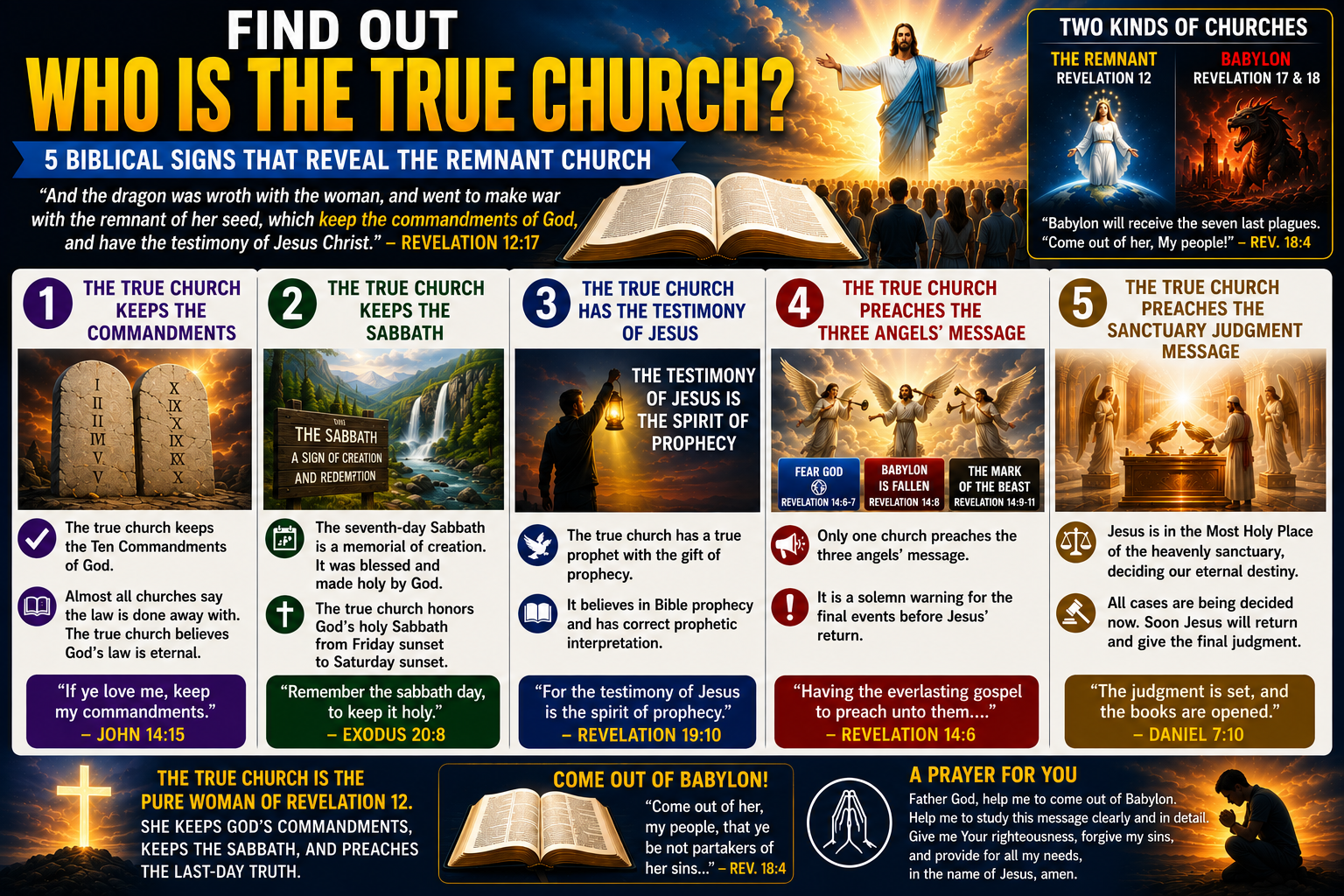
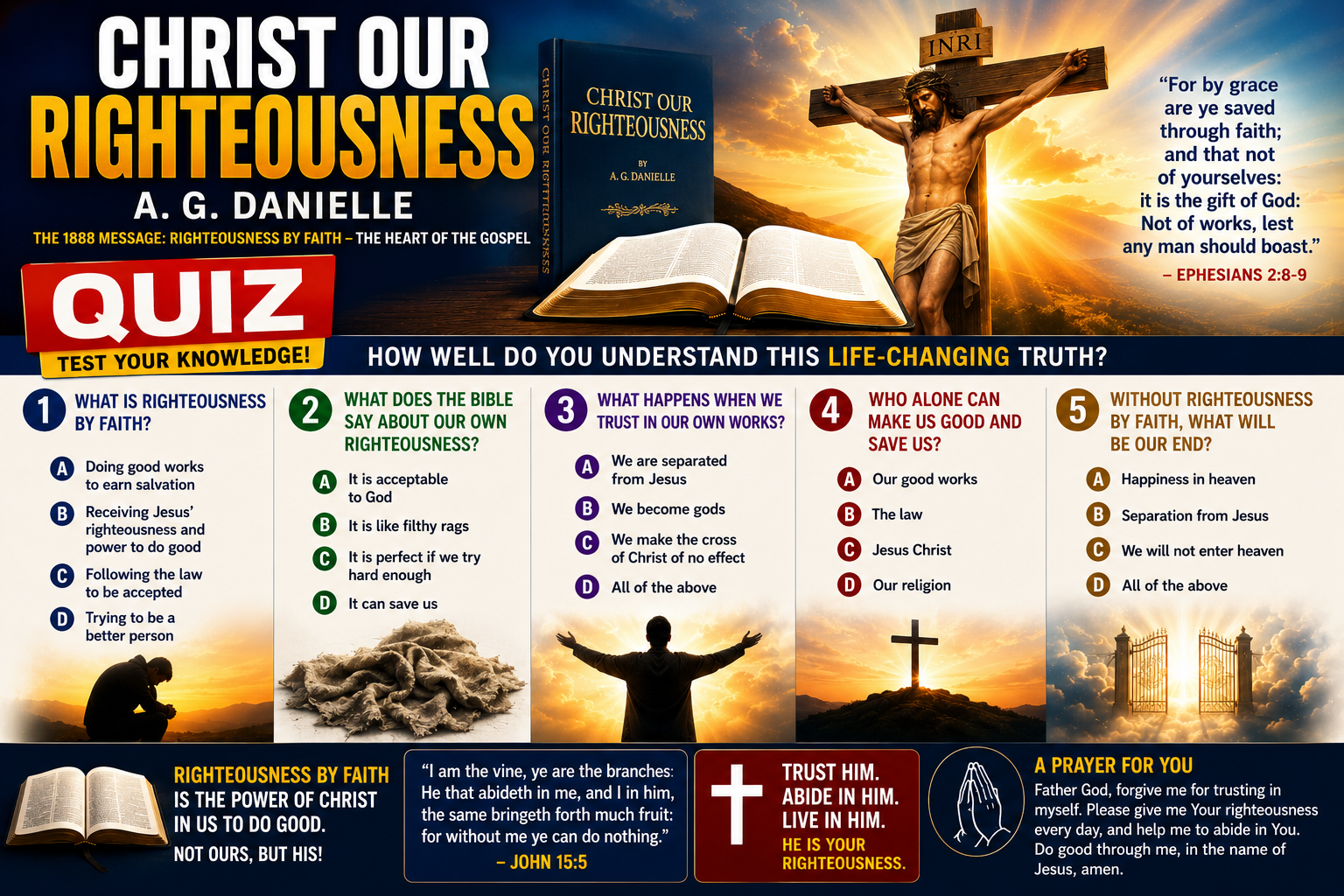
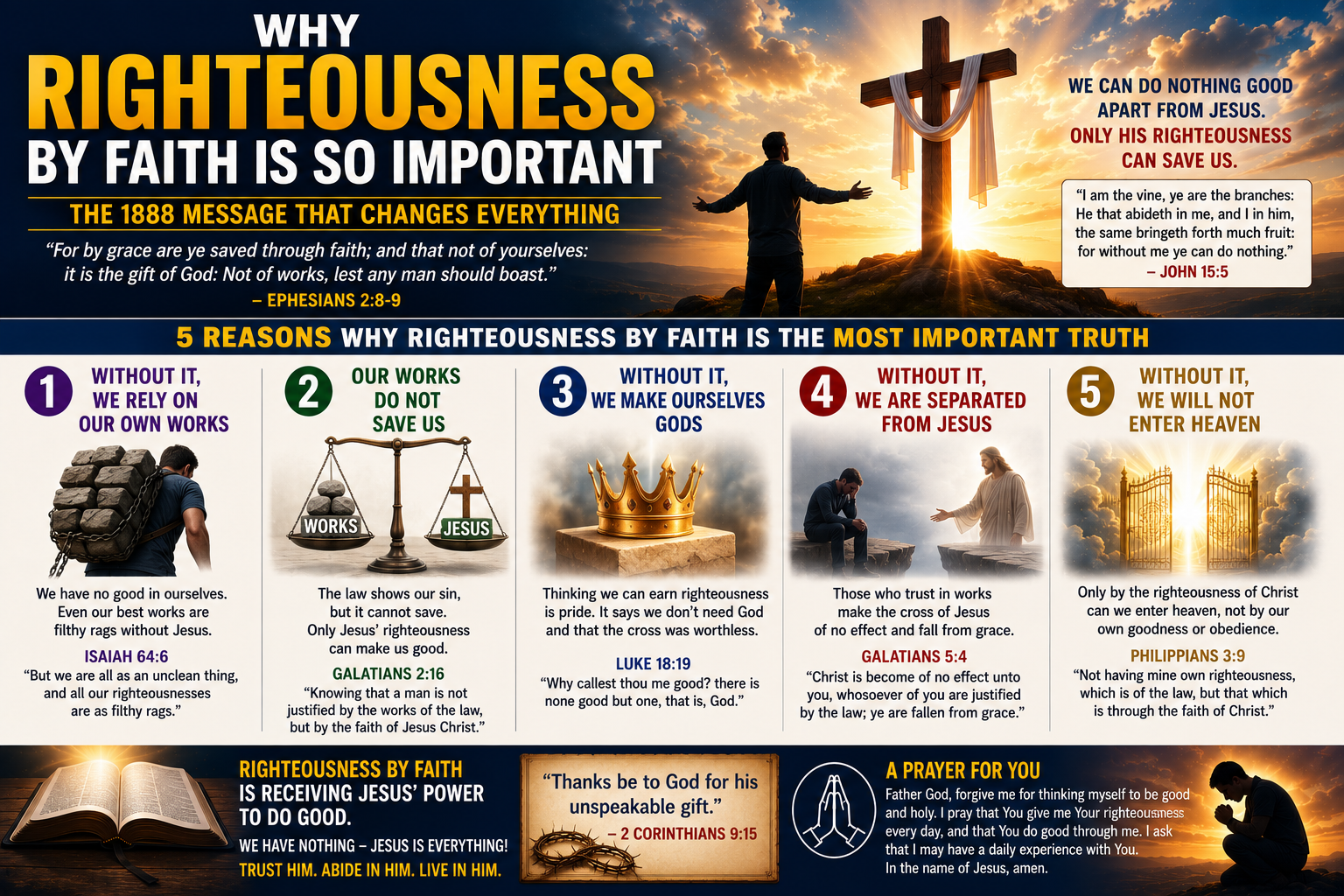
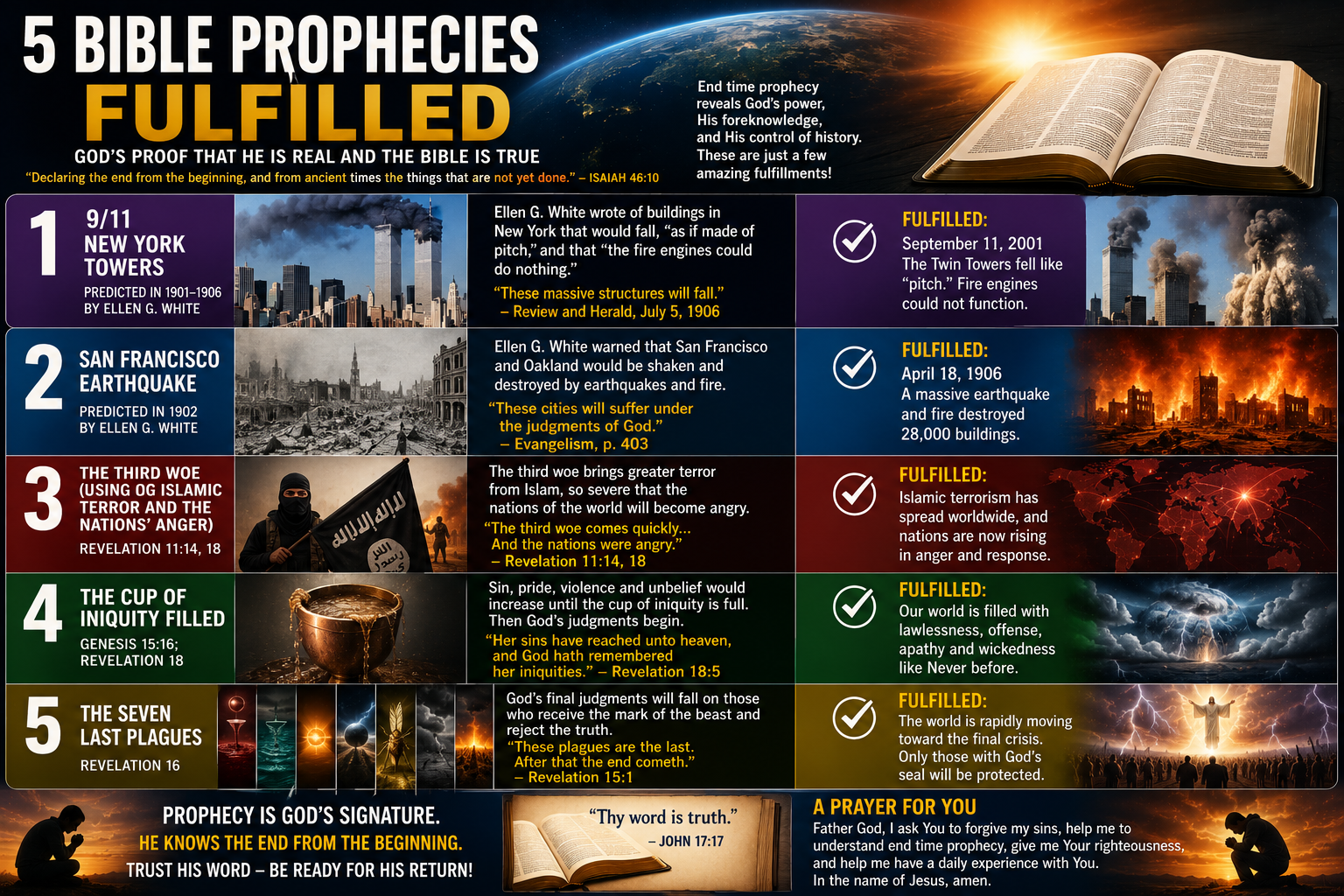
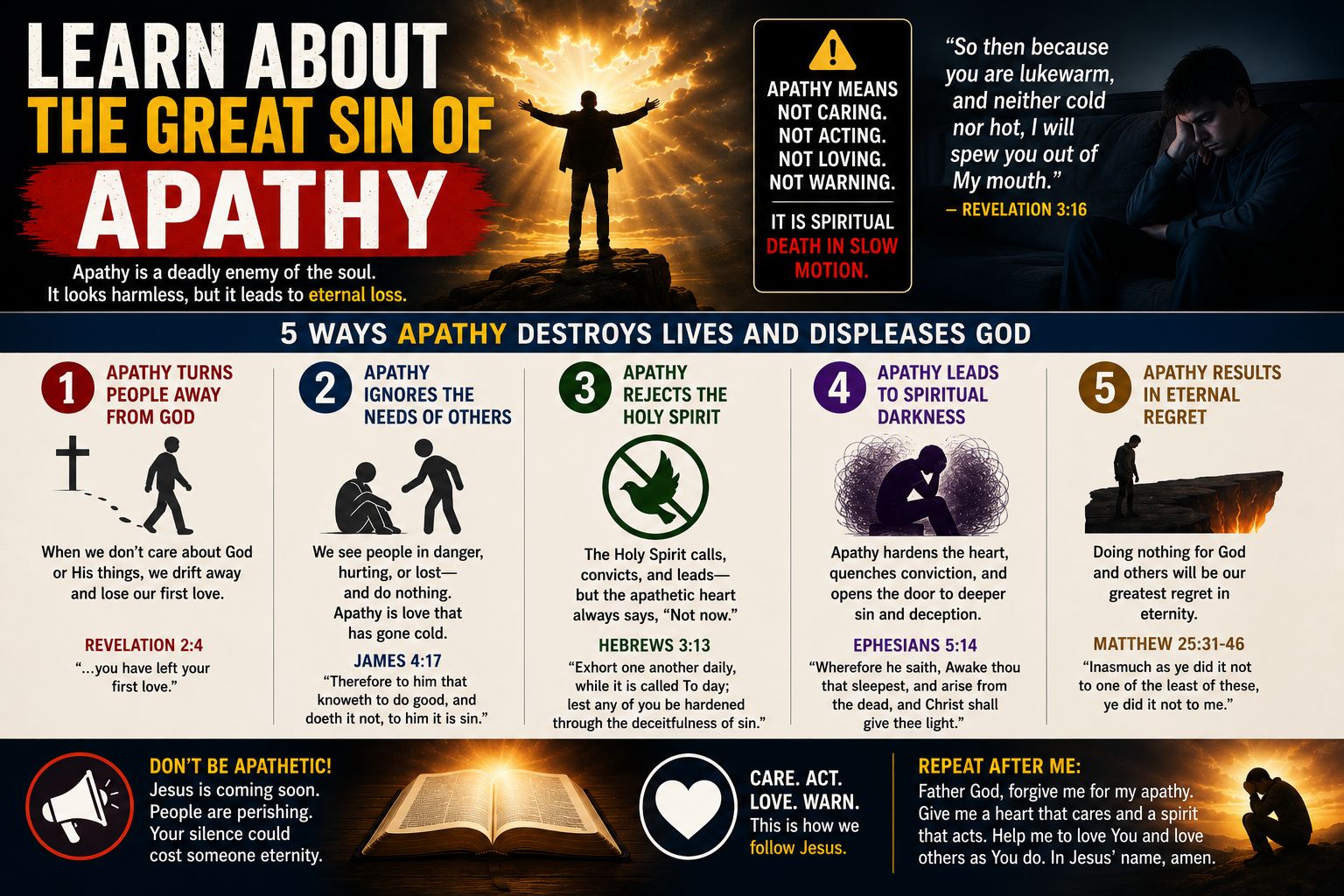
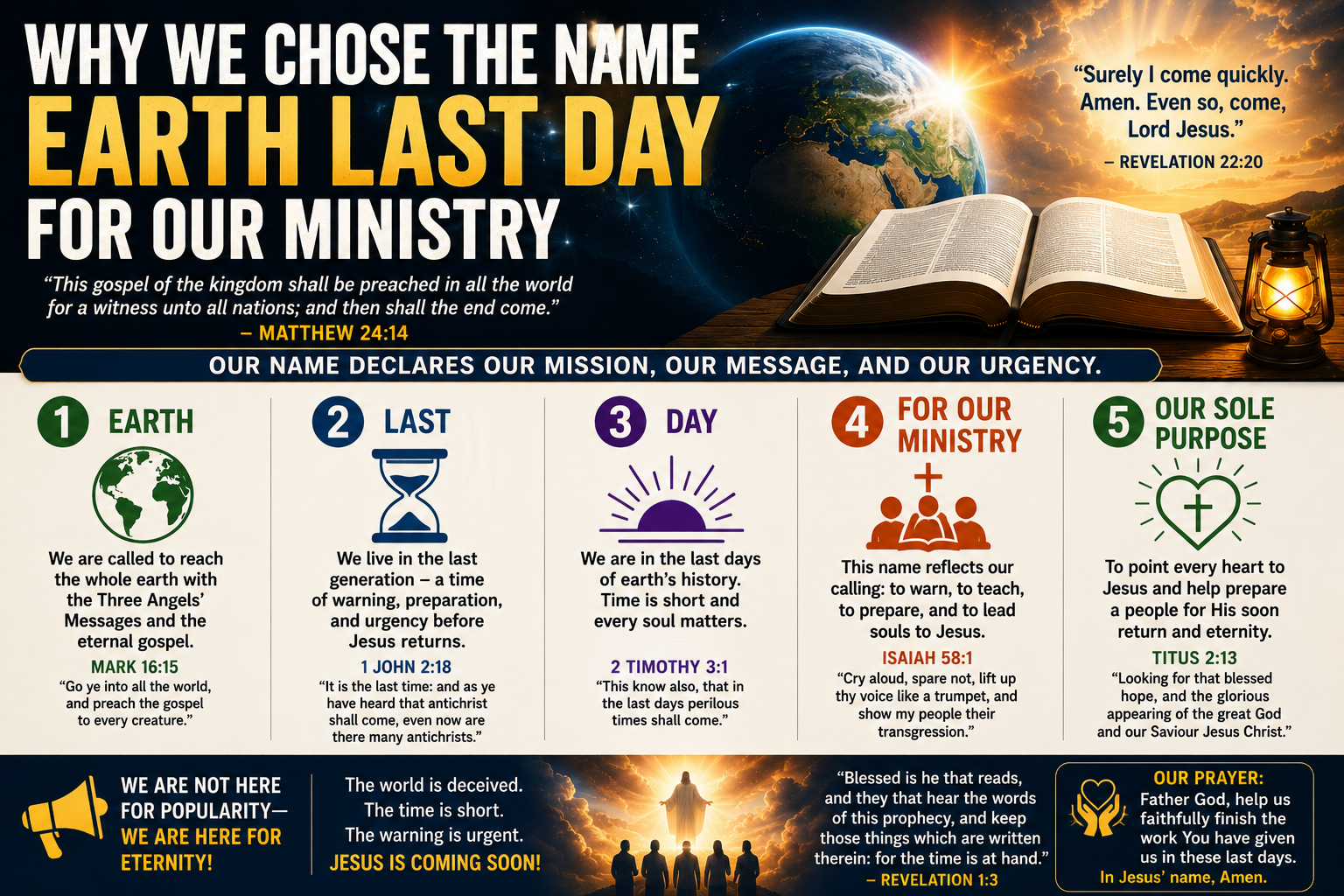
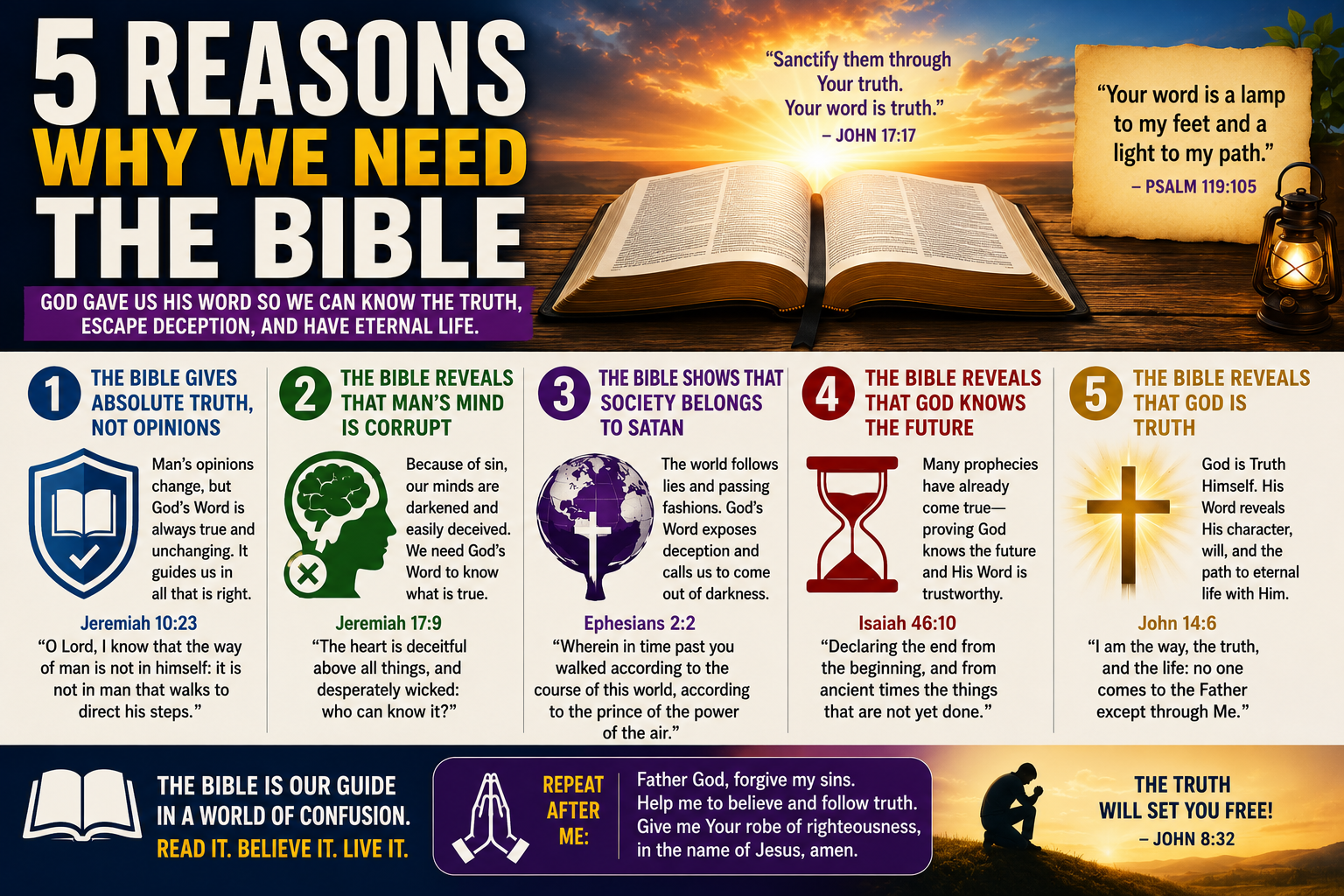
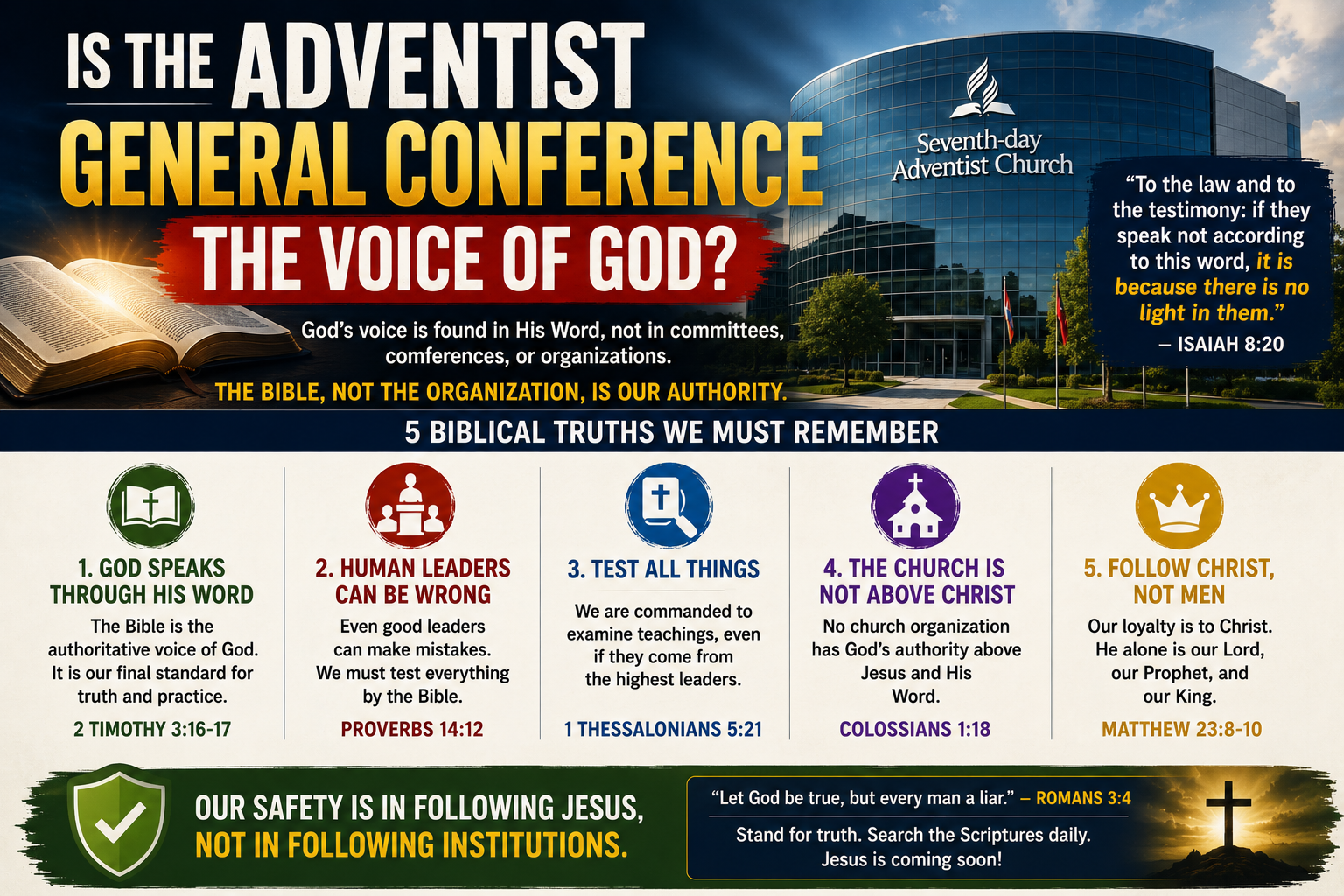
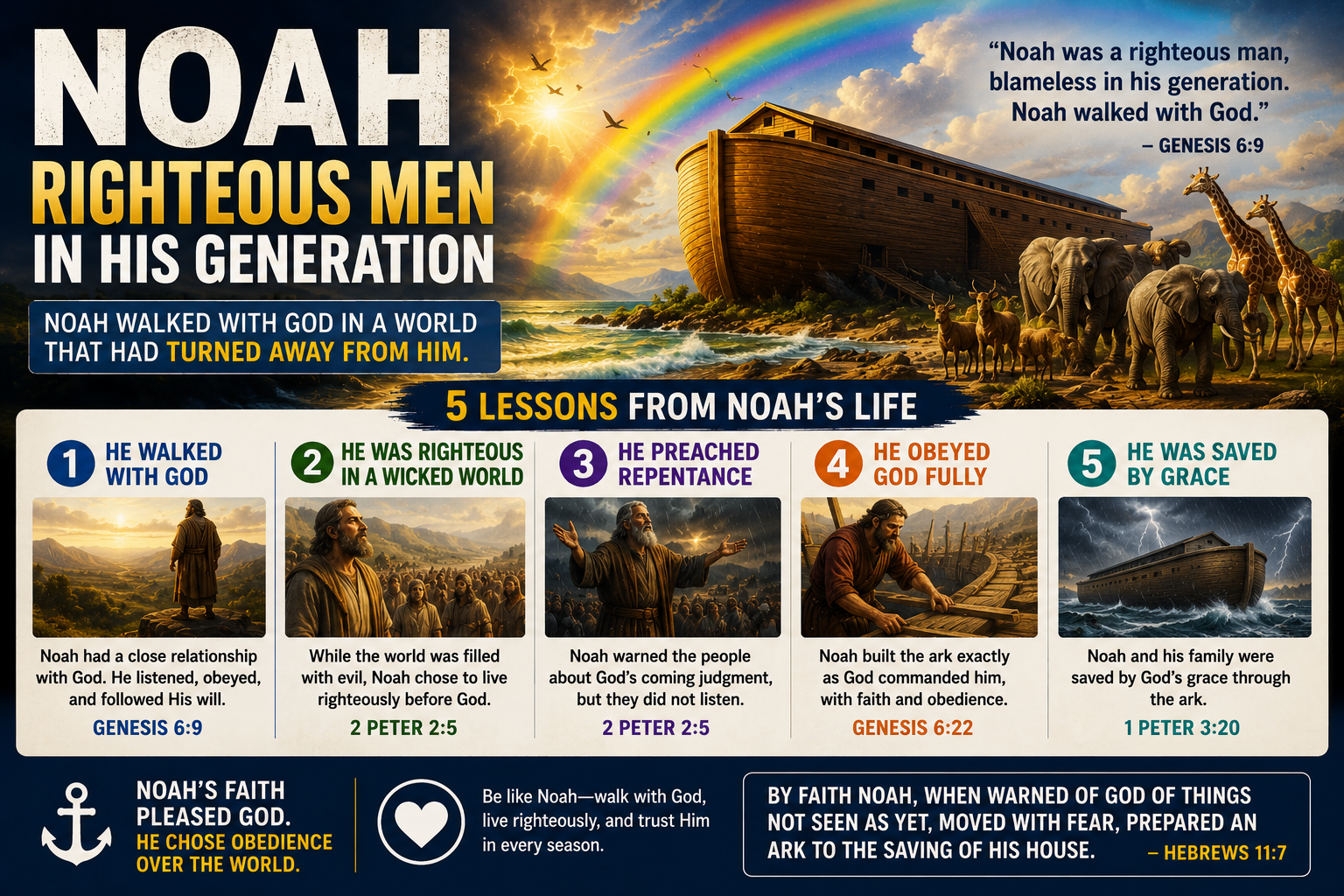
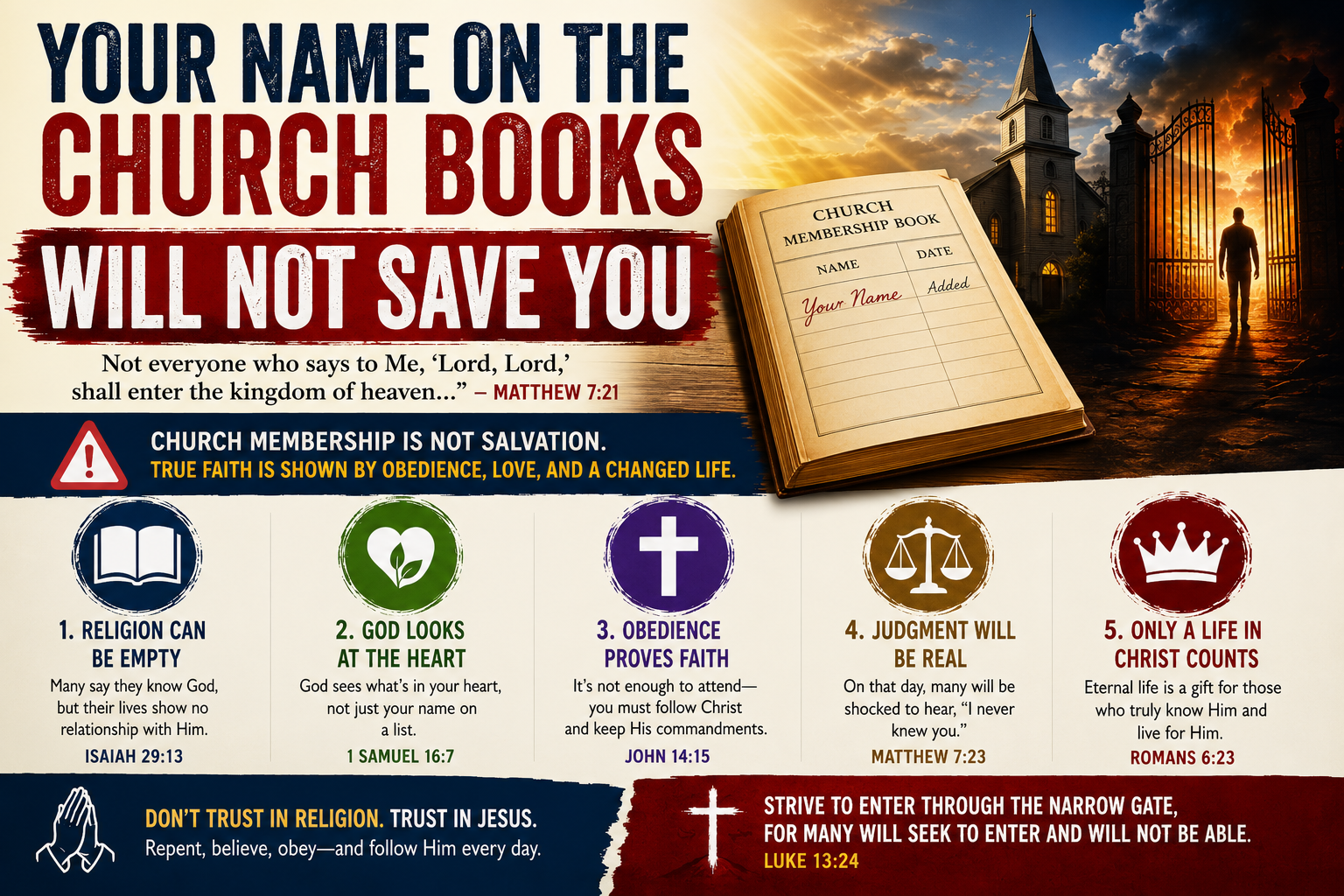
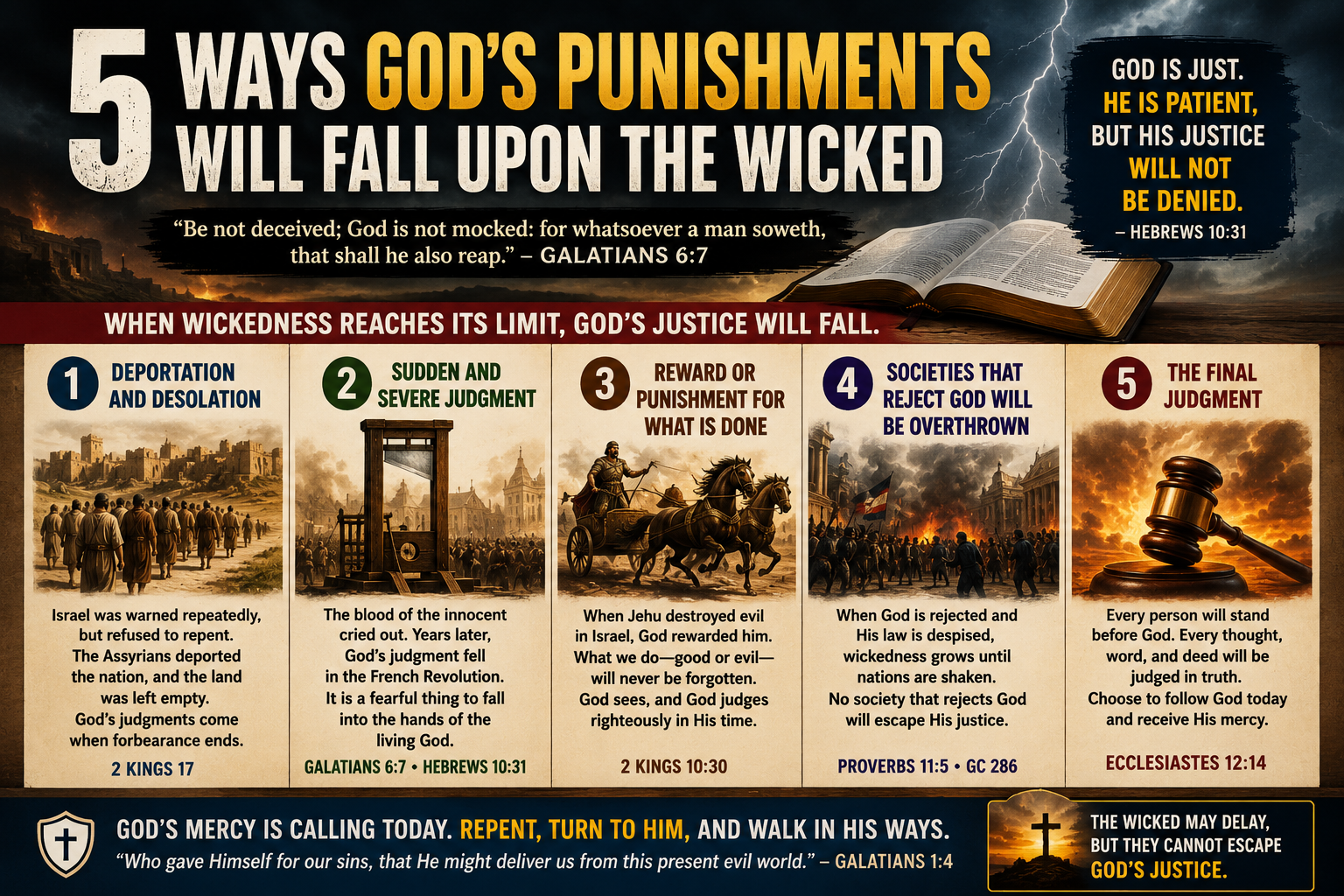


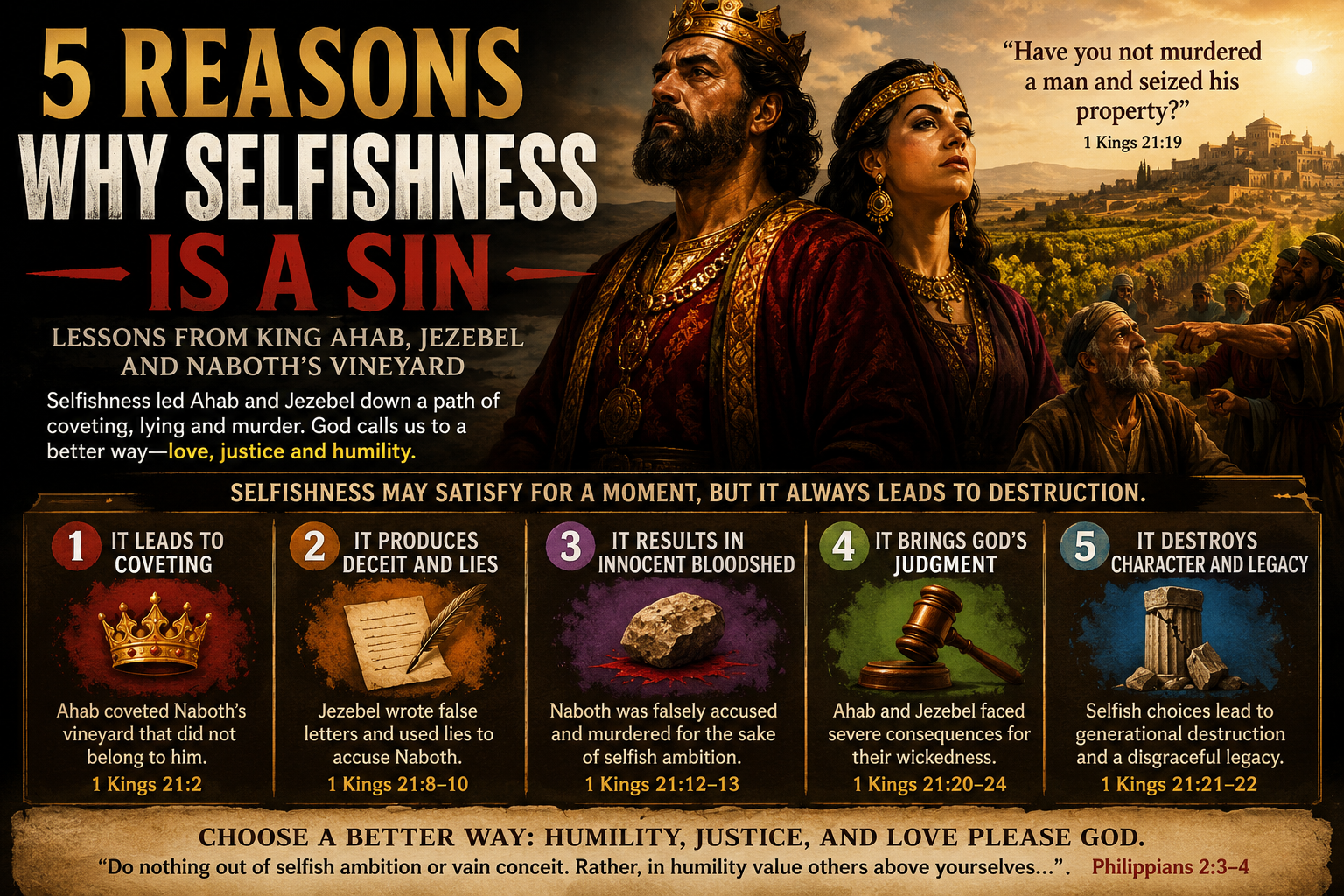
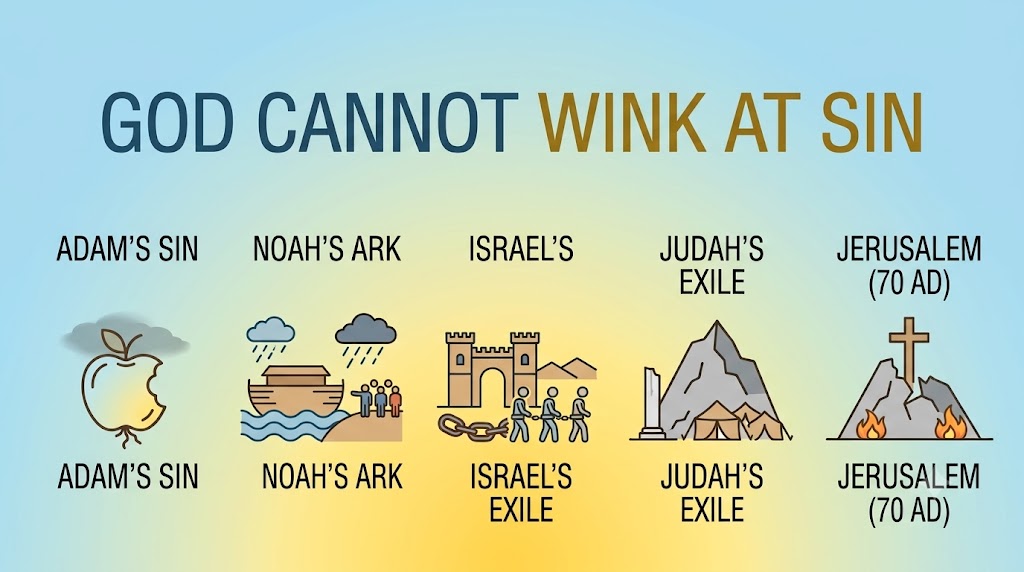
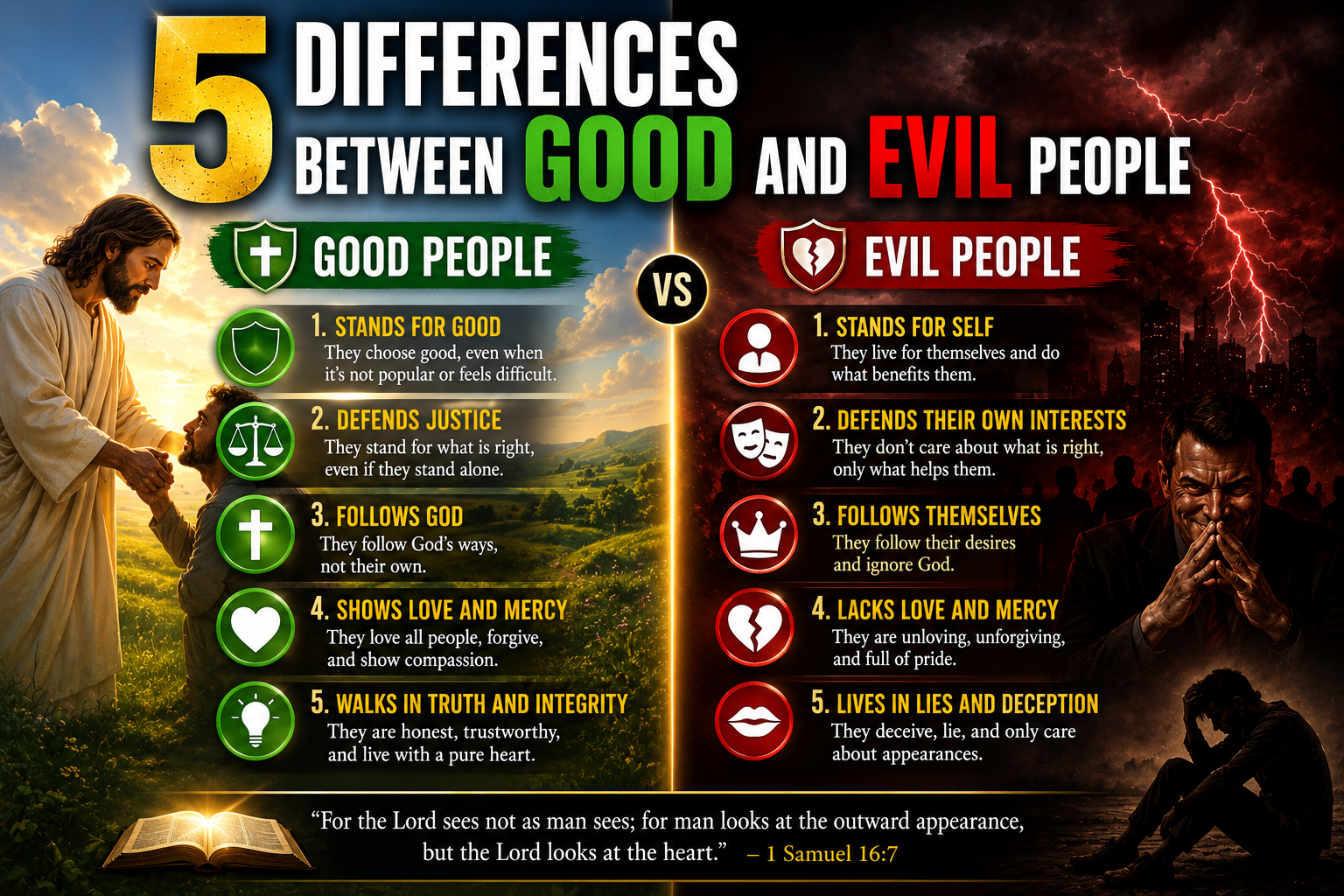
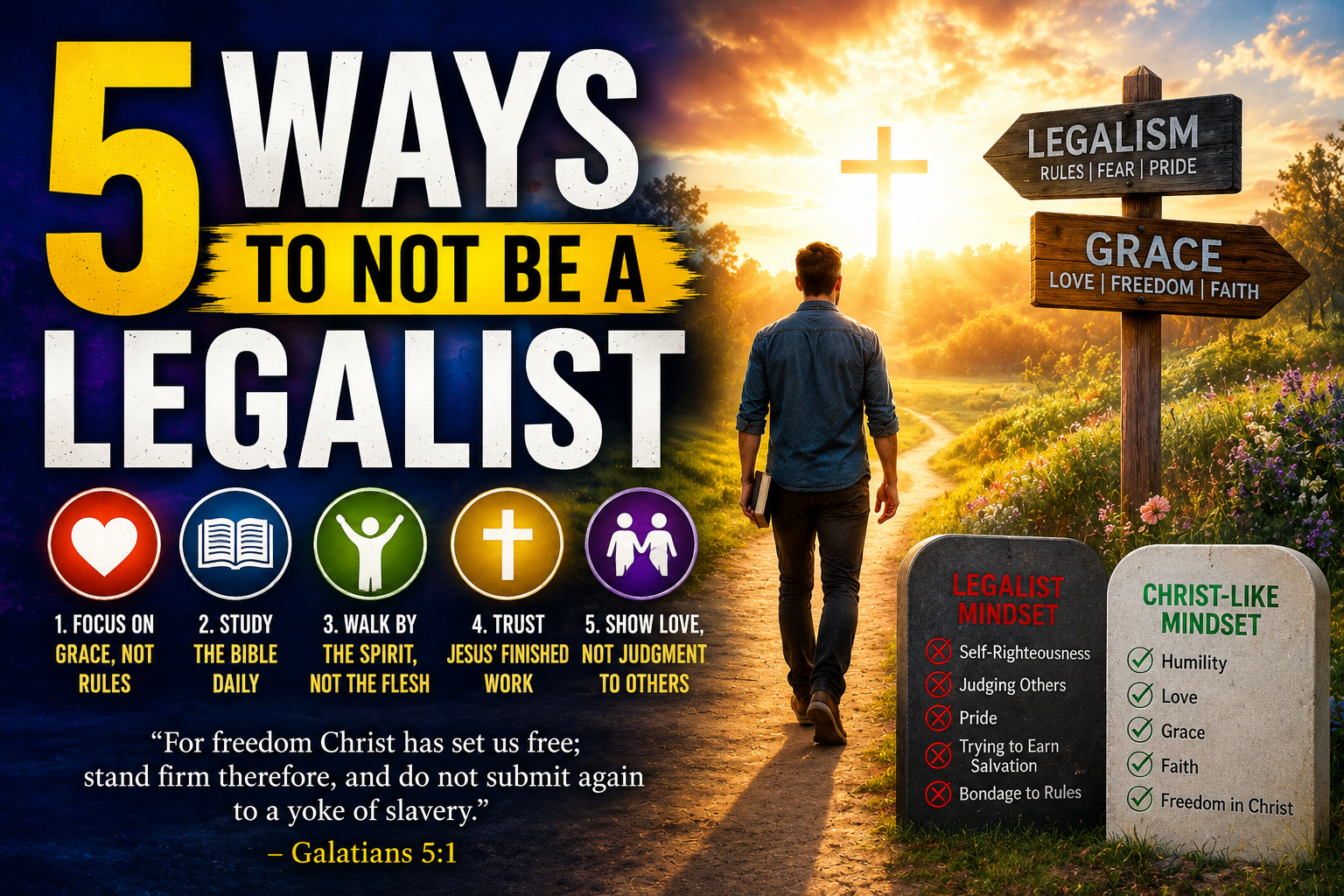





  • Book of Esther bible quiz

    Book of Esther bible quiz

    Esther ch 1

    V1 Which territory did Ahasuerus reign over? India to Ethiopia.
    V3 When did he make a feast for all the princes? In the third year of his reign.
    V4 How long was the feast? 180 days.

    V17 Why was Vashti’s behavior wrong? This deed shall come upon all women, so that they shall despise their husbands.
    V18 There shall arise too much wrath and contempt.

    Esther ch 2

    V1 What happened after Vashti was gone? Let there be fair young virgins sought for the king.
    V7 Another name for Esther? Hadassah.
    V14 When did Esther go to see Ahasuerus? In the evening.
    V17 And the king loved Esther above all the women.

    Esther ch 3

    V8 What was Haman’s excuse to destroy the Jews? There is a certain people; their laws are diverse; neither keep they the king’s laws.
    What provoked this decree? Mordecai not bowing down to Haman.

    Esther ch 4

    V11 What happened to someone who came into the king’s presence uncalled? He was killed unless the king held out the golden scepter.
    V13 Mordecai answered Esther, “Think not that you shall escape in the king’s house more than all the Jews.”

    Esther ch 5

    V3 What did Ahasuerus say when Esther came before him? It shall be given you to the half of the kingdom.
    V6 What kind of banquet did Esther make? A banquet of wine.
    V14 How high was the gallows Haman made? 50 cubits high, or 27 meters.

    Esther ch 6

    V1 What happened when Ahasuerus could not sleep? He commanded to bring the book of records.
    V2 What did Ahasuerus read? Mordecai saved his life.
    V4 Who just entered the palace? Haman, thinking what? To ask the king to hang Mordecai.
    V6 What did Ahasuerus ask Haman? What shall be done unto the man whom the king delights to honour?
    What did Haman think? To whom would the king delight to honour more than to myself?
    V11 Who had to array Mordecai and lead the horse? Haman.

    Esther ch 8

    V2 Who took the place of Haman? Mordecai.
    Who gave him this position?

    V9 How many provinces did Ahasuerus have? 127.
    V17 Who became Jews after the decree that Jews should not be killed? Many people.
    Why? For the fear of the Jews fell upon them.

    Esther ch 9

    V4 What happened to Mordecai? He was great in the king’s house; his fame went throughout all the provinces, for this man Mordecai waxed greater and greater.
    V21 Which day was to be kept as the Jews’ victory? The 14th day of Adar.
    V26 What were these days called? Purim, after the name of Esther.

    Esther ch 10

    V2 Where was this story also written? In the book of the chronicles of the kings of Media and Persia.

  • Book of Job bible quiz

    Book of Job bible quiz

    This is an amazing way to study the Bible. Really, this has changed my Christian life. Instead of reading a few chapters of the Bible each morning, I study the Bible quiz page and remember and retain a lot more of the Bible than reading chapters once. Job Bible study questions and answers. We should be completing the whole Bible in Bible quiz. Like Job Bible study questions and answers. Study our Bible quiz and tell your friends how this manner of studying the Bible is blessing your life.

    Job ch 1

    V1 Where was Job from? Land of Uz.
    How was Job’s character? Perfect and upright, one that feared God and shunned evil.
    V2 How many sons and daughters did he have? 7 sons and daughters.
    V3 This man was the greatest man in the East.

    Job ch 2

    V11 Who were Job’s three friends? Eliphaz, Bildad, Zophar.
    V12 What happened when Job’s friends came to see him? They knew him not, rent their garments, and threw dust in the air.
    V13 What happened for seven days? Nobody spake a word.

    Job ch 5

    V8 I will seek unto God and unto God will I commit my cause.
    V9 Which does great things and unsearchable, marvelous things without number.
    V11 To set up on high those who are low.
    V12 That those which mourn be exalted to safety.
    V12 He disappoints the devices of the crafty.
    V13 He takes the wise in their own craftiness.
    V15 But He saves the poor from their sword, their mouth, and from the hand of the mighty.

    V18 For God makes sore and binds up.
    He wounds and His hands make whole.
    V19 He shall deliver you in six troubles; in seven shall no evil touch you.
    V20 In famine He shall redeem you from death; in war from the power of the sword.
    V21 You shall be hid from the scourge of the tongue; you will not be afraid when destruction comes.
    Scourge: whip.

    V22 At destruction and famine you shall laugh.
    V23 You shall be in league with the stones of the field;
    the beasts of the field shall be at peace with you.
    V24 Your tabernacle shall be in peace.

    Job ch 8

    V20 God will not cast away a perfect man, nor help evil doers.
    V21 Till He fill your mouth with laughing and your lips with rejoicing.
    V22 They that hate you shall be clothed with shame;
    the dwelling place of the wicked shall come to naught.

    Job ch 9

    V13 If God will not withdraw His anger, the proud helpers do stoop under Him.

    Job ch 15

    V14 What is man that he should be clean,
    and he which is born of a woman that he should be righteous?

    Job ch 22

    V21 Acquaint yourself with God and be at peace with Him; thereby good shall come unto you.
    V23 If you return to the Almighty, you shall be built up.
    V24 You shall lay gold as dust.
    V25 The Almighty shall be your defense, and you shall have plenty of silver.

    Job ch 32

    V2 Why was Elihu angry against Job? Because he justified himself rather than God.

    Job ch 39

    V10 Which animal did God give total freedom? The unicorn.
    V16 Why is the ostrich hardened against her young ones and lays eggs, forgetting that foot may crush them? Because God has deprived them of wisdom.

    Job ch 40

    V2 Shall he that contends with the Almighty instruct Him?
    He that reproves God, let him answer it.
    V8 Will you disannul My judgment?
    Will you condemn Me that you may be righteous?
    V9 Do you have an arm like God?
    Can you thunder with a voice like Him?

    V10 Deck yourself now with majesty and excellency;
    array yourself with glory and beauty.
    V11 Behold everyone that is proud, and abase him.
    V12 Look on everyone that is proud and bring him low;
    tread down the wicked in their place.
    V16 Where is Behemoth’s strength? His loins.
    His force is in the navel of his belly.
    V21 Where does Behemoth lie? Under the shady tree.

    Job ch 42

    V7 Against who was God angry? Eliphaz and the two friends.
    Why? For you have not spoken of Me the thing that is right.
    V8 What had they to do? Offer seven bullocks and seven rams, lest I deal with you according to your folly.
    V10 What did God do to Job? Turned the captivity of Job and gave twice as much as he had before.
    V12 The Lord blessed the latter end of Job more than his beginning.

  • Book of Psalms Concentrate bible quiz

    Book of Psalms Concentrate bible quiz

    Ps ch 1

    V1 Blessed is he that walks not in the counsel of the ungodly,
    nor stands in the way of sinners,
    nor sits in the seat of the scornful.

    V2 But his delight is in the law of the Lord;
    in His law he meditates day and night.

    V3 He shall be like a tree planted by the rivers of water
    that brings forth its fruit in its season;
    his leaf shall not wither;
    whatsoever he does prospers.

    V4 The ungodly are not so,
    but are like the chaff that the wind drives away.

    V5 The ungodly shall not stand in judgment,
    nor sinners in the congregation of the righteous.

    V6 The Lord knows the way of the righteous,
    but the way of sinners shall perish.

    Ps ch 2

    V1 Against whom kings of the earth set themselves? Against the Lord and His Anointed.

    V3 What do the kings say against God? Let us break Their bands asunder, and cast away Their cords from us.

    V5 How will God speak to kings? In His wrath and vex them in His sore displeasure.

    V9 How will Jesus break them? With a rod of iron, and dash them in pieces like a potter’s vessel.

    V12 What do kings have to do? Kiss the Son, lest He be angry, and you perish from the way.

    Ps ch 3

    V3 But You are a shield for me, my glory, and the lifter of my head.

    V5 I laid me down and slept; I awakened, for You sustained me.

    V6 I will not be afraid of the thousands of people who have set themselves against me round about.

    V7 You have smitten all my enemies upon the cheekbone;
    You have broken the teeth of the ungodly.

    Ps ch 4

    V1 You have enlarged me when I was in distress.

    V6 Lift up the light of Your countenance upon us.

    V7 You have put gladness in my heart more than when their corn and wine increase.

    V8 I will both lay me down in peace and sleep;
    for You, Lord only, make me dwell in safety.

    Ps ch 5

    V4 You are not a God that has pleasure in wickedness, evil, foolish workers of iniquity.

    V6 You shall destroy him that speaks leasing.
    Leasing: falsehood, lies, untruth.

    V11 Why should those that put trust in God rejoice? For You defend them.

    V12 For You will bless the righteous with favour;
    with favour You will compass him as with a shield.
    Favour: delight, acceptance.

    Ps ch 6

    V11 Let all my enemies be ashamed and sore vexed;
    let them return and be ashamed suddenly.

    Ps ch 7

    V10 My defense is of God, which saves the upright in heart.

    V11 God is angry with the wicked every day.

    V12 If he turn not, He has whet His sword;
    He has bent His bow and made it ready.

    Ps ch 8

    V4 What is man, that You are mindful of him?
    And the son of man, that You visit him?

    Ps ch 9

    V9 The Lord shall be a refuge for the oppressed,
    a refuge in times of trouble.

    V10 For You have not forsaken those who trust in You.

    V12 He forgets not the cry of the humble.

    V18 For the needy shall not always be forgotten;
    the expectation of the poor shall not perish forever.

    V20 Put them in fear, Lord,
    that the nations may know themselves to be but men.

    Ps ch 10

    V14 You have seen it; for You behold mischief and spite.
    Spite: provocation, grief of men, indignation,
    to requite it.

    V18 That the men of the earth may be no more oppressed.

    Ps ch 11

    V7 For the righteous Lord loves righteousness;
    His countenance beholds the upright.

    Ps ch 12

    V3 The Lord shall cut off all flattering lips,
    and the tongue that speaks proud things.

    The words of the Lord are pure words.

    V6 As silver purified in a furnace seven times.

    V8 The wicked walk on every side,
    when the vilest men are exalted.

    Ps ch 13

    V6 I will sing unto the Lord,
    for He has dealt bountifully with me.

    Ps ch 14

    V2 The Lord looks down to see if there were any that did understand and seek God.

    V3 They are all gone aside, become filthy;
    there is none that does good, no, not one.

    V7 Oh that the salvation of Israel were come out of Zion!
    When the Lord brings back the captivity of His people,
    Jacob shall rejoice, Israel shall be glad.

    Ps ch 15

    V1 Who shall abide in God’s tabernacle?
    He that walks uprightly, works righteousness, speaks truth in his heart, backbites not, nor does evil to his neighbour, nor takes up reproach against his neighbour.

    In whose eyes a vile person is contemned.

    He that swears to his own hurt and changes not.

    He that puts not out his money to usury.

    Nor takes reward against the innocent.

    He that does these things shall never be moved.

    Ps ch 16

    V5 The Lord is the portion of my inheritance and of my cup;
    You maintain my lot.

    V8 Because He is at my right hand, I shall not be moved.

    V11 In Your presence is fullness of joy;
    at Your right hand are pleasures forevermore.

    Ps ch 17

    V7 Show me Your marvelous lovingkindness,
    You that save by Your right hand them that put their trust in You from those that rise up against them.

    V8 Keep me as the apple of Your eye;
    hide me under the shadow of Your wings.

    Ps ch 18

    V2 The Lord is my rock, and my strength, and my deliverer;
    my buckler, and the horn of my salvation, my high tower.

    V16 He sent from above; He took me, He drew me out of many waters.

    V30 He is a buckler for all those who trust in Him.

    V35 Your gentleness has made me great.

    V47 It is God that avenges me and subdues the people under me.

    Ps ch 21

    V2 You have given him his heart’s desire,
    and have not withholden the request of his lips.

    V3 You prevented him with blessings of goodness.

    Ps ch 22

    V4 Our fathers trusted in You and You delivered them.

    V5 They cried unto You and were delivered;
    they trusted in You and were not confounded.

    V28 God is the governor among the nations.

    Ps ch 23

    V1 The Lord is my shepherd; I shall not want.

    V2 He makes me to lie down in green pastures;
    He leads me beside the still waters.

    V3 He restores my soul;
    He leads me in the paths of righteousness for His name’s sake.

    V4 Though I walk through the valley of the shadow of death,
    I will fear no evil;
    Your rod and Your staff, they comfort me.

    V5 You prepare a table before me in the presence of my enemies;
    You anoint my head with oil; my cup runs over.

    V6 Surely goodness and mercy shall follow me all the days of my life,
    and I will dwell in the house of the Lord forever.

    Ps ch 24

    V1 The earth is the Lord’s, and the fullness thereof;
    the world, and they that dwell therein.

    V2 For He has founded it upon the seas,
    and established it upon the floods.

    V3 Who shall ascend into the hill of the Lord?
    He that has clean hands, a pure heart,
    not lifted up his soul unto vanity,
    nor sworn deceitfully.

    V5 He shall receive blessing from the Lord,
    and righteousness from the God of his salvation.

    Ps ch 25

    V6 Remember Your tender mercies and lovingkindnesses,
    for they have been ever of old.

    V8 Good and upright is the Lord.

    V9 The meek will He guide in judgment, and teach His way.

    V10 All the paths of the Lord are mercy and truth
    unto such as keep His covenant and His testimonies.

    V12 What man is he that fears the Lord?
    Him shall He teach in the way that he shall choose.

    V13 His soul shall dwell at ease;
    his seed shall inherit the earth.

    V14 The secret of the Lord is with those that fear Him;
    He will show them His covenant.

    V15 He shall pluck my feet out of the net.

    Ps ch 26

    V3 Your lovingkindness is ever before my eyes.

    Ps ch 27

    V1 The Lord is my light and my salvation;
    whom shall I fear?
    The Lord is the strength of my life; of whom shall I be afraid?

    V3 Though a host should encamp against me, I will not fear.

    V5 For in the time of trouble He shall hide me in His pavilion,
    in the secret of His tabernacle shall He hide me;
    He shall set me up upon a rock.

    V6 My head shall be lifted up above my enemies round about me.

    V10 When my father and my mother forsake me,
    then the Lord will take me up.

    V13 I had fainted unless I had believed to see the goodness of the Lord in the land of the living.

    V14 Wait on the Lord; be of good courage,
    and He shall strengthen your heart.

    Ps 28

    V7 The Lord is my strength and my shield;
    my heart trusts in Him.

    Ps ch 29

    V3 The voice of the Lord is upon the waters;
    the glory of God thunders.

    V4 The voice of the Lord is powerful, full of majesty.

    V7 The voice of the Lord divides the flames of fire.

    V11 The Lord sits upon the floods.

    V8 The voice of the Lord shakes the wilderness.

    V11 The Lord will give strength unto His people;
    the Lord will bless His people with peace.

    Ps ch 30

    V1 I will exalt You, for You have lifted me up,
    and have not made my foes to rejoice over me.

    V2 I cried unto You, and You have healed me.

    V5 For His anger endures for a moment,
    but His favour is for life;
    weeping may endure for a night, but joy comes in the morning.

    V10 Have mercy upon me, for You are my helper.

    V11 You have turned my mourning into dancing;
    You have put off my sackcloth and girded me with gladness.

    Ps ch 31

    V3 For You are my rock and my fortress.

    V7 For You have considered my trouble;
    You have known my soul in adversity.

    V8 You have not shut me up into the hands of my enemy;
    You have set my feet in a large room.

    V19 How great is Your goodness,
    which You have laid up for those that fear You.

    V21 Blessed be the Lord, for He has showed me His marvelous kindness.

    V22 You heard the voice of my supplication when I cried unto You.

    V23 O love the Lord, for He preserves the faithful
    and plentifully rewards the proud doer.

    V24 Be of good courage, and He shall strengthen your heart.

    Ps ch 32

    V7 You are my hiding place; You shall preserve me from trouble;
    You shall compass me about with songs of deliverance.

    V10 Many sorrows shall be to the wicked,
    but he that trusts in the Lord, mercy shall compass him about.

    V11 Be glad in the Lord, and rejoice, you righteous,
    and shout for joy, all you that are upright in heart.

    Ps ch 33

    V10 The Lord brings the counsel of the heathen to naught;
    He makes the devices of the people of none effect.

    V18 The eye of the Lord is upon them that fear Him,
    upon them that hope in His mercy.

    V19 To deliver their soul from death
    and keep them alive in famine.

    V20 Our soul waits for the Lord;
    He is our help and our shield.

    Ps ch 34

    V1 I will bless the Lord at all times;
    His praise shall continually be in my mouth.

    V4 I sought the Lord, and He heard me
    and delivered me from all my fears.

    V6 This poor man cried, and the Lord heard him,
    and delivered him out of all his troubles.

    V7 The angel of the Lord encamps around them that fear Him,
    and delivers them.

    V8 O taste and see that the Lord is good.

    V9 O fear the Lord, for there is no want to them that fear Him.

    V10 The young lions do lack and suffer hunger,
    but they that trust in the Lord shall not want any good thing.

    V12 What man is he that desires life, and loves many days, that he may see good?

    V13 Keep your tongue from evil,
    and your lips from speaking guile.

    V14 Depart from evil, and do good;
    seek peace, and pursue it.

    V15 The eyes of the Lord are upon the righteous,
    and His ears are open to their cry.

    V16 The face of the Lord is against them that do evil,
    to cut off the remembrance of them from the earth.

    V17 The righteous cry, and the Lord hears,
    and delivers them out of all troubles.

    V18 The Lord is close to them that are of a broken heart,
    and saves such as have a contrite spirit.

    V19 Many are the afflictions of the righteous,
    but the Lord delivers him out of them all.

    V21 Evil shall slay the wicked;
    they that hate the righteous shall be desolate.

    Ps ch 35

    V27 Let the Lord be magnified,
    who has pleasure in the prosperity of His servant.

    Ps ch 36

    V5 Your mercy, O God, is in the heavens;
    Your faithfulness reaches unto the clouds.

    V6 Your righteousness is like the great mountains;
    Your judgments are like a great deep.

    V7 O how excellent is Your lovingkindness!
    The children of men put their trust under the shadow of Your wings.

    V8 You will make them drink of the river of Your pleasures.

    V10 O continue Your lovingkindness unto them that know You.

    Ps ch 37

    V1 Fret not yourself against evildoers,
    neither be envious against the workers of iniquity.

    V2 For they shall soon be cut down like the grass
    and wither like the green herb.

    V3 Trust in the Lord and do good,
    and dwell in the land, and verily you shall be fed.

    V4 Delight yourself in the Lord,
    and He shall give you the desires of your heart.

    V9 For evildoers shall be cut off,
    but those that wait upon the Lord shall inherit the earth.

    V10 For yet a little while, and the wicked shall not be.

    V11 But the meek shall inherit the earth
    and delight themselves in the abundance of peace.

    V12 The wicked plots against the just.

    V13 The Lord laughs at him,
    for He sees that his day is coming.

    V17 The Lord upholds the righteous.

    V18 The Lord knows the days of the upright;
    their inheritance shall be forever.

    V19 They shall not be ashamed in the evil time;
    and in the days of famine they shall be satisfied.

    V23 The steps of a good man are ordered by the Lord;
    He delights in his way.

    V24 Though he falls, he shall not be utterly cast down,
    for the Lord upholds him with His hand.

    V25 I have been young, and am old;
    yet have I never seen the righteous forsaken,
    nor his seed begging bread.

    V27 Depart from evil, and do good,
    and dwell forevermore.

    V32 The wicked watches the righteous
    and seeks to slay him.

    V33 The Lord will not leave him in his hand,
    nor condemn him when he is judged.

    V34 When the wicked are cut off, you shall see it.

    V37 Mark the perfect man, and behold the upright.

    V39 The salvation of the righteous is of the Lord;
    He is their strength in the time of trouble.
    For the end of that man is peace.

    V40 The Lord shall help them and deliver them;
    He shall deliver them from the wicked
    and saves them because they trust in Him.

    Ps ch 40

    V1 I waited patiently for the Lord,
    and He inclined unto me, and heard my cry.

    V2 He brought me up out of an horrible pit,
    out of the miry clay,
    and set my feet upon a rock, and established my goings.

    V3 He has put a new song in my mouth,
    even praise to our God.

    V4 Blessed is the man that makes the Lord his trust,
    and respects not the proud, nor such as turn aside to lies.

    V11 Withhold not Your tender mercies from me;
    let Your lovingkindness and Your truth ever preserve me.

    V17 The Lord thinks upon me;
    You are my help and deliverer.

    Ps ch 41

    V1 Blessed is he that considers the poor;
    the Lord shall deliver him in time of trouble.

    V2 The Lord will preserve him and keep him alive;
    he shall be blessed upon the earth,
    and God will not deliver him unto the will of his enemies.

    V3 The Lord will strengthen him upon the bed of languishing;
    You will make all his bed in his sickness.

    V11 This I know, that You favour me,
    that my enemies do not triumph over me.

    Ps ch 42

    V5 Why are you cast down, O my soul?
    Why are you disquieted within me?
    Hope you in God, for I shall yet praise Him.

    V8 The Lord will command His lovingkindness in the daytime.

    Ps ch 44

    V5 Through You will we push down our enemies;
    through Your name will we tread them under that rise up against us.

    V7 But You have saved us from our enemies;
    You have put them to shame that hate us.

    Ps ch 45

    V11 The king shall greatly desire your beauty.

    Ps ch 46

    V1 The Lord is our refuge and strength, a very present help in trouble.

    V2 Therefore will not we fear, though the earth be removed,
    and though the mountains be carried into the midst of the sea.

    V3 Though the waters roar and be troubled.

    V7 The Lord of hosts is with us;
    the God of Jacob is our refuge.

    V10 Be still, and know that I am God;
    I will be exalted among the heathen.

    V11 The Lord of hosts is with us;
    the God of Jacob is our refuge.

    Ps ch 47

    V8 God reigns over the heathen.

    Ps ch 48

    V1 Great is our God, and greatly to be praised in the city of our God,
    in the mountain of His holiness.

    V3 God is known in her palaces for a refuge.

    V9 We have thought of Your lovingkindness in the midst of Your temple.

    V14 For this God is our God forever and ever;
    He will be our guide even unto death.

    Ps ch 49

    V5 Why should I fear in the days of evil?

    V10 Man that is in honour and understands not
    is like the beasts that perish.

    Ps ch 50

    V3 Our God shall come and shall not keep silence;
    a fire shall devour before Him,
    and it shall be very tempestuous round about Him.

    V12 If I were hungry, I would not tell you;
    for the earth is Mine, and the fullness thereof.

    V15 Call upon Me in the day of trouble;
    I will deliver you, and you shall glorify Me.

    V22 Consider this, you that forget God,
    lest I tear in pieces, and there be none to deliver.

    V23 Whoso offers praise glorifies Me;
    to him that orders his conversation aright will I show the salvation of God.

    Ps ch 52

    V1 The goodness of God endures forever.

    Ps ch 53

    V1 God looks down from heaven upon the children of men,
    to see if there were any that did understand, that did seek God.

    V3 Everyone of them is gone back;
    they are all together become filthy;
    there is none that does good, no, not one.

    V4 Have the workers of iniquity no knowledge, who eat up my people like bread?

    V5 There were they in great fear,
    when no fear was.

    Ps ch 54

    V4 Behold, God is my helper;
    the Lord is with them that uphold my soul.

    V5 He will reward evil unto my enemies;
    cut them off in Your truth.

    V7 For He has delivered me out of trouble;
    my eye has seen His desire upon my enemies.

    Ps ch 55

    V18 For He has delivered my soul in peace from the battle that was against me,
    for there were many with me.

    V19 God shall hear and afflict them.

    V22 Cast your burden upon the Lord, and He shall sustain you;
    He shall never suffer the righteous to be moved.

    Ps ch 56

    V3 What time I am afraid, I will trust in You.

    V11 In God I put my trust;
    I will not be afraid what man can do unto me.

    Ps ch 57

    V1 In the shadow of Your wings will I make my refuge,
    until these calamities be overpast.

    V2 I will cry unto God most high,
    who performs all things for me.

    V3 He shall send from heaven and save me
    from the reproach of him that would swallow me up.
    God shall send forth His mercy and His truth.

    V10 For Your mercy is great unto the heavens,
    and Your truth unto the clouds.

    Ps ch 58

    V10 The righteous shall rejoice when he sees the vengeance;
    he shall wash his feet in the blood of the wicked.

    V11 So that a man shall say, Verily there is a reward for the righteous;
    verily there is a God that judges in the earth.

    Ps ch 59

    V4 They run and prepare themselves without my fault;
    awake to help me, and behold.

    V9 I will wait upon You, for God is my defense.

    V10 The God of my mercy shall prevent me;
    God shall let me see my desire upon my enemies.

    V16 I will sing of Your power;
    for I will sing aloud of Your mercy in the morning;
    for You have been my defense and refuge in the day of my trouble.

    V17 Unto You, O my strength, will I sing;
    for God is my defense and the God of my mercy.

    Ps ch 60

    V7 Ephraim is the strength of my head;
    Judah is my lawgiver.

    V8 Moab is my washpot;
    over Edom will I cast out my shoe;
    Philistia, triumph you because of me.

    V11 Give us help from trouble;
    for vain is the help of man.

    V12 Through God we shall do valiantly;
    for He it is that shall tread down our enemies.

    Ps ch 61

    V2 When my heart is overwhelmed, lead me to the rock that is higher than I.

    V3 For You have been a shelter for me,
    and a strong tower from the enemy.

    Ps ch 62

    V2 He only is my rock and my salvation;
    He is my defense; I shall not be greatly moved.

    V7 In God is my salvation and my glory;
    the rock of my strength, and my refuge.

    V12 Also unto You belongs mercy;
    for You render to every man according to his works.

    Ps ch 63

    V3 Because Your lovingkindness is better than life,
    my lips shall praise You.

    V7 Because You have been my help,
    therefore in the shadow of Your wings will I rejoice.

    Ps ch 66

    V9 Which holds our soul in life,
    and suffers not our feet to be moved.

    V19 Verily God has heard me;
    He has attended to the voice of my prayer.

    V20 Blessed be God, who has not turned away my prayer,
    nor His mercy from me.

    Ps ch 68

    V5 A father of the fatherless,
    and a judge of the widows, is God in His holy habitation.

    V6 God sets the solitary in families;
    He brings out those that are bound with chains,
    but the rebellious dwell in a dry land.

    V10 God has prepared of Your goodness for the poor.

    V19 Blessed be the Lord, who daily loads us with benefits.

    V35 O God, You are terrible out of Your holy places;
    the God of Israel is He that gives strength and power unto His people.
    Blessed be God.

    Ps ch 69

    V16 Hear me, O Lord, for Your lovingkindness is good;
    turn unto me according to the multitude of Your tender mercies.

    V33 For the Lord hears the poor
    and despises not His prisoners.

    Ps ch 71

    V3 Be You my strong habitation,
    whereunto I may continually resort;
    You have given commandment to save me,
    for You are my rock and fortress.

    V7 I am as a wonder unto many,
    but You are my strong refuge.

    V21 You shall increase my greatness;
    You will comfort me on every side.

    Ps ch 72

    V12 For He shall deliver the needy when he cries,
    the poor also, and him that has no helper.

    V18 Blessed be the God of Israel,
    who only does wondrous things.

    Ps ch 73

    V1 Truly God is good to Israel,
    even to such as are of a clean heart.

    Ps ch 75

    V7 For God is the judge;
    He puts down one, and sets up another.

    V8 For in the hand of the Lord there is a cup,
    and the wine is red; it is full of mixture;
    and He pours out of the same;
    but the dregs thereof, all the wicked shall wring them out and drink them.

    Ps ch 76

    V7 You, even You, are to be feared;
    and who may stand in Your sight when once You are angry?

    V9 When God arose in judgment to save all the meek of the earth.

    Ps ch 77

    V1 I cried unto God with my voice,
    and He gave ear unto me.

    Ps ch 78

    V19 They spoke against God, saying, Can God furnish a table in the wilderness?

    V20 Behold, He smote the rock, that the waters gushed out, and the streams overflowed;
    can He give bread also? Can He provide flesh for His people?

    V20 The Lord heard this and was wroth,
    so a fire was kindled against Jacob,
    and anger also came up against Israel.

    V22 Because they believed not in God and trusted not in His salvation.

    V23 Though He had commanded the clouds from above and opened the doors of heaven,

    V24 And had rained down manna upon them to eat,
    and had given them the corn of heaven.

    V25 Men did eat angel’s food;
    He sent them meat to the full.

    V32 For all this they sinned still and believed not for His wondrous works.

    V38 But He, being full of compassion, forgave their iniquity, and destroyed them not.
    Many a time turned He His anger away,
    and did not stir up all His wrath.

    V39 For He remembered that they were but flesh,
    a wind that passes away and comes not again.

    V49 How often did they provoke Him in the wilderness and grieve Him in the desert.

    Ps ch 81

    V7 You called in trouble, and I delivered you;
    I answered you in the secret place of thunder;
    I proved you at the waters of Meribah.

    V13 Oh that my people had hearkened unto Me.

    V14 I would have soon subdued their enemies,
    and turned My hand against their adversaries.

    V16 He should have fed them with the finest of the wheat,
    and with honey out of the rock should I have satisfied you.

    Ps ch 82

    V2 How long will you judge unjustly
    and accept the person of the wicked?

    V3 Defend the poor and fatherless;
    do justice to the afflicted and needy.

    Ps ch 84

    V11 For the Lord is a sun and shield;
    the Lord will give grace and glory.
    No good thing will He withhold from those who walk uprightly.

    Ps ch 85

    V8 For He will speak peace to His people,
    but let them not turn again to folly.

    V12 Our land shall give that which is good,
    and our land shall yield her increase.

    Ps ch 86

    V5 For You, Lord, are good and ready to forgive,
    and plenteous in mercy unto all them that call upon You.

    V7 In the day of trouble I will call upon You,
    for You will answer me.

    V13 For great is Your mercy toward me,
    and You have delivered my soul from the lowest hell.

    V15 But You, Lord, are a God full of compassion, and gracious, long-suffering,
    and plenteous in mercy and truth.

    V17 Show me a token for good,
    that they which hate me may see it and be ashamed,
    because You have helped me and comforted me.

    Ps ch 88

    V18 Lover and friend You have put far from me,
    and my acquaintance far from me.

    Ps ch 89

    V1 I will sing of the mercies of the Lord forever;
    with my mouth will I make known Your faithfulness to all generations.

    V7 God is greatly to be feared in the assembly of the saints,
    and to be had in reverence of all them that are about Him.

    V8 O Lord, who is a strong Lord like unto You?
    Or to Your faithfulness round about You?

    V9 You rule the raging of the sea;
    when the waves arise, You still them.

    V18 For the Lord is our defense;
    the Holy One of Israel our king.

    Ps ch 90

    V1 Lord, You have been our dwelling place in all generations.

    V11 Who knows the power of Your anger?
    Even according to Your fear, so is Your wrath.

    V12 Teach us to number our days,
    that we may apply our hearts unto wisdom.

    V14 Satisfy us early with Your mercy,
    that we may rejoice and be glad all our days.

    Ps ch 91

    V1 He that dwells in the secret place of the most High
    shall abide under the shadow of the Almighty.

    V2 I will say of the Lord, My refuge and my fortress;
    my God, in Him will I trust.

    V3 Surely He shall deliver you from the snare of the fowler,
    fowler: trapper,
    and from the noisome pestilence.

    V4 He shall cover you with His feathers,
    and under His wings shall you trust;
    His truth shall be your shield and buckler.

    V5 You shall not be afraid of the terror by night,
    nor of the arrow that flies by day.

    V6 Nor of the pestilence that walks in darkness,
    nor for the destruction that wastes at noonday.

    V7 A thousand may fall at your side,
    and ten thousand at your right hand,
    but it shall not come near you.

    V8 Only with your eyes shall you behold
    and see the reward of the wicked.

    V9 Because you have made the Lord, which is my refuge,
    even the most High, your habitation.

    V10 There shall no evil befall you,
    neither shall any plague come near your dwelling.

    V11 For He shall give His angels charge over you,
    to keep you in all your ways.

    V12 They shall bear you up in their hands,
    lest at any time you dash your foot against a stone.

    V13 You shall tread upon the lion and adder;
    the young lion and the dragon shall you tread under foot.

    V14 Because he has set his love upon Me,
    I will deliver him;
    I will set him on high, because he has known My name.

    V15 He shall call upon Me, and I will answer him;
    I will be with him in trouble;
    I will deliver him and honour him.

    V16 With long life will I satisfy him,
    and show him My salvation.

    Ps ch 92

    V2 To show forth Your lovingkindness in the morning
    and Your faithfulness every night.

    V15 To show that the Lord is upright;
    there is no unrighteousness in Him.

    Ps ch 93

    V1 The Lord reigns, He is clothed with majesty;
    the Lord is clothed with strength.
    The world also is established, that it cannot be moved.

    V2 Your throne is established of old;
    You are from everlasting.

    V4 The Lord is mightier than the noise of many waters.

    Ps ch 94

    V1 O Lord God, to whom vengeance belongs, show Yourself.

    V2 Lift up Yourself, O Judge of the earth;
    render a reward to the proud.

    V10 He that chastises the heathen, shall He not correct?
    He that teaches man knowledge, shall He not know?

    V11 The Lord knows the thoughts of man, that they are vanity.

    V14 For the Lord will not cast off His people,
    neither forsake His inheritance.

    V17 Unless the Lord had been my help,
    my soul had almost dwelt in silence.

    V18 When I said, My foot slips, Your mercy held me up.

    V20 In the multitude of my thoughts, Your comforts delight my soul.

    V22 But the Lord is my defense,
    and my God is the rock of my refuge.

    Ps ch 96

    V4 For the Lord is great and greatly to be praised;
    He is to be feared above all gods.

    V5 For all the gods of the nations are idols,
    but the Lord made the heavens.

    V6 Honour and majesty are before Him;
    strength and beauty are in His sanctuary.

    V13 For He comes to judge the earth;
    He shall judge the world with righteousness
    and the people with His truth.

    Ps ch 97

    V2 Clouds and darkness are round about Him;
    righteousness and judgment are the habitation of His throne.

    V3 A fire goes before Him that burns up His enemies round about.

    V7 Confounded are they that serve graven images,
    that boast themselves of idols.

    V19 You that love the Lord hate evil;
    He preserves the soul of His saints
    and delivers them out of the hand of the wicked.

    V11 Light is sown for the righteous,
    and gladness for the upright in heart.

    Ps ch 99

    V1 He sits between the cherubims.

    Ps ch 100

    V4 Enter His gates with thanksgiving,
    and into His courts with praise;
    be thankful unto Him,
    and bless His name.

    V5 For the Lord is good;
    His mercy is everlasting,
    and His truth endures to all generations.

    Ps ch 101

    V5 Whoso privily slanders his neighbour, I will cut off;
    him that has a high look and a proud heart will not I suffer.

    V7 He that works deceit shall not dwell in my house;
    he that tells lies shall not tarry in my sight.

    V8 I will early destroy all the wicked of the land.

    Ps ch 102

    V17 He shall regard the prayer of the destitute,
    and not despise their prayer.

    V20 To hear the groaning of the prisoner;
    to loose those that are appointed to death.

    Ps ch 103

    V2 Bless the Lord, O my soul, and forget not all His benefits.

    V3 Who forgives your iniquities,
    who heals all your diseases,

    V4 Who redeems your life from destruction,
    who crowns you with lovingkindness and tender mercy.
    Lovingkindness: mercy, goodness, favour, good deed, kindness, pity.
    Tender mercies: compassion, pity, tender love, the womb as cherishing the fetus.

    V5 Who satisfies your mouth with good things,
    so that your youth is renewed like the eagle’s.

    V6 The Lord executes righteousness and judgment for all that are oppressed.

    V8 The Lord is merciful and gracious,
    slow to anger, and plenteous in mercy.

    V9 He will not always chide,
    neither will He keep His anger forever.
    Chide: strive, complain, contend, quarrel.

    V10 He has not dealt with us after our sins,
    nor rewarded us according to our iniquities.

    V11 For as the heaven is high above the earth,
    so great is His mercy toward them that fear Him.

    V12 As far as the east is from the west,
    so far has He removed our transgressions from us.

    V13 Like as a father pities his children,
    so the Lord pities them that fear Him.

    V14 For He knows our frame;
    He remembers that we are dust.

    V15 As for man, his days are as grass;
    as a flower of the field, so he flourishes.

    V16 For the wind passes over it, and it is gone;
    and the place shall know it no more.

    V17 But the mercy of the Lord is from everlasting to everlasting upon them that fear Him,
    and His righteousness unto children’s children.

    V18 To such as keep His covenant
    and remember His commandments to do them.

    Ps ch 104

    V1 O Lord, You are very great;
    You are clothed with honour and majesty.

    V2 Who covers Yourself with light as with a garment,

    V3 Who lays the beams of His chambers in waters,
    who makes the clouds His chariots,
    who walks upon the wings of the wind.

    V4 Who makes His angels spirits,
    and His ministers a flaming fire.

    Ps ch 105

    V14 He suffered no man to do them wrong;
    He reproved kings for their sakes,

    V15 saying, Touch not My anointed,
    and do My prophets no harm.

    V24 He increased His people greatly
    and made them stronger than their enemies.

    V44 He gave them the lands of the heathen;
    they inherited the labour of the people.

    Ps ch 106

    V43 Many times did He deliver them.

    V44 Nevertheless He regarded their affliction
    when He heard their cry.

    V45 He remembered them for His covenant
    and repented according to the multitude of His mercies.

    V46 He made them to be pitied of all those who carried them captive.

    Ps ch 107

    V6 Then they cried unto the Lord in their trouble,
    and He delivered them out of their distresses.

    V8 Oh that men would praise the Lord for His goodness
    and for His wonderful works to the children of men.

    V9 For He satisfies the longing soul
    and fills the hungry soul with goodness.

    V35 He turns the wilderness into standing water
    and dry ground into water springs.

    V38 He blesses them so that they are multiplied greatly;
    He suffers not their cattle to decrease.

    V43 Whosoever is wise and will observe these things,
    even they shall understand the lovingkindness of the Lord.

    Ps ch 108

    V4 For Your mercy is great above the heavens,
    and Your truth reaches unto the clouds.

    V12 Give us help from trouble,
    for vain is the help of man.

    Through God we shall do valiantly,
    for He it is that shall tread down our enemies.

    Ps ch 109

    V19 For He shall stand at the right hand of the poor,
    to save him from those who condemn his soul.

    Ps ch 110

    V5 The Lord at Your right hand shall strike through kings in the day of His wrath.

    V6 He shall judge among the heathen;
    He shall fill the places with the dead bodies;
    He shall wound the heads over many countries.

    V7 He shall drink of the brook in the way;
    therefore shall He lift up the head.

    Ps ch 111

    V4 He has made His wonderful works to be remembered;
    the Lord is gracious and full of compassion.

    V5 He has given meat unto them that fear Him;
    He will ever be mindful of His covenant.

    V6 He has showed His people the power of His works,
    that He may give them the inheritance of the heathen.

    V7 The works of Your hands are verity and judgment;
    all His commandments are sure.

    V10 Good understanding have all they that do His commandments.

    Ps ch 112

    V1 Blessed is the man that fears the Lord
    and delights greatly in His commandments.

    V2 His seed shall be mighty upon the earth;
    the generation of the upright shall be blessed.
    Wealth and riches shall be in his house.

    V4 Unto the upright arises light in darkness.

    V7 He shall not be afraid of evil tidings;
    his heart is fixed, trusting in the Lord.

    Ps ch 113

    V5 Who is like the Lord,
    who humbles Himself to behold the things that are in heaven and in the earth?

    V7 He raises the poor out of the dust
    and lifts the needy out of the dunghill,

    V8 That He may set him with princes,

    V9 He makes the barren woman to keep house.

    Ps ch 114

    V7 Tremble, you earth, at the presence of the Lord.

    V8 Which turns the rock into standing water,
    the flint into a fountain of waters.

    Ps ch 115

    V9 O Israel, trust in the Lord;
    He is their help and their shield.

    V12 The Lord has been mindful of us;
    He will bless us.

    V14 The Lord shall increase you more and more.

    Ps ch 116

    V1 I love the Lord because He has heard the voice of my supplication.

    V2 Because He has inclined His ear unto me.

    V5 Gracious is the Lord, and righteous;
    our Lord is merciful.

    V6 The Lord preserves the simple;
    I was brought low, and He helped me.

    V7 Return unto your rest, O my soul,
    for the Lord has dealt bountifully with you.

    Ps ch 117

    V2 For His merciful kindness is great toward us.

    Ps ch 118

    V22 O give thanks unto the Lord,
    for He is good; for His mercy endures forever.

    Ps ch 119

    V76 Let Your merciful kindness be for my comfort.

    V77 Let Your tender mercies come unto me, that I may live.

    V125 It is time for You to work,
    for they have made void Your law.

    V149 Hear my voice according to Your lovingkindness.

    V156 Great are Your tender mercies.

    Ps ch 121

    V3 He will not suffer your foot to be moved;
    He that keeps you will not slumber.

    V5 The Lord is your keeper;
    the Lord is the shade at your right hand.

    V7 The Lord shall preserve you from all evil.

    Ps ch 125

    V1 They that trust in the Lord shall be as Mount Zion, which cannot be moved.

    V2 As the mountains are round about Jerusalem,
    so the Lord is round about His people.

    V3 For the rod of the wicked shall not rest upon the lot of the righteous,
    lest the righteous put forth their hand unto iniquity.

    Ps ch 126

    V5 They that sow in tears shall reap in joy.

    V6 He that goes forth weeping, bearing precious seed,
    shall doubtless come again with rejoicing, bringing his sheaves with him.
    Sheaf: something bound.

    Ps ch 127

    V2 It is vain for you to rise up early, to sit up late, to eat the bread of sorrows;
    for so He gives His beloved sleep.

    V3 Children are the heritage of the Lord;
    the fruit of the womb is His reward.

    V4 As arrows are in the hands of a mighty man,
    so are children of the youth.

    V5 Happy is the man that has his quiver full of them;
    they shall not be ashamed,
    but they shall speak with the enemy in the gate.

    Ps ch 128

    V1 Blessed is everyone that fears the Lord and walks in His ways.

    V2 For you shall eat the labour of your hands;
    happy shall you be, and it shall be well with you.

    V3 Your wife shall be as a fruitful vine by the sides of your house;
    your children like olive plants round about your table.

    V4 Thus shall the man be blessed that fears the Lord.

    Ps ch 130

    V7 Let Israel hope in the Lord,
    for with the Lord is mercy,
    and with Him is plenteous redemption.

    Ps ch 137

    V1 By the rivers of Babylon, there we sat down; we wept when we remembered Zion.

    Ps ch 138

    V6 Though the Lord be high, yet He has respect unto the lowly;
    but the proud He knows afar off.

    Ps ch 139

    V17 How great are Your thoughts toward me, O God!
    How great is the sum of them! If I should count them, they are more in number than the sand;
    when I awake, I am still with You.

    Ps ch 140

    V12 I know that the Lord will maintain the cause of the afflicted
    and the right of the poor.

    Ps ch 144

    V2 My goodness and my fortress, my high tower and my deliverer,
    my shield and He in whom I trust,
    who subdues my people under me.

    Ps ch 145

    V6 Men shall speak of the might of Your terrible acts,
    and I will declare Your greatness.

    V7 They shall abundantly utter the memory of Your great goodness.

    V8 The Lord is gracious and full of compassion, slow to anger, and of great mercy.

    V9 The Lord is good to all,
    and His tender mercies are over all His works.

    V14 The Lord upholds all that fall,
    and raises all that be bowed down.

    V18 The Lord is nigh unto all them that call upon Him,
    to all that call upon Him in truth.

    V19 He will fulfill the desire of them that fear Him;
    He also will hear their cry and will save them.

    V20 The Lord preserves them that love Him,
    but all the wicked will He destroy.

    Ps ch 146

    V7 Which executes judgment for the oppressed,
    which gives food to the hungry.
    The Lord looseth the prisoners.

    V8 The Lord opens the eyes of the blind;
    the Lord raises them that are bowed down;
    the Lord preserves the strangers;
    He relieves the fatherless and widows,
    but the way of the wicked He turns upside down.

    Ps ch 147

    V3 He heals the broken in heart;
    He binds up their wounds.

    V5 Great is our Lord and of great power;
    His understanding is infinite.

    V6 The Lord lifts up the meek;
    He casts the wicked down to the ground.

    V11 The Lord takes pleasure in them that fear Him,
    in those that hope in His mercy.

    Ps ch 149

    V4 He will beautify the meek with salvation.

    V7 To execute vengeance upon the heathen,

    V8 To bind up their kings with chains,
    their nobles with fetters of iron,

    V9 To execute upon them the judgment written.

  • Book of Proverbs Questions and Answers Quiz

    Book of Proverbs Questions and Answers Quiz

    Pr ch 1

    V2 Why are proverbs for? To know wisdom and instruction,
    to perceive the words of understanding.

    V3 To receive the instruction of wisdom, justice, judgment, and equity.

    V3 To give subtilty to the simple,
    to the young men knowledge and discretion.

    V5 A wise man will hear and increase learning,
    and a man of understanding will attain unto wise counsels.

    V6 To understand a proverb and its interpretation,
    the words of the wise and their dark sayings.

    V7 The fear of the Lord is the beginning of knowledge,
    but fools despise knowledge and instruction.

    V8 My son, hear the instruction of your father,
    and forsake not the law of your mother.

    V9 They shall be an ornament of grace unto your head,
    and chains about your neck.

    V10 My son, if sinners entice you, consent you not.

    V17 Surely in vain the net is spread in the sight of any bird.

    V30 For the turning away of the simple shall slay them,
    and the prosperity of fools shall destroy them.

    V31 Whoso hearkens unto me shall dwell safely,
    and shall be quiet from fear of evil.

    V32 For the turning away of the simple shall slay them.

    V33 But whoso hearkens unto me shall dwell safely,
    and shall be quiet from fear of evil.

    Pr ch 2

    V2 Incline your ear unto wisdom,
    apply your heart to understanding.

    V3 If you cry after knowledge
    and lift your voice for understanding,

    V4 If you seek her as silver
    and search for her as hid treasures,

    V5 Then shall you understand the fear of the Lord,
    and find the knowledge of God.

    V6 The Lord gives wisdom;
    out of His mouth comes knowledge and understanding.

    V7 He lays up sound wisdom for the righteous;
    He is a buckler for those that walk uprightly.

    V20 That you may walk in the way of good men
    and keep the paths of the righteous.

    Ps CH 3

    V1 My son, forget not my law.

    V2 For length of days and long life and peace shall they add to you.

    V3 Let not mercy and truth forsake you;
    bind them about your neck,
    write them upon the tables of your heart.

    V4 So shall you find favour and good understanding in the sight of God and men.

    V7 Be not wise in your own eyes;
    fear the Lord and depart from evil.

    V8 It shall be health to your navel
    and marrow to your bones.

    V9 Honour the Lord with your substance.

    V10 So shall your barns be filled with plenty,
    and your presses burst out with new wine.

    V13 Happy is the man that finds wisdom.

    V14 For the merchandise of it is better than the merchandise of silver,
    and the gain thereof than fine gold.

    V15 She is more precious than rubies,
    and all the things you can desire are not to be compared unto her.

    V16 What is in her right hand? Length of days,
    and in her left riches and honour.

    V17 Her ways are the ways of pleasantness,
    and all her paths are peace.

    She is a tree of life;
    those who retain her are happy.

    V19 The Lord by wisdom has founded the earth;
    by understanding has He established the heavens.

    V20 By His knowledge the depths are broken up,
    and the clouds drop down the dew.

    V26 For the Lord shall be your confidence,
    and shall keep your foot from being taken.

    V29 Devise not evil against your neighbour,
    seeing he dwells securely with you.

    V30 Strive not with a man without a cause,
    if he has done you no harm.

    V31 Envy not the oppressor,
    choose none of his ways.

    V32 For the froward is abomination to the Lord.
    Froward: perverse, devious, crooked.
    God’s secret is with the righteous.

    V33 The curse of the Lord is in the house of the wicked,
    but He blesses the habitation of the just.

    V34 Surely God scorns the scorners,
    but He gives grace to the lowly.

    V35 The wise shall inherit glory,
    but shame shall be the promotion of fools.

    Pr CH 4

    V7 Wisdom is the principal thing.

    V9 She shall give to your head an ornament of grace;
    a crown of glory shall she deliver to you.

    V10 Receive my sayings, and the years of your life shall be many.

    V12 When you go, your steps shall not be straightened,
    and when you run, you shall not stumble.

    V14 Enter not into the path of the wicked,
    go not in the way of evil men.

    V15 Avoid it, pass not by it;
    turn from it and pass away.

    V16 For they sleep not, except they have done mischief;
    and their sleep is taken away unless they cause some to fall.

    V19 The way of the wicked is as darkness;
    they know not at what they stumble.

    V23 Keep your heart with all diligence,
    for out of it are the issues of life.

    V24 Put away from you a froward mouth and perverse lips.

    V25 Let your eyes look right on,
    let your eyelids look straight before you.

    V25 Ponder the path of the feet,
    and let all your ways be established.

    V27 Remove your foot from evil.

    Pr ch 5

    V1 My son, attend to my wisdom;
    bow your ear to my understanding.

    V3 The lips of a strange woman drop as honeycomb;
    her mouth is sweeter than oil.

    V4 But her end is bitter as wormwood,
    sharp as a two-edged sword.

    V5 Her feet go down to death;
    her steps take hold on hell.

    V8 Remove your way far from her,
    come not near the door of her house.

    V9 Lest you give your honour to others,
    and your years unto the cruel.

    V10 Lest strangers be filled with your wealth,
    and your labours be in the house of a stranger.

    V11 And you mourn at the last,
    when your flesh and body are consumed.

    V12 And say, How have I hated instruction,
    and my heart despised reproof.

    V15 Drink waters out of your own cistern,
    running waters out of your own well.

    V17 Let them be only your own, and not strangers with you.

    Pr ch 6

    V1 If you be surety for a friend,
    if you have stricken your hand with a stranger,

    V2 You are snared by the words of your mouth.

    V5 Deliver yourself as a roe from the hand of the hunter.
    Roe: gazelle, roebuck.
    As a bird from the hand of the fowler.

    V12 A naughty person, a wicked man, walks with a froward mouth,
    speaks with his feet.

    V13 He winks with his eyes,
    teaches with his fingers.

    V16 Six things the Lord hates: a proud look, lying tongue, hands that shed innocent blood,
    a heart that devises wicked imaginations,
    feet swift in running to mischief.
    Mischief: bad, evil, malignant, displeasing, hurtful.

    V26 By means of a whorish woman a man is brought to a piece of bread;
    the adulteress will hunt for the precious life.

    V30 Men do not despise a thief if he steal,

    V31 But if he be found,
    he will restore sevenfold;
    he shall give all the substance of his house.

    V32 Whoso commits adultery lacks understanding;
    he that does it destroys his own soul.

    V33 A wound and dishonour shall he get;
    his reproach shall not be wiped away.

    V34 For jealousy is the rage of a man;
    therefore he will not spare in the day of vengeance.

    V35 He will not regard any ransom,
    neither will he rest content though you give many gifts.

    Pr CH 7

    V2 Keep my commandments and live.

    V3 Bind them upon your fingers,
    write them upon the tables of your heart.

    Pr CH 8

    V13 The fear of the Lord is to hate evil:
    pride, arrogancy, and the evil way, and the froward mouth do I hate.

    Pr CH 9

    V7 He that reproves a scorner gets to himself shame;
    he that rebukes a wicked man gets himself a blot.

    Pr CH 10

    V2 Treasures of wickedness profit nothing.

    V3 The Lord will not suffer the soul of the righteous to famish,
    but He casts away the substance of the wicked.

    V4 He becomes poor that deals with a slack hand,
    the hand of the diligent makes rich.

    V5 He that gathers in summer is a wise son;
    he that sleeps in harvest causes shame.

    V6 Blessings are upon the head of the just.

    V7 The memory of the just is blessed,
    but the name of the wicked shall rot.

    V10 He that winks with the eye causes sorrow,
    but a prating fool shall fall.
    Prating: vain.

    V11 The mouth of the righteous is a well of life,
    but violence covers the mouth of the wicked.

    V12 Hatred stirs up strife,
    but love covers all sins.

    V13 In the lips of him that has understanding wisdom is found,
    but a rod is for the back of him that is void of understanding.

    V14 Wise men lay up knowledge,
    but the mouth of the foolish is near destruction.

    V15 The rich man’s wealth is his strong city,
    the destruction of the poor is their poverty.

    V15 The labour of the righteous tends to life.

    V19 In the multitude of words there wanteth not sin;
    he that refrains his lips is wise.

    V20 The heart of the wicked is little worth.

    V21 Fools die for want of wisdom.

    V24 The fear of the wicked, it shall come upon him;
    the desire of the righteous, it shall be granted.

    V25 As the whirlwind passes, so is the wicked no more.

    V26 As vinegar to the teeth and smoke to the eyes,
    so is the sluggard to them that send him.

    V28 The hope of the righteous shall be gladness.

    V30 The wicked shall not inhabit the earth.

    Ps CH 11

    V1 A false balance is abomination to the Lord,
    but a just weight is His delight.

    V2 When pride comes, then comes shame,
    but with the lowly is wisdom.

    V4 Riches profit not in the day of wrath.

    V8 The righteous is delivered out of trouble,
    and the wicked comes in his stead.

    V12 He that is void of wisdom despises his neighbour,
    but a man of understanding holds his peace.

    V17 A merciful man does good to his own soul;
    he that is cruel troubles his own flesh.

    V19 As righteousness tends to life,
    so he that pursues evil to his own death.

    V20 They that have a froward heart are abomination to the Lord,
    such as are upright in their way are His delight.

    V22 As a jewel of gold in a swine’s snout,
    so is a fair woman without discretion.

    V24 There is that scatters and increases;
    there is that withholds more than is meet, but it tends to poverty.

    V25 The liberal soul shall be made fat;
    he that waters shall be watered.

    V26 He that withholds corn, the people shall curse him;
    the blessing shall be upon the head of him that sells it.

    V29 The fool shall be servant to the wise of heart.

    V31 The righteous shall be recompensed in the earth;
    much more the wicked and the sinner.

    Pr CH 12

    V9 He that is despised and has a servant is better than he that honours himself and lacks bread.

    V10 A righteous man regards the life of the beast;
    the tender mercies of the wicked are cruel.

    V13 The wicked is snared by the transgression of his lips,
    but the just shall come out of trouble.

    V14 A man shall be satisfied with good by the fruit of his mouth;
    the recompense of a man’s hands shall be rendered unto him.

    V15 The way of a fool is right in his own eyes,
    he that listens to counsel is wise.

    V19 The lips of truth shall be established forever,
    but a lying tongue is but for a moment.

    V21 There shall no evil happen to the just,
    but the wicked shall be filled with mischief.

    V22 Lying lips are abomination to the Lord,
    they that deal truly are His delight.

    V23 A prudent man conceals knowledge,
    but the heart of fools proclaims foolishness.

    V24 The hand of the diligent shall bear rule,
    but the slothful shall be under tribute.

    V25 Heaviness in the heart of man makes it stoop,
    but a good word makes it glad.

    Pr ch 13

    V2 A man shall eat good by the fruit of his mouth.

    V3 He that keeps his mouth keeps his life,
    the soul of the sluggard desires and has nothing,
    the soul of the diligent shall be made fat.

    V8 The ransom of a man’s life are his riches.

    V10 Only by pride comes contention.

    V11 Wealth gotten by vanity shall diminish,
    he that gathers by labour shall increase.

    V15 The way of transgressors is hard.

    V19 The desire accomplished is sweet to the soul.

    V21 Evil pursues sinners, but to the righteous good shall be repaid.

    V21 A good man leaves an inheritance to his children’s children;
    the wealth of the sinner is laid up for the just.

    V23 The righteous eats to the satisfying of his soul,
    but the belly of the wicked shall want.

    Pr ch 14

    V1 A foolish woman plucks her house with her own hands.

    V9 Fools make a mock at sin.

    V19 The evil bow before the good,
    and the wicked at the gates of the righteous.

    V21 He that despises his neighbour sins.

    V23 In all labour there is profit,
    but the talk of the lips tends only to penury.

    V29 He that is slow to wrath is of great understanding.

    V30 Envy is rottenness of the bones.

    Pr ch 15

    V1 A soft answer turns away wrath,
    but grievous words stir up anger.

    V3 The eyes of the Lord are everywhere,
    beholding the evil and the good.

    V6 In the house of the righteous is much treasure,
    but in the revenue of the wicked is trouble.

    V17 Better is a dinner of herbs, where love is,
    than a stalled ox and hatred therewith.

    V25 The Lord will destroy the house of the proud.

    V29 The Lord is far from the wicked,
    but He hears the prayer of the righteous.

    V33 Before honour is humility.

    Pr ch 16

    V1 The preparation of the heart in man,
    and the answer of the tongue, is from the Lord.

    V2 All the ways of a man are clean in his own eyes,
    but the Lord weighs the spirits.

    V4 The Lord has made all things for Himself,
    even the wicked for the day of evil.

    V5 Everyone that is proud in heart is abomination to the Lord;
    though hand join in hand, he shall not be unpunished.

    V7 When a man’s ways please the Lord,
    He makes even his enemies to be at peace with him.

    V8 Better is little with righteousness
    than great revenues without right.

    V9 A man’s heart devises his way,
    but the Lord directs his steps.

    V12 It is an abomination for kings to commit wickedness,
    for the throne is established by righteousness.

    V14 The wrath of a king is as messengers of death,
    but a wise man will pacify it.

    V19 Better it is to be of a humble spirit
    than to divide the spoil with the proud.

    V21 The wise in heart shall be called prudent.

    V24 Pleasant words are as honeycomb,
    sweet to the soul and health to the bones.

    V29 A whisperer separates chief friends.

    V31 The hoary head is a crown of glory.
    Hoary: gray, aged.

    V32 He that is slow to anger is better than the mighty;
    he that rules his spirit than he that takes a city.

    V33 The lot is cast into the lap,
    but the whole disposing is of the Lord.

    Pr ch 17

    V1 Better is a dry morsel and quietness
    than a house full of sacrifices with strifes.

    V2 A wise servant shall have rule over a son that causes shame.

    V5 Whoso mocks the poor reproaches his Maker;
    he that is glad at calamities shall not be unpunished.

    V9 He that covers a transgression seeks love;
    he that repeats a matter separates friends.

    V14 The beginning of strife is as one letting out water;
    leave off contention before it be meddled with.

    V15 He that justifies the wicked and condemns the just are abomination to the Lord.

    V17 A friend loves at all times,
    a brother is born for adversity.

    V18 A man void of understanding strikes hands
    and becomes surety in the presence of his friends.

    V19 He loves transgression that loves strife.

    V20 He that has a froward heart finds no good.

    V21 He that begets a fool does it to his sorrow;
    a father of a fool has no joy.

    V22 A merry heart does good like a medicine,
    a broken spirit dries up the bones.

    V24 Wisdom is before him that has understanding,
    the eyes of a fool are in the ends of the earth.

    V28 Even a fool, when he holds his peace, is counted wise;
    he that shuts his lips is esteemed a man of understanding.

    Pr ch 18

    V2 A fool has no delight in understanding.

    V3 When the wicked comes, then comes contempt.

    V4 The words of a man’s mouth are as deep waters.

    V5 It is not good to accept the person of the wicked,
    to overthrow the righteous in judgment.

    V6 A fool’s lips enter into contention.

    V7 A fool’s mouth is his destruction,
    and his lips are the snare of his soul.

    V8 The words of a talebearer are as wounds;
    they go down into the innermost part of the belly.

    V9 He also that is slothful in his work is brother to him that is a great waster.

    V10 The name of the Lord is a strong tower;
    the righteous runs into it and is safe.

    V11 The rich man’s wealth is his strong city.

    V12 Before destruction man’s heart is haughty,
    and before honour is humility.

    V13 He that answers a matter before he hears it,
    it is folly and shame unto him.

    V14 The spirit of a man will sustain his infirmity,
    but a wounded spirit who can bear?

    V17 He that is first in his own cause seems just;
    but his neighbour comes and searches him.

    V19 A brother offended is harder to be won than a strong city,
    and their contentions are like bars of a castle.

    V20 A man’s belly shall be satisfied with the fruit of his mouth;
    with the increase of his lips shall he be filled.

    V21 Death and life are in the power of the tongue.

    V22 Whoso finds a wife finds a good thing,
    and favour of the Lord.

    V23 The poor uses intreaties,
    but the rich answers roughly.

    V24 A man that has friends must show himself friendly,
    and there is a friend that sticks closer than a brother.

    Pr ch 19

    V4 Wealth makes many friends;
    the poor is separated from his neighbour.

    V5 A false witness shall not be unpunished;
    he that speaks lies shall not escape.

    V6 Every man is a friend of him that gives gifts.

    V7 All the brethren of the poor do hate him.

    V8 He that gets wisdom loves his own soul;
    he that keeps understanding shall find good.

    V11 The discretion of a man defers his anger;
    it is his glory to pass over a transgression.

    V12 The king’s wrath is as the roaring of a lion,
    but his favour is as the dew upon the grass.

    V14 A prudent wife is from the Lord.

    V17 He that has pity upon the poor lends to the Lord;
    that which he has given will He pay him again.

    V18 Chasten your son while there is hope,
    let not your soul spare for his crying.

    V21 There are many devices in a man’s heart; nevertheless it is the counsel of the Lord that shall stand.

    V22 The desire of a man is his kindness;
    a poor man is better than a liar.

    Pr ch 20

    V3 It is an honour for a man to cease from strife,
    but every fool will be meddling.
    Meddling: exposed, disclosed.

    V6 Most men will proclaim every one his own goodness,
    but a faithful man who can find?

    V9 Who can say, I have made my heart clean,
    I am pure from my sin?

    V13 Love not sleep, lest you come to poverty;
    open your eyes and you shall be satisfied with bread.

    V17 Bread of deceit is sweet, but afterwards his mouth shall be filled with gravel.

    V18 Every purpose is established by counsel;
    with good advice make war.

    V22 Say not, I will recompense evil;
    wait on the Lord, and He shall save you.

    V24 Man’s goings are of the Lord;
    who can understand his own way?

    V29 The glory of young men is their strength,
    the beauty of old men is the grey head.

    Pr ch 21

    V1 The king’s heart is in the hands of the Lord;
    as the rivers of water, He turns it whithersoever He wills.

    V2 Every way of a man is right in his own eyes,
    but the Lord ponders the hearts.

    V3 To do justice and judgment is more acceptable to the Lord than sacrifice.

    V4 A high look and a proud heart, and the plowing of the wicked, is sin.

    V5 The thoughts of the diligent tend only to plenteousness,
    but of every one that is hasty only to want.

    V6 The getting of treasures by a lying tongue is vanity,
    tossed to and fro of them that seek death.

    V9 It is better to dwell in a corner of a housetop
    than with a brawling woman in a wide house.

    V13 Whoso stops his ears at the cry of the poor,
    he also shall cry himself, and not be heard.

    V17 He that loves wine and oil shall not be rich.

    V18 The wicked shall be a ransom for the righteous.

    V19 It is better to dwell in the wilderness
    than with a contentious and angry woman.

    V20 There is treasure to be desired and oil in the dwelling of the wise,
    but a foolish man spends it up.

    V21 He that follows after righteousness and mercy finds life, righteousness, honour.

    V22 A wise man scales the city of the mighty,
    and casts down the strength of the confidence.

    V23 Whom keeps his mouth and his tongue keeps his soul from troubles.

    V25 The desire of the slothful kills him,
    for his hands refuse to labour.

    V28 A false witness shall perish;
    he that hears shall speak constantly.

    V31 The horse is prepared for the day of battle,
    but safety is of the Lord.

    Pr ch 22

    V2 The rich and the poor meet together;
    the Lord is the maker of them all.

    V3 A prudent man foresees the evil and hides himself,
    the simple pass on and are punished.

    V4 By humility and the fear of the Lord are riches, honour, life.

    V5 Thorns and snares are in the way of the froward;
    he that does keep his soul shall be far from them.

    V6 Train up a child in the way that he should go,
    and when he is old he will not depart from it.

    V7 The rich rules over the poor,
    and the borrower is servant to the lender.

    V9 He that has a bountiful eye shall be blessed,
    for he gives his bread to the poor.

    V10 Cast out the scorner and contention shall go out;
    strife and reproach shall cease.

    V13 The slothful man says, There is a lion without; I shall be slain in the streets.

    V14 The mouth of a strange woman is a deep pit;
    he that is abhorred of the Lord shall fall therein.

    V15 Foolishness is bound in the heart of a child, but the rod of correction shall drive it far from him.

    V22 Rob not the poor because he is poor,
    neither oppress the afflicted at the gate.

    V23 For the Lord will plead their cause,
    and spoil the soul of those that spoiled them.

    V24 Make no friendship with an angry man,
    with a furious man you shall not go,

    V25 Lest you learn his ways and get a snare to your soul.

    V26 Be not you one of them that strike hands,
    and one of them that are surety for debts.

    V28 Remove not the ancient landmarks that your fathers have set.

    Pr ch 23

    V6 Eat not the bread of him that has an evil eye.

    V7 For as he thinks in his heart, so is he.
    Eat and drink, says he to you, but his heart is not with you.

    V9 Speak not in the ears of a fool,
    for he will despise the wisdom of your words.

    V13 Withhold not correction from a child;
    if you beat him with a rod, he shall not die.

    V14 You will beat him with a rod,
    and deliver his soul from hell.

    V15 My son, if your heart be wise, my heart shall rejoice.

    V17 Let not your heart envy sinners,
    but be you in the fear of the Lord all the day long.

    V18 For surely there is an end,
    and your expectation shall not be cut off.

    V10 Be not among winebibbers, among riotous eaters of flesh.

    V21 For the drunkard and the glutton shall come to poverty.

    V24 The father of the righteous shall greatly rejoice;
    he that begat a wise child shall have joy of him.

    Pr ch 24

    V13 Be not envious of evil men,
    neither desire to be with them.

    V21 For their heart studies destruction,
    and their lips talk of mischief.

    V13 Through wisdom an house is builded,

    V13 And by knowledge the chambers be filled with all pleasant and precious riches.

    V6 In the multitude of counsellors there is safety.

    V17 Rejoice not when your enemy falls;
    let not your heart be glad when he stumbles,

    V18 Lest the Lord see it and it displease Him,
    and He turn away His wrath from him.

    V20 For there shall be no reward for the evil man.

    V24 He that says to the wicked, You are righteous,
    him shall the people curse;
    nations shall abhor him.

    V25 But to them that rebuke him shall be delight,
    a good blessing shall come upon them.

    V29 Say not, I’ll do to him as he has done unto me;
    I will render to the man according to his works.

    Pr ch 25

    V2 It is the glory of God to conceal a thing;
    the honour of a king is to search out the matter.

    V11 A word fitly spoken is like apples of gold in pictures of silver.

    V21 If your enemy is hungry, give him bread to eat;
    if he be thirsty, give him water to drink.

    V22 For you shall heap coals of fire upon his head,
    and the Lord shall reward you.

    V23 The north wind drives away rain;
    so does an angry countenance a backbiting tongue.

    V24 It is better to dwell in the corner of a housetop
    than with a brawling woman in a wide house.

    V25 As cold water to a thirsty soul,
    so is good news from a far country.

    V26 A righteous man falling down before the wicked
    is as a troubled fountain and a corrupt spring.

    V27 It is not good to eat much honey;
    so for men to search their own glory is not glory.

    V28 He that has no rule over his own spirit
    is like a city broken down and without walls.

    Pr ch 26

    V1 As snow in summer and rain in harvest,
    so honour is not seemly for a fool.

    V11 As a dog returns to his vomit, so a fool returns to his folly.

    V14 As a door turns upon its hinges,
    so does the slothful upon his bed.

    V16 The sluggard is wiser in his own conceit
    than seven men that can render a reason.

    V17 He that passes by and meddles with strife not belonging to him
    is like one that takes dogs by the ears.

    V22 The words of a talebearer are as wounds;
    they go down into the innermost part of the belly.

    V27 Whoso digs a pit shall fall therein;
    whoso rolls a stone, it will return upon him.

    V28 A lying tongue hates those who are afflicted by it;
    a flattering mouth works ruin.

    Pr ch 27

    V1 Boast not of tomorrow,
    for you know not what a day may bring.

    V2 Let another man praise you and not your own mouth,
    a stranger and not your own lips.

    V13 A stone is heavy and the sand weighty,
    but a fool’s wrath is heavier than them both.

    V14 Wrath is cruel and anger outrageous,
    but who can stand before envy?

    V15 Open rebuke is better than secret love.

    V6 Faithful are the wounds of a friend,
    but the kisses of an enemy are deceitful.

    V7 The full soul loathes an honeycomb,
    but to the hungry soul every bitter thing is sweet.

    V9 Ointment and perfume rejoice the heart;
    so does the sweetness of a man’s friend by hearty counsel.

    V10 Your own friend and your father’s friend forsake not.

    V12 A prudent man foresees the evil and hides himself,
    but the simple pass on and are punished.

    V15 A continual dropping in a rainy day
    and a contentious woman are alike.

    V17 Iron sharpens iron;
    so a man sharpens the countenance of his friend.

    V19 As in water face answers to face,
    so the heart of man to man.

    V20 Hell and destruction are never full;
    so the eyes of man are never satisfied.

    Pr ch 28

    V1 The wicked flee when no man pursues,
    but the righteous are bold as a lion.

    V4 They that forsake the law praise the wicked,
    but such as keep the law contend with them.

    V5 Evil men understand not judgment,
    but they that seek the Lord understand all things.

    V8 He that by usury and unjust gain increases his substance,
    he shall gather it for him that pities the poor.

    V9 He that turns his heart from hearing the law,
    even his prayer shall be abomination.

    V10 Whoso causes the righteous to fall astray in an evil way
    shall fall himself in his own pit;
    but the upright shall have good things in possession.

    V11 The rich man is wise in his own conceit,
    but the poor that has understanding searches him out.

    V13 He that covers his sin shall not prosper,
    but whoso confesses and forsakes them shall have mercy.

    V15 As a roaring lion and a ranging bear,
    so is a wicked ruler over a poor people.

    V16 The prince that wanteth understanding is also a great oppressor.

    V20 A faithful man shall abound in blessings.

    V25 He that is proud of heart stirs up strife,
    he that puts his trust in the Lord shall be made fat.

    V26 He that trusts on his own heart is a fool.

    V27 He that gives to the poor shall not lack;
    he that hides his eyes shall have many a curse.

    Pr ch 29

    V1 He that, being often reproved, hardens his neck
    shall suddenly be destroyed, and that without remedy.

    V4 The king by judgment establishes the land,
    but he that receives gifts overthrows it.

    V5 A man that flatters his neighbour spreads a net for his feet.

    V7 The righteous considers the cause of the poor,
    but the wicked regards it not to know it.

    V9 If a wise man contends with a foolish man,
    whether he rage or laughs, there is no rest.

    V10 The bloodthirsty hate the upright,
    but the just shall seek his soul.

    V11 A fool utters all his mind,
    but a wise man keeps it in till afterwards.

    V13 The poor and the deceitful man meet together;
    the Lord lightens both their eyes.

    V14 The king that faithfully judges the poor,
    his throne shall be established forever.

    V15 The rod and reproof give wisdom,
    but a child left to himself brings his mother to shame.

    V16 When the wicked are multiplied, transgression increases,
    but the righteous shall see their fall.

    V18 Where there is no vision, the people perish.

    V20 See you a man hasty in his words?
    There is more hope of a fool than of him.

    V22 An angry man stirs up strife,
    and a furious man abounds in transgression.

    V23 A man’s pride shall bring him low,
    but honour shall uphold the humble in spirit.

    V24 Whoso is partner with a thief hates his own soul.

    V25 The fear of man brings a snare,
    but whoso puts their trust in the Lord shall be safe.

    V27 An unjust man is an abomination to the just,
    he that is upright in the way is abomination to the wicked.

    Pr ch 30

    V1 Whose is this proverb from? Agur.

    V5 Every word of God is pure;
    He is a shield to them that trust in Him.

    V5 Add not to His words,
    lest He reprove you and you be found a liar.

    V9 Lest I be full and deny Thee and say, Who is the Lord?
    Or lest I be poor and steal and take the name of my God in vain.

    V12 There is a generation that is pure in their own eyes,
    and is not washed from their filthiness.

    V13 There is a generation, O how lofty are their eyes,
    and their eyelids are lifted up.

    V15 There are three things that are never satisfied, four say not, It is enough.

    V16 The grave, the barren womb,
    the earth that is not filled with water,
    and the fire that says not, It is enough.

    V18 There are three things that are too wonderful for me,
    four which I know not:

    V19 The way of the eagle in the air,
    the way of the serpent upon the rock,
    the way of the ship in the midst of the sea,
    and the way of a man with a maid.

    V21 For three things the earth is disquieted,
    for four which it cannot bear:

    V22 For a servant when he reigns,
    for a fool when he is filled with meat.

    V23 For an odious woman when she is married,
    and an handmaid that is heir to her mistress.

    There are four things that are little upon the earth,
    but are exceedingly wise.

    V25 The ants, conies, locusts, spiders.
    The ants are a people not strong, yet they prepare their meat in summer.

    V26 The conies are but agreeable folk, yet make they their house in the rock.

    V27 The locusts have no king, yet go they forth all of them by bands.

    V28 The spider takes hold with her hands and is in kings’ palaces.

    V29 Three things that go well, four are comely in going:

    V30 A lion, which is strongest among beasts,
    and turns not away for any,

    V31 A greyhound and a he goat also,
    and a king against whom there is no rising up.

    V32 If you have done foolishly in lifting up yourself,
    or if you have thought evil, lay your hand upon your mouth.

    V32 Surely the churning of milk brings forth butter,
    the wringing of the nose brings forth blood,
    so the forcing of wrath brings forth strife.

    Pr ch 31

    V1 The words of king Lemuel.

    V4 It is not for kings to drink wine,

    V5 Lest they drink and forget the law,
    and pervert the judgment of any of the afflicted.

    V6 Give strong drink to him that is ready to perish,
    and wine to them that are of heavy hearts.

    V7 Let him drink and forget his poverty,
    and remember his misery no more.

    V10 Who can find a virtuous woman?
    For her price is above rubies.

    V11 The heart of her husband safely trusts in her,
    so that he shall have no need of spoil.

    V12 She will do him good and not evil
    all the days of her life.

    V16 She considers a field and buys it;
    with the fruit of her hands she plants a vineyard.

    V23 Her husband is known at the gates,
    when he sits among the elders of the land.

    V26 She opens her mouth with wisdom,
    and in her tongue is the law of kindness.

  • Will there be two second comings of Jesus in the New Testament?

    Will there be two second comings of Jesus in the New Testament?

    The early church members wrote many books. We can trace back to them what they really believed. We do not have the sermons that Paul preached in different churches around Asia and Europe. But we have these books that tell us exactly what Paul preached, because what they believed is what Paul taught them.

    No early church Christian did believe that Jesus would return two times. This belief of two second comings comes from the 1800s. Margaret MacDonald had a dream where she saw Jesus returning two times. Then Irving, the preacher of her church, took on this idea. Then Darby popularized it. Then Scofield, who published his Bible all over the world, put notes saying there would be two second comings. I am glad I never bought this Scofield Bible. Will there be two second comings of Jesus in the New Testament? No, as

    Just this point alone is enough for us to understand it is impossible for God to teach one thing for 1800 years, then teach the opposite. God does not contradict Himself. God does not lie. It would be a lie for God to say He will return one time and give rewards at His coming, then say, “Oh no, I am coming one time before that secretly; then I will return again.” People could not trust such a Jesus that would change the truth and would not know how many times He will return.

    If the early Christians of the first centuries did not believe in two second comings, it means that the apostles taught them that there would be only one second coming. If Paul preached that Jesus would return two times, then what would the early church Christians believe? They would have believed that Jesus would return two times.

    To say that God would have taught people the second coming, then God would change the truth, is not possible. The truth never changes. God can change His idea on something like the destruction of Nineveh, but the truth never changes, as it is absolute. If there were two second comings, it would mean that God lied to people for 1800 years. How could that be possible? It is like when I talk to my Muslim friends. They say that God only revealed the truth to Mohammed, and before that God allowed people to have a corrupt Bible.

    Which is nonsense, as God cannot make people believe a lie and deceive all Christians until 500 AD. Will there be two second comings of Jesus in the New Testament? No, as the purpose of the Bible and God is to give us the truth. The Bible says that the Holy Spirit will guide us into all truth. In the truth, the Bible says there is no lie. No lie is of the truth. Then the Bible says that God cannot lie.

    Will there be two second comings of Jesus in the New Testament? Early church preparation

    Then if there is only one second coming, then people will need to prepare as they never know the day or the hour. But if there would be two second comings, then people could relax and not repent of their sins. As they would wait for the first coming invisibly, then they would repent.

    But the exact purpose of not knowing the day or hour and the purpose of one second coming is that people need to be prepared always. As one who would only prepare, knowing Jesus would come tomorrow, is not someone that really loves Jesus. As following the truth, we obey God because of love and not because of ulterior motives like removing evil just because Jesus is coming. We need to hate evil just because we love God and we love good.

    Jesus did not give the day or the hour, nor did He give different events. The Bible teaches that we need to be always prepared.

    MT 24 42 ‘Watch therefore: for ye know not what hour your Lord doth come. 43 But know this, that if the goodman of the house had known in what watch the thief would come, he would have watched, and would not have suffered his house to be broken up.

    44 Therefore be ye also ready: for in such an hour as ye think not the Son of man cometh. 45 Who then is a faithful and wise servant, whom his lord hath made ruler over his household, to give them meat in due season? 46 Blessed is that servant, whom his lord when he cometh shall find so doing. 47 Verily I say unto you, That he shall make him ruler over all his goods.’

    Will there be two second comings of Jesus in the New Testament? New beliefs

    If God sends new beliefs, then they cannot contradict old truths. There is a difference between new revelations and new so-called truths that contradict what the Bible teaches. We need to discern this carefully. God will always send new light and new truths, because truth is unfolding. But this new truth will never contradict what God has taught us in the past. This is a problem of the modern church. The Seventh-day Adventist Church is the remnant church, but many are satisfied with their revelations and few of them seek and study new truths. Thus they are Laodicea.

    Laodicea is having the truth but not seeking more light. Babylon is a state where the beliefs are from Satan and God at the same time. It is a mix of paganism and Bible teachings. The true church can become weak like the Jews, but they could never become Babylon, as the spiritual state of being Babylon is when God’s truth is mixed with lies. The Bible teaches that in the end times a power would come called the false prophet.

    This belief of will there be two second comings of Jesus in the New Testament is a new belief that contradicts what Jesus already taught. When the Bible says Jesus will return as a thief, this means that the manner of His return will be as a thief. A thief comes unexpected and very fast. But a thief is not invisible. Note the Bible says as a thief, not comes a thief. As means in the manner of.

    Synonyms of as: to the same degree or amount.

    1 Th 5 2 ‘For yourselves know perfectly that the day of the Lord so cometh as a thief in the night. 3 For when they shall say, Peace and safety; then sudden destruction cometh upon them, as travail upon a woman with child; and they shall not escape. 4 But ye, brethren, are not in darkness, that that day should overtake you as a thief.’

    This verse says that when Jesus returns there will be sudden destruction. Everything on earth will be destroyed. How can it be a secret if everything is destroyed? It cannot be a secret. As a woman ready to give birth, the pains of a woman giving birth are sudden and not expected. As a thief means the return of Jesus will be sudden, unexpected. This also means that when it says they shall not escape, then it will not be secret, as everyone on earth will be affected. Some will go with Jesus in the air; the others will be destroyed and will only resurrect after the 1000 years are finished.

    RE 20 5 ‘But the rest of the dead lived not again until the thousand years were finished. This is the first resurrection. 6 Blessed and holy is he that hath part in the first resurrection: on such the second death hath no power, but they shall be priests of God and of Christ, and shall reign with him a thousand years.’

    Jesuit invention

    Will there be two second comings of Jesus in the New Testament? This belief is a deception. It comes from two Jesuit priests, Lacunza and Rivera. They wrote books, and Protestants did not know they were Jesuits. This was created as a deception. People all over the world have been deceived. Now the whole Protestant world is not protesting anymore because the whole Protestant belief has been changed. They put the Antichrist in the future, when in fact Luther, Calvin, and all reformers taught that the pope and the Catholic Church is the Antichrist.

    There are many loving Catholics, but the belief is a masterpiece of satanic deception. If all Protestant belief has been changed to futurism and they erased what the apostles and reformers taught, then the whole of modern Christianity is a false prophet. This is because all the events they expect will never happen, such as the rebuilding of the Jerusalem temple, such as the Antichrist being a strange man in the future, and such as the 1260 days being literal days in the future when Antichrist will reign. All of the prophecies of the Bible believed by evangelicals and Pentecostals are a deception and will never happen. Did you know that the only worldwide church that teaches the same belief as the apostles and the reformers is the Seventh-day Adventist Church? This is why Jesus says:

    RE 14 ‘Here is the patience of the saints: here are they that keep the commandments of God, and the faith of Jesus.’

    Jesus notes a group that is different than the majority, which He calls Babylon and the daughters. This group keeps the commandments of God, the Sabbath included. They did not introduce Sunday pagan worship. They preach the 3 angels’ message, they preach the sanctuary message, they keep the Sabbath, and have the testimony of Jesus, which is the Spirit of prophecy. All these signs are characteristics of the remnant church.

    1. The testimony of Jesus and keeping the Sabbath.

    RE 12 17 ‘And the dragon was wroth with the woman, and went to make war with the remnant of her seed, which keep the commandments of God, and have the testimony of Jesus Christ.’

    RE 19 10 ‘And I fell at his feet to worship him. And he said unto me, See thou do it not: I am thy fellowservant, and of thy brethren that have the testimony of Jesus: worship God: for the testimony of Jesus is the spirit of prophecy.’

    1. Preaching the 3 angels’ message.

    Note that when this message is given to all nations, then Jesus returns, as everyone would have made a decision for or against the truth.

    RE 14 7 ‘Saying with a loud voice, Fear God, and give glory to him; for the hour of his judgment is come: and worship him that made heaven, and earth, and the sea, and the fountains of waters. 8 And there followed another angel, saying, Babylon is fallen, is fallen, that great city, because she made all nations drink of the wine of the wrath of her fornication. 9 And the third angel followed them, saying with a loud voice, If any man worship the beast and his image, and receive his mark in his forehead, or in his hand,

    10 The same shall drink of the wine of the wrath of God, which is poured out without mixture into the cup of his indignation; and he shall be tormented with fire and brimstone in the presence of the holy angels, and in the presence of the Lamb: 11 And the smoke of their torment ascendeth up for ever and ever: and they have no rest day nor night, who worship the beast and his image, and whosoever receiveth the mark of his name.’

    Here is the coming of Jesus right after the 3 angels’ message is given. Did you know that the only church in the world giving the 3 angels’ message is the Seventh-day Adventist Church? It is the only church that fulfils the Bible prophecy about bringing the remnant church.

    RE 14 ‘And I looked, and behold a white cloud, and upon the cloud one sat like unto the Son of man, having on his head a golden crown, and in his hand a sharp sickle.’

    Note that in message 1 of the 3 angels’ message it says this group gives the judgment hour message. Two Christianities in the end times: one teaches futurism, secret rapture. One teaches the 3 angels’ message. Choose your side, my friend. Jesus loves you.

    Repeat: Father God, forgive my sins, help me to know the truth and to follow You. Please provide for all my needs, in the name of Jesus. Amen.

  • Righteousness by Faith Ellen G. White Quotes

    Righteousness by Faith Ellen G. White Quotes

    Let no one take the limited, narrow position that any of the works of man can help, in the least possible way, to liquidate the debt of his transgression. This is a fatal deception. If you would understand it, you must cease haggling over your pet ideas, and with humble hearts survey the atonement. This matter is so dimly comprehended that thousands upon thousands claiming to be sons of God are children of the wicked one, because they will depend on their own works. God always demanded good works, the law demands it, but because man placed himself in sin, where his good works were valueless, Jesus’ righteousness alone can avail. 1 SM Ch. 37

    The present message—justification by faith—is a message from God; it bears the divine credentials, for its fruit is unto holiness. – The Review and Herald, September 3, 1889. COR 73.5

    The thought that the righteousness of Christ is imputed to us, not because of any merit on our part, but as a free gift from God, seemed a precious thought. – The Review and Herald, September 3, 1889. COR 73.6

    The sweetest melodies that come from human lips are justification by faith and the righteousness of Christ. – COR 73.7

    Justification by faith is God’s way of saving sinners; His way of convicting sinners of their guilt, their condemnation, and their utterly undone and lost condition. It is also God’s way of canceling their guilt, delivering them from the condemnation of His divine law, and giving them a new and right standing before Him and His holy law. Justification by faith is God’s way of changing weak, sinful, defeated men and women into strong, righteous, victorious Christians. COR 65.1

    This wondrous transformation can be wrought only by the grace and power of God, and it is wrought for those only who lay hold of Christ as their substitute, their surety, their Redeemer. Therefore, it is said that they “keep the faith of Jesus.” This reveals the secret of their rich, deep experience. They laid hold of the faith of Jesus, that faith by which He triumphed over the powers of darkness. COR 66.3

    To fail to enter into this experience will be to miss the real, vital, redeeming virtue of the third angel’s message. Unless this experience is gained, the believer will have only the theory, the doctrines, the forms, and activities of the message. That will prove a fatal and awful mistake. The theory, the doctrines, even the most earnest activities of the message, cannot save from sin, nor prepare the heart to meet God in judgment. COR 68.4

    “The sum and substance of the whole matter of Christian grace and experience is contained in believing on Christ, in knowing God and His Son whom He hath sent.” “Religion means the abiding of Christ in the heart, and where He is, the soul goes on in spiritual activity, ever growing in grace, ever going on to perfection.” – The Review and Herald, May 24, 1892. COR 74.3

    “Many present the doctrines and theories of our faith; but their presentation is as salt without savor; for the Holy Spirit is not working through their faithless ministry. They have not opened the heart to receive the grace of Christ; they know not the operation of the Spirit; they are as meal without leaven; for there is no working principle in all their labor, and they fail to win souls to Christ. They do not appropriate the righteousness of Christ; it is a robe unworn by them, a fullness unknown, a fountain untouched.” – The Review and Herald, November 29, 1892. COR 77.3

    Our doctrines may be correct; we may hate false doctrine, and may not receive those who are not true to principle; we may labor with untiring energy; but even this is not sufficient…. A belief in the theory of the truth is not enough. To present this theory to unbelievers does not constitute you a witness for Christ. – The Review and Herald, February 3, 1891. COR 78.4

    “The trouble with our work has been that we have been content to present a cold theory of the truth.” – The Review and Herald, May 28, 1889. COR 79.1

    “How much more power would attend the preaching of the word today, if men dwelt less upon the theories and arguments of men, and far more upon the lessons of Christ, and upon practical godliness.” – The Review and Herald, January 7, 1890. COR 79

    The greatest deception of the human mind in Christ’s day was that a mere assent to the truth constitutes righteousness. In all human experience a theoretical knowledge of the truth has been proved to be insufficient for the saving of the soul. It does not bring forth the fruits of righteousness. A jealous regard for what is termed theological truth often accompanies a hatred of genuine truth as made manifest in life.

    The darkest chapters of history are burdened with the record of crimes committed by bigoted religionists. The Pharisees claimed to be children of Abraham, and boasted of their possession of the oracles of God; yet these advantages did not preserve them from selfishness, malignity, greed for gain, and the basest hypocrisy. They thought themselves the greatest religionists of the world, but their so-called orthodoxy led them to crucify the Lord of glory. COR 79.5

    “The same danger still exists. Many take it for granted that they are Christians, simply because they subscribe to certain theological tenets. But they have not brought the truth into practical life. They have not believed and loved it; therefore they have not received the power and grace that come through sanctification of the truth. Men may profess faith in the truth; but if it does not make them sincere, kind, patient, forbearing, heavenly-minded, it is a curse to its possessors, and through their influence it is a curse to the world.” – The Desire of Ages, 309, 310. COR 80.1

    “In the lives of many of those whose names are on the church books there has been no genuine change. The truth has been kept in the outer court. There has been no genuine conversion, no positive work of grace done in the heart. Their desire to do God’s will is based upon their own inclination, not upon the deep conviction of the Holy Spirit.

    Their conduct is not brought into harmony with the law of God. They profess to accept Christ as their Saviour, but they do not believe that He will give them power to overcome their sins. They have not a personal acquaintance with a living Saviour, and their characters reveal many blemishes.” – The Review and Herald, July 7, 1904. COR 81.1

    “A cold, legal religion can never lead souls to Christ; for it is a loveless, Christless religion.” – The Review and Herald, March 20, 1894. COR 82.1

    “The saving salt is the pure first love, the love of Jesus, the gold tried in the fire. When this is left out of the religious experience, Jesus is not there; the light, the sunshine of His presence, is not there. What, then, is the religion worth? Just as much as the salt that has lost its savor. It is a loveless religion. Then there is an effort to supply the lack by busy activity, a zeal that is Christless.” – The Review and Herald, February 9, 1892. COR 82.2

    “It is possible to be a formal, partial believer, and yet be found wanting, and lose eternal life. It is possible to practice some of the Bible injunctions, and be regarded as a Christian, and yet perish because you are lacking in essential qualifications that constitute Christian character.” – The Review and Herald, January 11, 1887. COR 82.4

    “To subscribe the name to a church creed is not of the least value to anyone if the heart is not truly changed…. Men may be church members, and may apparently work earnestly, performing a round of duties from year to year, and yet be unconverted.” – The Review and Herald, February 14, 1899. COR 83.1

    “While we are incased in self-righteousness, and trust in ceremonies, and depend on rigid rules, we cannot do the work for this time.” – The Review and Herald, May 6, 1890. COR 84.2

    Chapter 9 – The Great Truth Lost Sight Of

    That such a fundamental, all-embracing truth as imputed righteousness—justification by faith—should be lost sight of by many professing godliness and entrusted with Heaven’s final message to a dying world, seems incredible; but such, we are plainly told, is a fact. COR 87.1

    “The doctrine of justification by faith has been lost sight of by many who have professed to believe the third angel’s message.” – The Review and Herald, August 13, 1889. COR 87.2

    “There is not one in one hundred who understands for himself the Bible truth on this subject [justification by faith] that is so necessary to our present and eternal welfare.” – The Review and Herald, September 3, 1889. COR 87.3

    “What is it that constitutes the wretchedness, the nakedness, of those who feel rich and increased with goods? It is the want of the righteousness of Christ. In their own righteousness they are represented as clothed with filthy rags, and yet in this condition they flatter themselves that they are clothed upon with Christ’s righteousness. Could deception be greater?” – The Review and Herald, August 7, 1894. COR 90.2

    “This I do know, that our churches are dying for the want of teaching on the subject of righteousness by faith in Christ, and on kindred truths.” – Gospel Workers, 301. COR 93.4

    “We have transgressed the law of God, and by the deeds of the law shall no flesh be justified. The best efforts that man in his own strength can make are valueless to meet the holy and just law that he has transgressed; but through faith in Christ he may claim the righteousness of the Son of God as all-sufficient.” COR 96.6

    “Christ satisfied the demands of the law in His human nature.” COR 96.7

    “He bore the curse of the law for the sinner, made an atonement for him, that whosoever believeth in Him should not perish, but have everlasting life.” COR 96.8

    “He who is trying to reach heaven by his own works in keeping the law is attempting an impossibility.” COR 96.10

    “Man cannot be saved without obedience, but his works should not be of himself; Christ should work in him to will and to do of His good pleasure.” – The Review and Herald, July 1, 1890. COR 97.1

    The third angel’s message is the proclamation of the commandments of God and the faith of Jesus Christ. The commandments of God have been proclaimed, but the faith of Jesus Christ has not been proclaimed by Seventh-day Adventists as of equal importance, the law and the gospel going hand in hand. I cannot find language to express this subject in its fullness. 1888 217.3

    “The faith of Jesus.” It is talked of, but not understood. What constitutes the faith of Jesus, that belongs to the third angel’s message? Jesus becoming our sin-bearer that He might become our sin-pardoning Saviour. He was treated as we deserve to be treated. He came to our world and took our sins that we might take His righteousness. Faith in the ability of Christ to save us amply and fully and entirely is the faith of Jesus. 1888 217.4

    By grace are ye saved through faith; and that not of yourselves; it is the gift of God. Ephesians 2:8. “He that believeth and is baptized shall be saved.” Mark 16:16.

    “As many as received Him, to them gave He power to become the sons of God, even to them that believe on His name.” John 1:12. “With the heart man believeth unto righteousness.” Romans 10:10. “This is the work of God, that ye believe on Him whom He hath sent.” John 6:29.

    Faith works. Time would fail to tell of those “who through faith subdued kingdoms, wrought righteousness, obtained promises, … out of weakness were made strong,” etc. Hebrews 11:33, 34. Men WOR 18.4

    Christ dwells in the heart by faith (Ephesians 3:17), and because He is our righteousness, “He also is become my salvation” (Isaiah 12:2). WOR 18.4

  • Song of Solomon Questions and Answers Quiz

    Song of Solomon Questions and Answers Quiz

    Sos CH 1

    V2 Let him kiss me with the kisses of his mouth,
    for his love is better than wine.

    V3 Because of the savour of your good ointment,
    therefore do the virgins love you.

    V4 Draw me; we will run after you.
    The king has brought me into his chamber.

    V5 I am black, but comely,
    as the tents of Kedar, as the curtains of Solomon.

    V6 They made me the keeper of the vineyards,
    but my own vineyard I have not kept.

    V9 I have compared you, my love, to a company of horses in Pharaoh’s chariots.

    V12 While the king sits at table, my spikenard sends forth the smell thereof.

    V13 A bundle of myrrh is my beloved.
    He shall lie all night between my breasts.

    V14 My beloved is unto me as a cluster of campfire in the vineyards of Engedi.

    V16 You are fair, my beloved, pleasant also. Our bed is green.

    Sos CH 2

    V1 I am the rose of Sharon, and the lily of the valleys.

    V2 As the lily among thorns, so is my love among the daughters.

    V3 I sat down under his shadow with great delight, and his fruit was sweet to my taste.

    V4 He brought me to the banqueting house.

    V9 My beloved is like a roe or a young hart.
    Roe? Chevreuil.
    Hart? Cerf.

    V11 For lo, the winter is past,
    the rain is over and gone.

    V16 My beloved is mine, and I am his.
    He feeds among the lilies.

    Sos CH 3

    V1 By night on my bed I sought him whom my soul loves.

    V4 I found him, and I would not let him go until I had brought him into my mother’s house
    and into the chamber of her that had conceived me.

    V11 Go you forth, daughters of Zion, behold King Solomon with the crown.

    Sos CH 4

    V5 Your two breasts are like two young roes that are twins which feed among the lilies.

    V6 Until the day break, and the shadows flee away,
    I will get me to the mountain of myrrh and to the hill of frankincense.

    V12 A garden enclosed is my sister,
    a spring shut up, a fountain sealed.

    V16 Awake, O north wind; blow upon my garden,
    that the spices may flow out.
    Let my beloved come into his garden and eat his pleasant fruits.

    Sos CH 5

    V1 I am come into my garden; I have gathered my myrrh and my spice.
    I have eaten my honeycomb and my honey.
    I have drunk my wine and my milk.
    O friends, drink, yea, drink abundantly.

    V4 My beloved put in his hand by the hole of the door,
    and my bowels were moved for him.

    V5 I rose to open to my beloved, and my hand dropped with myrrh,
    and my fingers with sweet-smelling myrrh upon the handles of the lock.

    Sos CH 6

    V2 My beloved is gone down into his garden, to the bed of spices,
    to feed in the garden and to gather lilies.

    V8 There are threescore queens,
    and fourscore concubines,
    and virgins without number.

    Sos CH 7

    V2 Your navel is a round goblet which wants no liquor.
    Your belly is like a heap of wheat set about with lilies.

    V3 Your two breasts are like two young roes that are twins.

    V8 I will go to the palm trees,
    I will take hold of the bough.
    Your breasts shall be as clusters of the vine.

    Sos CH 8

    V1 O that you were as a brother that sucked the breasts of my mother!
    When I should find you without, I would kiss you.

    V2 I would cause you to drink of spices wine,
    of the juice of my pomegranate.

    V6 For love is strong as death;
    jealousy as cruel as the grave.

    V7 Many waters cannot quench love,
    neither can the floods drown it.
    If a man would give all the substance of his house for love, he would be utterly contemned.

    V14 Be you like a roe or a young hart upon the mountain of spices.

  • Book of Ecclesiastes bible quiz

    Book of Ecclesiastes bible quiz

    Ec ch 1

    V3 What profit has a man of all the labour which he takes under the sun?

    V9 The thing that has been, it is that which shall be.
    That which is done is that which shall be done.
    There is no new thing under the sun.

    V11 There is no remembrance of former things.

    V14 I have seen all the work that is done under the sun, and behold, it is all vanity and vexation of spirit.

    V18 With much wisdom is much grief.
    He that increases knowledge increases sorrow.

    Ec ch 2

    V1 Go to now, I will prove you with myrrh; therefore enjoy pleasure. This is also vanity.

    V10 Whatsoever my eyes desired, I kept not from them.
    I withheld not my heart from any joy.

    V14 Wisdom excels folly as far as light excels darkness.

    V24 There is nothing better for men than that he should eat and drink,
    and that he should make his soul enjoy good in his labour.
    This also I saw, that it was from the hand of God.

    V26 For God gives to a man who is good in His sight wisdom, knowledge, and joy.
    But to the sinner He gives travail, to gather and to heap up,
    that he may give to him that is good before God.

    Ec ch 3

    V1 To everything there is a season,
    and a time to every purpose under the heaven.

    V2 A time to be born and a time to die,
    a time to plant and a time to pluck up.

    V10 He has made everything beautiful in His time.
    He has set the world in their hearts so that no man can find out the work that God makes from the beginning to the end.

    V12 O, I know that there is no good in them, but that a man should rejoice and do good in his life.

    V13 And also that a man should eat and drink and enjoy the good of all his labour; it is the gift of God.

    V14 I know that whatsoever God does, it shall be forever.
    Nothing can be put to it, or anything taken from it.

    V15 God requires that which is past.

    V16 I saw the place of judgment, and wickedness is there;
    and the place of righteousness, that iniquity is there.

    V22 I perceive that there is nothing better than that a man should rejoice in his own works,
    for that is his portion.
    For who shall bring him to see what shall be after him?

    Ec ch 4

    V1 The tears of such as were oppressed, and they had no comforters.

    V2 Wherefore I praised the dead that are already dead more than the living which are yet alive.

    V3 Yes, better is he than both they,
    which has not yet been,
    who has not seen the evil work that is done under the sun.

    V6 Better is a handful with quietness than both hands full with travail and vexation of spirit.

    V8 There is one alone, and there is not a second.
    For whom do I labour and bereave my soul of good? This also is vanity and sore travail.

    V9 Two are better than one, for they have a good reward for their labour.

    V10 For if they fall, one will lift up his fellow.

    V11 If two lie together, they have heat.
    How can one be warm alone?

    V12 If one can prevail against him, two shall withstand him.
    A threefold cord is not easily broken.

    V13 Better is a poor and a wise child than an old and foolish king.

    Ec ch 5

    V1 Be more ready to hear than to give the sacrifice of fools,
    for they consider not that they do evil.

    V2 Be not rash with your mouth,
    and let not your heart be hasty to utter anything before God.
    Therefore let your words be few.

    V2 For a dream comes through the multitude of business,
    a fool’s voice is known by the multitude of words.

    V8 If you see the oppression of the poor,
    and violent perverting of judgment and justice in a province,
    marvel not at the matter.

    V11 When goods are increased, they are increased that eat them.

    V12 The sleep of a labouring man is sweet,
    whether he eat little or much.
    But the abundance of the rich will not suffer him to sleep.

    V18 It is comely for one to eat and drink, and enjoy the good of his labour,
    for it is his portion.

    V19 Every man to whom God has given riches and wealth,
    and has given him power to eat and to take his portion, and to rejoice in his labour,
    this is the gift of God.

    V20 He shall not much remember the days of his life,
    because God answers him in the joy of his heart.

    Ec ch 6

    V3 If a man beget a hundred children and live many years, so that the days of his years be many,
    and his soul be not filled with good,
    I say that an untimely birth is better than he.

    V4 For he comes in vanity,
    and departs in darkness,
    and his name shall be covered in darkness.

    V9 Better is the sight of the eyes than the wandering of desire.

    V12 For who knows what is good for man in his life,
    all the days of his vain life which he spends as a shadow?
    For who can tell a man what shall be after him under the sun?

    Ec ch 7

    V1 A good name is better than a precious ointment,
    and the day of death than the day of one’s birth.

    V3 Sorrow is better than laughter, for by the sadness of the countenance the heart is made better.

    V4 The heart of the wise is in the house of mourning.
    The heart of the fool is in the house of mirth.

    V4 It is better to hear the rebuke of the wise
    than to hear the song of fools.

    V8 Better is the end of a thing than the beginning.

    V9 Be not hasty to be angry,
    for anger rests in the bosom of fools.

    V12 For wisdom is a defense, and money is a defense.

    V13 Consider the work of God;
    who can make straight that which He has made crooked?

    V14 In the day of prosperity be joyful.
    In the day of adversity consider.
    God has also set the one over against the other,
    to the end that man should find nothing after him.

    V16 Be not righteous over much,
    neither make yourself overwise.
    Why should you destroy yourself?

    V17 Be not over much wicked,
    neither be you foolish.
    Why would you die before your time?

    V19 Wisdom strengthens the wise more than ten mighty men which are in the city.

    V20 For there is no just man that does good and sins not.

    V21 Take no heed to all words that are spoken, lest you hear your servant curse you.

    V22 For oftentimes you yourself know that you have cursed others.

    V24 That which is far off and exceeding deep, who can find it out?

    V26 I find more bitter than death the woman whose heart is snares and nets, and her hands are bands.
    Whoso pleases God shall escape from her.

    V27 This I have found, counting one in one.

    V28 Which yet my soul seeks but I find not.
    One man among a thousand have I found,
    but a woman among all those have I not found.

    V29 This only have I found, that God has made man upright, but they have sought out many inventions.

    Ec ch 8

    V6 Because to every purpose there is a time and judgment,
    therefore the misery of man is great upon him.

    V9 There is a time that one rules over another to his own hurt.

    V11 Because sentence against an evil work is not executed speedily,
    therefore the heart of the sons of men is fully set in them to do evil.

    V12 Though a sinner does evil a hundred times,
    and his days be prolonged,
    I know that it shall be well with them that fear God.

    V15 Then I commended myrrh, for a man has no better thing under the sun
    than to eat, drink, and be merry;
    for that shall abide with him of his labour.

    V16 For there is that neither day nor night sees sleep with his eyes.

    Ec ch 9

    V1 The righteous and the wise, and their works, are in the hands of God.

    V4 To him that is joined to the living there is hope,
    for a living dog is better than a dead lion.

    V11 The race is not to the swift, nor the battle to the strong,
    nor bread to the wise,
    nor riches to men of understanding,
    nor favour to men of skill;
    but time and chance happens to them all.

    V12 For man knows not his time,
    as the fishes that are taken in an evil net,
    and as the birds that are caught in the snare in an evil time,
    when it falls suddenly upon them.

    V16 Wisdom is better than strength.

    V17 The words of wise men are heard in quiet
    more than the cry of him that rules among fools.

    V16 Wisdom is better than weapons of war,
    but one sinner destroys much good.

    Ec ch 10

    V1 Dead flies cause the ointment of the apothecary to send forth a stinking savour,
    so does little folly him that is in reputation for wisdom and honour.

    V4 If the spirit of the ruler rise up against you, leave not your place;
    for yielding pacifies great offenses.

    V6 Folly is set in great dignity,
    and the rich sit in low place.

    V8 He that digs a pit shall fall into it;
    whoso breaks an edge, a serpent shall bite him.

    V11 Surely the serpent will bite without enchantment.

    V18 By much slothfulness the building decays;
    through idleness the house drops through.

    V19 A feast is made for laughter,
    wine makes merry;
    but money answers all things.

    Ec ch 11

    V1 Cast your bread upon the waters, you shall find it after many days.

    V2 Give a portion to seven, and also to eight,
    for you know not what evil shall be upon the earth.

    V3 If the clouds be full of rain, they empty themselves upon the earth.
    If a tree falls, where the tree falls, there it shall be.

    V4 He that observes the wind shall not sow,
    and he that regards the clouds shall not reap.

    V5 As you know not what is the way of the spirit,
    nor how the bones grow in the womb,
    even so you know not the works of God who makes all.

    V6 In the morning sow your seed;
    in the evening withhold not your hand,
    for you know not what shall prosper, this or that,
    or whether both shall be alike good.

    V9 Rejoice, young men, in your youth,
    for all these things God will bring you into judgment.

    V10 Therefore remove sorrow from your heart,
    and put away evil from your flesh,
    for childhood and youth are vanity.

    Ec ch 12

    V1 Remember the Creator in the days of your youth, while evil days come not,
    nor years when you shall say, I have no pleasure in them.

    V13 Fear God and keep His commandments, for this is the whole duty of man.

    V14 For God shall bring every work into judgment,
    with every secret thing, whether it be good or evil.

  • What Is the Difference Between Faith and Works in the Bible?

    What Is the Difference Between Faith and Works in the Bible?

    This is such an important topic that 90 percent of Christians do not understand. Because they do not discern the difference between faith and works, their whole religious life is tainted by legalism and religious behavior. What is the difference between faith and works in the Bible?

    A legalist is not converted. A legalist is still lost, just as an atheist is. A legalist is still not accepting the gift of Jesus on the cross. Even if they say, “I understand we are saved by grace,” by the way they talk we can know they do not understand the topic at all.

    What is the difference between faith and works in the Bible? Understanding

    Why is it so important to understand faith and works? Because one cannot go to heaven or be converted if they still believe they can merit heaven and be good enough to go to heaven.

    I was listening to a YouTube channel. It is very good. But after a few videos, I realized the brother does not understand the topic and is still a legalist. Because he said things like we can attain sanctification and stop sinning.

    This is presented in a way that makes the human being able to become holy and to stop sinning. Even if he said that God helps this, he believes that at one point the human being has attained a certain point where, on his own, holiness means he will not sin anymore.

    It is like the misconception of believing sex out of marriage is a sin based on one verse that says

    Mt 5 28 ‘But I say unto you, that whosoever looketh on a woman to lust after her hath committed adultery with her already in his heart.’

    Not understanding that the context is about married people because the word adultery is never used for single people. The same way, mainly one verse wrongly understood makes one a legalist. Which verse is it?

    James 2 24 ‘You see then that a man is justified by works, and not by faith only.’ Does the Bible say here that we are saved by works? No. Most people, like we saw in earlier articles on how to read the Bible correctly, can lose eternal life by not understanding how to read the Bible. What is the difference between faith and works in the Bible? How do we read this verse?

    We read this verse in the context of the rest of the Bible. Jesus says

    Jn 15 5 ‘I am the vine, you are the branches. He who abides in Me, and I in him, bears much fruit; for without Me you can do nothing.’

    If we can do nothing without Jesus, what does it mean? It means even the works cannot be done by us. God does the works through us.

    But people are twisting the meaning of works by thinking that men can merit heaven by working. They believe men can become holy and good and attain sinlessness at a certain point of obedience. This is a very dangerous belief, and it makes men as a god, able to attain holiness and sinlessness. Apart from God, we do not even have inclinations to do good.

    James is not saying we are saved by works. He is saying that if someone has true faith, then the works which are done by God will follow automatically by faith. Righteousness comes by faith; works also come by faith. God does the works through us once we have faith and receive righteousness. What is the difference between faith and works in the Bible?

    If men could work themselves to heaven, then there would be no need of Jesus dying on the cross, as men could attain holiness by his own efforts. Then it would make men a god, who would be able to become a god one day.

    What is the difference between faith and works in the Bible? The meaning of James

    When we read James chapter 2 we realize that James is talking of someone who does not really have faith. Someone that says he has faith and does not love or help others or does not spend time in the Bible and prayer, his faith is vain. It is a false faith.

    It is like a husband saying to his wife, “I love you. You are amazing. I care so much about you,” but never kisses her, never helps, is never kind, never loving, always angry, and abusing her. Is the love of that man real or false? It is a false love, as love would be seen by actions.

    A man would not force himself to love someone. It is automatic. If we love Jesus and ask His righteousness, then as God is working in us, He does the works through us. The prophet Ellen G. White says:

    “He who is trying to reach heaven by his own works in keeping the law, is attempting an impossibility. COR 96.10

    “Man cannot be saved without obedience, but his works should not be of himself; Christ should work in him to will and to do of His good pleasure.” – The Review and Herald, July 1, 1890. COR 97.1

    What is the difference between faith and works in the Bible? No contradiction

    We know God does not lie.

    Titus 1 2 ‘in hope of eternal life which God, who cannot lie, promised before time began,’

    As God cannot lie, we know God cannot say
    The car is blue, then somewhere else say
    The car is red.

    Even human beings who would say different things would be considered liars. Today few people understand the Bible correctly. As when they see what we call apparent contradiction, they say, “Oh well, I will choose one of the two verses.”

    But they do not realize that

    1. It is not for the human being to decide what the Bible says. We are on earth to seek and find the truth. Only honest people will accept the truth.

    God puts apparent contradictions in the Bible so that we study further to understand the meaning. Truth never contradicts itself. When someone believes the Bible teaches two different things and they can choose one of the two verses, it shows their mind is very dishonest.

    They have never understood truth. Truth is absolute like a rock. If God says the car is blue, God will never say the car is red. Apparent contradictions have the purpose of making us study further and for God to reveal those who are honest and dishonest.

    What is the difference between faith and works in the Bible? Not by works

    Ro 11 6 6 ‘And if by grace, then it is no longer of works; otherwise grace is no longer grace. [a] But if it is of works, it is no longer grace; otherwise work is no longer work.’

    The Bible clearly says that we are not saved by works. If we are saved by works then we cannot be saved by faith. If someone is inside a car, he cannot be riding a bicycle at the same time.

    If the light is red, it cannot be green at the same time. If someone is on the water, he cannot be on the sand at the same time. If we are saved by faith alone, then we cannot be saved by works alone at the same time. It is one of the two.

    When James spoke he meant that the works are done by God also, so we can say faith and works are both the result of righteousness by faith. Works also come by faith.

    When we take other verses that talk about works, it is in the meaning of men doing the works. No man can be saved by working to go to heaven. Ellen G. White also says:

    “To subscribe the name to a church creed is not of the least value to anyone if the heart is not truly changed…. Men may be church members, and may apparently work earnestly, performing a round of duties from year to year, and yet be unconverted.” – The Review and Herald, February 14, 1899. COR 83.1

    “While we are incased in self-righteousness, and trust in ceremonies, and depend on rigid rules, we cannot do the work for this time.” – The Review and Herald, May 6, 1890. COR 84.2

    It is such a serious topic that all works-religious people on earth are wicked because they believe they are saved by works. They make rules for others. They believe themselves to be good persons. They see a great holiness in themselves and think highly of their religious life. They do not see their wretchedness and corruption inside. They are blind to their own defects.

    The darkest chapters of history are burdened with the record of crimes committed by bigoted religionists. The Pharisees claimed to be children of Abraham, and boasted of their possession of the oracles of God; yet these advantages did not preserve them from selfishness, malignity, greed for gain, and the basest hypocrisy. They thought themselves the greatest religionists of the world, but their so-called orthodoxy led them to crucify the Lord of glory. COR 79.5

    The worst people on earth who make life a burden for others are religious people. Paul says those who are of works are separated from Jesus. They can be pastors and workers in the church, but they are lost.

    Ga 5 4 ‘For if you are trying to make yourselves right with God by keeping the law, you have been cut off from Christ! You have fallen away from God’s grace.’

    Eph 2 8,9 ‘God saved you by his grace when you believed. And you can’t take credit for this; it is a gift from God. Salvation is not a reward for the good things we have done, so none of us can boast about it..

    Ro 11 6. ‘And since it is through God’s kindness, then it is not by their good works. For in that case, God’s grace would not be what it really is—free and undeserved.’

    Ro 4 2 ‘For if Abraham were justified by works, he hath whereof to glory; but not before God.’

    Ro 9 32 ‘Wherefore? Because they sought it not by faith, but as it were by the works of the law. For they stumbled at that stumblingstone;’

    Ga 2 16 ‘Knowing that a man is not justified by the works of the law, but by the faith of Jesus Christ, even we have believed in Jesus Christ, that we might be justified by the faith of Christ, and not by the works of the law: for by the works of the law shall no flesh be justified.’

    Ti 3 5 ‘Not by works of righteousness which we have done, but according to his mercy he saved us, by the washing of regeneration, and renewing of the Holy Ghost;’

    Repeat father God forgive out sins, give us Your righteousness, help us to understand it is not by works. Give us the desires of our hearts. Prosper us, help us to get along with people. Give us happiness and peace, please, in the name of Jesus. Amen.

  • Is the seventh day Adventist church legalist ?

    Is the seventh day Adventist church legalist ?

    This is inspired after a YouTube video where the person looks at the Seventh-day Adventist Church today and judges the church according to the people in it today. This is like saying the Jews were a wicked organization because they rebelled against God, because they worshiped idols, because they made their children pass through the fire, because they killed the prophets, and because they did so many wicked things. Is the Seventh-day Adventist Church legalistic? The Jews’ belief system was given by God; the truth of the Old Testament cannot be corrupt because God gave it.

    In the same way, if the truth of the Seventh-day Adventist Church is given by God, then no matter what people do in the church, the truth remains the truth. Let us understand a very important concept: God is not responsible for what people in the churches do. God is only responsible for the truth He sends. Often, His churches turned away from Him, but God remained true. The fact that Israel turned away from God does it mean that the Old Testament was false? No.

    But this is the way some people judge today. They look at some Adventist churches, which is true, are legalistic, and they say, “Oh, the whole message and every Seventh-day Adventist church is legalistic.” This is because they do not know what has happened in the past.

    Is the Seventh-day Adventist Church legalistic? What happened in the past?

    Most people do not know what 1888 is. Do you know what 1888 is in the Seventh-day Adventist Church? It is the most important General Conference. In 1888, A. T. Jones and Waggoner, two young men called by God, gave the most solemn and important message called righteousness by faith. We find a lot of information about what happened in 1888 in books like Ellen G. White 1888 Materials, or Testimonies to Ministers.

    The difference between Sunday churches’ grace belief is that this Sunday grace belief is a scam, as it says on one hand that there is no more law. But on the other hand, they say we need grace. If there was no law, we would not need to obey anything, and we would not need grace. This is called cheap grace belief. It is a corrupt counterfeit to the true grace, or righteousness by faith belief. When A. T. Jones and Waggoner came to preach, the whole of the Seventh-day Adventist Church rejected the truth.

    Only prophet Ellen G. White came behind the pulpit to say that the message they heard that day was from God and that it is the most important for the church. In fact, this message by A. T. Jones and Waggoner is called the fourth angel of Revelation 18, or the loud cry, or the third angel’s message in verity. Since that time, most Adventists do not preach the righteousness by faith 1888 message. Ellen G. White herself said that only those who receive this 1888 experience are converted and will make it through the time of trouble.

    Sadly, most Adventists today, as well as many Sunday keepers, do not understand righteousness by faith and are lost. But it does not mean that this is the Adventists’ message. The true Adventist message is righteousness by faith. Read those A. T. Jones and Waggoner books, brothers; they are stunning.

    Is the Seventh-day Adventist Church legalistic? What is righteousness by faith?

    In many sermons, like the ones I heard this month, this brother has good videos. But in some, he said that we need to become holy, to have holiness, and that we can attain to a place where we will not sin. When he said that, it was in the context of man doing works to be saved and becoming holy. We cannot be holy. Only God is holy. Only God can give righteousness by which we can do His work.

    This is the misconception where many unconverted Christians think they can become holy. No holiness and righteousness are only found in God. Unless God gives us His righteousness, we have none of our own. We are saved without the works of the law. Paul called people who think they are saved by works foolish.

    GA 3 ‘O foolish Galatians, who hath bewitched you, that ye should not obey the truth, before whose eyes Jesus Christ hath been evidently set forth, crucified among you?
    2 This only would I learn of you, Received ye the Spirit by the works of the law, or by the hearing of faith? 3 Are ye so foolish? having begun in the Spirit, are ye now made perfect by the flesh? 4 Have ye suffered so many things in vain? if it be yet in vain. 5 He therefore that ministereth to you the Spirit, and worketh miracles among you, doeth he it by the works of the law, or by the hearing of faith?

    6 Even as Abraham believed God, and it was accounted to him for righteousness.’ Paul calls believing in works to be saved like receiving a spell. When men think so highly of themselves that they think they can become God and holy and righteous. Even on the day of our death, if we are not connected to God, we will have no holiness, no righteousness.

    GA 3 10 ‘For as many as are of the works of the law are under the curse: for it is written,

    Cursed is every one that continueth not in all things which are written in the book of the law to do them.’ Someone who believes they are saved by works is bound to always be perfect and keep all the laws in the Old Testament. Paul calls it a curse. Do you want to be cursed? No. The free Christian is the one who believes that we have no holiness, we have no righteousness or goodness, and only through God’s righteous gift can we do what is right.

    Is the Seventh-day Adventist Church legalistic? The state of the church today

    The misconception comes from people looking at the Seventh-day Adventist Church today and thinking this is their belief: legalism. Not all Adventist churches are legalists. The Adventist message is righteousness by faith, the 1888 message. But because so many Adventists never heard this message, or so many pastors only teach a legal religion, even when they teach the truth, on this point they are wrong and teach errors by telling members that they are saved by doing things. Is the Seventh-day Adventist Church legalistic?

    No, the Seventh-day Adventist Church is not legalist, but most members never studied the 1888 message, and they follow pastors who are legalists instead of studying for themselves what the Bible says. Here are a few quotes from Ellen G. White, the Seventh-day Adventist founder, on righteousness by faith.

    That such a fundamental, all-embracing truth as imputed righteousness—justification by faith—should be lost sight of by many professing godliness and entrusted with Heaven’s final message to a dying world, seems incredible; but such, we are plainly told, is a fact. COR 87.1

    “The doctrine of justification by faith has been lost sight of by many who have professed to believe the third angel’s message.” – The Review and Herald, August 13, 1889. COR 87.2

    “There is not one in one hundred who understands for himself the Bible truth on this subject [justification by faith] that is so necessary to our present and eternal welfare.” – The Review and Herald, September 3, 1889. COR 87.3

    “What is it that constitutes the wretchedness, the nakedness, of those who feel rich and increased with goods? It is the want of the righteousness of Christ. In their own righteousness they are represented as clothed with filthy rags, and yet in this condition they flatter themselves that they are clothed upon with Christ’s righteousness. Could deception be greater?” – The Review and Herald, August 7, 1894. COR 90.2

    “This I do know, that our churches are dying for the want of teaching on the subject of righteousness by faith in Christ, and on kindred truths.” – Gospel Workers, 301. COR 93.4

    “We have transgressed the law of God, and by the deeds of the law shall no flesh be justified. The best efforts that man in his own strength can make are valueless to meet the holy and just law that he has transgressed; but through faith in Christ he may claim the righteousness of the Son of God as all-sufficient. COR 96.6

    “Christ satisfied the demands of the law in His human nature. COR 96.7

    “He bore the curse of the law for the sinner, made an atonement for him, that whosoever believeth in Him should not perish, but have everlasting life. COR 96.8

    “He who is trying to reach heaven by his own works in keeping the law is attempting an impossibility. COR 96.10

    “Man cannot be saved without obedience, but his works should not be of himself; Christ should work in him to will and to do of His good pleasure.” – The Review and Herald, July 1, 1890. COR 97.1

    Father God, forgive our sins, help us to receive Your righteousness. Provide for all our needs. Help us to be at peace with us. Deliver us from sickness and troubles, make us happy, and give us life in abundance, please, in the name of Jesus, amen.

  • Is the seventh day Adventist church false?

    Is the seventh day Adventist church false?

    There are so many youtube channels and videos about the false teachings of the seventh day Adventist church, that i thought it was time to expose some of those claims. Many people do not seek for the truth honestly. They seek what they want in the bible or in anyone speech. Is the seventh day Adventist church false? Let us find out what does the bible say and the teachings of this church The seventh day Adventist church.

    The modern church

    One thing i need to note and it is very important, is that the teachings that God gives to a person of a movement like the Jews and the people are two different things. This is where many people get it wrong. They look at the people and conclude that the teachings were brought humanely by those people and because the behavior of those people is wrong, then the teachings must be wrong also.

    Abraham lied, Moses killed people, David killed someone and married his wife. Israel worshiped evil spirits and gave their children as sacrifices to Satan. We can go on to show how many wicked things Israel did? Can we conclude that their teachings were not of God? No. The teachings, the old testament came from God. Whatever people do after that God i not responsible.

    God will not force someone to follow the truth, God will not force someone to do good. God will not force a church to follow and teach the truth. The truth comes from God. The people that receive the truth can become wicked. Does it annul the truth? No we are responsible for the truth as it comes from God.

    In my long study i know of only one things that the modern seventh day Adventist church is teaching wrong. And that is righteousness by faith. Note that i said the modern seventh day Adventist church. I did not say that God gave them wrong beliefs, or that they teach lies from the origins. I am saying God gave a most precious message to AT Jones and AG Waggoner in 1888. This is called the loud cry, this is righteousness by faith. This is the 4 rth angel found in revelation 18.

    As the seventh day Adventist church rejected this message in great manner, thus still today many seventh day Adventist churches teach O we are saved by faith. But in truth most still believe they are saved by works. And as Ellen g White the founder of the seventh day Adventist church said. There is not one in a hundred who understand righteousness by faith.

    So is the seventh day Adventist church false? No , but in this teaching when you go to some seventh day Adventist churches, or any church most Christians are still legalists and never understood righteousness by faith. Sermons are about being saved by doing things, they are about works. But did God give this works teaching to the seventh day Adventist church? No God gave this incredible message which is much most correct than the Sunday churches who have a corrupt grace massage. As they believe there is no law, yet they say we need grace.

    If there is no law, then we do not need grace and we would not need to obey anything. The only church who teaches this righteousness by faith message correctly is the seventh day Adventist church. As yes the 10 commandments are still valid and we need to keep the sabbath. But God does alworks through us, they are prepared before hand. But also all righteousness is given by faith. As no human being has any righteousness.

    It is like in Ezekiel 9 it says the leaders of Israel were worshiping pagan deities and the queen of heaven. Did God tell them to do that? No so were the teachings given false because they acted evil? No the teachings of the old testament were and are still valid, even if the people; turned away from it. Is the seventh day Adventist church false? No it is true most of them never understood the righteousness by faith message and many seventh day Adventist church teach legalism. But we are responsible to know the truth and to have studied the books of AT Jones and Waggoner.

    Revelation 12

    There are 2 women or 2 churches today brother. It means you are either in Babylon or in Gods remnant church. Many people say The church as if there was one church only. In the times of Paul, yes there was only one church. This is why when we go back to Paul writings we see he says the church singular. Let us remember we live in the times of the book of revelation. And now Jesus who is the writer of the book of revelation says there are 2 churches. Babylon in revelation 17 and 18 And the remnant church which is revelation 12 the pure church.

    The 2 churches

    REVELATION 17 ‘And there came one of the seven angels which had the seven vials, and talked with me, saying unto me, Come hither; I will shew unto thee the judgment of the great whore that sitteth upon many waters: 2 With whom the kings of the earth have committed fornication, and the inhabitants of the earth have been made drunk with the wine of her fornication. 3 So he carried me away in the spirit into the wilderness: and I saw a woman sit upon a scarlet coloured beast, full of names of blasphemy, having seven heads and ten horns.

    4 And the woman was arrayed in purple and scarlet colour, and decked with gold and precious stones and pearls, having a golden cup in her hand full of abominations and filthiness of her fornication: 5 And upon her forehead was a name written, Mystery, Babylon The Great, The Mother Of Harlots And Abominations Of The Earth. 6 And I saw the woman drunken with the blood of the saints, and with the blood of the martyrs of Jesus: and when I saw her, I wondered with great admiration. 7 And the angel said unto me, Wherefore didst thou marvel? I will tell thee the mystery of the woman, and of the beast that carrieth her, which hath the seven heads and ten horns.’

    This is the false church

    REVELATION 12

    RE 12 17 ‘And the dragon was wroth with the woman, and went to make war with the remnant of her seed, which keep the commandments of God, and have the testimony of Jesus Christ.’ This is the true church , they keep the comandments, they keep the sabbath, they have the testimony of Jesus which is

    RE 19 10 ‘And I fell at his feet to worship him. And he said unto me, See thou do it not: I am thy fellowservant, and of thy brethren that have the testimony of Jesus: worship God: for the testimony of Jesus is the spirit of prophecy.’

    This true church came out after the 1250 years of papal persecution that ended in 1798 . When should we look for this church. Around 1798 . Which church came around 1798, kept the sabbath, had a strong emphasis in prophecy . Preached the 3 angels message of revelation 14 Did you know the seventh day Adventist church is the only church preaching the 3 angels message . And they preach the sanctuary judgment message . O it is o easy to find who the true church is .

    RE 14 7 ‘Saying with a loud voice, Fear God, and give glory to him; for the hour of his judgment is come: and worship him that made heaven, and earth, and the sea, and the fountains of waters.’

    What happens to the false church?

    Can a church who starts to teach many pagan and false belief still be called the true church? No In this case we could say the church of Satan is the true church as they teach Jesus , they read from the bible, they teach about creation, they teach many things close to the bible. Rat poison is 99 percent good food? But the one percent of poison make sit a counterfeit.

    The same thing for a church, when they do not teach the truth anymore they cannot be called Gods church. And they end up falling. Is the seventh day Adventist church false?. No in fast it is the only true church on earth today. But the modern church is Boadicea and many are not converted and often they do not teach righteousness by faith correctly.

    Appearance of holiness

    A men can wear a doctor garment and be called a garment. Did you know that if someone wears a police uniform most people will count him as a policeman. Most people will call someone teacher if he wear a teacher uniform. Most people go by the apparent. Did you know that many churches , pastors and Christians can wear the christian garment, they can go to church every sabbath or Sunday and God calls them children of Satan? Did you know that God doe snot look on what appears, but God looks at the heart?

    1 SA 16 7 ‘But the Lord said unto Samuel, Look not on his countenance, or on the height of his stature; because I have refused him: for the Lord seeth not as man seeth; for man looketh on the outward appearance, but the Lord looketh on the heart.’

    So what will happen to Babylon, if you are in Babylon and refuse to study the 3 angels message which the bible says is the last message before Jesus returns. When this message is given to all people then Jesus is seen returning on the white cloud.

    RE 14 14 ‘And I looked, and behold a white cloud, and upon the cloud one sat like unto the Son of man, having on his head a golden crown, and in his hand a sharp sickle.’ Is the seventh day Adventist church false, no as its teachings come from God and the bible explains to us that it is the remnant church opposite to the fallen Babylonian churches

    Then all those who will do such a thing and refuse the truth. Will be engulfed, is following men instead of God and the bible. Many of them will continue to go to church, but Jesus will have left those churches and sadly. All of those people will receive

    1. The seven last plagues
    2. The mark of the beast
    3. End up destroyed in hell

    In revelation 18 it gives us a glimpse of those churches after the mark of the beast is passed. Many people will go to church, Jesus will be preached, but as when the Jews continue to go to the temple and sacrifice lambs after Jesus died, the vail of the temple had been rent in two. Similarly the Holy Spirit would have left those churches and replaced by evil spirits who will give a zeal that seems to come from God, but will be satanic.

    RE 18 2 ‘And he cried mightily with a strong voice, saying, Babylon the great is fallen, is fallen, and is become the habitation of devils, and the hold of every foul spirit, and a cage of every unclean and hateful bird.’

    U ire you to read 3 important books. As the bible says we need to be like the Bereans and study to show ourselves approves and daily search the bible to see if those things you heard today are from God or not.

    AC 17 11 ‘These were more noble than those in Thessalonica, in that they received the word with all readiness of mind, and searched the scriptures daily, whether those things were so.’

    Are you against knowing the truth and following Jesus? Are you against avoiding the mark of the beast? Why not study these 3 books now to find out if it is true?

    • The story of Daniel the prophet Haskell
    • Daniel and the revelation Uiah Smith
    • The great controversy Ellen g White
  • Is Ellen White a True Prophet?

    Is Ellen White a True Prophet?

    When we ask whether Ellen White is a true prophet, we should first go to the Bible, which is the source of truth. Does the Bible speak about Ellen White by name? No. But does the Bible describe an end-time movement that keeps the Sabbath, preaches the three angels’ message, and has the testimony of Jesus? Yes, it does.

    The Bible and the End-Time Movement

    In Paul’s time there was only one church, but the Bible also points to a time after the 1260 years of papal power, when the church would again face a final test. Daniel says that in the time of the end, many shall run to and fro, and knowledge shall increase. That means we should look for an end-time people after 1798, when papal persecution ended and the time of the end began.

    The Bible describes a remnant people with clear identifying marks. They keep the commandments of God, they have the testimony of Jesus, and they proclaim a worldwide message to every nation, kindred, tongue, and people. Revelation says that the testimony of Jesus is the spirit of prophecy.

    That means the end-time movement is not hidden or obscure. God gave enough identifying marks so that honest people could recognize it. It is like describing a person by their clothing, age, and location. When the details fit, the identity becomes clear.

    Why the Remnant Matters

    The Bible shows that the final message goes to the whole world. The three angels’ messages are not local or small; they are global. This message warns every human being to choose between God and the beast. Those who reject the message will receive the mark of the beast and the seven last plagues.

    That makes this message extremely important. Jesus returns only after this final warning has gone to all the world. So the remnant movement that carries this message matters greatly in the plan of God.

    The Bible also says that the remnant has the testimony of Jesus Christ. Revelation explains that this testimony is the spirit of prophecy. If an end-time people has the commandments, the Sabbath, the sanctuary message, and the spirit of prophecy, then the Bible has already given the identifying marks.

    False Prophecies and Conditional Prophecy

    Some people argue that Ellen White had false prophecies. But Bible prophecy often depends on human response. Jonah warned Nineveh that it would be destroyed in forty days, but when the people repented, God spared the city. That does not make Jonah a false prophet. It shows that some prophecies are conditional.

    In the same way, some of Ellen White’s statements about the near return of Jesus must be understood in the light of the spiritual condition of God’s people. If God’s people had remained faithful, the outcome could have been different. But unbelief, worldliness, and disobedience can delay fulfillment.

    This is why we should not rush to call a prophet false simply because a statement was not fulfilled in the exact way people expected. We must consider the Bible pattern first.

    The Issue of Quoting Other Writers

    Another accusation is that Ellen White used the writings of other authors. But that alone does not prove false prophecy. The New Testament itself often quotes the Old Testament, and the Bible also records inspired men quoting non-biblical sources. Paul quoted pagan poets, and that did not make his writings false.

    God can use many ways to communicate truth. He can speak through a pagan king, a prophet, or a converted believer. He used Nebuchadnezzar, Darius, and Cyrus in the Bible. So the fact that a writer draws from other sources does not automatically mean God was not guiding the message.

    The Holy Spirit is not limited by human copyright or modern ideas of originality. If God inspires a message, He can use whatever means He chooses to communicate it.

    What the Bible Shows

    The Bible gives clear marks for the remnant:

    • it appears after the time of the end,
    • it keeps the commandments of God,
    • it has the testimony of Jesus,
    • it proclaims the three angels’ messages,
    • and it carries the spirit of prophecy.

    These marks fit the Seventh-day Adventist movement. If that movement is the remnant, then Ellen White would be understood as the prophet associated with it.

    That is why many believers conclude that Ellen White is a true prophet. The Bible gives the framework, and the evidence is meant to be tested by Scripture, not by modern society.

    Final Appeal

    The real question is not simply whether Ellen White is a true prophet. The deeper question is whether we are willing to follow truth when God reveals it. We should ask God for wisdom, humility, and a willing heart.

    Father God, help me know and follow truth. Give me Your righteousness. Forgive my sins and help me be with You forever in heaven, in the name of Jesus. Amen.

  • What Does the Bible Mean When It Says Babylon Is Fallen?

    What Does the Bible Mean When It Says Babylon Is Fallen?

    It is very important to understand what “Babylon is fallen” means, because Revelation shows that many modern churches have fallen away from truth. If a person remains in Babylon, they will not receive God’s blessing. In fact, the Bible warns that Babylon will be connected with the mark of the beast and the wrath of God without mercy.

    What Babylon Means

    In Revelation 14, God’s wrath is poured out on those who worship the beast. This shows that many people may still go to church, read the Bible, and speak about religion, yet still follow the world more than God. Their beliefs may come mostly from society, family tradition, or human opinion rather than from Scripture.

    That is why the three angels’ message is so important. Everyone must choose between the voice of society and the voice of God. Those who refuse God’s final warning may continue attending church, but if they reject truth, they are rejecting God just as people in Noah’s day rejected the warning before the flood.

    Why Babylon Is Fallen

    Babylon is fallen because it has departed from truth. When a church or person slowly begins to accept pagan ideas, false beliefs, and human traditions, they eventually move away from the Bible. At that point, they can no longer be called a true church of truth.

    The Bible says that the wrath of God will come on those who receive the mark of the beast. This judgment is described as coming without mercy because people have chosen the world instead of God. They have preferred human reasoning over divine truth.

    This is already happening in the world today. Many people trust human ideas more than Scripture. They follow influential men, popular opinions, and social pressure rather than searching the Bible for truth. That is why God is angry. Human beings are being treated as if they were God, and that is an insult to the Creator.

    Lessons From Noah

    The time of Noah is a powerful example. People followed the leaders and scientists of the day who told them not to fear Noah’s warning. They believed human reasoning instead of God’s Word, and the result was destruction.

    Babylon represents the same kind of rebellion. People hear the warning but reject it because they trust society more than God. Honest people will follow truth, but dishonest hearts will believe a lie. That is why the Bible says God will send strong delusion to those who refuse the truth.

    What Falling Means

    Falling means departing from the truth. When a church or person gradually accepts false beliefs, they move away from God. The book of Galatians uses this idea when it says that those who try to be justified by the law have fallen from grace.

    In Babylon, this falling is much larger. It is not just one wrong belief, but a whole system of false teachings. These churches may still claim the name of Christ, but they are separated from Him because they have accepted error in many areas.

    That is why so many people are disgusted by what they see in religion. They see money, show, false teaching, and strange behavior, and they think that is Christianity. But that is not Jesus. That is fallen religion.

    Final Warning

    You do not want to be in a church that is not standing on the Bible. You do not want to believe things that are not in Scripture and end up following society instead of Jesus. True faith means staying with the truth, even when the crowd goes the other way.

    Read Daniel and Revelation carefully. Pray for wisdom. Ask God to lead you out of Babylon and into truth.

    Father God, forgive my sins, give me Your righteousness, bless and heal me, and help me to get out of Babylon, in the name of Jesus. Amen.

  • Are There Contradictions in the Bible?

    Are There Contradictions in the Bible?

    This is one of the main reasons many people do not believe in God. They hear what they call Bible contradictions and assume the Bible is false. But are there really contradictions, or are they only apparent contradictions? We live in a society that judges everything by outward appearance. God is not about appearance; He is about truth.

    Many things seem one way at first, but the truth is often very different. A good example is Noah’s day. One man was saying a flood was coming, while the politicians, scientists, and great men of the day were saying there would be no flood. It had never even rained on the earth. So by appearance, Noah looked wrong. But appearance was false. People needed to seek truth more deeply.

    The Bible may have many apparent contradictions, but it never contradicts itself.

    Why Apparent Contradictions Exist

    God allows apparent contradictions because truth is important. It becomes a test for human beings. Honest people will search for the truth instead of judging too quickly. Those who are careless, lazy, or dishonest will judge by appearance and come to the wrong conclusion.

    When someone believes a lie because something only appears false, that person becomes a liar in practice. Nobody forces us to believe falsehood. We have the power to choose. If we do not seek the truth carefully, we can easily arrive at wrong conclusions.

    A simple example is this: if two people witness a car and bicycle accident, but one only sees the end of the event, that person may wrongly blame the bicycle. The one who saw the whole event will know what really happened. In the same way, many Bible “contradictions” come from not having enough information.

    The Bible warns that there is a way that seems right to a man, but its end is death. That is why we must be careful not to judge too quickly.

    The Pharisees and Jesus

    The Pharisees saw Jesus, heard His teaching, and witnessed His miracles. Yet they still rejected Him. Why? Because they judged by appearance instead of by Scripture. They saw a humble man without wealth or status. They saw that He did not fit the established religious system of the day. So they concluded He could not be the Messiah.

    But the Bible had already given many prophecies about Jesus. The Pharisees should have judged by truth, not by appearance. Their mistake is a warning for us today. If we are not careful, we will do the same thing and reject truth simply because it does not look the way we expect.

    This is why we must be slow to judge. We are not the judge of truth itself. God is judging us by the way we judge.

    Solomon’s Horses

    A good example often used to claim a contradiction is Solomon’s horses.

    One verse says:

    “Solomon had forty thousand stalls of horses for his chariots.”

    Another verse says:

    “Solomon had four thousand stalls for horses and chariots.”

    At first glance, this looks like a contradiction. But it is only apparent. One verse is speaking about horses used with chariots, while the other is speaking more broadly. The difference is in how the information is being described. When we read too quickly, we can come to the wrong conclusion.

    This shows again that many Bible contradictions are only apparent contradictions for those who judge too fast or do not study carefully.

    The Bible Must Be Spiritually Understood

    The Bible is inspired by God, and many things in it are hard to understand. The meaning of Scripture is given by the Holy Spirit. If the Holy Spirit does not open the understanding, people will not grasp the truth correctly.

    The natural person does not receive the things of the Spirit of God, because they are spiritually discerned. The Holy Spirit will guide believers into all truth. But those who twist Scripture do so to their own destruction.

    Peter also warns that some parts of Scripture are hard to understand, and unstable people distort them. That is dangerous. It is far better to seek the truth humbly and slowly than to read quickly and make a false judgment.

    Final Thought

    The Bible does not contain real contradictions. It contains truth, but some passages are difficult and may appear contradictory at first. That is why we must not judge by appearance. We must seek truth carefully, pray for wisdom, and ask God to show us what His Word really means.

    Father, help us to love truth, to judge wisely, and to understand Your Word by the Holy Spirit. Give us Your righteousness, and help us never to be deceived by appearances. In the name of Jesus, amen.

  • Why People Follow the Crowd Instead of Truth

    Why People Follow the Crowd Instead of Truth

    This is a very important topic because a person can be religious and still belong to the world. Most people follow the crowd and their local society, even when it is contrary to the truth, the Bible, and God’s will. People often have a strong drive to follow others instead of following truth.

    We saw this in Noah’s day, when most people followed the scientists of the time who said there would be no flood. In Jesus’ day, most people followed the Pharisees, the political and religious leaders, who said Jesus could not be the Son of God. During the Dark Ages, many followed the papacy and the Inquisition. Even then, people preferred to stay with the crowd rather than leave a corrupt system.

    Most people care little for truth because society is not built to follow truth, but to follow leaders. Like animals that follow the herd, people often follow the majority even when it leads to destruction. Human beings can even follow the crowd to eternal ruin rather than stand with a small minority that is right.

    Jesus made human beings with freedom so they could live in truth, love God, and love others. But the Jesus of the Bible is often very different from the Jesus many people worship today. The only true Jesus is the Jesus revealed in Scripture.

    If truth matters to someone, they will follow truth instead of the crowd. The Bible gives many examples of people suffering because they wanted to be like everyone else. Israel wanted to be like other nations and asked for a king. God was displeased because they had rejected Him. Later, when Israel worshiped pagan gods, they again wanted to look like the nations around them.

    Jesus was different. He is the truth. He told people to give to Caesar what belongs to Caesar. If you follow the crowd, people may not like you. But the real question is whether you want to please God or men. We often follow the majority because we can see human approval, but we cannot see God’s disapproval. That is why so many choose people over truth.

    “Friendship with the world is enmity with God.” That is a serious warning.

    Truth Above Opinion

    Most people go by majority opinion or by their own reasoning powers, as if human beings could always be trusted. But the human mind is corrupt, so God gave us the Bible to show us truth. When Adam and Eve were created, there was no fall, and human beings did not need a Bible in the same way they do now. After sin entered, God had to give His Word so people could know what truth is.

    Long before that, even in heaven, a terrible example of following the wrong side took place. Satan deceived many angels. Some did not understand the issue clearly and joined him because he was so beloved and persuasive. Pride was the root of evil. Satan wanted the first place, and jealousy entered his heart.

    Each time you are humbled, thank God. Humility protects you from pride. Pride is one of the main reasons people fall away from truth.

    “Thou shalt not follow a multitude to do evil.” That is exactly what many people refuse to do today. The prince of this world is Satan, and society often reflects his spirit. If you love what is fashionable and cool, you may be following the wrong master.

    A Corrupt Society

    Jesus did not build His ministry around endless policies and ceremonies. He called people to follow Him. He did not require contracts, tests, or complicated systems before people could come near Him. Today’s society is filled with suspicion and control, and that is not the mind of Jesus.

    “Thinketh no evil.” That is a direct contrast to the suspicious spirit of the world. When people constantly look for evil in others, they are not thinking like Christ. Jesus welcomed people as they were. Of course, if someone is clearly dangerous, wisdom is needed. But paranoia, mistrust, and judgment without proof are not Christian.

    Evil thinking often comes from pride. A person may appear moral and good to the world, but if they think of themselves as better than others, the Bible calls that evil. The Pharisees thought they were righteous, yet Jesus rebuked them sharply. Only God knows the heart.

    Jesus came to give life more abundantly. He came to bring joy, peace, friendship, and hope. A society where everyone judges and condemns others becomes cold and unhappy. Instead of making life harder with rules and human standards, we should be people who make life easier for others.

    Follow Jesus

    Jesus called His disciples with a simple invitation: “Follow Me.” He did not make them sign contracts or pass through a long approval process. He did not create a hierarchy of worthiness. He welcomed people, taught them, and called them to truth.

    Noah did not require people to show financial records before entering the ark. Moses did not make the Israelites prove themselves by human standards before leaving Egypt. God’s work has always been based on faith, truth, and obedience—not on human systems that mimic the world.

    This world is far from Jesus and far from the Bible. But we still have a choice. Will we follow the crowd, or will we follow truth?

    Father, forgive our sins, give us Your righteousness, and help us follow the truth. In the name of Jesus, amen.

  • Is It a Sin to Lust in the Bible?

    Is It a Sin to Lust in the Bible?

    It is interesting that the whole Christian world believes lust is always a sin, when in fact the Bible uses the word in a broader way. Lust is often understood today as sexual desire, but its original meaning is closer to appetite, desire, or strong wanting. If that is true, then we need to ask: is lust always evil, or can it be good?

    Many people treat lust as if it always means something sinful, but that would make God sound like a tyrant. God gives people strong desires, and it would not make sense to say that desire itself is always evil. The real question is whether the desire is orderly or sinful.

    The meaning of lust

    When studying a word, it is better to look at its original meaning rather than only modern usage. Lust originally meant desire, appetite, inclination, or pleasure. Over time, it came to be associated mostly with sinful sexual desire. But the Bible uses the word in more than one way.

    In Numbers 11:4, the mixed multitude “fell a lusting” for meat. Here lust clearly refers to desire for food. In Deuteronomy 12:15, God says that a person may eat whatever their soul desires. In those cases, desire is not automatically sinful. It becomes wrong only when it is out of order.

    So lust can be either good or bad:

    • Ordered desire is good.
    • Disordered desire is bad.

    Wanting to eat, wanting to help others, or wanting to evangelize can all be good desires. But wanting to commit adultery, smoke, dominate others, or exalt yourself is evil desire.

    Lust as sinful desire

    Psalm 78 speaks about people asking for meat in lust. That desire was wrong because they already had food and still craved what was not good for them. Proverbs 6:25 warns, “Lust not after her beauty in thine heart.” In that case, lust means a desire to commit adultery, which is sinful because it involves taking what belongs to another person.

    Matthew 5:28 says that whoever looks on a woman to lust after her has committed adultery in his heart. This verse is often used to say that all sexual desire is sinful, but the context is adultery. The issue is not attraction itself, but sinful desire toward someone who does not belong to you.

    If sexual desire itself were always sinful, then no one could ever get married. Marriage begins with choosing a spouse, which involves desire. So the Bible cannot be teaching that all desire is bad.

    Lust in other Bible verses

    Mark 4:19 speaks of “the lusts of other things,” showing that lust is not only sexual. It can refer to craving possessions, status, or worldly things. Satan also has lusts, and clearly Satan does not have sexual lust in every case. His lust includes pride, power, and rebellion.

    Romans 1 speaks about lusts of the heart and unnatural desires. In that passage, lust is clearly sinful because it is against God’s design. Romans 7:7 connects lust with coveting. Coveting what belongs to another person is sinful. So lust becomes sin when it is a desire for evil or forbidden things.

    Paul also speaks about the “lust of the flesh, the lust of the eyes, and the pride of life.” These are worldly desires that oppose God. Titus says we should deny ungodliness and worldly lusts and live soberly, righteously, and godly. That means some lusts are indeed bad, but the word itself is not always evil.

    Lust, the flesh, and pride

    Lust is often connected with the flesh. The flesh wants to be first, to control others, to exalt self, and to be proud. This is why lust is often more than outward acts. It is a heart issue.

    Sin is much more about who we are than only what we do. An outward sin may happen once, and God can forgive it. But pride, selfishness, and dishonesty are deeper sins because they shape character. These sins can live in a person all day long unless Jesus gives victory.

    James says wars and fighting come from lusts in our members. If we ask for evil lusts, God will not answer. But if we ask for good desires, God can bless them. The problem is not desire itself, but evil desire.

    Truth about lust

    Many Christians think sin is only outward things like sex, drugs, or alcohol. But the Bible shows that sin also includes pride, selfishness, envy, disrespect, and wanting the wrong things. Jesus often rebuked the Pharisees because their hearts were wrong. They were proud, dishonest, and self-righteous.

    So the answer is this: lust is a sin when it is an evil desire, a coveting of what is wrong, or a craving that goes against God’s will. But lust can also mean a strong desire for good things, and in that sense it is not sinful.

    Psalm 40 says, “Blessed is that man that maketh the Lord his trust, and respecteth not the proud, nor such as turn aside to lies.” We should trust God, reject evil desires, and ask Him to give us holy desires.

    Father God, please help us to understand truth, to see our sins clearly, and to receive Your righteousness through Jesus Christ. Amen.

  • Can We Trust Our Reasoning Power and Our Mind?

    Can We Trust Our Reasoning Power and Our Mind?

    This is what most people are doing today. They say that because most people do something, it must be right. Others say that because most people believe something is wrong, then it must be wrong. But who decides what truth is?

    In The Great Controversy, Ellen G. White explains that the angels fell because Satan told them they could choose right and wrong by their own reasoning powers. He claimed that their own judgment was enough to decide truth.

    “Leaving his place in the immediate presence of God, Lucifer went forth to diffuse the spirit of discontent among the angels… He claimed that in aspiring to greater power and honor he was not aiming at self-exaltation, but was seeking to secure liberty for all the inhabitants of heaven.”

    When we go to the source of something, we can find answers. People often follow fashions and human opinions without understanding the outcome. Sin and evil began with Satan saying that his own reasoning was enough. He thought he was God, and the angels believed his reasoning was divine.

    Can human reasoning be trusted? No. We cannot trust our own understanding. Philosophy is built on human reasoning, which is why the Bible says, “Beware lest any man spoil you through philosophy and vain deceit, after the tradition of men, after the rudiments of the world, and not after Christ.”

    Can a person trust God and themselves at the same time? No. Human beings do not know enough to trust their own minds fully. It is like a sailor lost at sea who cannot tell where he is. In the same way, the human mind is not powerful enough to know the whole story of life.

    “There is a way that seems right to a man, but its end is the way of death.”

    Many people follow the reasoning of leaders in science, politics, and other fields, not realizing that human reasoning can lead them astray. It may seem right, but that does not make it true. Human beings may only know a very small part of reality. It is far better to trust God and the Bible than human opinion.

    “Sanctify them through Thy truth: Thy word is truth.”

    The only source of truth is the Bible. God gave us the Bible because human beings are deceived since the fall of Adam. “And ye shall know the truth, and the truth shall make you free.”

    Freedom comes from truth, not from human opinion. If someone believes something false, they are being led into error. We are all responsible to seek truth for ourselves. No one is forced to believe a lie. The Pharisees believed Jesus was not God and were destroyed. The people in Noah’s day believed Noah was foolish, and they died in the flood.

    “You are of your father the devil… he is a liar, and the father of it.”

    Satan can even speak to our minds. He can make us think we are coming up with our own thoughts when we are really being influenced. This is deep deception, and people who are unaware of it can easily be misled. Satan is far more powerful than humans, and those who are most easily deceived are often those who think they are highly educated.

    “When they knew God, they glorified Him not as God, neither were thankful; but became vain in their imaginations, and their foolish heart was darkened… Professing themselves to be wise, they became fools.”

    Humans often compare themselves only with other humans. They do not realize there are beings much wiser than they are. It is like an ant thinking it is stronger than a human, or a cat thinking it can defeat a lion. Pride makes people foolish. Pride is also linked with dishonesty, because a proud person would rather stay in lies than accept plain truth.

    “That we henceforth be no more children, tossed to and fro, and carried about with every wind of doctrine.”

    Can we trust the majority of human reasoning? No. Even most churches will fall from the truth and accept lies. The whole world will be under evil spirits and doctrines of devils. Only those kept by the Bible will be safe. Belief in human reasoning is leading millions toward eternal destruction.

    Even science and modern medicine are often built on human reasoning. But it is far better to trust an all-wise God who gives counsel that leads to truth.

    “Thy word is a lamp unto my feet, and a light unto my path.”

    The only safe path is to follow the Bible and not human reasoning. Human beings are biased, corrupt, and easily deceived.

    “The heart is deceitful above all things, and desperately wicked: who can know it?”

    The Bible says no one can fully understand how wicked and deceitful the human heart is. This is one of the most important verses in this study. It is wise to memorize it, because it can protect us from human reasoning that leads astray and even to death.

    Think of how many people have died because modern medicine told them not to follow God’s health plan. Think of how many millions believe evolution, even though it is not true science but a religion based on faith in diplomas and human reasoning. Think of how many people may end up lost because they trusted this kind of philosophy.

    “Trust in the Lord with all thine heart; and lean not unto thine own understanding. In all thy ways acknowledge Him, and He shall direct thy paths.”

    Trust God and the Bible. We know the Bible is true because of archaeology, history, prophecy, and God’s presence in the heart.

    “The whole world wondered after the beast.”

    Here we have the sad fact that the whole world will follow human reasoning and the beast. People love to fit in and follow the majority, but it will end badly. They will receive the mark of the beast, the seven last plagues, and be destroyed forever.

    We have the responsibility to search for truth and to take time to do so. We also have the responsibility not to follow the majority when we know they are wrong. When human reasoning contradicts the Bible, reject it.

    “Babylon the great is fallen, is fallen, and is become the habitation of devils.”

    This is what happens when people follow the world. Most churches follow society and the majority, just as in Noah’s day most people trusted the leaders and scientists who said there would never be a flood.

    When we ask whether human reasoning is infallible and trustworthy, we find that the world will become very religious again, but it will be led by Satan. Churches around the world will reject the three angels’ message. God will leave those churches, and they will be filled with demons.

    They will continue to preach Jesus and sing to Jesus, not knowing that they have received the mark of the beast and are lost forever. Just as the Jews continued sacrificing lambs in Jerusalem after Jesus died, many today continue in religion without knowing that God’s presence is no longer with them.

    Father God, help us follow the truth and not be led by human reasoning. Forgive our sins, give us Your righteousness, and thank You for all Your blessings, in the name of Jesus. Amen.

  • What Is the Parable of the Wedding Feast?

    What Is the Parable of the Wedding Feast?

    Matthew 22 contains a very important parable. It shows the difference between those who are saved and those who are lost at the end. It also shows that some who claim to be Christians will not enter heaven. This parable is a rebuke to our modern world and to its policies, which are often against God and the truth.

    Jesus teaches truth through parables and allegories. Some people today do not like or understand allegories. But an allegory is simply a way of explaining one thing by using another. Jesus was not talking about a human wedding. He was teaching a spiritual truth.

    The king and the son

    “The kingdom of heaven is like unto a certain king, which made a marriage for his son.”

    The king is God the Father, and the son is Jesus. God the Father, the Son, and the Holy Spirit are inviting everyone to a feast. This feast represents deliverance from earth’s sorrow, destruction, sickness, sadness, and misery. It is an invitation to a place of joy, happiness, and peace forever.

    The marriage also points to Christ and His church. Another parable, the ten virgins, shows Jesus as the Bridegroom. God calls all people to this wedding. The marriage means that God does not want us to belong to another master. That other master is Satan, false religion, and false beliefs.

    A person can belong to Satan by believing false doctrines. Beliefs shape the whole life. They shape the way a person thinks, speaks, behaves, and lives. Wrong beliefs mean worshiping the wrong master.

    The first invitation

    “He sent forth his servants to call them that were bidden to the wedding: and they would not come.”

    The servants may represent angels and also true believers who are active in God’s work. God’s children are active in service. Those who are passive and bear no fruit will not remain servants forever.

    This call goes out to everyone. It is like warning people on a road to stop before destruction comes. The sad part is that many people who are called do not want to escape destruction. The reason is not that they want to be destroyed, but that they do not believe destruction is coming.

    They do not believe the words of the servants, the words of Jesus, or the words of the Father. Instead, they believe the words of men. One cannot believe God and man at the same time. Society is often against Bible truth and teaches the opposite. Human reasoning and God cannot both rule the heart.

    God is saddened by this because many people reject the loving words of their Father. Pride and a love of human approval make it hard for people to accept the truth.

    The invitation rejected

    “Behold, I have prepared my dinner: my oxen and my fatlings are killed, and all things are ready: come unto the marriage.”

    Jesus has also gone to prepare mansions for us. But many people are too occupied with the things of this world, pride, and the desire for human praise. They lightly regard the invitation of Jesus.

    This call is urgent. It points to the nearness of Christ’s return. Those who reject it act as if life will continue as normal. They think God will simply overlook their refusal. But this invitation is the final call. Once Jesus returns, the opportunity is over.

    God does not always punish sin immediately. Ecclesiastes says that because sentence against an evil work is not executed quickly, people become bold in doing evil. That is why many think God will delay judgment forever. But they are mistaken.

    The careless and the violent

    “But they made light of it, and went their ways, one to his farm, another to his merchandise: and the remnant took his servants, and entreated them spitefully, and slew them.”

    The farms and merchandise represent earthly things that become more important than God. These people are not only the world in general; they can also be professing Christians.

    This shows that there are two groups in the church: nominal Christians and active servants of God. A person who is truly working for God will recognize that the call to the wedding feast is serious.

    “When the king heard thereof, he was wroth: and he sent forth his armies, and destroyed those murderers, and burned up their city.”

    Some people like to say the New Testament is only love and the Old Testament is judgment, but this parable shows the justice of God. Unbelief is a sin. Those who do not believe truth are not entering heaven, because honest people accept truth when it is presented rightly.

    God judges those who reject His call. Revelation says that liars will have their part in the lake of fire.

    The guests from the highways

    “The wedding is ready, but they which were bidden were not worthy.”

    A person who refuses God’s call is not worthy of entering heaven, because they do not believe God’s words. Why would God allow into heaven those who would continue to rebel there?

    This wedding call points to the last message for planet earth, the three angels’ message. God has never been popular, and this message is not about seeing whether everyone will accept it. It is the final call before the end. Babylon and her daughters, along with sleeping servants who reject the three angels’ message, will receive the mark of the beast and the seven last plagues.

    “Go ye therefore into the highways, and as many as ye shall find, bid to the marriage.”

    The people who seem impressive to society are often not the ones God calls. God often chooses those who are rejected, overlooked, and considered worthless by the world. Those who do not fit in with society are often the ones who hear God’s voice best.

    “Gathered together all as many as they found, both bad and good.”

    The guests of this wedding are often outsiders, the rejected, and the nonconformists.

    The wedding garment

    “When the king came in to see the guests, he saw there a man which had not on a wedding garment.”

    This verse speaks about professing Christians. The wedding garment is the righteousness of Jesus. Many Christians do not understand righteousness by faith. They claim to be saved by faith, but they still trust in works.

    This man entered the feast thinking he was good enough on his own. But the Bible is clear that we are saved by faith and not by our own goodness. When someone thinks they are saved by works, they become proud. They make the sacrifice of Jesus of no effect in their own lives.

    “If you were a good person, then Jesus would not have needed to die on the cross.”

    The person without the wedding garment was speechless. In another parable, five foolish virgins were left out. In both cases, some who claimed to belong to God were not ready. They had made their own truth and their own righteousness.

    Spiritual pride is what makes someone think they are good enough. Only those who know they are sinful and need Jesus can enter heaven. If a person thinks their works can save them, they have not truly understood the cross.

    The final verdict

    “Bind him hand and foot, and take him away, and cast him into outer darkness.”

    This is a serious warning. The man was outwardly among the guests, but inwardly he had rejected the garment of Christ’s righteousness. He may have seemed religious, may have given tithe, may have helped the poor, and may have spoken kindly, but he did not truly believe he needed the sacrifice of Jesus.

    Many church members are like this. They hear sermons, attend worship, and appear religious, but they are not converted. Ellen G. White says conversion is rare. True conversion happens when we ask God for His righteousness and allow Him to work through us.

    This parable teaches two major truths:

    • those who reject God’s final message will be rejected,
    • and those who trust in their own goodness will be cast out.

    Will you receive God’s words? Will you ask for Jesus’ righteousness instead of your own?

    Father God, please help me accept Your truth. Help me see that I am a wicked sinner. Give me Your righteousness, in the name of Jesus. Amen.

  • How to Have Success in Evangelism

    How to Have Success in Evangelism

    The Christian world is declining in the West. This is the result of following trends and society rather than following the Bible. It is also the result of people not giving to mission and not caring about lost people around the world who are dying without Jesus.

    1. Have a steady spiritual life

    One reason people do not evangelize is that they themselves need to be evangelized. We live in a world like the USA, where people need to be brought back to Jesus again and again. It is a waste of time when the mission field is ignored, because the real need is not only more believers, but also many more missionaries.

    For this to happen, a person needs a steady spiritual life. Spiritual life comes when someone spends time with Jesus. How do we do that? We pray and talk to God, we read the Bible, and God speaks to us. We also help others. Staying active in service strengthens spiritual life.

    If your spiritual life is not active, you will not be a strong Christian. You need a loving, friendship-based connection with Jesus through prayer, Bible reading, and helping others. These are the pillars of a healthy relationship with Him.

    If you stop communicating with a friend, the friendship weakens. The same is true with Jesus. When we stop communicating with Him, our spiritual life weakens, and evangelism suffers. This is sad because it wastes a lot of effort from God’s servants who are trying to bring weak believers back into the fold.

    2. Do not stay in one place

    Most Christians in the world are stuck in one place. Many are concentrated in the Americas and do not see the need in other parts of the world. Billions of people are dying without Jesus, and few people care enough to tell them how to escape hell and enter heaven.

    Having success in evangelism means going where God needs you. Be sure you are called and ready. Not everyone is called to be a missionary, but many can work where they are, support missionaries with money, and pray for them.

    The 10/40 Window is a place where much of the world’s population lives with little access to the Bible, other Christians, or churches. That should concern every Christian. If believers truly love Jesus and love people, they will want to share God’s love.

    We must remember that Jesus will not return until everyone has had the opportunity to listen to the truth. If Christians stay comfortable in one place while ignoring the world, then their Christianity becomes only a profession without fruit.

    3. Know the Bible and the truth

    If you are going to spend much time telling people about the Bible, you need to know the Bible well. If you know only a little, do not worry. You can still tell others what you know, and God will teach you more as you grow.

    But one danger is teaching things that are not in the Bible. That is why we must study carefully and only share truth. Many beliefs in Christian churches are actually pagan in nature, so we need to teach the Bible, not human tradition.

    The main topics to share with others are righteousness by faith and end-time prophecy. These are important messages that help people understand the love of God and the urgency of the hour.

    4. Do not fear rejection

    Many people avoid evangelism because they are afraid of rejection. They wonder if people will say no. Yes, some will say no, so expect it. But when they reject the message, they are not rejecting you alone; they are rejecting God.

    That changes everything. God did not call us to make sure everyone says yes. Our job is to present the truth and let people decide for or against Jesus.

    Noah preached, and the world rejected his message. Yet Noah still fulfilled his work. His task was to bring people to a decision. That is also the work of every Christian. When someone says no, you have still done your job if you faithfully presented the truth.

    This makes evangelism much easier to understand. Your role is not to force decisions, but to present truth clearly and leave the result to God.

    5. End with a call

    This is very important. Many sermons are preached, and the Holy Spirit works through the message, but the preacher never makes a call. That is a mistake. It is like a salesperson giving a presentation and never asking for a decision.

    People need to make decisions. Evangelism should lead people to a clear choice. But they should not be asked to decide before they understand enough about Jesus. People cannot truly love Jesus if they do not know Him.

    So when you speak to someone, guide them toward a decision only after they have heard enough about the love of Christ. Do not end without a clear invitation. Ask them what they will do with Jesus. People rarely decide on their own unless they are helped to make that choice.

    6. A simple purpose

    These steps are a good beginning for evangelism:

    • keep a strong spiritual life,
    • go where the need is,
    • know the Bible,
    • do not fear rejection,
    • and make a clear call.

    What would keep you from starting today?

    Father God, please forgive our sins and provide for all our needs. Help the Christian world wake up and bring the truth to the world and to all honest people on earth. May they hear and accept Your love, in the name of Jesus. Amen.

  • Is Ellen G. White the Greater Light or the Lesser Light?

    Is Ellen G. White the Greater Light or the Lesser Light?

    In this article we will study whether Ellen G. White is the greater light or the lesser light. It is often repeated in Seventh-day Adventist churches that Ellen G. White is the lesser light and that the Bible is the greater light. A few weeks ago, I heard a sermon from Pastor Hugo Gambetta explaining this important topic, and I decided to study it for myself. Even official Seventh-day Adventist magazines and websites say that Ellen G. White is the lesser light, meaning that she is less than the Bible and other prophets. But is this true?

    Israel had the truth. It came from God, and the Torah was inspired by God. Yet Israel began to teach false doctrines, and in Ezekiel 9 we find that they were leading people to worship Baal and pagan deities. God’s truth to the Seventh-day Adventist Church is all true. It is the last movement before the return of Jesus, and what comes from God cannot fail. But people are not God’s truth, and God will not force people to be good or always teach the truth.

    Things can creep into a church that God never intended. This is one of those false teachings taught by some people contrary to Ellen G. White’s writings and the Bible. Is Ellen G. White an inspired writer like the other prophets? Who inspires prophets? God. If God inspires prophets, will He inspire one prophet 40 percent less than another? This is what many modern Seventh-day Adventist pastors teach, contrary to Ellen G. White’s writings.

    “The Holy Ghost is the author of the Scriptures and the Spirit of Prophecy.”

    Both Ellen G. White and the Bible are inspired by the Holy Spirit. Nowhere does it say that the Holy Spirit inspires some prophets less than others. There is no degree of inspiration to the point that one prophet could not be biblical.

    The Bible must be your counselor. Study it, and the Testimonies God has given, for they never contradict His Word. If Ellen G. White is inspired, then her writings from the Holy Spirit will not contradict the Bible. Why are some prophets like Gad, Nathan, and Enoch not in the Bible? Because God chose it to be so. We do not know why. God is the one who chose which writings to include in the Bible. Were those other prophets not inspired? Yes, they were inspired. So why are they not in the Bible? Because God chose it to be so.

    “Little heed is given to the Bible, and the Lord has given a lesser light to lead men and women to the greater light.”

    Modern Seventh-day Adventist members often assume that the greater light is the Bible. But the statement does not say that directly. What is the greater light? The greater light is the Bible, but also Jesus Christ, the true Light.

    John the Baptist as the lesser light

    “The prophet John was the connecting link between the two dispensations. He was the lesser light which was to be followed by a greater. He was to shake the confidence of the people in their traditions, call their sins to their remembrance, and lead them to repentance, that they might be prepared to appreciate the work of Christ.”

    No light had ever shone, or ever will shine, so clearly upon the mind of fallen man as that which came from the teachings and example of Jesus.

    The greatest prophet, John the Baptist, was also called the lesser light. If John the Baptist was the lesser light, what about the other prophets in the Bible? They too are lesser lights.

    “Although not one of the prophets has a higher mission or greater work to perform than had John, yet he was not to see even the result of his own labors. He was not privileged to be with Christ and witness the divine power attending the greater light.”

    John the Baptist was the greatest prophet, yet he was the lesser light. Jesus is the greater light, because Jesus is the Truth. Since the Bible is truth, and Jesus is the Word of God, the Bible is also the greater light in that sense. All prophets are lesser lights, reflecting the greater light. No prophet has light in himself, because none of them is God.

    “The prophet John was the connecting link between the two dispensations. As God’s representative, he stood forth to show the relation of the law and the prophets to the Christian dispensation. He was the lesser light, which was to be followed by a greater. The mind of John was illuminated by the Holy Spirit, that he might shed light upon his people; but no other light ever has shone or ever will shine so clearly upon fallen man as that which emanated from the teaching and example of Jesus.”

    John was “more than a prophet.” While prophets had seen Christ’s coming from afar, John was given the privilege of beholding Him and presenting Him to Israel as the Sent of God. The prophet John was the lesser light to be followed by a greater. No other light will ever shine so clearly on fallen man as the teaching and example of Jesus.

    “[We have] also a more sure word of prophecy; whereunto ye do well that ye take heed, as unto a light that shineth in a dark place, until the day dawn, and the day star arise in your hearts.”

    The Bible is light because Jesus is the Word of God. All prophets point to the true Light, Jesus Christ.

    “There was a man sent from God, whose name was John. The same came for a witness, to bear witness of the Light, that all men through him might believe. He was not that Light, but was sent to bear witness of that Light. That was the true Light, which lighteth every man that cometh into the world.”

    John came to bear witness of the Light of the world, Jesus.

    “He was a burning and a shining light.”

    “I am the light of the world.”

    Jesus is the light of the world. All prophets reflect the true Light, who has light in Himself: Jesus Christ.

    The Old Testament and light

    “With the first advent of Christ there was ushered in an era of greater light and glory; but it would indeed be sinful ingratitude to despise and ridicule the lesser light because a fuller and more glorious light had dawned.”

    Here we must be careful not to say that the Old Testament is less inspired than the New Testament. Ellen G. White is not saying that. The Old Testament is fully inspired, but it is lesser in the sense that it pointed forward to the coming of Jesus. The Old and New Testaments are both the Word of God, fully inspired by the Holy Spirit.

    Ellen G. White’s books contain light

    “I thank my Heavenly Father for the interest that my brethren and sisters have taken in the circulation of Christ’s Object Lessons… The larger books, Patriarchs and Prophets, Great Controversy, and Desire of Ages, should be sold everywhere. These books contain truth for this time, truth that is to be proclaimed in all parts of the world.”

    “Sister White is not the originator of these books. They contain the instruction that during her life-work God has been giving her. They contain the precious, comforting light that God has graciously given His servant to be given to the world.”

    Ellen G. White says she did not originate her books. If she did not originate them, who did? The Holy Spirit. So could she say she was not inspired or less inspired if the Holy Spirit inspired her? No. Ezekiel, Isaiah, Jeremiah, and Ellen G. White were all prophets. All prophets are lesser lights pointing people to the greater Light: Jesus.

    The moon and the sun

    “And God made two great lights; the great light to rule the day, and the lesser light to rule the night.”

    There are two lights in the sky. One reflects the original light, the sun. The moon has no light in itself; it only reflects the light of the sun. Even the sun itself receives its light and power from God.

    “But unto you that fear my name shall the Sun of righteousness arise with healing in his wings.”

    Jesus is called the Sun, because He has light and truth in Himself. It is amazing that we live in a society that thinks human reasoning can create and decide truth, when the Bible says only Jesus has original truth and light. No one can create truth. No one can decide what truth or light is.

    “The sun rising in the heavens is the representative of Him who is the life and light of all that He has made.”

    The moon is like the prophets or Christians who reflect the light of Jesus.

    “And the city had no need of the sun, neither of the moon, to shine in it: for the glory of God did lighten it, and the Lamb is the light thereof.”

    In heaven, Jesus will be the light of the whole world.

    Jesus as the light of the world

    “Then spake Jesus again unto them, saying, I am the light of the world: he that followeth Me shall not walk in darkness, but shall have the light of life.”

    If we do not receive the light of Jesus, we are in darkness. Believing lies or false teachings is walking in darkness.

    Christ makes no apology when He declares, “I am the light of the world.” He was, in life and teaching, the gospel and the foundation of all pure doctrine. Just as the sun compares with the lesser lights in the heavens, so Christ, the Source of light, compared with the teachers of His day. He was before them all, and shining with the brightness of the sun, He diffused His penetrating, gladdening rays throughout the world.

    When Jesus spoke these words, He was in the court of the temple during the Feast of Tabernacles. Lamps were lighted and the court was filled with rejoicing. The scene pointed to the Messiah. But to Jesus, the scene had a wider meaning. As the radiant lamps of the temple lit everything around them, so Christ, the Source of spiritual light, illumines the darkness of the world. Yet the symbol was imperfect. The great light that His own hand had set in the heavens was a truer representation of the glory of His mission.

    The Christian’s calling

    Israel was the light of the world among pagan nations. They were to spend time with God, receive light, and pass it on to others. Sadly, they failed in their mission, and God rejected them as a nation. Today many churches are also failing to give light to others, and they are in danger of ending up in darkness.

    “It is the privilege of the Christian to connect with the Source of light, and through this living connection become the light of the world.”

    We are called to do the work of God and tell others that Jesus loves them. But many are not doing this work, and mission work is diminishing. We need to wake up. We need to tell others that they are in danger of being eternally lost. If we do not cooperate with God, our Christian life has been in vain.

    Unless we connect with Jesus, the Source of light, we will not reflect light to others. Bible study, the Spirit of Prophecy, prayer, and evangelism are ways God gives us more light.

    God does not send more light to those who have refused the light they already have.

    “As the light of the sun is light and life and blessing to all that live, so should Christians, by their good works, by their cheerfulness and courage, be the light of the world.”

    We do not do good works by ourselves. As Jesus said, the works that He does, the Father does through Him.

    “O be sure you receive your illumination from the Source of all light. He is the great central Light of the universe of heaven and the great Light of the world.”

    Most people receive their illumination from Satan, which is false light, not true light.

    “In Him was life; and the life was the light of men.”

    Jesus has life in Himself. Jesus is truly God and the only originator of light. What is light? It is truth.

    Light and truth

    “These experiences helped the disciples to understand that among those whom many regarded as unworthy of salvation, there were souls hungering for the light of truth.”

    Truth is light. When we understand something from the Bible, the Holy Spirit helps us understand truth or light.

    “As they heard their beloved Master explaining the Scriptures in the light of all that had happened, their faith in Him was fully established.”

    One truth can have unlimited light and lessons brought out from one verse. The Bible is infinite and unlimited. On the other hand, some people wait idly for a special season of spiritual refreshing while neglecting present duties. They let their light burn dim while waiting for blessing without effort.

    We need to make strong efforts to search for light and truth and study the Bible, or what we already know will grow dim. Light-seeking is a continual quest. Those who rest in their light become lukewarm and lose their savor.

    Rejecting light

    “The very last deception of Satan will be to make of none effect the testimony of the Spirit of God.”

    Satan works in different ways to unsettle the confidence of God’s remnant people in the true testimony. But the truth is this: the Bible and Ellen G. White’s books contain truth and light. We need to believe these sources and test every modern teaching by them. When people say Ellen G. White is a lesser light, they diminish the work of the Holy Spirit and teach others to disregard what is fully inspired.

    They persistently rejected light and stifled the convictions of the Spirit. The influence that controlled the children of disobedience worked in them, leading them to abuse the men through whom God was working.

    When we reject light, we fall. The true church stands on truth. Babylon, the Sunday Protestant churches, and the papacy have fallen from Bible truth into a mixture of paganism and Scripture. A church whose main teachings come from paganism cannot be called God’s church. The Seventh-day Adventist Church is the last true church of God.

    The wrath of God is not declared merely because of sins already committed, but because when people are called to repent, they choose continued resistance. If the Jewish leaders had submitted to the Holy Spirit, they would have been pardoned. But by refusing, they placed themselves beyond His influence.

    Pride and dishonesty are mighty sins that prevent many people from accepting the light and admitting they were wrong. Will you accept truth today?

    Father God, bless my brother and sister who is reading. Give them an honest heart so that they accept the truth. Let us give the three angels’ message to the world that is ready to perish. May many voices go forth with Your truth, and may many accept Your message and love, in the name of Jesus. Amen.

  • What Are the Prophetic Events That Will Soon Take Place?

    What Are the Prophetic Events That Will Soon Take Place?

    The Bible is true, and we know it through history, archaeology, and prophecy. Some people say prophecy is not accurate, but when asked to name even a few prophecies they have studied, they usually cannot explain them. Many people judge by appearance instead of truth. If your life depends on it, why not search for the truth and find out what you can do to escape eternal hell?

    When a person arrives in a country, it is not the president’s job to explain the laws to him. It is his responsibility to know them. In the same way, every human being born on earth has the responsibility to know why they are here, where they are going, and who rules the universe.

    The Meaning of Wickedness

    The wickedness of people is not always what we think. Many do not realize how wicked the world is today. Wickedness is not only murder, robbery, or drugs. Even many Christians do not understand what evil really is. Wickedness is human beings claiming to be as God. It is the worship of human reasoning, pride, and the replacement of God with what man thinks.

    Evil is being uncaring toward others and absorbed in self. This is the same sin that caused Lucifer to fall. The serpent told Eve, “You shall be as God,” and Satan’s goal is for men to think they are gods too. That is the highest offense against the Creator, because it steals the glory that belongs to God alone.

    Most people today care deeply about human opinion and human reasoning. They act as if humans decide truth and can change truth. But the Bible says that Jesus is the true light. Even John the Baptist, the greatest prophet, was only a shining light reflecting the light of Jesus. Evil began with pride. Satan became evil because he thought he was God and could take the place of God.

    Warning for Our Time

    I love the books Last Day Events, Maranatha, and The Great Controversy. These books are important for anyone who wants to understand what will happen to the earth in the coming years.

    The present is a time of great interest to all living. Leaders, statesmen, and thinking men and women are watching the events around the world. They see the tension among nations and understand that something great and decisive is about to happen. The world is on the verge of a major crisis.

    Calamities by land and sea, social unrest, and the alarms of war are signs of approaching events of great magnitude. The powers of evil are gathering for the final crisis. Great changes are soon to take place, and the final movements will be rapid ones.

    The time of trouble is near. We have no time to lose. The world is stirred with the spirit of war, and the prophecies are nearing their final fulfillment. The trouble will continue until Jesus comes. We are like the sleeping virgins and need to wake up and ask Jesus to carry us through the coming trial.

    Judgment and Trouble

    Ellen G. White also warns that when papacy and fallen Protestant churches unite to persecute God’s people, the inquisition will be surpassed and the conflict will be worse than before. Now is the time to tell others what is coming, because one day they may say, “You knew this and did not tell me.”

    The world is becoming more and more lawless. Great trouble will arise among the nations and will not cease until Jesus comes. Society thinks it is becoming more civilized, but that is an illusion. The Bible says evil men and seducers will wax worse and worse, deceiving and being deceived.

    God’s judgments will come in succession: fire, flood, earthquake, war, and bloodshed. These judgments are meant to awaken people to their danger of being lost forever. God destroyed Sodom and Gomorrah, Tyre, and the old world in the flood. He does judge evil, but because sentence against evil is not always executed quickly, people think He does not exist.

    When a nation or individual fills up the cup of iniquity, God sends judgment. We are only seeing the first drops. Instead of repenting and loving others more, many use God’s judgments to oppress others.

    God’s Warnings

    God has always warned people before judgment fell. Noah was warned and saved because he obeyed. Lot was warned and escaped. The disciples were warned before Jerusalem was destroyed. In the same way, we are warned now about the second coming of Christ and the destruction soon to fall on the world. Those who heed the warning will be saved.

    The whole world will soon be in rebellion against God. Few will remain faithful to the truth. Many will think they are moral and will create laws based on human reasoning, but they will actually be serving Satan. This was seen in the French Revolution, when the Bible was replaced by human morality and the result was terror and bloodshed.

    There will also be false prophets, false dreams, and false visions. We must preach the Word and not be drawn away from the voice of God in His Word. Many churches have fallen because they have rejected the three angels’ message and have become Babylon. Revelation says, “Babylon is fallen, is fallen.”

    The Final Conflict

    Around 1840, God sent the last-day message known as the three angels’ message. At the same time, Satan sent counterfeit movements and false systems to confuse people. Many churches today have adopted dispensationalist ideas such as a secret rapture, a future Antichrist, a rebuilt temple, eternal hell, and the idea that the law has passed away.

    On one side are the dispensationalist churches. On the other side is the remnant church, which keeps the commandments, keeps the Sabbath, and preaches the three angels’ message and the sanctuary message. Many preachers say there is only one church, but in Revelation there is Babylon, her daughters, and the remnant.

    Another lie is that just believing in Jesus is enough to go to heaven. The Bible says many will say, “Lord, Lord,” but Jesus will tell them, “I do not know you.” Most Christians will end up lost if they reject the truth. When laws are passed against Sabbath keepers, the churches will likely lead the way in persecution.

    What the Future Holds

    In the days of Noah, the majority opposed the truth and loved falsehood. Violence filled the land. It will be the same before Christ returns. People reject the truth, and God permits strong delusion so they believe a lie.

    Human wickedness will reach such a height that God will reveal Himself in majesty. The perversity and cruelty of men will reach their limit, and as in Noah’s day, God will pour out His judgments. No one knows exactly when people will cross the limit of God’s patience, but when they do, the judgments will come as never before.

    We need to warn others now. If people reject the message, that is between them and God. The whole world will think they are moral while becoming more rebellious against God. The papacy, Protestant churches, and all religions, including atheism, will unite. They will pass Sunday laws against the Bible and persecute Sabbath keepers. Jesus will return and bring this to an end, and the earth will be destroyed.

    The Bible makes it clear: no man can serve two masters. We cannot serve God and the world at the same time. Friendship with the world is enmity with God.

    Father God, please guide us into all truth. Let us know what truth is. Protect us from all evil now and in the future. Provide for all our needs. May the three angels’ message go to honest souls. Wake up Your church to reject legalism and preach the three angels’ message in its fullness. Provide for all the ministries in the name of Jesus. Amen.

  • Are Those Who Are Saved by Works Cursed?

    Are Those Who Are Saved by Works Cursed?

    When we see people doing good things, we naturally think they are good people. We often assume that religious people are also good. But the Bible says we need to look deeper to understand the true relationship between faith and works.

    The Bible shows two groups: those of faith and those of works. This is not only about Christianity or religious people. Every person on earth falls into one of these two groups. This is an important question because the Bible teaches something very different from what society teaches today. If we love the truth and Jesus, then we will follow the truth.

    The truth is found in Jesus, and unless we follow Jesus, we fall away from the truth. Let us find out whether those who trust in works are under a curse.

    Deuteronomy 27:26 says, “Cursed be he that confirmeth not all the words of this law to do them. And all the people shall say, Amen.” In this verse, the people agreed to obey everything written in the law. But no one, except Christ, ever kept the law perfectly. If a person says they are saved by works, then they are bound to keep every detail of the law without failure. If they fail in even one point, they come under a curse.

    This is one of the most important topics in the Bible. A person who relies on works is not truly converted. God never saved people by works, neither in the Old Testament nor in the New Testament. People in the Old Testament were saved by faith too, faith in the coming Messiah. Cain was rejected because he did not trust in the sacrifice that pointed to Jesus; instead, he offered his own offering.

    Galatians 3 says that Abraham believed God, and it was counted to him for righteousness. Those who are of faith are the children of Abraham. Scripture also says that those who are of faith are blessed with faithful Abraham. But “as many as are of the works of the law are under the curse.” The Bible says, “Cursed is every one that continueth not in all things which are written in the book of the law to do them.”

    So those who try to be saved by works are not only cursed, they are under a curse. They must constantly depend on their own power to keep the whole law perfectly. The Bible says that no man is justified by the law in the sight of God. “The just shall live by faith.” That means the righteous live by faith, not by works.

    The blessings of Deuteronomy 28 are for those who hear and obey the voice of the Lord. But we cannot obey in our own strength. God must do the work in us. God makes us willing, God gives us power, and God loves through us. When God works in us, those works are blessed.

    Psalm 119:21 says, “Thou hast rebuked the proud that are cursed, which do err from thy commandments.” One reason people rely on works is pride. They do not want to see themselves as sinners. They want to believe they are good. But pride blinds the heart, and pride is at the root of much suffering, death, disease, and separation.

    The Bible says, “Receiving the end of your faith, even the salvation of your souls.” The end goal of faith is salvation. The end goal of works-based religion is not salvation. The Pharisees did many works, but that did not save them. Salvation comes through faith, and faith means trusting God to do what we cannot do ourselves.

    Romans 7 shows the struggle against sin in our members, and Romans 8 says that the law of the Spirit of life in Christ Jesus has made us free from the law of sin and death. This does not mean sin is harmless, but it means victory comes through Christ’s power, not our own.

    There will never be a time when we can say, “I have arrived.” We must keep coming to the cross in repentance. But that does not mean we cannot overcome sin. We can overcome only by faith and by God’s power. Hebrews 8 says that God writes His laws in our hearts and minds. The commandments are not done away with; they are written within us.

    Grace is given because we cannot keep the law on our own. Romans 3 says that by the deeds of the law no flesh will be justified. The law reveals sin, but righteousness comes through faith in Jesus Christ. All have sinned and come short of the glory of God. That is why justification is by faith, not by works.

    Galatians 4 shows that those who desire to be under the law are in bondage. Legal religion can feel comforting because it makes a person feel good about themselves, but it is slavery if it depends on human effort. Freedom is found in Christ. We are justified freely by His grace through the redemption that is in Jesus Christ.

    Galatians 2:16 says that a man is not justified by the works of the law, but by the faith of Jesus Christ. No flesh is justified by works of the law. If we try to be justified by Christ while trusting in ourselves, we make ourselves transgressors again. Through the law we become dead to the law, that we might live unto God.

    This does not mean we are free to sin. It means that God Himself must work in us. We are dead to sin and alive unto God through Jesus Christ our Lord. When we live by faith, God does the works through us. That is why Paul asks whether the Spirit was received by the works of the law or by the hearing of faith. We begin by the Spirit, and we must continue by the Spirit, not by the flesh.

    Those who think they are saved by works are living in the flesh. They are trying to keep the law by their own effort. That path leads to bondage and curse. True freedom is found in the righteousness of Jesus. May God forgive our sins, give us His righteousness, provide for all our needs, and give us the desires of our hearts in the name of Jesus. Amen.

  • Is Believing in Jesus Enough to Be Saved?

    Is Believing in Jesus Enough to Be Saved?

    This is what many preachers teach today according to the Bible: Is believing in Jesus enough to be saved? Many Christians now believe that simply believing in Jesus is enough to go to heaven. But what does the Bible really say? Is there still a difference between justification and sanctification? Let us find out whether a profession of Christianity is enough to be saved.

    Mark 16 says, “He that believeth and is baptized shall be saved; but he that believeth not shall be damned.” Some people take this verse out of context to argue that everyone who comes to Jesus will automatically go to heaven. But this verse is not saying that. It teaches that believing is the first step toward salvation. It is like saying that if you have car keys, you can go to Africa. That does not mean you will automatically arrive there. You still need fuel, insurance, driving skill, a car, and a license. In the same way, belief in Jesus is the beginning, not the end.

    Acts 16:31 says, “Believe on the Lord Jesus Christ, and thou shalt be saved, and thy house.” This also shows that believing in Jesus is the first step. This is justification. Then comes sanctification. A person who begins a marathon is not guaranteed to finish and win it. Starting is not the same as completing. In the same way, unless a person accepts Jesus in their heart, they have no chance of eternal life. But acceptance alone does not guarantee final salvation if they later turn away.

    Hebrews 10:38 says, “Now the just shall live by faith: but if any man draw back, my soul shall have no pleasure in him.” This verse makes it clear that people can draw back from Jesus. Some turn away from faith, while others turn away because of offense or because they no longer want God. Hebrews 10:39 adds that drawing back leads to perdition. Salvation is by faith, not by works, but true faith does not abandon Christ.

    Matthew 7 warns about false prophets who come in sheep’s clothing but are inwardly ravening wolves. Some people are church members and even church leaders, yet they are false teachers. We know people by their fruits, not by their profession. Jesus said, “Ye shall know them by their fruits.” A person does not become a doctor by wearing a doctor’s coat, and a robber does not become a police officer by wearing a uniform. In the same way, a Christian is not made by profession alone. Without fruit, there is no true Christianity.

    The fruits of the Spirit are love, gentleness, humility, kindness, honesty, and similar qualities. Many professed Christians bear evil fruit, which shows they are not children of God. A tree is known by the fruit it bears. Claiming to be a Christian means nothing if the life does not match the confession. God looks at the heart.

    Matthew 7:21 says, “Not every one that saith unto me, Lord, Lord, shall enter into the kingdom of heaven; but he that doeth the will of my Father which is in heaven.” Many will claim to know Jesus, but He will say, “I never knew you.” A person may be religious, active, and even gifted, yet still be lost if their heart is unconverted. Jesus also warns that those who hear His words and do them are like a wise man who built his house on a rock. Those who hear and do not obey are like a foolish man who built on sand.

    This shows that a profession of Christianity is not enough. We need conversion and righteousness by faith. We must accept the truth God gives us and continue in it. If we reject light, we fall into darkness.

    The rich young ruler in Matthew 19 seemed outwardly righteous. He kept many commandments and appeared to be a good believer. But Jesus saw his heart. He was attached to his possessions, and when Jesus asked him to give them up, he went away sorrowful. This shows that outward religion is not enough. Character matters more than appearance. We cannot go to heaven by our own works, because even our best efforts are tainted by sin. True salvation comes through faith that leads to transformation.

    James 2:19 says that even the devils believe and tremble. So belief alone is not enough, because Satan and his angels also believe facts about Jesus. Hebrews 12:14 says, “Follow peace with all men, and holiness, without which no man shall see the Lord.” A person may say they are a Christian, but if their life is filled with pride, fighting, arrogance, dishonesty, and selfishness, they cannot enter heaven.

    Jesus said in Matthew 16 that anyone who wants to come after Him must deny self, take up the cross, and follow Him. He also said that whoever tries to save their life will lose it. In Luke 14, Jesus said that anyone who does not love Him more than father, mother, wife, children, and even their own life cannot be His disciple. Many people claim to follow Christ, attend church, and even preach, but they are not truly surrendered to Him.

    John 6:66 says that many disciples went back and walked no more with Him. They had once followed Jesus, but when new truth came, they rejected it. Judas also showed that a person can be active in religious work and still be lost because of selfishness and pride. Ananias and Sapphira were church members, but they lied to the Holy Spirit and were judged. These examples show that profession without character is not enough.

    Outside the city of God will be many who claimed to be Christians but were actually controlled by pride, selfishness, fear, and unbelief. Some are willing to accept one truth, but when God brings another test, they resist because it touches their idols. Their hearts are not fully surrendered. The Lord tests people to see whether they will give up selfishness, pride, and evil passions. Those who refuse are left to their chosen course.

    If the power of divine truth is working in a person, it will produce good works. It will make them humble, generous, kind, and Christlike. But if evil controls the heart, the fruit will be selfishness, covetousness, pride, and evil passions. Many professed Christians go to church, pay tithe, preach, and do religious duties while still carrying the character of Satan. What matters most is not merely what a person does, but who they are. Repeated actions shape character, and character reveals the heart.

    We are not saved by saying, “I am a Christian.” We are saved when Jesus removes sin from our lives and makes us like Him. We need His righteousness, His grace, and His transforming power. Father God, please give us your righteousness. Provide for all our needs, forgive our sins, protect us from evil people, and give us the desires of our hearts in the name of Jesus. Amen.

  • Who became an habitation of Devils in revelation 18 ?

    Who became an habitation of Devils in revelation 18 ?

    This is a very important question, as when we understand Revelation and the book of Daniel, God in mercy sends us warnings to escape what will come to pass on earth. Jesus told early Christians to escape Jerusalem because the Roman army would return. Not one Christian died in the siege of Jerusalem by Titus in AD 70.

    Who is this Babylon that became an habitation of devils? This is the verse.

    RE 18 1 “And after these things I saw another angel come down from heaven, having great power; and the earth was lightened with his glory. 2 And he cried mightily with a strong voice, saying, ‘Babylon the great is fallen, is fallen, and is become the habitation of devils,’ and the hold of every foul spirit, and a cage of every unclean and hateful bird.”

    Can Hinduism, atheism, Buddhism, or Islam become an habitation of devils? No. There are so many good and loving people in those religions, and often they are much better than Christians. Here we are not talking about the people who are loving in many instances. We are talking about the beliefs and the origin of the belief.

    Who became an habitation of devils in Revelation 18?

    The word become means it was not at one point filled with demons. So it must be an organization which was pure before and close to God, an organization that fell from its purity and became a place where evil angels love to dwell.

    RE 18 3 “For all nations have drunk of the wine of the wrath of her fornication, and the kings of the earth have committed fornication with her, and the merchants of the earth are waxed rich through the abundance of her delicacies. 4 And I heard another voice from heaven, saying, Come out of her, my people, that ye be not partakers of her sins, and that ye receive not of her plagues.”

    Who became an habitation of devils in Revelation 18? This message that lights the whole world is the 4th angel. The 3 angels’ message is the last message for planet earth. All nations, tongues, and peoples need to hear and make a decision. All Christians will have to listen and make a decision for or against the truth, or as Peter calls it, the present truth. As all churches rejected this message, they fell and became Babylon.

    God’s last movement, the 3 angels’ movement, became lukewarm, yet the message is true. Then God sends them a 4th angel, which is AT Jones and AG Waggoner’s righteousness by faith message. Who became an habitation of devils in Revelation 18? As we saw above, all pagan religions have always been filled with demons. The Bible says that those beliefs came from Satan.

    There are many wonderful people in these religions, atheism being also a religion. But the message does not come from God or heaven. Thus it has always been filled with demons. Thus when the Bible says this group became the habitation of devils, it is saying that it used to be holy and good.

    Then the only religious belief on earth that matches this is some Christian church. We know that Martin Luther and other reformers taught that the papacy is Babylon mother. In searching who became an habitation of devils in Revelation 18, we find that the Catholic Church says she is the mother church, and the daughters went out from her.

    Thus those churches who became habitation of devils can be none other than the Sunday Protestant churches. Something happened to these organizations to become Babylon, when they were once true. What happened to them? They have rejected the 11th angel’s message. A church can only be called thus when it teaches the Bible.

    The Pharisees could no longer be called God’s people, as they taught many traditions and things contrary to the Bible. The churches today cannot be called God’s church, as most of their beliefs are from paganism.

    Who became an habitation of devils in Revelation 18? The Bible says that the true church would go into the wilderness for 1260 years. Then it would come out and give the 3 angels’ message. Papal persecution lasted from 538 to 1798. When the 1st angel’s message was heard all over America and the world by William Miller, in the USA about 10 percent accepted the message. All churches refused the return of Jesus. They did not want any new light and were comfortable in their lukewarmness. Thus they became Babylon.

    Thus it is very easy to find out who became an habitation of devils in Revelation 18. It cannot be pagan religions, who were never holy and always filled with demons. Even if the members are kind, the truth is from God, and these beliefs have mixed truth and error and come from the pit of hell. These religions who became a house of devils can be none other than Protestant churches. The Catholic Church had already become Babylon 2,000 years ago.

    RO 2 14 “For when the Gentiles, which have not the law, do by nature the things contained in the law, these, having not the law, are a law unto themselves: 15 Which shew the work of the law written in their hearts, their conscience also bearing witness, and their thoughts the mean while accusing or else excusing one another; 16 In the day when God shall judge the secrets of men by Jesus Christ according to my gospel.”

    God takes to heart many pagans who never heard the truth and will be saved. They never read the Bible, they never went to church, they never heard a sermon. But those religions are filled with demons. Some of the members are honest persons—qualities God especially loves: honesty, humility, love. Because the churches are so corrupt today, God does not let many of these people become Christians, and the Holy Spirit guides them through the heart or conscience, or as Paul says, doing by nature.

    It means without the law of the Bible, they believe the truth the Holy Spirit sends them in their hearts. As the battle is in the mind where Satan or God are fighting, this pagan chooses the truth and thus will have his conscience bear witness that he is a child of God, even if he is not a Christian.

    Who became an habitation of devils in Revelation 18? It is the Sunday Protestant churches.

    Father God, help us understand the truth and come out of Babylon, who will receive the seven last plagues. Give us Your righteousness. Provide for our needs. Give us the desires of our hearts, please, in the name of Jesus, amen.

  • Is Jesus the Son of God in Islam and the Bible?

    Is Jesus the Son of God in Islam and the Bible?

    How does someone become a son of God?

    Is it blasphemy for Christians to believe they are sons of God? Does the Bible teach that Christians are literal children of God? This is what non-Christians and Muslims especially believe. But does the Bible really teach that Christians are literal sons of God? No. What is a son of God according to the Bible? How does someone become a son of God? By birth? As God does not have any sons, God cannot make little gods. But when our Muslim friends listen and hear that Christians are children of God, they think, “They say Christians believe they are gods also.”

    Someone becomes a son of God through faith. The word son can be translated as a believer in God. Is it blasphemy for Christians to believe they are sons of God? No, as they are sons of God like little gods. They remain humans. Sometimes you have friends or family who call each other “my son.” In my family, my uncle says to his brothers, “How are you, my son?” Is he his son? No, but it is an appellation of kindness.

    Galatians 4:6: “Because you are his sons, God sent the Spirit of his Son into our hearts, the Spirit who calls out, ‘Abba, Father.’” God calls believers sons. As when one reflects God’s character, they are children of God. Jesus said, “Who is my mother and brother but those who do the will of my Father in heaven?”

    Jesus also said to the Pharisees, “You are of your father the devil.” But can the devil have children? No. Then it must mean something else than a man having sex with a woman and having children. It means the lying, the stealing, the pride shows that they belong to Satan. When one is honest, humble, sincere, and loving, they show they are followers or sons of God.

    Genesis 6:1-4: “When human beings began to increase in number on the earth and daughters were born to them, the sons of God saw that the daughters of humans were beautiful, and they married any of them they chose. Then the LORD said, ‘My Spirit will not contend with humans forever, for they are mortal; their days will be a hundred and twenty years.’ The Nephilim were on the earth in those days—and also afterward—when the sons of God went to the daughters of humans and had children by them. They were the heroes of old, men of renown.”

    Here we see also that son of God does not mean humans are gods and were born of God. It means character. A liar, robber, proud, selfish person is a son of Satan. Someone who is humble, honest, and kind has a similar character to God. Let us understand that in the Bible, the goal of God is to have human beings brought back to the life of Eden and to have people like Adam and Eve: honest, humble, and good. Jesus said, “Learn of Me, for I am meek and lowly of heart.”

    To go to heaven we need to be like Jesus or God. In fact, this is the goal of being on earth: to be ready to go to heaven. It is not by birth, but by who we become throughout life. As God sanctifies us, He removes sin from our lives. We do not become gods. We do not become sons of God in a literal sense, but in a spiritual sense. Jesus said, “Blessed are the merciful, blessed are the poor in spirit, blessed are the meek.” Those people whom God sanctifies will become children of God, or people whom God has cleansed from sin. It does not mean they are gods. It means their character will be fit to enter heaven.

    Romans 8:14: “For those who are led by the Spirit of God are the children of God.” Does it say those who are born from God are sons? No, it says those who are led by the Holy Spirit and sanctified by the Holy Spirit become cleansed and fit to be called sons of God in a spiritual sense and not a literal sense.

    Luke 3:38: “the son of Enosh, the son of Seth, the son of Adam, the son of God.” As God created Adam, we can say Adam is the son of God. It does not mean Adam is a little God. It means God is his Creator. Like if you build a car, you are the father or maker of the car. It does not mean the car becomes a human being.

    John 1:12: “Yet to all who did receive him, to those who believed in his name, he gave the right to become children of God.” We see in this verse that people are not children of God, but they have the right, through their character and cleansing from God, to become children of God. God loves us so much that it is a sign of affection to call us His sons. God knows we are not gods, but because of His immense love, He chooses to call us sons, by adoption.

    1 John 3:1-2: “See what great love the Father has lavished on us, that we should be called children of God! And that is what we are! The reason the world does not know us is that it did not know him.” Here we have a confirmation of that, that God’s great love for us makes Him call us sons.

    Matthew 5:9: “Blessed are the peacemakers, for they will be called children of God.” Who we are makes us sons of Satan or sons of God. Satan cannot have sons. But when Jesus says to the Pharisees that they are children of Satan, it means their character resembles Satan.

    Philippians 2:15: “so that you may become blameless and pure, ‘children of God without fault in a warped and crooked generation.’ Then you will shine among them like stars in the sky.” Those whom God cleanses and sanctifies can become children of God, in the sense that their character becomes similar to God. As we have the Holy Spirit in us, then this transformation comes from God. And we do not sanctify ourselves. As God makes the transformation, He has the right to call us His sons.

    Galatians 3:26: “So in Christ Jesus you are all children of God through faith.” All those who sound like Jesus are His spiritual sons. Some who belong to a political party do so because of their beliefs. They become identified with that political party. A Catholic, for example, becomes so because of his beliefs. He can be called a son of the Catholic Church. Does it mean that the Catholic Church, the building, can have babies? No, it means the character of the person makes him a son of the Catholic Church.

    Father God, thank You for Your love. Forgive our sins. Give us the desires of our hearts. Provide for all our needs. Help us to find the truth and to live with You. Give us, please, Your righteousness, in the name of Jesus, amen.

  • Does the law of Jesus do away with the 10 commandments?

    Does the law of Jesus do away with the 10 commandments?

    Does the law of Jesus do away with the 10 commandments? No.

    Does the law of Jesus do away with the 10 commandments? No

    Are the ten commandments in the new testament

    Paul says

    Ro 7 11 “For sin, taking occasion by the commandment, deceived me, and by it slew me. 12 Wherefore the law is holy, and the commandment holy, and just, and good.”

    Jesus’ law is just a concentrate of the 10 commandments. It is simplified even more when it says:

    Ro 13 10 “Love worketh no ill to his neighbour: therefore love is the fulfilling of the law.”

    Paul kept the Sabbath all his life. Jesus, to make it simple, said love God and love others. Then, to simplify it more, Jesus said love is the fulfilling of the law. It does not mean it does away with the ten commandments. It is just Jesus explaining the law in a simple way. Nobody is saved by keeping the law. God keeps the law through us, as our works are dirty rags. But the law is not done away with.

    Ac 17 2 “And Paul, as his manner was, went in unto them, and three sabbath days reasoned with them out of the scriptures”

    Paul kept the Sabbath, which is one of the ten commandments, all his life. Paul never said the law is done away with. Paul said we are not under the law, or under the condemnation of the law, as the price for sin has been paid by Jesus. We do not need to bring animal sacrifices anymore.

    Does the law of Jesus do away with the 10 commandments? No, as the law of Jesus is the same as the ten commandments. Jesus did not come to do away with the law. Jesus said not one jot from the law will pass until heaven pass. If Jesus kept the Sabbath all His life, as it says in Luke 4 16, then Jesus did not do away with the ten commandments, as Jesus is the One who gave the ten commandments to Moses.

    Paul says a man is bound by the 10 commandments as long as he lives

    Ro 7 1 “Know ye not, brethren, (for I speak to them that know the law,) how that the law hath dominion over a man as long as he liveth?”

    As long as we live, we will have the ten commandments. It never was done away. If God could have done away with the ten commandments, then Jesus would not have needed to die on the cross.

    Ro 3 20 “Therefore by the deeds of the law there shall no flesh be justified in his sight: for by the law is the knowledge of sin.”

    Sin is known by the ten commandments. Are there sinners today? Yes, then it means we are breaking the ten commandments. Sin is the breaking of the ten commandments.

    Was the Sabbath done away after Jesus died? No. The Sabbath is part of the ten commandments.

    Lk 23 54 “And that day was the preparation, and the Sabbath drew on. 55 And the women also, which came with him from Galilee, followed after, and beheld the sepulchre, and how his body was laid. 56 And they returned, and prepared spices and ointments; and rested the Sabbath day according to the commandment.”

    The Sabbath was kept by the apostles after Jesus died. They did not start to keep Sunday, as it says they returned to the tomb on Sunday, but they rested on Sabbath. If the Sabbath was changed to Sunday, then the apostles would have rested Sunday also. Does the law of Jesus do away with the 10 commandments? But Sunday is a pagan holiday. Why would the apostles keep a pagan holiday?

    Apostles rested according to commandment? Which commandments? The 10.

    If the commandments were done away, would they have rested on Sabbath? No. It proves the 10 commandments were not done away with.

    Lk 24 1 “Now upon the first day of the week, very early in the morning, they came unto the sepulchre, bringing the spices which they had prepared, and certain others with them.”

    If Sabbath was changed to Sunday, why did they not rest on Sunday? Because Sabbath was not changed to Sunday. They rested on Sabbath and came to see Jesus’ tomb on Sunday because Sunday is a working day, as Monday, etc. Does the law of Jesus do away with the 10 commandments? No.

    Lk 4 16 “And he came to Nazareth, where he had been brought up: and, as his custom was, he went into the synagogue on the Sabbath day, and stood up for to read.”

    Jesus kept the Sabbath all His life. Jesus is the Lord of the Sabbath. When it says the law was given because of transgressions, it means the law was spoken because of transgressions. Watching the Greek and Hebrew in the Bible is very important. So the verse would say the law was spoken because of transgression, or spoken again.

    To the young ruler, Jesus tells him keep the commandments. Through Jesus’ righteousness, as we do not keep the law. No one can keep the law. We are all sinners and none is good, not one. There is no righteousness in us. Our best works are dirty rags. Jesus does the works through us only for those who ask for His righteousness.

    Mt 19 17 “And he said unto him, Why callest thou me good? there is none good but one, that is, God: but if thou wilt enter into life, keep the commandments. 18 He saith unto him, Which? Jesus said, Thou shalt do no murder, Thou shalt not commit adultery, Thou shalt not steal, Thou shalt not bear false witness”

    James says if we break one commandment, like the Sabbath, we become transgressors of the whole law and condemned of God. We are all sinners and nobody can keep the law. Only Jesus through us keeps the law. We do not have to make efforts anymore; it is by faith.

    Ja 2 10 “For whosoever shall keep the whole law, and yet offend in one point, he is guilty of all. 11 For he that said, Do not commit adultery, said also, Do not kill. Now if thou commit no adultery, yet if thou kill, thou art become a transgressor of the law. 12 So speak ye, and so do, as they that shall be judged by the law of liberty.”

    The Bible says we will be judged by the 10 commandments. We need to overcome sin through Jesus. When we die, if we are still proud, selfish, unloving, unkind, then we cannot enter heaven. Thank God Jesus can remove sin from us, as we cannot do it.

    Ec 12 13 “Let us hear the conclusion of the whole matter: Fear God, and keep his commandments: for this is the whole duty of man. 14 For God shall bring every work into judgment, with every secret thing, whether it be good, or whether it be evil.”

    All good works comes from God. All desire to do good and to love God and love others come from God.

    In heaven everyone will keep the Sabbath

    Is 66 22 “For as the new heavens and the new earth, which I will make, shall remain before me, saith the LORD, so shall your seed and your name remain. 23 And it shall come to pass, that from one new moon to another, and from one Sabbath to another, shall all flesh come to worship before me, saith the LORD.”

    If the Sabbath ever existed and was given to Adam and Eve, and all prophets kept the Sabbath, and all apostles kept the Sabbath, Jesus says in Revelation 12 that His true end-time movement will keep the Sabbath also. Then Isaiah also says in heaven everyone will keep the Sabbath. It makes no sense to believe that the Sabbath would have been done away. Does the law of Jesus do away with the 10 commandments? No.

    Jesus keeps the law through faith

    Jn 14 10 “Believest thou not that I am in the Father, and the Father in me? the words that I speak unto you I speak not of myself: but the Father that dwelleth in me, he doeth the works.”

    The works that Jesus did were by faith. The Father did the works through Him. Why are so many Christians believing that they have to work and do something for heaven? Our part is faith, not works. If it is by works, then it is no more of faith. Salvation is not of works. Does the law of Jesus do away with the 10 commandments? No.

    Jesus’ end-time movement will keep the Sabbath compared to Babylon that will teach the law is passed.

    Re 14 12 “Here is the patience of the saints: here are they that keep the commandments of God, and the faith of Jesus.”

    Jesus says here is the group that keeps the Sabbath compared to over there; on the other side is Babylon. This is the great body of modern Christianity which has fallen under the second angel’s message of Revelation 14.

    By rejecting the first angel’s message, they became Babylon. They fell under unbelief. They fell from the truth. The group that teaches Babylon teachings, that the Sabbath is done away with, is led by Satan. Please, my brother, come out of her. And do not partake of her sins and the plagues that will be falling on the majority of Christian churches. Study the 3 angels’ messages. Read The Great Controversy by Ellen G. White.

  • Will you burn in hell forever ?

    Will you burn in hell forever ?

    Jesus says in the Bible that many are called and few will be chosen. Jesus says many shall come and say, “We have done wonderful things.” Jesus will tell them, “I do not know you. Depart from Me.” Will Jesus say this to non-Christians only? No, it is also to the majority of Christians. Jesus said, “As it was in the days of Noah,” when only 8 persons were saved out of probably millions.

    The same thing will happen soon. Why will most people end up burning in hell? Why is this the case? Why will most people not enter heaven? Why will most people be destroyed in hell according to the Bible? Let us find out.

    Unbelief

    This was a big problem before the flood, and this is a big problem today. When humans trust their own mind and reasoning powers, they cannot trust God at the same time. Either we trust humans or God. Why will most people end up burning in hell according to the Bible? Prophet Ellen White says that most people during the flood did not go into the ark because they trusted the wise men, the great men of the day.

    They followed their reasoning powers instead of following the call of God to get into the ark. Why will most people end up burning in hell according to the Bible? Following the crowd. Honest people believe the truth; they do not follow trends, because they are honest and follow truth even if the majority says something else. Truth has nothing to do with majority opinions.

    It is staggering to see how many people judge a person by what a few people say about them. It is incredible that a grown, intelligent human being cannot use their mind and the leading of God to decide something; they need to follow what other people are saying. Why would someone do that? Do they not know that the majority of people are not of God, that this world is in rebellion against God? Satan is the leader of the world. Why would they continue to follow majority opinion and not the truth?

    Unbelief comes from being dishonest, as all honest people will accept the truth, and all dishonest people will reject the truth. This is how God will judge. He sends truth to people, the Bible. And what people do with it will make all the difference. Why will most people end up burning in hell according to the Bible? Because of unbelief. People look at what other people say, and often they follow other people. Animals do that, but why would humans do such a thing? If everyone says oranges are triangles, then most people will say oranges are triangles.

    Following the world

    It costs a lot to follow God and the truth and to go contrary to popular opinion. Martin Luther, before the Pope, was standing almost alone against the great religious powers of earth. But he said, “I will follow my conscience; I cannot do otherwise.” Martin Luther saw the truth, and he saw that God is the author of truth. He saw that since Adam and Eve, human beings have hearts that are deceitful above all things. Martin Luther saw that the only thing we can trust is the Bible. Martin Luther followed truth rather than majority opinion and human reasoning.

    Pride

    The Bible says that pride is the worst sin we can have. The cause of sin is pride; this is what made Satan sin. The Bible calls sin a mystery. But it says that because Satan was so beautiful and so intelligent, he started to think he was God. And he tried to take over the universe and the territory from God. Why will most people end up burning in hell? Pride is at the head of the list.

    Jesus says, “Without Me you can do nothing.” And unless the branch is connected to the vine, or to God, we have no life in ourselves; we can do nothing. But many human beings do not recognize that God is the one blessing them, prospering them, and giving them all they have and are. How few people realize how frail and insignificant human beings are without God.

    Why will most people end up burning in hell? Because of pride. Many people, because of pride, refuse the truth. They stay with their false beliefs. They follow the crowd, thinking that crowd mentality is more important than the truth.

    In the Bible we have several examples of people who were so proud God had to punish them. King Nebuchadnezzar said, “This is the greatest city in the world, and I did it all by myself.” God had to humble him as a beast for 7 years to learn that the kingdom he had came from God’s power and not his own abilities.

    “Let his heart be changed from man’s, and let a beast’s heart be given unto him; and let seven times pass over him. This matter is by the decree of the watchers, and the demand by the word of the holy ones: to the intent that the living may know that the most High ruleth in the kingdom of men, and giveth it to whomsoever he will, and setteth up over it the basest of men.” God humbled the pride of the greatest king on earth to teach that the Most High rules over the kingdoms of men and gives them to whomsoever He wills.

    Herod was very proud, and when people said he was a god for his oratory skills, God killed him with great suffering. This is how offensive pride is to God. “And upon a set day Herod, arrayed in royal apparel, sat upon his throne, and made an oration unto them. And the people gave a shout, saying, It is the voice of a god, and not of a man. And immediately the angel of the Lord smote him, because he gave not God the glory: and he was eaten of worms, and gave up the ghost.”

    Pride is lying to God. Pride is stealing from God. If someone gives you a shirt and you say, “I bought it,” you lie. All things come from God. We do not own anything. We do not deserve anything. God is the owner of all things. God glorifies people and humbles others. We do not bring anything ourselves. Without God we cannot do anything. Why will most people end up burning in hell according to the Bible? Because of pride.

    Not accepting Jesus’ righteousness

    This is a great reason why most people end up burning in hell according to the Bible. Because most religious and non-religious people are legalists. They think humans have goodness; this follows the sin we just saw of pride. The pride in our hearts refuses to realize that we have nothing good in us. While we refuse to see our own sinfulness, then we are lost. But this is the condition of most religious people. They are no more saved than the Pharisees, whom Jesus said were of their father the devil.

    Not 1 in 100 in religious circles understands this topic. Righteousness by faith is the most important topic in the Bible. Most people will be lost because of their pride; they think they are good. Not only do such people condemn and are very aggressive over the sins of others in a harsh manner, but they are blind to their own condition. Like the Pharisees, they thought they were better than Jesus. Can you imagine a person who is so blind as to believe they are better than Jesus? Incredible. Why will most people end up burning in hell according to the Bible? Because of refusing righteousness by faith.

    Do you believe there is something good in you? While you do, you are unconverted and lost. Conversion comes when we understand none is good, no, not one. “Therefore by the deeds of the law there shall no flesh be justified in his sight: for by the law is the knowledge of sin… There is none that understandeth, there is none that seeketh after God. They are all gone out of the way, they are together become unprofitable; there is none that doeth good, no, not one.

    Their throat is an open sepulchre; with their tongues they have used deceit; the poison of asps is under their lips: whose mouth is full of cursing and bitterness: their feet are swift to shed blood: destruction and misery are in their ways: and the way of peace have they not known: there is no fear of God before their eyes.”

    We can be pastors and work for God, but not be converted. We are lost. Someone who teaches others is even more responsible to give to others the truth of righteousness by faith.

    “All we like sheep have gone astray; we have turned every one to his own way; and the Lord hath laid on him the iniquity of us all.”

    Following human reasoning

    Little by little the truth of God is removed from human hearts, and people trust human reasoning and human opinions. Let us understand that if God created the universe, then God is the only one who has truth, who can create truth, and who can decide what truth is. No human being can create truth or decide what truth is. Why will most people end up burning in hell according to the Bible?

    Because many people think humans choose and decide what truth is. In the time of Noah, many people did not get into the ark because they listened to the great men and the scientists of the day who said a flood could not happen. Everyone has a choice to make: to follow God, which is often in the minority, or to follow men. On which side do you stand?

    Had the antediluvians believed the warning and repented of their evil deeds, the Lord would have turned aside His wrath, as He afterward did from Nineveh. But by their obstinate resistance to the reproofs of conscience and the warnings of God’s prophet, that generation filled up the measure of their iniquity and became ripe for destruction. But men had become so hardened by their persistent rejection of light that even this scene produced but a momentary impression. Patriarchs and Prophets, p. 97

    It is indeed sad to see so many people not caring what truth is, but following their own reasoning powers. A man at sea cannot, with his reasoning powers, know where he is. He needs a compass. Human reasoning is not powerful enough for a pilot to know where he is in the sky. Only the Bible can lead you to know where you are and where you are going.

    Do not trust men; trust God. Why will most people end up burning in hell according to the Bible? Because they follow frail men, blind leading the blind.

    Repeat after me: Father God, please forgive my sins, give me your righteousness, help me to walk with you, give me the desires of my heart, in the name of Jesus, amen.

  • Ellen G White on trials and tribulations

    Ellen G White on trials and tribulations

    ]Angels are watching over us, to guard us; and we often grieve these angels by indulging in trifling conversation, jesting and joking, and also by sinking down in a careless, stupid state. And although we may make an effort now and then for the victory, and obtain it, yet if we do not keep it, but sink down in the same careless, indifferent state, unable to endure temptations, and to resist the enemy, it is not enduring the trial of our faith, that is more precious than gold. It is not suffering for Christ’s sake, and glorying in tribulation. ExV54 30.2

    And not only so, but we glory in tribulation also, knowing that tribulation worketh patience; and patience experience; and experience hope; and hope maketh not ashamed, because the love of God is shed abroad in our hearts. EA 162.3

    The seeds of truth that are being sown by missionary efforts will then spring up and blossom and bear fruit. Souls will receive the truth who will endure tribulation and praise God that they may suffer for Jesus. “In the world ye shall have tribulation: but be of good cheer; I have overcome the world.” When the overflowing scourge shall pass through the earth, when the fan is purging Jehovah’s floor, God will be the help of His people. The trophies of Satan may be exalted on high, but the faith of the pure and holy will not be daunted. 5T 82.1

    Shrinking from hardships, complaining under tribulation, makes the servants of God weak and inefficient in bearing responsibilities and burdens. RH May 19, 1885, par. 10

    What is our path to heaven? Is it a road with every inviting convenience? No, it is a path that is narrow and apparently inconvenient; it is a path of conflict, of trial, of tribulation and suffering. Our Captain, Jesus Christ, has hid nothing from us in regard to the battles we are to fight. He opens the map before us and shows us the way. “Strive,” He says, “to enter in at the straight gate: for many, I say unto you, will seek to enter in, and shall not be able.”

    But I would have you see the importance of keeping the eye fixed upon him who is the Author and Finisher of our faith; for when we take our eyes off the difficulties and trials and fix them upon our Helper, we shall see his matchless charms, and know that “all things work together for good to them that love God.” ST March 28, 1892, Art. A, par. 1

    The Lord would not have us depreciate ourselves, or think that he has forsaken us, when tribulation comes upon us; for we are of value in his sight. He declares, “I will make a man more precious than fine gold; even a man than the golden wedge of Ophir.” He places upon us a value equal to the sufferings of Christ, who died for us upon Calvary’s cross; he clothes us with his righteousness; and when trial comes upon us, his eye is upon the purchase of the blood of his only-begotten Son. In this we are to rejoice.

    The Lord will have a tried people. We are to be tested and proved, to see whether we are worthy of an entrance into the city of God, to have right to the tree of life. If we gain eternal life, we gain everything; and if we lose it, we lose everything; it would be better for us had we never been born than to lose heaven. It is only as we depend upon the strength and righteousness of Christ that we can stand the testing of God. We shall have to educate the mind, and again and again bring to our remembrance the fact that Christ has his hand upon us. With his own divine lips he has said, “Without me ye can do nothing,” but through Christ we can do all things. It is not for us to mark out the way in which we shall walk; but if we take everything that comes to us as in the providence of God, even our tribulation will work patience, and we need not sink in discouragement while we look by faith to Jesus. When the fogs and mists rise here in Oakland, you cannot see the sun, but you do not despair of ever seeing the sun again. You know that behind the clouds the sun is still shining. And by and by the mists roll back, and the sun shines forth, and gladdens the hearts of men by its radiant beams.

    Then why should we despair when our spiritual sky is clouded? Can we not have faith that the Sun of Righteousness is still shining? Can we not say, “I know that my Redeemer liveth”? We should let our faith penetrate the darkness. It is Satan that casts his dark shadow between our souls and God so that we may not see Jesus; but by living faith we may keep him in view, and let nothing interpose between the soul and God. ST March 28, 1892, Art. A, par. 3

    Then you will be in a position where you can rejoice in tribulation.

    If I had given way to the attacks of the enemy, I should long ago have been out of the work; for Satan has been on my track ever since I started in the service of the Lord. But after all the trials and conflicts through which I have had to pass, I have only this testimony to bear: There is help for every soul in God. There is no respect of persons with God; for every soul for whom Christ has died is precious in his sight. Jesus loves every soul, from the least to the greatest. The entire family circle is precious before him, and whatever he permits to come upon us is for the purpose of perfecting our characters. He desires that we shall bring the solid timbers into our character building in this life, that nothing may mar our religious experience, or unfit us for the future immortal inheritance.

    We are to grow in grace and in the knowledge of our Lord and Saviour Jesus Christ. Jesus said, “This is life eternal, that they might know thee, the only true God, and Jesus Christ whom thou hast sent.”

    We may gain a better knowledge of God through tribulation than through any other experience; for we may then learn to trust God in the dark. Paul says: “For our light affliction, which is but for a moment, worketh for us a far more exceeding and eternal weight of glory; while we look not at the things which are seen, but at the things which are not seen; for the things which are seen are temporal; but the things which are not seen are eternal.” Can we measure such a reward as is promised in these words, an exceeding and eternal weight of glory?

    We are living in the last days, and we read that “the dragon was wroth with the woman, and went to make war with the remnant of her seed, which keep the commandments of God, and have the testimony of Jesus Christ.” The powers from beneath are moving the people to take the measures that will bring the people of God into tribulation. Satan is ever seeking to weaken the church by bringing in dissension and discord, that we shall not fulfill the words of Christ, and be one as he and the Father are one, and so bear a decided testimony to the world of the divinity of Christ. But we must look by faith to Jesus, and the trial will lose its force, and no art of the enemy can avail to cripple our hope in Christ; for we shall realize that we have a Saviour who is mighty to save. Through the darkness of trial and sorrow, we shall be able to distinguish the marks of the crucifixion in his hands and feet and side, and shall hear the voice of the Lord of glory saying…

    Can a woman forget her sucking child, that she should not have compassion on the son of her womb? yea, they may forget, yet will I not forget thee. Behold, I have graven thee upon the palms of my hands; thy walls are continually before me.” Our whole future eternal life depends on whether we shall so live that our names may remain graven upon the palms of his hands. ST March 28, 1892, Art. A, par. 3

    They have not the genuine article that Paul possessed, that could glory in tribulation, because “tribulation worketh patience; and patience, experience; and experience, hope: and hope maketh not ashamed; because the love of God is shed abroad in our hearts.” Romans 5:3-5 GW92 115.2

    Christ has given us no assurance that to attain perfection of character is an easy matter. It is a conflict, a battle, a march day after day. It is through much tribulation that we enter the kingdom of heaven. If we sit with Christ on his throne, we must first be partakers with him in his suffering. Individually we must experience that which was spoken of Christ. It became him, “in bringing many sons unto glory, to make the Captain of their salvation perfect through suffering.” “Though he were a Son, yet learned he obedience by the things which he suffered.” Shall we then be timid and cowardly because of the trials we must meet as we advance? Shall we not meet them without repining or complaint? In this world we shall have tribulation; but the Lord Jesus will give us all the help that we ask, and believe that he will bestow. RH June 20, 1907, par. 3

    By God’s mighty cleaver of truth we have been taken from the quarry of the world and brought into the workshop of the Lord to be prepared for a place in his temple. In this work the hammer and chisel must act their part, and then comes the polishing. Rebel not under this process of grace. You may be a rough stone, on which much work must be done before you are prepared for the place God designs you to fill. You need not be surprised if with the hammer and the chisel of trial God cuts away your defects of character. He alone can accomplish this work. And be assured that he will not strike one useless blow. His every blow is struck in love, for your eternal good and happiness. He knows your defects, and works to restore, not to destroy. He sends trials to you to make you strong to do and to suffer for him. RH June 20, 1907, par. 4

    During the march of the children of Israel through the wilderness, God tried their faith, to lead them to trust in him. Before they left Egypt, he began to give them these lessons, to lead them to look to him as their deliverer and protector. The tribulations through which they passed were a part of his great plan. It was not by chance that they came to Marah, where they could not drink of the water, “for it was bitter.” Thus God desired to teach them a lesson of trust. But they murmured and complained, crying out in distrust, “What shall we drink?” Do we not too often, like the Israelites, forget God, and by murmuring and complaining lose the blessing of the trial? RH June 20, 1907, par. 5

    Remember that in every time of trouble Jesus is near you, seeking to impress his image upon you. He is trying to help you to carry the cross. He is close beside you, seeking to lead you to see how sorry he is that you make mistakes. He is always ready to clasp the hand stretched out for aid.

    Christ’s love for his children is as strong as it is tender. It is a love stronger than death; for he died for us. It is a love more true than that of a mother for her children. The mother’s love may change; but Christ’s love is changeless. “I am persuaded,” Paul says, “that neither death, nor life, nor angels, nor principalities, nor powers, nor things present, nor things to come, nor height, nor depth, nor any other creature, shall be able to separate us from the love of God, which is in Christ Jesus our Lord.” RH June 20, 1907, par. 6 – RH June 20, 1907, par. 7

    In every trial we have strong consolation. Is not our Saviour touched with the feeling of our infirmities? Has he not been tempted in all points like as we are? And has he not invited us to take every trial and perplexity to him? Then let us not make ourselves miserable over tomorrow’s burdens. Bravely and cheerfully carry the burdens of today. Today’s trust and faith we must have. But we are not asked to live more than a day at a time. He who gives strength for today will give strength for tomorrow. Let us take our sorrows to the Lord in prayer, saying, “My burdens are too heavy for me. Wilt thou bear them?” Christ will say, “I will take them. With everlasting kindness will I have mercy upon thee.” Nothing wounds the soul like the sharp doubts of unbelief. RH June 20, 1907, par. 8

    When trial comes, as it will, do not worry or complain. Silence in the soul makes more distinct the voice of God. “Then are they glad because they be quiet.” Remember that underneath you are the everlasting arms. “Rest in the Lord, and wait patiently for him.” He is guiding you into a harbor of gracious experience, and he bids you, “Be still, and know that I am God.”

    “Beloved, think it not strange concerning the fiery trial which is to try you, as though some strange thing happened unto you: but rejoice, inasmuch as ye are partakers of Christ’s sufferings; that, when his glory shall be revealed, ye may be glad also with exceeding joy.” If you are patient, “the trial of your faith, being much more precious than of gold that perisheth,” will be found “unto praise and honor and glory at the appearing of Jesus Christ.” RH June 20, 1907, par. 8 – RH June 20, 1907, par. 9

    Our path to the Paradise of God will be often intercepted by the tempter, who is intent on weakening our faith by hiding the rays of the Sun of Righteousness. Our Saviour has warned us that through much tribulation we must enter into the kingdom of God. “These things have I spoken unto you, that in me ye might have peace. In the world ye shall have tribulation; but be of good cheer; I have overcome the world.”

    “Peace I leave with you, my peace I give unto you; not as the world giveth give I unto you. Let not your heart be troubled, neither let it be afraid.” For every service we render, every self-denial, every sacrifice we make, the Lord has guaranteed to requite us, not because it is a debt he owes, but because his heart is full of infinite love, full of mercy and tenderness. In this life he will repay us a hundredfold, and in the world to come he will give us everlasting life. ST October 22, 1896, par. 9

    Every moment is exceedingly precious. Those who overcome much, love Jesus the most, and in that day, when every one is rewarded according to his works, they will be put next to Christ, within the inner circle; honored, yes, greatly honored. “He that overcometh, the same shall be clothed in white raiment; and I will not blot out his name out of the book of life, but I will confess his name before my Father, and before his angels.”

    In the name of Jesus Christ of Nazareth, be strong in the Lord and in the power of his might. Know that he loves you, and will be your constant efficiency. ST October 22, 1896, par. 10 – ST October 22, 1896, par. 11

    Through trial God leads His children to perfect trust. “In the world ye shall have tribulation,” Christ says; “but in Me ye shall have peace.” It is through much tribulation that we are to enter the kingdom of God. The followers of Christ will often be sorely tried and afflicted. Joseph was maligned and persecuted because he was determined to preserve his virtue and integrity. David, God’s chosen messenger, was hunted like a beast of prey by wicked enemies. Daniel was cast into a den of lions because he would not yield his allegiance to God. Jeremiah spoke the word that God gave him, and his plain testimony so enraged the king and the princes that he was cast into a loathsome pit. Stephen was stoned for preaching Christ and Him crucified.

    Paul was imprisoned, and finally put to death, because he obeyed Christ’s command to carry the Gospel to the Gentiles. John, the beloved disciple, was banished to the Isle of Patmos for the Word of God and the testimony of Jesus Christ. ST February 5, 1902, par. 2

    No cross, no crown. How can we be strong in the Lord without trial? To have physical strength, we must have exercise. To have strong faith, we must be placed in circumstances where our faith will be tried. Every temptation resisted, every trial bravely borne, gives us a new experience, and advances us in the work of character building. Our Saviour was tried in every way, yet He triumphed in God constantly. It is our privilege under all circumstances to be strong in the strength of God, and to glory in the cross of Christ.

    Through affliction God reveals to us the plague-spots in our characters, that by His grace we may overcome our faults. Unknown chapters in regard to ourselves are opened to us, and the test comes, whether we will accept the reproof and the counsel of God. When brought into trial, we are not to fret and worry. We should not rebel, or worry ourselves out of the hand of Christ. We are to humble the soul before God.

    The ways of the Lord are obscure to him who desires to see things in a light pleasing to himself. They appear dark and joyless to our human nature. But God’s ways are ways of mercy, and the end is salvation. Elijah knew not what he was doing when in the desert he said that he had had enough of life, and prayed that he might die. The Lord in His mercy did not take him at his word. There was yet a great work for Elijah to do; and when his work was done, he was not to perish in discouragement and solitude in the wilderness.

    Not for him the descent into the dust of earth, but the ascent in glory, with the convoy of celestial chariots to the throne on high.

    Our sorrows do not spring out of the ground. God “doth not afflict willingly nor grieve the children of men.” When He permits trials and afflictions, it is for our profit, that we may be partakers of His holiness. If received in faith, the trial that seems so bitter and hard to bear will prove a blessing. The cruel blow that blights the joys of earth will be the means of turning our eyes to heaven. How many there are who would never have known Jesus had not sorrow led them to seek comfort in Him.

    The trials of life are God’s workmen, to remove the impurities and roughness from our character. Their hewing, squaring, and chiseling, their burnishing and polishing, is a painful process; it is hard to be pressed down to the grinding wheel. But the stone is brought forth prepared to fill its place in the heavenly temple. Upon no useless material does the Master bestow such careful, thorough work. Only His precious stones are polished after the similitude of a palace.

    But when tribulation comes upon us, how many of us are like Jacob. We think it the hand of an enemy; and in the darkness we wrestle blindly until our strength is spent, and we find no comfort or deliverance. To Jacob the divine touch at break of day revealed the One with whom he had been contending,—the Angel of the covenant; and, weeping and helpless, he fell upon the breast of Infinite Love, to receive the blessing for which his soul longed. We also need to learn that trials mean benefit, and not to despise the chastening of the Lord, nor faint when we are rebuked of Him.

    Happy is the man whom God correcteth…. He maketh sore, and bindeth up; He woundeth, and His hands make whole. He shall deliver thee in six troubles; yea, in seven there shall no evil touch thee. To every stricken one, Jesus comes with the ministry of healing. The life of bereavement, pain, and suffering may be brightened by precious revealings of His presence.

    Each fiery trial is God’s agent for our refining. Each is fitting us for our work as co-laborers with Him. “Our light affliction, which is but for a moment, worketh for us a far more exceeding and eternal weight of glory; while we look not at the things which are seen, but at the things which are not seen; for the things which are seen are temporal; but the things which are not seen are eternal.” Mrs. E. G. White ST February 5, 1902, par. 8 – ST

    When we accept Christ as our Saviour, we must not flatter ourselves with the false hope that all the briers and thorns will be removed from our pathway. O Jesus, thou self-denying Son of God, how infinite is thy tenderness! We should all have perished had it not been for thy forbearance and love. Thou seest our weakness; thou knowest our defects of character; thou art acquainted with every temptation and its strength. It is because of thine infinite mercy that we are not consumed. Thou knowest our weakness, yet thou dost not cast us off, but bearest long with us. Having loved his own, Christ loved them unto the end. Shall we then refuse to be partakers with him in suffering? 14LtMs, Ms 203, 1899, par. 5

    Many of your afflictions have been visited upon you, in the wisdom of God, to bring you closer to the Throne of Grace. He softens and subdues his children by sorrows and trials. This world is God’s work-shop, where he fashions us for the courts of Heaven. He uses the planing knife upon our quivering hearts until the roughness and irregularities are removed, and they are fitted for their proper places in the heavenly building.

    Through tribulation and distress, the Christian becomes purified and strengthened, developing a character after the model Christ has given. The influence of a true godly life cannot be measured. It reaches beyond the immediate circle of home and friends, shedding a light that wins souls to Jesus. T26 208.2 – T26 208.3

    There the redeemed greet those who led them to the Saviour, and all unite in praising Him who died that human beings might have the life that measures with the life of God. The conflict is over. Tribulation and strife are at an end. Songs of victory fill all heaven as the ransomed ones take up the joyful strain, Worthy, worthy is the Lamb that was slain, and lives again, a triumphant conqueror. AA 602.1

    These things I have spoken unto you, that in Me ye might have peace. In the world ye shall have tribulation: but be of good cheer; I have overcome the world. John 16:33. Christ did not fail, neither was He discouraged; and His followers are to manifest a faith of the same enduring nature. They are to live as He lived, and work as He worked, because they depend on Him as the great Master-worker. GW 39.1

    Courage, energy, and perseverance they must possess. Though apparent impossibilities obstruct their way, by His grace they are to go forward. Instead of deploring difficulties, they are called upon to surmount them. They are to despair of nothing, and to hope for everything. With the golden chain of His matchless love, Christ had bound them to the throne of God. It is His purpose that the highest influence in the universe, emanating from the Source of all power, shall be theirs. They are to have power to resist evil, power that neither earth, nor death, nor hell can master, power that will enable them to overcome as Christ overcame. GW 39.2

    Christ tells us that our sea will not always be smooth. We shall have tribulation. This is a part of our education, necessary to the formation of a strong, symmetrical character. There is nobility of character for us to gain. Every day we are to acquire a deeper knowledge of Christ. 18LtMs, Ms 130, 1903, par. 35

    The grace of God sustained Paul in his imprisonment, enabling him to rejoice in tribulation. With faith and assurance he wrote to his Philippian brethren that his imprisonment had resulted in the furtherance of the gospel. “I would ye should understand, brethren,” he declared, “that the things which happened unto me have fallen out rather unto the furtherance of the gospel; so that my bonds with Christ are manifest in all the palace, and in all other places; and many of the brethren in the Lord, waxing confident by my bonds, are much more bold to speak the word without fear.” AA 480.2

    There is a lesson for us in this experience of Paul’s, for it reveals God’s way of working. The Lord can bring victory out of that which may seem to us discomfiture and defeat. We are in danger of forgetting God, of looking at the things which are seen, instead of beholding by the eye of faith the things which are unseen. When misfortune or calamity comes, we are ready to charge God with neglect or cruelty. If He sees fit to cut off our usefulness in some line, we mourn, not stopping to think that thus God may be working for our good. We need to learn that chastisement is a part of His great plan and that under the rod of affliction the Christian may sometimes do more for the Master than when engaged in active service. AA 481.1

    If ministers, while engaged in the work that the Master has appointed them, have trials and perplexities and temptations, should they be discouraged? Should they cast away their confidence because their labors do not always bring the results that they so greatly desire to see? True workers will not despond in view of the work before them, arduous though it may be. Shrinking from hardship, complaining under tribulation, makes the servants of God weak and inefficient. GW 266.2

    As those who stand in the forefront of the battle see that the special warfare of Satan is directed against them, they will realize their need of strength from God, and they will labor in His strength. The victories that they gain will not exalt them, but will cause them to lean more securely upon the Mighty One. Deep and fervent gratitude to God will spring up in their hearts, and they will be joyful in the tribulation that comes to them while pressed by the enemy. GW 266.3

    You need not expect always to be correctly judged or correctly represented. Christ says that in the world we shall have tribulation, but in Him we shall have peace. 3T 423.2

    Tribulation will come of a character that will drive to God all who wish to be His, and His alone. Until tested and proved in the furnace of trial, we do not know ourselves, and it is not proper for us to measure the characters of others and to condemn those who have not yet had the light of the third angel’s message. 6T 396.3

    Blessed are they which are persecuted for righteousness’ sake: for theirs is the kingdom of heaven. Blessed are ye, when men shall revile you, and persecute you, and shall say all manner of evil against you falsely, for My sake. Rejoice, and be exceeding glad: for great is your reward in heaven: for so persecuted they the prophets which were before you. 8T 127.3

    Jesus has not left you to be amazed at the trials and difficulties you meet. He has told you all about them, and He has told you also not to be cast down and oppressed when trials come. Look to Jesus, your Redeemer, and be cheerful and rejoice. The trials hardest to bear are those that come from our brethren, our own familiar friends; but even these trials may be borne with patience. Jesus is not lying in Joseph’s new tomb. He has risen and has ascended to heaven, there to intercede in our behalf. We have a Saviour who so loved us that He died for us, that through Him we might have hope and strength and courage, and a place with Him upon His throne. He is able and willing to help you whenever you call upon Him. 8T 128.1

    If you try to carry your burdens alone you will be crushed under them. You have heavy responsibilities. Jesus knows about them, and He will not leave you alone if you do not leave Him. He is honored when you commit the keeping of your soul to Him as unto a faithful Creator. He bids you hope in His mercy, believing that He does not desire you to carry these weighty responsibilities in your own strength. Only believe, and you will see the salvation of God. 8T 128.2

    Do you feel your insufficiency for the position of trust that you occupy? Thank God for this. The more you feel your weakness, the more you will be inclined to seek for a helper. “Draw nigh to God, and He will draw nigh to you.” James 4:8. Jesus wants you to be happy, to be cheerful. 8T 128.3

    Let not the unkind speeches of men hurt you. Did not men say unkind things about Jesus? You err, and may sometimes give occasion for unkind remarks; but Jesus never did. He was pure, spotless, undefiled. Do not expect a better portion in this life than the Prince of glory had. When your enemies see that they can make you feel hurt, they will rejoice, and Satan will rejoice. Look to Jesus, and work with an eye single to His glory. Keep your heart in the love of God. 8T 129.1

    Sister said, “My heart is glad for this privilege. I seldom have the opportunity of meeting with such friends on God’s holy day. I am alone, yet not alone; for Jesus is with me, and angels help me in the love of the truth. I want to be purified through a knowledge of the truth. I rejoice that I have eaten the manna that will sustain me in my loneliness and great tribulation.” RH May 25, 1876, par. 58

    God desires us to be patient in tribulation and affliction, content to rest in His great arms of infinite love, believing that He is working for us all the time. It is our privilege to be joyful in the Lord. Let us praise Him more. By our joyfulness we reveal that our life is hid with Christ in God; that in Him we find the most blessed companionship; and that through His grace we have a living connection with heaven. 16LtMs, Ms 102, 1901, par. 14

    Jesus would have us comforted with faith in His goodness. Whatever may be the tribulation that shall come upon us in the world, yet we are to be of good cheer, knowing that Christ has overcome the world. We will have tribulation in the world, but peace in Jesus Christ. My brother, turn your eyes from within and look to Jesus who is your only helper. 10LtMs, Lt 26, 1895, par. 22

  • Book of Isaiah quiz bible study

    Book of Isaiah quiz bible study

    Is ch 1

    V1 the vision of Isaiah the son of Amoz
    that he saw concerning Judah and Jerusalem
    in the days of Uzziah, Jotham, Ahaz,
    Hezekiah kings of Judah

    V2 I have nourished and brought up children
    and they have rebelled against me

    V3 the ox knows its owner
    and the ass its master’s crib
    but Israel does not know, my people do not consider

    V4 ah sinful nation, a people laden with iniquity
    a seed of evildoers
    children that are corrupters
    they have forsaken the Lord, they have provoked the Holy One of Israel
    unto anger
    they are gone away backward

    V5 why should you be stricken anymore
    you will revolt more and more
    the whole head is sick and the whole heart faint

    V6 from the sole of the foot unto the head there is no soundness in it
    but wounds, bruises, and putrefying sores
    they have not been closed, neither bound up, neither mollified with ointment

    V7 your country is desolate
    your cities are burned with fire
    your land, strangers devour it in your presence
    and it is desolate, as overthrown by strangers

    V11 to what purpose is the multitude of your sacrifices unto me

    V16 wash you, make you clean
    put away the evil of your doings from before my eyes
    cease to do evil

    V17 learn to do well
    seek judgment, relieve the oppressed
    judge the fatherless
    plead for the widow

    V19 if ye be willing and obedient, you shall eat of the good of the land

    The book of Isaiah bible study verse by verse

    V20 but if you refuse and rebel, you shall be devoured with the sword

    V21 how is the faithful city become a harlot
    it was full of judgment
    righteousness lodged in it but now murderers

    V22 your silver is become dross
    your wine mixed with water

    V23 your princes are rebellious
    your companions are thieves

    V30 for you shall be as an oak whose leaf fades
    as a garden that has no water

    Is ch 2

    V1 it shall come to pass in the last days
    that the mountain of the Lord’s house shall be established on top of the mountains
    and shall be exalted above the hills and all nations shall flow into it

    V3 for out of Zion shall go forth the law
    and the word of the Lord from Jerusalem

    V12 for the day of the Lord shall be upon everyone that is proud and lofty
    and upon everyone that is lifted up and he shall be brought low

    V17 and the loftiness of men shall be bowed down
    the haughtiness of men shall be made low
    and the Lord alone shall be exalted in that day

    V22 cease from men whose breath is in his nostrils
    for what is he to be accounted for

    Is ch 3

    V8 for Jerusalem is ruined and Judah is fallen
    because their tongues and their doings are against the Lord
    to provoke the eyes of his glory

    V9 the show of their countenance does witness against them
    they declare their sin as Sodom, they hide it not
    woe unto their souls, for they have rewarded evil unto themselves

    V10 say to the righteous, it shall be well with him
    for they shall eat the fruit of their doings

    V11 woe unto the wicked, for it shall be ill with him
    for the reward of his hands shall be given him

    V12 as for my people, children are their oppressors and women rule over them
    O my people, they which lead you cause you to err
    and destroy the way of your paths

    V14 the Lord will enter into judgment with the ancients of his people
    and the princes, for you have eaten up the vineyard, the spoil of the poor is in your houses

    V16 the daughters of Zion are haughty

    V17 therefore the Lord will smite with a scab the crown of the head
    and the Lord will discover their secret parts

    V24 instead of sweet smell, stinking
    instead of girdle, a rent
    instead of well-set hair, baldness
    instead of a stomacher, a girding of sackcloth
    burning instead of beauty

    V25 your men shall fall by the sword
    your mighty men in war

    V26 her gates shall lament and mourn
    she being desolate shall sit upon the ground

    Is ch 4

    V1 in that day seven women shall take hold of one man
    saying, we will eat our own bread
    wear our own apparel
    only let us be called by your name
    to take away our reproach

    V2 in that day shall the branch of the Lord be beautiful and glorious
    and the fruit of the earth be excellent and comely
    for those that are escaped of Israel

    The book of Isaiah bible study verse by verse

    V3 he that is left in Zion shall be called holy
    even everyone that is written among the living

    V4 when the Lord shall have washed the filth of the daughter of Zion
    and shall have purged the blood of Jerusalem from the midst
    by the spirit of judgment and by the spirit of burning

    V5 the Lord will create upon every place in Mount Zion a cloud and a smoke by day
    and the shining of a flaming fire by night
    for upon all the glory shall be a defense

    V6 there shall be a tabernacle for a shadow in the daytime from the heat
    for a place of refuge
    and for a covert from storm and rain

    Is ch 5

    V1 now will I sing a song to my well-beloved touching my vineyard
    my well-beloved had a vineyard in a very fruitful hill

    V2 he fenced it and gathered out the stones
    planted it with the choicest vine
    and built a tower in the midst of it and also made a winepress
    and he looked that it should bring forth grapes
    and it brought forth wild grapes

    V3 judge I pray you between me and my vineyard

    V4 what more could have been done to my vineyard
    that I have not done in it
    when I looked that it should bring forth grapes
    it brought forth wild grapes

    V5 what I will do to my vineyard, I will take away the hedge
    and it shall be eaten up
    and break down the wall and it shall be trodden down

    V6 and I will lay it waste
    and it shall not be pruned or digged
    but there shall come up briers and thorns
    and I will command the clouds that they rain no rain upon it

    V7 for the vineyard of the Lord is the house of Israel
    and the men of Judah his pleasant plant
    he looked for judgment, and behold oppression
    for righteousness, behold a cry

    V8 woe to them that join house to house
    that lay field to field
    till there be no place
    that they may be placed alone in the midst of the earth

    V10 ten acres of vineyard shall yield one bath
    the seed of an homer shall yield an ephah

    V11 woe unto them that rise up early that they may follow strong drink

    V13 my people are gone into captivity because they have no knowledge
    their honourable men are famished
    their multitude dried up with thirst

    V15 and the mean men shall be brought down
    the mighty men shall be humbled

    V13 woe unto them that draw iniquity with cords of vanity
    and sin as it were a cart rope

    V20 woe unto them that call evil good and good evil
    that put darkness for light and bitter for sweet

    V21 woe unto them that are wise in their own eyes
    and prudent in their own sight

    V23 which justify the wicked for reward
    and take away the righteousness of the righteous from him

    The book of Isaiah bible study verse by verse

    V24 as fire devours the stubble
    and the flame consumes the chaff
    so their root shall be as rottenness
    and their blossom shall go up as dust
    because they have cast away the law of the Lord
    and despised the word of the Holy One of Israel

    V25 therefore is the anger of the Lord kindled against his people
    and he has stretched forth his hand against them
    and has smitten them
    and the hills did tremble
    their carcasses were torn in the midst of the streets
    for all this his anger is not turned away
    and his hand is stretched out still

    Is ch 6

    V1 in the year King Uzziah died I saw the Lord sitting upon a throne
    high and lifted up
    and his train filled the temple

    V2 above it stood seraphims
    which each had six wings
    twain covered face and feet

    V4 the posts of the door moved at the voice of him that cried
    the house was filled with smoke

    V5 then said I, woe is me for I am undone
    because I am a man of unclean lips and I dwell in the midst of a people with unclean lips
    for my eyes have seen the King, the Lord of hosts

    V6 then flew one of the seraphims unto me having a live coal in his hand
    which he had taken with the tongs from off the altar

    V7 and he laid it upon my mouth
    and said, this has touched your lips and your iniquity is taken away
    and your sin purged

    V9 go and tell this people, hear you indeed but understand not
    and see indeed but perceive not

    V10 make the heart of this people fat and their heart heavy
    and shut their eyes lest they see with their eyes

    V11 then I said, Lord how long? till the cities be wasted without inhabitants and the houses without men
    and the land be utterly desolate

    Is ch 7

    V8 for the head of Damascus is Rezin
    within 65 years shall Ephraim be broken that it be not a people

    V9 the head of Ephraim is Samaria
    the head of Samaria is Remaliah’s son
    if you do not believe, surely you will not be established

    V15 butter and honey shall he eat
    that he may know to refuse the evil and choose the good

    V18 it shall come to pass in that day that the Lord shall hiss for the fly that is in the uttermost part of the rivers of Egypt
    and for the bee that is in the land of Assyria

    V19 it shall come to pass that they shall rest, all of them, in the desolate valleys
    and in the holes of the rocks
    and upon all thorns and all bushes

    V20 in that same day shall the Lord shave with a razor that is hired
    namely by them beyond the river
    by the king of Assyria

    V21 it shall come to pass in that day that a man shall nourish a young cow and two sheep

    Is ch 8

    V1 take a great roll and write in it with a man’s pen concerning Mahershalalhashbaz

    V2 I took unto me witnesses, Uriah the priest and Zechariah

    V3 I went unto the prophetess and she conceived
    then said the Lord unto me, call his name Mahershalalhashbaz

    V4 before the child shall have knowledge to cry my father and my mother
    the riches of Damascus and the spoil of Samaria shall be taken away before the king of Assyria

    V6 as the people refuse the waters of Shiloah that go softly
    and rejoice in Rezin and Remaliah’s son

    V7 therefore the Lord will bring upon them the rivers of the waters strong and many
    even the king of Assyria and all his glory

    V13 sanctify the Lord and let him be your fear and let him be your dread

    V14 and he shall be for a sanctuary
    but for a stone of stumbling and a rock of offense to both the houses of Israel

    Is ch 9

    V2 the people that walked in darkness have seen a great light
    they that dwell in the land of the shadow of death
    upon them has the light shined

    V6 for unto us a child is born, unto us a son is given
    and the government shall be upon his shoulder
    his name shall be called Wonderful, Counselor, the Mighty God, the Everlasting Father, the Prince of Peace

    The book of Isaiah bible study verse by verse

    V7 of the increase of his government and peace there shall be no end

    V10 the bricks are fallen down but we will build with hewn stones
    the sycomores are cut down but we will change them into cedars

    V11 the Lord shall set up the adversaries of Rezin against him
    and join his enemies together

    V14 therefore the Lord shall cut off from Israel head and tail, branch and rush, in one day

    V15 the ancient and honourable, he is the head
    the prophet that teaches lies, he is the tail

    V16 for the leaders of this people cause them to err
    they that are led of them are destroyed

    V17 the Lord shall have no joy in their young men
    neither shall have mercy on the fatherless and widows
    for everyone is a hypocrite and an evildoer
    every mouth speaks folly

    V19 through the wrath of the Lord the land is darkened
    and the people shall be as fuel for the fire
    no man shall spare his brother

    V20 they shall snatch on the right hand and be hungry
    they shall eat on the left hand and they shall not be satisfied
    they shall eat every man the flesh of his own arm

    Is ch 10

    V1 woe unto them that decree unrighteous decrees
    and that write grievousness which they have prescribed

    V5 O Assyrian, the rod of my anger
    and the staff in their hand is my indignation

    V6 I will send him against an hypocritical nation
    and against the people of my wrath

    I will give him a charge to take the spoil and to take the prey
    and to tread them down like the mire in the street

    V12 I will punish the fruit of the stout heart of the king of Assyria
    and the glory of his high looks

    V13 for he says, by the strength of my hand have I done it
    and by my wisdom, for I am prudent
    and I have removed the bounds of the people
    and I have robbed their treasures
    and I have put down the inhabitants like a valiant man

    V15 shall the axe boast itself against him that hews with it?
    shall the saw magnify itself against him that shakes it?
    or should the rod shake itself against him that lifts it up, as if the staff should lift up itself as if it were no wood?

    V24 O my people, be not afraid of the Assyrian
    he shall smite you with a rod
    and shall lift up his staff against you after the manner of Egypt

    V25 for yet a little while and the indignation shall cease
    and my anger in their destruction

    V26 the Lord shall stir up a scourge for him
    according to the slaughter of Midian at the rock of Oreb

    Is ch 11

    V1 there shall come forth a rod out of the stem of Jesse
    and a branch shall grow out of his roots

    V2 the spirit of the Lord shall rest upon him
    the spirit of wisdom, understanding, counsel, might, knowledge, and fear of the Lord

    V3 he shall make him of quick understanding
    and shall not judge after the sight of the eyes
    neither reprove after the hearing of his ears

    V4 but with righteousness he shall judge the poor
    and reprove with equity for the meek of the earth
    he shall smite the earth with the rod of his mouth
    and with the breath of his lips he shall slay the wicked

    V5 and righteousness shall be the girdle of his loins
    and faithfulness the girdle of his reins

    V6 the wolf shall dwell with the lamb
    the leopard shall lie down with the kid
    and the calf and the lion and the fatling together

    V9 they shall not hurt nor destroy in all my holy mountain
    for the earth shall be full of the knowledge of the Lord
    as the waters cover the sea

    The book of Isaiah bible study verse by verse

    Is ch 12

    V1 O Lord, I will praise you though you were angry with me
    your anger is turned away and you comforted me

    V2 God is my salvation; I will trust and not be afraid
    for the Lord is my strength and my song
    he also is become my salvation

    V3 with joy shall you draw water out of the wells of salvation

    V5 sing unto the Lord, for he has done excellent things
    this is known in all the earth

    V6 cry out and shout, you inhabitant of Zion, for great is the Holy One of Israel in the midst of you

    Is ch 13

    V1 the burden of Babylon which Isaiah did see

    V2 lift up a banner upon the high mountain
    exalt the voice unto them
    shake the hand
    that they may go into the gates of the nobles

    V5 they come from a far country, from the end of heaven, even the Lord
    and the weapons of his indignation to destroy the whole land

    V6 howl, for the day of the Lord is at hand
    it shall come as a destruction from the Almighty

    V7 therefore all hands be faint
    every man’s heart shall melt

    V8 they shall be afraid
    pangs and sorrows shall take hold of them
    they shall be in pain as a woman that travails
    they shall be amazed one at another
    their faces shall be as flames

    V9 behold, the day of the Lord comes
    cruel both with wrath and fierce anger
    to lay the land desolate
    he shall destroy the sinners out of it

    V10 the stars and constellations shall not give their light
    the sun be darkened
    the moon not cause her light to shine

    V11 I will punish the world for their evil
    and the wicked for their iniquity
    I will cause the arrogance of the proud to cease
    and will lay low the haughtiness of the terrible

    V13 I will shake the heavens and earth shall remove out of her place
    in the wrath of the Lord
    in the day of his fierce anger

    V14 it shall be as a chased roe and as a sheep that no man takes up
    every man will turn to his own people
    and flee everyone to his own land

    V15 everyone that is found shall be thrust through
    everyone that is joined with them shall fall by the sword

    V16 their children shall be dashed to pieces before their eyes
    their houses shall be spoiled
    and their wives ravished

    V17 I will stir up the Medes against them
    which shall not regard silver
    as for gold they shall not delight in it

    V18 Babylon shall be as when God overthrew Sodom and Gomorrah

    V20 it shall never be inhabited
    neither shall the Arab pitch his tent
    neither shall shepherds make their fold there

    V21 but wild beasts of the desert shall be there
    their houses shall be full of doleful creatures
    owls shall dwell there and satyrs

    Is ch 14

    V1 the Lord shall have mercy on Jacob
    and yet choose Israel
    and set them in their own land

    V3 the Lord shall give you rest from your sorrows
    and from the fear and hard bondage

    V4 take this proverb against the king of Babylon
    how has the oppressor ceased and the golden city ceased

    V5 the Lord has broken the staff of the wicked and the scepter of the rulers

    V7 the whole earth is at rest and is quiet
    they break forth in singing

    V27 the Lord has purposed and who shall disannul it
    his hand is stretched out, who shall turn it back

    V29 rejoice not, Palestinian, because the rod of him that smote you is broken
    for out of the serpent root shall come a cockatrice
    and his fruit shall be a fiery flying serpent

    V33 the Lord has founded Zion
    and the poor of his people shall trust in it

    Is ch 15

    V1 in the night Ar of Moab is laid waste and brought to silence

    V2 he is gone up to Bajith and to Dibon to weep
    Moab shall howl over Nebo
    on all their heads shall be baldness and every beard cut off

    V6 the waters of Nimrim are desolate
    the hay withers away
    the grass fails, there is no green thing

    Is ch 17

    V1 Damascus shall be a ruinous heap

    V2 the cities of Aroer are forsaken
    they shall be for flocks which shall lie down and none shall make them afraid

    V7 at that day shall men look to his Maker
    his eyes shall have respect to the Holy One of Israel

    V8 he shall not look to the altars
    neither shall respect that which his fingers have made
    either the groves or images

    V10 because you have forgotten the God of my salvation
    you shall plant pleasant plants and set it with strange slips

    V11 in the morning you shall make your seed to flourish
    but the harvest shall be a heap in the day of grief and desperate sorrow

    V12 woe to the multitude who make a noise like the noise of the sea
    and the rushing of nations like the rushing of many waters

    V13 nations shall rush as mighty waters, but God shall rebuke them
    they shall flee far off and be chased as the chaff of the mountains before the wind

    V14 at evening tide trouble
    and before the morning he is not
    this is the portion of them that spoil us and the lot of them that rob us

    Is ch 18

    V1 woe to the land shadowing with wings
    which is beyond the river of Ethiopia

    Is ch 19

    V1 the Lord rides upon a swift cloud
    and shall come to Egypt
    the idols of Egypt shall be moved at his presence
    the heart of Egypt shall melt in the midst of it

    V2 I will set the Egyptians against the Egyptians
    they shall fight every one his brother

    V3 the spirit of Egypt shall fail

    V14 the Lord has mingled a perverse spirit
    they have caused Egypt to err in every work
    as a drunken man staggers in his vomit

    V16 in that day Egypt shall be as women
    it shall be afraid and fear because of the shaking of the hand of the Lord
    which he shakes over it

    V18 in that day five cities in Egypt shall speak the language of Canaan
    and swear to the Lord
    one shall be called the city of destruction

    V21 the Lord shall be known to Egypt

    V25 the Lord shall say, Blessed be Egypt my people
    and Assyria the work of my hands
    and Israel my inheritance

    Is ch 20

    V2 the Lord said to Isaiah, go
    and loose the sackcloth from off your loins
    and he did so, walking naked and barefoot

    V3 for a sign and wonder upon Egypt and Ethiopia

    V4 the king of Assyria shall lead the Egyptians and Ethiopians captives
    naked and barefoot, their buttocks uncovered to the shame of Egypt

    The book of Isaiah bible study verse by verse

    Is ch 21

    V16 within a year, according to the year of an hireling
    all the glory of Kedar shall fail

    Is ch 22

    V13 let us eat and drink, for tomorrow we shall die

    V20 in that day I will call my servant Eliakim the son of Hilkiah

    V22 the key of the house of David shall be upon his shoulders
    he shall open and none shall shut

    V23 I will fasten him as a nail in a sure place
    he shall be for a glorious throne

    V25 in that day shall the nail that was fastened in a sure place
    be removed and be cut down

    Is ch 23

    V1 the burden of Tyre, howl ye ships of Tarshish
    for it is laid waste

    V2 be still, ye inhabitants of the isles
    to whom the merchants of Zidon, that pass over the sea, have replenished

    V3 by the great waters the seed of Sihor
    what is Sihor? the name given to the Nile, probably the river of Egypt
    the harvest of the river is her revenue
    she is a mart of nations
    mart: traffic, gain, profit

    V4 be you ashamed, O Zidon
    for the sea has spoken
    saying, I will travail not
    nor bring forth children
    neither do I nourish young men nor bring up virgins

    V5 as the report concerning Egypt, so shall they be sorely pained at the report of Tyre

    V6 pass you over to Tarshish
    howl, ye inhabitants of the isle

    V9 who has taken counsel against Tyre
    the crowning city
    whose merchants are princes
    whose traffickers are the honourable of the earth

    V9 the Lord has purposed to stain the pride of all glory
    and to bring into contempt all the honourable of the earth

    V10 pass through the land as a river
    O daughter of Tarshish

    V11 the Lord has given commandment against the merchant city
    to destroy the strongholds

    V12 you shall no more rejoice
    O you oppressed virgin daughter of Zidon
    arise, pass over to Chittim
    there also shall you have no rest

    V13 behold the land of the Chaldeans; this people was not
    till the Assyrians founded it for them

    V14 howl, ye ships of Tarshish, for your strength is laid waste

    V15 it shall come to pass in that day that Tyre shall be forgotten seventy years
    according to the days of one king
    at the end of seventy years Tyre shall sing as a harlot

    V17 it shall come to pass at the end of seventy years the Lord shall visit Tyre

    V19 her merchandise and her hire shall be holiness to the Lord
    it shall not be treasured nor laid up
    their merchandise shall be for them that dwell before the Lord
    to eat sufficiently and for durable clothing

    Is ch 24

    V1 the Lord makes the earth empty, he makes it waste
    and turns it upside down and scatters abroad the inhabitants thereof

    V3 the land shall be utterly emptied
    and utterly spoiled

    V4 the earth mourns and fades away
    the haughty people of the earth do languish

    V5 the earth is defiled because they have transgressed the laws
    changed the ordinance
    broken the everlasting covenant

    V6 therefore the curse has devoured the earth
    they that dwell therein are desolate
    the inhabitants of the earth are burned and few men left

    V13 there shall be as the shaking of an olive tree
    as the gleaning grape when the vintage is done

    V19 the earth is utterly broken down
    the earth is clean dissolved
    the earth is moved exceedingly

    V20 the earth shall reel to and fro like a drunkard
    and shall be removed like a cottage
    and the transgression shall be heavy upon it
    and it shall fall and not rise again

    V21 in that day the Lord shall punish the host of the high ones
    and the kings of the earth

    V22 and they shall be gathered as prisoners are gathered in the pit
    and shall be shut up in the prison
    and after many days shall they be visited

    V23 the moon shall be confounded
    the sun ashamed
    when the Lord shall reign upon Mount Zion

    Is ch 25

    V1 I will praise your name for you have done wonderful things
    your counsels of old are faithfulness and truth

    V2 you have made of a city a heap
    of a defended city a ruin
    a palace to be no city

    V4 you have been a strength to the poor
    a strength to the needy in his distress
    a refuge from the storm
    a shadow from the heat

    V5 you shall bring down the noise of strangers
    as the heat in a dry place
    the branch of the terrible ones shall be brought low

    V6 in this mountain the Lord shall make a feast unto all people

    V8 he will swallow up death in victory
    the Lord shall wipe all tears from all faces
    and the rebuke of his people shall be taken away

    V9 it shall be said in that day, lo this is our God we have waited for him and he will save us
    we will be glad and rejoice in his salvation

    V10 for on this mountain the hand of the Lord shall rest
    and Moab shall be trodden down for the dunghill

    V11 he shall bring down their pride together with the spoil of their hands

    V12 the fortress of the high fort of your walls shall be brought down, laid low
    and brought to the ground, even to the dust

    Is ch 26

    V4 trust in the Lord forever, for in the Lord Jehovah is everlasting strength

    V5 for he brings down them that dwell on high
    the lofty city he lays it low

    V11 let favour be shown to the wicked yet will he not learn righteousness

    V12 Lord, you will ordain peace for us

    V20 come, my people, enter into your chambers
    and shut your doors about you
    hide yourself as it were for a little moment
    until the indignation be overpast

    V21 the Lord comes out of his place
    to punish the inhabitants of the earth for their iniquity

    Is ch 27

    V1 in that day the Lord with his great and strong sword shall punish Leviathan that piercing serpent
    Leviathan that crooked serpent
    he shall slay the dragon that is in the sea

    V2 in that day sing unto her, a vineyard of red wine

    V2 I the Lord do keep it
    I will water it every moment lest any hurt it
    I will keep it night and day

    Is ch 28

    V1 woe to the crown of pride
    to the drunkards of Ephraim
    shall be trodden under feet

    V5 in that day shall the Lord be for a crown of glory and for a diadem of beauty unto the residue of his people

    V6 and for a spirit of judgment to him that sits in judgment
    and for strength to them that turn the battle to the gate

    V7 but they also have erred through wine and strong drink
    the priest and prophet have erred through strong drink
    they are swallowed up of wine
    they err in vision
    they stumble in judgment

    V8 all tables are full of vomit
    there is no place clean

    V9 to whom shall he teach knowledge
    them that are weaned from milk
    and drawn from the breasts

    V11 with stammering lips shall he speak to this people

    V13 the word of the Lord was unto them a little here, a little there

    V14 hear the word of the Lord, ye scornful men who rule this people

    V15 because you have said, we have made an agreement with death and with hell
    when the overflowing scourge shall pass
    it shall not come unto us
    for we have made lies our refuge
    and under falsehood have we hid ourselves

    V16 I lay in Zion for a foundation a stone
    a tried stone, a precious cornerstone
    a sure foundation
    he that believes shall not make haste

    V21 the Lord shall rise up as in Mount Perazim
    he shall be wroth as in the valley of Gibeon
    that he may do his work, his strange work
    and bring to pass his act, his strange act
    I have heard from the Lord a consumption even determined upon the whole earth

    V29 the Lord which is wonderful in counsel and excellent in working

    Is ch 29

    V1 woe to Ariel, the city where David dwelt

    V2 I will distress Ariel
    there shall be heaviness and sorrow

    V9 they are drunk but not with wine
    they stagger but not with strong drink

    V10 for the Lord has poured out the spirit of deep sleep
    and has closed your eyes

    V11 the vision is become unto you as the words of a book that is sealed

    V13 this people draw near me with their mouth
    and with their lips do honour me
    but have removed their hearts far from me
    their fear of me is taught by the precept of men

    V14 the wisdom of their wise men shall perish

    V15 woe to them that seek deep to hide their counsel from the Lord
    their works are in the dark
    they say, who sees us? who knows us?

    V16 surely your turning things upside down shall be esteemed as the potter’s clay
    shall the work say, he made me not?

    V17 yet a little while and Lebanon shall be turned into a fruitful field
    the fruitful field shall be esteemed as a forest

    V18 in that day the deaf shall hear the words of the book
    the blind shall see out of obscurity and darkness

    V19 the meek shall increase their joy in the Lord
    the poor shall rejoice in the Holy One of Israel

    V20 the terrible ones are brought to naught
    the scorner is consumed
    all they that watch for iniquity are cut off

    V21 that make a man an offender for a word
    lay a snare for him that reproves at the gate
    and turn aside the just for a thing of naught

    Is ch 30

    V1 woe to the rebellious children that take counsel but not of me
    that take covering but not with my Spirit
    that they may add sin to sin

    V2 that walk to go down to Egypt
    and have not asked at my mouth
    to strengthen themselves in the strength of Pharaoh
    and trust in the shadow of Egypt

    V3 therefore the strength of Pharaoh be your shame
    the trust in the shadow of Egypt your confusion

    V4 his princes were at Zoan
    his ambassadors came to Hanes

    V7 for the Egyptians shall help in vain
    and to no purpose
    their strength is to sit still

    V8 now go, write it before them in a table and note it in a book
    that it may be for the time to come

    V9 that this is a rebellious people
    rebellious children that will not hear the law of the Lord

    V10 which say to the seers, speak unto us smooth things
    prophesy deceit

    V11 get you out of the way, turn aside out of the path
    cause the Holy One of Israel to cease from us

    V12 this says the Holy One, because you despise this word
    and trust in oppression and perverseness

    V13 therefore this iniquity shall be to you as a breach ready to fall
    swelling out in a high wall
    whose breaking comes suddenly at an instant

    V14 he shall break it as the breaking of a potter’s vessel that is broken in pieces
    so that there shall not be found in the bursting of it a shard to take fire

    V15 this says the Lord in returning and rest shall you be saved
    in quietness and confidence shall be your strength, but you would not

    V16 but you said, no, we will flee upon horses
    we will ride upon the swift
    therefore shall they that pursue you be swift

    V17 one thousand shall flee at the rebuke of one
    till you be left as a beacon upon the top of a mountain
    and as an ensign on an hill

    V18 therefore will the Lord wait
    till he may be gracious unto you
    therefore will he be exalted
    that he may have mercy upon you
    for the Lord is a God of judgment
    blessed are all they that wait for him

    V19 for the people that dwell in Zion
    you shall weep no more
    he will be very gracious unto you at the voice of your cry
    when he shall hear it he will answer you

    V20 and though the Lord give you the bread of adversity and the waters of affliction
    yet shall not your teachers be removed
    meaning your Teacher God will not be removed

    V21 you shall hear a word behind you, this is the way, walk you in it

    V22 you shall cast the graven images as a menstruous cloth
    you shall say to it, get thee hence

    V23 then shall he give the rain of your seed
    and you shall sow the ground
    and bread of the increase of the earth
    and it shall be fat and plenteous
    in that day your cattle shall feed in large pastures

    V24 the ox and the young asses shall eat clean provender
    which has been winnowed with the shovel and the fan

    V25 there shall be upon every high mountain and upon every hill rivers and streams of water
    in the day of the great slaughter
    when the towers fall

    V26 the light of the moon shall be as the light of the sun
    the light of the sun shall be sevenfold as the light of seven days
    in the day that the Lord binds up the breach of the people
    and heals the stroke of their wound

    V27 behold the name of the Lord comes from far
    burning with his anger
    and the burden is heavy
    his lips are full of indignation
    his tongue as a devouring fire

    V28 and his breath as an overflowing stream
    shall reach to the midst of the neck
    to sift the nations with the sieve of vanity
    there shall be a bridle to the jaws of the people
    causing them to err

    V29 you shall have a song as in the night when a holy solemnity is kept
    and gladness of heart as when one goes with a pipe to come into the mountain of the Lord

    V30 the Lord shall cause his glorious voice to be heard
    shall show the lightning down of his arm
    with the indignation of his anger
    and with the flame of a devouring fire
    with scattering and tempest and hailstones

    V31 through the voice of the Lord shall the Assyrian be beaten down which smote with the rod

    V32 in every place where the grounded staff shall pass it shall be with tabrets and harps
    and in battles of shaking will he fight with it

    V32 for Tophet is ordained of old
    for the king it is prepared
    he has made it deep and large
    the pile is fire and much wood
    the breath of the Lord, like a stream of brimstone, does kindle it

    Is ch 31

    V1 woe to them that go down to Egypt for help
    and stay on horses and trust in chariots because they are many
    and in horsemen because they are very strong
    but look not unto the Holy One of Israel
    neither seek the Lord

    V2 yet he also is wise
    will bring evil
    and will not call back his words
    but will arise against the house of evildoers
    and against the help of them that work iniquity

    V3 the Egyptians are men and not God, and their horses flesh and not spirit
    when the Lord shall stretch out his hand
    both he that helps and he that is helped shall fall down
    and they shall fail together

    V4 like as the lion roaring on his prey
    when a multitude of shepherds is called forth against him
    he will not be afraid of their voices
    nor abase himself for the noise of them
    so shall the Lord come down to fight for Mount Zion and for the hill

    V5 as birds flying so the Lord defend Jerusalem
    he will also deliver it and passing over he will preserve it

    V6 turn ye unto him from whom the children of Israel have deeply revolted

    V7 in that day every man shall cast away his idols of silver
    which your own hands have made unto you for a sin

    V8 then shall the Assyrian fall with the sword
    not of a mighty man, not of a mean man
    shall devour him
    he shall flee from the sword
    his young men shall be disconfited

    V9 he shall pass over to his strongholds for fear
    his princes shall be afraid of the ensigns
    ensigns, flag, standard
    saith the Lord, whose fire is in Zion and his furnace in Jerusalem

    Is ch 32

    V1 a king shall reign in righteousness
    princes shall rule in judgment

    V2 a man shall be as a hiding place from the wind
    a covert from the tempest
    as rivers of water in a dry place
    as a shadow of a great rock in a weary land

    V3 the eyes of them that see shall not be dim
    ears of them that hear shall hearken

    V4 the heart of the rash shall understand knowledge
    tongue of stammerers shall be ready to speak plainly

    V5 the vile person shall no more be called liberal
    nor the churl said to be bountiful

    V6 the vile person shall speak villainy
    his heart will work iniquity
    to practice hypocrisy
    to utter errors against the Lord
    to make empty the soul of the hungry
    he will cause the drink of the thirsty to fail

    V7 the instruments of the churl are evil
    he deviseth wicked devices to destroy the poor with lying words
    even when the needy speaks right

    V8 the liberal deviseth liberal things
    liberal things shall stand

    V9 rise up, you women that are at ease
    hear my voice, you careless daughters

    V10 many days shall you be troubled, you careless women
    the vintage shall fail
    the gathering shall not come

    V11 tremble, you women that are at ease
    be troubled, you careless ones
    strip you, make you bare
    and gird sackcloth upon your loins

    V12 they shall lament for the teats
    for the pleasant fields, for the fruitful vine

    V13 upon the land of my people shall come up thorns and briers
    upon the joyous city

    V14 the palaces shall be forsaken
    the multitude of the city shall be left
    the forts and towers shall be for dens forever
    a joy of wild asses, a pasture for flocks

    V15 until the spirit be poured upon us from on high
    the wilderness be as a fruitful field
    the fruitful field be counted as a forest

    V16 judgment shall dwell in the wilderness
    righteousness remain in the fruitful field

    V17 the work of righteousness shall be peace
    the effect of righteousness, quietness and assurance forever

    V18 my people shall dwell in a peaceable habitation
    in sure dwellings and in quiet resting places

    V19 when it shall hail
    coming down on the forest
    and the city shall be low in a low place

    V20 blessed are they that sow beside all waters
    that send forth thither the feet of the ox and the ass

    Is ch 33

    V1 woe unto you that spoil
    and were not spoiled and deal treacherously
    and they dealt not treacherously with you
    when you shall cease to spoil, you will be spoiled
    when you make an end of being treacherous, they shall deal treacherously with you

    V2 O Lord be gracious unto us
    we have waited for you
    be you their arm every morning
    our salvation in time of trouble

    V3 at the noise of tumult the people fled
    at the lifting up of yourself the nations were scattered

    V4 your spoil shall be gathered like the gathering of the caterpillar
    as the running to and fro of locusts shall he run upon them

    V5 the Lord is exalted
    for he dwells on high
    he has filled Zion with judgment and righteousness

    V6 wisdom and knowledge shall be the stability of your times
    strength and salvation, the fear of the Lord is his treasure

    V7 the valiant ones shall cry without
    the ambassador of peace shall weep bitterly

    V8 the highways lie waste
    the wayfaring man ceases

    V9 the earth mourns and languishes
    Lebanon is ashamed and hewn down
    Sharon is like a wilderness
    Bashan and Carmel shake off their fruits

    V10 now will I rise, says the Lord
    now will I be exalted
    now will I lift up myself

    V11 you shall conceive chaff
    you shall bring forth stubble
    your breath as fire shall devour you

    V12 the people shall be as the burnings of lime
    as thorns cut up
    shall they be burned with the fire

    V13 hear, you that are far off
    acknowledge my might

    V14 the sinners in Zion are afraid
    fearfulness has surprised the hypocrites
    who among us shall dwell with the devouring fire
    who among us shall dwell with everlasting burnings

    V15 he that walks righteously
    speaks uprightly
    despises the gain of oppressions
    shakes his hands from holding of bribes
    stops his ears from hearing of blood
    shuts his eyes from seeing evil

    V16 he shall dwell on high
    his place of defense shall be the munitions of rocks
    bread shall be given him
    his waters shall be sure

    V17 your eyes shall see the King in his beauty
    they shall behold the land that is very far off

    V18 your heart shall meditate terror
    where is the scribe
    where is the receiver
    where is he that counted the towers

    V19 you shall not see a fierce people
    a people of deeper speech that you cannot perceive
    of a stammering tongue that you cannot understand

    V20 look upon Zion
    your eyes shall see Jerusalem a quiet habitation
    a tabernacle that shall not be taken down
    not one of the stakes shall be removed
    neither shall any of her cords be broken

    V21 there the Lord shall be unto us a place of broad rivers and streams
    wherein shall go no galley with oars
    neither shall gallant ship pass thereby
    oar, pole, or steer

    V22 the Lord is our judge
    the Lord is our lawgiver, our king
    he will save us

    V23 the tacklings are loosed
    they could not well strengthen their mast
    they could not spread their sail
    then is the prey of a great spoil divided
    the lame take their prey

    V24 the inhabitant shall not say, I am sick
    the people that dwell there shall be forgiven their iniquity

    Is ch 34

    V2 the indignation of the Lord is upon all nations
    his fury upon their armies
    he has utterly destroyed them
    he has delivered them to the slaughter

    V3 their slain shall be cast out
    their stink shall come out of their carcasses
    the mountains shall be melted with their blood

    V4 all the host of heaven shall be dissolved
    the heavens shall be rolled together as a scroll
    all their host shall fall down
    as the leaf falls off the vine
    as a falling fig from the fig tree

    V5 for my sword shall be bathed in heaven
    it shall come upon Idumea
    upon the people of my curse to judgment

    V6 the sword of the Lord is filled with blood
    it is made fat with fatness
    with the blood of lambs and goats
    with the fat of kidneys of rams
    the Lord has a sacrifice in Bozrah
    a great slaughter in the land of Idumea

    V7 the unicorns shall come down with them
    the bullocks with the bulls
    their land shall be soaked with blood
    their dust made fat with fatness

    V8 it is the day of the Lord’s vengeance
    the year of recompense for the controversy of Zion

    V9 the streams shall be turned into pitch
    the dust into brimstone
    the land shall become burning pitch

    V10 it shall not be quenched night or day
    the smoke shall go up forever
    from generation to generation it shall lie waste
    none shall pass through it forever

    V11 the cormorant and the bittern shall possess it
    the owl also and the raven shall dwell in it
    he shall stretch out upon it the line of confusion
    the stones of emptiness

    V12 they shall call the nobles
    but none shall be there
    her princes shall be nothing

    V13 thorns shall come up in her palaces
    nettles and brambles in the fortress
    it shall be an habitation of dragons
    a court for owls

    V14 wild beasts of the desert shall meet with wild beasts of the island
    the satyr shall cry to his fellow
    the screech owl shall rest there
    find herself a place of rest

    V15 there the great owl shall make her nest
    and lay and hatch and gather under her shadow
    there vultures shall be gathered, every one with her mate

    V16 seek you out of the book of the Lord and read
    no one of these shall fail
    none shall want her mate
    for my mouth has commanded and his spirit has gathered them

    Is ch 35

    V1 the wilderness and the solitary place shall be glad for them
    the desert shall rejoice and blossom like the rose

    V2 it shall blossom abundantly
    and rejoice even with joy and singing
    the glory of Lebanon shall be given unto it
    the excellency of Carmel and Sharon
    they shall see the glory of the Lord
    and the excellency of our God

    V3 strengthen the weak hands and confirm the feeble knees

    V4 say to them that are of a fearful heart, be strong, fear not
    your God will come with vengeance
    even God with a recompense
    he will come and save you

    V5 the eyes of the blind shall be opened
    the ears of the deaf shall be unstopped

    V6 then the lame shall leap like the hart
    the tongue of the dumb sing
    in the wilderness waters break out and streams in the desert

    V7 the parched ground shall become a pool
    the thirsty land springs of water
    in the habitation of dragons where each lay shall be grass with reeds and rushes

    V8 a highway shall be there and a way
    and it shall be called the way of holiness
    the unclean shall not pass over it
    it shall be for those the wayfaring men
    though fools shall not err therein

    V9 no lion shall be there nor any ravenous beast
    the redeemed shall walk there

    V10 the ransomed of the Lord shall return
    and come to Zion with songs and everlasting joy upon their heads
    they shall obtain joy and gladness
    sorrow and sighing shall flee away

    Is ch 36

    V1 it came to pass in the 14th year of King Hezekiah that Sennacherib king of Assyria came up against the fenced cities of Judah and took them

    V2 king of Assyria sent Rabshakeh from Lachish to Jerusalem unto King Hezekiah with a great army
    he stood in the conduit of the upper pool in the highway of the fuller’s field

    V3 then came unto him Eliakim Hilkiah’s son, the scribe Shebna, Joah Asaph’s son the recorder

    V4 Rabshakeh said, what confidence is this wherein you trust?

    V5 on whom do you trust, that you rebel against me?

    V6 you trust in the staff of this broken reed on Egypt
    whereon if a man lean it will go into his hand and pierce it
    so is Pharaoh to all that trust in him

    V7 but you say, we trust in the Lord
    is it not he whose high places and altars Hezekiah has taken away?

    V8 now give pledges to my master king of Assyria
    and I will give you 2000 horses
    if you be able to set riders upon them

    V9 how then will you turn away the face of one captain of the least of my master’s servants
    and put your trust on Egypt for chariots and for horsemen?

    V10 am I now come up without the Lord against this land to destroy it?
    the Lord said unto me, go up against this land and destroy it

    V11 then said Eliakim to Rabshakeh, speak in the Syrian language for we understand it
    speak not in the Hebrew language in the ears of the people that are in the wall

    V12 Rabshakeh said, has my master not sent me to the men that sit upon the wall
    that they may eat their own dung and drink their own piss with you?

    V13 Rabshakeh cried, hear ye the words of the great king, the king of Assyria

    V14 let not Hezekiah deceive you, for he shall not be able to deliver you

    V15 neither let Hezekiah make you trust in the Lord, saying, the Lord shall surely deliver us
    this city shall not be delivered into the hands of the king of Assyria

    V16 hearken not to Hezekiah
    for this says the king of Assyria, make an agreement with me by a present
    and come out to me and eat every one of his own vine and fig tree
    and drink every one of his own cistern

    V17 until I come to take you away to a land like your own land
    a land of corn and wine, a land of bread and vineyards

    V18 beware lest Hezekiah persuade you, saying, the Lord shall deliver us
    has any of the gods of the nations delivered his land out of the hand of the king of Assyria?

    V19 where are the gods of Hamath, Arphad, and Sepharvaim?
    have they delivered Samaria out of my hand?

    V21 but they held their peace and answered him not a word
    for the king’s commandment was, answer him not

    V22 then came Eliakim, Shebna, and Joah to Hezekiah with their clothes rent
    and told him the words of Rabshakeh

    Is ch 37

    V1 when Hezekiah heard it he rent his clothes
    and covered himself with sackcloth
    and went into the house of the Lord

    V2 he sent Eliakim to Isaiah the prophet, the son of Amoz

    V3 they say unto him, this day of trouble and of rebuke and of blasphemy
    for the children are come to the birth
    and there is not enough strength to bring forth

    V4 wherefore lift up your prayer for the remnant that is left

    V6 Isaiah said, be not afraid of the words

    V7 I will send a blast upon him
    and he shall hear a rumour
    and return to his own land
    I will cause him to fall by the sword in his own land

    V20 now therefore, O Lord, save us from his hand
    that all the kingdoms of the earth may know that you are the Lord, even you only

    V22 this is the word with the Lord spoke concerning king Assyria
    the virgin daughter of Zion has despised you and laughed you to scorn
    the daughter of Jerusalem has shaken her head at you

    V23 whom did you reproach and blaspheme
    against whom have you exalted your voice and lifted up your eyes on high
    even against the Holy One of Israel

    V24 by your servants you have reproached the Lord
    you said, by the multitude of my chariots am I come up to the heights of the mountains, to the sides of Lebanon
    I will cut down the tall cedars and the choice fir trees
    I will enter into the heights of his border and the forest of his Carmel

    V25 I have digged and drunk water
    with the sole of my feet have I dried up all the rivers of the besieged places

    V26 you should be to lay waste fenced cities into ruinous heaps

    V27 their inhabitants were of small power
    they were dismayed and confounded
    they were as the grass of the field, as the green herb, as the grass on the housetops, as corn blasted before it be grown up

    V28 I know your abode and your going out and your coming in and your rage against me

    V29 because your rage against me is come up into my ears
    therefore I will put my hook in your nose and my bridle in your lips
    and I will turn you back by the way by which you came

    V30 this shall be a sign unto you: you shall eat this year such as grows of itself
    the second year that which springs of the same
    in the third year sow you and reap and plant vineyards and eat the fruit

    V31 the remnant that is escaped of the house of Judah shall again take root downward and bear fruit upward

    V32 out of Jerusalem shall go forth a remnant
    they that escape out of Mount Zion
    the zeal of the Lord of hosts shall do this

    V33 this says the Lord concerning the king of Assyria
    he shall not come into this city, nor shoot an arrow there, nor come before it with shields, nor cast a bank against it

    V34 by the way he came, by the same he shall return and shall not come into this city

    V35 for I will defend this city to save it for my own sake and for my servant David’s sake

    V36 the angel of the Lord went forth and smote in the camp of the Assyrians 180,000
    when they arose early, behold, they were all dead corpses

    V37 so Sennacherib king of Assyria departed and returned and dwelt at Nineveh

    V38 as he was worshiping in the house of Nisroch his god, Adrammelech and Sharezer his sons smote him with the sword
    they escaped to the land of Armenia and Esarhaddon his son reigned in his stead

    Is ch 38

    V1 in those days Hezekiah was sick unto death
    Isaiah came unto him and said, thus says the Lord, set your house in order, for you shall die and not live

    V2 then Hezekiah turned his face toward the wall and prayed unto the Lord

    V3 and said, remember O Lord how I have walked before you in truth and with a perfect heart
    I have done that which is good in your sight

    V5 go and say to Hezekiah, I have heard your prayer
    I have seen your tears
    I will add unto your days 15 years

    V6 I will deliver you and this city out of the hand of the king of Assyria
    and I will defend this city

    V7 it shall be a sign unto you from the Lord

    V8 I will bring again the shadow of the degrees which is gone down in the dial of Ahaz 10 degrees backward
    so the sun returned 10 degrees by which degrees it was gone down

    V21 Isaiah said, let them take a lump of figs
    and lay it for a plaster upon the boil and he shall recover

    V22 Hezekiah said, what is the sign that I shall go up to the house of the Lord?

  • Isaiah quiz (parts)

    Isaiah quiz (parts)

    v21 Isaiah said, “Let them take a lump of figs, and lay it for a plaster upon the boil, and he shall recover.”
    v22 Hezekiah said, “What is the sign that I shall go up to the house of the Lord?”

    is ch 39

    v1 At that time Merodach-baladan king of Babylon sent letters and a present to Hezekiah, for he had heard that he had been sick and was recovered.
    v2 Hezekiah was glad of them, and showed them the house of his precious things, the silver, the gold, and the spices, and the precious ointment. There was nothing in his house nor in all his dominion that Hezekiah showed them not.

    is ch 54

    v1 Sing, O barren, that did not bear; break forth into singing and cry aloud, you that did not travail with child: for more are the children of the desolate than the children of the married wife.
    v2 Enlarge the place of your tent; let them stretch forth the curtains of your habitations: spare not, lengthen your cords, and strengthen your stakes.

    v3 For you shall break forth on the right hand and on the left; and your seed shall inherit the Gentiles, and make the desolate cities to be inhabited.
    v4 Fear not; for you shall not be ashamed: neither shall you be confounded; for you shall not be put to shame: for you shall forget the shame of your youth, and shall not remember the reproach of your widowhood any more.

    v5 For your Maker is your husband; the Lord of hosts is his name; and your Redeemer the Holy One of Israel; the God of the whole earth shall he be called.
    v6 The Lord has called you as a woman forsaken and grieved in spirit, and a wife of youth when you were refused.
    v7 For a small moment I have forsaken you; but with great mercies I will gather you.
    v8 In a little wrath I hid my face from you for a moment; but with everlasting kindness will I have mercy on you.

    v9 For this is as the waters of Noah unto me: for I have sworn that the waters of Noah should no more go over the earth; so have I sworn that I would not be wroth with you, nor rebuke you.
    v10 For the mountains shall depart, and the hills be removed; but my kindness shall not depart from you, neither shall the covenant of my peace be removed, says the Lord that has mercy on you.
    v11 O you afflicted, tossed with tempest, and not comforted, I will lay your stones with fair colors, and lay your foundations with sapphires.

    is ch 34

    v2 The indignation of the Lord is upon all nations, and his fury upon all their armies: he has utterly destroyed them, he has delivered them to the slaughter.
    v3 Their slain shall be cast out, and their stink shall come up from their carcasses, and the mountains shall be melted with their blood.
    v4 All the host of heaven shall be dissolved, and the heavens shall be rolled together as a scroll: all their host shall fall down, as the leaf falls off from the vine and as a falling fig from the fig tree.
    v5 For my sword shall be bathed in heaven: it shall come upon Idumea, and upon the people of my curse to judgment.
    v6 The sword of the Lord is filled with blood, it is made fat with fatness, and with the blood of lambs and goats, with the fat of the kidneys of rams: for the Lord has a sacrifice in Bozrah, and a great slaughter in the land of Idumea.
    v7 The unicorns shall come down with them, and the bullocks with the bulls; their land shall be soaked with blood, and their dust made fat with fatness.
    v8 It is the day of the Lord’s vengeance, and the year of recompenses for the controversy of Zion.
    v9 And the streams shall be turned into pitch, and the dust into brimstone, and the land shall become burning pitch.
    v10 It shall not be quenched night nor day; the smoke thereof shall go up forever: from generation to generation it shall lie waste; none shall pass through it forever and ever.


    v11 But the cormorant and the bittern shall possess it; the owl also and the raven shall dwell in it: and he shall stretch out upon it the line of confusion, and the stones of emptiness.
    v12 They shall call the nobles thereof to the kingdom, but none shall be there, and all her princes shall be nothing.
    v13 Thorns shall come up in her palaces, nettles and brambles in the fortresses thereof: and it shall be an habitation of dragons, and a court for owls.
    v14 The wild beasts of the desert shall meet with the wild beasts of the island, and the satyr shall cry to his fellow; the screech owl also shall rest there, and find for herself a place of rest.
    v15 There shall the great owl make her nest, and lay, and hatch, and gather under her shadow: there shall the vultures also be gathered, every one with her mate.
    v16 Seek you out of the book of the Lord, and read: no one of these shall fail, none shall want her mate: for my mouth it has commanded, and his spirit it has gathered them.

    is ch 35

    v1 The wilderness and the solitary place shall be glad for them; and the desert shall rejoice and blossom as the rose.
    v2 It shall blossom abundantly, and rejoice even with joy and singing: the glory of Lebanon shall be given unto it, the excellency of Carmel and Sharon; they shall see the glory of the Lord, and the excellency of our God.
    v3 Strengthen the weak hands, and confirm the feeble knees.
    v4 Say to them that are of a fearful heart, Be strong, fear not: behold, your God will come with vengeance, even God with a recompense; he will come and save you.
    v5 Then the eyes of the blind shall be opened, and the ears of the deaf shall be unstopped.


    v6 Then shall the lame leap as a hart, and the tongue of the dumb sing: in the wilderness shall waters break out, and streams in the desert.
    v7 The parched ground shall become a pool, and the thirsty land springs of water: in the habitation of dragons, where each lay, shall be grass with reeds and rushes.
    v8 And a highway shall be there, and a way, and it shall be called The way of holiness; the unclean shall not pass over it.
    v9 No lion shall be there, nor any ravenous beast shall go up thereon; the redeemed shall walk there.
    v10 And the ransomed of the Lord shall return, and come to Zion with songs and everlasting joy upon their heads: they shall obtain joy and gladness, and sorrow and sighing shall flee away.

    is ch 36

    v1 It came to pass in the 14th year of King Hezekiah that Sennacherib king of Assyria came up against the fenced cities of Judah and took them.
    v2 The king of Assyria sent Rabshakeh from Lachish to Jerusalem unto King Hezekiah with a great army. He stood in the conduit of the upper pool in the highway of the fuller’s field.
    v3 Then came unto him Eliakim the son of Hilkiah, Shebna, and Joah the son of Asaph, the recorder.
    v4 Rabshakeh said, “What confidence is this wherein you trust?”
    v5 “On whom do you trust, that you rebel against me?”
    v6 “You trust in the staff of this broken reed, on Egypt; whereon if a man lean, it will go into his hand and pierce it. So is Pharaoh to all that trust in him.”


    v7 “But if you say, We trust in the Lord our God: is it not he whose high places and altars Hezekiah has taken away?”
    v8 “Now therefore give pledges to my master the king of Assyria, and I will give you 2000 horses, if you be able on your part to set riders upon them.”
    v9 “How then will you turn away the face of one captain of the least of my master’s servants, and put your trust on Egypt for chariots and for horsemen?”
    v10 “Am I now come up without the Lord against this land to destroy it? The Lord said unto me, Go up against this land and destroy it.”
    v11 Then said Eliakim to Rabshakeh, “Speak in the Syrian language, for we understand it; speak not in the Hebrew language in the ears of the people that are in the wall.”
    v12 Rabshakeh said, “Has my master sent me to the men that sit upon the wall, that they may eat their own dung and drink their own piss with you?”


    v13 Rabshakeh cried, “Hear you the words of the great king, the king of Assyria.”
    v14 “Let not Hezekiah deceive you: for he shall not be able to deliver you.”
    v15 “Neither let Hezekiah make you trust in the Lord, saying, The Lord shall surely deliver us: this city shall not be delivered into the hand of the king of Assyria.”
    v16 “Hearken not to Hezekiah: for thus says the king of Assyria, Make an agreement with me by a present, and come out to me, and eat every one of his own vine and fig tree, and drink every one of his own cistern.”
    v17 “Until I come and take you away to a land like your own land, a land of corn and wine, a land of bread and vineyards.”


    v18 “Beware lest Hezekiah persuade you, saying, The Lord shall deliver us. Has any of the gods of the nations delivered his land out of the hand of the king of Assyria?”
    v19 “Where are the gods of Hamath and Arphad? Where are the gods of Sepharvaim? Have they delivered Samaria out of my hand?”
    v20 They held their peace, and answered him not a word: for the king’s commandment was, Answer him not.
    v22 Then came Eliakim, Shebna, and Joah to Hezekiah with their clothes rent, and told him the words of Rabshakeh.

    is ch 37

    v1 When Hezekiah heard it, he rent his clothes, and covered himself with sackcloth, and went into the house of the Lord.
    v2 He sent Eliakim to Isaiah the prophet, the son of Amoz.
    v3 They said unto him, “This day is a day of trouble, and of rebuke, and of blasphemy: for the children are come to the birth, and there is not enough strength to bring forth.”
    v4 “Wherefore lift up your prayer for the remnant that is left.”
    v5 Isaiah said, “Be not afraid of the words.”
    v6 “I will send a blast upon him, and he shall hear a rumour, and return to his own land; and I will cause him to fall by the sword in his own land.”


    v20 Now therefore, O Lord, save us from his hand, that all the kingdoms of the earth may know that you are the Lord, even you only.
    v22 This is the word which the Lord has spoken concerning the king of Assyria: The virgin daughter of Zion has despised you and laughed you to scorn; the daughter of Jerusalem has shaken her head at you.
    v23 “Whom have you reproached and blasphemed? And against whom have you exalted your voice, and lifted up your eyes on high? Even against the Holy One of Israel.”
    v24 “By your servants you have reproached the Lord, and said, By the multitude of my chariots am I come up to the heights of the mountains, to the sides of Lebanon. I will cut down the tall cedars and the choice fir trees.”


    v25 “I have dug and drunk water, and with the sole of my feet have I dried up all the rivers of the besieged places.”
    v26 “You should have heard that I have purposed to lay waste fenced cities into ruinous heaps.”
    v27 Their inhabitants were of small power; they were dismayed and confounded. They were as the grass of the field, as the green herb, as the grass on the housetops, and as corn blasted before it be grown up.
    v28 “I know your abode, and your going out, and your coming in, and your rage against me.”
    v29 “Because your rage against me is come up into my ears, therefore I will put my hook in your nose and my bridle in your lips, and I will turn you back by the way by which you came.”


    v30 This shall be a sign unto you: you shall eat this year such as grows of itself; and the second year that which springs of the same; and in the third year sow you, and reap, and plant vineyards, and eat the fruit thereof.
    v31 The remnant that is escaped of the house of Judah shall again take root downward, and bear fruit upward.
    v32 Out of Jerusalem shall go forth a remnant, and they that escape out of Mount Zion: the zeal of the Lord of hosts shall do this.
    v33 Thus says the Lord concerning the king of Assyria: He shall not come into this city, nor shoot an arrow there, nor come before it with shields, nor cast a bank against it.
    v34 By the way that he came, by the same shall he return, and shall not come into this city.


    v35 For I will defend this city to save it for my own sake, and for my servant David’s sake.
    v36 The angel of the Lord went forth and smote in the camp of the Assyrians 180,000. When they arose early in the morning, behold, they were all dead corpses.
    v37 So Sennacherib king of Assyria departed, and returned and dwelt at Nineveh.
    v38 As he was worshiping in the house of Nisroch his god, Adrammelech and Sharezer his sons smote him with the sword. They escaped to the land of Armenia, and Esarhaddon his son reigned in his stead.

    is ch 38

    v1 In those days Hezekiah was sick unto death, and Isaiah came unto him, and said, “Thus says the Lord, Set your house in order: for you shall die, and not live.”
    v2 Then Hezekiah turned his face toward the wall, and prayed unto the Lord.
    v3 He said, “Remember now, O Lord, how I have walked before you in truth and with a perfect heart, and have done that which is good in your sight.”
    v5 Go and say to Hezekiah, “I have heard your prayer; I have seen your tears: behold, I will add unto your days fifteen years.”
    v6 “I will deliver you and this city out of the hand of the king of Assyria: and I will defend this city.”
    v7 “And this shall be a sign unto you from the Lord.”
    v8 “Behold, I will bring again the shadow of the degrees which is gone down in the dial of Ahaz ten degrees backward.” So the sun returned ten degrees, by which degrees it was gone down.

  • Daniel 11 short explanation

    Daniel 11 short explanation

    Daniel 11:1 — Also I, in the first year of Darius the Mede, even I, stood to confirm and to strengthen him. This opening verse shows God’s continued involvement in the affairs of kings and kingdoms.

    Daniel 11:2 — And now I will show you the truth. Behold, there shall stand up yet three kings in Persia; and the fourth shall be far richer than they all. By his strength through his riches, he shall stir up all against the realm of Grecia. The fourth king after Cyrus is Xerxes, who was famous for his wealth and his determination to conquer Greece.

    Daniel 11:3 — And a mighty king shall stand up, that shall rule with great dominion, and do according to his will. This refers to Alexander the Great, who rose with power and ruled according to his own will.

    Daniel 11:4 — And when he shall stand up, his kingdom shall be broken, and shall be divided toward the four winds of heaven; and not to his posterity, nor according to his dominion which he ruled, for his kingdom shall be plucked up, even for others beside those. After Alexander’s death in 323 BC, Greece was divided into four parts: Cassander, Lysimachus, Seleucus, and Ptolemy.

    Daniel 11:5 — And the king of the south shall be strong, and one of his princes; and he shall be strong above him, and have dominion; his dominion shall be a great dominion. Cassander’s kingdom was taken over by Lysimachus and later by Seleucus.

    Daniel 11:6 — And in the end of years they shall join themselves together; for the king’s daughter of the south shall come to the king of the north to make an agreement, but she shall not retain the power of the arm, neither shall he stand, nor his arm. She shall be given up, and they that brought her, and he that begat her, and he that strengthened her in these times. This refers to the treaty between Egypt and Syria. Ptolemy of Egypt gave his daughter Berenice to Antiochus of Syria, but Antiochus later took back Laodice, who poisoned him and Berenice.

    Daniel 11:7 — But out of a branch of her roots shall one stand up in his estate, which shall come with an army, and shall enter into the fortress of the king of the north, and shall deal against them, and shall prevail. This branch from Berenice’s root was her brother Ptolemy Euergetes.

    Daniel 11:8 — And shall also carry captives into Egypt their gods, with their princes, and with their precious vessels of silver and of gold; and he shall continue more years than the king of the north. Ptolemy Euergetes carried away spoils from Syria and continued longer than the king of the north.

    Daniel 11:9 — So the king of the south shall come into his kingdom, and shall return into his own land. This follows the conflict between the southern and northern kingdoms.

    Daniel 11:10 — But his sons shall be stirred up, and shall assemble a multitude of great forces. And one shall certainly come, and overflow, and pass through; then shall he return, and be stirred up, even to his fortress. These were the sons of Syria, including Seleucus Ceraunus and Antiochus Magnus, who recovered parts of Syria.

    Daniel 11:11 — And the king of the south shall be moved with choler, and shall come forth and fight with him, even with the king of the north. He shall set forth a great multitude; but the multitude shall be given into his hand. Ptolemy Philopator fought against Antiochus at Raphia but was defeated.

    Daniel 11:12 — And when he hath taken away the multitude, his heart shall be lifted up; and he shall cast down many ten thousands, but he shall not be strengthened by it. Ptolemy did not use his victory well and later brought ruin and persecution in Alexandria.

    Daniel 11:13 — For the king of the north shall return, and shall set forth a multitude greater than the former, and shall certainly come after certain years with a great army and with much riches. After years of peace, Antiochus Magnus returned with a greater army against Egypt.

    Daniel 11:14 — And in those times there shall many stand up against the king of the south: also the robbers of thy people shall exalt themselves to establish the vision; but they shall fall. Many rose against young Ptolemy, and Rome defended the infant king.

    Daniel 11:15 — So the king of the north shall come, and cast up a mount, and take the most fenced cities. This continues the advance of the northern power.

    Daniel 11:16 — But he that cometh against him shall do according to his own will, and none shall stand before him. He shall stand in the glorious land, which by his hand shall be consumed. This points to the growing power of Rome in the region.

    Daniel 11:17 — He shall also set his face to enter with the strength of his whole kingdom, and upright ones with him; thus shall he do. This reflects the strategic expansion of the Roman power.

    Daniel 11:18 — After this shall he turn his face unto the isles, and shall take many. Rome extended its reach by conquest.

    Daniel 11:19 — Then he shall turn his face toward the fort of his own land, but he shall stumble and fall, and not be found. This marks the decline of that ruler.

    Daniel 11:20 — Then shall stand up in his estate a raiser of taxes in the glory of the kingdom, but within few days he shall be destroyed, neither in anger, nor in battle. This refers to Augustus, the tax raiser, who succeeded in the height of Roman greatness and died in peace.

    Daniel 11:21 — And in his estate shall stand up a vile person, to whom they shall not give the honour of the kingdom: but he shall come in peaceably, and obtain the kingdom by flatteries. This refers to Tiberius Caesar, who came to power by flatteries and without true honour from the people.

    Daniel 11:22 — And with the arms of a flood shall they be overflown from before him, and shall be broken; yea, also the prince of the covenant. Tiberius ruled during the time of Jesus and was eventually destroyed.

    Daniel 11:23 — And after the league made with him he shall work deceitfully: for he shall come up, and shall become strong with a small people. Rome made a league with the Jews and later worked deceitfully.

    Daniel 11:24 — He shall enter peaceably even upon the fattest places of the province; and he shall do that which his fathers have not done, nor his fathers’ fathers. He shall scatter among them the prey, and spoil, and riches; yea, and he shall forecast his devices against the strong holds, even for a time. Rome took large provinces peacefully and advanced by policy and power.

    Daniel 11:25 — And he shall stir up his power and his courage against the king of the south with a great army. This refers to Rome against Egypt in the battle of Actium.

    Daniel 11:26 — Yea, they that feed of the portion of his meat shall destroy him, and his army shall overflow: and many shall fall down slain. Antony was deserted by allies and lost the battle.

    Daniel 11:27 — And both these kings’ hearts shall be to do mischief, and they shall speak lies at one table; but it shall not prosper: for yet the end shall be at the time appointed. Antony and Augustus were in alliance, but it was marked by deceit.

    Daniel 11:28 — Then shall he return into his land with great riches; and his heart shall be against the holy covenant; and he shall do exploits, and return to his own land. Rome returned in glory and later opposed the holy covenant, leading to the destruction of Jerusalem.

    Daniel 11:29 — At the time appointed he shall return, and come toward the south; but it shall not be as the former, or as the latter. The removal to Constantinople marked a decline in Rome’s prestige.

    Daniel 11:30 — For the ships of Chittim shall come against him: therefore he shall be grieved, and return, and have indignation against the holy covenant. Chittim refers to the Mediterranean powers that resisted him.

    Daniel 11:31 — And arms shall stand on his part, and they shall pollute the sanctuary of strength, and shall take away the daily sacrifice, and they shall place the abomination that maketh desolate. This is understood as the rise of papal power, which replaced paganism and used civil power to control religion.

    Daniel 11:32 — And such as do wickedly against the covenant shall he corrupt by flatteries: but the people that do know their God shall be strong, and do exploits. The pope corrupted true Christians, but the faithful stood strong.

    Daniel 11:33 — And they that understand among the people shall instruct many: yet they shall fall by the sword, and by flame, by captivity, and by spoil, many days. This describes the Dark Ages and the long years of persecution.

    Daniel 11:34 — Now when they shall fall, they shall be holpen with a little help: but many shall cleave to them with flatteries. The Reformation brought some help, though many joined only outwardly.

    Daniel 11:35 — And some of them of understanding shall fall, to try them, and to purge, and to make them white, even to the time of the end: because it is yet for a time appointed. Papal persecution continued for the appointed time.

    Daniel 11:36 — And the king shall do according to his will; and he shall exalt himself, and magnify himself above every god, and shall speak marvellous things against the God of gods. This is applied to atheistic France.

    Daniel 11:37 — Neither shall he regard the God of his fathers, nor the desire of women, nor regard any god: for he shall magnify himself above all. This also points to atheistic France.

    Daniel 11:38 — But in his estate shall he honour the God of forces: and a god whom his fathers knew not shall he honour with gold, and silver, and with precious stones, and pleasant things. France introduced the goddess of reason.

    Daniel 11:39 — Thus shall he do in the most strong holds with a strange god, whom he shall acknowledge and increase with glory: and he shall cause them to rule over many, and shall divide the land for gain. France confiscated the land and distributed it for gain.

  • Does the Bible Teach That Jesus is Divine or Human?

    Does the Bible Teach That Jesus is Divine or Human?

    Is Jesus human, or is Jesus God? What is the true nature of Jesus? These are profound questions that many people don’t fully understand. We were recently discussing this topic with members of our WhatsApp Bible study group, and two people in the conversation were focusing only on the verses that describe Jesus’ humanity.

    So, is Jesus human or divine? God calls us to be wise and to search the Scriptures to discover what He wants to teach us — not simply what we want to see. Is Jesus human, or is Jesus God? The answer is: Jesus is both. How can Jesus be both, when God cannot become human? Jesus is fully God. He existed before He took on a human form two thousand years ago. What is the nature of Jesus? Jesus is fully God, just as His Father is.

    The two friends in our group were looking at Bible verses that describe Jesus as fully human. But do those verses say that Jesus is not God? No — they simply show that when Jesus came to earth, He took on the likeness of humanity. It’s similar to when we leave the house and put on a coat. Do we become the coat? No. When we return home, we take the coat off, and we are still the same human being who merely wore it for a time.

    Jesus: Both Divine and Human

    This is difficult to fully grasp, but Jesus has always existed. Jesus said, “Before Abraham was, I am.” He also said that Abraham saw Him and rejoiced. How could Abraham have seen Jesus, when Abraham lived thousands of years before Jesus was born? It’s because Jesus took on human form when He was born in Bethlehem — His existence did not begin there. Jesus never ceased to be God.

    Consider an illustration: imagine a professional player like Messi or Mbappé came to a local stadium to play a friendly match with children and won the game. The referee would likely say the result doesn’t count, since professionals competing against children isn’t a fair contest. In the same way, if God had simply lived a sinless life on earth by relying on His divine power, Satan could rightly object that the victory wasn’t fair — that God had used His divinity to win the battle of living without sin.

    It would have been entirely unfair for Jesus to come as God alone. So Jesus had to become fully what we are — human — and live a sinless life in that humanity, then die on the cross.

    Romans 8:3 explains: “For what the law could not do, in that it was weakened by the flesh, God did by sending His own Son in the likeness of sinful flesh, and for sin, He condemned sin in the flesh.” Jesus took on the likeness of mankind.

    Philippians 2:6-7 adds: “Who, being in the form of God, thought it not robbery to be equal with God, but made Himself of no reputation, taking the form of a servant, and was made in the likeness of men, and was found in fashion as a man.” Jesus took on the form of a servant. He was made like mankind. Notice that Scripture does not say Jesus became a mere man — Jesus put on human nature in addition to His divine nature. Why? Because there was no other way to win the battle against sin and pay the price for our sins.

    Both Divine and Human — Why It Had to Be This Way

    So, was Jesus divine or human? The answer is both. Jesus could not have come only as God, because that would have made the contest with sin unfair, and Satan would have had grounds to claim victory. At the same time, Jesus could never set aside His divine nature, because He will always be God — and for God, nothing is impossible. Jesus put on human nature the way we might put on a coat.

    Is Jesus human, or is Jesus God? Jesus is God, and Jesus took on a human body. What is the nature of Jesus? His nature is divine — but He clothed Himself in a human body.

    Did the Divine Jesus Die on the Cross?

    No. According to the writings of Ellen G. White, this would have been impossible, because God can never die.

    “There is no one who can explain the mystery of the incarnation of Christ. Yet we know that He came to this earth and lived as a man among men. The man Christ Jesus was not the Lord God Almighty, yet Christ and the Father are one. The Deity did not sink under the agonizing torture of Calvary, yet it is nonetheless true that ‘God so loved the world, that He gave His only begotten Son, that whosoever believeth in Him should not perish, but have everlasting life.’” (Letter 140, 1903, in Seventh-day Adventist Bible Commentary, vol. 5, pp. 1129–1130)

    “Was the human nature of the Son of Mary changed into the divine nature of the Son of God? No; the two natures were mysteriously blended in one person — the man Christ Jesus. In Him dwelt all the fullness of the Godhead bodily.

    When Christ was crucified, it was His human nature that died. Deity did not sink and die; that would have been impossible. Christ, the sinless One, will save every son and daughter of Adam who accepts the salvation proffered them, consenting to become the children of God. The Saviour has purchased the fallen race with His own blood.” (Letter 280, 1904, in Seventh-day Adventist Bible Commentary, vol. 5, p. 1113)

    How Can Jesus Be God and Man at the Same Time?

    The Bible says that nothing is impossible for God. Can God make rocks speak? Yes. Can God make a donkey speak? Yes. Can God make an iron axhead float? Yes. Can God transport Elijah and Enoch to heaven? Yes. Can God send a flood to cover the whole earth? Yes. Can God send fire from heaven to destroy Sodom? Yes. So why would it be hard to believe that God could take on a human body and still remain fully God?

    Does the Bible teach that Jesus was divine or human? Jesus is God, and Jesus took on a human body. Just as a caterpillar can transform into a butterfly, all things are possible for God.

    Luke 1:37 — “For with God nothing will be impossible.”

    Jeremiah 32:27 — “Behold, I am the LORD, the God of all flesh. Is there anything too hard for Me?”

    Verses That Describe Jesus as a Man

    There are verses that seem to describe Jesus simply as a man. But wisdom requires that we not take one part of Scripture while neglecting the rest — to do so would be dishonest with the text.

    1 Timothy 2:5 — “For there is one God and one Mediator between God and men, the Man Christ Jesus.” Likewise, Jesus said He did not know the hour or the day of His return, and Jesus needed water, food, and sleep. In His humanity, Jesus became like us in every way.

    Hebrews 2:17 — “Therefore, in all things He had to be made like His brethren, that He might be merciful and a faithful High Priest in things pertaining to God, to make propitiation for the sins of the people.”

    These verses describe the humanity Jesus took on when He came to earth two thousand years ago. But consider three things:

    1. We see Jesus worshiped as God throughout the Old Testament.
    2. Jesus never set aside His divinity when He became a man.
    3. While the Bible sometimes describes Jesus in His human form, those verses never say that Jesus was not God at the same time.

    Jesus as God in the Bible

    In the Old Testament, Jesus appears as the Angel of the LORD — note the capital letters, which distinguish this figure from the ordinary angels the Bible refers to using lowercase. In Genesis 18, the LORD appears to Abraham along with two angels. Genesis 19:1 tells us that the two angels then leave for Sodom, while Abraham remains in the presence of the LORD.

    Genesis 19:1 — “Now the two angels came to Sodom in the evening, and Lot was sitting in the gate of Sodom. When Lot saw them, he rose to meet them, and he bowed himself with his face toward the ground.”

    Later in that same chapter, the LORD who had been speaking with Abraham on earth calls on the LORD in heaven to send fire and brimstone:

    Genesis 19:24 — “Then the LORD rained brimstone and fire on Sodom and Gomorrah, from the LORD out of the heavens.”

    In Hebrews 1, the Father commands all the angels to worship Jesus. If Jesus were not God, why would the Father command the angels to worship Him?

    Hebrews 1:6 — “And again, when He brings the firstborn into the world, He says: ‘Let all the angels of God worship Him.’”

    And finally, the Father Himself declares to Jesus that He is God:

    Hebrews 1:8 — “But to the Son He says: ‘Your throne, O God, is forever and ever; a scepter of righteousness is the scepter of Your kingdom.’”

    Conclusion: Jesus Is Fully God and Fully Man

    Does the Bible teach that Jesus was divine or human? The Bible is clear: Jesus is fully God, and He took on a human body. The mistake many make is refusing to look at the verses that affirm Jesus’ divinity, focusing only on those that describe His human body.

    Is Jesus human, or is Jesus God? This is no small question. If Jesus were merely a man, then no one could go to heaven, and no one’s sins could be forgiven — because a man cannot even pay for his own sins, much less for the sins of the whole world. What is the nature of Jesus? Jesus is God. Jesus has always existed. Jesus is as fully God as His Father is.

    What is keeping you from accepting Jesus into your heart today, and asking forgiveness for your sins? You can pray this simple prayer right now: “Father God, I believe Jesus is God. Please forgive my sins and help me make it to heaven, in the name of Jesus. Amen.”
  • Ellen White Quotes on Pride

    Ellen White Quotes on Pride

    There was danger that Battle Creek would become as Jerusalem of old — a powerful center. If we do not heed these warnings, the evils that ruined Jerusalem will come upon us. Pride, self-exaltation, neglect of the poor, and partiality to the wealthy — these were the sins of Jerusalem. (8T 133.3)

    Pride of heart is a fearful trait of character. “Pride goeth before destruction.” This is true in families, in the church, and in nations. (T28 183.1)

    Everyone who has real faith in God will crush pride under his feet. (5LtMs, Ms 11, 1888, par. 75)

    Pride That Blinds the Heart

    At the beginning of His ministry they had taken their first steps in the rejection of Christ. They had committed themselves to the work and the will of Satan, and their pride was so strong, their prejudices so great, that at His second call they would not acknowledge Him as the Messiah, although they had the most convincing proof of His divinity. Oh, what will not pride, unbelief, and prejudice lead men to do! (6LtMs, Lt 4, 1889, par. 24)

    But through selfish pride, the work of God in the Echo Office has labored under great embarrassment. (7LtMs, Ms 13, 1891, par. 3)

    This is a lesson all should study carefully, that they may be warned against selfishness and avarice, against pride which destroys love for God and corrodes the soul. (14LtMs, Ms 164, 1899, par. 25)

    An Affront to God

    All pride in human agencies is a direct affront to God. All exaltation of self is displeasing to God. Men claim to themselves the honor of wisdom, which honor belongs wholly to God and came from God. Man originates nothing. God will abase all who rob Him of His glory. “Pride goeth before destruction, and a haughty spirit before a fall. Better is it to be of a humble spirit with the lowly, than to divide the spoil with the proud.” (17LtMs, Ms 233, 1902, par. 29)

    Ambitious pride, a desire for self-exaltation, caused Satan’s downfall. Every soul should humble himself, striving for perfect mastery over the desire for self-uplifting. By forgetting his repentance and walking again in the paths of pride and self-worship, a man becomes further and further separated from God. If he would learn to walk humbly with God, his proud spirit would be abased, and he would realize his need of a daily conversion. Unless he receives daily a fresh supply of grace, he will frequently stumble and fall, and finally it will be said of him, he “is joined to his idols; let him alone” (Hosea 4:17). (18LtMs, Ms 35, 1903, par. 4)

    The crown of pride, the drunkards of Ephraim, shall be trodden under feet; and the glorious beauty, which is on the head of the fat valley, shall be a fading flower. (21LtMs, Lt 268, 1906, par. 11)

    God Hates Pride

    God hates pride; “and all the proud, and all that do wickedly, shall be stubble; and the day that cometh shall burn them up.” The third angel’s message must yet work like leaven upon the hearts of many that profess to believe it; pride, selfishness, covetousness, and love of the world must be subdued. Jesus is soon coming, and He will acknowledge as His none but those who have been purified and made white, and who have kept themselves separate, unspotted from the world. (The Review and Herald, September 9, 1884, par. 5)

    The ax must be laid at the root of the tree. Pride and worldliness should not be suffered in the church. It is these things that separate God from His people. They have been asleep to the pride and conformity to the world which exist in the very midst of the church. Pride, covetousness, selfishness, and love of the world are constantly increasing. (The Review and Herald, September 9, 1884, par. 7)

    You are deciding your own eternal destiny. Your pride, your vain and empty conversation, your selfishness, are all put in the scale, and in many cases the weight of evil is fearfully against you. While evil is increasing and taking deep root, it is choking the good seed which has been sown in the heart. Many are flattering themselves that they are good Christians who have not a single ray of light from Jesus. (The Review and Herald, September 9, 1884, par. 10)

    Many are not sensible of their condition and their danger; and there is much in the nature and manner of Christ’s work averse to every worldly principle, and opposed to the pride of the human heart. (The Review and Herald, November 18, 1909, par. 7)

    …themselves before the cross of Calvary. This spirit of pride will never be acknowledged in heaven, nor will men who cherish it receive the heavenly benediction, “Well done, thou good and faithful servant: … enter into the joy of thy Lord” (Matthew 25:21). (7LtMs, Ms 25, 1892, par. 38)

    Unless human pride is humbled and subdued, unless the stubborn heart is made tender by the Spirit of Christ, it is not possible for Him to impress His divine similitude upon us. (11LtMs, Lt 81, 1896, par. 17)

    I saw that God hates pride, and that all the proud and all that do wickedly shall be stubble, and the day that cometh shall burn them up. I saw that the third angel’s message must yet work like leaven upon many hearts that profess to believe it, and purge away their pride, selfishness, covetousness, and love of the world. (1T 132.3)

    No Attraction for the Proud

    Truth will never be agreeable to a liar; meekness will not satisfy self-esteem and pride; purity is not acceptable to the corrupt; disinterested love does not appear attractive to the selfish. What source of enjoyment could heaven offer to those who are wholly absorbed in earthly and selfish interests? (GC 542.1)

    Those who have a religious experience that opens their hearts to Jesus will not cherish pride, but will feel that they are under obligation to God to be missionaries, as was Jesus. They will seek to save that which is lost. They will not, in Pharisaical pride and haughtiness, withdraw themselves from any class of humanity, but will feel with the apostle Paul, “I am debtor both to the Greeks, and to the barbarians; both to the wise, and to the unwise.” (PH078 43.1)

    Oh, the pride that was shown me of God’s professed people! It has increased every year, until it is now impossible to distinguish professed Advent Sabbath-keepers from all the world around them. (4bSG 21.1)

    Whenever pride and ambition are indulged, the life is marred, for pride, feeling no need, closes the heart against the infinite blessings of Heaven. He who makes self-glorification his aim will find himself destitute of the grace of God. (PK 60.2)

    Pride in the Temple of the Soul

    Jesus sees the world filled with ingratitude, formalism, insincerity, pride, and apostasy. He sees His love despised, His law rejected, His ambassadors treated with indifference. Jesus has spoken by mercies, but these mercies have been unacknowledged; He has spoken by warnings, but these warnings have been unheeded. The temple courts of the human soul have been turned into places of unholy traffic. Selfishness, envy, pride, malice — all are cherished. (The Review and Herald, November 20, 1913, par. 6)

    They have been full of rebellion, ingratitude, and forgetfulness of God; and still He has dealt with them as a loving, forgiving father deals with an ungrateful, wayward son. They have resisted His grace, abused His privileges, slighted His opportunities, and have been satisfied to sink down in contentment, in lamentable ingratitude, hollow formalism, and hypocritical insincerity. With Pharisaic pride they have vaunted themselves till it has been said of them, “Thou sayest, I am rich and increased with goods, and have need of nothing.” (The Review and Herald, July 23, 1889, par. 12)

    Has not the Lord Jesus sent message after message of rebuke, of warning, of entreaty to these self-satisfied ones? Have not His counsels been despised and rejected? Have not His delegated messengers been treated with scorn, and their words been received as idle tales? Christ sees that which man does not see. He sees the sins which, if not repented of, will exhaust the patience of a long-suffering God. Christ cannot take up the names of those who are satisfied in their own self-sufficiency. He cannot importune in behalf of a people who feel no need of His help, who claim to know and possess everything. (The Review and Herald, July 23, 1889, par. 13)

    Pride That Blocks God’s Help

    While they have this spirit, God does not give them the help they desire; for their pride, their self-esteem, their erroneous ideas, must be corrected before they can be in a situation where they can appreciate help from God. (The Review and Herald, October 10, 1893, par. 8)

    If the truth we profess to believe does not change the heart and transform the character, it is of no value to us. If the same defects of character remain in us after we have a knowledge of the truth — if pride, self-esteem, self-sufficiency, evil thinking, evil surmising, evil speaking still continue, if we judge those with whom we come in contact — we are not becoming sanctified through the truth, and will have no part with Christ in His kingdom. The Lord will deal with us as we deal with others. Have we dealt unkindly, unjustly with the brethren, with the world? (The Review and Herald, October 31, 1893, par. 6)

  • Ellen White Quotes About Idiots and the Mind

    Ellen White Quotes About Idiots and the Mind

    “Am I in danger of insanity?” He answered, “Worse than that.” He understood, then, that he would become an idiot. He felt, for the sake of his wife and children, he must preserve his life, and he came to California, and from there to Battle Creek.

    He publishes His law, and the penalty that will follow the transgression of it, that all may learn, and be careful to live in harmony with natural law. He proclaims His law so distinctly, and makes it so prominent, that it is like a city set on a hill. All accountable beings can understand His law if they will. Idiots will not be held responsible. (PH138 1.2)

    The Cost of a Vicious Practice

    What little intellect he has left is of a low order. If he continues in this vicious practice, he will eventually become idiotic. (2T 402.1)

    Will We Do It?

    Will we do it? It is our privilege to do it if we will; it is the greatest privilege and blessing that could ever be granted to the human being. In obeying God, shall we become fools and idiots? We may, in the sight of the world. They may say it, but is it so? “The entrance of thy word giveth light; it giveth understanding to the simple.” (9LtMs, Ms 43, 1894, par. 8)

    Caring for the Body as Wisely as the Farmer Cares for His Horse

    He remarked how the farmers, who perhaps could not read, knew how to take care of their horses in winter, to preserve their health; yet some, in caring for meeting rooms, act like “idiots,” creating health-imperiling conditions. He closed his editorial by referring to his and his wife’s personal practice. (2BIO 16.1–16.2)

  • Ellen White on Spiritual Stupidity, Dullness, and Indifference

    Ellen White on Spiritual Stupidity, Dullness, and Indifference

    Angels are watching over and guarding us; we often grieve these angels by indulging in trifling conversation, jesting, and joking, and also by sinking down into a careless, stupid state. Although we may now and then make an effort for the victory and obtain it, yet if we do not keep it, but sink down into the same careless, indifferent state, unable to endure temptations and resist the enemy, we do not endure the trial of our faith that is more precious than gold. We are not suffering for Christ’s sake, and glorying in tribulation. (EW 111.2)

    Satan’s Growing Cunning

    I have been shown that Satan has not been stupid and careless these many years, since his fall, but has been learning. He has grown more artful. His plans are laid deeper, and are more covered with a religious garment to hide their deformity. The power of Satan now to tempt and deceive is tenfold greater than it was in the days of the apostles. His power has increased, and it will increase, until it is taken away. His wrath and hate grow stronger as his time to work draws near its close. God knows how Satan is working. (2SG 277.1–277.2)

    They do not possess living faith. Their fruits are not such as will please God. A stupid indifference hangs upon them. They lack fervent piety. They manifest but very little melting love for Jesus, and warm affection for their brethren. (2SG 279.1)

    A People Asleep

    Oh, my heart is burdened as I see our people, sleepy, stupid, and almost indifferent! We must not depend now on the strength of argument or the knowledge of the truth. We must depend on the strong Arm, mighty to save. There must be the spirit of intercession. (3LtMs, Lt 19, 1882, par. 4)

    Oh, what love, what wondrous love, hath the Son of God for us poor sinners! Should we be stupid and careless while everything is being done for our salvation that can be done? All heaven is interested for us. We should be alive and awake to honor, glorify, and adore the High and Lofty One. Our hearts should flow out in love and gratitude to Him who has been so full of love and compassion to us. (EW 113.1)

    Little Henry was soon taken very sick, and grew worse so fast that we were much alarmed. He lay in a stupid state; his breathing was quick and heavy. We gave remedies with no success. (LS 106.2)

    I saw that some of the people of God are stupid and dormant, and but half awake; they do not realize the time we are now living in…. I begged of Jesus to save them, to spare them a little longer, and let them see their awful danger, that they might get ready before it should be forever too late. The angel said, “Destruction is coming like a mighty whirlwind.” I begged of the angel to pity and to save those who loved this world, who were attached to their possessions, and were not willing to cut loose from them, and sacrifice to speed the messengers on their way to feed the hungry sheep who were perishing for want of spiritual food. (SpTA02a 29.5)

    Said the angel, Jesus’ work is almost finished in the sanctuary. It is no time to be stupid now; a quick work will the Lord do upon the earth, the four angels will soon let go the four winds. Said the angel, Beware how thou treadest; enchantment is all around thee, East and West, North and South. If Satan can get thee to slumber now, he is sure of his prey. I saw some in Israel had been half-starved for food, and when the present truth was presented to them, they ate it with thankfulness and gratitude like half-starved children. (1LtMs, Ms 5, 1850, par. 6)

    Paralyzed and Unfeeling

    The people of God are stupid and, as it were, paralyzed. They do not sense sin. They do not see the grievous character of sin and how offensive sin is in the sight of God. Impatience, stubborn independence, working at cross purposes with one another, suffering emulation, discord, and strife to be developed — God sees, God knows. The angels of God mark these defects, and the judgment will reveal what a spotted record is recorded in heaven. The pure in heart alone can see God. (2LtMs, Ms 2, 1875, par. 23)

    But many seemed to remain in a stupid state, as if asleep; yet I could see the trace of deep sorrow upon their countenances. The disappointed ones saw from the Scriptures that they were in the tarrying time, and that they must patiently wait the fulfillment of the vision. The same evidence which led them to look for their Lord in 1843 led them to expect Him in 1844. Yet I saw that the majority did not possess that energy which marked their faith in 1843. Their disappointment had dampened their faith. (EW 247.1)

    The Jews manifested a stupid indifference to the story of the wise men. But Herod is intensely interested and excited. He summons the scribes and the chief priests, and urges upon them to search carefully prophetic history, and tell him where the infant king was to be born. The careless indifference and apparent ignorance of the scribes and chief priests, as they turn to their books for the words of prophecy, irritate the fully aroused king. He thinks they are trying to conceal from him the real facts in regard to the birth of the Messiah. He authoritatively commands them to make close search in relation to their expected king. (2SP 22.3)

    Many suppose that the Catholic religion is unattractive, and that its worship is a dull, stupid round of ceremony. Here they mistake. While Romanism is based upon deception, it is not a coarse and clumsy imposture. (4SP 382.2)

    A Direct Warning

    You have recklessly rushed upon Satan’s battleground, and it is no marvel that your mind is so stupid and unfeeling. Already has Satan, through his agents, poisoned the atmosphere you breathe; already have evil angels telegraphed to his agents upon earth in regard to the course to be pursued toward you. And this is one whom God has called to stand between the living and the dead; this is one of the watchmen stationed upon the walls of Zion to tell the people the time of night. A heavy responsibility rests upon you. If you go down, you will not go alone, for Satan will employ you as his agent to lead souls to death. (1T 430.1)

    Unless she lays aside her selfishness, and overcomes her will and her temper, she cannot have heaven. She would mar all heaven with these elements in her character. I warn Sister J to repent. I call upon her, in the name of my Master, to arouse quickly from her stupid indifference, to heed the counsel of the True Witness, and zealously repent; for she is imperiling her soul. (3T 533.2)

    Let none now tamper with sin, the source of every misery in our world. No longer remain in lethargy and stupid indifference. Let not the destiny of your soul hang upon an uncertainty. Know that you are fully on the Lord’s side. Let the inquiry go forth from sincere hearts and trembling lips, “Who shall be able to stand?” Have you, in these last precious hours of probation, been putting the very best material into your character building? Have you been purifying your souls from every stain? Have you followed the light? Have you works corresponding to your profession of faith? (6T 404.3)

    Stupid Ingratitude

    The benefits and beauties which God has bestowed upon us have been worshiped, while the glorious Giver has been forgotten. This is stupid ingratitude. We should acknowledge the love of God to us in all His creative works, and our heart should respond to these evidences of His love by giving Him the heart’s best and holiest affections. (HR July 1, 1871, Art. A, par. 5)

    Too often so large an amount of food is eaten on the Sabbath that the mind is rendered dull and stupid, incapable of appreciating spiritual things. (RH May 27, 1902, Art. A, par. 10)

    A Call to Earnest Study

    There is a large field for our efforts. We should study the Word of God, not in a stupid, sleepy, indifferent way, but with zeal and earnestness, longing for a knowledge of the truth. We should keep the mind pure by avoiding the reading of novels. He who allows himself to become infatuated with fiction will have no genuine interest in the study of the Word of God; for the mind becomes diseased by contact with evil imaginations. (YI February 20, 1896, par. 5)

    Those who should come up to the help of the Lord, to the help of the Lord against the mighty, those who should be channels of light, polished instruments for God, are doing nothing. Many of them are locked in stupid indifference when they should be winning souls to Christ. (4LtMs, Lt 38, 1886, par. 5)

    Some men are slow and stupid with the mind, but when doing a work which requires physical strength, they are more than a match for the men of educated intellect. (4LtMs, Lt 115, 1886, par. 7)

    Not a Blind Credulity

    The Lord does not sanction in any one of us a blind, stupid credulity. He does not dishonor the human understanding, but, far from this, He calls for the human will to be brought into connection with the divine will. He calls for the ingenuity of the human mind, the tact, the skill, to be strenuously exercised in searching out the truth as it is in Jesus. You must know for yourself the prescribed conditions under which you are to become children of the heavenly King, and called as such to “work out your own salvation with fear and trembling: for it is God which worketh in you both to will and to do His good pleasure” (Philippians 2:12–13). Ye are laborers together with God. (8LtMs, Lt 109, 1893, par. 33)

    We must not read the Word of God with a stupid indifference, but we must strive to understand, verse by verse, every passage we read. Put the mental powers to the tax; will to comprehend. Seek wisdom from God. Many passages of Scripture are easily understood; others demand patient digging, as for hidden treasure, close study, and painstaking effort.

    Put to the stretch every spiritual sinew and muscle in the search for the treasure. Seek for it as the miner seeks for the veins of precious ore, concealed beneath the surface of the earth. As you search for truth in this way, the Holy Spirit flashes the gracious heavenly truth into mind and heart. Rich, and apparently hidden, passages are discovered only by those who are determined to dig into this mine of celestial gold and sink their shafts deep. (11LtMs, Lt 122, 1896, par. 17)

    A Stupid Lethargy in the Cities

    …in a stupid lethargy. Their sleep is as deep as if they were under a powerful, poisonous drug. They are dead in trespasses and sins. And yet no work for God is being done in these cities. The entire tendency is toward corruption, and the end is a moral prostration which means death to the soul. Why should we not be alarmed? (12LtMs, Lt 130, 1897, par. 12)

    We seem to be wading through the influence of a stupid uncertainty upon the subject of organization. (WV 80.3)

    Wondrous Love, and Our Response

    As I realize how much has been done for us, to keep us right, I am led to exclaim, O, what love! What wondrous love hath the Son of God for us poor sinners! Should we be stupid and careless, while everything is being done for our salvation that can be done? All heaven is interested for us. We should be alive and awake, to honor, glorify, and adore the High and Lofty One. Our hearts should flow out in love and gratitude to Him who has been so full of love and compassion to us. With our lives we should honor Him, and with pure and holy conversation show that we are born from above; that this world is not our home, but that we are pilgrims and strangers here, traveling to a better country. (ExV54 32.1)

    The Lord gave me a view, January 26, 1850, which I will relate. I saw that some of the people of God are stupid and dormant and but half awake; they do not realize the time we are now living in, and that the man with the “dirt brush” has entered, and that some are in danger of being swept away. I begged of Jesus to save them, to spare them a little longer, and let them see their awful danger, that they might get ready before it should be forever too late. The angel said, “Destruction is coming like a mighty whirlwind.” (EW 48.2)

    Sabbath Indulgence and a Clouded Mind

    Many have erred in not practicing self-denial upon the Sabbath. By partaking of full meals, as on the six laboring days, their minds are beclouded; they are stupid, and often drowsy; some suffer with headache. Such have no truly devotional feelings upon the Sabbath, and the blessing resting upon the Sabbath does not prove a blessing to them. The sick and suffering require care and attention upon the Sabbath, as well as upon the other six days of the week; and it may be necessary for their comfort to prepare warm food and drinks upon the Sabbath. In such instances, it is no violation of the fourth commandment to make them as comfortable as possible. The great Lawgiver is a God of compassion, as well as of justice. (1SP 226.1)

    God, who made the Eden home of our first parents so surpassingly lovely, has also given the noble trees, the beautiful flowers, and everything lovely in nature, for our happiness. He has given us these tokens of His love, that we may have correct views of His character. He has implanted in the hearts of His children the love of the beautiful. But by many this love has been perverted.

    The benefits and beauties which God has bestowed upon us have been worshiped, while the glorious Giver has been forgotten. This is stupid ingratitude. We should acknowledge the love of God to us in all His creative works, and our heart should respond to these evidences of His love by giving Him the heart’s best and holiest affections. (RH July 25, 1871, par. 5)

  • Ellen White on Righteousness by Faith: The 1888 Message

    Ellen White on Righteousness by Faith: The 1888 Message

    Let no one take the limited, narrow position that any of the works of man can help in the least possible way to liquidate the debt of his transgression. This is a fatal deception. If you would understand it, you must cease haggling over your pet ideas, and with humble hearts survey the atonement.

    This matter is so dimly comprehended that thousands upon thousands claiming to be sons of God are children of the wicked one, because they depend on their own works. God always demanded good works — the law demands it — but because man placed himself in sin, where his good works became valueless, Jesus’ righteousness alone can avail. (1SM Ch. 37)

    The Message of Justification by Faith

    “The present message — justification by faith — is a message from God; it bears the divine credentials, for its fruit is unto holiness.” (The Review and Herald, September 3, 1889; COR 73.5)

    “The thought that the righteousness of Christ is imputed to us, not because of any merit on our part, but as a free gift from God, seemed a precious thought.” (The Review and Herald, September 3, 1889; COR 73.6)

    “The sweetest melodies that come from human lips are justification by faith and the righteousness of Christ.” (COR 73.7)

    Justification by faith is God’s way of saving sinners — His way of convicting sinners of their guilt, their condemnation, and their utterly undone and lost condition. It is also God’s way of canceling their guilt, delivering them from the condemnation of His divine law, and giving them a new and right standing before Him and His holy law. Justification by faith is God’s way of changing weak, sinful, defeated men and women into strong, righteous, victorious Christians. (COR 65.1)

    This wondrous transformation can be wrought only by the grace and power of God, and it is wrought only for those who lay hold of Christ as their substitute, their surety, their Redeemer. Therefore it is said that they “keep the faith of Jesus.” (COR 66.3)

    This reveals the secret of their rich, deep experience. They laid hold of the faith of Jesus — that faith by which He triumphed over the powers of darkness.

    To fail to enter into this experience will be to miss the real, vital, redeeming virtue of the third angel’s message. Unless this experience is gained, the believer will have only the theory, the doctrines, the forms, and the activities of the message. That will prove a fatal and awful mistake. The theory, the doctrines, even the most earnest activities of the message, cannot save from sin, nor prepare the heart to meet God in judgment. (COR 68.4)

    “The sum and substance of the whole matter of Christian grace and experience is contained in believing on Christ, in knowing God and His Son whom He hath sent.” “Religion means the abiding of Christ in the heart, and where He is, the soul goes on in spiritual activity, ever growing in grace, ever going on to perfection.” (The Review and Herald, May 24, 1892; COR 74.3)

    The Danger of a Dead Theory

    “Many present the doctrines and theories of our faith, but their presentation is as salt without savor, for the Holy Spirit is not working through their faithless ministry. They have not opened the heart to receive the grace of Christ; they know not the operation of the Spirit; they are as meal without leaven, for there is no working principle in all their labor, and they fail to win souls to Christ. They do not appropriate the righteousness of Christ; it is a robe unworn by them, a fullness unknown, a fountain untouched.” (The Review and Herald, November 29, 1892; COR 77.3)

    “Our doctrines may be correct; we may hate false doctrine, and may not receive those who are not true to principle; we may labor with untiring energy; but even this is not sufficient…. A belief in the theory of the truth is not enough. To present this theory to unbelievers does not constitute you a witness for Christ.” (The Review and Herald, February 3, 1891; COR 78.4)

    “The trouble with our work has been that we have been content to present a cold theory of the truth.” (The Review and Herald, May 28, 1889; COR 79.1)

    “How much more power would attend the preaching of the word today, if men dwelt less upon the theories and arguments of men, and far more upon the lessons of Christ, and upon practical godliness.” (The Review and Herald, January 7, 1890; COR 79)

    The greatest deception of the human mind in Christ’s day was that a mere assent to the truth constitutes righteousness. In all human experience, a theoretical knowledge of the truth has proved insufficient for the saving of the soul. It does not bring forth the fruits of righteousness.

    A jealous regard for what is termed theological truth often accompanies a hatred of genuine truth as made manifest in life. The darkest chapters of history are burdened with the record of crimes committed by bigoted religionists.

    The Pharisees claimed to be children of Abraham and boasted of their possession of the oracles of God; yet these advantages did not preserve them from selfishness, malignity, greed for gain, and the basest hypocrisy. They thought themselves the greatest religionists of the world, but their so-called orthodoxy led them to crucify the Lord of glory. (COR 79.5)

    The same danger still exists. Many take it for granted that they are Christians simply because they subscribe to certain theological tenets. But they have not brought the truth into practical life. They have not believed and loved it; therefore they have not received the power and grace that come through sanctification of the truth.

    “Men may profess faith in the truth, but if it does not make them sincere, kind, patient, forbearing, heavenly-minded, it is a curse to its possessors, and through their influence it is a curse to the world.” (The Desire of Ages, 309–310; COR 80.1)

    In the lives of many of those whose names are on the church books, there has been no genuine change. The truth has been kept in the outer court. There has been no genuine conversion, no positive work of grace done in the heart. Their desire to do God’s will is based upon their own inclination, not upon the deep conviction of the Holy Spirit. Their conduct is not brought into harmony with the law of God.

    “They profess to accept Christ as their Saviour, but they do not believe that He will give them power to overcome their sins. They have not a personal acquaintance with a living Saviour, and their characters reveal many blemishes.” (The Review and Herald, July 7, 1904; COR 81.1)

    “A cold, legal religion can never lead souls to Christ, for it is a loveless, Christless religion.” (The Review and Herald, March 20, 1894; COR 82.1)

    The saving salt is the pure first love, the love of Jesus, the gold tried in the fire. When this is left out of the religious experience, Jesus is not there; the light, the sunshine of His presence, is not there. What, then, is the religion worth? Just as much as the salt that has lost its savor. It is a loveless religion. Then there is an effort to supply the lack by busy activity — a zeal that is Christless. (The Review and Herald, February 9, 1892; COR 82.2)

    “It is possible to be a formal, partial believer, and yet be found wanting, and lose eternal life. It is possible to practice some of the Bible injunctions, and be regarded as a Christian, and yet perish because you are lacking in essential qualifications that constitute Christian character.” (The Review and Herald, January 11, 1887; COR 82.4)

    “To subscribe the name to a church creed is not of the least value to anyone if the heart is not truly changed…. Men may be church members, and may apparently work earnestly, performing a round of duties from year to year, and yet be unconverted.” (The Review and Herald, February 14, 1899; COR 83.1)

    “While we are encased in self-righteousness, and trust in ceremonies, and depend on rigid rules, we cannot do the work for this time.” (The Review and Herald, May 6, 1890; COR 84.2)

    Chapter 9: The Great Truth Lost Sight Of

    That such a fundamental, all-embracing truth as imputed righteousness — justification by faith — should be lost sight of by many professing godliness and entrusted with Heaven’s final message to a dying world, seems incredible; but such, we are plainly told, is a fact. (COR 87.1)

    “The doctrine of justification by faith has been lost sight of by many who have professed to believe the third angel’s message.” (The Review and Herald, August 13, 1889; COR 87.2)

    “There is not one in one hundred who understands for himself the Bible truth on this subject [justification by faith] that is so necessary to our present and eternal welfare.” (The Review and Herald, September 3, 1889; COR 87.3)

    “What is it that constitutes the wretchedness, the nakedness, of those who feel rich and increased with goods? It is the want of the righteousness of Christ. In their own righteousness they are represented as clothed with filthy rags, and yet in this condition they flatter themselves that they are clothed upon with Christ’s righteousness. Could deception be greater?” (The Review and Herald, August 7, 1894; COR 90.2)

    “This I do know, that our churches are dying for the want of teaching on the subject of righteousness by faith in Christ, and on kindred truths.” (Gospel Workers, 301; COR 93.4)

    We have transgressed the law of God, and by the deeds of the law shall no flesh be justified. The best efforts that man in his own strength can make are valueless to meet the holy and just law that he has transgressed; but through faith in Christ he may claim the righteousness of the Son of God as all-sufficient. (COR 96.6)

    Christ satisfied the demands of the law in His human nature. (COR 96.7)

    He bore the curse of the law for the sinner, made an atonement for him, that whosoever believeth in Him should not perish, but have everlasting life. (COR 96.8)

    He who is trying to reach heaven by his own works in keeping the law is attempting an impossibility. (COR 96.10)

    “Man cannot be saved without obedience, but his works should not be of himself; Christ should work in him to will and to do of His good pleasure.” (The Review and Herald, July 1, 1890; COR 97.1)

    The Faith of Jesus

    The third angel’s message is the proclamation of the commandments of God and the faith of Jesus Christ. The commandments of God have been proclaimed, but the faith of Jesus Christ has not been proclaimed by Seventh-day Adventists as of equal importance, the law and the gospel going hand in hand. I cannot find language to express this subject in its fullness. (1888 217.3)

    “The faith of Jesus.” It is talked of, but not understood. What constitutes the faith of Jesus that belongs to the third angel’s message? Jesus becoming our sin-bearer that He might become our sin-pardoning Saviour. He was treated as we deserve to be treated. He came to our world and took our sins that we might take His righteousness. Faith in the ability of Christ to save us amply, fully, and entirely is the faith of Jesus. (1888 217.4)

    “By grace are ye saved through faith; and that not of yourselves; it is the gift of God” (Ephesians 2:8). “He that believeth and is baptized shall be saved” (Mark 16:16). “As many as received him, to them gave he power to become the sons of God, even to them that believe on his name” (John 1:12). “With the heart man believeth unto righteousness” (Romans 10:10). “This is the work of God, that ye believe on him whom he hath sent” (John 6:29).

    Faith works. Time would fail to tell of those “who through faith subdued kingdoms, wrought righteousness, obtained promises, … out of weakness were made strong” (Hebrews 11:33–34). (WOR 18.4)

    Christ dwells in the heart by faith (Ephesians 3:17), and because He is our righteousness, “He also is become my salvation” (Isaiah 12:2). (WOR 18.4)

    Looking Away From Self

    We must learn in the school of Christ. Nothing but His righteousness can entitle us to one of the blessings of the covenant of grace. We have long desired and tried to obtain these blessings, but have not received them, because we have cherished the idea that we could do something to make ourselves worthy of them. We have not looked away from ourselves, believing that Jesus is a living Saviour. We must not think that our own grace and merits will save us; the grace of Christ is our only hope of salvation. (2TT 91.4)

    We look to self, as though we had power to save ourselves; but Jesus died for us because we are helpless to do this. In Him is our hope, our justification, our righteousness. We should not despond, and fear that we have no Saviour, or that He has no thoughts of mercy toward us. At this very time He is carrying on His work in our behalf, inviting us to come to Him in our helplessness, and be saved. We dishonor Him by our unbelief. It is astonishing how we treat our very best Friend, how little confidence we repose in Him who is able to save to the uttermost, and who has given us every evidence of His great love. (2TT 92.1)

    My brethren, are you expecting that your merit will recommend you to the favor of God, thinking that you must be free from sin before you trust His power to save? If this is the struggle going on in your mind, I fear you will gain no strength, and will finally become discouraged. (2TT 92.2)

    You may see that you are sinful and undone; but it is just on this account that you need a Saviour. (2TT 93.2)

    Those who hunger and thirst after righteousness will be filled, for Jesus has promised it. Precious Saviour! His arms are open to receive us, and His great heart of love is waiting to bless us. (2TT 93.2)

    Some seem to feel that they must be on probation, and must prove to the Lord that they are reformed, before they can claim His blessing. But these dear souls may claim His blessing even now. They must have His grace, the Spirit of Christ, to help their infirmities, or they cannot form a Christian character. Jesus loves to have us come to Him just as we are — sinful, helpless, dependent. (2TT 93.3)

    While they think they are committing themselves to God, there is a great deal of self-dependence. There are conscientious souls that trust partly to God, and partly to themselves. They do not look to God to be kept by His power, but depend upon watchfulness against temptation and the performance of certain duties for acceptance with Him. There are no victories in this kind of faith. Such persons toil to no purpose; their souls are in continual bondage, and they find no rest until their burdens are laid at the feet of Jesus. (2TT 94.2)

    We can do nothing, absolutely nothing, to merit our salvation through ourselves or our good works; but when, as erring, sinful beings, we come to Christ, we may find rest in His love. God will accept everyone who comes to Him trusting wholly in the merits of a crucified Saviour. (2TT 94.3)

    We look to self, as though we had power to save ourselves; but Jesus died for us because we are helpless to do this. In Him is our hope, our justification, our righteousness. We should not despond and fear that we have no Saviour, or that He has no thoughts of mercy toward us. At this very time He is carrying on His work in our behalf, inviting us to come to Him in our helplessness and be saved. We dishonor Him by our unbelief. It is astonishing how we treat our very best Friend, how little confidence we repose in Him who is able to save to the uttermost, and who has given us every evidence of His great love. (CCh 47.5)

    My brethren, are you expecting that your merit will recommend you to the favor of God, thinking that you must be free from sin before you trust His power to save? If this is the struggle going on in your mind, I fear you will gain no strength, and will finally become discouraged. (CCh 48.1)

    You may see that you are sinful and undone, but it is just on this account that you need a Saviour. (CCh 48.4)

    Those who hunger and thirst after righteousness will be filled, for Jesus has promised it. Precious Saviour! His arms are open to receive us, and His great heart of love is waiting to bless us. (CCh 48.4)

    The perishing sinner may say: “I am a lost sinner; but Christ came to seek and to save that which was lost. He says, ‘I came not to call the righteous, but sinners to repentance.’ I am a sinner, and He died upon Calvary’s cross to save me. I need not remain a moment longer unsaved. He died and rose again for my justification, and He will save me now. I accept the forgiveness He has promised.” (The Signs of the Times, March 6, 1893, par. 7)

    The Danger of Confused Ideas on Justification

    Some seek earnestly to find something to sustain the doctrine of justification through the works of the law, and wander in a tangle of condemnation, bitterness, and constant uncertainty. They fail to receive the light which God has given them, and their recompense is darkness. (The Bible Echo, August 26, 1895, par. 8)

    What is justification by faith? It is the work of God in laying the glory of man in the dust, and doing for man that which it is not in his power to do for himself. When men see their own nothingness, they are prepared to be clothed with the righteousness of Christ. When they begin to praise and exalt God all the day long, then by beholding they are becoming changed into the same image. What is regeneration? It is revealing to man what is his own real nature — that in himself he is worthless. (Sp T Ser. A, No. 9, 62.2)

    The danger has been presented to me again and again of entertaining, as a people, false ideas of justification by faith. I have been shown for years that Satan would work in a special manner to confuse the mind on this point. The law of God has been largely dwelt upon and has been presented to congregations almost as destitute of the knowledge of Jesus Christ and His relation to the law as was the offering of Cain.

    I have been shown that many have been kept from the faith because of the mixed, confused ideas of salvation, because the ministers have worked in a wrong manner to reach hearts. The point which has been urged upon my mind for years is the imputed righteousness of Christ. I have wondered that this matter was not made the subject of discourses in our churches throughout the land, when the matter has been kept so constantly urged upon me, and I have made it the subject of nearly every discourse and talk that I have given to the people. (6LtMs, Ms 36, 1890, par. 3)

    Many young men are sent forth to labor who do not understand the plan of salvation and what true conversion is; in fact, they need to be converted. We need to be enlightened on this point, and the ministers need to be educated to dwell more particularly upon subjects which explain true conversion. All who are baptized are to give evidence that they have been converted. There is not a point that needs to be dwelt upon more earnestly, repeated more frequently, or established more firmly in the minds of all than the impossibility of fallen man meriting anything by his own best good works. Salvation is through faith in Jesus Christ alone. (6LtMs, Ms 36, 1890, par. 5)

    Let the subject be made distinct and plain that it is not possible to effect anything in our standing before God, or in the gift of God to us, through creature merit. Should faith and works purchase the gift of salvation for anyone, then the Creator is under obligation to the creature. Here is an opportunity for falsehood to be accepted as truth. If any man can merit salvation by anything he may do, then he is in the same position as the Catholic who does penance for his sins. Salvation, then, is partly of debt, that may be earned as wages. If man cannot, by any of his good works, merit salvation, then it must be wholly of grace, received by man as a sinner because he receives and believes in Jesus. (6LtMs, Ms 36, 1890, par. 8)

    It is wholly a free gift. Justification by faith is placed beyond controversy. And all this controversy is ended as soon as the matter is settled that the merits of fallen man in his good works can never procure eternal life for him. (6LtMs, Ms 36, 1890, par. 8)

    The light given me of God places this important subject above any question in my mind. Justification is wholly of grace and not procured by any works that fallen man can do. The matter has been presented before me in clear lines that if the rich man has money and possessions, and he makes an offering of the same to the Lord, false ideas come in to spoil the offering — by the thought that he has merited the favor of God, that the Lord is under obligation to him to regard him with special favor because of this gift. (6LtMs, Ms 36, 1890, par. 9)

    Discussions may be entered into by mortals strenuously advocating creature merit, each man striving for the supremacy, but they simply do not know that all the time, in principle and character, they are misrepresenting the truth as it is in Jesus. They are in a fog of bewilderment. They need the divine love of God which is represented by gold tried in the fire; they need the white raiment of Christ’s pure character; and they need the heavenly eyesalve, that they might discern with astonishment the utter worthlessness of creature merit to earn the wages of eternal life.

    There may be a fervor of labor and an intense affection, high and noble achievement of intellect, a breadth of understanding, and the humblest self-abasement, laid at the feet of our Redeemer; but there is not one jot more than the grace and talent first given of God. (6LtMs, Ms 36, 1890, par. 17)

    If you would gather together everything that is good and holy and noble and lovely in man, and then present the subject to the angels of God as acting a part in the salvation of the human soul, or in merit, the proposition would be rejected as treason. (6LtMs, Ms 36, 1890, par. 18)

    Any works that man can render to God will be far less than nothingness. My requests are made acceptable only because they are laid upon Christ’s righteousness. The idea of doing anything to merit the grace of pardon is fallacy from beginning to end. (6LtMs, Ms 36, 1890, par. 19)

    When men learn they cannot earn righteousness by their own merit or works, and they look with firm and entire reliance upon Jesus Christ as their only hope, there will not be so much of self and so little of Jesus.

    Souls and bodies are defiled and polluted by sin, the heart is estranged from God, yet many are struggling in their own finite strength to win salvation by good works. Jesus, they think, will do some of the saving; they must do the rest. They need to see by faith the righteousness of Christ as their only hope for time and for eternity. (6LtMs, Ms 36, 1890, par. 23)

    Divine power and the human agency combined will be a complete success, for Christ’s righteousness accomplishes everything. (6LtMs, Ms 36, 1890, par. 26)

    When men think the Lord has made a mistake in their individual cases, and they appoint their own work, they will meet with disappointment. (6LtMs, Ms 36, 1890, par. 27)

    It is the bewitching power of Satan that leads men to look to themselves in the place of looking to Jesus. The righteousness of Christ must go before us if the glory of the Lord becomes our rereward. (6LtMs, Ms 36, 1890, par. 28)

    The Message Through Waggoner and Jones

    The Lord, in His great mercy, sent a most precious message to His people through Elders Waggoner and Jones. This message was to bring more prominently before the world the uplifted Saviour, the sacrifice for the sins of the whole world. It presented justification through faith in the Surety. (PH154 35.2)

    All power is given into His hands, that He may dispense rich gifts unto men, imparting the priceless gift of His own righteousness to the helpless human agent. This is the message that God commanded to be given to the world. It is the third angel’s message, which is to be proclaimed with a loud voice, and attended with the outpouring of His Spirit in a large measure. (PH154 35.2)

    “The present message — justification by faith — is a message from God; it bears the divine credentials, for its fruit is unto holiness.” (6LtMs, Ms 8, 1890, par. 4)

    If our brethren were all laborers together with God, they would not doubt that the message He has sent us during these last two years is from heaven. Suppose that you blot out the testimony that has been coming during these past two years proclaiming the righteousness of Christ — to whom can you point as bringing out special light for the people? (6LtMs, Ms 8, 1890, par. 5)

    Some of our brethren have expressed fears that we shall dwell too much upon the subject of justification by faith, but I hope and pray that none will be needlessly alarmed, for there is no danger in presenting this doctrine as it is set forth in the Scriptures. If there had not been a remissness in the past to properly instruct the people of God, there would not now be a necessity of calling especial attention to it. Some of our brethren are not receiving the message from God upon this subject. (6LtMs, Ms 8, 1890, par. 6)

    Several have written to me, inquiring if the message of justification by faith is the third angel’s message, and I have answered, “It is the third angel’s message in verity.” (6LtMs, Ms 8, 1890, par. 6)

    God has raised up His messengers to do His work for this time. Some have turned from the message of the righteousness of Christ to criticize the men and their imperfections, because they do not speak the message of truth with all the grace and polish desirable. They have too much zeal, are too much in earnest, speak with too much positiveness — and the message that would bring healing and life and comfort to many weary, oppressed souls is, in a measure, excluded. (6LtMs, Ms 8, 1890, par. 7)

    “The doctrine of justification has been lost sight of by many who have professed to believe the third angel’s message. God has raised up men to meet the necessity of this time who will cry aloud, who will lift up their voice like a trumpet, and show My people their transgressions, and the house of Jacob their sins. Their work is not only to proclaim the law, but to preach the truth for this time — the Lord our Righteousness.” (The Review and Herald, August 13, 1889; 6LtMs, Ms 8, 1890, par. 9)

    Self-Justification and Its Dangers

    God calls them to repentance, while unconsecrated, unconverted men, as bodies of darkness, call their attention from the necessity of repentance to self-justification. These cunning speeches serve the purpose of Satan. Self-inflated, self-deceived souls are deceiving others. (PH155 9.2)

    Meetings that should have been meetings of confession and humiliation have been meetings of self-justification. A spirit of coldness, of irreverence, of lightness was with many. And while it is called today, if you hear His voice, harden not your hearts, as in the provocation in the wilderness. (PH155 9.2)

    The great doctrine of justification by faith, so clearly taught by Luther, had been almost wholly lost sight of, and the Romish principle of trusting to good works for salvation had taken its place. (GC88 253.3)

    When Charles Wesley at one time fell ill, and anticipated that death was approaching, he was asked upon what he rested his hope of eternal life. His answer was, “I have used my best endeavors to serve God.” As the friend who had put the question seemed not to be fully satisfied with his answer, Wesley thought, “What! Are not my endeavors a sufficient ground of hope? Would he rob me of my endeavors? I have nothing else to trust to.” Such was the dense darkness that had settled down on the church, hiding the atonement, robbing Christ of His glory, and turning the minds of men from their only hope of salvation — the blood of the crucified Redeemer. (GC88 253.4)

    By the most diligent and prayerful efforts they endeavored to subdue the evils of the natural heart. They lived a life of self-denial, charity, and humiliation, observing with great rigor and exactness every measure which they thought could be helpful to them in obtaining what they most desired — that holiness which could secure the favor of God. But they did not obtain the object which they sought. In vain were their endeavors to free themselves from the condemnation of sin or to break its power. (GC88 254.1)

    When Saul turned away from the reproof sent him by God’s Holy Spirit, and persisted in his stubborn self-justification, he rejected the only means by which God could work to save him from himself. He had willfully separated himself from God. He could not receive divine help or guidance until he should return to God by confession of his sin. (PP 633.3)

    That rest is found when all self-justification is put away, and an entire surrender is made to Christ, to be and do only what He wills. Those who do not comply with these conditions cannot find rest. (The Signs of the Times, July 6, 1904, par. 5)

    The Third Angel’s Message Moving Forward

    Some who will gossip over the Bible subject of justification by faith, and cavil and question and throw out their objections, do not know what they are talking about. They do not know that they are placing themselves as bodies of darkness to intercept the bright rays of light which God has determined shall come to His people. And they will come; the third angel’s message is to go forth with power, filling the earth with its glory. And what is man, that he can work against God? He may choose the darkness, he may love the darkness and be left enshrouded in darkness; but the message is to go forward in power, even if some refuse to advance with it. (6LtMs, Ms 22, 1889, par. 43)

    Recently we have been hearing the precious doctrine of justification by faith. This is not a new doctrine, for Paul declares, “The just shall live by faith” (Romans 1:17). But it has been buried under the rubbish of error, and now, by diligent, persevering effort, it has been rescued, and placed in the framework of truth. (6LtMs, Ms 31, 1889, par. 14)

    There is great need that Christ should be preached as the only hope and salvation. When the doctrine of justification by faith was presented at the Rome meeting, it came to many as water comes to the thirsty traveler. The thought that the righteousness of Christ is imputed to us, not because of any merit on our part, but as a free gift from God, seemed a precious thought. The enemy of man and God is not willing that this truth should be clearly presented, for he knows that if the people receive it fully, his power will be broken. (The Review and Herald, September 3, 1889, par. 12)

    Their words of self-justification are registered against them in heavenly records, there to stand until they repent and confess their evil doings. (The Review and Herald, March 12, 1895, par. 10)

    The sinner cannot depend upon his own good works as a means of justification. (The Signs of the Times, May 19, 1898, par. 13)

    I felt that I could claim only what they called justification. In the word of God I read that without holiness no man should see God. Then there was some higher attainment that I must reach before I could be sure of eternal life. I studied over the subject continually, for I believed that Christ was soon to come, and feared He would find me unprepared to meet Him. Words of condemnation rang in my ears day and night, and my constant cry to God was, “What shall I do to be saved?” (Life Sketches, 29.2)

    Attended ministers’ meeting. The Spirit of the Lord was in our midst. Several bore testimony of the blessings received during the past year, of the blessed light they had received and cherished, which was justification through faith. They were delivered from bondage and had realized the rich blessing of God. (6LtMs, Ms 22, 1889, par. 10)

    Justification and the Fruits of Grace

    These duties performed are not the means of salvation, not a way to earn justification, not the price we pay for heaven; they are the fruits that appear on the branch connected with the living Vine — the natural result of abiding in the Vine. None of these graces is it possible for us to produce ourselves. We are to be fruit-bearing branches. “Herein is My Father glorified, that ye bear much fruit” (John 15:8), said Jesus. (6LtMs, Ms 51, 1890, par. 41)

    The grace of Christ is freely given to justify the sinner without merit or claim on his part. Justification is a full, complete pardon of sin. The moment a sinner accepts Christ by faith, that moment he is pardoned. The righteousness of Christ is imputed to him, and he is no more to doubt God’s forgiving grace. (The Signs of the Times, May 19, 1898, par. 11)

    We are to come to God, not in a spirit of self-justification, but with humility, repenting of our sins. He is able to help us, and willing. (The Signs of the Times, November 18, 1903, par. 5)

    We look to self, as though we had power to save ourselves; but Jesus died for us because we are helpless to do this. In Him is our hope, our justification, our righteousness. (Gospel Workers ’92, 412.2)

    The themes of justification by faith, the righteousness of Christ, should be presented in our schools, that the youth and children may understand these important subjects, and teachers and scholars may know the way of salvation. Sacred and eternal principles connected with the plan of salvation have long been lost from sight, but they must be restored to their proper place in the plan of salvation, and made to appear in their heavenly light, and penetrate the moral darkness in which the world is enshrouded. (TSS 52.1)

    Some seek earnestly to find something to sustain the doctrine of justification through the works of the law, and wander in a tangle of condemnation, bitterness, and constant uncertainty. They fail to receive the light which God has given them, and their recompense is darkness. The search which they commenced in unbelief, they finish with a deeper and more settled unbelief. Is there any light, and peace, and faith, and assurance, and victory for them while taking this course? (The Bible Echo, August 26, 1895, par. 8)

    The pardon of sin, justification by faith in Jesus Christ, access to God only through a mediator because of their lost condition, their guilt and sin — of these truths the people had little conception. In a great measure they had lost a knowledge of God and of the only way to approach Him. They had lost nearly all sense of what constitutes sin and of what constitutes righteousness. (The Review and Herald, April 22, 1902, Art. A, par. 1)

    But when I learned that I could come to Jesus just as I was, that the Saviour had come to ransom just such unworthy sinners, then light broke upon my darkness, and I could claim the promises of God. (The Signs of the Times, February 3, 1876, par. 6)

    Faith in Christ is the only condition upon which justification can be received, and the gift is bestowed only upon those who realize that they are sinners, and undeserving of mercy. (The Youth’s Instructor, March 1, 1900, par. 1)

    We are having most excellent meetings. The spirit that was in the meeting at Minneapolis is not here. All moves off in harmony. There is a large attendance of delegates. Our five o’clock morning meeting is well attended, and the meetings good. All the testimonies to which I have listened have been of an elevating character. They say that the past year has been the best of their life; the light shining forth from the Word of God has been clear and distinct — justification by faith, Christ our righteousness. The experiences have been very interesting. (6LtMs, Ms 10, 1889, par. 2)

    A Doctrine Essential to a Church’s Health

    Justification by faith must act a prominent part in the growth and healthful condition of any church. He who fails to recognize in all its fullness this point of scriptural doctrine fails to recognize, in all humility, that we are not sufficient of ourselves in the great combat with the powers of darkness. (6LtMs, Ms 36, 1889, par. 7)

    It has been necessary to exalt the great standard of righteousness, but in doing this, many have neglected to preach the faith of Jesus. (The Review and Herald, September 3, 1890)

    “The doctrine of justification has been lost sight of by many who have professed to believe the third angel’s message. God has raised up men to meet the necessity of this time who will cry aloud, who will lift up their voice like a trumpet, and show My people their transgressions, and the house of Jacob their sins. Their work is not only to proclaim the law, but to preach the truth for this time — the Lord our Righteousness.” (The Review and Herald, August 13, 1889; 6LtMs, Ms 8, 1890, pars. 8–9)

    The light given me of God places this important subject above any question in my mind. Justification is wholly of grace, and not procured by any works that fallen man can do. The matter has been presented before me in clear lines that if the rich man has money and possessions, and he makes an offering of the same to the Lord, false ideas come in to spoil the offering — by the thought that he has merited the favor of God, that the Lord is under obligation to him to regard him with special favor because of this gift. (6LtMs, Ms 36, 1890, par. 9)

    I am sorry that so many are doubtful in regard to justification by faith, and that some are standing in opposition to the light that God has given on this subject. Sinners are committed for trial. (17LtMs, Lt 134, 1902, par. 9)

    Some in our day, by their attitude toward the law as revealed in Galatians, have brought a sad chapter into their life experience. Let none repeat the past. Let none indulge in speculative theories or call attention to things that do not pertain to the solemn work of deciding their own eternal destiny. The twenty-third chapter of Matthew describes the condition of those who are so blinded spiritually that they cannot discern the relative importance of things which they should understand. (17LtMs, Lt 134, 1902, par. 12)

    Christ’s righteousness has been misrepresented by some in positions of responsibility who, supposing they were doing God’s service, have done things which show that they are spiritually blind. Men have been overbearing and imperious in spirit, and their wrong course of action, their lack of principle, will cause them to be denounced by the Lord as surely as the Pharisees were denounced. The woes that fell on the Pharisees will verily fall on all who are engaged in a like work, unless they repent. (17LtMs, Lt 134, 1902, par. 13)

    A Solemn Warning

    This is the message that God commanded to be given to the world. It is the third angel’s message, which is to be proclaimed with a loud voice, and attended with the outpouring of His Spirit in a large measure. (PH154 35.2)

    I would speak in warning to those who have stood for years resisting light and cherishing the spirit of opposition. How long will you hate and despise the messengers of God’s righteousness? God has given them His message. They bear the word of the Lord. There is salvation for you, but only through the merits of Jesus Christ. The grace of the Holy Spirit has been offered you again and again. Light and power from on high have been shed abundantly in the midst of you. Here was evidence that all might discern whom the Lord recognized as His servants. But there are those who despised the men and the message they bore. They have taunted them with being fanatics, extremists, and enthusiasts. Let me prophesy unto you: unless you speedily humble your hearts before God, and confess your sins, which are many, you will, when it is too late, see that you have been fighting against God. (PH154 41.1)

    Through the conviction of the Holy Spirit, no longer unto reformation and pardon, you will see that these men whom you have spoken against have been as signs in the world, as witnesses for God. Then you would give the whole world if you could redeem the past, and be just such zealous men, moved by the Spirit of God to lift your voice in solemn warning to the world, and like them, to be in principle firm as a rock. Your turning things upside down is known of the Lord. Go on a little longer as you have gone, in rejection of the light from heaven, and you are lost. “The man that shall be unclean, and shall not purify himself, that soul shall be cut off from among the congregation.” (PH154 41.1)

    I have no smooth message to bear to those who have been for so long as false guide-posts, pointing the wrong way. If you reject Christ’s delegated messengers, you reject Christ. Neglect this great salvation, kept before you for years, despise this glorious offer of justification through the blood of Christ, and sanctification through the cleansing power of the Holy Spirit, and there remaineth no more sacrifice for sins, but a certain fearful looking for of judgment and fiery indignation. I entreat you now to humble yourselves, and cease your stubborn resistance of light and evidence. Say unto the Lord, “Mine iniquities have separated between me and my God. O Lord, pardon my transgressions. Blot out my sins from the book of Thy remembrance.” Praise His holy name, there is forgiveness with Him, and you can be converted, transformed. (PH154 42.1)

    The Minneapolis and 1888 Meetings

    Elders A. T. Jones, J. O. Corliss, and others took an active part in conducting the meetings. The principal topic dwelt upon was justification by faith, and this truth came as meat in due season to the people of God. The living oracles of God were presented in new and precious light. (The Review and Herald, February 12, 1889, par. 1)

    Their offerings were accepted, their faith was directed to Christ our Righteousness, and the glory of the only begotten of the Father, full of grace and truth, has been revealed to their souls. Personal efforts have been made to reach those who were backslidden and enshrouded in darkness. But while many have found light and peace, there are still others in this large church who need a deep work of grace wrought in their hearts. (The Review and Herald, February 12, 1889, par. 2)

    The Spirit of the Lord, with its still, small voice, invites sinners to come to Christ, saying, “Turn ye, turn ye, for why will ye die?” “Come unto Me, all ye that labor and are heavy-laden, and I will give you rest.” (The Review and Herald, February 12, 1889, par. 3)

    The Christian life, which had before seemed to them undesirable and full of inconsistencies, now appeared in its true light, in remarkable symmetry and beauty. He who had been to them as a root out of dry ground, without form or comeliness, became “the chiefest among ten thousand,” and the one altogether lovely. (The Review and Herald, February 12, 1889, par. 3)

    “The present message — justification by faith — is a message from God; it bears the divine credentials, for its fruit is unto holiness. Some who greatly need the precious truth that was presented before them, we fear, did not receive its benefit. They did not open the door of their hearts to welcome Jesus as a heavenly guest, and they have suffered great loss.” (The Review and Herald, September 3, 1889, par. 10)

    Opposition to the Message

    God, in His own good time, will give the message to men whom you least expect — to come from men’s policy to the policy of God. The doctrine of justification by faith and righteousness by faith was opposed, and masterly efforts made through opposition and denunciation by a formal church, whose attitude was of a character to discourage integrity and faithfulness and good works. And the result is just as it was in Christ’s day.

    Those who were blinded by the enemy would, from their standpoint, pronounce judgment against the living principles of truth as heresy, and, if they dared, would make the press voice their sentiments with warnings and anathemas, because their own preconceived opinions were not considered supreme and without a flaw. And how much of God’s talents has been wasted under misconception, in counterworking the work of God, at the very time the message was to go with a loud voice and ripen off the harvest of the earth!

    Men in high places of trust have gone from place to place as agents, working on the enemy’s side. While the workers of God, sent forth with a special message, have prosecuted their work as men who must give an account, they have not been appreciated. Their way has been hedged up, and their labor counterworked as far as possible. (PH157 18.2)

    No man can stand before God in his own merit. Those who are saved will be saved because Jesus has paid the full debt; and man can do nothing, absolutely nothing, to merit salvation. Christ says, “Without Me, ye can do nothing.” Then whose is the merit? It all belongs to our Redeemer. All the capabilities of man come alone through Christ, and we may say of our best performances, “All things come of Thee, and of Thine own have we given to Thee.” (The Signs of the Times, November 10, 1890, par. 1)

    Made Righteous in Christ

    In ourselves we are sinners; but in Christ we are righteous. Having made us righteous through the imputed righteousness of Christ, God pronounces us just, and treats us as just. He looks upon us as His dear children. Christ works against the power of sin, and where sin abounded, grace much more abounds. (The Signs of the Times, March 13, 1893, par. 6)

    Through the work of the Holy Spirit, the sanctification of the truth, the believer becomes fitted for the courts of heaven; for Christ works within us, and His righteousness is upon us. Without this, no soul will be entitled to heaven. We would not enjoy heaven unless qualified for its holy atmosphere by the influence of the Spirit and the righteousness of Christ. (The Signs of the Times, March 13, 1893, par. 7)

    In order to be candidates for heaven we must meet the requirement of the law: “Thou shalt love the Lord thy God with all thy heart, and with all thy soul, and with all thy strength, and with all thy mind; and thy neighbor as thyself.” We can do this only if we grasp by faith the righteousness of Christ. (The Signs of the Times, March 13, 1893, par. 8)

    By His perfect obedience He has satisfied the claims of the law, and my only hope is found in looking to Him as my substitute and surety, who obeyed the law perfectly for me. By faith in His merits I am free from the condemnation of the law. He clothes me with His righteousness, which answers all the demands of the law. I am complete in Him who brings in everlasting righteousness. He presents me to God in the spotless garment of which no thread was woven by any human agent. (The Signs of the Times, March 20, 1893, par. 1)

    The great doctrine of justification by faith, so clearly taught by Luther, had been almost wholly lost sight of; and the Romish principle of trusting to good works for salvation had taken its place. Whitefield and the Wesleys, who were members of the established church, were sincere seekers for the favor of God, and this they had been taught was to be secured by a virtuous life and an observance of the ordinances of religion. (The Great Controversy, 253.2–253.3)

    Teachers of Bible truth need not be ever learning and never coming to the knowledge of the truth in regard to justification by faith and the imputed righteousness of Christ. As soon as the truth is grasped, and the Holy Spirit’s power impresses the image of Christ on the soul, tarry not — go forth proclaiming everywhere, as did the apostles, the Word of Life. Teaching, you will be taught by the Holy Spirit. (7LtMs, Ms 19, 1891, par. 2)

    While one class perverts the doctrine of justification by faith and neglects to comply with the conditions laid down in the Word of God — “If ye love Me, keep My commandments” (John 14:15) — there is fully as great an error on the part of those who claim to believe and obey the commandments of God but who place themselves in opposition to the precious rays of light, new to them, reflected from the cross of Calvary. The first class do not see the wondrous things in the law of God for all who are doers of His Word. The others cavil over trivialities, and neglect the weightier matters, mercy and the love of God. (6LtMs, Ms 36, 1890, par. 33)

    A Call to Awake

    Though the heavenly Merchantman displays before them the richest jewels of faith and love, though His voice invites them to buy of Him gold tried in the fire, and white raiment that they may be clothed, the eyesalve that they may see, yet they steel their hearts against Him and fail to exchange their lukewarmness for love and zeal; but fold their hands in complacency and make a profession, but deny the power of true godliness. If they continue in this state, God will reject them with abhorrence. To praise the world and God at the same time is in no way acceptable to God. Awake, awake! Before it is everlastingly too late. (7LtMs, Ms 13, 1892, par. 6)

    Why are there so few that can unveil the mysteries of redemption? Why is it that the imputed righteousness of Christ does not shine through His professed followers as a light to the world? (7LtMs, Ms 13, 1892, par. 7)

    Light, heaven’s light, has been shining. The trumpet has given a certain sound. Those who have made their various excuses for neglecting to respond to the call have lost much. The light has been shining upon justification by faith and the imputed righteousness of Christ. (10LtMs, Ms 47, 1895, par. 2)

    What is justification by faith? It is the work of God in laying the glory of man in the dust, and doing for man that which it is not in his power to do for himself. When men see their own nothingness, they are prepared to be clothed with the righteousness of Christ. (11LtMs, Lt 73, 1896, par. 56)

    The money expended to prepare ministers for work was essential at the time when there was so much opposition to the light that God was giving in regard to justification by faith and the righteousness of Christ, which is abundantly imputed to all who hunger and thirst for it. (12LtMs, Lt 5, 1897, par. 11)

    The doctrine of justification by faith and righteousness by faith was opposed, and masterly efforts made, through opposition and denunciation, by a formal church whose attitude was of a character to discourage integrity and faithfulness and good works. And the result is just as it was in Christ’s day. Those who were blinded by the enemy would, from their standpoint, pronounce judgment against the living principles of truth as heresy, and, if they dared, would make the press voice their sentiments with warnings and anathemas, because their own preconceived opinions were not considered supreme and without a flaw. (12LtMs, Ms 24, 1897, pars. 18–19)

    God has given His Word power, but at what a cost! What labor and pain and anguish of soul has been endured! What time and money has been bestowed! And how much of God’s talents have been wasted, under misconception, in counterworking the work of God at the very time the message was to go with a loud voice and ripen off the harvest of the earth. Men in high places of trust have gone from place to place as agents working on the enemy’s side. While the workers of God, sent forth with a special message, have prosecuted their work as men that must give an account, they have not been appreciated. Their way has been hedged up, and their labors counterworked as far as possible. (12LtMs, Ms 24, 1897, par. 20)

    The Sweetest Melodies

    The sweetest melodies that come from God through human lips — justification by faith, and the righteousness of Christ — do not bring forth from them a response of love and gratitude. (12LtMs, Ms 151, 1897, par. 3)

    Though the heavenly Merchantman displays before them the richest jewels of faith and love, though His voice invites them to buy of Him “gold tried in the fire,” and “white raiment” that they might be clothed, and “eyesalve” that they may see (Revelation 3:18), they steel their hearts against Him, and fail to exchange their lukewarmness for love and zeal; but fold their hands in complacency, make a profession, but deny the power of true godliness. If they continue in this state, God will reject them with abhorrence. To praise the world and God at the same time is in no way acceptable to God. Awake, awake, before it is everlastingly too late. (12LtMs, Ms 151, 1897, par. 4)

    The spiritual banquet has been set before us in rich abundance. We have had presented to us by the messengers of God the richest feast — the righteousness of Christ, justification by faith, the exceeding great and precious promises of God in His Word, the free access to the Father through Jesus Christ, the comforts of the Holy Spirit, the well-grounded assurance of eternal life in the kingdom of God. We ask, What could God do more for us that He has not done, in preparing the great supper, the heavenly banquet? (13LtMs, Ms 29, 1898, par. 17)

    Justification by faith is the article of our true standing in the sight of God. Sanctification through the Holy Spirit binds up man’s will and purpose with the will and purpose of God. If we have not these features in our experience, the church will be sickly and feeble. (14LtMs, Ms 91, 1899, par. 43)

    When men are stripped of self-righteousness, they will see their spiritual poverty. Then they will approach that state of brotherly kindness that will show that they are in sympathy with Christ. They will be able to appreciate the high and elevated character of Christian missions. (17LtMs, Lt 173, 1902, par. 13)

    Good works are the result of justification by faith. Good works spring from good, true faith. They are the fruit borne on a Christian tree. (21LtMs, Ms 129, 1906, par. 10)

    The Robe of Christ’s Righteousness

    The Lord, in His great mercy, sent a most precious message to His people through Elders Waggoner and Jones. This message was to bring more prominently before the world the uplifted Saviour, the sacrifice for the sins of the whole world. It presented justification through faith in the Surety. This is the message that God commanded to be given to the world. It is the third angel’s message, which is to be proclaimed with a loud voice, and attended with the outpouring of His Spirit in a large measure. (PH154 35.2)

    Sin is disloyalty to God, and deserving of punishment. Fig leaves sewed together have been employed since the days of Adam, yet the nakedness of the soul of the sinner is not covered. All the arguments pieced together by all who have interested themselves in this flimsy work will come to naught. Sin is the transgression of the law. Christ was manifest in our world to take away transgression and sin, and to substitute for the covering of fig leaves the pure robes of His righteousness. (12LtMs, Ms 145, 1897, par. 8)

    John Kellogg, put on the Lord Jesus Christ, that you may see that of your own self you can do nothing. You cannot possibly atone for your own sins. Through faith in Christ Jesus, purify your soul from all dross, and reveal the righteousness of Christ, which is of God by faith. (19LtMs, Lt 165, 1904, par. 8)

    The Lord Jesus Christ has prepared a covering, the robe of His own righteousness, that He will put on every repenting, believing soul who by faith will receive it. Said John, “Behold the Lamb of God, which taketh away the sin of the world.” Sin is the transgression of the law; but Christ died to make it possible for every man to have his sins taken away. A fig-leaf apron will never cover our nakedness. Sin must be taken away; the garment of Christ’s righteousness must cover the transgressor of God’s law. Then when the Lord looks upon the believing sinner, He sees not the fig leaves covering him, but his own robe of righteousness, which is perfect obedience to the law of Jehovah. (The Review and Herald, November 15, 1898, par. 12)

    To see and acknowledge our vileness and emptiness and weakness is an indispensable preparation for seeking the Lord in penitence and receiving, yes, manifestly receiving, the righteousness of Christ, which is of God by faith, and which brings eternal life. (15LtMs, Lt 91, 1900, par. 27)

    A happy flight of feeling is no evidence that we are or are not the sons and daughters of God. The Saviour of the world declares that the evidence of our acceptance is sure if we lay hold of the righteousness of Christ, the robe woven in the heavenly loom, by faith in His merits. We are to know the children of God by the fruits they bear. Good fruit is borne upon the Christian tree, but corrupt fruit is borne on a corrupt tree. (6LtMs, Lt 8a, 1890, par. 18)

    “That the world may know that Thou hast sent Me and hast loved them as Thou hast loved Me” (John 17:23). What words are these! Can we take hold of them by faith? Is it possible that the Lord can love poor, perverse, fallen men, and accept him through the imputed righteousness of Christ? Oh, what a treasure of hope we have in these words for our faith to grasp! (7LtMs, Lt 30a, 1892, par. 20)

    Those who would be saved must accept by faith the righteousness of Christ; and when they do this, they will work the works of God. (PH118 11.1)

    Complete in Him

    Perfection through our own good works we can never attain. The soul who sees Jesus by faith repudiates his own righteousness. He sees himself as incomplete, his repentance insufficient, his strongest faith but feebleness, his most costly sacrifice as meager, and he sinks in humility at the foot of the cross. But a voice speaks to him from the oracles of God’s word. In amazement he hears the message, “Ye are complete in Him.” Now all is at rest in his soul. No longer must he strive to find some worthiness in himself, some meritorious deed by which to gain the favor of God. (The Signs of the Times, July 4, 1892, par. 8)

    “Ye are complete in Him.” How hard is it for humanity, long accustomed to cherish doubt, to grasp this great truth! But what peace it brings to the soul, what vital life! In looking to ourselves for righteousness, by which to find acceptance with God, we look to the wrong place, “for all have sinned, and come short of the glory of God.” We are to look to Jesus, “for we all, with open face beholding as in a glass the glory of the Lord, are changed into the same image from glory to glory.” You are to find your completeness by beholding the Lamb of God, which taketh away the sin of the world. (The Signs of the Times, July 4, 1892, par. 9)

    Christ gives lesson after lesson in His school to teach us to learn to trust, not in our merits, but in the merits of Christ’s righteousness. (The Signs of the Times, February 14, 1895, par. 5)

    Paul declares, “I count all things but loss for the excellency of Christ Jesus my Lord, for whom I have suffered the loss of all things, and do count them but dung that I may win Christ, and be found in Him, not having mine own righteousness, but the righteousness which is of God by faith” (Philippians 3:8–9). (14LtMs, Ms 17, 1899, par. 25)

    We do not trust in our own righteousness, we do not boast in our holiness, but we trust in Christ’s merit. We accept by faith the robe of Christ’s righteousness, and are one with Christ. (The Present Truth, January 30, 1890, par. 11)

    Many say, “I am weak and ignorant and sinful. I must be in a different condition before I can come to Jesus.” I would say to such, Do not parley with the enemy one moment, but come, for the Spirit of the Lord is drawing you. (The Present Truth, January 30, 1890, par. 12)

    The Closing Appeal

    The stirring testimonies of reproof and warning do not arouse them to repentance. The sweetest melodies that come from God through human lips — justification by faith, and the righteousness of Christ — do not call forth from them a response of love and gratitude. Though the heavenly Merchantman displays before them the richest jewels of faith and love, though He invites them to buy of Him “gold tried in the fire,” and “white raiment” that they may be clothed, and “eyesalve” that they may see, they steel their hearts against Him, and fail to exchange their lukewarmness for love and zeal. While making a profession, they deny the power of godliness. If they continue in this state, God will reject them. They are unfitting themselves to be members of His family. (Testimonies, vol. 6, 426.4)

    Elder E. J. Waggoner had the privilege granted him of speaking plainly and presenting his views upon justification by faith and the righteousness of Christ in relation to the law. This was no new light, but it was old light placed where it should be in the third angel’s message. (5LtMs, Ms 24, 1888, par. 25)

    The faith of Jesus has been overlooked and treated in an indifferent, careless manner. It has not occupied the prominent position in which it was revealed to John. Faith in Christ as the sinner’s only hope has been largely left out, not only of the discourses given, but of the religious experience of very many who claim to believe the third angel’s message. (5LtMs, Ms 24, 1888, par. 26)

    At this meeting I bore testimony that the most precious light had been shining forth from the Scriptures in the presentation of the great subject of the righteousness of Christ connected with the law, which should be constantly kept before the sinner as his only hope of salvation. This was not new light to me, for it had come to me from higher authority for the last forty-four years, and I had presented it to our people by pen and voice in the testimonies of His Spirit. But very few had responded except by assent to the testimonies borne upon this subject. There was altogether too little spoken and written upon this great question. The discourses of some might be correctly represented as like the offering of Cain — Christless. (5LtMs, Ms 24, 1888, par. 27)

    We have seen evidence in this meeting how far apart has been faith and the righteousness of Christ from the religious life of those even who claim to be keeping the commandments of God. There has been the great want of a knowledge of Jesus Christ. The want in the religious experience is the acceptance of Jesus Christ as presented in the gospel. Many have not yet received Christ. They have accepted a theory of the truth, and have been in a large degree left to this kind of experience. And how hard it has been to impress the minds with the necessity of justification by faith! “As many as received Him, to them gave He power to become the sons of God, even to them that believe on His name” (John 1:12). (6LtMs, Lt 85, 1889, par. 14)

    We stand in favor before God, not because of any merit in ourselves, but because of our faith in “the Lord our Righteousness.” (The Signs of the Times, July 4, 1892, par. 6)

    Never allow the enemy to obtain an advantage over you because you do not think you are good enough to be called a child of God. By faith you are to constantly repose in the righteousness which God has provided you through His Substitute, Jesus Christ the Righteous. He forgiveth sins, and pardoneth iniquities and transgressions. He takes away our sin, and in its place imputes His own righteousness. What a blessing this is for us! (10LtMs, Lt 24, 1895, par. 11)

    All who have truly repented of sin, and by faith claimed the blood of Christ as their atoning sacrifice, have had pardon entered against their names in the books of Heaven; and as they have become partakers of the righteousness of Christ, and their characters are found to be in harmony with the law of God, their sins will be blotted out, and they themselves will be accounted worthy of eternal life. Said Jesus, “He that overcometh, the same shall be clothed in white raiment; and I will not blot out his name out of the book of life, but I will confess his name before My Father, and before His angels.” (GC88 483.2)

  • Ellen G. White Quotes on “Lording It Over” God’s HeritageThe Results of Domination

    Ellen G. White Quotes on “Lording It Over” God’s HeritageThe Results of Domination

    The holy principles that God has given are represented by the sacred fire, but common fire has been used in its place. Plans contrary to truth and righteousness are introduced subtly, on the plea that “this must be done” and “that must be done,” because it is supposedly for the advancement of the cause of God. But it is the devising of men that leads to oppression, injustice, and wickedness. The cause of God must be free from every taint of injustice. It can gain no advantage by robbing the members of the family of God of their individuality or of their rights. All such practices are abhorrent to God.


    The high-handed power that has been developed — as though positions had made men gods — makes me afraid, and ought to cause fear. It is a curse wherever, and by whomsoever, it is exercised. This lording it over God’s heritage will create such a disgust toward man’s jurisdiction that a state of insubordination will result. The people are learning that men in high positions of responsibility cannot be trusted to mold and fashion other men’s minds and characters. The result will be a loss of confidence, even in the management of faithful men.


    The spirit of domination is extending to the presidents of our conferences. If a man is overconfident in his own powers and seeks to exercise dominion over his brethren, feeling that he is invested with authority to make his will the ruling power, the best and only safe course is to remove him — lest great harm be done, he lose his own soul, and imperil the souls of others. “All ye are brethren.” This disposition to lord it over God’s heritage will cause a reaction unless these men change their course. Those in authority should manifest the spirit of Christ. They should deal as He would deal with every case that requires attention.
    They should go forward weighted with the Holy Spirit. A man’s position does not make him one jot or tittle greater in the sight of God; it is character alone that God values.

    — Letter 55, 1895 (September 19, 1895, to O. A. Olsen)
    How the Wheels of Progress Are Clogged
    If it were possible, the enemy would clog the wheels of progress and prevent the truths of the gospel from being circulated everywhere. With this object, he leads men to feel that it is their privilege to control the consciences of their fellow men according to their own perverted ideas. They dismiss the Holy Spirit from their councils, and then, under the power and name of the General Conference, they invent regulations through which they compel men to be ruled by their own ideas and not by the Holy Spirit.


    There is need of education regarding the rights and duties of men in authority who have lorded it over God’s heritage. When a man is placed in a position of trust, not knowing what kind of spirit he should exercise in dealing with human minds, he needs to learn the very first principles concerning his authority over his fellow men. Right principles must be brought into the heart and wrought into the very warp and woof of character.

    — Letter 83, 1896 (May 22, 1896, to O. A. Olsen)
    Satan Fiercely Assails Responsible Men
    Observing carefully every direction the Lord has specified regarding the Christian armor, you will walk before Him softly, and will work discreetly. You will not carry with you any yokes to bind men to your plans, nor will you attempt to make the Lord’s workers amenable to any finite mind. The maxims and precepts of men are not to control His laborers. Let no man be placed in a position where he can lord it over God’s heritage, for this imperils alike the soul of him who rules and the souls of those who are under his rule.

    — Manuscript 140, 1902 (November 6, 1902, “Principles for the Guidance of Men in Positions of Responsibility”)
    No Commanding
    Among the Lord’s servants there is to be no commanding. No yokes are to be placed on the necks of God’s blood-bought heritage. Every yoke is to be broken. Men and women are more precious in the sight of God than the human mind can estimate. Christ understands their value, for He sacrificed Himself for their redemption. We are His property, the purchase of His life-blood. Sign not away your allegiance to any human jurisdiction or power. “Ye are not your own; for ye are bought with a price: therefore glorify God in your body, and in your spirit, which are God’s” (1 Corinthians 6:19–20).

    — Ibid.
    Exalted Idea of Position Dangerous
    Sometimes a man placed in responsibility as a leader gains the idea that he is in a position of supreme authority, and that all of his brethren, before making advance moves, must first come to him for permission to do what they feel should be done. Such a man is in a dangerous position. He has lost sight of the work of a true leader among God’s people. Instead of acting as a wise counselor, he assumes the prerogatives of an exacting ruler.


    God is dishonored by every such display of authority and self-exaltation. No man standing in his own strength is ever to be the mind and judgment for another man whom the Lord is using in His work. No one is to lay down man-made rules and regulations to arbitrarily govern his fellow laborers who have a living experience in the truth.

    — Testimonies to Ministers and Gospel Workers, p. 491
    Leadership Is Not Lordship
    No man is ever to set himself up as a ruler, as a lord over his fellow men, to act out his natural impulses. No one man’s voice and influence should ever be allowed to become a controlling power.
    I am instructed by the Lord to say that position never gives a man grace or makes him righteous. “The fear of the Lord is the beginning of wisdom.” Some men entrusted with positions of responsibility entertain the idea that position exists for the aggrandizement of self.

    — Medical Ministry, pp. 164–165
    Not to Judge or Rule
    It is dangerous work to invest men with authority to judge and rule their fellow men. Power has not been given to you, nor to any other man, to control the actions of God’s people, and the effort to do this must no longer continue. God has been dishonored by the education given to the churches in Southern California in looking to one man as conscience and judgment for them. God has never authorized any man to exercise ruling power over his fellow workers, and those who have allowed a dictatorial spirit to enter their official work need to experience the converting power of God upon their hearts. They have placed man where God should be.

    — Letter 290, 1907, pp. 2–3 (August 29, 1907)
    The Conference President and Authority
    It is a mistake for a conference to select as president one who considers that his office places unlimited power in his hands. The Lord has instructed me to tell you that you do not know when to use authority and when to refrain from using it unwisely. You have much to learn before you can do the work of a conference president intelligently. You are to bear in mind that in the cause of God there is a chief Director, whose power and wisdom is above that of human minds.


    God will have nothing to do with methods of working where finite men are allowed to bear rule over their fellow men. He calls for a decided change to be made. The voice of command must no longer be heard. The Lord has, among His workers, men of humility and discretion; from these should be chosen men who will conduct the work in the fear of God. It would be well if Elder Cottrell and at least one other worker of broad experience should be called upon to consult together and consider your plans affecting the medical work. God designs that His servants shall carry the responsibilities of that conference in a spirit of humility and dependence upon Him.

    — Letter 290, 1907, pp. 2–3 (August 29, 1907, to George W. Reaser)
    Device to Oppress Men God Will Not Vindicate
    God will not vindicate any device whereby man shall, in the slightest degree, rule or oppress his fellow men. The only hope for fallen man is to look to Jesus and receive Him as the only Saviour. As soon as a man begins to make any iron rule for other men, as soon as he begins to harness up and drive men according to his own mind, he dishonors God and imperils his own soul and the souls of his brethren.


    Sinful man can find hope and righteousness only in God, and no human being is righteous any longer than he has faith in God and maintains a vital connection with Him. A flower of the field must have its roots in the soil; it must have air, dew, showers, and sunshine. It will flourish only as it receives these advantages, and all are from God. So with men — we receive from God that which ministers to the life of the soul. We are warned not to trust in man, not to make flesh our arm.

    — Testimonies to Ministers and Gospel Workers, pp. 366–367
    The Conference President
    Again and again I repeat the warning: never place as president of a conference a man who supposes that such a position gives him the power to dictate and control the consciences of others. It is natural for man to have a large estimate of self; old habits wrestle for supremacy. But the man who occupies a position of trust should not glorify himself.


    The worker who daily subordinates his will to the will of Christ will be educated away from such an idea. He will practice the virtues of Christ’s character in all meekness and lowliness of mind, and this will give those whom his ministry is supposed to benefit the precious freedom of the liberty of the children of God. They will be free to act out the grace bestowed upon them, so that all may understand the precious privileges the saints possess as members of the body of Christ.


    The one entrusted with sacred responsibilities should ever show forth the meekness and wisdom of Christ, for it is thus that he becomes a representative of Christ’s character and methods. Never should he usurp authority, or command or threaten, saying, “Unless you do as I say, you will receive no pay from the conference.” A man who would speak such words is out of his place as president of a conference. He would make men slaves to his judgment.

    — Letter 416, 1907, pp. 5–6 (December 30, 1907, to A. G. Daniells and W. C. White)
    Remove the Dictator
    The spirit of domination is extending to the presidents of our conferences. If a man is overconfident in his own powers and seeks to exercise dominion over his brethren, feeling that he is invested with authority to make his will the ruling power, the best and only safe course is to remove him — lest great harm be done, he lose his own soul, and imperil the souls of others. “All ye are brethren.” This disposition to lord it over God’s heritage will cause a reaction unless these men change their course. Those in authority should manifest the spirit of Christ. They should deal as He would deal with every case that requires attention.

    — Testimonies to Ministers and Gospel Workers, p. 362
    A Closing Reflection
    At the time of the first advent of Christ, the men who composed the Sanhedrin exercised their authority by controlling others according to their own will. Thus, the very souls whom Christ had given His life to free from the bondage of Satan were brought under bondage to men in another form.


    Do we, individually, realize our true position — that as God’s hired servants, we are not to bargain away our stewardship? We have an individual accountability before the heavenly universe to administer the trust committed to us by God. Our own hearts are to be stirred. Our hands are to have something to impart of the income that God entrusts to us. The humblest among us may be agents for God, using our gifts for His name’s glory. He who improves his talents to the best of his ability may present to God his offering as a consecrated gift, as fragrant incense before Him. It is the duty of everyone to see that his talents are turned to advantage as a gift he must return, having done his best to improve it.


    The spirit of domination is extending to the presidents of our conferences. If a man is overconfident in his own powers and seeks to exercise dominion over his brethren, feeling that he is invested with authority to make his will the ruling power, the best and only safe course is to remove him — lest great harm be done, he lose his own soul, and imperil the souls of others. “All ye are brethren.” This disposition to lord it over God’s heritage will cause a reaction unless these men change their course.


    Those in authority should manifest the spirit of Christ. They should deal as He would deal with every case that requires attention. They should go forward weighted with the Holy Spirit. A man’s position does not make him one jot or tittle greater in the sight of God; it is character alone that God values.
    The goodness, mercy, and love of God were proclaimed by Christ to Moses. This was God’s character. When men who profess to serve God ignore His parental character and depart from honor and righteousness in dealing with their fellow men, Satan exults, for he has inspired them with his own attributes. They are following in the track of Romanism.

  • Babylon in the Book of Revelation

    Babylon in the Book of Revelation


    Why is it important to identify Babylon in the book of Revelation?
    In Revelation 14, a message is given to the whole world — “to all nations, kindreds, tongues, and people.” When the world and its churches reject this message, the very next verse declares: “Babylon is fallen.”
    Following that rejection, the seven last plagues fall on this Babylon system, and those who remain receive the mark of the beast and the wrath of God. In other words, the entire sequence — the daughters of Babylon, the mark of the beast — begins with a message that is given and then rejected:

    “The hour of his judgment is come” (Revelation 14)

    To understand what the mark of the beast is, we first have to understand who delivered this message, what it was about, and when it was given. And all of this prophecy traces back to one starting point: Daniel 2 and Daniel 7.
    Tracing Babylon back to Daniel
    The author of Revelation is the apostle John — also known as John the Revelator.
    Babylon in the book of Revelation is identified with the “little horn” in Daniel 7, which in turn is identified as the antichrist, the “man of sin,” and the “son of perdition.” In Daniel 2, Daniel describes an image made of four metals, and tells the king of Babylon:

    “Thou art this head of gold… And after thee shall arise another kingdom inferior to thee, and another third kingdom of brass, which shall bear rule over all the earth.” (Daniel 2:38–39)

    After Babylon came Medo-Persia, then Greece, then Rome.
    In Daniel 7, the same four kingdoms appear again, but this time as beasts. Scripture gives more detail about the fourth beast, Rome — saying a “little horn” (the antichrist) arises out of it. This makes the case, as this interpretation argues, that the antichrist arises from Rome — laid out plainly in both Daniel 2 and Daniel 7.
    The characteristics of this power
    According to Daniel 7, this little horn — antichrist, or Babylon — would:

    Persecute the saints (the Inquisition)
    Change times and law — specifically, change the commandment regarding the Sabbath from Saturday to Sunday
    Speak blasphemies — claiming the power to forgive sins, and claiming the title “God”
    Continue for “a time and times and the dividing of time” (interpreted as 1,260 years)

    “I considered the horns, and, behold, there came up among them another little horn, before whom there were three of the first horns plucked up by the roots: and, behold, in this horn were eyes like the eyes of man, and a mouth speaking great things… 25 And he shall speak great words against the most High, and shall wear out the saints of the most High, and think to change times and laws: and they shall be given into his hand until a time and times and the dividing of time.” (Daniel 7:8, 25)

    The book of Revelation adds further identifying marks. This power would:

    Be located on the city of seven hills (Rome)
    Have prelates wearing purple and scarlet (the cardinals of Rome)

    “And the woman was arrayed in purple and scarlet colour, and decked with gold and precious stones and pearls, having a golden cup in her hand full of abominations and filthiness of her fornication… 9 And here is the mind which hath wisdom. The seven heads are seven mountains, on which the woman sitteth.” (Revelation 17:4, 9)

    Jesus doesn’t give us names outright — his words are written in parables and characteristics. But, in this view, anyone who searches the Scriptures with these descriptions in hand will conclude that Babylon in the book of Revelation refers to the Catholic Church.


    Why “Babylon” can’t mean paganism
    For Babylon to “fall,” it must have once stood on the truth. Did the Catholic Church ever stand on the truth? That’s a worthwhile question for debate when it comes to the early church fathers — but one thing is clear: Babylon cannot refer to pagan religion, because paganism never fell away from the truth in the first place.
    Babylon in the book of Revelation is identified here as the papacy, and the “daughters of Babylon” as the Protestant churches that observe Sunday — many of which, in this view, no longer “protest” in any meaningful sense. Babylon is said to become “the house of demons” — which implies it was once the house of God.
    So consider the contrast:

    Were pagan religions ever the house of God? No.
    Did pagan religions ever fall away from the truth? No.
    Do pagan religions commit “fornication” by claiming to belong to Jesus while serving another master? No — pagan religions never claimed to belong to Jesus in the first place.

    But Revelation specifically says Babylon fornicates.
    What does “fornication” mean here?
    In this reading, it means claiming to belong to Jesus — to be saved by him alone — while at the same time advancing the kingdom of Satan by teaching his doctrines, whether knowingly or unknowingly. Scripture warns that Satan can deceive “even the very elect.” A deceived person doesn’t know they’re serving Satan; they believe they’re serving Jesus alone.


    By this reasoning, Babylon can only refer to Christian churches that have rejected truth and become Babylon. Believers within “Babylon” today believe they belong to Jesus, even though — in this view — many of their core teachings are the same ones that Babylonian priests once preached on Sundays in pagan temples to Satan, back in the days of Daniel.
    When does Babylon fall?
    A message is given to all nations. That message is rejected. And in the very next verse, Jesus declares: “Babylon is fallen.”

    “And I saw another angel fly in the midst of heaven, having the everlasting gospel to preach unto them that dwell on the earth, and to every nation, and kindred, and tongue, and people, 7 saying with a loud voice, Fear God, and give glory to him; for the hour of his judgment is come.” (Revelation 14:6–7)

    A similar pattern of “falling” appears in Romans 11, where Israel falls because of unbelief:

    “Well; because of unbelief they were broken off, and thou standest by faith. Be not highminded, but fear: 21 for if God spared not the natural branches, take heed lest he also spare not thee.” (Romans 11:20–21)

    “Falling,” in this sense, means rejecting new light from God or rejecting the messengers who bring it. When a church “falls,” it doesn’t mean it rejects the entire Bible or stops preaching Jesus altogether — Babylon in the book of Revelation continues to preach Jesus. But Satan doesn’t mind that, because he knows that rejecting new light sends people backward into darkness.
    When the first angel’s message is given in Revelation 14 —

    “saying with a loud voice, Fear God, and give glory to him; for the hour of his judgment is come: and worship him that made heaven, and earth, and the sea, and the fountains of waters” —

    Jesus says, in the very next verse:

    “And there followed another angel, saying, Babylon is fallen, is fallen, that great city, because she made all nations drink of the wine of the wrath of her fornication.” (Revelation 14:8)

    If the “mother church” had already fallen back in the early centuries, then who is Jesus referring to here?


    The historical moment of the message
    In this interpretation, this is a message about “the hour of his judgment” that was proclaimed throughout the world — first to Protestant churches in the United States, then to the world — by William Miller in 1844. Miller proclaimed that Jesus had entered the Most Holy Place in heaven to begin judging humanity in that year. When churches broadly rejected this message, they became “Babylon” — though many sincere individuals responded and joined what is described as Jesus’ final message to the world.


    The closing appeal
    Will you follow Jesus and the three angels’ message — or remain content in Babylon? Knowing that the seven last plagues, the mark of the beast, and the wrath of God are coming upon Babylon, why remain in a system that will receive God’s judgment? Jesus is asking: will you obey now?

    “And I heard another voice from heaven, saying, Come out of her, my people, that ye be not partakers of her sins, and that ye receive not of her plagues. 5 For her sins have reached unto heaven, and God hath remembered her iniquities.” (Revelation 18:4–5)

  • Jeremiah quiz part 1

    Jeremiah quiz part 1

    Jeremiah questions answers

    je ch 1

    v1 Jeremiah the son of ? Hilkiah

    of the ? priests that were in Anatoth

    in the land of ? Benjamin

    v2 to whom ? the Word of the Lord came in the days of Josiah

    the ? 13th year of his reign

    v5 before I formed you ? in the belly I knew you

    before you came forth ? of the womb I sanctified you

    and I ? ordained you a prophet unto the nations

    v6 then said I ? ah Lord behold I cannot speak for I am a child

    v7 the Lord said ? say not I am a child, for ? you shall go to all that I send you, whatever I command you ? you shall speak

    v8 be not afraid ? of their faces

    for ? I am with you to deliver you

    v9 then the Lord ? put forth his hand and touched my mouth

    and said ? behold I have put my words in your mouth

    v10 I have set you ? over the nations and over the kingdoms

    to ? root out, pull down, destroy and throw down, to build up and to plant

    v11 Jeremiah what do you see ? I see a rod of an almond tree

    v12 you have seen well, for ? I will hasten my word to perform it

    v13 what do you see ? I see a seething pot

    the face is ? toward the north

    v14 out of the north an ? evil shall break forth upon the inhabitants of the land

    v15 I will call ? all the families of the kingdom of the north

    they shall ? come and they shall set everyone his throne

    at ? the entering of the gates of Jerusalem

    and against ? the walls round about

    v16 I will utter my ? judgments against them

    touching ? all their wickedness

    who have ? forsaken me

    and ? have burned incense unto other gods

    and ! worshipped the work of their own hands

    v17 gird up ? your loins and arise

    and ? speak unto them all that I command you

    be not ? dismayed at their faces

    lest ? I confound you before them

    v18 I have made you ? this day a defenced city and an iron pillar and brasen wall

    against ? the whole land

    v19 they shall fight ? against you

    but ? they shall not prevail against you

    for ? I am with you to deliver you

    je ch 2

    v2 go and cry ? in the ears of Jerusalem

    I remember ? you the kindness of your youth

    the ? love of your espousals

    when you ? went after me in the wilderness

    in a land that ? was not sown

    v3 Israel was ? holiness to the Lord

    and the ? first fruit of his increase

    all that devour ? him shall offend

    evil shall ? come upon you says the Lord

    v5 what iniquity ? have your fathers found in me, that ? they are gone from me and have ? walked after vanity and are become vain

    v6 neither said they ? where is the Lord, that ? brought us out of the land of Egypt, that led us ? through the wilderness, through a land ? of deserts, pits, drought, shadow of death, a land that ? no man passed through, and where no man dwelt

    v7 I brought you ? into a plentiful country, to ? eat the fruit and the goodness, but when ye ? entered you defiled my land and made my heritage an abomination

    v8 the priests said not ? where is the Lord, they that handle ? the law knew me not, the pastors ? also transgressed against me, and the prophets ? prophesied by Baal, and ? walked after things that do not profit

    v9 I will yet ? plead with you

    v10 pass over the ? isles of Chittim, and ? see, and send unto Kedar, and ? consider diligently, and see ? if there be such a thing

    v11 has a nation ? changed their gods which are not gods, but my people ? have changed their glory to that which does not profit

    v12 be astonished ? o ye heavens at this, be ? horribly afraid, be ye very desolate

    v13 for my people have committed two evils ? they have forsaken me the fountain of living waters, and ? hewed them out cisterns, broken cisterns that can hold no water

    v14 is Israel a servant? is he a home born slave? why is he spoiled?

    v15 the young lions ? roared upon him and yelled, they made ? his land waste, his cities burned without inhabitant

    v16 the children of ? Noph and Tahapanes have broken the crown of the head

    v17 you have forsaken ? the Lord, when ? he led you by the way

    v18 what hast thou to do with ? the way of Egypt, to drink the waters of ? Sihor, what hast thou to do with ? the way of Assyria, to drink ? the waters of the river

    v19 your own wickedness shall ? correct you, your backslidings ? shall reprove you, know and see that ? it is an evil thing and bitter, that ? you have forsaken the Lord and that ? my fear is not in you

    v20 of old time I have ? broken your yoke and burst your bands

    and you said ? I will not transgress

    when ? upon every hill and under every green tree

    you ? wandered, playing the harlot

    v21 I planted you ? a noble vine

    wholly ? a right seed

    how then ? are you turned into a degenerate plant of a strange vine unto me

    v22 for though you wash thee ? with nitre

    and ? take much soap

    yet ? your iniquity is marked before me

    v23 how can you say ? I am not polluted

    I have ? not gone after Baalim

    see your way in ? the valley

    know ? what you have done

    you are a swift ! dromedary traversing her ways

    v24 a wild ass ? used to the wilderness that snuffeth up the wind at her pleasure

    in her occasion ? who can turn her away

    all they that ? seek her will not weary themselves; in her month they shall find her

    v25 withhold your foot ? from being unshod

    unshod meaning ? not wearing shoes

    and your throat ? from thirst

    but you said ? there is no hope, no, I have loved strangers and after them will I go

    v26 as the thief is ? ashamed when he is found

    so is the house of Israel ? ashamed

    they, ? their kings, princes, priests, prophets

    v27 saying to a stock ? you are my father

    and to a stone ? you have brought me forth

    they have turned ? their back unto me

    and not ? their faces

    but in the ? time of their trouble they will say, arise and save us

    v28 where are your gods ? that you have made you

    let them ? arise if they can save you in the time of your trouble

    for ? according to the number of your cities are your gods, o Judah

    v29 wherefore will ? you plead with me

    you all ? have transgressed against me

    v30 in vain ? have I smitten your children

    they received ? no correction

    your own sword ? has devoured your prophets

    like a ? destroying lion

    v31 have I been ? a wilderness unto Israel

    a ? land of darkness

    wherefore say ? my people, we are lords, we will come no more unto you

    v32 can a maid ? forget her ornaments

    or a bride ? her attire

    yet my people ? have forgotten me days without number

    v33 why trimmest ? thou thy way to seek love

    you have also taught ? the wicked ones your ways

    v34 in thy skirts ? is found the blood of the souls of the poor innocents

    I have not ? found it by secret search but upon all these

    v35 yet you say ? because I am innocent

    surely his ? anger shall turn from me

    behold I will ? plead with you because you say I have not sinned

    v36 why do you go about so much ? to change your ways

    you shall be ? ashamed of Egypt

    as you were ? of Assyria

    v37 you shall go forth from ? him

    and your hands ? upon your head

    the Lord has ? rejected your confidences

    and ? you shall not prosper in them

    je ch 3

    v1 if a man put away his wife ? and she go from him and become another man's

    shall ? he return unto her again?

    shall not that land ? be greatly polluted?

    but you have ? played the harlot with many lovers

    yet ? return again to me

    v2 lift up your eyes ? unto high places

    see where you have not ? lain with men

    you have polluted ? the land with your whoredoms

    and ? with your wickedness

    v3 therefore the showers have ? been withholden

    and there has been ? no latter rain

    you had a ? whore's forehead, you refused to be ashamed

    v4 will you not from this time ? cry unto me

    my Father ? you are the guide of my youth

    v5 will he reserve ? his anger forever

    will he keep ? it to the end

    you have spoken ? and done evil things as you could

    v6 the Lord said unto me ? in the days of Josiah the king

    have you seen ? that which backsliding Israel has done

    she is ? gone up upon every high mountain

    and under ? every green tree

    and there ? has played the harlot

    v7 and I said after ? she has done all these things

    turn you ? unto me

    but ? she returned not

    and her ? treacherous sister Judah saw it

    v8 backsliding Israel ? committed adultery

    I had put ? her away and given her a bill of divorce

    yet her ? treacherous sister Judah feared not

    but ? went and played the harlot also

    v9 through the lightness of ? her whoredom

    that she ? defiled the land

    and ? committed adultery with stones and stocks

    v10 yet for all this ? her treacherous sister Judah had not turned unto me with her whole heart

    but ? feignedly

    v11 the backsliding Israel has ? justified herself more than treacherous Judah

    v12 go and proclaim ? these words toward the north

    say ? return, you backsliding Israel

    and I will not ? cause my anger to fall upon you

    for ? I am merciful

    I will not ? keep anger forever

    v13 only ? acknowledge your iniquity, that you have transgressed against the Lord

    your God, and ? have scattered your ways to the strangers under every green tree

    you have not ? obeyed my voice

    v14 turn ? o backsliding children

    for ? I am married unto you

    I will take you ? one of a city and two of a family

    and I will ? bring you to Zion

    v15 I will give you ? pastors according to my heart

    which shall ? feed you with knowledge and understanding

    v16 when you be multiplied and ? increased in the land

    they shall ? say no more, the ark of the covenant of the Lord

    neither shall ? it come to mind

    v17 at that time they shall ? call Jerusalem the throne of the Lord

    and all nations ? shall be gathered unto it

    neither shall they ? walk anymore after the imagination of their evil heart

    v18 in those days the ? house of Judah shall walk with the house of Israel

    they shall come together out of the ? land of the north

    to the land ? that I have given for an inheritance unto your fathers

    v19 but I said how ? shall I put you among the children, and give you a pleasant land

    a goodly ? heritage of the host of nations? I said ? you shall call me my Father, and shall not turn away from me

    v20 as a wife ? treacherously departs from her husband

    so ? have you dealt treacherously with me, o house of Israel

    v21 a voice was heard ? upon the high places, weeping and supplications of the children of Israel

    for they have ? perverted their way and have ? forgotten the Lord their God

    v22 return you ? backsliding children, and I will heal your backslidings

    behold ? we come unto you, for you are the Lord our God

    v23 truly in vain ? is salvation hoped for from ? the hills and from the multitude of mountains; truly in the Lord ? our God is the salvation of Israel

    v24 for shame has ? devoured the labour of our fathers from our youth

    v25 we lie down ? in our shame and our ? confusion covers us, for we have sinned against the Lord

    we have not ? obeyed the voice of the Lord

    je ch 4

    v1 if you will ? return, o Israel

    and if you will put ? away your abominations out of my sight, then ? shall you not remove

    v2 you shall swear ? the Lord lives in truth, in judgment, and in righteousness

    the nations shall ? bless themselves in him, and in him ? shall they glory

    v3 to the men of Judah, break ? up your fallow ground

    and sow not ? among thorns

    fallow meaning ? left without being sown to restore its fertility

    v4 circumcise yourselves ? to the Lord

    and ? take away the foreskins of your heart

    lest my fury ? come forth like fire and burn

    and ? none can quench it because of the evil of your doings

    v6 set up the ? standard toward Zion

    retire, stay ? not, for I will bring evil from the north and a great destruction

    v7 the lion ? is come up from his thicket

    and the ? destroyer of the gentiles is on his way

    he is ? gone forth from his place to make your land desolate

    and your cities ? shall be laid waste without an inhabitant

    v8 for this gird ? you with sackcloth, lament and howl

    for ? the fierce anger of the Lord is not turned back from us

    v9 it shall come to pass ? at that day that the heart of the king shall perish

    the heart of the princes ? and the priests shall be astonished, and the prophets shall wonder

    v10 then said I ? ah, Lord, surely you have greatly deceived this people and Jerusalem

    saying ? you shall have peace, whereas ? the sword reaches unto the soul

    v11 at that time shall ? it be said, a dry wind ? of the high places in the ? wilderness toward the daughter of my people, not to ? fan, nor to cleanse

    v12 even a ? full wind from those places shall come unto me; now also ? will I give sentence against them

    v13 behold he shall ? come up as clouds

    and his ? chariots shall be as a whirlwind

    his horses are ? swifter than eagles

    woe unto us ? for we are spoiled

    v14 o Jerusalem ? wash your heart from wickedness

    that you ? may be saved

    how long ? shall your vain thoughts lodge within you

    v15 for a voice ? declares from Dan, and publishes affliction from mount Ephraim

    v16 make you ? mention to the nations, ? publish against Jerusalem

    that ? watchers come from a far country

    and give out ? their voice against the cities of Judah

    v17 as keepers ? of a field are they against her round about

    because ? she has been rebellious against me

    v18 your way and your doings ? have procured these things unto you

    this is ? your wickedness

    because ? it is bitter, because it reaches unto your heart

    v19 my bowels, my bowels, ? I am pained at my very heart

    my heart makes ? a noise in me

    I cannot ? hold my peace, because you have heard

    o my soul ? the sound of the trumpet, the alarm of war

    v20 destruction upon ? destruction is cried

    for ? the whole land is spoiled; suddenly ? are my tents spoiled

    and my curtains ? in a moment

    v21 how long shall I see ? the standard

    and hear ? the sound of the trumpet

    v22 for my people is ? foolish

    they have not ? known me

    they are ? sottish children

    they have none ? understanding

    they are wise to ? do evil

    but to do ? good they have no knowledge

    v23 I beheld ? the earth, and lo, it was without form and void

    the heavens ? they had no light

    v24 I beheld the mountains ? lo, they trembled

    and all the hills ? they moved lightly

    v25 I beheld and lo ? there was no man

    all the birds ? of the heavens had fled

    v26 the fruitful place ? was a wilderness, all the cities were ? broken down at the presence of the Lord

    and by ? his fierce anger

    v27 the whole land ? shall be desolate

    yet ? I will not make a full end

    v28 for this shall ? the earth mourn

    and the heavens ? above be black

    because ? I have spoken, I have purposed it

    and I will not ? repent, neither turn back from it

    v29 the whole city shall ? flee for the noise of the horsemen and bowmen

    they shall go ? into thickets

    and ? climb up upon the rocks

    every city ? shall be forsaken

    and not a man ? dwell therein

    v30 and when you are ? spoiled what will you do?

    though you clothe ? yourself with crimson

    and deck ? yourself with ornaments of gold

    though you rend ? your face with painting

    in vain ? shall you make yourself fair

    for your lovers ? shall despise you

    they will seek ? your life

    v31 I have heard a voice ? as of a woman in travail

    and the anguish ? as of her that brings forth her first child

    the voice of the ? daughter of Zion

    that ? bewails herself

    that ? spreads her hands

    saying ? woe is me now, for my soul is wearied because of murderers

    je ch 5

    v1 run ye ? to and fro through the streets of Jerusalem

    and see ? now, and know, and seek in the broad places

    if you can find ? a man, if there be any that executeth judgment, that seeketh the truth, and I will pardon it

    v2 though they say ? the Lord lives, they swear falsely

    v3 Lord, are ? not your eyes upon the truth?

    you have stricken them ? but they have not grieved

    you have consumed them ? but they have refused to receive correction

    they have made ? their faces harder than a rock

    they have ? refused to return

    v4 I said ? surely these are poor, they are foolish

    for they ? know not the way of the Lord

    nor the ? judgment of their God

    v5 I will get me to ? the great men

    and I will speak ? unto them, for they have known the way of the Lord

    but ? these have altogether broken the yoke and burst the bonds

    v6 wherefore a ? lion out of the forest shall slay them

    and a ? wolf of the evenings shall spoil them

    a leopard shall ? watch over their cities

    everyone that goes out ? shall be torn in pieces

    because the ? transgressions are many

    and their ? backslidings have increased

    v7 how shall I ? pardon you for this?

    your children have ? forsaken me and sworn by them ? that are no gods

    when I had ? fed them to the full

    they ? committed adultery

    and ? assembled themselves in troops in the harlots' houses

    v8 they were as ? fed horses in the morning

    everyone ? neighed after his neighbour's wife

    neighed meaning ? made a sound like a horse

    v9 shall I not ? visit for these things?

    shall not my soul ? be avenged on such a nation as this?

    v10 go you up ? upon her walls and destroy

    but make not a ? full end

    take away ? her battlements, for they are not the Lord's

    v11 for the house of Israel and the house of Judah ? have dealt very treacherously against me

    v12 they have ? belied the Lord

    and said ? it is not he

    neither shall ? evil come upon us

    neither shall we see ? sword and famine

    belied meaning ? failed to fulfill or give a right impression

    v13 the prophets shall ? become wind

    and the word is ? not in them

    thus ? shall it be done unto them

    v14 because you speak this word ? behold I will make my words in your mouth fire

    and this people ? wood, and it shall devour them

    v15 I will bring a nation upon you ? from far, o house of Israel

    it is a ? mighty nation, it is an ancient nation

    a nation ? whose language you know not

    neither ? understand what they say

    v16 their quiver is ? as an open sepulchre

    they are all ? mighty men

    v17 they shall ? eat up your harvest and your bread

    which ? your sons and daughters should eat

    they shall eat up ? your flocks and your herds, your vines and your fig trees

    they shall ? impoverish your fenced cities wherein you trusted, with the sword

    v18 in those days I will not ? make a full end of you

    v19 when you shall say ? wherefore doeth the Lord all these things unto us

    then shall ? you answer them

    like as you ? have forsaken me and served strange gods in your land

    so shall ? you serve strangers in a land that is not yours

    v20 declare this ? in the house of Jacob

    and publish it ? in Judah, saying

    v21 hear now this ? o foolish people

    and ? without understanding

    which have ? eyes and see not

    which have ? ears and hear not

    v22 fear you ? not me, says the Lord?

    will you not ? tremble at my presence

    who have placed ? the sand for the bound of the sea by a perpetual decree

    that ? it cannot pass it

    and ? though the waves thereof toss themselves

    yet ? can they not prevail

    though ? they roar, yet can they not pass over it

    v23 but this people ? has a revolting and a rebellious heart

    they are ? revolted and gone

    v24 neither say they ? let us now fear the Lord our God

    that gives ? rain, both the former and the latter, in his season

    he reserves ? unto us the appointed weeks of the harvest

    v25 your iniquities ? have turned away these things

    and your sins ? have withholden good things from you

    v26 for among my people ? are found wicked men

    they lay ? wait as he that sets snares

    they set a trap ? they catch men

    v27 as a cage ? is full of birds

    so are their ? houses full of deceit

    therefore ? they are become great and waxen rich

    v28 they are ? waxen fat, they shine

    they overpass ? the deeds of the wicked

    they judge not ? the cause of the fatherless

    yet ? they prosper

    the right of the needy ? they do not judge

    v29 shall I not ? visit for these things?

    shall not my ? soul be avenged on such a nation as this?

    v30 a wonderful ? and horrible thing is committed in the land

    v31 the prophets ? prophesy falsely

    and the priests ? bear rule by their means

    my people ? love to have it so

    and what ? will you do at the end?

    je ch 6

    v1 children of ? Benjamin, gather yourselves to flee out of the midst of Jerusalem

    and ? blow the trumpet in Tekoa

    and set ? up a sign of fire in Bethaccerem

    for ? evil appears out of the north and great destruction

    v2 I have likened the ? daughter of Zion unto a comely and delicate woman

    v3 the shepherds with ? their flocks shall come unto her

    they shall ? pitch their tents against her round about

    they shall ? feed everyone in his place

    v4 prepare ye ? war against her

    arise and let us ? go up at noon

    woe ? unto us, for the day goes away

    for the ? shadows of the evening are stretched out

    v5 arise, let us ? go up by night

    let us ? destroy her palaces

    v6 hew down ? trees, and cast a mount against Jerusalem

    this is the city ? to be visited; she is wholly oppression in the midst of her

    v7 as a fountain ? casts out her waters

    so she ? casts out her wickedness

    violence and ? spoil is heard in her

    before me ? continually is grief and wounds

    v8 be you ? instructed, o Jerusalem

    lest my ? soul depart from you

    lest I ? make you desolate

    a land ? not inhabited

    v9 they shall thoroughly ? glean the remnant of Israel as a vine

    turn back your hand ? as a grapegatherer into the baskets

    v10 to whom ? shall I speak and give warning

    that ? they may hear?

    behold their ? ear is uncircumcised

    and they cannot ? hearken

    the word of the Lord is unto them ? a reproach; they have no delight in it

    v11 I am full of ? the fury of the Lord

    I am weary of ? holding in

    I will ? pour it out upon the children abroad

    and upon ? the assembly of young men together

    for even ? the husband with the wife shall be taken

    the aged ? with him that is full of days

    v12 their houses ? shall be turned unto others, with their ? fields and wives together

    for I will ? stretch out my hand upon the inhabitants of the land

    v13 from the least of them to ? the greatest

    everyone ? is given to covetousness

    from the prophet ? even unto the priest, everyone deals falsely

    v14 they have healed ? the hurt of the daughter of my people slightly

    saying ? peace, peace, when there is no peace

    v15 were they ashamed ? when they committed abomination?

    nay, they were ? not at all ashamed

    neither ? could they blush

    therefore shall ? they fall among them that fall

    at the time that ? I shall visit them they shall be cast down

    v16 stand ye in ? the ways, and see

    and ask ? for the old paths

    where is ? the good way, and walk therein

    and you ? shall find rest for your souls

    but they said ? we will not walk therein

    v17 also I set watchmen ? over you

    saying ? hearken to the sound of the trumpet

    but they said ? we will not hearken

    v18 hear ? o nations, and know, o congregation, what is among them

    v19 hear, o earth, I will bring ? evil upon this people

    even ? the fruit of their thoughts

    because they ? have not hearkened unto my words

    nor ? to my law, but rejected it

    v20 to what purpose ? comes there to me incense from Sheba

    and the sweet cane ? from a far country

    your burnt ? offerings are not acceptable

    nor your ? sacrifices sweet unto me

    v21 therefore ? I will lay stumbling blocks before this people

    and their ? fathers and their sons together

    shall ? fall upon them

    the ? neighbour and his friend shall perish

    v22 a people comes ? from the north country

    and a great ? nation shall be raised from the sides of the earth

    v23 they shall lay hold ? on bow and spear; they ? are cruel and have no mercy

    their voice ? roars like the sea

    they ride ? upon horses, set in array as men for war against you, o daughter of Zion

    v24 we have ? heard the fame thereof

    our hands ? wax feeble; anguish has taken hold of us

    and ? pain, as of a woman in travail

    v25 go not ? forth into the field

    nor ? walk by the way

    for the ! sword of the enemy and fear is on every side

    v26 o daughter of my people ? gird thee with sackcloth, and wallow thyself in ashes

    make you ? mourning as for an only son

    most bitter ? lamentation

    for the ? spoiler shall suddenly come upon us

    v27 I have set you ? for a tower

    and a ? fortress among my people

    that you ? may know and try their way

    v28 they are all ? grievous revolters

    walking with ? slanders

    they are ? brass and iron

    they are all ? corrupters

    v29 the bellows are ? burned

    bellows meaning ? a device for blowing air on a fire

    the lead ? is consumed of the fire

    the founder ? melts in vain

    for the wicked are ? not plucked away

    v30 reprobate ? silver shall men call them

    because the Lord ? has rejected them

    je ch 7

    v2 stand in the gate of the Lord's house

    and ? proclaim there these words

    and say ? hear the word of the Lord

    v3 amend ? your ways and your doings

    and I will ? cause you to dwell in this place

    v4 trust ye not ? in lying words

    saying ? the temple of the Lord, the temple of the Lord, are these

    v5 for if you ? thoroughly amend your ways and your doings

    if you ? thoroughly execute judgment between a man and his neighbour

    v6 if you ? oppress not the stranger, the fatherless, and the widow

    and shed not ? innocent blood in this place

    neither ? walk after other gods to your hurt

    v7 then will I cause you to dwell in this place

    in the land ? that I gave to your fathers forever

    v8 behold, you ? trust in lying words that cannot profit

    v9 will you ? steal, murder, commit adultery, and swear falsely

    and burn ? incense unto Baal

    and ? walk after other gods whom you know not

    v10 and come and ? stand before me in this house

    which ? is called by my name

    and say ? we are delivered, to do all these abominations

    v11 is this house ? which is called by my name

    become a ? den of robbers in your eyes?

    behold ? even I have seen it

    v12 but go you ? now unto my place which was in Shiloh

    where I ? set my name at the first

    and see ? what I did to it for the wickedness of my people Israel

    v13 now because ? you have done all these works

    I spake unto you ? rising up early and speaking

    but you ? heard not

    and I called you ? but you answered not

    v14 therefore ? will I do unto this house

    which ? is called by my name, wherein you trust

    and unto ? the place which I gave unto you and to your fathers

    as ? I have done unto Shiloh

    v15 I will ? cast you out of my sight

    as I have ? cast out all your brethren

    even the ? whole seed of Ephraim

    v16 pray not ? for this people

    neither ? lift up cry nor prayer for them

    neither ? make intercession to me

    for ? I will not hear thee

    v17 don't you see ? what they do in the cities of Judah

    and ? in the streets of Jerusalem

    v18 the children ? gather wood

    the fathers ? kindle the fire

    the women ? knead their dough, to make cakes to the queen of heaven

    and ? to pour out drink offerings unto other gods

    that ? they may provoke me to anger

    v19 do they provoke ? me to anger?

    do they not ? provoke themselves, to the confusion of their own faces?

    v20 therefore ? thus says the Lord: behold, my anger and my fury shall be poured out upon this place

    upon ? man and beast, and upon the trees of the field

    and upon the ? fruit of the ground

    and ? it shall burn and shall not be quenched

    v21 put your ? burnt offerings unto your sacrifices and eat flesh

    v22 for I spake not ? unto your fathers concerning burnt offerings or sacrifices

    v23 but this thing I commanded them ? saying, obey my voice, and I will be your God

    and ? you shall be my people

    and walk ? in all the ways that I have commanded you

    that ? it may be well unto you

    v24 but they ? listened not, nor inclined their ear

    but walked ? in the counsels and in the imagination of their evil heart

    and went ? backward, and not forward

    v25 since the day ? that your fathers came forth out of the land of Egypt unto this day

    I have even ? sent unto you

    all my servants ? the prophets

    daily ? rising up early and sending them

    v26 yet they ? hearkened not unto me

    nor ? inclined their ear

    but ? hardened their neck

    they ? did worse than their fathers

    v27 you shall ? speak all these words unto them

    but they ? will not hearken to you

    you shall also call unto them ? but they will not answer you

    v28 this is a nation that ? obeys not the voice of the Lord

    nor ? receives correction

    truth is ? perished, and is cut off from their mouth

    v29 cut off ? your hair, o Jerusalem, and cast it away

    take up ? a lamentation on the high places

    for the Lord ? has rejected and forsaken the generation of his wrath

    v30 the children of Judah ? have done evil in my sight

    they have ? set their abominations in the house which is called by my name, to pollute it

    v31 they have built ? the high places of Tophet

    which is ? in the valley of the son of Hinnom

    to ? burn their sons and their daughters in the fire

    which ? I commanded them not, neither came it into my mind

    v32 it shall no more be called ? Tophet

    nor ? the valley of the son of Hinnom

    but ? the valley of slaughter

    for they ? shall bury in Tophet till there be no place

    v33 the carcasses ? of this people shall be meat for the fowls of the heaven

    and ? for the beasts of the earth

    and ? none shall fray them away

    v34 then I will cause to cease ? from the cities of Judah and from the streets of Jerusalem

    the ? voice of mirth and the voice of gladness

    the ? voice of the bridegroom and the voice of the bride

    for ? the land shall be desolate

    je ch 8

    v1 at that time ? they shall bring out the bones of the kings of Judah

    v2 they ? shall spread them before the sun and the moon

    and ? all the host of heaven, whom they have loved

    they shall not be ? gathered nor be buried

    they shall ? be for dung upon the face of the earth

    v3 and death ? shall be chosen rather than life

    by ? all the residue that remain of this evil family

    which ? remain in all the places whither I have driven them

    v4 shall they fall ? and not arise?

    shall he ? turn away and not return?

    v5 why then is this ? people of Jerusalem slidden back by a perpetual backsliding?

    they hold fast ? deceit

    they ? refuse to return

    v6 I hearkened and heard, but ? they spake not aright

    no man ? repented him of his wickedness

    saying ? what have I done?

    everyone ? turned to his course

    as the ? horse rushes into the battle

    v7 the stork in ? the heaven knows her appointed times

    the turtledove ? and the crane and the swallow observe the time of their coming

    but my ? people know not the judgment of the Lord

    v8 how do you say ? we are wise, and the law of the Lord is with us?

    certainly ? in vain made he it

    the pen ? of the scribes is in vain

    v9 the wise men ? are ashamed

    they are ? dismayed and taken

    they ? have rejected the word of the Lord

    what wisdom ? is in them?

    v10 I will give their ? wives unto others

    their fields ? to them that shall inherit them

    for everyone ? from the least even unto the greatest is given to covetousness

    from ? the prophet even unto the priest

    everyone ? deals falsely

    v11 for they ? have healed the hurt of the daughter of my people slightly

    saying ? peace, peace, when there is no peace

    v12 were they ashamed ? when they had committed abomination?

    nay ? they were not ashamed

    neither ? could they blush

    therefore shall ? they fall among them that fall

    in the time of their ? visitation they shall be cast down

    v13 I will ? surely consume them

    they shall have ? no grapes on the vine

    no ? figs on the fig tree

    the leaf ? shall fade

    the things ? that I have given them shall pass away from them

    v14 why do we ? sit still?

    assemble ? yourselves, and let us enter into the defenced cities

    and let us ? be silent; for the Lord our God has put us to silence

    and given us ? water of gall to drink

    because ? we have sinned against the Lord

    v15 we looked for ? peace, but no good came

    and for a time of health ? and behold trouble

    v16 the snorting of his horses was heard ? from Dan; the whole land ? trembled at the sound of the neighing

    for they are ? come and have devoured the land

    and ? all that is in it, the city and those that dwell therein

    v17 for behold I will send ? serpents, cockatrices among you

    which will not ! be charmed

    and they shall ? bite you

    v18 when I would comfort ? myself against sorrow

    my heart ? is faint in me

    v19 why have they ? provoked me to anger with their graven images and with their strange vanities?

    v20 the harvest is ? past

    the summer ? is ended, and we are not saved

    v21 for the hurt of the ? daughter of my people am I hurt

    I am ? black; astonishment has taken hold on me

    v22 is there no ? balm in Gilead?

    is there no ? physician there?

    why ? then is not the health of the daughter of my people recovered?

    je ch 9

    v1 o that my ? head were waters, and my ? eyes a fountain of tears

    that I might ? weep day and night for the slain of the daughter of my people

    v2 oh that I had in ? the wilderness a lodging place of wayfaring men

    that I might ? leave my people and go from them

    for they be ? all adulterers

    an assembly ? of treacherous men

    v3 they bend ? their tongues like their bow for lies

    they are not ? valiant for the truth upon the earth

    for they ? proceed from evil to evil

    they know not ? me

    v4 take heed ? everyone of his neighbour

    trust you not in ? any brother

    for every brother ? will utterly supplant

    and every neighbour ? will walk with slanders

    v5 they will ? deceive everyone his neighbour

    and will not ? speak the truth

    they have ? taught their tongues to speak lies

    and ? weary themselves to commit iniquity

    v6 your habitation ? is in the midst of deceit

    through ? deceit they refuse to know me

    v7 therefore I will ? melt them and try them

    for how shall ? I do for the daughter of my people?

    v8 their tongue ? is as an arrow shot out

    it ? speaks deceit

    one speaks ? peaceably to his neighbour with his mouth

    but in ? heart he lays his wait

    v9 shall I not ? visit them for these things?

    shall not ? my soul be avenged on such a nation as this?

    v10 for the mountains ? will I take up a weeping and wailing

    for the ? habitations of the wilderness

    a lamentation, because ? they are burned up

    so that ? none can pass through them

    neither can ? men hear the voice of the cattle

    both the ? fowl of the heavens and the beast are fled; they are gone

    v11 I will make Jerusalem ? heaps, and ? a den of dragons

    I will make the cities ? of Judah desolate, without an inhabitant

    v12 who is the wise ? man that may understand this?

    and who is he ? to whom the mouth of the Lord has spoken, that he may declare it?

    for what the land ? perishes and is burned up like a wilderness

    that ? none passes through

    v13 because they have ? forsaken my law

    which ? I set before them

    and have ? not obeyed my voice, neither walked therein

    v14 but have walked ? after the imagination of their own heart

    and ? after Baalim

    which ? their fathers taught them

    v15 I will feed them ? even this people with wormwood

    and give them ? water of gall to drink

    v16 I will ? scatter them also among the heathen

    whom ? neither they nor their fathers have known

    I will send ? a sword after them, till I have consumed them

    v17 consider you, and ? call for the mourning women

    that ? they may come

    and send ? for skilful women, that they may come

    v18 and let them make ? haste, and take up a wailing for us

    that our eyes ? may run down with tears

    and our ? eyelids gush out with waters

    v19 for a voice of ? wailing is heard out of Zion

    how are we ? spoiled

    we are ? greatly confounded

    because ? we have forsaken the land

    because our ? dwellings have cast us out

    v20 teach your daughters ? wailing

    and every one her neighbour ? lamentation

    v21 for death ? is come up into our windows

    and is ? entered into our palaces

    to cut ? off the children from without

    and the young men ? from the streets

    v22 even the carcases of men shall fall ? as dung upon the open field

    as a handful ? after the harvestman

    and ? none shall gather them

    v23 let not the ? wise man glory in his wisdom

    neither ? let the mighty man glory in his might

    let not the ? rich man glory in his riches

    v24 but let him that glories glory in this, ? that he understands and knows me

    that I am ? the Lord that exercises lovingkindness, judgment, and righteousness in the earth

    for ? in these things I delight

    v25 the days come, says the Lord, ? that I will punish all them which are circumcised with the uncircumcised

    v26 Egypt, ? and Judah, and Edom, and the children of Ammon, and Moab

    and all ? that are in the utmost corners

    that ? dwell in the wilderness

    for all ? these nations are uncircumcised

    all the house ? of Israel are uncircumcised in heart

    je ch 10

    v1 learn not ? the way of the heathen

    be not ? dismayed at the signs of heaven

    for the heathen ? are dismayed at them

    v2 (continued) ? the customs of the people are vain

    v3 for one ? cuts a tree out of the forest

    v4 they deck it ? with silver and with gold

    they fasten it ? with nails and with hammers, that it move not

    v5 they are ? upright as the palm tree, but speak not

    they must ? needs be borne, because they cannot go

    be not ? afraid of them

    for ? they cannot do evil

    neither ? is it in them to do good

    v6 there is none ? like unto you, o Lord

    you are great ? and your name is great in might

    v7 who would not fear you, ? o king of nations? for to you does it appertain

    among all the wise men of the nations ? there is none like unto you

    v8 they are ? altogether brutish and foolish

    the ? stock is a doctrine of vanities

    v9 silver ? spread into plates is brought from Tarshish

    v10 but the Lord is ? the true God

    at his wrath ? the earth shall tremble

    and the nations ? shall not be able to abide his indignation

    v11 the gods that have not ? made the heavens and the earth

    they ? shall perish from the earth

    v12 he has made ? the earth by his power

    he has ? established the world by his wisdom

    and ? has stretched out the heavens by his discretion

    v13 when he utters his voice ? there is a multitude of waters in the heavens

    and he ? causes the vapours to ascend from the ends of the earth

    he makes ? lightnings with rain, and brings forth the wind out of his treasures

    v14 every man ? is brutish in his knowledge

    every founder ? is confounded by the graven image

    for ? his molten image is falsehood

    there is no ? breath in them

    v15 they are ? vanity, and the work of errors

    in the ? time of their visitation they shall perish

    v18 behold I will ? sling out the inhabitants of the land at this once

    and will ? distress them, that they may find it so

    v19 woe is me ? for my hurt; my wound is grievous

    I said, ? truly this is a grief, and I must bear it

    v20 my tabernacle is ? spoiled, and all my cords are broken

    my children ? are gone forth of me

    they are not ? there is none to stretch forth my tent any more

    and to ? set up my curtains

    v21 for the pastors ? have become brutish

    and have not ? sought the Lord

    therefore shall ? they not prosper

    and all their ? flocks shall be scattered

    v22 behold the ? noise of the bruit is come

    and a great ? commotion out of the north country

    to make ? the cities of Judah desolate

    and a den ! of dragons

    v23 o Lord, I know that ? the way of man is not in himself

    it is ? not in man that walks to direct his steps

    v24 o Lord, correct me ? but with judgment

    not ? in your anger

    lest ? you bring me to nothing

    v25 pour out ? your fury upon the heathen

    that ? know you not

    and upon ? the families that call not on your name

    for they ? have eaten up Jacob

    and ? devoured him and consumed him

    and have made ? his habitation desolate

    je ch 11

    v3 cursed be ? the man that obeys not the words of this covenant

    v4 which ? I commanded your fathers

    in the day ? that I brought them forth out of the land of Egypt

    from ? the iron furnace

    saying ? obey my voice, and do them

    according to ? all which I command you

    so shall ? you be my people, and I will be your God

    v5 that I may ? perform the oath which I have sworn unto your fathers

    to ? give them a land flowing with milk and honey

    v6 proclaim ? all these words in the cities of Judah and in the streets of Jerusalem

    saying ? hear the words of this covenant, and do them

    v7 for I earnestly protested ? unto your fathers

    in the day ? that I brought them up out of the land of Egypt

    even unto this day, rising ? up early and protesting, saying, obey my voice

    v8 yet they ? obeyed not

    nor ? inclined their ear

    but walked ? everyone in the imagination of their evil heart

    I will bring ? upon them all the words of this covenant

    which ? I commanded them to do

    but they ? did them not

    v9 the Lord said ? unto me, a conspiracy is found among the men of Judah

    and ? among the inhabitants of Jerusalem

    v10 they are ? turned back to the iniquities of their forefathers

    which ? refused to hear my words

    and they ? went after other gods to serve them

    the ? house of Israel and the house of Judah have broken my covenant which I made with their fathers

    v11 therefore I will bring ? evil upon them, which they shall not be able to escape

    and though ? they shall cry unto me I will not hearken unto them

    v12 then shall the cities of Judah and inhabitants of Jerusalem ? go and cry unto the gods

    unto ? whom they offer incense

    but ? they shall not save them at all in the time of their trouble

    v13 for ? according to the number of your cities were your gods, o Judah

    according to the ? number of the streets of Jerusalem

    have you set ? up altars to that shameful thing

    even ? altars to burn incense unto Baal

    v14 therefore pray not ? for this people

    neither ? lift up a cry or prayer for them

    for ? I will not hear them in the time that they cry unto me for their trouble

    v15 what has ? my beloved to do in my house

    seeing she ? has wrought lewdness with many

    when you do evil ? then you rejoice

    v16 the Lord called ? your name a green olive tree, fair, and of goodly fruit

    with the noise ? of a great tumult he has kindled fire upon it

    and the ? branches of it are broken

    v17 for the Lord that planted ? you has pronounced evil against you

    for ? the evil of the house of Israel

    which ? they have done against themselves

    to ? provoke me to anger in offering incense unto Baal

    v18 and the Lord has ? given me knowledge of it

    and ? I know it; then you showed me their doings

    v19 but I was like a lamb ? or an ox that is brought to the slaughter

    and I knew not ? that they had devised devices against me

    saying ? let us destroy the tree with the fruit thereof

    and let us ? cut him off from the land of the living

    that ? his name may be no more remembered

    v20 but, o Lord of hosts, that ? judges righteously

    that ? tries the reins and the heart

    let me see ? your vengeance on them

    for ? unto you have I revealed my cause

    v21 men of Anatoth that ? seek your life, saying

    prophesy ? not in the name of the Lord, that you die not by our hand

    v22 behold, I will ? punish them

    the ? young men shall die by the sword

    their sons ? and their daughters shall die by famine

    v23 and there shall be no ? remnant of them

    for I will ? bring evil upon the men of Anatoth

    even ? the year of their visitation

    je ch 12

    v1 righteous are ? you, o Lord, when I plead with you

    yet let me ? talk with you of your judgments

    wherefore does the way ? of the wicked prosper?

    wherefore are all they happy ? that deal very treacherously?

    v2 you have planted them, ? they have taken root

    they grow, ? they bring forth fruit

    you are near ? in their mouth, and far

    from their reins

    v3 but you, o Lord, knows me ? you have seen me

    and ? tried my heart toward you

    pull them ? out like sheep for the slaughter

    and prepare them ? for the day of slaughter

    v4 how long shall ? the land mourn, and the herbs of every field wither

    for the ? wickedness of them that dwell therein

    the beasts are ? consumed, and the birds

    because ? they said, he shall not see our last end

    v5 if you have run ? with the footmen

    and ? they have wearied you

    then how can you ? contend with horses?

    and if in the land ? of peace wherein you trusted they wearied you

    then how will you do ? in the swelling of Jordan?

    v6 for even your brethren ? and the house of your father have dealt treacherously with you

    they have ! even called a multitude after you

    believe them not ? though they speak fair words unto you

    v7 I have forsaken ? my house

    I have ? left my heritage

    I have given ? the dearly beloved of my soul into the hand of her enemies

    v8 my heritage is ? unto me as a lion in the forest

    it cried out ? against me; therefore have I hated it

    v9 my heritage is unto me ? as a speckled bird

    the birds ? round about are against her

    come you, ? assemble all the beasts of the field

    come to ? devour

    v10 many pastors have ? destroyed my vineyard

    they have ? trodden my portion under foot

    they have made ? my pleasant portion a desolate wilderness

    v11 they have made it ? desolate

    being desolate ? it mourns unto me

    the whole land ? is made desolate

    because ? no man lays it to heart

    v12 the spoilers ? are come upon all the high places

    through ? the wilderness

    for the ? sword of the Lord shall devour

    from the one ? end of the land even to the other end of the land

    no flesh ! shall have peace

    v13 they have sown ? wheat, but shall reap thorns

    they have put ? themselves to pain, but shall not profit

    and they shall ? be ashamed of your revenues

    because ? of the fierce anger of the Lord

    v14 thus says the Lord ? against all my evil neighbours

    that touch ? the inheritance

    which I have caused ? my people Israel to inherit

    I will ? pluck them out of their land, and pluck out ? the house of Judah from among them

    v15 and it shall come to pass, ? after that I have plucked them out

    I will return ? and have compassion on them

    and I will ? bring them again, every man to his heritage

    and every ? man to his land

    v16 and it shall come to pass, if they will ? diligently learn the ways of my people

    to swear by my name, the Lord liveth ? as they taught my people to swear by Baal

    then shall ? they be built in the midst of my people

    v17 but if they will ? not obey

    I will ? utterly pluck up and destroy that nation

    je ch 13

    v1 get you a linen ? girdle, and put it ? upon your loins, and put it not in water

    v2 so I got a linen girdle and ? put it on my loins

    v4 take the girdle and ? go to Euphrates, and hide it there

    in ? a hole of the rock

    v6 and after many days ? the Lord said unto me

    arise, take the girdle

    v7 then I took the girdle ? and behold, the girdle was marred, it was profitable for nothing

    v8 after this manner ? I will mar the pride of Judah

    and ? the great pride of Jerusalem

    v10 this evil people, ? who refuse to hear my words

    who walk ? in the imagination of their heart, and walk after other gods to serve them

    shall even ? be as this girdle, which is good for nothing

    v11 for as the girdle ? cleaves to the loins of a man

    so have I ? caused to cleave unto me the whole house of Israel

    that they ? might be unto me for a people, and for a name, and for a praise, and for a glory

    but ? they would not hear

    v12 every bottle ? shall be filled with wine

    v13 I will fill all the inhabitants of this land with ? drunkenness

    v14 and I will ? dash them one against another

    even the ? fathers and the sons together

    I will not ? pity, nor spare, nor have mercy, but destroy them

    v15 hear you, and give ear; be not proud

    v16 give glory to the Lord your God before ? he causes darkness

    before ? your feet stumble upon the dark mountains, while you ? look for light

    he turned it ? into the shadow of death and made it gross darkness

    v17 but if you will not hear it, ? my soul shall weep

    in ? secret places for your pride

    my eye shall ? weep sore and run down

    with tears, ? because the Lord's flock is carried away captive

    v18 say to the king and the queen, ? humble yourselves, sit down

    for ? your principalities shall come down

    even ? the crown of your glory

    v19 the cities of the south ? shall be shut up

    and none ? shall open them

    Judah shall ? be carried away captive, all of it

    v20 lift up your eyes ? and behold them that come from the north

    where is ? the flock that was given thee

    v21 what will you say ? when he shall punish you?

    shall not sorrows ? take you, as a woman in travail?

    v22 and if you say in ? your heart, why come these ? things upon me?

    for the ? greatness of your iniquity

    are your ? skirts discovered, and your heels made bare

    v23 can the Ethiopian ? change his skin

    or the leopard ? his spots?

    then may you ? also do good, that are accustomed to do evil

    v24 therefore will I scatter them ? as the stubble that passes away

    by ? the wind of the wilderness

    v25 this is your ? lot, the portion of your measure from me

    because ? you have forgotten me

    and ? trusted in falsehood

    v26 therefore will I discover ? your skirts upon your face

    that ? your shame may appear

    v27 I have seen your ? adulteries, and your neighings, the lewdness of your whoredom

    and your ? abominations on the hills. Woe unto you, ? o Jerusalem

    will you not be ? made clean?

    je ch 14

    v2 Judah mourns, and ? the gates thereof languish

    they are ? black unto the ground; and the ? cry of Jerusalem is gone up

    v3 their nobles have sent ? their little ones to the waters

    and found ? no water

    they returned with ? their vessels empty

    they were ? ashamed and confounded, and covered their heads

    v4 because the ground is ? chapt

    the plowmen were ? ashamed, they covered their heads

    chapt meaning ? raw and cracked

    v5 yea, the hind ? also calved in the field and ? forsook it

    because ? there was no grass

    to calve ? meaning to give birth

    v7 o Lord, our iniquities ? testify against us

    for our backslidings ? are many

    v8 o the hope of Israel, ? the saviour thereof in time of trouble

    why should you ? be as a stranger in the land

    and as a ? wayfaring man that turns aside to tarry for a night

    v9 why should you be as ? a man astonished

    as a mighty man ? that cannot save?

    yet you, o Lord, are in ? the midst of us, and we are called by your name ? leave us not

    v10 they have loved to ? wander, they have not ? refrained their feet

    therefore ? the Lord does not accept them

    he will now ? remember their iniquity and visit their sins

    v11 then said the Lord unto me, pray not ? for this people for their good

    v12 when they fast ? I will not hear their cry; and when they offer ? burnt offering and an oblation, I will not accept them

    but I will ? consume them by the sword, and by the famine, and by the pestilence

    v13 then said I, ah Lord God, behold, the prophets say ? unto them, you shall not see sword, neither shall you have famine

    but I will give you ? assured peace in this place

    v14 then the Lord said unto me, the prophets prophesy ? lies in my name

    I sent them ? not, neither have ? I commanded them

    they prophesy unto you ? a false vision and divination

    a thing ? of naught, and the deceit of their heart

    v15 by sword and famine ? shall those prophets be consumed

    v16 and the people to whom they prophesy ? shall be cast out in the streets of Jerusalem

    because ? of the famine and the sword

    and they will have ? none to bury them

    for I will pour out ? their wickedness upon them

    v17 let my eyes run ? down with tears night and day

    and let them not cease, for ? the virgin daughter of my people

    is ? broken with a great breach

    with ? a very grievous blow

    v18 if I go forth into the field, ? then behold the slain with the sword

    and if I enter into the city, ? then behold them that are sick with famine

    v19 why have you smitten us, ? and there is no healing for us?

    we looked for ? peace, and there is no good

    and for the time of healing, ? and behold trouble

    v20 we acknowledge, o Lord, our ? wickedness

    je ch 15

    v1 though Moses and Samuel stood before me, ? yet my mind could not be toward this people

    cast them ? out of my sight, and let them go forth

    v2 and it shall come to pass, if they say unto thee, ? whither shall we go forth?

    then you shall tell them, ? thus says the Lord, such as are for death, to death

    such as are for the sword, ? to the sword

    and such as are for ? the famine, to the famine

    and such as are for ? the captivity, to the captivity

    v3 and I will appoint ? over them four kinds

    the sword ? to slay

    the dogs to ? tear

    the fowls of the heaven ? and the beasts of the earth to devour and destroy

    v4 I will cause them to ? be removed into all kingdoms of the earth

    because of ? Manasseh

    v5 for who ? shall have pity upon you, o Jerusalem?

    or who ? shall bemoan you?

    or who shall go aside to ? ask how you do?

    v6 you have ! forsaken me, says the Lord

    you are gone ? backward

    therefore I ? will stretch out my hand against you

    and ? destroy you

    I am ? weary with repenting

    v7 and I will fan ? them with a fan in the gates of the land

    I will bereave them ? of children

    I will ? destroy my people

    since ? they return not from their ways

    v8 their widows are ? increased to me above the sand of the seas

    I have brought upon them ? against the mother of the young men a spoiler at noonday

    I have caused him ? to fall upon it suddenly

    and ? terrors upon the city

    v9 the residue of them will ? I deliver to the sword before their enemies

    v10 woe is me, my mother, ? that you have borne me a man of strife and a man of contention to the whole earth

    I have neither lent ? on usury

    nor men have lent to me on usury; yet ? everyone of them does curse me

    v13 your substance ? and your treasures will I give to be spoiled, without price

    and that for ? all your sins

    v14 and I will make you to ? pass with your enemies

    into a land ? which you know not

    for a fire ? is kindled in my anger, ? which shall burn upon you

    v15 o Lord, you know; remember me, and visit me, ? and revenge me of my persecutors

    take me not ? away in your longsuffering

    know that ? for your sake I have suffered rebuke

    v16 your words were ? found, and I did eat them

    and your word was ? unto me the joy and rejoicing of my heart

    v17 I sat not ? in the assembly of the mockers

    I sat alone ? because of your hand

    for you ? have filled me with indignation

    v18 why is my pain ? perpetual, and my wound incurable

    which ? refuses to be healed?

    will you be altogether unto me ? as a liar, and as waters that fail?

    v19 therefore thus says the Lord, if you return, then will I bring you again; if you take forth the ! precious from the vile

    you shall be ? as my mouth

    let them return ? unto you

    but ? return not unto them

    v20 and I will make you ? unto this people a fenced brasen wall

    and they shall ? fight against you

    but they shall not ? prevail against you

    for I am ? with you to save you and to deliver you, says the Lord

    v21 and I will deliver you ? out of the hand of the wicked

    and I will redeem you ? out of the hand of the terrible

    je ch 16

    v3 for thus says the Lord concerning ? the sons and concerning the daughters that are born in this place

    v4 they shall die ? of grievous deaths

    they shall not be ? lamented, neither shall they be buried

    but they shall be as ? dung upon the face of the earth

    they shall be ? consumed by the sword and by famine

    and their carcasses shall ? be meat for the fowls of heaven and for the beasts of the earth

    v5 enter not into the ? house of mourning

    neither go ? to lament nor bemoan them

    for I have ? taken away my peace from this people

    even ? lovingkindness and mercies

    v6 both the great and ? the small shall die in this land; they shall not be buried

    neither shall men ? lament for them

    nor cut ? themselves, nor make themselves bald for them

    v7 neither shall men tear ? themselves for them in mourning

    to ? comfort them for the dead

    neither shall men ? give them the cup of consolation to drink for their father or for their mother

    v8 also you shall not go into the house ? of feasting

    to ? sit with them to eat and to drink

    v9 for thus says the Lord, behold, I will cause to cease ? out of this place in your eyes, and in your days

    the ? voice of mirth and the voice of gladness, the voice of the bridegroom and the voice of the bride

    v10 and it shall come to pass, when you shall show this people all these words, ? and they shall say unto you

    wherefore has the Lord ? pronounced all this great evil against us?

    or what is our ? iniquity?

    v11 then shall you say unto them, because your fathers ? have forsaken me

    and have walked ? after other gods

    and have ? served them, and have worshipped them

    and have forsaken me, ? and have not kept my law

    v12 and you have done ? worse than your fathers

    for behold, you walk every one ? after the imagination of his evil heart

    that they ? may not hearken unto me

    v13 therefore will I cast you out ? of this land

    into a land that ? you know not, neither you nor your fathers

    and there ! shall you serve other gods day and night

    where I will ? not show you favour

    v17 for my eyes ? are upon all their ways

    they are not ? hid from my face

    neither is their ? iniquity hid from my eyes

    v18 and first I will recompense their ? iniquity and their sin double

    because they have ? defiled my land

    they have filled ? my inheritance with the carcasses

    of their ? detestable and abominable things

    v19 o Lord, my ? strength, and my fortress, and my refuge, in the day of affliction

    v20 shall a man make ? gods unto himself, and they are no gods?

    v21 therefore behold, I will this once ? cause them to know

    my ? hand and my might

    and they shall know ? that my name is the Lord

    je ch 17

    v1 the sin of Judah is written ? with a pen of iron

    with the point ? of a diamond

    it is graven upon ? the table of their heart

    and upon the ? horns of your altars

    v2 whilst their children ? remember their altars and their groves

    v3 o my mountain in the field, ? I will give your substance and all your treasures

    to ? the spoil

    and your high places for sin, ? throughout all your borders

    v4 and you, even yourself, shall ? discontinue from your heritage that I gave you

    and I will cause you to ? serve your enemies

    in the land ? which you know not

    for you have ? kindled a fire in my anger

    which shall ? burn forever

    v5 cursed be the man ? that trusts in man

    and makes ? flesh his arm

    and whose heart ? departs from the Lord

    v6 for he shall be like ? the heath in the desert

    he shall not see ? when good comes

    but shall inhabit ? the parched places in the wilderness

    in a ? salt land and not inhabited

    v7 blessed is the man ? that trusts in the Lord

    whose hope ? is in the Lord

    v8 for he shall be as ? a tree planted by the waters

    that spreads out ? her roots by the river

    and shall not see when ? heat comes

    but her leaf shall ? be green

    and shall not be careful in ? the year of drought

    neither shall cease ? from yielding fruit

    v9 the heart ? is deceitful above all things

    and ? desperately wicked; who can know it?

    v10 I the Lord ? search the heart

    I try the ? reins, even to give every man according to his ways

    according to ? the fruit of his doings

    v11 as the partridge sits on eggs ? and hatches them not

    partridge ? meaning perdrix

    so he that gets riches ? and not by right

    shall leave them ? in the midst of his days

    and at his end ? shall be a fool

    v12 a glorious high throne ? from the beginning

    is ? the place of our sanctuary

    v13 all that forsake you ? shall be ashamed

    and they that depart ? from me shall be written in the earth

    because they have ? forsaken the Lord, the fountain of living waters

    v17 be not a terror ? unto me; you are my hope in the day of evil

    v18 let them be ? confounded that persecute me

    but let not me be ? confounded

    bring upon them the ? day of evil, and destroy ? them with double destruction

    v21 bear no burden on ? the sabbath day

    nor bring it ? in by the gates of Jerusalem

    v22 neither carry forth ? a burden out of your houses on the sabbath day

    neither do any ? work

    but ? hallow the sabbath day, as I commanded your fathers

    v23 but they obeyed not

    neither ? inclined their ear

    but made their ? neck stiff

    that they might not ? hear, nor receive instruction

    v24 and it shall come to pass, if you diligently ? hearken unto me

    to bring in ? no burden through the gates of this city on the sabbath day

    but hallow ? the sabbath day, to do no work therein

    v25 then shall there enter into the gates of this city kings and princes

    sitting ? upon the throne of David

    riding in ? chariots and on horses, they, and their princes

    v26 and they shall come from ? the cities of Judah, and from the places about Jerusalem, and from the land of Benjamin

    bringing burnt offerings, and sacrifices

    v27 but if you will not ? hearken unto me to hallow the sabbath day

    and not to ? bear a burden

    even entering in at the gates of Jerusalem on the sabbath day

    then will I kindle a fire ? in the gates thereof, and ? it shall not be quenched

    je ch 18

    v2 arise and go down ? to the potter's house

    and there I will cause ? you to hear my words

    v3 then I went down to the potter's house

    and behold, he ? wrought a work on the wheels

    v4 and the vessel that he made ? of clay was marred in the hand of the potter

    so he made it again ? another vessel

    as seemed good ? to the potter to make it

    v6 o house of Israel, ? cannot I do with you as this potter?

    as the clay is in the potter's hand, ? so are you in my hand

    v7 at what instant ? I shall speak concerning a nation

    to ? pluck up, and pull down, and to destroy it

    v8 if that nation, ? against whom I have pronounced

    turn from ? their evil

    I will ? repent of the evil that I thought to do unto them

    v9 and at what instant ? I shall speak concerning a nation

    to ? build and to plant it

    v10 if it do evil in my sight, ? that it

    obey not my voice, ? then I will repent

    of the good wherewith I said I would benefit them

    v11 speak to the ? men of Judah and the inhabitants of Jerusalem

    saying ? I frame evil against you

    and ? devise a device against you

    return ? every one from his evil way

    and make ? your ways and your doings good

    v12 and they said, ? there is no hope

    but ? we will walk after our own devices

    and we will ? every one do the imagination of his evil heart

    v13 ask now among the heathen, ? who has heard such things?

    the virgin of Israel has done ? a very horrible thing

    v14 will a man leave ? the snow of Lebanon which comes from the rock of the field?

    or shall the cold flowing ? waters that come from another place be forsaken?

    v15 because my people ? have forgotten me

    they have ? burned incense to vanity

    and they have ? caused them to stumble in their ways from the ancient paths

    to walk in paths, ? in a way not cast up

    v16 to make their land ? desolate

    and a ? perpetual hissing

    everyone that passes ? thereby shall be astonished, and wag his head

    v17 I will scatter them ? as with an east wind before the enemy

    I will show them ? the back, and not the face, in the day of their calamity

    v18 then said they, ? come, and let us devise devices against Jeremiah

    for the law ? shall not perish from the priest

    nor ? counsel from the wise

    nor the word from ? the prophet

    come, and let us ? smite him with the tongue

    and let us not give heed ? to any of his words

    v20 shall evil be ? recompensed for good?

    for they have dug a pit ? for my soul

    remember that I stood ? before you to speak good for them

    and to turn away ? your wrath from them

    v21 therefore deliver up their ? children to the famine

    and pour out their blood ? by the force of the sword

    and let their wives ? be bereaved of their children, and be widows

    and let their men ? be put to death

    let their young men ? be slain by the sword in battle

    v22 let a cry ? be heard from their houses

    when you shall bring a troop ? suddenly upon them

    for ? they have dug a pit to take me

    and ? hid snares for my feet

    v23 yet, Lord, you know ? all their counsel against me to slay me

    forgive not ? their iniquity

    neither blot out ? their sin from your sight

    but let them be ? overthrown before you

    deal thus with them ? in the time of your anger

    je ch 19

    v1 thus says the Lord, go and get a ? potter's earthen bottle

    and take of the ? ancients of the people, and of the ancients of the priests

    v2 and go forth unto ? the valley of the son of Hinnom

    which is ? by the entry of the east gate

    and ? proclaim there the words that I shall tell you

    v3 and say, hear the word of the Lord; behold, I will bring evil ? upon this place

    the which ? whosoever hears, his ears shall tingle

    v4 because they have ? forsaken me, and have estranged this place

    and have ? burned incense in it unto other gods

    whom ? neither they nor their fathers have known

    and have filled ? this place with the blood of innocents

    v5 they have built ? also the high places of Baal, to burn their sons with fire as burnt offerings unto Baal

    which I ? commanded not, nor spake it

    neither came ? it into my mind

    v6 therefore, behold, the days come, says the Lord, that this place shall ? no more be called Tophet

    nor ? the valley of the son of Hinnom

    but ? the valley of slaughter

    v7 and I will make void ? the counsel of Judah and Jerusalem in this place

    and I will cause them ? to fall by the sword before their enemies

    and by the hands ? of them that seek their lives

    their carcasses ? will I give to be meat for the fowls of the heaven and for the beasts of the earth

    v8 and I will make this city ? desolate, and a hissing

    everyone that passes ? thereby shall be astonished and hiss

    because ? of all the plagues thereof

    hiss meaning ? to make a sharp sound of disapproval

    v9 and I will cause them to ? eat the flesh of their sons and the flesh of their daughters

    v11 even so will I ? break this people and this city

    as one ? breaks a potter's vessel

    that cannot be ? made whole again

    and they shall bury them ? in Tophet, till there be no place to bury

    v12 thus will I do ? unto this place, says the Lord, and to the inhabitants thereof

    and even ? make this city as Tophet

    v13 and the houses of Jerusalem shall be ? defiled like the place of Tophet

    because ? of all the houses upon whose roofs they have burned incense unto all the host of heaven

    and have poured out drink offerings ? unto other gods

    v15 thus says the Lord, behold, I will bring upon this city ? and upon all her towns all the evil that I have pronounced against it

    because they have ? hardened their necks

    that they might not hear my words

    je ch 20

    v1 now Pashur ? the son of Immer the priest, who was also chief governor in the house of the Lord

    heard that Jeremiah ? prophesied these things

    v2 then Pashur ? smote Jeremiah, and put him in the stocks that were in the high gate of Benjamin

    which was ? by the house of the Lord

    v3 and it came to pass that on the morrow Pashur ? brought forth Jeremiah out of the stocks

    then said Jeremiah unto him, the Lord has not called your name Pashur, ? but

    Magormissabib

    v4 for thus says the Lord, behold, ? I will make you a terror to yourself, and to all your friends

    for they shall ? fall by the sword of their enemies

    and I will give all Judah ? into the hand of the king of Babylon

    and he shall carry them ? captive into Babylon

    and shall ? slay them with the sword

    v5 moreover I will deliver all the strength ? of this city, and all the labours thereof

    and I will give them into the hand ? of their enemies

    which ! shall spoil them, and take them, and carry them to Babylon

    v6 and you, Pashur, ? and all that dwell in your house shall go into captivity

    and you shall come to Babylon, ? and there you shall die, and shall be buried there

    you, and all your friends, ? to whom you have prophesied lies

    v7 o Lord, you have ? deceived me, and I was deceived

    I am in derision ? daily, everyone mocks me

    v8 for since I spake, ? I cried out, I cried violence and spoil; because the word of the Lord was made a reproach unto me, and a derision daily

    v9 then I said, ? I will not make mention of him

    nor ? speak any more in his name

    but his word was ? in my heart as a burning fire shut up in my bones

    and I was ? weary with forbearing, and I could not stay

    forbearing meaning ? patient and forgiving

    v10 for I heard the ? defaming of many

    fear on every side ? said they

    report, and we will report it; all my familiars ? watched for my halting

    saying, ? peradventure he will be enticed

    v11 but the Lord is ? with me as a mighty terrible one

    therefore my persecutors ? shall stumble, and they shall not prevail

    v12 but, o Lord of hosts, that tries the ? righteous, and sees the reins and the heart

    let me see ? your vengeance on them

    v13 sing unto the Lord, ? praise you the Lord, for he has delivered the soul of the poor

    from ? the hand of the evildoers

    v14 cursed be ? the day wherein I was born

    let not the day ? wherein my mother bare me be blessed

    v15 cursed be the man ? who brought tidings to my father

    saying, ? a man child is born unto you

    making him ? very glad

    v16 and let that man be ? as the cities which the Lord overthrew, and repented not

    v17 because he slew me ? not from the womb

    or that my mother had been ? my grave

    and her womb to be ? always great with me

    v18 wherefore came I forth ? out of the womb to see labour and sorrow

    that my days ? should be consumed with shame

    je ch 21

    v1 the word which came unto Jeremiah from the Lord, when Zedekiah sent ? unto him Pashur

    v2 enquire, I pray you, of the Lord ? for us, for Nebuchadnezzar king of Babylon makes war against us

    if so be ? that the Lord will deal with us according to all his wondrous works

    that he may go ? up from us

    v4 thus says the Lord God of Israel, behold, I will turn back ? the weapons of war that are in your hands

    with which ? you fight against the king of Babylon

    and I will assemble them ? into the midst of this city

    v5 and I myself will ? fight against you

    with ? an outstretched hand and with a strong arm

    even in ? anger, and in fury, and in great wrath

    v6 and I will smite the ? inhabitants of this city, both man and beast

    they shall die ? of a great pestilence

    v7 and afterward, says the Lord, I will deliver ? Zedekiah king of Judah, and his servants, and the people, and such as are left in this city from the pestilence, from the sword, and from the famine

    into ? the hand of Nebuchadnezzar king of Babylon

    and into the hand ? of their enemies

    they shall ? smite them with the edge of the sword

    he shall not ? spare them, neither have pity, nor have mercy

    v8 and unto this people you shall say, thus says the Lord, behold, I set before you the way of life and the way of death

    v9 he that abides in this city ? shall die by the sword, and by the famine, and by the pestilence

    but he that goes out, ? and falls to the Chaldeans that besiege you, he shall live

    and his life shall ? be unto him for a prey

    v10 for I have set my face against ? this city for evil, and not for good, says the Lord

    it shall be given ? into the hand of the king of Babylon

    and he shall ? burn it with fire

    v12 execute judgment in the morning, and ? deliver him that is spoiled out of the hand of the oppressor

    lest my ? fury go out like fire

    and burn that ? none can quench it

    because of the ? evil of your doings

    v13 behold, I am against you, ? o inhabitant of the valley, and rock of the plain

    which say, ? who shall come down against us?

    or who shall enter ? into our habitations?

    v14 but I will ? punish you according to the fruit of your doings, says the Lord

    and I will kindle a fire ? in the forest thereof, and it shall devour all things round about it

    je ch 22

    v3 thus says the Lord, execute judgment and ? righteousness

    and deliver the ? spoiled out of the hand of the oppressor

    do no wrong, ? do no violence

    neither shed ? innocent blood in this place

    v4 for if you do this thing ? then shall there enter in by the gates of this house kings

    v5 but if you will not hear ? these words

    I swear by myself, ? says the Lord, that this house shall become a desolation

    v6 for thus says the Lord unto ? the king's house of Judah

    you are ? Gilead unto me, and the head of Lebanon

    yet surely I ? will make you a wilderness

    and ? cities which are not inhabited

    v7 and I will prepare ? destroyers against you

    everyone with ? his weapons

    and they shall cut down ? your choice cedars, and cast them into the fire

    v8 and many nations shall ? pass by this city

    and they shall say every man ? to his neighbour, wherefore has the Lord done thus unto this great city?

    v9 then they shall answer, because they have ? forsaken the covenant of the Lord their God

    and worshipped ? other gods, and served them

    v10 weep not for ? the dead

    neither bemoan him? ? but weep sore for him that goes away

    for he shall return no more, ? nor see his native country

    v11 for thus says the Lord touching ? Shallum king of Judah

    which went forth out of this place; ? he shall not return thither anymore

    v12 but he shall die ? in the place whither they have led him captive

    and shall see ? this land no more

    v13 woe unto him that ? builds his house by unrighteousness

    and his chambers ? by wrong

    that uses his neighbour's ? service without wages

    and gives him not ? for his work

    v15 shall you reign, because ? you close yourself in cedar?

    did not your father ? eat and drink, and do judgment and justice

    and then it was ? well with him

    v16 he judged the cause ? of the poor and needy

    and then it was well ? with him

    was not this to ? know me, says the Lord?

    v17 but your eyes and your heart ? are not but for your covetousness, and for to shed innocent blood

    and for ? oppression, and for violence, to do it

    v18 therefore thus says the Lord concerning Jehoiakim, ? they shall not lament for him

    v19 he shall be buried with the burial of an ass, ? drawn and cast forth

    beyond ? the gates of Jerusalem

    v21 I spake unto you in ? your prosperity

    but you said, ? I will not hear

    this has been your ? manner from your youth

    that you ? obeyed not my voice

    v22 the wind shall ? eat up all your pastors

    and your lovers shall go ? into captivity

    surely then shall you be ? ashamed and confounded for all your wickedness

    v23 o inhabitant of Lebanon, ? that makes your nest in the cedars

    how gracious ? shall you be when pangs come upon you

    the pain ? as of a woman in travail

    v24 as I live, says the Lord, though ? Coniah the son of Jehoiakim king of Judah

    were the signet ? upon my right hand

    yet ? would I pluck you thence

    v25 and I will give you into the hand ? of them that seek your life

    and into the hand of them ? whose face you fear

    v26 and I will cast ? you out

    and your ? mother that bare you, into another country

    where you ? were not born

    and there shall ? you die

    v27 but to the land where unto they desire to return, ? they shall not return there

    v28 is this man Coniah a ? despised broken idol?

    is he a vessel wherein is no pleasure? wherefore are they cast out, he and his seed, and ? cast into a land which they know not?

    v30 thus says the Lord, write this man ? childless

    a man that ? shall not prosper in his days

    for none of his seed ? shall prosper, sitting upon the throne of David

    je ch 23

    v1 woe be unto the pastors that ? destroy and scatter the sheep of my pasture

    v2 you have scattered ? my flock, and driven them away

    and have not ? visited them

    behold I will visit ? upon you the evil of your doings

    v3 and I will gather ? the remnant of my flock out of all countries whither I have driven them

    and will bring them ? again to their folds

    and they shall be ? fruitful and increase

    v4 and I will set up ? shepherds over them which shall feed them

    and they shall fear ? no more, nor be dismayed

    neither shall they ? be lacking, says the Lord

    v5 behold, the days come, says the Lord, that ? I will raise unto David a righteous Branch

    and a King shall ? reign and prosper

    and shall ? execute judgment and justice in the earth

    v6 in his days Judah ? shall be saved

    and Israel shall ? dwell safely

    and this is his name whereby he shall be called, ? the Lord our righteousness

    v7 therefore, behold, ? the days come, says the Lord

    that they shall no more ? say, the Lord lives, which brought up the children of Israel out of the land of Egypt

    v8 but, the Lord lives, ? which brought up and which led the seed of the house of Israel

    out ? of the north country

    and from all countries whither I had driven them; and they shall dwell ? in their own land

    v9 my heart within me is broken ? because of the prophets

    all my bones ? shake

    I am like a ? drunken man

    and like a man whose ? wine has overcome him

    because of ? the Lord, and because of the words of his holiness

    v10 for the land is full ? of adulterers

    for because of ? swearing the land mourns

    the pleasant places of the wilderness ? are dried up

    and their course is ? evil, and their force is not right

    v11 for both prophet and priest are profane

    yea, in my house I have ? found their wickedness

    v12 wherefore their way shall be ? unto them as slippery ways in the darkness

    they shall be ? driven on, and fall therein

    for I will bring ? evil upon them, even the year of their visitation

    v13 I have seen ? folly in the prophets of Samaria

    they prophesied in ? Baal, and caused my people Israel to err

    v14 I have seen ? also in the prophets of Jerusalem a horrible thing

    they commit ? adultery, and walk in lies

    they strengthen also the ? hands of evildoers

    that none ? does return from his wickedness

    they are unto me ? all of them as Sodom, and the inhabitants thereof as Gomorrah

    v15 therefore thus says the Lord of hosts concerning ? the prophets

    behold, I will feed them with ? wormwood

    and make them drink ? the water of gall

    for from the prophets of Jerusalem ? is profaneness gone forth into all the land

    v16 thus says the Lord of hosts, listen not unto the ? words of the prophets that prophesy unto you

    they make you ? vain; they speak a vision of their own heart

    and not ? out of the mouth of the Lord

    v17 they say still unto ? them that despise me

    the Lord has said, ? you shall have peace

    and they say unto everyone ? that walks after the imagination of his own heart, no evil shall come upon you

    v18 for who ? has stood in the counsel of the Lord

    and has ? perceived and heard his word?

    who has marked ? his word, and heard it?

    v19 behold, a whirlwind of the Lord ? is gone forth in fury

    even a ? grievous whirlwind; it shall fall grievously upon the head of the wicked

    v20 the anger of the Lord ? shall not return

    until he have ? executed, and till he have performed the thoughts of his heart

    in the latter days ? you shall consider it perfectly

    v21 I have not sent ? these prophets, yet they ran

    I have not spoken ? to them, yet they prophesied

    v22 but if they had ? stood in my counsel

    and had caused my ? people to hear my words

    then they should ? have turned them from their evil way

    and from ? the evil of their doings

    v23 am I a God ? at hand, says the Lord

    and not ? a God afar off?

    v24 can any hide ? himself in secret places that I shall not see him? says the Lord

    do not I ? fill heaven and earth? says the Lord

    v25 I have heard what the prophets said ? that prophesy lies in my name

    saying, ? I have dreamed, I have dreamed

    v26 how long shall this be ? in the heart of the prophets that prophesy lies?

    yea, they are prophets of ? the deceit of their own heart

    v27 which think ? to cause my people to forget my name

    by ? their dreams which they tell every man to his neighbour

    as their fathers have ? forgotten my name for Baal

    v28 the prophet that has a dream, ? let him tell a dream

    and he that has my word, ? let him speak my word faithfully

    what is the chaff ? to the wheat? says the Lord

    v29 is not my word ? like as a fire? says the Lord

    and like s hammer that ? breaks the rock in pieces?

    v30 therefore, behold, I am against the prophets, ? says the Lord, that steal my words every one from his neighbour

    v31 behold, I am against the prophets, ? says the Lord, that use their tongues, and say, he says

    v32 behold, I am against them that prophesy ? false dreams, says the Lord

    and do ? tell them, and cause my people to err by their lies, and by their lightness

    yet I sent them ? not, nor commanded them

    therefore they ? shall not profit this people at all

    v33 and when this people, or the prophet, or a priest, shall ask ? you, saying, what is the burden of the Lord?

    you shall then say unto them, ? what burden? I will even forsake you, says the Lord

    v34 and as for the prophet, and the priest, and the people, that shall say, ? the burden of the Lord

    I will even ? punish that man and his house

    v36 and the burden of the Lord shall ? you mention no more

    for every man's ? own word shall be his burden

    for you have ? perverted the words of the living God

    v38 but since you say, ? the burden of the Lord

    therefore behold, I, even I, have ? sent unto you, saying, you shall not say, the burden of the Lord

    v39 therefore, behold, ? I, even I, will utterly forget you, and I will forsake you

    and the ? city that I gave you and your fathers

    and cast you ? out of my presence

    v40 and I will bring ? an everlasting reproach upon you

    and a perpetual ? shame, which shall not be forgotten

    je ch 24

    v1 the Lord showed me, ? and behold, two baskets of figs were set before the temple of the Lord

    v2 one basket had ? very good figs

    even like the figs ? that are first ripe

    and the other basket had ? very naughty figs

    which could ? not be eaten, they were so bad

    v3 then said the Lord unto me, what do you see, Jeremiah? ? and I said, figs; the good figs, very good; and the evil very evil, that cannot be eaten, they are so evil

    v5 thus says the Lord, the God of Israel, like these good figs, ? so will I acknowledge them that are carried away captive of Judah

    v6 for I will set my eyes ? upon them for good

    and I will bring them ? again to this land

    and I will ? build them, and not pull them down

    and I will ? plant them, and not pluck them up

    v7 and I will give them ? a heart to know me, that I am the Lord

    and they shall return ? unto me with their whole heart

    v8 and as the evil figs, which cannot be eaten, they are so evil; surely thus says the Lord, so ? will I give Zedekiah the king of Judah

    v9 to be ? a removing into all the kingdoms of the earth for their hurt

    to be ? a reproach and a proverb, a taunt and a curse, in all places whither I shall drive them

    v10 and I will send the ? sword, the famine, and the pestilence among them

    till ? they be consumed from off the land that I gave unto them and to their fathers

  • Jeremiah bible quiz part 2

    Jeremiah bible quiz part 2

    Here are the spelling and grammatical corrections for your text, maintaining your original verse-by-verse structure and wording as requested.

    Jeremiah Chapter 25

    v3 The word of the Lord came unto me, but you have not hearkened. v4 The Lord has sent his servants, the prophets, rising early; but you have not hearkened nor inclined your ear to hear. v5 Turn everyone from his evil way and from the evil of your doings, and dwell in the land. v6 Go not after other gods to serve them and worship them, and provoke me not to anger with the works of your hands, and I will do you no hurt. v7 Yet you have not hearkened unto me, that you might provoke me to anger with the works of your hands. v8 Because you have not heard my words, v9 Behold, I will take all the families of the north, and Nebuchadnezzar will bring them against this land; I will utterly destroy them and make them an astonishment and a hissing and perpetual desolations. v10 I will take from them the voice of mirth, gladness, bridegroom, bride, millstone, light of candle.

    v11 This whole land shall be a desolation and astonishment; these nations shall serve the king of Babylon seventy years. v12 When 70 years are accomplished, I will punish the King of Babylon and make it perpetual desolations. v13 I will bring upon that land all my words against it. v14 I will recompense them according to their deeds and according to the work of their own hands. v15 Take the wine cup of his fury at my hand, cause all the nations to drink it. v16 They shall drink and be moved and mad, because of the sword that I will send among them. v17 Then took I the cup at the Lord’s hand and made the nations to drink. v18 To make them a desolation, astonishment and a hissing and a curse, unto this day. v27 This says the Lord, drink you and be drunken and spue and fall and rise no more, because of the sword which I will send among you. v28 If they refuse to take the cup at your hand to drink, you shall tell them, you shall certainly drink.

    v29 For lo, I begin to bring evil on the city which is called by my name, should you be utterly unpunished? You shall not be unpunished, for I will call for a sword upon the inhabitants of the earth. v30 The Lord shall roar from on high and utter his voice from his holy habitation; he shall mightily roar and give a shout as they that tread the grapes against the inhabitants of the earth. v31 A noise shall come even to the ends of the earth; the Lord has a controversy with the nations; he will plead with all flesh; he will give them that are wicked to the sword.

    v32 Evil shall go forth from nation to nation, a great whirlwind shall be raised up from the coasts of the earth. v33 The slain of the Lord shall be at that day from one end of the earth to the other end; they shall not be lamented nor buried; they shall be dung upon the ground. v34 Howl ye shepherds and cry and wallow yourself in ashes, ye principals of the flock, for the days of your slaughter and dispersion are accomplished; ye shall fall like a pleasant vessel. v35 The shepherds shall have no way to flee, nor the principals of the flock to escape. v36 A voice of the cry of the shepherds and an howling of the principals of the flock shall be heard, for the Lord has spoiled their pasture. v37 The peaceable habitations are cut down because of the fierce anger of the Lord. v38 He has forsaken his covert as a lion, for their land is desolate because of the fierceness of the oppressor, because of his fierce anger.

    Jeremiah Chapter 26

    v2 Stand in the court of the Lord’s house and speak unto all the cities of Judah all the words which I command you to speak; diminish not a word. v3 If so be that they will hearken and turn every man from his evil way, that I may repent me of the evil which I purposed to do unto them because of the evil of their doings. v4 If you will not hearken to me to walk in my law which I have set before you. v5 To hearken to the words of my servants the prophets, whom I sent unto you both rising up early and sending them, but you have not listened. v6 Then I will make this house like Shiloh, I will make this city a curse to all nations of the earth. v8 When Jeremiah had made an end of speaking that the priests, prophets and all the people took him, saying, you shall surely die. v9 Why hast you prophesied in the name of the Lord, saying, this house shall be as Shiloh, the city shall be desolate without an inhabitant? All the people were gathered against Jeremiah in the house of the Lord.

    v10 When the princes of Judah heard these things, v11 They said, this man is worthy to die, for he has prophesied against this city as you have heard with your ears. v12 Then spake Jeremiah, the Lord has sent me to prophesy against this house all the words you have heard. v13 Now amend your ways and your doings and obey the voice of the Lord, and the Lord will repent him of the evil that he has pronounced against you. v14 As for me, I am in your hand to do with me as seems good and meet unto you.

    v15 Know for a certain that if you put me to death, you shall bring innocent blood upon yourselves, for a truth the Lord has sent me to speak all these words in your ears. v16 Then said the princes, this man is not worthy to die, for he has spoken unto us in the name of the Lord. v18 Who were 2 men that prophesied in the name of the Lord? Micah and Urijah. v21 Jehoiakim sought to put Urijah to death; when Urijah heard it, he was afraid and fled into Egypt. v22 Jehoiakim sent men into Egypt. v23 They fetched him and brought him to Jehoiakim who slew him with the sword, cast his dead body in the grave of the common people. v24 Nevertheless the hand of Ahikam was with Jeremiah, that they should not give him into the hand of the people to put him to death.

    Jeremiah Chapter 27

    v2 Make thee bonds and yokes and put them upon your neck. v3 Send them to the king of Edom, Ammonites, Tyrus, Zidon. v5 I have made the earth by my great power and my outstretched arm; I have given it unto whom it seems meet unto me. v6 I have given all these lands into the hand of Nebuchadnezzar my servant. v7 All nations shall serve him. v8 It shall come to pass, the nation which will not serve Nebuchadnezzar, that will not put their neck under the yoke of Babylon, that nation I will punish with the sword, famine, pestilence, until I have consumed them by his hand.

    v9 Hearken not unto your prophets, diviners, dreamers, enchanters, sorcerers, which say, you shall not serve the king of Babylon. v10 For they prophesy a lie unto you to remove you far from your land, that I should drive you out and you should perish. v11 But the nations that bring their neck under the yoke of Babylon, those will I let remain still in their own land; they shall till it and dwell therein. v21 This says the Lord concerning the vessels that remain in house of the Lord. v22 They shall be carried to Babylon, there shall they be until I visit them; then will I bring them up and restore them to this place.

    Jeremiah Chapter 28

    v2 This says the Lord, I have broken the yoke of the king of Babylon. v3 Within 2 full years will I bring again to this place all the vessels of the Lord’s house. v4 I will bring again Jeconiah and all the captives of Judah that went to Babylon; I will break the yoke of the king of Babylon. v9 The prophet that prophesied of peace, when the word of the prophet shall come to pass, then shall the prophet be known that the Lord has truly sent him.

    v10 Then Hananiah the prophet took the yoke off the prophet Jeremiah’s neck and brake it. v11 Even so will I break the yoke of all nations within the space of two full years. v13 Go tell Hananiah, you have broken the yokes of wood, but you shall make for them yokes of iron. v14 I have put a yoke of iron upon the neck of all nations, that they may serve Nebuchadnezzar. v15 Then said Jeremiah to Hananiah, the Lord has not sent you; you make this people trust in a lie. v16 I will cast you from off the face of the earth; this year you shall die because you have taught rebellion against the Lord. v17 So Hananiah the prophet died the same year in the seventh month.

    Jeremiah Chapter 29

    v5 Build houses and dwell in them, plant gardens and eat the fruit of them. v6 Take ye wives and beget sons, that ye may be increased and not diminished. v7 Seek the peace of the city and pray the Lord for it, for in the peace thereof you shall have peace. v8 Let not your prophets deceive you, neither hearken to your dreams which ye cause to be dreamed. v9 For they prophesy falsely unto you in my name; I have not sent them. v10 After seventy years be accomplished at Babylon I will visit you and perform my good word toward you in causing you to return to this place.

    v11 For I know the thoughts I have toward you, thoughts of peace and not of evil, to give you an expected end, or to give you a future and hope. v12 You shall call upon me and you shall go and pray, I will hearken unto you. v13 You shall seek me and find me when you shall search for me with all your heart. v14 I will be found of you, I will turn away your captivity, I will gather you from all nations.

    v15 Because you said, the Lord has raised us up prophets in Babylon. v16 This says the Lord of the king that sits on the throne of David. v17 I will send upon them the sword, famine, pestilence; I will make them like vile figs that cannot be eaten, they are so evil. v18 I will persecute them with the sword, famine, pestilence, deliver them to be removed to all kingdoms, to be a curse, astonishment, hissing, reproach among all nations. v19 Because they have not hearkened to my words which I sent them by my servants the prophets, rising up early and sending them, but they would not hear.

    v21 To Ahab which prophesy a lie, I will deliver them into hand of Nebuchadnezzar; he shall slay them before your eyes. v22 Of them shall be taken up a curse, saying, the Lord make you like Zedekiah and Ahab, whom the king of Babylon roasted in the fire. v23 Because they have committed villainy in Israel and have committed adultery with their neighbors’ wife and have spoken lying words in my name which I have not commanded them, even I know and I am a witness, says the Lord. v25 To Shemaiah, because you have sent letters in your name,

    v26 The Lord has made you priest instead of Jehoiada, that you should be officers in the house of the Lord, for every man that is mad and makes himself a prophet, that you should put him in prison. v27 Why have you not reproved Jeremiah which makes himself a prophet? v28 For he sent unto us, saying, this captivity is long, build ye houses. v29 Zephaniah read the letter in the ears of Jeremiah. v31 Because Shemaiah has prophesied and I sent him not, and he caused you to trust in a lie. v32 I will punish Shemaiah; his seed shall not have a man to dwell among his people, neither shall he behold the good that I will do for my people, because he has taught rebellion against the Lord.

    Jeremiah Chapter 30

    v2 Write thee all the words that I have spoken unto you in a book. v3 The days come that I will bring again the captivity of my people; I will cause them to return to this land. v6 Ask ye now and see whether a man doth travail with child; wherefore do I see every man with his hands on his loins as a woman in travail, and all faces are turned to paleness? v7 This day is great, it is even the day of Jacob’s trouble, but he shall be saved out of it. v8 I will break his yoke from off your neck and burst your bonds. v10 Fear not, neither be dismayed, O Israel, for I will save you from afar.

    v11 For I am with you to save you; though I make a full end of all nations whether I have scattered you, I will not make a full end of you, but correct you in measure; I will not leave you altogether unpunished. v12 Your bruise is incurable and your wound grievous. v13 There is none to plead your cause that you may be bound up; you have no healing medicine. v14 All your lovers have forgotten you, they do not seek you; I have wounded you with the wound of an enemy, with the chastisement of a cruel one, for the multitude of your iniquity, because your sins were increased. v15 Why criest you for your affliction? Your sorrow is incurable for the multitude of your iniquity, because your sins were increased.

    v16 All they that devour you shall be devoured; all your adversaries shall go into captivity; they that spoil you shall be a spoil; all they that prey upon you shall give for a prey. v17 I will restore health unto you; I will heal you of your wounds, because they called you an outcast, saying, this is Zion whom no man seeks after. v18 I will bring again the captivity of Jacob’s tents and have mercy on his dwelling places; the city shall be builded upon her own heap; the palace shall remain after the manner. v19 Out of them shall proceed thanksgiving and the voice of them that make merry; I will multiply them, they shall not be few; I will glorify them, they shall not be small. v20 Their children shall be as aforetime; their congregation shall be established before me; I will punish all that oppress them. v21 The whirlwind of the Lord goes forth with fury, a continuing whirlwind; it shall fall with pain upon the head of the wicked. v22 The fierce anger of the Lord shall not return until he have done it, until he has performed the intents of his heart; in the latter days you shall consider it.

    Jeremiah Chapter 31

    v1 At that time the Lord will be the God of the families of Israel; they shall be my people. v2 The people which were left of the sword found grace in the wilderness, even Israel when I went to cause him to rest. v3 The Lord appeared of old, I loved you with everlasting love; therefore with loving kindness have I drawn you. v4 I will build you and you shall be built; you shall again be adorned with your tabrets and shall go forth in the dances of them that make merry. v5 You shall plant vines upon mountains of Samaria; the planters shall plant and eat them as common things. v6 There shall be a day that the watchmen upon mount Ephraim shall cry, arise ye, let us go unto Zion. v7 Sing with gladness for Jacob and shout along the chiefs of nations; publish ye, praise.

    v8 I will bring them from north country and gather them from the coasts with them the blind, lame, woman with child. v9 They shall come with weeping and supplications; I will cause them to walk by the rivers of waters in a straight way wherein they shall not stumble; for I am a father to Israel and Ephraim is my first born. v10 He that scatters Israel will gather him and keep him as a shepherd does his flock. v11 The Lord has redeemed Jacob and ransomed him from the hand of him that was stronger than he. v12 They shall come and sing in the heights of Zion, shall flow together to the goodness of the Lord, for wheat, wine, oil, for the young of the flock and of the herd; their soul shall be as a watered garden; they shall not sorrow anymore.

    v13 Then shall the virgin rejoice in the dance; I will turn their mourning into joy and will comfort them and make them rejoice from their sorrows. v14 I will satiate the soul of the priests with fatness; my people shall be satisfied with my goodness. v15 A voice was heard in Ramah, lamentation and bitter weeping; Rachel weeping for her children, refused to be comforted for her children, for they were not. v16 Refrain your voice from weeping and your eyes from tears, for your work shall be rewarded; they shall come again from the land of the enemy. v17 There is hope in your end that your children shall come again to their own borders. v18 I heard Ephraim bemoaning thus: You have chastised me and I was chastised, as a bullock unaccustomed to the yoke; turn ye me and I shall be turned, for you are my God.

    v19 After I was turned I repented; after I was instructed I smote upon my thigh; I was ashamed, even confounded, because I did bear the reproach of my youth. v20 Is Ephraim my dear son? Is he a pleasant child? Since I spake against him I do earnestly remember him still; therefore my bowels are troubled for him; I will surely have mercy upon him. v22 How long will you go about, O backsliding daughter? For the Lord has created a new thing in the earth, a woman shall compass a man. v25 I have satiated the weary soul and have replenished every sorrowful soul. v26 Upon this I awaked and behold my sleep was sweet unto me.

    v28 Like I have watched over them to pluck up and to throw down and to destroy and to afflict, so will I watch over them to build and to plant. v29 In those days they shall say no more, your fathers have eaten a sour grape and your children’s teeth are set on edge. v30 But everyone shall die for his own iniquity; every man that eats sour grape his teeth shall be on edge. v32 Not according to the covenant that I made with their fathers in the day I took them by the hand to bring them out of the land of Egypt which covenant they brake, although I was a husband unto them. v33 This is the covenant I will make: I will put my law in their inward parts and write it in their hearts.

    Jeremiah Chapter 32

    v2 King of Babylon’s army besieged Jerusalem; Jeremiah was in court prison. v7 Your uncle Hananeel shall come unto you, saying, buy thee my field that is in Anathoth, for the right of redemption is thine. v8 So Hananeel came to me according to the word of the Lord; then I knew it was the word of the Lord. v14 Thus said the Lord, take these evidences of the purchase, both which is sealed and which is open, put them in an earthen vessel that they may continue many days. v15 This says the Lord, houses, fields and vineyards shall be possessed again in this land.

    v18 You show lovingkindness unto thousands and recompense the iniquity of the fathers into the bosom of their children; the Great, the Mighty God, the Lord of hosts. v19 Great in counsel and mighty in work, for your eyes are open upon all the ways of the sons of men to give everyone according to his ways and according to the fruit of his doings. v23 They obeyed not your voice neither walked in your law; they have done nothing of all that you commanded them to do; therefore you have caused all this evil to come upon them.

    v27 I am the Lord of all flesh, is there anything too hard for me? v28 I will give this city into the hands of the Chaldeans. v29 The Chaldeans that fight against this city shall come and set it on fire and burn it with the houses upon whose roofs they have offered incense unto Baal to provoke me to anger. v30 The children of Israel have only done evil before me from their youth; they have only provoked me to anger with the work of their hands. v31 This city has been to me a provocation of my anger and of my fury from the day that they built it even to this day, that I should remove it from before my face. v33 They have turned unto me the back and not the face; though I taught them rising up early and teaching them, they have not hearkened to receive instruction.

    v34 They set their abominations in the house which is called by my name to defile it. v35 They built the high places of Hinnom to cause their sons and daughters to pass through the fire unto Molech. v36 Concerning this city whereof you say, it shall be delivered into hands of King of Babylon. v37 I will gather them from all countries whither I have driven them in my anger; I will bring them again unto this place; I will cause them to dwell safely. v39 I will give them one heart and one way that they may fear me forever. v40 I will make an everlasting covenant with them; I will not turn away from them to do them good; I will put my fear in their hearts; they shall not depart from me. v41 I will rejoice over them to do them good; I will plant them in this land assuredly with my whole heart and soul. v42 Like I have brought all this great evil upon this people, so I will bring upon them all the good that I have promised them. v43 Fields shall be bought in this land whereof you say, it is desolate without man or beast, it is given into the hands of the Chaldeans. v44 Men shall buy fields for money, for I will cause their captivity to return.

    Jeremiah Chapter 33

    v3 Call unto me and I will answer you and show you great and mighty things that you know not. v4 Thus says the Lord concerning the houses of this city. v5 They come to fight with the Chaldeans, but it is to fill them with the dead bodies of men whom I have slain in my anger and fury, and for all whose wickedness I have hid my face from this city. v6 I will bring health and cure; I will reveal unto them the abundance of peace and truth. v7 I will cause the captivity of Judah and Israel to return; I will build them as at the first. v8 I will cleanse them from all their iniquity; I will pardon all their iniquities. v9 It shall be to me a name of joy and praise and an honor before the nations of the earth, which shall hear all the good that I do unto them; they shall fear and tremble for all the goodness and for all the prosperity that I procure unto it. v10 Again there shall be heard

    v11 The voice of joy and gladness. v12 In this place which is desolate shall be an habitation of shepherds causing their flocks to lie down. v14 The days come that I will perform that good thing which I have promised unto the house of Israel. v15 In those days I will cause the branch of righteousness to grow up unto David; he shall execute judgment and righteousness in the land. v16 In those days Judah shall be saved and Jerusalem dwell safely; this is the name she shall be called: The Lord our righteousness. v17 David shall never want a man to sit on the throne. v18 Neither shall the priests want a man to offer burnt sacrifices. v20 If you can break my covenant of the day and night, that there should not be day and night in their seasons, v21 Then may also my covenant be broken with David, that he should not have a son to reign. v22 As the host of heaven cannot be numbered, neither the sand of the sea measured, so will I multiply the seed of David. v25 If my covenant be not with day and night, if I have not appointed the ordinances, v26 Then I will cast away the seed of Jacob, so that I will not take any of his seed to be rulers.

    Jeremiah Chapter 34

    v2 Go speak to Zedekiah, I will give this city into the hands of king of Babylon. v3 You shall not escape out of his hands, but shall be taken and delivered into his hands. v4 The word of the Lord to Zedekiah, you shall not die by the sword. v5 You shall die in peace. v17 You have not hearkened unto me in proclaiming liberty, everyone to his brother; I proclaim a liberty for you to the sword, to the famine; I will make you to be removed into all kingdoms of earth. v19 I will give the men that have transgressed, v20 I will give them into the hands of their enemies, into the hand of them that seek their life; their dead bodies shall be for meat unto the fowls and beasts. v22 I will command, cause them to return to this city; they shall fight against it, take it and burn it with fire; I will make the cities of Judah a desolation without an inhabitant.

    Jeremiah Chapter 35

    v2 Go to the house of the Rechabites; give them wine to drink. v5 I set before them pots full of wine; I said, drink ye wine. v6 They said, we will drink no wine, for Jonadab commanded us, saying, ye shall drink no wine. v7 Brother shall ye build houses nor sow seed nor plant vineyard; you shall dwell in tents, that ye may live many days. v8 Thus have we obeyed. v13 Will ye not receive instruction to hearken to my words? v14 The words of Jonadab are performed unto this day; notwithstanding I have spoken unto you, rising early, but ye hearkened not unto me.

    v15 I have sent my servants the prophets, saying, return ye now every man from his evil way and amend your doings, go not after other gods to serve them, and ye shall dwell in the land; but ye have not inclined your ear nor hearkened unto me. v17 Therefore I will bring upon Jerusalem all the evil that I have pronounced against them; but they have not heard; I have called unto them but they have not answered. v18 Jeremiah said to house of Rechabites, because you have obeyed the commandment of Jonadab, v19 Therefore Jonadab shall not want a man to stand before me forever.

    Jeremiah Chapter 36

    v2 Take thee a roll of a book and write therein all the words I have spoken unto you against Israel. v3 It may be the house of Judah will hear all the evil I purpose to do unto them, that they may turn every man from his evil way, that I may forgive their iniquity and sin. v4 Jeremiah called Baruch; Baruch wrote from the mouth of Jeremiah all the words of the Lord which he had spoken unto him upon a roll of a book. v5 Jeremiah commanded, I am shut up; I cannot go into the house of the Lord. v6 Go read in the roll which you have written in the ears of the people. v7 It may be they will present their supplications before the Lord and will return everyone from his evil way, for great is the anger and the fury that the Lord has pronounced against this people.

    v14 All the princes take the roll and come. v15 Sit down and read. v16 When they heard all the words they were afraid. v17 They asked Baruch, how did you write all these words? v18 Baruch answered them, he pronounced all these words unto me. v19 Then said the princes, go hide thee and Jeremiah; let no man know where ye be. v20 They told all the words in the ears of the king. v22 The king sat in winter house, there was a fire. v23 When Jehudi read three or four leaves, he cut it with his own knife and cast it into the fire; all the roll was consumed in the fire. v24 Yet they were not afraid, nor rent their garments, neither the king nor any of his servants that heard all these words.

    v25 Nevertheless, Elnathan, Delaiah, Gemariah made intercession to the king that he would not burn the roll, but he would not hear them. v26 The king commanded to take Baruch and Jeremiah, but the Lord hid them. v27 The word of the Lord came to Jeremiah after the king burned the roll, saying, v28 Take thee another roll, write in it all the former words that were in first roll. v29 And you shall say to Jehoiakim king of Judah, you have burned the roll. v30 Therefore he shall have none to sit upon the throne of David; his dead body shall be cast out in the day to the heat, in the night to the frost. v31 I will punish him and his seed and his servants for their iniquity; I will bring upon inhabitants of Jerusalem all the evil that I have pronounced against them; but they hearkened not. v32 Then took Jeremiah another roll.

    Jeremiah Chapter 37

    v1 Zedekiah reigned instead of Coniah son of Jehoiakim, whom Nebuchadnezzar made king in Judah. v2 Neither he nor his servants nor the people of the land did hearken unto the words of the Lord which he spake by the prophet Jeremiah. v3 Zedekiah sent Jehucal, saying, pray now unto the Lord for us. v4 Jeremiah came in and went among the people, for they had not put him into prison. v5 Pharaoh’s army was come forth out of Egypt; when Chaldeans that besieged Jerusalem heard tidings of them, they departed from Jerusalem.

    Jeremiah Chapter 38

    v1 Shephatiah heard the words that Jeremiah had spoken. v2 He that remains in this city shall die with the sword, famine, pestilence; he that goes forth to the Chaldeans shall live; he shall have his life for a prey and shall live. v3 This city shall surely be given into hands of king of Babylon, which shall take it. v4 The princes said, let this man be put to death, for he weakens the hands of men of war; this man seeks not the welfare of this people but the hurt. v5 Zedekiah said, he is in your hand, for the king is not he that can do anything against you. v6 They took Jeremiah, cast him in dungeon; they let down Jeremiah with cords; in the dungeon there was no water but mire, so Jeremiah sunk in the mire. v7 Ebedmelech the Ethiopian, one of the eunuchs, heard they had put Jeremiah in dungeon.

    v8 Ebedmelech spake to the king. v9 These men have done evil to Jeremiah the prophet; he is like to die of hunger, for there is no more bread in the city. v10 So Ebedmelech took old rotten rags and let them down into the dungeon. v11 Ebedmelech said to Jeremiah, put these old rags under your armholes. v12 They drew up Jeremiah with cords. v14 Zedekiah sent and took Jeremiah unto him and said, I will ask you a thing. v15 Jeremiah said, if I declare it unto you, will you not surely put me to death? v16 Zedekiah said, I will not put you to death if you will go forth to king of Babylon; then this city will be given to Chaldeans and burn it with fire. v19 Zedekiah said, I am afraid of those that are fallen to the Chaldeans, lest they deliver me into their hands and they mock me. v20 Jeremiah said, they shall not deliver you; obey the voice of the Lord which I spake unto you, so it shall be well unto you. v21 But if you refuse to go, this is the word of the Lord. v23 You shall not escape out of their hands. v24 Zedekiah said, let no man know of these words. v28 Jeremiah above in court of prison until the day Jerusalem was taken.

    Jeremiah Chapter 39

    v1 In the 9th year of Zedekiah came Nebuchadnezzar and his army. v2 In the 11th year, the 4th month, the city was broken up. v3 All the princes of Babylon sat in the middle gate. v4 When Zedekiah saw them, they fled and went out of the city by night. v5 But the Chaldeans’ army pursued after them and overtook Zedekiah in the plains of Jericho. v6 The king of Babylon slew Zedekiah’s sons before his eyes; king of Babylon slew all the nobles of Judah. v7 He put out Zedekiah’s eyes and bound him with chains to carry him to Babylon. v8 The Chaldeans burned the king’s house with fire and broke down the walls of Jerusalem. v9 Nebuzaradan carried away captive into Babylon the remnant.

    v10 Nebuzaradan left the poor of the people which had nothing and gave them vineyards and fields. v11 Nebuchadnezzar gave charge concerning Jeremiah to Nebuzaradan, saying, v12 Take him, look well unto him, do him no harm, do unto him as he shall say unto you. v14 They took Jeremiah out of prison, committed him to Gedaliah that he should carry him home, so he dwelt among his people. v15 The word of the Lord came unto Jeremiah while he was shut up in prison court. v16 Speak unto Ebedmelech, I will bring my words against this city for evil and not for good; they shall be accomplished in that day before thee. v17 But I will deliver you in that day; you shall not be given into the hands of the men whom you are afraid. v18 I will surely deliver you; you shall not fall by the sword, but your life shall be for a prey unto you, because you have put your trust in me.

    Jeremiah Chapter 40

    v2 Nebuzaradan took Jeremiah and said, the Lord your God has pronounced evil against this place. v3 Now the Lord has brought it, because you have sinned against the Lord and have not obeyed his voice; therefore this thing is upon you. v4 Now I loose you from these chains; if it seems good unto you to come with me to Babylon, come; I will look well unto you, but if it seems ill unto you, forbear. v5 Go back to Gedaliah, whom king of Babylon made governor. v14 They took Jeremiah out of prison, committed him to Gedaliah that he should carry him home, so he dwelt among his people. v15 The word of the Lord came unto Jeremiah while he was shut up in prison court. v16 Speak unto Ebedmelech, “I will bring my words against this city for evil and not for good; they shall be accomplished in that day before thee.” v17 “But I will deliver you in that day; you shall not be given into the hands of the men whom you are afraid.” v18 “I will surely deliver you; you shall not fall by the sword, but your life shall be for a prey unto you, because you have put your trust in me.”

    Jeremiah Chapter 40

    v2 Nebuzaradan took Jeremiah and said, “The Lord your God has pronounced evil against this place.” v3 “Now the Lord has brought it, because you have sinned against the Lord and have not obeyed his voice; therefore this thing is upon you.” v4 “Now I loose you from these chains; if it seems good unto you to come with me to Babylon, come; I will look well unto you; but if it seems ill unto you, forbear.” v5 “Go back to Gedaliah, whom king of Babylon made governor.” v14 “Do you know that Baalis, King of Ammonites, sent Ishmael to slay you?” But Gedaliah believed them not. v15 Johanan spake to Gedaliah, “Let me go, I will slay Ishmael.” v16 But Gedaliah said, “You shall not do this thing, for you speak falsely of Ishmael.”

    Jeremiah Chapter 41

    v1 It came to pass, Ishmael came unto Gedaliah. v2 Then arose Ishmael and smote Gedaliah with the sword. v3 Ishmael also slew all the Jews that were with Gedaliah at Mizpah. v4 The second day after he had slain Gedaliah, no man knew it. v5 Then came fourscore men, having their beards shaven, clothes rent, having cut themselves with offerings and incense. v6 Ishmael went forth to meet them, weeping all along as he went; as he met them he said, “Come to Gedaliah.” v7 They came midst city, Ishmael slew them. v8 Ten men among them said, “Slay is not, for we have treasures in the field.” So Ishmael forbade and slew them not. v10 Ishmael carried away captive the residue of the people and departed to go over to the Ammonites. v11 When Johanan heard all the evil Ishmael had done, v12 They found Ishmael by the great waters in Gibeon. v15 Ishmael escaped and went to the Ammonites.

    Jeremiah Chapter 42

    v1 All captains of the forces came near. v2 Said to Jeremiah, “Pray for us unto the Lord.” v3 “That the Lord may show us the way wherein we may walk, and the thing that we may do.” v4 Jeremiah said, “I will pray according to your words; it shall come to pass whatsoever thing the Lord shall answer you, I will declare unto you; I will keep nothing back from you.” v5 They said to Jeremiah, “The Lord be a witness between us if we do not even according to all things for the which the Lord shall send you to us.”

    v6 “Whether it be good or whether it be evil, we will obey the voice of the Lord, that it may be well with us when we obey the voice of the Lord.” v7 After ten days the word of the Lord came to Jeremiah. v8 Then called he all the people. v9 And said to them, “This says the Lord.” v10 “If you will abide in this land, then I will build you up and not pull you down; I will plant you and not pluck you up; for I repent me of the evil that I have done unto you.” v11 “Be not afraid of king of Babylon, of whom you are afraid; for I am with you to save you and deliver you from his hand.” v12 “I will show mercies unto you, that he may show mercy upon you and cause you to return to your own land.”

    v13 “But if you say, ‘We will not dwell in this land,’ neither obey the voice of the Lord,” v14 “Saying, ‘No, but we will go into the land of Egypt, where we shall see no war,’” v15 “If you wholly set your faces to enter Egypt and go to sojourn there,” v16 “It shall come to pass, the sword which you feared shall overtake you in Egypt, and the famine whereof you were afraid shall follow close after you in Egypt; there shall ye die.”

    v17 “So shall it be with all the men that set their faces to go to Egypt to sojourn there; they shall die by the sword and famine, pestilence; none of them shall remain nor escape from the evil that I will bring upon them.” v18 “As my anger and fury has been poured forth upon Jerusalem, so shall my fury be poured forth upon you when you shall enter Egypt; you shall be an execration and an astonishment and a curse and reproach; you shall see this place no more.” v19 “O ye remnant of Judah, go ye not into Egypt; know certainly that I have admonished you this day.” v20 “When ye sent me unto you, saying, ‘Pray for us,’” v21 “I declared unto you, but you have not obeyed the voice of the Lord, nor any thing for the which he has sent me unto you.” v22 “Know certainly that you shall die with the sword, famine, pestilence in the place whither ye desire to go and sojourn.”

  • Jeremiah bible quiz part 3

    Jeremiah bible quiz part 3

    Jeremiah Chapter 43

    V1: When Jeremiah had made an end of speaking. V2: Then spake Azariah and all the proud men, saying, “You speak falsely. God has not sent you to say, ‘Go not into Egypt to sojourn.’” V3: But Baruch sets you against us, to deliver us into the hands of the Chaldeans. V4: So all the captains obeyed not the voice of the Lord. V5: But Johanan took all the remnant of Judah. V7: They came to the land of Egypt; they obeyed not the voice of the Lord. They came to Tahpanhes. V8: Then came the word of the Lord, saying:

    V9: “Take great stones and hide them in the clay in the brickkiln which is at the entry of Pharaoh’s house, in the sight of all the men of Judah.” V10: Say unto them, “I will send Nebuchadnezzar; I will set his throne upon these stones. He shall spread his royal pavilion over them.” V11: “When he comes, he shall smite the land of Egypt; deliver such as are for death to death, such as are for captivity to captivity, and such as are for the sword to the sword.” V12: “I will kindle a fire in the houses of the gods of Egypt; he shall burn them and carry them away captives. He shall array himself with the land of Egypt, as a shepherd puts on his garment.” V13: “He shall break the images of Bethshemesh.”

    Jeremiah Chapter 44

    V1: The word of the Lord came to Jeremiah concerning the Jews that dwell in Egypt. V2: “You have seen all the evil that I have brought upon Jerusalem. This day they are a desolation; no man dwells therein.” V3: “Because of the wickedness they have committed to provoke me to anger; they went to burn incense and serve other gods.” V4: “I sent all my servants the prophets, rising up early and sending them, saying, ‘Do not this abominable thing that I hate.’” V5: “But they hearkened not, nor inclined their ear to turn from their wickedness, to burn incense to other gods.” V6: “Wherefore my fury and my anger was poured forth and was kindled in the cities of Judah.”

    V7: “Why do you commit this great evil against your souls, to cut off from you men and women, to leave you none to remain?” V8: “In that you provoke me to wrath, burning incense to other gods, that you might cut yourselves off, that you might be a curse and a reproach among all nations of the earth.” V9: “Have you forgotten the wickedness of your fathers or the kings of Judah?” V10: “They are not humbled unto this day, neither have they feared nor walked in my law.” V11: “Therefore, I will set my face against you for evil, to cut off Judah.”

    V12: “I will take the remnant of Judah that have set their faces to go to Egypt. They shall be consumed by the sword and famine; they shall die from the least to the greatest. They shall be an execration, an astonishment, a curse, and a reproach.” V13: “I will punish them that dwell in the land of Egypt, as I have punished Jerusalem, by the sword, famine, and pestilence.” V14: “So that none that are gone to Egypt shall escape or remain.” V15: Then all the men that knew their wives burned incense to other gods:

    V16: Said, “As for the word which you have spoken, we will not hearken to you.” V17: “But we will certainly do whatsoever goes forth out of our own mouths, to burn incense to the Queen of Heaven, as we have done in the cities of Judah; for then had we plenty of victuals, and we were well and saw no evil.” V18: “But since we left off to burn incense to the Queen of Heaven, we have wanted all things, and have been consumed by the sword and famine.” V19: “When we burned incense to the Queen of Heaven, we made her cakes without our men.” V20: Then Jeremiah said:

    V21: “The incense that you burned, did not the Lord remember them? Came it not into his mind?” V22: “So that the Lord could no longer bear because of the evil of your doings; therefore is your land a desolation, an astonishment, and a curse, without an inhabitant as at this day.” V23: “Because you have burned incense, therefore this evil has happened unto you.”

    V25: “Ye and your wives have spoken with your mouths, ‘We will surely perform our vows.’” V26: “I have sworn by my great name, that my name shall no more be named in the mouths of any men of Judah in Egypt.” V27: “I will watch over you for evil and not for good; all men of Judah shall be consumed by the sword and famine until there is an end of them.” V28: “Yet a small number that escape the sword shall return and shall know whose words shall stand, mine or theirs.” V29: “This shall be a sign: I will punish you in this place, that you may know that my words shall surely stand against you for evil.” V30: “I give Pharaoh-hophra, king of Egypt, into the hands of his enemies, as I gave Zedekiah into the hands of Nebuchadnezzar.”

    Jeremiah Chapter 45

    V4: The Lord said, “Behold, that which I have built I will break down; that which I have planted I will pluck up, even this whole land.” V5: “Seekest thou great things? Seek them not; for I will bring evil upon all flesh, but your life will I give unto you for a prey in all places where you go.”

    Jeremiah Chapter 46

    V1: The word of the Lord came to Jeremiah. V2: Against Egypt, against the army of Pharaoh-necho, which Nebuchadnezzar smote. V3: “Order the buckler and shield and draw near to battle!” V4: “Harness the horses; stand forth with your helmets!” V5: “Wherefore have I seen them dismayed and turned back? Their mighty ones are beaten down.” V6: “Let not the swift flee away, nor the mighty escape; they shall stumble and fall toward the north by the Euphrates.” V7: “Who is he that comes up as a flood, whose waters are moved as the rivers?” V8: “Egypt rises up as a flood; his waters are moved like the rivers. I will go up, I will cover the earth; I will destroy the city and the inhabitants.” V9: “Come up, ye horses, and rage, ye chariots; let the mighty men come forth, the Ethiopians and the Libyans.”

    V10: “For this is the day of vengeance, that he may avenge him of his adversaries. The sword shall devour; it shall be satiate and made drunk with their blood, for the Lord has a sacrifice in the north country by the river Euphrates.” V11: “Go up to Gilead and take balm, O virgin daughter of Egypt; in vain you use many medicines, for you shall not be cured.” V12: “The nations have heard of your shame; your cry has filled the land. For the mighty men have stumbled against the mighty; they are fallen both together.” V13: Declare ye in Egypt, publish in Migdol, Noph, and Tahpanhes. Stand fast; prepare, for the sword of the Lord shall devour.

    V19: “Why are valiant men swept away? They stood not because the Lord did drive them.” V20: “He made many to fall, one upon another.” V18: “As I live,” says the King, whose name is the Lord, “as Tabor is among the mountains, and as Carmel by the sea, so shall he come.” V19: “O daughter dwelling in Egypt, furnish yourself to go into captivity, for Noph shall be waste and desolate.” V20: “Egypt is like a very fair heifer, but destruction comes; it comes out of the north.” V22: “They shall come against her with axes like hewers of wood.” V23: “They shall cut down her forest, though it cannot be searched, because they are more than the grasshoppers and are innumerable.”

    V24: “The daughter of Egypt shall be confounded; she shall be delivered into the hand of the people of the north.” V25: “The Lord says, ‘I will punish No, Pharaoh, Egypt, their gods, and their kings; even Pharaoh and those who trust in him.’” V26: “Into the hand of those who seek their lives: Nebuchadnezzar.” V27: “Fear not, O servant Jacob; be not dismayed, for I will save you from afar off, and your seed from the land of their captivity. Jacob shall return and be at rest and at ease; none shall make him afraid.” V28: “Fear not, Jacob my servant, for I am with you. I will make a full end of all the nations whither I have driven you, but I will not make a full end of you; but I will correct you in measure, yet I will not leave you wholly unpunished.”

    Jeremiah Chapter 47

    V1: The word of the Lord against the Philistines, before Pharaoh smote Gaza. V2: “Waters rise up out of the north and shall be an overflowing flood; they shall overflow the land; the men shall cry and howl.” V3: “The fathers will not look back to their children for feebleness of hands.” V4: “Because of the day that comes to spoil the Philistines, to cut off from Tyrus and Zidon every helper. The Lord will spoil the Philistines, the remnant of Caphtor.” V5: “Baldness is come upon Gaza; Ashkelon is cut off with the remnant of their valley.” V6: “O ye sword of the Lord, how long will it be ere ye be quiet? Put up yourself into your scabbard; rest and be still.” V7: “How can it be quiet, when the Lord has given it a charge against Ashkelon and against the sea shore?”

    Jeremiah Chapter 48

    V1: Against Moab. Woe unto Nebo, for it is spoiled! Kiriathaim is confounded and taken; Misgab is confounded and dismayed. V2: “There shall be no more praise of Moab in Heshbon. They have devised evil against it: ‘Come, let us cut it off from being a nation.’” V3: “A voice of crying shall be from Horonaim, spoiling and great destruction.” V4: “Moab is destroyed; her little ones have caused a cry to be heard.” V5: “For in the going up of Luhith, continual weeping shall go up.” V6: “Flee, save your lives; be like the heath of the wilderness.” V7: “Because you have trusted in your works and treasures, you shall be taken; and Chemosh shall go into captivity.” V8: “The spoiler shall come upon every city; no city shall escape. The valley shall perish; the plain shall be destroyed, as the Lord has spoken.” V9: “Give wings unto Moab, that it may flee and get away; for the cities shall be desolate.” V10: “Cursed be he that does the work of the Lord deceitfully; cursed be he that keeps back his sword from blood.”
    V11: “Moab has been at ease from his youth; has settled on his lees. Has not been emptied from vessel to vessel, neither has he gone into captivity. Therefore his taste remains in him, and his scent is not changed.” V12: “The days come that I will send him wanderers that shall cause him to wander; shall empty his vessels and break his bottles.” V13: “Moab shall be ashamed of Chemosh, as Israel was ashamed of Bethel, their confidence.” V14: “How say ye, ‘We are mighty and strong men for the war’?”

    V15: “Moab is spoiled and gone up out of her cities; his chosen young men are gone down to the slaughter,” says the King whose name is the Lord of hosts. V16: “The calamity of Moab is near to come; his affliction hasteth fast.” V17: “All ye that are about him, bemoan him; all ye that know his name, say, ‘How is the strong staff broken!’” V18: “You daughter that inhabit Dibon, come down from your glory; sit in thirst, for the spoiler of Moab shall come upon you; he shall destroy your strongholds.” V19: “Inhabitant of Aroer, stand by the way and espy; ask him that flees what is done.” V20: “Moab is confounded, for it is broken down; howl and cry, for tell ye it: ‘Moab is spoiled.’”

    V21: “Judgment is come upon the plain country.” V25: “The horn of Moab is cut off; his arm is broken.” V26: “Make him drunken, for he has magnified himself against the Lord. Moab shall swallow and vomit; he also shall be in derision.” V27: “Was not Israel a derision unto you? Was he found among thieves? Since you speak of him, you skip for joy.” V28: “Ye that dwell in Moab, leave the cities and dwell in the rock; be like the dove that makes her nest in the sides of the hole’s mouth.”
    V29: “We have heard the pride of Moab; he is exceedingly proud; his loftiness and his arrogancy, and his pride and the haughtiness of his heart.” V30: “I know his wrath,” but it shall not be so; his lies shall not so affect it. V31: “Therefore will I howl for Moab.” V33: “Joy and gladness is taken from the plentiful field.” V35: “I will cause to cease in Moab him that offers in the high places and him that burns incense to his gods.” V36: “My heart shall sound like pipes for Moab, because the riches he has gotten are perished.” V37: “For every head shall be bald, every beard clipped; upon all hands shall be cutting, upon loins sackcloth.”

    V38: “There shall be lamentations upon every housetop, for I have broken Moab like a vessel wherein is no pleasure.” V39: “They shall howl, saying, ‘How is it broken down? How has Moab turned the back with shame?’ So that Moab be a derision and a dismaying to all them about him.” V40: “He shall fly as an eagle and shall spread his wings over Moab.” V41: “The mighty men’s hearts in Moab shall be as the heart of a woman in her pangs.” V42: “Moab shall be destroyed from being a people, because he has magnified himself against the Lord.” V43: “Fear and the pit and the snare shall be upon you.” V44: “He that flees from fear shall fall into the pit; he who gets out of the pit shall be taken in the snare. I will bring upon it the year of their visitation.” V47: “Yet I will bring again the captivity of Moab in the latter days.”

    Jeremiah Chapter 49

    V1: Concerning the Ammonites: “Has Israel no sons? Why does their king inherit Gad, and his people dwell in the cities?” V2: “I will cause an alarm of war to be heard in Rabbah of the Ammonites; it shall be desolate heaps; her daughters shall be burned with fire.” V3: “Howl, Heshbon, for Ai is spoiled; cry, daughters of Rabbah, for their king shall go into captivity.” V4: “Why do you glory in the valleys, O backsliding daughter that trust in her treasures, saying, ‘Who shall come unto me?’” V5: “I will bring fear upon you from all those that be about you; you shall be driven out every man; none shall gather up him that wanders.”

    V6: “Afterward, I will bring again the captivity of the children of Ammon.” V7: Concerning Edom: “Is wisdom no more in Teman? Is counsel perished from the prudent?” V8: “Flee, turn back, for I will bring the calamity of Esau upon him.” V9: “If grape-gatherers come to you, would they not leave some gleaning grapes? If thieves by night, they will destroy till they have enough.” V10: “I have made Esau bare; I have uncovered his secret places; he shall not be able to hide himself; his seed is spoiled.” V11: “Leave your fatherless children; I will preserve them alive; let your widows trust in me.”

    V12: “They whose judgment was not to drink of the cup have assuredly drunken. Are you he that shall go unpunished? You shall not go unpunished, but you shall drink of it.” V13: “I have sworn by myself that Bozrah shall become a desolation, a reproach, a waste, a curse. All cities shall be perpetual wastes.” V14: “I have heard a rumour from the Lord; an ambassador is sent unto the heathen, saying, ‘Gather together, come against her; rise up to battle!’” V15: “For I will make you small among the heathen, despised among men.” V16: “Your terribleness has deceived you and the pride of your heart, O ye that dwell in the clefts of the rock, that hold the heights of the hill; though you should make your nest as high as the eagle, I will bring you down from thence,” says the Lord.
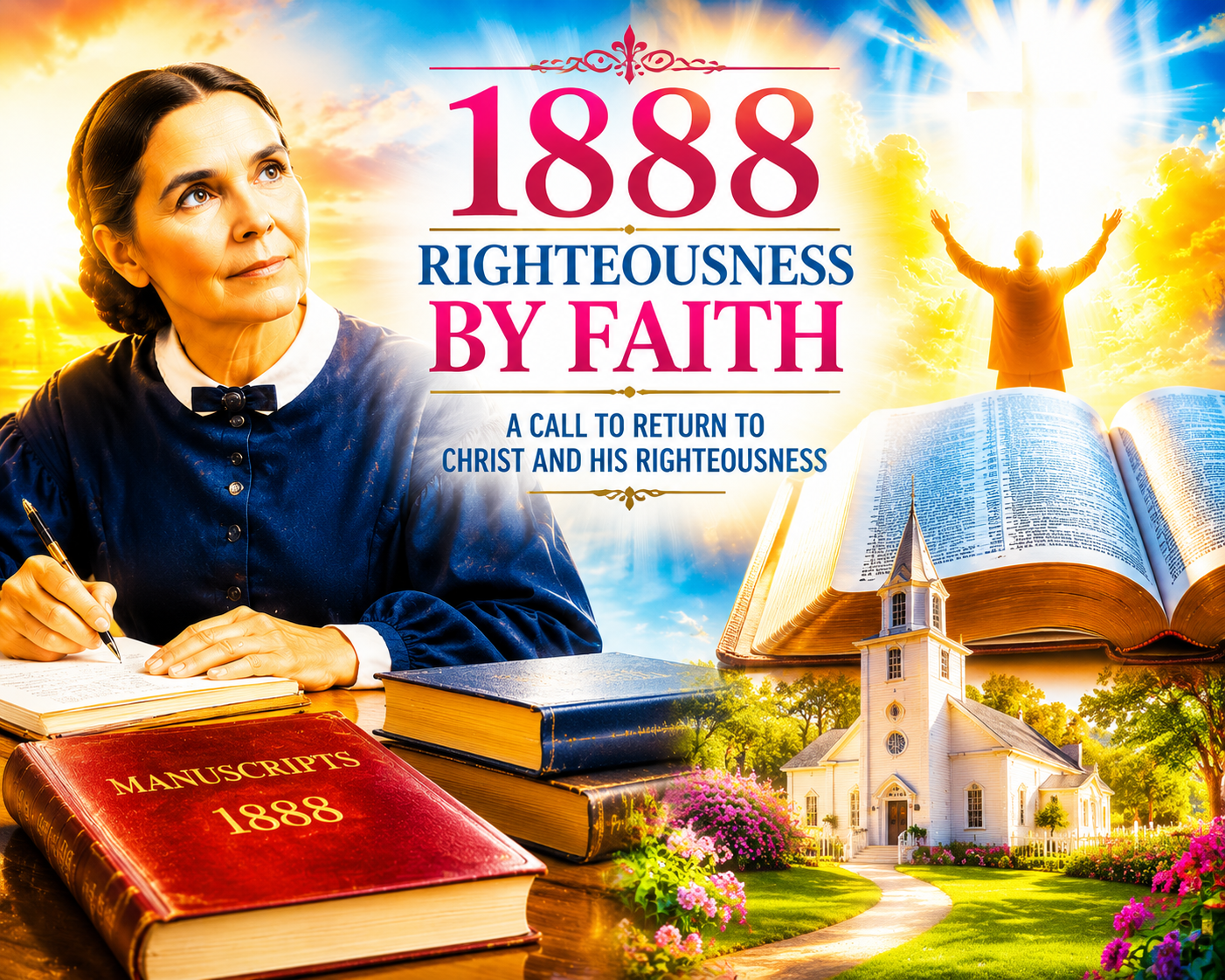
    V17: “Edom shall be a desolation; everyone that goes by it shall be astonished and shall hiss at all the plagues.” V18: “As in the overthrow of Sodom and Gomorrah, no man shall abide there, neither shall a son of man dwell in it.” V19: “He shall come as a lion from the swelling of Jordan against the habitation of the strong. I will suddenly make him run away. Who is a chosen man that I may appoint over her? Who is like me? Who will appoint me the time? Who is that shepherd that will stand before me?” V20: “Hear the counsel of the Lord that he has taken against Edom, and his purposes that he has purposed against the inhabitants of Teman: Surely the least of the flock shall draw them out; surely he shall make their habitations desolate.”

    V21: “The earth is moved at the noise of their fall; the noise was heard in the Red Sea.” V22: “He shall come up as the eagle and spread his wings over Bozrah. In that day, the heart of the mighty men shall be as the heart of a woman in her pangs.” V23: Concerning Damascus: “Hamath is confounded, for they have heard evil tidings; they are fainthearted; there is sorrow on the sea; it cannot be quiet.” V24: “Damascus is waxed feeble and turns to flee; fear has seized on her as a woman in travail.” V26: “Therefore, her young men shall fall in the streets; all men of war shall be cut off.” V27: “I will kindle a fire in the wall of Damascus; it shall consume the palaces of Ben-hadad.”

    V28: Concerning Kedar and Hazor, which Nebuchadnezzar shall smite. V33: “Hazor shall be a dwelling for dragons, a desolation forever; no man shall abide there.” V34: The sword of the Lord that came to Jeremiah against Elam. V35: “I will break the bow of Elam.” V36: “Upon Elam, I will bring the four winds from the four quarters of heaven; will scatter them toward all those winds; there shall be no nation whither the outcasts of Elam shall not come.” V37: “I will cause Elam to be dismayed before their enemies and before them that seek their life; I will bring evil against them, even my fierce anger; I will send the sword after them till I have consumed them.” V38: “I will set my throne in Elam and will destroy the king and princes.” V39: “It shall come to pass in the latter days, I will bring again the captivity of Elam.”

    Jeremiah Chapter 50

    V1: The word of the Lord against Babylon. V2: “Declare ye, ‘Babylon is fallen; Bel is confounded, Merodach is broken in pieces.’” V3: “For out of the north comes a nation against her which shall make her land desolate; none shall dwell there; they shall remove, depart, both man and beast.” V4: “In those days, the children of Israel shall come, going and weeping.” V5: “They shall ask the way to Zion, saying, ‘Come, let us join ourselves to the Lord.’” V6: “My people have been lost sheep; their shepherds have caused them to go astray; they have turned them away on the mountains.”

    V7: “All that found them devoured them; their adversaries said, ‘We offend not, because they have sinned against the Lord.’” V8: “Remove out of the midst of Babylon, go forth out of the land of the Chaldeans; be as the he-goats before the flocks.” V9: “I will raise and cause to come against Babylon an assembly of great nations from the north; their arrows shall be as of a mighty expert; none shall return in vain.” V10: “Chaldea shall be a spoil; all that spoil her shall be satisfied.”

    V11: “Because you were glad, because ye rejoiced, O ye destroyers of my heritage, because ye are grown fat.” V12: “Your mother shall be confounded; she that bare you; the hindermost of the nations shall be a wilderness, dry land, desert.” V13: “Because of the wrath of the Lord, it shall not be inhabited; it shall be wholly desolate. Everyone that goes to Babylon shall be astonished and hiss at all her plagues.” V14: “Put yourself in array against Babylon round about; all ye that bend the bow, shoot at her, spare no arrow, for she has sinned against the Lord.”

    V15: “Shout against her! Her foundations are fallen, her walls are thrown down, for it is the vengeance of the Lord; take vengeance upon her; as she has done, do unto her.” V16: “Cut off the sower from Babylon, and him that handles the sickle; for fear of the oppressing sword, they shall flee everyone to his own land.” V17: “Israel is a scattered sheep; the lions have driven him away; first the King of Assyria, last Nebuchadnezzar has broken his bones.” V18: “Therefore I will punish the king of Babylon as I have punished the king of Assyria.”

    V19: “I will bring Israel to his habitation; he shall feed on Carmel and Bashan; his soul shall be satisfied upon mount Ephraim and Gilead.” V20: “In those days, the iniquity of Israel shall be sought for, for there shall be none; I will pardon them.” V21: “Go up against the land of Merathaim, against the inhabitants of Pekod; waste and utterly destroy after them.” V22: “A sound of battle is in the land and of great destruction.” V23: “How is the hammer of the whole earth cut asunder! How is Babylon become a desolation!” V24: “I have laid a snare for you; you are taken, O Babylon; you were not aware; you are found and caught, for you have striven against the Lord.”

    V25: “The Lord has opened his armoury and has brought forth the weapons of his indignation; this is the work of the Lord in the land of the Chaldeans.” V26: “Come against her from the uttermost border; open her storehouses; cast her up as heaps; destroy her utterly; let nothing of her be left.” V27: “Slay all her bullocks; let them go down to the slaughter. Woe unto them, for their day is come, the time of their visitation!” V28: “The voice of them that flee and escape out of Babylon to declare in Zion the vengeance of the Lord.” V29: “Call together the archers against Babylon; camp against it; let none escape; recompense her according to her work; according to all she has done, do unto her, for she has been proud against the Lord.” V30: “Therefore her young men fall in the streets, and her men of war shall be cut off.”

    V31: “I am against you, O you most proud,” says the Lord, “for your day is come, the time that I will visit you.” V32: “The most proud shall stumble and fall, and none shall raise him up; I will kindle a fire in the cities.” V33: “The children of Israel were oppressed together; all that took them captives held them fast; they refused to let them go.” V34: “Their Redeemer is strong; he shall thoroughly plead their cause, that he may give rest to the land and disquiet the inhabitants of Babylon.” V35: “A sword is upon the Chaldeans.” V36: “A sword is upon the liars; they shall be dismayed.” V37: “They shall become as women; a sword is upon their treasures; they shall be robbed.”

    V38: “A drought is upon her waters; they shall be dried up, for it is the land of graven images; they are mad upon their idols.” V39: “The wild beasts of the desert shall dwell there; it shall be no more inhabited, neither shall it be dwelt in from generation to generation.” V40: “As God overthrew Sodom and Gomorrah, so shall no man abide there.” V41: “A people shall come from the north.” V42: “They are cruel and will not show mercy against you, O daughter of Babylon.” V43: “The king of Babylon heard the report; his hands waxed feeble; anguish took hold of him and pangs as of a woman in travail.” V45: “Hear the counsel of the Lord against Babylon; surely the least of the flock shall draw them out; surely he shall make their habitations desolate.” V46: “At the noise of the taking of Babylon, the earth is moved; the cry is heard among the nations.”

    Jeremiah Chapter 51

    V1: “I will raise up against Babylon, that rise up against me, a destroying wind.” V2: “I will send unto Babylon fanners that shall fan her and shall empty her land; in the day of trouble they shall be against her.” V5: “For Israel has not been forsaken, though their land was filled with sin against the Holy One of Israel.” V6: “Flee out of Babylon, deliver every man his soul; be not cut off in her iniquity; for this is the time of God’s vengeance; he will render unto her a recompense.” V7: “Babylon has been as a golden cup in the Lord’s hand that made all the earth drunken; the nations have drunken of her wine.” V8: “Babylon is suddenly fallen and destroyed; howl for her; take balm for her pain, if so be she may be healed.” V9: “We would have healed Babylon, but she is not healed; forsake her, and let us go everyone to his own country, for her judgment reaches to heaven and is lifted up even to the skies.” V10: “The Lord has brought forth our righteousness.” V11: “The Lord has raised up the spirit of the kings of the Medes, for his device is against Babylon to destroy it, because it is the vengeance of the Lord, the vengeance of the temple.”

    V13: “O you that dwell upon many waters, abundant in treasures, your end is come and the measure of your covetousness.” V14: “The Lord has sworn by himself: ‘I will fill you with men as with caterpillars; they shall lift up a shout against you.’” V15: “He has made the earth by his power; he has established the world by his wisdom; he has stretched the heaven by his understanding.” V16: “When he utters his voice, there is a multitude of waters in the heavens; he causes the vapours to ascend from the end of the earth; he makes lightning with rain; brings forth the wind out of his treasures.”

    V17: “Every man is brutish by his knowledge; every founder is confounded by the graven image, for his molten image is falsehood; there is no breath in them.” V18: “They are vanity, the work of errors; in the time of their visitation they shall perish.” V19: “The portion of Jacob is not like them; he is the former of all things; Israel is the rod of his inheritance.” V20: “You are my battle axe and weapons of war; with you I will break in pieces the nations; with you I will destroy kingdoms.” V21: “With you I will break in pieces the horse and rider; with you I will break in pieces the chariot and his rider.” V24: “I will render unto Babylon all their evil that they have done in Zion in your sight.”

    V25: “I am against you, O destroying mountain; I will stretch out my hand upon you and roll you down from the rocks; I will make you a burnt mountain.” V26: “They shall not make of you a stone for a corner, but you shall be desolate forever.” V28: “Prepare against her the nations with the king of the Medes.” V29: “The land shall tremble and sorrow; every purpose of the Lord shall be performed against Babylon to make Babylon a desolation without an inhabitant.” V30: “The mighty men of Babylon have foreborne to fight; they have remained in their holds; they became as women.” V32: “Nebuchadnezzar has devoured, crushed me, made me empty.” V35: “The violence done to me and my flesh be upon Babylon, and my blood upon the inhabitants of Chaldea.” V36: “I will plead your cause and take vengeance for you; I will dry up her sea.” V49: “Babylon has caused the slain of Israel to fall, so at Babylon fall the slain of all the earth.” V61: Jeremiah said to Seraiah. V63: “When you have made an end of reading this book, you shall bind a stone to it and cast it to the Euphrates.” V64: “You shall say, ‘Thus shall Babylon sink and shall not rise from the evil that I bring upon her.’”

    Jeremiah Chapter 52

    V1: Zedekiah was 21 years old when he began to reign; he reigned 11 years in Jerusalem. V2: He did that which was evil in the sight of the Lord, according to all that Jehoiakim had done. V3: Through the anger of the Lord in Jerusalem and Judah, till he had cast them out from his presence, that Zedekiah rebelled against Babylon. V4: In the 9th year of his reign, Nebuchadnezzar came against Jerusalem. V5: The city was besieged until the 11th year. V6: In the 4th month, 9th day, the famine was sore in the city, so that there was no bread. V7: The city was broken up; all the men of war fled by night. V8: But the army of the Chaldeans pursued after the king and overtook Zedekiah in Jericho.

    V9: They took the king and carried him to Riblah in the land of Hamath. V10: The king of Babylon slew the sons of Zedekiah before his eyes. V11: Then he put out the eyes of Zedekiah; bound him in chains to Babylon. V31: It came to pass in the 37th year of Jehoiakim’s captivity, the king of Babylon lifted the head of Jehoiakim and brought him forth out of prison. V32: And spake kindly to him; set his throne above the throne of the kings that were with him in Babylon. V33: Changed his prison garments; he did eat bread continually before him all the days of his life. V34: For his diet, there was a continual diet given him every day a portion, until the day of his death.